
Judge, 1914-06-27 · page 16 of 25
Judge — June 27, 1914 — page 16: what you’re looking at
What you’re looking at
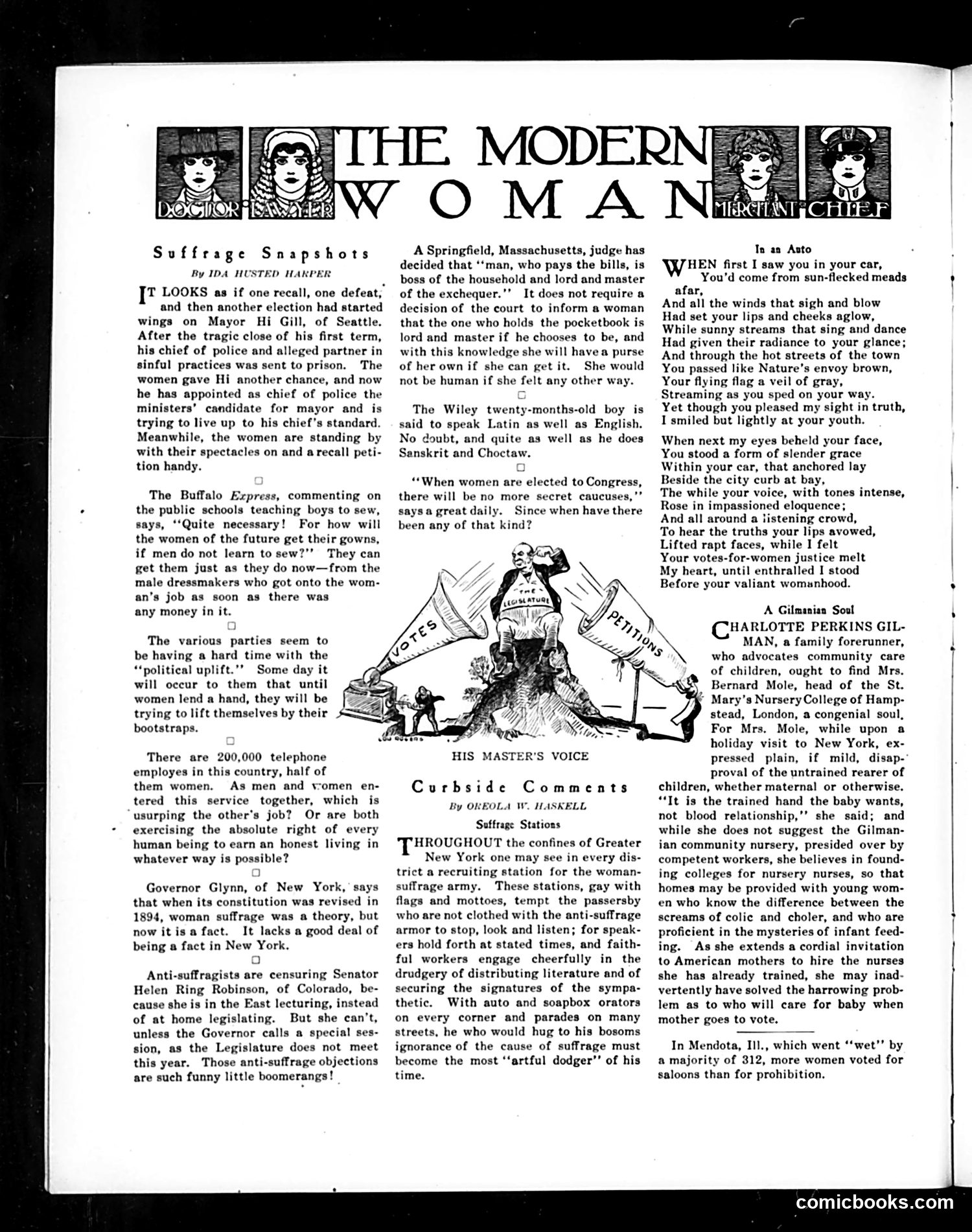
This page from *Judge* magazine satirizes women's suffrage debates through multiple commentaries. The "Suffrage Snapshots" column by Ida Husted Harper critiques anti-suffrage arguments with dry wit—mocking claims that teaching boys to sew harms women (since male dressmakers already dominate), and pointing out that anti-suffragists' objections "boomerang" against their own logic. The central cartoon "His Master's Voice" depicts a woman politician being pulled in opposite directions by competing petitions and demands, suggesting the contradictory pressures women face in politics. The "Curbside Comments" section describes suffrage recruiting stations throughout New York, normalizing women's political activism. Overall, the page presents suffrage as inevitable progress while ridiculing the logical inconsistencies of its opponents—a pro-suffrage stance typical of *Judge* during the Progressive Era.
📄 Transcribed text from this page (OCR, searchable)
Machine-transcribed from the original scan — historical spelling and the odd misread are preserved.
Suffrage Snapshots By IDA HUSTED HAKPER [7 LOOKS as if one recall, one defeat, and then another election had started wings on Mayor Hi Gill, of Seattle. After the tragic close of his first term, his chief of police and alleged partner in sinful practices was sent to prison. The women gave Hi another chance, and now he has appointed as chief of police the ministers’ candidate for mayor and is trying to live up to his chief's standard. Meanwhile, the women are standing by with their spectacles on and arecall peti- tion handy. The Buffalo Express, commenting on the public schools teaching boys to sew, says, ‘‘Quite necessary! For how will the women of the future get their gowns, if men do not learn to sew?’’ They can get them just as they do now—from the male dressmakers who got onto the wom- an’s job as soon as there was any money in it. The various parties seem to be having a hard time with the “political uplift.” Some day it will occur to them that until women lend a hand, they will be trying to lift themselves by their bootstraps. There are 200,000 telephone employes in this country, half of them women. As men and vromen en- tered this service together, which is usurping the other's job? Or are both exercising the absolute right of every human being to earn an honest living in whatever way is possible? a] Governor Glynn, of New York, says that when its constitution was revised in 1894, woman suffrage was a theory, but now itis afact. It lacks a good deal of being a fact in New York. a Anti-suffragists are censuring Senator Helen Ring Robinson, of Colorado, be- cause she is in the East lecturing, instead of at home legislating. But she can’t, unless the Governor calls a special ses- sion, as the Legislature does not meet this year. Those anti-suffrage objections are such funny little boomerangs! A Springfield, Massachusetts, judge has decided that ‘man, who pays the bills, is boss of the household and lord and master of the exchequer.’’ It does not require a decision of the court to inform a woman that the one who holds the pocketbook is lord and master if he chooses to be, and with this knowledge she will havea purse of her own if she can get it. She would not be human if she felt any other way. The Wiley twenty-months-old boy is said to speak Latin as well as English. No doubt, and quite as well as he does Sanskrit and Choctaw. “‘When women are elected to Congress, there will be no more secret caucuses,"’ saysa great daily. Since when have there been any of that kind? HIS MASTER'S VOICE Curbside Comments By OREOLA W. HASKELL Suffrage Stations HROUGHOUT the confines of Greater New York one may see in every dis- trict a recruiting station for the woman- suffrage army. These stations, gay with flags and mottoes, tempt the passersby who are not clothed with the anti-suffrage armor to stop, look and listen; for speak- ers hold forth at stated times, and faith- ful workers engage cheerfully in the drudgery of distributing literature and of securing the signatures of the sympa- thetic. With auto and soapbox orators on every corner and parades on many streets, he who would hug to his bosoms ignorance of the cause of suffrage must become the most ‘‘artful dodger’ of his time. Tn an Asto WHEN first I saw you in your car, You'd come from sun-flecked meads afar, And all the winds that sigh and blow Had set your lips and cheeks aglow, While sunny streams that sing and dance Had given their radiance to your glance; And through the hot streets of the town You passed like Nature’s envoy brown, Your flying flag a veil of gray, Streaming as you sped on your way. Yet though you pleased my sight in truth, I smiled but lightly at your youth. When next my eyes beheld your face, You stood a form of slender grace Within your car, that anchored lay Beside the city curb at bay, The while your voice, with tones intense, Rose in impassioned eloquence; And all around a jistening crowd, To hear the truths your lips avowed, Lifted rapt faces, while I felt Your votes-for-women justice melt My heart, until enthralled I stood Before your valiant womanhood. A Gilmanian Soul HARLOTTE PERKINS GIL- MAN, a family forerunner, who advocates community care of children, ought to find Mrs. Bernard Mole, head of the St. - Mary’s Nursery College of Hamp- stead, London, a congenial soul, For Mrs. Mole, while upon a holiday visit to New York, ex- pressed plain, if mild, disap- proval of the untrained rearer of children, whether maternal or otherwise. “It is the trained hand the baby wants, not blood relationship,’”” she said; and while she does not suggest the Gilman- ian community nursery, presided over by competent workers, she believes in found- ing colleges for nursery nurses, so that homes may be provided with young wom- en who know the difference between the screams of colic and choler, and who are proficient in the mysteries of infant feed- ing. As she extends a cordial invitation to American mothers to hire the nurses she has already trained, she may inad- vertently have solved the harrowing prob- lem as to who will care for baby when mother goes to vote. In Mendota, III., which went ‘‘wet’’ by a majority of 312, more women voted for saloons than for prohibition. comicbooks.com