
Judge, 1914-06-27 · page 5 of 25
Judge — June 27, 1914 — page 5: what you’re looking at
What you’re looking at
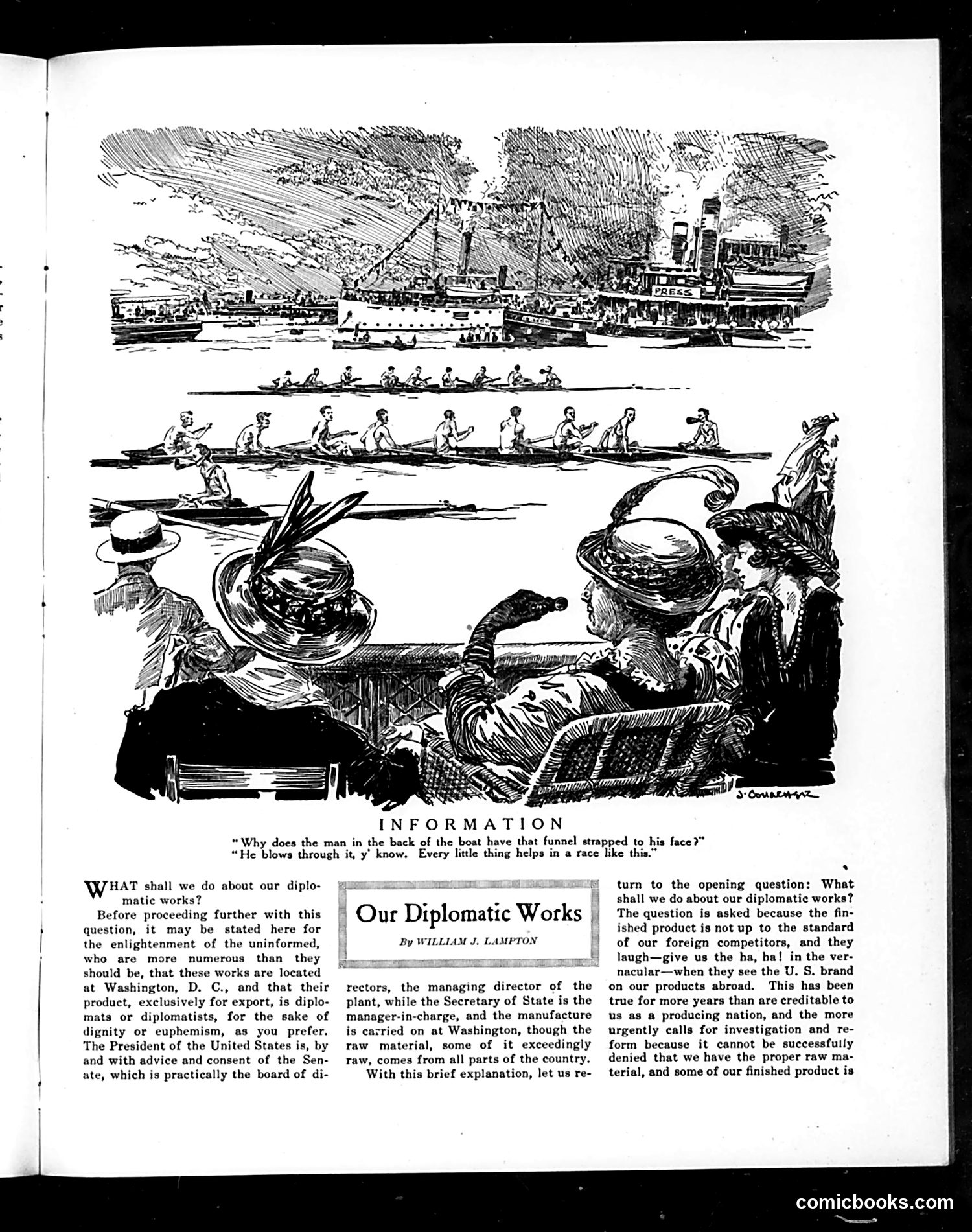
This page combines an editorial article titled "Our Diplomatic Works" by William J. Lampton with a satirical cartoon above it. The cartoon depicts spectators watching a rowing race on the water. The "Information" caption jokes about a man in the boat's stern with a funnel on his face, asking why he's there. The answer—"He blows through it, y'know. Every little thing helps in a race like this"—is absurdist humor mocking competitive desperation. The article below criticizes American diplomatic products and manufacturing quality, suggesting they're inferior to foreign competition. It implies U.S. diplomatic efforts lack proper "raw material" and manufacturing standards, comparing diplomacy to industrial production. The piece appears to advocate for investigation and reform of how American diplomatic work is conducted.
📄 Transcribed text from this page (OCR, searchable)
Machine-transcribed from the original scan — historical spelling and the odd misread are preserved.
wrt shall we do about our diplo- matic works? Before proceeding further with this question, it may be stated here for the enlightenment of the uninformed, who are more numerous than they should be, that these works are located at Washington, D. C., and that their product, exclusively for export, is diplo- mats or diplomatists, for the sake of dignity or euphemism, as you prefer. The President of the United States is, by and with advice and consent of the Sen- ate, which is practically the board of di- INFORMATION “Why does the man in the back of the boat have that funnel strapped to his face?” “He blows through it, y’ know. Every little thing helps in a race like this.” * Our Diplomatic Works | By WILLIAM J. LAMPTON F rectors, the managing director of the plant, while the Secretary of State is the manager-in-charge, and the manufacture is carried on at Washington, though the raw material, some of it exceedingly raw, comes from all parts of the country. With this brief explanation, let us re- ] { | . turn to the opening question: What shall we do about our diplomatic works? The question is asked because the fin- ished product is not up to the standard of our foreign competitors, and they laugh—give us the ha, ha! in the ver- nacular—when they see the U. S. brand on our products abroad. This has been true for more years than are creditable to us as a producing nation, and the more urgently calls for investigation and re- form because it cannot be successfully denied that we have the proper raw ma- terial, and some of our finished product is comicbooks.com