
A complete issue · 24 pages · 1914
Judge — March 7, 1914
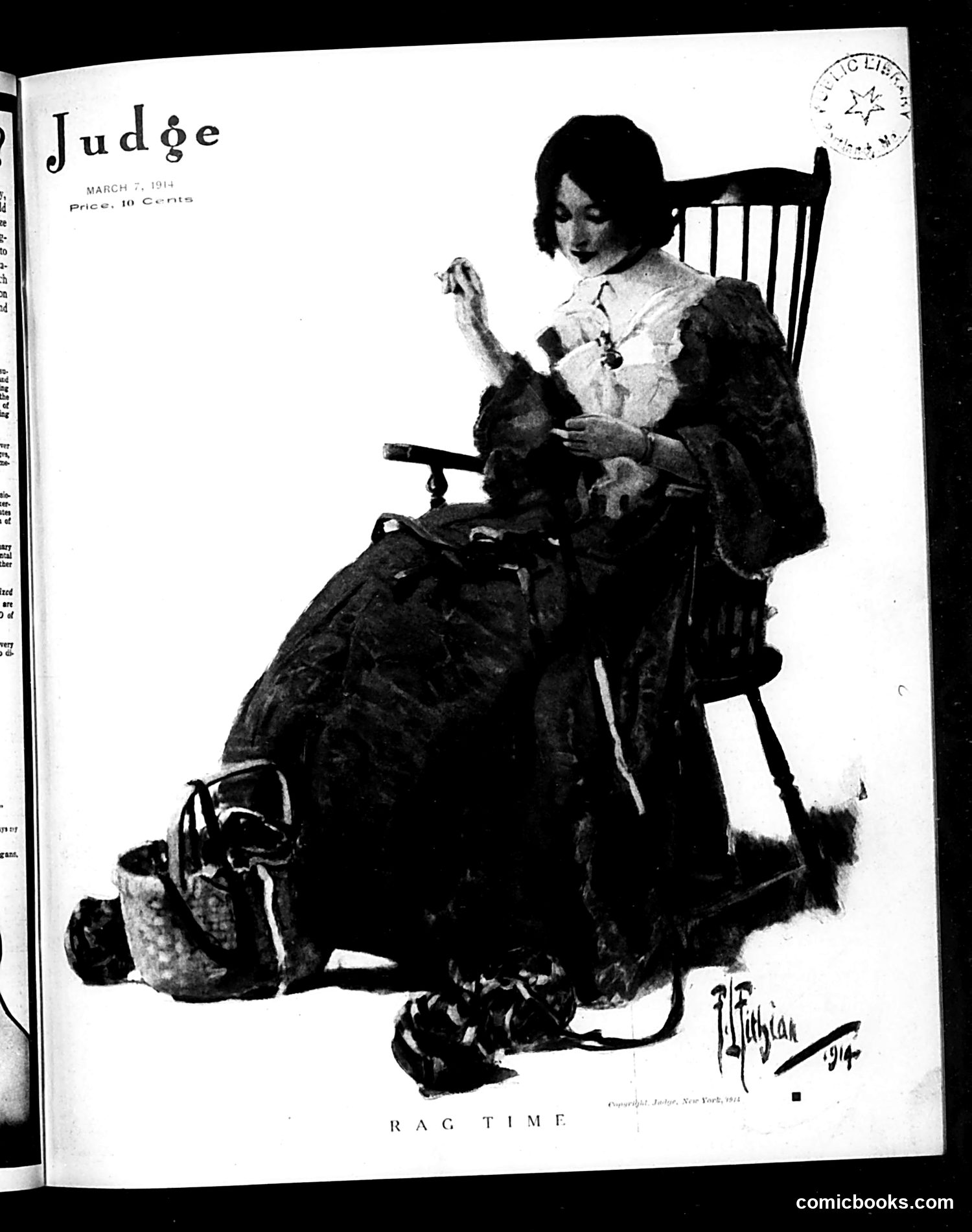
This illustration by Flagler depicts a woman seated in a chair, dressed in fashionable dark clothing with fur trim, reading sheet music or a musical score. The title "RAG TIME" and the domestic interior setting suggest commentary on the popular ragtime music craze of the early 1900s. The cartoon likely satirizes the widespread adoption of ragtime by middle and upper-class Americans, particularly women. During this era, ragtime—rooted in African American musical traditions—was considered somewhat scandalous or lowbrow by cultural elites. The fashionably dressed subject suggests Judge is mocking how respectable society had embraced this "ragtime" phenomenon, previously considered disreputable. The composition emphasizes the contrast between refined appearance and popular entertainment consumption.
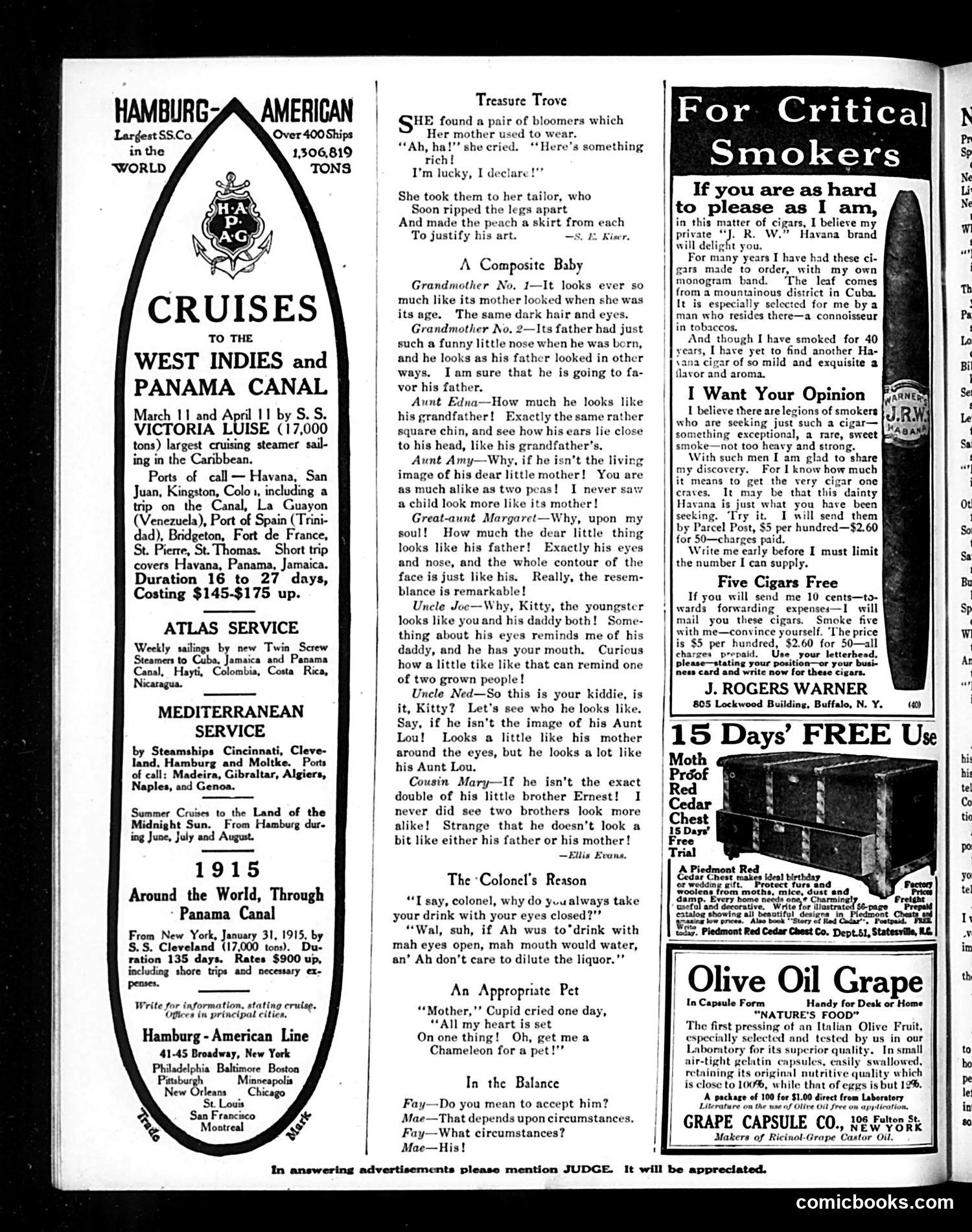
This page is **primarily advertising** with minimal satirical content. The dominant features are: 1. **Hamburg-American Line cruise advertisements** (left side) promoting Caribbean and Panama Canal voyages on the steamship Victoria Louise 2. **"Treasure Trove"** and **"A Composite Baby"** — brief humorous pieces about finding bloomers and a baby resembling multiple family members. These are light domestic humor, not political satire. 3. **"For Critical Smokers"** advertisement (right) for J.R.W. Havana cigars and a **Piedmont Red Cedar Chest** promotion 4. **"Olive Oil Grape"** health product advertisement The page contains no identifiable political cartoons or caricatures of public figures. It reflects early 1915 consumer culture and domestic comedy typical of *Judge* magazine's lighter content.
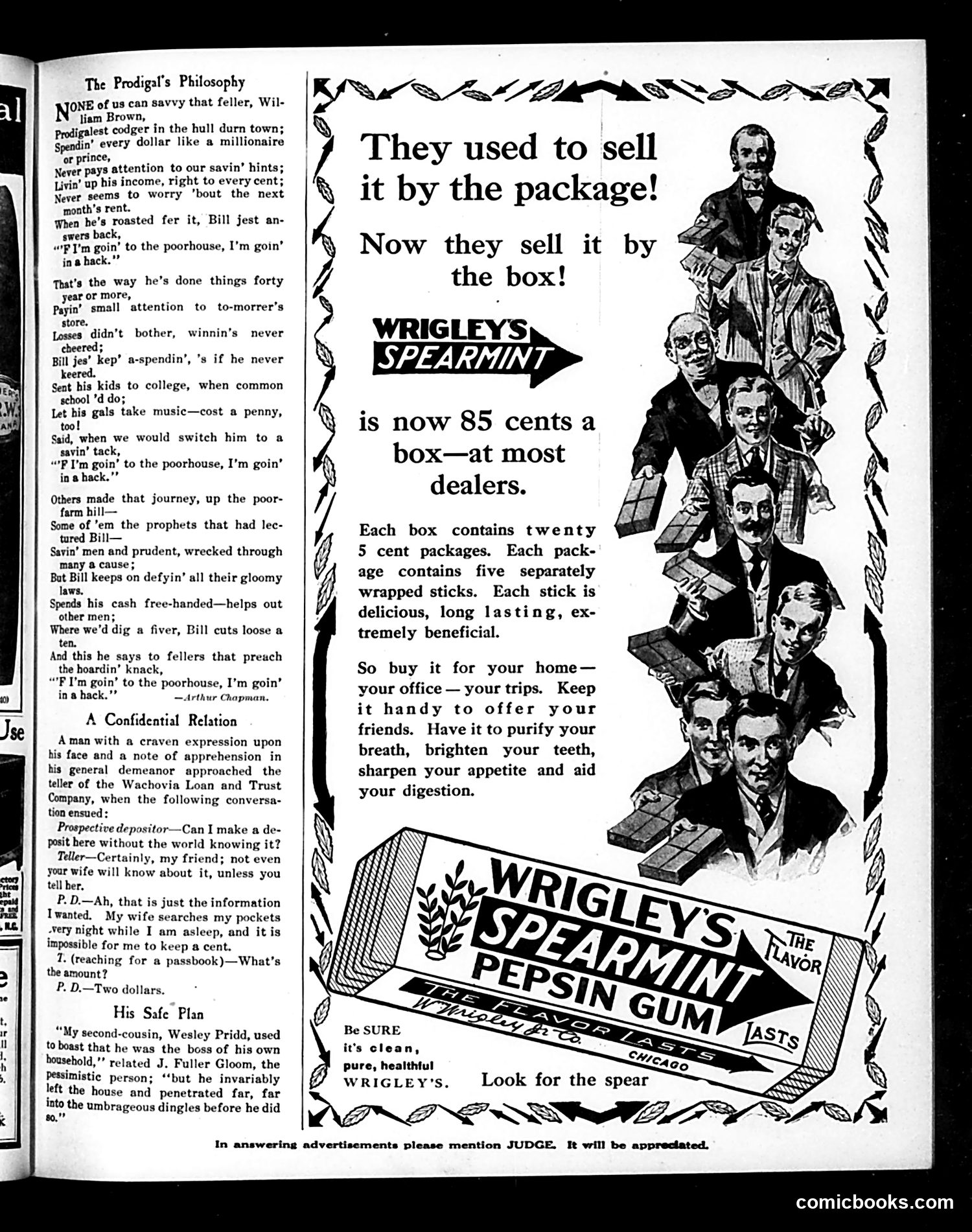
This page contains **advertising rather than political satire**. The dominant right-hand content is a Wrigley's Spearmint Gum advertisement announcing a packaging change: gum now sells "by the box" at 85 cents instead of "by the package." Each box contains twenty 5-cent packages with five wrapped sticks each. The left side features unrelated humorous pieces: "The Prodigal's Philosophy" (a poem about thrift) and "A Confidential Relation" and "His Safe Plan" (short comic dialogues). The gum ad uses illustrations of multiple men's faces to convey respectability and broad appeal, suggesting the product's suitability for various social contexts—home, office, travel. This reflects early 20th-century advertising strategy of associating consumer goods with social status and wholesomeness.
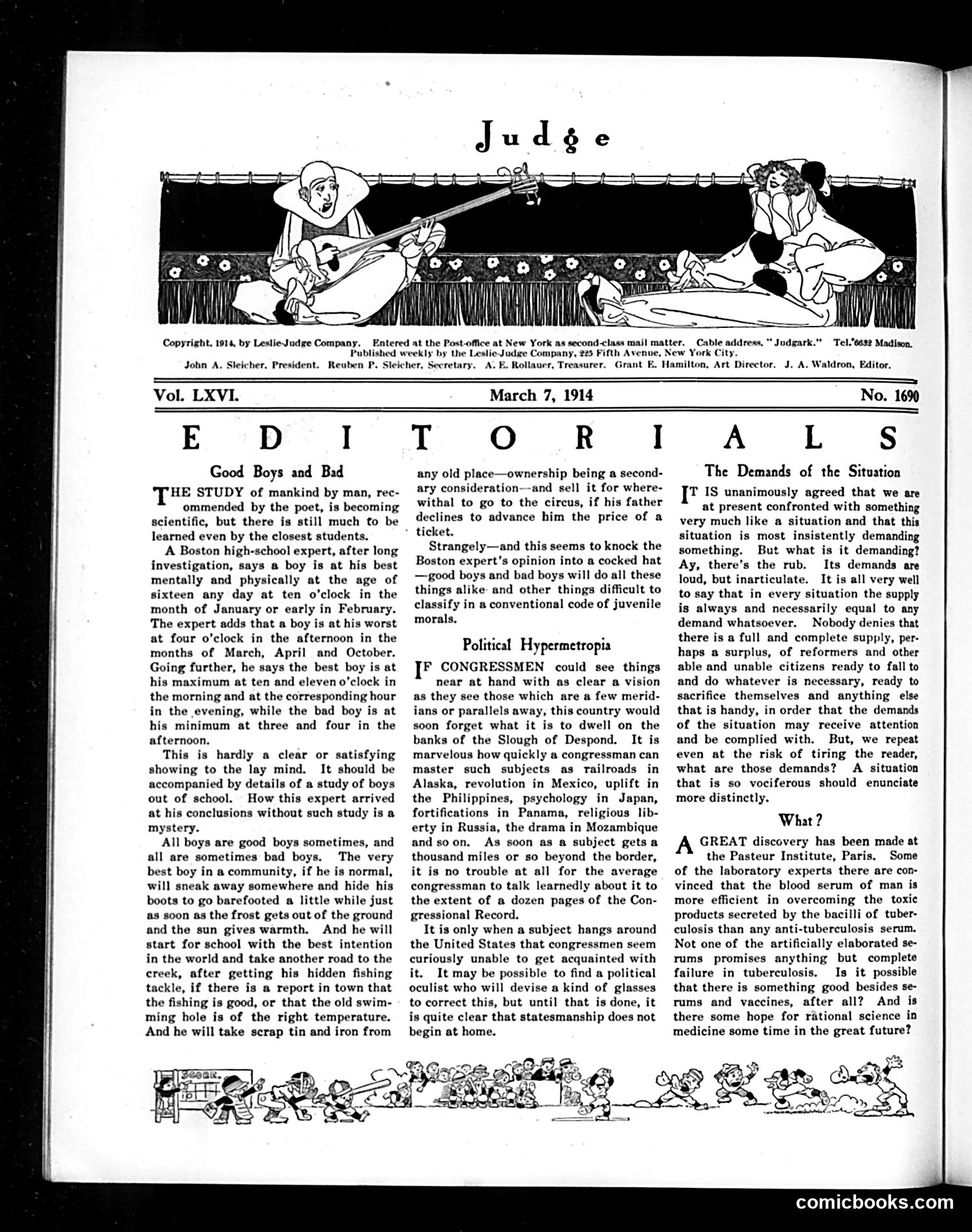
The page contains three editorial pieces without clear caricatures of specific identifiable figures. **"Good Boys and Bad"** satirizes a Boston expert's study claiming boys are worst behaviorally in October-March afternoons and evenings. The satire mocks scientific pretension—questioning whether such obvious seasonal patterns (cold weather driving boys indoors) really needed formal investigation. **"Political Hypermetropia"** criticizes congressmen for being distracted by distant foreign issues (Mexico, Philippines, Panama, Russia) while ignoring urgent domestic concerns. The metaphor "hypermetropia" (farsightedness) suggests politicians focus on what's far away while neglecting what's near. **"What?"** discusses tuberculosis research at the Pasteur Institute, remaining largely straightforward rather than satirical.
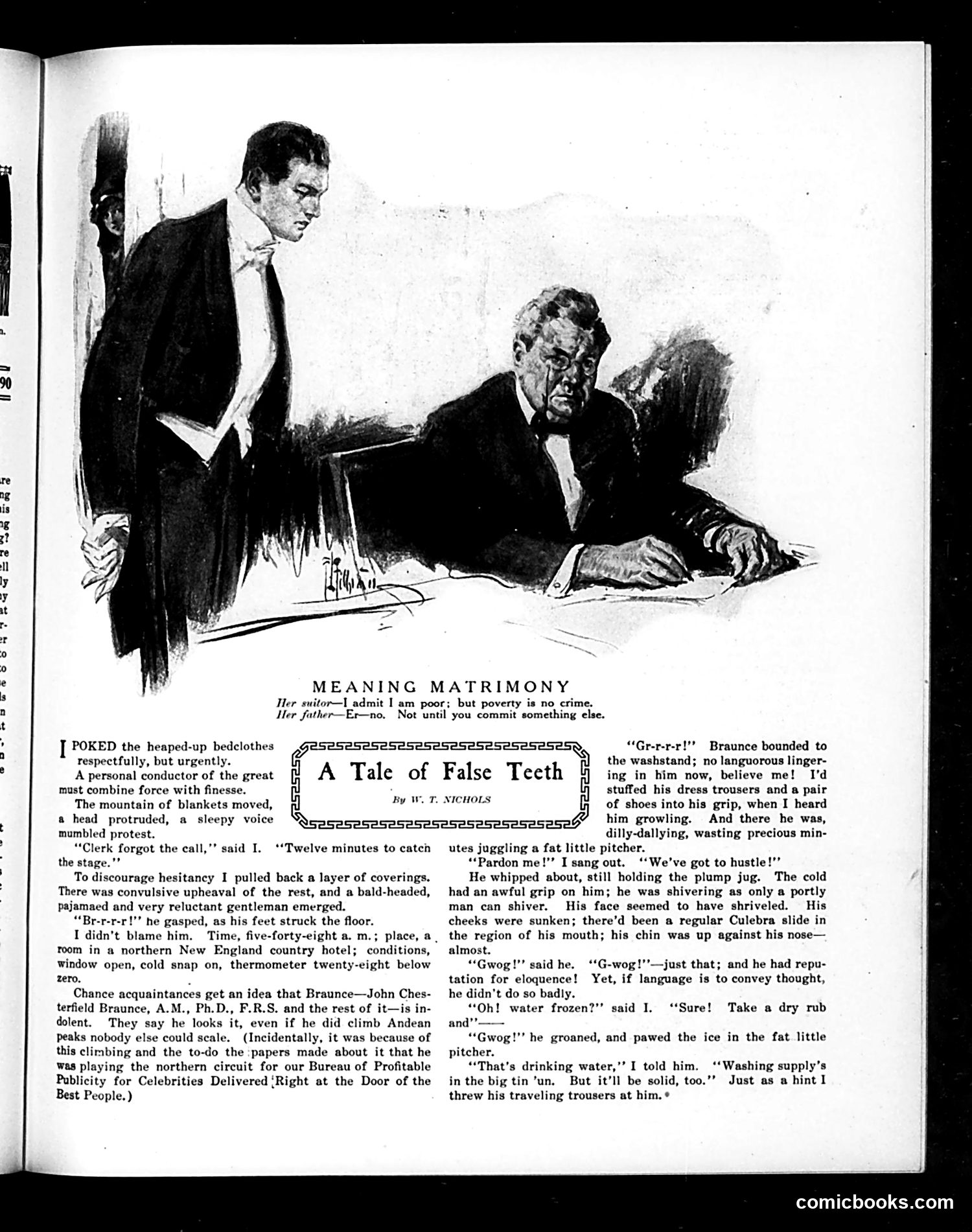
The top illustration, titled "Meaning Matrimony," depicts a social scene satirizing class attitudes toward marriage. The caption shows a father telling his daughter "I admit I am poor; but poverty is no crime," while the daughter's suitor responds skeptically. The satire mocks the hypocrisy of wealthy families who claim to value character over money while actually prioritizing financial status in matrimonial prospects. Below this is "A Tale of False Teeth" by H.T. Nichols, a humorous short story about a man (Braunce) encountering difficulties in cold weather while traveling. The narrative emphasizes physical discomfort and social embarrassment—likely satirizing both frontier hardships and the pretensions of traveling "celebrities." Both pieces represent Judge's typical early-20th-century social commentary through humor.
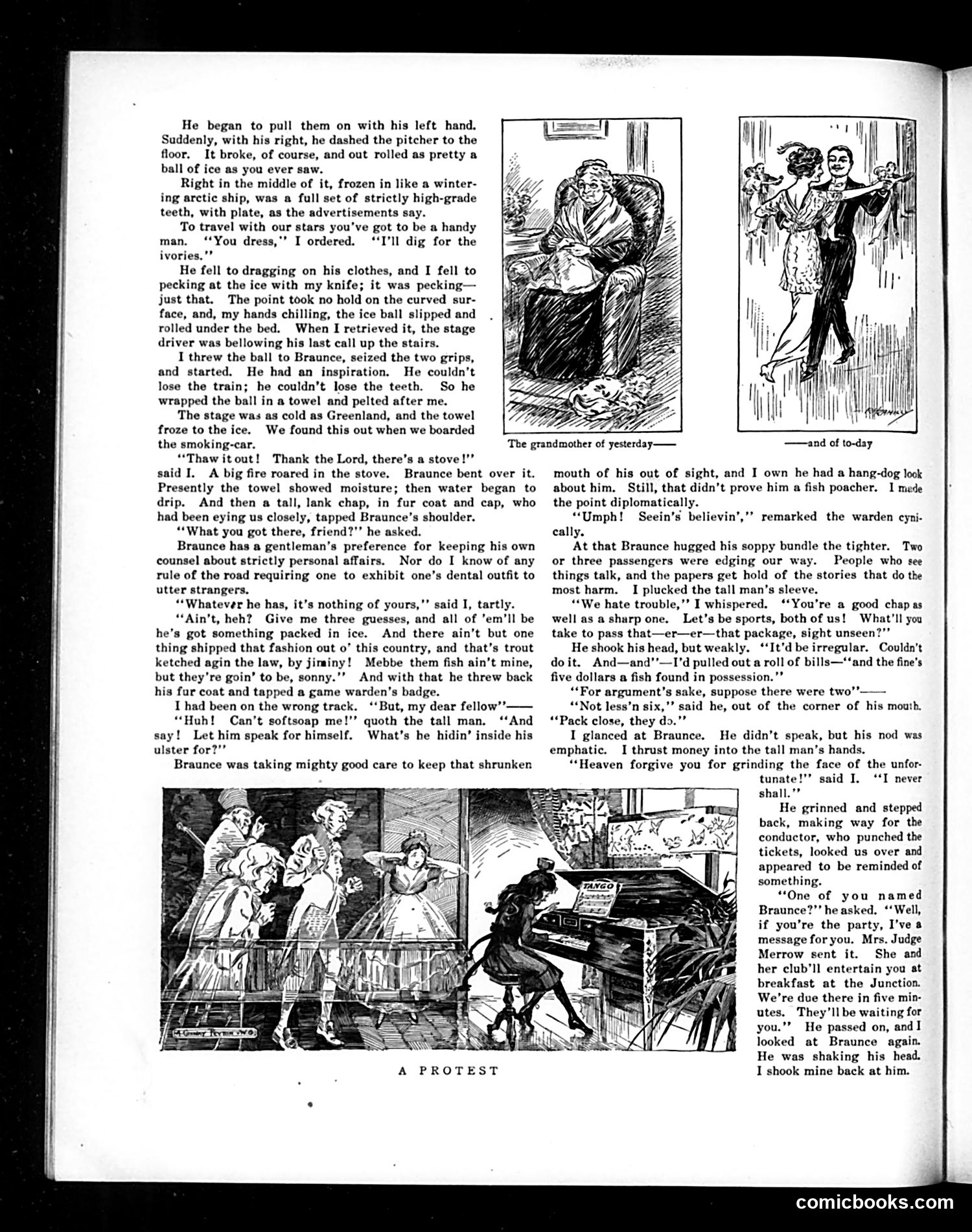
This story-illustration satirizes rural American corruption and hypocrisy around game laws. A stage driver accidentally freezes his false teeth in ice, which gets mistaken by a game warden for illegally poached trout (fish caught out of season). The warden threatens arrest based on circumstantial evidence. Rather than reveal the truth, the narrator bribes the warden with cash—first offering five dollars per "fish," then negotiating to six dollars for "two fish." The satire targets: - **Overzealous game enforcement** and wardens' abuse of authority - **Casual rural corruption**: bribing officials becomes routine ("Pack close, they do") - **Hypocrisy**: the narrator moralizes about "grinding the face of the unfortunate" while actively corrupting an official The title suggests Judge is protesting both dishonest enforcement and the ease with which citizens circumvent it through bribery.
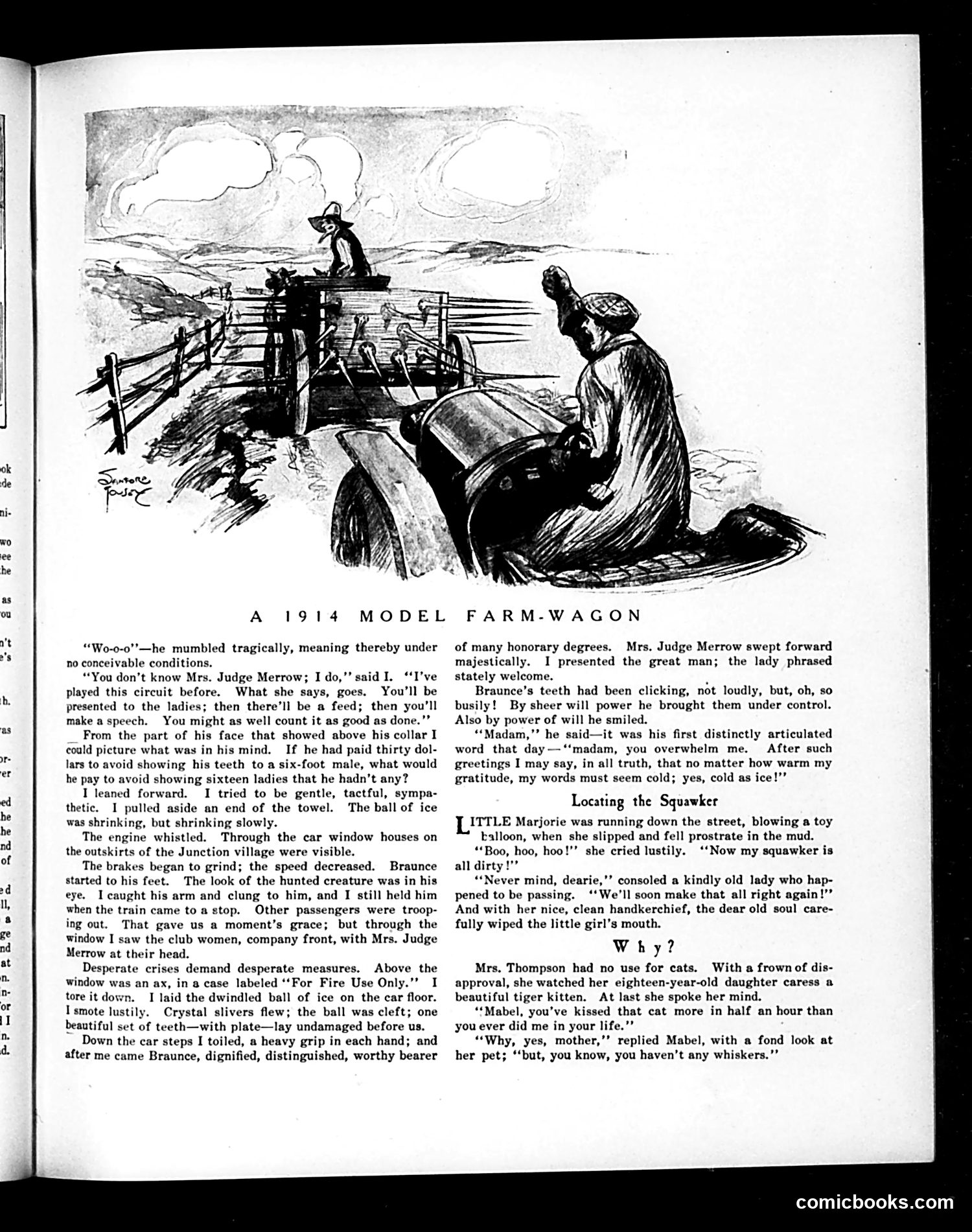
This page contains three separate humorous stories typical of Judge's satirical content: **Main illustration - "A 1914 Model Farm-Wagon":** A dentist character named Braunce dreads meeting society ladies at a train stop, fearing he must smile and reveal his lack of teeth. The narrator destroys Braunce's false teeth with an ax (ironically marked "For Fire Use Only") to extract them from the ice they're frozen in. The joke plays on the awkwardness of social obligations and the absurdity of the "solution." **"Locating the Squawker":** A child's toy balloon gets dirty; a kindly stranger wipes the child's mouth instead of the balloon—a gentle joke about misunderstanding the word "squawker" (the toy) for the child herself. **"Why?":** A mother complains her daughter kisses the family cat more than her; the daughter replies the cat has whiskers. Light domestic humor about maternal jealousy and a child's innocent logic. These are lighthearted vignettes rather than political satire, reflecting Judge's mix of social commentary and family humor.
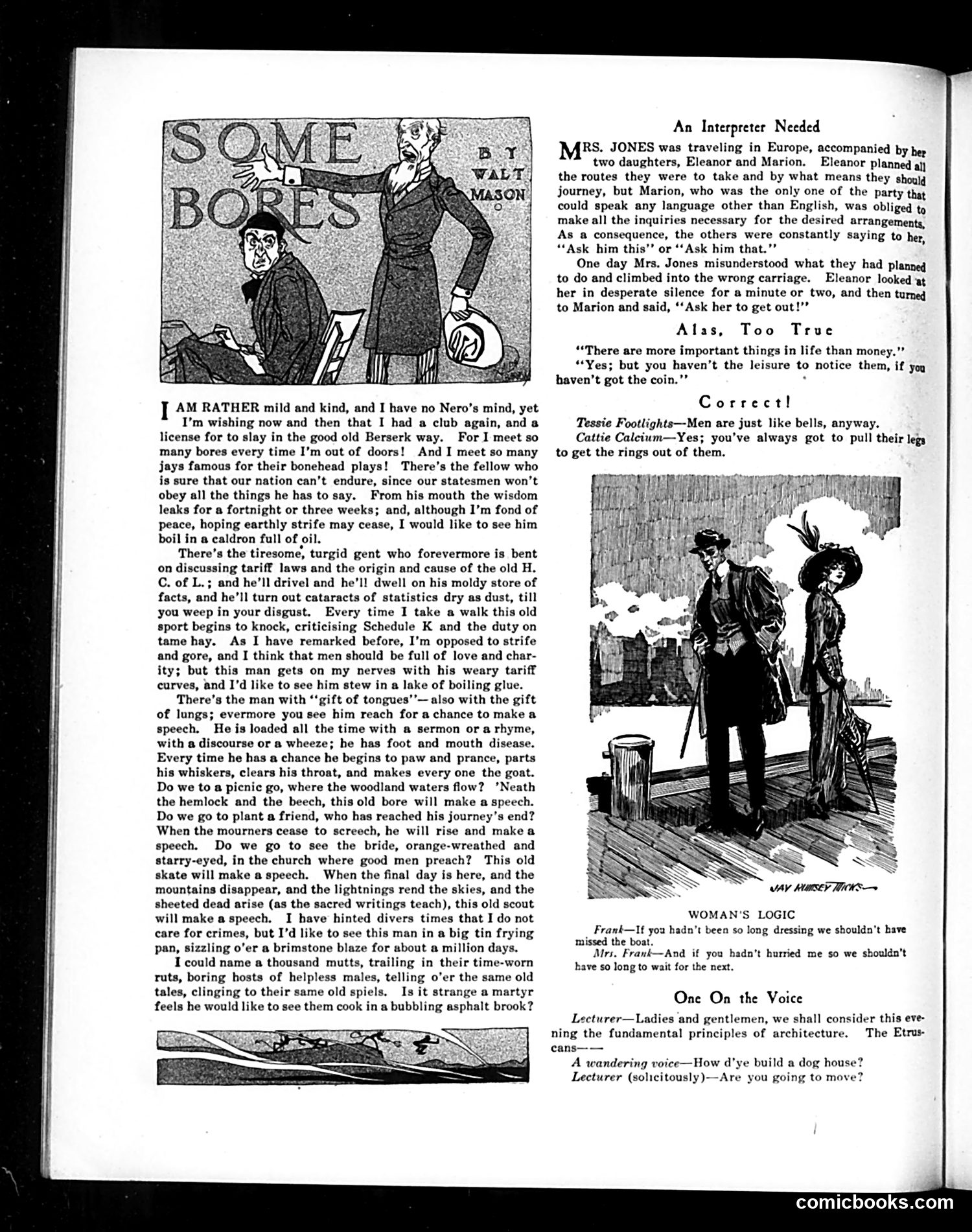
This page contains a humorous essay-poem by Walt Mason complaining about tedious social types. The author laments meeting various "bores": a political know-it-all who won't stop lecturing about governance, a tariff-obsessed economist spouting dry statistics (referencing the "H.C. of L." — likely the cost of living debate), and worst of all, a compulsive public speaker who sermonizes everywhere—at picnics, funerals, and weddings alike. The satire mocks early 20th-century American social nuisances: mansplaining politicians, economic pedants, and attention-seeking orators. Mason expresses (darkly comic) violent fantasies about silencing them, contrasting his stated pacifism with his exasperation. The accompanying brief humorous sketches mock translation difficulties in travel and cynical observations about money and relationships, typical of Judge's light satirical fare aimed at middle-class readers.
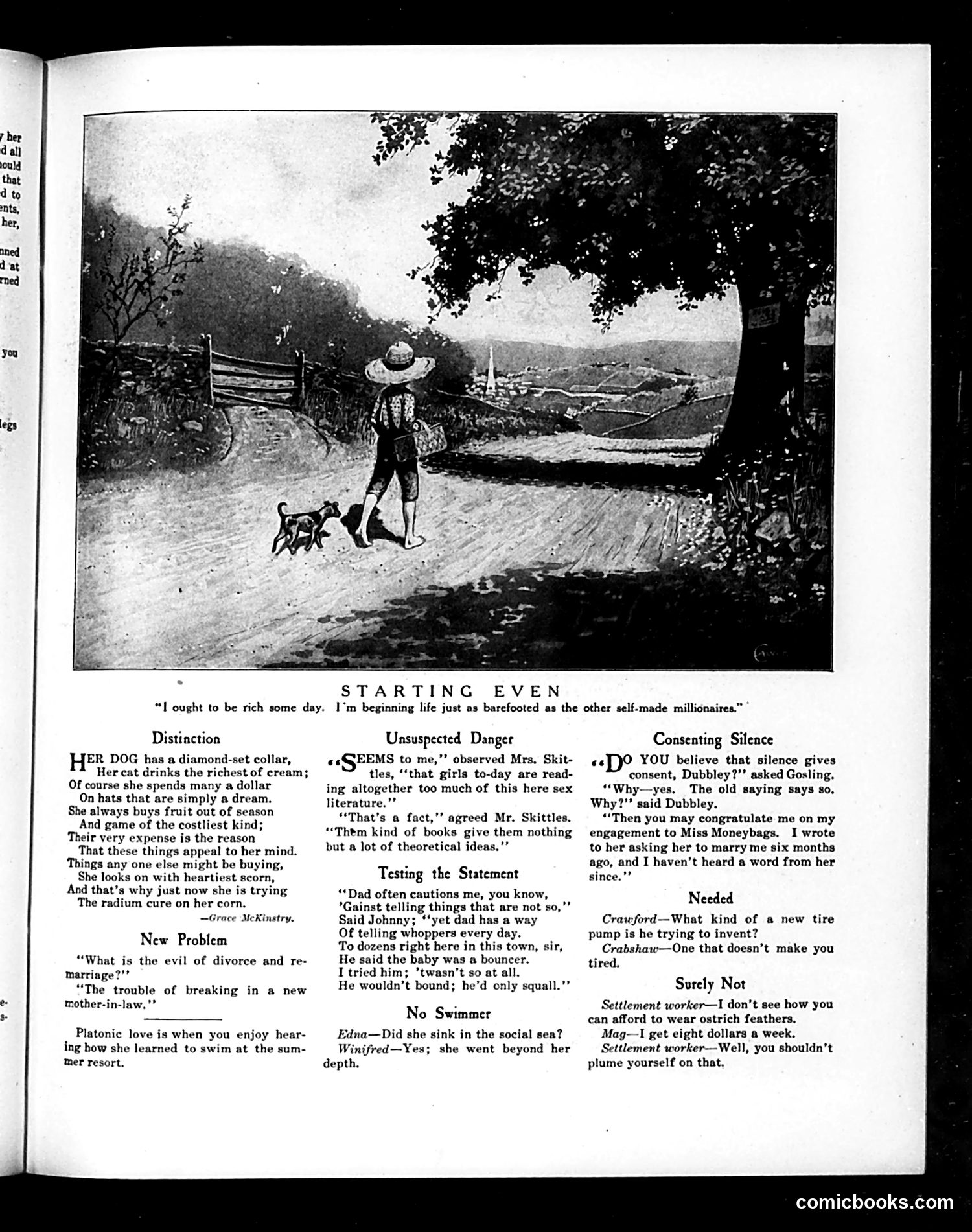
This page from *Judge* magazine contains multiple short humor pieces satirizing early 20th-century American social pretensions and gender dynamics. The main cartoon depicts a barefoot young man claiming he'll become rich "like other self-made millionaires"—mocking the contradiction of starting with nothing while imitating the wealthy. The text pieces target: - **Class anxiety**: A woman obsessively buys expensive, useless items (radium corn cure) purely for their cost as status symbols - **Sexual hypocrisy**: Adults worry girls read too much "sex literature" while fathers lie constantly to others - **Gender expectations**: A man interprets a woman's silence on a marriage proposal as consent; a settlement worker puns on a poor woman wearing ostrich feathers ("plume yourself") - **Marital anxiety**: Divorce's "problem" is managing a new mother-in-law The satire assumes readers recognize these as common anxieties of the era: conspicuous consumption, Victorian sexual repression, class performance, and the changing social roles of women. The humor relies on exposing hypocrisy between stated values and actual behavior.
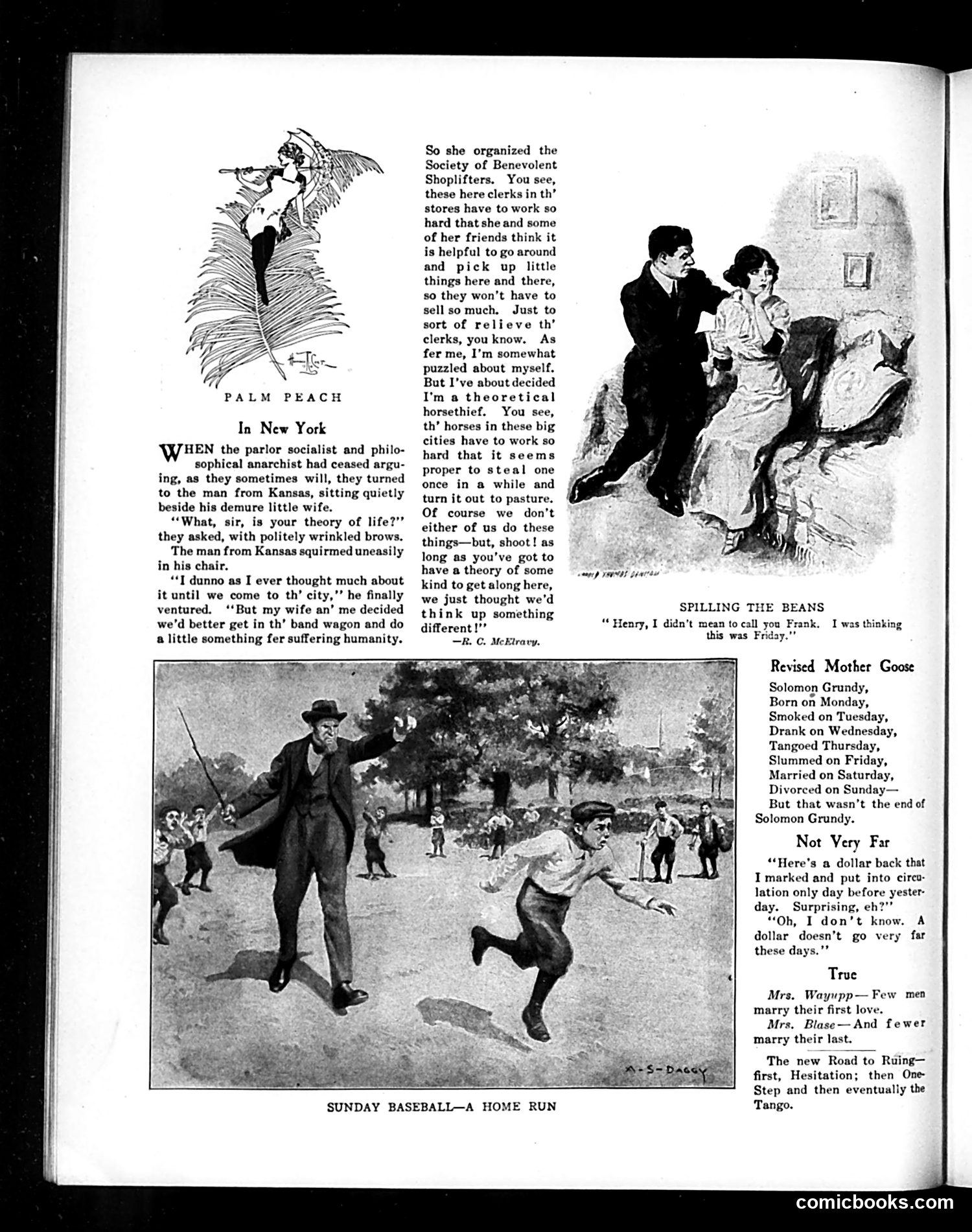
This Judge magazine page satirizes early 20th-century American social pretensions through several sketches: **"Palm Peach in New York"**: A Kansas couple, newly arrived in the city, adopt fashionable radical ideologies. The husband becomes a "theoretical horsethief" and his wife organizes a "Society of Benevolent Shoplifters"—justified as helping overworked clerks by reducing their sales burden. The satire mocks how city intellectuals adopt socialist/anarchist rhetoric while actually proposing criminal acts, presented as theoretical benevolence. The rural couple's naive adoption of this sophistry exposes urban hypocrisy. **"Sunday Baseball—A Home Run"**: An illustration showing people playing baseball, likely satirizing Sunday recreational activities or changing social norms around leisure. **Minor sketches**: Include jokes about infidelity ("Spilling the Beans"), modern morality ("Revised Mother Goose" depicting rapid marriage/divorce), currency circulation, and romantic disappointment. The page's recurring theme: mocking pretentious urban society and misapplied ideological justifications for questionable behavior.
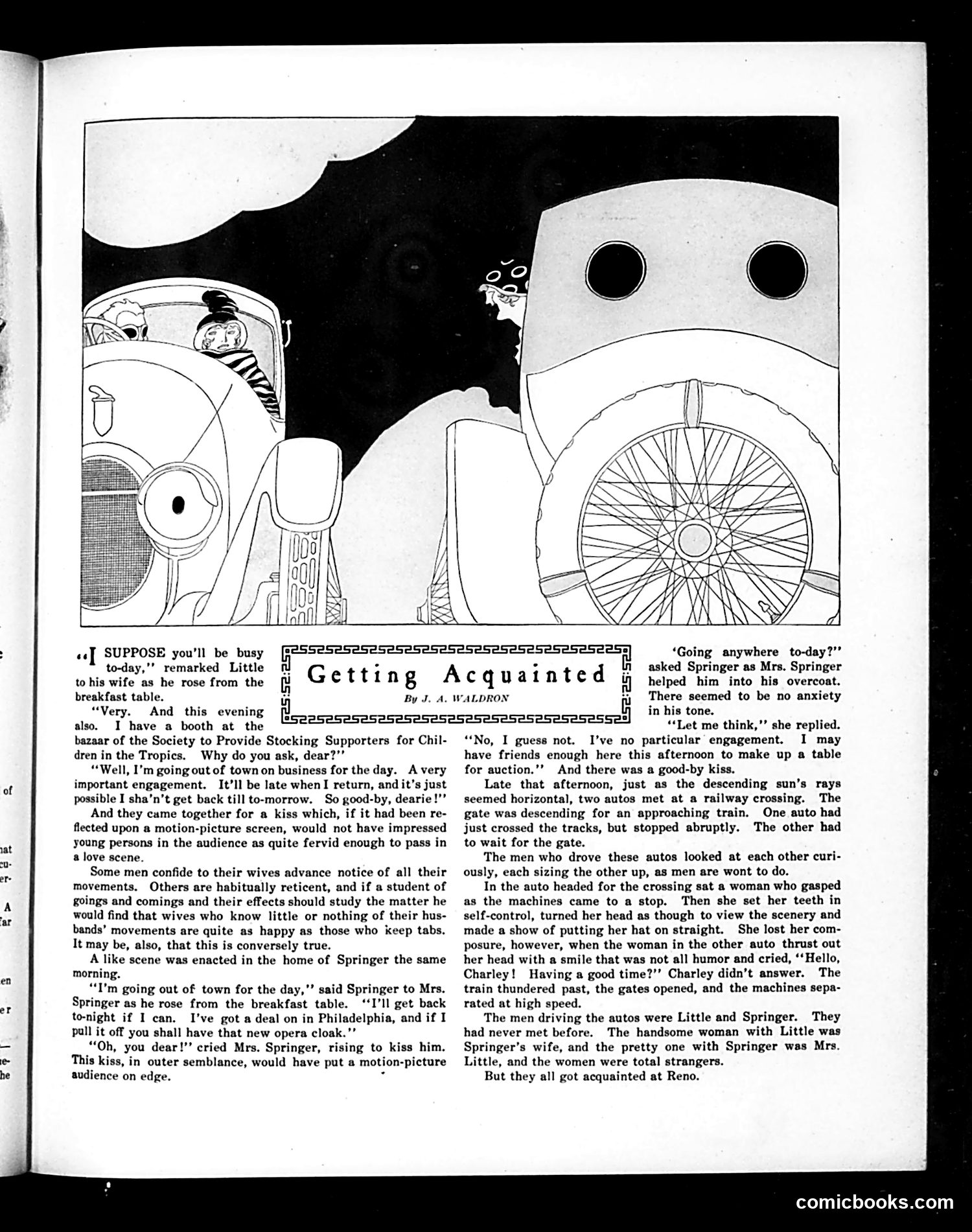
This 1910s story satirizes the casual infidelity and permissive marriage attitudes of the wealthy urban class. Two respectable married men, Little and Springer, each separately tell their wives they're going out of town on "business," but they're actually eloping with each other's wives—women they've never met before. The satire's bite comes from the understated domesticity: the couples share perfunctory, unemotional goodbye kisses while the wives remain blissfully occupied with charity galas and card games. The "punchline" is that all four parties eventually end up in Reno, Nevada—then America's divorce capital, famous for easy no-fault divorces and remarriage. Judge uses this to mock both the hypocrisy of respectable society and the increasingly casual attitude toward marriage dissolution among the wealthy, who could afford Reno's residency requirements. The cartoon's automobile imagery emphasizes modernity and mobility—literal and moral.
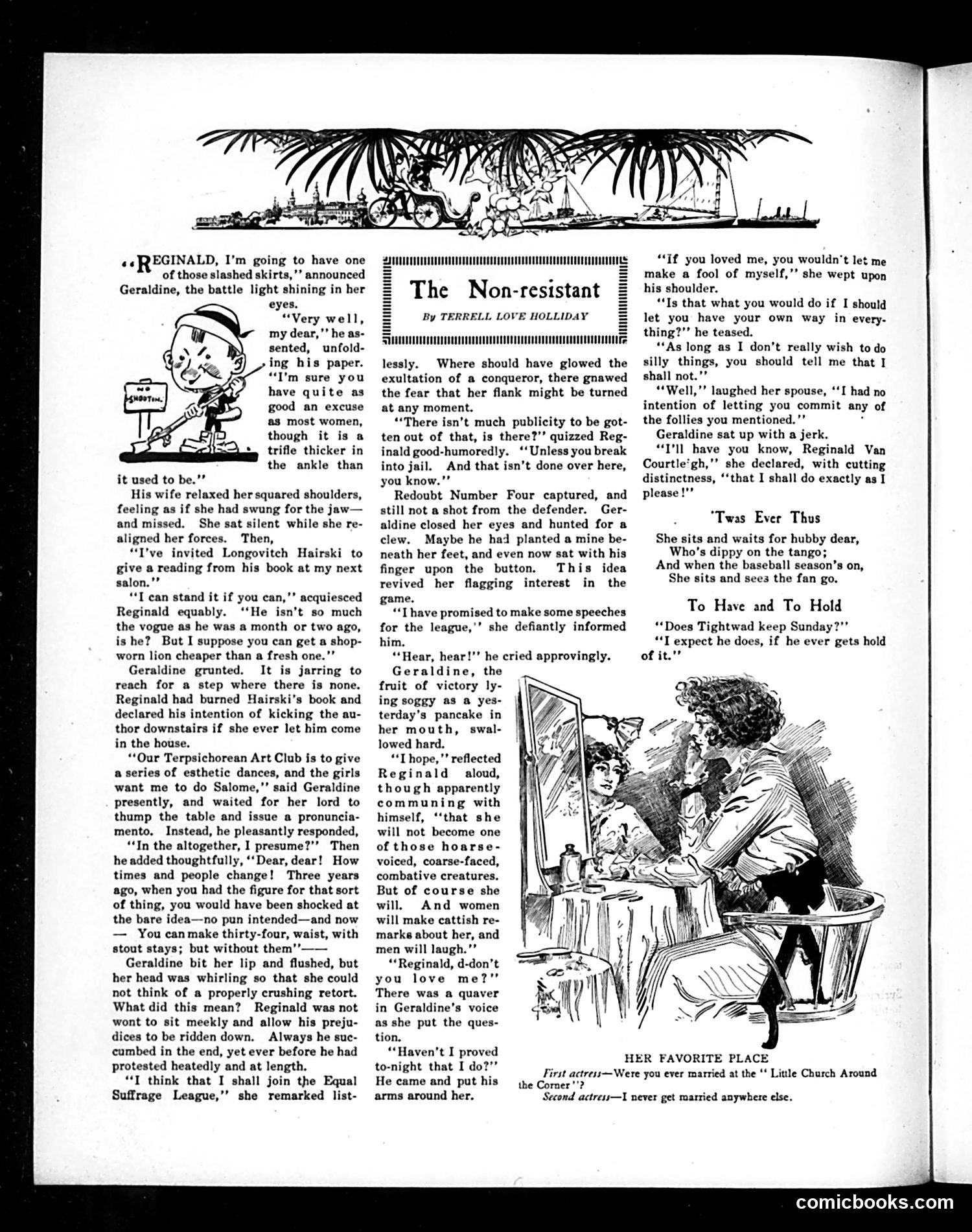
This story satirizes the "New Woman" of the early 1900s—Geraldine, who aggressively pursues fashionable progressive causes (slashed skirts, theatrical performances as Salome, equal suffrage speeches). However, her husband Reginald has adopted a clever counter-strategy: instead of opposing her as he previously did, he now cheerfully agrees with everything, thereby robbing her of the rebellious satisfaction she craves. The satire targets both sides: Geraldine's performative activism (adopting causes for social attention) and the era's women's rights movements, which the magazine treats as fashionable affectations rather than serious convictions. Her tactics—seeking marital conflict to justify her choices—are exposed as emotionally manipulative. Reginald's "non-resistance" strategy ultimately proves more effective than his former protests, suggesting that removing opposition deflates the appeal of these movements. The piece reflects early-20th-century skepticism about women's suffrage and feminist activism.
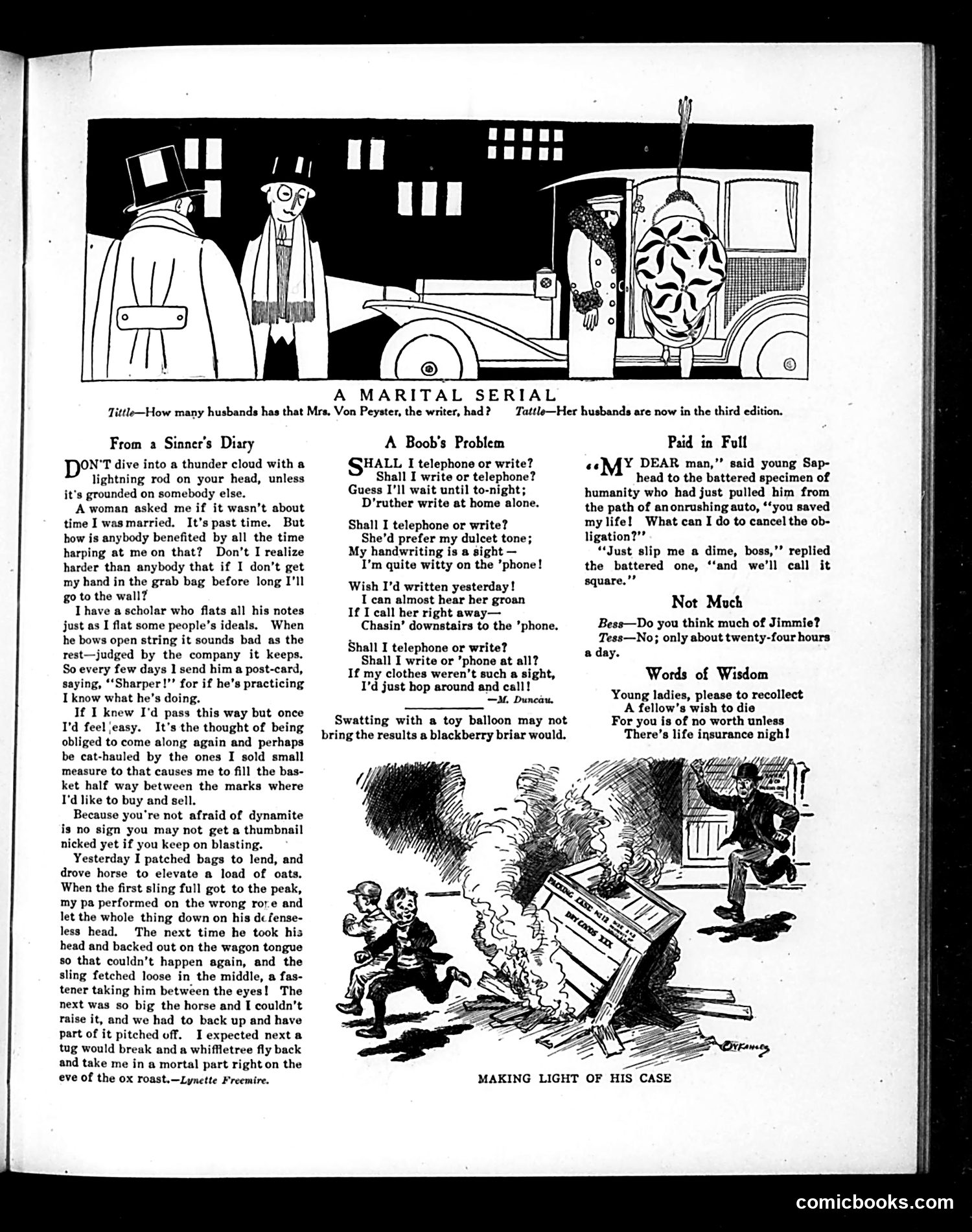
This page from *Judge* contains several satirical pieces targeting early 20th-century social conventions: **"A Marital Serial"** mocks indecisive courtship—a man agonizes endlessly over whether to telephone or write to a woman, paralyzed by vanity (worried his handwriting looks bad, his clothes are shabby). The joke is his overthinking prevents action entirely. **"A Boob's Problem"** satirizes a foolish man who rescues someone from traffic, then cheaply offers only a dime as thanks, calling it "square." The satire targets both his stinginess and obliviousness to the rescued man's injuries. **The title quips** mock a female writer ("Mrs. Von Peyster") through tattle about her multiple marriages—implying promiscuity while pretending innocence. **"Words of Wisdom"** cynically jokes that young women should reject romantic declarations unless backed by life insurance—satirizing both male sentimentality and mercenary courtship. The cartoons and humor reflect period anxieties about gender roles, courtship rituals, and urban modern life.
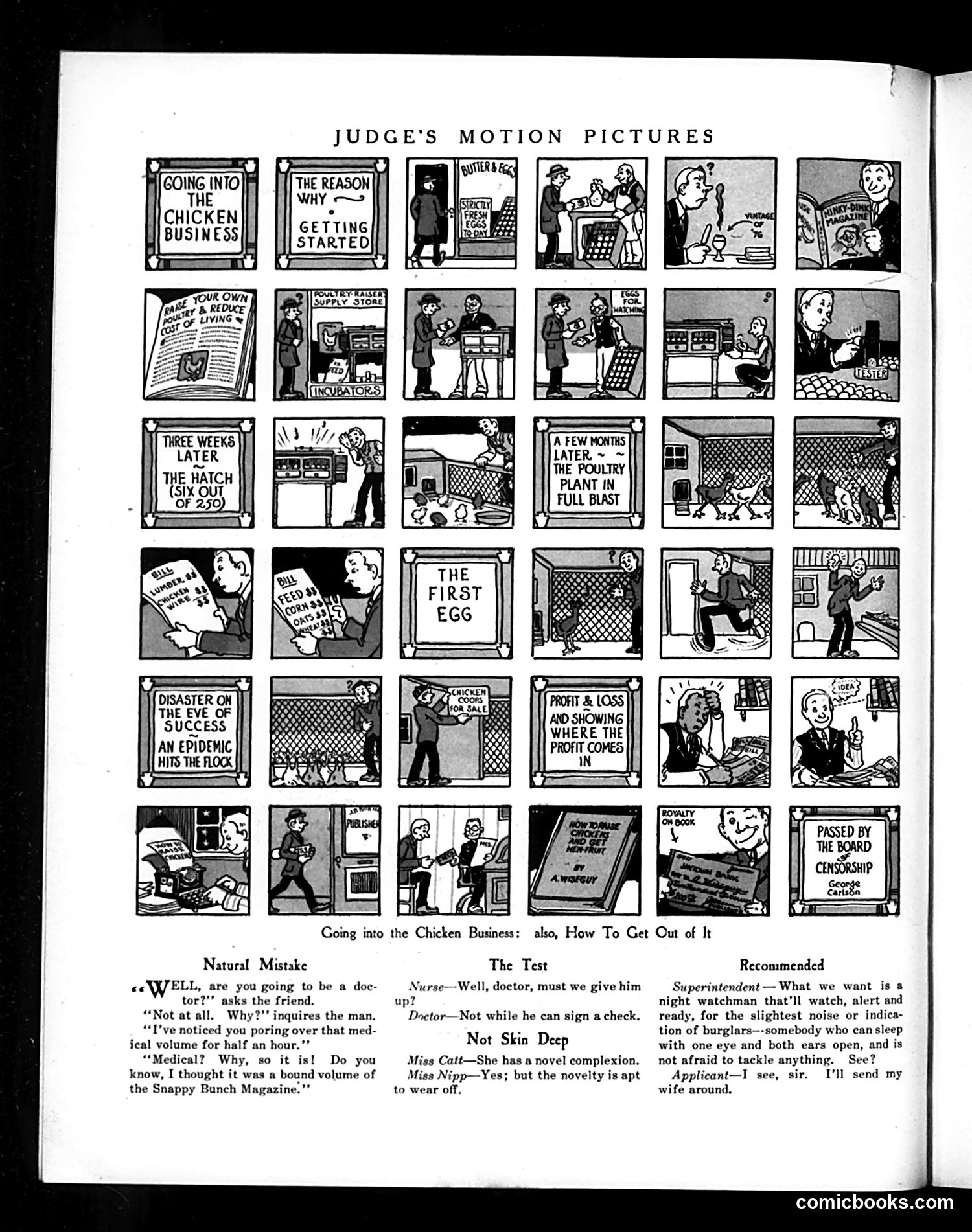
This comic strip sequence satirizes the early 20th-century craze for poultry farming as a get-rich-quick scheme. The narrative follows an entrepreneur starting a chicken business with optimistic expectations ("Going Into the Chicken Business"), progressing through setup and operation, then culminating in disaster when "an epidemic hits the floor"—wiping out his birds and investment. The accompanying jokes mock related social follies: a man mistaking a medical textbook for a magazine, a doctor prioritizing patient payment ability over health, superficial beauty claims, and an overly-demanding job advertisement. The satire targets widespread gullibility about agricultural business opportunities and the naive assumption that anyone could profitably raise chickens with minimal knowledge. This reflected real historical speculation bubbles where ordinary people invested in ventures they didn't understand, often losing money to epidemics, market crashes, or simple incompetence.
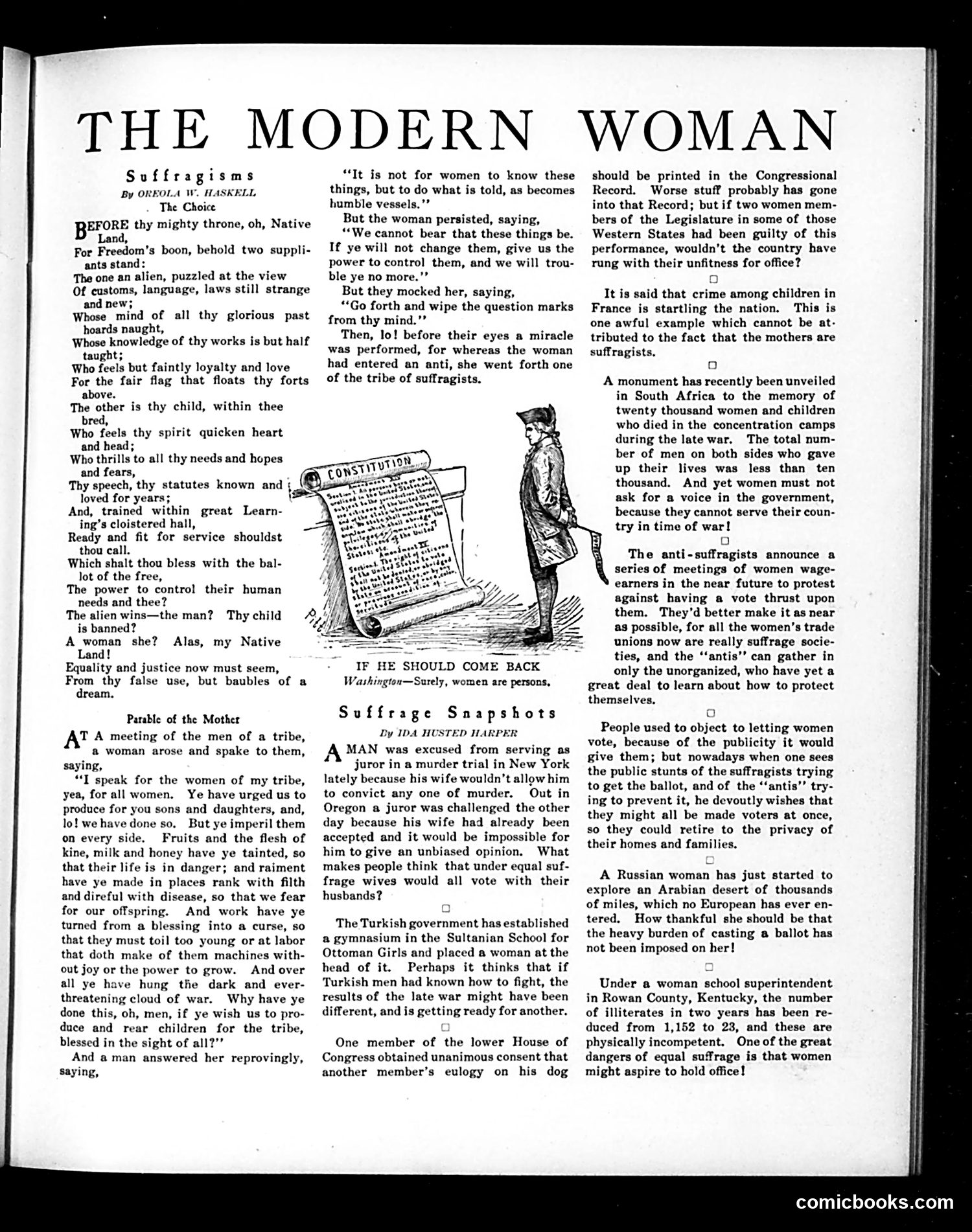
This anti-suffrage page from Judge magazine uses satire to mock women's suffrage arguments. The content includes: **"Suffragisms" poem**: Presents a false binary—contrasting a loyal, educated native-born woman against an ignorant male immigrant. The irony: the woman is denied voting rights while the man receives them, highlighting the absurdity of excluding women from political participation based on capability. **"Parable of the Mother"**: A tribal allegory where women demand voting power to address social problems (contaminated food, unsafe labor, war), but men dismiss them as "humble vessels" unfit for knowledge. The woman exits as a "suffragist"—suggesting empowerment through political voice. **"Suffrage Snapshots"**: Satirical anecdotes exposing anti-suffrage arguments as baseless (wives voting identically to husbands, women's unfitness for office), while mocking men's trivial Congressional behavior. The **Constitution illustration** reinforces the disconnect between democratic ideals and women's exclusion. **Overall message**: Judge argues that denying women the vote contradicts American principles of equality and wastes female capability on social problems men have created.
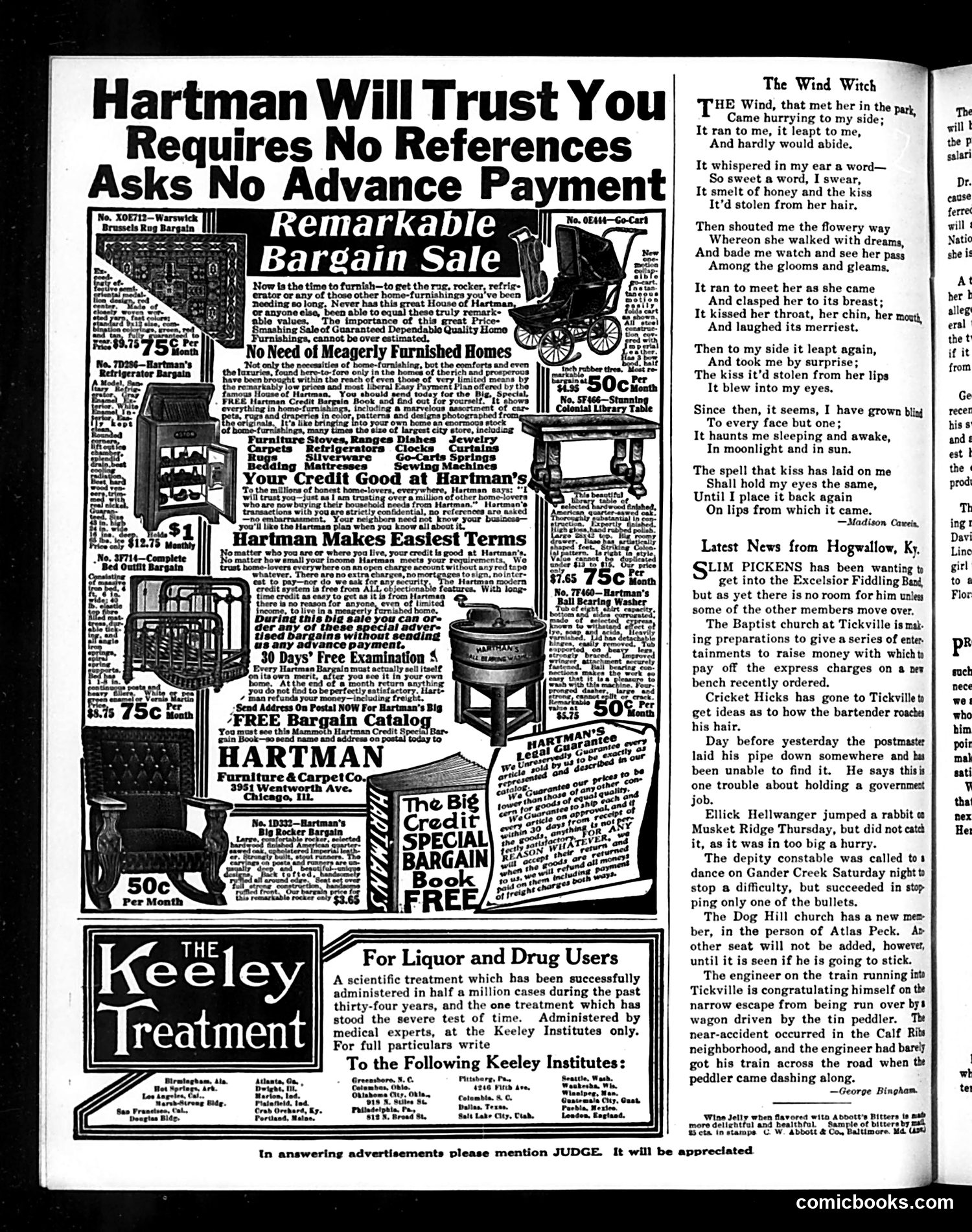
This page is primarily **advertising**, not political satire. The dominant content is a large Hartman Furniture Company ad promoting easy credit terms for home furnishings—no references required, no advance payment, flexible payment plans. This reflects early 20th-century consumer credit practices aimed at working-class families. The page includes a romantic poem, "The Wind Witch," about a man enchanted by a woman through a kiss carried by the wind—sentimental verse typical of the era. A small section titled "Latest News from Hogwallow, Ky" contains humorous rural anecdotes (a musician wanting to join a band, a church raising money for a bench, a postmaster losing his pipe). These are gentle small-town humor, not political commentary. At the bottom is an advertisement for the Keeley Institute, offering medical treatment for "liquor and drug users"—a legitimate contemporary medical service. The page reflects Judge magazine's mixed content: advertising revenue alongside light entertainment and verse, typical of early 20th-century periodicals.
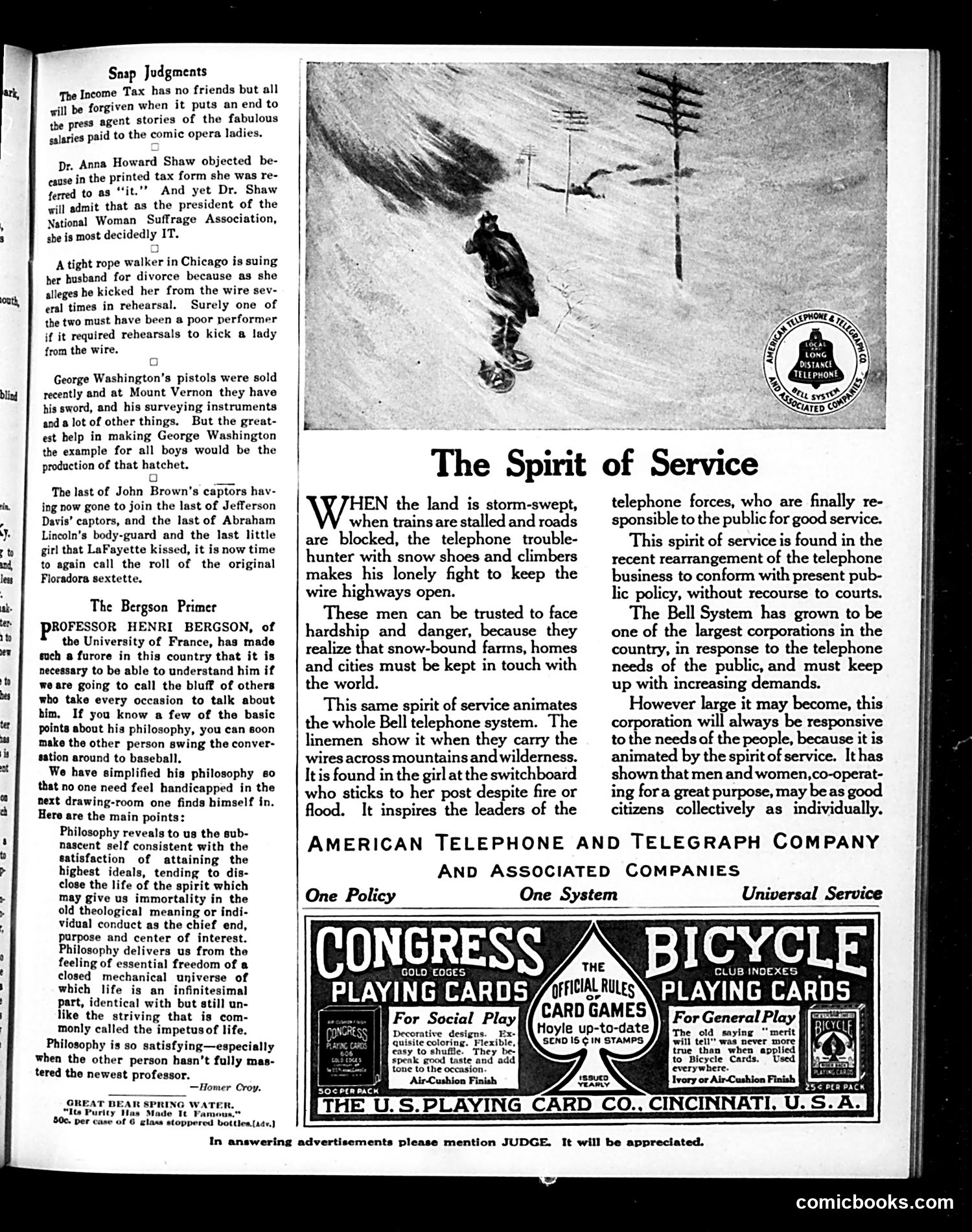
This page combines several elements typical of Judge's satirical approach: **"Snap Judgments"** section mocks contemporary figures and absurdities: Dr. Anna Howard Shaw (women's suffrage leader) is criticized for objecting to a tax form reference; a tight-rope walker's divorce suit is ridiculed as evidence of poor performance; and there's nostalgic commentary on historical artifacts. **"The Bergson Primer"** satirizes the craze for French philosopher Henri Bergson, whose ideas were fashionable among American intellectuals. The humor lies in suggesting his philosophy is incomprehensible jargon useful only for impressing others at social gatherings—the ultimate joke being that mentioning baseball will derail any Bergson discussion. **The main feature**, "The Spirit of Service," is a full-page **Bell Telephone advertisement** featuring a photograph of a lineman in snow. It presents telephone workers as noble public servants, emphasizing corporate responsibility during the era of trust-busting and railroad regulation debates. The page reflects Judge's focus on satirizing intellectual pretension, women's rights activism, and corporate self-promotion.
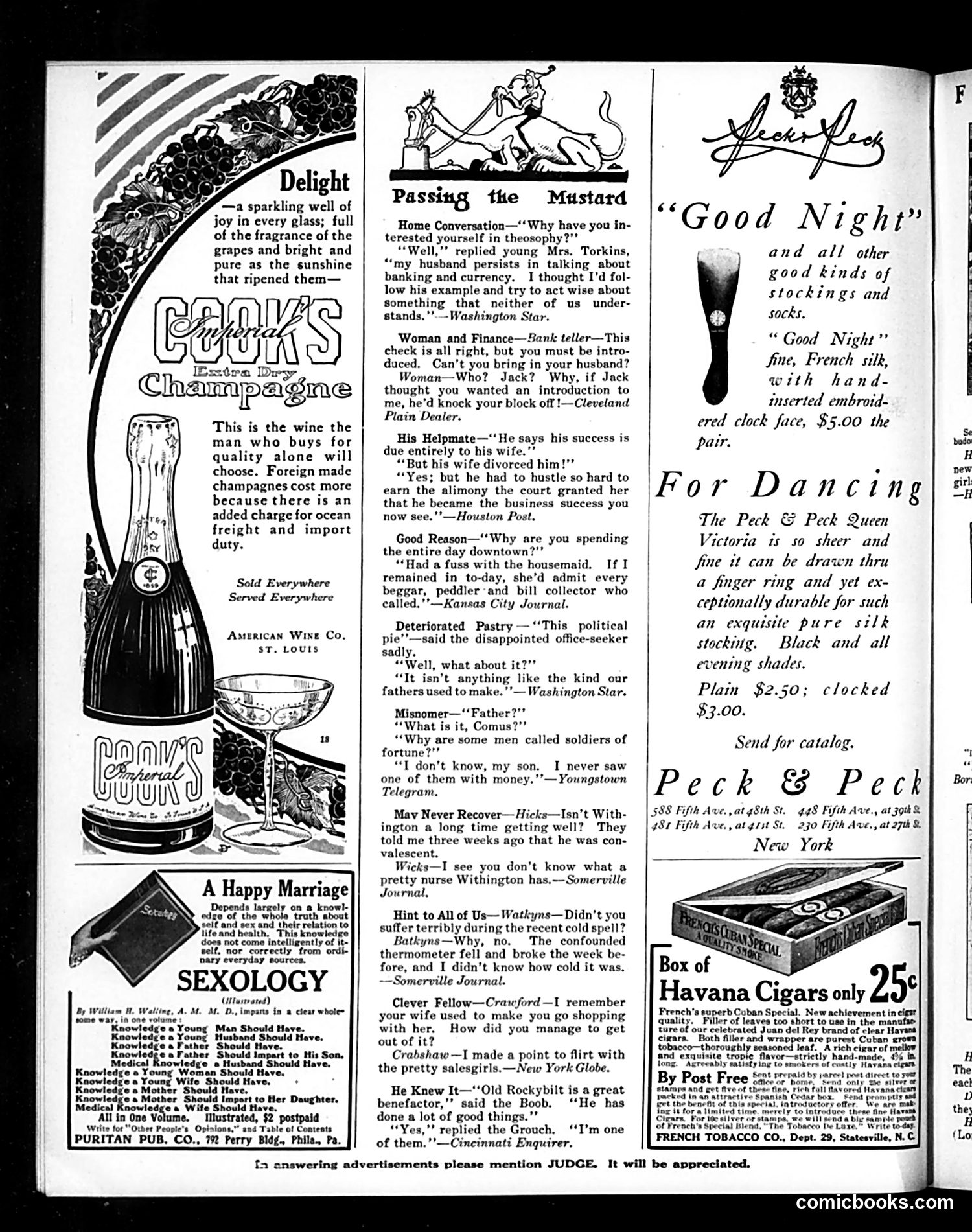
This page is primarily **advertising and humor columns**, typical of Judge magazine's format. The bulk consists of short joke-anecdotes about marriage, gender relations, and domestic life—common satirical fodder of the era. These poke gentle fun at wives managing household staff, husbands avoiding shopping, and the financial/romantic dynamics of marriage. The humor relies on period assumptions: women as household managers, men as breadwinners trying to escape domestic duties. The advertisements include Cooks Champagne (emphasizing American over imported), a "Sexology" instructional book (addressing marriage education), and luxury items like Peck & Peck stockings and Havana cigars—targeting affluent readers. One notable joke involves a man whose wife divorced him but whose "hustling" to pay alimony made him successful—satirizing how even marital failure could yield business advantage, reflecting Jazz Age social mobility. The cartoons themselves aren't political commentary but rather social satire on middle/upper-class domestic life and gender dynamics of the 1920s.
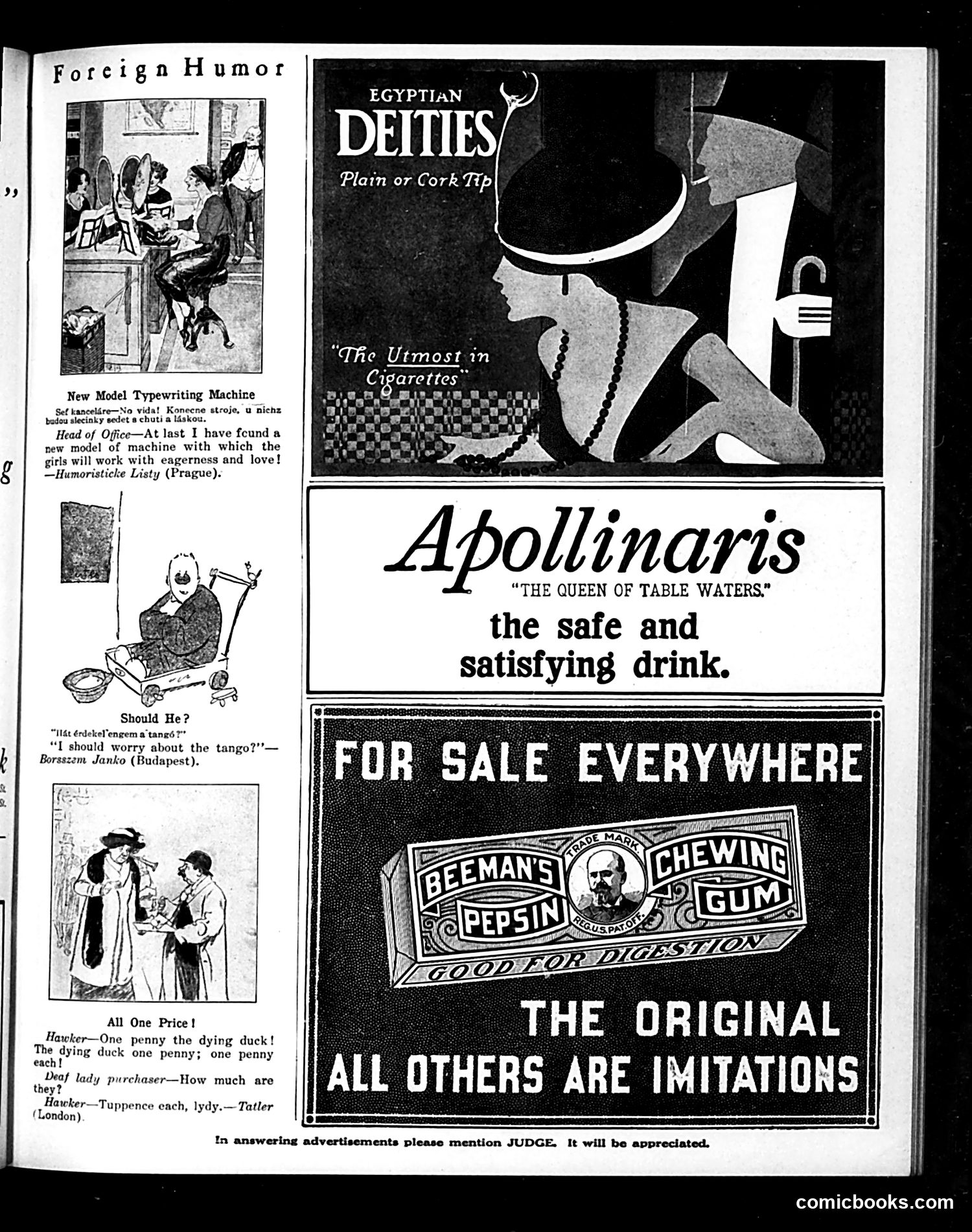
This page presents reprinted international humor from European publications, demonstrating Judge magazine's regular feature showcasing jokes from abroad. The cartoons satirize gender dynamics and modern anxieties of the early 20th century: 1. **Prague cartoon**: A male office manager celebrates finding a typewriter that will make female secretaries work "with eagerness and love"—mocking both the condescension toward women workers and faith in technological solutions to workplace management. 2. **Budapest cartoon**: A woman dismisses concern about the tango (a scandalous dance of the era), playing on moral panic about modern dance crazes. 3. **London cartoon**: A deaf woman mishears a street vendor's pricing, creating wordplay confusion—a traditional joke format unrelated to broader satire. The page also contains period advertisements (Egyptian Deities cigarettes, Apollinaris water, Beeman's Pepsin Gum), typical of Judge's commercial content.
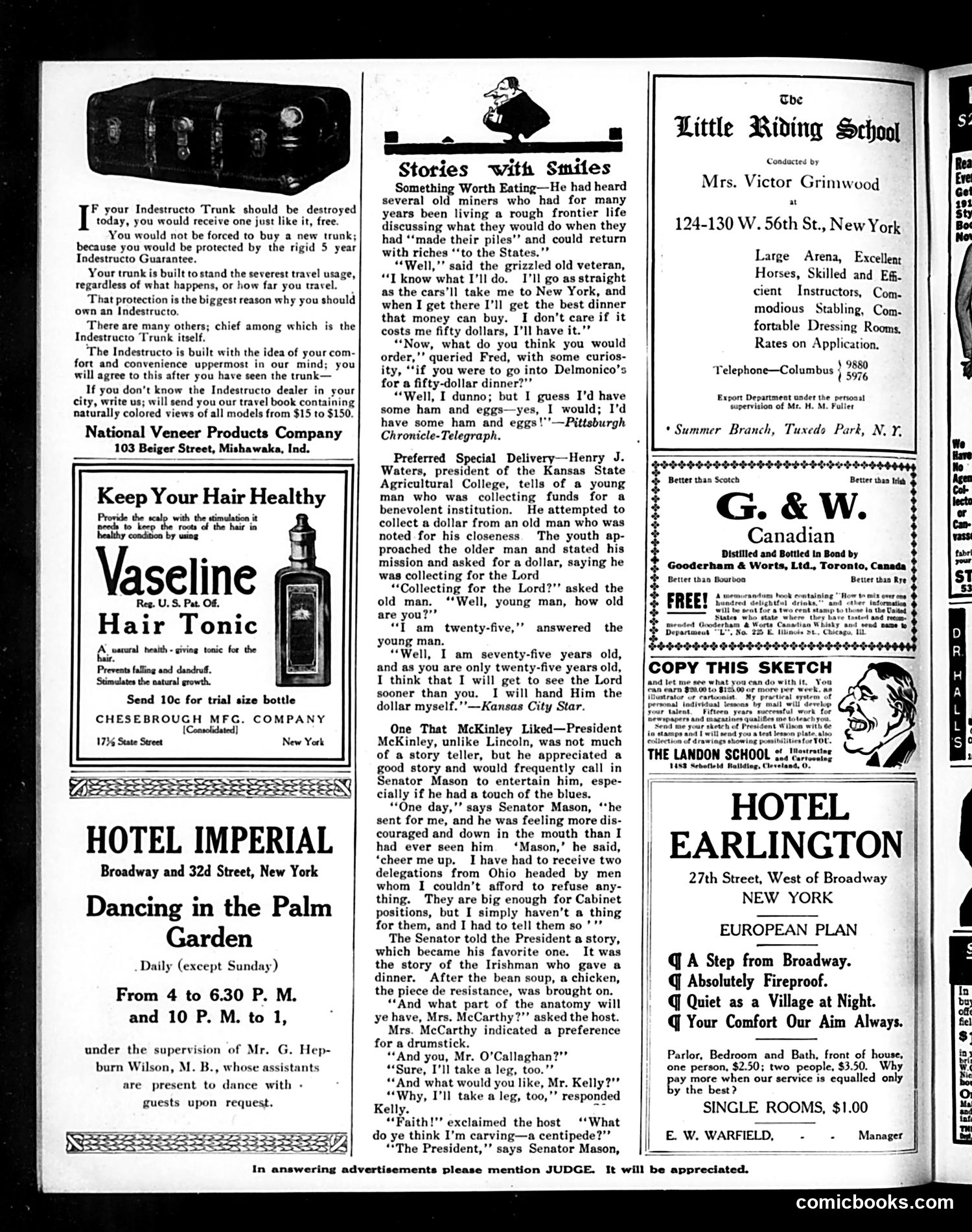
This is primarily an **advertising page** from Judge magazine, not a political cartoon page. The content consists mostly of commercial advertisements for products like Indestructo trunks, Vaseline hair tonic, and New York hotels. The only actual satirical content is a section titled "Stories with Smiles"—humorous anecdotes meant to entertain readers. These include: 1. A joke about a prospector who plans to celebrate striking it rich with a fancy dinner at Delmonico's but ends up ordering ham and eggs (humor based on frontier simplicity versus urban sophistication). 2. A anecdote about a fundraiser and a stingy old man who claims he'll reach heaven before the young collector anyway, so he'll give his dollar directly to God. 3. A story about President McKinley (likely William McKinley, early 1900s) asking Senator Mason to tell jokes to cheer him up during difficult political appointments. These are light, wholesome humor pieces rather than pointed political satire—typical filler content for magazines of this era.
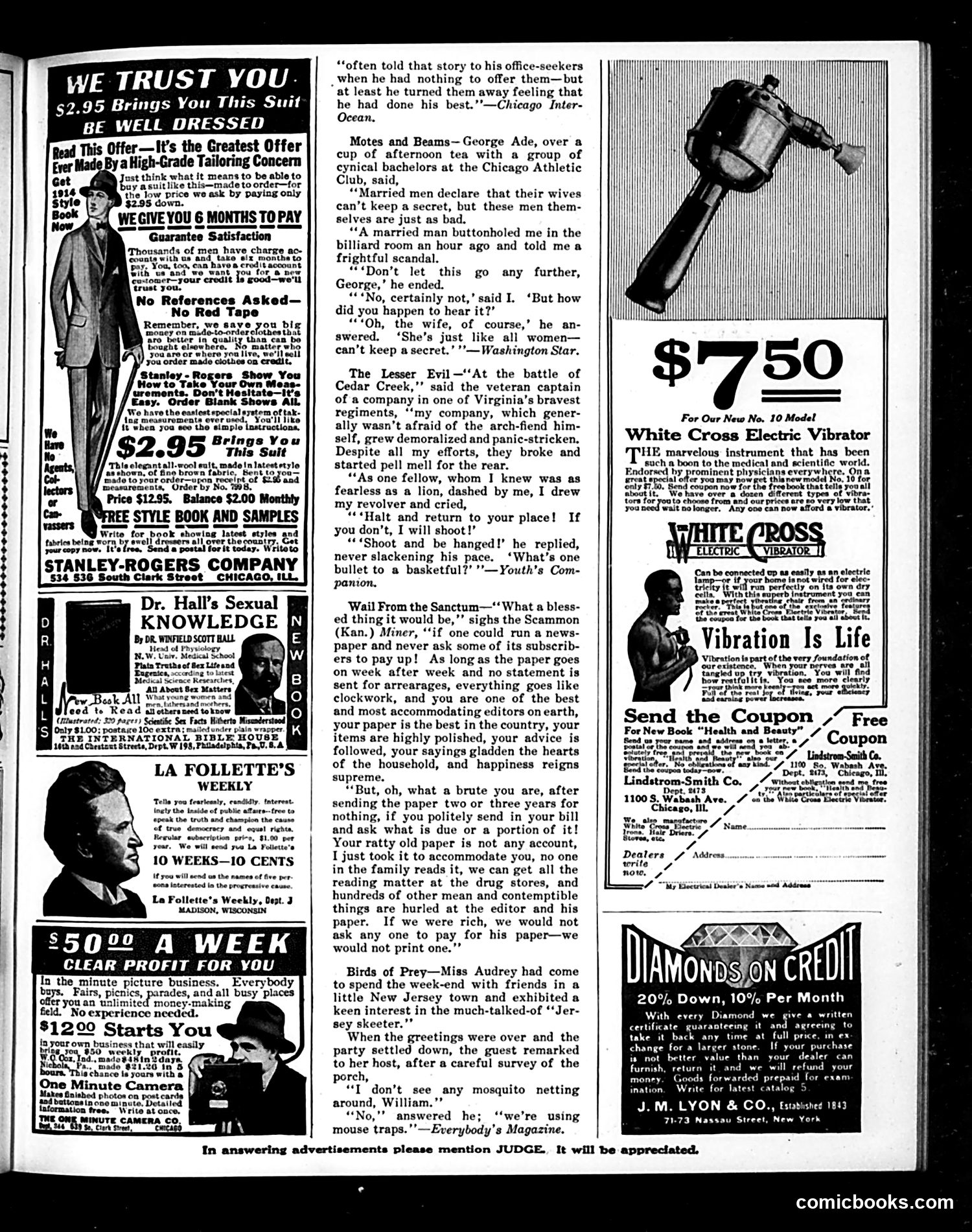
This page is primarily **advertising**, typical of early 20th-century magazines. The content consists of mail-order business pitches rather than political satire. **Notable advertisements include:** - **Stanley-Rogers Company**: A tailoring scheme offering made-to-order suits for $2.95 down, 6 months to pay—likely targeting working-class men concerned about appearing respectable. - **Dr. Hall's Sexual Knowledge**: A mail-order medical book, common in this era when such information wasn't readily available. - **La Follette's Weekly**: Progressive political magazine promoting Robert La Follette's reformist politics. - **White Cross Electric Vibrator**: An early electrical health device marketed as therapeutic—vibrators were then promoted for legitimate medical uses before later associations changed their image. The humor pieces ("Motes and Beams," "The Lesser Evil") are generic anecdotes about marriage and military service, not satirizing specific current events. The page reflects early 1900s consumer culture and the era's approach to advertising intimate products.
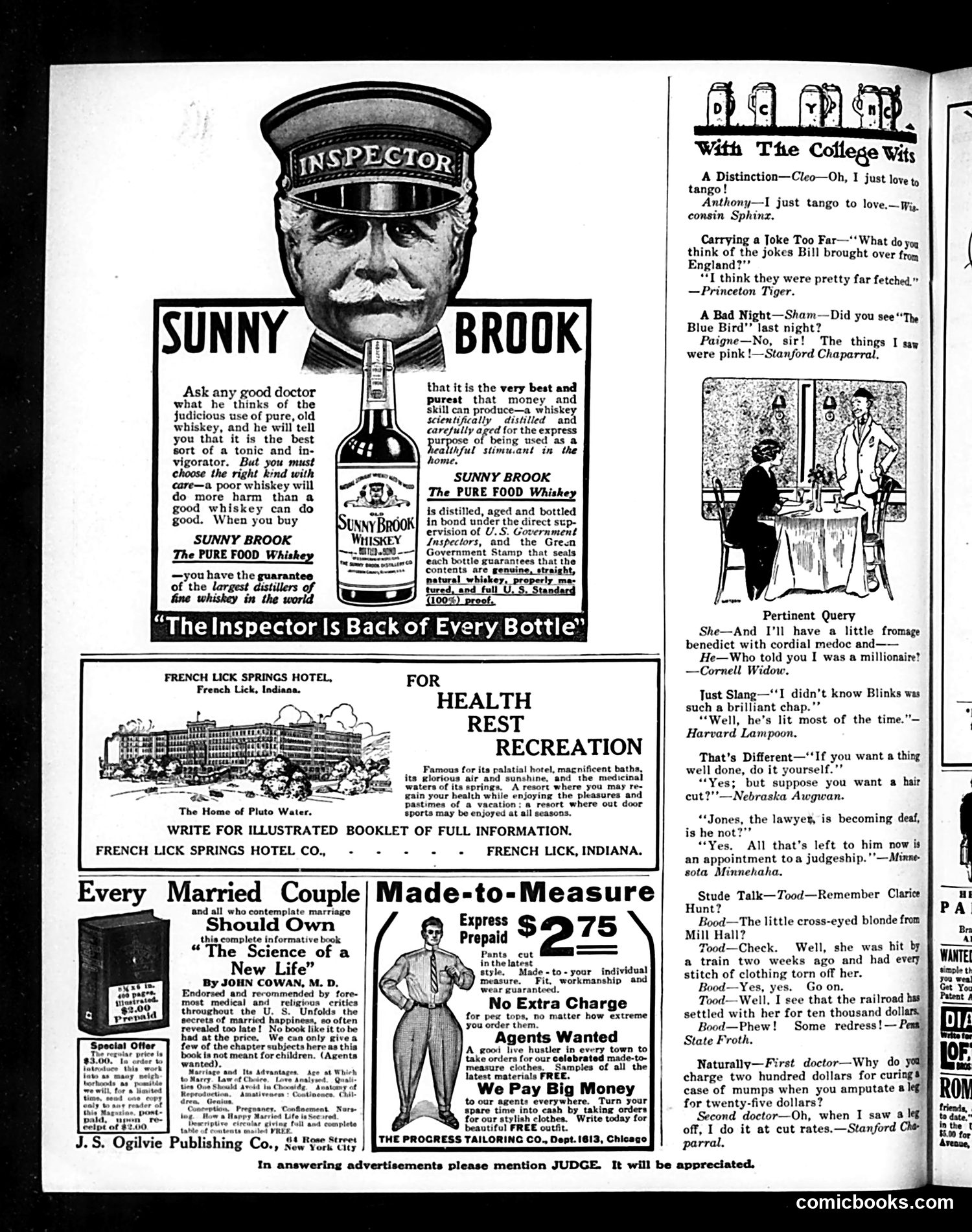
This page is primarily **advertisements** with a "College Wits" humor section. The main satirical content is subtle: **The Sunny Brook Whiskey Ad** uses a caricatured "Inspector" figure to invoke government authority and credibility. The pitch—that whiskey is medicinal—reflects the pre-Prohibition era (before 1920) when alcohol was marketed as health tonic. The "Pure Food" branding references the 1906 Pure Food and Drug Act, exploiting newly-won consumer trust in government oversight. **The College Wits section** collects humor from various university magazines (Wisconsin, Princeton, Stanford, etc.). These jokes satirize college social life: the tango craze, theatrical pretension, and student romance. The "Stude Talk" piece contains crude humor about a woman hit by a train, reflecting period attitudes. **Context**: This represents Judge magazine's advertising-heavy format and collegiate culture from the early 1900s, before modern consumer protection standards or attitudes toward women's safety.
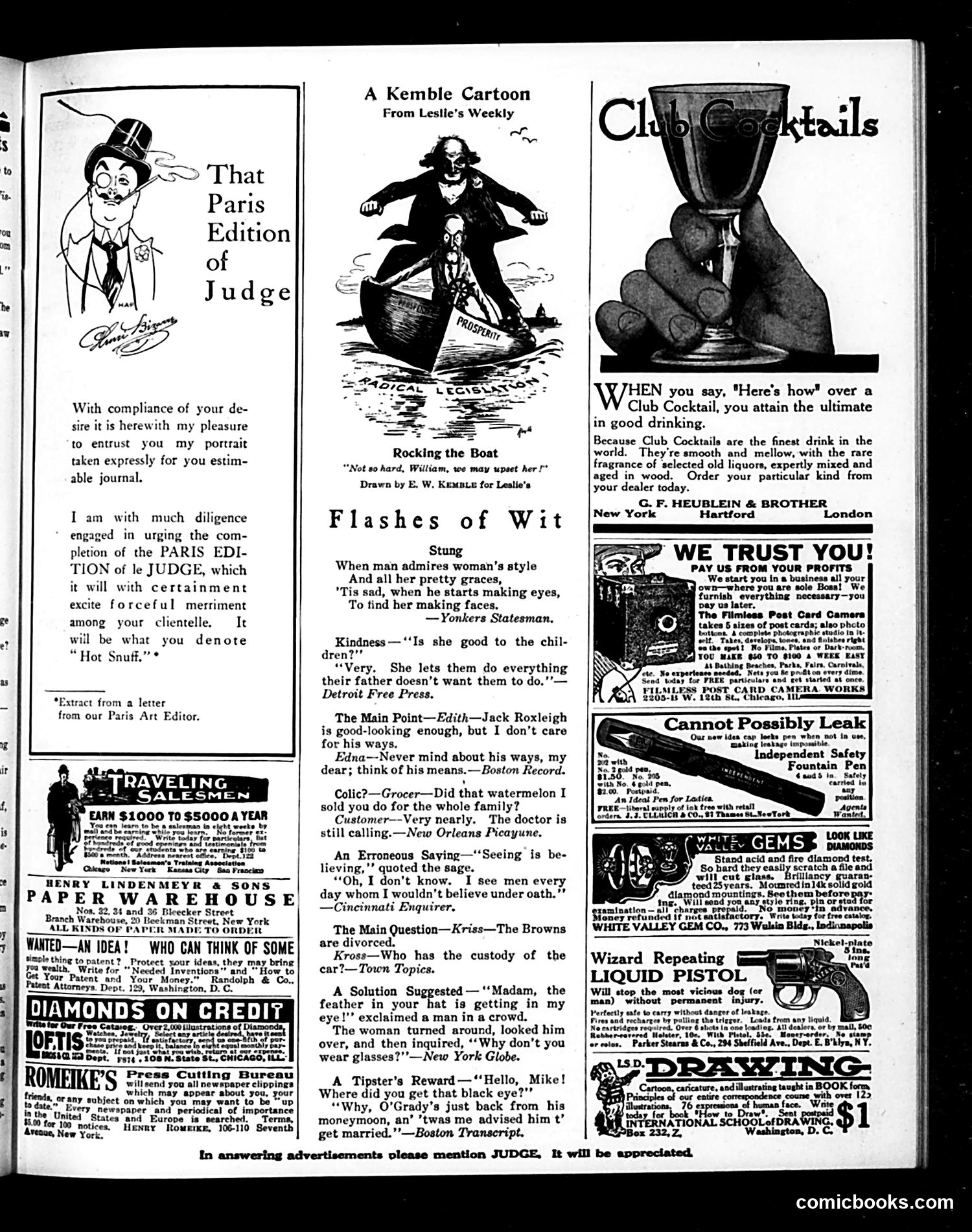
This page from *Judge* magazine contains primarily **advertisements and humor columns** rather than political satire. The main cartoon—"Rocking the Boat" by E.W. Kemble, republished from *Leslie's Weekly*—appears to depict a figure (unclear who specifically) in a boat, though the image quality makes the exact subject difficult to determine. The "Flashes of Wit" section collects brief jokes about domestic life and courtship, typical of early 20th-century humor: a wife who lets children misbehave, a man valuing a woman for her money rather than her looks, etc. The page is dominated by **advertisements** for products like Club Cocktails, cameras, diamonds, paper warehouses, and patent services—reflecting the magazine's business model. No clear political figures or contemporary events are identifiable on this page. It represents *Judge* functioning as a general-interest publication mixing light social satire with commercial advertising rather than hard political commentary.
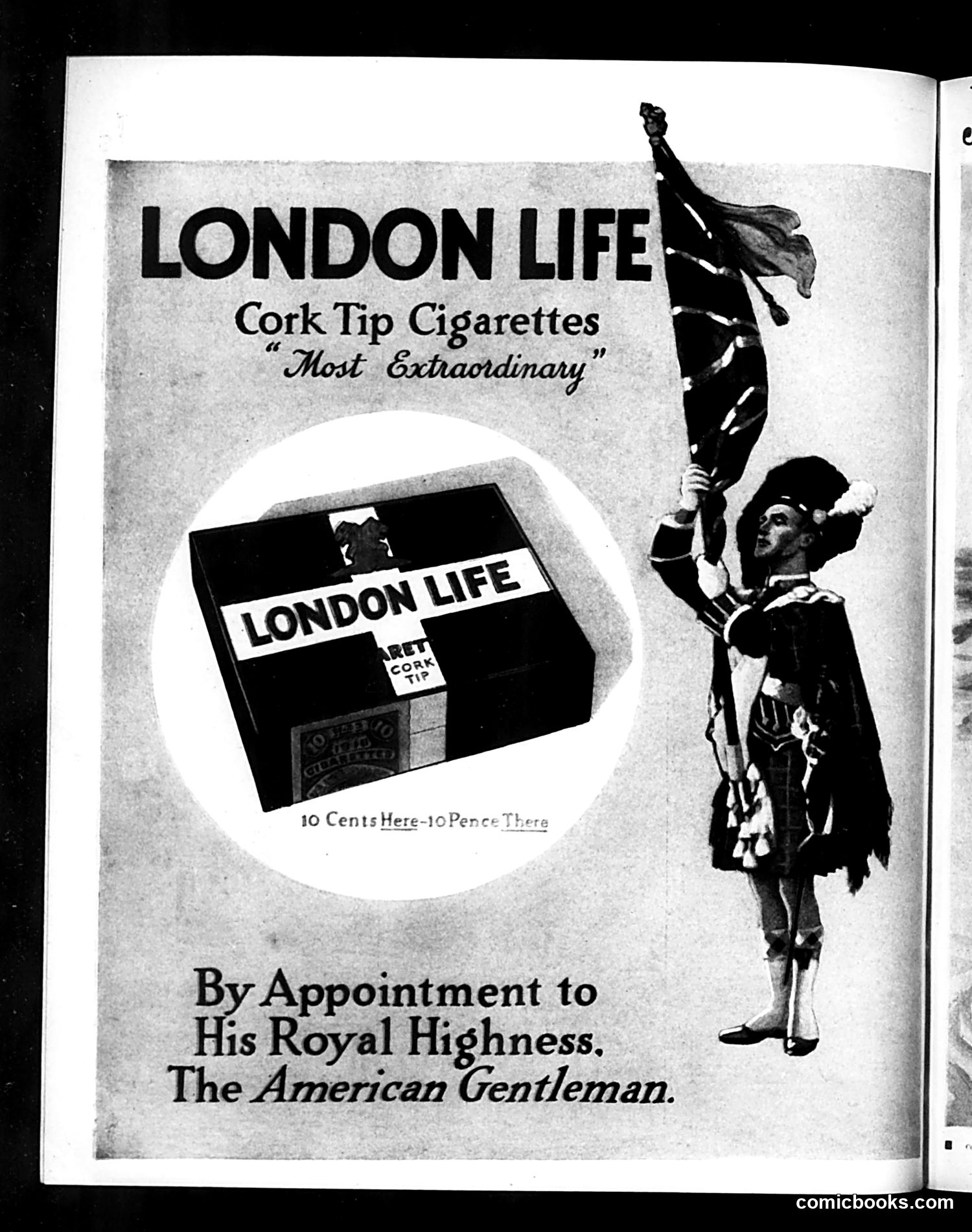
This is a cigarette advertisement rather than a satirical cartoon. It promotes "London Life" cork-tip cigarettes as "Most Extraordinary," priced at "10 Cents Here–10 Pence There." The ad features a figure in formal British attire holding a Union Jack flag, positioned next to a cigarette box. The phrase "By Appointment to His Royal Highness. The American Gentleman" is satirical wordplay: it mimics the prestigious "By Royal Appointment" labels on British luxury goods, but humorously suggests an "American Gentleman" as a royal patron—likely poking fun at wealthy American tourists or expatriates in London who adopted British mannerisms. The transatlantic pricing comparison emphasizes the product's international appeal and broad availability.