
Judge, 1914-03-07 · page 4 of 24
Judge — March 7, 1914 — page 4: what you’re looking at
What you’re looking at
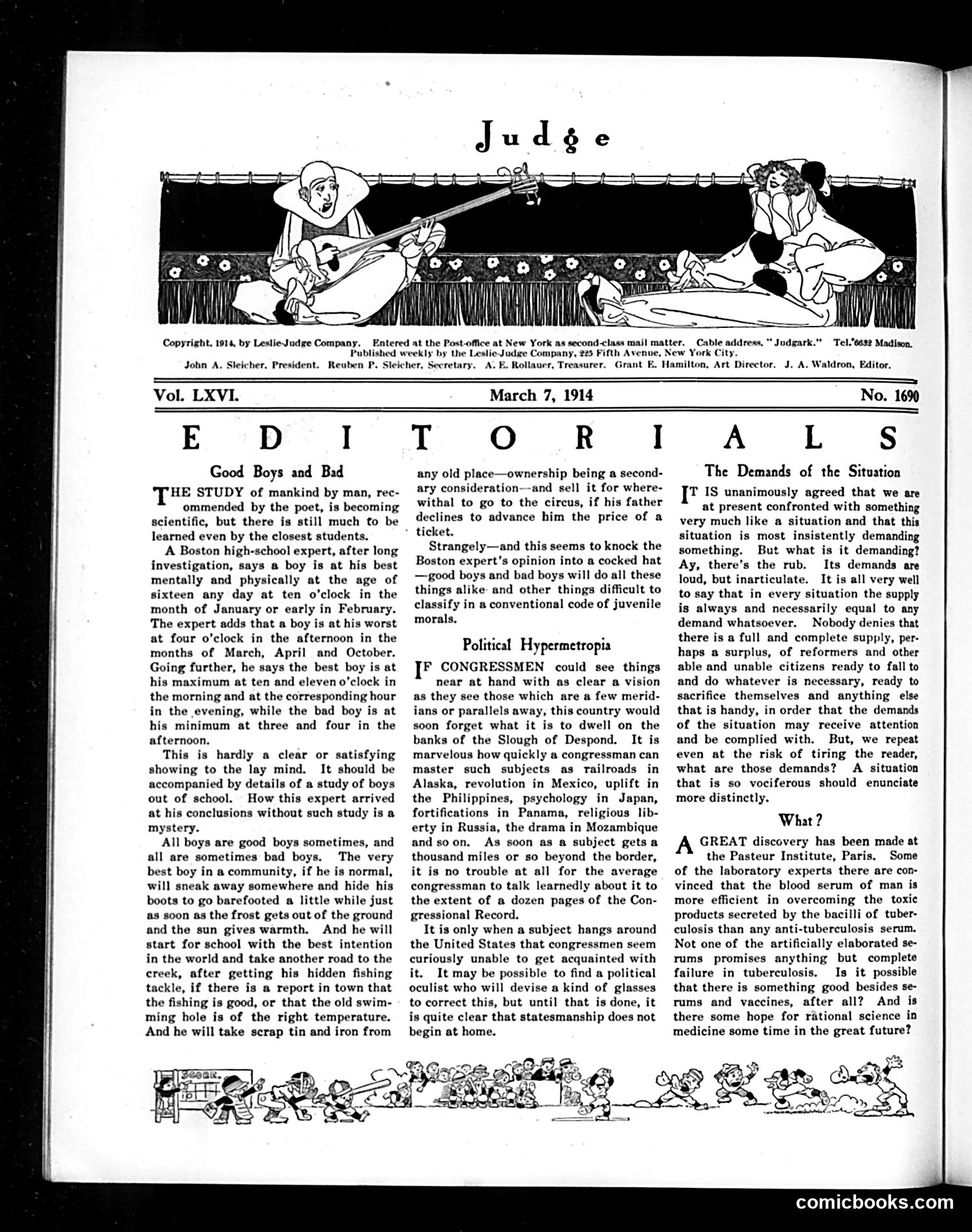
The page contains three editorial pieces without clear caricatures of specific identifiable figures. **"Good Boys and Bad"** satirizes a Boston expert's study claiming boys are worst behaviorally in October-March afternoons and evenings. The satire mocks scientific pretension—questioning whether such obvious seasonal patterns (cold weather driving boys indoors) really needed formal investigation. **"Political Hypermetropia"** criticizes congressmen for being distracted by distant foreign issues (Mexico, Philippines, Panama, Russia) while ignoring urgent domestic concerns. The metaphor "hypermetropia" (farsightedness) suggests politicians focus on what's far away while neglecting what's near. **"What?"** discusses tuberculosis research at the Pasteur Institute, remaining largely straightforward rather than satirical.
📄 Transcribed text from this page (OCR, searchable)
Machine-transcribed from the original scan — historical spelling and the odd misread are preserved.
Copyright, 1914, by Leslie Judge Company. Pu her, President. Vol. LXVI. E «DB < I Good Boys and Bad THE STUDY of mankind by man, rec- ommended by the poet, is becoming scientific, but there is still much to be learned even by the closest students. A Boston high-school expert, after long investigation, says a boy is at his best mentally and physically at the age of sixteen any day at ten o'clock in the month of January or early in February. The expert adds that a boy is at his worst at four o’clock in the afternoon in the months of March, April and October. Going further, he says the best boy is at his maximum at ten and eleven o'clock in the morning and at the corresponding hour in the evening, while the bad boy is at his minimum at three and four in the afternoon, This is hardly a clear or satisfying showing to the lay mind. It should be accompanied by details of a study of boys out of school. How this expert arrived at his conclusions without such study is a mystery. All boys are good boys sometimes, and all are sometimes bad boys. The very best boy in a community, if he is normal, will sneak away somewhere and hide his boots to go barefooted a little while just as soon as the frost gets out of the ground and the sun gives warmth. And he will start for school with the best intention in the world and take another road to the creek, after getting his hidden fishing tackle, if there is a report in town that the fishing is good, or that the old swim- ming hole is of the right temperature. And he will take scrap tin and iron from Reuben P. Sleicher Entered at the Post-office at New York as second-class mail matter. ublished weekly by the Leslie Judge Company, 225 Fifth Avenue, New York City. t E. Hamilton, Art Director. cretary. A, E, Rollauer, Treasurer, March 7, 1914 Cable address, “ Judgark.” Tel."6632 Madison. J. A. Waldron, Editor. No. 1690 T O R I any old place—ownership being a second- ary consideration—and sell it for where- withal to go to the circus, if his father declines to advance him the price of a ticket. Strangely—and this seems to knock the Boston expert’s opinion into a cocked hat —good boys and bad boys will do all these things alike and other things difficult to classify in a conventional code of juvenile morals. Political Hypermetropia IF CONGRESSMEN could see things near at hand with as clear a vision as they see those which are a few merid- ians or parallels away, this country would soon forget what it is to dwell on the banks of the Slough of Despond. It is marvelous how quickly a congressman can master such subjects as railroads in Alaska, revolution in Mexico, uplift in the Philippines, psychology in Japan, fortifications in Panama, religious lib- erty in Russia, the drama in Mozambique and soon. As soon as a subject gets a thousand miles or so beyond the border, it is no trouble at all for the average congressman to talk learnedly about it to the extent of a dozen pages of the Con- gressional Record. It is only when a subject hangs around the United States that congressmen seem curiously unable to get acquainted with it. It may be possible to find a political oculist who will devise a kind of glasses to correct this, but until that is done, it is quite clear that statesmanship does not begin at home. A L §& The Demands of the Situation T IS unanimously agreed that we are at present confronted with something very much like a situation and that this situation is most insistently demanding something. But what is it demanding? Ay, there’s the rub. Its demands are loud, but inarticulate. It is all very well to say that in every situation the supply is always and necessarily equal to any demand whatsoever. Nobody denies that there is a full and complete supply, per- haps a surplus, of reformers and other able and unable citizens ready to fall to and do whatever is necessary, ready to sacrifice themselves and anything else that is handy, in order that the demands of the situation may receive attention and be complied with. But, we repeat even at the risk of tiring the reader, what are those demands? A situation that is so vociferous should enunciate more distinctly. What ? A GREAT discovery has been made at the Pasteur Institute, Paris. Some of the laboratory experts there are con- vinced that the blood serum of man is more efficient in overcoming the toxic products secreted by the bacilli of tuber- culosis than any anti-tuberculosis serum, Not one of the artificially elaborated se- rums promises anything but complete failure in tuberculosis. Is it possible that there is something good besides se- rums and vaccines, after all? And is there some hope for rational science in medicine some time in the great future? comicbooks.com