
A complete issue · 25 pages · 1913
Judge — December 27, 1913
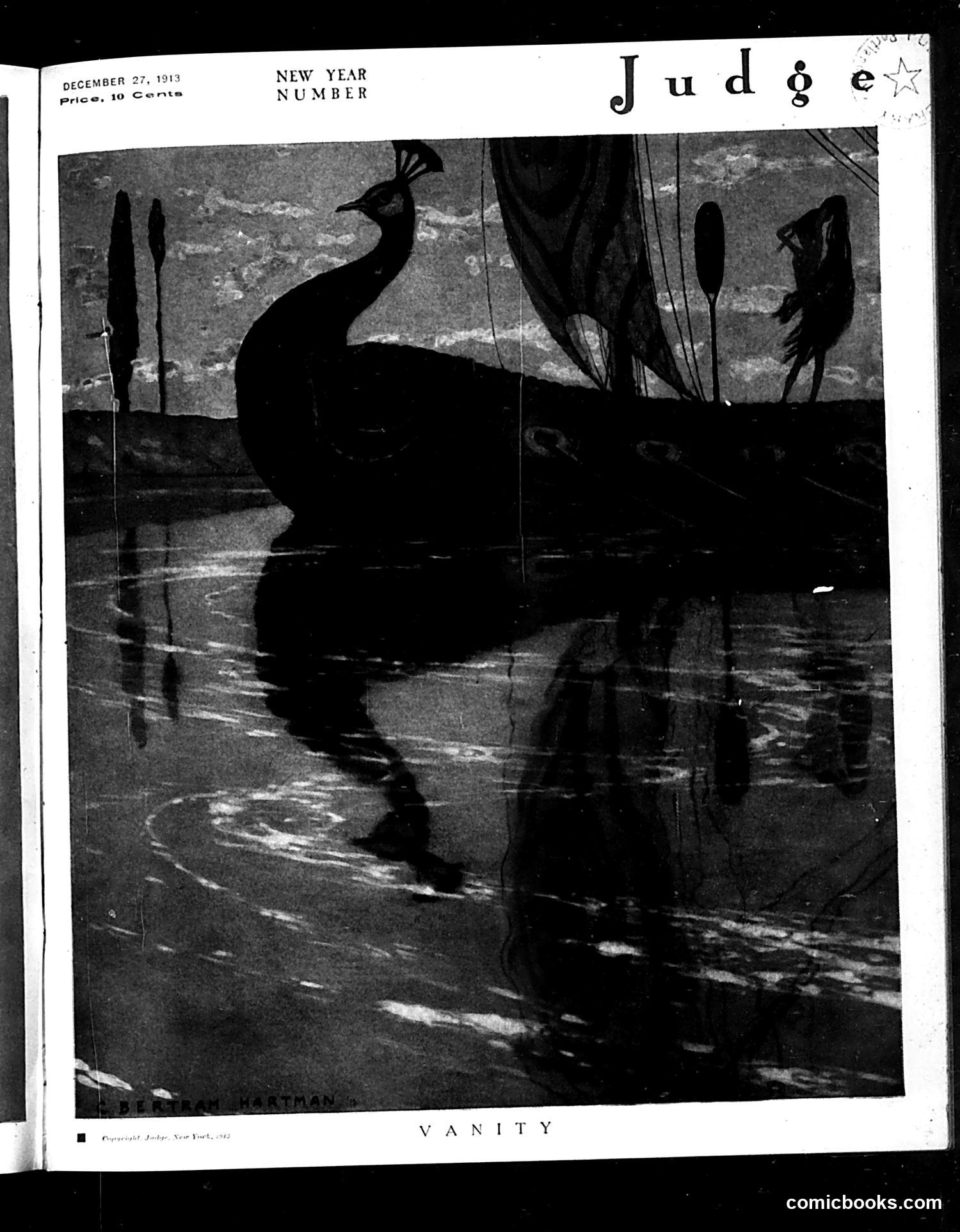
This silhouette illustration titled "Vanity" depicts a peacock in profile against a landscape backdrop. The peacock—a traditional symbol of vanity and pride—displays its characteristic elaborate tail feathers while standing near water with cattails visible on the left and a figure on the right. The image appears to be a straightforward allegorical commentary on human vanity, using the peacock's natural tendency to display its plumage as metaphor. This was a common theme in satirical publications of the era. The silhouette technique emphasizes the bird's distinctive proud posture, making the vanity reference unmistakable to contemporary readers familiar with classical artistic symbolism. Without additional context or text on the page visible, the specific satirical target remains unclear.
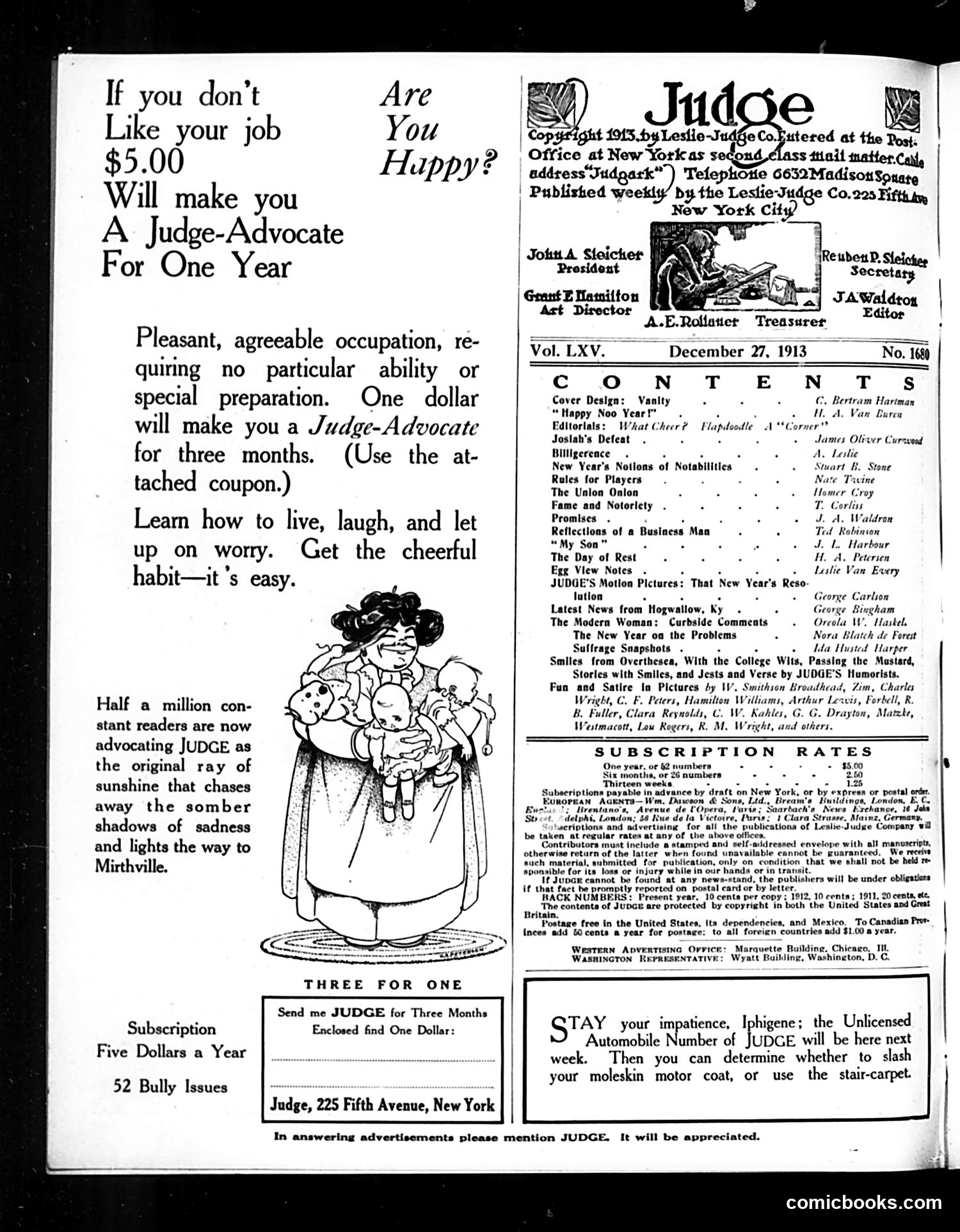
This page is primarily **advertising for Judge magazine subscriptions**, not political commentary. The left side promotes a "$5 subscription for one year" offer, using the slogan "Three for One"—three months' subscription for one dollar. The accompanying illustration shows a nurturing maternal figure (labeled "Mirthville") holding multiple infants, symbolizing Judge as a source of comfort and cheerfulness during difficult times. The accompanying text promises readers will "learn how to live, laugh, and let up on worry," positioning the magazine as escapist entertainment for "half a million constant readers." The right side contains typical magazine masthead information, contents listing, and subscription details. A small advertisement jokes about an "Unlicensed Automobile Number" coming next week, poking fun at automobile regulations.
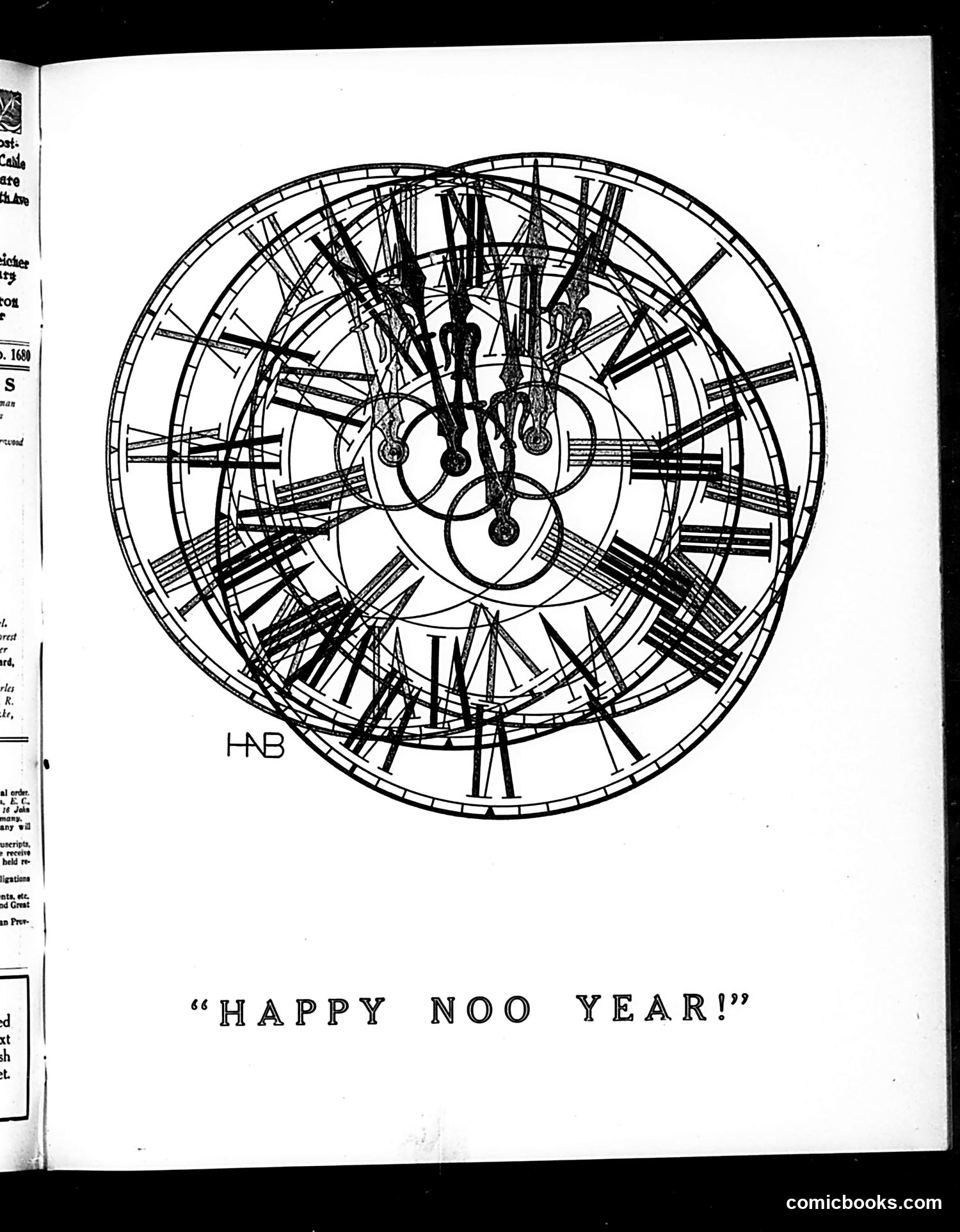
This is a satirical New Year's greeting from Judge magazine, featuring an elaborate mechanical clock face with Roman numerals and complex internal gearing. The initials "HNB" appear to be the cartoonist's signature. The phrase "Happy Noo Year!" uses deliberately misspelled dialect humor (common in period satire), likely mocking immigrants or working-class speech patterns. The intricate, almost chaotic machinery of the clock suggests the complexity and potential disorder of entering a new year—possibly commenting on political or social machinery of the era. Without additional context about the specific publication date, the exact satirical target remains unclear, though the style and approach suggest early-to-mid 20th century American social commentary.
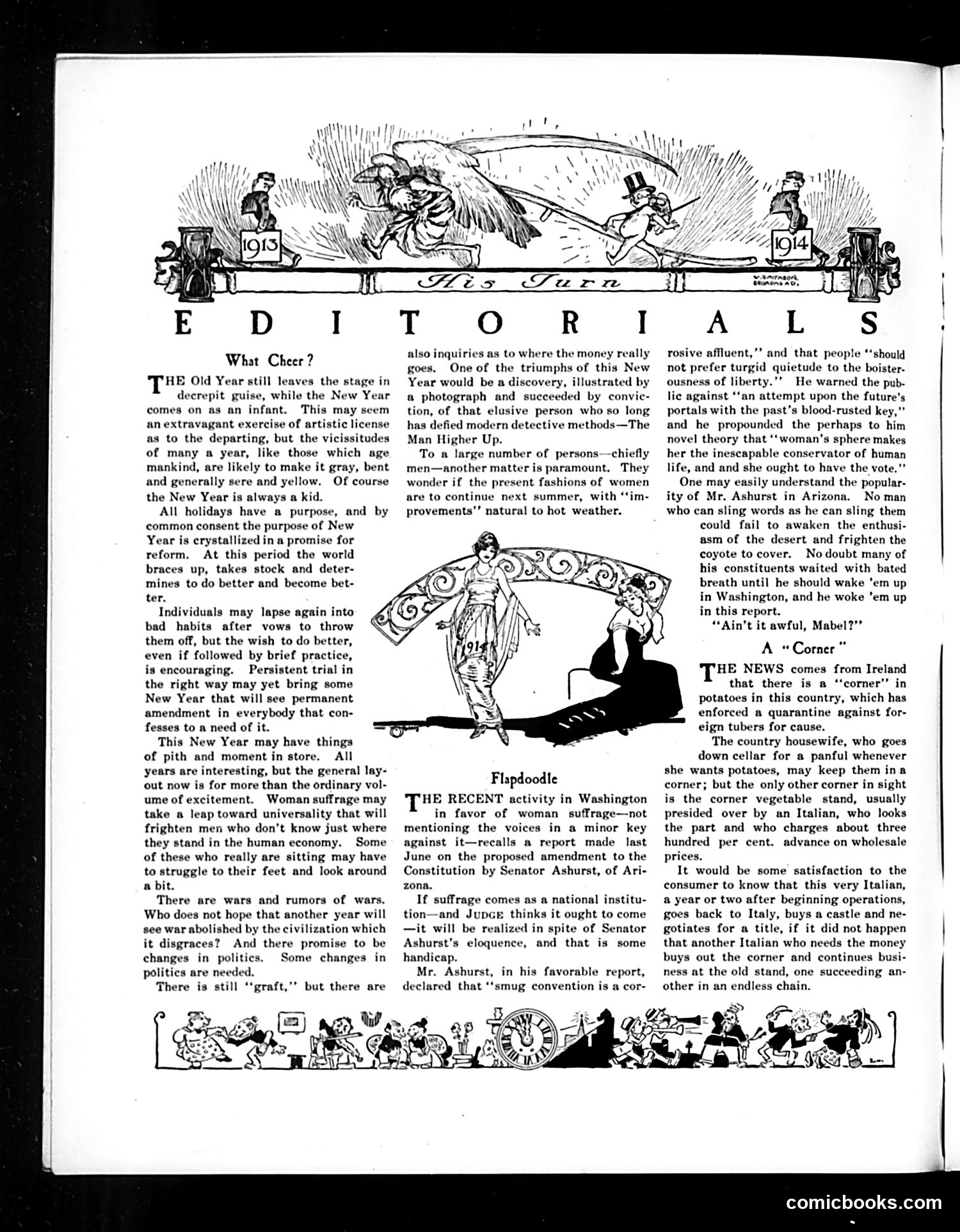
The page contains two main editorial pieces: **"What Cheer?"** discusses New Year's resolutions and reform, suggesting individuals should use the holiday to break bad habits through persistent practice. **"A Corner"** appears to reference a potato-related scandal or concern, mentioning Senator Ashurst of Arizona and discussion of woman suffrage. The piece sarcastically discusses a "corner" in potatoes (market manipulation) and an Italian who allegedly controls potato prices, suggesting consumer frustration with food costs and market speculation. The central illustration labeled **"Flapdoodle"** depicts a flapper-style woman, likely satirizing contemporary fashion and social attitudes toward women during the 1910s-20s era when this magazine was published. The overall tone mocks political ineffectiveness and commercial exploitation affecting ordinary consumers.
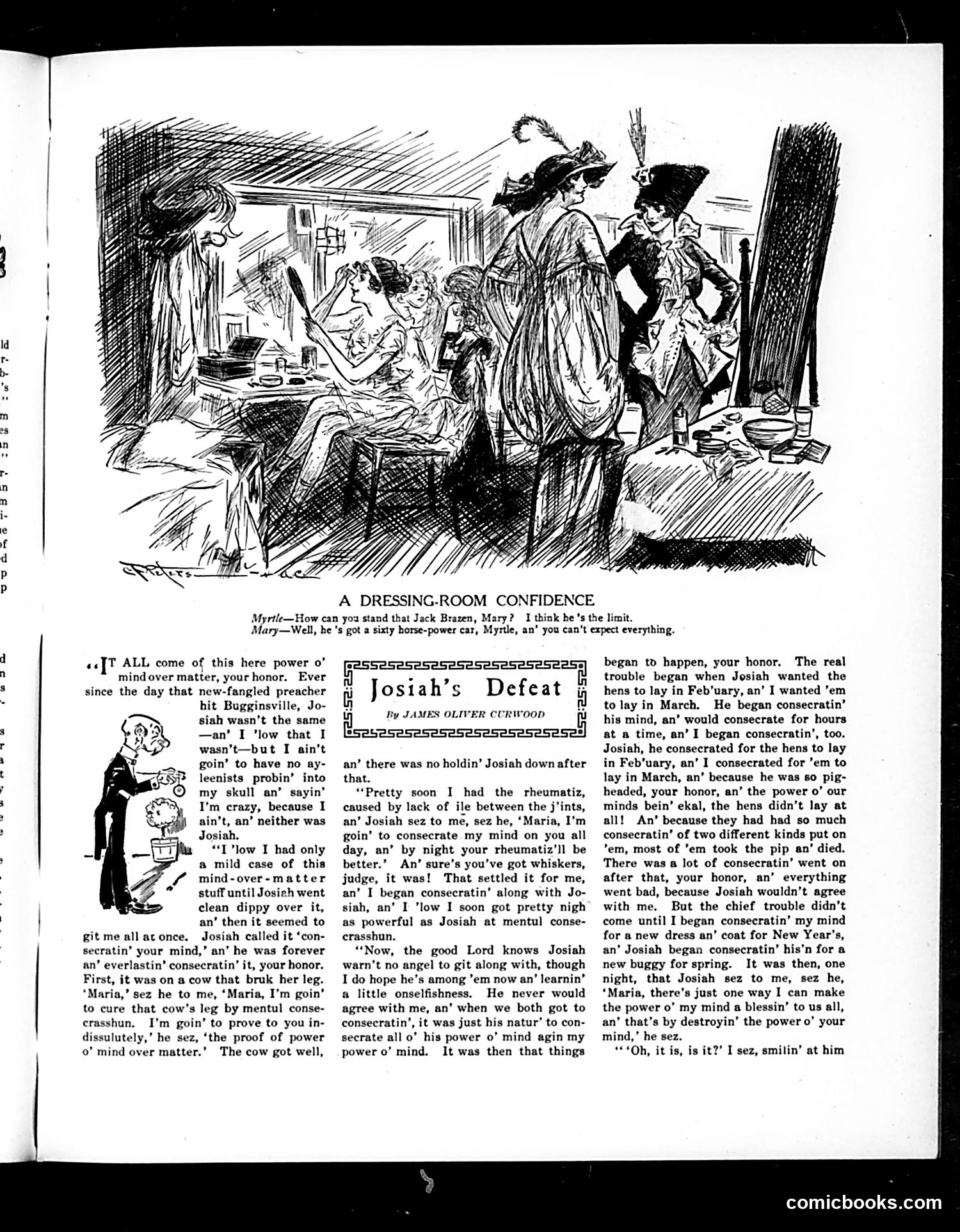
The top illustration depicts women in a dressing room discussing a man named Jack Brazen, with one character (Myrtle) noting he's "the limit"—slang for someone extreme or objectionable. The main story, "Josiah's Defeat" by James Oliver Curwood, is a humorous anecdote about a man named Josiah who believed he possessed "power of mind over matter." He attempted to use mental concentration to control various situations—making a cow behave, curing rheumatism, and controlling horses—with mixed results. The satire mocks pseudoscientific claims about "mind power" and mental willpower as cure-alls, showing Josiah's repeated failures despite his unshakeable confidence in the method.
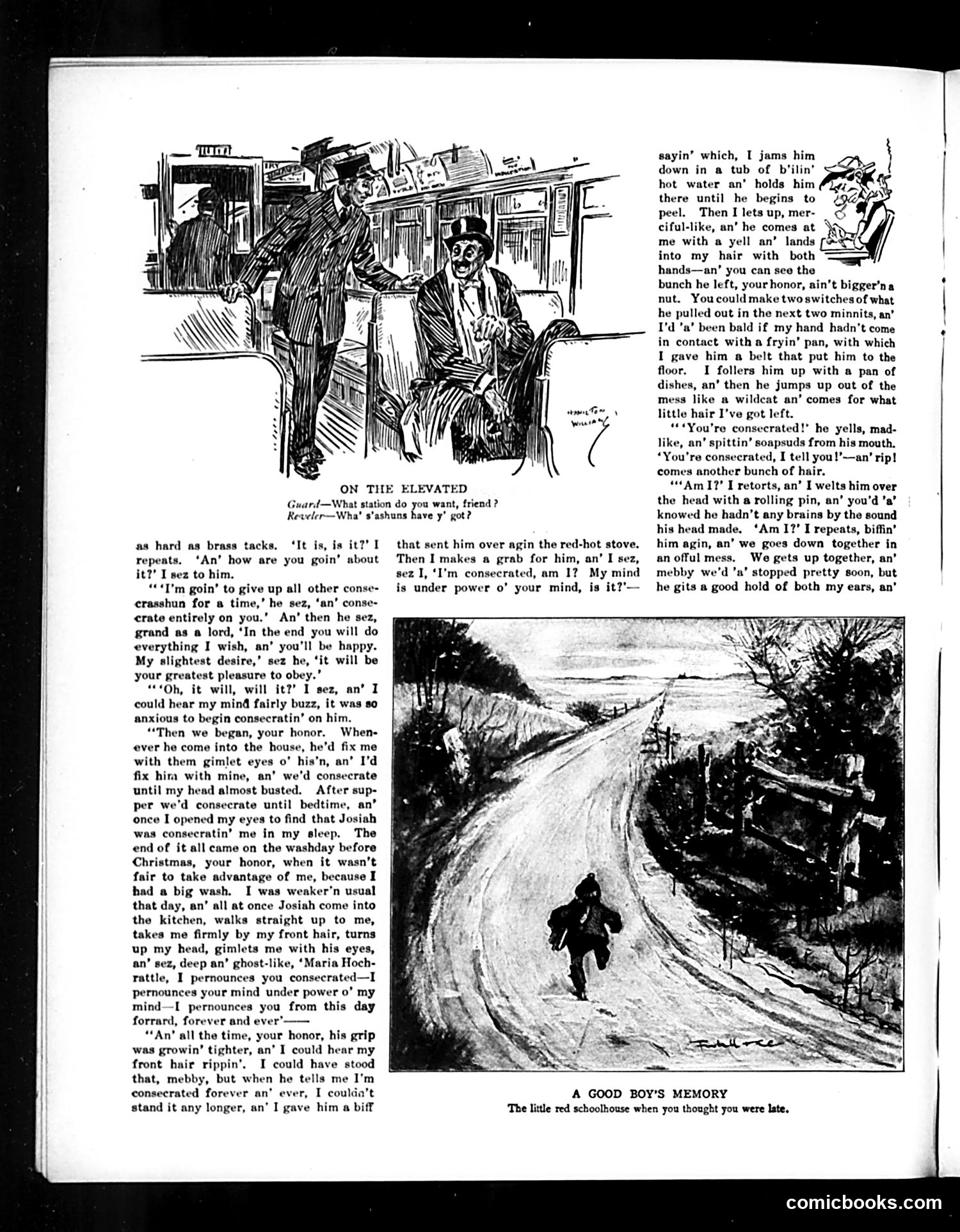
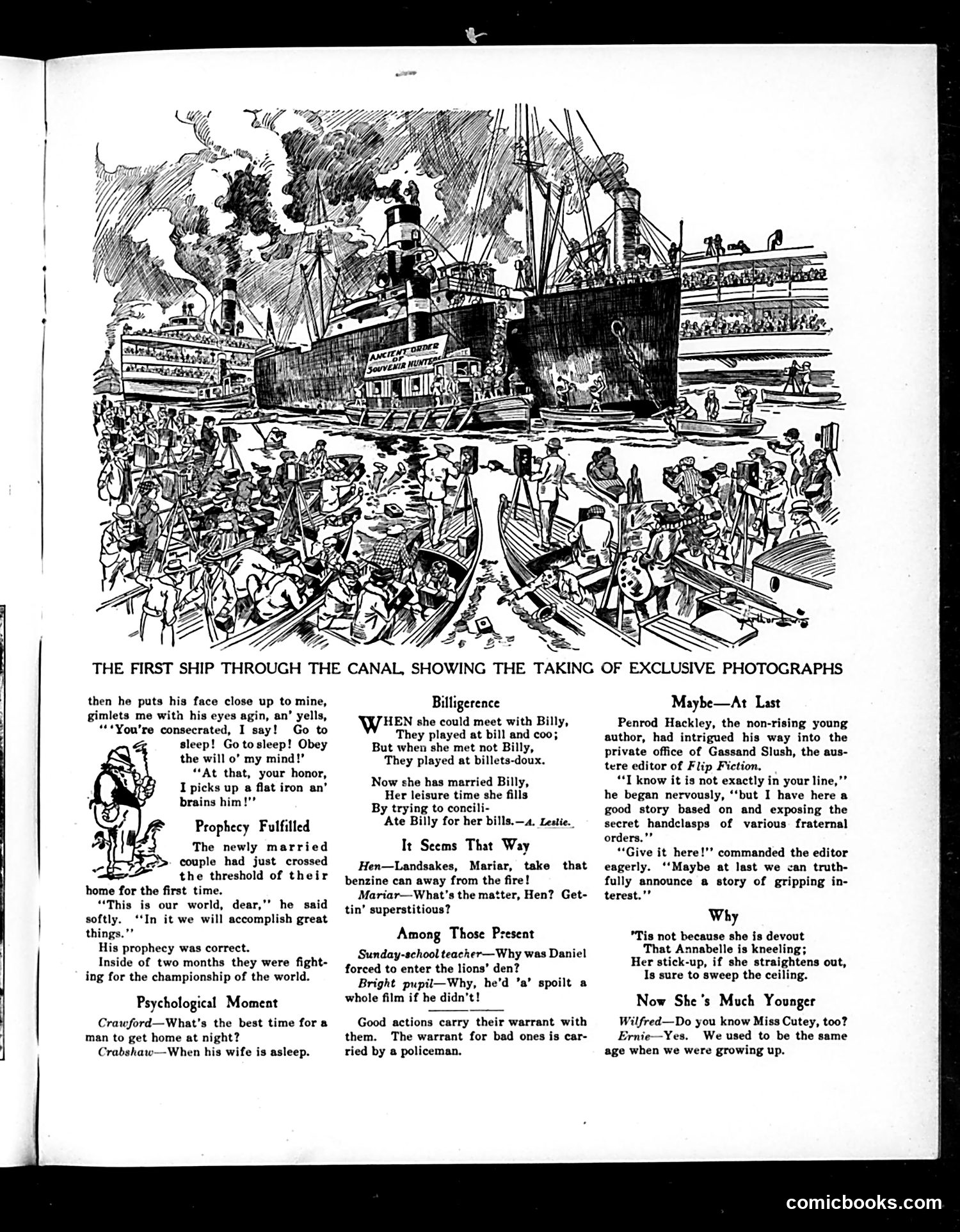
This page from *Judge* magazine features the prominent illustration of "The First Ship Through the Canal" — likely referencing the Panama Canal's opening (1914). The large engraving depicts a steamship surrounded by crowds and smaller vessels, capturing the public spectacle and media frenzy around this major engineering achievement. The caption notes "exclusive photographs," satirizing how photographers and journalists competed intensely to document this historic moment. The surrounding comic vignettes mock contemporary social life: marital discord ("Prophecy Fulfilled," "Billigerence"), domestic absurdities, and publishing satire. One joke references film production—a "bright pupil" suggests Daniel entered the lions' den because he'd "spoilt a whole film," reflecting early cinema's growing cultural presence. The humor targets predictable targets: newlyweds fighting, henpecked husbands, and struggling authors pitching sensational stories about fraternal orders to editors. These reflect typical *Judge* preoccupations with middle-class foibles and modern anxieties of the 1910s era.
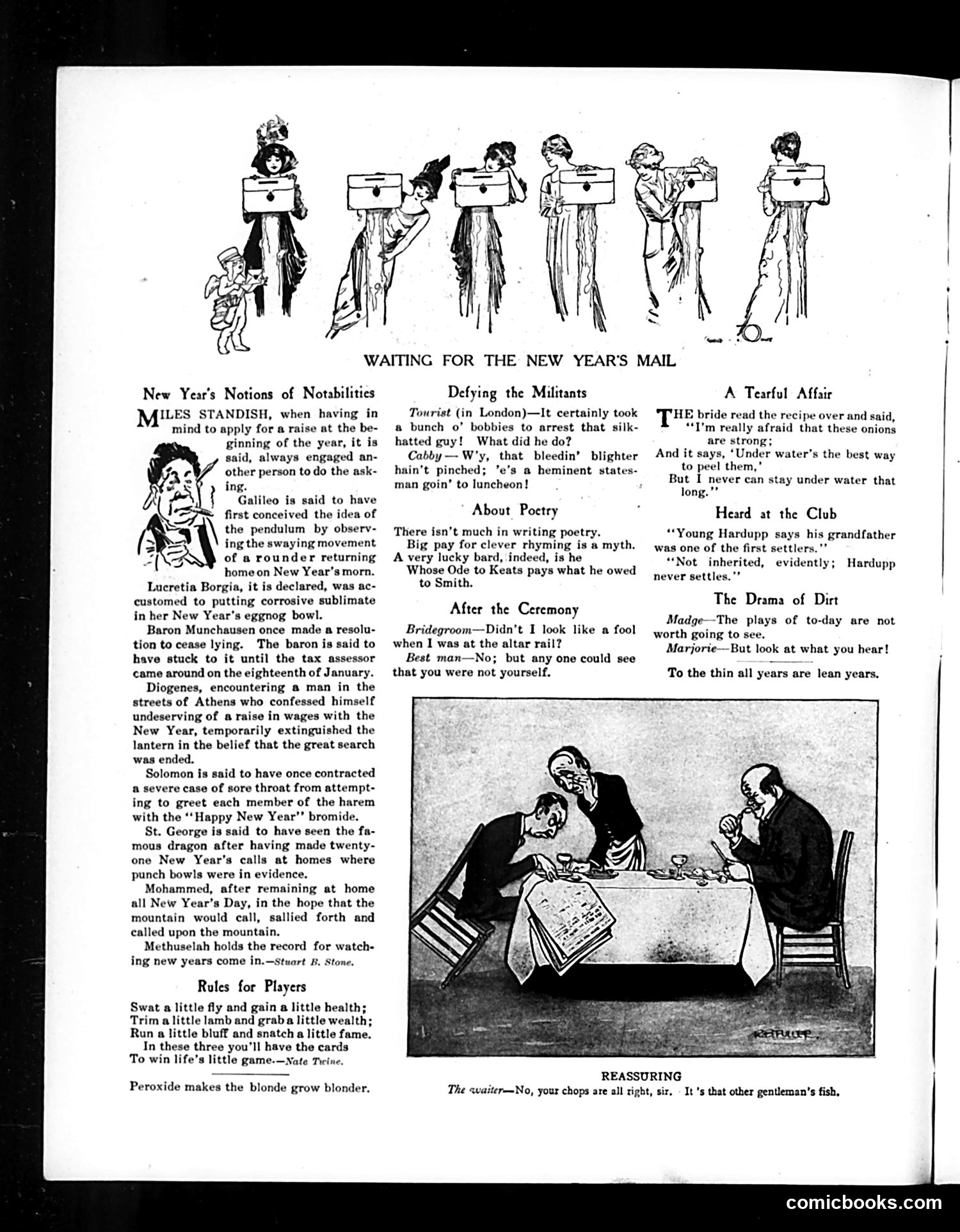
This page collects humorous brief anecdotes and quips typical of *Judge* magazine's satirical format. **"Waiting for the New Year's Mail"** (top illustration) shows women holding mailboxes, satirizing the New Year custom of receiving greeting cards and correspondence. **"New Year's Notions of Notabilities"** pairs historical/legendary figures with humorous anecdotes about New Year's behavior—Miles Standish avoiding asking for a raise himself, Lucretia Borgia poisoning eggnog, Baron Munchausen breaking a resolution to stop lying when the tax assessor arrives (implying he lies to avoid taxes), and Methuselah holding the longevity record for celebrating New Years. **"Defying the Militants"** references the British suffragette movement—a cabby explains a "silk-hatted" man arrested by police isn't a criminal but a prominent statesman, humorously equating suffragettes with lawbreakers. Other sections contain wordplay: "The Drama of Dirt" jokes that "thin" people experience "lean years," while "Reassuring" features a waiter insisting the customer's chops are fine—it's another diner's fish that's bad. The page is primarily humor and light satire rather than hard political commentary.
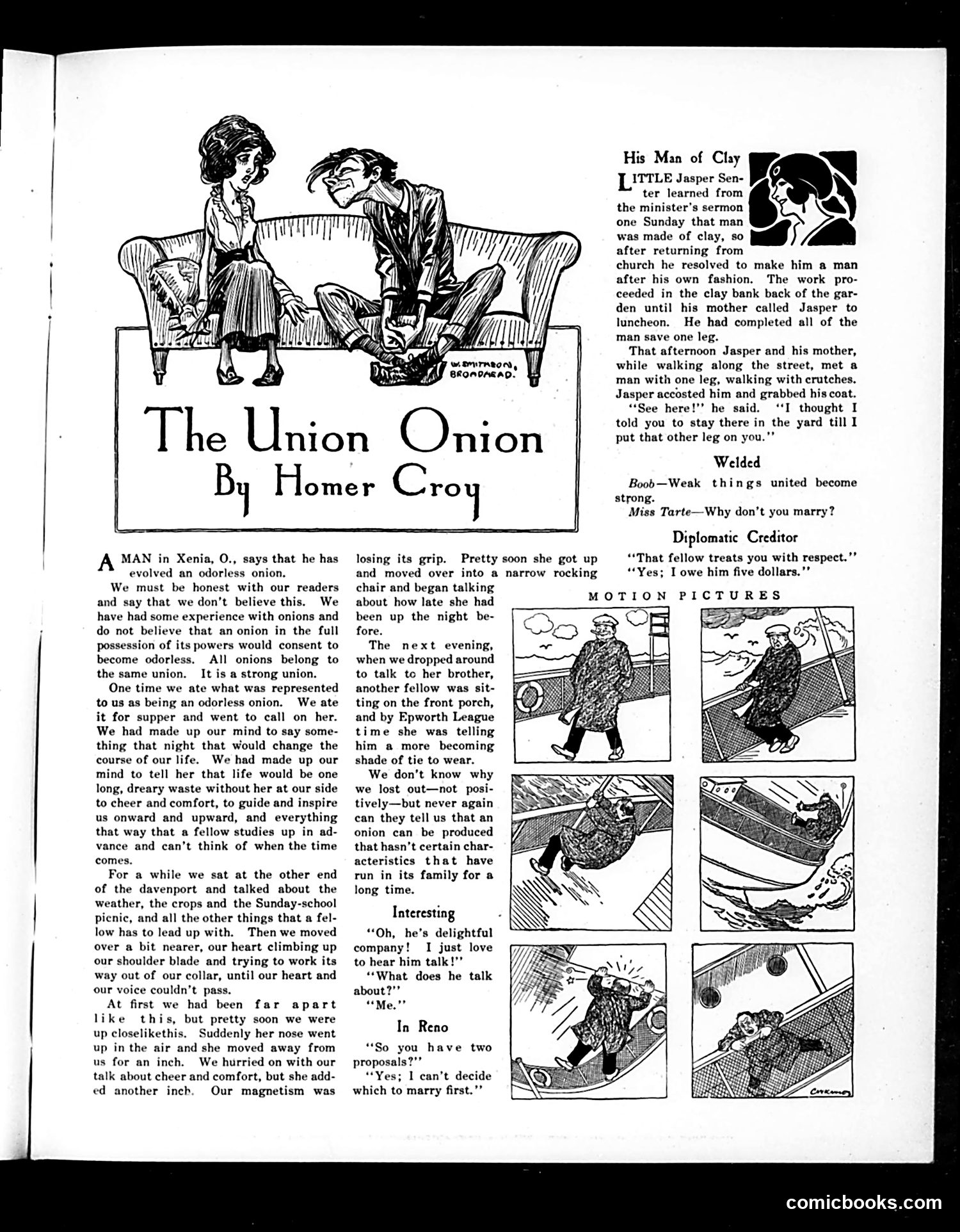
This is a humorous romantic story, not political satire. A man from Ohio claims to have bred an odorless onion, which the narrator dismisses as impossible—onions have a "union" (a pun on labor unions, which were prominent in early 20th-century America) and won't surrender their defining characteristic. The narrator recounts eating such an onion before a romantic visit. Despite his prepared speech about love, the woman detects the onion smell on his breath and progressively moves away from him, eventually losing interest entirely. She later accepts another suitor's courtship instead. The joke's point: no matter what anyone claims, onions cannot be truly de-odorized. Their nature is unchangeable—a metaphor for how our fundamental characteristics persist despite our wishes. The "union" reference humorously anthropomorphizes onions as a collective that protects their shared identity.
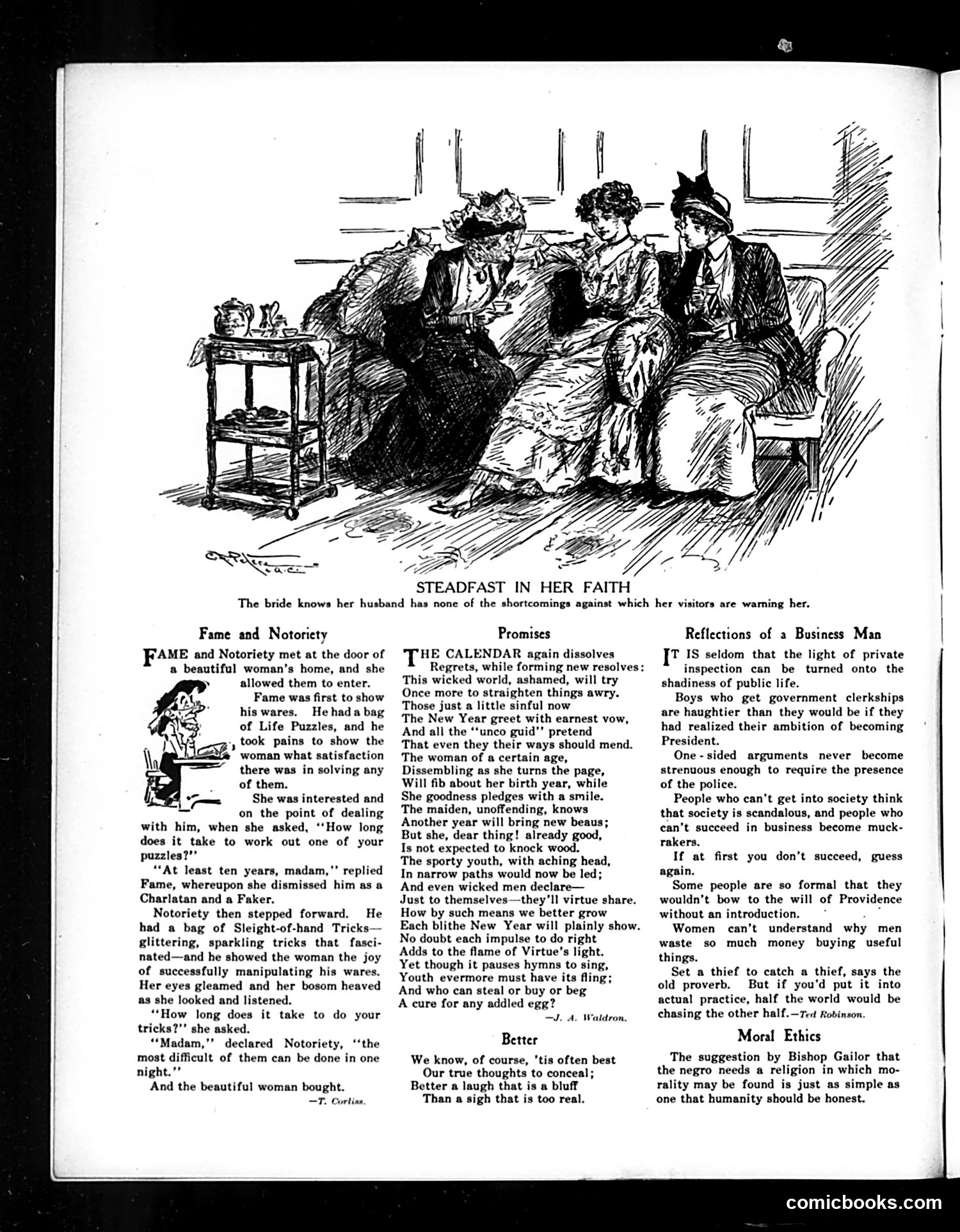
The top cartoon, "Steadfast in Her Faith," depicts a bride receiving visitors who warn her about her husband's character flaws. The caption's irony suggests the bride knows her husband lacks these supposed shortcomings—or perhaps that she's naive about his actual faults. It's a commentary on marital delusion or willful blindness in relationships. Below are five short satirical pieces. "Fame and Notoriety" compares two paths to recognition: Fame requires years of effort but lasting respect, while Notoriety delivers instant gratification through scandal. A woman chooses quick notoriety, satirizing society's preference for sensational shortcuts over genuine achievement. The remaining sections—"Promises," "Better," "Reflections of a Business Man," and "Moral Ethics"—are brief cynical observations about New Year's resolutions, social hypocrisy, government corruption, and racial issues. The tone throughout is skeptical of human nature and institutional integrity, typical of Judge's satirical approach to Progressive-era American society.
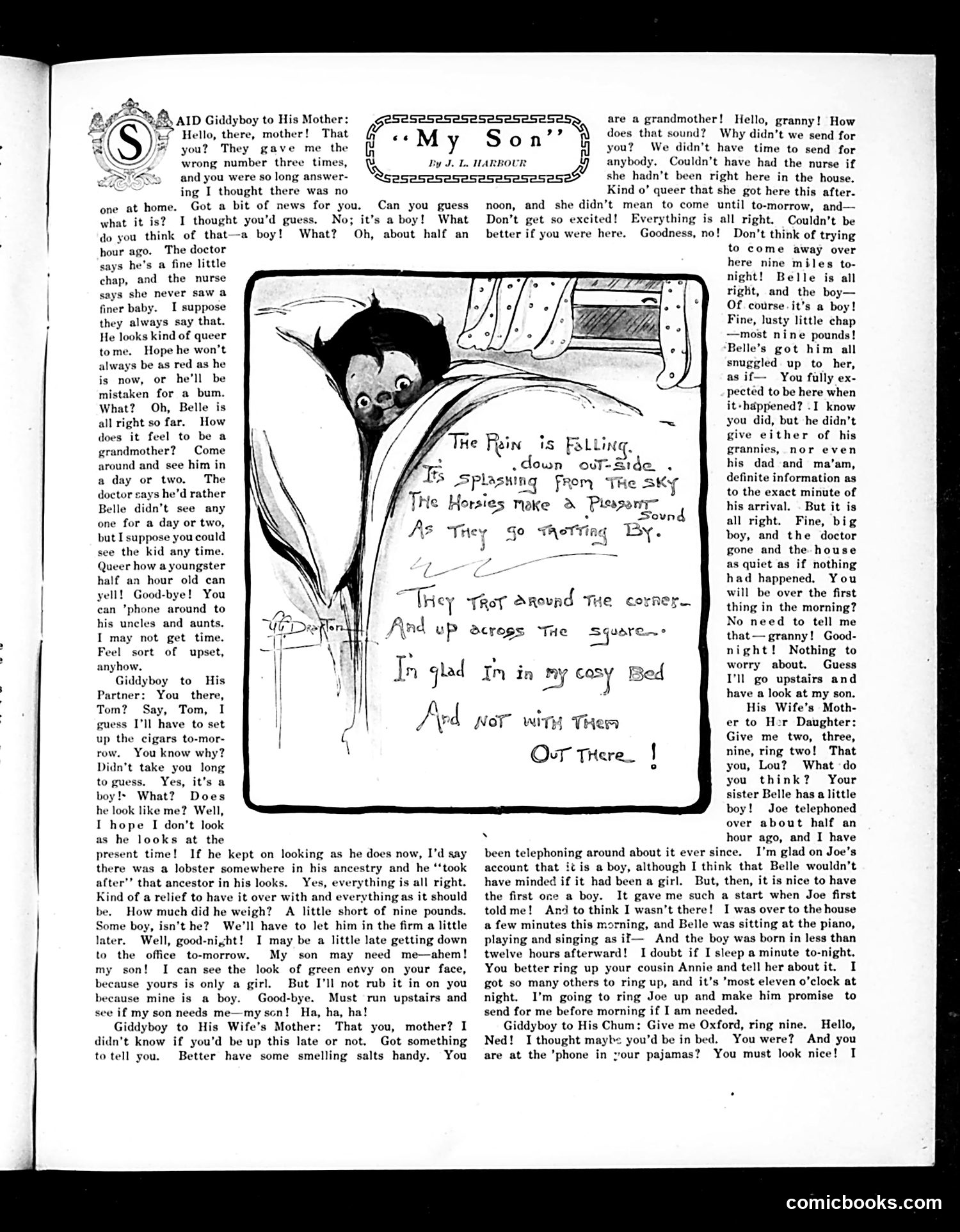
This is a humorous piece capturing a new father's telephone announcements about his newborn son, written from three perspectives: to his mother, to his business partner Tom, and to his mother-in-law. The satire targets the absurdity of male pride in producing a male heir. "Giddyboy" repeatedly emphasizes "it's a boy!" with almost manic excitement, contrasting sharply with his dismissive attitude toward his sister's daughter ("only a girl"). The joke satirizes paternal vanity—he obsesses over whether the baby resembles him (unfavorably comparing it to a lobster), plans to eventually bring the boy into the family business, and announces he'll "set up cigars" for colleagues. The cartoon illustration captures the newborn's perspective: rain, splashing, noise, and discomfort of the outside world versus the comfort of the mother's bed. This visual irony undercuts the father's grandiose pronouncements about the child's future importance. The humor relies on the gender politics and social expectations of early 20th-century America regarding male children as status symbols and business assets.
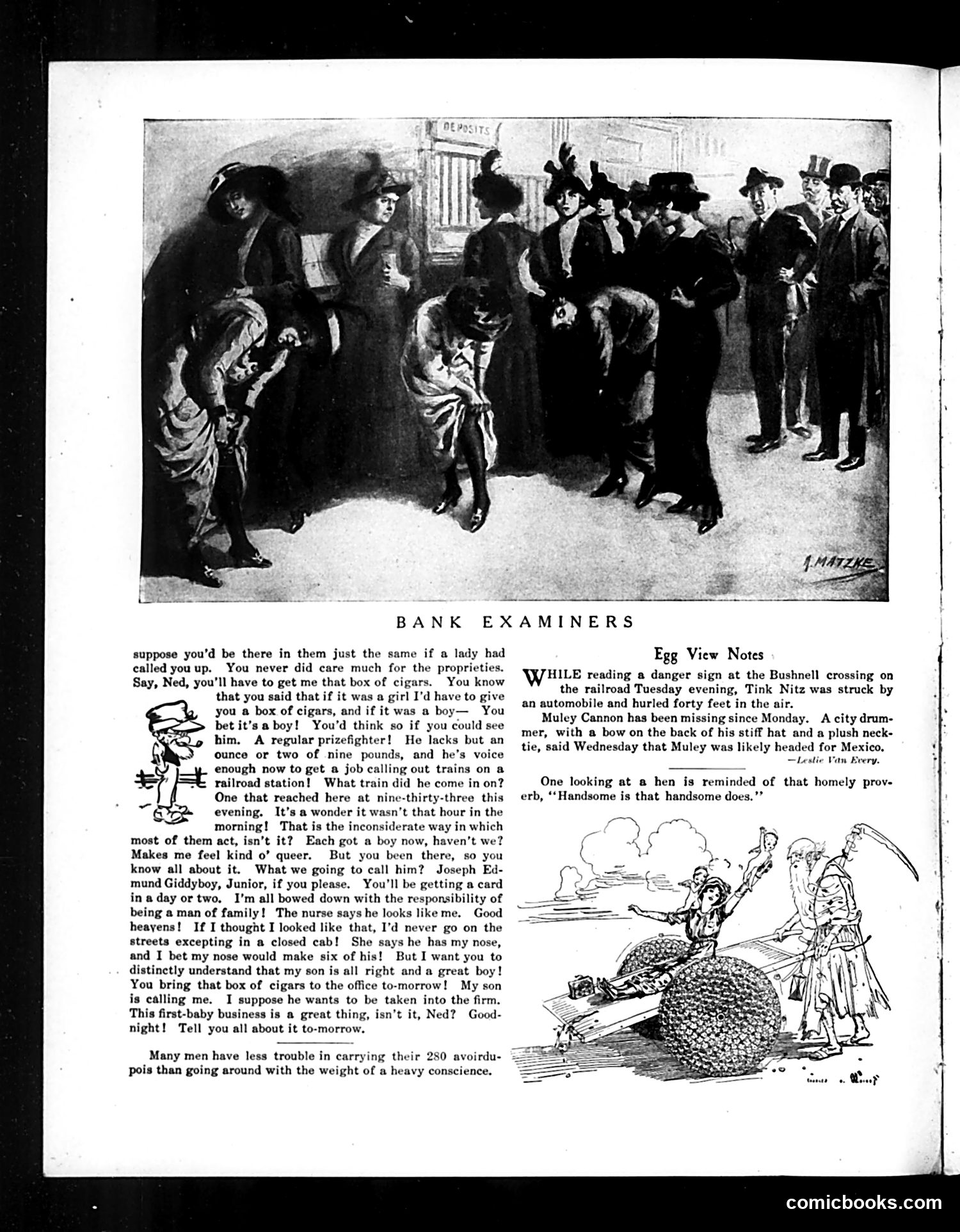
The top cartoon depicts bank examiners arriving at a financial institution—a commentary on regulatory oversight of banks during the early 20th century. The large crowd of formally dressed men and women suggests either public anxiety about bank inspections or satirical exaggeration of bureaucratic intrusion. The accompanying text is a humorous monologue by a new father bragging about his newborn son to a colleague named Ned, mixing personal pride with social pretension. The joke relies on the speaker's contradictions: he boasts the baby is "a regular prizefighter" yet denies he looks like himself; he claims his son is "all right and a great boy" while complaining the child is inconsiderately loud and demanding. The final line—"Many men have less trouble in carrying their 280 avoirdupois than going around with the weight of a heavy conscience"—suggests the cartoon's real target: the hypocrisy and moral compromise of men in banking and business who, like this new father, present false fronts while harboring guilt.
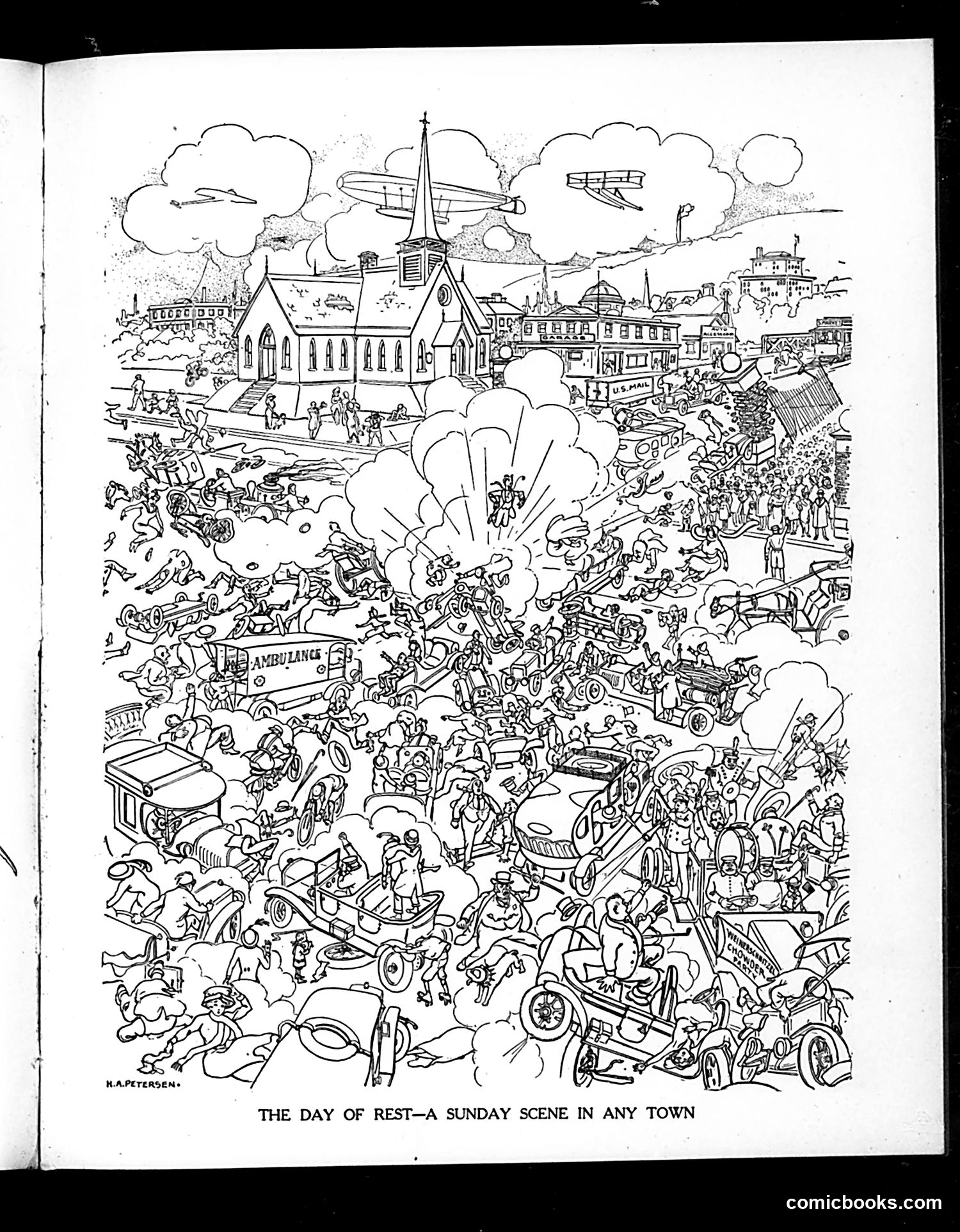
This cartoon by H.A. Petersen satirizes the chaos of American Sunday leisure culture. Despite the religious imagery—a prominent church with steeple dominates the background—the scene depicts pandemonium: crowds of people, vehicles (cars, motorcycles, bicycles), an ambulance, explosions, and general mayhem fill the streets. The satire's point: Sunday, supposedly a day of spiritual rest, has become a day of frenzied activity and danger. The ironic title contrasts the church's promise of peaceful rest with the actual bedlam of modern American recreation and traffic. The artist critiques how automobiles and consumerism have transformed the Sabbath into chaotic disorder rather than contemplative peace.
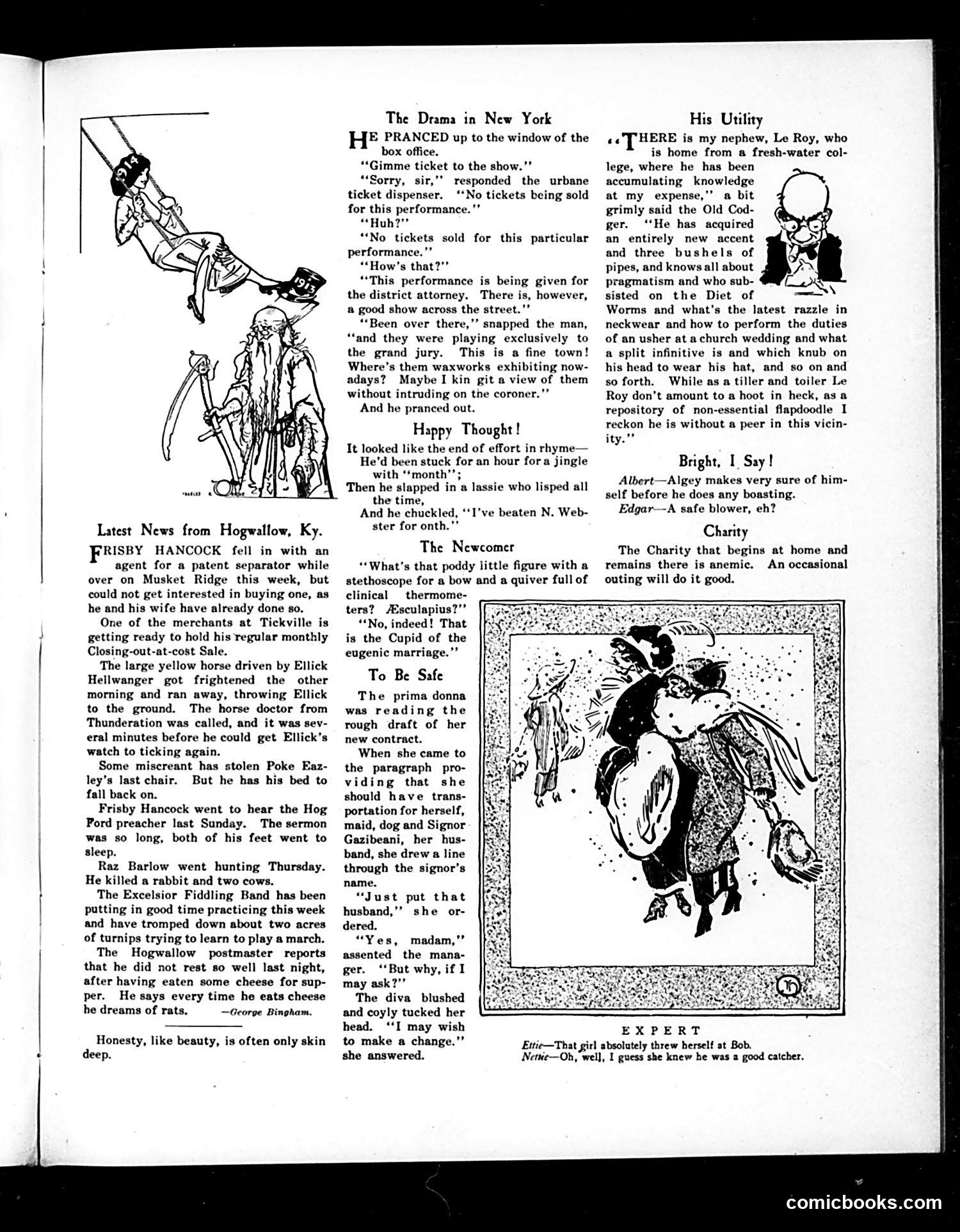
This page contains several satirical pieces mocking American life circa early 1900s: **"Latest News from Hogwallow, Ky."** ridicules rural life through absurd anecdotes—a merchant's perpetual "closing-out" sale, a horse doctor fixing a man's watch instead of the horse, stolen furniture. The humor targets unsophisticated country folk and their improbable misadventures. **"The Drama in New York"** satirizes urban corruption: a man seeking theater tickets discovers performances are reserved exclusively for district attorneys, grand juries, and coroners—suggesting these legal proceedings dominate the city. **"His Utility"** mocks over-educated but useless young men fresh from college, acquiring "pragmatism" and knowledge of split infinitives while contributing nothing practical. **"The Newcomer"** and other brief pieces employ standard magazine humor: wordplay, romantic complications, and social observations about marriage contracts and charity. The cartoons feature exaggerated line drawings typical of the era's satirical style, emphasizing physical comedy and social pretension.
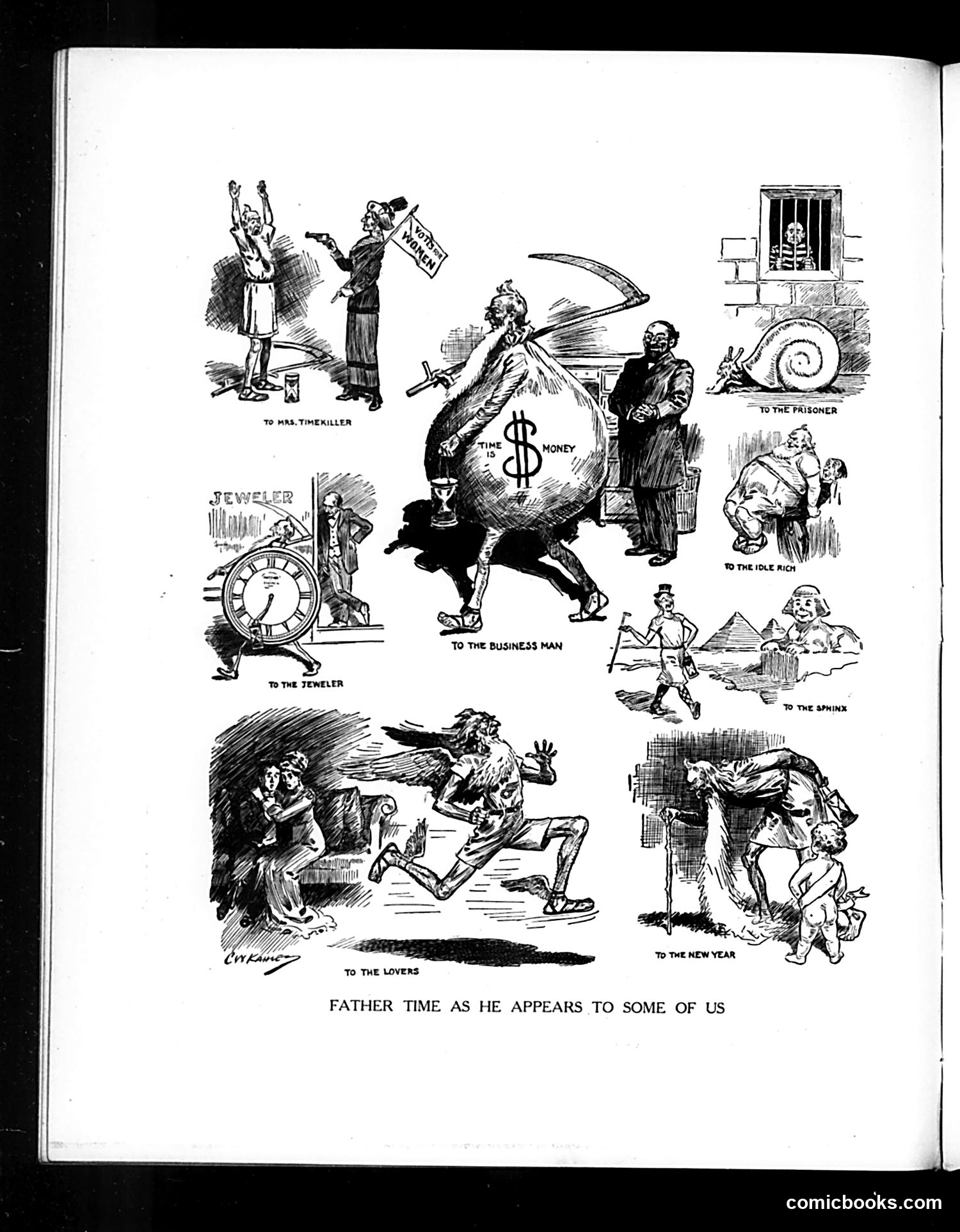
This satirical cartoon from *Judge* magazine presents personified "Father Time" as experienced by different social groups. The central figure—Time as a money bag with a scythe—illustrates how different classes perceive temporal passage. Each vignette shows Time's appearance to: the idle rich (indolent); the businessman (frantic, money-driven); the prisoner (justice/confinement); the jeweler (commercial); the time-killer (as entertainment); lovers (passionate); the sphinx (eternal mystery); the new year (chaotic); and the masses/working poor (oppressive). The satire critiques how capitalism and class position fundamentally alter perception of time itself—wealthy individuals experience leisure while working and imprisoned populations experience time as constraint, burden, or endless monotony. The cartoon mocks both social inequality and humanity's universal obsession with temporal measurement.
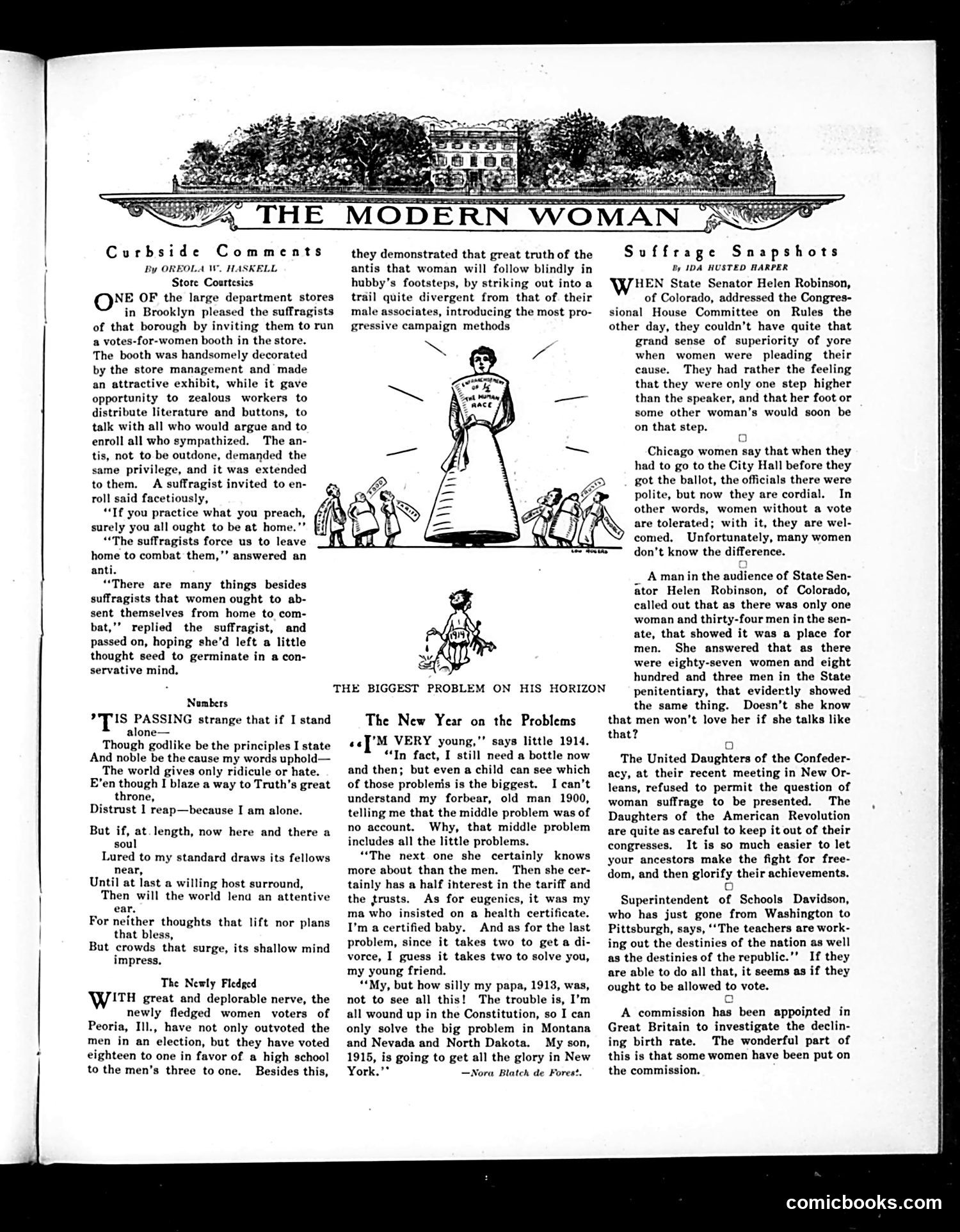
This page from Judge magazine presents early 1910s suffrage commentary through multiple sections: **Main Cartoons & Content:** The central illustration shows a tall woman suffragist figure surrounded by smaller figures, likely representing anti-suffragists or male opposition, visually depicting the power dynamic women were asserting. **Key Arguments:** - "Curbside Comments" describes a Brooklyn department store allowing both suffragists *and* anti-suffragists equal booth space—satirizing the "antis" (women opposed to suffrage) as hypocritical - "The Newly Fledged" mocks anti-suffragist claims that women blindly follow men, citing Peoria, Illinois women voters who outvoted men 18-to-1 on a school referendum—contradicting the antis' own argument - "Suffrage Snapshots" recounts State Senator Helen Robinson of Colorado testifying before Congress, describing congressmen's diminished sense of superiority **The Satire:** Judge uses these anecdotes to ridicule anti-suffrage arguments while celebrating women's demonstrated political independence and competence—arguing women voters actually *don't* blindly follow men, as opponents claimed.
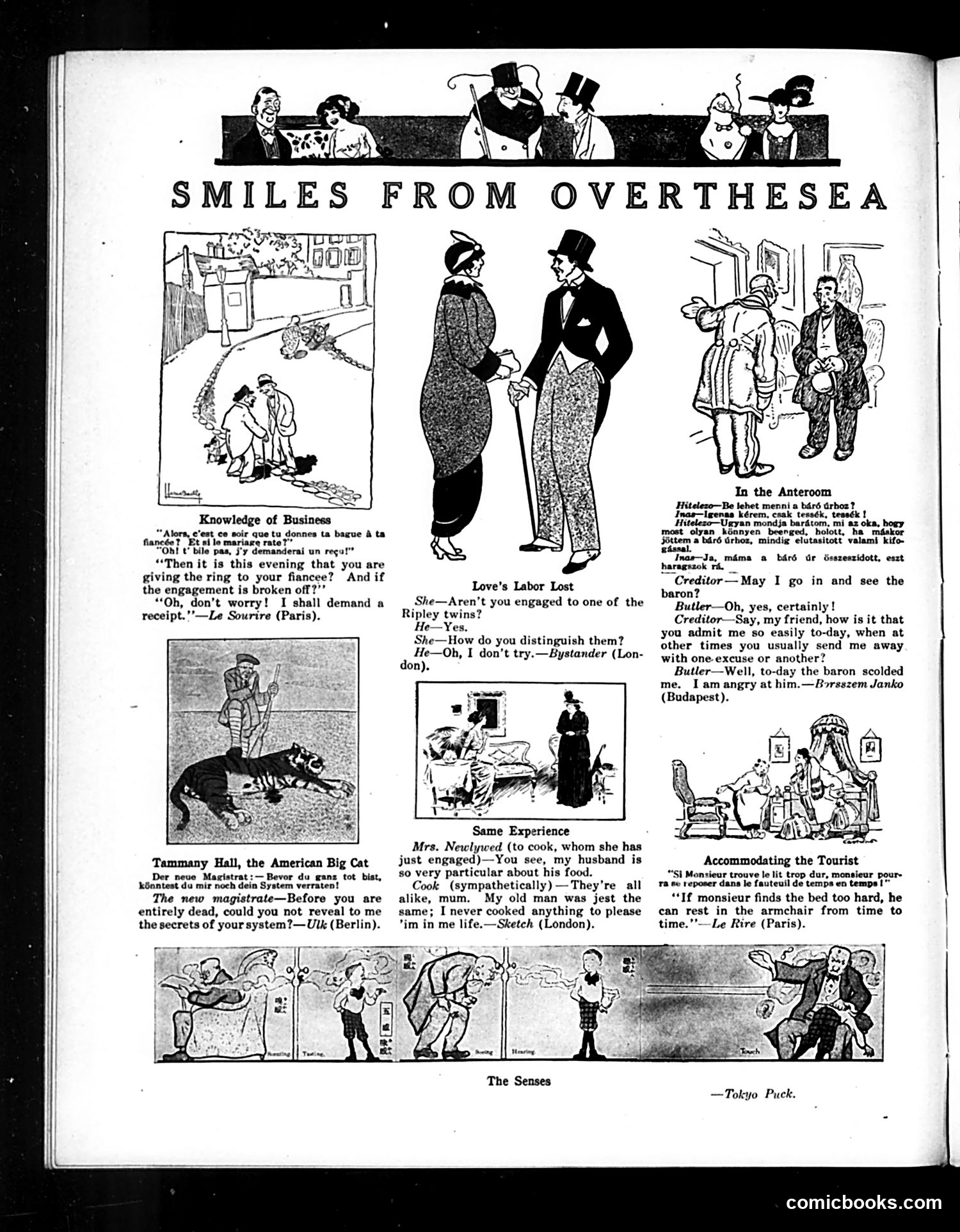
This page collects international humor reprinted from foreign satirical magazines (Paris, Berlin, London, Budapest, Tokyo). Each joke reflects period social attitudes: **"Knowledge of Business"** mocks a fiancé's mercenary caution—he demands a receipt for the engagement ring in case the wedding fails, treating romance as a business transaction. **"Tammany Hall, the American Big Cat"** references the corrupt New York political machine; a new magistrate urgently asks the dying boss to reveal his system of graft before he dies. **"Love's Labor Lost"** jokes about identical twins and relationship indifference—the engaged man can't distinguish his fiancée from her sister and doesn't bother trying. **"Same Experience"** shows class humor: a newly hired cook commiserates with her employer about husbands being impossible to please with food. The remaining sketches offer mild domestic comedy about creditors, hotel accommodations, and similar everyday situations. The page demonstrates early 20th-century Judge's practice of translating European humor for American readers.
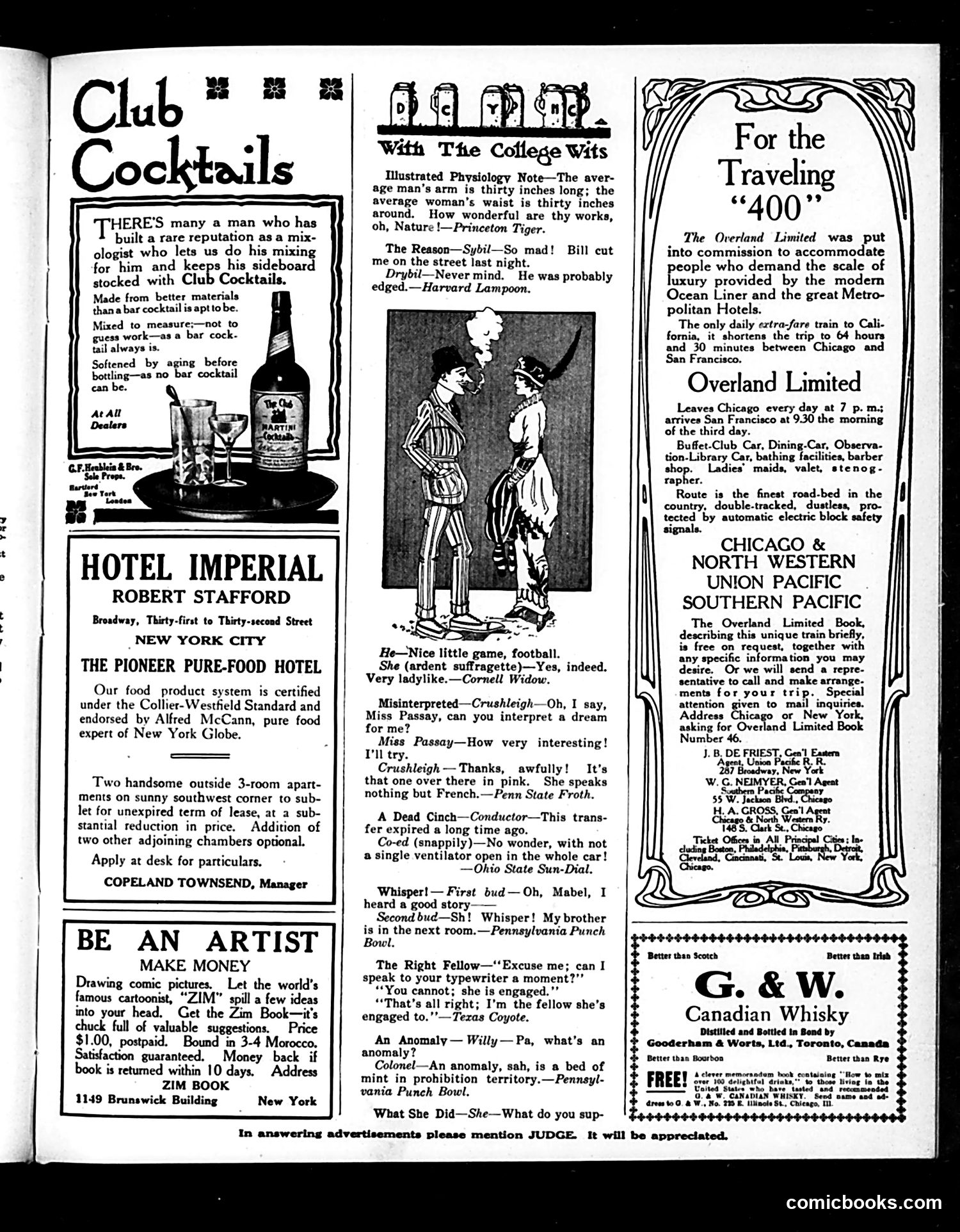
This page is primarily **advertisements and fillers** typical of Judge magazine's era. The content includes: **"Club Cocktails" Advertisement:** Promotes pre-mixed cocktails for home drinkers who lack bartending skill—a practical product reflecting Prohibition-era demand for convenient alcohol alternatives disguised as commercial sophistication. **"With The College Wits" Section:** A humor column featuring collegiate jokes satirizing college life and modern manners. Examples mock gender attitudes (woman's waist/man's arm comparison), suffragettes, conduct on trains, and social courtship rituals. The humor relies on contemporary college social conventions now unfamiliar. **"Overland Limited" Advertisement:** Pitches an luxury train route to California for wealthy travelers ("the 400" refers to Society's elite), emphasizing speed and amenities rivaling ocean liners. **Other Advertisements:** Hotels, art instruction, and Canadian whisky round out the page. No political cartoons appear. The page reflects 1920s-era consumer culture, gender dynamics, and social hierarchies through mostly period-specific collegiate humor and luxury advertising.
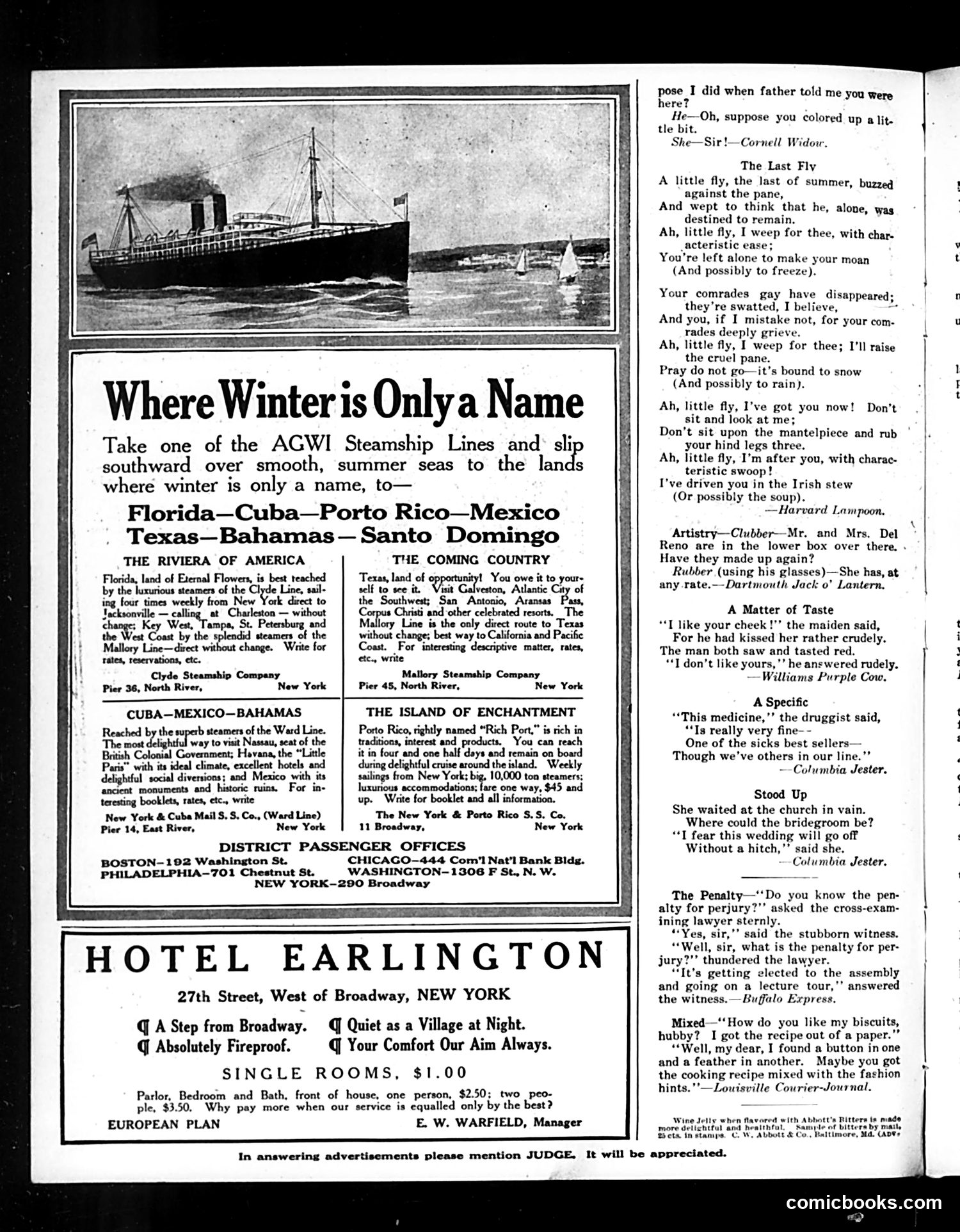
This page is primarily **advertising**, not political satire. It features steamship and hotel advertisements with minimal cartoon content. The small comedic vignettes on the right are light humor pieces unrelated to current events: - **"The Last Fly"** (Harvard Lampoon): A sentimental/comic poem about the season's final fly, anthropomorphizing it with human emotions about abandonment and winter. - **Short jokes** about social situations (a young woman coloring her cheeks, a couple reconciling, courtroom testimony about penury). The dominant content is **travel advertising** promoting Caribbean and southern U.S. steamship routes (Clyde Line, Ward Line, Mallory Line) and winter getaways to Florida, Cuba, and Puerto Rico—marketed as escapes where "winter is only a name." A hotel ad for the Earlington in Manhattan rounds out the page. There is **no political commentary or social satire** visible. This appears to be a typical Judge magazine page balancing light humor with commercial advertisements.
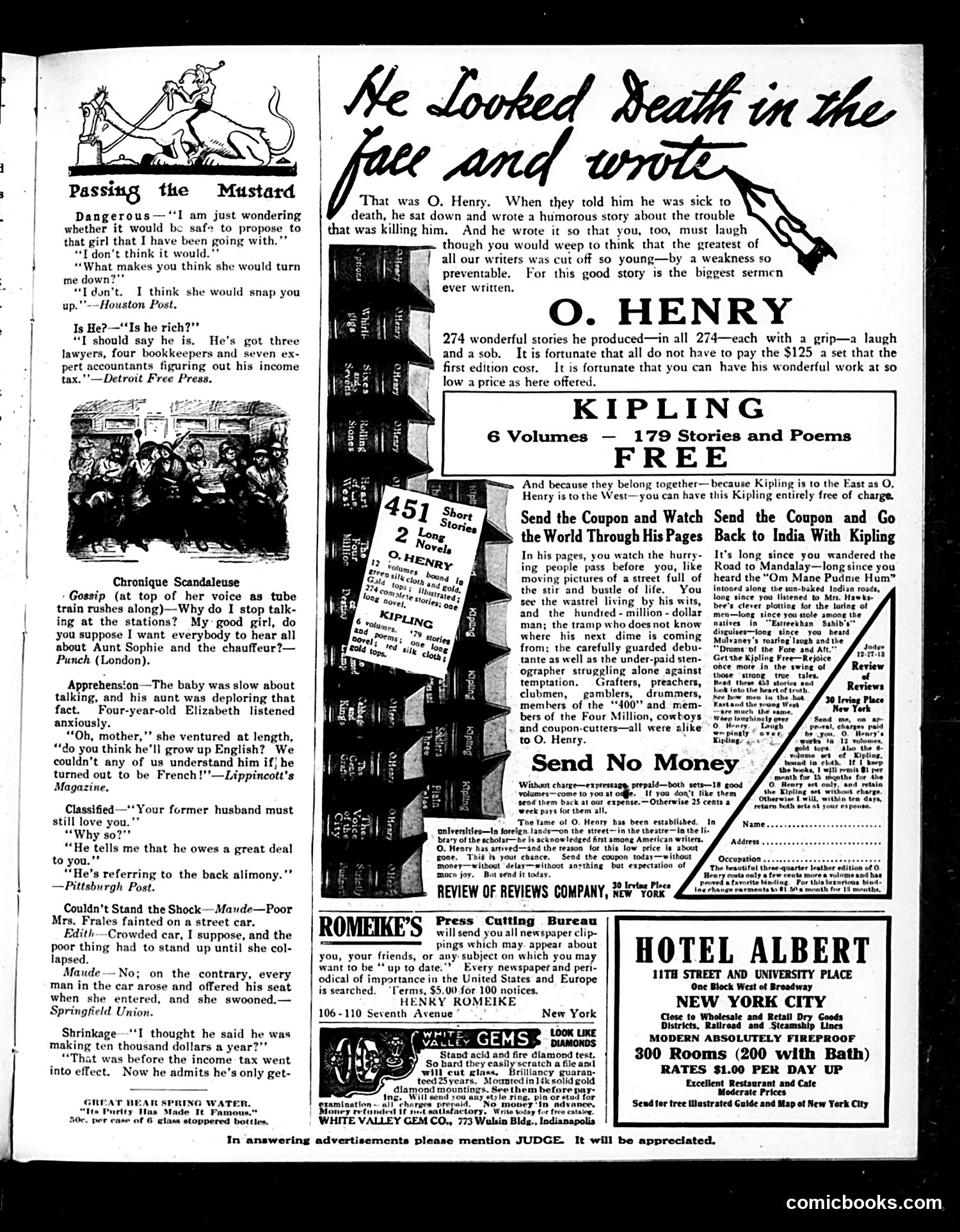
This page is primarily **advertising** rather than editorial content. The dominant feature is a book subscription offer for O. Henry's collected works (274 stories) bundled free with Rudyard Kipling's complete works (6 volumes, 179 stories/poems). The small comic snippets at left are filler—brief jokes about romance, wealth, taxes, and gossip that were standard Judge fare. They're unrelated to each other and appear to be reprinted quips from other publications (Houston Post, Detroit Free Press, Punch, etc.). The O. Henry tribute frames the offer as quasi-noble: Henry died young from preventable illness while writing humorous stories despite mortal illness. This emotional appeal justifies the "surprisingly" low price ($0.25/week). The Kipling connection is explained through parallel logic: both writers are canonical for their respective regions (Henry = American cities, Kipling = the East). The page contains no political cartoons or satire—it's a straightforward, emotionally manipulative direct-mail advertisement designed to capitalize on early-20th-century literary celebrity.
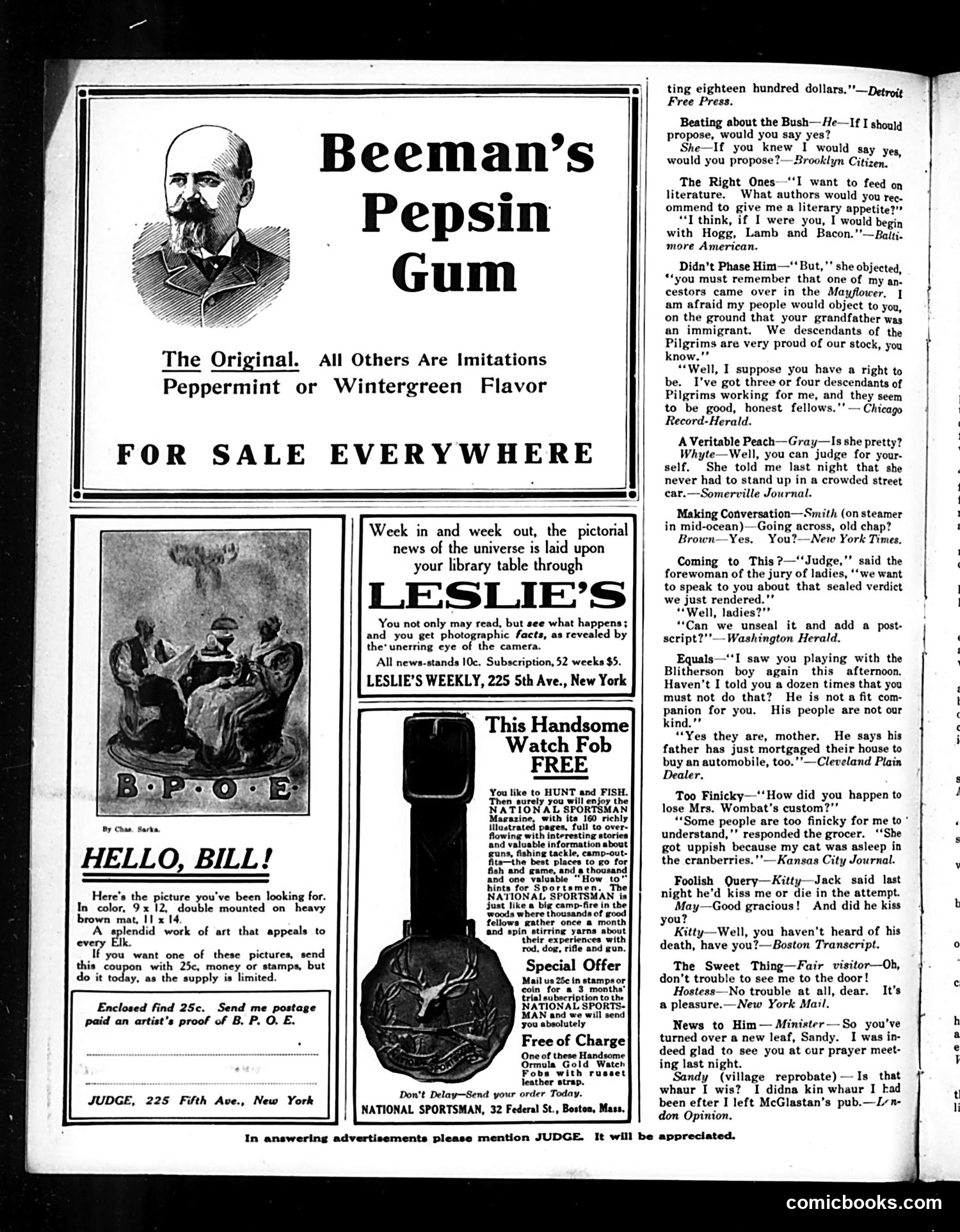
This page from *Judge* magazine contains mostly **advertisements and brief humorous anecdotes** rather than political cartoons. The main visual content includes ads for **Beeman's Pepsin Gum** (featuring a bearded man's portrait), **Leslie's Weekly**, a watch fob offer, and a "Hello, Bill!" Elk lodge picture. The cartoon strip **"B.O.P.O.E."** by Chic Sartis visible but difficult to read clearly. The text consists of short, punchy jokes on social topics typical of early 20th-century American humor: courtship rituals, immigrant ancestry snobbery, class consciousness, and gender relations. One recurring theme mocks **social pretension**—a woman boasting of Mayflower ancestry while her suitor's grandfather was an "immigrant," and a mother objecting to her daughter's beau because his father mortgaged their house for an automobile (implying nouveau riche desperation). The humor relies on wordplay and situational irony rather than political satire. This appears to be a relatively advertisement-heavy issue of the magazine.
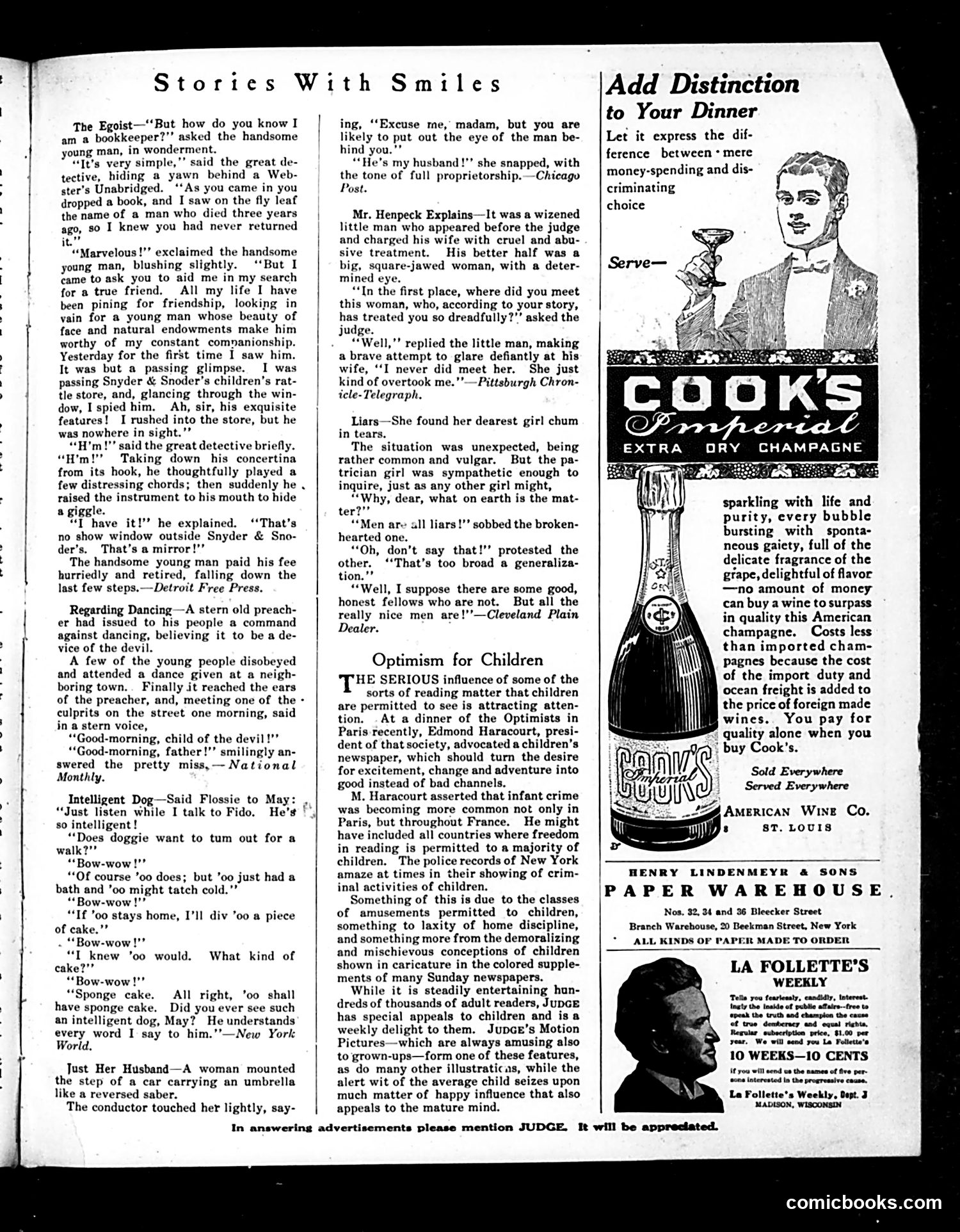
This page contains six brief humorous stories typical of early 20th-century American humor magazines, plus advertisements. **The stories satirize human folly:** "The Egoist" mocks vanity—a man seeks help finding a stranger he glimpsed, but a detective reveals he saw only his own reflection in a mirror. "Regarding Dancing" jokes about hypocrisy—a stern preacher condemns dancing as sinful, yet a young woman he catches attending responds cheerfully, deflating his moral authority. "Intelligent Dog" plays on owners' tendency to anthropomorphize pets, crediting a dog with understanding human speech when it merely responds to tone. "Just Her Husband" and "Mr. Henpeck Explains" depict marital dynamics where wives dominate—the woman weaponizes an umbrella against her husband; the henpecked husband describes being "overtaken" rather than courting his wife. "Liars" begins a story about women and dishonesty (text cuts off). The page also features Cook's Imperial Champagne and other period advertisements. These jokes reflect turn-of-the-century preoccupations with courtship, marriage power dynamics, and social pretension.
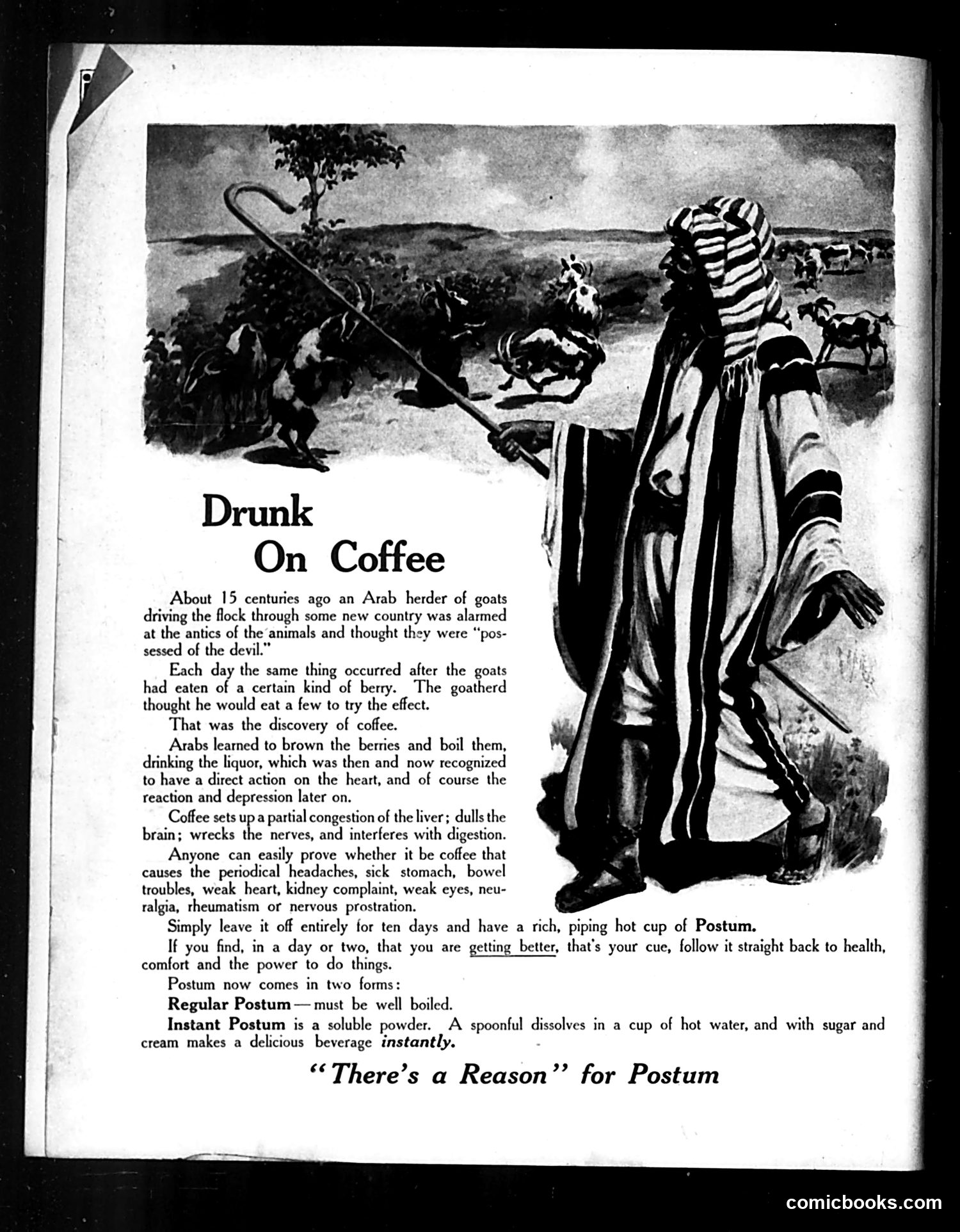
This is a **health advertisement** disguised as satirical content, not political satire. The "cartoon" shows an Arab figure (likely meant to evoke stereotypical orientalism) supposedly "possessed" by coffee's effects—the visual joke being that coffee makes one "drunk." The advertisement claims coffee causes serious ailments: liver congestion, nerve damage, headaches, weak heart, and "nervous prostration." It promotes **Postum**, a caffeine-free grain beverage alternative, as the cure. The pitch: stop coffee for ten days, drink Postum, and you'll improve—proving coffee caused your problems. This reflects early 20th-century health anxiety marketing. The Arab origin story lends the "legend" exotic credibility while subtly reinforcing period racial attitudes. The entire piece is designed to scare readers into switching beverages, using pseudoscientific health claims common to that era's advertising.

I'm unable to provide a meaningful analysis of this page. The image is almost entirely black with only a white edge visible on the left side, making it impossible to discern any cartoon artwork, caricatures, text, or satirical content that would typically appear in a Judge magazine page. The only legible element is the "comicbooks.com" watermark at the bottom right. To provide the historical and contextual analysis you've requested, I would need a clearer, properly exposed image where the actual cartoon(s) and accompanying text are visible. If you have a better version of this page, I'd be happy to analyze it according to your guidelines.