
Judge, 1913-12-27 · page 10 of 25
Judge — December 27, 1913 — page 10: what you’re looking at
What you’re looking at
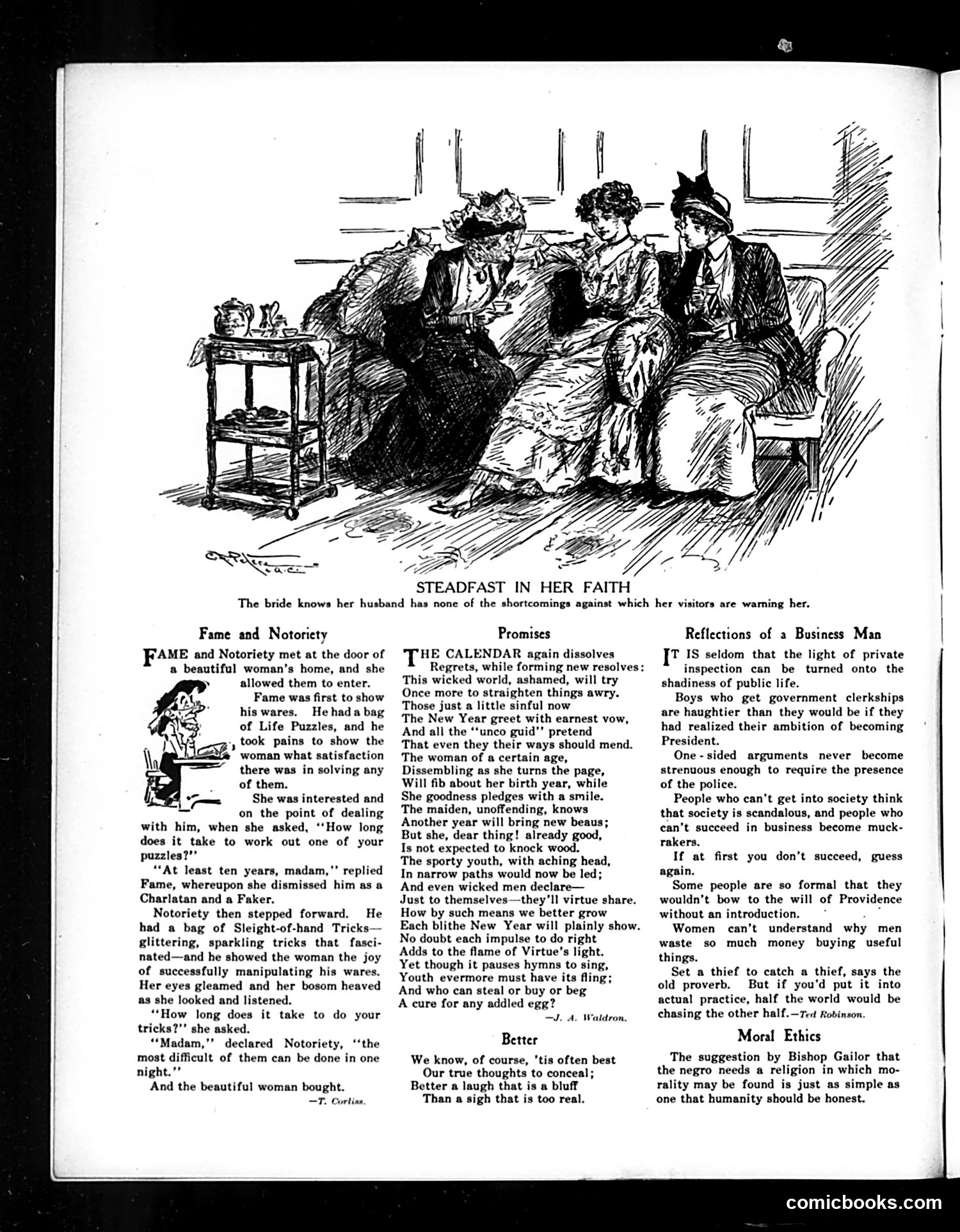
The top cartoon, "Steadfast in Her Faith," depicts a bride receiving visitors who warn her about her husband's character flaws. The caption's irony suggests the bride knows her husband lacks these supposed shortcomings—or perhaps that she's naive about his actual faults. It's a commentary on marital delusion or willful blindness in relationships. Below are five short satirical pieces. "Fame and Notoriety" compares two paths to recognition: Fame requires years of effort but lasting respect, while Notoriety delivers instant gratification through scandal. A woman chooses quick notoriety, satirizing society's preference for sensational shortcuts over genuine achievement. The remaining sections—"Promises," "Better," "Reflections of a Business Man," and "Moral Ethics"—are brief cynical observations about New Year's resolutions, social hypocrisy, government corruption, and racial issues. The tone throughout is skeptical of human nature and institutional integrity, typical of Judge's satirical approach to Progressive-era American society.
📄 Transcribed text from this page (OCR, searchable)
Machine-transcribed from the original scan — historical spelling and the odd misread are preserved.
STEADFAST IN HER FAITH The bride knows her husband has none of the shortcomings against which her visitors are warming her. Fame and Notoriety FAME and Notoriety met at the door of a beautiful woman's home, and she allowed them to enter. Fame was first to show his wares. He hada bag of Life Puzzles, and he , took pains to show the woman what satisfaction there was in solving any of them. She was interested and on the point of dealing with him, when she asked, ‘‘How long does it take to work out one of your puzzles?’’ “At least ten years, madam,”’ replied Fame, whereupon she dismissed him as a Charlatan and a Faker. Notoriety then stepped forward. He had a bag of Sleight-of-hand Tricks— glittering, sparkling tricks that fasci- nated—and he showed the woman the joy of successfully manipulating his wares. Her eyes gleamed and her bosom heaved as she looked and listened. ‘How long does it take to do your tricks?”’ she asked. “‘Madam,"’ declared Notoriety, ‘‘the most difficult of them can be done in one night."” And the beautiful woman bought. —T. Cortina, Promises THE CALENDAR again dissolves Regrets, while forming new resolves: This wicked world, ashamed, will try Once more to straighten things awry. Those just a little sinful now The New Year greet with earnest vow, And all the ‘‘unco guid’’ pretend That even they their ways should mend. The woman of a certain age, Dissembling as she turns the page, Will fib about her birth year, while She goodness pledges with a smile. The maiden, unoffending, knows Another year will bring new beaus; But she, dear thing! already good, Is not expected to knock wood. The sporty youth, with aching head, In narrow paths would now be led; And even wicked men declare— Just to themselves—they’ll virtue share. How by such means we better grow Each blithe New Year will plainly show. No doubt each impulse to do right Adds to the flame of Virtue’s light. Yet though it pauses hymns to sing, Youth evermore must have its fling; And who can steal or buy or beg A cure for any addled egg? J. A. Waldron. Better We know, of course, ‘tis often best Our true thoughts to conceal; Better a laugh that is a bluff Than a sigh that is too real. Reflections of a Business Man T IS seldom that the light of private inspection can be turned onto the shadiness of public life. Boys who get government clerkships are haughtier than they would be if they had realized their ambition of becoming President. One -sided arguments never become strenuous enough to require the presence of the police. People who can't get into society think that society is scandalous, and people who can’t succeed in business become muck- rakers. If at first you don’t succeed, guess again. Some people are so formal that they wouldn’t bow to the will of Providence without an introduction. . Women can’t understand why men waste so much money buying useful things. Set a thief to catch a thief, says the old proverb. But if you'd put it into actual practice, half the world would be chasing the other half.—Ted Robinson. Moral Ethics The suggestion by Bishop Gailor that the negro needs a religion in which mo- rality may be found is just as simple as one that humanity should be honest. comicbooks.com