
Judge, 1913-12-27 · page 17 of 25
Judge — December 27, 1913 — page 17: what you’re looking at
What you’re looking at
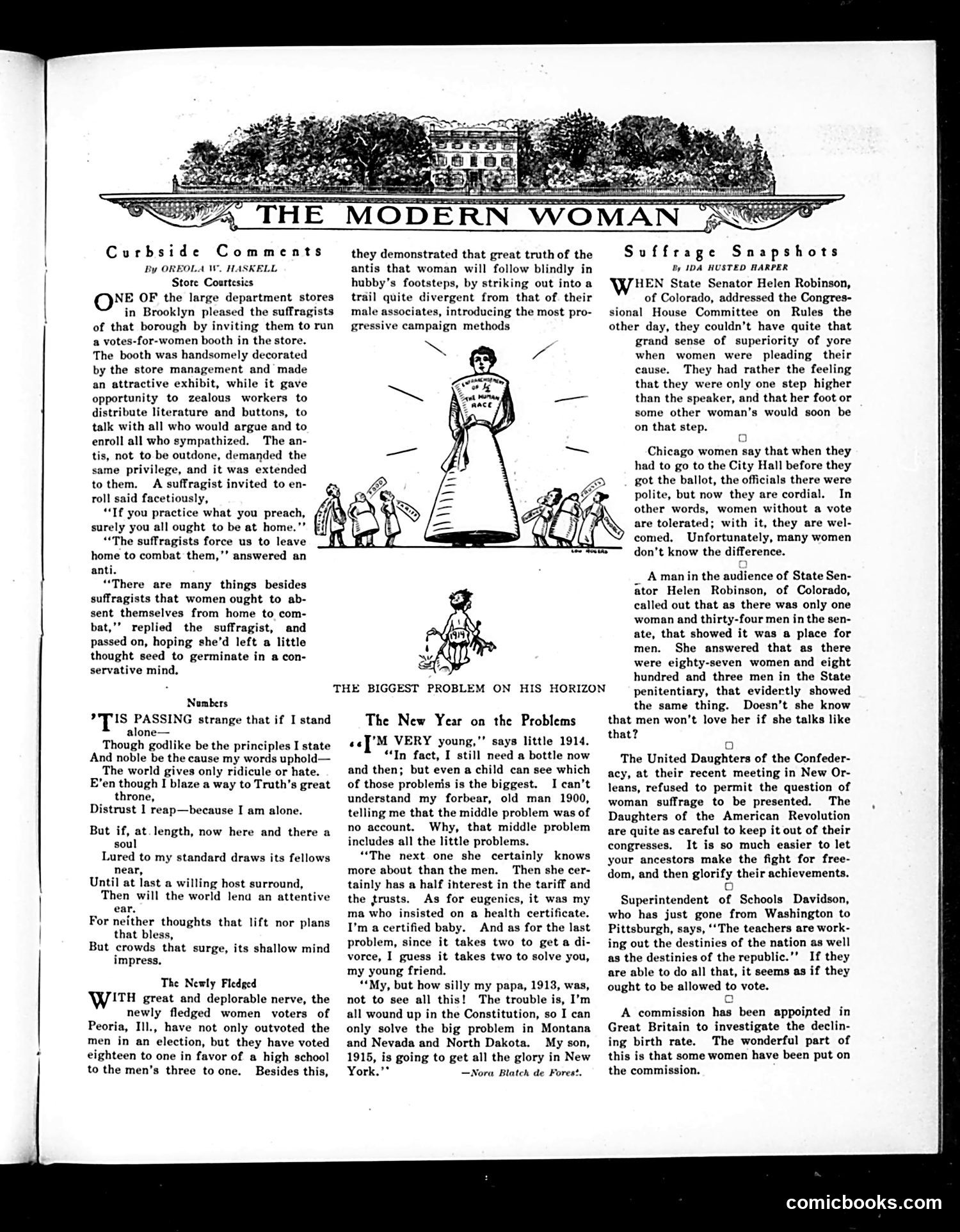
This page from Judge magazine presents early 1910s suffrage commentary through multiple sections: **Main Cartoons & Content:** The central illustration shows a tall woman suffragist figure surrounded by smaller figures, likely representing anti-suffragists or male opposition, visually depicting the power dynamic women were asserting. **Key Arguments:** - "Curbside Comments" describes a Brooklyn department store allowing both suffragists *and* anti-suffragists equal booth space—satirizing the "antis" (women opposed to suffrage) as hypocritical - "The Newly Fledged" mocks anti-suffragist claims that women blindly follow men, citing Peoria, Illinois women voters who outvoted men 18-to-1 on a school referendum—contradicting the antis' own argument - "Suffrage Snapshots" recounts State Senator Helen Robinson of Colorado testifying before Congress, describing congressmen's diminished sense of superiority **The Satire:** Judge uses these anecdotes to ridicule anti-suffrage arguments while celebrating women's demonstrated political independence and competence—arguing women voters actually *don't* blindly follow men, as opponents claimed.
📄 Transcribed text from this page (OCR, searchable)
Machine-transcribed from the original scan — historical spelling and the odd misread are preserved.
Curbside Comments By OREOLA W. HASKELL Store Courtesics ONE OF the large department stores in Brooklyn pleased the suffragists of that borough by inviting them to run a votes-for-women booth in the store. The booth was handsomely decorated by the store management and made an attractive exhibit, while it gave opportunity to zealous workers to distribute literature and buttons, to talk with all who would argue and to enroll all who sympathized. The an- tis, not to be outdone, demanded the same privilege, and it was extended tothem. A suffragist invited to en- roll said facetiously, “If you practice what you preach, surely you all ought to be at home.’’ “The suffragists force us to leave home to combat them,’’ answered an anti. “There are many things besides suffragists that women ought to ab- sent themselves from home to com- bat,”’ replied the suffragist, and passed on, hoping she'd left a little thought seed to germinate in a con- servative mind, Nombers Tis PASSING strange that if I stand alone— Though godlike be the principles I state And noble be the cause my words uphold— The world gives only ridicule or hate. E’en though I blaze a way to Truth’s great throne, Distrust 1 reap—because I am alone. But if, at. length, now here and there a soul Lured to my standard draws its fellows near, Until at last a willing host surround, Then will the world lena an attentive ear. For neither thoughts that lift nor plans that bless, But crowds that surge, its shallow mind impress, The Newly Fledged ITH great and deplorable nerve, the newly fledged women voters of Peoria, Ill., have not only outvoted the men in an election, but they have voted eighteen to one in favor of a high school to the men’s three to one. Besides this, they demonstrated that great truth of the antis that woman will follow blindly in hubby’s footsteps, by striking out into a trail quite divergent from that of their male associates, introducing the most pro- e campaign methods THE BIGGEST PROBLEM ON HIS HORIZON The New Year on the Problems oo] ™M VERY young,"’ says little 1914. “In fact, I still need a bottle now and then; but even a child can see which of those problenis is the biggest. I can’t understand my forbear, old man 1900, telling me that the middle problem was of no account. Why, that middle problem includes all the little problems. “The next one she certainly knows more about than the men. Then she cer- tainly has a half interest in the tariff and the trusts. As for eugenics, it was my ma who insisted on a health certificate. I’m a certified baby. And as for the last problem, since it takes two to get a di- vorce, I guess it takes two to solve you, my young friend. “My, but how silly my papa, 1913, was, not to see all this! The trouble is, I’m all wound up in the Constitution, so I can only solve the big problem in Montana and Nevada and North Dakota. My son, 1915, is going to get all the glory in New York.’* —Nora Blatch de Fores. Suffrage Snapshots By IDA HUSTED HARPER WHEN State Senator Helen Robinson, of Colorado, addressed the Congres- sional House Committee on Rules the other day, they couldn’t have quite that grand sense of superiority of yore when women were pleading their cause. They had rather the feeling that they were only one step higher than the speaker, and that her foot or some other woman's would soon be on that step. o Chicago women say that when they had to go to the City Hall before they got the ballot, the officials there were polite, but now they are cordial. In other words, women without a vote are tolerated; with it, they are wel- comed, Unfortunately, many women don’t know the difference. A man in the audience of State Sen- ator Helen Robinson, of Colorado, called out that as there was only one woman and thirty-four men in the sen- ate, that showed it was a place for men. She answered that as there were eighty-seven women and eight hundred and three men in the State penitentiary, that evidertly showed the same thing. Doesn’t she know that men won't love her if she talks like that? e) The United Daughters of the Confeder- acy, at their recent meeting in New Or- leans, refused to permit the question of woman suffrage to be presented. The Daughters of the American Revolution are quite as careful to keep it out of their congresses, It is so much easier to let your ancestors make the fight for free- dom, and then glorify their achievements. oO Superintendent of Schools Davidson, who has just gone from Washington to Pittsburgh, says, ‘‘The teachers are work- ing out the destinies of the nation as well as the destinies of the republic."’ If they are able to do all that, it seems as if they ought to be allowed to vote. A commission has been appointed in Great Britain to investigate the declin- ing birth rate. The wonderful part of this is that some women have been put on the commission. comicbooks.com