
A complete issue · 24 pages · 1913
Judge — June 21, 1913
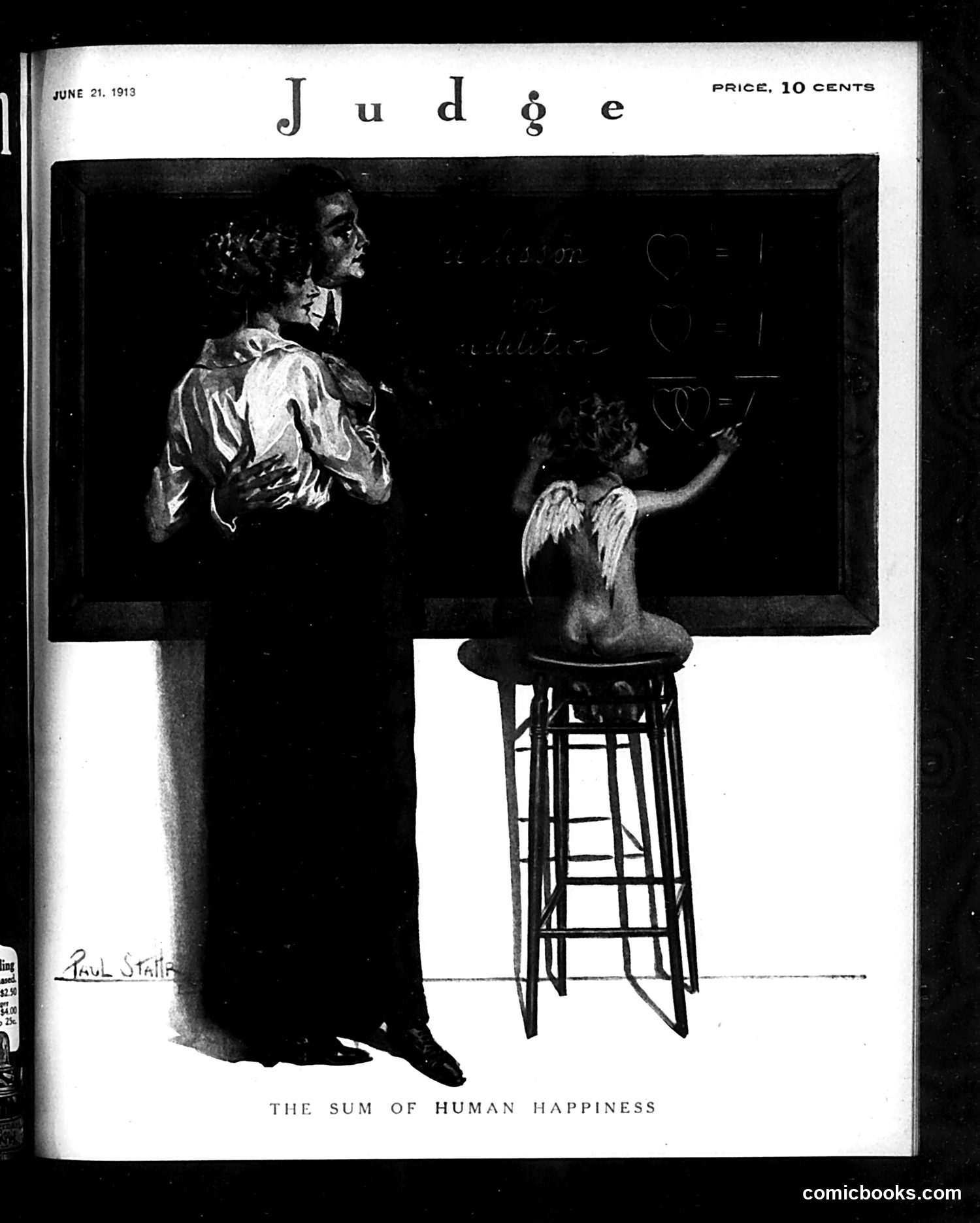
This Judge magazine cover from June 21, 1913, presents satirical commentary on mathematics and human contentment. The illustration shows an adult man observing a cherubic child (depicted with wings, suggesting innocence or purity) writing equations on a blackboard. The child appears to be solving mathematical problems while the adult watches approvingly. The title "The Sum of Human Happiness" suggests ironic commentary—likely mocking the era's faith in scientific rationalism and mathematical solutions to social problems. The juxtaposition of childlike simplicity with complex formulas implies skepticism about whether human happiness can be reduced to mathematical calculation. This reflects early 20th-century tensions between scientific progress and humanistic values. The artwork is credited to Paul Stahr.
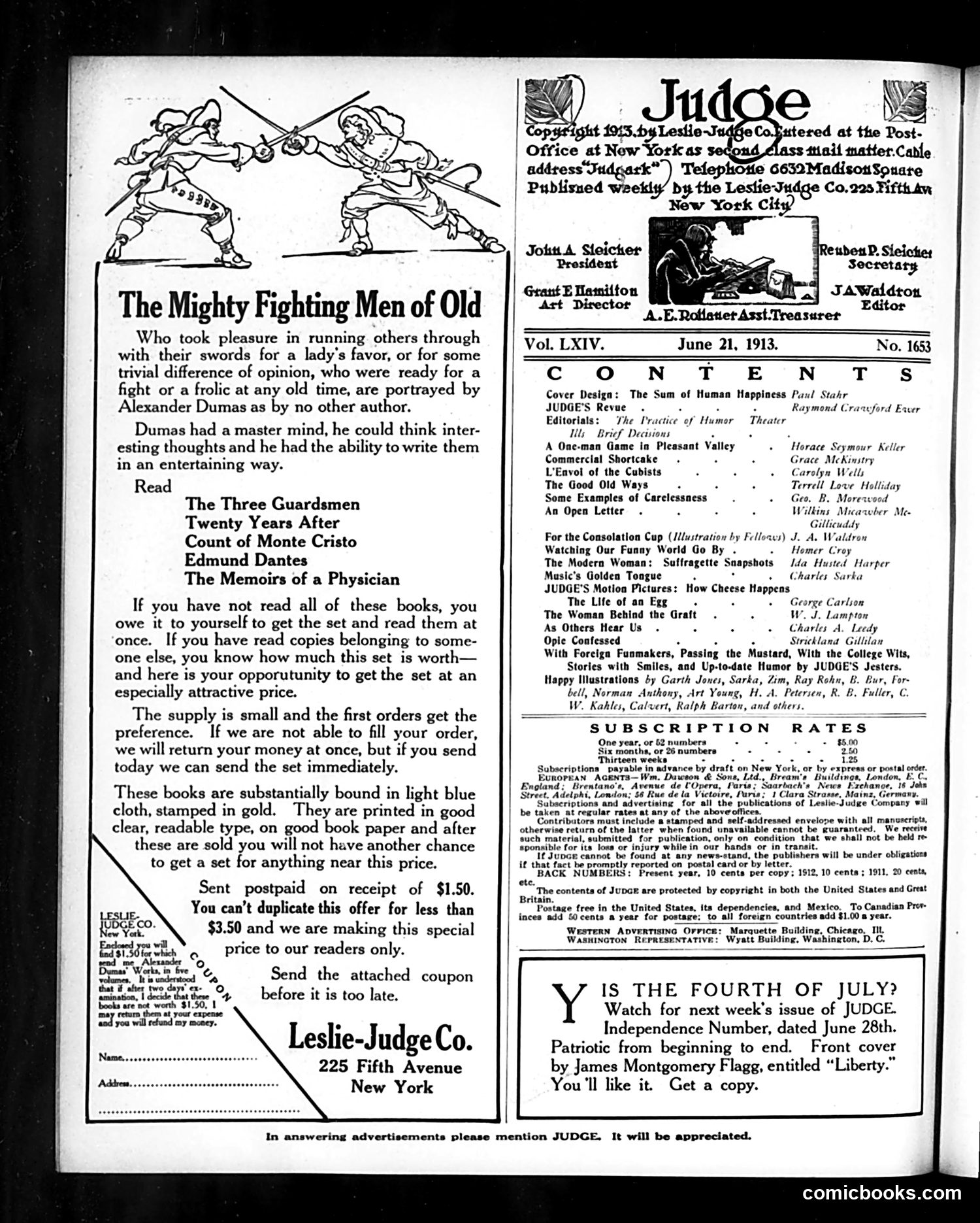
**The Left Page:** This is primarily advertising for Leslie-Judge Company promoting a collection of Alexandre Dumas novels (including "The Three Guardsmen," "Count of Monte Cristo," and "Edmund Dantes"). The cartoon at top shows two men in period costume engaged in a sword fight, illustrating the swashbuckling adventure tales being sold. **The Right Page:** The masthead and contents listing dominate. A promotional box at bottom announces next week's Independence Day issue (June 28th) with a patriotic front cover by James Montgomery Flagg titled "Liberty." The page is primarily commercial rather than political satire. No specific political figures or contemporary events appear to be referenced in the visible content.
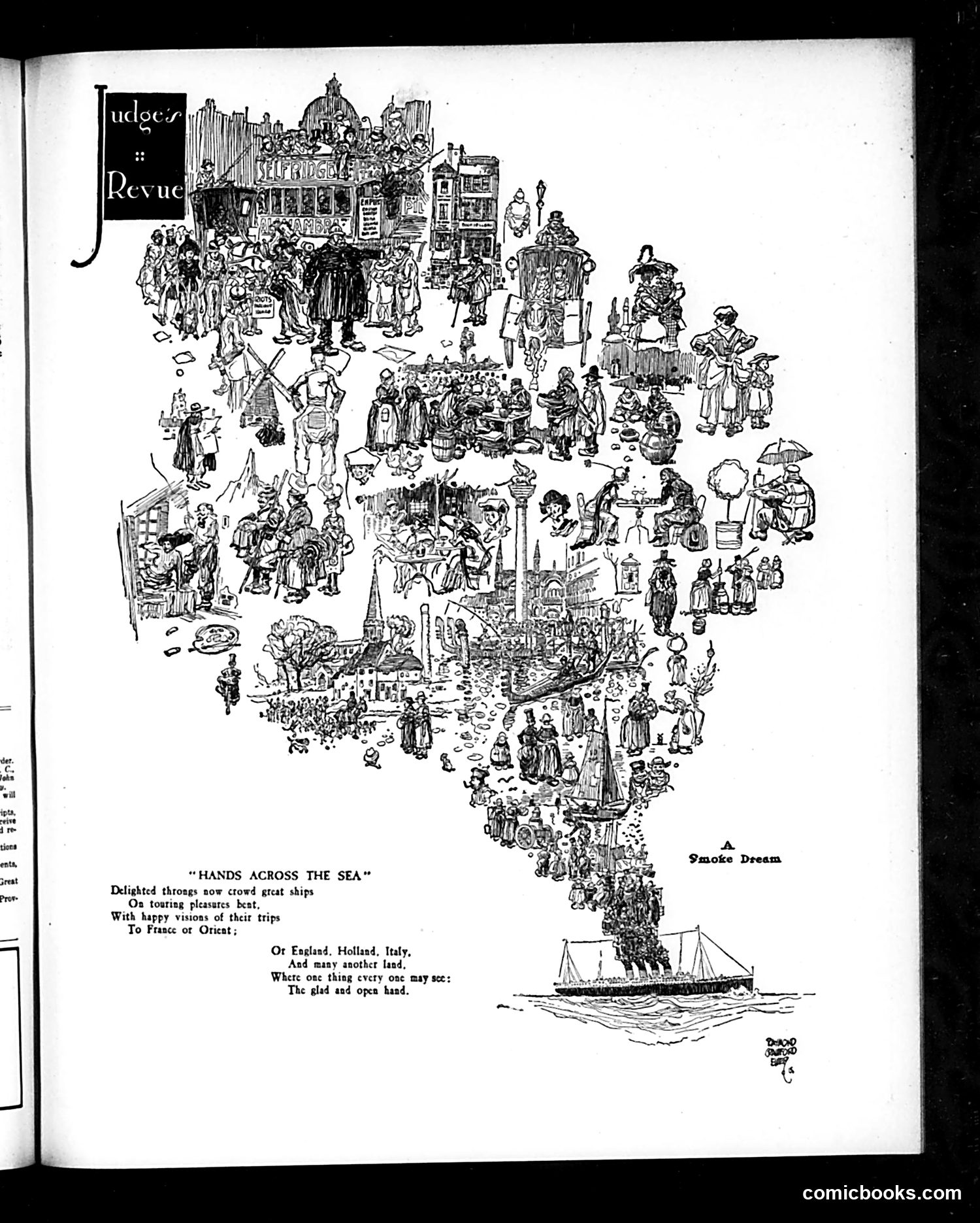
This illustration depicts a map of the United States formed entirely by crowds of people, ships, and architectural landmarks. The title references international travel and commerce between America and Europe (France, Orient, England, Italy mentioned in the verse). The satirical point appears to celebrate American prosperity and global connectivity—"hands across the sea" suggesting peaceful international relations and trade. The verse humorously notes how citizens eagerly travel abroad as tourists ("On touring pleasures bent"), viewing their trips as aspirational ("happy visions"). The "Smoke Dream" ship at bottom suggests these are fantastical aspirations rather than realistic depictions. The cartoon likely satirizes American tourism culture and the working class's dreams of European travel during an era of industrial wealth and expanding transatlantic shipping.
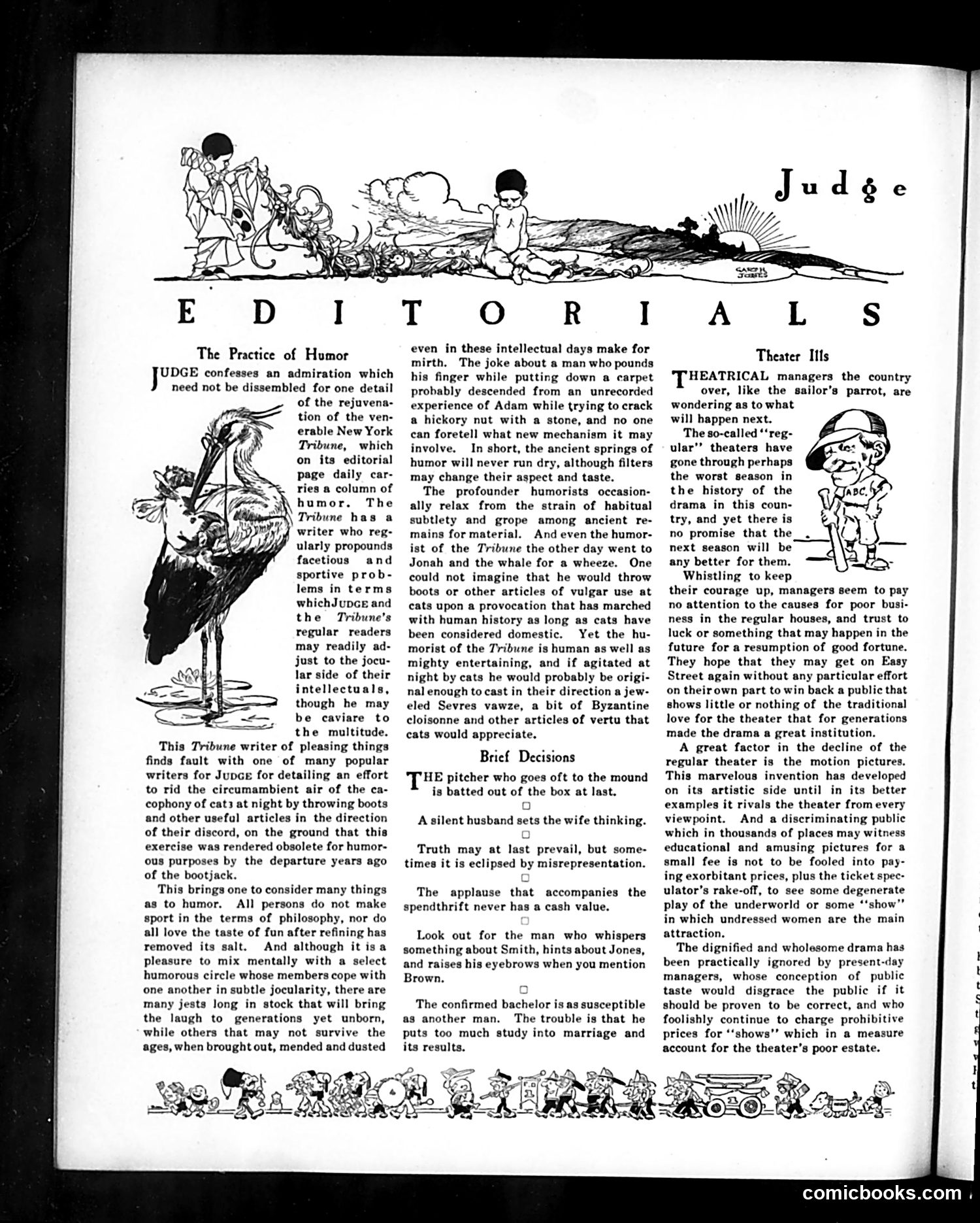
This page contains two editorial sections criticizing American cultural institutions: **"The Practice of Humor"** defends the *Tribune's* humor column against critics who find jokes lowbrow. The writer argues humor serves a valuable purpose—relaxing people from life's strain—and that even intellectual publications need levity. The crane illustration suggests sophistication. **"Theater Ills"** attacks theatrical managers for abandoning legitimate drama in favor of motion pictures and vulgar "shows," which the author claims have degraded public taste. The managers prioritize profit over artistic integrity, charging inflated prices for low-quality entertainment. Both pieces reflect early 20th-century anxieties about commercialization eroding cultural standards—a recurring *Judge* theme. The "Brief Decisions" aphorisms mock human nature generally.
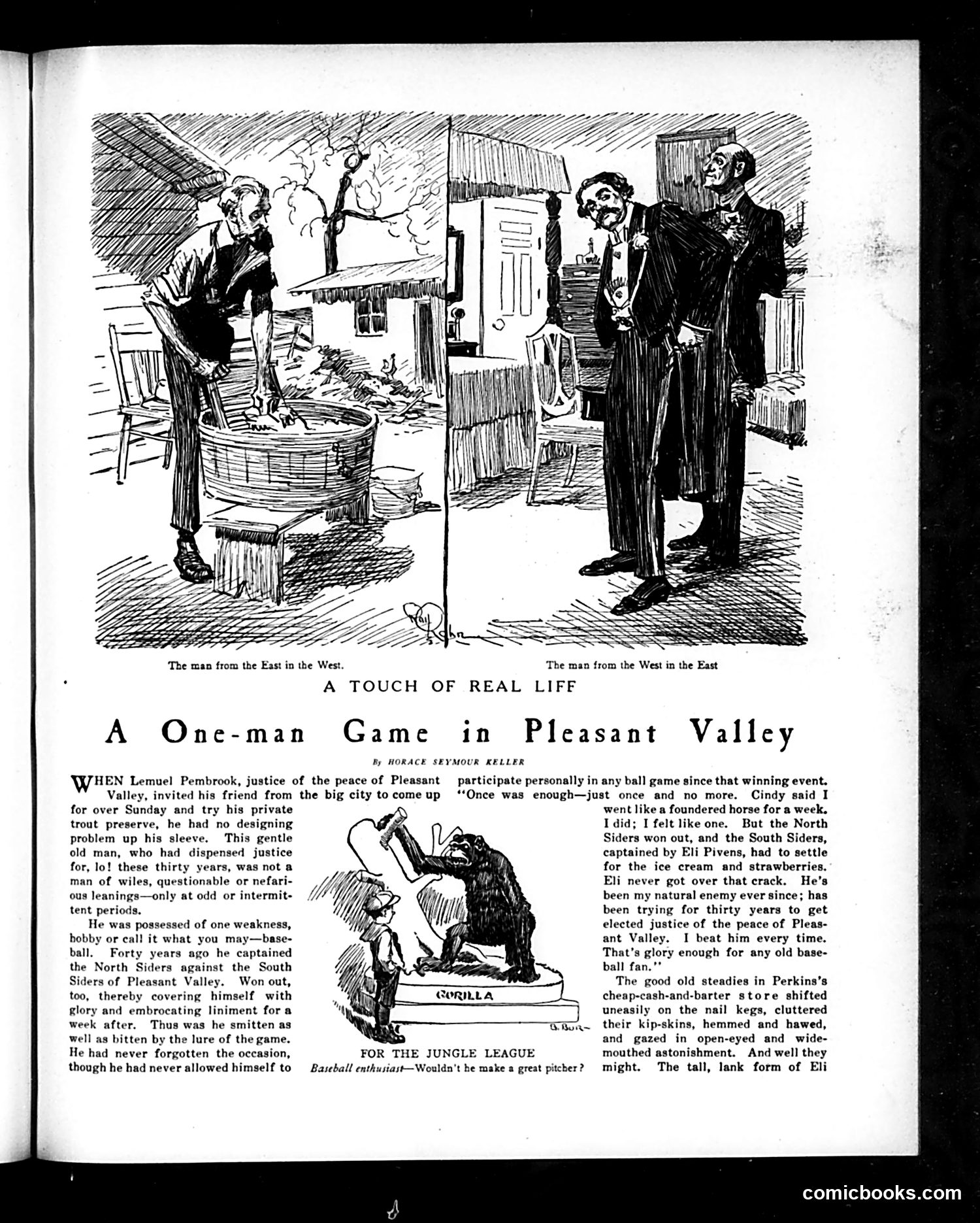
This page presents a humorous story titled "A One-man Game in Pleasant Valley" by Horace Seymour Keller about Lemuel Pembrook, a small-town justice of the peace who was obsessed with baseball. **The joke:** Pembrook captained the North Siders against the South Siders forty years prior, winning decisively. He never recovered from this glory and constantly references it. When a friend from the city visits, Pembrook insists on playing a one-man baseball game alone (illustrated by the cartoon showing him pitching to himself), which the friend finds absurd and embarrassing. The satire mocks small-town provincialism and aging athletes clinging to past athletic achievements. The top panels contrast "the man from the East in the West" with "the man from the West in the East"—likely illustrating cultural misunderstandings between rural and urban Americans.
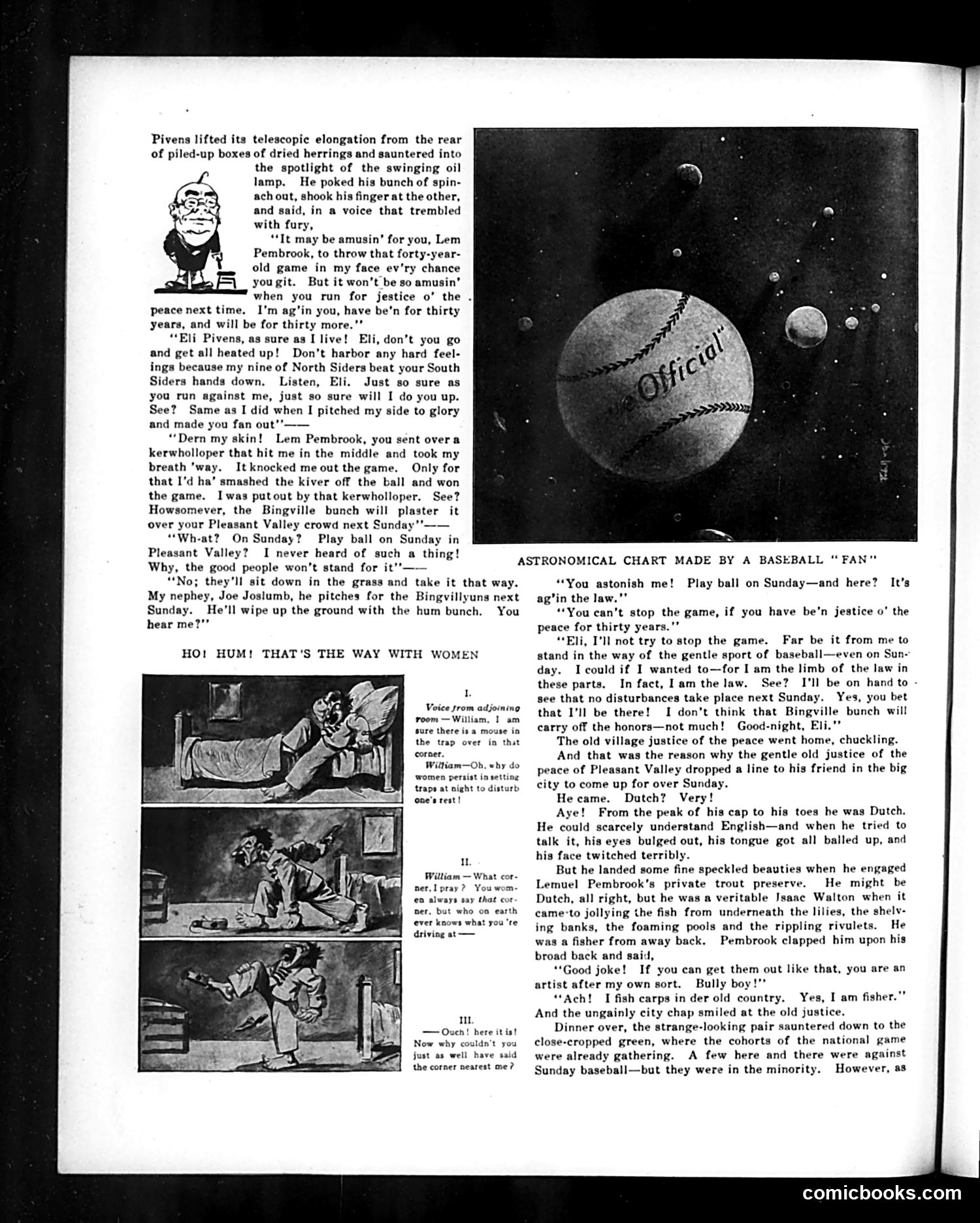
This Judge magazine page contains two separate satirical pieces: **Main Story (Top/Right):** A humorous rural tale about two small-town rivals—Eli Pivens and Lem Pembrook—who've feuded for thirty years over a baseball game. Their petty animosity persists into local politics. The satire mocks how trivial personal grudges dominate small-town life and governance. When Pembrook (now justice of the peace) learns they'll play baseball on Sunday—illegal at the time—he paradoxically allows it, then invites a Dutch immigrant friend to witness the match. The joke appears to be about hypocrisy and the absurdity of enforcing religious restrictions selectively. **Side Comic (Left):** Titled "HO! HUM! THAT'S THE WAY WITH WOMEN," this three-panel sketch satirizes wives as vague and illogical. A woman complains about a mousetrap in "that corner," but when her exasperated husband asks which corner, she can't specify. The humor relies on the period's tired stereotype of female imprecision—typical of early-20th-century gender satire. Both pieces reflect Judge's focus on domestic and small-town Americana with gentle mockery.
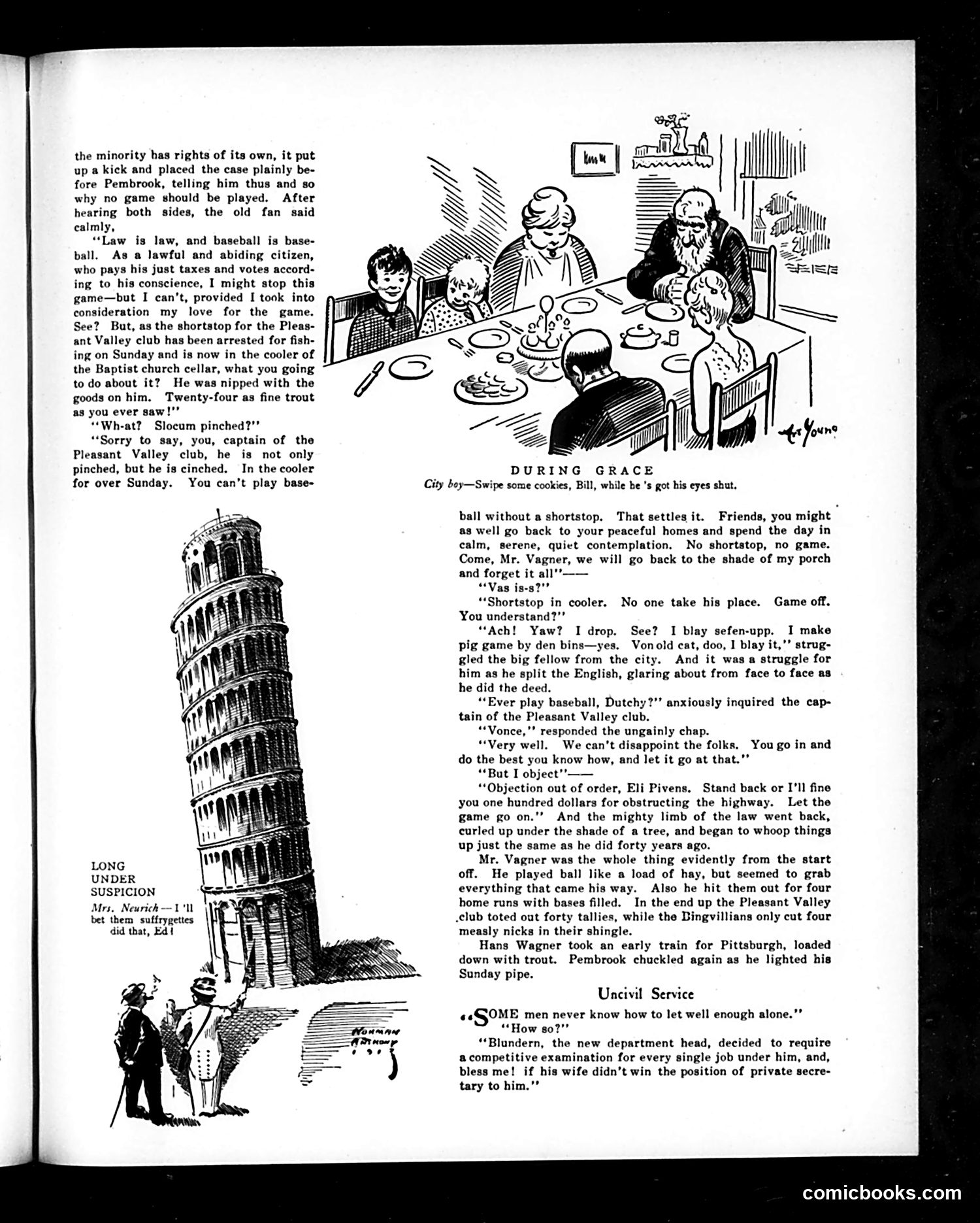
This page contains two separate satirical pieces: **"During Grace"** (top cartoon): A city boy steals cookies while a family says grace at dinner, mocking urban children's lack of manners and religious propriety compared to rural/immigrant families. **Main story**: A baseball game conflict where a German immigrant ("Dutchy"/"Mr. Vagner") is recruited to play shortstop after the regular player is arrested for Sunday fishing. The satire targets: - **Sunday blue laws**: Strict prohibition on weekend activities, even innocent fishing - **Class/ethnic humor**: The bumbling German immigrant is portrayed through exaggerated dialect ("Vonce," "Vonold cat") - **Legal absurdity**: A corrupt law officer enforces arbitrary rules while ignoring his own authority Despite incompetence, Vagner heroically wins the game. The joke seems to mock both oppressive regulations and ethnic stereotypes, suggesting immigrant "outsiders" can succeed despite prejudice. **"Uncivil Service"** (bottom): Brief satire on nepotism—a newly promoted department head requires competitive exams for all positions, yet his wife wins the secretary job anyway.
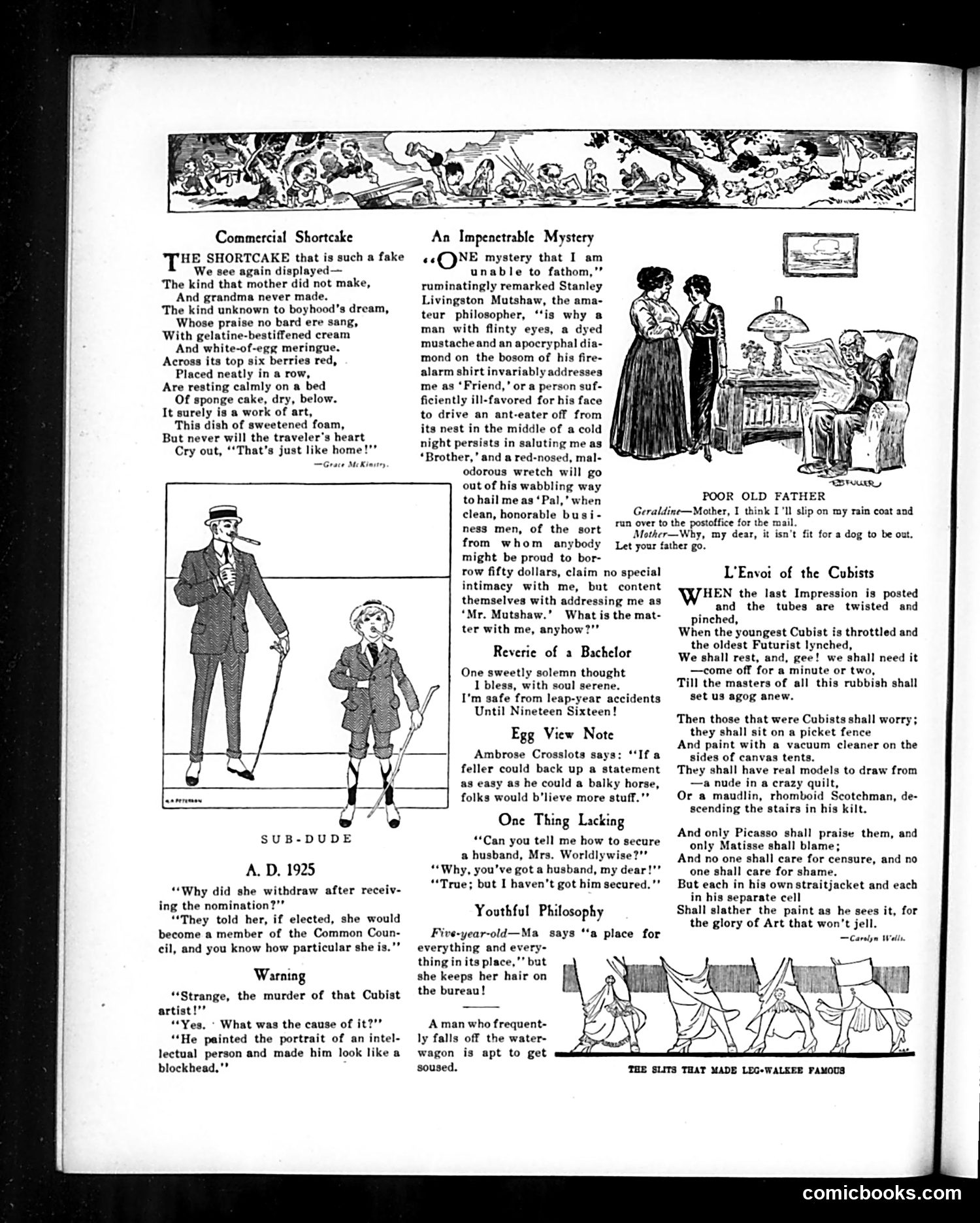
This page contains several short humorous pieces typical of 1925 satirical commentary: **"Commercial Shortcake"** mocks mass-produced desserts sold commercially—artificial, gelatinous confections with precisely arranged berries, nothing like homemade versions. The satire criticizes modern commercialization replacing authentic domestic goods. **"An Impenetrable Mystery"** presents a philosopher puzzled why disreputable people call him "Friend" and "Brother" while respectable men only use "Mr. Mutshaw." The joke satirizes social hypocrisy and how status determines familiarity. **"L'Envoi of the Cubists"** viciously mocks Cubism and Futurism as artistic movements. The poem imagines these artists eventually confined to "straightjackets," painting absurdities like "a nude in a crazy quilt." The final line—"the glory of Art that won't jell"—suggests modernist art is incoherent nonsense. This reflects mainstream 1920s hostility toward avant-garde movements. The remaining items are brief gag jokes about marriage, leap-year conventions, and child logic—standard period humor without deeper satire.
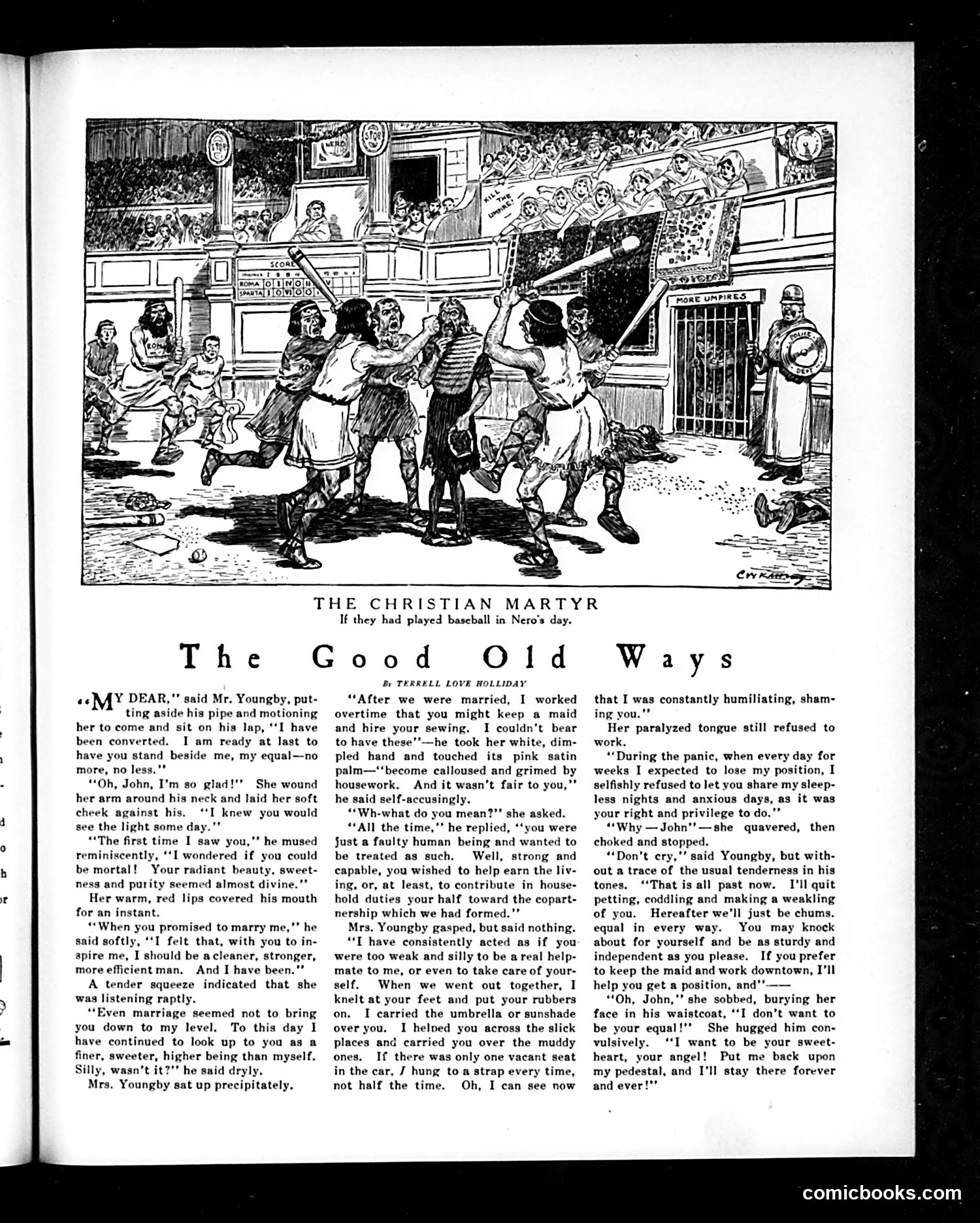
The cartoon satirizes early 20th-century debates about women's rights and marriage equality. Mr. Youngby announces he's "converted"—abandoning the Victorian practice of treating wives as delicate, superior beings requiring protection—and proposes treating her as an equal partner instead. His wife initially celebrates this "enlightenment," but when he details the practical implications (she'd work, share financial worries, manage without chivalrous gestures), she emotionally rejects the idea, begging to remain on a "pedestal." **The satire's point**: The cartoon mocks both sides—men who patronize women under the guise of protection, AND women who claim to want equality but actually prefer traditional dependency and romantic idealization. It suggests that genuine equality was threatening to both genders' established roles. The title "The Good Old Ways" ironically endorses the status quo while exposing its hollow contradictions.
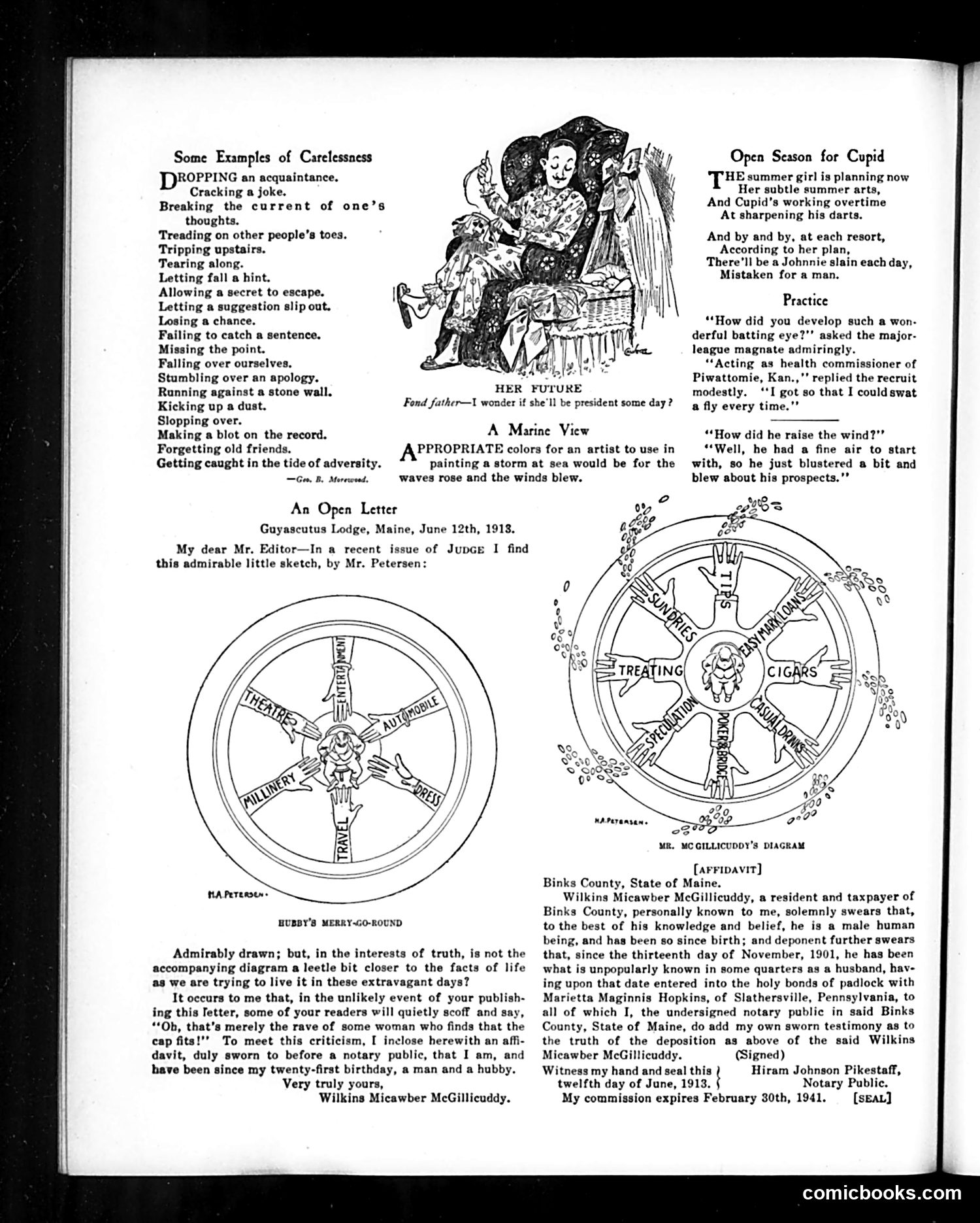
This 1918 page satirizes **domestic spending and marital budget conflicts** during wartime austerity. The centerpiece is a humorous "open letter" from "Wilkins Micawber McGillicuddy" (a comically absurd name) who rebuts an earlier Judge cartoon showing a husband's "merry-go-round" of domestic expenses. McGillicuddy provides an affidavit—complete with a notarized "diagram" and comic seal—satirizing how wives actually spend household money on luxuries: cigars, treating friends, plays, theaters, and other indulgences rather than practical needs. The joke targets **married women's extravagant wartime spending** despite calls for conservation. The elaborate legal framework (fake notary, impossible expiration date "February 30th") amplifies the absurdity. The letter ridicules both wives' lavish habits and husbands' complaint-prone passivity. Other brief items on the page include a "Practice" joke about a health commissioner killing flies (wartime pest control humor) and mild romantic/summer resort gags.
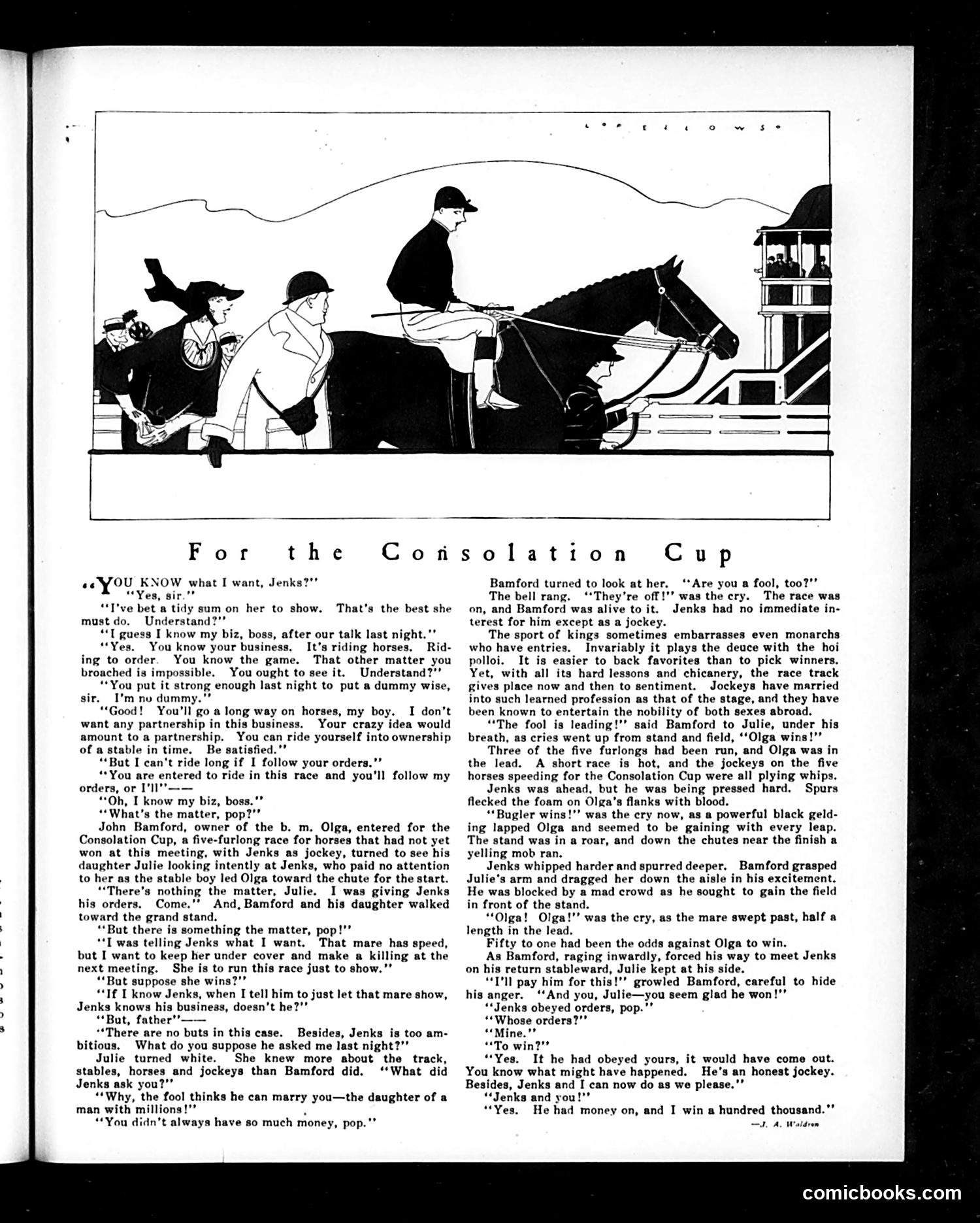
This story-illustration depicts a horse-racing drama centered on competing loyalties. John Bamford, a wealthy horse owner, instructs his jockey Jenks to deliberately hold back his mare Olga in a race—to "show" rather than win—so Bamford can profit from betting on her at better odds in a future race. The complication: Jenks loves Bamford's daughter Julie and has proposed marriage, which Bamford considers absurd given their class difference. When the race begins, Jenks faces a choice between obeying Bamford's orders or winning. The narrative suggests Jenks ultimately disobeys, driving Olga to victory despite Bamford's instructions. The satire mocks both wealthy men's attempts to manipulate outcomes through money and social hierarchies, while implying that honest work and merit (Jenks as a skilled jockey) may transcend class pretension.
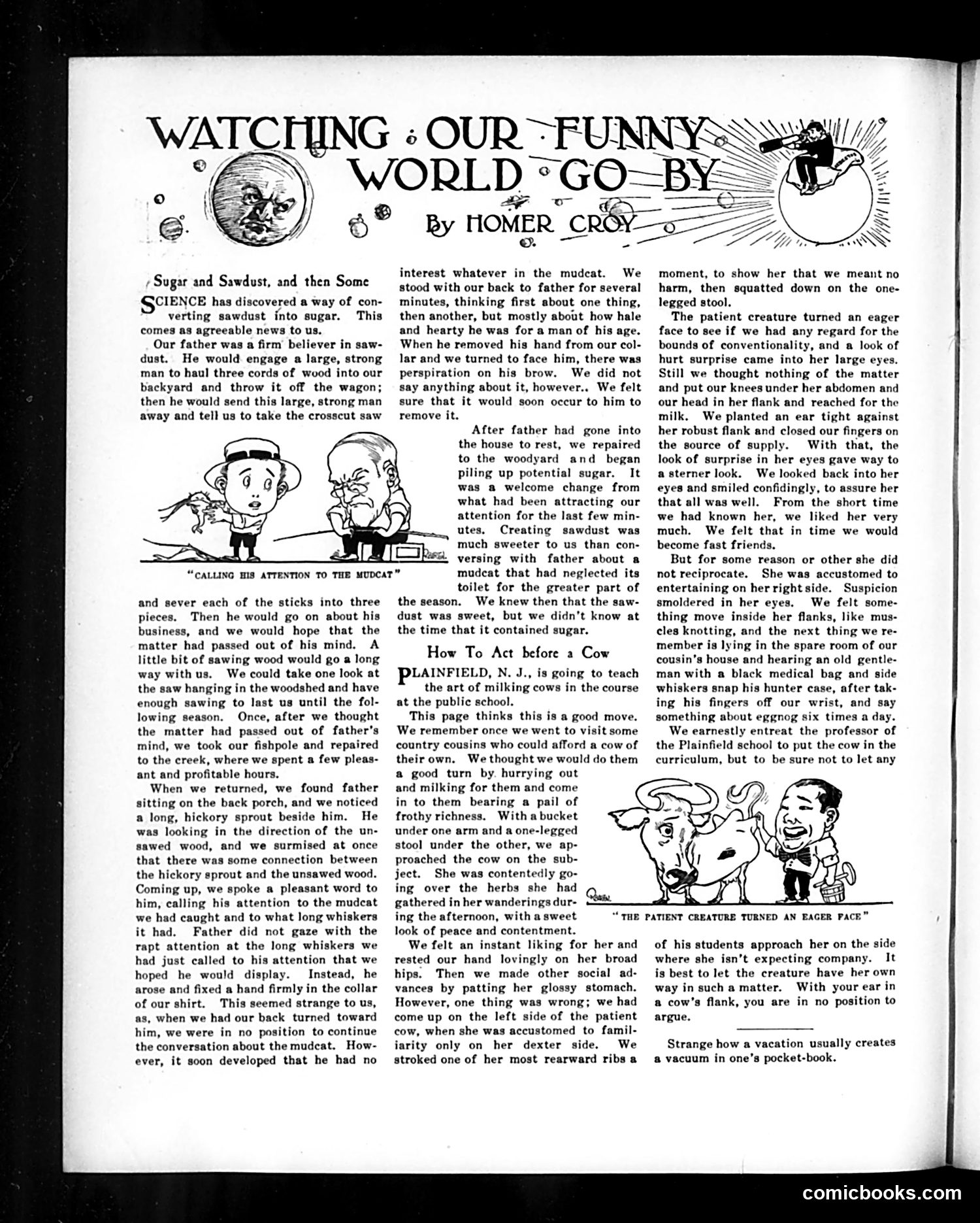
This humorous column contains two nostalgic anecdotes about childhood mischief and rural life. The first story depicts a boy deliberately avoiding assigned chores (sawing wood) by fishing instead. When caught, his father—standing with hickory switch in hand—physically disciplines him. The humor lies in the boy's transparent attempt to distract father by pointing out a catfish, which spectacularly fails. The second piece describes an embarrassing attempt to impress country cousins by milking their cow. The narrator approaches from the wrong side (left instead of right), and the cow, unaccustomed to this, presumably reacts badly—the text cuts off. The satire targets city people's ignorance of farm practices, presented as comic incompetence. Both stories reflect early 20th-century attitudes: paternal corporal punishment as normal, rural life as quaint and amusing to urban readers, and physical comedy as entertainment. The column's tone is self-deprecating nostalgia.
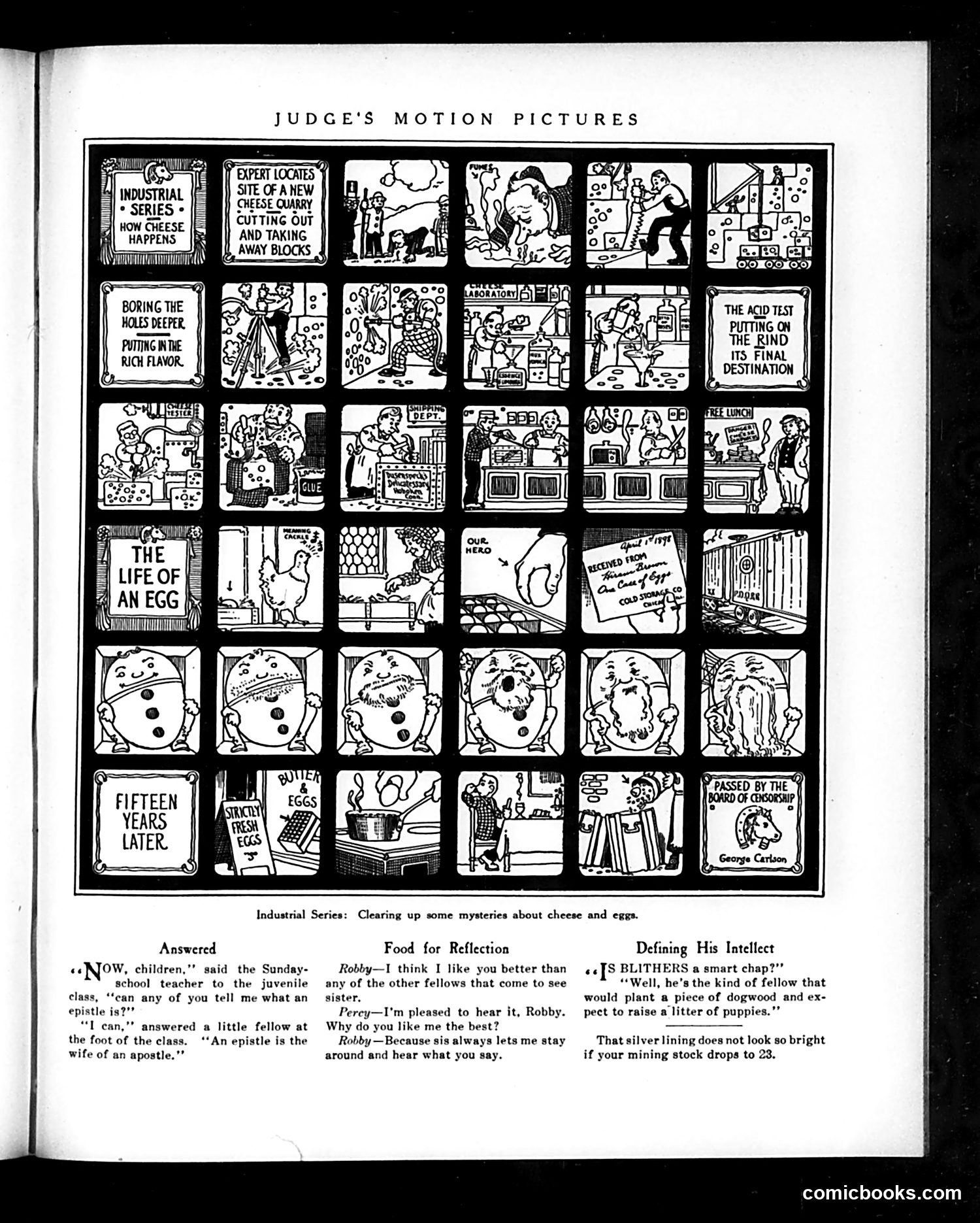
This page presents a comic strip series about cheese and egg production, titled "Clearing up some mysteries about cheese and eggs." The top grid shows sequential panels depicting industrial processes—quarrying, processing, testing, and packaging—presented as if they were film frames. The satire appears to mock industrial manufacturing by presenting everyday food production with the gravitas of serious documentary filmmaking. Below are three separate jokes: one about a child's misunderstanding of "epistle" (confusing it with "apostle's wife"), one about romantic rivalry where a suitor realizes he's preferred only because he tolerates eavesdropping, and one mocking someone's fundamental stupidity. The final note about mining stocks suggests financial concerns of the era's readership.
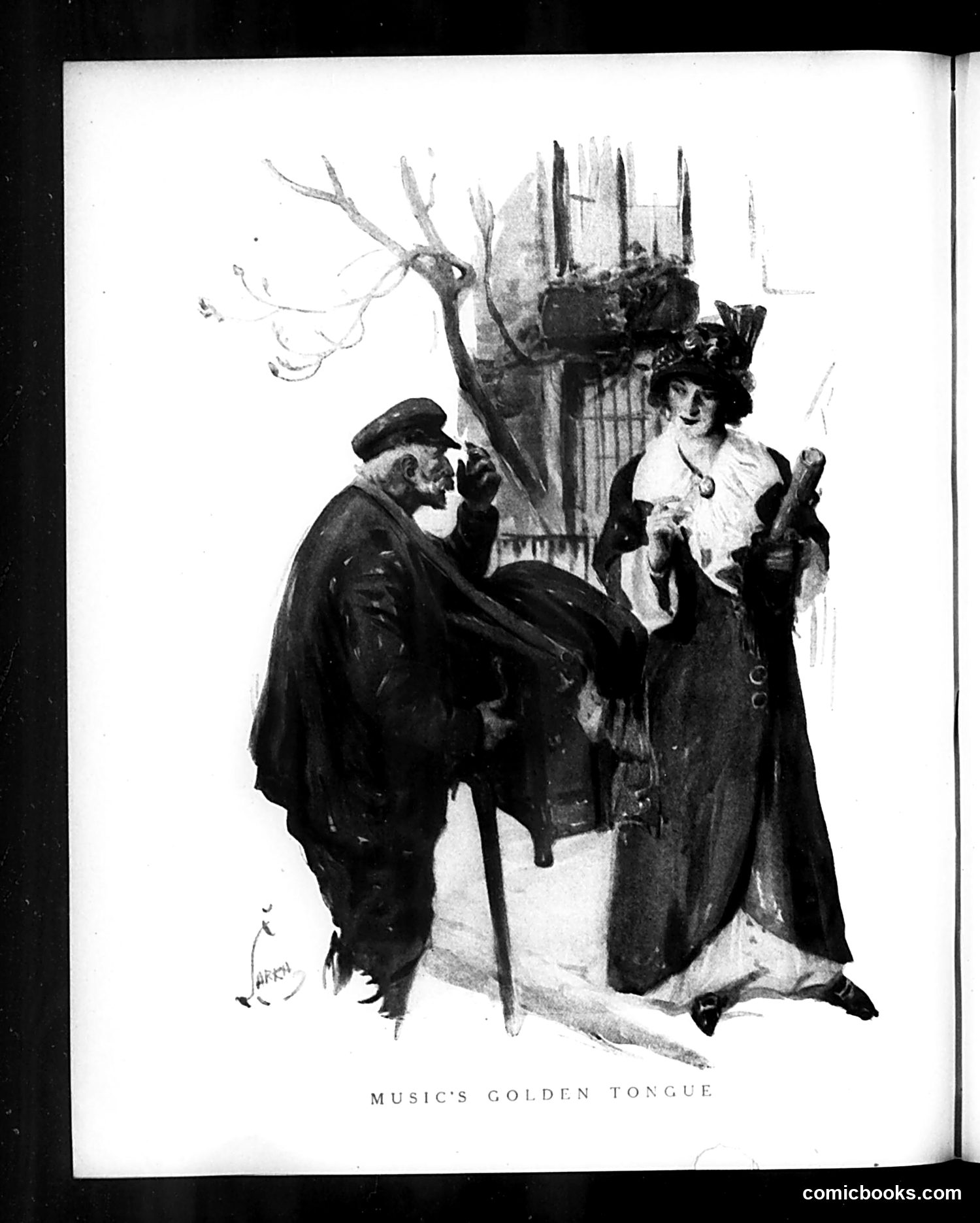
This appears to be a satirical illustration from *Judge* magazine depicting two figures in conversation near what looks like a gothic cathedral or church structure. The title "Music's Golden Tongue" suggests commentary on music or musical performance. The image shows a well-dressed woman in fashionable attire speaking with an older man in dark clothing. The artistic style and composition suggest social satire, likely critiquing either the music industry, public taste, or perhaps the relationship between wealth/status and artistic patronage during the early 20th century. Without more context or visible text, the specific figures and exact satirical point remain unclear, though the "golden tongue" metaphor suggests commentary on eloquence, persuasion, or perhaps the corrupting influence of money in artistic circles.
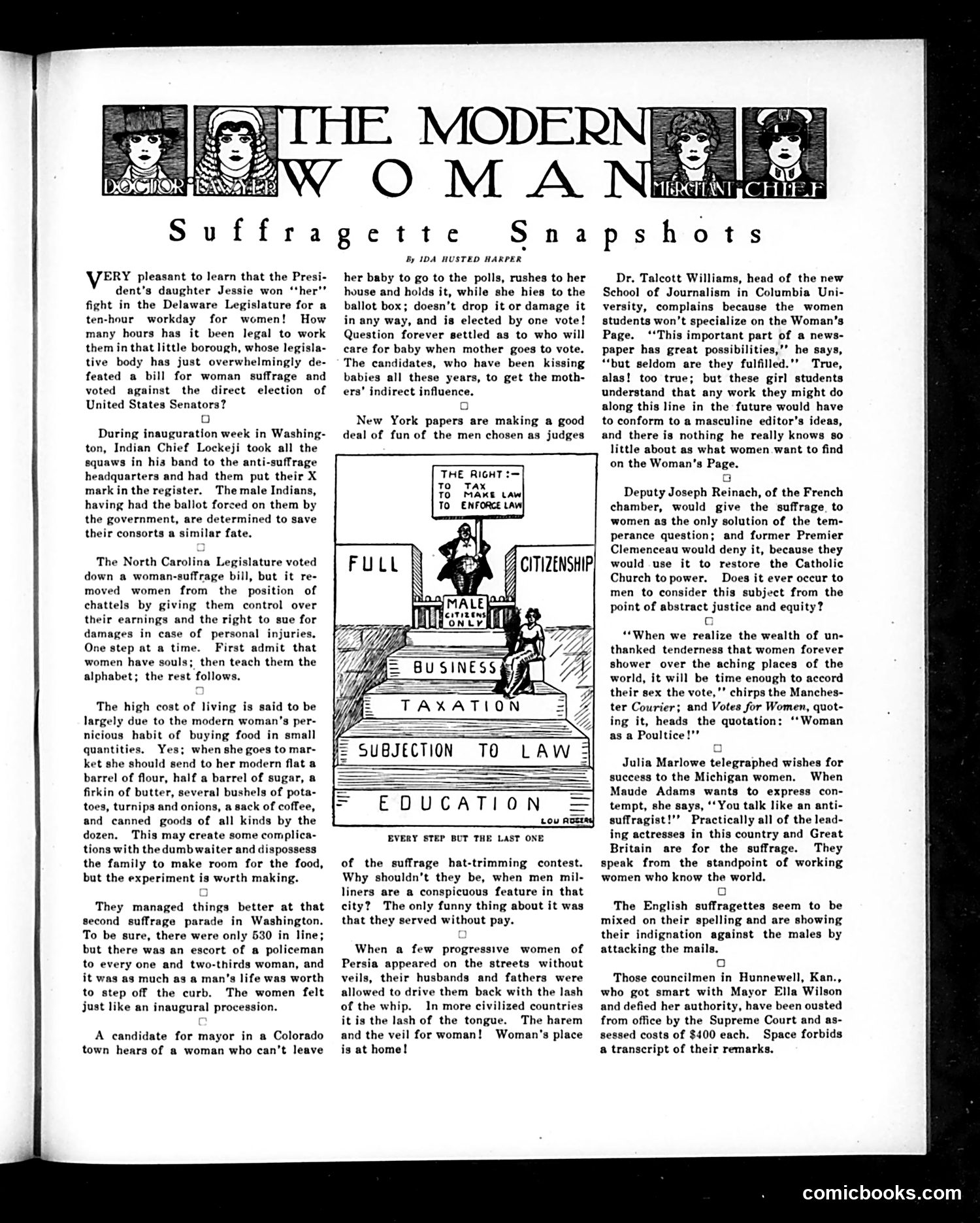
This "Modern Woman" feature lampoons the hypocrisy and resistance to women's suffrage. The main cartoon's pyramid diagram—with "Subjection to Law" and "Taxation" supporting the base, but "Full Citizenship" and "Male Only Business" blocked above—illustrates the satire: women pay taxes and face legal restrictions yet are denied voting rights. The column's vignettes mock anti-suffrage arguments: Delaware celebrates women winning workplace protections while denying them the vote; Native Americans are portrayed resisting suffrage for their wives; and North Carolina grants economic rights but withholds political ones. The author (Ida Husted Harper, a known suffragist) satirizes piecemeal concessions—"First admit that women have souls; then teach them the alphabet"—exposing the absurdity of granting rights selectively while denying franchise. The Persian veil reference criticizes backward practices, implying America should progress further. Throughout, the tone is sarcastic, highlighting the logical contradictions of denying women voting rights while granting them other powers.
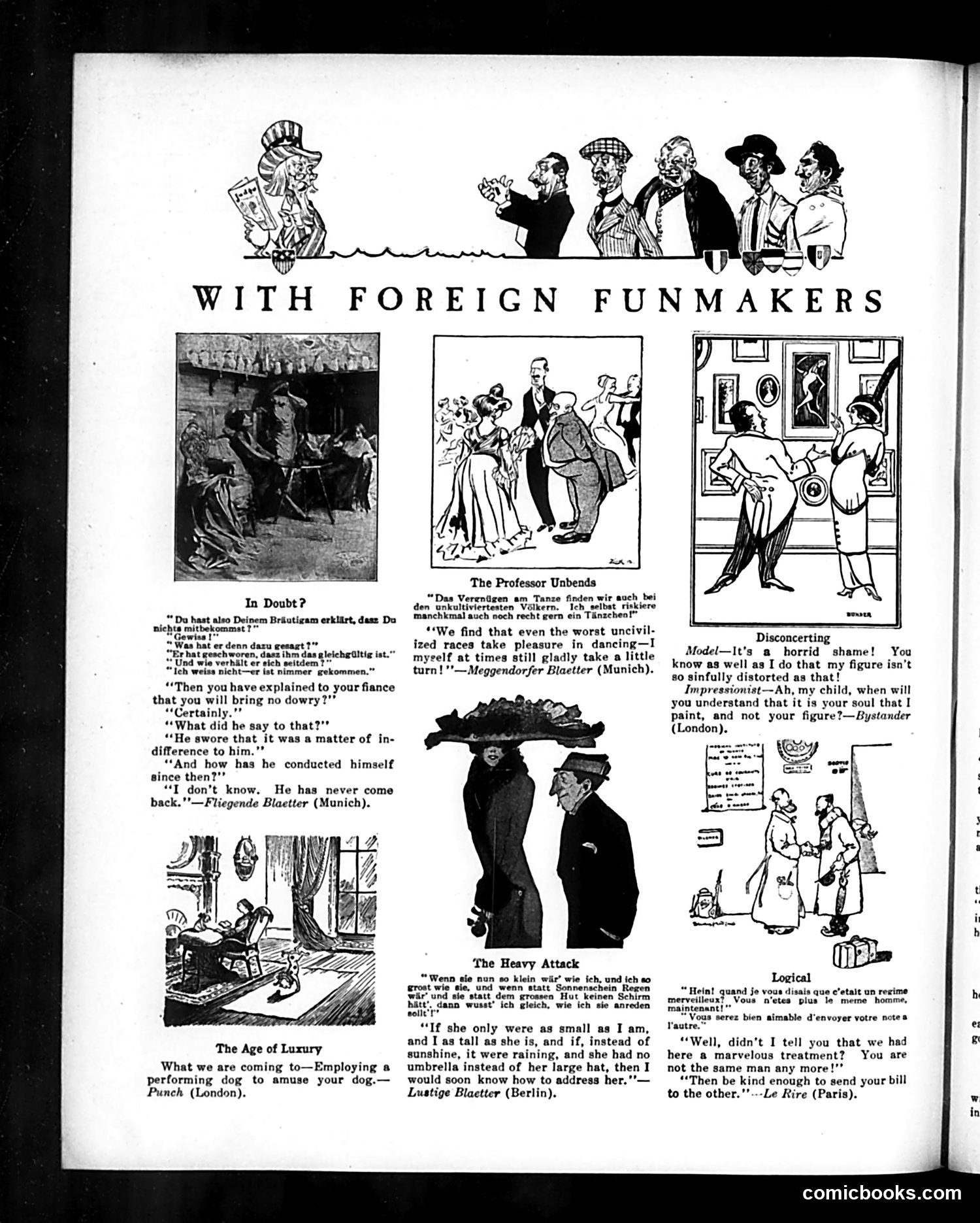
This Judge page republishes cartoons from European satirical magazines, demonstrating the international nature of humor journalism in the early 20th century. **The jokes satirize:** - **"In Doubt?"** (Munich): A fiancé abandons his bride upon learning she has no dowry—mocking mercenary marriage customs. - **"The Age of Luxury"** (London): Absurdist humor about hiring a performing dog to entertain your pet dog, lampooning excess. - **"The Professor Unbends"** (Munich): A pompous academic admits he still enjoys dancing "like uncivilized races," exposing scholarly pretension. - **"The Heavy Attack"** (Berlin): A short man fantasizes about role-reversal with a tall woman—mocking courtship awkwardness. - **"Disconcerting"** (London): An impressionist painter claims to paint the model's "soul" rather than her actual figure—satirizing pretentious modern art. - **"Logical"** (Paris): A patient, "cured" by a doctor's marvelous treatment, demands the doctor send *his* bill to the patient's previous physician—mocking medical billing absurdity.
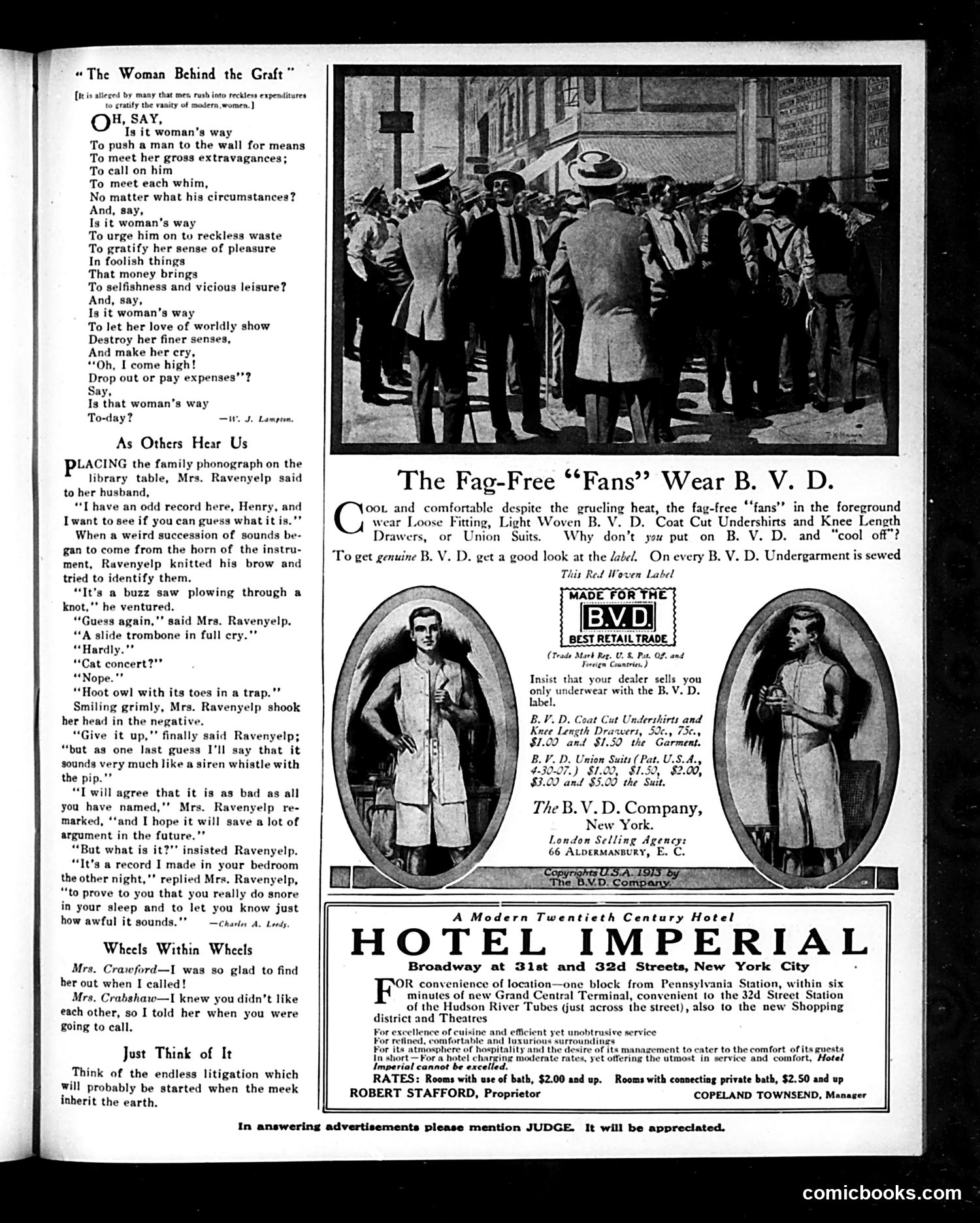
This page combines satirical commentary with period advertising. **"The Woman Behind the Graft"** is a poem blaming women for men's financial ruin. It sarcastically catalogs how women allegedly push husbands toward reckless spending through demanding extravagance, vanity, and materialism—framing female consumerism as the root cause of male "graft" (corruption/excess). The poem reflects early 20th-century anxieties about women's spending power and changing gender dynamics. **"As Others Hear Us"** is a humor anecdote where a wife records her husband's snoring to prove how awful it sounds, exposing his denial. It's gentle domestic satire about marital bickering. **"Just Think of It"** is a brief joke prophesying future lawsuits when "the meek inherit the earth"—cynical commentary on American litigiousness. The advertisements—for B.V.D. underwear and Hotel Imperial—are period commercial content typical of Judge's revenue model. The B.V.D. ad emphasizes staying cool during summer heat.
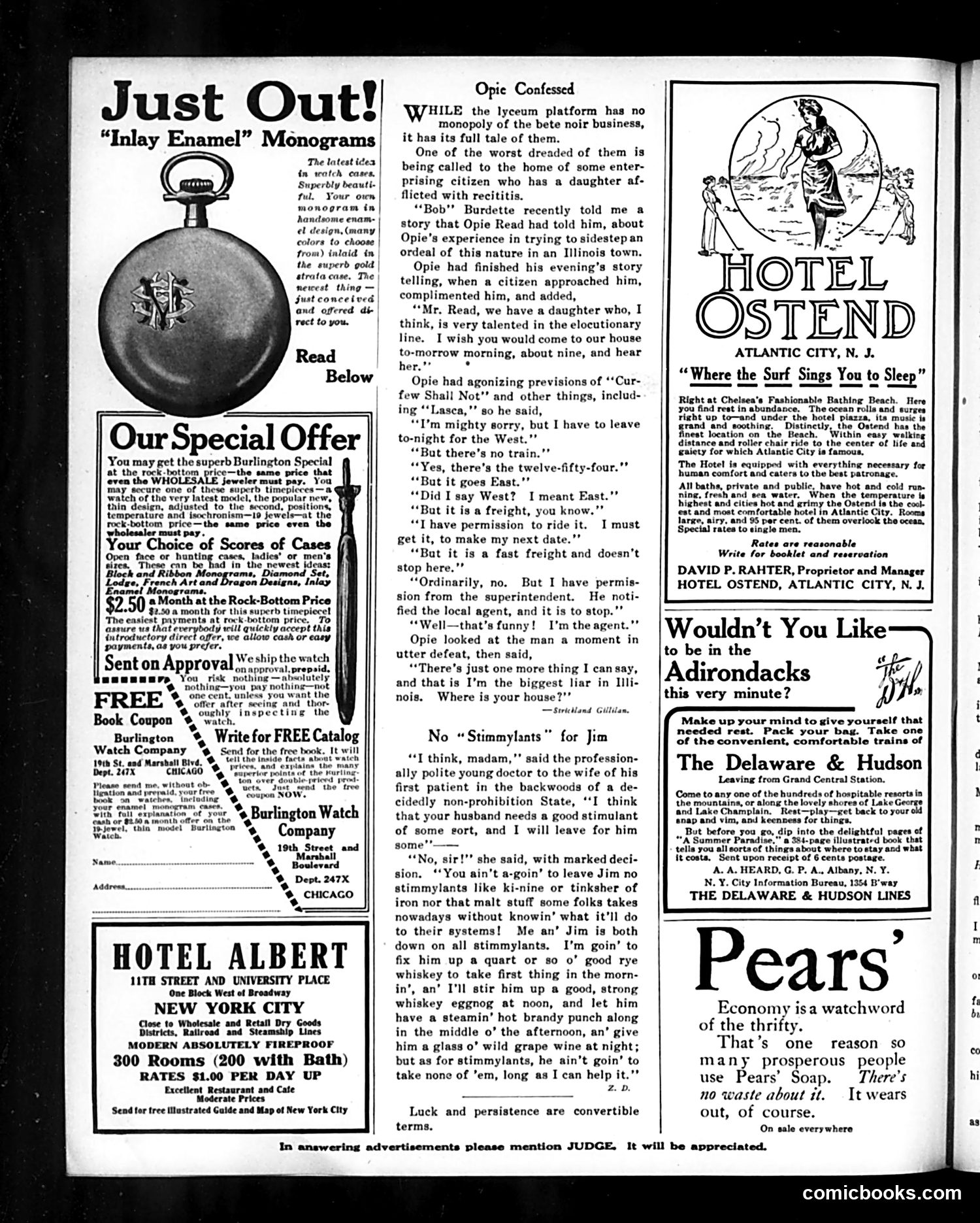
This page from *Judge* magazine is primarily **advertising**, not political satire. The dominant content includes ads for a Burlington Watch Company (offering affordable monthly payments), Hotel Albert in New York, Hotel Ostend in Atlantic City, and Pears' Soap. The one substantial article is "Opie Confessed," a humorous anecdote about **Opie Read**, a popular American humorist and entertainer of that era. The story recounts Read's attempt to escape a dinner invitation to hear a citizen's daughter perform elocution (recitation)—a common social obligation that speakers dreaded. Read fabricates increasingly absurd excuses about trains until cornered by the man, who reveals he's the railroad agent. The joke's punchline: Read admits to being "the biggest liar in Illinois" and resignedly accepts the invitation. The satire targets the social convention of forcing entertainers to endure amateur performances, and celebrates clever excuse-making. The reference to "Curfew Shall Not" indicates popular recitation pieces audiences expected.
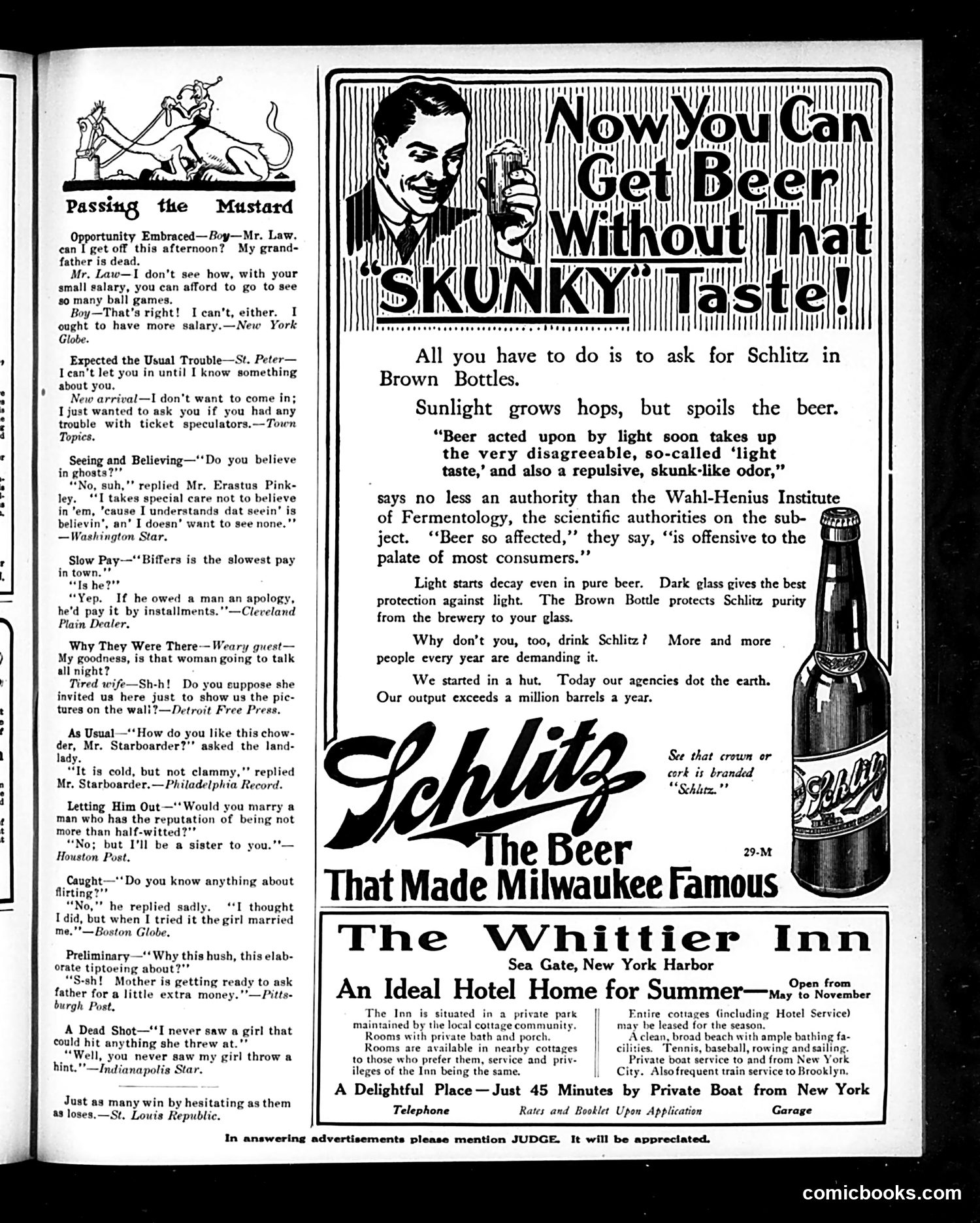
This page contains **short humorous anecdotes** (left column) and **two advertisements** (right side). ## The Anecdotes The left column features brief jokes from various newspapers, typically playing on wordplay or ironic reversals. Examples include a boy claiming his grandfather died to skip work (but actually attending baseball games), and a man preferring not to believe in ghosts to avoid seeing them. These are lightweight satirical observations about human nature and social pretense, typical of early 20th-century newspaper humor. ## The Advertisements The dominant content is a **Schlitz beer advertisement** emphasizing brown bottles, claiming sunlight damages beer's taste (invoking the "Wahl-Henius Institute of Fermentology" for scientific authority). Below is an advertisement for **The Whittier Inn** in Sea Gate, New York Harbor, promoting summer accommodations. ## Historical Context These materials reflect pre-Prohibition era advertising and humor conventions. The Schlitz ad's pseudo-scientific appeal and the hotel's leisure-class marketing represent early 20th-century commercial strategies, while the anecdotes capture period attitudes toward class, authority, and gender relations.
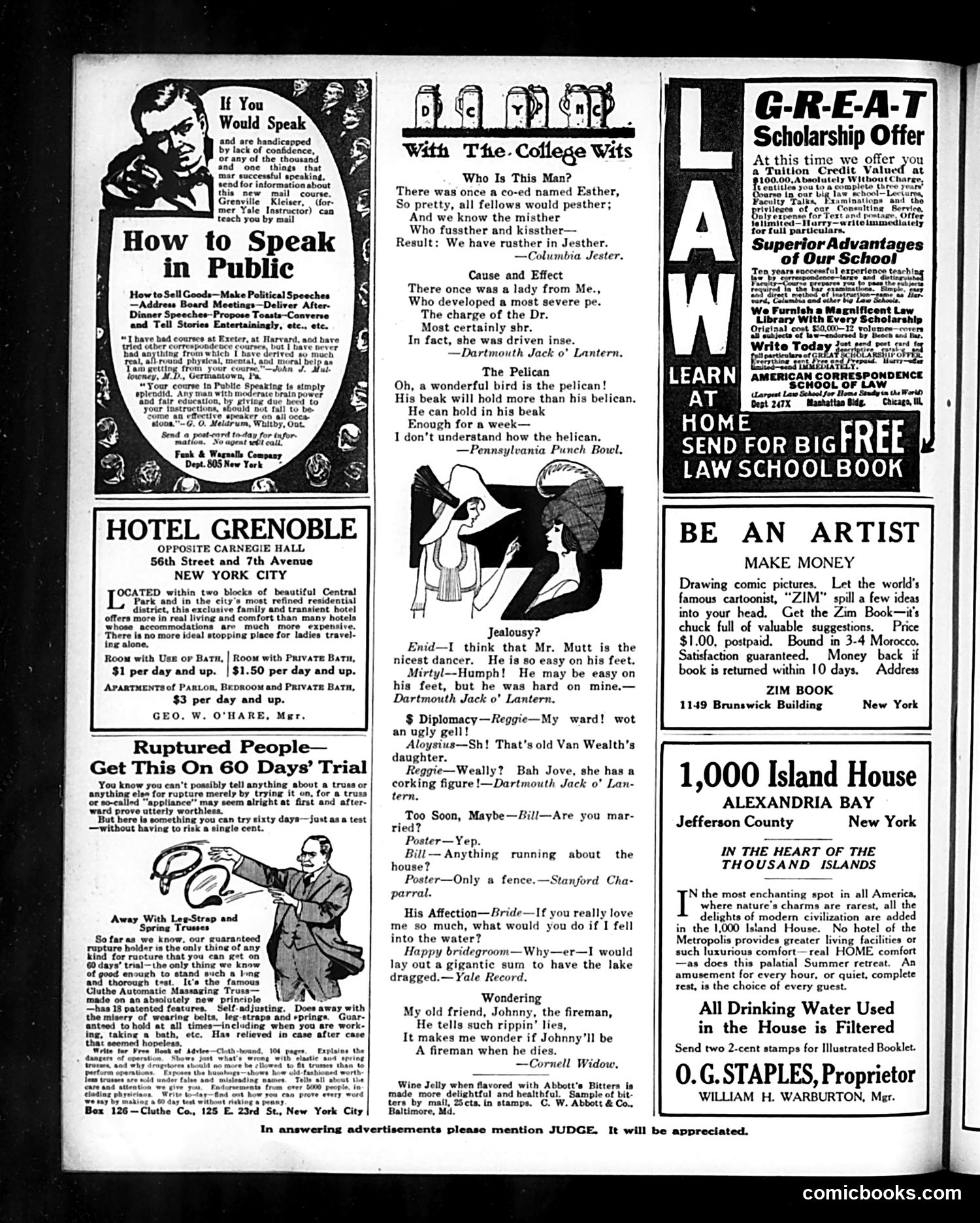
This is primarily an **advertising page** from Judge magazine featuring various commercial products and services typical of the early 20th century: public speaking courses, hotels, medical devices (trusses), and real estate. The only satirical content consists of **college humor verses** in the center, reprinted from various university publications (Columbia Jester, Dartmouth Jack O'Lantern, Pennsylvania Punch Bowl, Stanford Chaparral, Yale Record). These are lighthearted, innocent jokes about college life—romance, dancing, marriage, and social situations—with deliberate forced rhymes and puns ("pesther/misther/fussther/kissther"). The humor is gentle collegiate wit with no political or social satire. The verses mock themselves through clumsy rhyming rather than making pointed commentary. This reflects Judge's practice of recycling campus humor to appeal to its educated, middle-class readership. The page demonstrates how early 20th-century magazines blended advertising with entertainment content.
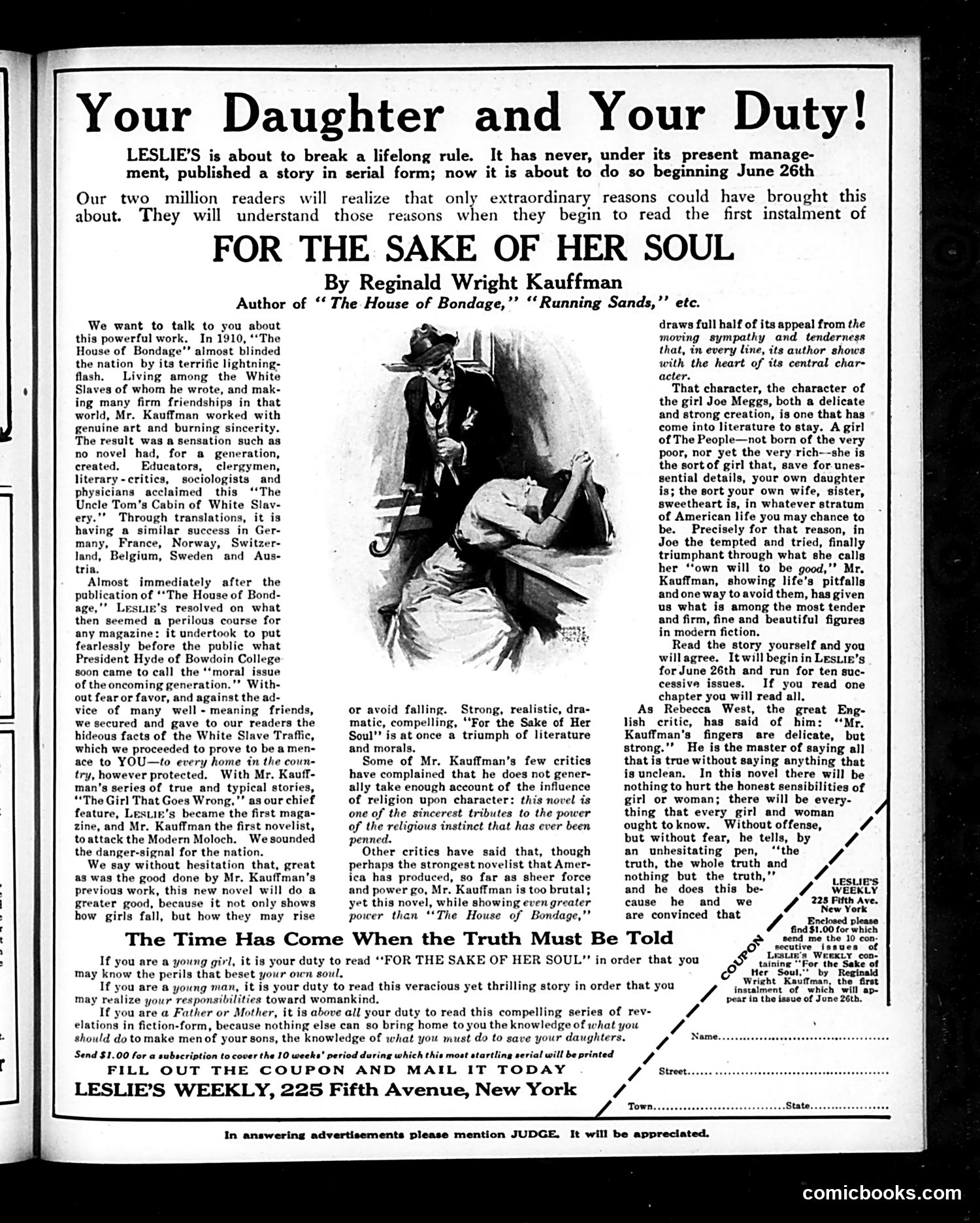
This is primarily a **promotional advertisement** for a serialized novel, not a satirical cartoon page. Judge magazine is announcing it will break its policy against serialized fiction to publish "For the Sake of Her Soul" by Reginald Wright Kauffman, beginning June 26th. The advertisement appeals to parents and young people by framing the novel as morally instructive—a work addressing the "white slave traffic" (human trafficking/forced prostitution). Kauffman's previous novel, "The House of Bondage" (1910), had caused national sensation by exposing this social evil. The rhetoric is urgent and paternalistic: readers have a *duty* to read this for moral education. Young women need to know "perils," young men need to understand their "responsibilities toward womankind," and parents must learn how to "save your daughters." The two illustrations show a man in a hat and coat appearing to approach or interact with a vulnerable young woman—likely depicting the predatory situations the novel addresses. This reflects early 20th-century Progressive Era muckraking: using sensational fiction to expose social problems and drive reform.
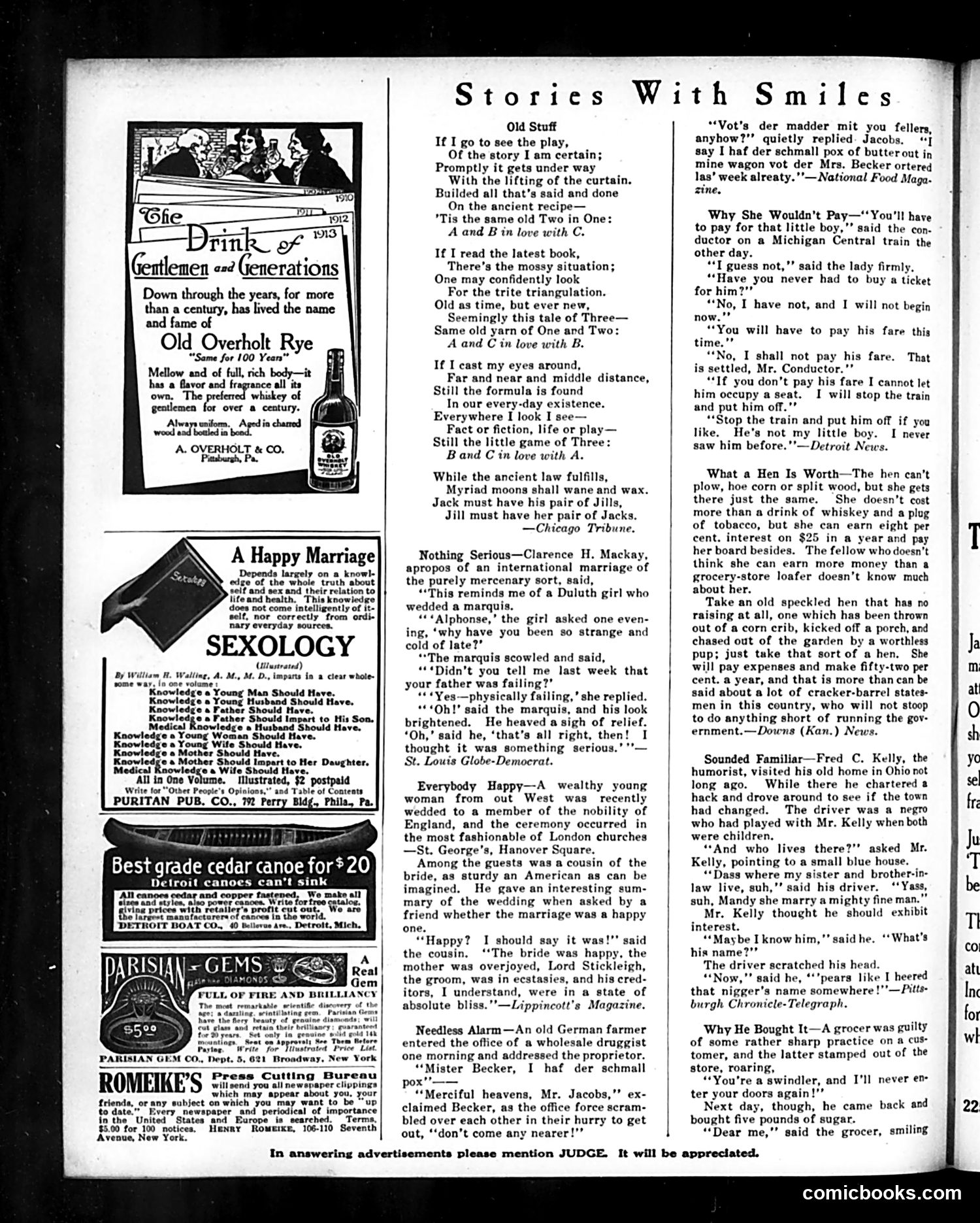
This page is primarily **advertising and humor content** rather than political cartoons. The dominant elements are: **Advertisements:** Old Overholt Rye whiskey, a "Sexology" instructional book, cedar canoes, Parisian gems, and press-cutting services occupy significant space. **Humor Section ("Stories With Smiles"):** Multiple brief anecdotes satirizing: - Literary/theatrical clichés (the "love triangle" plot appearing everywhere) - Mercenary international marriages between American heiresses and titled European nobility - A German immigrant's misunderstanding (likely a "dialect humor" joke common to the era) **The Social Satire:** The humor targets the pretensions of wealthy Americans marrying into European aristocracy purely for titles, while creditors benefit most. The "Duluth girl" anecdote mocks the transactional nature of such unions. The page reflects early 1900s American attitudes: fascination with European nobility, ethnic/immigrant humor (German dialect), and satirical commentary on new-money American society.
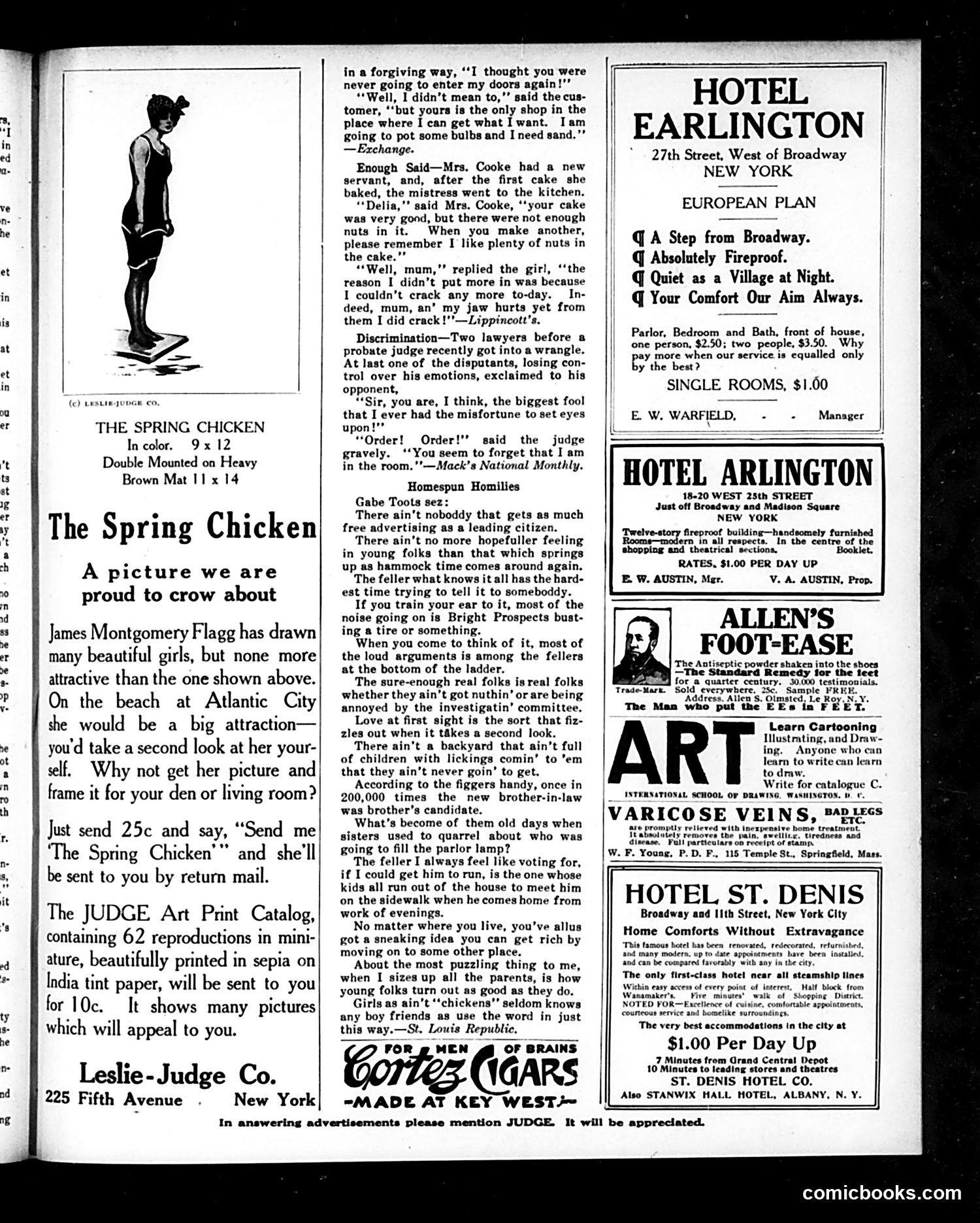
This page is primarily **advertising and filler content** rather than political satire. The main feature is "The Spring Chicken," a glamorous illustration by James Montgomery Flagg—a famous commercial artist of the era—depicting an attractive young woman in a bathing suit. Judge magazine is selling prints of this image for 25 cents. The page also includes three brief humorous anecdotes typical of Judge's "homespun humor" section: jokes about a servant who couldn't crack enough nuts for a cake, a lawyer's courtroom outburst, and folksy aphorisms attributed to "Gabe Toots." The remainder of the page consists of hotel and product advertisements (Allen's Foot-Ease, art instruction courses, cigars). **There is no political cartoon or significant satire here**—this appears to be a standard early 20th-century magazine page mixing commercial illustration, light humor, and advertisements, with no deeper social commentary intended.
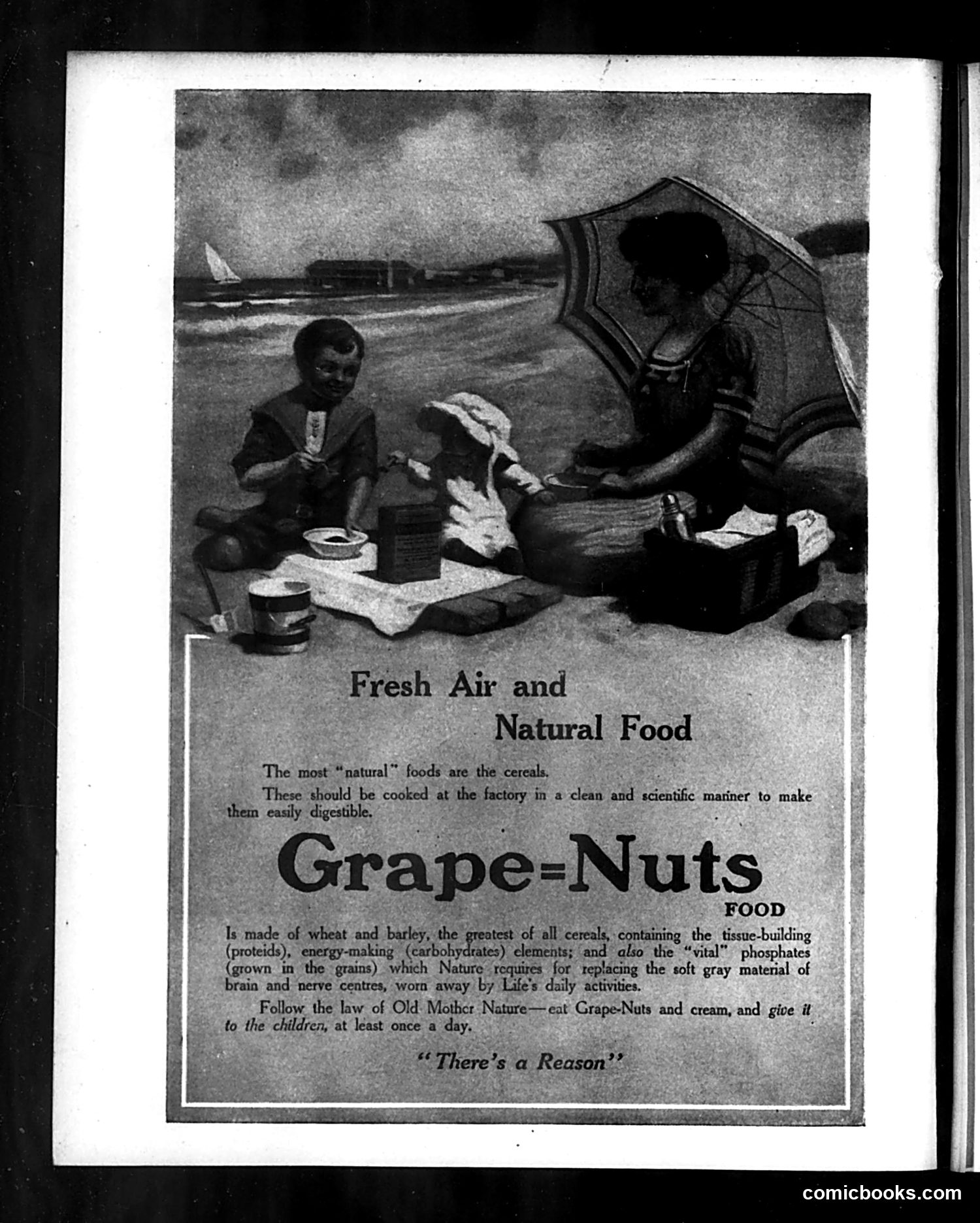
This is a **cereal advertisement, not political satire**. The page promotes "Grape=Nuts" food, marketed as a natural, nutritious cereal made from wheat and barley. The image shows a woman and child having a beach picnic under an umbrella, illustrating the product's positioning as wholesome family nutrition. The ad emphasizes the cereal's "vital phosphates" and tissue-building proteins, claiming it replaces nutrients lost through daily activity. The tagline "There's a Reason" was Grape=Nuts' actual advertising slogan. The advertisement reflects early 20th-century marketing trends emphasizing scientific nutrition language and health benefits to appeal to modern mothers concerned with child welfare. There is no political commentary or satire present on this page.