
Judge, 1913-06-21 · page 4 of 24
Judge — June 21, 1913 — page 4: what you’re looking at
What you’re looking at
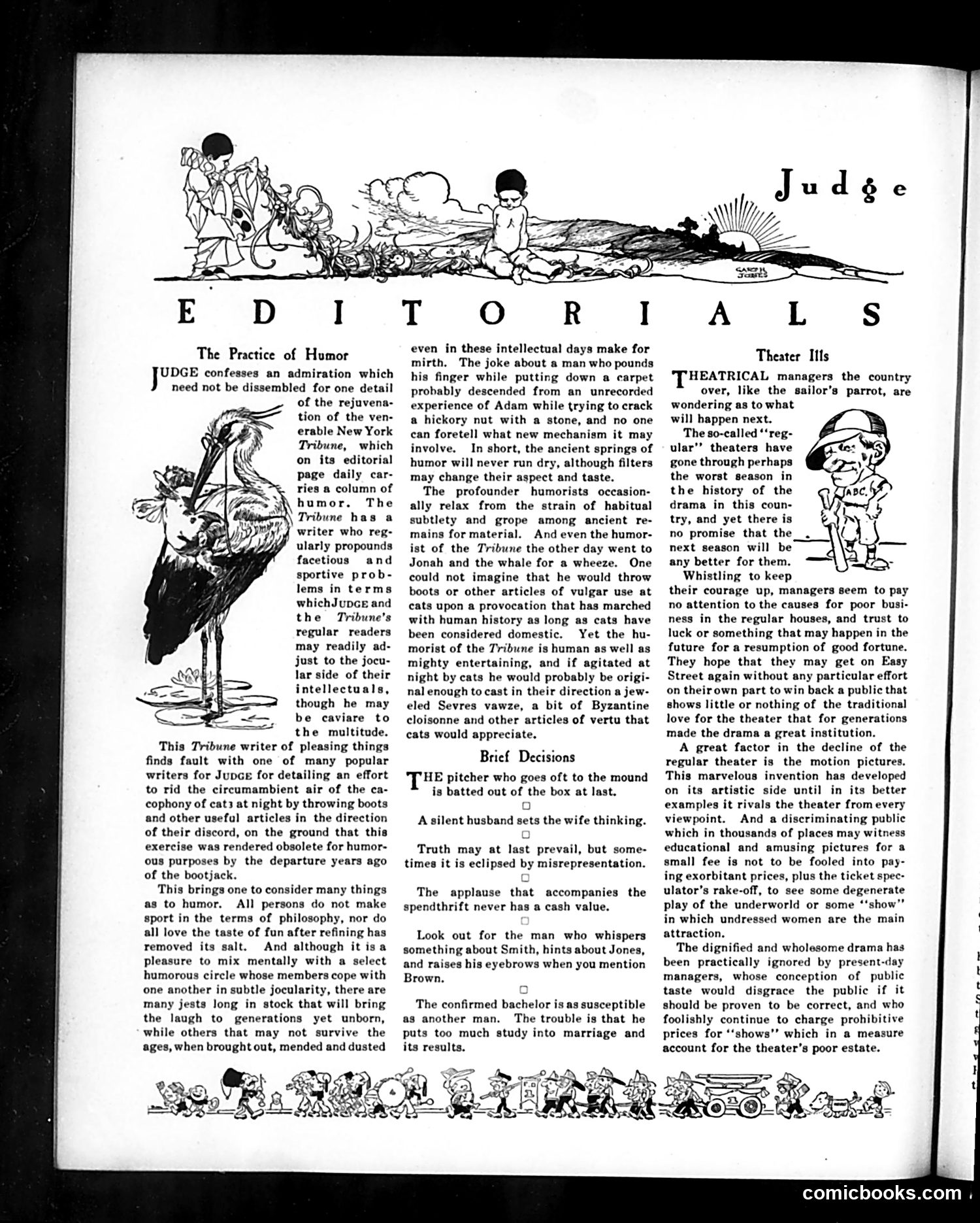
This page contains two editorial sections criticizing American cultural institutions: **"The Practice of Humor"** defends the *Tribune's* humor column against critics who find jokes lowbrow. The writer argues humor serves a valuable purpose—relaxing people from life's strain—and that even intellectual publications need levity. The crane illustration suggests sophistication. **"Theater Ills"** attacks theatrical managers for abandoning legitimate drama in favor of motion pictures and vulgar "shows," which the author claims have degraded public taste. The managers prioritize profit over artistic integrity, charging inflated prices for low-quality entertainment. Both pieces reflect early 20th-century anxieties about commercialization eroding cultural standards—a recurring *Judge* theme. The "Brief Decisions" aphorisms mock human nature generally.
📄 Transcribed text from this page (OCR, searchable)
Machine-transcribed from the original scan — historical spelling and the odd misread are preserved.
The Practice of Humor UDGE confesses an admiration which need not be dissembled for one detail of the rejuvena- tion of the ven- erable New York Tribune, which on its editorial page daily car- ries a column of humor. The Tribune has a writer who reg- ularly propounds facetious and sportive prob- lems in terms whichJupce and the Tribune's regular readers may readily ad- just to the jocu- lar side of their intellectuals, though he may be caviare to the multitude. This Tribune writer of pleasing things finds fault with one of many popular writers for Jupce for detailing an effort to rid the circumambient air of the ca- cophony of cat3 at night by throwing boots and other useful articles in the direction of their discord, on the ground that this exercise was rendered obsolete for humor- ous purposes by the departure years ago of the bootjack. This brings one to consider many things as to humor. All persons do not make sport in the terms of philosophy, nor do all love the taste of fun after refining has removed its salt. And although it isa pleasure to mix mentally with a select humorous circle whose members cope with one another in subtle jocularity, there are many jests long in stock that will bring the laugh to generations yet unborn, while others that may not survive the ages, when brought out, mended and dusted even in these intellectual days make for mirth. The joke about a man who pounds his finger while putting down a carpet probably descended from an unrecorded experience of Adam while trying to crack a hickory nut with a stone, and no one can foretell what new mechanism it may involve. In short, the ancient springs of humor will never run dry, although filters may change their aspect and taste. The profounder humorists occasion- ally relax from the strain of habitual subtlety and grope among ancient re- mains for material. And even the humor- ist of the Tribune the other day went to Jonah and the whale for a wheeze. One could not imagine that he would throw boots or other articles of vulgar use at cats upon a provocation that has marched with human history as long as cats have been considered domestic. Yet the hu- morist of the Tribune is human as well as mighty entertaining, and if agitated at night by cats he would probably be origi- nal enough to cast in their direction a jew- eled Sevres vawze, a bit of Byzantine cloisonne and other articles of vertu that cats would appreciate. Brief Decisions THE pitcher who goes oft to the mound is batted out of the box at last. o A silent husband sets the wife thinking. Truth may at last prevail, but some- times it is eclipsed by misrepresentation. The applause that accompanies the spendthrift never has a cash value. Look out for the man who whispers something about Smith, hints about Jones, and raises his eyebrows when you mention Brown. The confirmed bachelor is as susceptible as another man. The trouble is that he puts too much study into marriage and its results. —a :Oe te Gay ee Theater Itls HEATRICAL managers the country over, like the sailor’s parrot, are wondering as to what will happen next. The so-called ‘‘reg- ular’’ theaters have gone through perhaps the worst season in the history of the drama in this coun- try, and yet there is no promise that the next season will be any better for them. Whistling to keep their courage up, managers seem to pay no attention to the causes for poor busi- ness in the regular houses, and trust to luck or something that may happen in the future for a resumption of good fortune. They hope that they may get on Easy Street again without any particular effort on theirown part to win back a public that shows little or nothing of the traditional love for the theater that for generations made the drama a great institution. A great factor in the decline of the regular theater is the motion pictures. This marvelous invention has developed on its artistic side until in its better examples it rivals the theater from every viewpoint. And a discriminating public which in thousands of places may witness educational and amusing pictures for a small fee is not to be fooled into pay- ing exorbitant prices, plus the ticket spec- ulator’s rake-off, to see some degenerate play of the underworld or some ‘‘show” in which undressed women are the main attraction. The dignified and wholesome drama has been practically ignored by present-day managers, whose conception of public taste would disgrace the public if it should be proven to be correct, and who foolishly continue to charge prohibitive prices for ‘‘shows'’ which in a measure account for the theater's poor estate. comicbooks.com .