
Judge, 1913-06-21 · page 11 of 24
Judge — June 21, 1913 — page 11: what you’re looking at
What you’re looking at
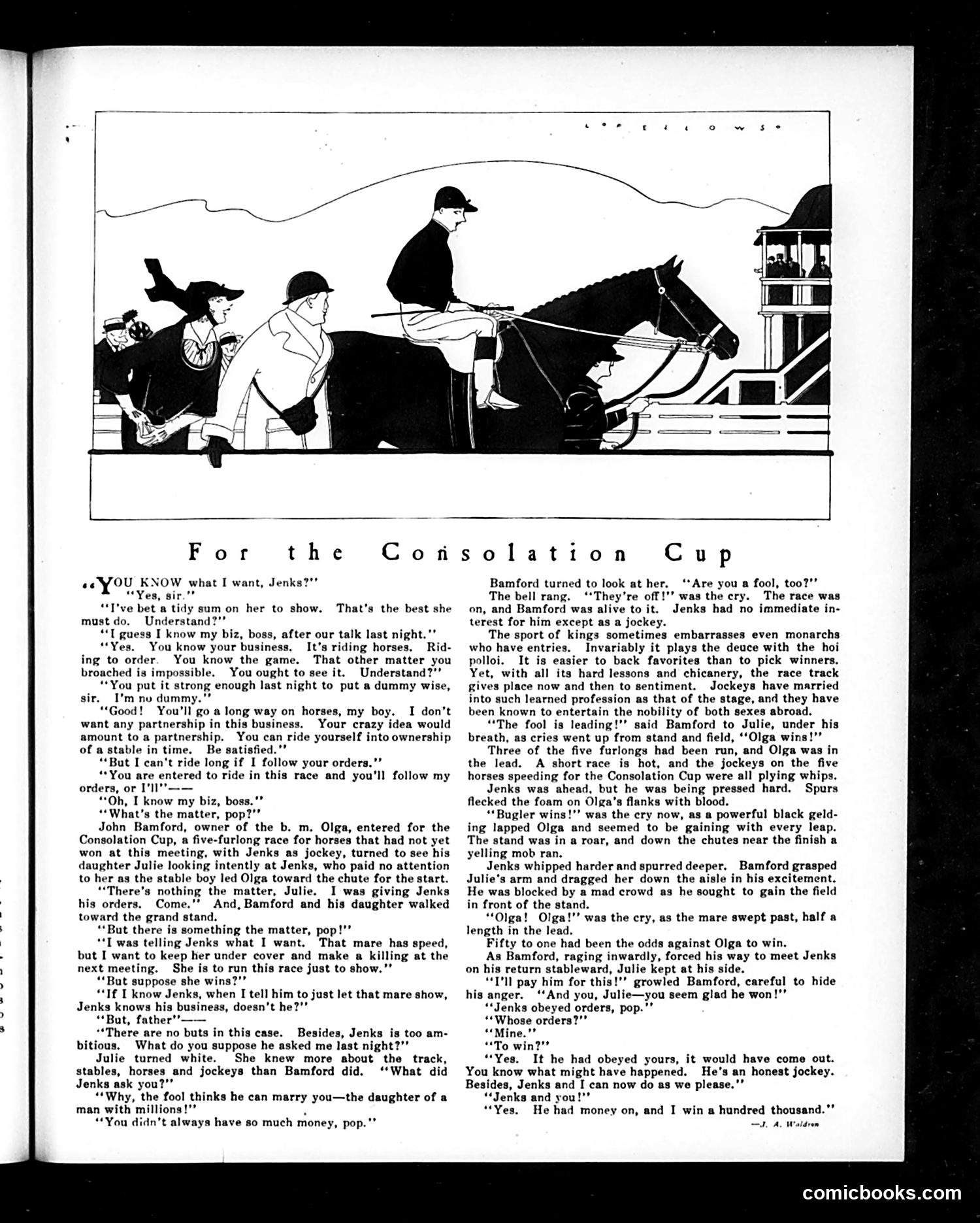
This story-illustration depicts a horse-racing drama centered on competing loyalties. John Bamford, a wealthy horse owner, instructs his jockey Jenks to deliberately hold back his mare Olga in a race—to "show" rather than win—so Bamford can profit from betting on her at better odds in a future race. The complication: Jenks loves Bamford's daughter Julie and has proposed marriage, which Bamford considers absurd given their class difference. When the race begins, Jenks faces a choice between obeying Bamford's orders or winning. The narrative suggests Jenks ultimately disobeys, driving Olga to victory despite Bamford's instructions. The satire mocks both wealthy men's attempts to manipulate outcomes through money and social hierarchies, while implying that honest work and merit (Jenks as a skilled jockey) may transcend class pretension.
📄 Transcribed text from this page (OCR, searchable)
Machine-transcribed from the original scan — historical spelling and the odd misread are preserved.
For the «You KNOW what I want, Jenks?” “Yes, sir.” “I've bet a tidy sum on her to show. must do. Understand?"’ I guess I know my biz, boss, after our talk last night."” Yes. You know your business. It’s riding horses. Rid- ing to order. You know the game. That other matter you broached is impossible. You ought to see it. Understand?’’ “*You put it strong enough last night to put a dummy wise, I'm no dummy.” “Good! You'll go a long way on horses, my boy. I don’t want any partnership in this business. Your crazy idea would amount to a partnership. You can ride yourself into ownership of a stable in time. Be satisfied.” “But I can't ride long if I follow your orders,’” “You are entered to ride in this race and you'll follow my orders, or I'Il""—— “Oh, I know my biz, boss.*” “What's the matter, pop?’’ John Bamford, owner of the b. m. Olga, entered for the Consolation Cup, a five-furlong race for horses that had not yet won at this meeting, with Jenks as jockey, turned to see his daughter Julie looking intently at Jenks, who paid no attention to her as the stable boy led Olga toward the chute for the start. “There’s nothing the matter, Julie. I was giving Jenks his orders. Come.’’ And, Bamford and his daughter walked toward the grand stand. “But there is something the matter, pop!"? “I was telling Jenks what I want. That mare has speed, but I want to keep her under cover and make a killing at the next meeting. She is to run this race just to show.’’ “‘But suppose she wins?’’ “If I know Jenks, when I tell him to just let that mare show, Jenks knows his business, doesn’t he?"’ “But, father’’—— “There are no buts in this case. Besides, Jenks is too am- bitious. What do you suppose he asked me last night?” Julie turned white. She knew more about the track, stables, horses and jockeys than Bamford did. ‘‘What did Jenks ask you?” “Why, the fool thinks he can marry you—the daughter of a man with millions!"" x “You didn’t always have so much money, pop."* That's the best she sir. Consolation Cup Bamford turned to look at her. ‘*Are you a fool, too?”’ The bell rang. ‘They're off!"? was the cry. The race was on, and Bamford was alive to it. Jenks had no immediate in- terest for him except as a jockey. The sport of kings sometimes embarrasses even monarchs who have entries. Invariably it plays the deuce with the hoi polloi. It is easier to back favorites than to pick winners, Yet, with all its hard lessons and chicanery, the race track gives place now and then to sentiment. Jockeys have married into such learned profession as that of the stage, and they have been known to entertain the nobility of both sexes abroad. “The fool is leading!’ said Bamford to Julie, under his breath, as cries went up from stand and field, ‘‘Olga wins!’’ Three of the five furlongs had been run, and Olga was in the lead. A short race is hot, and the jockeys on the five horses speeding for the Consolation Cup were all plying whips. Jenks was ahead, but he was being pressed hard. Spurs flecked the foam on Olga’s flanks with blood. “Bugler wins!"’ was the cry now, as a powerful black geld- ing lapped Olga and seemed to be gaining with every leap. The stand was in a roar, and down the chutes near the finish a yelling mob ran. Jenks whipped harder and spurred deeper. Bamford grasped Julie's arm and dragged her down the aisle in his excitement. He was blocked by a mad crowd as he sought to gain the field in front of the stand. “Olga! Olga!’ was the cry, as the mare swept past, half a length in the lead. Fifty to one had been the odds against Olga to win. As Bamford, raging inwardly, forced his way to meet Jenks on his return stableward, Julie kept at his side. “I'll pay him for this!"" growled Bamford, careful to hide his anger. ‘‘And you, Julie—you seem glad he won!’’ ‘*Jenks obeyed orders, pop.’” “Whose orders?’’ “Mine.”” “To win?"? “Yes. It he had obeyed yours, it would have come out. You know what might have happened. He’s an honest jockey. Besides, Jenks and I can now do as we please.’’ “Jenks and you!’" “Yes. He had money on, and I win a hundred thousand." dA, Waldron comicbooks.com