
A complete issue · 24 pages · 1912
Judge — August 17, 1912
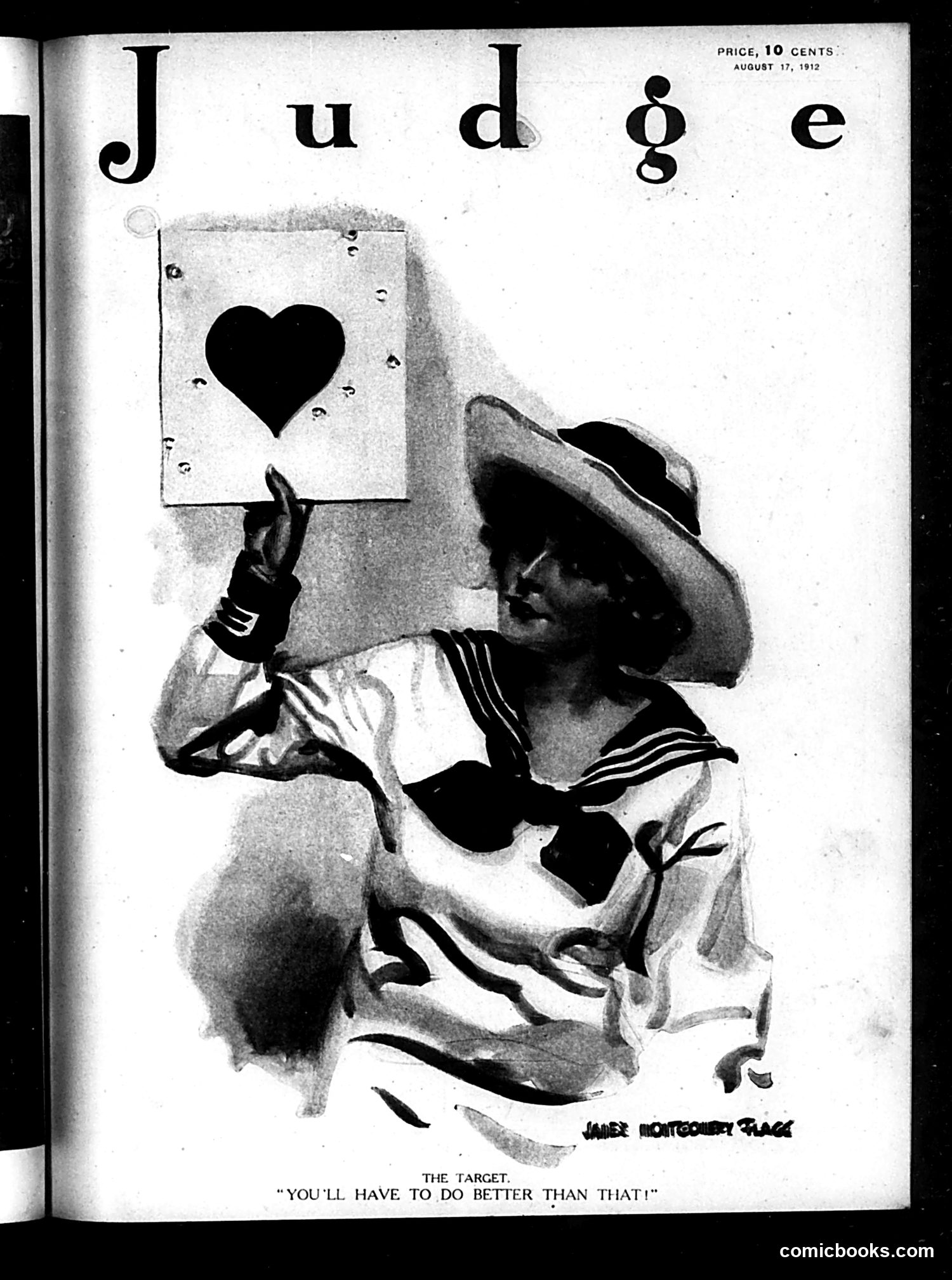
This satirical cover depicts a figure in Western/cowboy attire holding a target with a heart in its center. The caption reads "THE TARGET. 'YOU'LL HAVE TO DO BETTER THAN THAT!'" The artwork appears to be commentary on a 1912 political or social target—likely related to that year's presidential election or a prominent public figure. The cowboy imagery suggests American frontier themes, while the heart target may reference matters of sentiment, morality, or romantic/personal conduct being scrutinized. The figure's expression and posture suggest confidence despite criticism ("you'll have to do better"), implying the subject feels their efforts or character are being unfairly judged or attacked by opponents. Without clearer identification of the specific figure, the precise political reference remains unclear, though the timing suggests connection to 1912's significant political events.
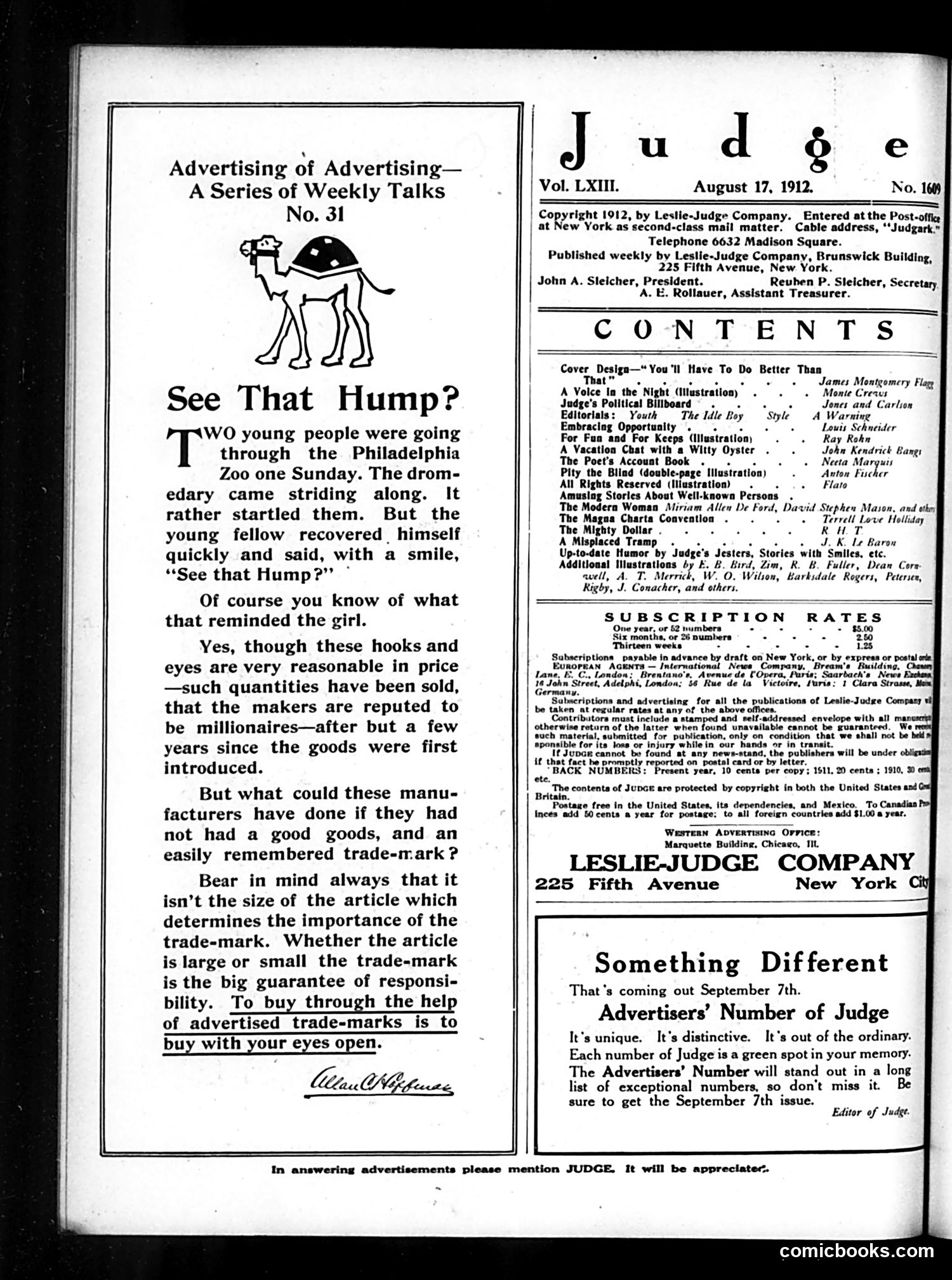
This page is primarily **advertising and editorial content** rather than political satire. The left side features an article titled "See That Hump?" with an illustration of a camel wearing a hat. The piece uses the camel as a metaphor to explain **trade-marks and branding**—comparing how people remember a camel by its distinctive hump to how consumers remember products by their distinctive marks. The article argues that trade-marks, regardless of product size, are crucial for brand recognition and responsibility. The right side contains the magazine's **table of contents and subscription information** for the August 17, 1912 issue (Vol. LXIII, No. 160). The satire here is gentle and commercial rather than political—using familiar imagery (the zoo camel) to make a business argument about the importance of advertising and brand recognition.
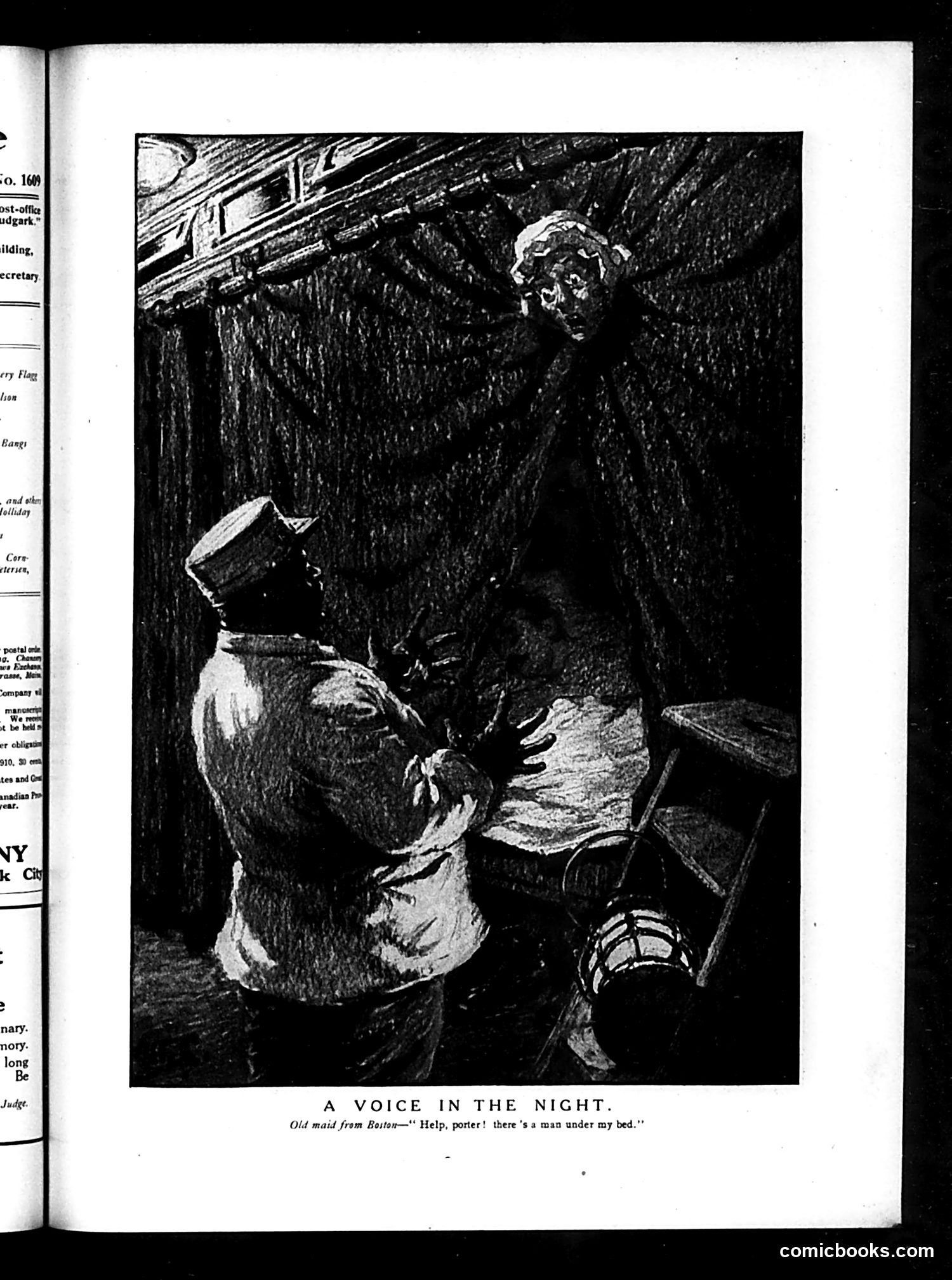
This illustration depicts a comedic domestic scene from a work titled "Old maid from Boston." An elderly woman in bed cries out in alarm: "Help, porter! there's a man under my bed." The satire plays on period anxieties about impropriety and the vulnerability of unmarried women. The "old maid" character—a stock figure in Victorian/early 20th-century humor representing an aging spinster—has apparently discovered an intruder beneath her bed, though the identity and intentions of the man remain unclear from the image alone. The humor derives from the embarrassing situation this creates for a respectable unmarried woman, reflecting era-specific anxieties about female virtue, propriety, and the scandalous implications of a man's presence in such circumstances. The Boston reference may suggest regional characteristics stereotyped in contemporary American humor.
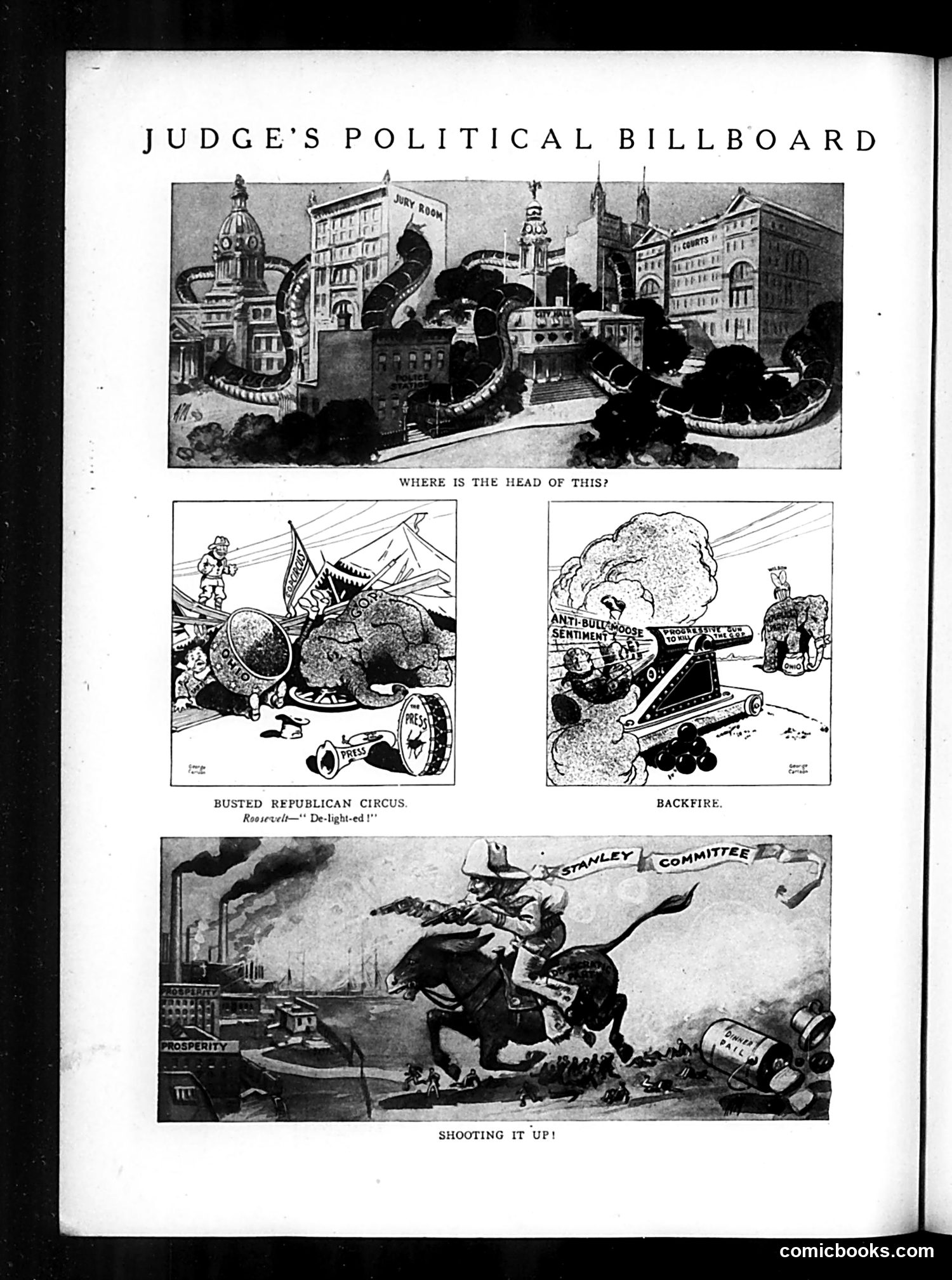
This page satirizes Republican political failures during what appears to be the Progressive Era. The top panel shows a cityscape with circus imagery—depicting Republican politics as hollow spectacle. Below, "Where Is the Head of This?" poses the central question. The "Busted Republican Circus" cartoon shows a headless body, with Roosevelt's "De-lighted!" response suggesting he's abandoned Republican leadership. The "Backfire" panel depicts anti-bullroose sentiment and "Insurgent" forces turning against Republican orthodoxy. The bottom cartoon, "Shooting It Up!," shows a mounted figure (likely Taft or a Republican leader) with a "Stanley Committee" banner amid industrial chaos labeled "Prosperity"—mocking Republican claims of economic success amid political turmoil. The cartoons collectively suggest Republican Party disarray and loss of coherent direction.
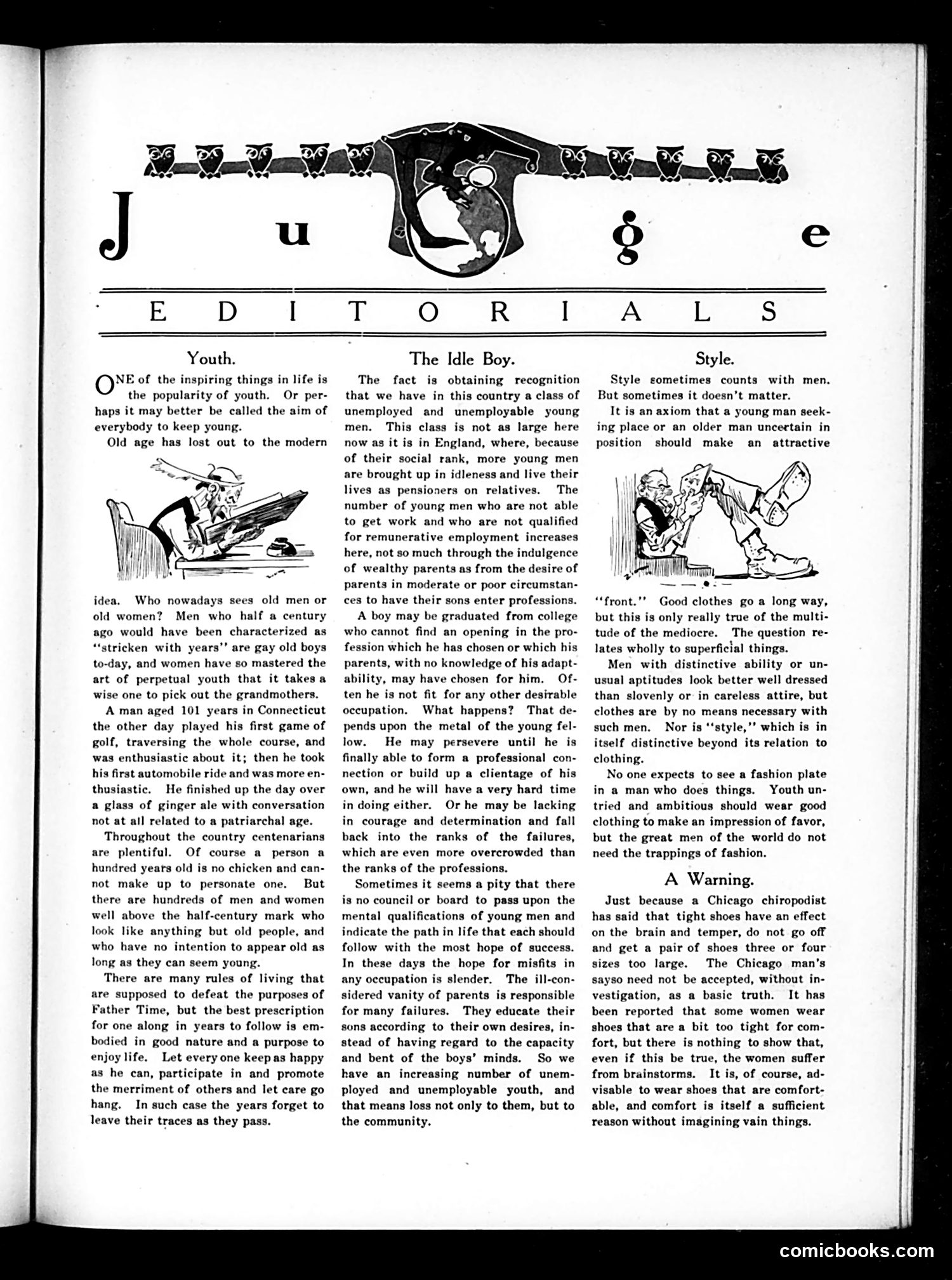
This editorial page contains three distinct columns of social commentary rather than political cartoons. The left illustration shows a young man playing golf enthusiastically; the right shows a poorly-dressed man in an awkward pose. The articles address early 20th-century social concerns: youth unemployment among educated men, the "idle boy" problem (privileged young men unable to find suitable work), and men's fashion. The pieces argue that style matters less than substance, and criticize both unemployed wealthy youth and impractical fashion trends. "A Warning" section mocks a Chicago chiropodist's claims about shoe sizes affecting the brain, and criticizes women wearing uncomfortable shoes—a common satirical target of the era. The overall message emphasizes practical values over vanity and appearance.
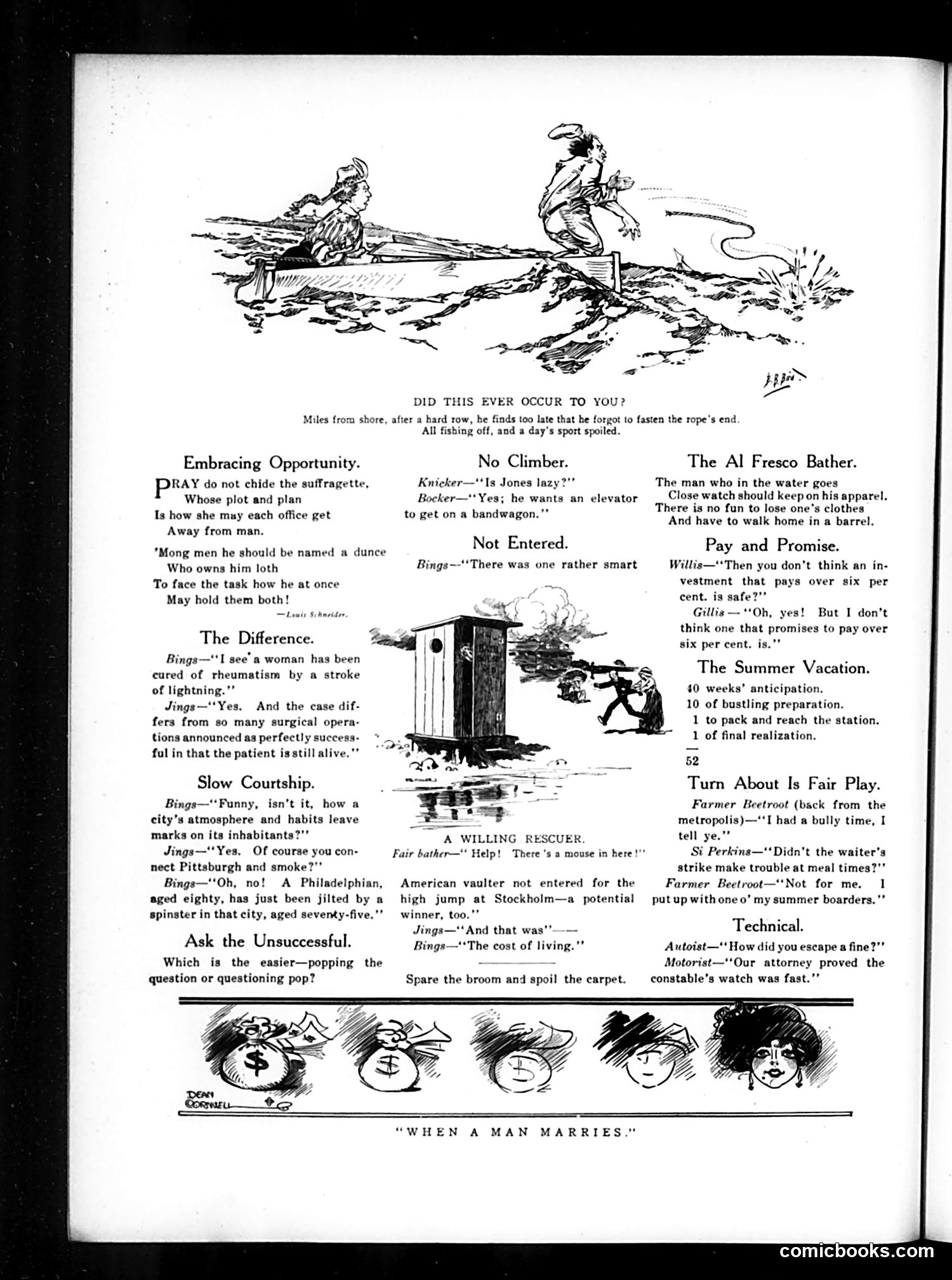
This page collects brief humorous sketches typical of early 20th-century Judge magazine. Key satirical targets include: **"Embracing Opportunity"** mocks the suffragette movement, suggesting women seeking political office want to escape men rather than pursue genuine reform. **"The Difference"** uses dark humor about medical treatment—a woman cured by lightning is compared favorably to surgical operations, implying many doctors' claimed successes are exaggerated or result in patient deaths. **"No Climber"** jokes about laziness and opportunism: Jones wants an elevator to board the bandwagon (join a popular cause without effort). **"The Summer Vacation"** satirizes urban workers' holiday expectations: weeks of anticipation collapse into one moment of actual realization. **"Turn About Is Fair Play"** presents rural humor—a farmer preferred his difficult summer boarder guest to city waiters during a strike. **"Technical"** mocks wealthy motorists using lawyers to escape traffic fines on technicalities. The page reflects period attitudes toward suffrage, class divisions, and urban-rural contrasts, with humor relying on cynicism about human nature and social hypocrisy.
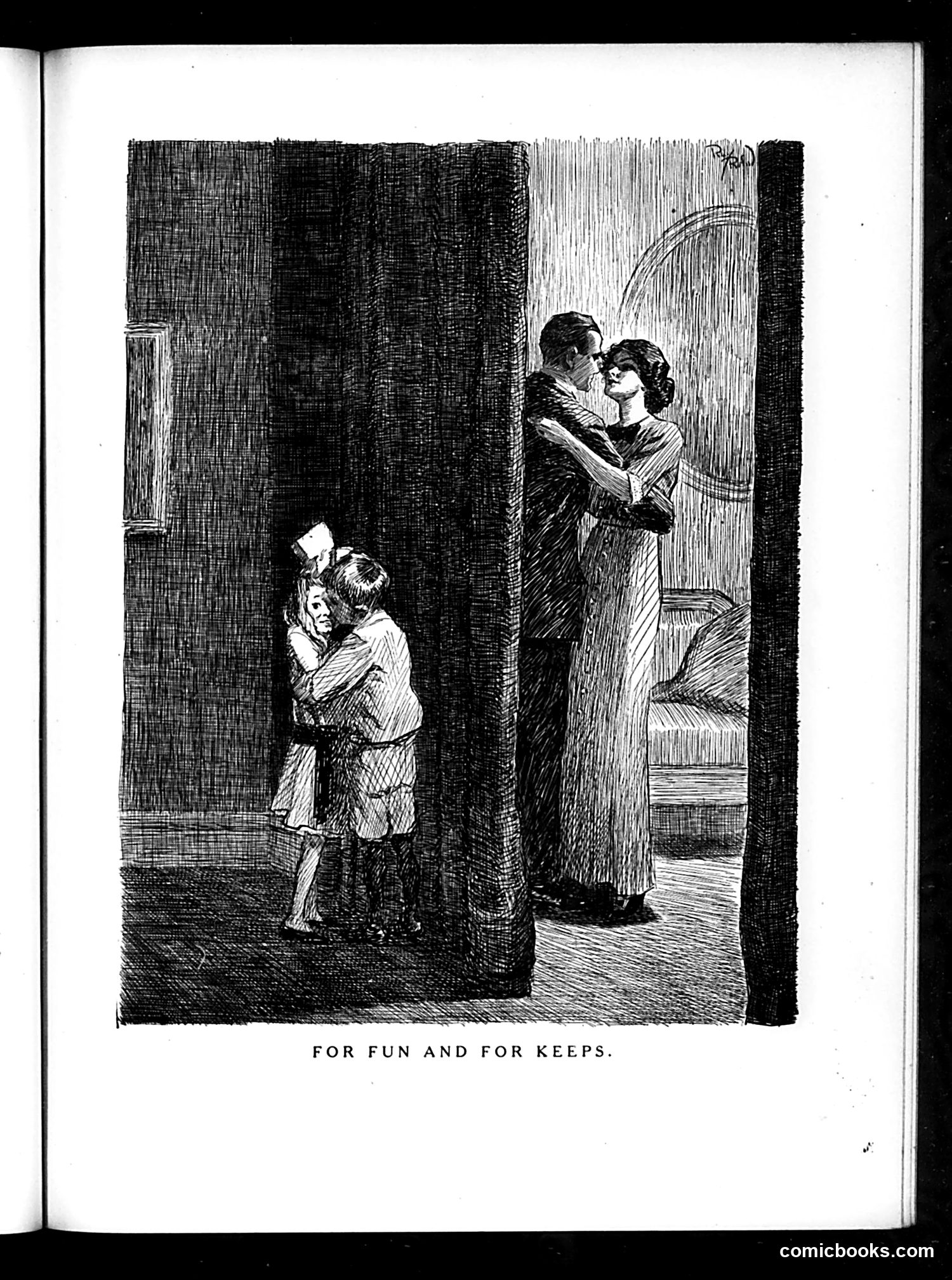
This illustration depicts a domestic scene with a romantic or marital theme. A couple embraces intimately in a doorway or hallway (right), while a small child in formal dress peeks around a corner or pillar (left), observing them. The caption "FOR FUN AND FOR KEEPS" suggests satire about marriage and relationships. The child's presence—catching the parents in an affectionate moment—creates the humor: the contrast between the adults' romantic moment and the innocent interruption. Without additional context, the specific political or social commentary remains unclear. This appears to be general domestic humor rather than political satire, possibly commenting on marriage, parenthood, or Victorian-era social propriety around displays of affection.
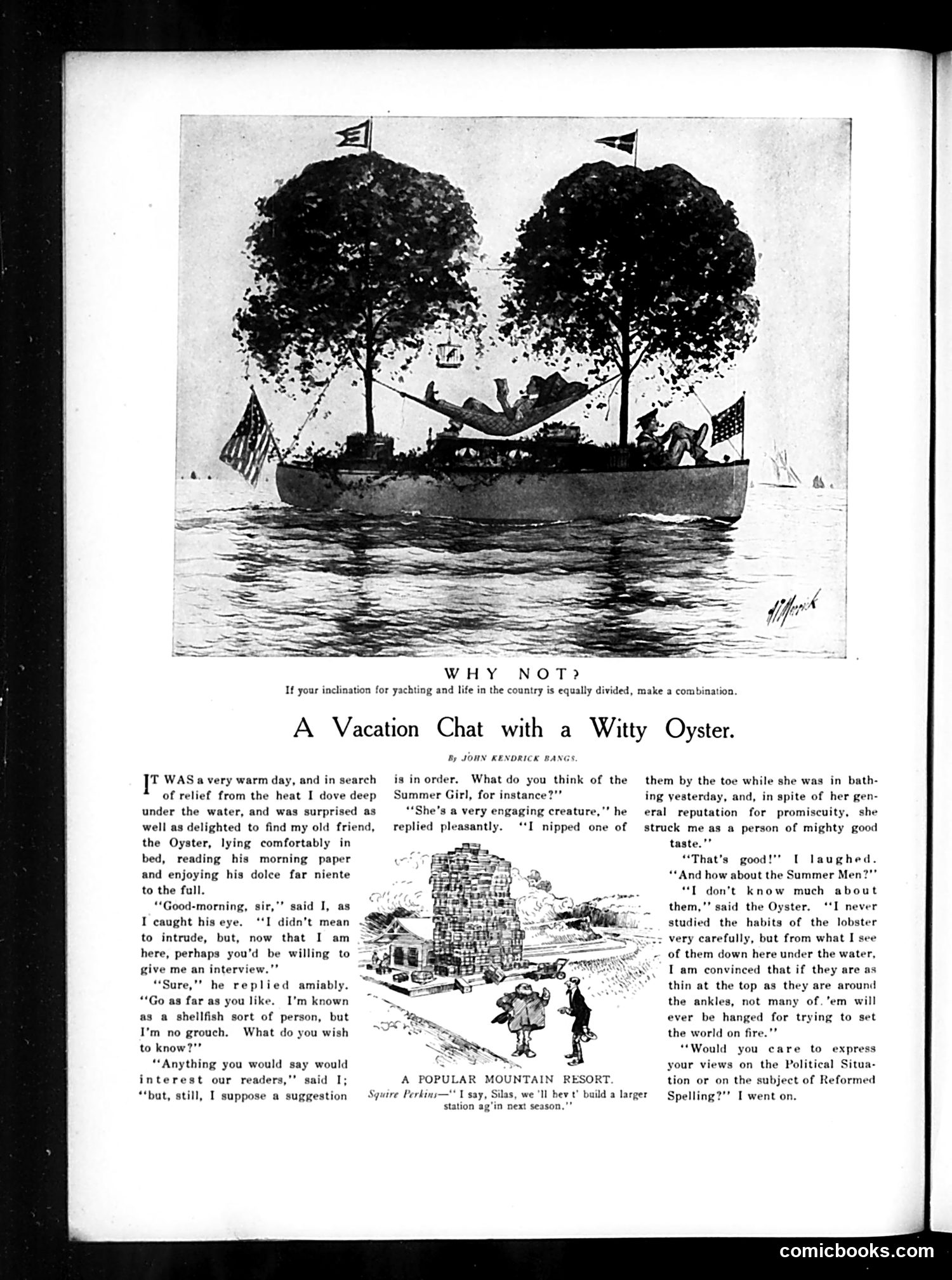
This is a humorous short story illustrated with two cartoons by John Kendrick Bangs, a popular satirist of the era. **Main Piece**: "A Vacation Chat with a Witty Oyster" depicts an underwater conversation between a narrator and a philosophical oyster. The oyster makes witty social commentary—dismissing "Summer Girls" as promiscuous, mocking "Summer Men" as physically weak and morally spineless ("not many of 'em will ever be hanged for trying to set the world on fire"). The satire targets upper-class vacationers, particularly the shallow "Summer Girl" trope popular in Gilded Age literature. **Top Cartoon**: A surreal image shows a boat growing two large trees, with small flags and figures aboard—illustrating the opening joke about combining yachting with country life. **Bottom Cartoon** ("A Popular Mountain Resort"): Two rustic characters discuss building a larger station, satirizing the commercial expansion of tourist destinations. The humor relies on period social stereotypes about leisure-class summer visitors and their affectations—material that would resonate strongly with Judge's educated, affluent readership.
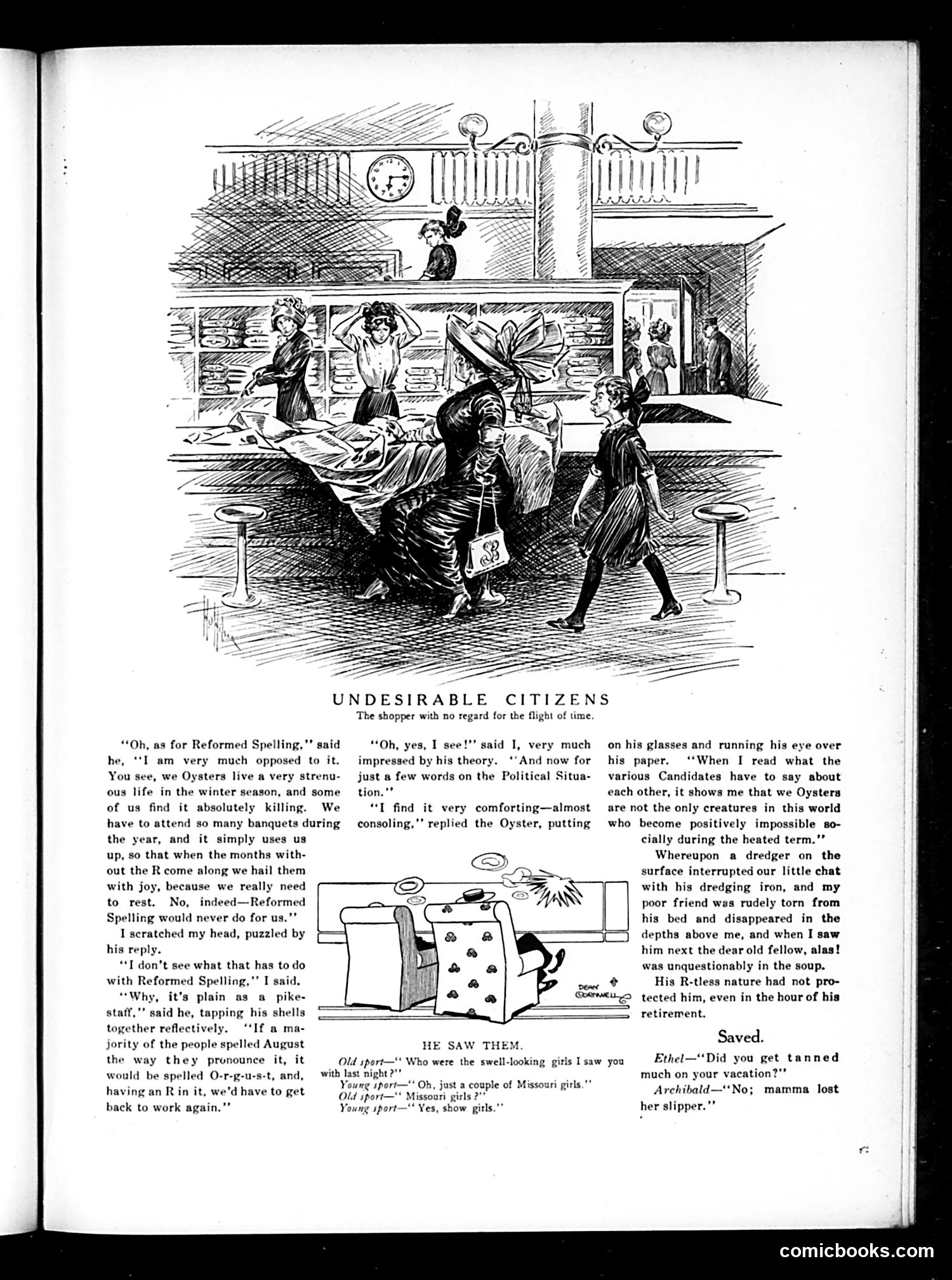
This satirical piece uses oysters as metaphors for wealthy socialites complaining about disruptions to their leisure. The main cartoon mocks the upper class's self-absorption: an oyster argues that Reformed Spelling (a real early 1900s movement to simplify English spelling) would harm oysters because they rely on the "R months" (September-April, when oysters are traditionally eaten) for rest—implying the wealthy's entire concern is avoiding social obligations during eating season. The secondary jokes mock the same class's superficiality: political candidates behaving impossibly during "heated" seasons mirrors oysters' own impossible social conduct; an oyster's loss of protection when actually harvested suggests the absurdity of their complaints. The smaller jokes about "Missouri girls" and vacation tanning reinforce themes of frivolous, self-centered leisure-class preoccupations—missing the point of experiences entirely (mamma losing her slipper overshadows vacation). The overarching satire targets the privileged classes' disconnection from reality and their trivial concerns.
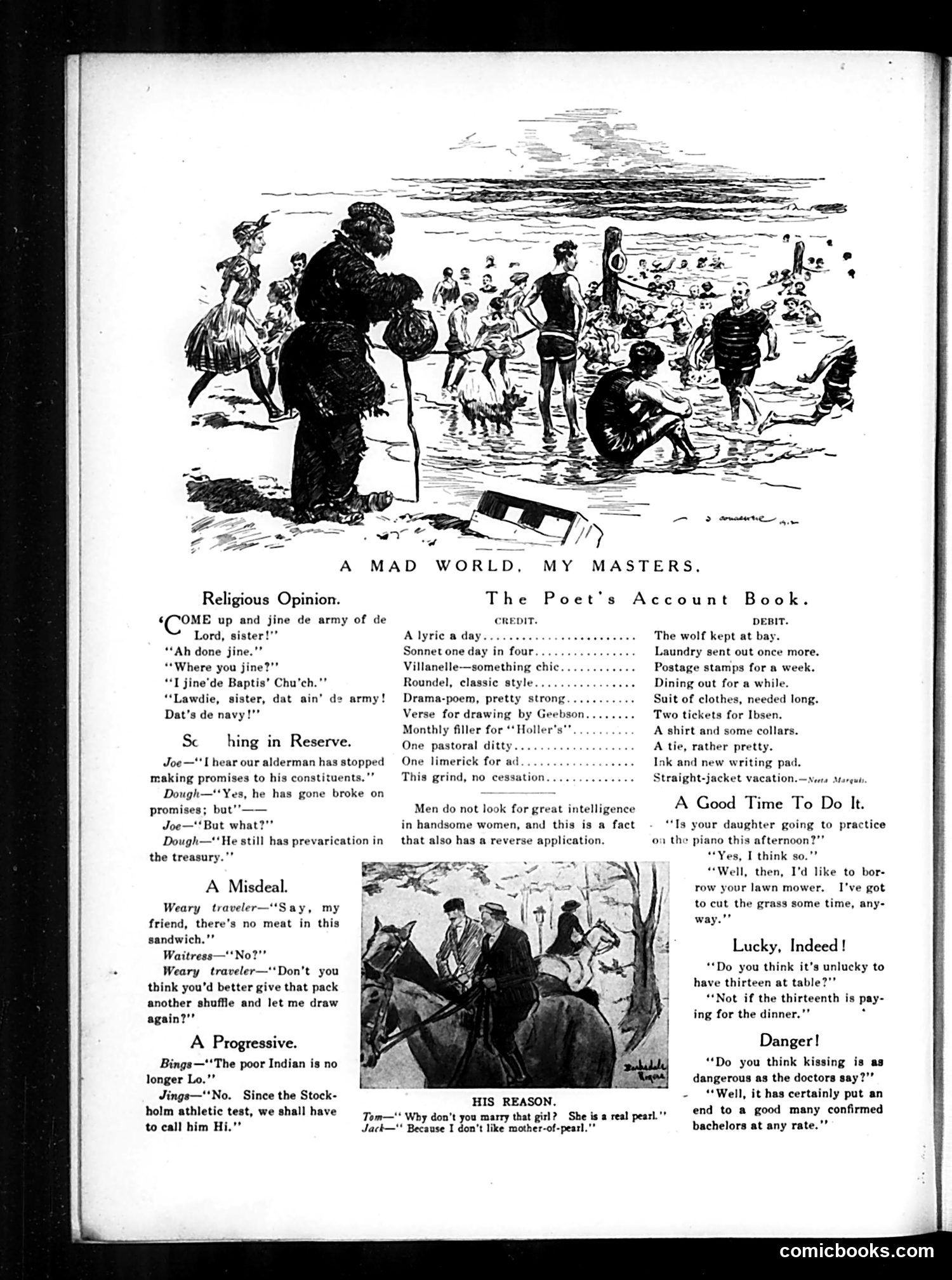
This page collects brief humorous sketches mocking various aspects of American society circa early 1900s. **"Religious Opinion"** uses dialect humor (common but now offensive) to joke about religious denominations—a Baptist woman mistakenly calls her church "the navy" instead of "the army of the Lord," playing on nautical/military metaphors for faith. **"Scheming in Reserve"** satirizes corrupt politicians who stop making promises when broke financially but retain dishonesty ("prevarication") as a resource. **"A Misdeal"** compares a poor restaurant sandwich to a bad card hand—asking the waitress to "shuffle" and let him "draw again." **"A Progressive"** jokes about Native Americans ("the poor Indian is no longer Lo"—referencing Longfellow's poem), suggesting athletic testing has made them stronger, so we'd call them "Hi" instead. **The Poet's Account Book** mocks hack poets grinding out verse-for-hire with minimal effort and maximum output. Remaining items are brief romantic/relationship jokes typical of period humor magazines.
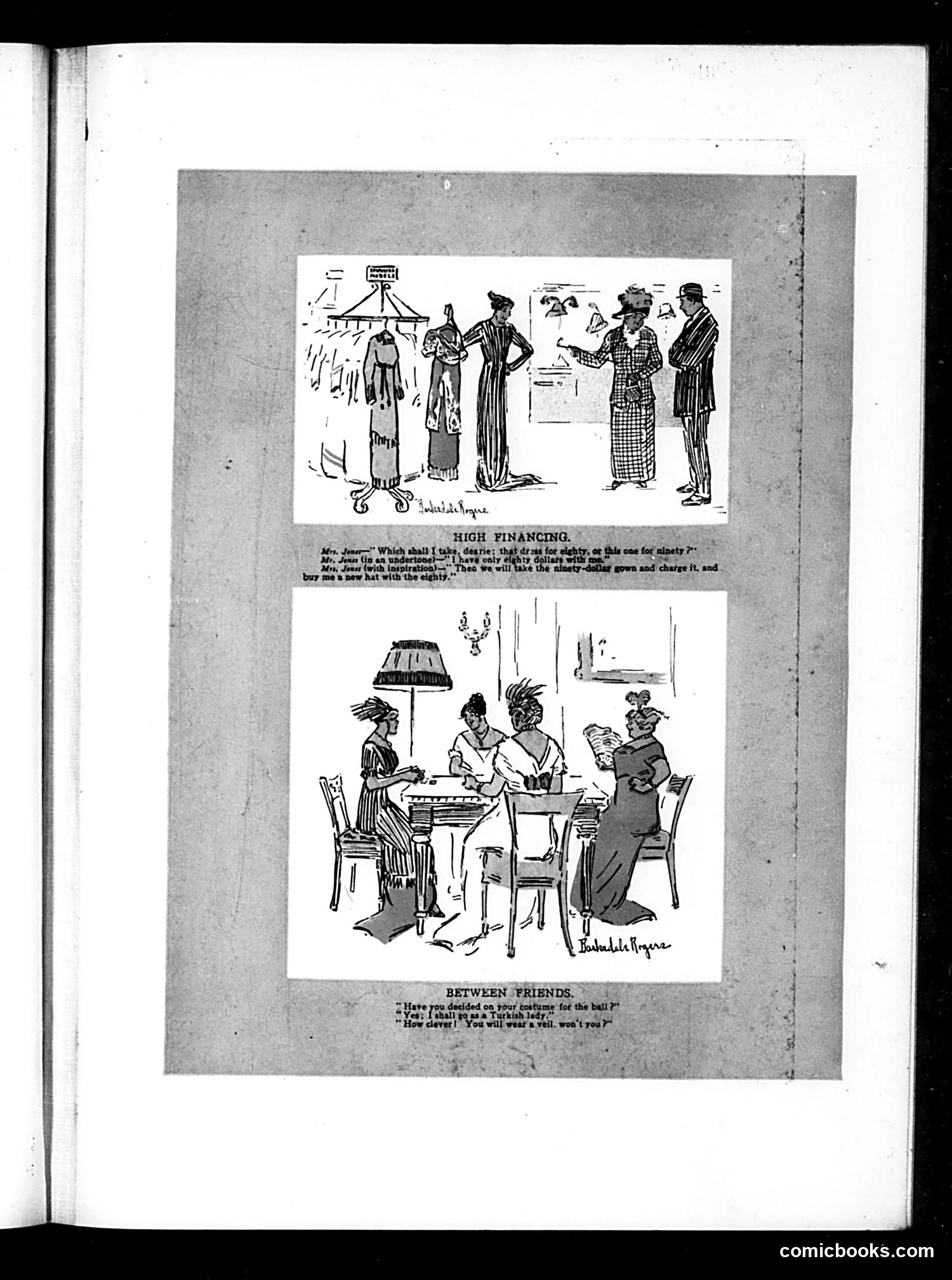
The top cartoon, titled "HIGH FINANCING," depicts a shopping dispute. A Mrs. Jensen asks a merchant which dress costs ninety dollars, then proposes buying one for that price and charging a second identical dress to her husband's account—essentially getting two dresses for one price. The merchant agrees to this scheme. The bottom cartoon, "BETWEEN FRIENDS," shows women at leisure discussing fashion. One mentions wearing a Turkish lady costume to a ball; another responds she'll wear a veil to match. Both cartoons satirize early 20th-century consumer culture and gender dynamics—women's shopping habits, their use of credit/husbands' finances, and fashion obsession. The humor targets women's perceived materialism and frivolous spending during a period of economic change.
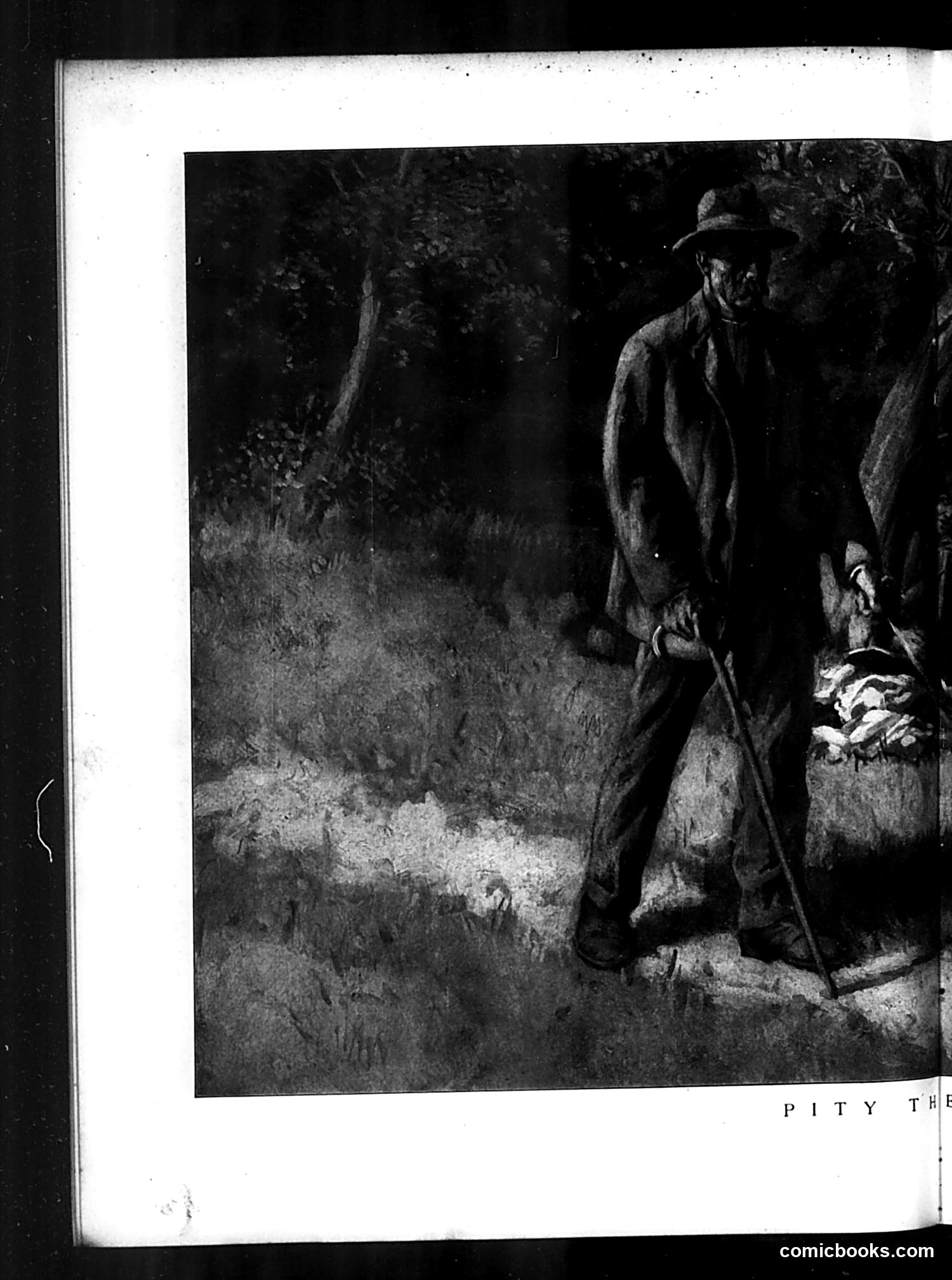
This appears to be a page from *Judge* magazine showing a black and white illustration. The partial text visible reads "PITY THE" at the bottom right, suggesting this is part of a larger cartoon or article title. The image depicts two figures in period clothing (coats and hats) on what appears to be a path or road with trees and foliage in the background. Without the complete title, caption, or full context visible on this page, I cannot definitively identify the specific figures being caricatured or determine the precise political or social satire being referenced. The mood appears serious or dramatic rather than comedic, but the exact subject and point of the satire remain unclear from this fragment alone.
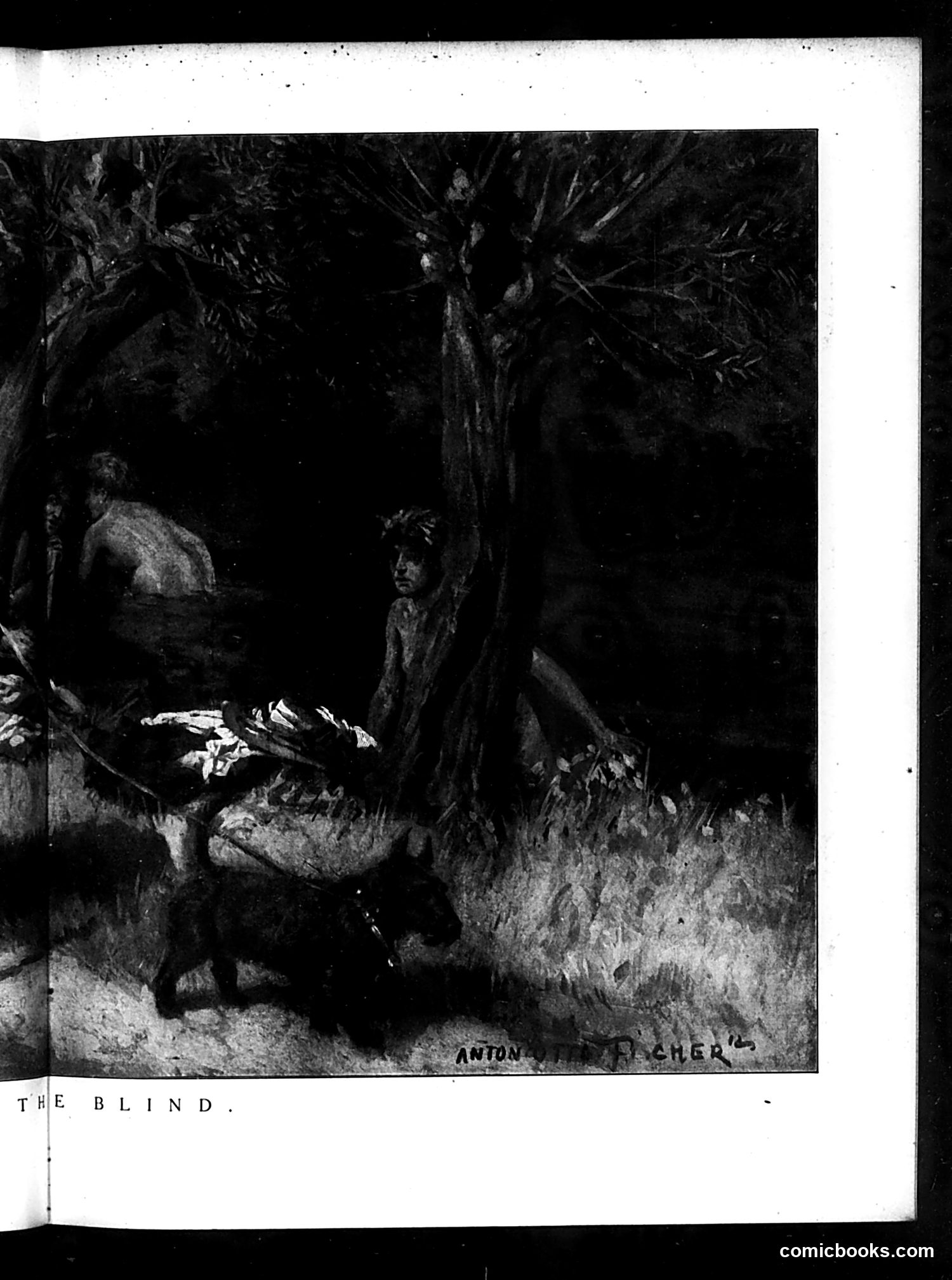
This appears to be an illustration rather than a political cartoon, depicting a dark, atmospheric scene in a forest or wooded area. The image shows several figures rendered in dramatic shadows and light contrasts—characteristic of Fischer's style. The title "The Blind" suggests a narrative illustration, possibly depicting a literary or allegorical scene. The composition emphasizes mystery and moral ambiguity through its chiaroscuro technique, with figures positioned among gnarled trees. Without additional context about which Judge issue this appeared in or what story it accompanied, the specific satirical or social commentary intent remains unclear. It may illustrate a story or poem published in Judge rather than serve as standalone political satire.
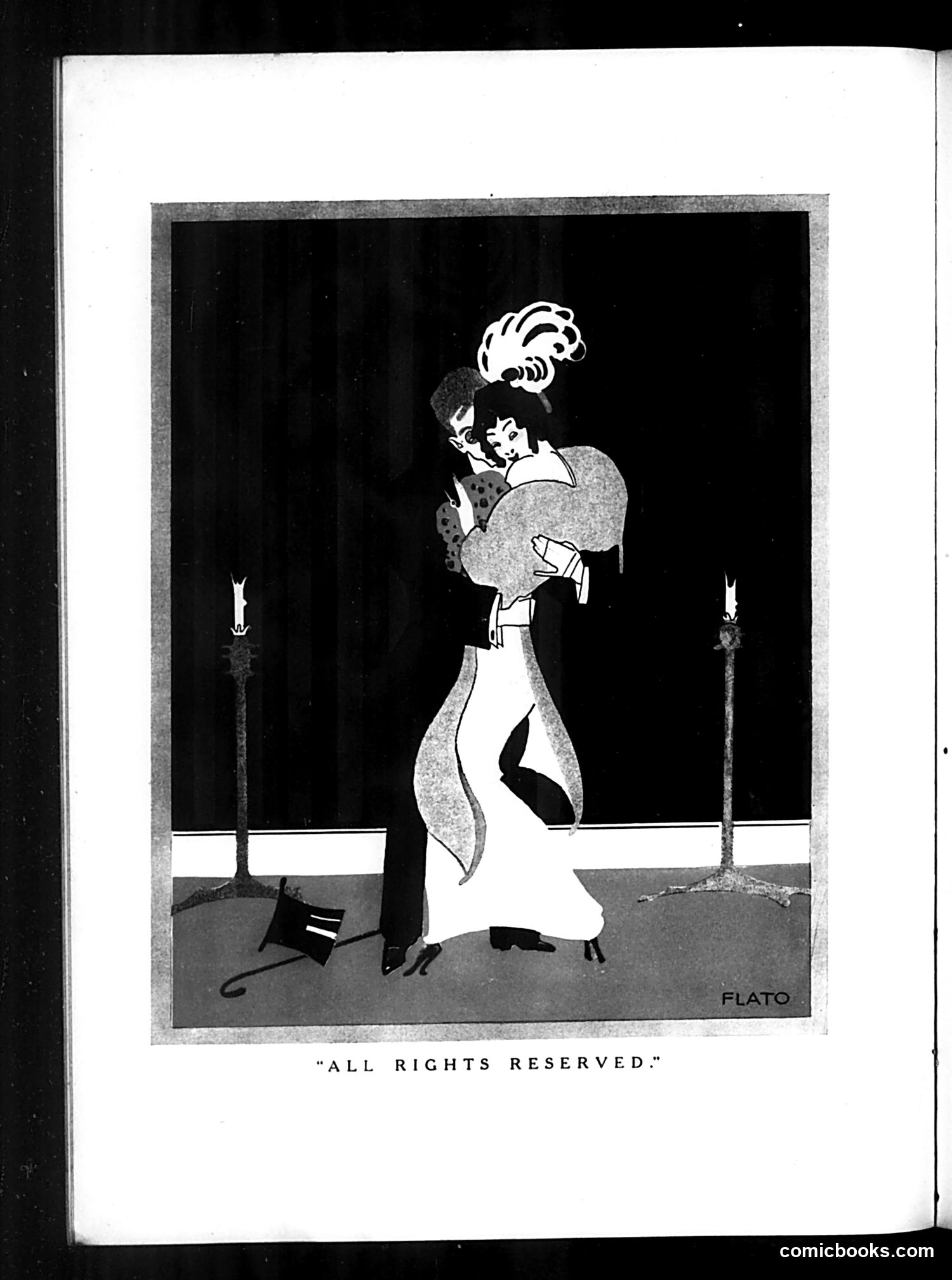
This cartoon by Flato depicts a glamorous woman in an elegant white gown holding a small child while standing between two candlesticks on a darkened stage with curtains. The title "All Rights Reserved" appears to be satirizing intellectual property claims or theatrical ownership. The image likely comments on how women—or perhaps actresses—and children are treated as possessions or property within the entertainment or legal system. The formal stage setting and the woman's composed elegance contrast with the possessive framing suggested by the title, suggesting irony about control, ownership, and limited agency. Without additional context about Judge magazine's publication date and contemporary issues, the specific target of the satire remains unclear, though it appears to critique property rights claims over people.
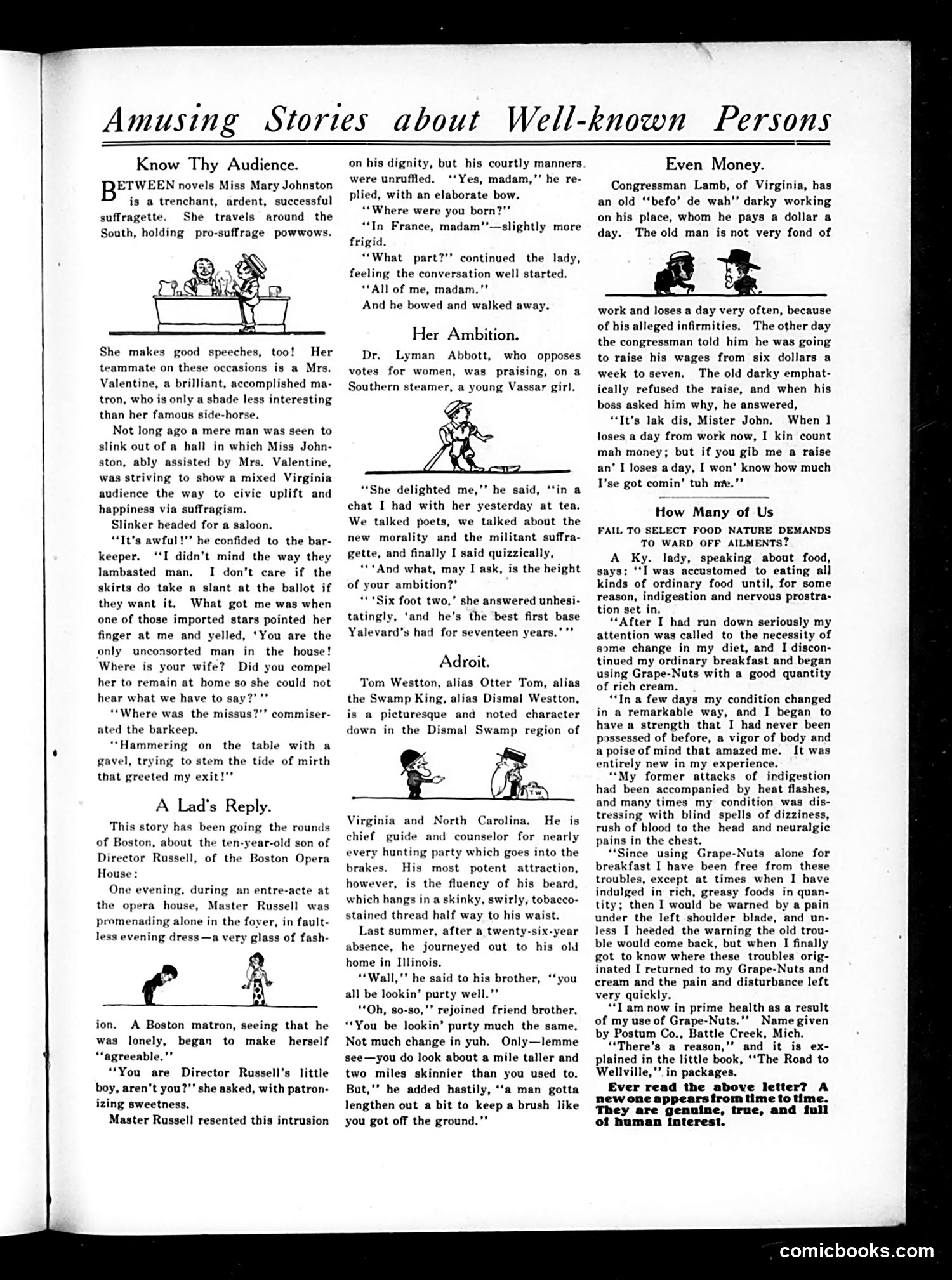
This page from *Judge* magazine presents several humorous anecdotes about contemporary public figures and social types, circa early 1900s. **"Know Thy Audience"** mocks women's suffrage activists, specifically novelist Mary Johnston and her speaking partner Mrs. Valentine. A man flees their pro-suffrage rally, offended not by their arguments but by being publicly shamed as an "unconsorted man"—one whose wife wasn't controlled enough to stay home. **"A Lad's Reply"** presents a witty Boston boy (son of Opera House Director Russell) who rebuffs a patronizing society matron's questions with increasingly cold French replies, culminating in "All of me, madam"—a clever put-down of her intrusive questioning. **"Her Ambition"** satirizes Dr. Lyman Abbott's anti-suffrage stance by recounting his praise of a Vassar girl whose ambition is marrying a six-foot-two baseball player—implying educated women's real goals remain domestic/romantic, not political. **"Adroit"** is a folksy anecdote about a Dismal Swamp character's beard, illustrating rural humor. The page satirizes suffragettes, pretentious society figures, and anti-suffrage arguments through ridicule and irony.
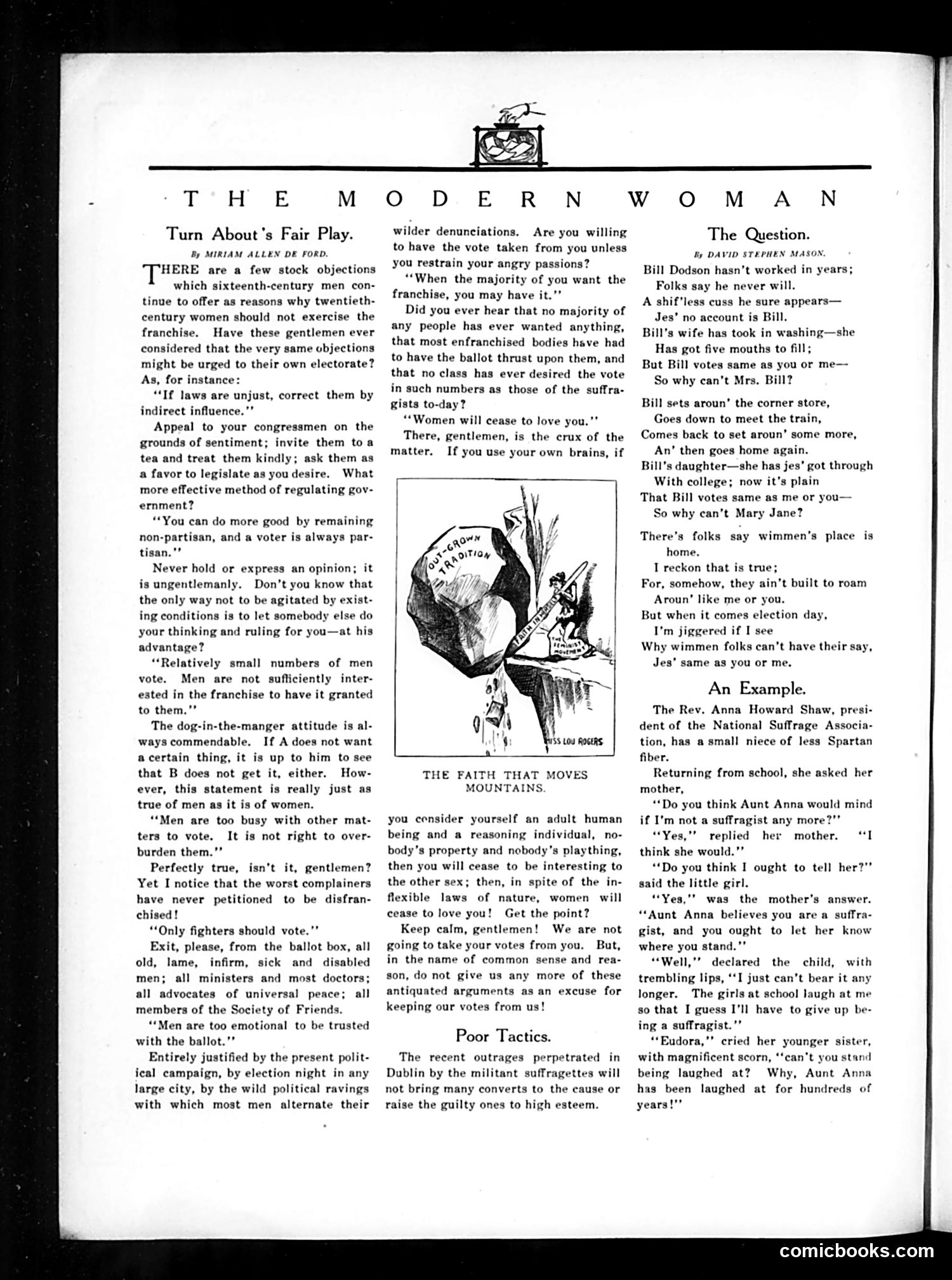
This Judge magazine page presents **pro-suffrage arguments** through satire. The left column, "Turn About's Fair Play" by Miriam Allen de Ford, uses **ironic reversal**: it lists objections men make against women voting, then points out these same objections apply equally to men. The strategy exposes the hypocrisy—if men can vote despite being "emotional," "busy," or "disinterested," why can't women? The cartoon "The Faith That Moves Mountains" (center) shows a woman pushing against a boulder labeled "WOMAN SUFFRAGE," suggesting women's determined effort to achieve voting rights. The right column, "The Question" by David Stephen Mason, presents a **concrete example**: Bill Dodson doesn't work but votes; his wife supports five children but cannot vote. This rhetorical device emphasizes the injustice—why should an idle man have political voice while an industrious woman doesn't? The page opposes "Poor Tactics" (militant suffragette violence in Dublin), distinguishing between legitimate suffrage arguments and counterproductive militant actions.
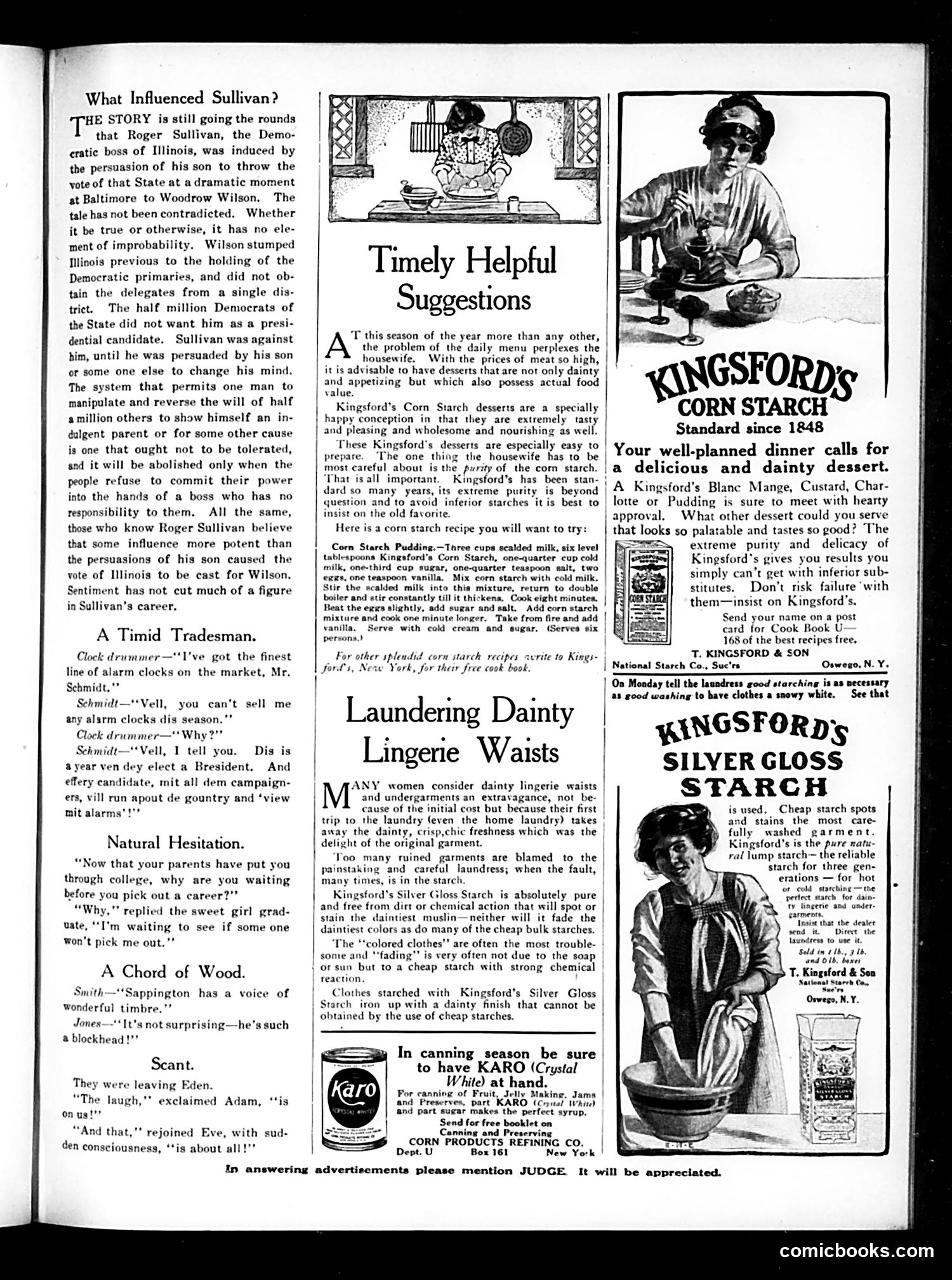
This page contains political satire and period humor alongside advertisements. **Main Article: "What Influenced Sullivan?"** Criticizes Roger Sullivan, Illinois Democratic boss, for allegedly switching his state's convention votes to Woodrow Wilson (1912 Democratic primary) based on his son's persuasion rather than principle. The satire attacks the corruption of machine politics—how one unaccountable boss could reverse the will of half a million voters. This reflects Progressive Era outrage at political "bosses" who controlled party machinery without democratic accountability. **Humorous Shorts:** Brief jokes about German-accented tradesmen worried about election-year disruptions, college graduates reluctant to work, and marriage ("Adam and Eve" leaving Eden). **Advertisements:** The page is dominated by Kingsford's Corn Starch ads promoting desserts and laundry starch, plus a Karo syrup ad—typical of Judge magazine's revenue model mixing satire with commercial content. The overall effect: political criticism wrapped in light entertainment, reflecting early 20th-century American anxieties about democracy and commerce.
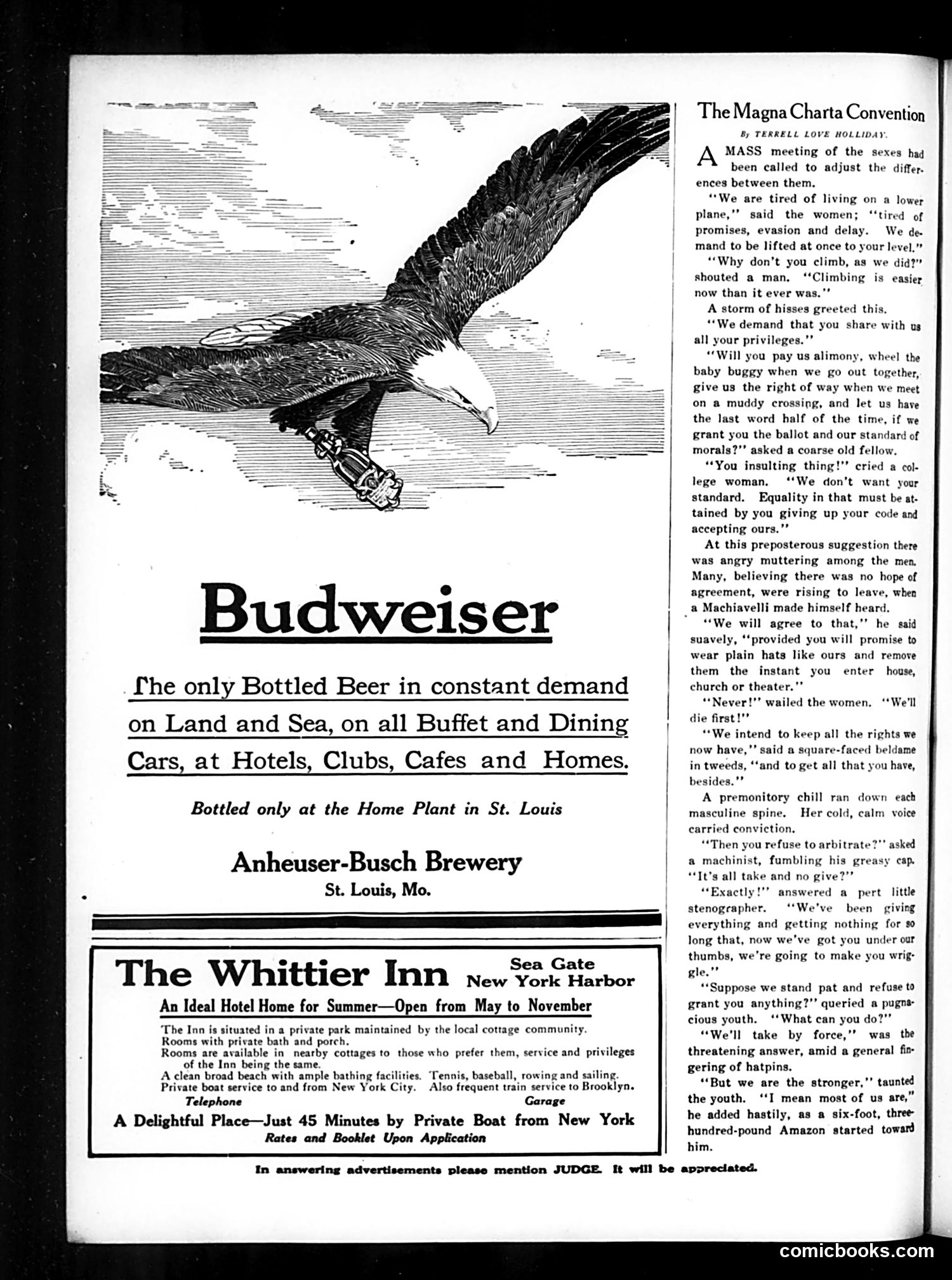
This satirical story mocks early 20th-century gender-equality debates. A mass meeting attempts to negotiate between men and women over rights and privileges. The humor lies in exposing contradictions: women demand "equality" while simultaneously insisting men grant them special treatment (alimony, baby-buggy pushing, right-of-way). When a man logically points out these aren't equal terms, women refuse compromise—they want men's rights *plus* their existing privileges. The satire's punchline: women threaten physical force (hatpins were real weapons) if denied, then a three-hundred-pound woman intimidates a man who boasted of male strength. Judge magazine used this to mock both suffragists (portrayed as hypocritical) and anti-suffragists (shown as logically outmaneuvered). The "Magna Charta" reference—evoking historical rights documents—undercuts the women's demands as absurdly self-serving rather than principled equality.
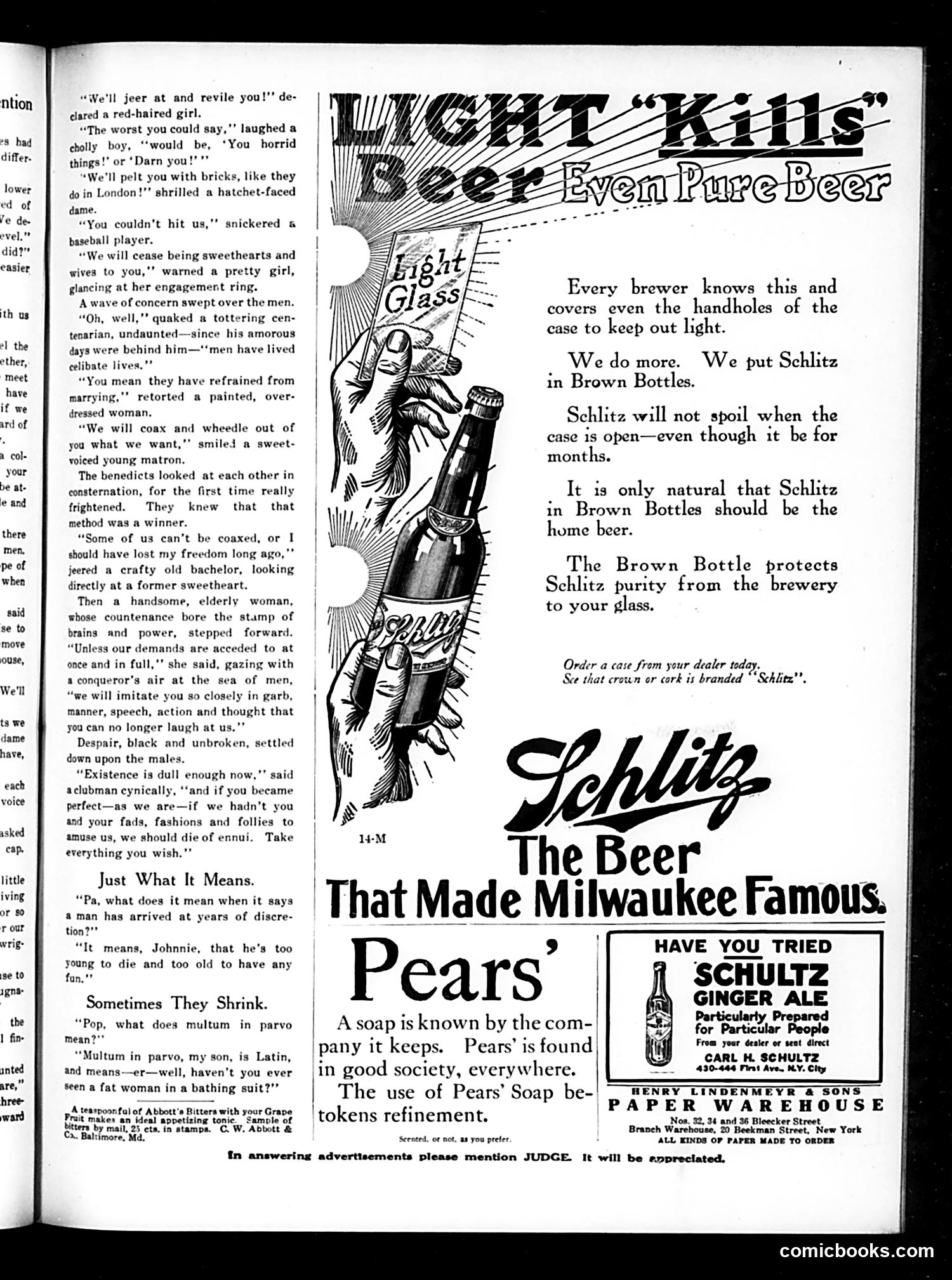
This page contains multiple satirical pieces typical of Judge magazine's humor: **Main Cartoon (left):** A dialogue where women threaten men with various punishments for unnamed offenses. The men remain unmoved until one woman—described as intelligent and powerful—threatens to imitate men so perfectly in "garb, manner, speech, action and thought" that men will lose their amusement from women's follies and fashions. This terrifies the men, satirizing male attitudes that women exist primarily to entertain them through their perceived inferiority and frivolity. The satire targets both female subservience expectations and male vanity. **Humor Pieces (below cartoon):** Two brief jokes about euphemistic language—"years of discretion" and "multum in parvo"—using physical appearance for comedic effect. **Advertisements:** The page is dominated by period beer and soap ads (Schlitz, Pears' Soap), reflecting Judge's commercial base. These represent early 20th-century brand marketing emphasizing purity and social refinement.
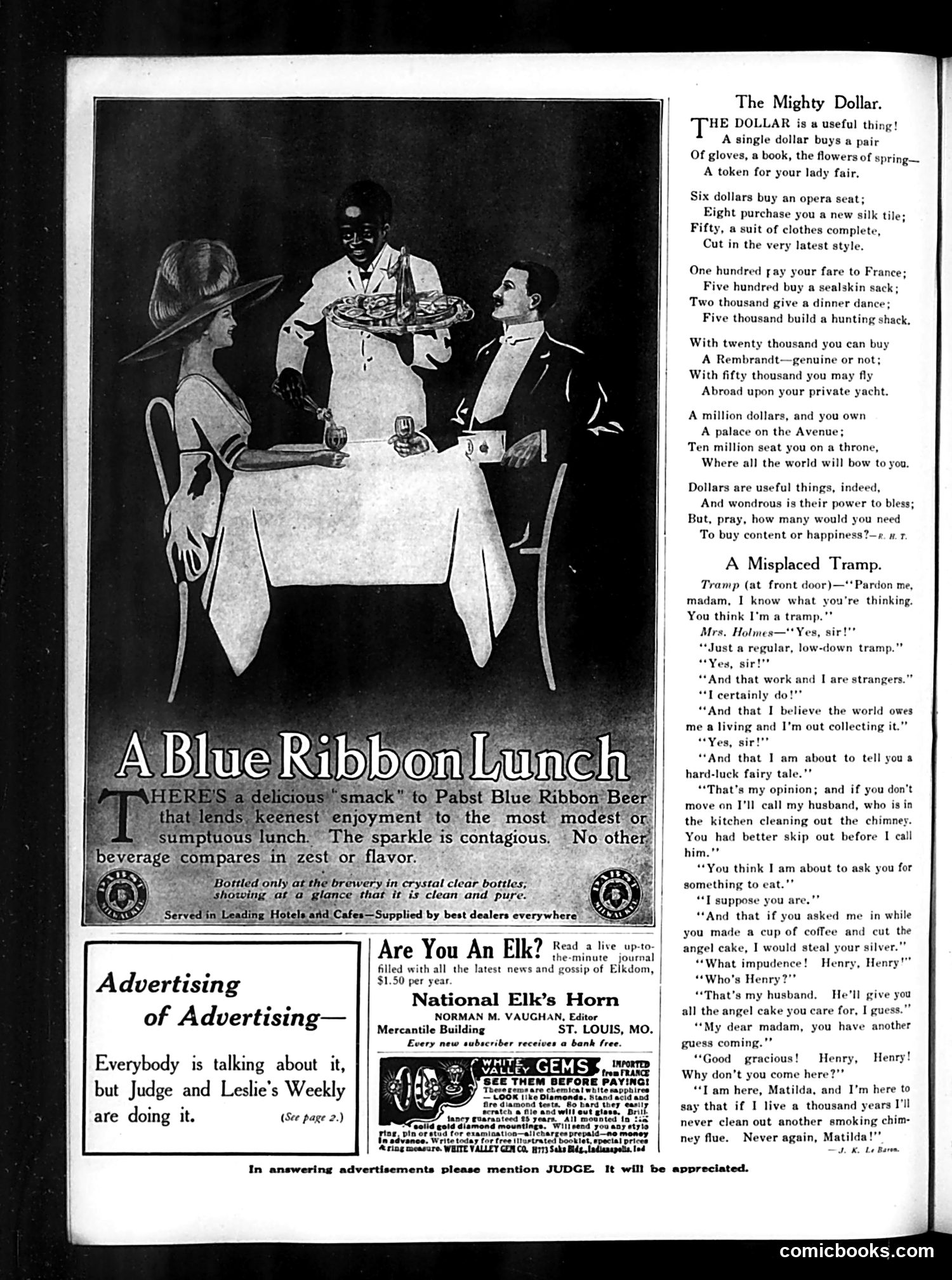
This comic sketch satirizes class assumptions and domestic life in the early 1900s. A vagrant appears at a wealthy woman's door, and she immediately launches into a condescending monologue cataloging every negative stereotype she assumes about him—that he's lazy, a burden on society, a liar, and a thief. The joke subverts expectations: the tramp wasn't actually going to ask for anything. More pointedly, it mocks *her* assumptions and reveals her own anxieties. The punchline is undercut when her husband Henry emerges from cleaning the chimney (servant's work), immediately quits, and declares he'll "never clean out another smoking chimney flue"—suggesting that *he's* the one fleeing his domestic servitude, not the tramp seeking handouts. The satire targets both snobbish class prejudice and the social instability of the era, where even middle-class domestic help was precarious.
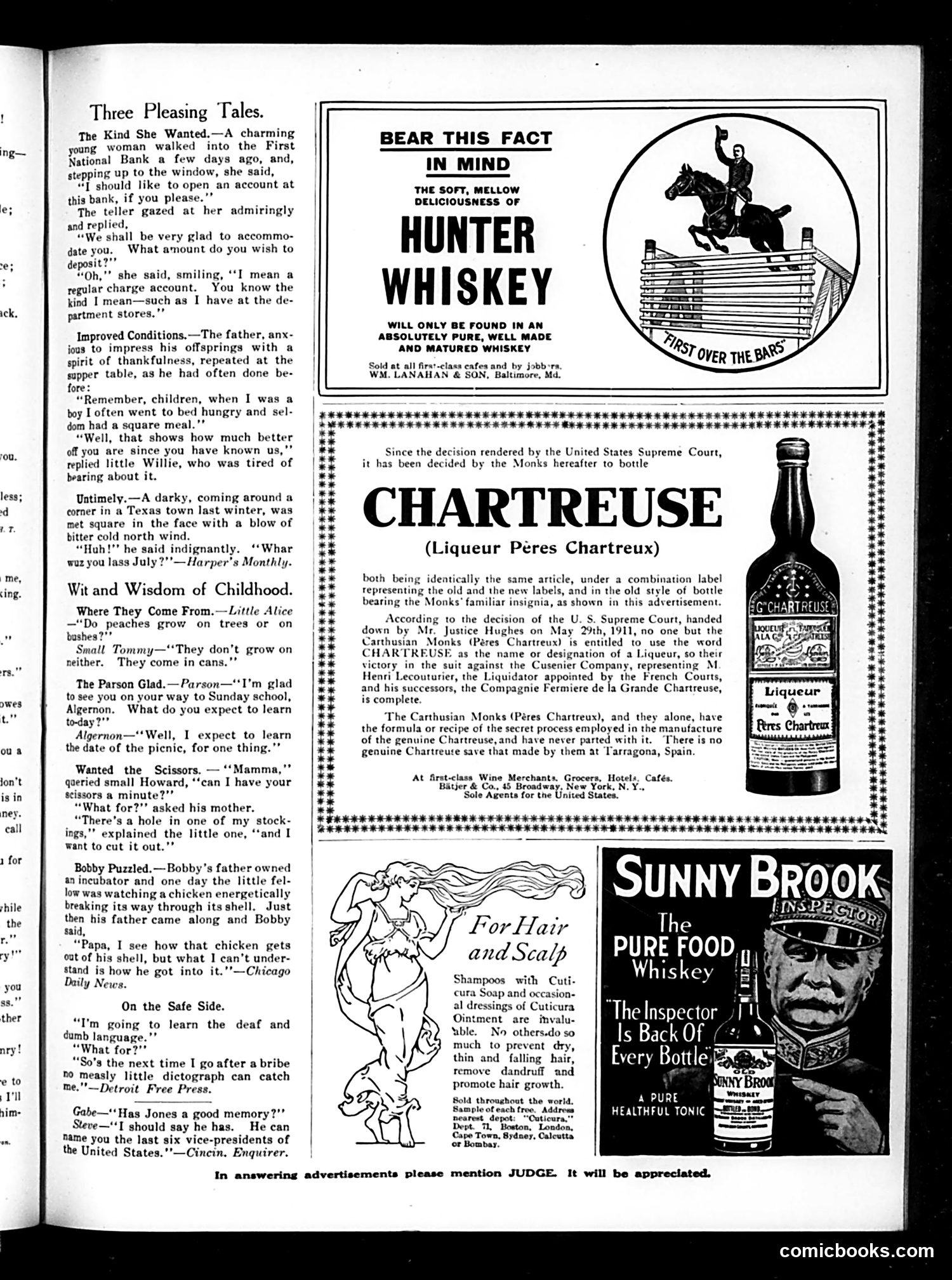
This Judge magazine page contains **three brief humorous anecdotes** plus **period advertisements**—not political cartoons. The jokes rely on early-20th-century social conventions: 1. **"The Kind She Wanted"**: A young woman asks a bank teller to open a "charge account" like department stores offer—satirizing women's shopping habits and the novelty of consumer credit. 2. **"Improved Conditions"**: A father boasts of childhood poverty; his son quips that the father's suffering proves nothing since the family's circumstances improved *after* meeting them—a child's logic joke. 3. **"Untimely"**: A Black man complains to cold wind about *timing*, as if addressing a person—wordplay on personification. The advertisements promote **Hunter Whiskey**, **Chartreuse liqueur** (highlighting a recent Supreme Court trademark ruling favoring Carthusian monks), and **Sunny Brook whiskey**—typical of Judge's alcohol advertising during the pre-Prohibition era. The humor is genteel and light, reflecting Judge's middle-class readership.
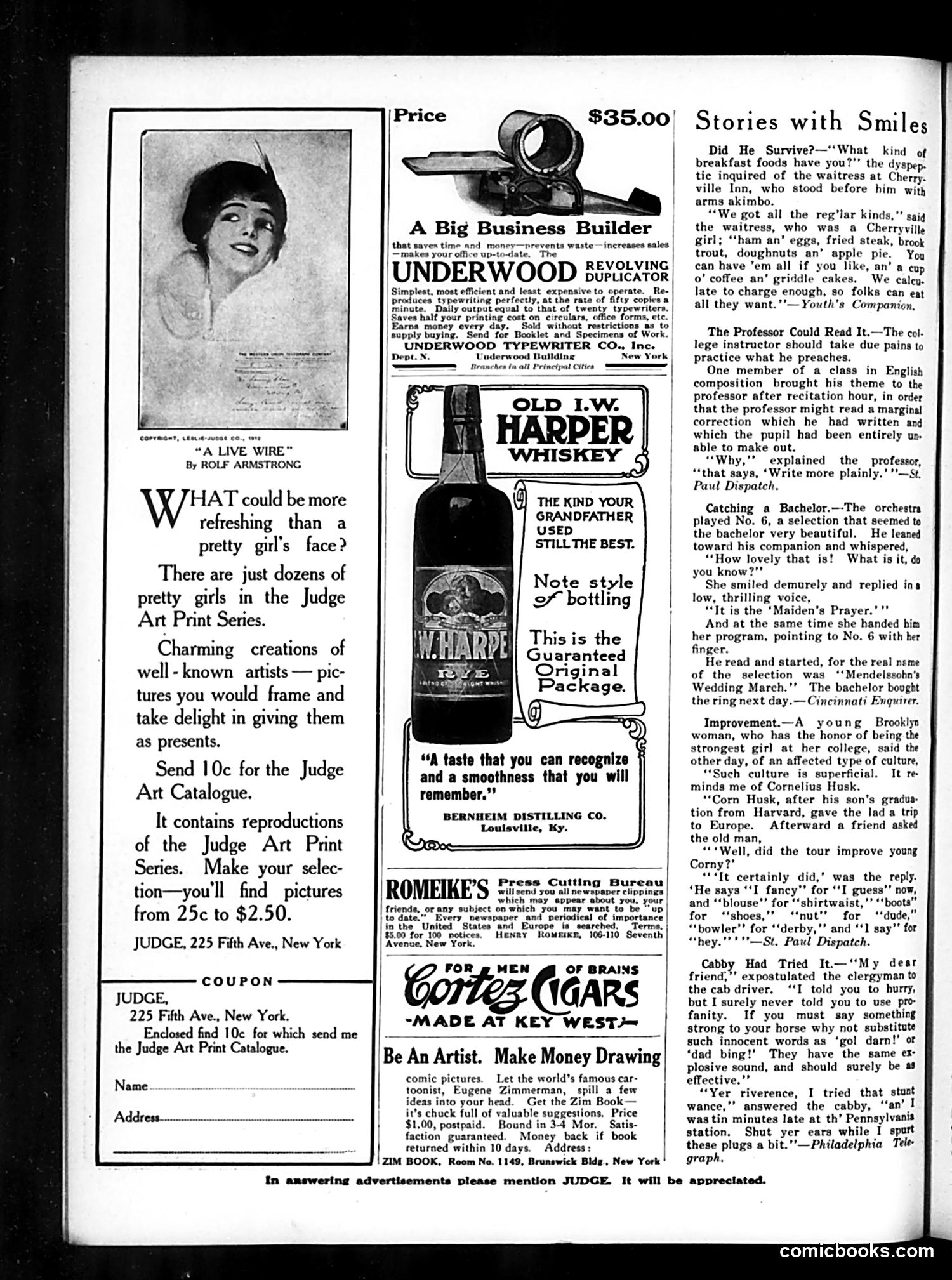
This page consists primarily of **advertisements and brief humorous stories** rather than political cartoons. **Key Content:** The page features ads for typewriters, whiskey, art prints, and cigars—typical early 20th-century Judge magazine fare. The only illustration is "A Live Wire" by Rolf Armstrong, showing a pretty woman's face (Armstrong was known for illustrating attractive women). **"Stories with Smiles"** comprises short, lighthearted anecdotes about: - A diner's encounter with a waitress offering excessive breakfast options - A professor's illegible handwriting correction - A bachelor charmed by orchestra music titled "Maiden's Prayer" (which he learns is actually "Mendelssohn's Wedding March") - A Harvard graduate's affected European speech patterns **Social Context:** These gentle jokes mock everyday situations—pretentious education, romantic mishaps, and miscommunication. The humor reflects early-1900s middle-class concerns about proper deportment and education, with no overt political satire present on this particular page.
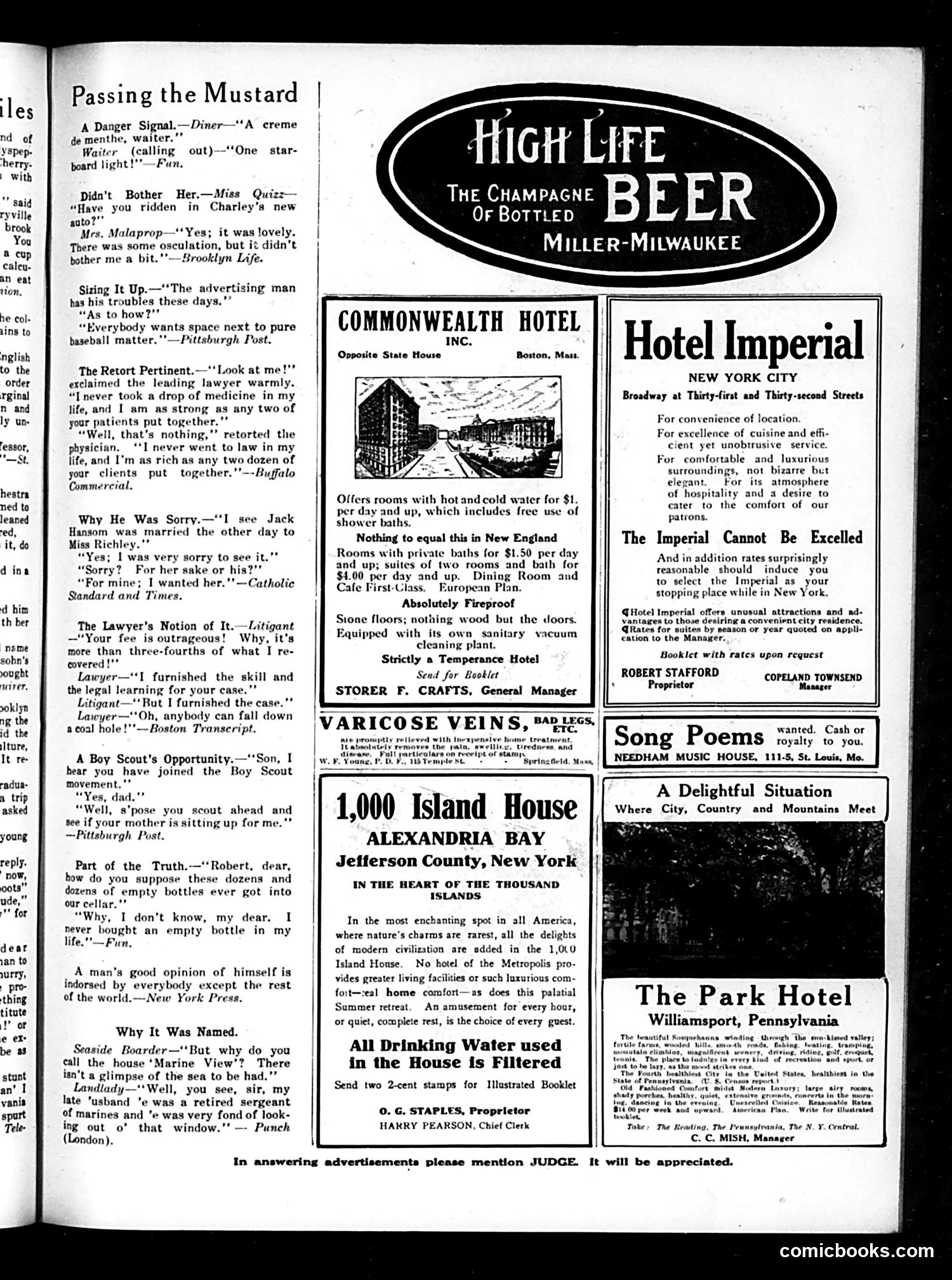
This page is primarily **advertising**, not satirical political content. The top section contains brief joke snippets labeled "Passing the Mustard"—typical Judge humor from the era. The jokes are mild social observations: a waiter's naval-style call-out when serving crème de menthe; a woman's malapropism about an automobile ride; a lawyer-versus-doctor wit battle about their respective lifestyles; and a romantic triangle joke about wanting someone else's fiancée. The bulk of the page features advertisements for hotels (Commonwealth Hotel in Boston, Hotel Imperial in New York, Island House in Alexandria Bay) and other services (beer, song poems, varicose vein treatment). These ads reflect early 20th-century leisure travel and consumer products marketed to middle and upper-class readers. The page contains **no political satire or caricature**—it's a representative sample of how Judge monetized its publication through advertising while providing light humor.
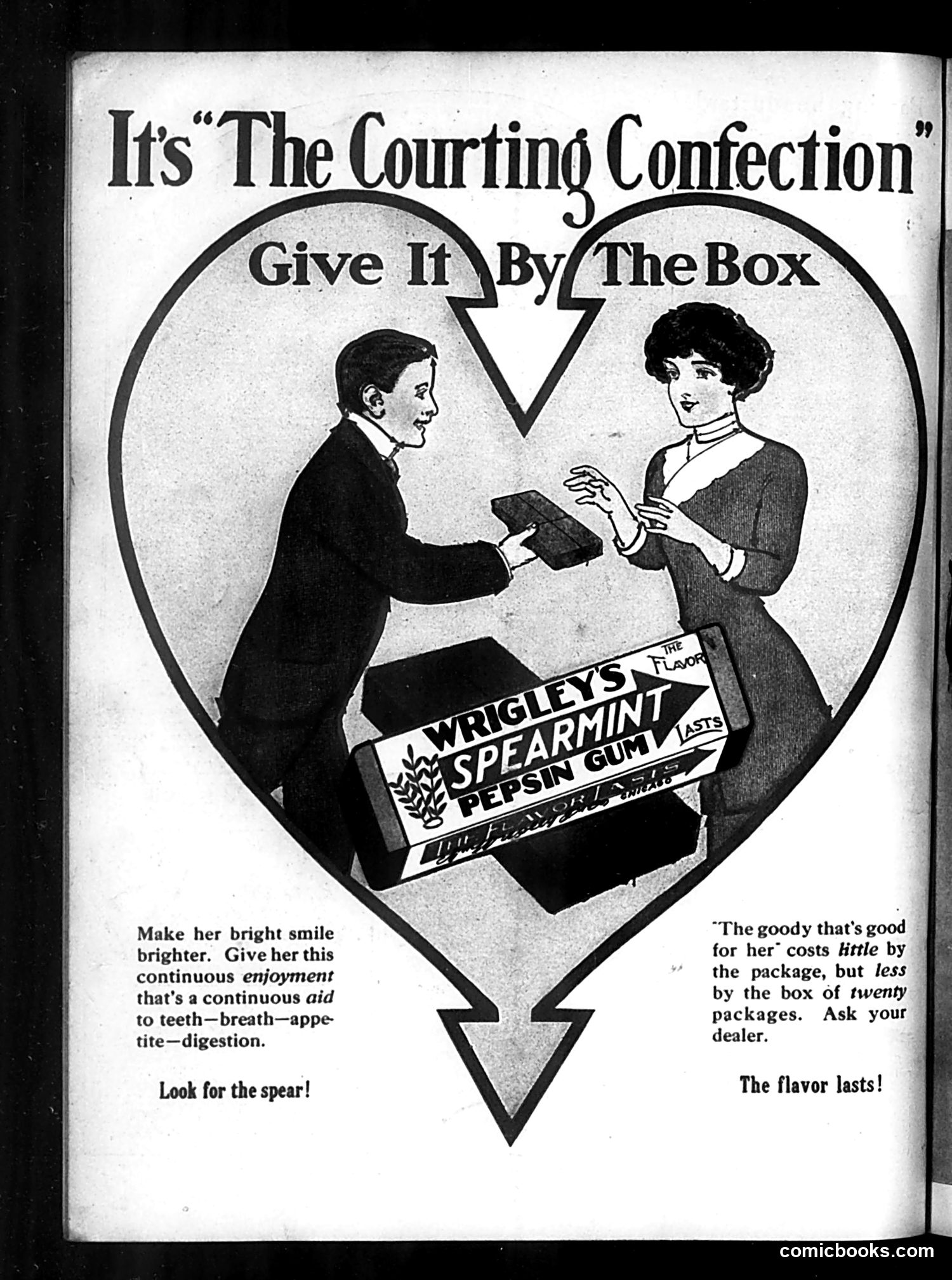
This is a **Wrigley's Spearmint gum advertisement**, not political satire. It depicts a courtship scene where a man presents gum to a woman in a heart-shaped frame, suggesting gum-giving as a romantic gesture. The ad's humor plays on early 20th-century courtship conventions: presenting the woman with a small gift to improve her appearance and appeal. The text promises gum maintains "bright smile," "breath," and "digestion"—practical benefits dressed as romantic enhancement. The phrase "Give It By The Box" suggests buying multiple packages as a courting gift. "Look for the spear" refers to Wrigley's spearmint leaf logo. This reflects period advertising that linked consumer products to social success and romantic viability—a common marketing strategy targeting young men to purchase gum for their female companions.