
Judge, 1912-08-17 · page 16 of 24
Judge — August 17, 1912 — page 16: what you’re looking at
What you’re looking at
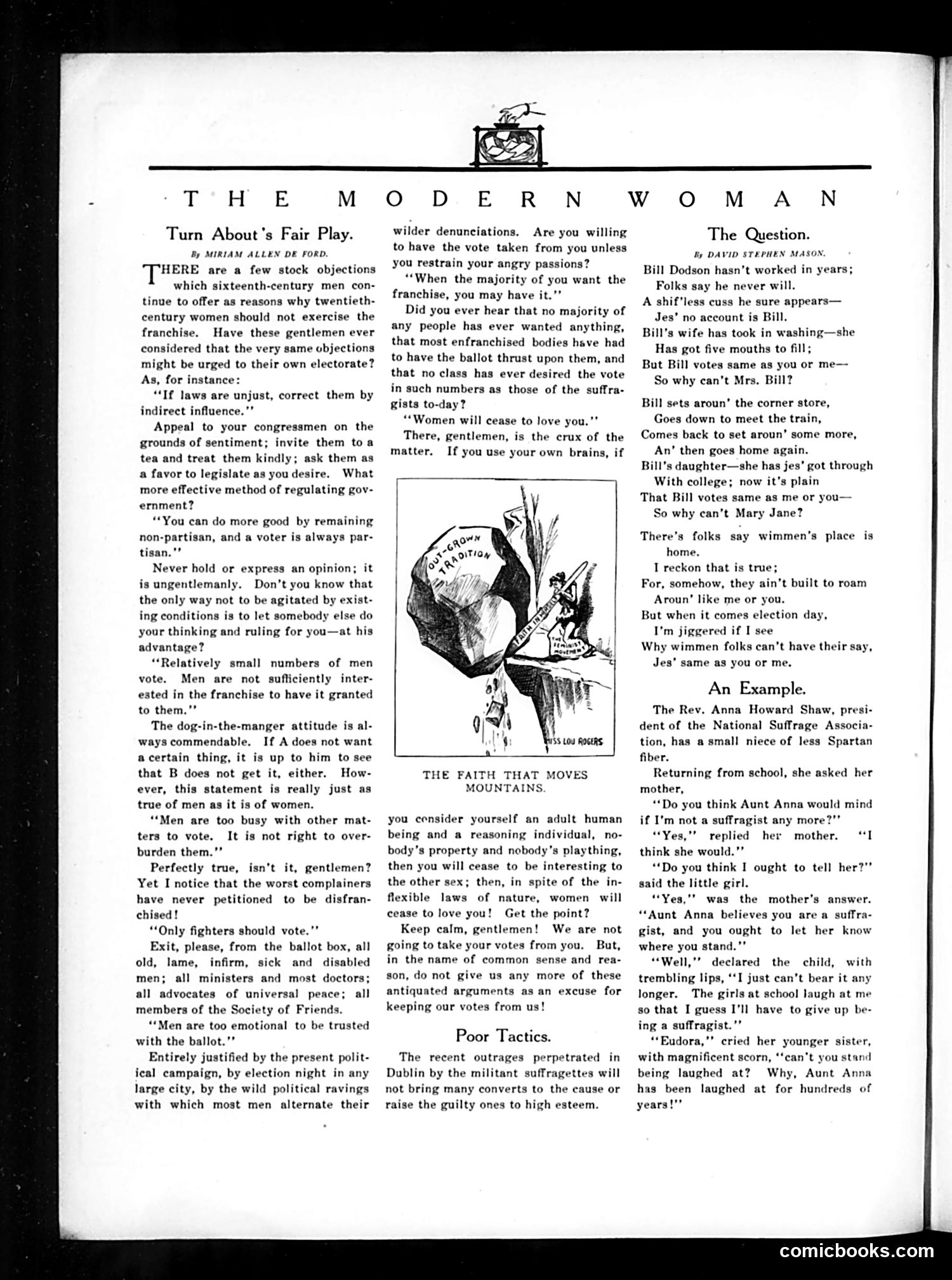
This Judge magazine page presents **pro-suffrage arguments** through satire. The left column, "Turn About's Fair Play" by Miriam Allen de Ford, uses **ironic reversal**: it lists objections men make against women voting, then points out these same objections apply equally to men. The strategy exposes the hypocrisy—if men can vote despite being "emotional," "busy," or "disinterested," why can't women? The cartoon "The Faith That Moves Mountains" (center) shows a woman pushing against a boulder labeled "WOMAN SUFFRAGE," suggesting women's determined effort to achieve voting rights. The right column, "The Question" by David Stephen Mason, presents a **concrete example**: Bill Dodson doesn't work but votes; his wife supports five children but cannot vote. This rhetorical device emphasizes the injustice—why should an idle man have political voice while an industrious woman doesn't? The page opposes "Poor Tactics" (militant suffragette violence in Dublin), distinguishing between legitimate suffrage arguments and counterproductive militant actions.
📄 Transcribed text from this page (OCR, searchable)
Machine-transcribed from the original scan — historical spelling and the odd misread are preserved.
T H E Turn About's Fair Play. By MIRIAM ALLEN DE FORD. HERE are a few stock objections which sixteenth-century men con- tinue to offer as reasons why twentieth- century women should not exercise the franchise. Have these gentlemen ever considered that the very same objections might be urged to their own electorate? As, for instance: “If laws are unjust, correct them by indirect influence."’ Appeal to your congressmen on the grounds of sentiment; invite them toa tea and treat them kindly; ask them as a favor to legislate as you desire. What more effective method of regulating gov- ernment? “You can do more good by remaining non-partisan, and a voter is always par- tisan,"’ Never hold or express an opinion; it is ungentlemanly. Don't you know that the only way not to be agitated by exist- ing conditions is to let somebody else do your thinking and ruling for you—at his advantage? “Relatively small numbers of men vote. Men are not sufficiently inter- ested in the franchise to have it granted to them.”’ The dog-in-the-manger attitude is al- ways commendable. If A does not want acertain thing, it is up to him to see that B does not get it, either. How- ever, this statement is really just as true of men as it is of women. “Men are too busy with other mat- ters to vote. It is not right to over- burden them.’"" Perfectly true, isn't it, gentlemen? Yet I notice that the worst complainers have never petitioned to be disfran- chised! “Only fighters should vote.’’ Exit, please, from the ballot box, all old, lame, infirm, sick and disabled men; all ministers and most doctors; all advocates of universal peace; all members of the Society of Friends. “Men are too emotional to be trusted with the ballot.’’ Entirely justified by the present polit- ical campaign, by election night in any large city, by the wild political ravings with which most men alternate their M O D E RN wilder denunciations. Are you willing to have the vote taken from you unless you restrain your angry passions? “When the majority of you want the franchise, you may have it."’ Did you ever hear that no majority of any people has ever wanted anything, that most enfranchised bodies have had to have the ballot thrust upon them, and that no class has ever desired the vote in such numbers as those of the suffra- gists to-day? ‘‘Women will cease to love you.”” There, gentlemen, is the crux of the matter. If you use your own brains, if THE FAITH THAT MOVES MOUNTAINS. you censider yourself an adult human being and a reasoning individual, no- body’s property and nobody's plaything, then you will cease to be interesting to the other sex; then, in spite of the in- flexible of nature, women will cease to love you! Get the point? We are not going to take your votes from you. But, in the name of common sense and rea- laws Keep calm, gentlemen! son, do not give us any more of these antiquated arguments as an excuse for keeping our votes from us! Poor Tactics. The recent outrages perpetrated in Dublin by the militant suffragettes will not bring many converts to the cause or raise the guilty ones to high esteem. WwW Oo M A N The Question. By DAVID STEPHEN MASON. Bill Dodson hasn’t worked in years; Folks say he never will. A shif’less cuss he sure appears— Jes’ no account is Bill. Bill's wife has took in washing—she Has got five mouths to fill; But Bill votes same as you or me— So why can’t Mrs. Bill? Bill sets aroun’ the corner store, Goes down to meet the train, Comes back to set aroun’ some more, An’ then goes home again. Bill's daughter—she has jes’ got through With college; now it’s plain That Bill votes same as me or you— So why can’t Mary Jane? There’s folks say wimmen’s place is home. I reckon that is true; For, somehow, they ain’t built to roam Aroun’ like me or you. But when it comes election day, I'm jiggered if I see Why wimmen folks can’t have their say, Jes’ same as you or me. An Example. The Rev. Anna Howard Shaw, presi- dent of the National Suffrage Associa- tion, has a small niece of less Spartan fiber. Returning from school, she asked her mother, “Do you think Aunt Anna would mind if I'm not a suffragist any more?" “Yes,’’ replied her mother. “I think she would.’” “Do you think I ought to tell her?” said the little girl. “Yes,"" was the mother’s answer. “‘Aunt Anna believes you are a suffra- gist, and you ought to let her know where you stand."’ ““Well,’’ declared the child, trembling lips, ‘‘I just can’t bear it any longer. The girls at school laugh at me so that I guess I'll have to give up be- ing a suffragist.’" “‘Eudora,”’ cried her younger sister, with magnificent scorn, ‘‘can’t you stand being laughed at?) Why, Aunt Anna has been laughed at for hundreds of years!"’ with comicbooks.com