
Judge, 1912-08-17 · page 5 of 24
Judge — August 17, 1912 — page 5: what you’re looking at
What you’re looking at
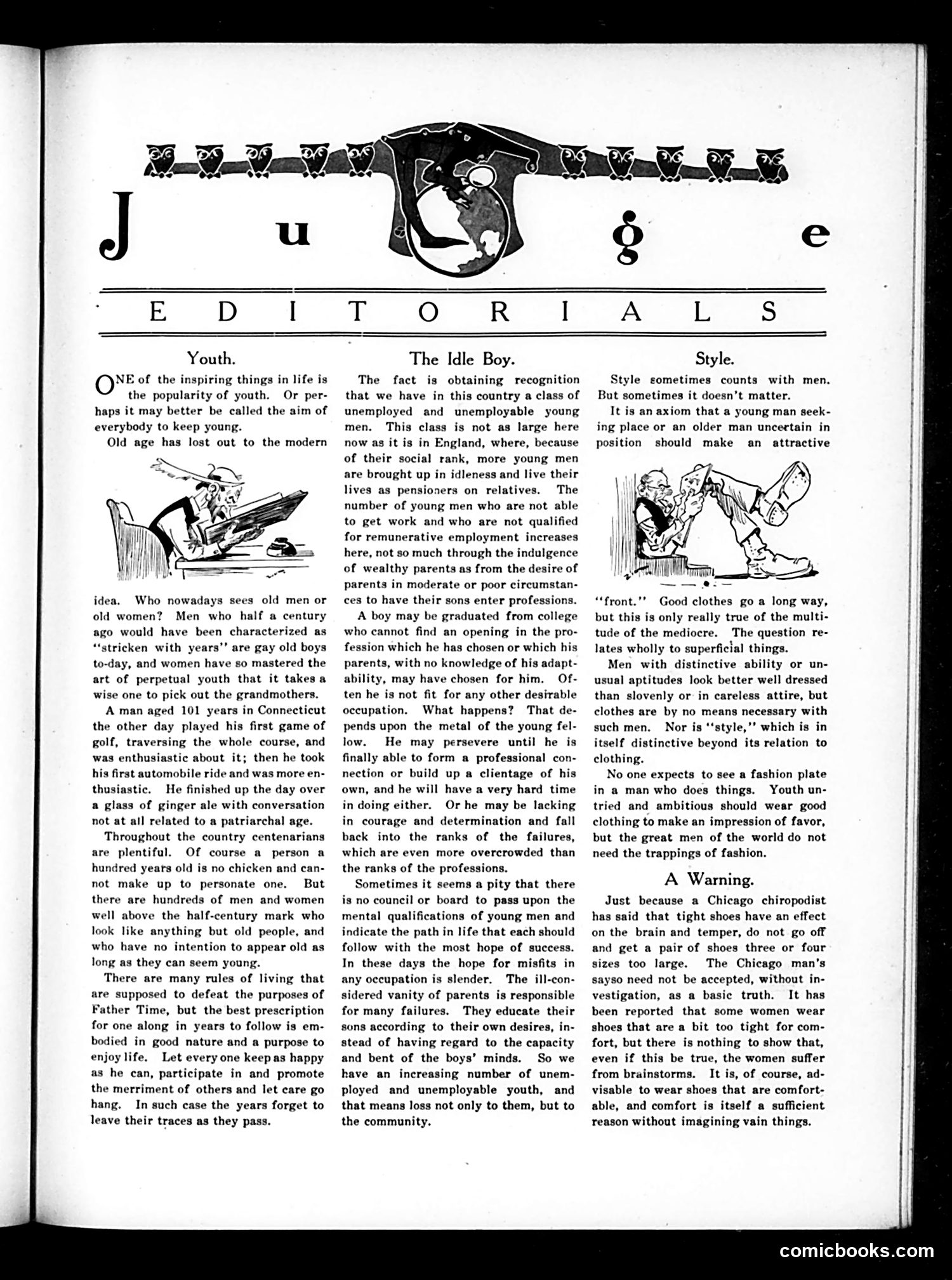
This editorial page contains three distinct columns of social commentary rather than political cartoons. The left illustration shows a young man playing golf enthusiastically; the right shows a poorly-dressed man in an awkward pose. The articles address early 20th-century social concerns: youth unemployment among educated men, the "idle boy" problem (privileged young men unable to find suitable work), and men's fashion. The pieces argue that style matters less than substance, and criticize both unemployed wealthy youth and impractical fashion trends. "A Warning" section mocks a Chicago chiropodist's claims about shoe sizes affecting the brain, and criticizes women wearing uncomfortable shoes—a common satirical target of the era. The overall message emphasizes practical values over vanity and appearance.
📄 Transcribed text from this page (OCR, searchable)
Machine-transcribed from the original scan — historical spelling and the odd misread are preserved.
A Cena Youth. E of the inspiring things in life is the popularity of youth. Or per- haps it may better be called the aim of everybody to keep young. Old age has lost out to the modern idea. Who nowadays sees old men or old women? Men who half a century ago would have been characterized as “stricken with years’? are gay old boys to-day, and women have so mastered the art of perpetual youth that it takes a wise one to pick out the grandmothers. A man aged 101 years in Connecticut the other day played his first game of golf, traversing the whole course, and was enthusiastic about it; then he took his first automobile ride and was more en- thusiastic. He finished up the day over a glass of ginger ale with conversation not at all related to a patriarchal age. Throughout the country centenarians are plentiful. Of course a person a hundred years old is no chicken and can- not make up to personate one. But there are hundreds of men and women well above the half-century mark who look like anything but old people, and who have no intention to appear old as long as they can seem young. There are many rules of living that are supposed to defeat the purposes of Father Time, but the best prescription for one along in years to follow is em- bodied in good nature and a purpose to enjoy life. Let every one keep as happy as he can, participate in and promote the merriment of others and let care go hang. In such case the years forget to leave their traces as they pass. The Idle Boy. The fact is obtaining recognition that we have in this country a class of unemployed and unemployable young men. This class is not as large here now as it is in England, where, because of their social rank, more young men are brought up in idleness and live their lives as pensioners on relatives. The number of young men who are not able to get work and who are not qualified for remunerative employment increases here, not so much through the indulgence of wealthy parents as from the desire of parents in moderate or poor circumstan- ces to have their sons enter professions. A boy may be graduated from college who cannot find an opening in the pro- fession which he has chosen or which his parents, with no knowledge of his adapt- ability, may have chosen for him. Of- ten he is not fit for any other desirable occupation. What happens? That de- pends upon the metal of the young fel- low. He may persevere until he is finally able to form a professional con- nection or build up a clientage of his own, and he will have a very hard time in doing either. Or he may be lacking in courage and determination and fall back into the ranks of the failures, which are even more overcrowded than the ranks of the professions. Sometimes it seems a pity that there is no council or board to pass upon the mental qualifications of young men and indicate the path in life that each should follow with the most hope of success. In these days the hope for misfits in any occupation is slender. The ill-con- sidered vanity of parents is responsible for many failures. They educate their sons according to their own desires, in- stead of having regard to the capacity and bent of the boys’ minds. So we have an increasing number of unem- ployed and unemployable youth, and that means loss not only to them, but to the community. Style. Style sometimes counts with men. But sometimes it doesn’t matter. It is an axiom that a young man seek- ing place or an older man uncertain in position should make an attractive “‘front.’’ Good clothes go a long way, but this is only really true of the multi- tude of the mediocre. The question re- lates wholly to superficial things. Men with distinctive ability or un- usual aptitudes look better well dressed than slovenly or in careless attire, but clothes are by no means necessary with such men. Nor is ‘‘style,’”’ which is in itself distinctive beyond its relation to clothing. No one expects to see a fashion plate in a man who does things. Youth un- tried and ambitious should wear good clothing to make an impression of favor, but the great men of the world do not need the trappings of fashion. A Warning. Just because a Chicago chiropodist has said that tight shoes have an effect on the brain and temper, do not go off and get a pair of shoes three or four sizes too large. The Chicago man’s sayso need not be accepted, without in- vestigation, as a basic truth. It has been reported that some women wear shoes that are a bit too tight for com- fort, but there is nothing to show that, even if this be true, the women suffer from brainstorms. It is, of course, ad- visable to wear shoes that are comfort- able, and comfort is itself a sufficient reason without imagining vain things. comicbooks.com