
A complete issue · 24 pages · 1912
Judge — February 24, 1912
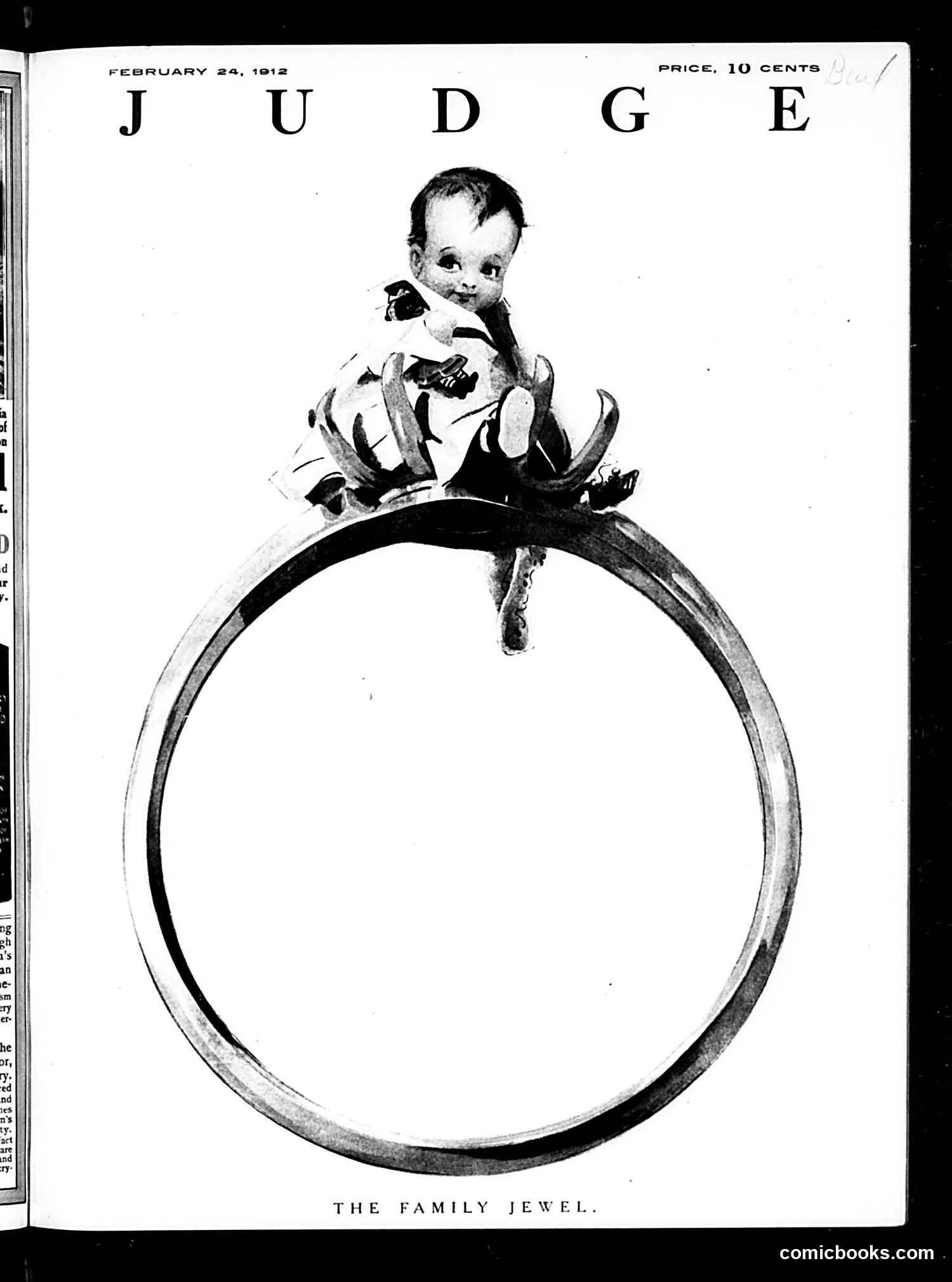
This cover depicts a cherubic baby in formal attire perched atop a large ring—the "jewel" of the title. The imagery suggests a precious family heirloom or legacy. The cartoon likely comments on the birth or existence of an important political figure's child, treating the infant as a prized possession or continuation of a family line. Given Judge magazine's satirical nature, this could be mocking wealthy or prominent families' pride in their heirs, or potentially referencing a specific notable birth from early 1912. The formal dress on an infant emphasizes the contrast between childhood innocence and adult pretension. Without additional context from the magazine's other content, the specific political target remains unclear, though the satire targets family pride and social status.
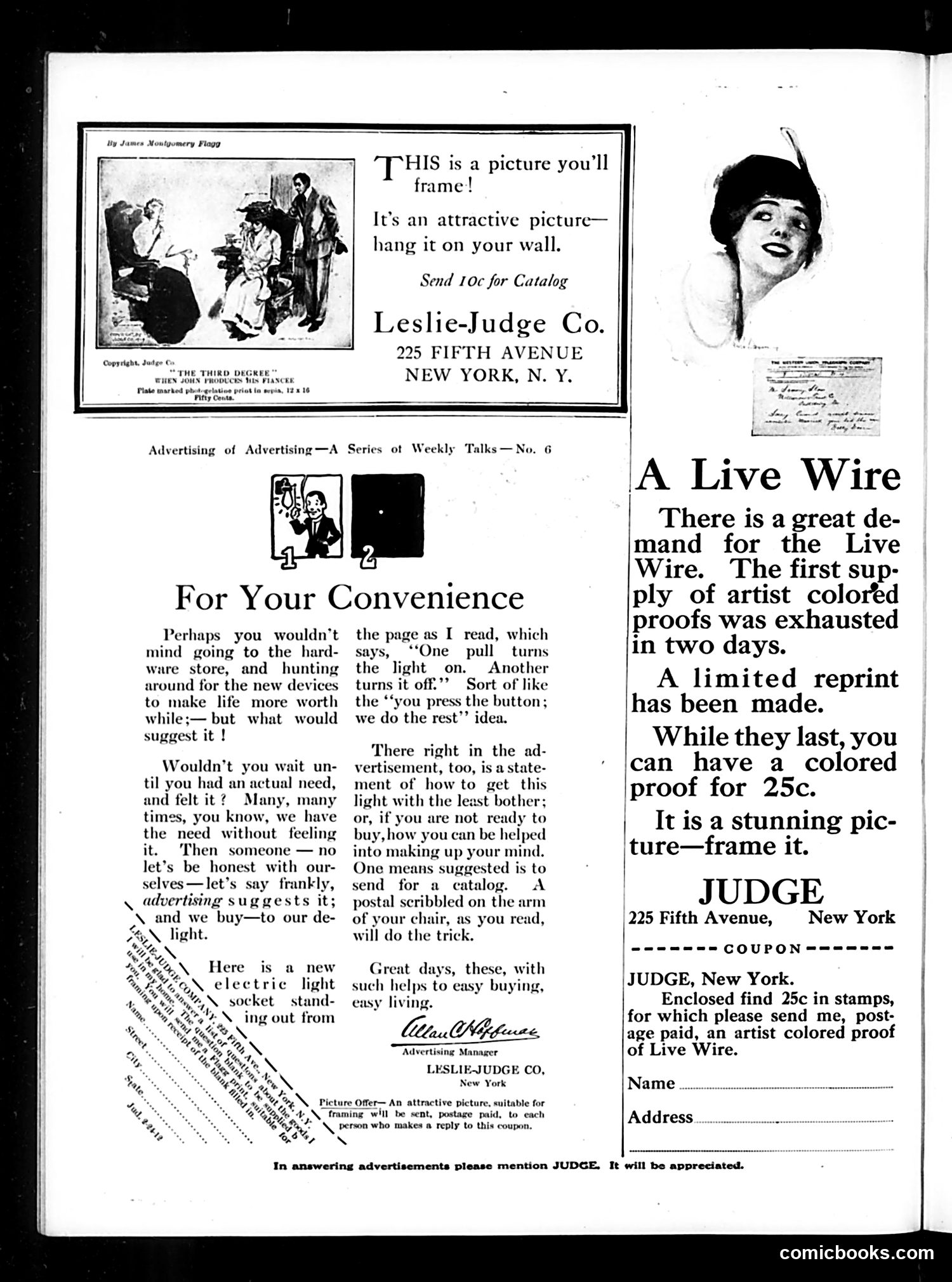
This page is primarily **advertising rather than political satire**. The top advertisement for Leslie-Judge Co. promotes framed pictures from "The Third Decree" film, offering a catalog for 10 cents. The main content is a humorous piece titled "For Your Convenience" that gently mocks consumer culture and modern conveniences. It suggests that advertising itself creates artificial "needs"—people buy electric light sockets and other devices not because they truly need them, but because advertising persuades them to. The satire is mild and self-aware; Judge acknowledges that advertising (including its own) manipulates purchasing decisions. The right side features another advertisement for "A Live Wire" colored proofs, selling for 25 cents. Overall, this represents Judge's lighthearted commentary on emerging consumer culture and advertising's persuasive power.
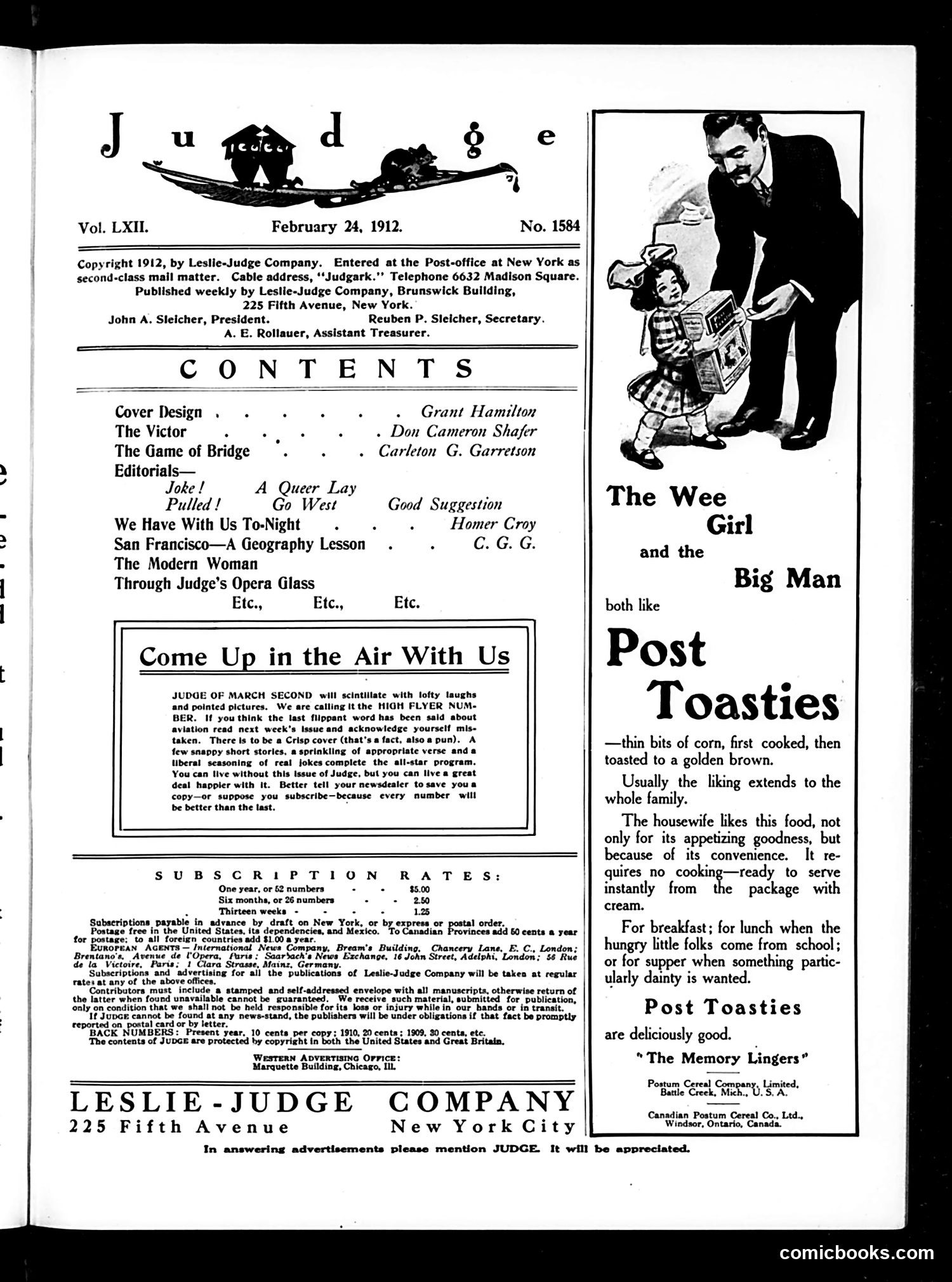
This page is primarily **advertising and contents listing** rather than political satire. The main visual element is a Post Toasties cereal advertisement featuring a well-dressed man showing the product to a young girl, with text emphasizing the cereal's convenience and appeal to both children and housewives. The contents list references several articles and illustrations within the issue, though specific political cartoons aren't visible on this particular page. The magazine's masthead and publication details (Leslie-Judge Company, New York) are standard for the period. The advertisement itself reflects early 20th-century consumer culture and gender roles—marketing convenience foods to busy housewives while depicting children as eager consumers.
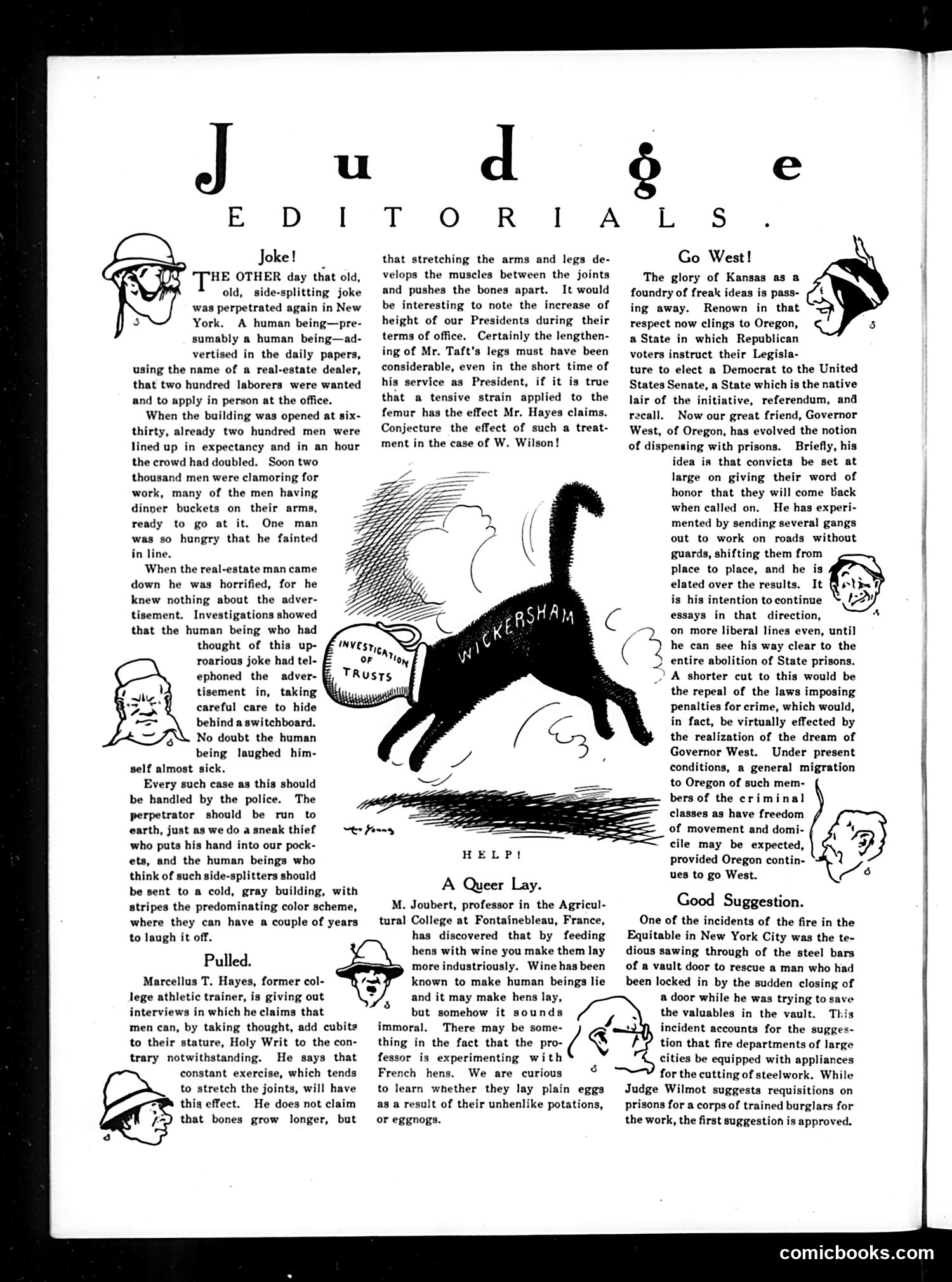
This page contains three separate editorial commentaries typical of Judge magazine's satirical approach: **"Joke!"** critiques a real-estate dealer who used the name of a labor organizer to advertise his business, deceiving potential clients into thinking he was the real person. **"Help! A Queer Lay"** features a cartoon of a black cat labeled "WICKERSHAM" being kicked, referencing Attorney General Wickersham. The accompanying text jokes about experimental French farming practices with hens and wine, apparently criticizing Wickersham's investigative approach as absurd. **"Go West!" and "Good Suggestion"** discuss Oregon's Governor, who advocates for prisoner rehabilitation through work gangs without guards. The final item praises a suggestion for equipping fire departments with steel-cutting equipment to aid locked vault rescues. The tone is typically sardonic, using animal caricatures and absurdist humor to mock government figures and policies.
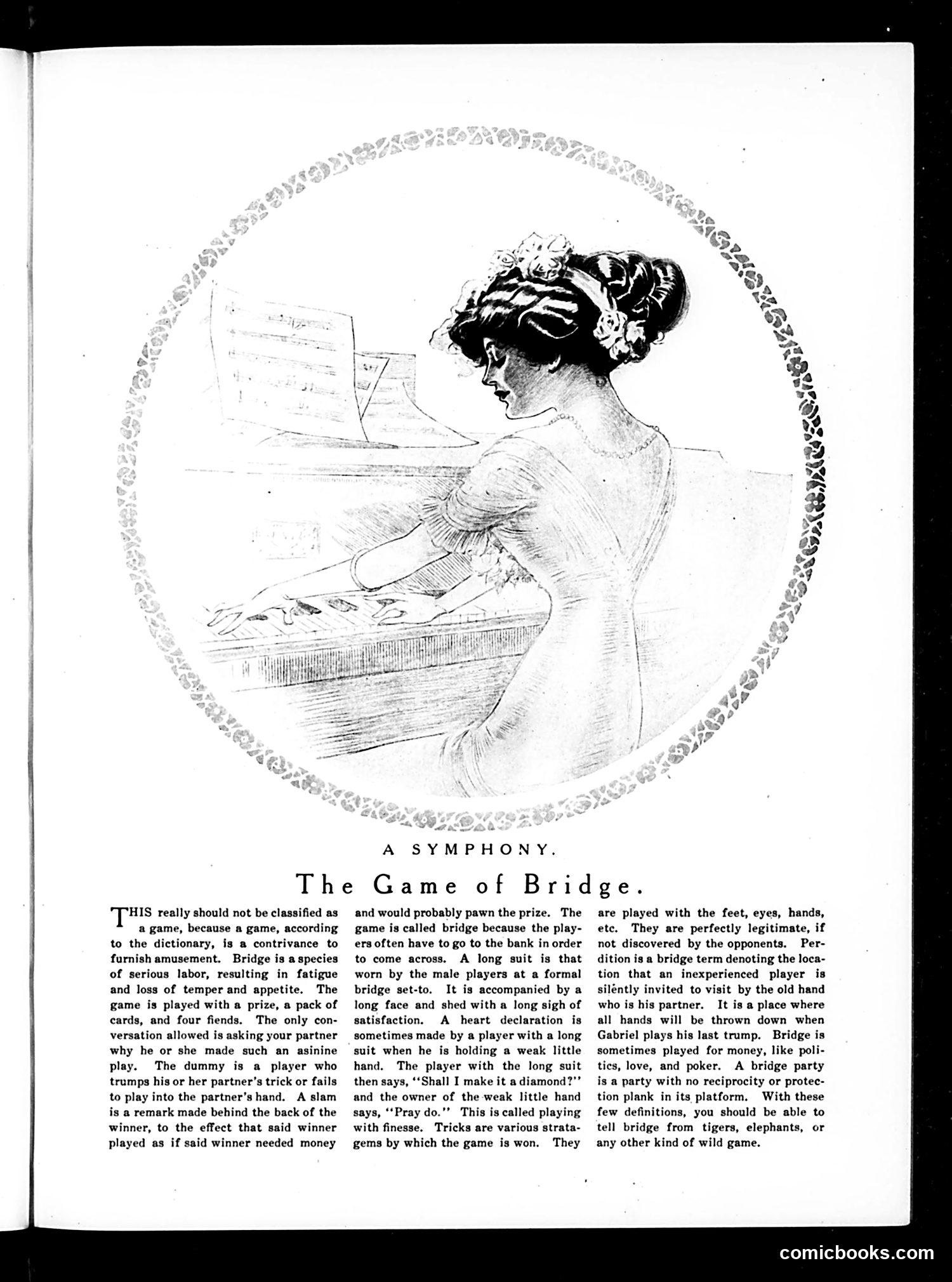
This page satirizes the card game bridge through a humorous essay framed as a "symphony." The illustration shows a fashionable woman in profile, dressed in elegant Edwardian-era clothing, playing cards at a table. The text humorously describes bridge not as a true "game" but as a ritualized social performance causing "fatigue and loss of temper and appetite." It mocks the elaborate etiquette surrounding bridge—including coded language ("Shall I make it a diamond?"), the dramatic declarations of players, and the social pretension of bridge parties among the wealthy. The satire targets how bridge had become a fashionable obsession among upper-class Americans in the early 20th century, transforming a card game into an exhausting social institution governed by arbitrary rules and snobbish conventions.
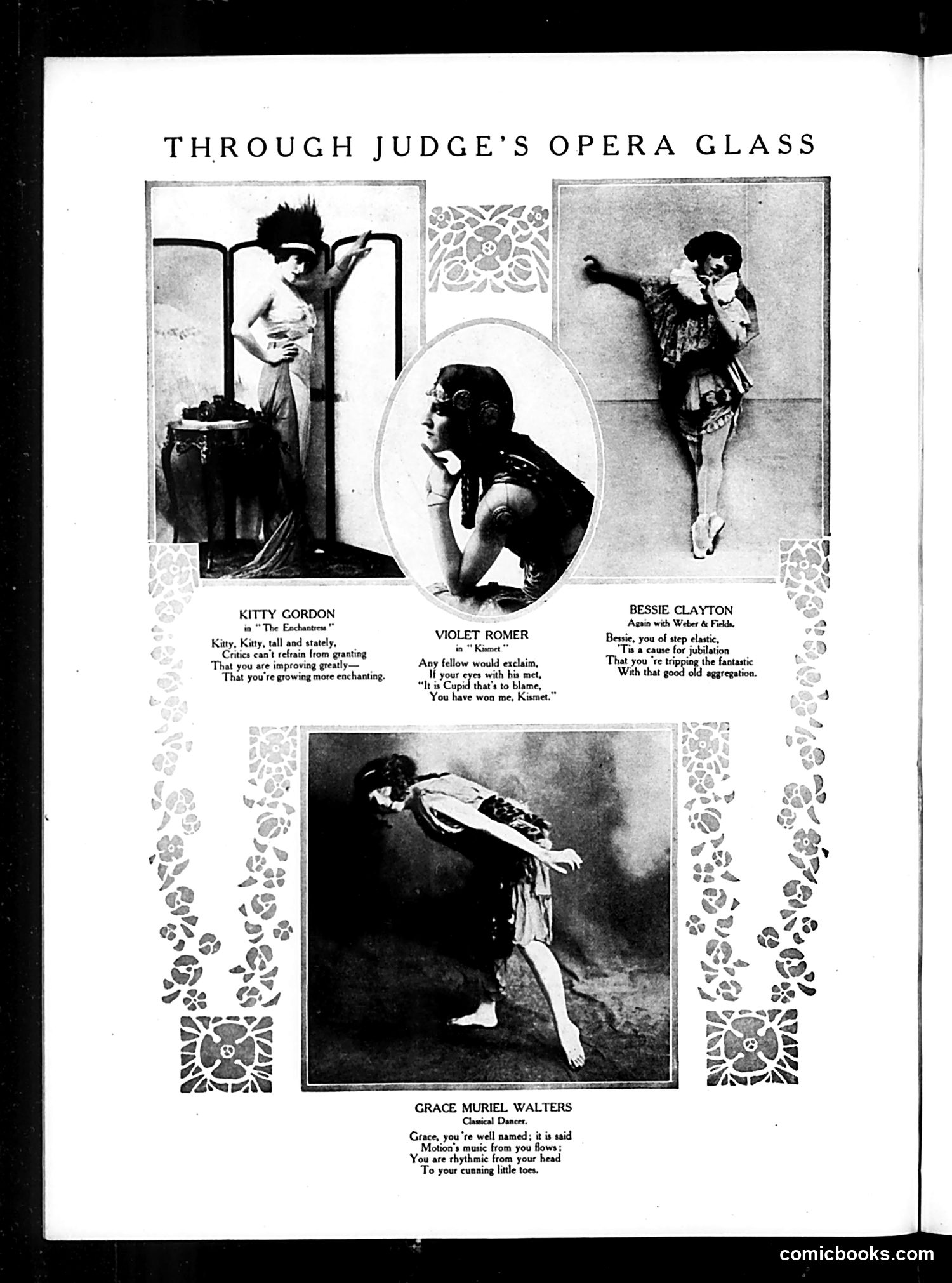
This page features theatrical reviews presented as light satirical verses about popular entertainers of the early 1900s. "Opera Glass" refers to the small binoculars used in theaters to view performances—here Judge magazine is offering critical commentary on stage performers. The four featured actresses—Kitty Gordon, Violet Romer, Bessie Clayton, and Grace Muriel Walters—were contemporary stage performers. The verses employ playful, often flirtatious commentary typical of theatrical criticism of the era. For instance, Gordon is praised for improving; Romer's appeal to male admirers is joked about; Clayton is complimented for her dancing elasticity; Walters is lauded for graceful, rhythmic movement. The satire is gentle—mocking the conventions of theatrical praise and male audience appreciation rather than critiquing the performers themselves. This represents Judge's coverage of popular entertainment and high society.
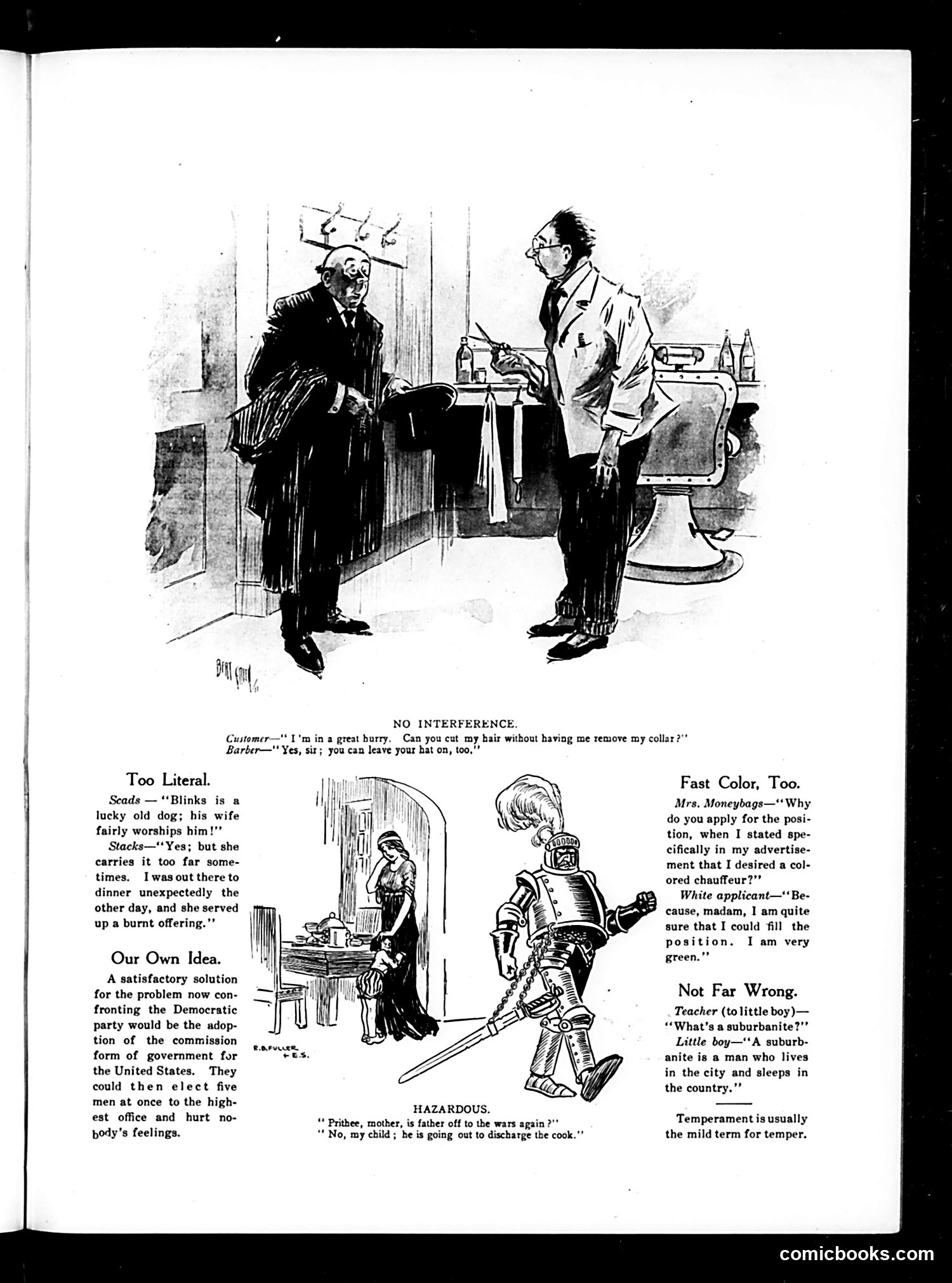
This page from *Judge* magazine contains several brief satirical cartoons and commentary jokes typical of early 20th-century American humor. The top cartoon, "No Interference," depicts a barber cutting a customer's hair while leaving his collar on—a humorous scenario about literal versus practical interpretation of requests. The other cartoons mock various social situations: "Too Literal" jokes about a wife's worship of a lucky dog; "Our Own Idea" appears to satirize Democratic Party governance proposals; "Fast Color, Too" ridicules a job applicant's dubious qualifications; "Hazardous" makes light of wartime concerns; and "Not Far Wrong" offers wordplay about "suburbanite" definitions. The humor relies on puns, misunderstandings, and observational comedy about domestic and social life—typical of *Judge's* appeal to educated, middle-class American readers seeking genteel satire.
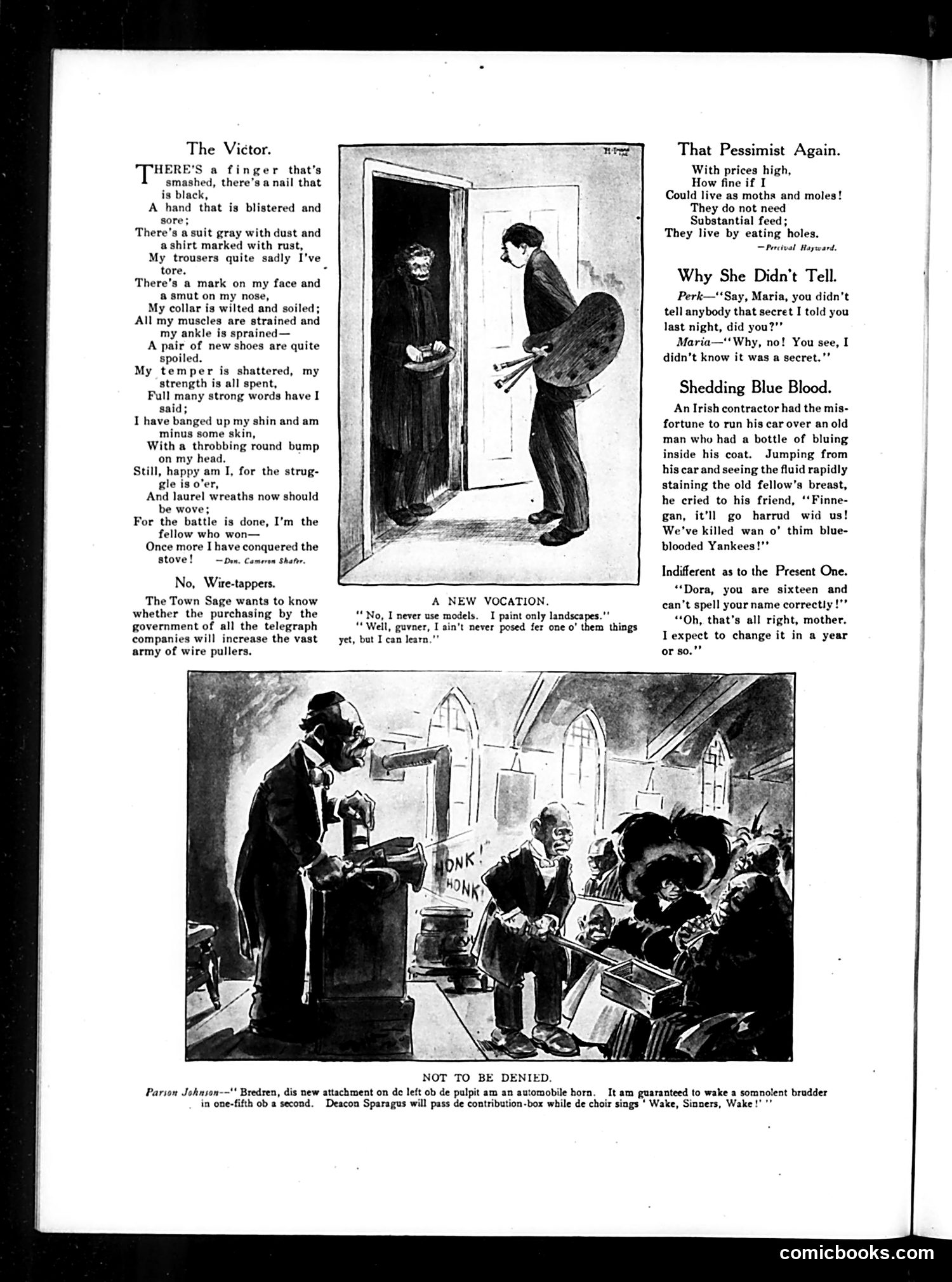
This page contains several humorous short pieces typical of early 20th-century American satirical magazines: **"The Victor"** is a poem about a man triumphantly describing his battle wounds and exhaustion after conquering "the stove"—a domestic cooking mishap played as epic struggle. **"Why She Didn't Tell"** is a brief dialogue joke about a woman who didn't realize something was confidential. **"Shedding Blue Blood"** mocks Irish-American stereotypes: an Irish contractor hits an old man carrying "bluing" (laundry whitening agent), then assumes from the blue staining that he's killed a wealthy "blue blood" Yankee, exclaiming they've killed an aristocrat. **"A New Vocation"** (cartoon) shows a man claiming he paints landscapes but has never posed for them—satirizing artistic pretension. **"Not to Be Denied"** depicts a Black preacher installing a car horn in his church to wake sleeping congregants during collection. The page relies on ethnic/racial stereotypes, class humor, and domestic comedy typical of Judge's era.
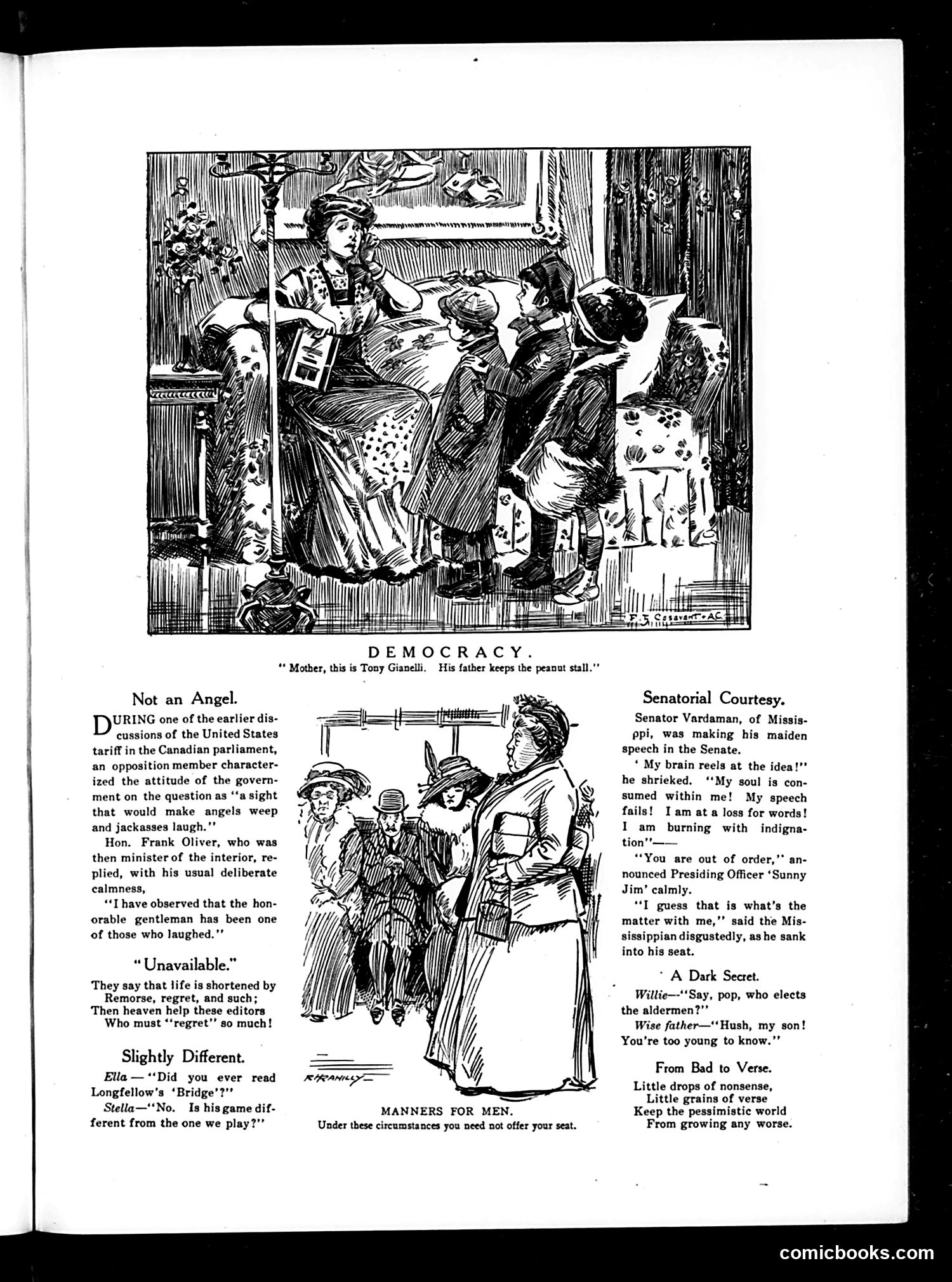
This page contains multiple satirical pieces mocking American and Canadian politics circa early 1900s: **Top cartoon ("Democracy"):** Depicts a well-dressed woman instructing children that "Tony Gianelli" is acceptable—his father runs a peanut stand. The satire targets class prejudice and the contradiction between democratic ideals and actual social snobbery. **"Not an Angel":** Recounts a Canadian parliamentary exchange where Hon. Frank Oliver (Interior Minister) cleverly retorted to an opposition member's criticism, suggesting the critic was among those who "laughed" at government policy—implying hypocrisy. **"Senatorial Courtesy":** Mocks Senator Vardaman of Mississippi's overwrought maiden Senate speech. When he claims he's "at a loss for words" while "burning with indignation," the Presiding Officer dryly notes he's "out of order"—suggesting his emotional outburst violates decorum, implying senators prioritize procedure over substance. **"A Dark Secret":** A father refuses to explain aldermanic elections to his son, humorously implying the process is too corrupt or absurd for children to understand.
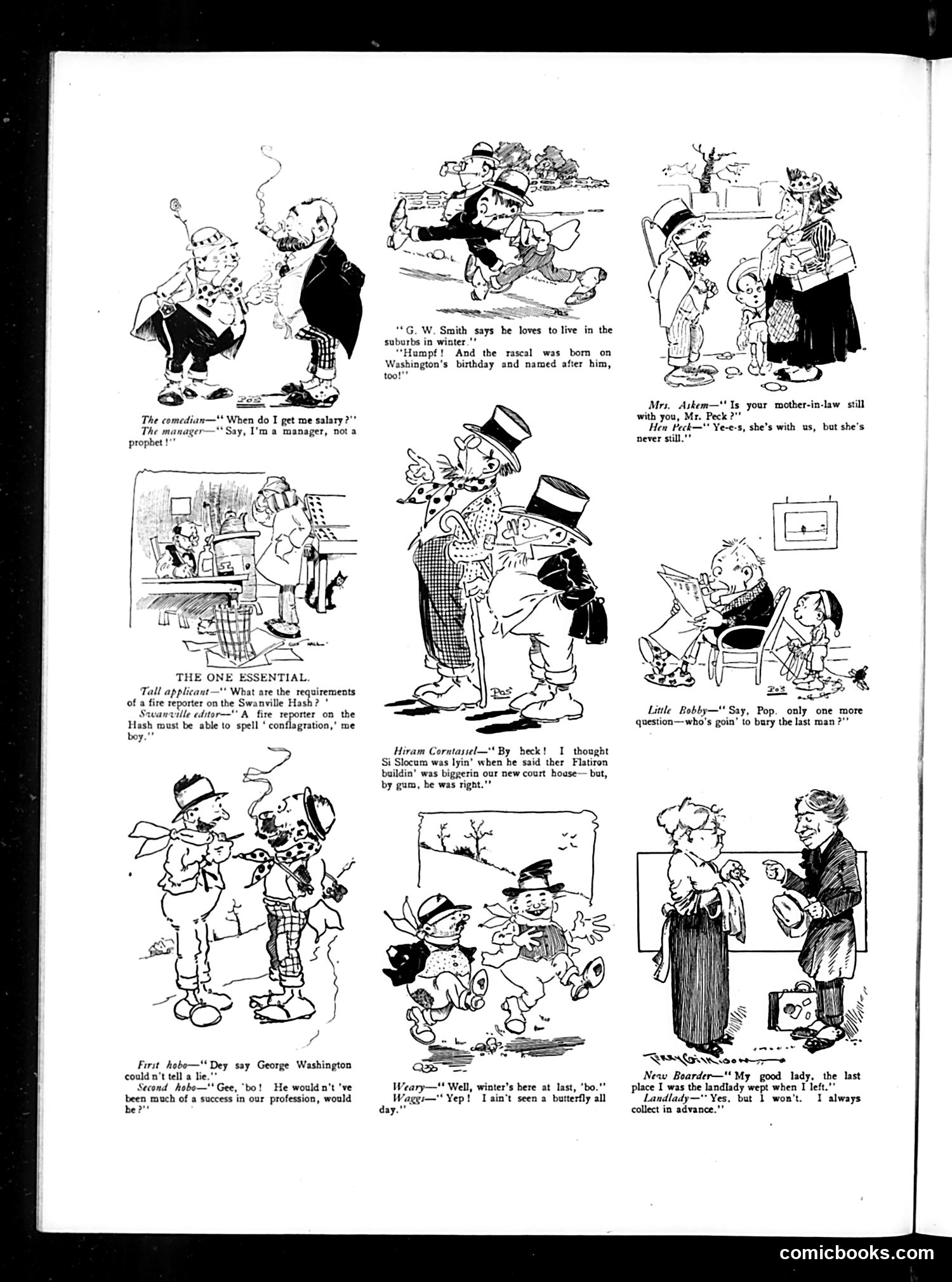
This page contains multiple unrelated joke cartoons typical of early 20th-century humor magazines. The jokes target recognizable social types and situations: **Key satirical targets:** - A fire reporter must spell "conflagration"—mocking journalistic pretension - A comedian pestering his manager about salary—standard vaudeville humor - A henpecked husband whose mother-in-law won't leave—a recurring domestic complaint - Two hobos discussing George Washington's honesty while themselves being liars—ironic commentary on professional dishonesty - A landlady who collects rent in advance to prevent tenant departures—reflecting working-class housing insecurity **Broader context:** These jokes reflect early 1900s American anxieties: unreliable employment, troublesome in-laws, housing instability, and professional dishonesty. The George Washington reference (his birthday/naming) appears in an unrelated joke about suburban living preferences. The humor relies on recognizable character types rather than specific political figures or events, making these broadly relatable domestic and occupational frustrations of the era.
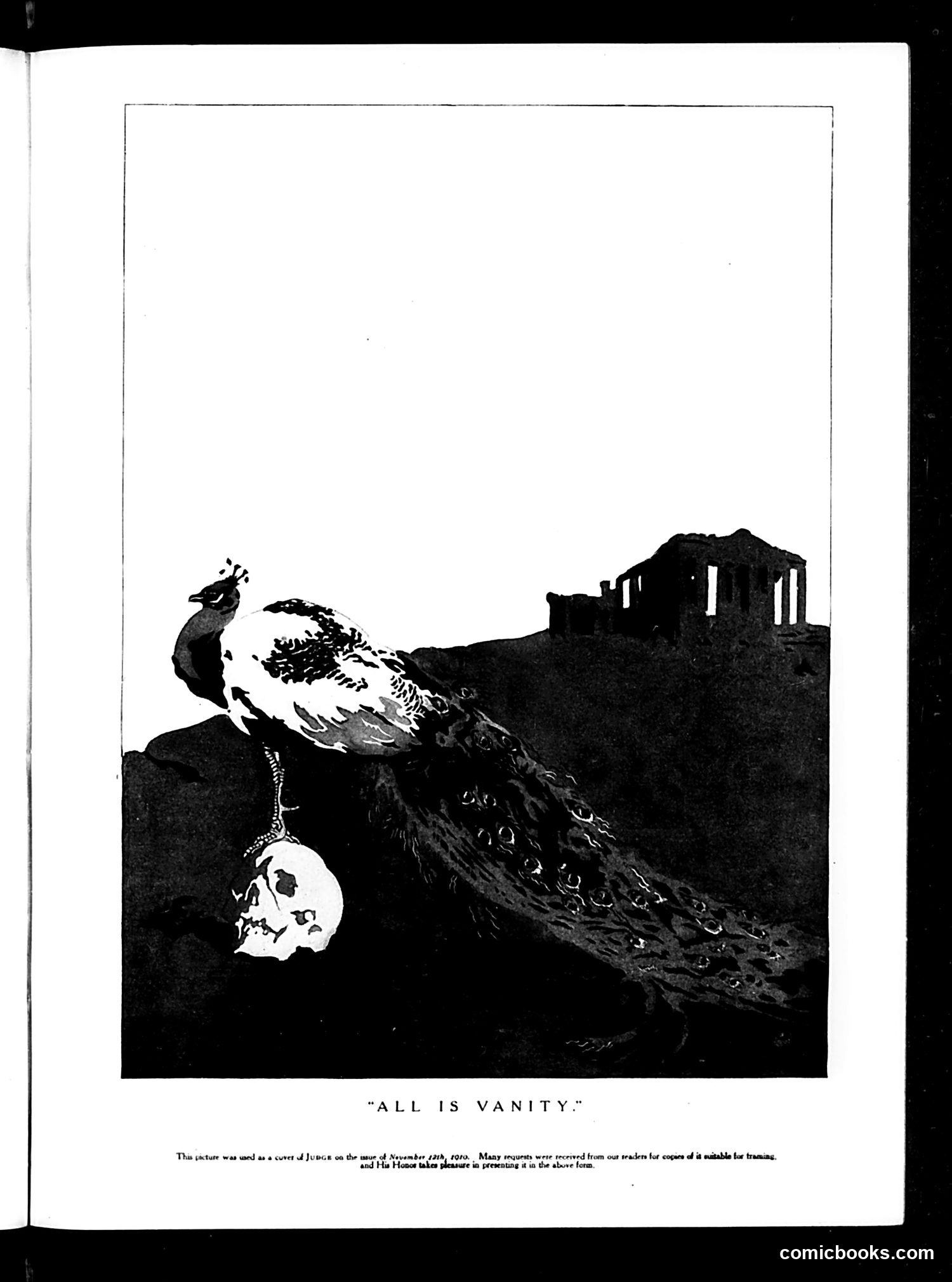
This is a memento mori illustration—a classical "vanity of life" image. A peacock, symbol of pride and vanity, dominates the composition while holding a skull in its beak. In the background sits a ruined classical structure (appears to be Greek or Roman columns), suggesting the decay of even grand civilizations. The cartoon's message is moralizing: despite outward beauty, pride, and achievement, death and ruin are inevitable. The peacock's elaborate plumage contrasts starkly with the skull—a traditional artistic device warning against vanity and worldly attachment. The text indicates this November 1910 cover was so popular *Judge* republished it as a standalone print for framing, suggesting readers found its philosophical message resonant enough for home display.
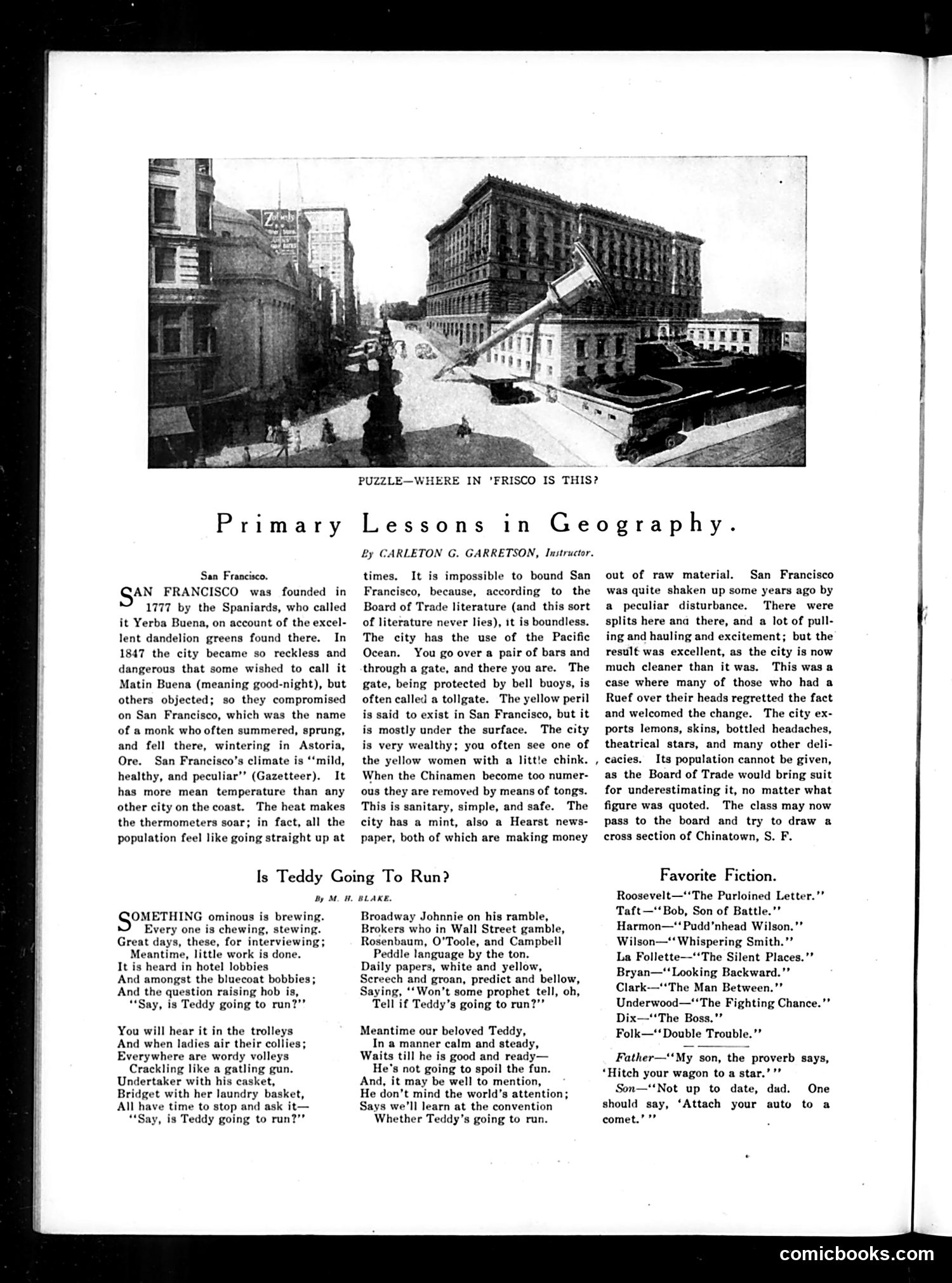
This page contains satirical educational content rather than a traditional political cartoon. **"Primary Lessons in Geography"** mockingly describes San Francisco through absurdist humor. The author uses fake historical details (the city founded by Spaniards seeking "dandelion greens") to satirize Chamber of Commerce boosterism and the "Board of Trade literature" that makes exaggerated claims about the city's boundless prosperity. The piece includes period anti-Chinese stereotypes ("the yellow peril") and references to the 1906 earthquake ("splits here and there"), presenting them with dry irony. **"Is Teddy Going To Run?"** addresses speculation about Theodore Roosevelt's 1912 presidential ambitions. The poem humorously catalogs public obsession with whether Roosevelt will run again, featuring stock figures ("Broadway Johnnie," Wall Street brokers, newspapers) all debating the question. The joke is Roosevelt's coy silence—he "waits till he is good and ready" while the nation speculates. The **"Favorite Fiction"** sidebar pairs political figures with book titles as commentary—Roosevelt with detective fiction, suggesting evasiveness; Taft with sentimental tales; progressives like La Follette with utopian works.
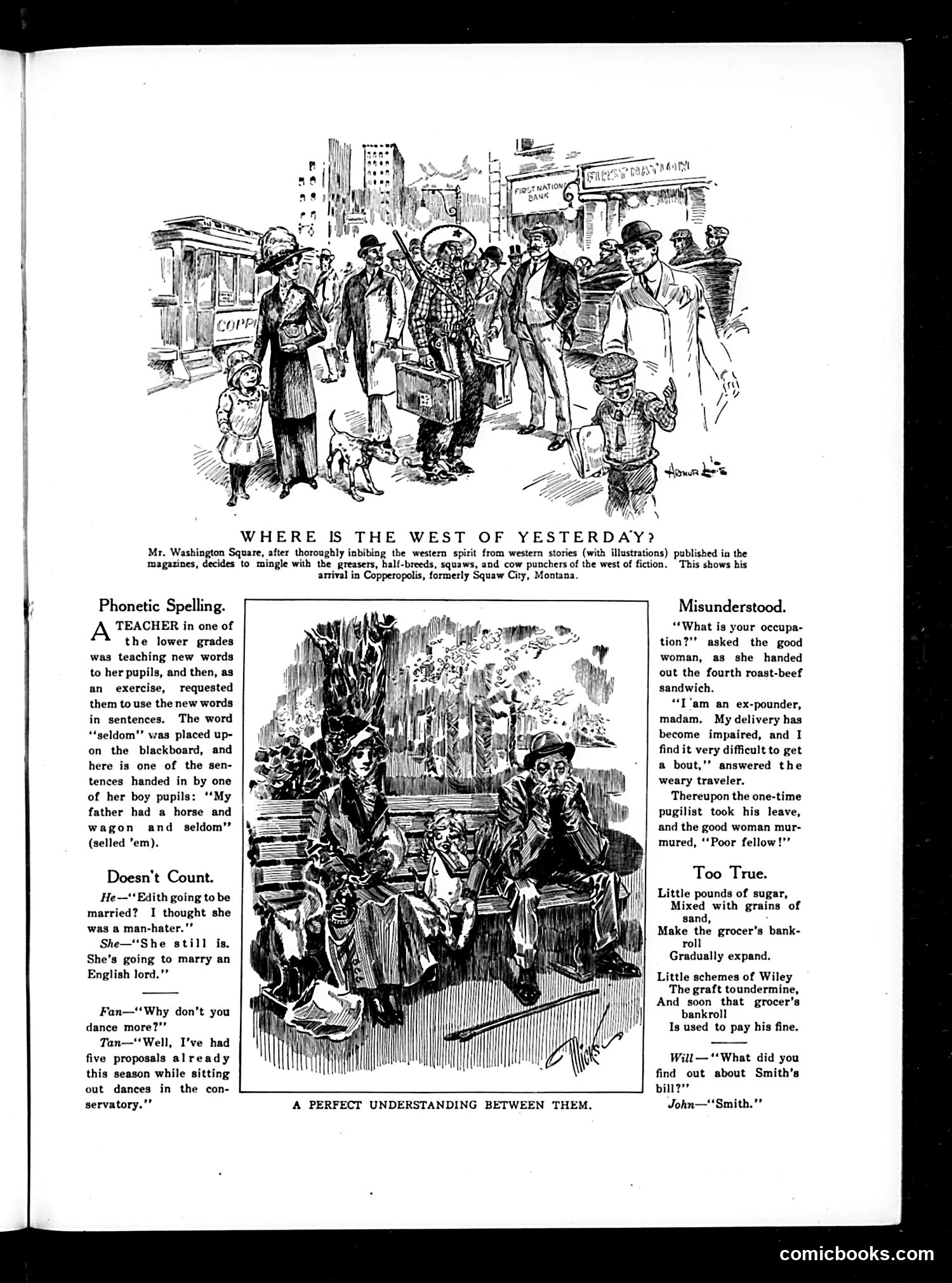
The main cartoon satirizes Eastern urbanites who romanticize the "Wild West" through popular fiction. "Mr. Washington Square" absorbs exaggerated Western stories from magazines, then naively expects to encounter the fictional version (greasers, half-breeds, squaws, cowboys) upon arriving in an actual Montana town. The humor lies in the gap between pulp Western fantasy and mundane reality. The four shorter pieces are unrelated humor: - **Phonetic Spelling**: A child misunderstands "seldom" as "sold 'em," creating an accidental pun about selling horses/wagons. - **Doesn't Count**: A woman marrying an English lord still counts as man-hating since nobility supposedly don't count as "real men." - **Misunderstood**: A former boxer (ex-pounder) seeking shelter is mistaken for an extortionist. - **Too True/Will-John**: Satirizes grocery fraud and political corruption, with an ambiguous final joke about "Smith's bill."
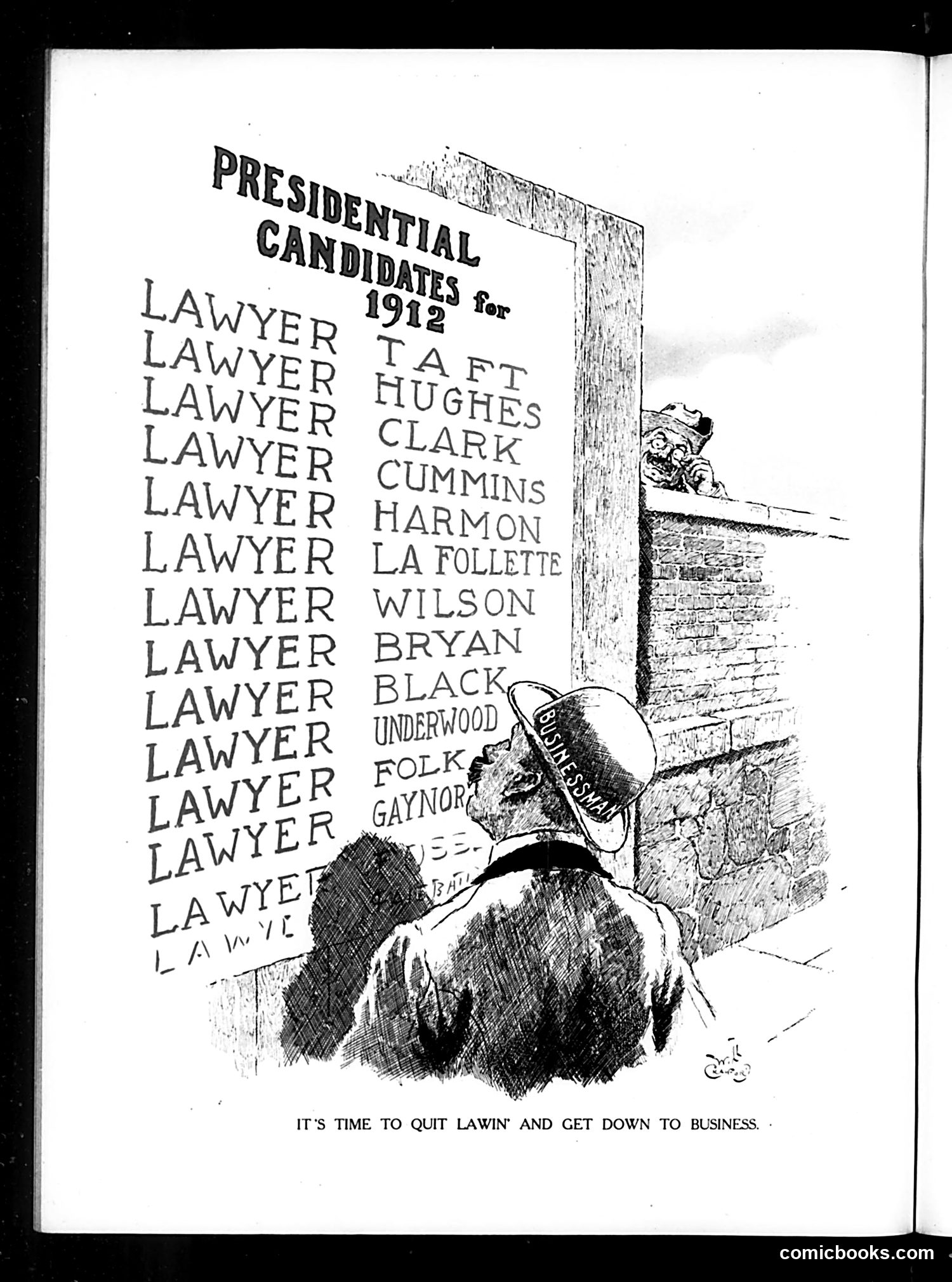
This **Judge** magazine cartoon satirizes the 1912 U.S. presidential election by listing all major candidates as "lawyers." The figure shown—appears to be a cowboy or working man—looks at a wall covered with "LAWYER" repeated alongside candidate names (Taft, Hughes, Clark, Cummins, Harmon, La Follette, Wilson, Bryan, Black, Underwood, Folk, and Gaynor). The satire's point: **all these political candidates are lawyers, not practical businessmen**. The caption—"It's time to quit lawin' and get down to business"—expresses frustration that America needs someone focused on actual business/commerce rather than lawyers engaged in political maneuvering. This reflects early 20th-century criticism of lawyer-politicians and desire for businessmen in leadership.
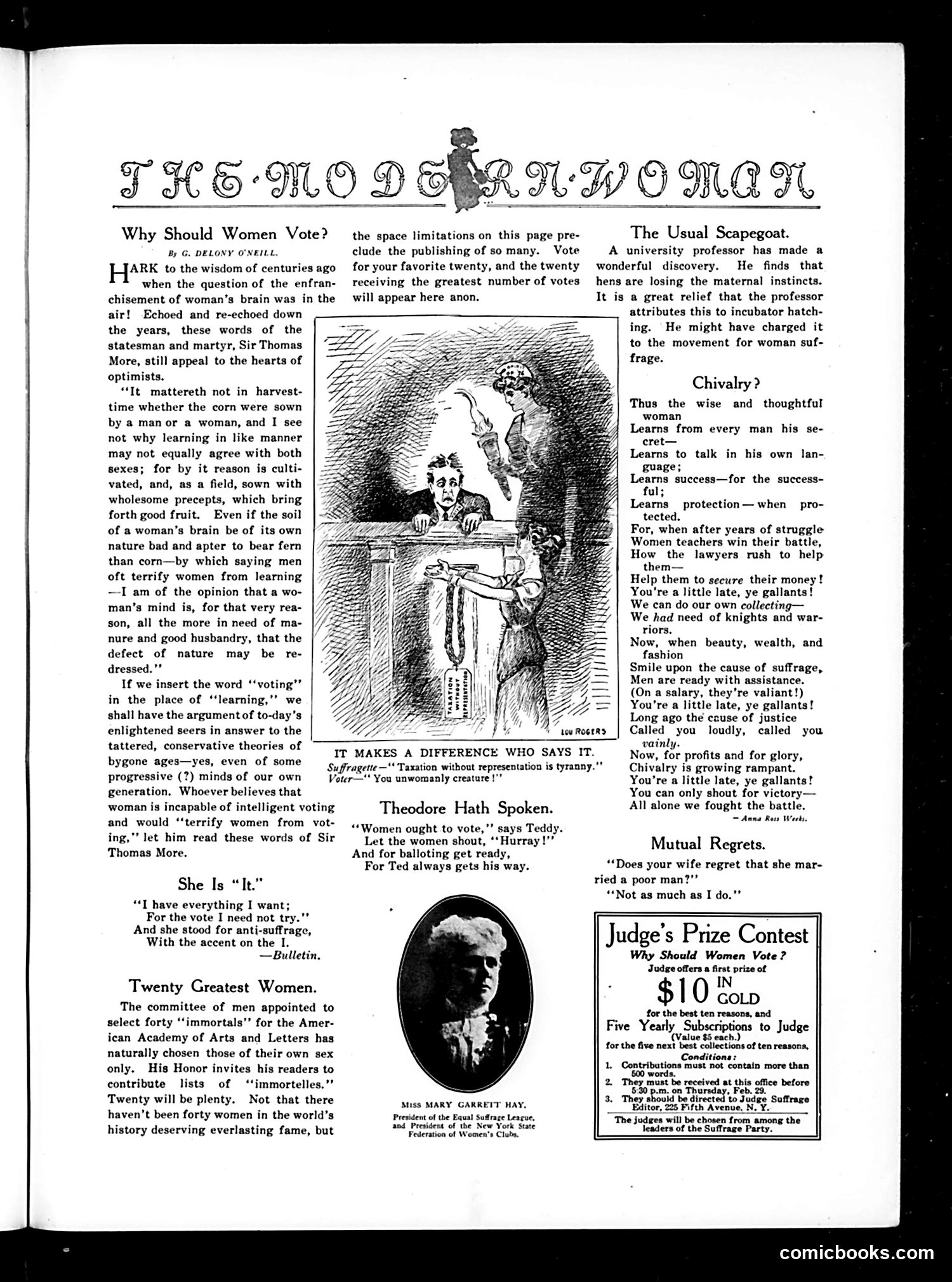
This Judge magazine page satirizes the women's suffrage movement through multiple perspectives, circa early 1900s. **Main Content:** - **O'Neill's essay** defends women voting, citing Sir Thomas More's arguments that women's minds are capable of learning and reasoning like men's. - **"She Is 'It'"** mocks anti-suffrage women who claim contentment without voting rights, criticizing their self-centered reasoning. - **"Theodore Hath Spoken"** sarcastically suggests women only support suffrage when President Theodore Roosevelt endorses it, implying they lack independent conviction. - **"Chivalry"** critiques male hypocrisy: men claim chivalry while actually denying women justice and independence; they only "help" when suffrage becomes fashionable and profitable. - **The cartoon** (by Low Rogers) appears to show a woman at a voting booth with male figures watching—unclear exact meaning without caption. The page's **satire targets both anti-suffrage opponents and insincere male supporters**, while presenting genuine pro-suffrage arguments. A contest offering $10 in gold solicits reasons supporting women's voting rights.
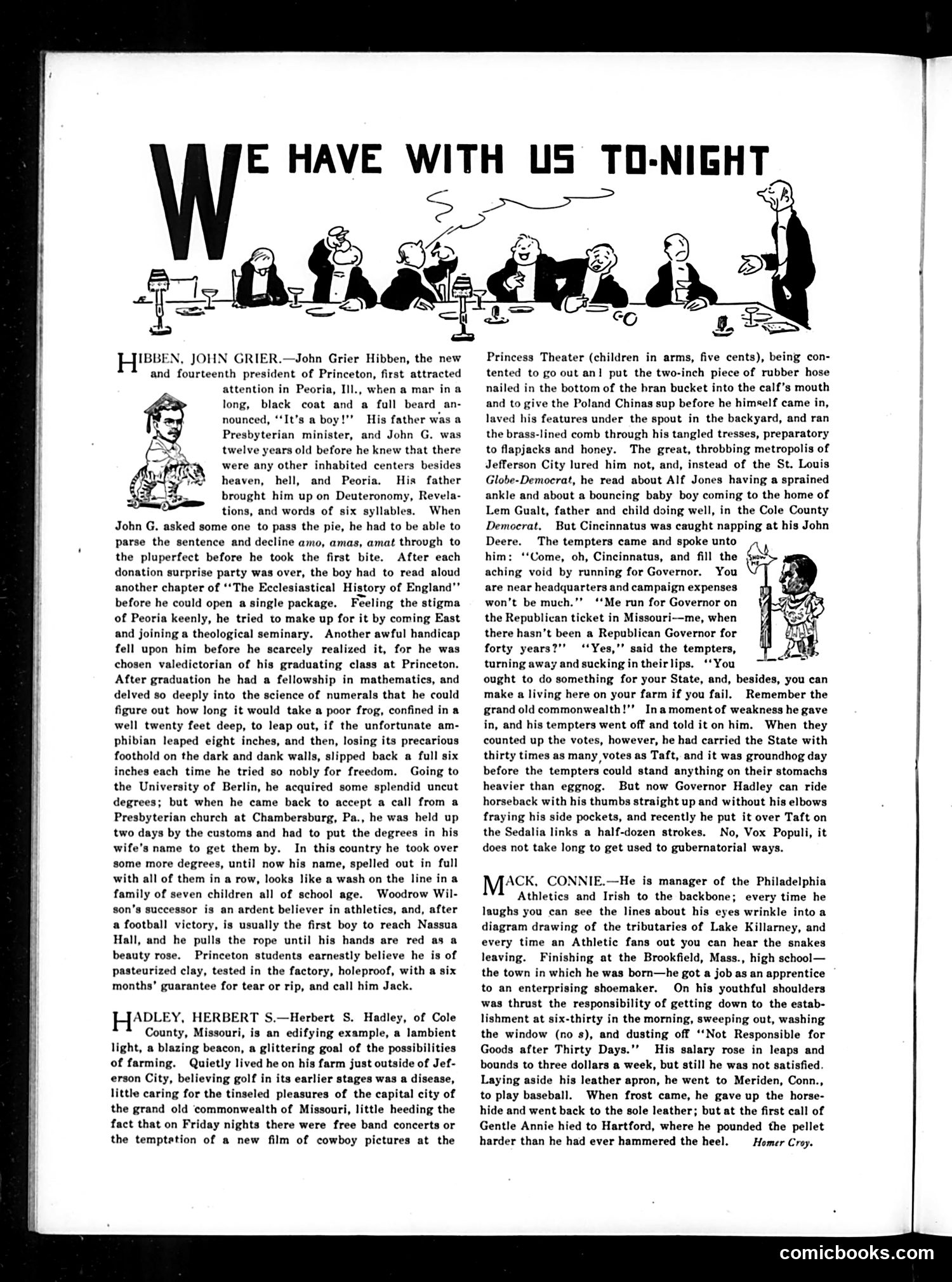
This Judge magazine page satirizes prominent early-20th-century figures through mock biographical sketches. The cartoon header depicts what appears to be a formal dinner gathering. **John Grier Hibben** (newly elected Princeton president) is mocked for his extremely rigid Presbyterian upbringing in Peoria, Illinois—portrayed as intellectually isolated. The satire lampoons his excessive formal education (numerous degrees, classical language requirements) and suggests he's comically overcredentialed yet sheltered. The joke that Princeton students call him "Jack" and believe him "pasteurized clay" with a "six months' guarantee" implies he's artificially perfected but fragile. **Herbert S. Hadley** (appears to be a Missouri politician) is satirized as an earnest farmer-turned-public figure who naively avoids city life's pleasures, reading agricultural gossip instead of serious newspapers. The humor lies in contrasting his deliberate rusticity with his rise to prominence. Both sketches exemplify Judge's characteristic mockery of American public figures through exaggerated biographical parody, highlighting pretension, provincial backgrounds, or incongruous career transitions.
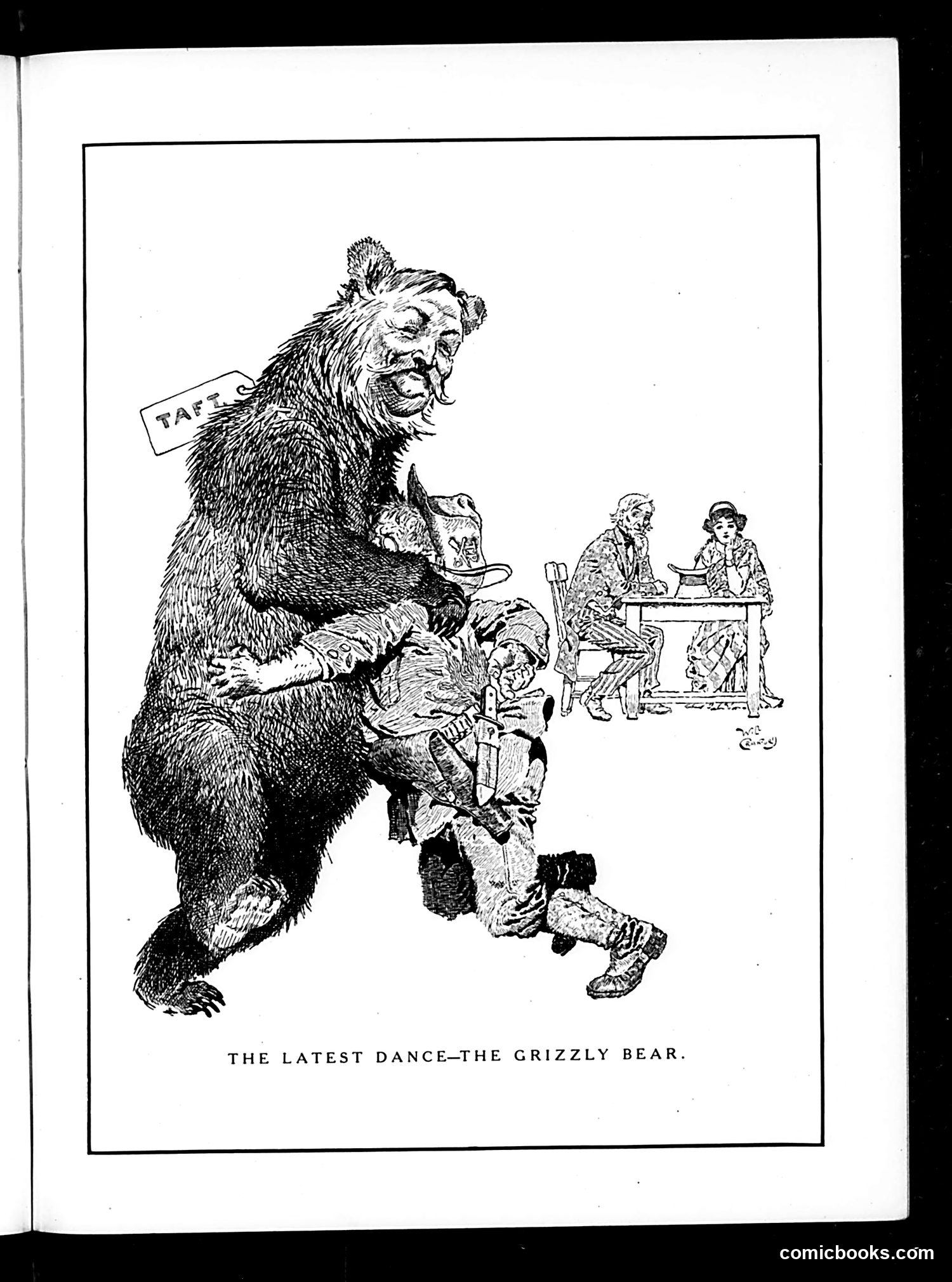
This cartoon satirizes the "Grizzly Bear," a popular ragtime dance of the early 1900s. The image shows a large, hairy bear-man (labeled "TAFT") dancing wildly with a small child, while two well-dressed figures observe from a table in the background. The bear represents President William Howard Taft. The satire likely mocks either Taft's physical appearance (he was notably overweight) or his political style as clumsy and dangerous—depicted as a brutish creature inappropriately "dancing" with vulnerable citizens (represented by the child). The observers' bemused expressions suggest disapproval or concern about this reckless behavior. The cartoon uses the trendy dance as a vehicle for political criticism of Taft's presidency or policies.
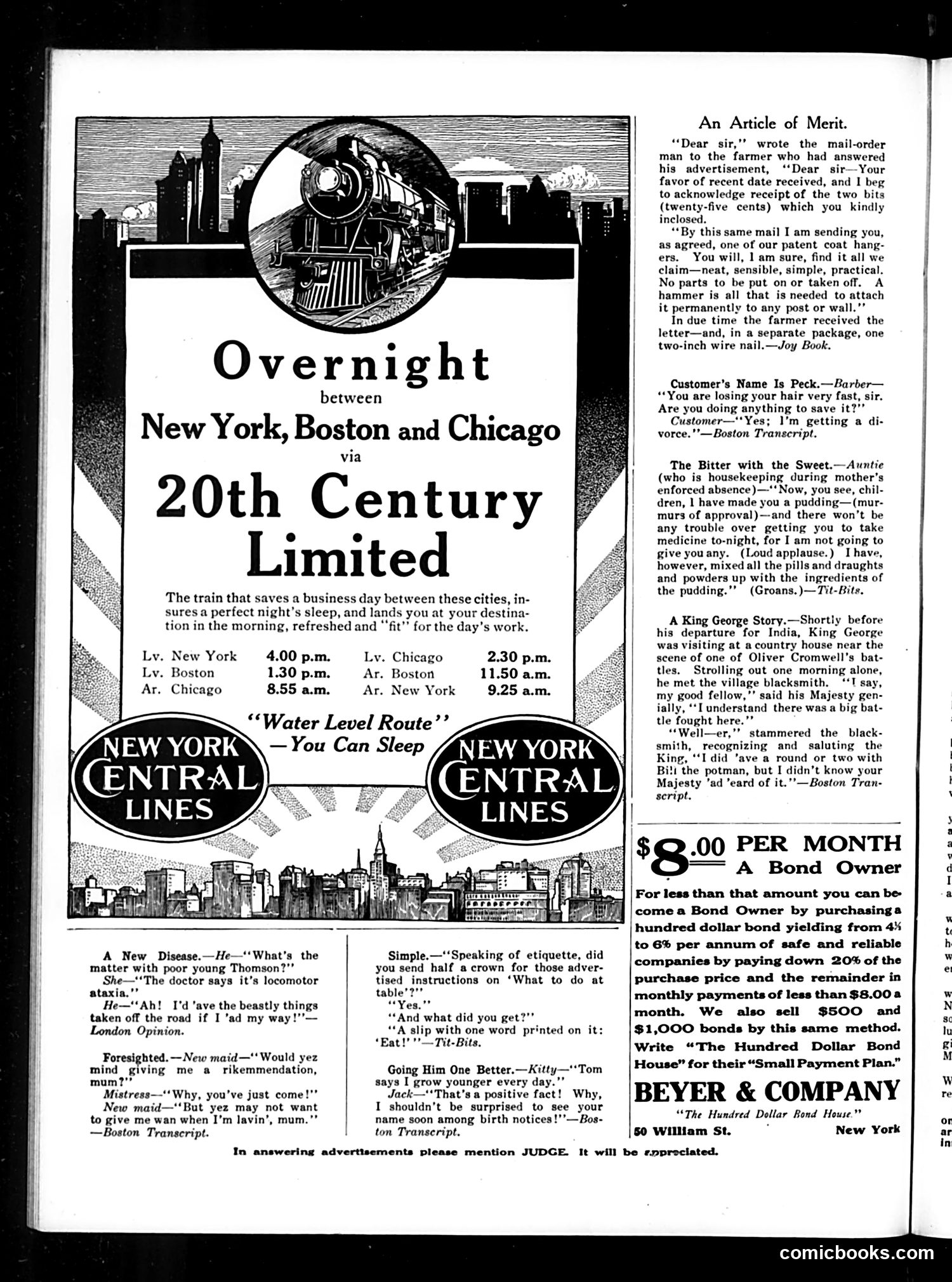
This page is primarily advertising, with the major feature being a full-page ad for the 20th Century Limited train service between New York, Boston, and Chicago (operated by New York Central Lines). The locomotive illustration emphasizes speed and modernity. The ad's main selling point: "water level route"—you can sleep comfortably overnight while traveling between these cities, arriving refreshed for work. Below the train ad are several short comedic anecdotes typical of Judge's satirical humor: - Jokes about disease ("locomotor ataxia" pun on "locomotive") - Servant/class humor (Irish maid seeking references prematurely) - Domestic comedy (divorce as hair-loss cure) - A story about King George confusing a blacksmith's tavern brawl with a historical battle The page also includes a bond investment ad by Beyer & Company offering small monthly payments. The humor reflects early 1900s sensibilities: class-based comedy, marital discord jokes, and gentle mockery of modern anxieties—all typical Judge content from this era.
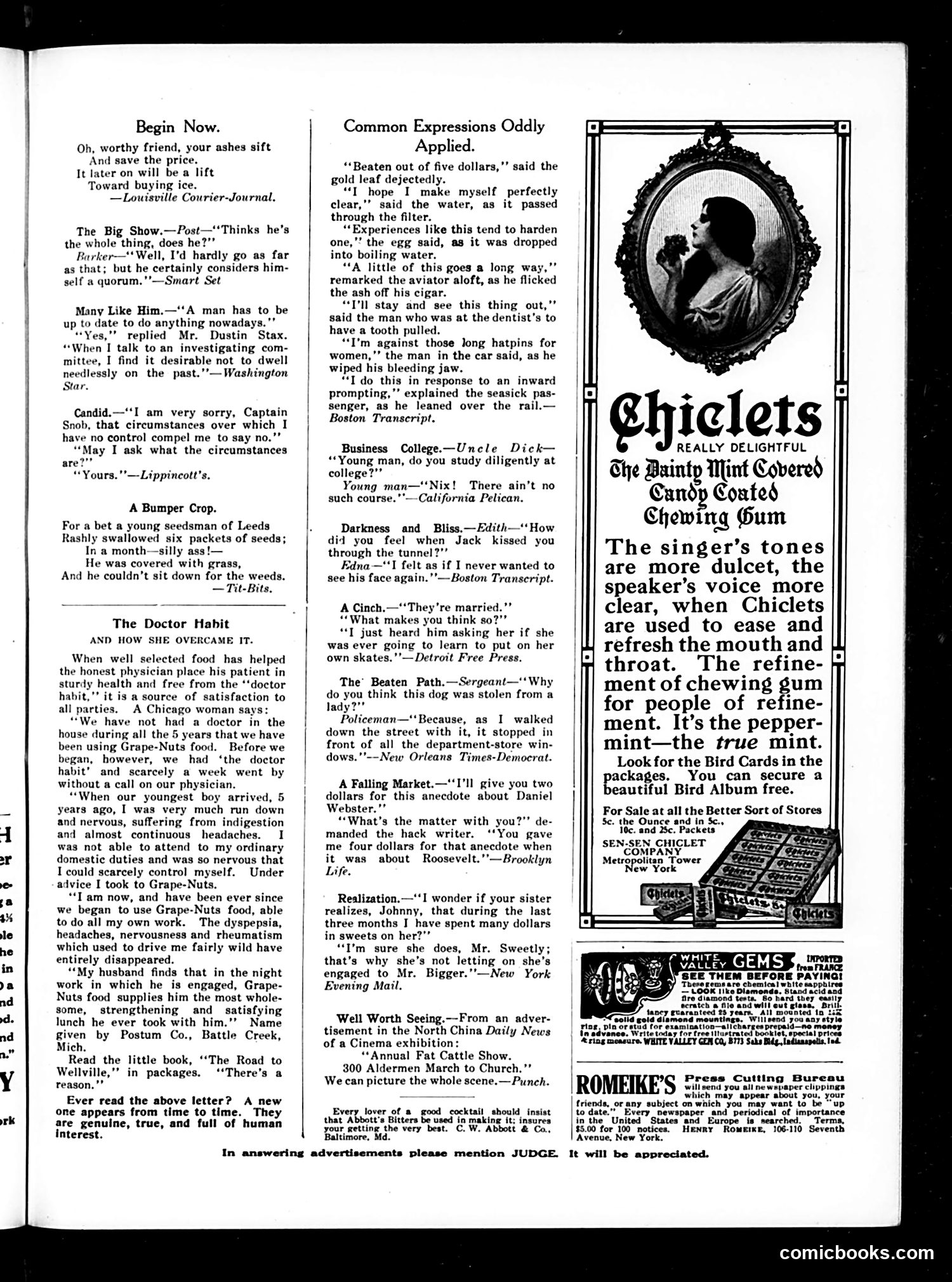
This page from *Judge* magazine contains primarily **humorous short jokes and puns** rather than political cartoons. The content includes: **"Common Expressions Oddly Applied"**: A series of puns where inanimate objects use human expressions literally. For example, water says "I hope I make myself perfectly clear" while passing through a filter, and an egg says experiences "tend to harden one" as it's dropped into boiling water. These are wordplay jokes exploiting double meanings. **Social Commentary Humor**: Several items mock contemporary behavior—a man claiming to be a "quorum" (suggesting self-importance), and jokes about doctors, marriage expectations, and college attitudes reflect early 20th-century social anxieties. **Right side**: Primarily **advertisements** for Chiclets gum and other products. The humor is genteel, relying on linguistic cleverness rather than sharp political satire. The page demonstrates *Judge*'s approach: light social observation wrapped in puns and wordplay for middle-class readers.
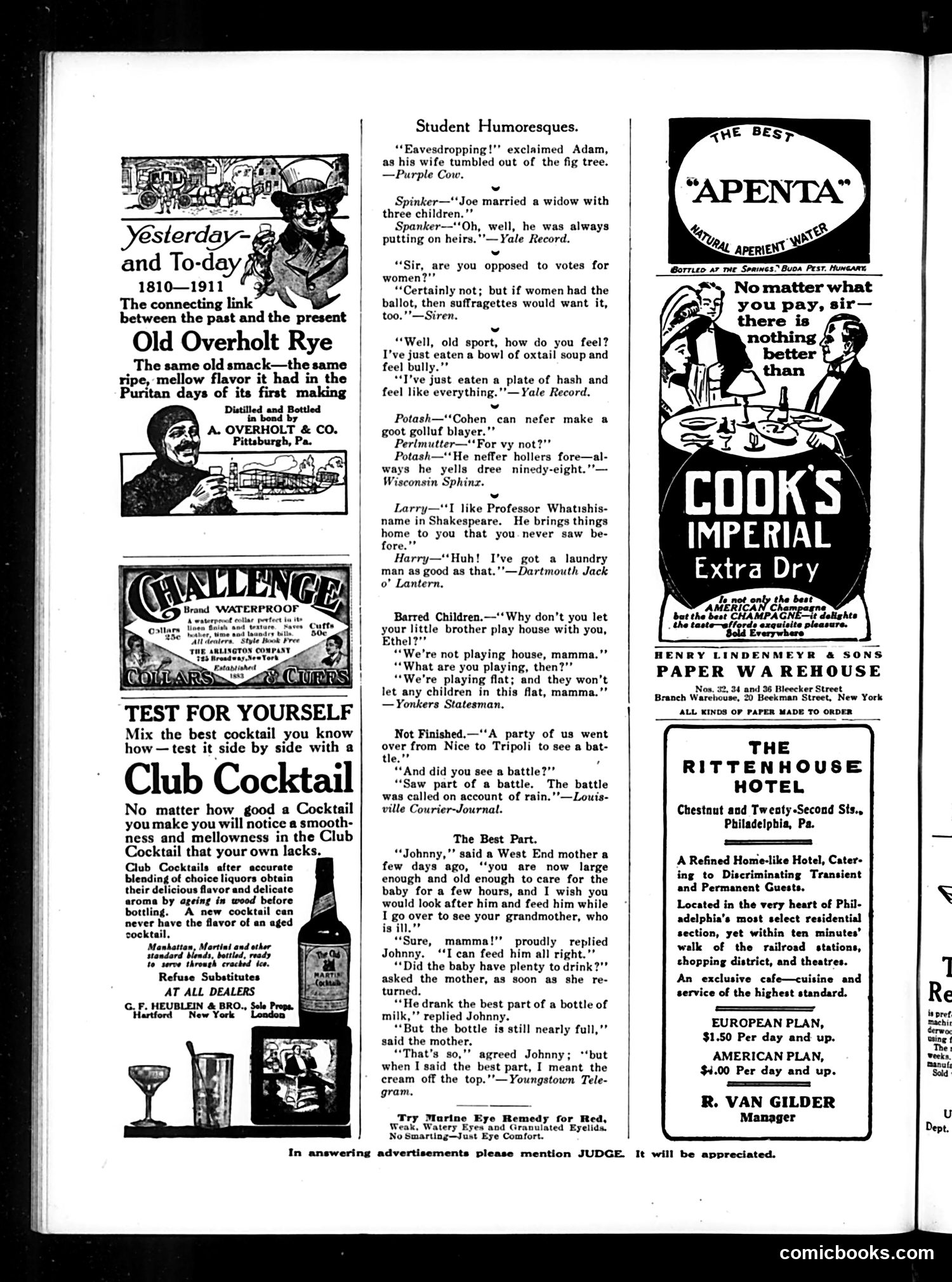
This is primarily an **advertising page** with a small collection of brief student jokes interspersed among liquor and hotel advertisements. The "Student Humoresques" section contains short, punny jokes typical of early 1900s college humor magazines—the sources cited (Yale Record, Wisconsin Sphinx, Dartmouth Jack o' Lantern) confirm these are reprinted campus jokes. They're mostly wordplay: a pun on "putting on heirs" (heirs/airs), ethnic dialect humor featuring "Potash" and "Perlmutter" (Jewish characters), and gentle domestic comedy about a boy feeding a baby cream instead of milk. The page's main content is **advertisements**: Old Overholt Rye whiskey, Club Cocktails, Challenge Collars, Cook's Imperial Champagne, a paper warehouse, and the Rittenhouse Hotel. These ads reflect the magazine's wealthy readership and pre-Prohibition drinking culture (1911 was before the 18th Amendment). The humor is gentle, family-appropriate, and entirely devoid of substantive satire or political content—this page represents Judge's lighter entertainment function rather than its satirical mission.
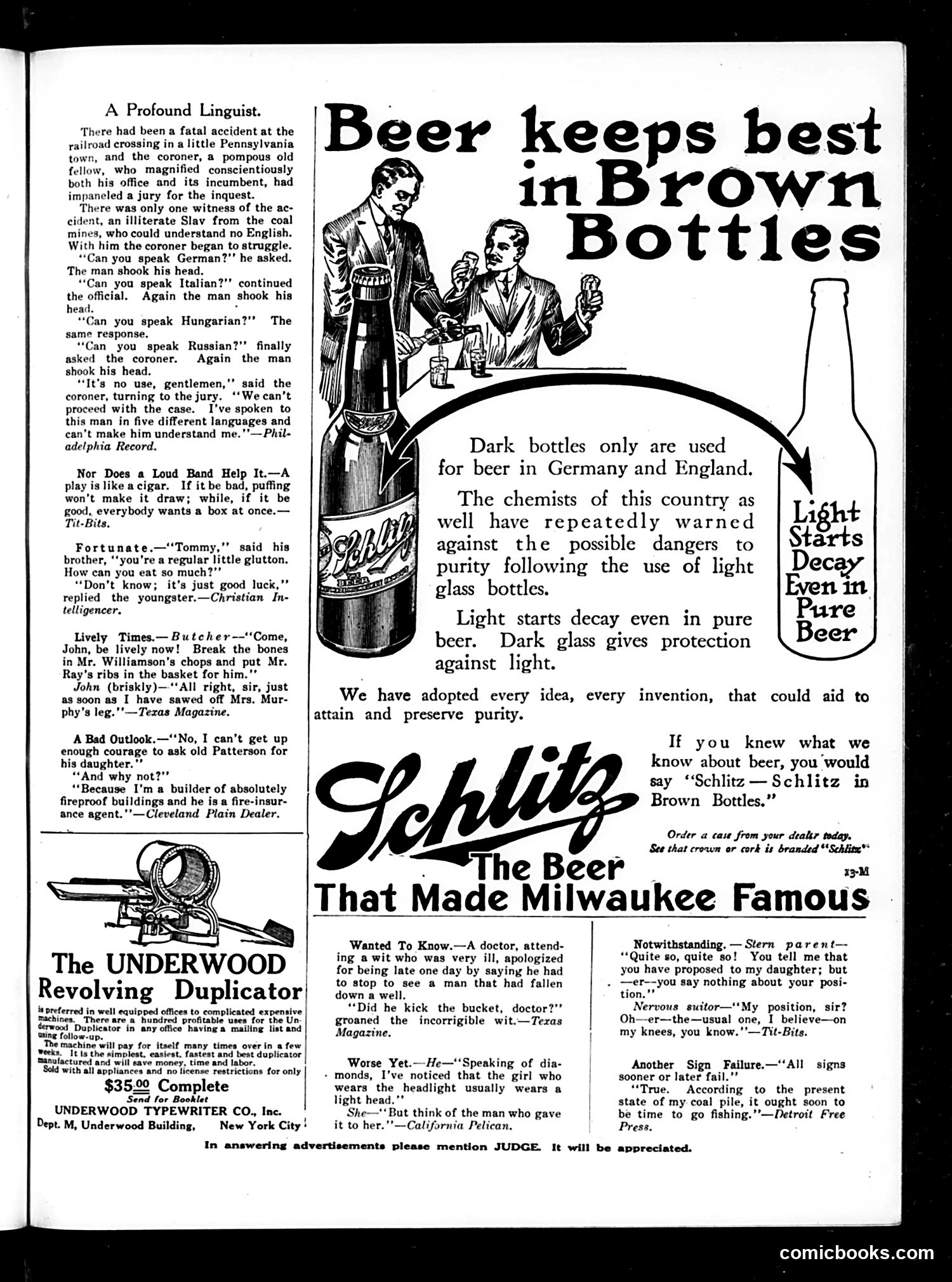
This page contains primarily **humor columns and advertisements** rather than political cartoons. The main satirical content is a short joke titled "A Profound Linguist" about a pompous, incompetent coroner investigating a railroad accident. Unable to communicate with a Slavic immigrant witness, the coroner tries German, Italian, Hungarian, and Russian—then gives up, declaring the case cannot proceed. The satire mocks the coroner's absurd assumption that the witness must speak *some* European language, while never considering that the man simply doesn't speak English and the coroner lacks basic communication skills. The page's largest feature is a **Schlitz beer advertisement** exploiting period anxieties about light damaging beer in glass bottles. It claims dark bottles protect purity—a scientific-sounding sales pitch typical of early 20th-century advertising. Minor humor items mock dramatic theater, gluttony, an overeager butcher, a cowardly suitor, and other everyday situations. The **Underwood Typewriter advertisement** offers office equipment.
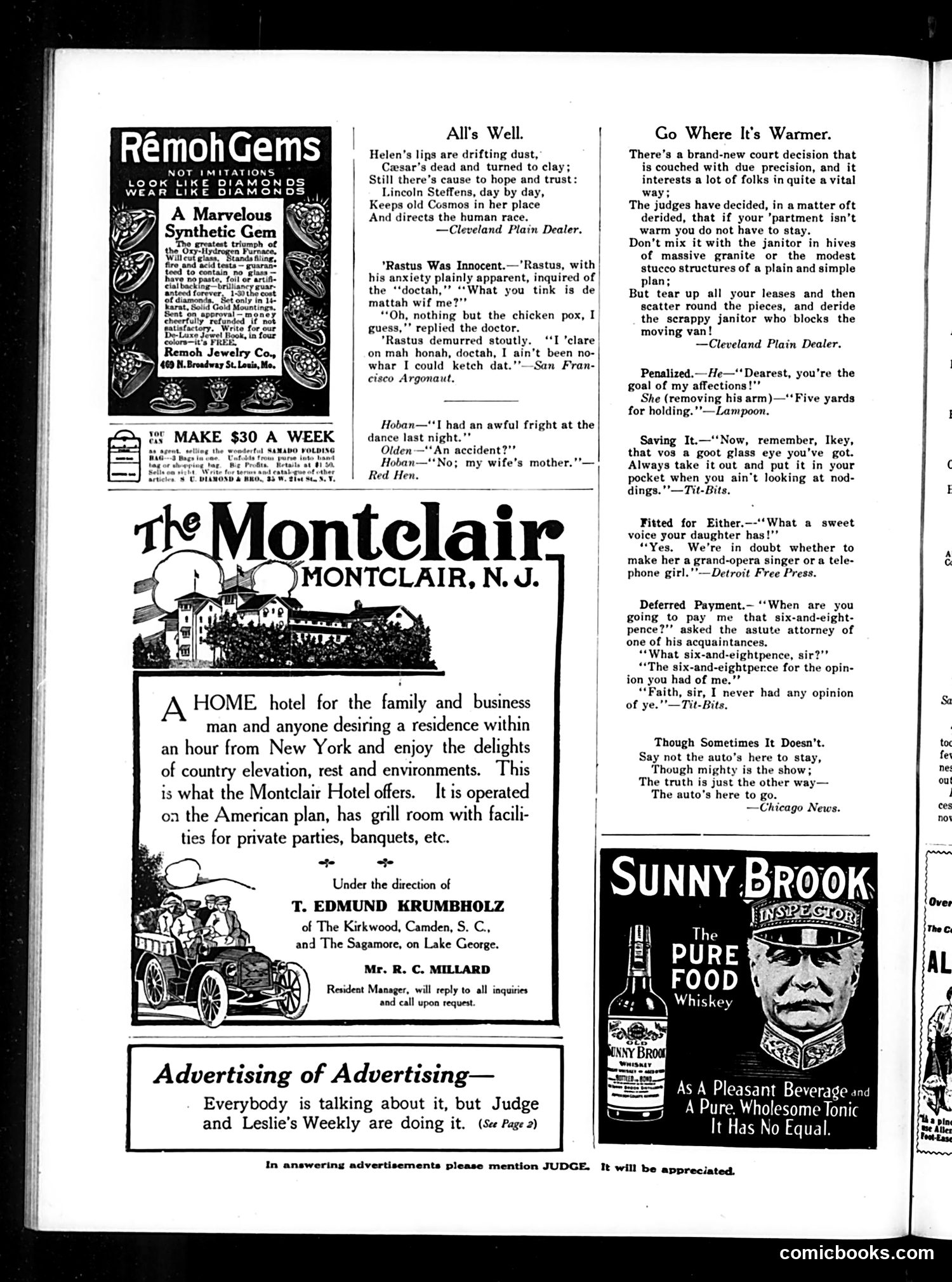
This page contains brief satirical jokes and advertisements typical of early 20th-century Judge magazine. The humor is largely domestic and social rather than overtly political. **Key Content:** The opening poem mocks **Lincoln Steffens**, a famous muckraking journalist, suggesting his writings about corruption ("Cosmos") have become so ubiquitous they seem to control society itself—satirizing his celebrity status and influence. Several brief jokes employ **ethnic stereotypes common to the era**: "Rastus" jokes featuring racist dialect humor about African Americans, and "Ikey" jokes using Yiddish-inflected speech to mock Jewish characters. Other jokes target **contemporary concerns**: a court ruling allowing tenants to break leases for inadequate heat, telephone operators' voices, and automobiles' unreliability. The page is primarily **advertising** for the Montclair Hotel in New Jersey and Sunny Brook Whiskey, with a self-promotional notice about Judge's own advertising practices. The humor reflects period attitudes now considered offensive, while addressing then-current social issues like housing standards and automotive technology.
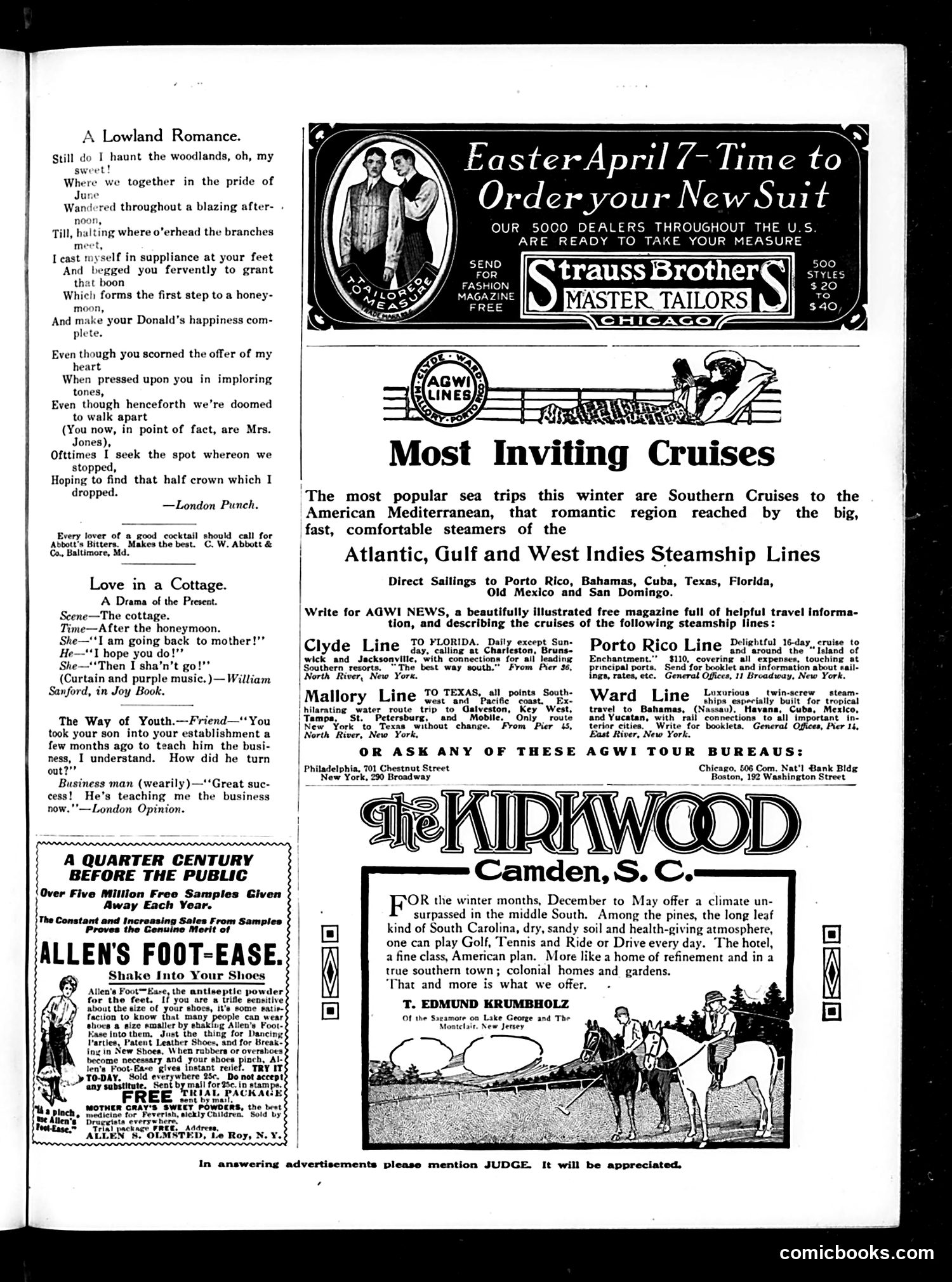
This page is primarily **advertising and light satirical verse**, not political commentary. The main content includes: **"A Lowland Romance"** — A romantic poem (from London Punch) humorously subverted by its punchline: a rejected suitor haunts the spot where he proposed, hoping to find the **half crown he dropped**, not to reconnect with his love. The joke mocks sentimental romance by reducing it to lost money. **"Love in a Cottage"** — A brief marital satire showing a newlywed wife threatening to leave; the husband callously agrees. This reflects early 20th-century humor about marriage's rapid disillusionment. The remainder consists of **travel advertisements** (cruise lines, resorts) and **product ads** (Allen's Foot-Ease powder, Abbott's Bitters, Strauss Brothers tailoring). No identifiable political figures or events appear. The satire is purely social—poking fun at romantic delusion and domestic discord—standard light humor for a general-audience magazine of this era.
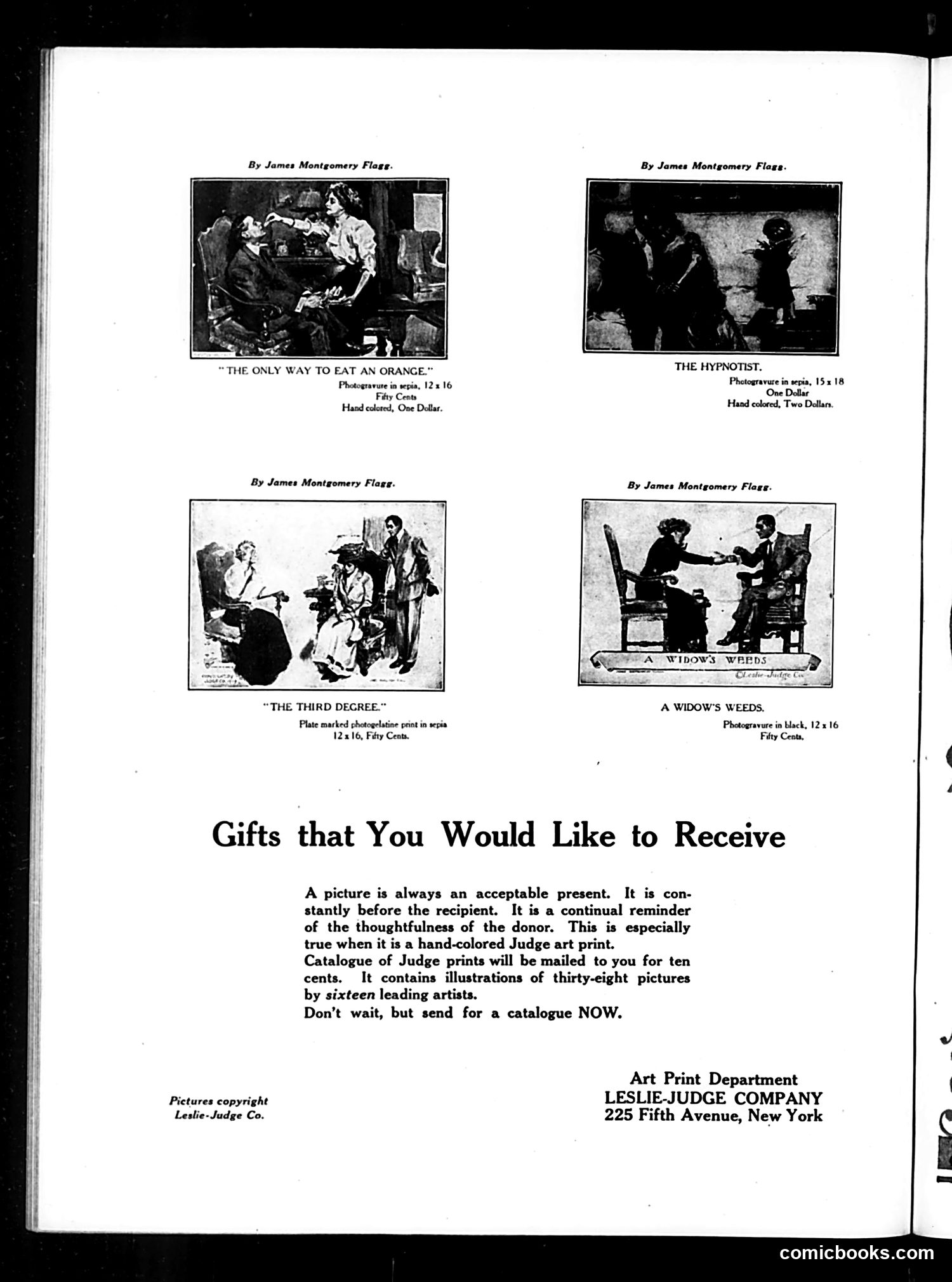
This page advertises art prints by James Montgomery Flagg, a prominent illustrator of the era. Rather than political cartoons, it showcases four domestic comedy scenes intended as gift-worthy artworks: - **"The Only Way to Eat an Orange"** and **"The Third Degree"** appear to depict humorous domestic situations - **"The Hypnotist"** and **"A Widow's Weeds"** suggest social comedy scenarios The advertisement emphasizes that hand-colored Judge prints make thoughtful, lasting gifts—"constantly before the recipient" as reminders of the donor's thoughtfulness. The Leslie-Judge Company promoted these as affordable art by "sixteen leading artists," available in various printing techniques and price points (fifty cents to two dollars). This reflects early 20th-century American consumer culture, where mass-produced "art prints" served as accessible home decoration for middle-class audiences.