
Judge, 1912-02-24 · page 16 of 24
Judge — February 24, 1912 — page 16: what you’re looking at
What you’re looking at
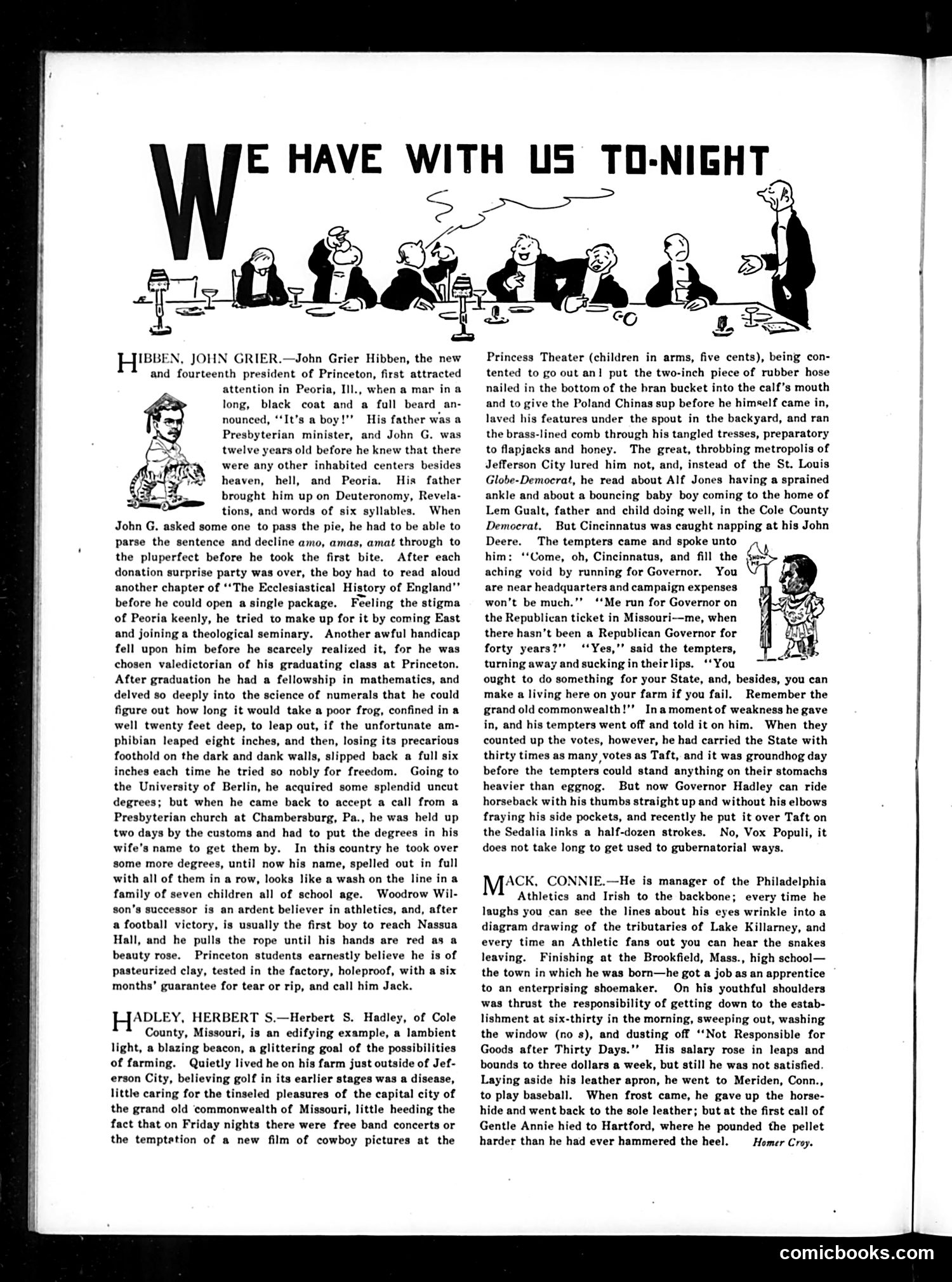
This Judge magazine page satirizes prominent early-20th-century figures through mock biographical sketches. The cartoon header depicts what appears to be a formal dinner gathering. **John Grier Hibben** (newly elected Princeton president) is mocked for his extremely rigid Presbyterian upbringing in Peoria, Illinois—portrayed as intellectually isolated. The satire lampoons his excessive formal education (numerous degrees, classical language requirements) and suggests he's comically overcredentialed yet sheltered. The joke that Princeton students call him "Jack" and believe him "pasteurized clay" with a "six months' guarantee" implies he's artificially perfected but fragile. **Herbert S. Hadley** (appears to be a Missouri politician) is satirized as an earnest farmer-turned-public figure who naively avoids city life's pleasures, reading agricultural gossip instead of serious newspapers. The humor lies in contrasting his deliberate rusticity with his rise to prominence. Both sketches exemplify Judge's characteristic mockery of American public figures through exaggerated biographical parody, highlighting pretension, provincial backgrounds, or incongruous career transitions.
📄 Transcribed text from this page (OCR, searchable)
Machine-transcribed from the original scan — historical spelling and the odd misread are preserved.
HEBBEN, JOHN GRIER.—John Grier Hibben, the new and fourteenth president of Princeton, first attracted attention in Peoria, Ill., when a mar ina long, black coat and a full beard an- nounced, ‘‘It's a boy!"’ His father was a Presbyterian minister, and John G. was twelve years old before he knew that there were any other inhabited centers besides heaven, hell, and Peoria. His father brought him up on Deuteronomy, Revela- tions, and words of six syllables. When John G. asked some one to pass the pie, he had to be able to parse the sentence and decline amo, amas, amat throvgh to the pluperfect before he took the first bite. After each donation surprise party was over, the boy had to read aloud another chapter of ‘‘The Ecclesiastical History of England’’ before he could open a single package. Feeling the stigma of Peoria keenly, he tried to make up for it by coming East and joining a theological seminary. Another awful handicap fell upon him before he scarcely realized it, for he was chosen valedictorian of his graduating class at Princeton. After graduation he had a fellowship in mathematics, and delved so deeply into the science of numerals that he could figure out how long it would take a poor frog, confined in a well twenty feet deep, to leap out, if the unfortunate am- phibian leaped eight inches, and then, losing its precarious foothold on the dark and dank walls, slipped back a full six inches each time he tried so nobly for freedom. Going to the University of Berlin, he acquired some splendid uncut degrees; but when he came back to accept a call from a Presbyterian church at Chambersburg, Pa., he was held up two days by the customs and had to put the degrees in his wife's name to get them by. In this country he took over some more degrees, until now his name, spelled out in full with all of them in a row, looks like a wash on the line ina family of seven children all of school age. Woodrow Wil- son’s successor is an ardent believer in athletics, and, after a football victory, is usually the first boy to reach Nassua Hall, and he pulls the rope until his hands are red as a beauty rose. Princeton students earnestly believe he is of pasteurized clay, tested in the factory, holeproof, with a six months’ guarantee for tear or rip, and call him Jack. H“2Ley. HERBERT S.—Herbert S. Hadley, of Cole County, Missouri, is an edifying example, a lambient light, a blazing beacon, a glittering goal of the possibilities of farming. Quietly lived he on his farm just outside of Jef- erson City, believing golf in its earlier stages was a disease, little caring for the tinseled pleasures of the capital city of the grand old commonwealth of Missouri, little heeding the fact that on Friday nights there were free band concerts or the temptetion of a new film of cowboy pictures at the E HAVE WITH US TO-NIGHT aS Princess Theater (children in arms, five cents), being con- tented to go out an! put the two-inch piece of rubber hose nailed in the bottom of the bran bucket into the calf’s mouth and to give the Poland Chinas sup before he himself came in, laved his features under the spout in the backyard, and ran the brass-lined comb through his tangled tresses, preparatory to flapjacks and honey. The great, throbbing metropolis of Jefferson City lured him not, and, instead of the St. Louis Globe-Democrat, he read about Alf Jones having a sprained ankle and about a bouncing baby boy coming to the home of Lem Gualt, father and child doing well, in the Cole County Democrat. But Cincinnatus was caught napping at his John Deere. The tempters came and spoke unto him: ‘Come, oh, Cincinnatus, and fill the {x~ aching void by running for Governor. You are near headquarters and campaign expenses won't be much.’’ ‘‘Me run for Governor on A the Republican ticket in Missouri—me, when ; . there hasn’t been a Republican Governor for forty years?’’ ‘‘Yes,’’ said the tempters, turning away and sucking in theirlips. ‘‘You ought to do something for your State, and, besides, you can make a living here on your farm if you fail. Remember the grand old commonwealth!"’ Inamomentof weakness he gave in, and his tempters went off and told iton him. When they counted up the votes, however, he had carried the State with thirty times as many votes as Taft, and it was groundhog day before the tempters could stand anything on their stomachs heavier than eggnog. But now Governor Hadley can ride horseback with his thumbs straight up and without his elbows fraying his side pockets, and recently he put it over Taft on the Sedalia links a half-dozen strokes. No, Vox Populi, it does not take long to get used to gubernatorial ways. M*ck: CONNIE.—He is manager of the Philadelphia Athletics and Irish to the backbone; every time he laughs you can see the lines about his eyes wrinkle into a diagram drawing of the tributaries of Lake Killarney, and every time an Athletic fans out you can hear the snakes leaving. Finishing at the Brookfield, Mass., high school— the town in which he was born—he got a job as an apprentice to an enterprising shoemaker. On his youthful shoulders was thrust the responsibility of getting down to the estab- lishment at six-thirty in the morning, sweeping out, washing the window (no s), and dusting off ‘‘Not Responsible for Goods after Thirty Days.’’ His salary rose in leaps and bounds to three dollars a week, but still he was not satisfied. Laying aside his leather apron, he went to Meriden, Conn., to play baseball. When frost came, he gave up the horse- hide and went back to the sole leather; but at the first call of Gentle Annie hied to Hartford, where he pounded the pellet harder than he had ever hammered the heel. Homer Croy. comicbooks.com