
Judge, 1912-02-24 · page 15 of 24
Judge — February 24, 1912 — page 15: what you’re looking at
What you’re looking at
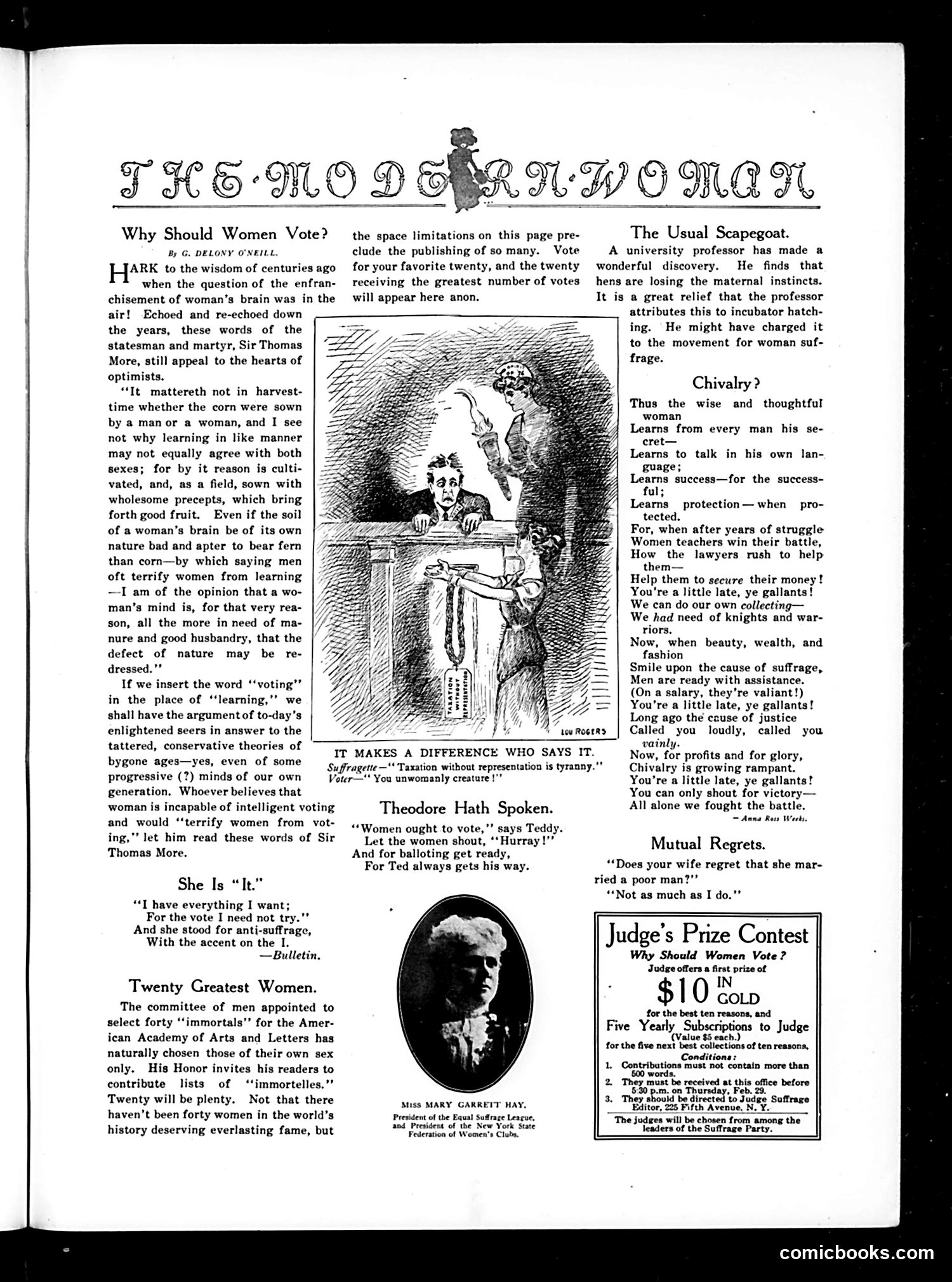
This Judge magazine page satirizes the women's suffrage movement through multiple perspectives, circa early 1900s. **Main Content:** - **O'Neill's essay** defends women voting, citing Sir Thomas More's arguments that women's minds are capable of learning and reasoning like men's. - **"She Is 'It'"** mocks anti-suffrage women who claim contentment without voting rights, criticizing their self-centered reasoning. - **"Theodore Hath Spoken"** sarcastically suggests women only support suffrage when President Theodore Roosevelt endorses it, implying they lack independent conviction. - **"Chivalry"** critiques male hypocrisy: men claim chivalry while actually denying women justice and independence; they only "help" when suffrage becomes fashionable and profitable. - **The cartoon** (by Low Rogers) appears to show a woman at a voting booth with male figures watching—unclear exact meaning without caption. The page's **satire targets both anti-suffrage opponents and insincere male supporters**, while presenting genuine pro-suffrage arguments. A contest offering $10 in gold solicits reasons supporting women's voting rights.
📄 Transcribed text from this page (OCR, searchable)
Machine-transcribed from the original scan — historical spelling and the odd misread are preserved.
TICS -MODSORNWHWO MAN Why Should Women Vote? By G. DELONY O'NEILL, ARK to the wisdom of centuries ago when the question of the enfran- chisement of woman’s brain was in the the space limitations on this page pre- clude the publishing of so many. Vote The Usual Scapegoat. A university professor has made a for your favorite twenty, and the twenty wonderful discovery. He finds that receiving the greatest number of votes hens are losing the maternal instincts. will appear here anon. It is a great relief that the professor attributes this to incubator hatch- air! Echoed and re-echoed down the years, these words of the statesman and martyr, Sir Thomas More, still appeal to the hearts of optimists. “It mattereth not in harvest- time whether the corn were sown by a man or a woman, and I see not why learning in like manner may not equally agree with both sexes; for by it reason is culti- vated, and, as a field, sown with wholesome precepts, which bring forth good fruit. Even if the soil of a woman's brain be of its own nature bad and apter to bear fern than corn—by which saying men oft terrify women from learning —I am of the opinion that a wo- man’s mind is, for that very rea- son, all the more in need of ma- nure and good husbandry, that the defect of nature may be re- dressed.’" If we insert the word ‘‘voting”’ in the place of ‘‘learning,’’ we shall have the argument of to-day’s enlightened seers in answer to the fi 4 1% 4 Low ROGERS ing. He might have charged it to the movement for woman suf- frage. Chivalry > Thus the wise and thoughtful woman Learns from every man his se- cret— Learns to talk in his own lan- guage; Learns success—for the success- protection — when _pro- tected. For, when after years of struggle Women teachers win their battle, How the lawyers rush to help them— Help them to secure their money! You're a little late, ye gallants! We can do our own collecting— We had need of knights and war- riors. Now, when beauty, wealth, and fashion Smile upon the cause of suffrage, Men are ready with assistance. (On a salary, they’re valiant!) You're a little late, ye gallants! Long ago the cause of justice Called you loudly, called you tattered, conservative theories of bygone ages—yes, even of some progressive (?) minds of our own generation. Whoever believes that woman is incapable of intelligent voting and would ‘‘terrify women from vot- ing,’’ let him read these words of Sir Thomas More. She Is “It.” “T have everything I want; For the vote I need not try.”” And she stood for anti-suffrage, With the accent on the I. —Bulletin. Twenty Greatest Women. The committee of men appointed to IT MAKES A DIFFERENCE WHO SAYS IT. —“ Taxation without representation is tyranny." You unwomanly creature !"’ Theodore Hath Spoken. “Women ought to vote,’” says Teddy. Let the women shout, ‘*Hurray!’" And for balloting get ready, For Ted always gets his way. vainly. Now, for profits and for glory, Chivalry is growing rampant. You're a little late, ye gallants! You can only shout for victory— All alone we fought the battle. = Anna Ros Weeks, Mutual Regrets. “Does your wife regret that she mar- ried a poor man?’’ “Not as much as I do.”” Judge’s Prize Contest Why Should Women Vote ? Judge offers a first prize of $10 cou for the best ten reasons, and select forty ‘‘immortals”’ for the Amer- x Five Yearly Subscriptions to Judge ican Academy of Arts and Letters has Value $5 each.) ; : for the five next best collections of ten reasons, naturally chosen those of their own sex \ / Conditions only. His Honor invites his readers to 1. Contributions mest not contain more than contribute lists of ‘‘immortelles.’’ a 2 They must be received at this office before Twenty will be plenty. Not that there Miss MARY GARRETT HAY, © "Baitor, 225 Fifth Avent haven t been forty women in the world’s resident of the Baual fang Lessee, ‘The judges will be chosen from among the history deserving everlasting fame, but Pree of the Nes Yar Se ieaders of the Suffrage Party. comicbooks.com