
A complete issue · 24 pages · 1911
Judge — October 21, 1911
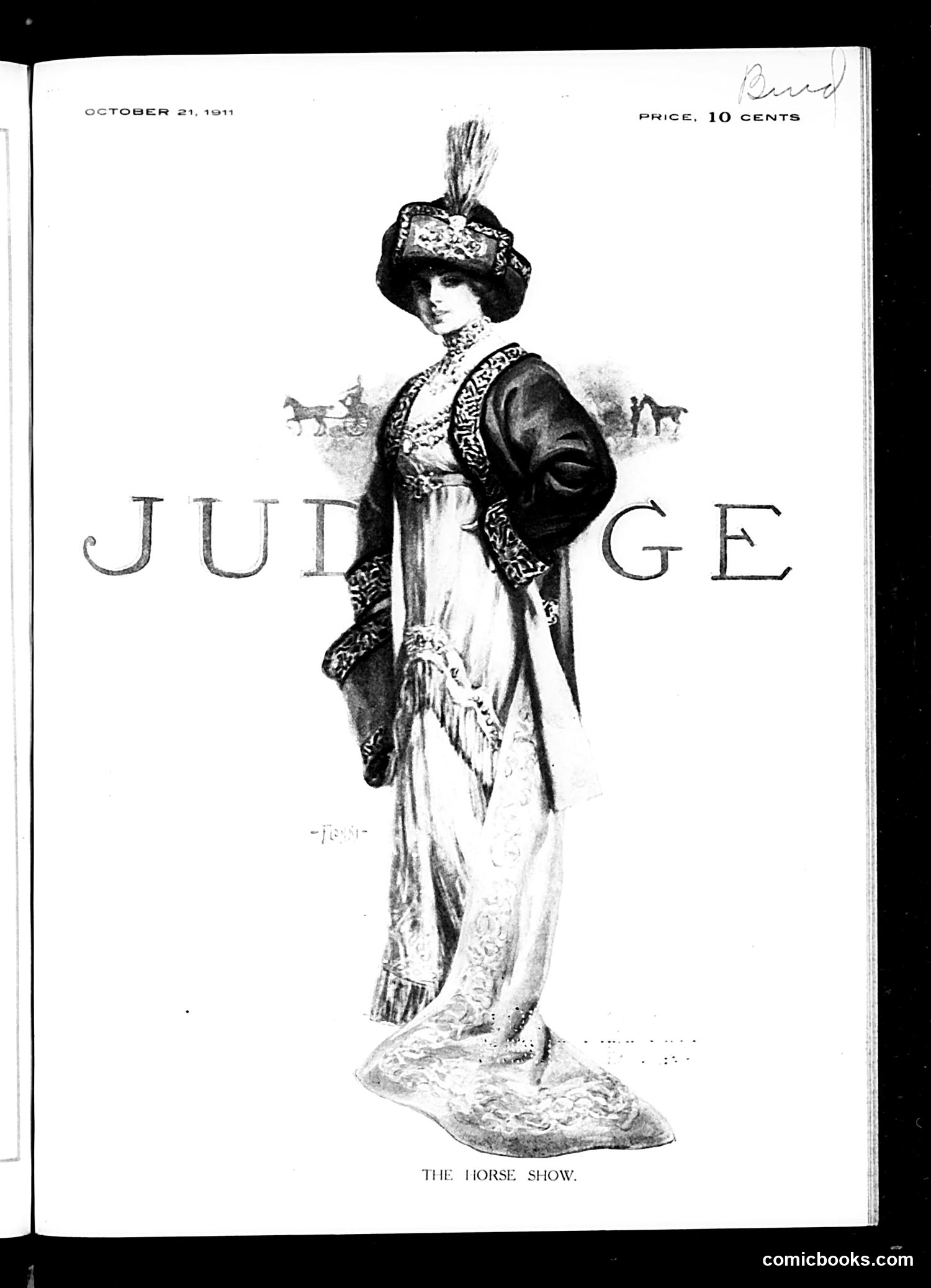
This page features an elegant illustration titled "The Horse Show" depicting a fashionably dressed woman in elaborate Edwardian attire—an ornate feathered hat, jeweled choker, embroidered jacket, and flowing white gown with a train. Horses appear faintly in the background. The satire likely mocks high society's obsession with fashionable display at prestigious horse shows of the era. The woman's extravagant outfit—clearly the focus—overshadows the actual equestrian event, suggesting that wealthy attendees prioritized showing off their own finery over the horses themselves. This reflects Judge's frequent satirization of upper-class vanity and conspicuous consumption during the Gilded Age period.
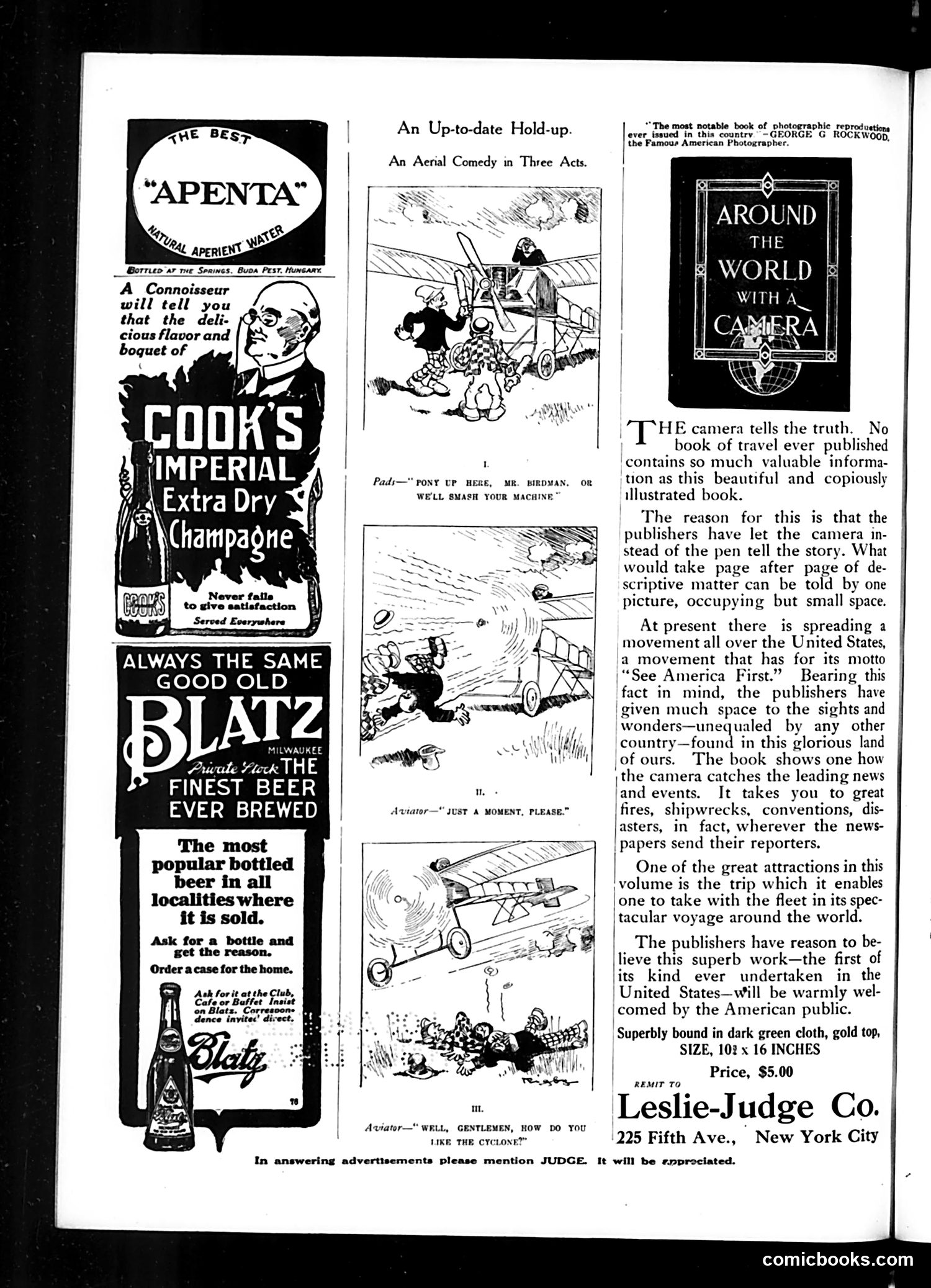
This page is primarily **advertising with one satirical comic strip**. The three-panel comic titled "An Up-to-date Hold-up" depicts an aerial comedy scenario. A figure in what appears to be an early airplane encounters another person, with captions suggesting a robbery or confrontation ("Post up here, Mr. Birdman, or we'll smash your machine"; "Just a moment, please"; "Well, gentlemen, how do you like the cyclone?"). The humor likely plays on the novelty of early aviation technology and the absurdity of attempting a robbery at altitude, though the specific satirical target is unclear without additional context. The advertisements dominate the page, promoting champagne, beer, and a photography book "Around the World with a Camera," emphasizing leisure and consumption typical of early 20th-century American magazines.
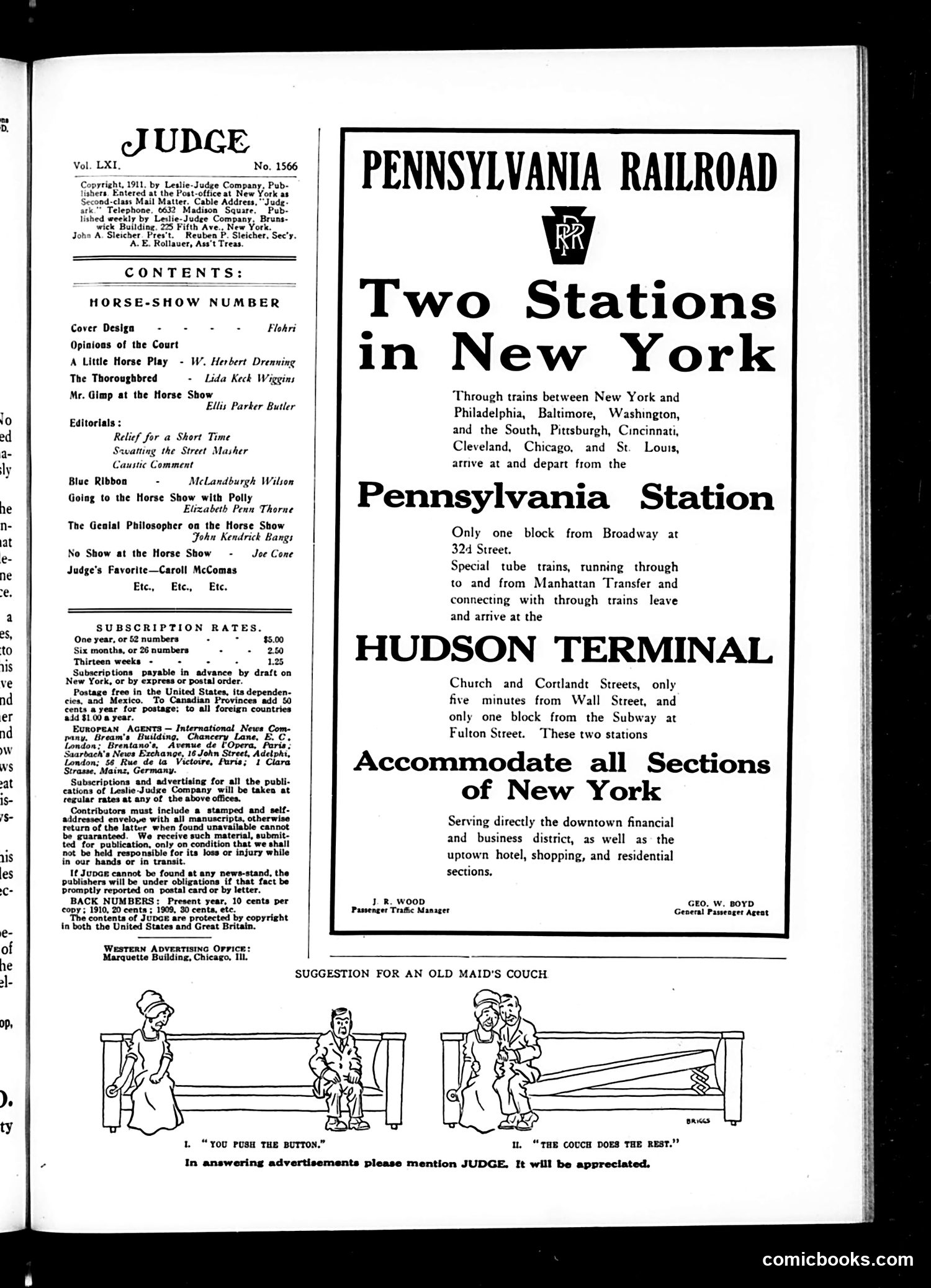
This page is primarily **advertising content** rather than satirical material. The dominant feature is a Pennsylvania Railroad advertisement promoting "Two Stations in New York" (Pennsylvania Station and Hudson Terminal), highlighting their convenient Manhattan locations for travelers. At the bottom is a small illustrated joke titled "SUGGESTION FOR AN OLD MAID'S COUGH," showing a domestic scene where a woman pushes a button, causing a man to fall from a bed. The humor appears to rely on crude innuendo about unmarried women and their romantic situations—typical of early 20th-century magazine humor that would be considered offensive today. The left side contains a table of contents for the magazine's "Horse-Show Number," indicating the issue focused on equestrian sports.
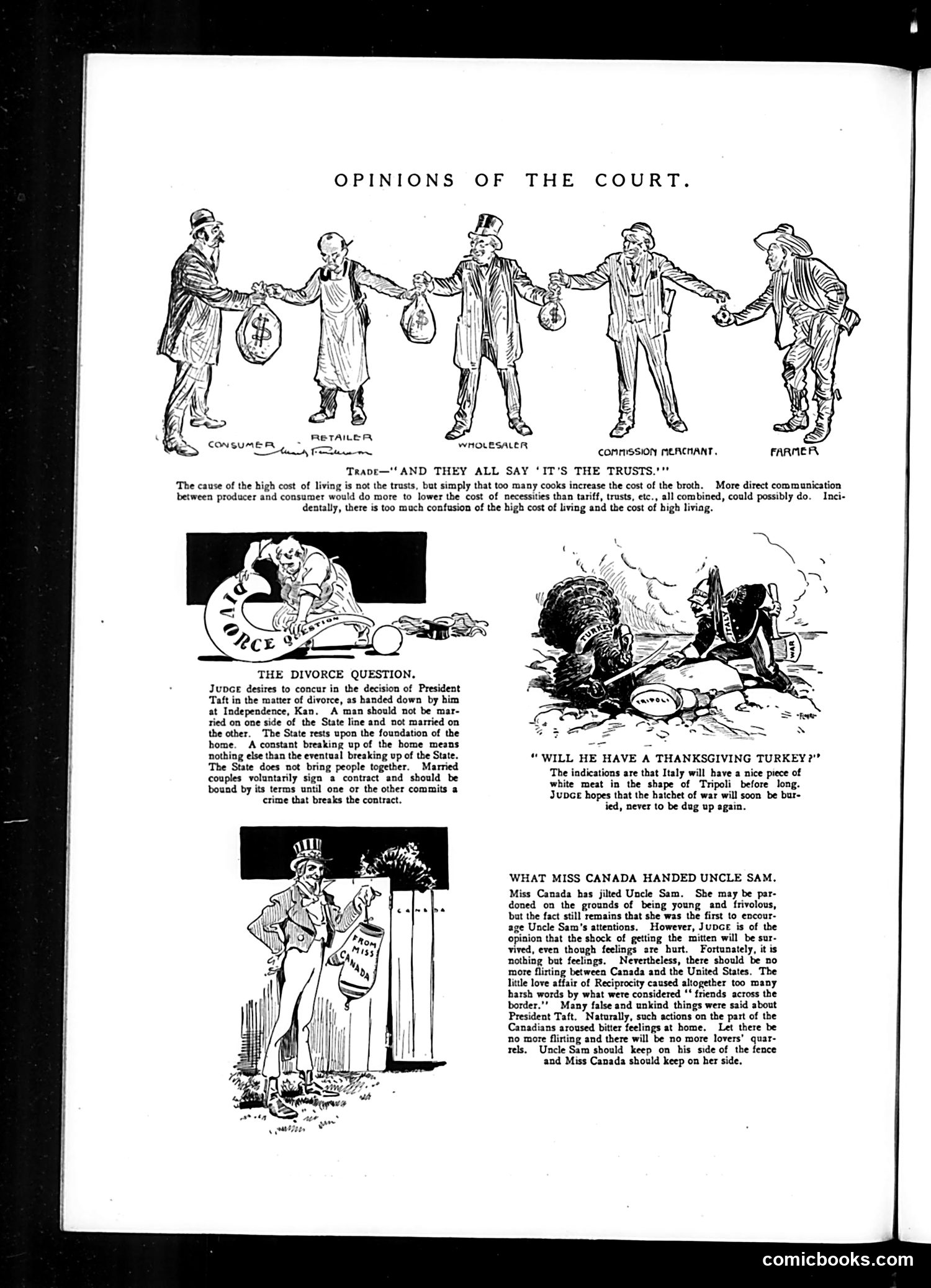
This Judge magazine page satirizes early 20th-century economic issues through caricatured figures representing different economic interests: a "Cowboy" (rancher), "Retailer," "Wholesaler," "Commission Merchant," and "Farmer." **Top cartoon**: Mocks the blame game over inflation. Each middleman passes responsibility to the next, suggesting that multiple intermediaries inflate costs rather than trusts alone causing high living expenses. **"The Divorce Question"**: References a judicial decision about presidential power regarding state divorce laws—likely Theodore Roosevelt era given the style. **"Will He Have a Thanksgiving Turkey?"**: Suggests Italy faced food shortages (possibly WWI-related). **"What Miss Canada Handed Uncle Sam"**: Addresses Canadian-American relations, possibly regarding reciprocity disputes or romantic/diplomatic tensions referenced in the text.
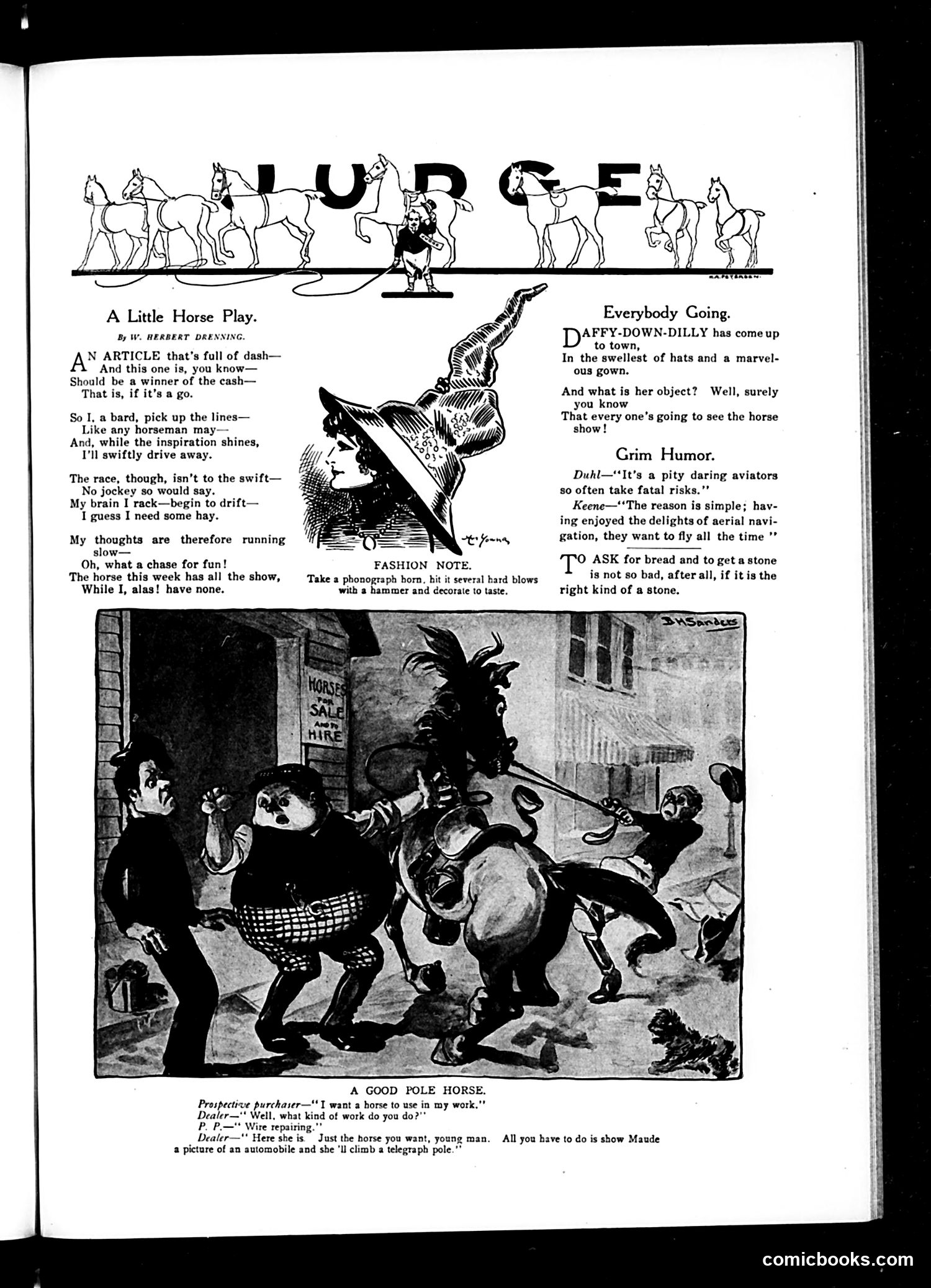
This page contains three distinct pieces of humor: 1. **"A Little Horse Play"** — A poem by W. Herbert Dressingabout a horseman seeking racing inspiration, playing on the double meaning of "horse play" (pranks). 2. **"Everybody Going"** — Brief social satire about Daffy-Down-Dilly visiting town in fashionable attire. The humor references her intent to display herself to others, typical of early 20th-century social commentary on vanity. 3. **"A Good Hole Horse"** — A cartoon showing a chaotic street scene where people attempt to use a spirited horse for various impossible tasks (climbing telegraph poles, wire repair, automobile work). The joke mocks incompetent workers requesting an unsuitable horse for jobs requiring actual skill or machinery, satirizing poor labor practices or unreasonable employer demands. The humor reflects period concerns about practicality and social pretension.
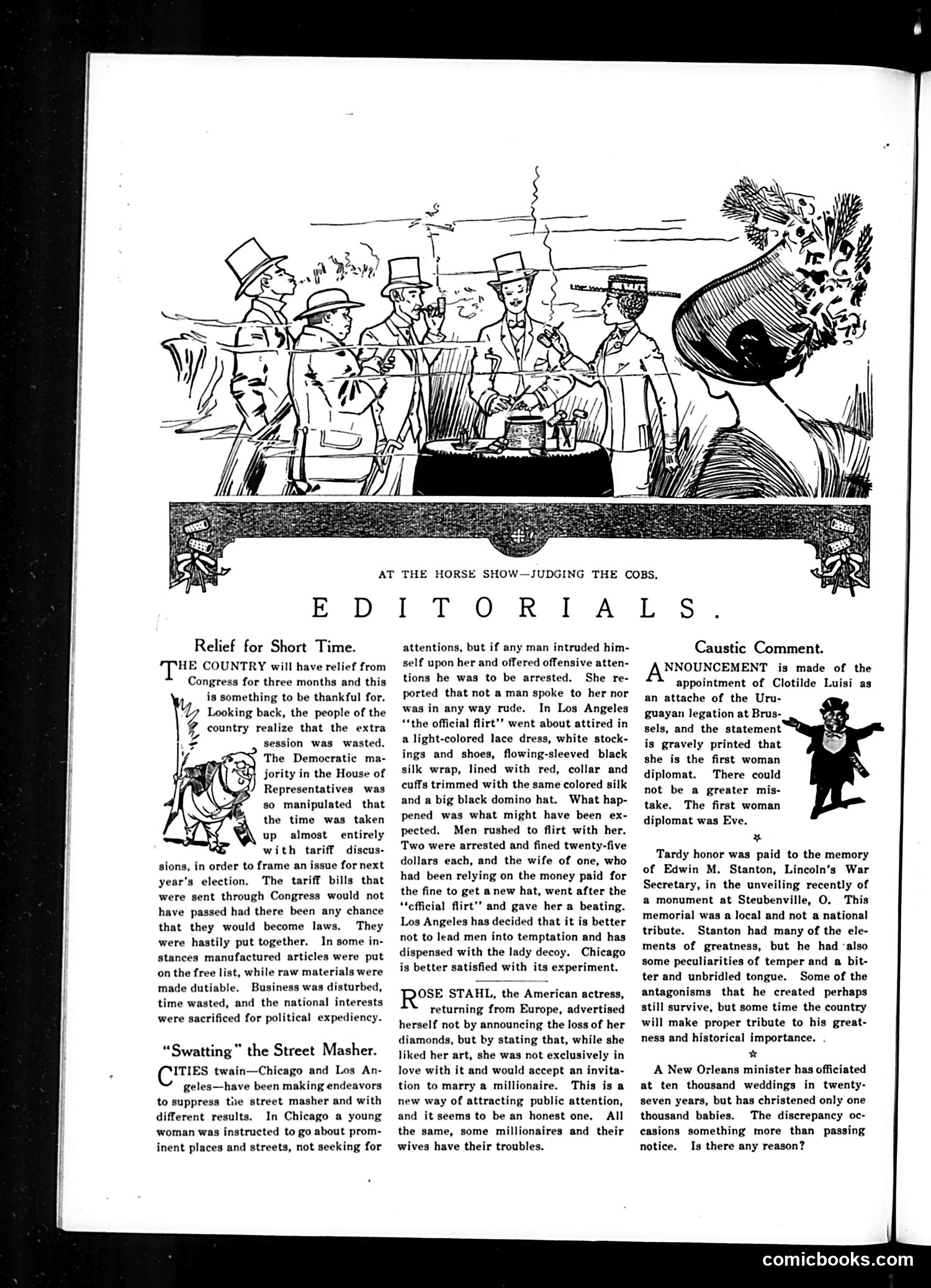
The page contains three editorial cartoons and commentary satirizing contemporary issues: **"Relief for Short Time"** criticizes the Democratic-controlled House for wasting an extra Congressional session on tariff debates designed purely to create campaign issues, rather than passing functional legislation. The satire targets political expediency over national interests. **"Swatting the Street Masher"** compares two cities' approaches to street harassment. Chicago's decoy (a woman dressed modestly who reported no inappropriate behavior) versus Los Angeles's "official flirt" (dressed provocatively), who attracted arrests and was beaten by an angry wife. The satire mocks Los Angeles's failed strategy of deliberately tempting men into illegal behavior. **"Caustic Comment"** sardonically notes that Clotilde Luisi is celebrated as the "first woman diplomat," but dismisses this by claiming Eve was history's first woman diplomat—a misogynistic joke suggesting women inherently cause humanity's problems. The top cartoon titled "Judging the Cobs" appears to satirize horse-show judges, though context is unclear.
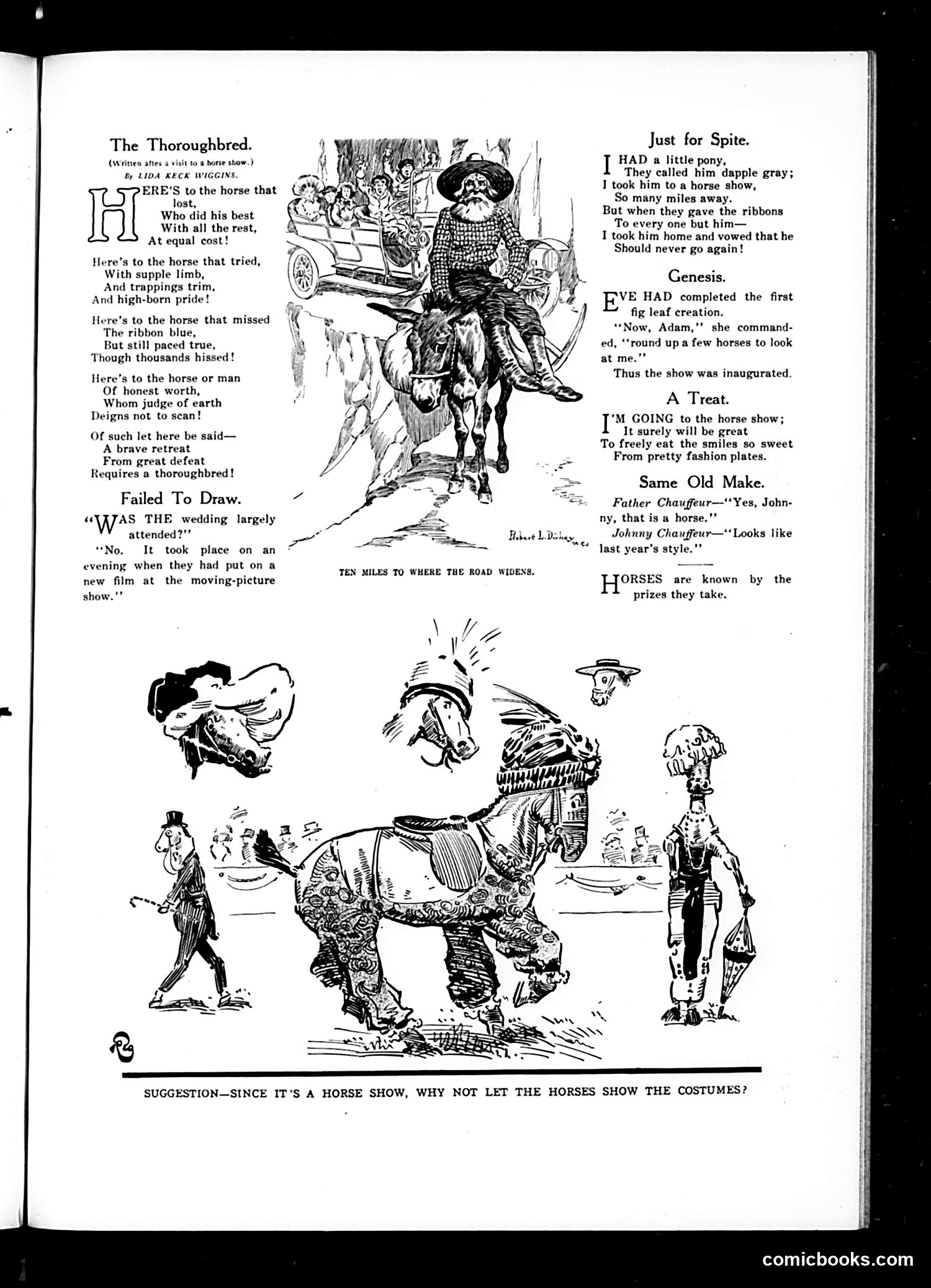
This page from *Judge* magazine contains multiple short satirical pieces about horse shows, a popular early 20th-century social event. **Main themes:** 1. **"The Thoroughbred"** and **"Just for Spite"** mock the competitive, status-conscious nature of horse shows—celebrating horses that lose or are rejected, satirizing how owners' pride is wounded by judges' decisions. 2. **"Genesis"** makes a clever joke equating the first fig leaf (Adam and Eve's clothing) with fashion display at horse shows, suggesting both are fundamentally about showing off appearance. 3. **"Same Old Make"** satirizes automobiles replacing horses; even a child assumes horses are "last year's style." 4. **The bottom cartoon** suggests the real spectacle at horse shows is human fashion, not equestrian skill—humorously proposing horses wear the fancy costumes instead. Overall, the page gently ridicules the vanity and social pretension surrounding horse shows, where human ego and display matter more than actual horsemanship or animal quality.
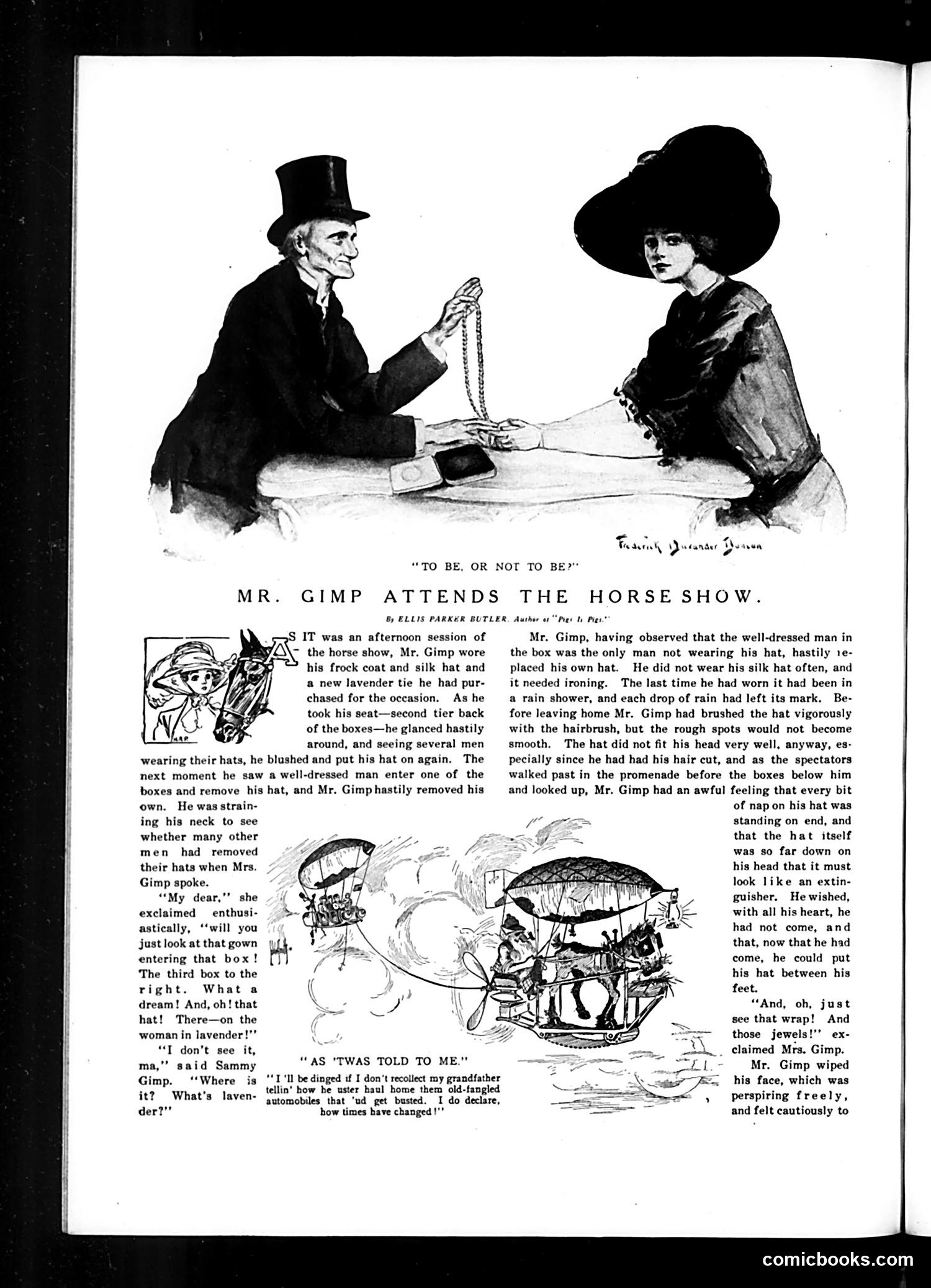
This is a humorous short story by Ellis Parker Butler illustrated with sketches. Mr. Gimp, an ordinary man, attends a fashionable horse show wearing a shabby silk hat he rarely uses—it's wrinkled from rain damage and doesn't fit properly. The satire targets middle-class social anxiety: Gimp obsessively monitors what others are wearing, frantically removing and replacing his hat based on what he observes wealthier attendees doing. Meanwhile, his wife focuses entirely on criticizing other women's gowns and jewelry rather than enjoying the event itself. The embedded anecdote about an old man discussing automobiles suggests how fashions and social conventions constantly change, making it futile to worry about appearing proper. The joke satirizes *Hamlet's* "To be or not to be" by making it about whether to wear one's hat—trivializing existential questions into petty social concerns. The humor derives from depicting ordinary people's status-conscious insecurity at upper-class venues.
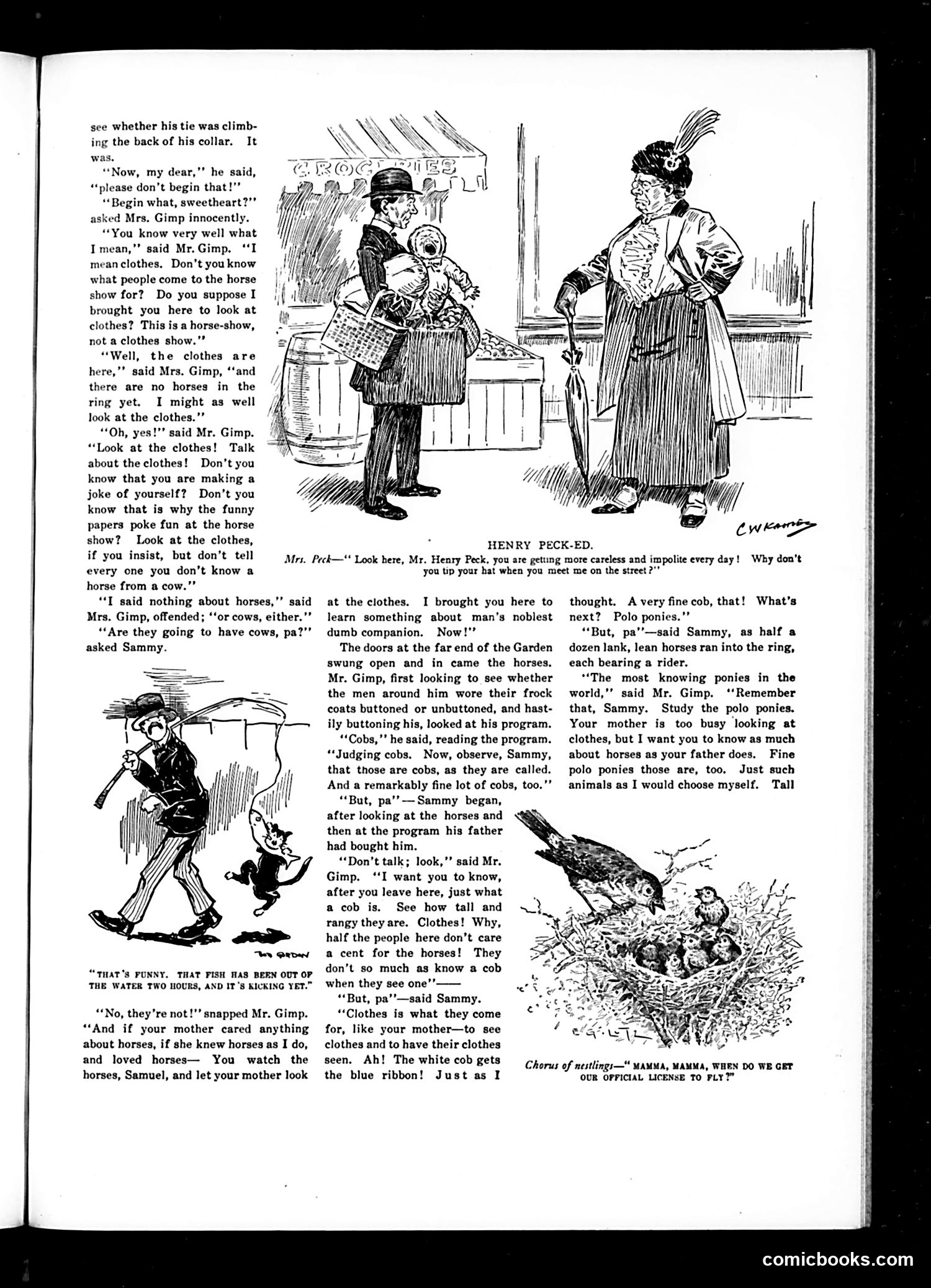
This page satirizes the disconnect between what people *claim* to attend events for versus their actual interests. Mr. Gimp repeatedly insists he brought his family to the horse show to educate them about horses—the "noblest dumb companion"—while constantly distracted by *clothes*. He hypocritically adjusts his own tie and coat buttons while lecturing his wife and son about focusing on the animals, not fashion. The satire targets male hypocrisy: Gimp accuses his wife of being superficial for observing clothing (the traditional female stereotype), yet he's equally preoccupied. The humor lies in his obliviousness—he lectures about cobs and polo ponies while demonstrating zero genuine interest in them. The secondary cartoons mock other social behaviors: marital conflict over etiquette, and children's observations about licensing (unclear reference, likely satirizing bureaucracy). The target is bourgeois pretension and gendered double standards at public events.
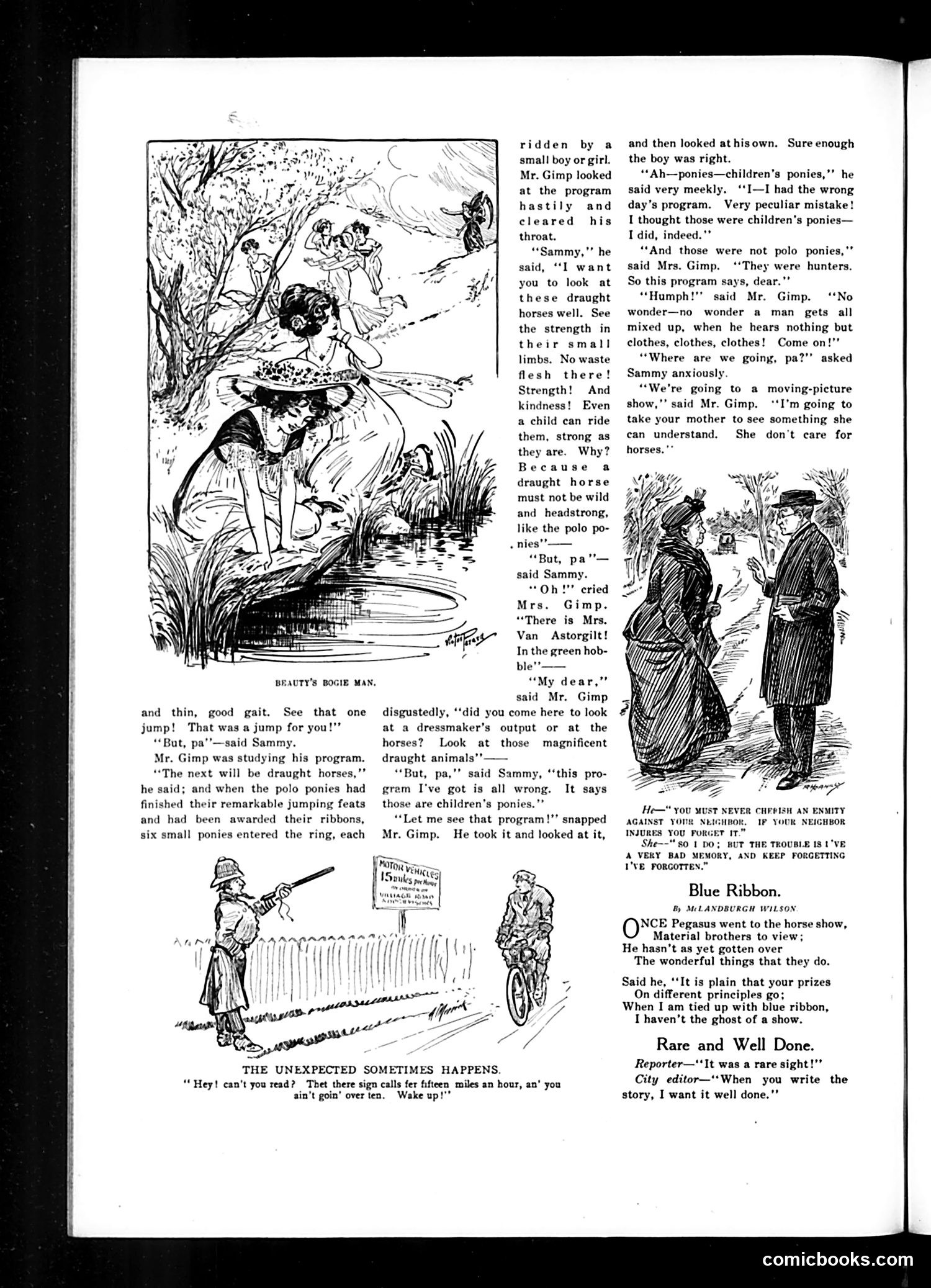
This cartoon mocks Mr. Gimp, a pompous horse show attendee who lectures his son Sammy about the superior qualities of draught horses while simultaneously getting his program wrong. Mr. Gimp pontificates about strength and kindness in working horses versus "wild and headstrong" polo ponies—adopting an air of expertise—only to be humbled when Sammy points out he's actually looking at children's ponies, then hunters, not draught horses at all. The satire targets social pretension: Gimp makes authoritative pronouncements he doesn't back up with actual knowledge, while his distracted wife cares only about fashion ("dressmaker's output"). The joke's punchline—taking his family to a movie because his wife "don't care for horses"—undercuts his entire pompous display of expertise as meaningless. The accompanying "Blue Ribbon" poem extends this theme, contrasting Pegasus's achievements with arbitrary prize-awarding conventions.
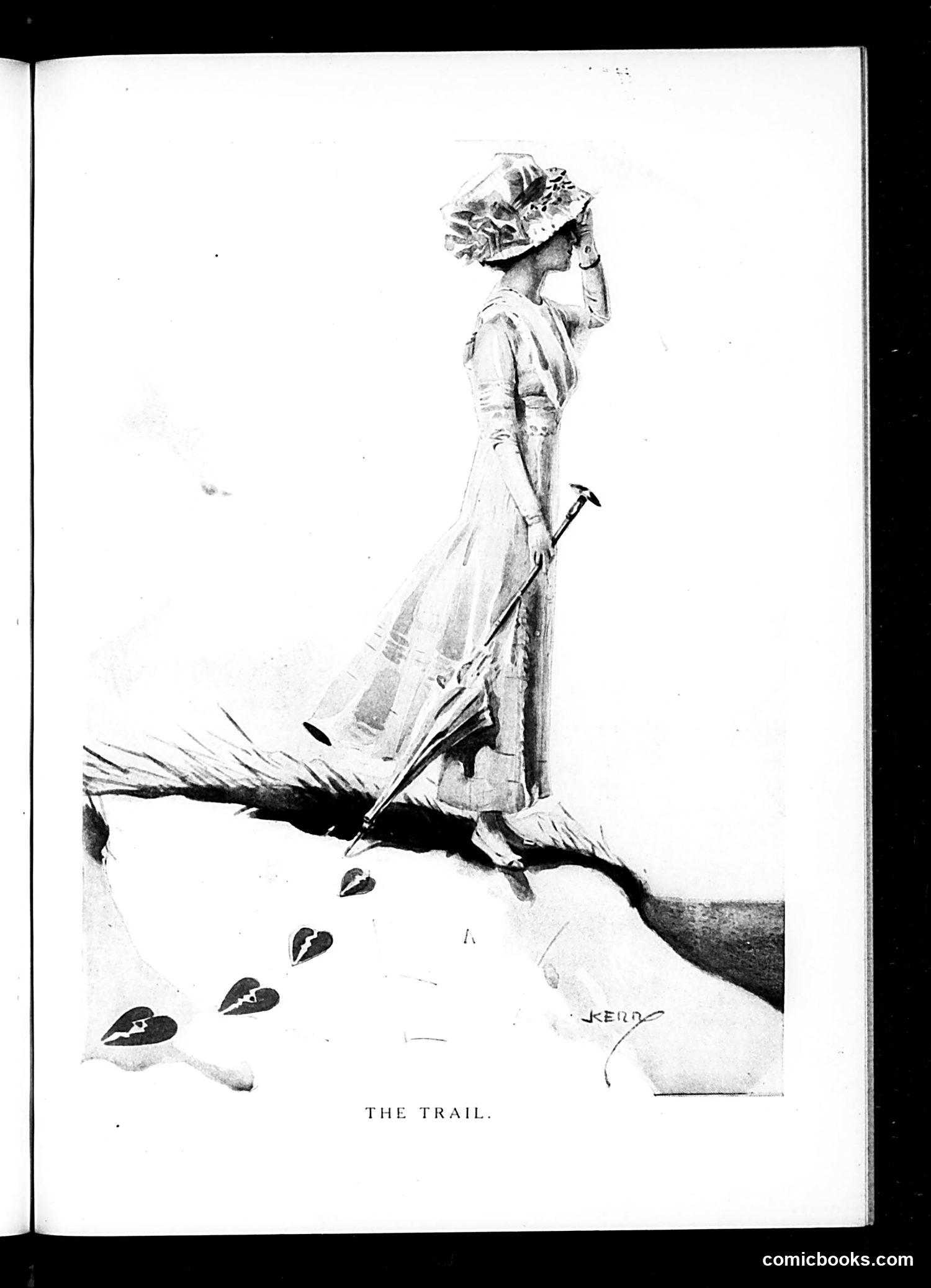
This illustration shows a elegantly dressed woman walking along a path, leaving a trail of small heart-shaped footprints behind her. The sketch style is refined, typical of Judge magazine's satirical artwork from the early 20th century. The cartoon appears to be romantic or sentimental satire, playing on the notion of a woman's romantic "trail"—the hearts she leaves behind suggest either her romantic conquests or the admirers following her path. The title "The Trail" reinforces this double meaning: both a literal path and the figurative trail of romantic interest or heartbreak she leaves in her wake. The signature appears to read "Keimp" or similar. Without additional context about the specific issue date, the exact satirical target remains unclear.
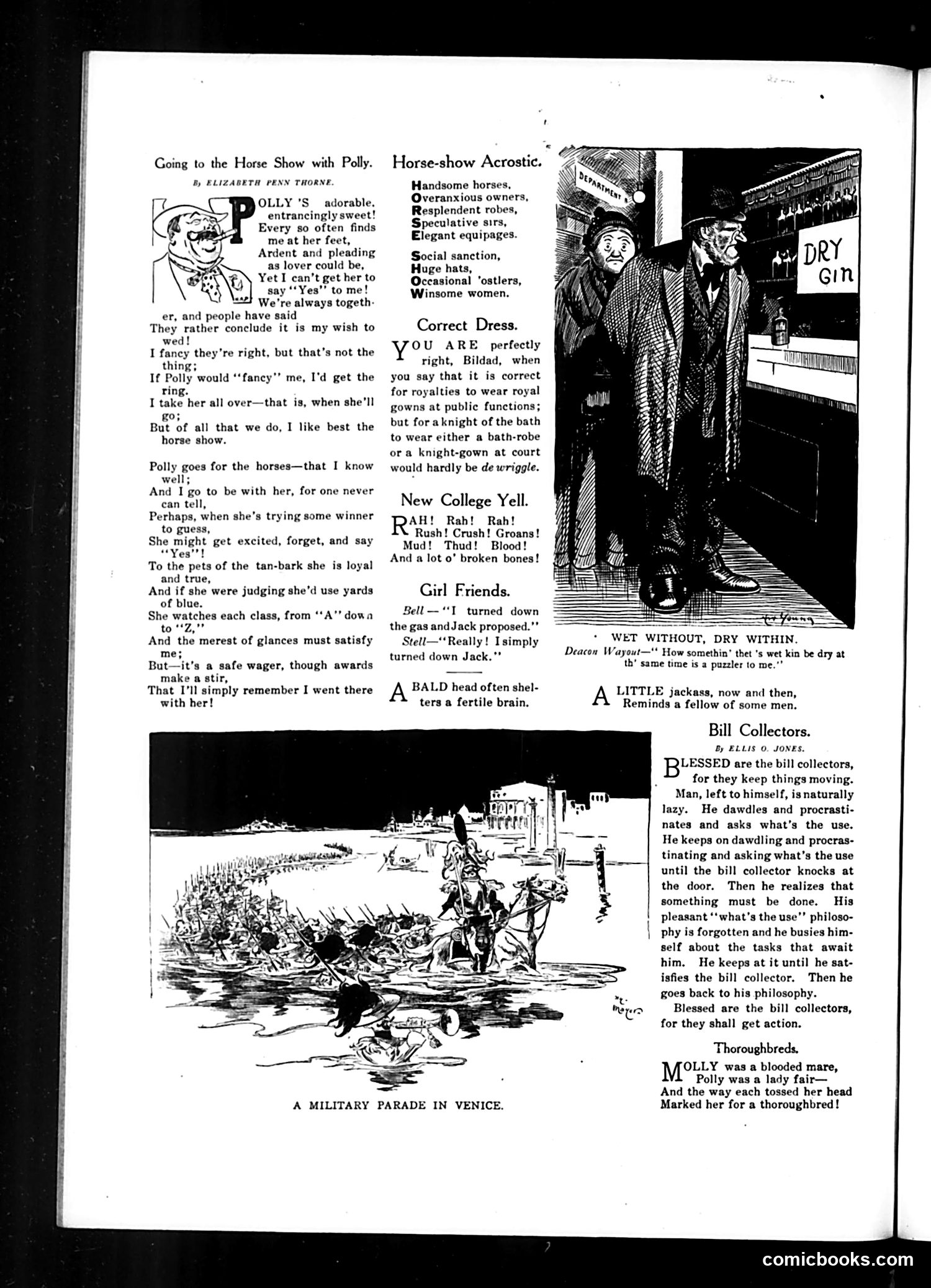
This page from the satirical magazine *Judge* contains several light humor pieces typical of early 20th-century American comedy: **"Going to the Horse Show with Polly"** is a romantic poem about a suitor accompanying his romantic interest to a prestigious horse show—a fashionable social event. The joke is that while Polly is genuinely interested in the horses, the narrator is primarily focused on winning her affection, hoping the exciting atmosphere might prompt her to accept his marriage proposal. **"Horse-show Acrostic"** satirizes the pretentiousness of horse-show attendees: their expensive horses, overdressed appearance, and affected manners. **"Correct Dress"** mocks nobility who wear formal robes at public events, suggesting such costume-wearing is ridiculous and outdated. The remaining pieces—"New College Yell," "Girl Friends," "Bill Collectors," and "Thoroughbreds"—are brief comedic observations about contemporary social life. The page reflects *Judge*'s focus on gentle social satire targeting upper-class conventions and behavior.
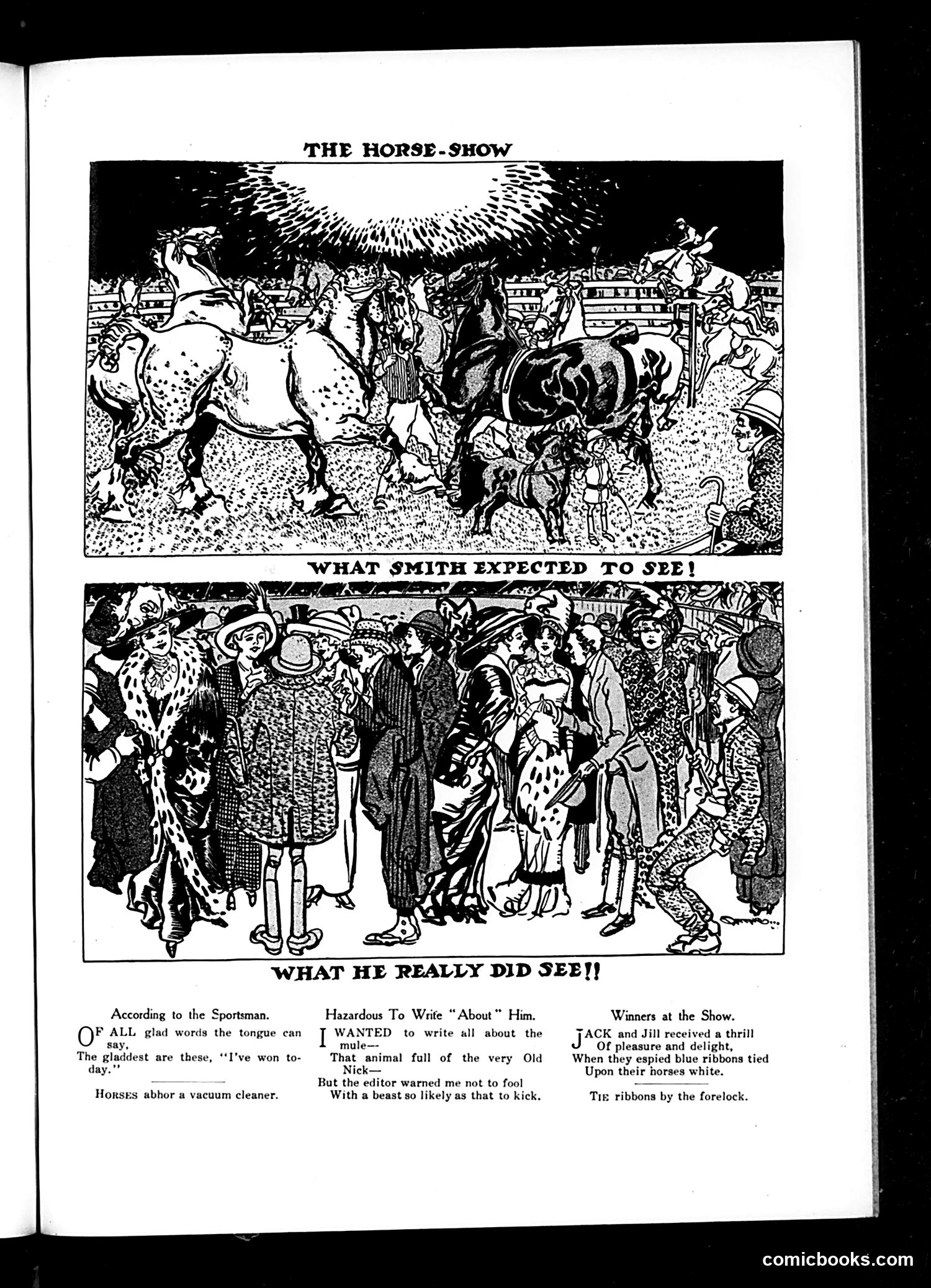
This two-panel comic contrasts expectations versus reality at a horse show. The top panel depicts what an attendee (likely named Smith) *expected* to see: elegant horses and refined spectators in a proper exhibition setting. The bottom panel shows what he *actually* saw: a chaotic crowd of working-class people in casual dress, with a notably rotund figure on the right—likely a mule rather than a purebred show horse. The accompanying verses mock the absurdity: a sportsman celebrates winning, but horses supposedly "abhor a vacuum cleaner" (unclear reference, possibly a joke about grooming). An editor warns against writing about a mule that kicks dangerously. The joke satirizes the pretension of horse shows—the gap between their refined reputation and their actual, messier reality, populated by ordinary people and unsuitable animals.
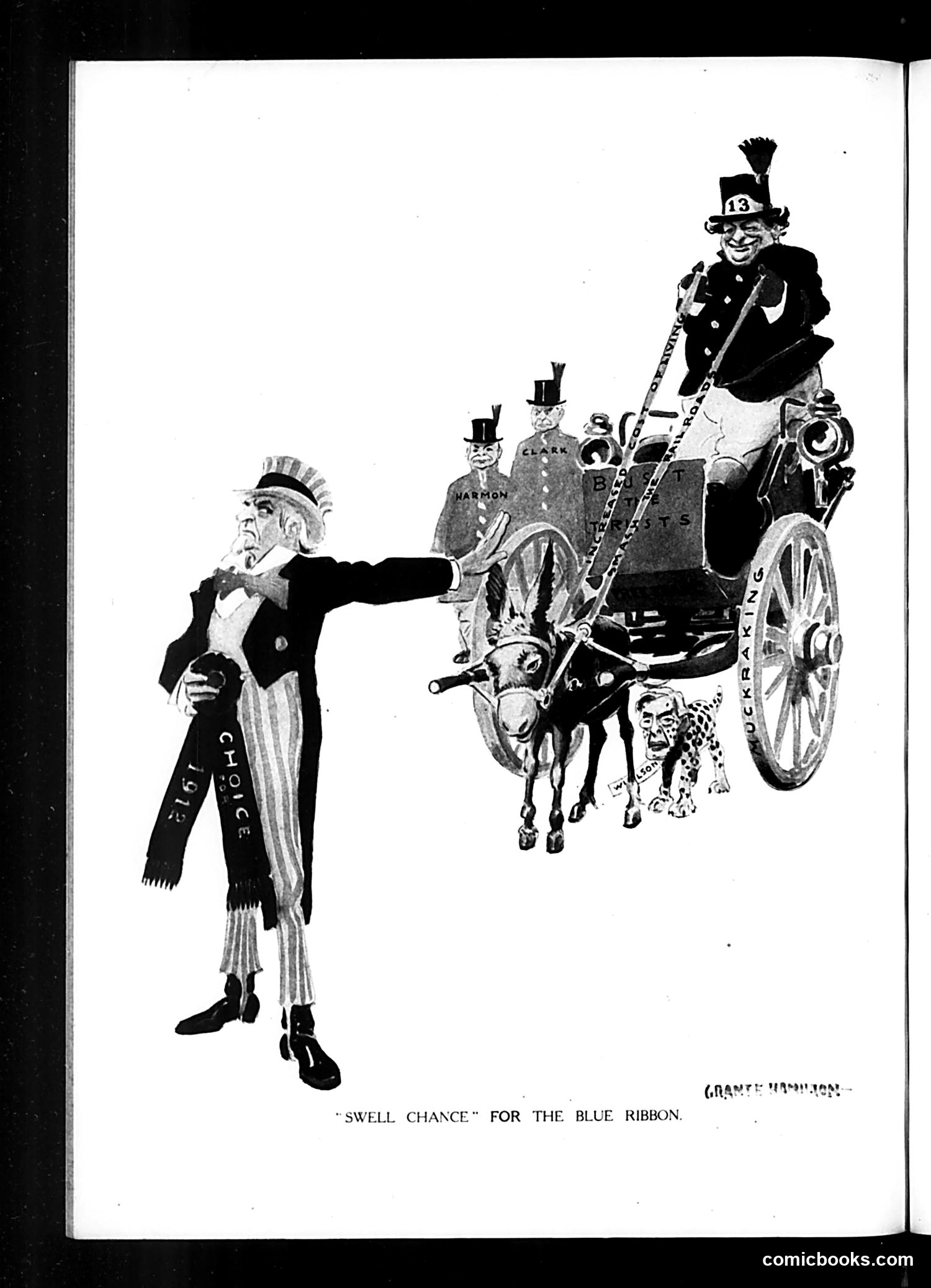
This political cartoon satirizes what appears to be a competitive race for high office. On the left stands Uncle Sam (identifiable by his top hat and patriotic attire marked "CHOICE"), gesturing dismissively at a horse-drawn carriage approaching from the right. The carriage carries a figure wearing the number "13" and appears labeled with names including "HARMON" and "CLARK." A small dog pulls alongside. The "Blue Ribbon" likely refers to first prize or victory in an election. Uncle Sam's gesture and the title "Swell Chance" convey sarcasm—suggesting the carriage's occupants have little realistic prospect of winning. The cartoon mocks what it views as an unlikely or absurd candidacy, though without a date, the specific election and candidates remain unclear.
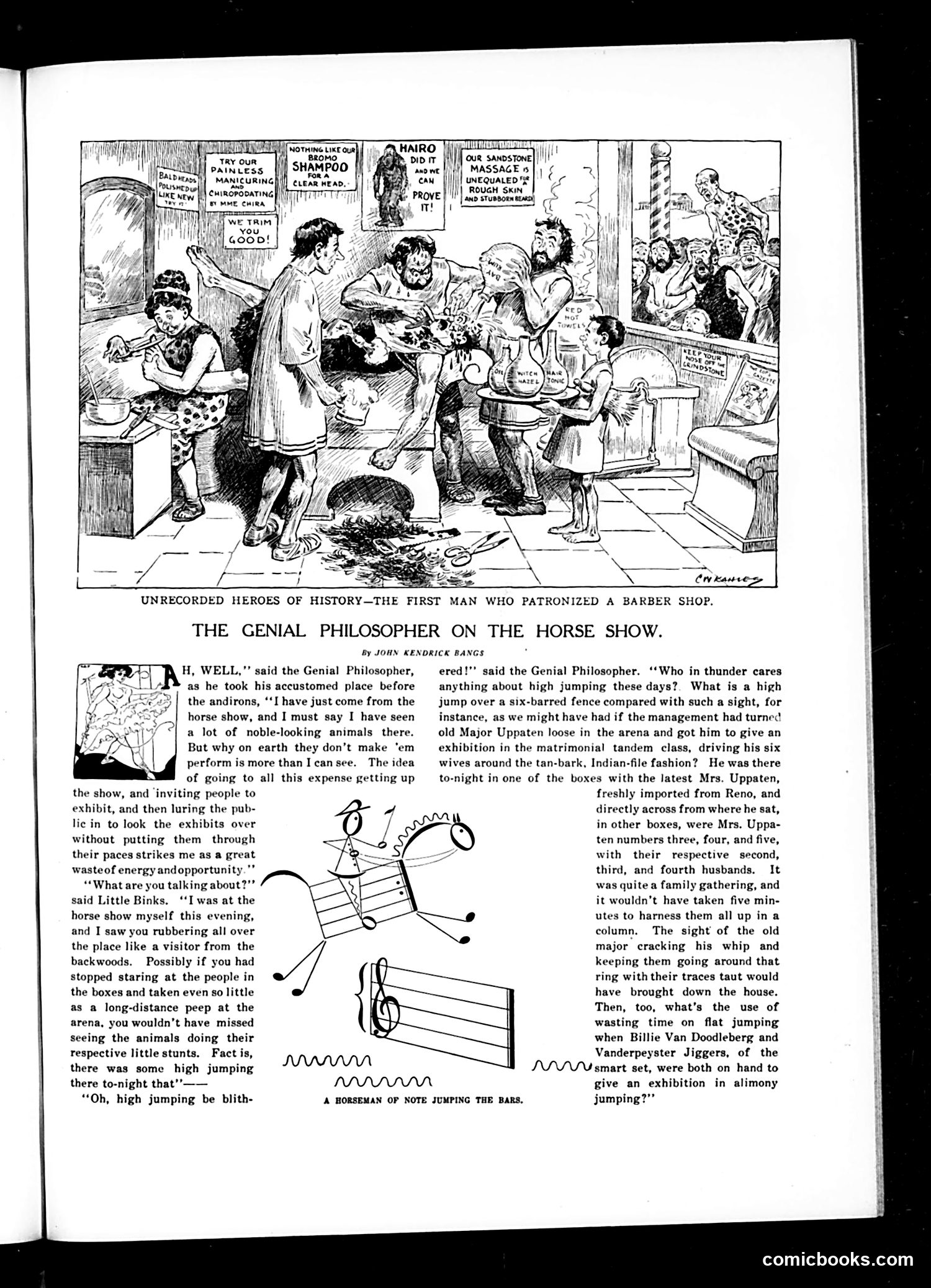
This 1910s *Judge* magazine page contains two satirical pieces mocking upper-class society. The top cartoon captioned "Unrecorded Heroes of History" shows a chaotic barber shop, humorously crediting the first man who patronized one as a historical hero—satire on contemporary barbershop culture and advertising. The main article, "The Genial Philosopher on the Horse Show," ridicules a wealthy man complaining that an exclusive horse show lacks entertainment. His absurd suggestions include: parading "Major Uppaten" with his multiple ex-wives (numbered 1-5) in harness, implying serial divorce among the wealthy; and watching socialites "Billie Van Doodleberg" and "Vanderpeyster Jiggers" give an "exhibition in alimony jumping"—mocking how wealthy men paid alimony to multiple ex-wives. The satire targets the frivolous wealthy who attend society events less to appreciate genuine skill than to gossip and observe the scandals of their peers, particularly the marital misadventures of the elite.
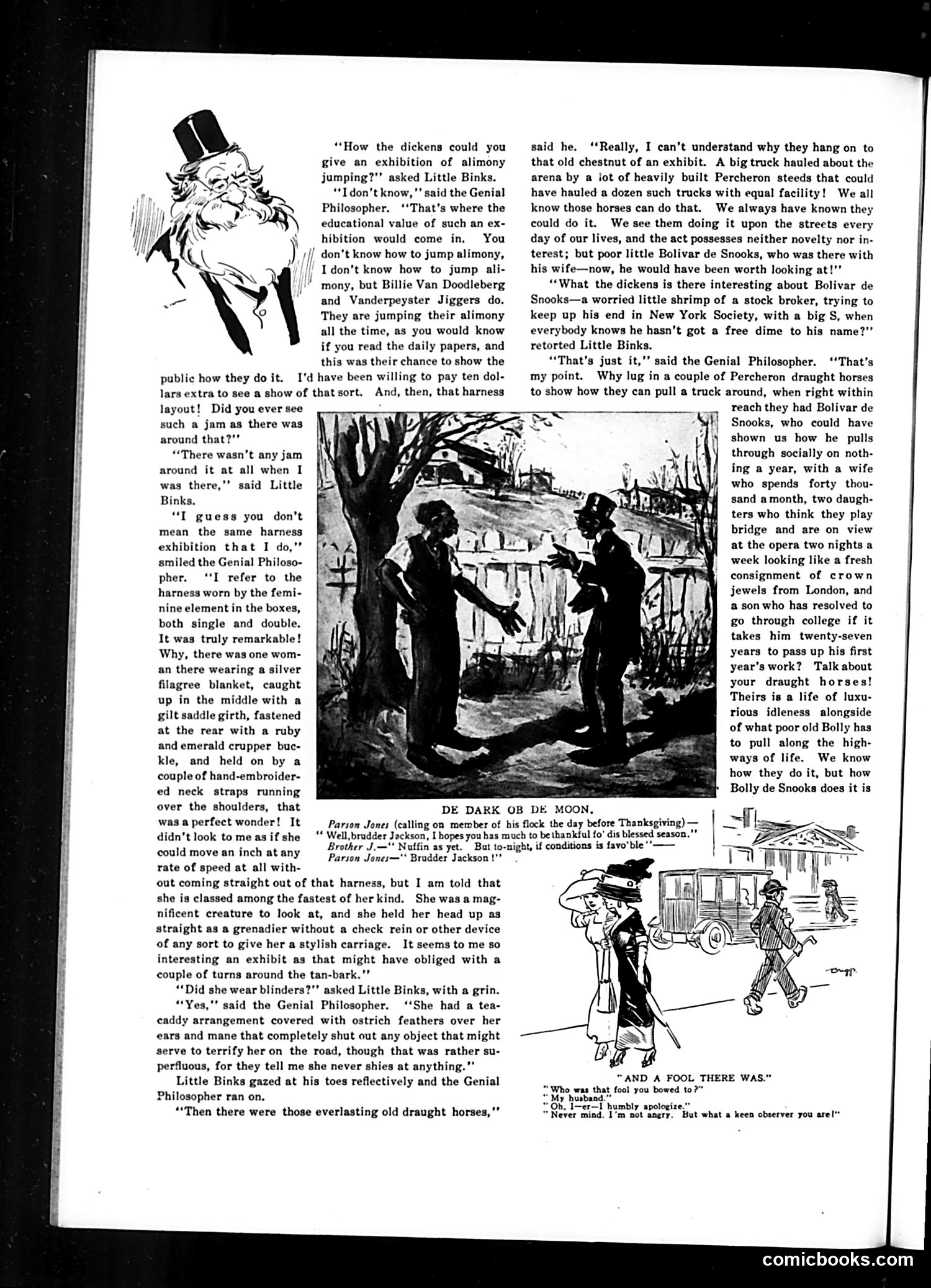
This page contains two separate satirical pieces mocking upper-class pretension and social hypocrisy. **Main Story (top):** Two characters—"Little Binks" and "the Genial Philosopher"—discuss a horse exhibition. The satire targets wealthy New Yorkers, particularly "Billie Van Doodleberg" and "Vanderpeyster Jiggers," who are "jumping their alimony"—slang for evading alimony payments while maintaining high society appearances. The Philosopher mocks the absurdity of featuring expensive Percheron draft horses when the real spectacle should be watching poor Bolivar de Snooks, a stock broker struggling to maintain social standing despite financial ruin, perform similar feats of strain. The humor attacks the disconnect between pretense and reality in Gilded Age society. **Bottom Cartoon:** "De Dark ob de Moon" depicts an African American preacher visiting a parishioner before Thanksgiving, speaking in exaggerated dialect. The humor relies on period racial stereotypes. Both pieces target pretension and social climbing, though the racial content reflects the magazine's problematic historical context.
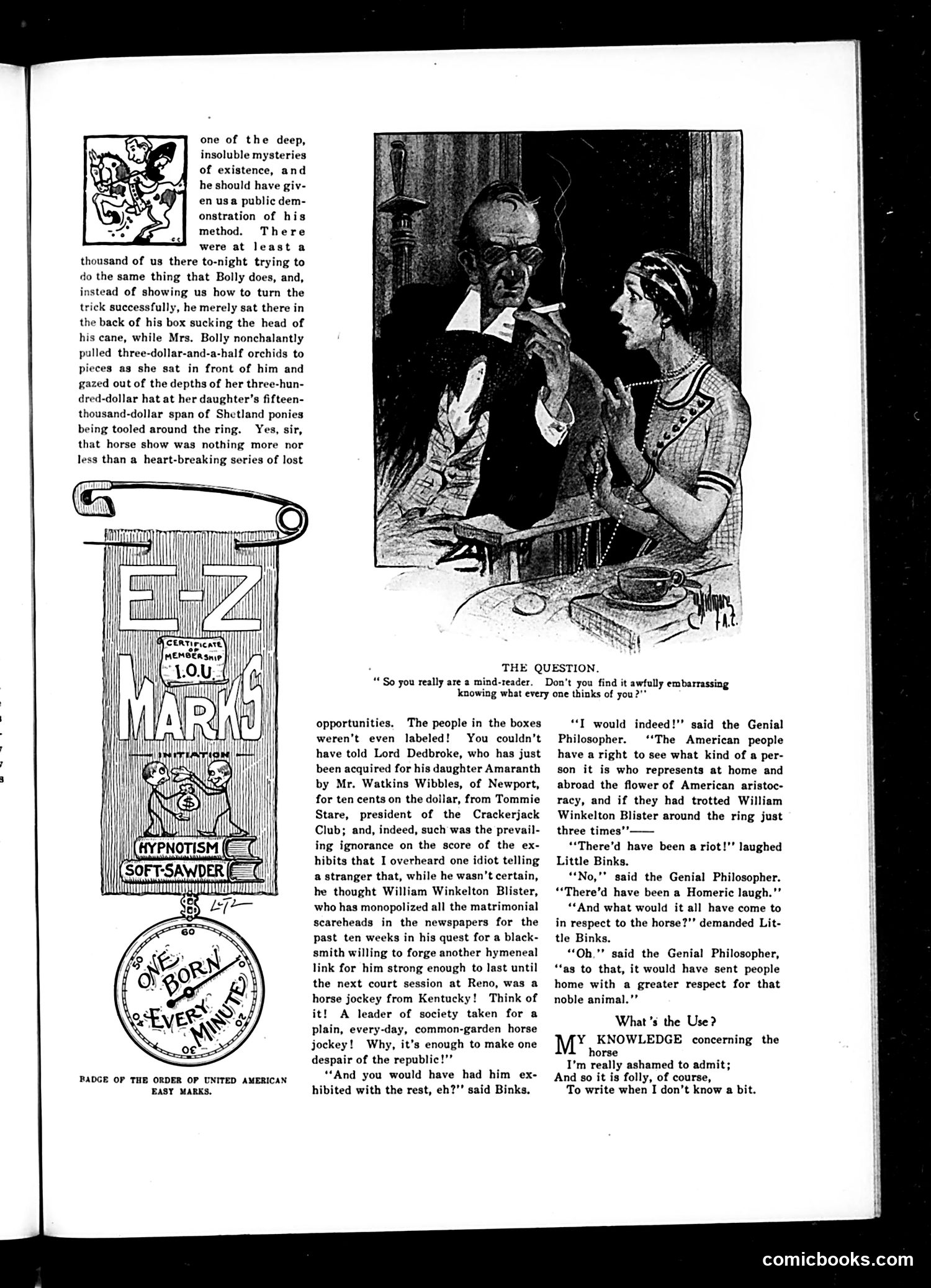
This page mocks American high society's pretension and shallow values through a horse show setting. The central cartoon depicts a "mind-reader" being questioned about the awkwardness of knowing others' true thoughts—a setup for satirizing society figures who hide behind facades. The accompanying dialogue ridicules wealthy New York socialites (names appear invented for comic effect: "Lord Dedbroke," "William Winkelton Blister") who attend horse shows not to appreciate animals but to display themselves as status symbols. The satire's target: these aristocrats' vanity is so extreme they should be "exhibited" like the horses—implying American wealth lacks genuine distinction. A secondary joke critiques the absurdity that society gossip fixates on trivial scandals (repeated divorces, remarriages) while the public cannot even identify who these people are. The "Badge of the Order of United American Easy Marks" advertisement (left) extends the mockery, suggesting Americans are gullible marks easily duped by false gentility.
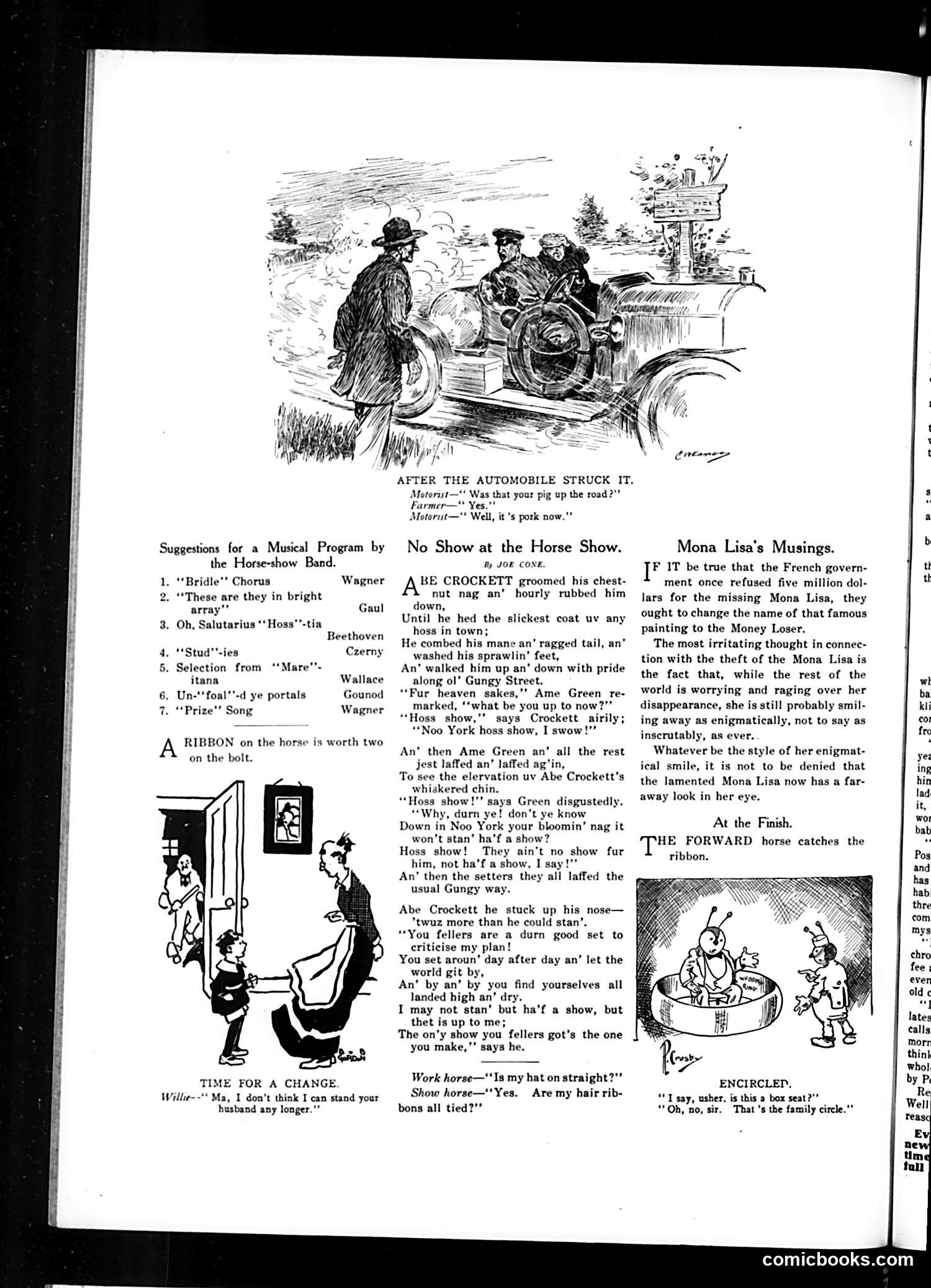
This Judge magazine page contains several satirical pieces typical of early 20th-century humor: **"After the Automobile Struck It"** (top): A motorist asks a farmer if a dead animal on the road was his pig. The farmer replies "Yes"—the motorist quips it's "pork now." This jokes about automobiles as new, dangerous hazards that kill livestock. **"No Show at the Horse Show"** (center): Rural character Abe Crockett plans to enter his horse in New York's prestigious horse show. Neighbors mock him—his horse won't compete—but Crockett defends ambition over complacency. The satire contrasts rural optimism with urban sophistication. **Other items**: Musical pun-titles for a horse show band ("Bridle Chorus," "Mare-itana"), a marital joke ("Time for a Change"), and a Mona Lisa reference (the painting was famously stolen in 1911, so this references that real event). "Encircled" jokes about circus seating. The humor is genteel, domestic, and relies on wordplay and social observation rather than political commentary.
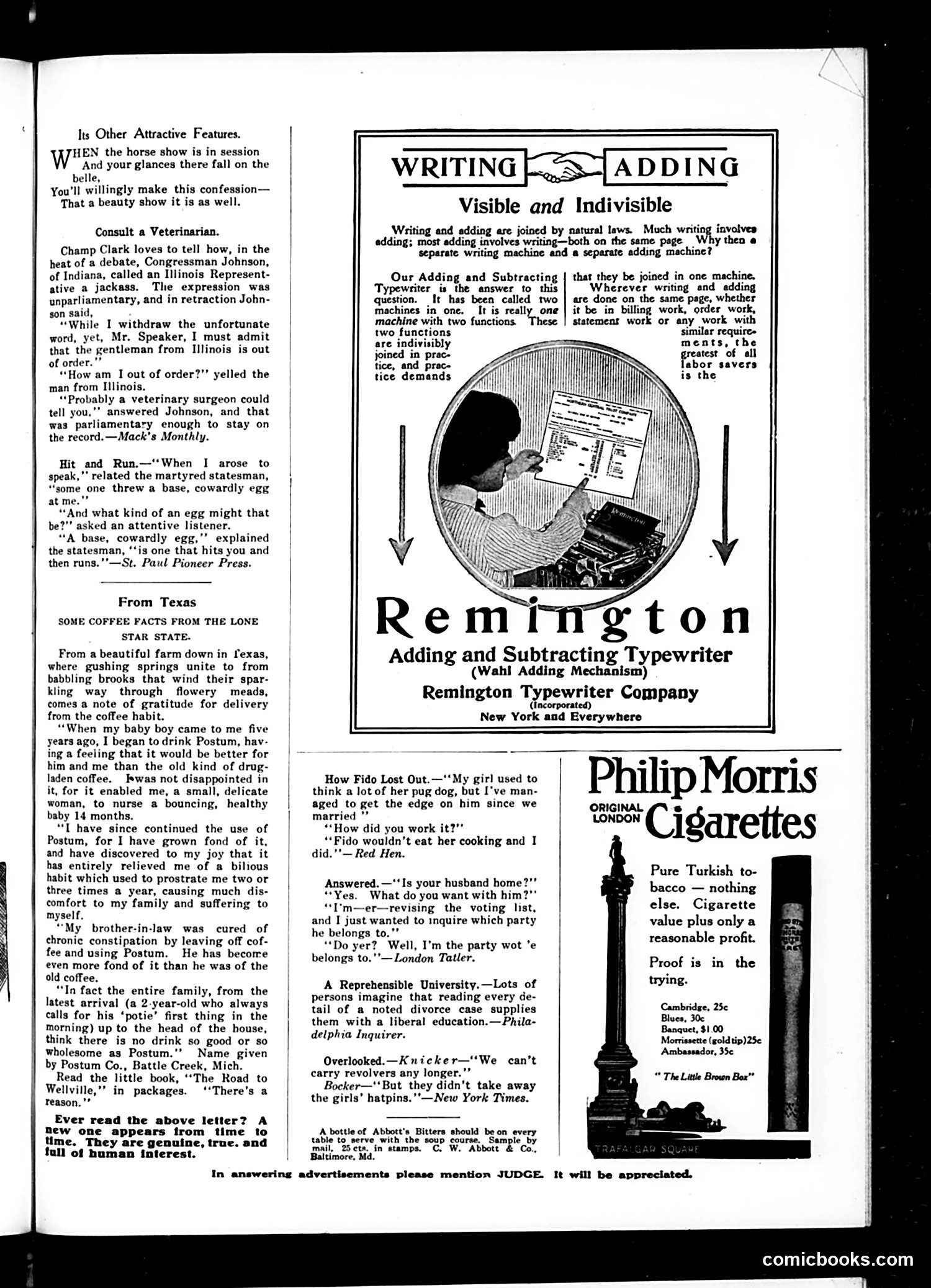
This page from Judge magazine contains miscellaneous humor and advertising typical of early 20th-century American periodicals. The humor pieces are brief anecdotes mocking politicians and everyday situations. One jokes about Congressman Champ Clark calling a colleague a "jackass" on the House floor—a breach of parliamentary decorum. Another features a politician hit by an egg who puns that it was a "base, cowardly egg" because "it hits you and then runs." The substantial "From Texas" section is actually advertising copy for Postum, a coffee substitute, presenting itself as testimonials from satisfied users crediting the drink with health improvements for their families. The right page features a Remington typewriter advertisement claiming their machine uniquely combines writing and adding functions, alongside ads for Philip Morris cigarettes and other products. The small anecdote "How Fido Lost Out" jokes about a man winning his fiancée's affection from her pet by being a better cook than the dog's owner.
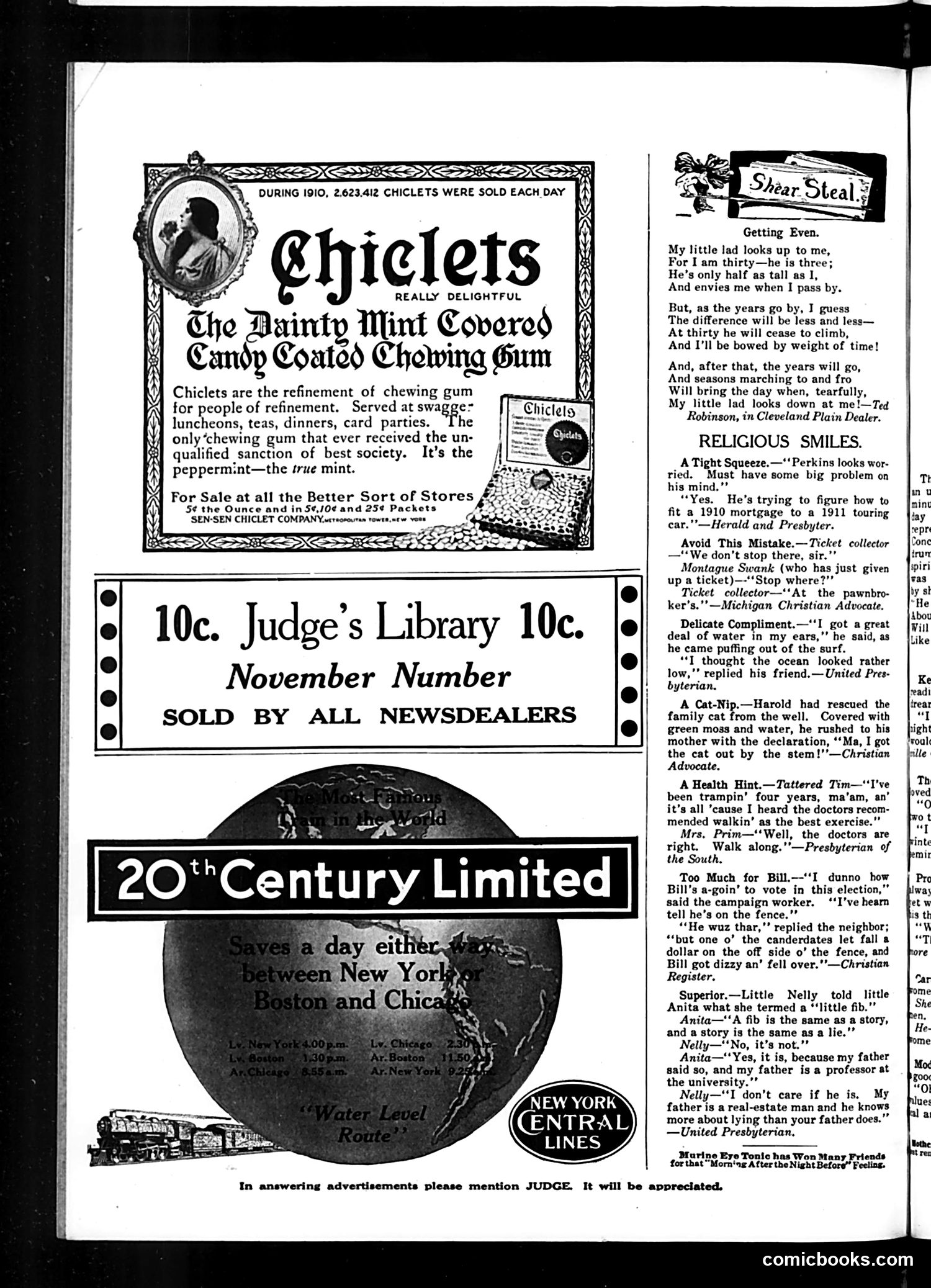
This page is primarily **advertisements and humor fillers**, not political cartoons. The main content includes: **Advertisements:** - Chiclets chewing gum (emphasizing refined society) - Judge's Library November issue (10 cents) - 20th Century Limited train service between New York, Boston, and Chicago - Marine Eye Tonic **Humor Section ("Religious Smiles"):** A collection of brief jokes with religious or moral undertones, typical of early 1910s family magazines. Examples include wordplay about mortgages, ticket collectors, and a child's innocent misunderstanding of lying. The humor is gentle, pun-based, and targets genteel audiences. **"Getting Even" Poem:** A sentimental verse about aging—a father envies his young son's height and vitality, anticipating he'll eventually be surpassed as he grows older. The page reflects **1910 commercial culture and middle-class values**: refined tastes, moral instruction, and nostalgic sentiment. There is **no overt political satire** visible here.
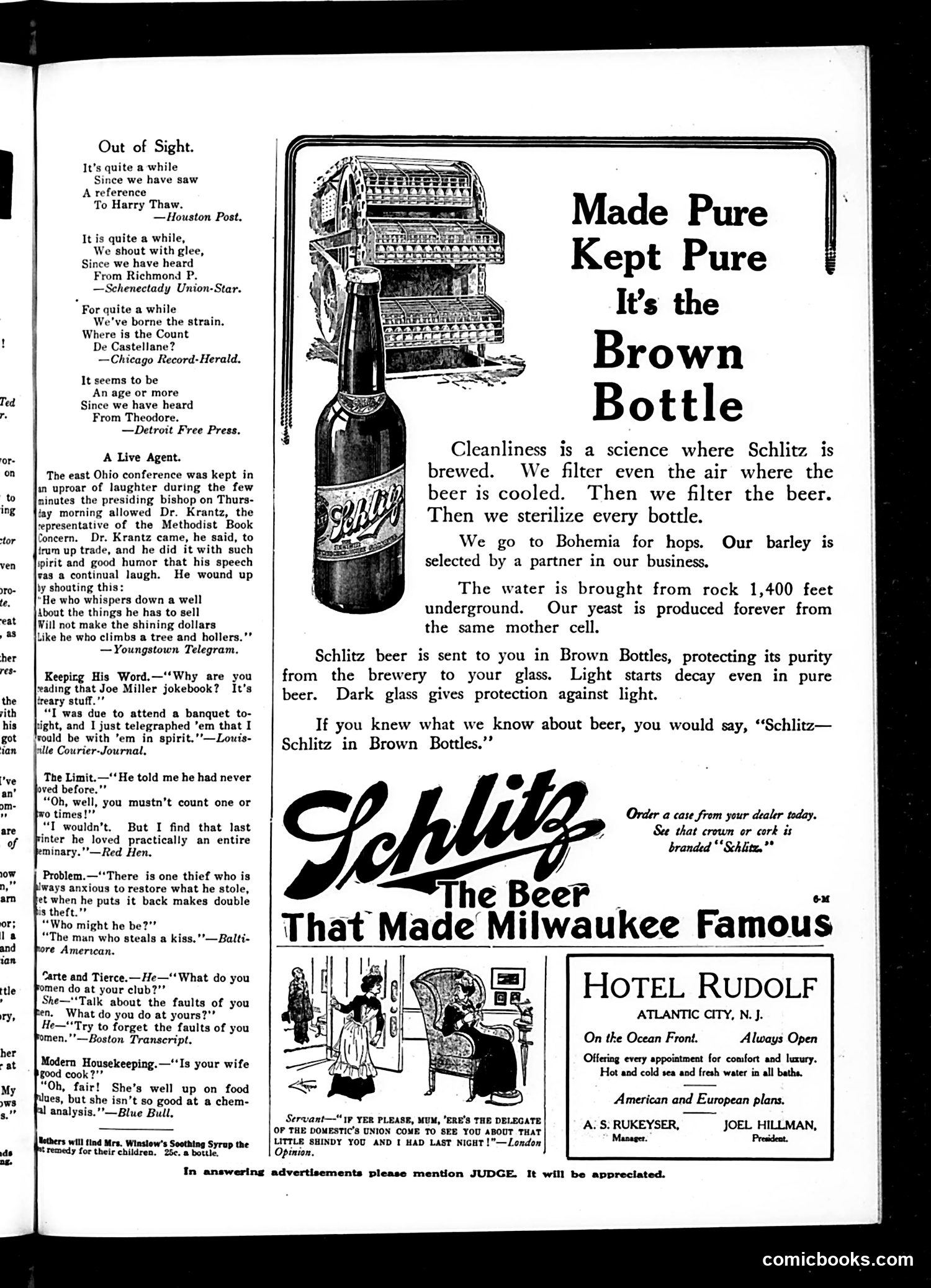
This page is primarily a **Schlitz beer advertisement** with satirical joke columns on the left side—typical of Judge magazine's format mixing humor with advertising. The **jokes** reference absent public figures ("Out of Sight"): Theodore Roosevelt, Richmond Pearson Hobson, and the Count de Castellane are mentioned as people Judge readers haven't heard from recently. These appear to be topical references to prominent figures who've faded from news—the humor lying in their disappearance from public discourse. The **Schlitz ad** emphasizes purity through brown glass bottles, which protect beer from light decay. It highlights their Bohemian hops, filtered air, sterilized bottles, and deep underground water source—marketing claims emphasizing quality control and scientific brewing. The tagline "The Beer That Made Milwaukee Famous" anchors Schlitz's regional reputation. A secondary **Hotel Rudolf advertisement** appears at bottom, promoting Atlantic City accommodations. The page reflects early 20th-century advertising that combined quality claims with emerging "scientific" brewing language to differentiate products in a competitive market.
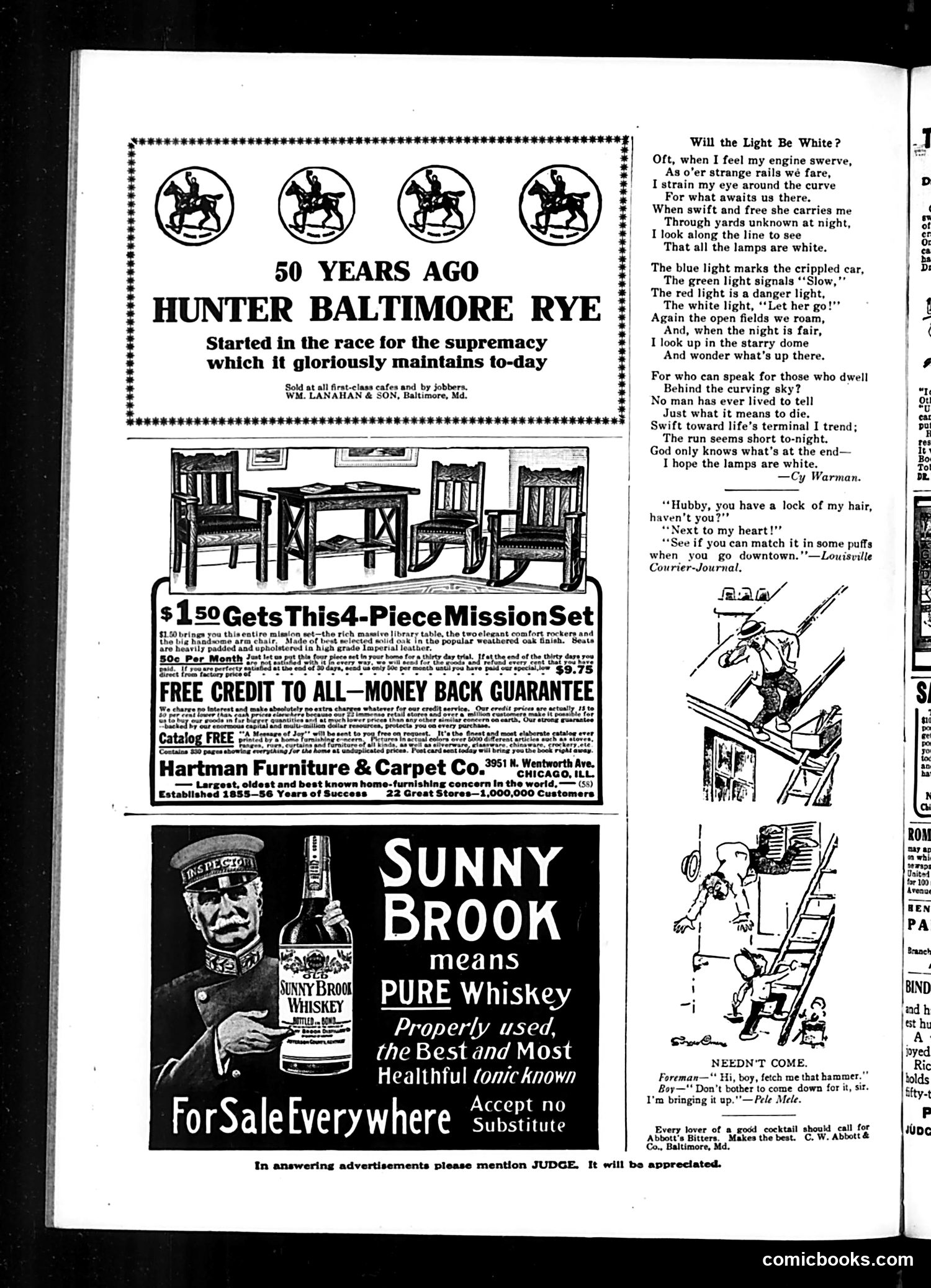
This page contains **primarily advertisements** with minimal editorial cartoon content. The main visual elements are: 1. **Hunter Baltimore Rye ad** (top): A liquor advertisement celebrating 50 years of market dominance, with decorative horseman medallions. 2. **Hartman Furniture ad** (center): A mission-style furniture set offer ($1.50) from a Chicago company. 3. **Sunny Brook Whiskey ad** (bottom left): Features a military or authority figure endorsing "pure whiskey" as a health tonic—reflecting early 20th-century marketing before Prohibition and FDA regulations restricted such claims. 4. **Small cartoon sketches** (right side): Appear to be humorous vignettes, including a brief domestic joke about a woman requesting her husband match her hair color in cosmetic "puffs." The page also includes a poem, "Will the Light Be White?" by Cy Warman, about railroad signals and mortality—typical of Judge's literary content. The ads reflect period attitudes toward alcohol and patent medicines as legitimate commercial products.
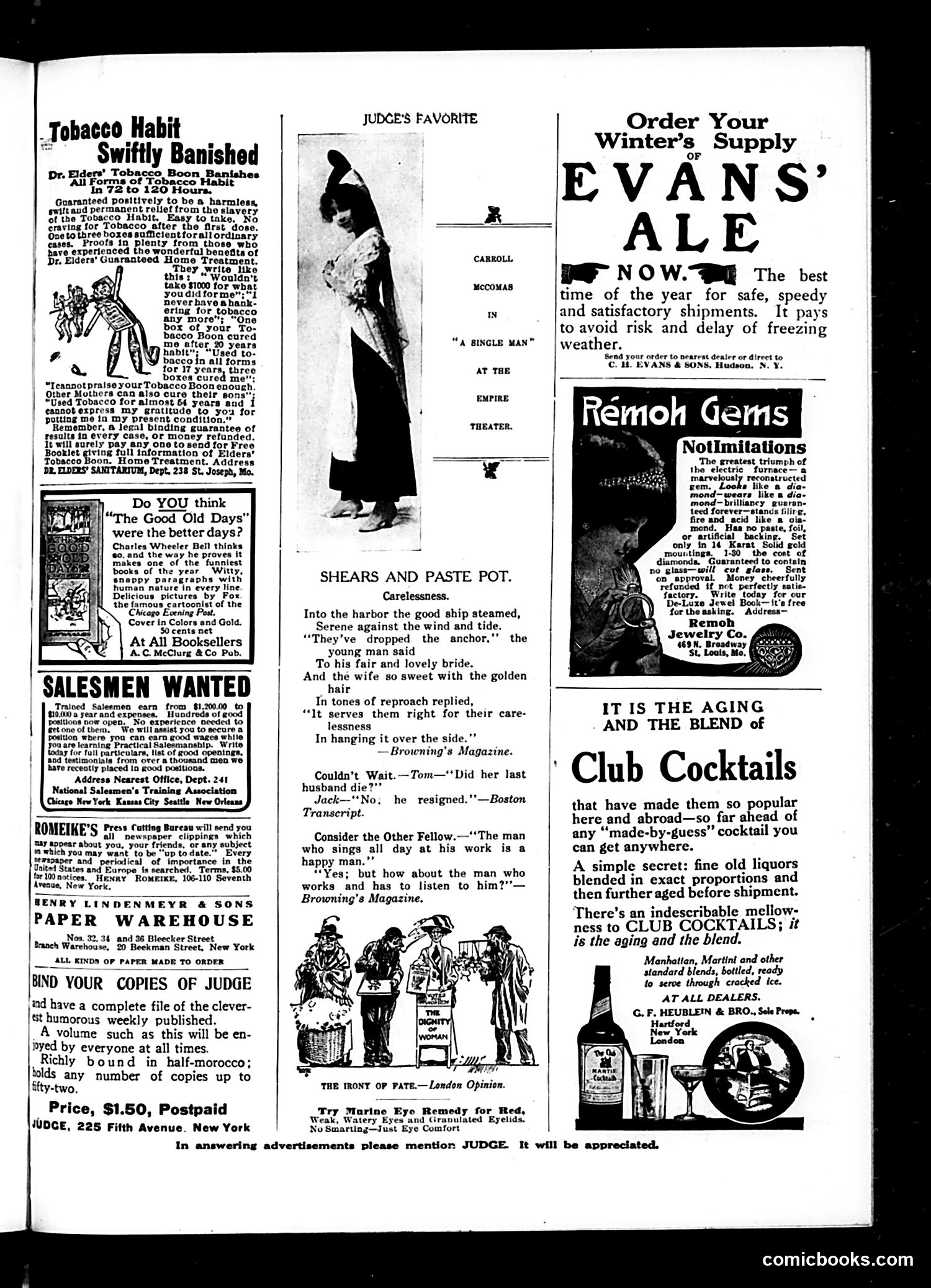
This page is primarily advertising and light humor from what appears to be a Judge magazine issue. The main content includes: **Advertisements**: Most of the page features ads for tobacco-cessation products (Dr. Eiders' Tobacco Boon), sales training, beer (Evans' Ale), jewelry (Remoh Gems), and paper supplies. **"Judge's Favorite"**: A theater advertisement for "A Single Man" at the Empire Theater, featuring Carroll McComas. The accompanying image shows a woman in profile. **Humorous pieces**: Several short, mild jokes appear in the "Shears and Paste Pot" section, including puns about a couple dropping an anchor overboard, marital humor, and workplace observations. These are generic comedic snippets typical of early 20th-century humor magazines. **"The Good Old Days"**: A sidebar promoting Charles Wheeler Bell's book. The page reflects the magazine's mix of satire, advertising, and genteel humor targeting upper-middle-class readers. Nothing politically significant or sharply satirical appears here—it's primarily commercial content with lightweight entertainment.
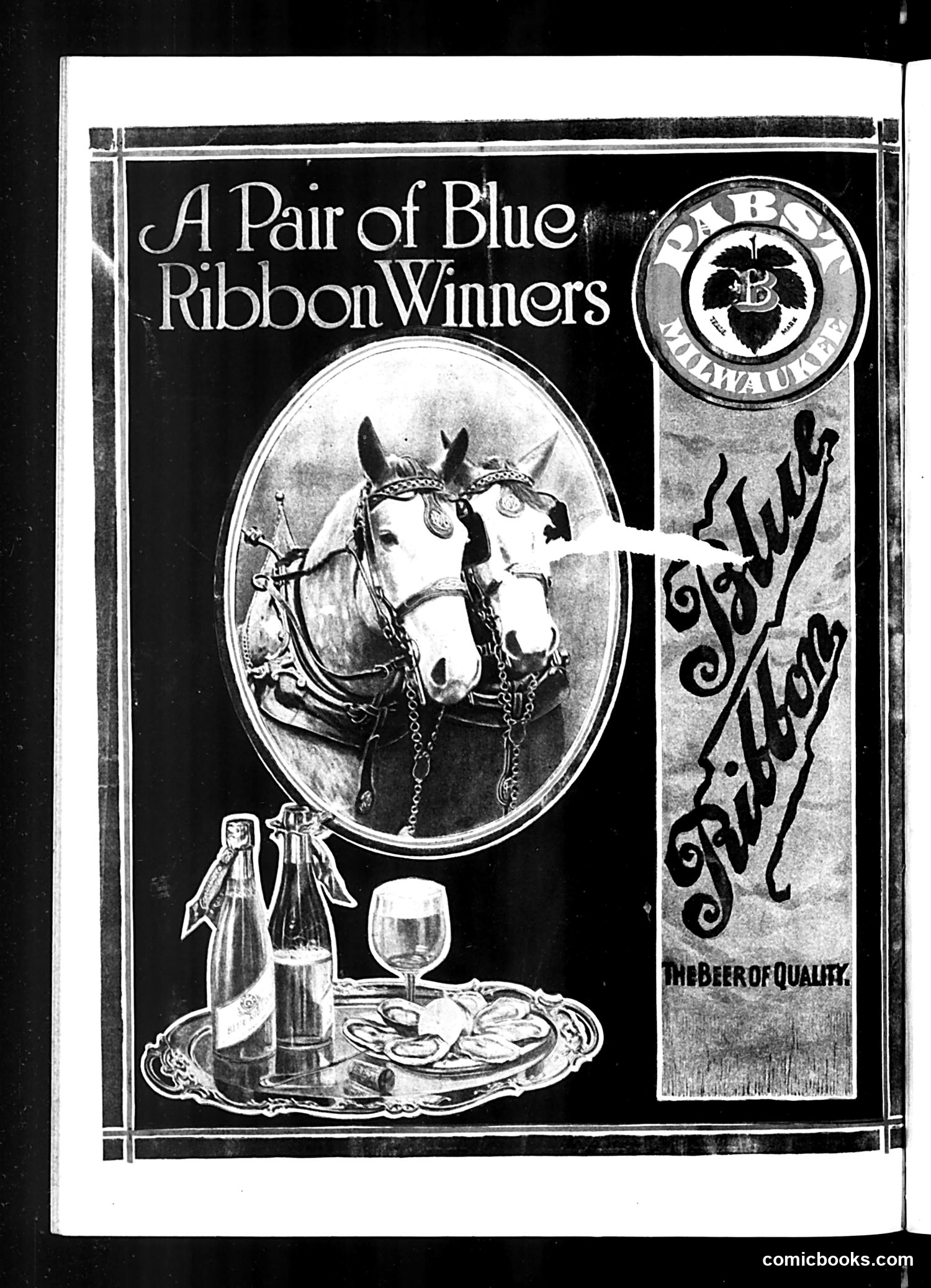
This appears to be a **Pabst Blue Ribbon beer advertisement** masquerading as magazine content. The page features two draft horses wearing decorative harnesses and ribbons—a visual pun on "blue ribbon winners." Below them are bottles, glasses, and food items, suggesting leisure and conviviality. The text "A Pair of Blue Ribbon Winners" and the Pabst logo with "The Beer of Quality" claim the product deserves top honors. This is straightforward advertising using equine imagery (historically associated with quality and strength) to suggest Pabst's superiority. There is **no apparent political satire** here—this is a commercial advertisement, likely from the early-to-mid 20th century when such ads frequently appeared in *Judge* magazine.