
A complete issue · 26 pages · 1911
Judge — September 23, 1911
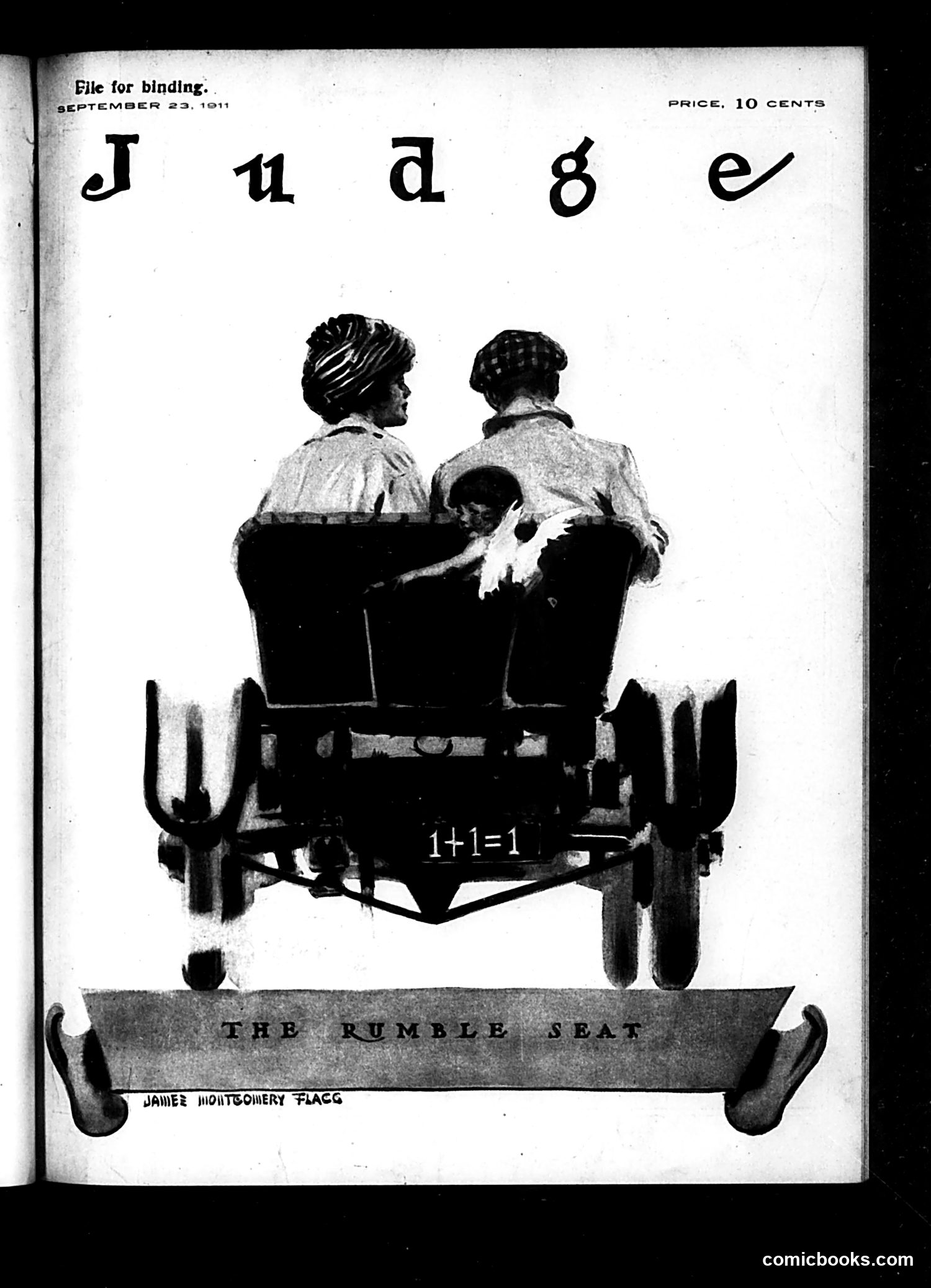
This is a satirical illustration titled "The Rumble Seat" by James Montgomery Flagg, depicting two women in a car's rear passenger area with a child. The phrase "1+1=1" written on the vehicle appears to be the cartoon's central joke. The satire likely comments on automobile culture and courtship customs of the early 1900s. The "rumble seat"—an open-air rear compartment popular for dating couples—was a subject of social concern about unmarried men and women spending time unsupervised together. The mathematical equation "1+1=1" humorously suggests the cramped, intimate nature of the seating arrangement, where two people inevitably become very close. The cartoon reflects period anxieties about modern transportation enabling unchaperoned socializing.
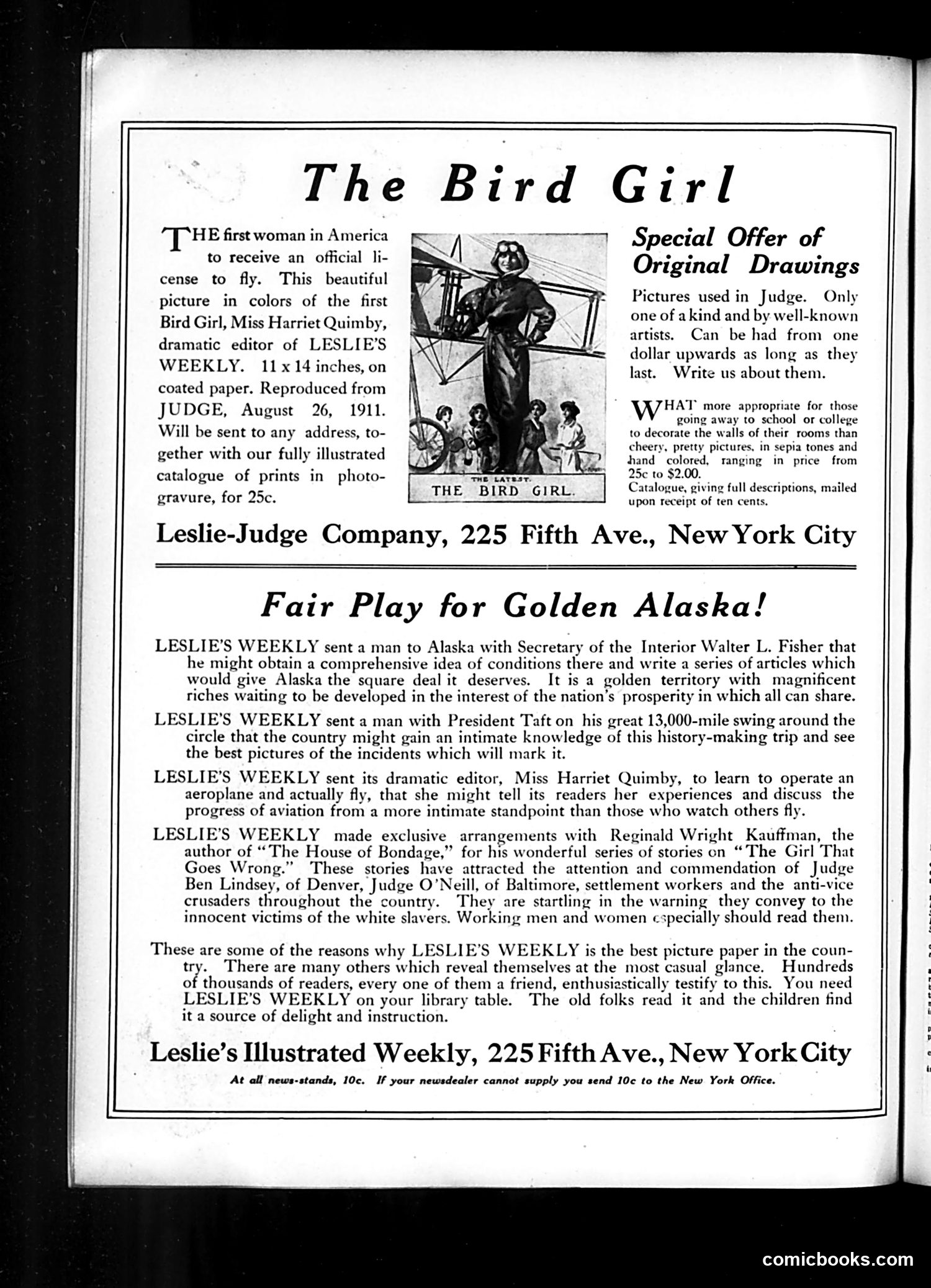
This page is primarily **advertising content** rather than political satire. It features two separate ads for Leslie's Weekly/Judge publications: 1. **"The Bird Girl"** advertisement promotes original drawings from Judge magazine, featuring Miss Harriet Quimby—identified as "the first woman in America to receive an official license to fly." The illustration shows her with an early airplane and admirers below. 2. **"Fair Play for Golden Alaska!"** promotes Leslie's Weekly's coverage of Alaska development and aviation progress, mentioning exclusive arrangements with Reginald Wright Kauffman (author) and dramatic editor Miss Quimby's aviation experiences. The content celebrates early 20th-century American progress in aviation and women's achievements in that field, positioning these publications as modern and forward-thinking.
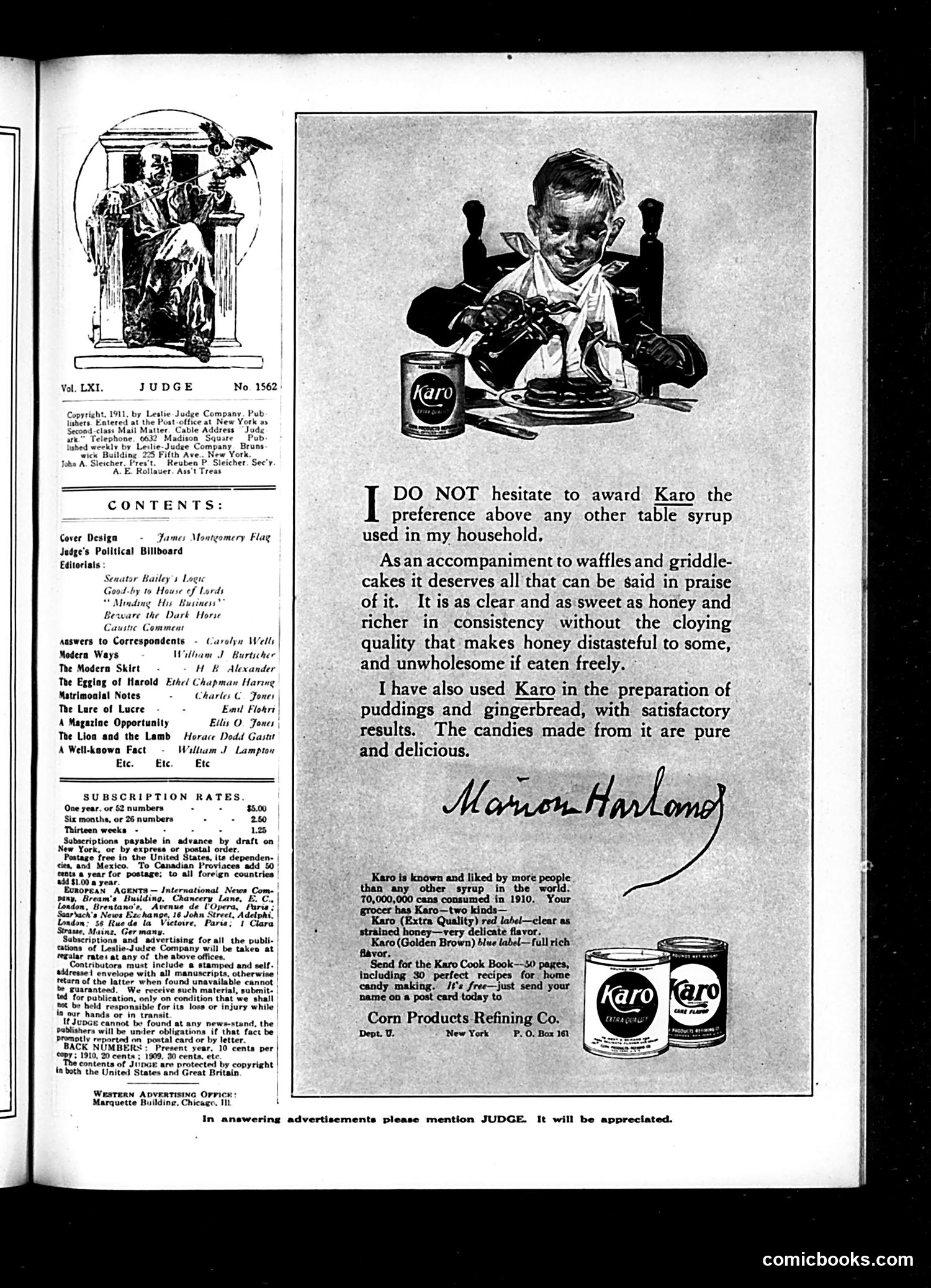
This page is primarily a **Karo brand syrup advertisement**, not political satire. The left side shows the magazine's masthead and contents listing for Judge No. 1562 (1911). The large right-side image depicts a young boy enthusiastically eating waffles or pancakes with Karo syrup. The advertisement includes a testimonial signed "Marion Harland" (a period-appropriate domestic authority figure) endorsing Karo as superior to honey for table use and cooking applications. The copy emphasizes the syrup's purity, consistency, and suitability for candymaking and baking. This represents typical early 20th-century advertising strategy: leveraging trusted domestic voices to market consumer products to American households. No political commentary or satire is evident on this particular page.
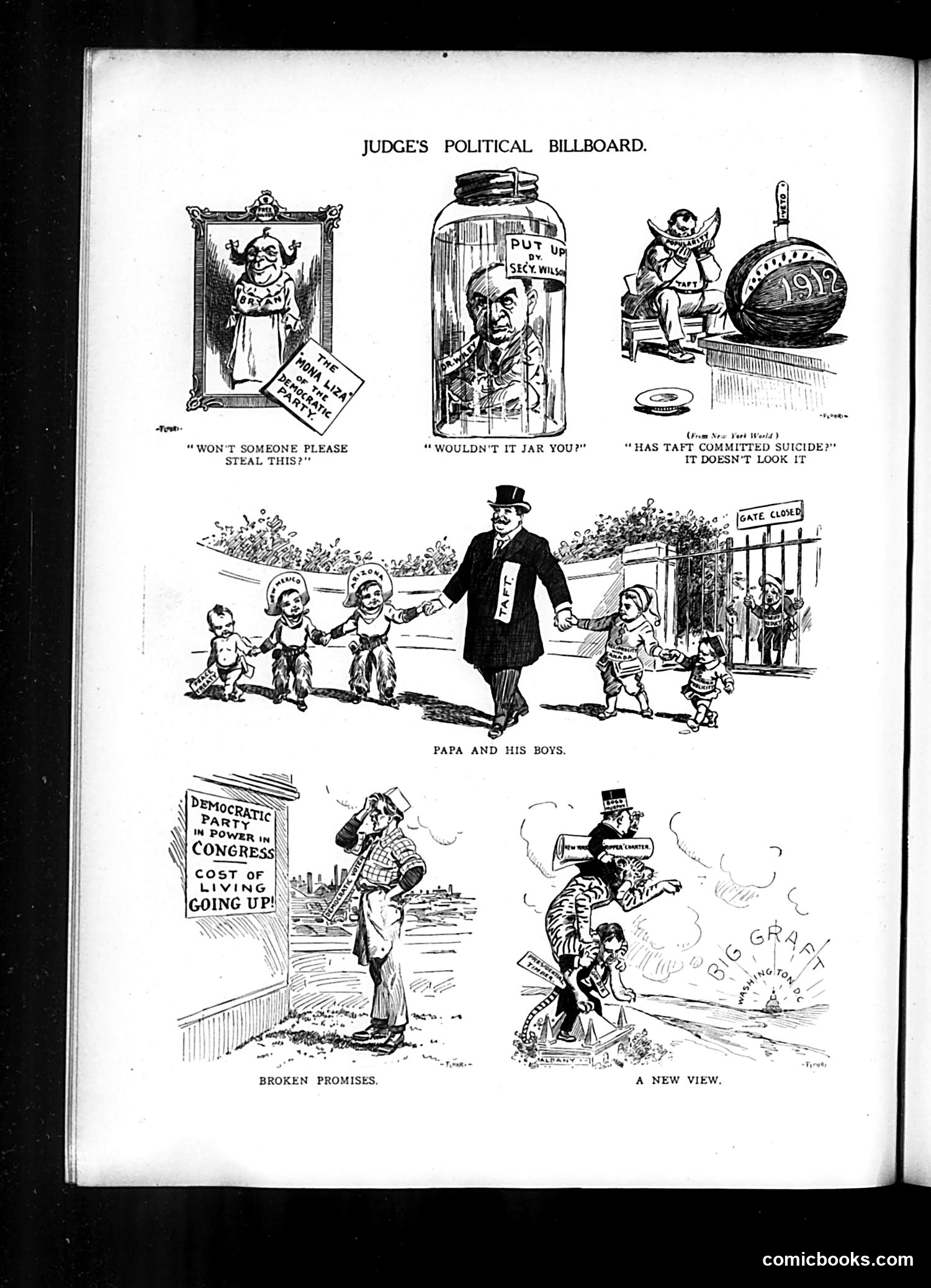
This 1912 political satire page attacks President William Howard Taft (the central figure in "Papa and His Boys"). The cartoons mock Taft's administration and policies: **Top panels** criticize Taft's judicial record and unpopularity—the jar suggests he's "pickled" or preserved, while the suicide reference questions his political viability. **"Papa and His Boys"** portrays Taft as a stern father controlling smaller figures (likely representing political factions or policies), with a "Gate Closed" barrier suggesting blocked opportunities. **Bottom panels** attack Democratic promises about cost-of-living increases ("Broken Promises") and mock what appears to be railroad policy ("A New View"), with exaggerated figures suggesting corruption or mismanagement. The overall message: Taft's leadership is ineffective, contradictory, and harmful to ordinary Americans.
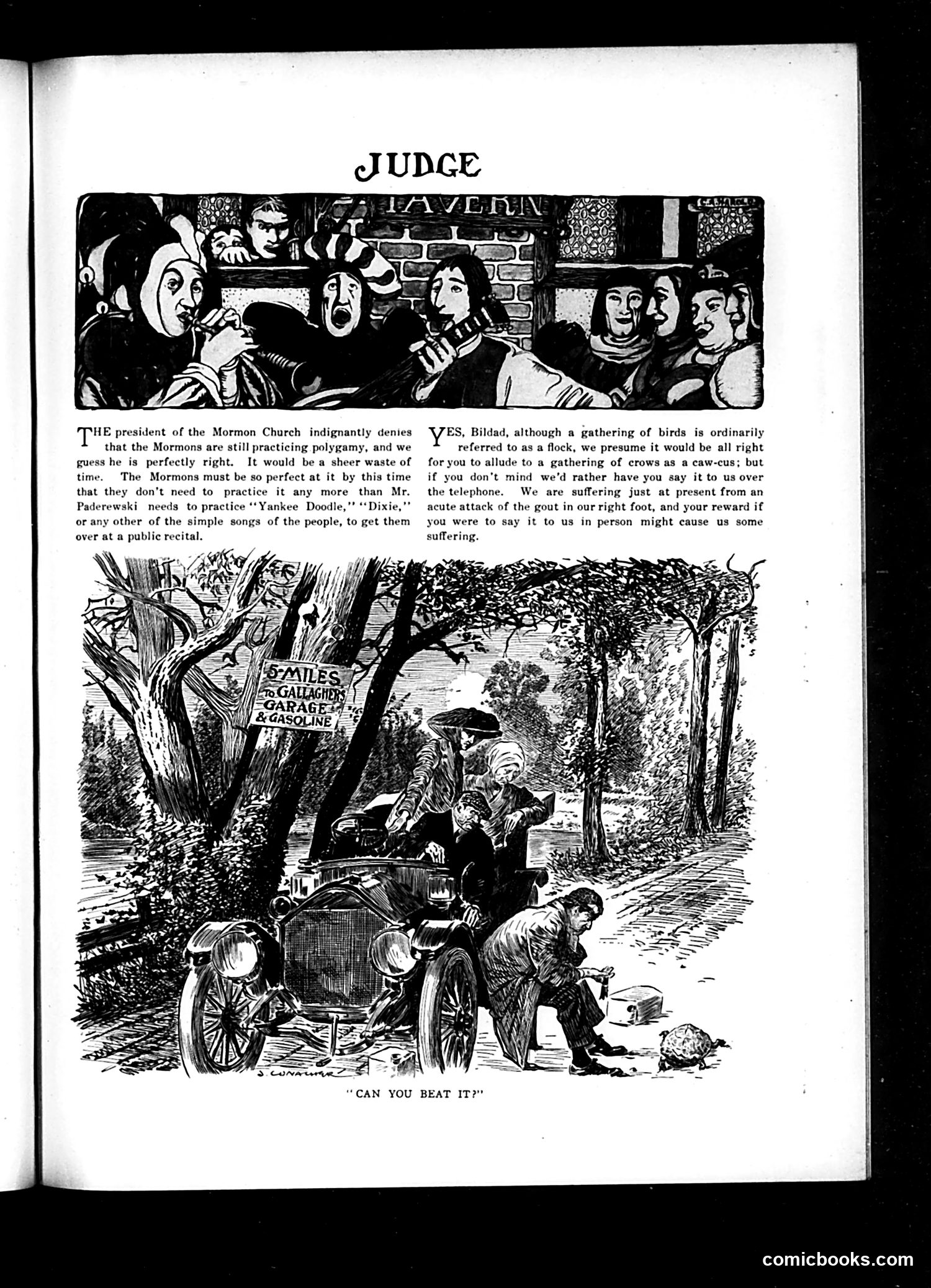
The top panel depicts a tavern scene satirizing the Mormon Church's leadership. The text criticizes the church president's denial that Mormons still practice polygamy, arguing they must "perfect" it through simplified folk songs like "Yankee Doodle" and "Dixie" performed at "pupil recitals." The bottom illustration, captioned "CAN YOU BEAT IT?", shows an early automobile broken down beside a tree, with a man working on repairs while another sits dejectedly nearby. This appears to satirize the unreliability of early automobiles—the joke being that despite their modern technology, they constantly fail, making horse travel seem preferable. A gas sign visible in the background emphasizes this is about automotive frustration rather than fuel availability. Both pieces mock institutional incompetence through humor.
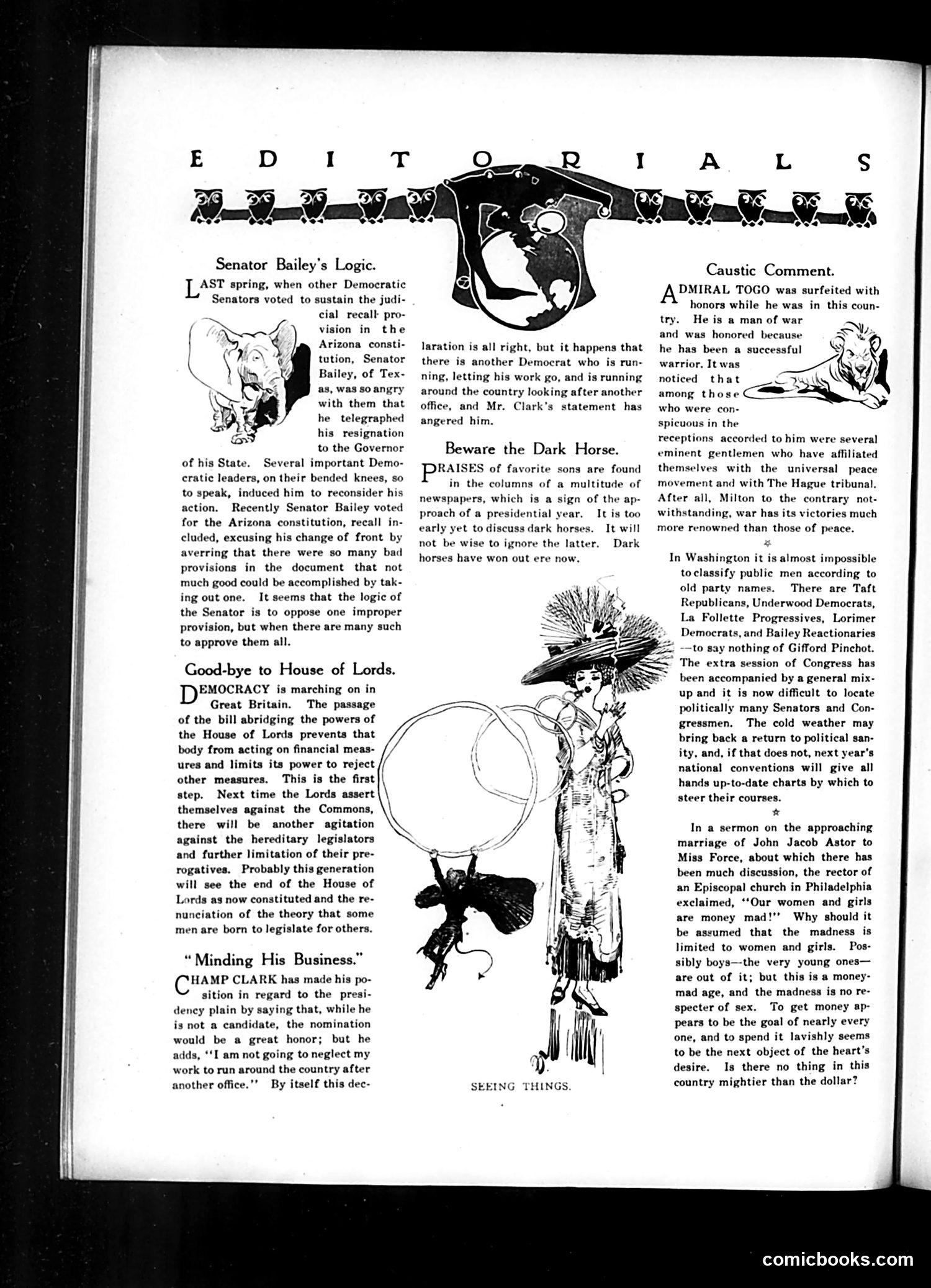
This page satirizes American political inconsistency circa 1911-1912. **Senator Bailey's Logic** mocks Texas Senator Joseph Weldon Bailey's hypocrisy: he dramatically resigned over the Arizona constitution's judicial recall provision, then voted for the same constitution anyway—claiming the document had so many flaws that opposing one wouldn't help. The satire: his logic is backwards (oppose one flaw, support everything?). **"Minding His Business"** references Speaker Champ Clark and an unnamed Democratic rival (likely Woodrow Wilson) competing for the 1912 presidential nomination. Clark claims he won't neglect his work for campaigning, apparently angering someone doing exactly that. **"Beware the Dark Horse"** warns that unexpected candidates often win presidencies, relevant to the fluid 1912 race. **Caustic Comment** notes the irony of peace advocates honoring Admiral Togo, a celebrated military figure, while claiming to support peace. The broader point: Washington politicians have become impossible to classify by traditional party lines anymore.
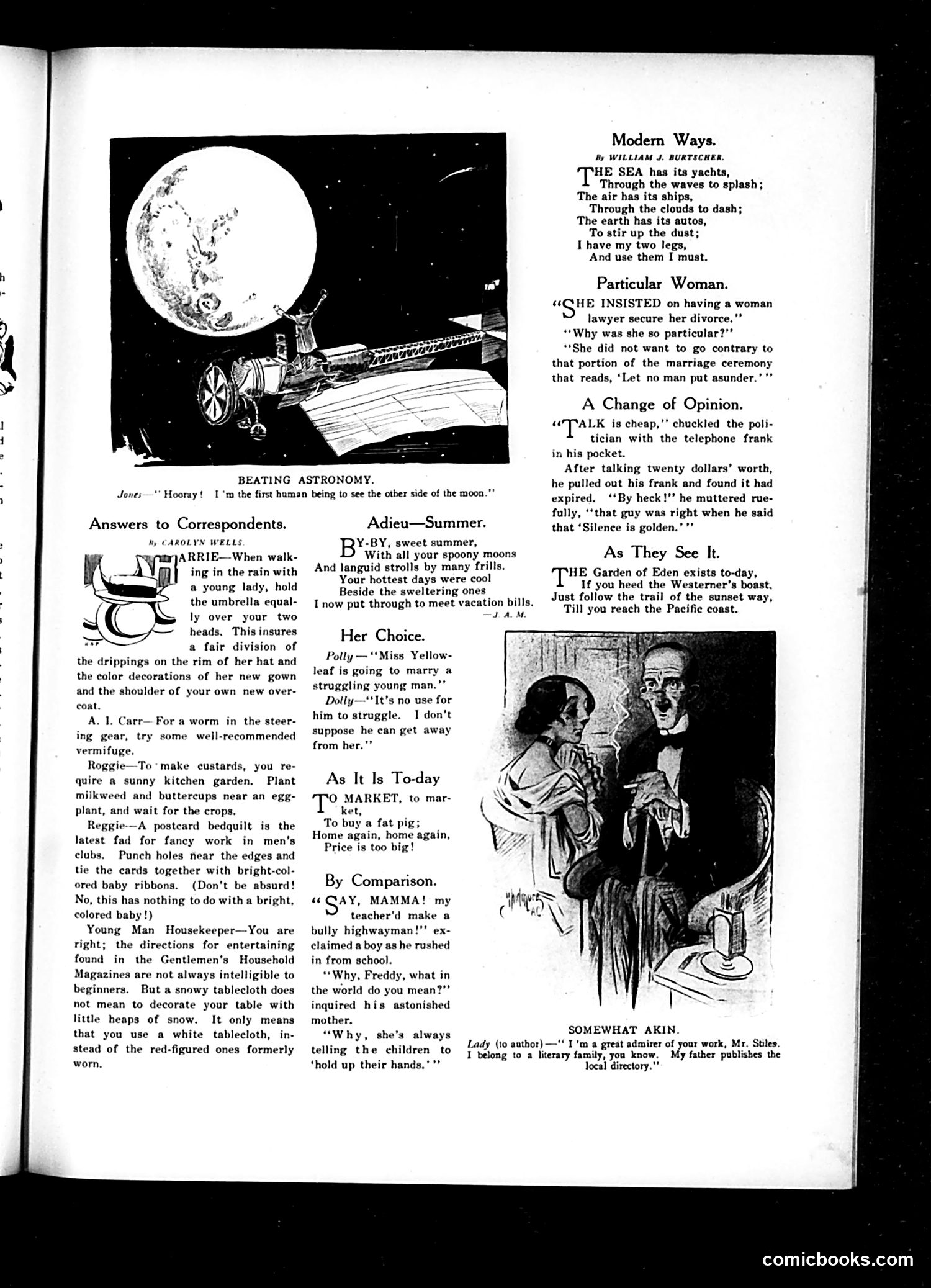
This page contains multiple short satirical pieces typical of early 20th-century humor magazines: **"Beating Astronomy"** mocks scientific pretension through a character claiming to be "the first human being to see the other side of the moon"—clearly absurd boasting presented as fact. **"Answers to Correspondents"** satirizes advice columns by offering deliberately ridiculous household tips (planting buttercups for custard ingredients) that sound authoritative but are nonsensical. **Social commentary pieces** include: a joke about divorce law using a woman lawyer to avoid violating marriage vows ("let no man put asunder"); political corruption humor about a congressman using expired postal "franks" (free mailing privileges); and a jest about "literary families" where someone's father merely publishes a city directory. The humor consistently targets pretension, pomposity, and social absurdity—hallmarks of Judge's satirical approach. The "Somewhat Akin" cartoon caption mocks someone claiming literary credentials based on trivial family connections, a common target of period satire.
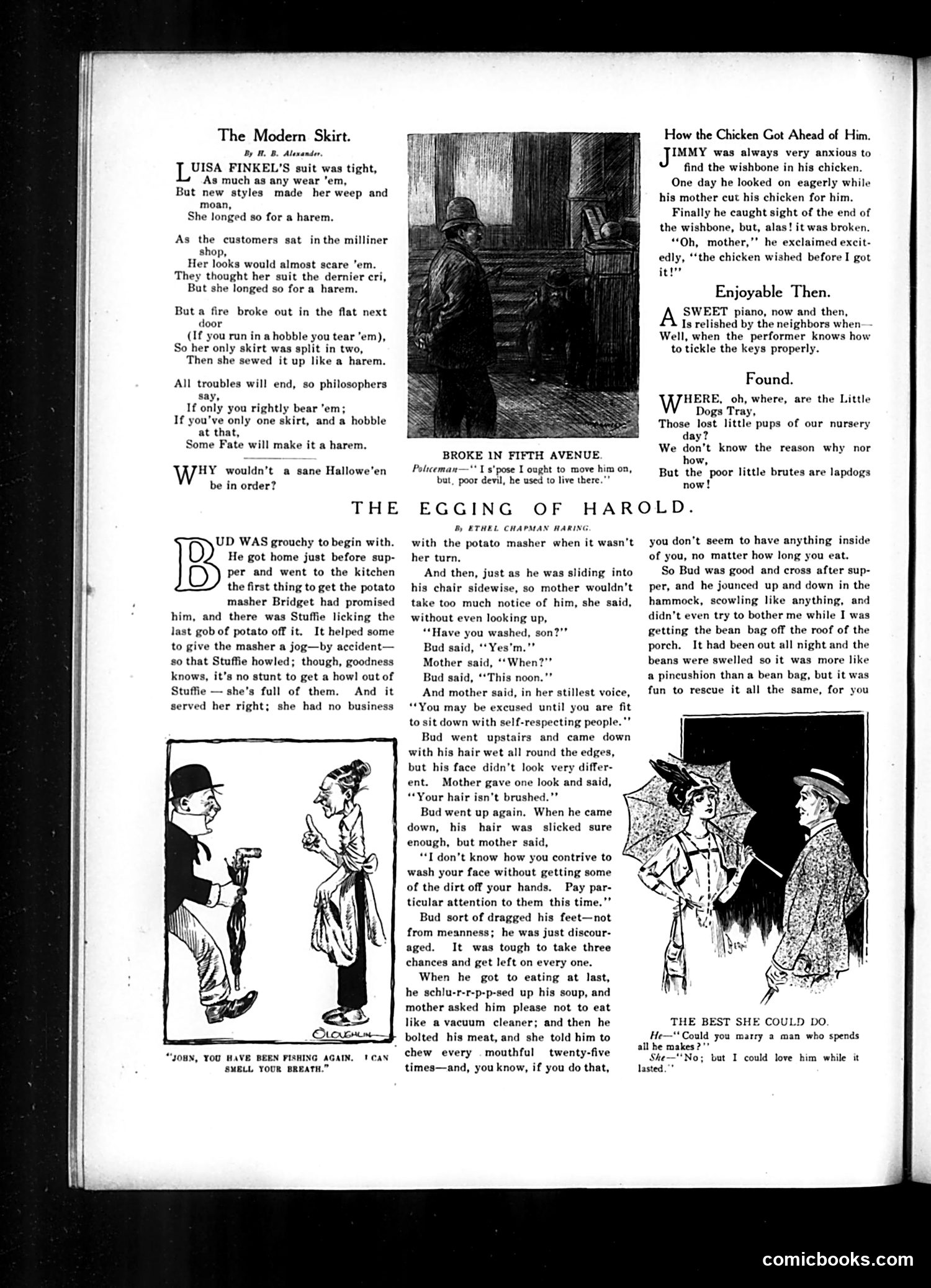
This page contains several short humorous stories and poems rather than political cartoons. The main pieces are: **"The Modern Skirt"** — A satirical poem mocking women's increasingly narrow skirts, which were fashionable in the early 1900s. The joke is that tight skirts caused practical problems (hobbling, fire hazards when running) yet women continued wearing them despite the inconvenience. **"The Egging of Harold"** — A domestic humor story about a boy named Bud being pestered by his mother about breakfast etiquette and personal hygiene before school. The accompanying illustrations are simple character sketches typical of period humor magazines. The satire targets early 20th-century fashion trends and domestic life rather than politics. These are lighthearted, everyday observational humor pieces rather than substantive social commentary.
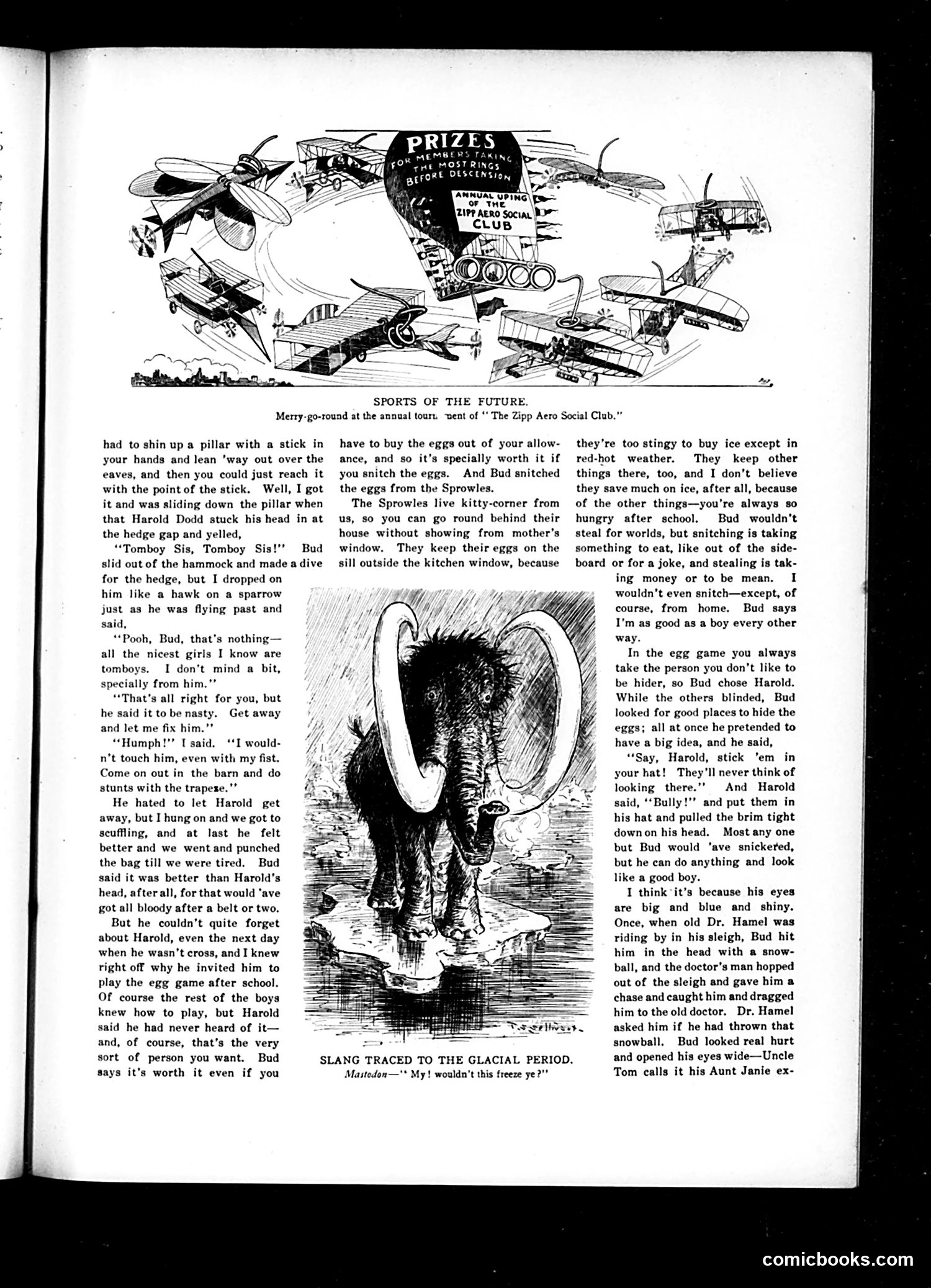
**Top Cartoon**: A satirical illustration titled "Sports of the Future" depicts the "Zipp Aero Social Club's" annual merry-go-round event. It's a visual pun showing various flying machines and aircraft arranged in circular motion—a literal "merry-go-round" of early aviation contraptions. The joke lampoons both the era's obsession with new aircraft technology and the absurdity of turning dangerous flying machines into amusement rides. The "Prizes" banner references competitive aviation before descension, poking fun at aviation's perilous, experimental nature circa early 1900s. **Story Below**: The text is a children's narrative about boys playing pranks, particularly an "egg game" where they hide eggs. The story illustrates period-appropriate boyhood mischief—snitching eggs (taking without permission but not considered true "stealing"), playing tricks on unpopular peers, and the charm of a blue-eyed boy who escapes consequences through innocent appearance. **Bottom Cartoon**: "Slang Traced to the Glacial Period" shows a mastodon saying "My! wouldn't this freeze ye?"—a pun connecting prehistoric animal slang to modern colloquial speech.
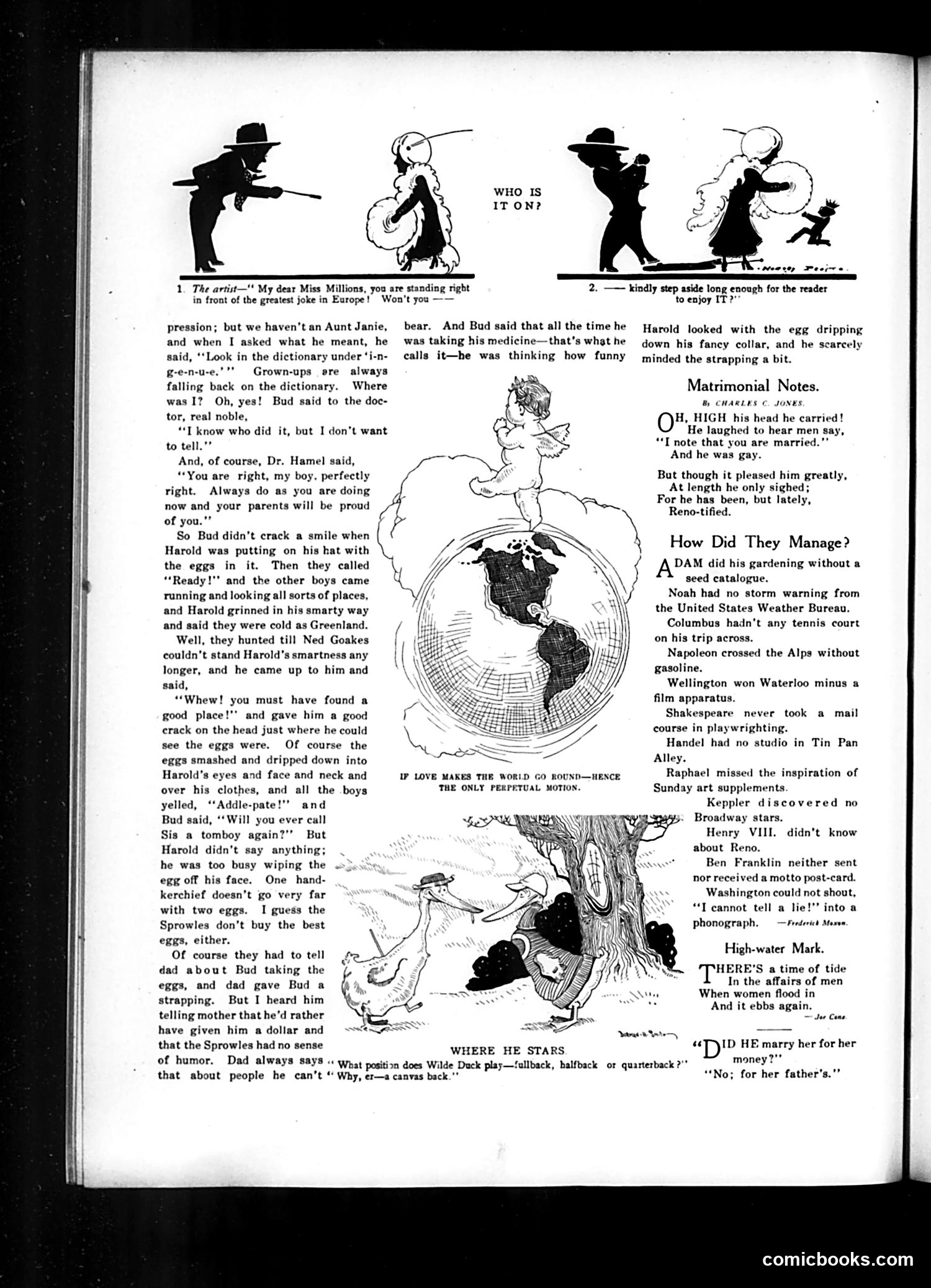
This page contains a humorous short story about a prank gone wrong, plus several satirical notes and jokes typical of early 20th-century humor. **Main Story:** A boy named Bud plays a prank by hiding eggs in Harold's hat. When discovered and cracked over Harold's head, the eggs drip down his collar. Harold's father is amused despite punishing Bud—the joke being that Harold didn't mind the messy comeuppance because he'd been secretly pleased by the prank's success. **"Matrimonial Notes"** satirizes divorce, specifically referencing "Reno-tified"—a play on "renovated," alluding to Reno, Nevada, which was famous as a divorce destination due to lenient laws. **"How Did They Manage?"** humorously lists historical figures who accomplished great things without modern conveniences or technologies—a commentary on contemporary over-reliance on modern gadgets. The bottom jokes are standard social humor: one about marrying for money, another about female social behavior. The tone is lighthearted domestic comedy typical of Judge's early 20th-century satirical approach to American life.
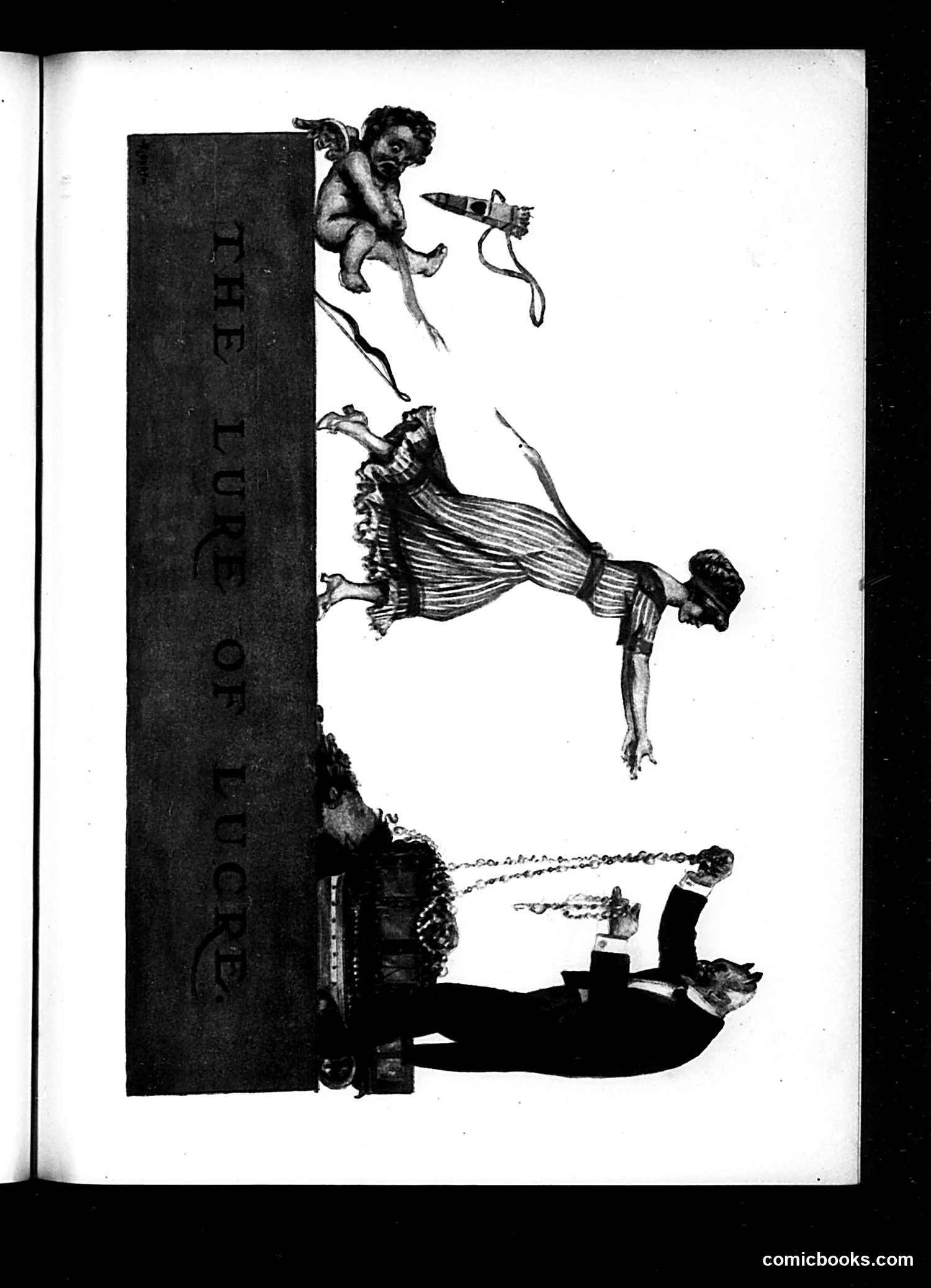
This appears to be a satirical cartoon about financial temptation and greed. The image shows three figures in a hierarchical composition: at the top, a cherub or cupid-like figure holds a rifle or gun; in the middle, a woman in a flowing dress appears to be flying or falling; at the bottom, a man in formal dress reaches upward with chains, seemingly pursuing the figures above. The title "The Lure of Lucre" (lucre meaning money) suggests the cartoon critiques how financial gain corrupts behavior and morality. The weaponry, the woman's precarious position, and the man's grasping gesture all suggest danger, desperation, or moral compromise driven by greed. Without a specific date or byline visible, the exact historical context remains unclear, but the imagery reflects common Gilded Age concerns about money's corrupting influence.
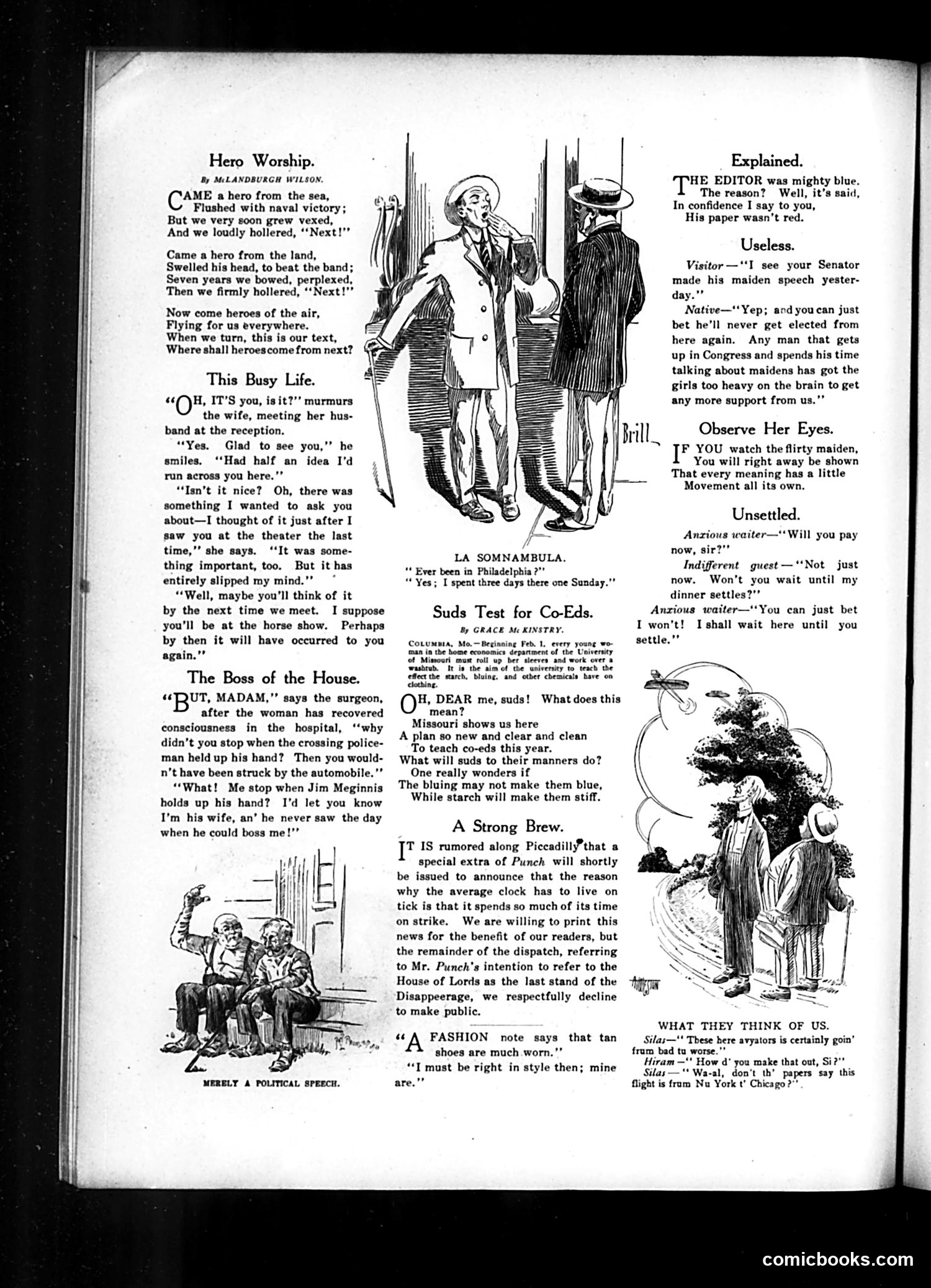
This page contains multiple satirical pieces mocking American social and political life circa early 1900s. **"Hero Worship"** critiques the public's fickleness—citizens celebrate military, naval, and aviation heroes in rapid succession, quickly demanding the next sensation ("Next!"). This satirizes America's short attention span for public figures. **"The Boss of the House"** jokes about gender dynamics: a woman ignores a traffic policeman's signal because she won't take orders from any man except her husband, then complains he bosses her. The satire highlights contradictions in attitudes toward female independence and marital authority. **"Suds Test for Co-Eds"** mocks a University of Missouri policy requiring female students to do laundry work, questioning whether manual labor will "make them blue" or "stiff"—suggesting skepticism about the educational value of domestic training for college women. **"A Strong Brew"** references British politics (Piccadilly, House of Lords), suggesting political commentary on class structures. The remaining pieces are brief social humor about dating, waiters, and fashion—typical light satirical fare for the magazine.
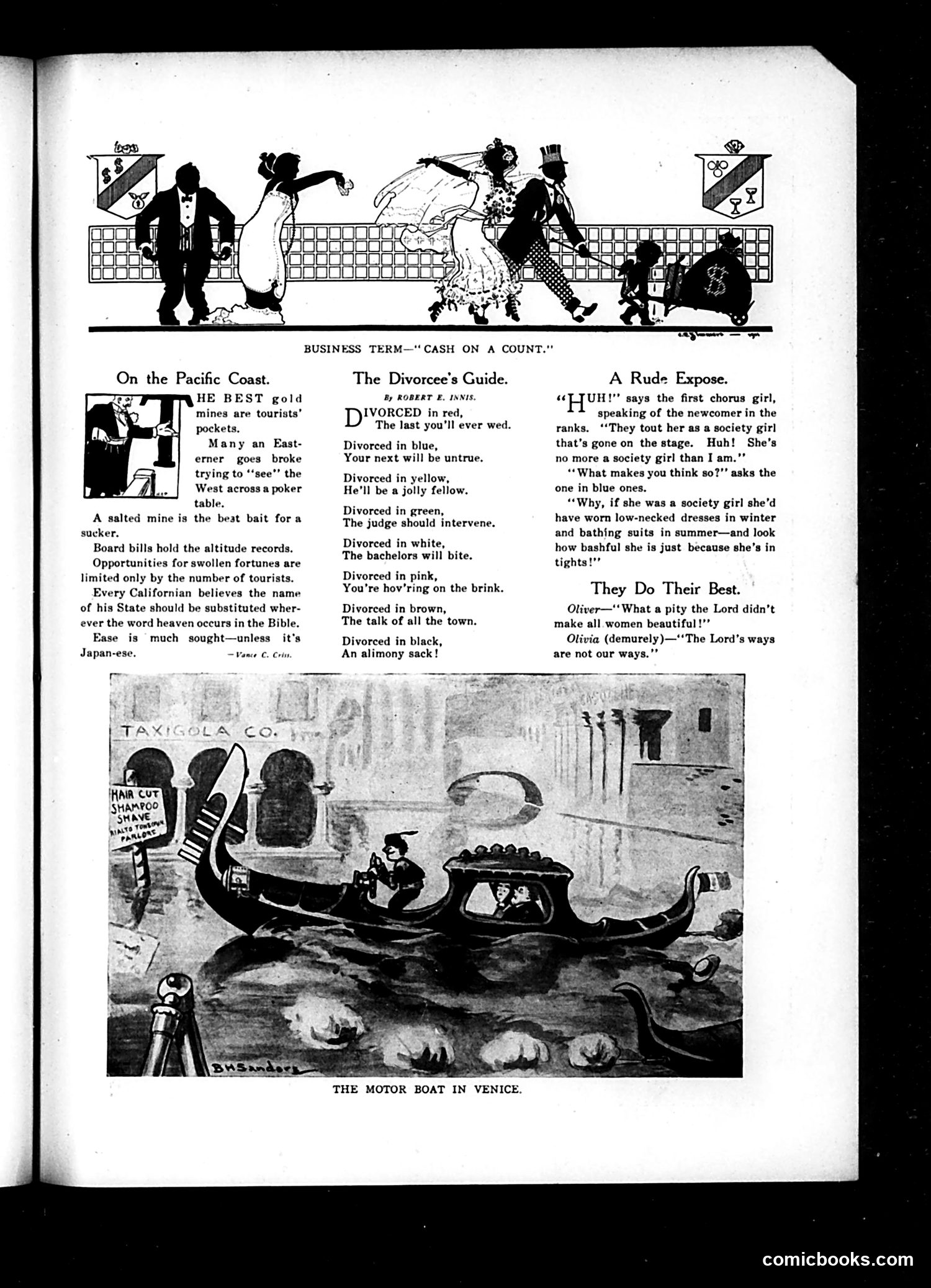
This Judge magazine page contains three satirical pieces mocking early 1900s American society: **"On the Pacific Coast"** ridicules California gold rush tourism—Eastern tourists lose money to con artists and gambling rather than finding actual wealth. The joke: California itself is the real "mine" being exploited, extracting tourist cash. **"The Divorcee's Guide"** is a humorous poem associating divorce with different colors (red = final divorce, black = alimony debt, etc.). It reflects the era's scandal around divorce, then socially shameful and expensive for women. **"A Rude Expose"** features chorus girls gossiping that a new performer claiming "society girl" status is actually lower-class, evidenced by her modesty and propriety—upper-class women supposedly wore revealing clothing casually. **"The Motor Boat in Venice"** cartoon depicts a motorboat crudely replacing Venice's traditional gondola, satirizing modern technology's invasion of historic culture. All pieces mock social pretension, tourism, and modernization's effects on tradition.
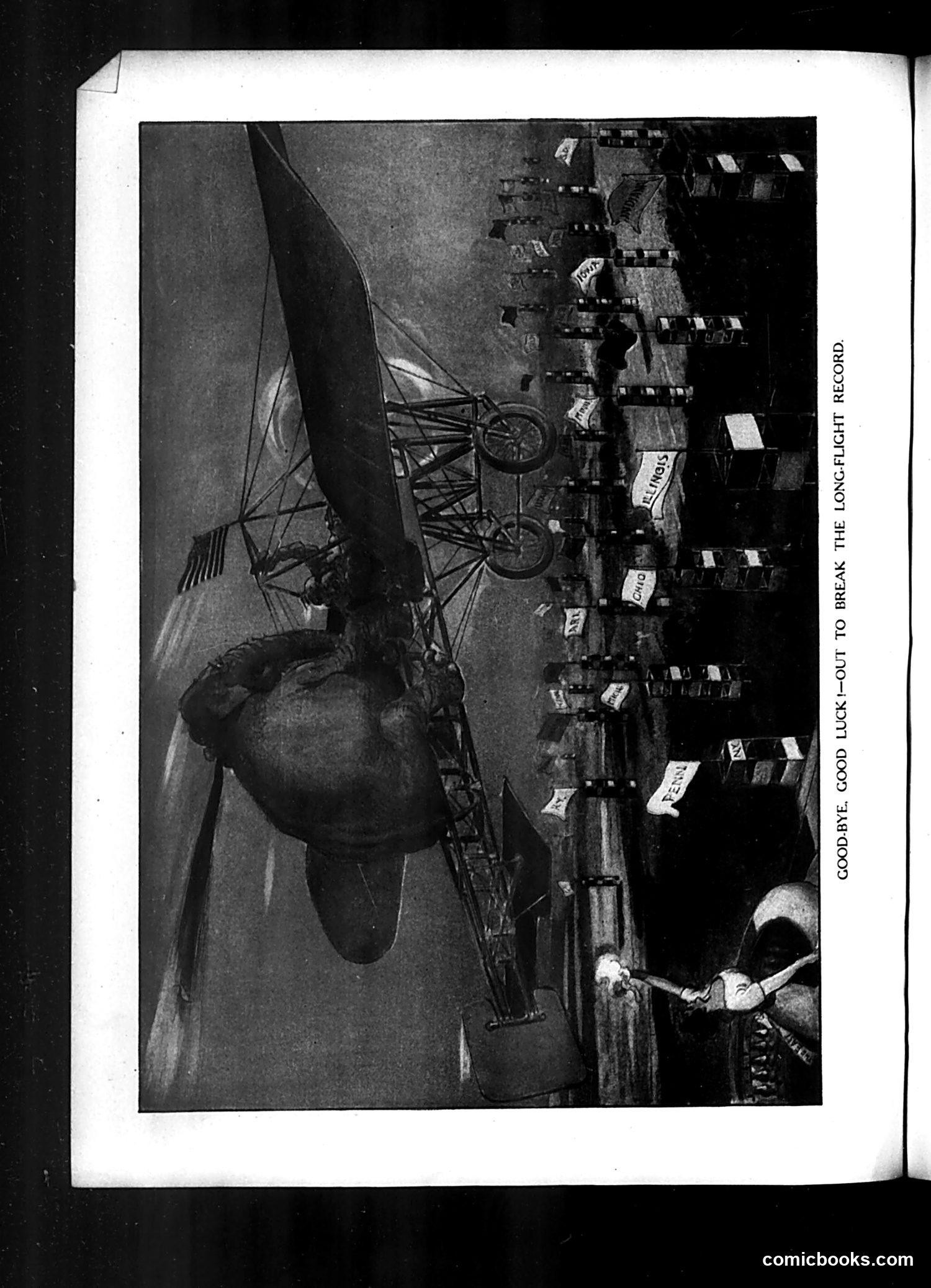
This page contains a black-and-white photograph (rotated 90 degrees) showing what appears to be a large airship or zeppelin with a prominent round balloon envelope. The caption reads "GOODBYE GOOD LUCK—OUT TO BREAK THE LONG-FLIGHT RECORD." The image documents an aviation milestone attempt, likely from the early-to-mid 20th century when long-distance flight records were major news events. The photograph shows the airship's structural framework and tethering equipment, with what appears to be ground crew visible. Without additional context about which specific flight record attempt this references, I cannot identify the exact date or participants. However, the satirical framing suggests *Judge* magazine is commenting on contemporary aeronautical ambitions—possibly mocking the competitive nature of aviation record-breaking or the optimism (and risk) involved in such endeavors.
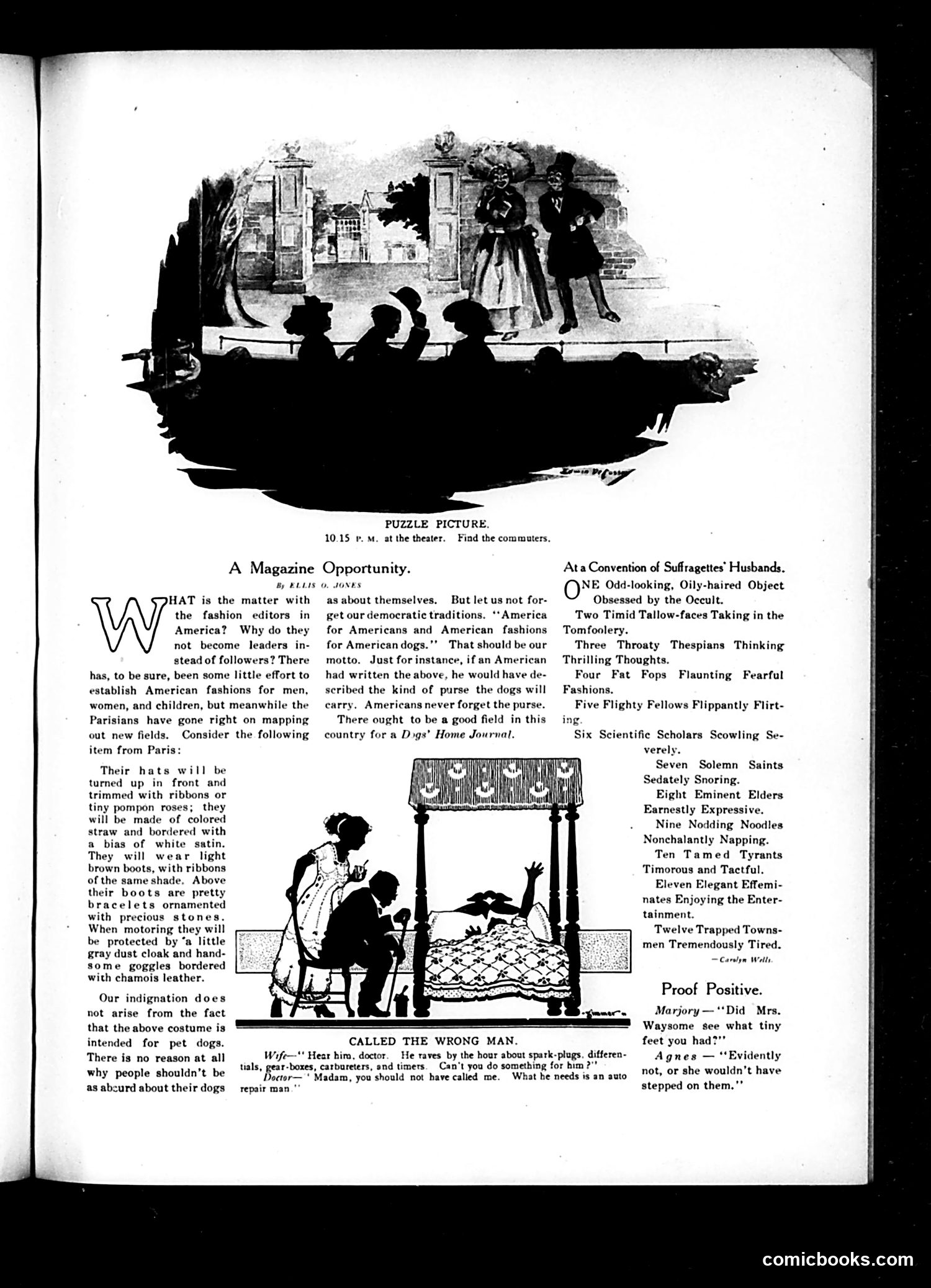
This page contains three distinct pieces of satire: 1. **"A Magazine Opportunity"** mocks American fashion editors for lacking originality compared to Paris. The author sarcastically suggests Americans should develop dog fashions instead, pointedly noting Americans "never forget the purse"—implying American materialism and consumerism as a national trait worthy of mockery. 2. **"Called the Wrong Man"** is a brief comic about a man obsessed with automobiles. His wife calls a doctor, but the doctor correctly identifies that her husband needs a mechanic, not medical care—satirizing the era's automobile mania consuming men's attention. 3. **"At a Convention of Suffragettes' Husbands"** uses alliteration to mock husbands at a women's suffrage event. The descriptions ("Timid Tallow-faces," "Trapped Townsmen Tremendously Tired") ridicule these men as emasculated, bored, or reluctant attendees—reflecting anti-suffrage attitudes prevalent in the era. The page reflects early 20th-century anxieties: consumer culture, automotive obsession, and resistance to women's political advancement.
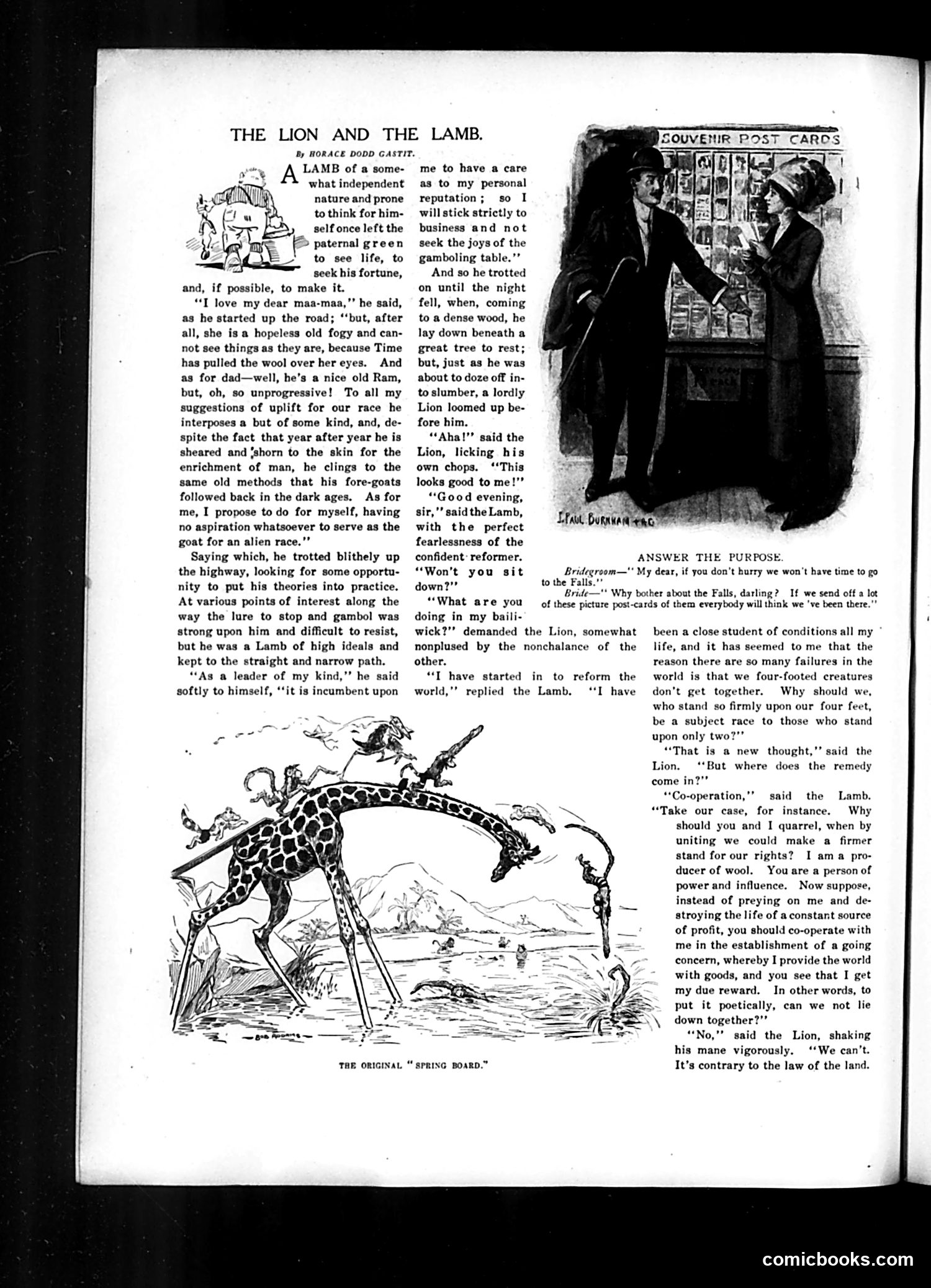
This Horace Dodd Gastit story satirizes progressive reformers and labor organizers of the early 20th century. The Lamb represents idealistic young radicals seeking to overturn traditional hierarchies and promote cooperation between classes. The Lion represents entrenched power and capitalism. The Lamb proposes that predator and prey unite through "co-operation"—the Lamb will supply wool (labor/goods), the Lion will use influence, and they'll share profits fairly. The Lion's response—"It's contrary to the law of the land"—is the satirical punch: established law protects the strong's right to exploit the weak. The cartoonist mocks the Lamb's naive belief that reasoned argument and mutual benefit can overcome fundamental power imbalances and legal structures designed to preserve inequality. The giraffe illustration titled "The Original 'Spring Board'" suggests the Lamb's idealism is unstable and doomed.
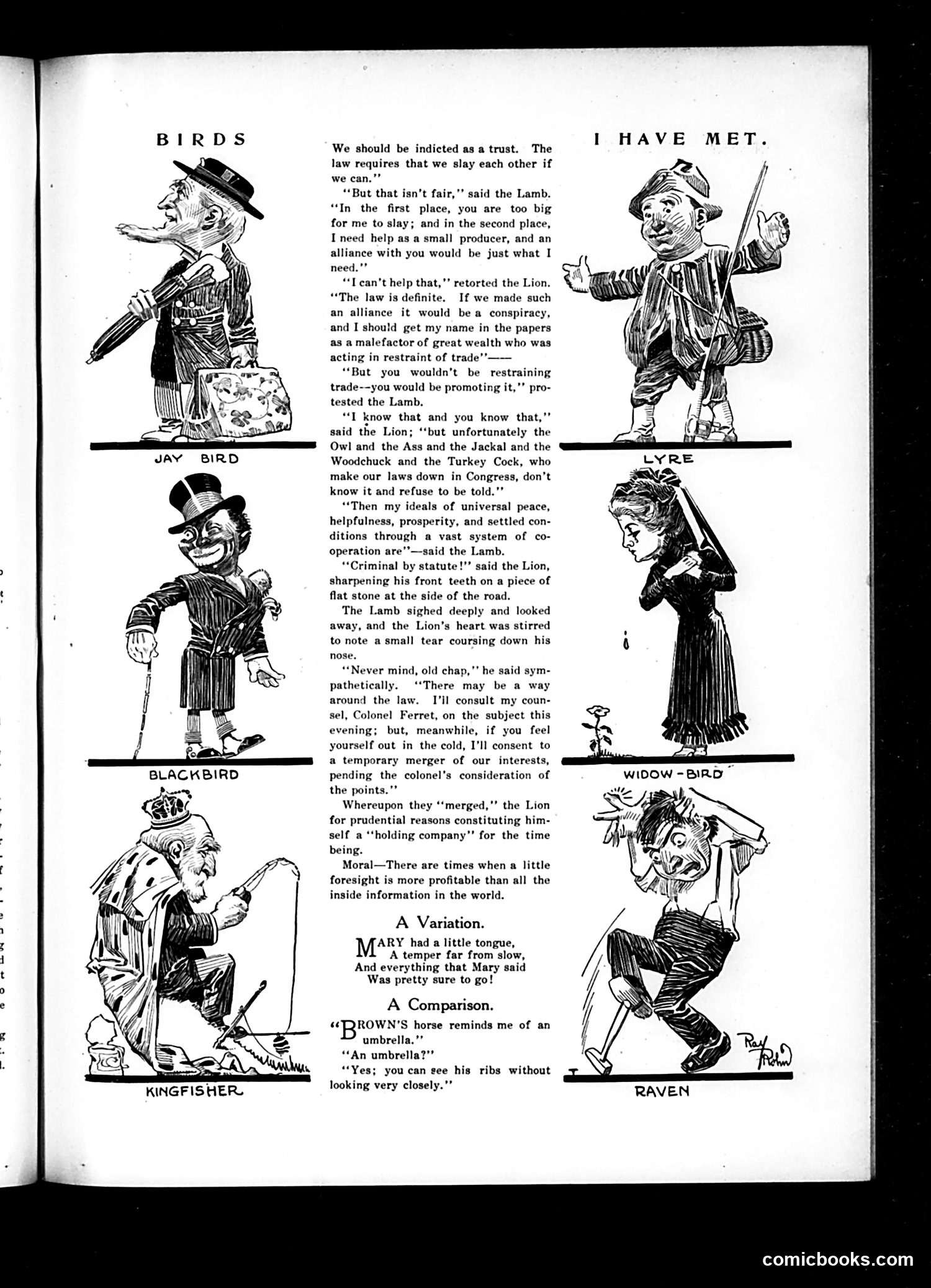
This page satirizes early 20th-century American antitrust enforcement through animal fables. The main narrative features a **Lion** (representing big business) and a **Lamb** (small producer) debating whether they can legally cooperate. The satire's target: Congress members depicted as animals—**Owl, Ass, Jackal, Woodchuck, Turkey Cock**—who write antitrust laws they don't understand. The Lion notes these lawmakers "don't know it and refuse to be told," criticizing their incompetence. The punchline: though cooperation would benefit trade, strict antitrust law forbids it as a "conspiracy." The solution? A "merger" structured as a holding company—a legal loophole that achieves the same result while technically obeying the law. The cartoon mocks rigid, poorly-crafted legislation that prevents beneficial business cooperation while clever lawyers find workarounds. Additional puns about "Brown's horse" and Mary's tongue occupy the page's bottom.
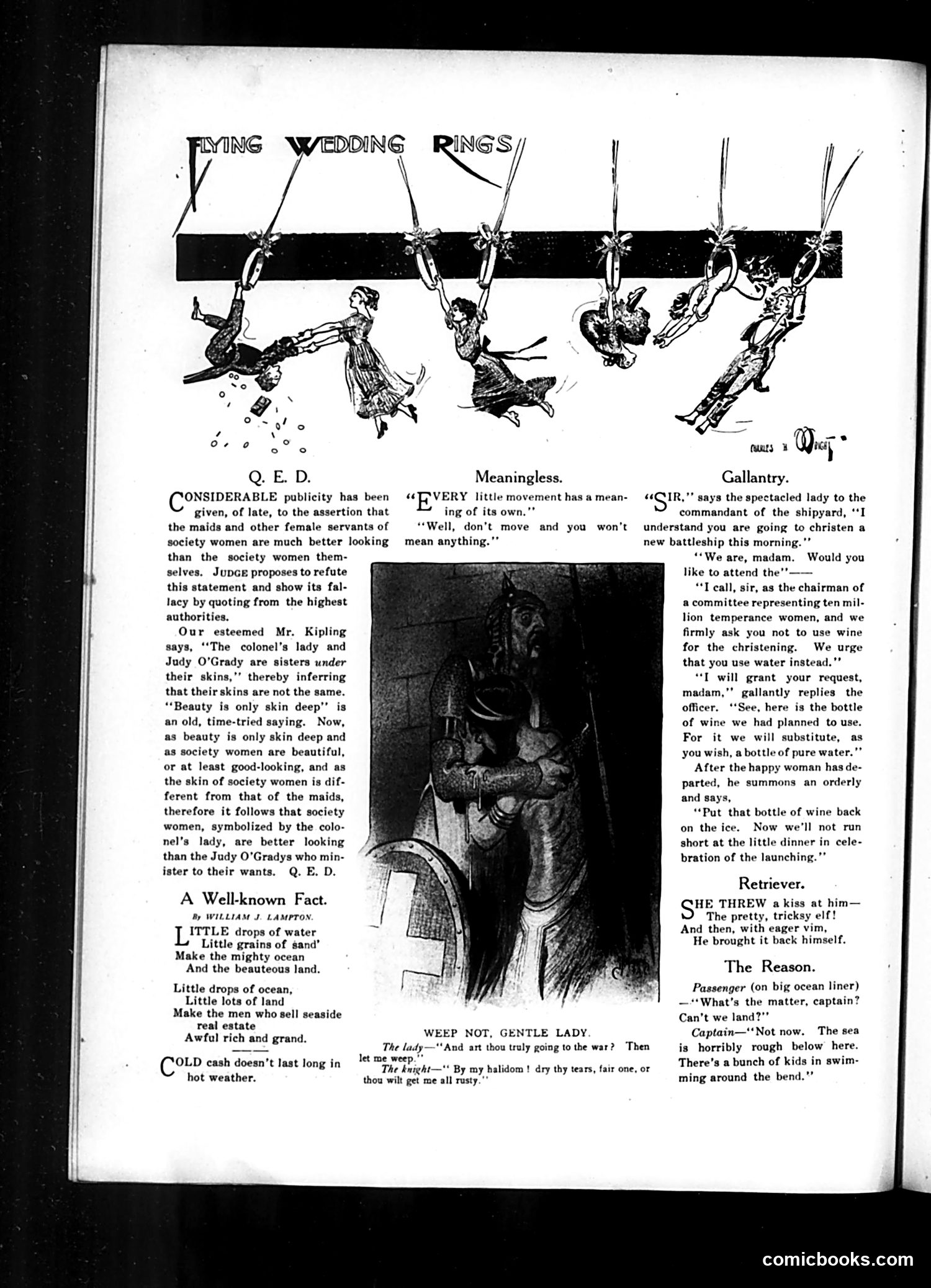
This **Judge magazine page** contains multiple satirical pieces typical of early 20th-century American humor: **Top cartoon**: "Flying Wedding Rings" depicts figures suspended from rings—a visual pun on the phrase "flying the coop" or escaping marriage, satirizing reluctance to matrimony. **Main articles**: - "Q.E.D." uses pseudo-logical argument to defend society women's beauty against servants, citing Kipling's famous line about class similarity ("colonel's lady and Judy O'Grady are sisters under their skins") to absurdly prove the opposite. - "Gallantry" mocks male duplicity: a naval officer agrees to use water instead of wine for a battleship christening to appease temperance activists, then immediately orders the wine back for the private celebration—satirizing hollow promises to reform movements. **Smaller pieces** include verse humor and brief jokes about romantic mishaps and seasickness. The page exemplifies Judge's blend of social commentary, gentle mockery of gender relations, and jabs at hypocrisy among the genteel classes and political advocates.
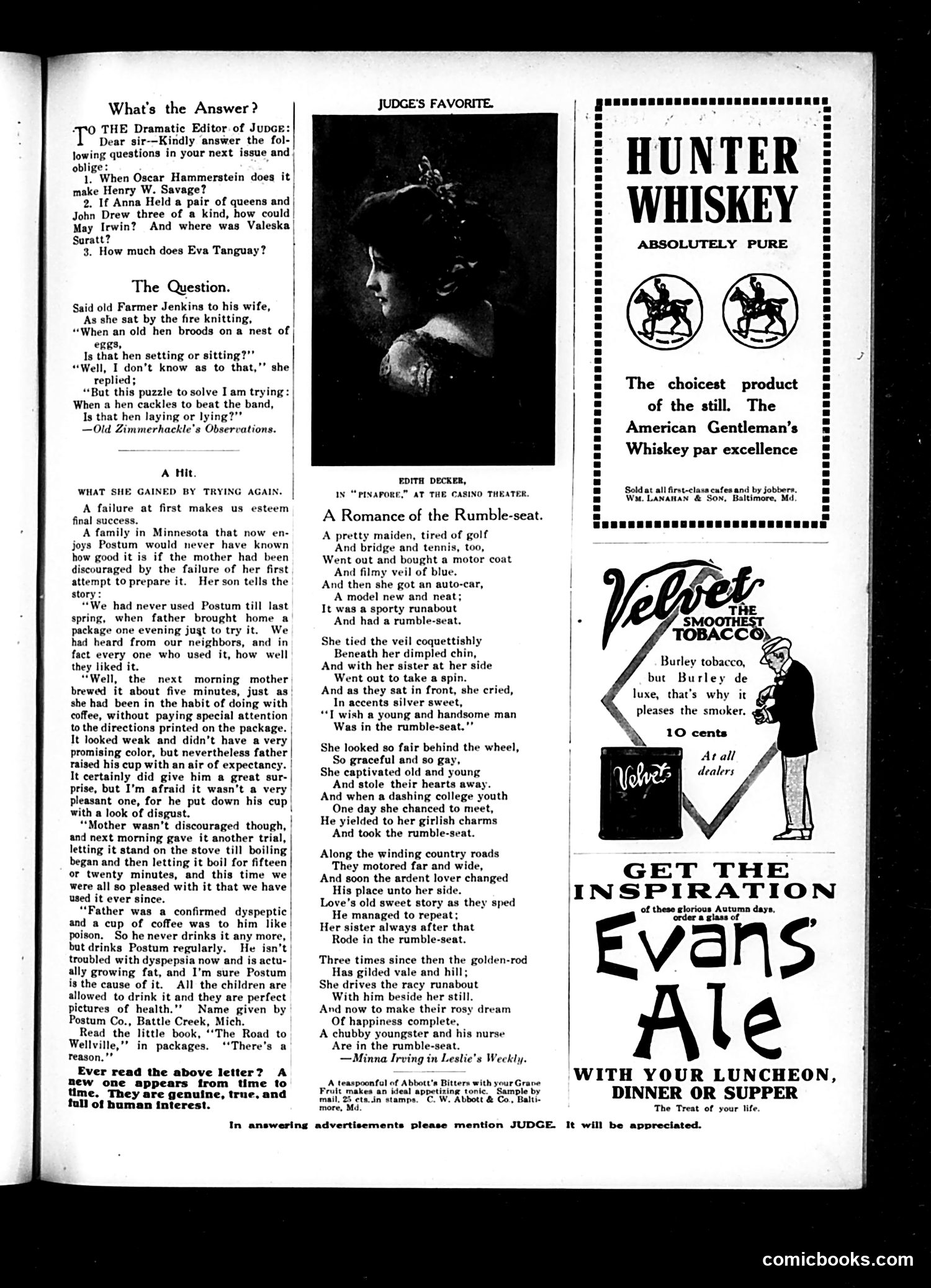
This page mixes reader Q&A, humor, and advertising typical of early 1900s satirical magazines. **"What's the Answer?"** presents theatrical in-jokes referencing Broadway figures (Oscar Hammerstein, Henry W. Savage, Anna Held, John Drew, May Irwin, Valeska Suratt, Eva Tanguay)—likely wordplay on their names or scandals, now obscure without deeper theatrical context. **"A Hit"** is a Postum coffee substitute advertisement disguised as a reader testimonial, claiming the product cured a man's dyspepsia when properly prepared. **The main poem** celebrates actress Edith Decker, describing a young woman in a motorcar who wishes for romance—and gets it. The "rumble-seat" (rear seating) allows her sister to tactfully disappear when a suitor appears, facilitating courtship. It's lighthearted commentary on modern dating enabled by automobiles and women's increasing independence. The page is primarily **commercial content** (advertisements for Hunter Whiskey, Velvet tobacco, Evans Ale) with entertainment value secondary.
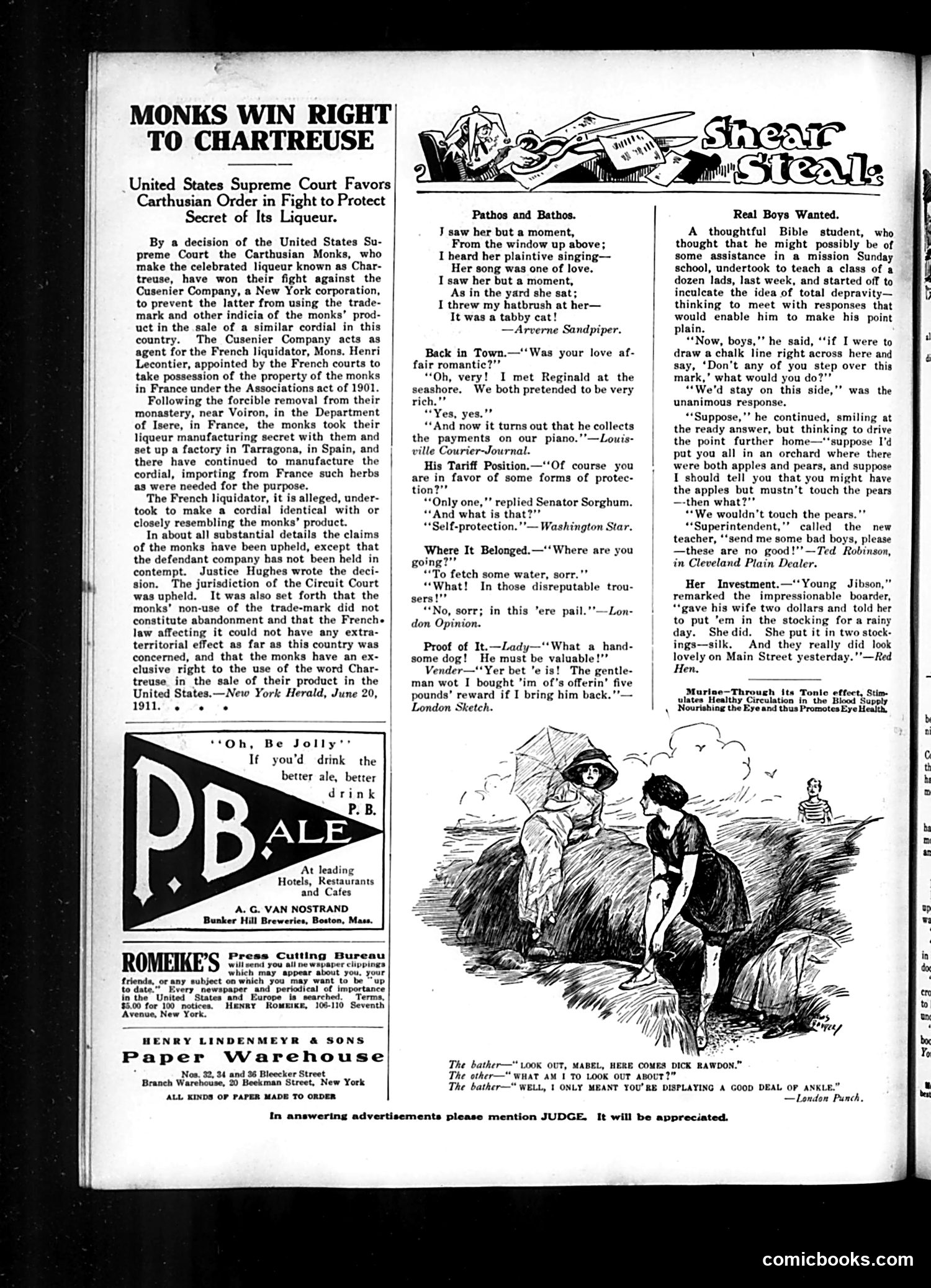
This Judge magazine page primarily concerns a **Supreme Court victory for Carthusian monks** protecting their Chartreuse liqueur formula. The monks, expelled from their French monastery under France's 1901 Associations Act, had relocated production to Spain. A French-backed New York company (Cusenier) attempted manufacturing a similar product. The Supreme Court upheld the monks' trademark rights and their exclusive claim to "Chartreuse" in U.S. sales—establishing that the monks' non-use of the trademark didn't constitute abandonment and French law couldn't affect their American rights. The page also features several brief humorous pieces: satirical anecdotes about romance, tariffs, and character-building Sunday school lessons. There's a small illustration depicting an apparently romantic beach scene with ironic caption. The advertisements for P.B. Ale, a press clipping bureau, and paper warehouse are typical commercial content of the era. The underlying theme mixes religious-commercial irony (monks protecting liqueur profits) with working-class humor throughout.
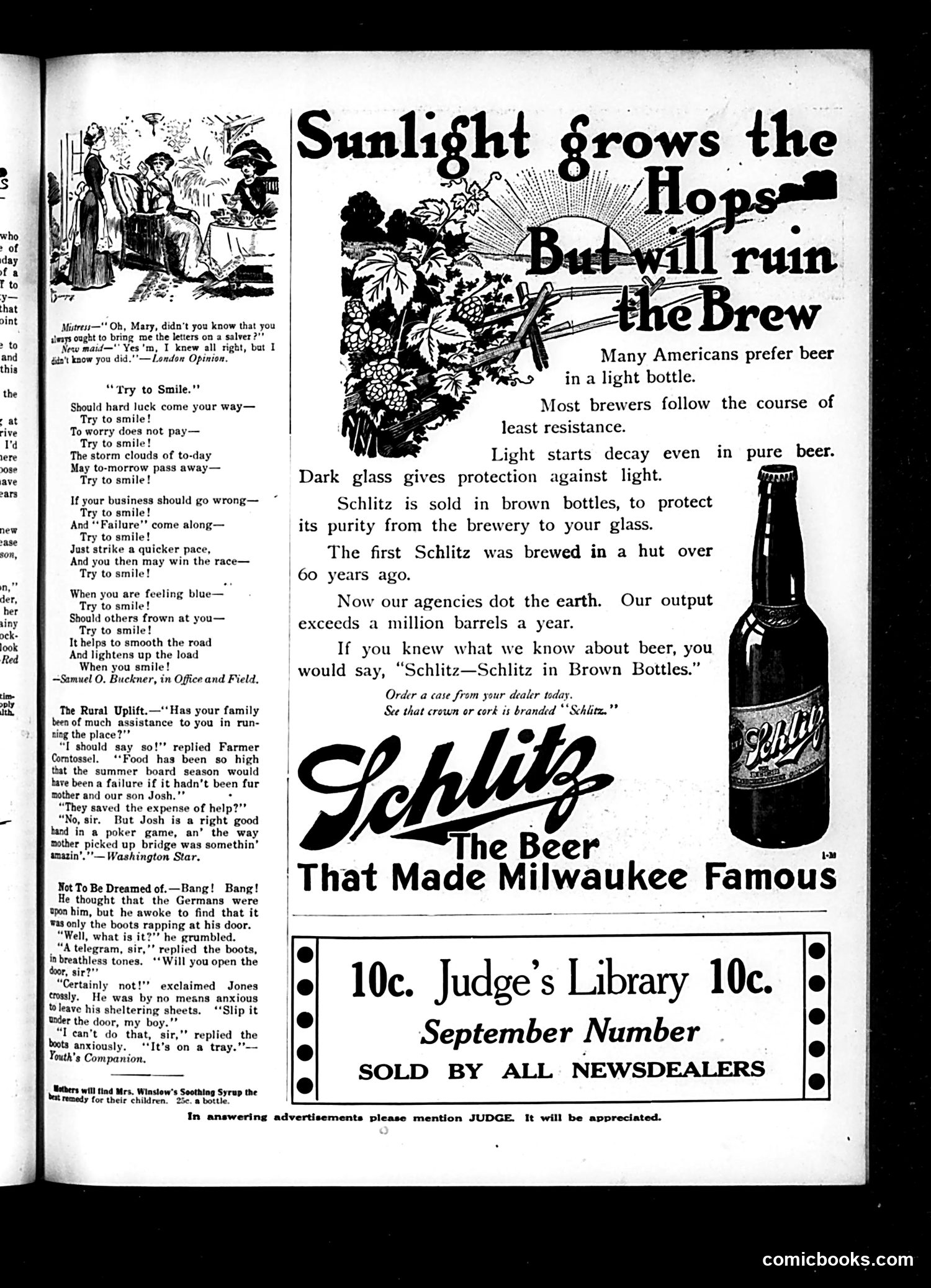
This page contains several unrelated humor pieces typical of Judge magazine's format, plus a major **Schlitz beer advertisement**. ## The Humor Pieces The left column features short, mild jokes: a maid not understanding formal service protocols, a motivational poem about smiling through hardship, and anecdotes about farm life and unexpected situations. These are genteel, inoffensive humor aimed at middle-class readers—representative of early-20th-century American periodical comedy. ## The Schlitz Advertisement The dominant feature is a full-page Schlitz beer ad making a specific **technical argument**: that sunlight degrades beer quality, so brown bottles protect it. The ad emphasizes Schlitz's century-old tradition and massive production ("exceeds a million barrels a year"). **Context**: This appears pre-Prohibition (or possibly early Prohibition era, given advertising still ran). The ad targets consumers concerned about beer purity and quality—a common selling point before refrigeration made quality control easier. The brown-bottle protection claim was a genuine competitive advantage in that era.
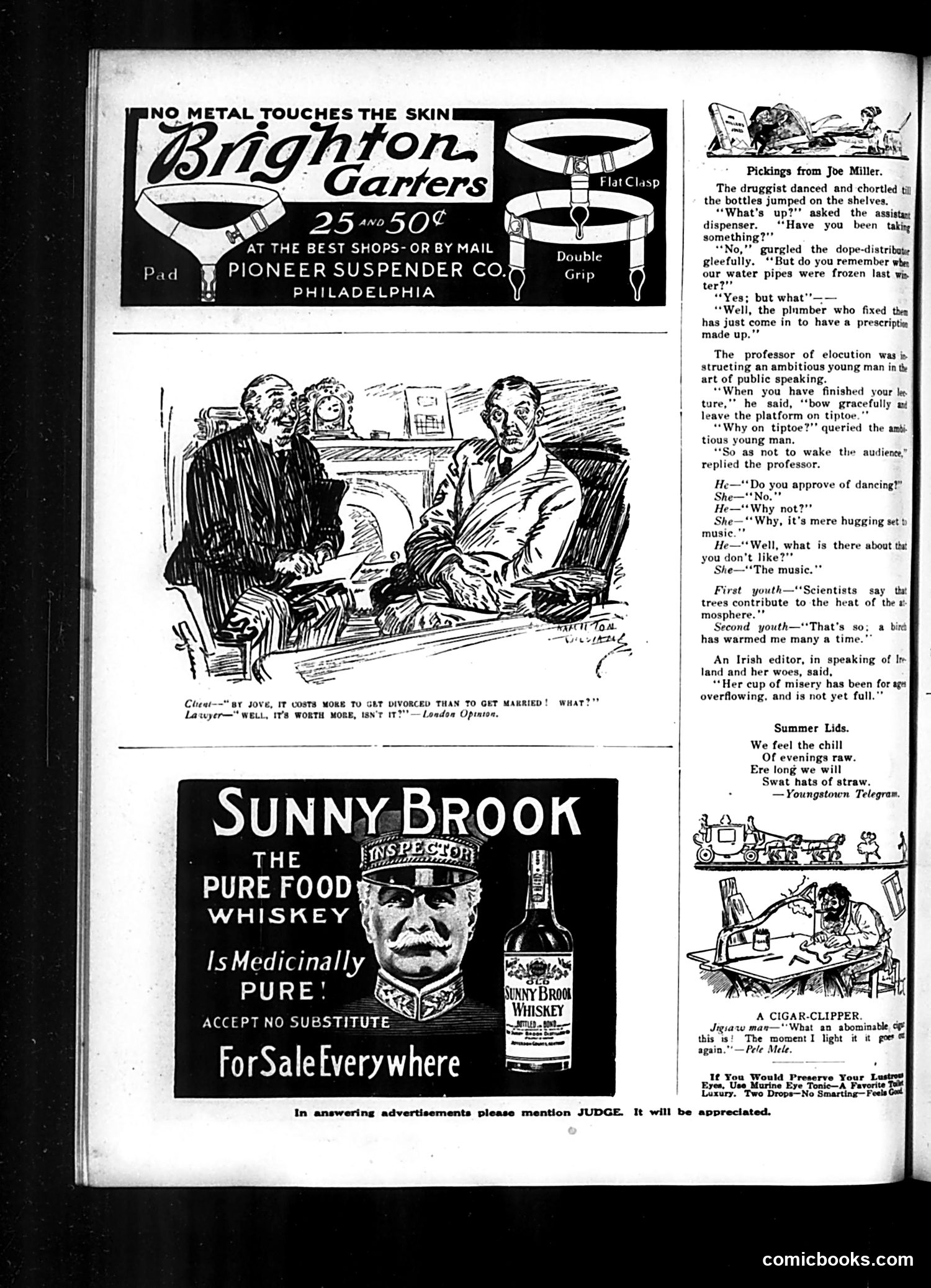
This page from *Judge* contains several short humorous anecdotes and advertisements typical of early 20th-century satirical magazines. **Main Cartoon:** A lawyer and client discuss divorce costs, with the lawyer asserting divorce is "worth more" than marriage—a joke about expensive legal fees and the financial burden of marital dissolution. **Text Jokes:** The "Pickings from Joe Miller" section offers quick one-liners: a druggist amused that a plumber needs medicine (ironic reversal), a professor advising students to leave the stage "on tiptoe" so as not to wake the audience (insulting the audience's attention), and various other brief quips about romance, nature, and Irish hardship. **Advertisements:** Brighton Garters (suspenders), Sunny Brook Whiskey (marketed as "medicinally pure"—a common claim during Prohibition era to sell alcohol legally), and other products fill the remaining space. The page reflects *Judge's* formula: mixing political/social satire with light domestic humor and period advertisements, targeting educated, middle-class readers.
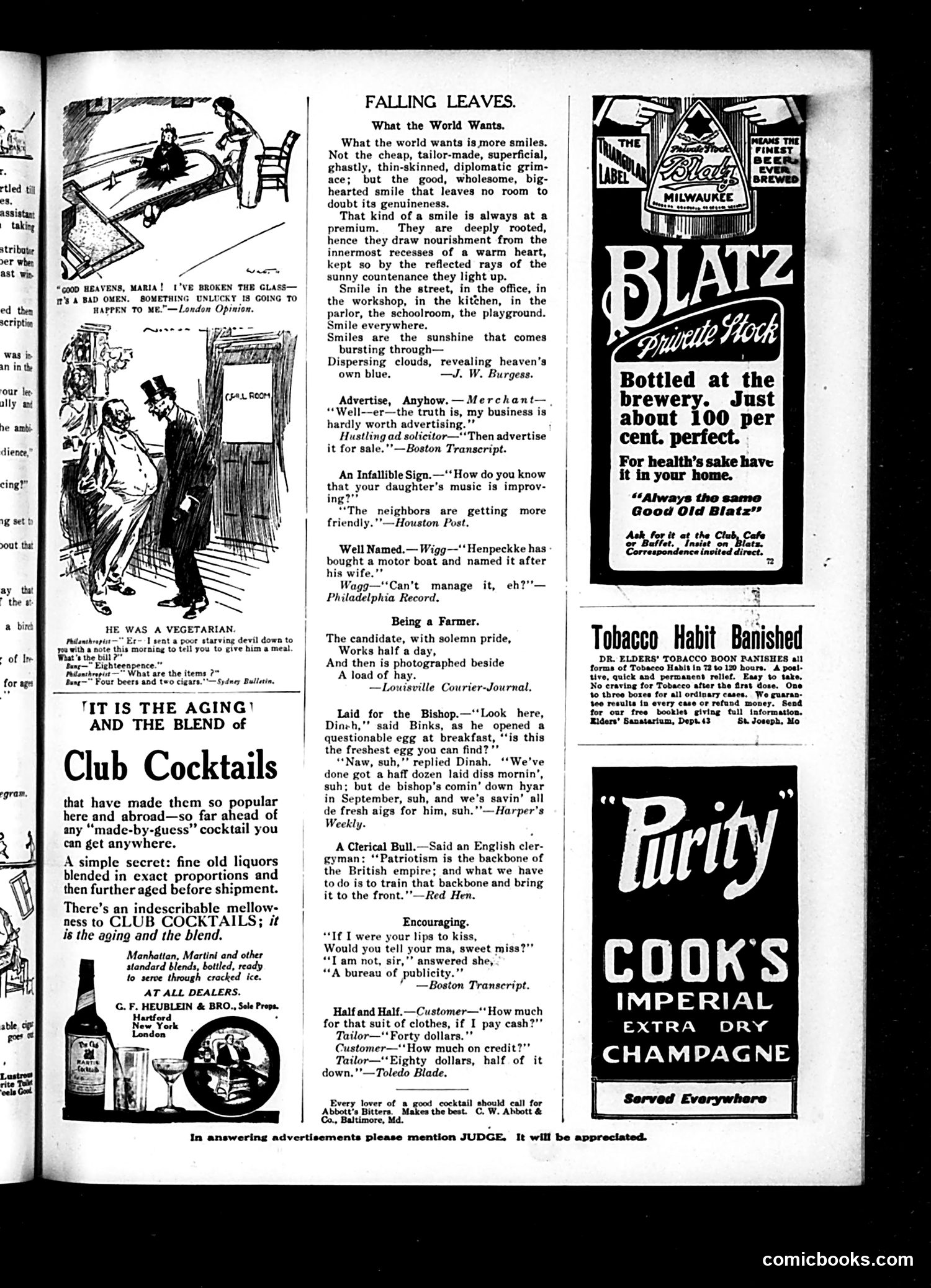
This page from *Judge* magazine contains multiple small jokes and advertisements rather than a single political cartoon. The humor reflects early 20th-century American sensibilities: **Notable Jokes:** - "Unlucky 13 Going to Happen to Me" depicts a superstitious man receiving bad news - "He Was a Vegetarian" shows a man being robbed, with a note saying the thief will return to rob him again - Political/campaign satire: "Being a Farmer" mocks politicians who pose with farm scenes for photographs while doing minimal actual work - Racial humor: "Laid for the Bishop" features dialect humor involving a Black servant saving fresh eggs for the bishop's visit **Advertisements** dominate the page, promoting Club Cocktails, Blatz beer, Cook's champagne, and a tobacco cessation product—reflecting Prohibition-era marketing. The overall tone is genteel, sometimes condescending humor aimed at a middle-class audience.
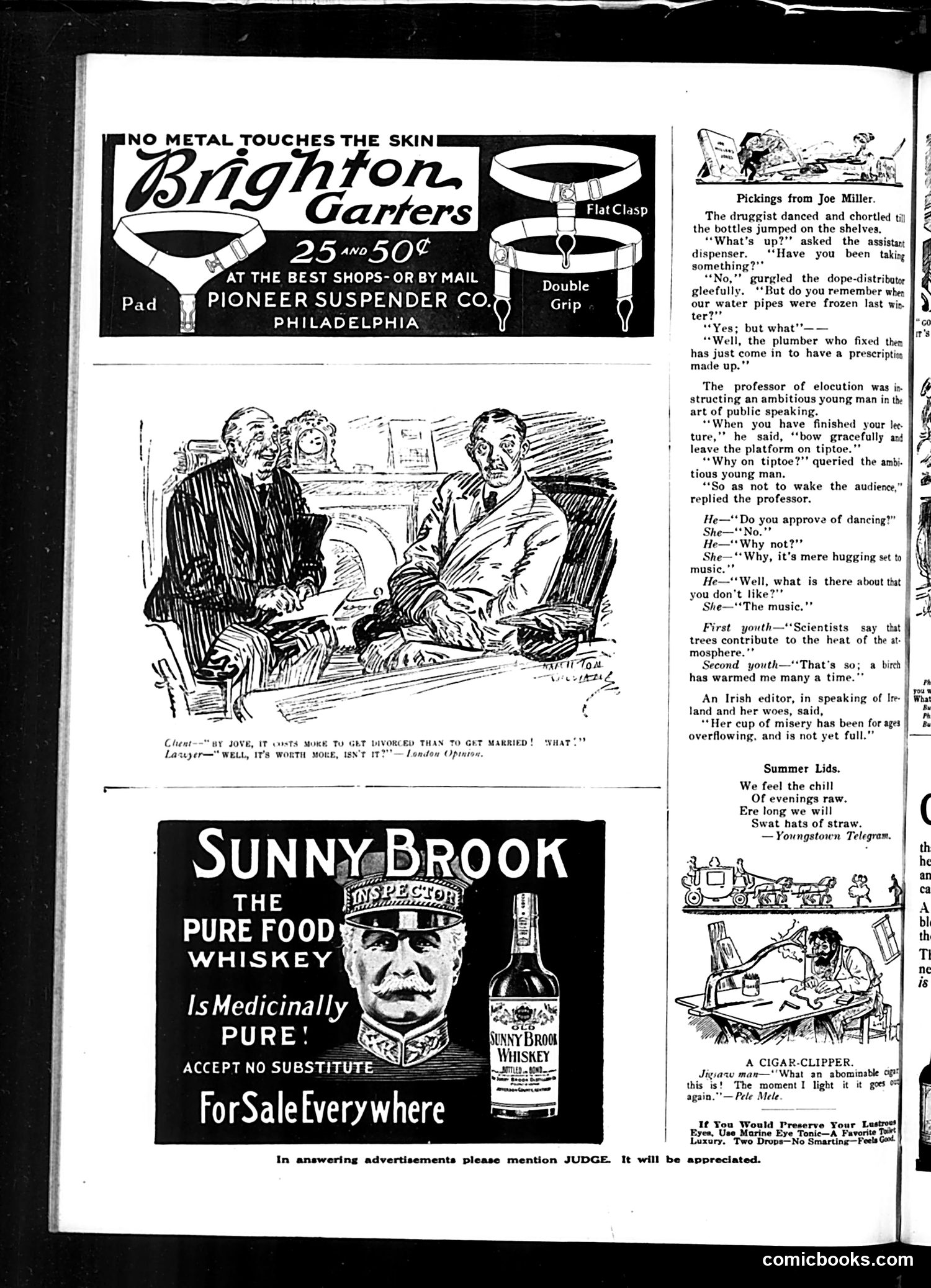
This page contains mostly **advertisements and humor columns** rather than political cartoons. The main visual cartoon shows two men in conversation—a client and lawyer discussing divorce costs versus marriage, with the joke being that divorce is "worth more" because lawyers charge higher fees. This is social satire on the legal profession's profit motive. The bulk of the page consists of **joke columns** ("Pickings from Joe Miller"), including: - A druggist's humor about a plumber seeking medicine after drinking frozen water pipes - A professor advising a student to leave lectures "on tiptoe so as not to wake the audience" - Wordplay about trees and birch wood providing warmth The **advertisements** include Brighton Garters, Pioneer Suspender Co., and notably **Sunny Brook Whiskey**, which claims to be "Medicinally Pure"—this is ironic given Prohibition-era rhetoric about alcohol's health claims. For modern readers: these jokes reflect early 20th-century concerns about lawyers' greed, education, and the dubious medical claims alcohol manufacturers made before Prohibition.
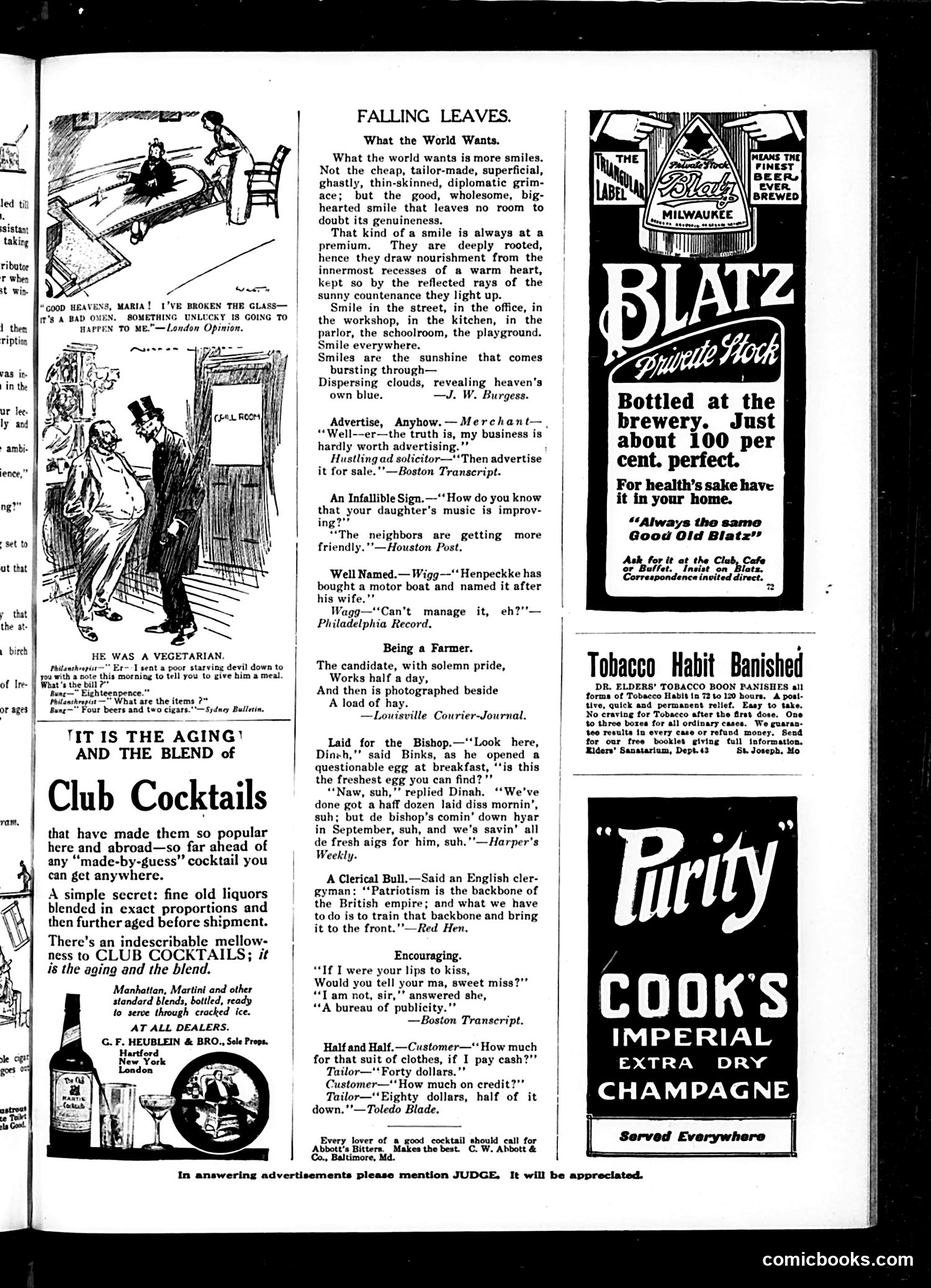
This page from *Judge* magazine contains mostly **short humorous anecdotes and advertisements** rather than political cartoons. The cartoons shown illustrate Victorian-era jokes: one depicts superstition (breaking a glass as bad luck), another mocks a "philanthropist" whose charity extends only to buying a poor man beer and cigars instead of actual food. The text sections are comedic vignettes satirizing everyday life: a husband named after his wife (implying she dominates him), a farmer posing for campaign photos with hay to appear rustic, and a Black servant ("Dinah") saving fresh eggs for the bishop's visit—this last reflecting period stereotypes about African American dialect and subservience. The primary content is **advertising**: Club Cocktails, Blatz beer, Cook's Champagne, and Abbott's Bitters dominate the page, typical of *Judge's* revenue model. The gentle satire targets social pretense, marital dynamics, and political posturing rather than substantive political issues—characteristic of light satirical magazines of this era.
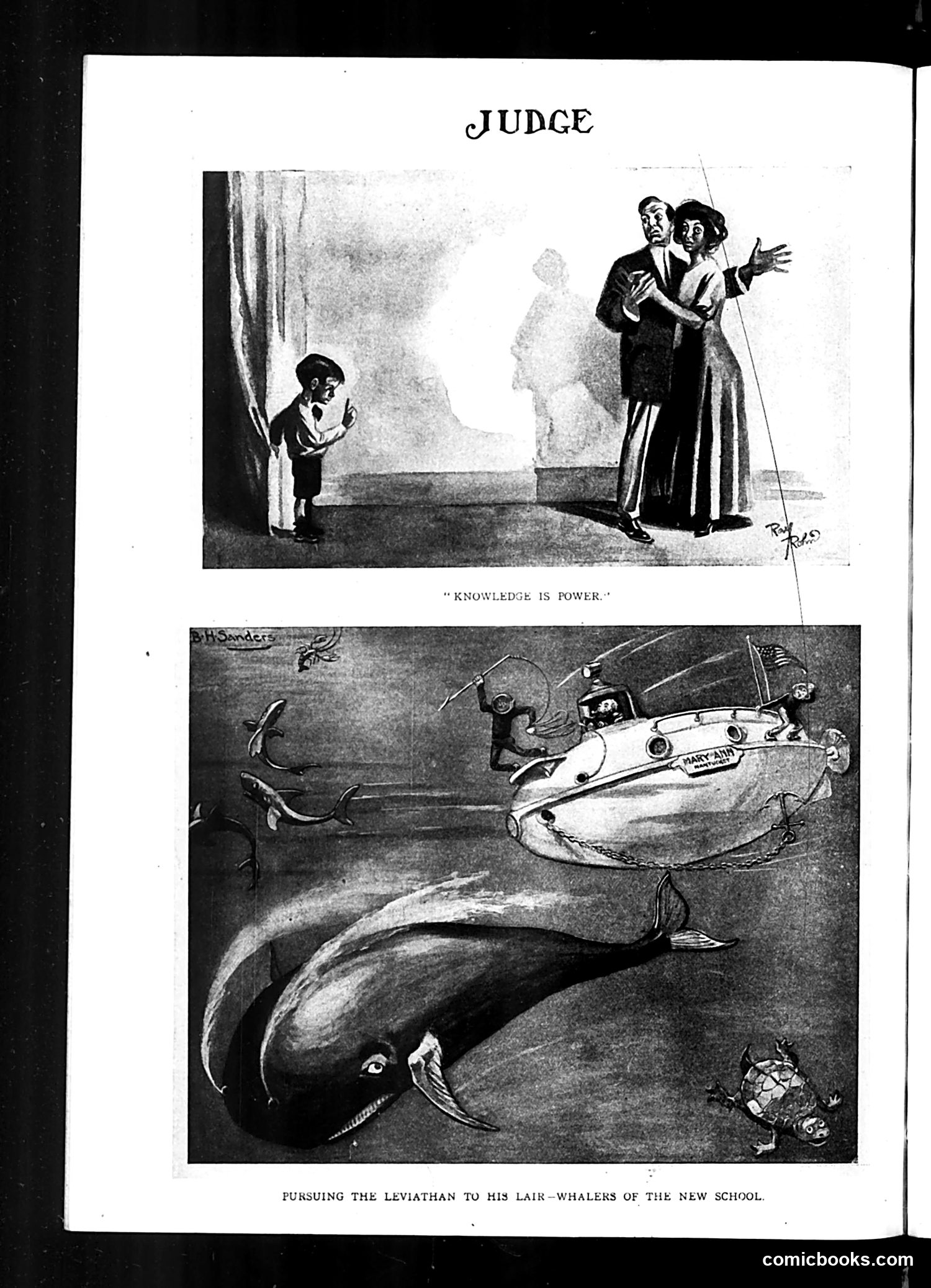
This page contains two cartoons satirizing legal/judicial matters under the heading "JUDGE." **Top cartoon:** Titled "Knowledge is Power," depicts a small child hiding behind a curtain while an adult judge and woman point accusingly. The satire appears to critique how legal knowledge or courtroom advantage can intimidate or disadvantage those without it—possibly mocking judges who wielded power through obscure legal procedures against ordinary citizens. **Bottom cartoon:** "Pursuing the Leviathan to His Lair—Whalers of the New School" shows a submarine labeled "Mary Ann" hunting a large whale underwater. This likely satirizes aggressive legal prosecution, with the "whale" representing a defendant or corporate entity being pursued relentlessly by lawyers/judges (the "new school" of legal hunters). The submarine suggests modern, technological legal tactics replacing traditional methods. Both cartoons critique judicial overreach or aggressive legal practices of the era.