
Judge, 1911-09-23 · page 6 of 26
Judge — September 23, 1911 — page 6: what you’re looking at
What you’re looking at
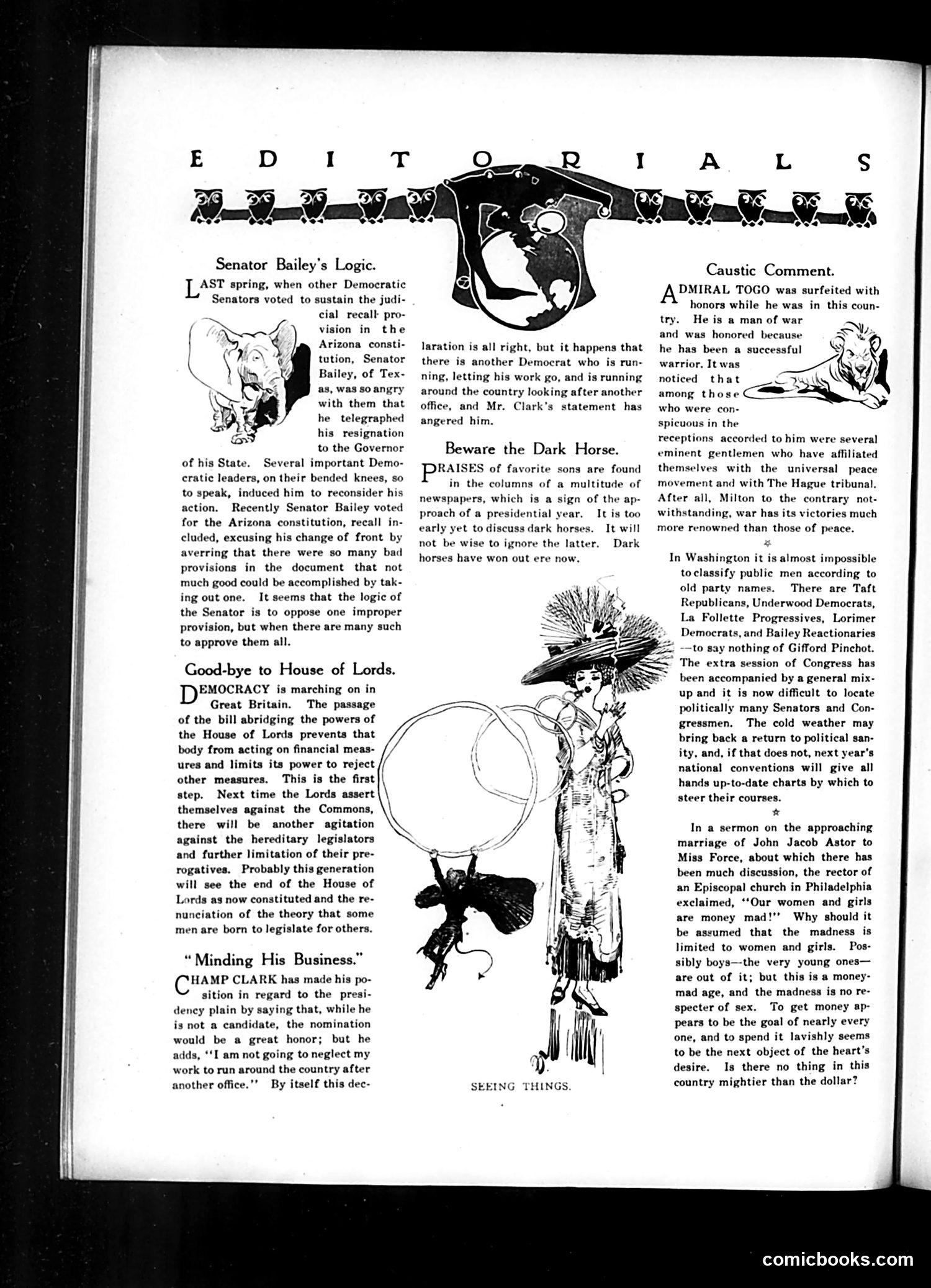
This page satirizes American political inconsistency circa 1911-1912. **Senator Bailey's Logic** mocks Texas Senator Joseph Weldon Bailey's hypocrisy: he dramatically resigned over the Arizona constitution's judicial recall provision, then voted for the same constitution anyway—claiming the document had so many flaws that opposing one wouldn't help. The satire: his logic is backwards (oppose one flaw, support everything?). **"Minding His Business"** references Speaker Champ Clark and an unnamed Democratic rival (likely Woodrow Wilson) competing for the 1912 presidential nomination. Clark claims he won't neglect his work for campaigning, apparently angering someone doing exactly that. **"Beware the Dark Horse"** warns that unexpected candidates often win presidencies, relevant to the fluid 1912 race. **Caustic Comment** notes the irony of peace advocates honoring Admiral Togo, a celebrated military figure, while claiming to support peace. The broader point: Washington politicians have become impossible to classify by traditional party lines anymore.
📄 Transcribed text from this page (OCR, searchable)
Machine-transcribed from the original scan — historical spelling and the odd misread are preserved.
Senator Bailey's Logic. [Ast spring, when other Democratic Senators voted to sustain the judi- cial recall pro- i the Arizona consti- tution, Senator Bailey, of Tex- as, was so angry with them that he telegraphed his resignation to the Governor of his State. Several important Demo- cratic leaders, on their bended knees, so to speak, induced him to reconsider his action. Recently Senator Bailey voted for the Arizona constitution, recall in- cluded, excusing his change of front by averring that there were so many bad provisions in the document that not much good could be accomplished by tak- ing outone. It seems that the logic of the Senator is to oppose one improper provision, but when there are many such to approve them all. Good-bye to House of Lords. EMOCRACY is marching on in Great Britain. The passage of the bill abridging the powers of the House of Lords prevents that body from acting on financial meas- ures and limits its power to reject other measures. This is the first step. Next time the Lords assert themselves against the Commons, there will be another agitation against the hereditary legislators and further limitation of their pre- rogatives. Probably this generation will see the end of the House of Lords as now constituted and the re- nunciation of the theory that some men are born to legislate for others. “Minding His Business.” HAMP CLARK has made his po- sition in regard to the presi- dency plain by saying that, while he is not a candidate, the nomination would be a great honor; but he adds, ‘I am not going to neglect my work to run around the country after another office.” By itself this dec- laration is all right, but it happens that there is another Democrat who is run- ning, letting his work go, and is running around the country looking after another office, and Mr. Clark's statement has angered him. Beware the Dark Horse. RAISES of favorite sons are found in the columns of a multitude of newspapers, which is a sign of the ap- proach of a presidential year. It is too early yet to discuss dark horses. It will not be wise to ignore the latter. Dark horses have won out ere now. SEEING THINGS. Caustic Comment. DMIRAL TOGO was surfeited with honors while he was in this coun- try. He is a man of war and was honored because he has been a successful warrior. It was noticed that among those C= who were con- spicuous in the receptions accorded to him were several eminent gentlemen who have affiliated themselves with the universal peace movement and with The Hague tribunal. After all, Milton to the contrary not- withstanding, war has its victories much more renowned than those of peace. % In Washington it is almost impossible toclassify public men according to old party names. There are Taft Republicans, Underwood Democrats, La Follette Progressives, Lorimer Democrats, and Bailey Reactionaries ig of Gifford Pinchot. The extra session of Congress has been accompanied by a general mix- up and it is now difficult to locate politically many Senators and Con- gressmen. The cold weather may bring back a return to political san- ity, and, if that does not, next year’s national conventions will give all hands up-to-date charts by which to steer their courses. * In a sermon on the approaching marriage of John Jacob Astor to Miss Force, about which there has been much discussion, the rector of an Episcopal church in Philadelphia exclaimed, ‘‘Our women and girls are money mad!"’ Why should it be assumed that the madness is limited to women and girls. Pos- sibly boys—the very young ones— are out of it; but this is a money- mad age, and the madness is no re- specter of sex. To get money ap- pears to be the goal of nearly every one, and to spend it lavishly seems to be the next object of the heart’s desire. Is there no thing in this country mightier than the dollar? comicbooks.com