
A complete issue · 28 pages · 1911
Judge — September 16, 1911
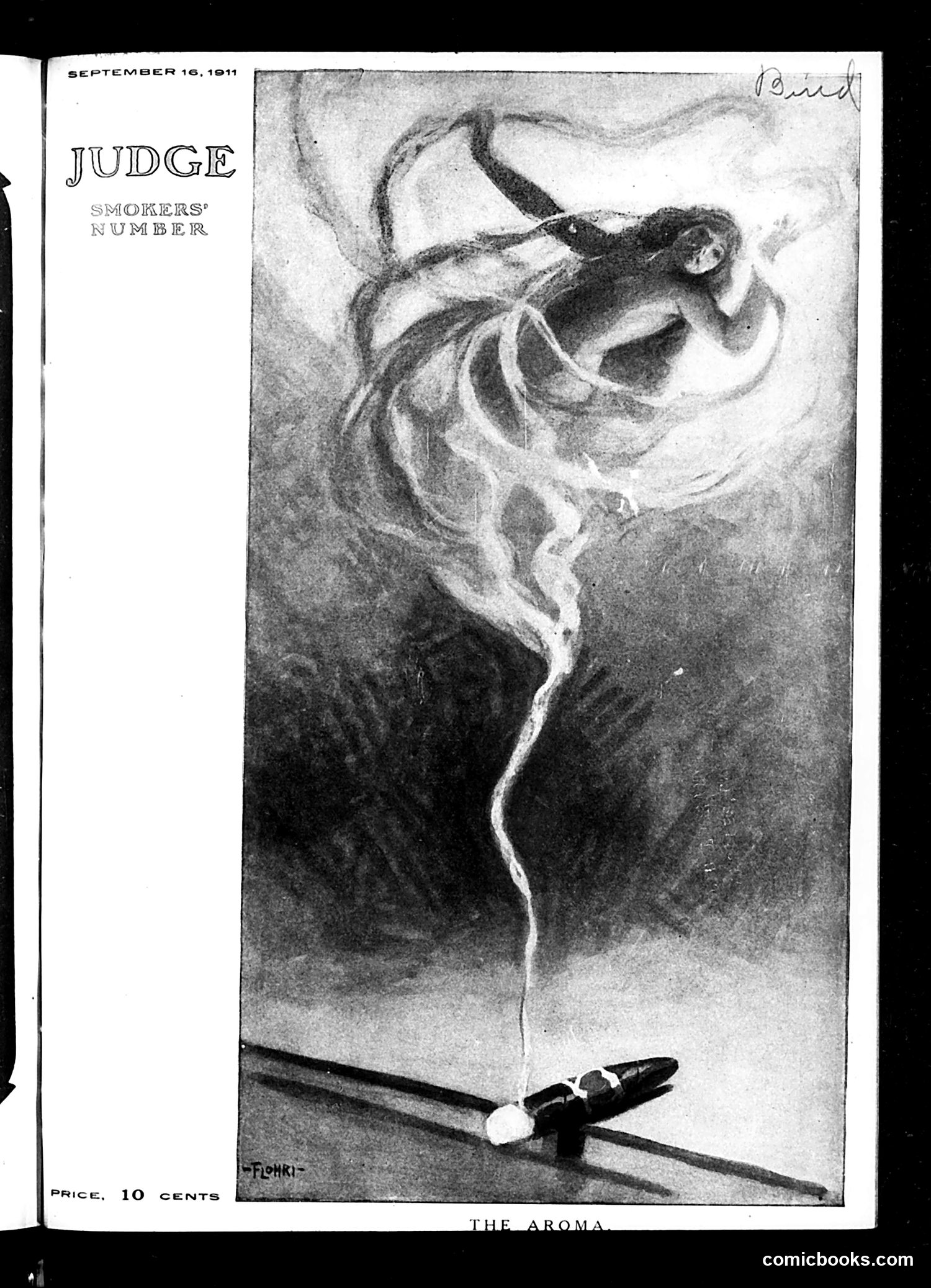
This is a Judge magazine cover from September 16, 1911, titled "Judge Smokers' Number." The illustration shows a bird emerging from cigar smoke, with "The Aroma" captioned below. The cartoon is a straightforward visual pun celebrating cigars and smoking. The bird—likely a dove or similar creature—materializes from the smoke wisps rising from a cigar positioned at the bottom of the image. The joke plays on the literal meaning of "aroma" (fragrance) by depicting the smoke itself taking bird form. This appears to be promotional content for a special "smokers' edition" of the magazine, when cigars were socially acceptable and widely advertised. The price was 10 cents. There's no apparent political satire here—it's simply witty advertising imagery celebrating smoking culture.
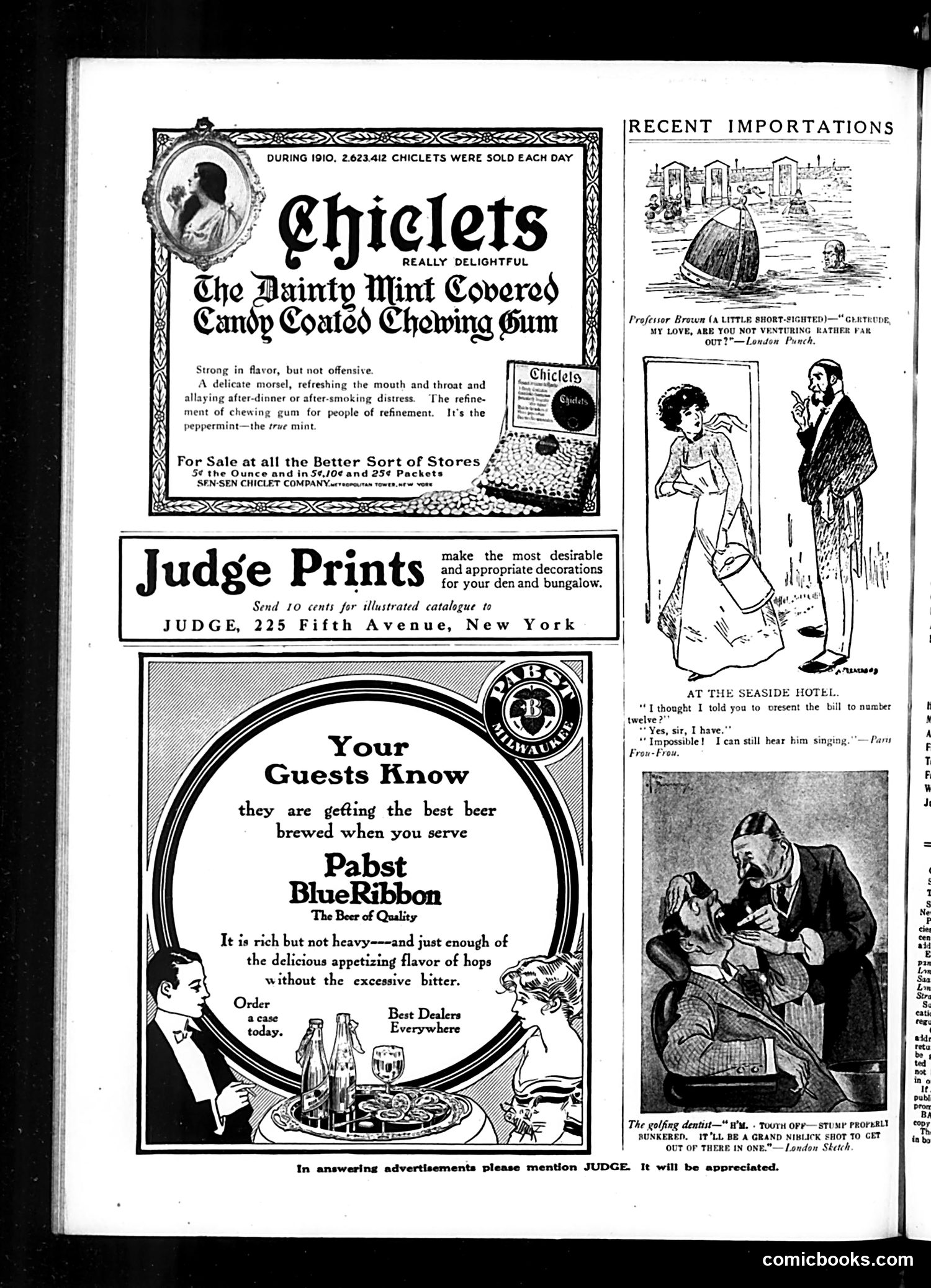
This page is primarily **advertising rather than editorial content**. The main items are: 1. **Chiclets gum ad** (top): References 1910 sales figures, marketing mint-flavored chewing gum as a refined product for "people of refinement." 2. **Judge Prints ad**: Offers decorative artwork for home interiors. 3. **Pabst Blue Ribbon beer ad** (largest): The central advertisement emphasizes quality and appeals to hosts serving guests, highlighting the beer's balanced flavor—"rich but not heavy." The right sidebar contains three separate **cartoon vignettes** from "Recent Importations," appearing to be humorous sketches with British captions, likely satirizing contemporary social situations or English mannerisms, though the specific context is unclear without additional context about Judge's typical editorial themes of the period.
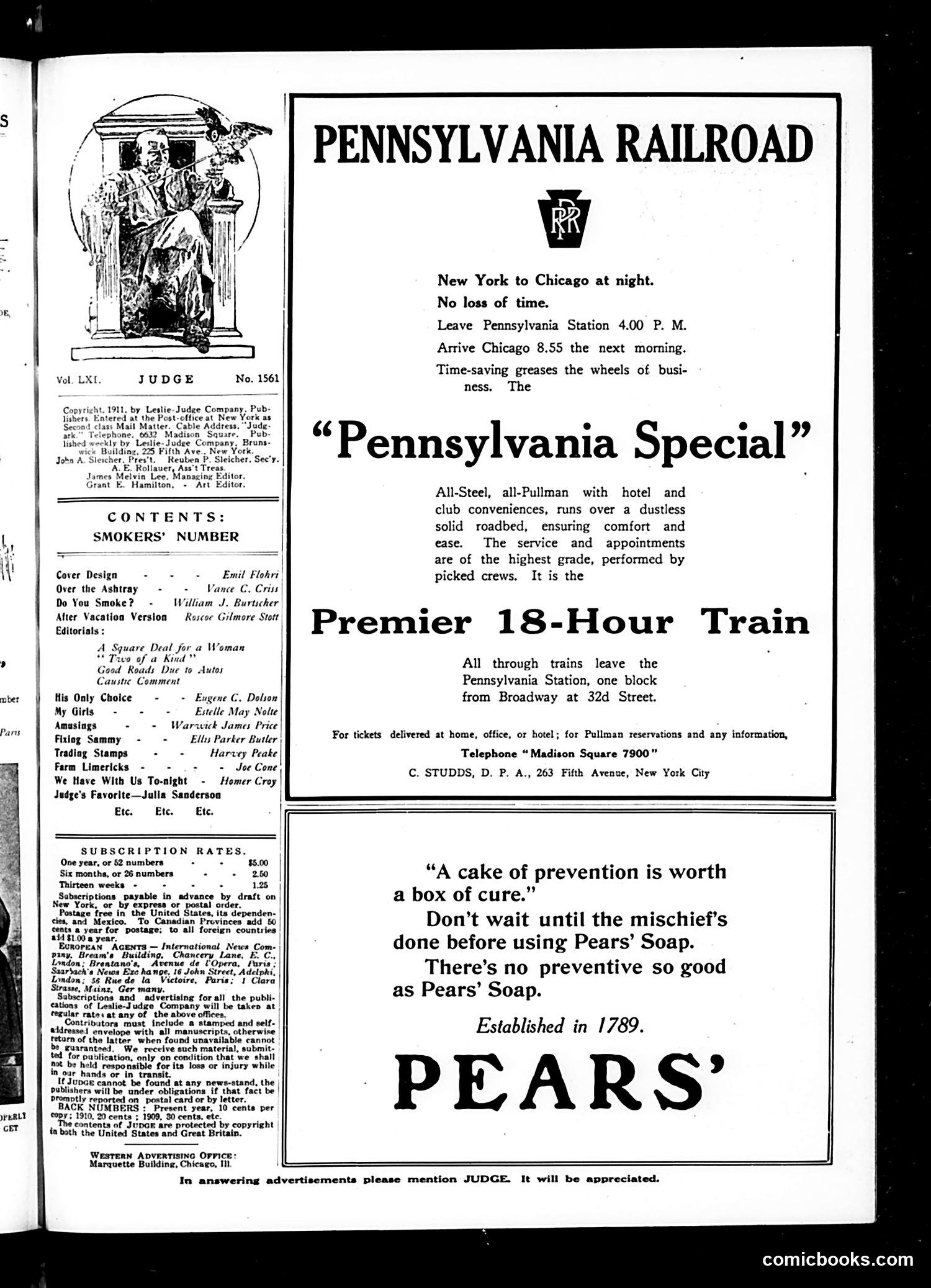
This page is primarily **advertising rather than satirical content**. The dominant features are two full-page ads: 1. **Pennsylvania Railroad advertisement** promoting the "Pennsylvania Special," an 18-hour overnight train from New York to Chicago. It emphasizes speed, comfort, and luxury (all-steel, Pullman cars, hotel and club conveniences). 2. **Pears' Soap advertisement** using the preventive health slogan "A cake of prevention is worth a box of cure," established 1789. The left column shows the magazine's masthead, contents listing (labeled "SMOKERS' NUMBER"), subscription rates, and contributor credits. There is no discernible political cartoon or satirical commentary visible on this particular page—it functions as a commercial issue of *Judge* magazine.
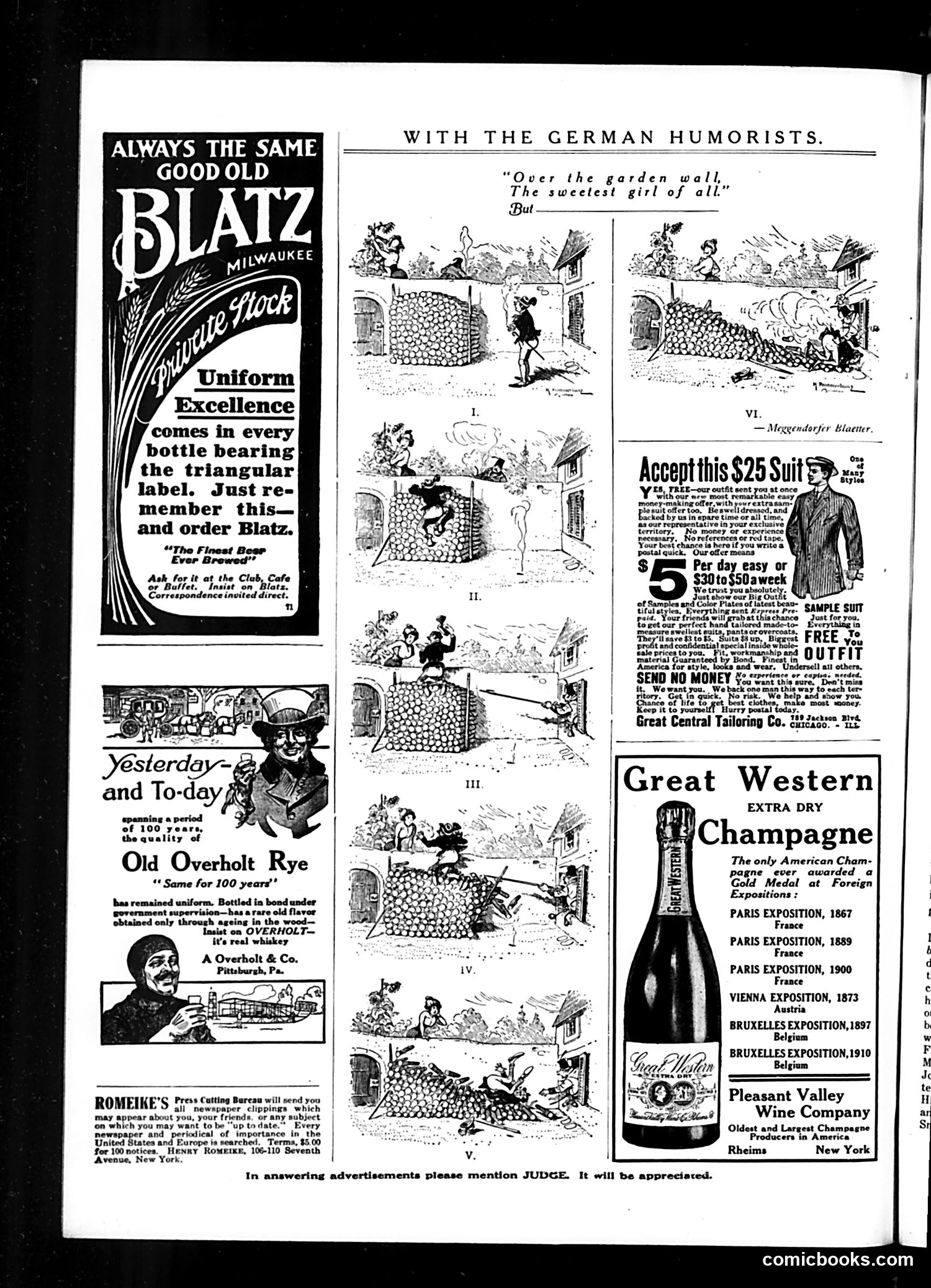
This page features a six-panel German comic strip titled "Over the garden wall, The sweetest girl of all"—but—" The humor appears to involve a romantic scenario where a young man repeatedly attempts to court a girl over a garden wall, with escalating slapstick consequences. Each panel shows him getting knocked down or falling, suggesting the "sweetest girl" is actually quite aggressive or the wall itself proves problematic. The strip satirizes sentimental German romantic poetry and courtship customs by subverting expectations: instead of tender romance, physical comedy ensues. The final panel is labeled "Morgendärfer Blätter" (a German humor magazine). The remaining page content consists primarily of period advertisements for beer, champagne, clothing, and whiskey—typical Judge magazine revenue sources from this era.
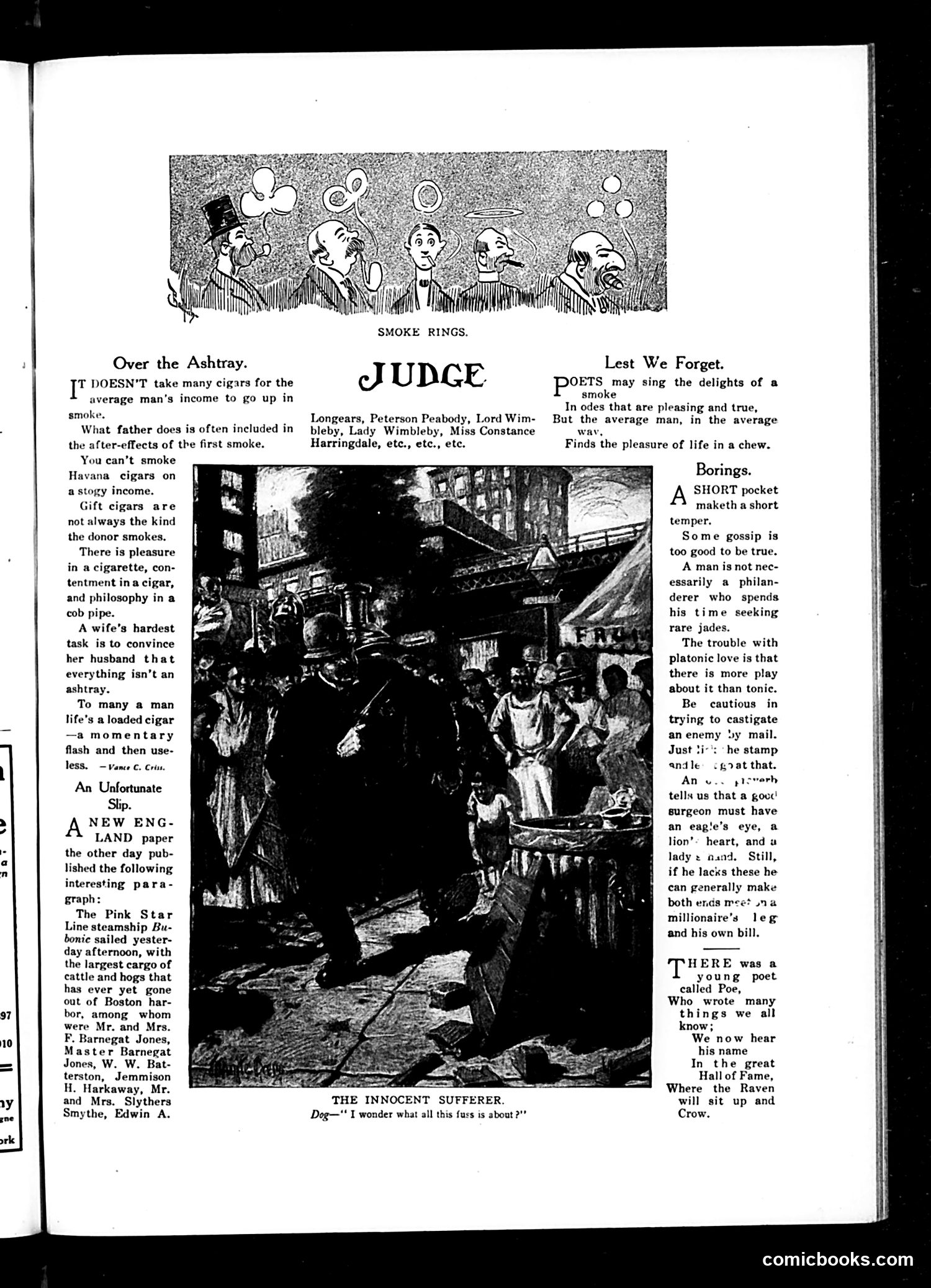
**"Smoke Rings"** (top cartoon): Five men exhale elaborate smoke rings, illustrating different social attitudes toward cigar smoking. The accompanying text discusses how cigars signify different things to different people—luxury for the wealthy, everyday pleasure for working men, and philosophical indulgence for pipe smokers. **"The Innocent Sufferer"** (main illustration): Shows a crowded street scene with a dog in the center, captioned "I wonder what all this fuss is about?" The image satirizes urban chaos and confusion, with the innocent dog representing bewilderment amid busy city life. The remaining text includes various brief humorous observations ("Borings," "Judge," "Lest We Forget") offering social commentary on everyday behaviors and human nature.
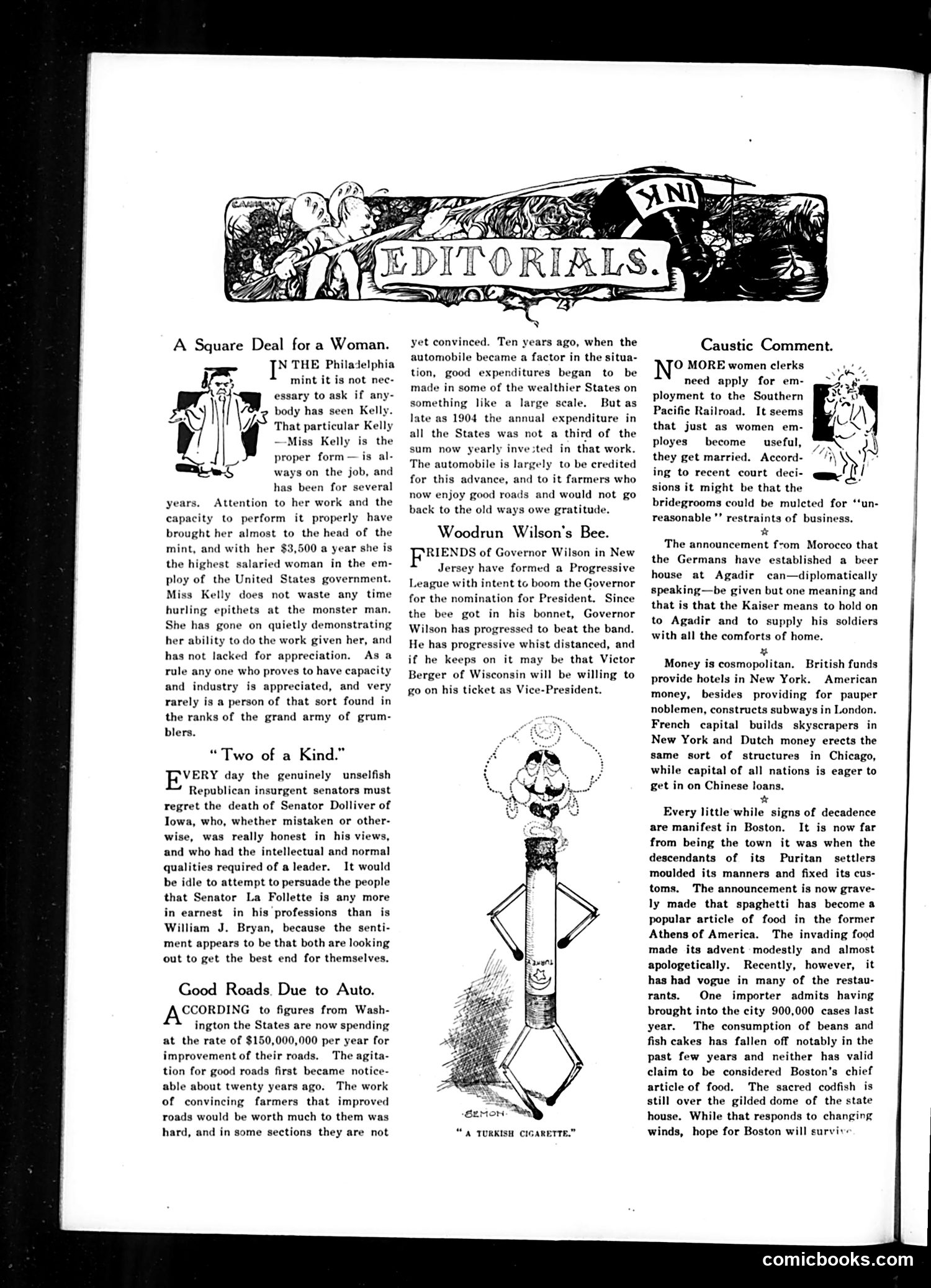
This page from the satirical magazine **Judge** contains several short editorials with accompanying cartoons: **"A Square Deal for a Woman"** praises Miss Kelly, the highest-paid female federal employee at the Philadelphia Mint, as an example of meritocratic advancement. The article argues she succeeded through competence rather than complaint—a subtle dig at suffragists and labor activists of the era. **"Two of a Kind"** mocks Republican insurgent senators, comparing Senator La Follette unfavorably to the recently deceased Senator Dolliver. It accuses both La Follette and Democrat William Jennings Bryan of self-serving ambition masked as principle. **"Good Roads Due to Auto"** credits automobiles with spurring road improvement, noting farmers previously resisted road investment but now appreciate the results. **"Woodrun Wilson's Bee"** jokes that New Jersey Governor Woodrow Wilson's presidential ambitions have made him obsessively "progressive," suggesting his ideology is opportunistic rather than genuine. The **Turkish Cigarette cartoon** appears decorative rather than satirical. Right-column items address miscellaneous topics: women railroad workers, German expansion in Morocco, and international capital flows.
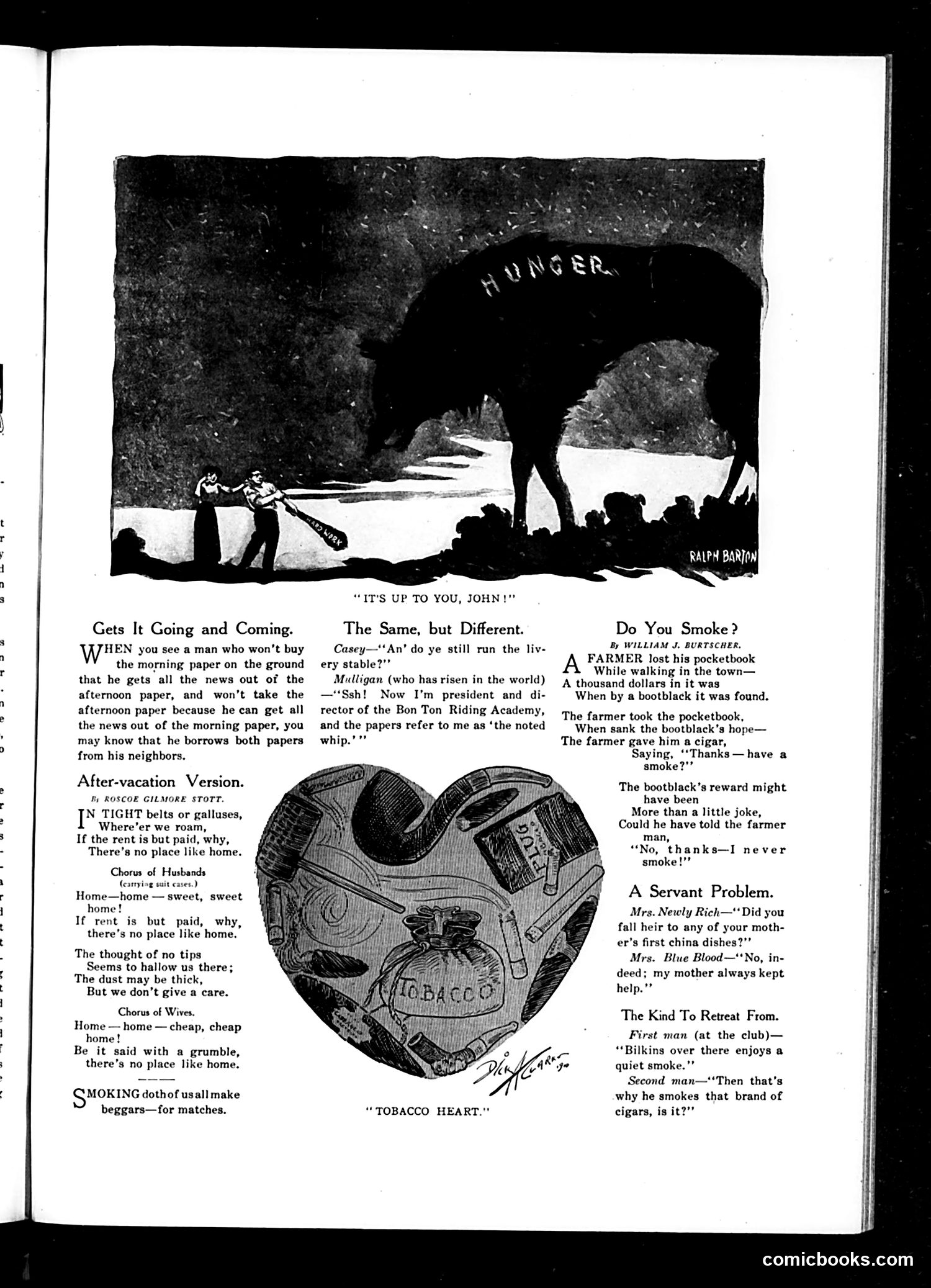
This page contains multiple short humorous pieces typical of early-20th-century American satirical magazines. **Main cartoon** (top): "It's Up to You, John!" depicts a giant moose labeled "Hunger" looming over tiny figures, likely referencing Theodore Roosevelt's famous 1909 African hunting expedition. The satire suggests Roosevelt must solve America's economic troubles. **Text pieces** satirize contemporary social anxieties: - **"Gets It Going and Coming"**: Mocks a man who won't buy morning papers but borrows both morning and afternoon editions from neighbors—absurd penny-pinching behavior. - **"After-vacation Version"**: A song parody where husbands celebrate returning home (avoiding hotel tips) while wives grumble about cheapness and household dust. - **"Do You Smoke?"** and related anecdotes: Gentle humor about smoking habits and social etiquette, including a bootblack who refuses a cigar reward. - **"Tobacco Heart"** illustration: A decorative drawing of a heart-shaped tobacco pouch. The page reflects period preoccupations: economic thrift, class distinctions, and smoking as a social marker.
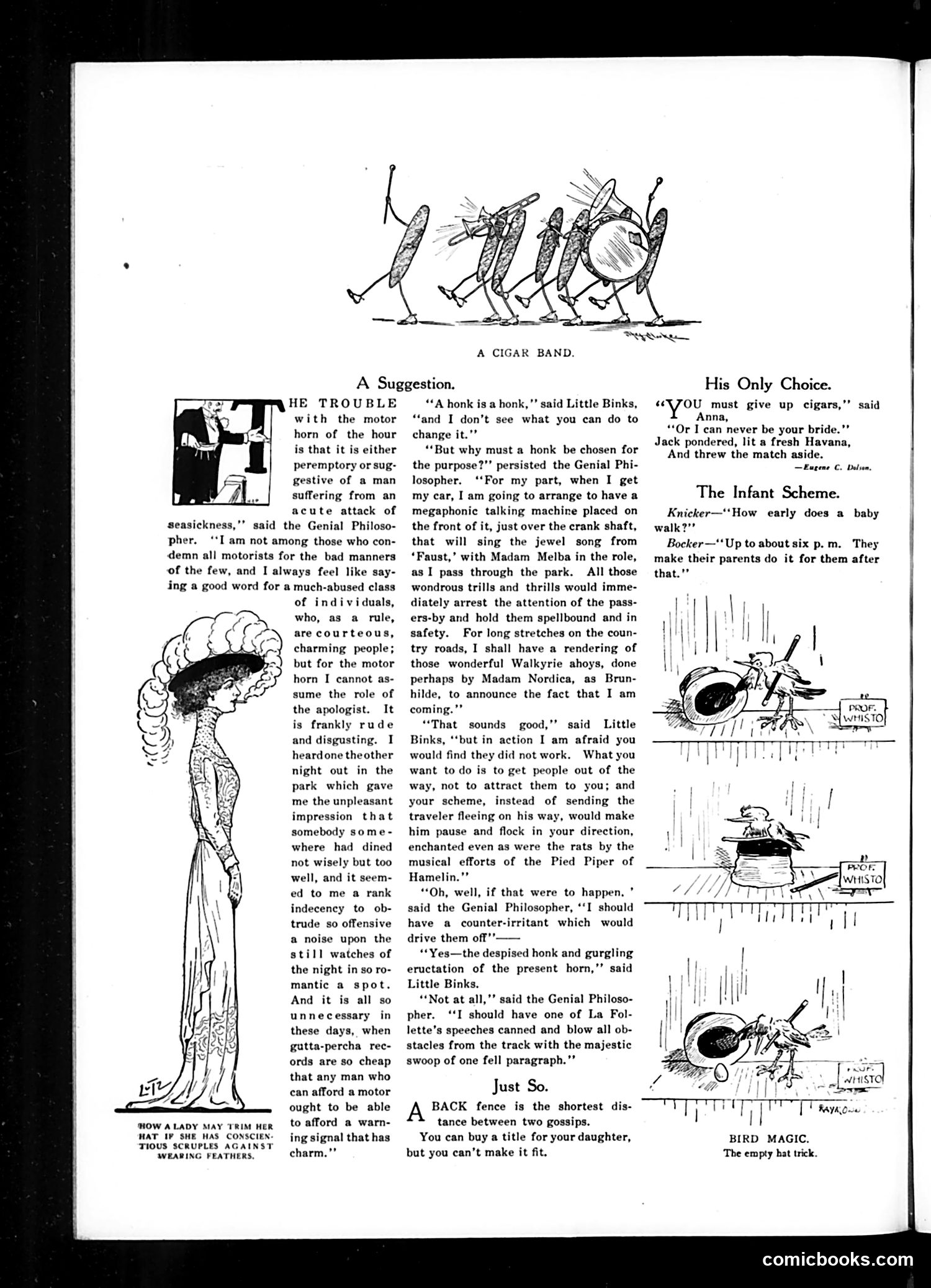
This page contains multiple humorous pieces from Judge magazine: **"A Cigar Band"** (top): A simple cartoon showing anthropomorphic cigars marching like a band, playing instruments. **"A Suggestion"** (main text): A satirical dialogue between the "Genial Philosopher" and "Little Binks" about automobile horn noise pollution. The Philosopher proposes replacing crude horn honks with opera recordings (featuring famous singers Melba and Nordica) to warn pedestrians. Binks points out this would attract rather than repel people—like the Pied Piper. The philosopher's retort: he'd use recorded speeches by Senator La Follette (a real political figure of the era) to clear the road. The satire mocks both automobile nuisance and political verbosity. **"His Only Choice"**: A brief poem about a man choosing cigars over marriage. **"The Infant Scheme"**: A joke about babies walking—parents make them do it after 6 p.m. **"Bird Magic"** and other items: Brief humorous observations about fashion and gossip. The page reflects early 1900s concerns about motorcar noise and contemporary figures like Senator La Follette.
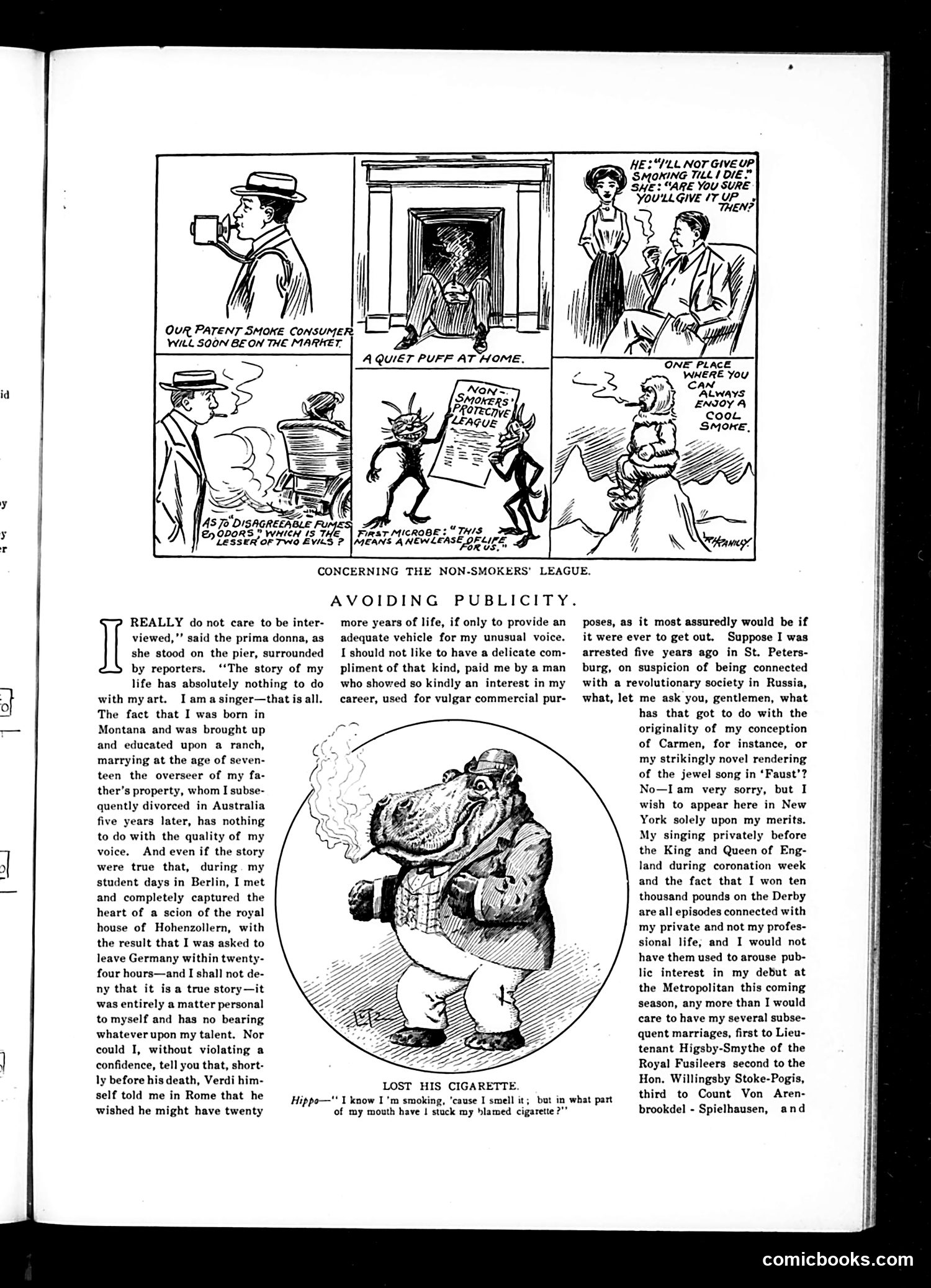
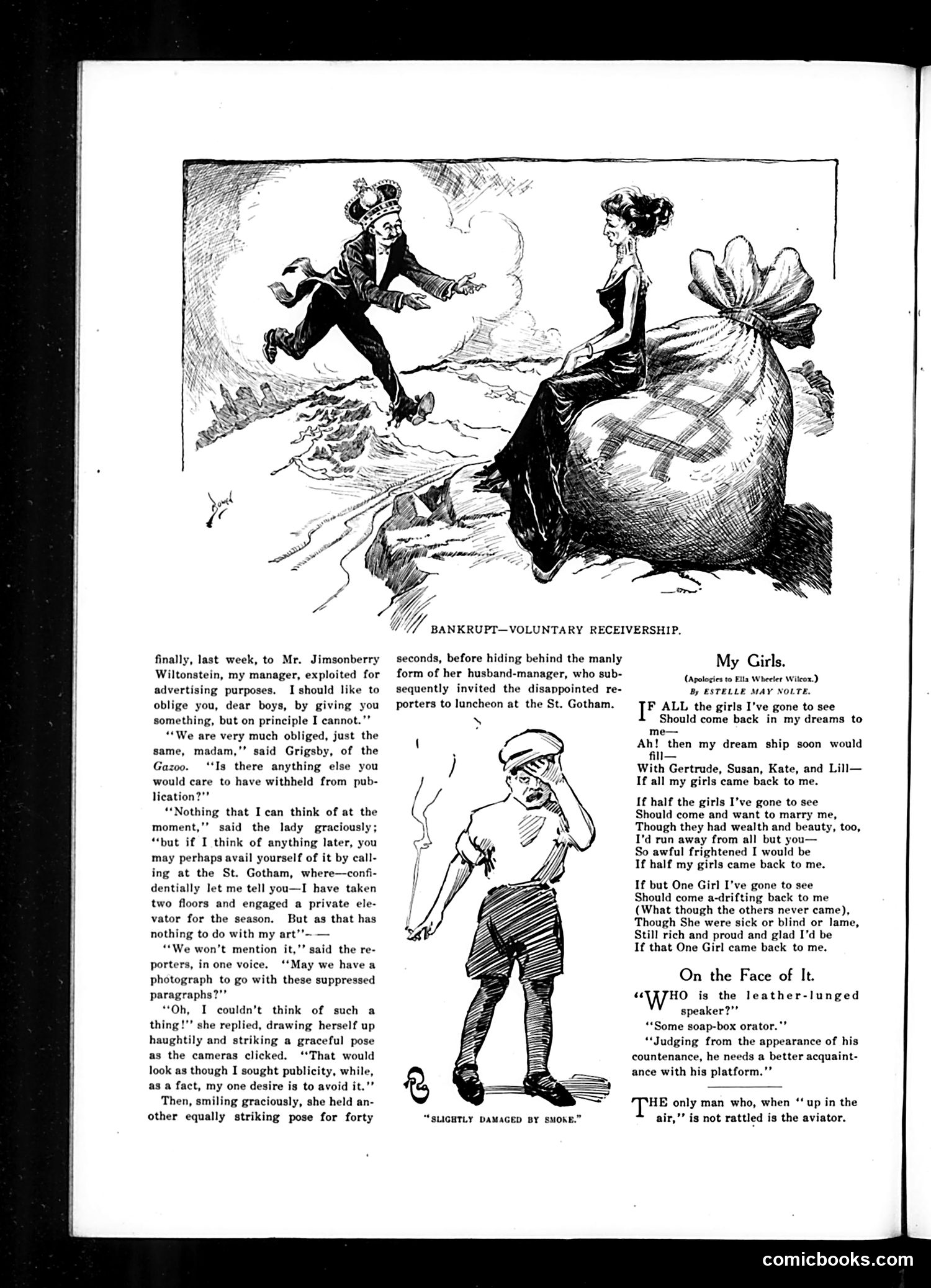
**Top Cartoon (Bankrupt—Voluntary Receivership):** This satirizes a wealthy woman's transparent hypocrisy. She refuses to give reporters anything for publication while simultaneously posing for photographs and arranging elaborate social events—clearly craving the publicity she claims to avoid. The "voluntary receivership" title suggests her financial troubles, mocking her pretense of importance while she's actually in decline. **Text Section (My Girls):** A sentimental poem about romantic nostalgia, likely humorous in its maudlin excess—typical of the magazine's parodic approach to popular poetry of the era. **Bottom Cartoon:** Two brief jokes: one mocks a soap-box orator's disheveled appearance, suggesting his passionate speech-making has literally damaged his face; the second makes a pun about aviators being unafraid ("not rattled") when airborne. The page exemplifies Judge's satirical approach: mocking social pretension, vanity, and the absurdities of public figures trying to manage their images.
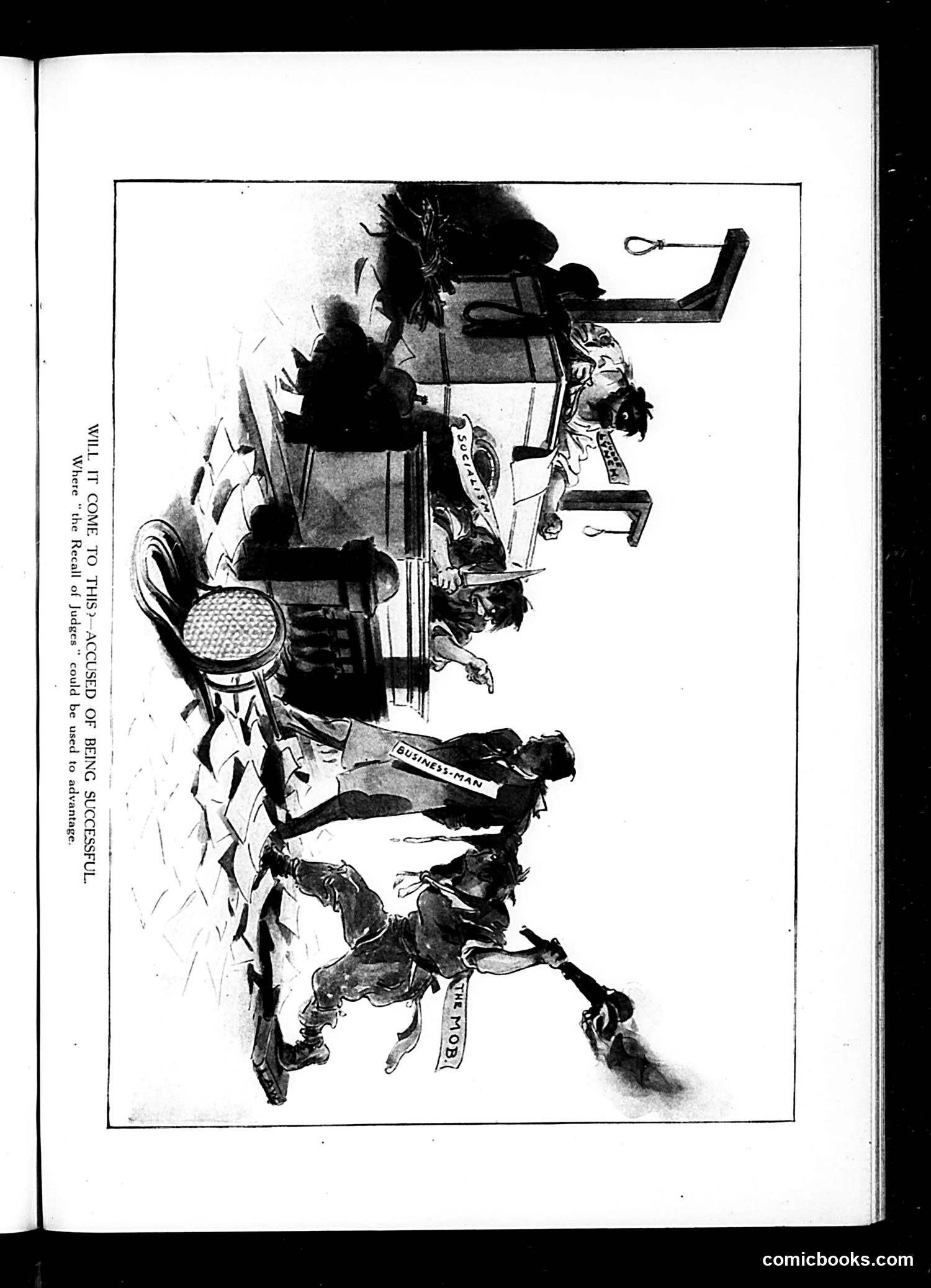
This Judge magazine cartoon satirizes the "recall of judges" movement—a progressive-era reform allowing voters to remove elected judges. The image shows a courtroom scene turned upside-down, depicting the chaos such recalls might create. The cartoon warns that successful judges could face removal simply for being effective, rather than corrupt. The overturned furniture and disarray suggest judicial instability and disorder. The figure labeled "BUSINESSMAN" appears targeted, suggesting the cartoon defends business interests against progressive reforms. The satire argues that recall mechanisms, intended to punish judicial misconduct, could instead be weaponized against competent jurists. This reflects late-19th/early-20th-century debates between conservatives opposing progressive reforms and reformers seeking greater democratic control over institutions.
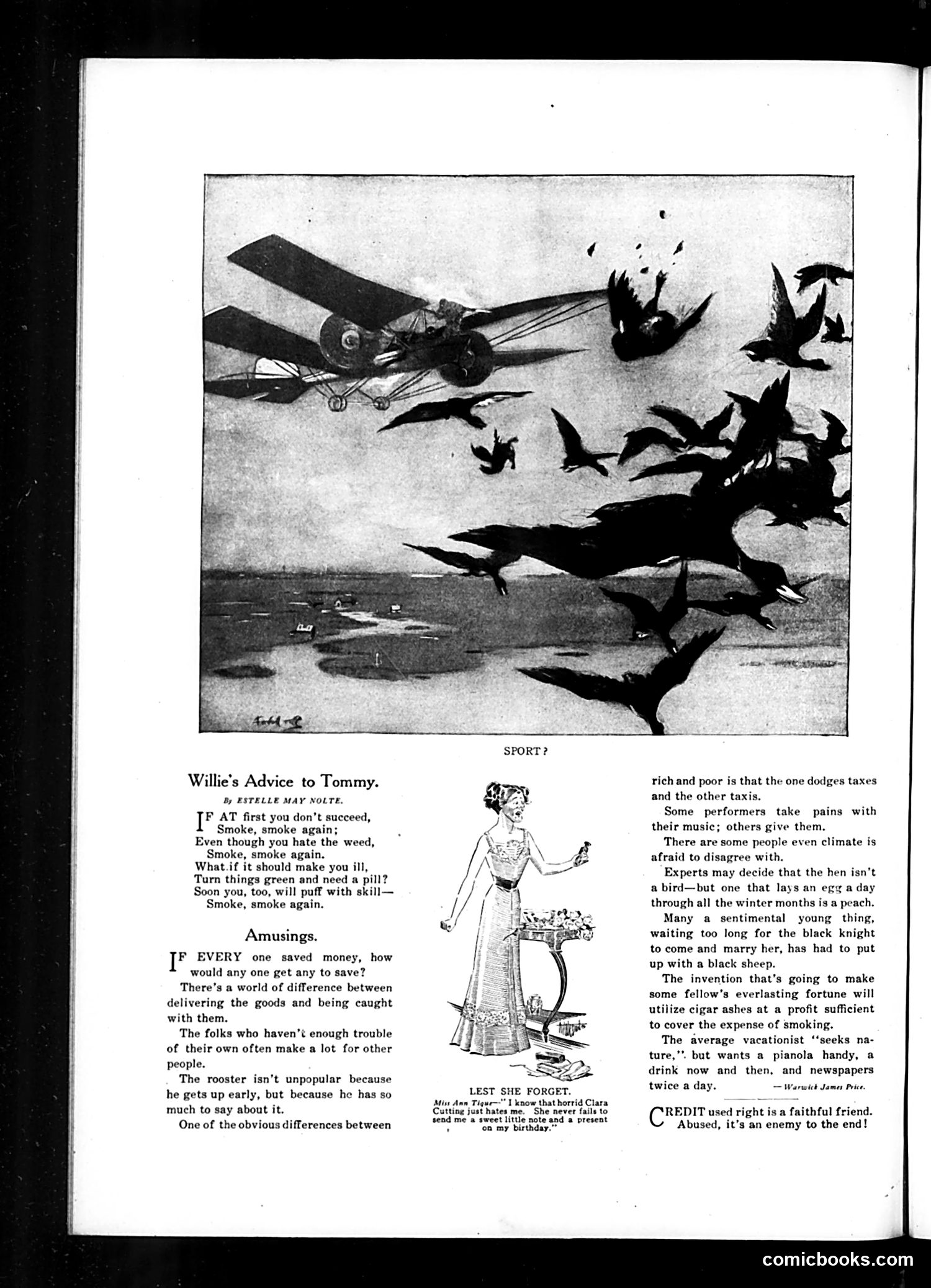
This page contains a satirical poem and humorous aphorisms typical of early-20th-century American magazines. **"Willie's Advice to Tommy"** is a mock-serious poem mocking youth smoking habits. It parodies self-help mantras ("If at first you don't succeed") by applying them absurdly to cigarette smoking—suggesting young people persist in smoking despite health consequences ("make you ill"). The satire targets both the normalization of smoking among youth and the era's contradictory attitudes: smoking was widespread yet acknowledged as potentially harmful. **"Amusings"** is a collection of wry social observations on human nature and contemporary customs—touching on money, class differences (tax dodging vs. taxi riding), performers, weather, romantic disappointment, invention, and tourism. These are cynical observations typical of Judge's satirical humor. **The airplane illustration** at top appears decorative, possibly referencing modern aviation as a novel curiosity. The small illustration of a woman with a kitten carries a caption about a social slight, exemplifying the magazine's focus on genteel social drama and gossip. Overall, this reflects Judge's approach: mixing political/social satire with light social commentary for educated, middle-class readers.
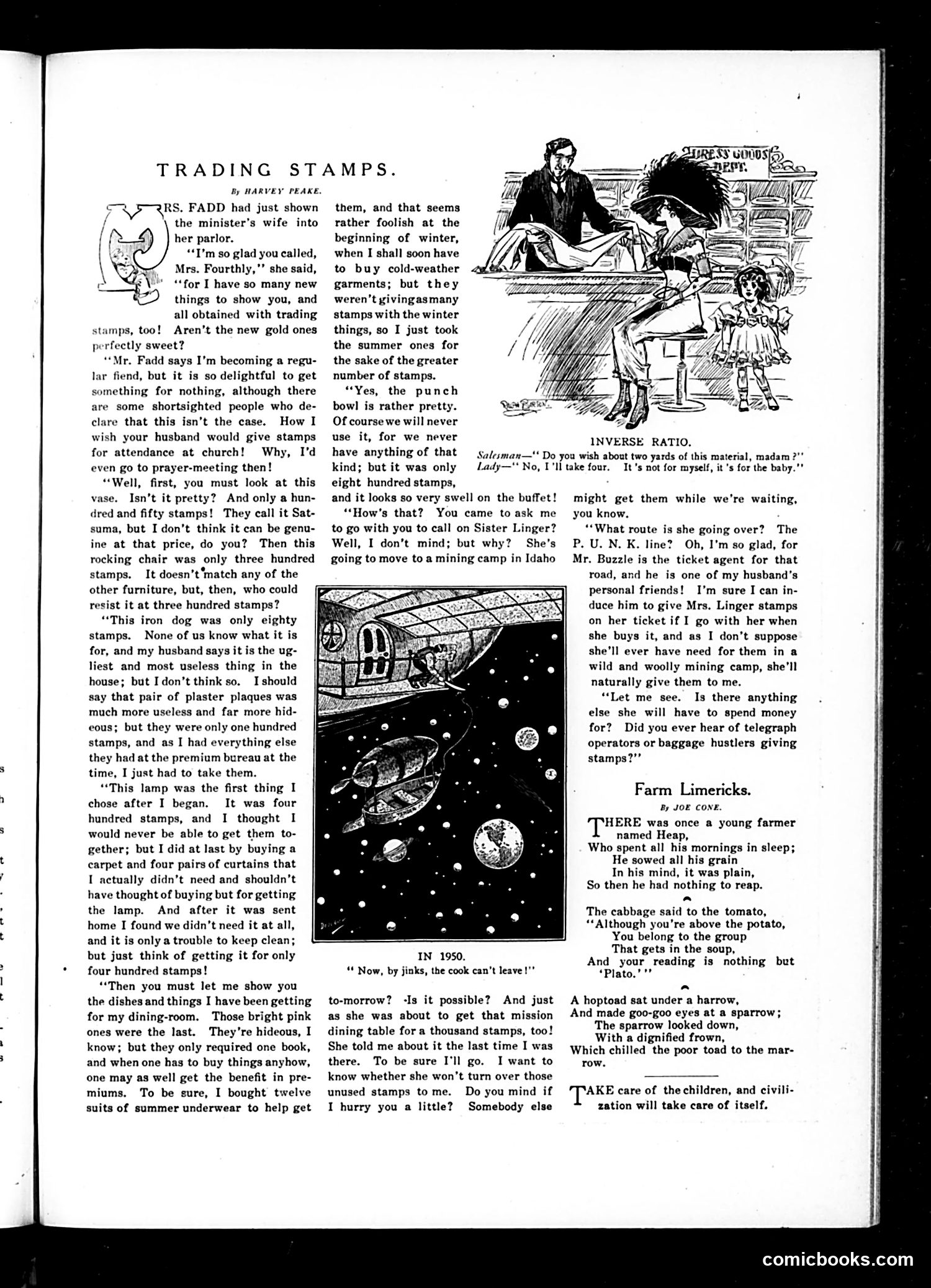
This Harvey Peake satirical piece mocks the trading stamp craze of the early 1900s. Mrs. Fadd represents consumers obsessed with accumulating "free" premiums through stamps, despite the economic irrationality. She's purchased useless items—a hideous iron dog, plaques, an unwanted lamp requiring her to buy unnecessary curtains—simply because stamps made them seem "free." The satire targets the psychology of perceived value: she'd rather attend prayer meetings for church stamps than genuine faith. The cartoon exposes how trading stamps manipulate consumers into wasteful spending, disguising the actual cost. The joke is that getting something "for nothing" actually costs more money in unnecessary purchases. This reflects Progressive Era consumer skepticism about manipulative marketing tactics. The secondary cartoon, "Inverse Ratio," extends the theme: buying excess quantities (four yards instead of two) just because they're available, regardless of actual need.
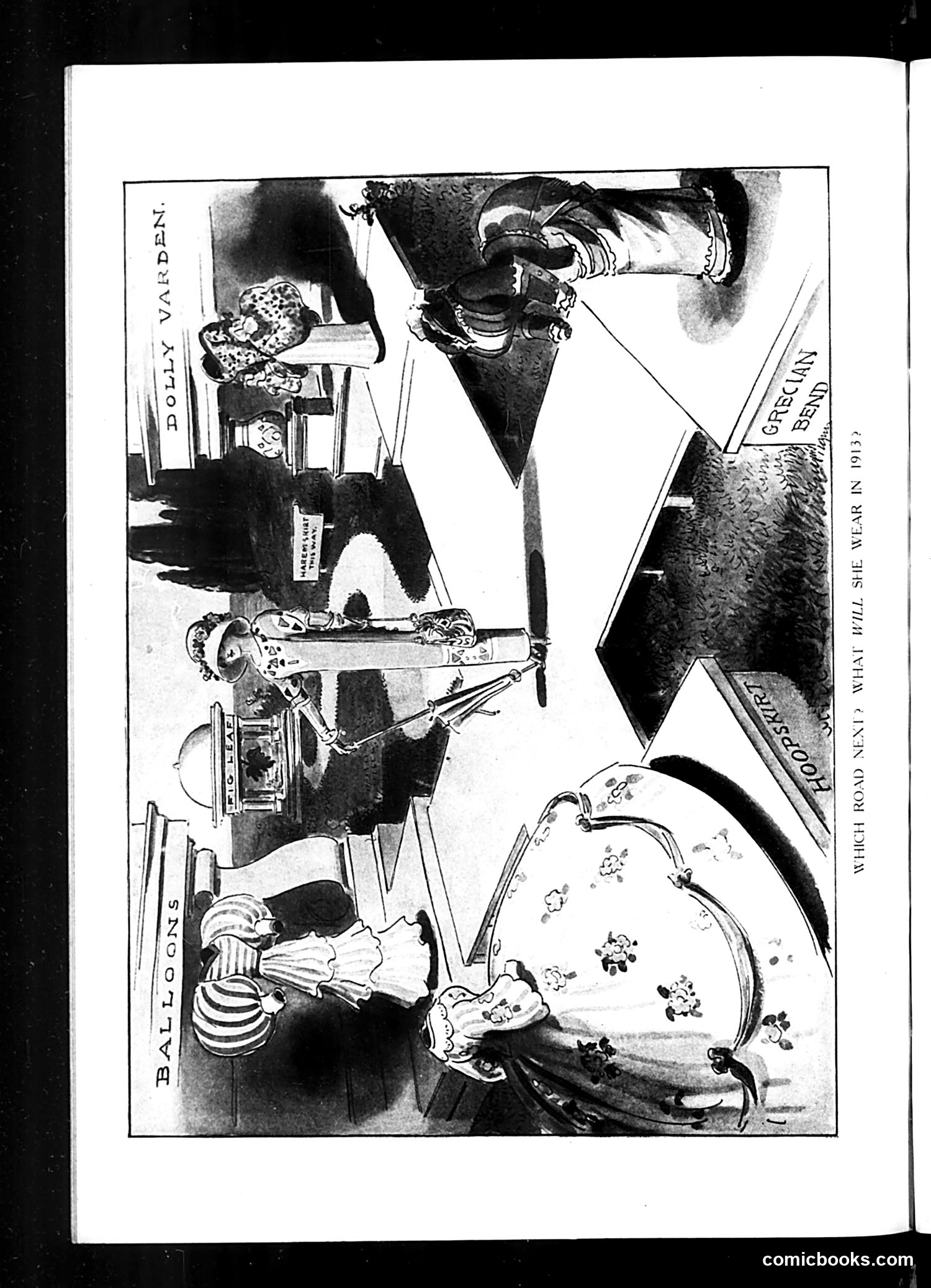
This page appears to be rotated, making the OCR text largely illegible. The visible cartoon shows what appears to be early 20th-century satirical illustrations featuring figures in period dress and decorated objects (possibly balloons or vessels marked with emblems). The text fragments visible include references to "BALLOONS," "BODY GUARD," and "GERMANY" along with what appears to be a date reference to 1913. This suggests the cartoon likely comments on pre-World War I international tensions, possibly depicting German militarism or diplomatic concerns of that era. However, without legible OCR text or the ability to read the caption clearly, I cannot confidently identify specific figures or explain the precise satirical point. The illustrations appear allegorical, but their exact meaning requires clearer source material.
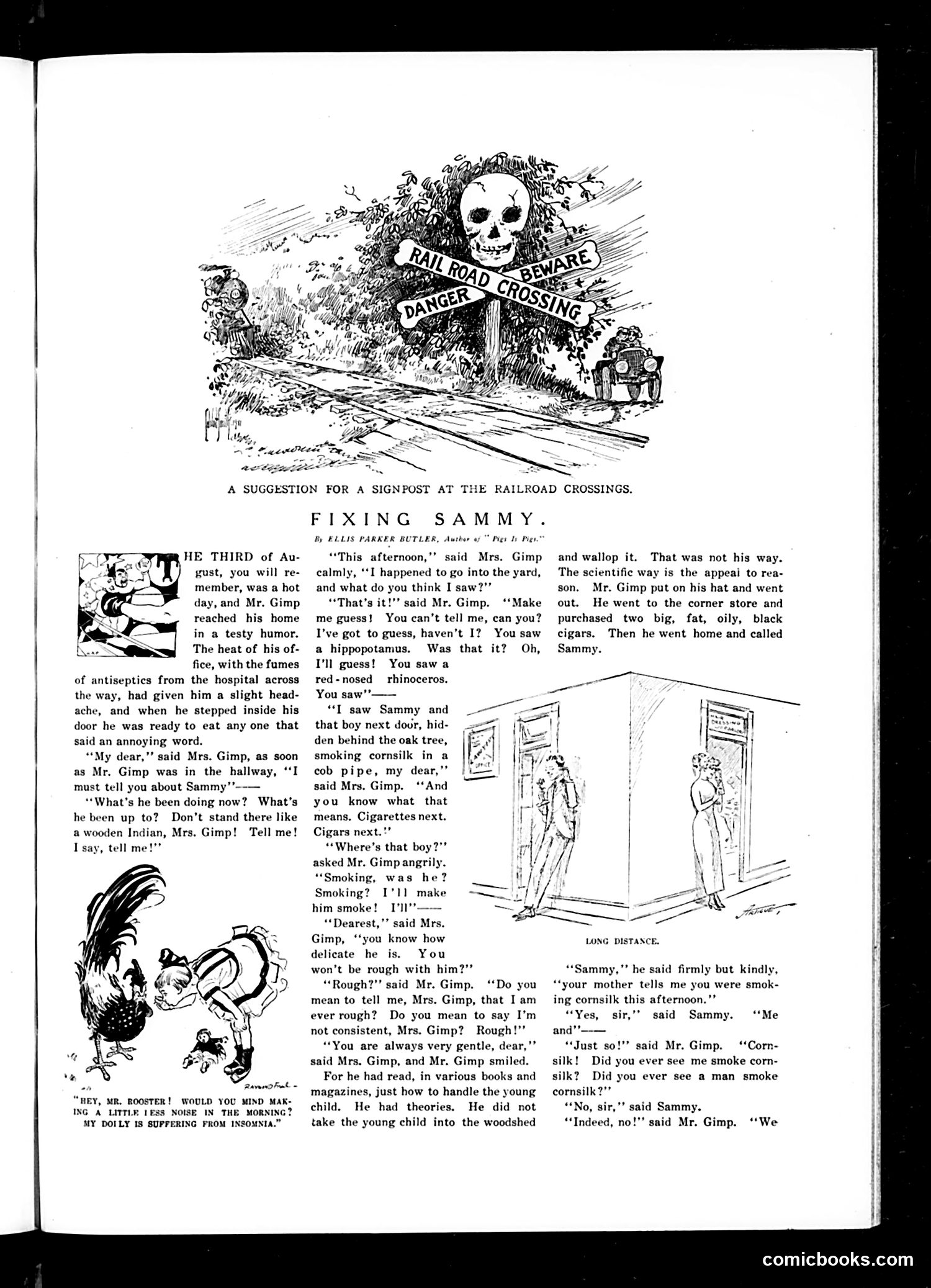
This is a humorous story by Ellis Parker Butler about child discipline, not political satire. The narrative depicts Mr. Gimp, an irritable father, discovering his son Sammy smoking cornsilk with a neighbor's boy. Rather than physically punishing the child (the "woodshed" method common in that era), Mr. Gimp employs "scientific" reasoning—a contemporary parenting theory emphasizing psychology over corporal punishment. He buys cigars and demonstrates to Sammy that adults don't smoke cornsilk, using logical persuasion instead of force. The top cartoon shows a skull-and-crossbones railroad crossing warning sign, satirizing railway safety with dark humor—a separate feature unrelated to the story below. The humor lies in the contrast between old-fashioned harsh discipline and the emerging "modern" psychological approach to child-rearing that was gaining popularity in early 20th-century America.
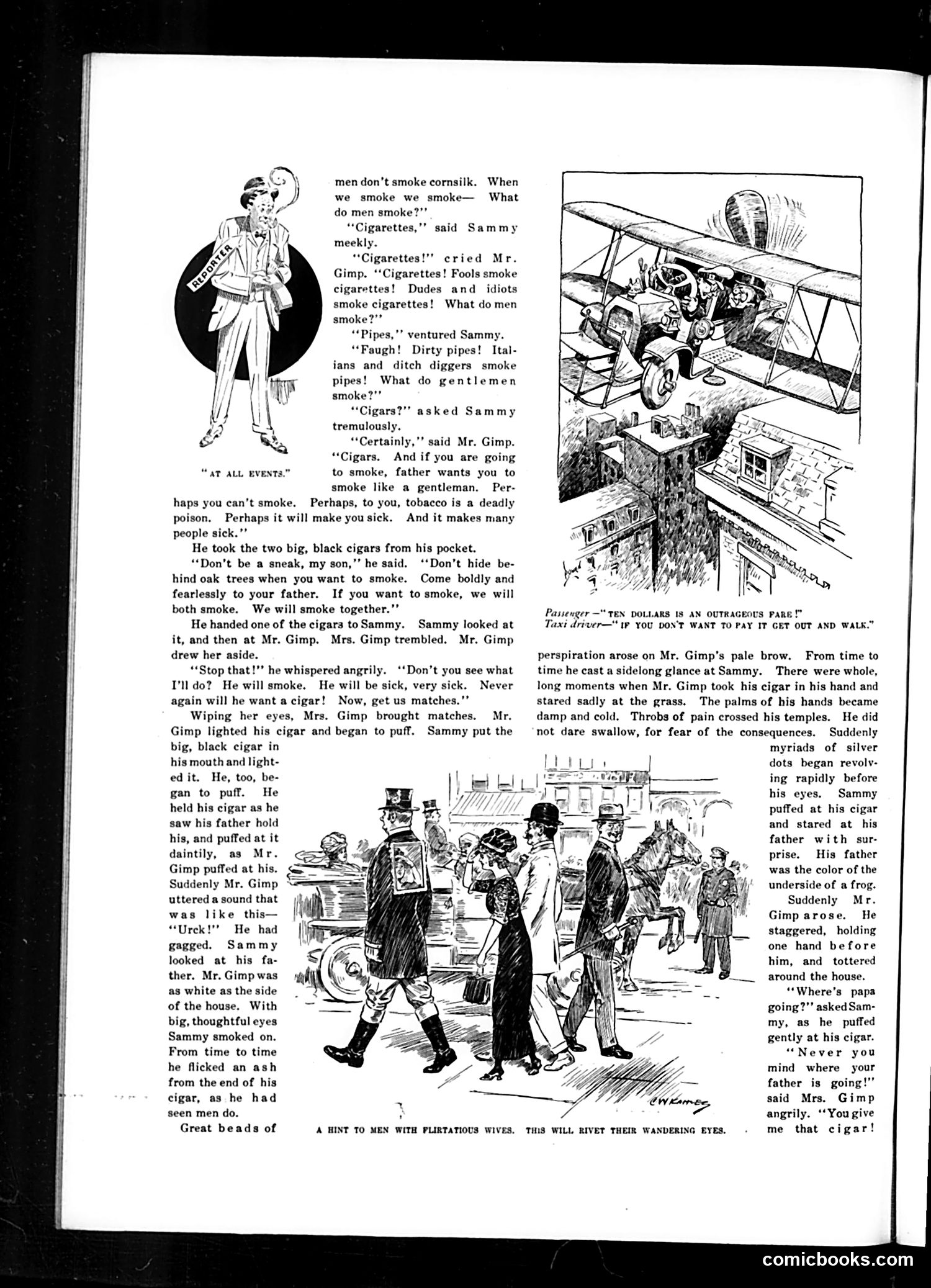
This is a humorous domestic story satirizing paternal hypocrisy and the masculine pretense around cigar-smoking. Mr. Gimp lectures his son Sammy about "smoking like a gentleman," claiming only cigars are proper while cigarettes are for "fools" and "dudes." He insists they smoke together boldly and openly. The joke: Mr. Gimp's bravado immediately collapses. While young Sammy puffs the cigar with ease, his father becomes violently ill—turning white, sweating, seeing stars, and eventually staggering away to presumably vomit. Sammy calmly continues smoking, utterly unimpressed by his father's distress. The satire targets masculine posturing: men lecturing about proper behavior while being unable to practice what they preach. It's also a gentle joke about nicotine sensitivity and the foolishness of forcing oneself to smoke for appearances' sake. The final panel shows Mrs. Gimp angrily demanding the cigar back, having caught on to the scheme's failure.
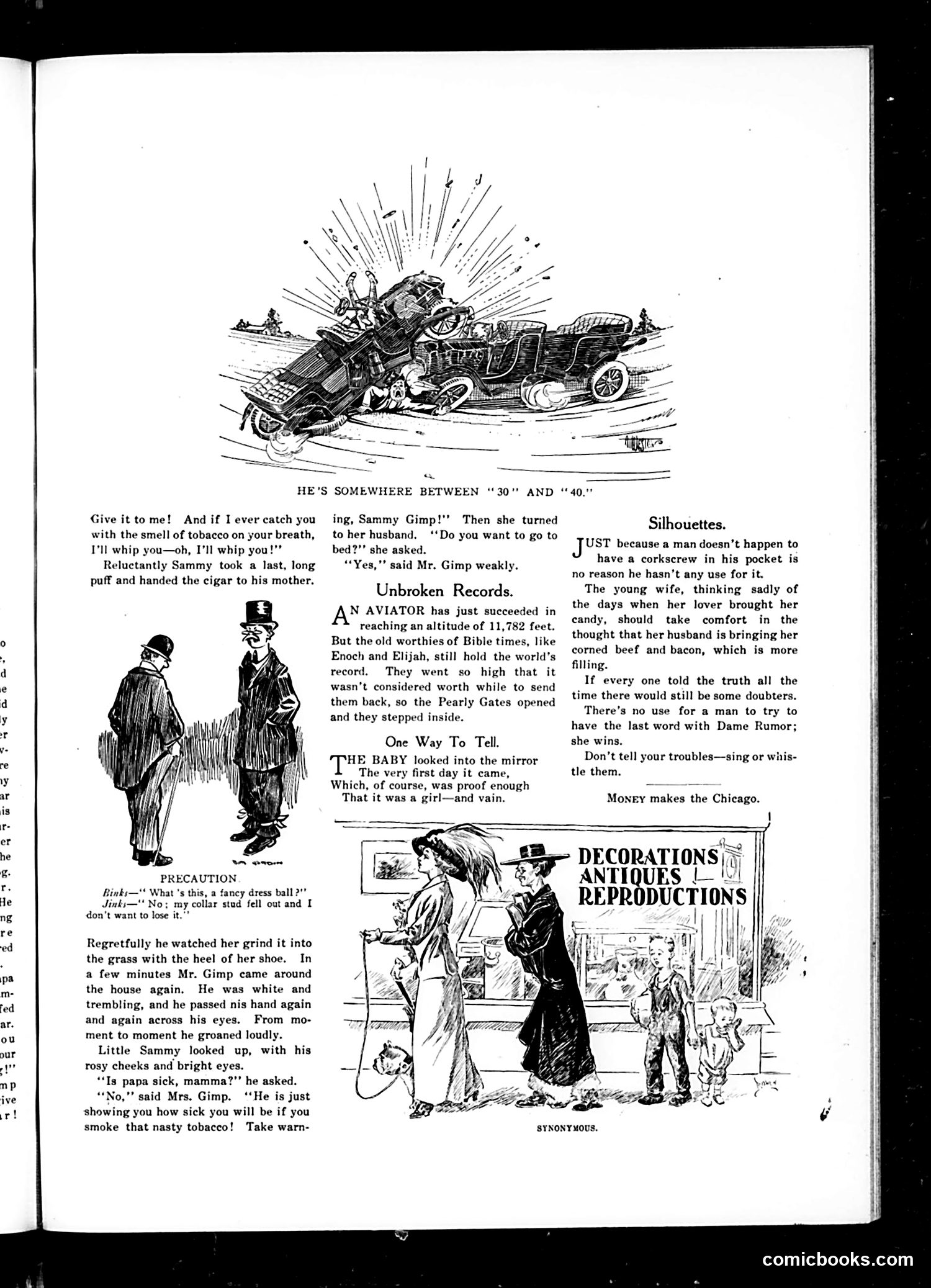
This page contains several brief satirical pieces typical of early 20th-century humor magazines: **Main cartoon** (top): Shows a collision between an old car and motorcycle, captioned "He's Somewhere Between '30' and '40'" — likely satirizing ambiguous dating or age claims. **"Precaution"**: Mocks overly strict parenting. A mother forces her young son Sammy to quit smoking cigars by threatening punishment, then dramatically demonstrates illness to him—exaggerated parental dramatics for comic effect. **"Unbroken Records"**: Jokes about an aviator's altitude record by comparing it to biblical figures (Enoch, Elijah) who supposedly ascended to heaven—religious humor suggesting modern achievements pale against ancient claims. **"One Way To Tell"**: A brief joke: a baby looking in a mirror proves it's a girl due to vanity—period sexist humor about feminine narcissism. **"Silhouettes"**: A series of aphoristic one-liners offering cynical observations about relationships, honesty, and rumor. The page reflects early 1900s satirical magazine conventions: domestic humor, gentle mockery of social pretension, and quick quips.
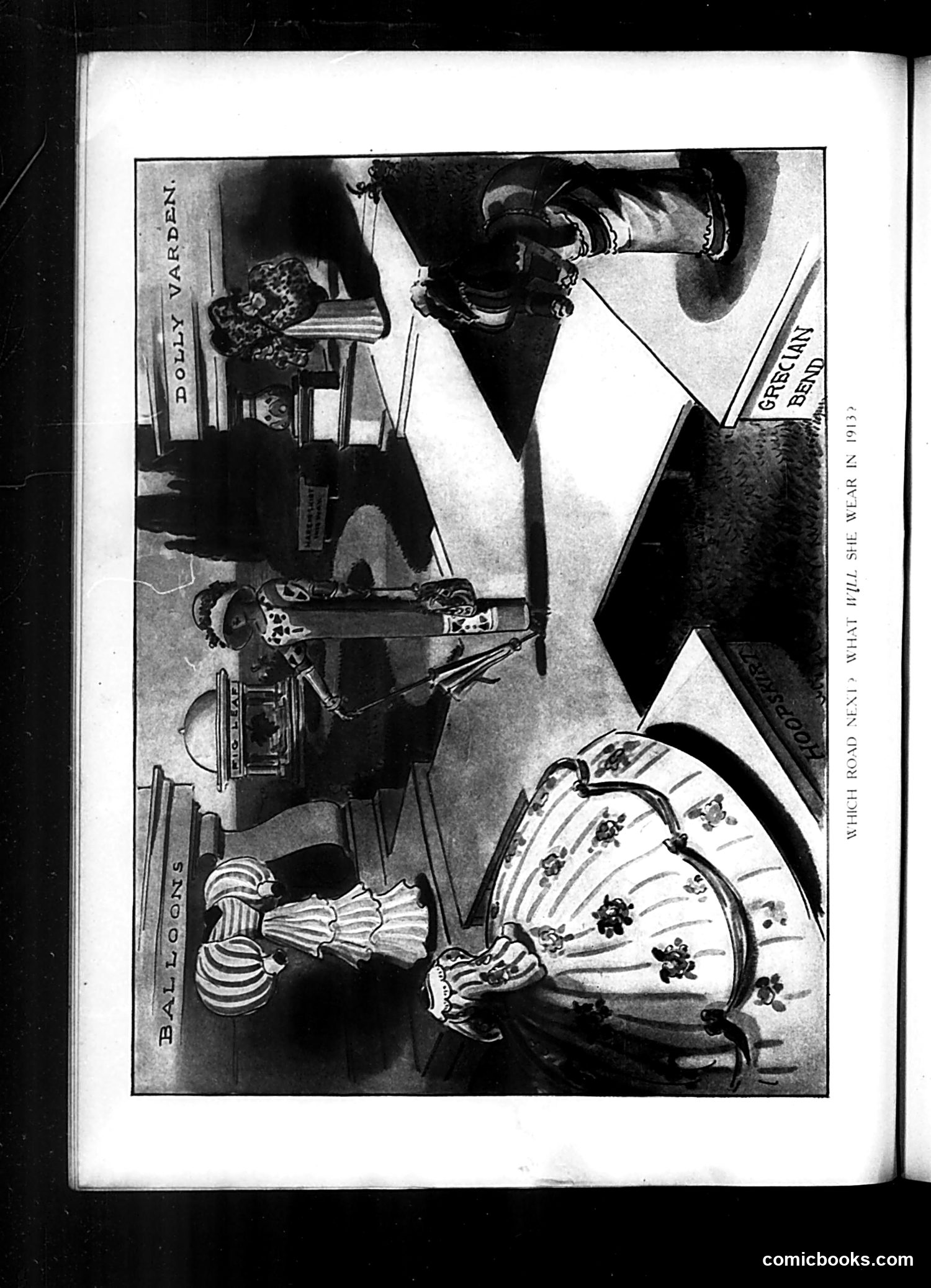
This page shows a rotated photograph (printed upside-down) depicting what appears to be a woman in 1910s-era dress examining a road sign or directional marker. The visible text references "Sen. Dolly Varden" and asks "Which Road Neni?" (likely "Which Road Next?"). "Dolly Varden" was a period slang term for a fashionable woman or flirtatious girl. The satire appears to mock a female senator or political figure (unclear which real person is caricatured) as indecisive about policy direction—the "road" being a metaphor for political choices. The photograph's deliberate upside-down printing may itself be part of the joke, suggesting confusion or absurdity. Without clearer identification of the specific senator referenced, the precise political target remains uncertain.
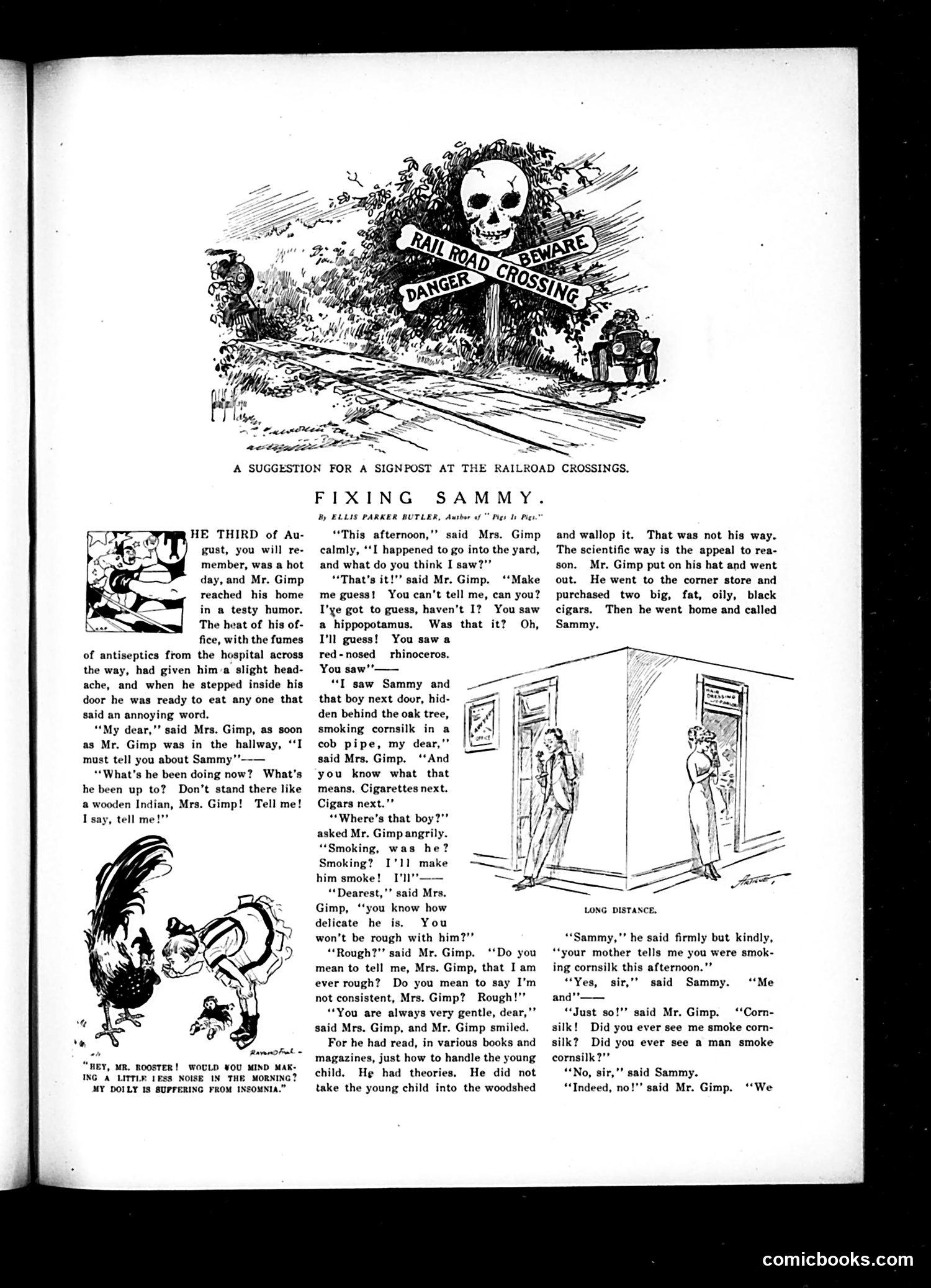
This story by Ellis Parker Butler satirizes early 20th-century "scientific" parenting theories that rejected physical punishment in favor of psychological persuasion. **The Setup:** Mr. Gimp discovers his son Sammy smoking cornsilk with a neighbor boy. Rather than spanking him (the traditional method), Gimp employs modern parenting advice he's read—appealing to reason instead of using the woodshed. **The Satire:** Butler mocks the pretension of these new theories. Gimp's approach—buying real cigars and asking rhetorical questions like "Did you ever see a man smoke cornsilk?"—is presented as absurdly indirect and ineffectual compared to old-fashioned discipline. **The Humor:** The contrast between Gimp's violent initial impulse ("I'll make him smoke!") and his forced gentleness reveals the tension between traditional and modern parenting philosophies. The story suggests that intellectual parenting methods, while well-intentioned, miss the point of actual discipline. The railroad-crossing cartoon at top appears unrelated—a memento mori safety warning.
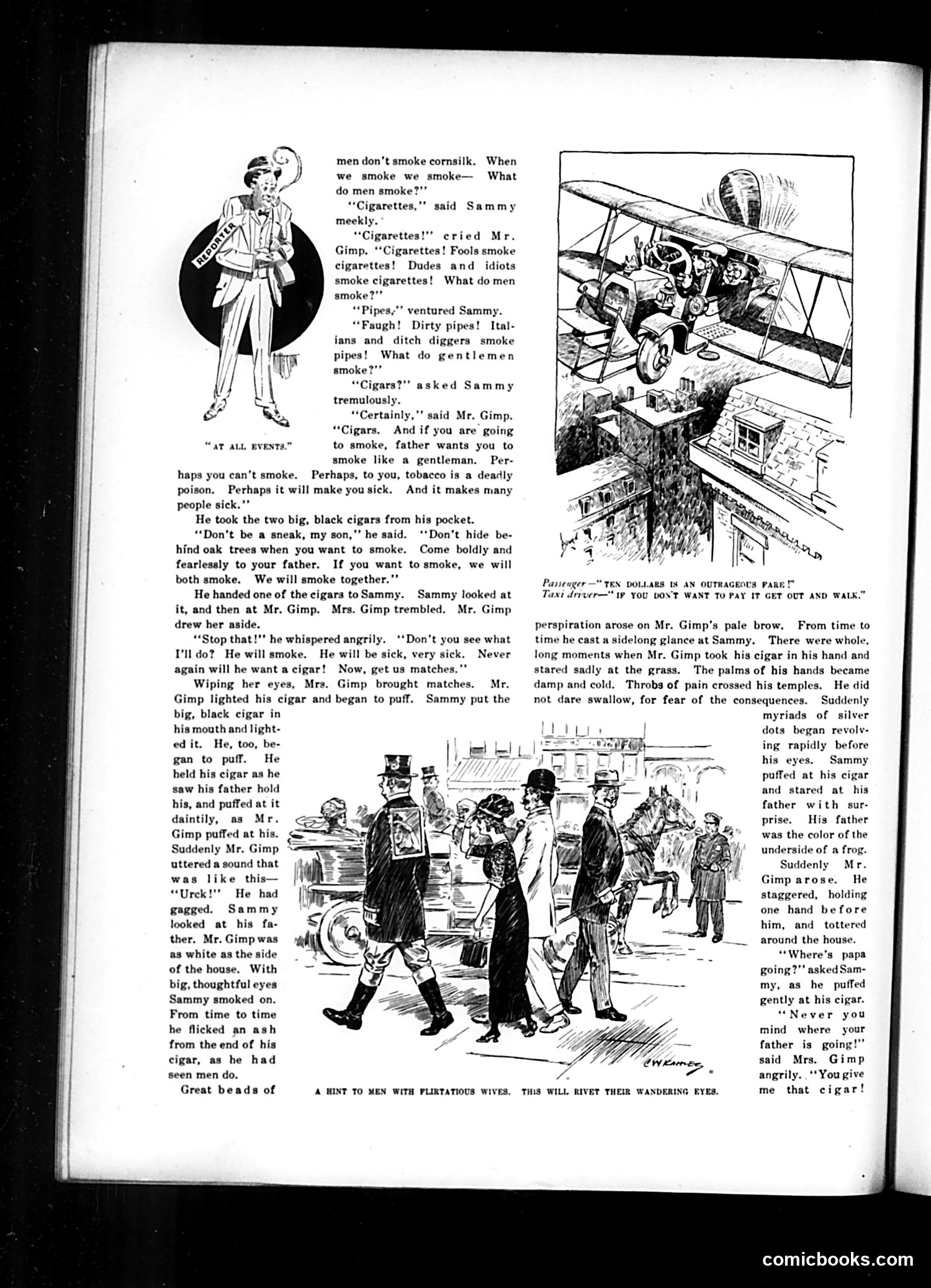
This humorous story satirizes overconfident parenting and masculine posturing. Mr. Gimp insists his son Sammy smoke cigars "like a gentleman" rather than sneaking around with cigarettes. He believes forcing the boy to smoke boldly with him will cure any future desire for tobacco. The joke: Mr. Gimp's plan backfires spectacularly. While lecturing about manly cigar-smoking, *he* becomes violently ill from the cigars, turning green and staggering away nauseous—while young Sammy calmly smokes without difficulty, leaving his father humiliated. The satire targets fathers who impose arbitrary "character-building" rules on their sons without considering consequences, and men who equate particular behaviors with manliness. Sammy's calm composure while his supposedly sophisticated father falls apart inverts the expected power dynamic. Secondary cartoons address taxi fare overcharging and wives' infidelity—unrelated social complaints typical of Judge's content.
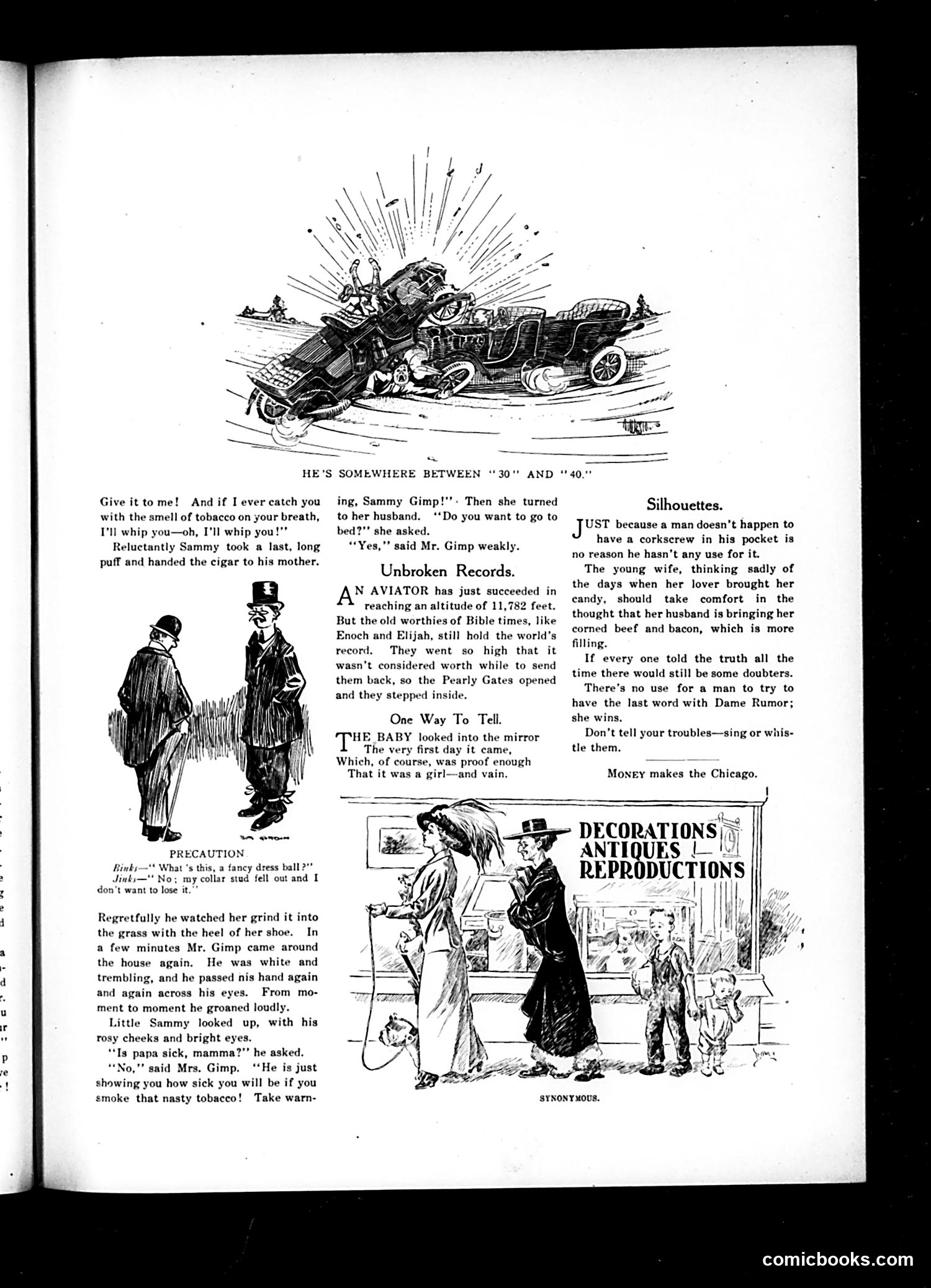
This page contains multiple brief satirical pieces typical of early 20th-century humor magazines: **"Precaution"** depicts a mother physically intimidating her son Sammy into avoiding tobacco by threatening to whip him, then forcing him to watch his father Mr. Gimp perform exaggerated illness to demonstrate smoking's supposed effects. The satire targets parental anti-smoking campaigns and their often theatrical, manipulative methods. **"Unbroken Records"** jokes about an aviator's altitude record by contrasting it with biblical figures (Enoch and Elijah) who went to heaven—thus holding "unbreakable" records through religious ascension rather than aviation. The remaining short pieces are miscellaneous one-liners on topics like vanity, marriage, truth-telling, and gossip—common themes for Judge's satirical commentary on everyday life and social conventions. The illustration shows a store scene advertising "Decorations, Antiques, Reproductions," likely part of a separate caption or advertisement.
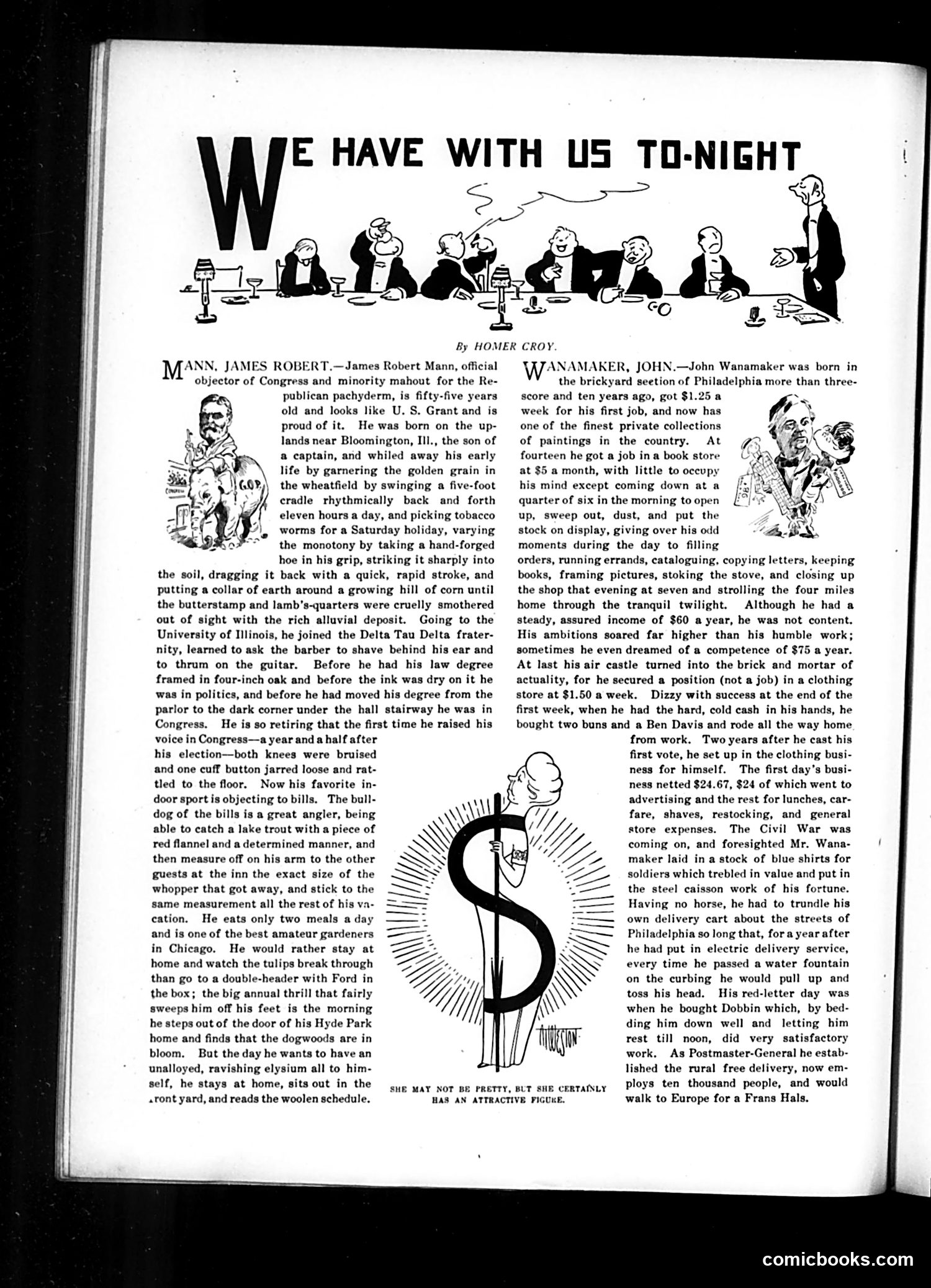
This page features biographical sketches by Homer Croy of two prominent figures, likely from the early 1900s: **James Robert Mann** is caricatured as a humorless Republican congressman known for obstructing legislation. The satire mocks his self-importance despite humble origins (farm labor, teaching himself law), portraying him as someone whose greatest pleasure is reading tariff schedules and measuring fish stories—a dull, pedantic obstructionist. **John Wanamaker** receives gentler treatment, presented as a self-made success story: from $1.25-per-week poverty to owning a significant art collection through commercial acumen and hard work in retail. The header cartoon shows men at dinner, likely representing Congress or political society. The satire's point: contrasting Mann's sterile political obstruction with Wanamaker's productive entrepreneurship—celebrating American self-made success while mocking legislative gridlock and Republican resistance to change.
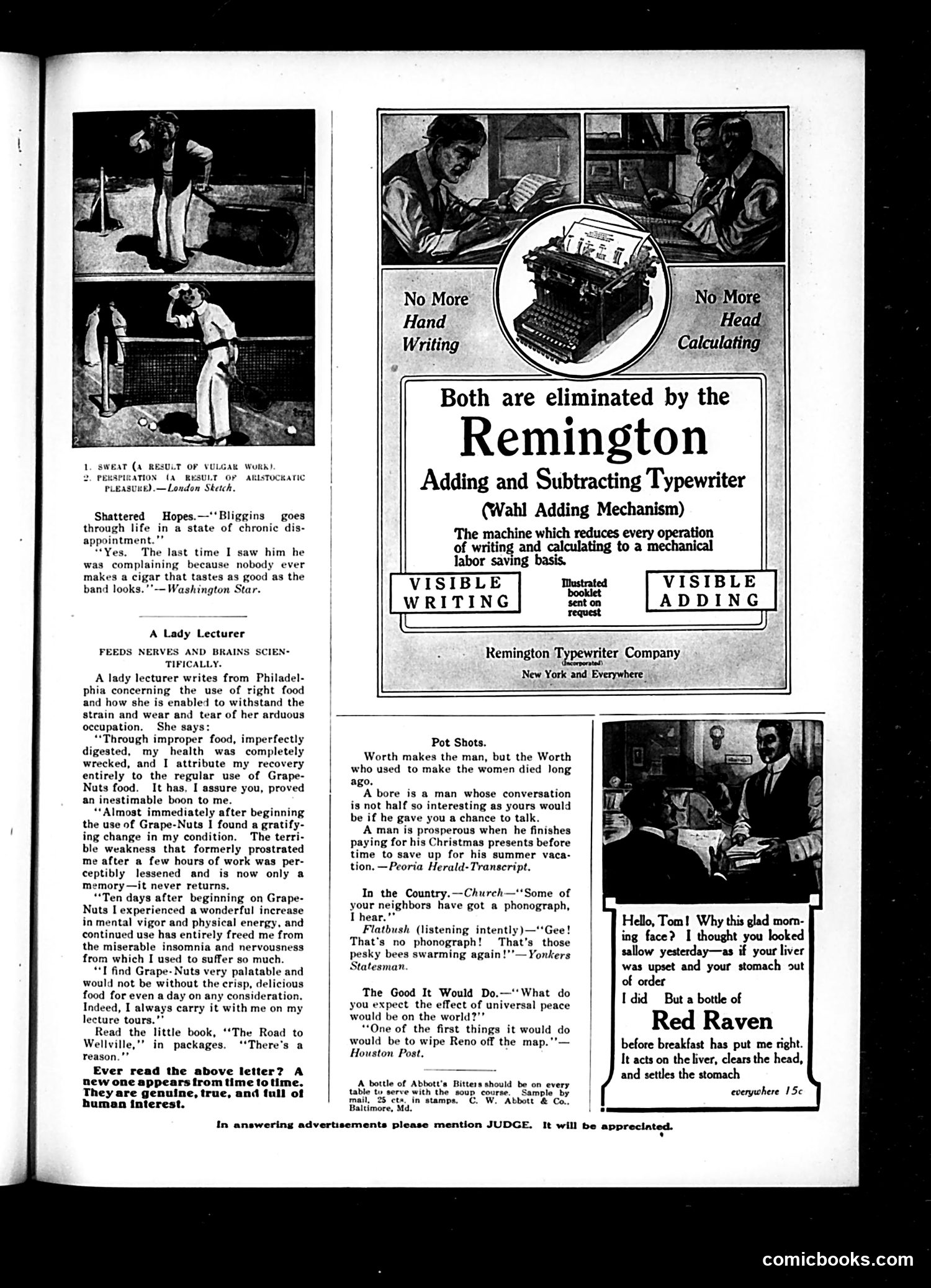
This page mixes editorial cartoons, humorous "pot shots" (short jokes), and advertisements typical of early 20th-century Judge magazine. The top left shows two satirical panels about class and labor: the first depicts manual work causing physical strain ("sweat"), the second shows aristocratic leisure causing mental fatigue ("ennui"). The accompanying joke about "Bliggins" satirizes materialistic disappointment—a man complains that cigars never taste as good as their decorative bands look. The center features a large Remington typewriter advertisement claiming to eliminate "hand writing" and "head calculating," appealing to office workers seeking efficiency. The right side contains scattered jokes mocking common types: a "bore" who monopolizes conversation, phonograph confusion in rural areas, and—notably—a quip about universal peace eliminating Reno (Nevada), a center for divorce proceedings, reflecting contemporary anxieties about marriage dissolution. The page also includes a testimonial for Grape-Nuts cereal (typical "health food" marketing of the era) and advertisements for Abbott's Bitters and Red Raven tonics—patent medicines promoting dubious health benefits.
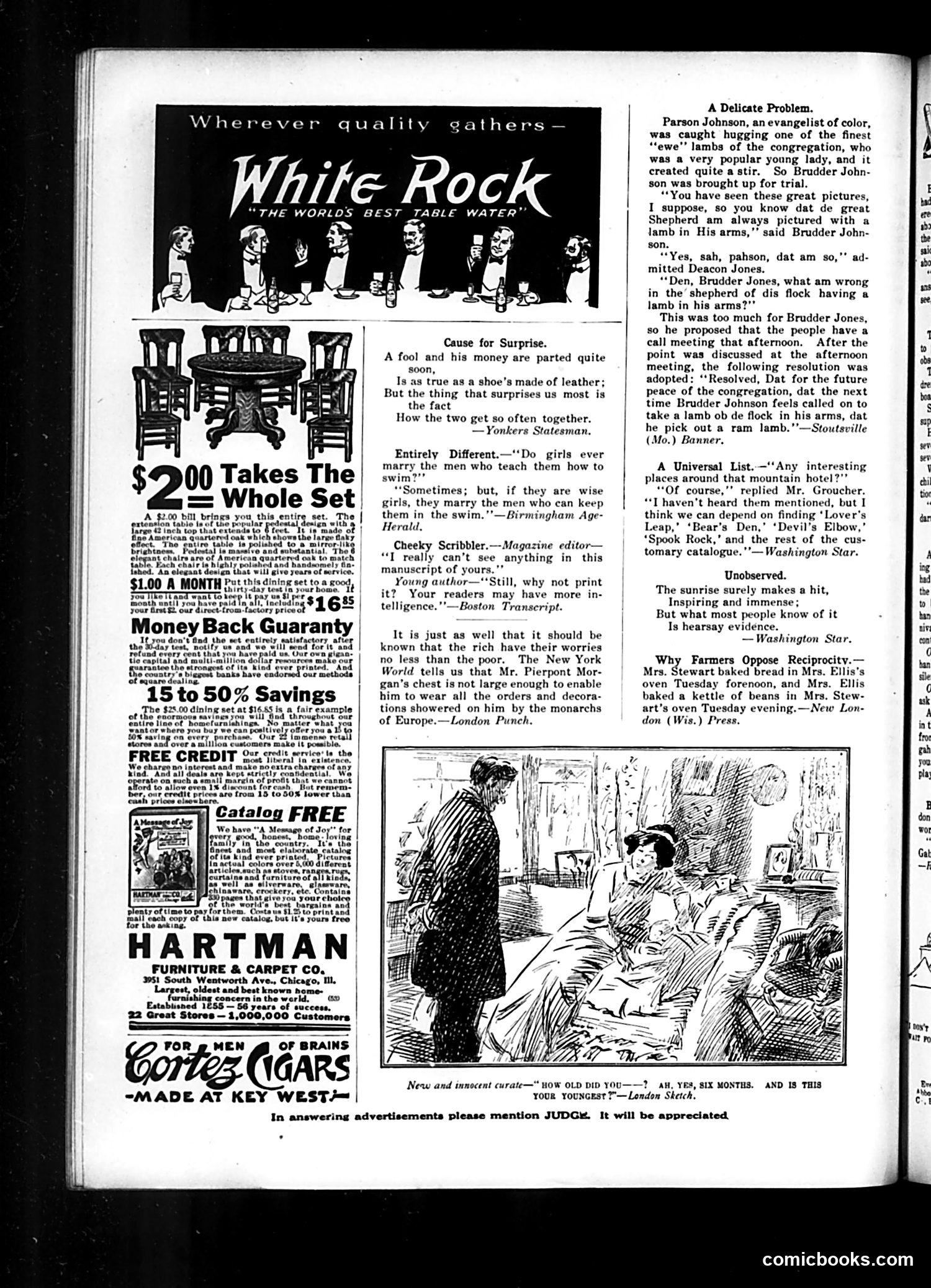
This page is primarily **advertising**, with a large White Rock water company ad dominating the left side, along with furniture and cigar advertisements. The right side contains short **humorous anecdotes and satirical commentary** typical of Judge's format: - "A Delicate Problem" satirizes a Black preacher caught embracing a young congregation member, using dialect humor common to the era. The joke hinges on the preacher's defensive biblical reference to shepherds and lambs, which the congregation resolves by requiring him to hug only male lambs in future. - Other brief jokes mock foolish behavior ("A fool and his money"), gender differences in courtship, impertinent writers, and the wealthy (Pierpont Morgan can't fit all his medals). - The cartoon shows what appears to be a medical or social scenario with an older man observing a younger person in bed. The content reflects early 20th-century attitudes, including racial stereotypes expressed through dialect humor. The overall tone is light satirical commentary on contemporary society.
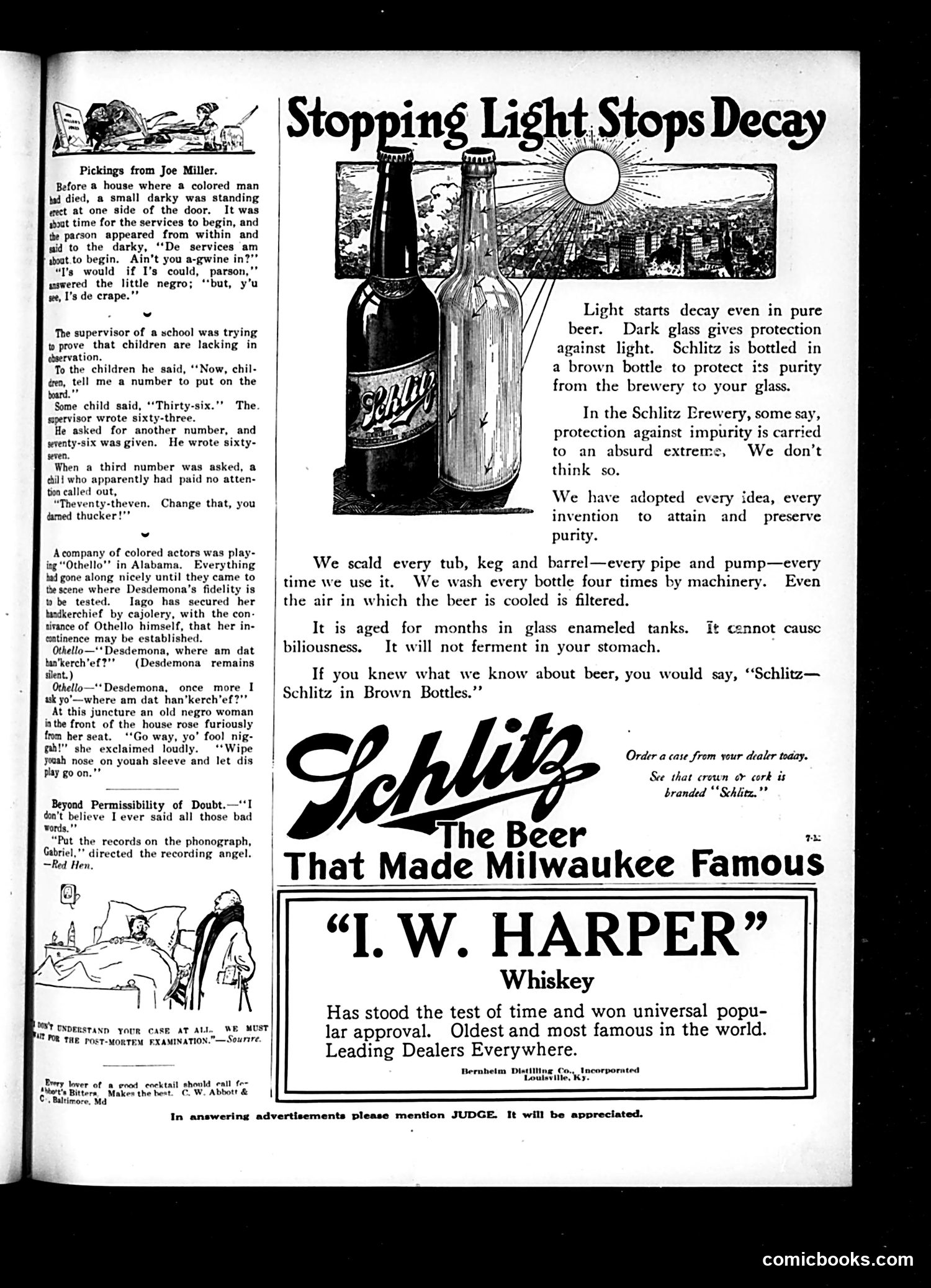
This page combines racial humor ("Pickings from Joe Miller") with advertising. The left column contains three racist anecdotes stereotyping Black people through dialect and caricature—a common format for "Joe Miller" joke collections that circulated in early 20th-century American humor publications. The jokes rely on minstrelsy-era speech patterns and depict Black characters as ignorant or comical (a child misreading numbers, a woman disrupting a Shakespeare performance). The dominant content is advertising: a large Schlitz beer advertisement emphasizing purity through brown bottle protection and rigorous manufacturing processes, plus an I.W. Harper whiskey ad. Both ads stress quality and safety—concerns relevant to early 1900s consumers worried about product adulteration. The page reflects Judge's target audience: educated, affluent readers entertained by racist humor while consuming premium products. The juxtaposition reveals how casually racist material was integrated into mainstream American publishing of this era.
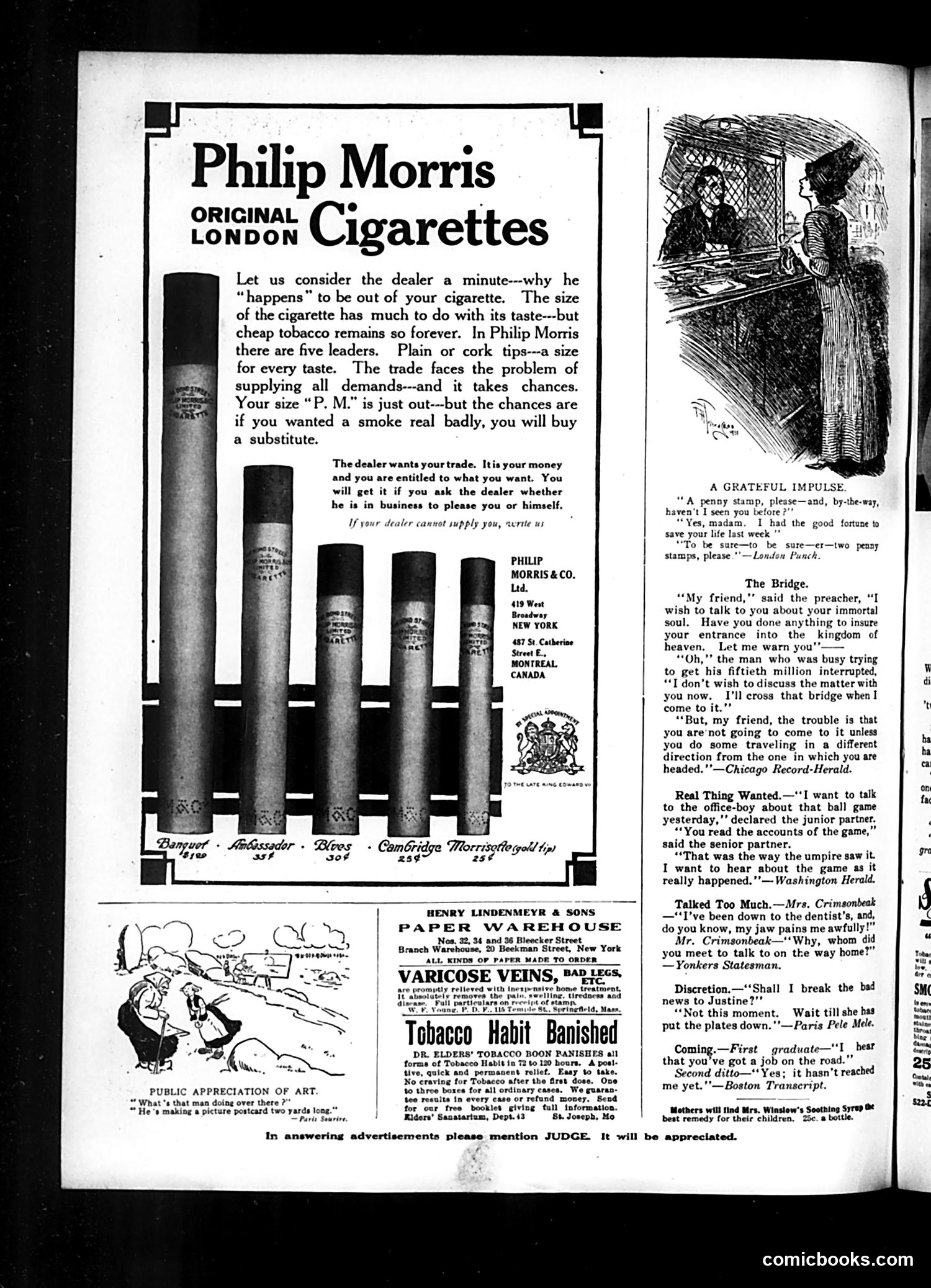
This page is primarily **advertising**, dominated by a Philip Morris cigarette ad occupying the left half. The ad uses consumer-oriented messaging: it argues that dealers who claim to be "out of stock" are lying, and encourages smokers to demand their preferred size rather than accept substitutes. This reflects early 20th-century retail dynamics and brand loyalty marketing. The right side contains short humorous anecdotes typical of Judge magazine's satirical content—jokes about social awkwardness, miserliness, and miscommunication. "A Grateful Impulse" mocks stinginess (a woman buying extra stamps rather than thanking her rescuer). "The Bridge" satirizes a wealthy businessman too preoccupied with money to consider mortality. These reflect period social anxieties about greed and materialism. The page also includes various patent medicine ads (for tobacco cessation, varicose veins), standard for era publications. The small cartoon at bottom left jokes about commercialized "art"—a vendor selling mass-produced postcards.
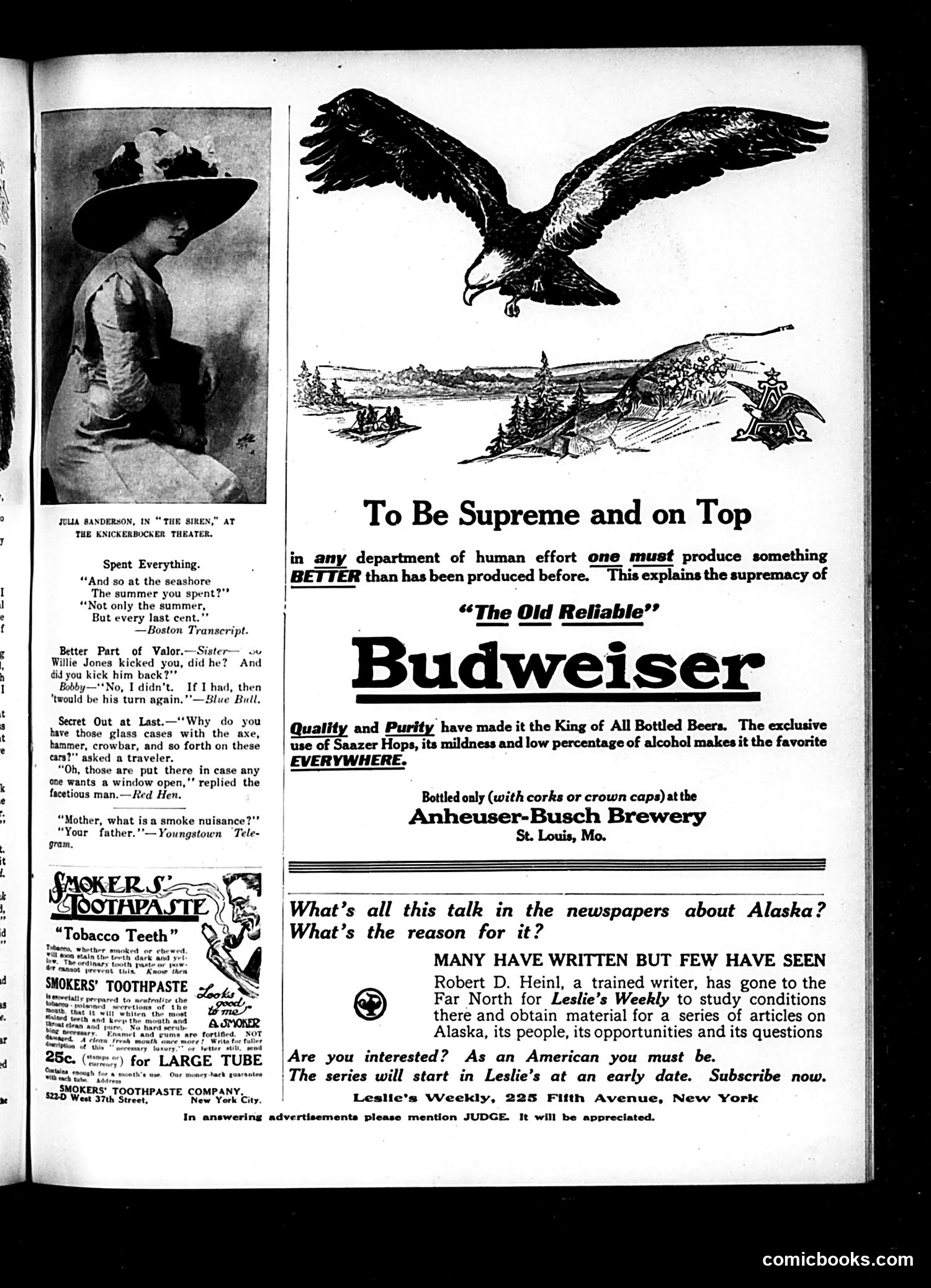
This page consists primarily of **advertisements and brief humorous anecdotes** rather than political cartoons. The top left features a photograph of Julia Sanderson in "The Siren" at the Knickerbocker Theater, accompanied by short joke exchanges (from newspapers like *Boston Transcript* and *Blue Bull*) about mundane topics: spending money at the seashore, a child's logic about fighting back, emergency equipment on trains, and fathers as "smoke nuisances." The dominant advertisement is **Budweiser beer**, claiming supremacy through "Quality and Purity"—typical early-20th-century marketing language emphasizing product superiority. Below that, **Leslie's Weekly** advertises an upcoming series on Alaska by journalist Robert D. Heinl, appealing to American readers' curiosity about the territory's "people, its opportunities and its questions." A **Smokers' Toothpaste advertisement** also appears. The page reflects typical Judge content: light social humor, theatrical promotion, and period advertising. No significant political satire is evident here.
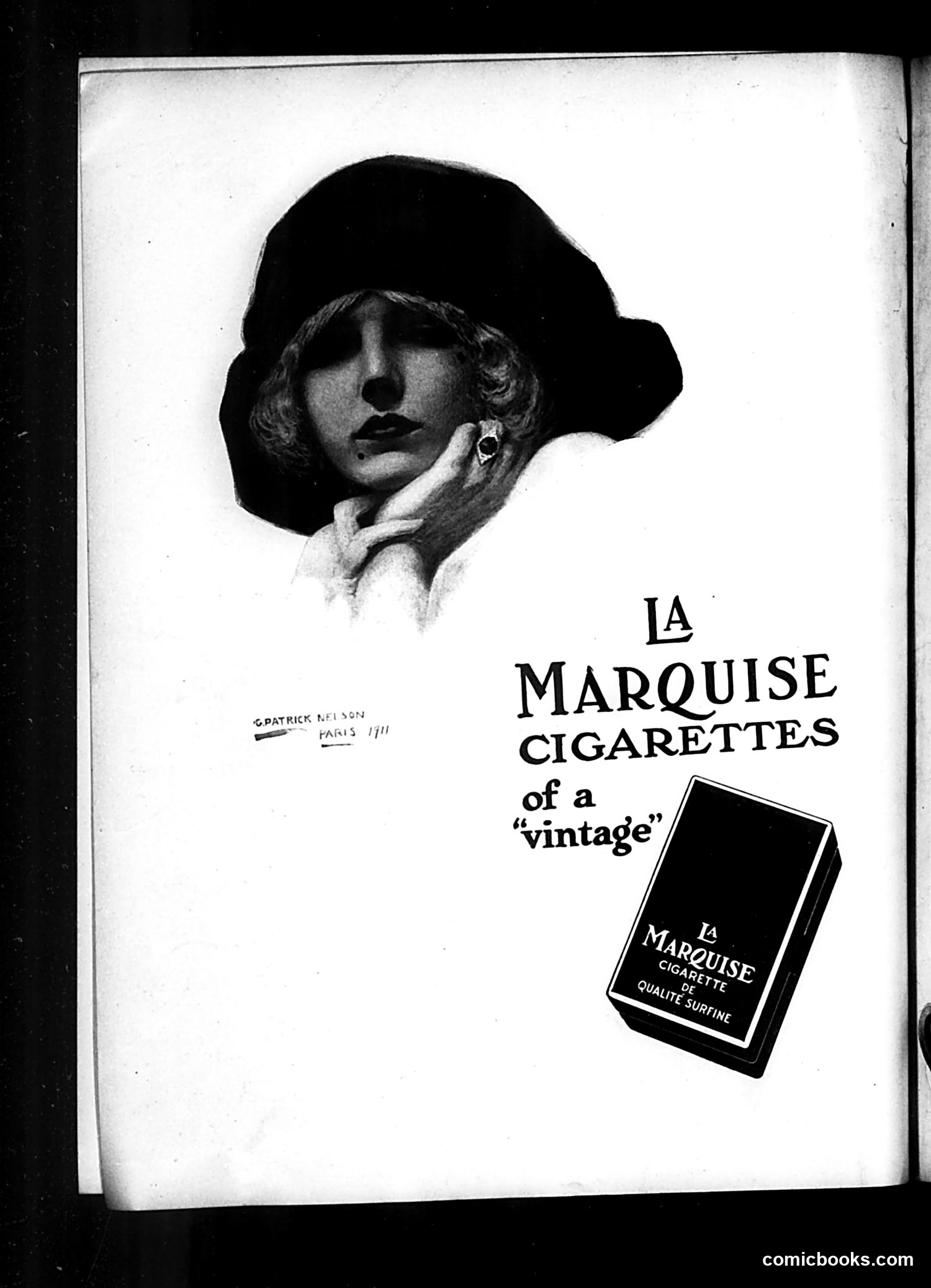
This is a cigarette advertisement rather than editorial content or satire. It promotes "La Marquise Cigarettes of a 'vintage'" quality, emphasizing their appeal through sophisticated branding ("Marquise" suggesting aristocratic elegance). The image features a stylized portrait of a woman in fashionable 1920s dress—cloche hat, defined makeup, elegant pose with hand to neck—embodying the modern, refined consumer the advertisement targets. The cigarette package is prominently displayed. The "vintage" reference likely appeals to notions of established quality and tradition, marketing these cigarettes as a premium product. The French branding ("Qualité Supérieure") adds Continental cachet. This represents typical early 20th-century luxury goods advertising that associated cigarette smoking with sophistication and modernity, targeting affluent readers of Judge magazine.