
Judge, 1911-09-16 · page 22 of 28
Judge — September 16, 1911 — page 22: what you’re looking at
What you’re looking at
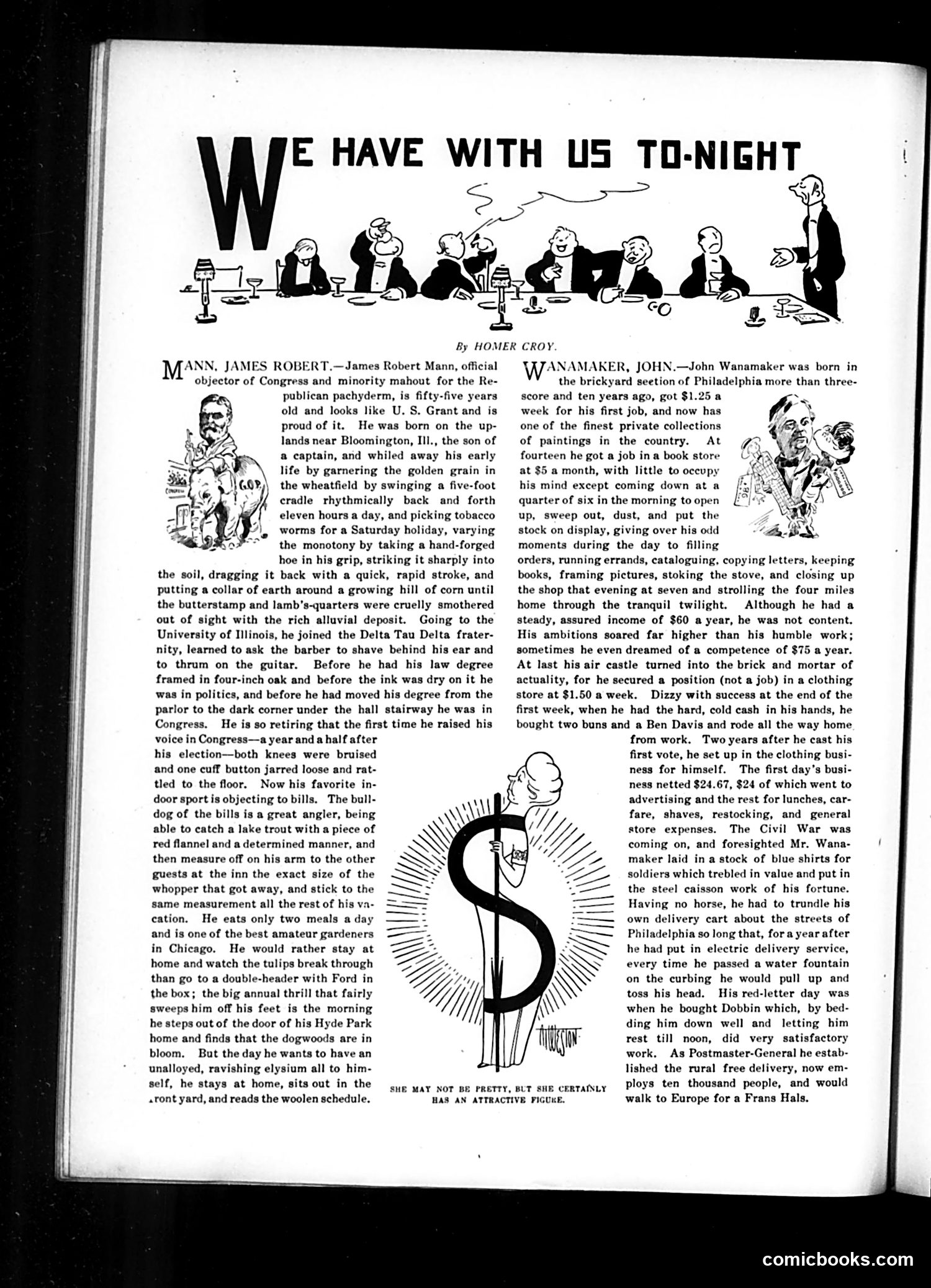
This page features biographical sketches by Homer Croy of two prominent figures, likely from the early 1900s: **James Robert Mann** is caricatured as a humorless Republican congressman known for obstructing legislation. The satire mocks his self-importance despite humble origins (farm labor, teaching himself law), portraying him as someone whose greatest pleasure is reading tariff schedules and measuring fish stories—a dull, pedantic obstructionist. **John Wanamaker** receives gentler treatment, presented as a self-made success story: from $1.25-per-week poverty to owning a significant art collection through commercial acumen and hard work in retail. The header cartoon shows men at dinner, likely representing Congress or political society. The satire's point: contrasting Mann's sterile political obstruction with Wanamaker's productive entrepreneurship—celebrating American self-made success while mocking legislative gridlock and Republican resistance to change.
📄 Transcribed text from this page (OCR, searchable)
Machine-transcribed from the original scan — historical spelling and the odd misread are preserved.
MAN JAMES ROBERT.—James Robert Mann, official objector of Congress and minority mahout for the Re- publican pachyderm, is fifty-five years old and looks like U. S. Grant and is proud of it. He was born on the up- lands near Bloomington, III., the son of a captain, and whiled away his early life by garnering the golden grain in the wheatfield by swinging a five-foot cradle rhythmically back and forth eleven hours a day, and picking tobacco worms for a Saturday holiday, varying the monotony by taking a hand-forged hoe in his grip, striking it sharply into the soil, dragging it back with a quick, rapid stroke, and putting a collar of earth around a growing hill of corn until the butterstamp and lamb’s-quarters were cruelly smothered out of sight with the rich alluvial deposit. Going to the University of Illinois, he joined the Delta Tau Delta frater- nity, learned to ask the barber to shave behind his ear and to thrum on the guit: Before he had his law degree framed in four-inch oak and before the ink was dry on it he was in politics, and before he had moved his degree from the parlor to the dark corner under the hall stairway he was in Congress. He is so retiring that the first time he raised his voice in Congress—a year and a half after his election—both knees were bruised and one cuff button jarred loose and rat- tled to the floor. Now his favorite in- door sport is objecting to bills. The bull- dog of the bills is a great angler, being able to catch a lake trout with a piece of red flannel and a determined manner, and then measure off on his arm to the other guests at the inn the exact size of the whopper that got away, and stick to the same measurement all the rest of his va- cation. He eats only two meals a day and is one of the best amateur gardeners in Chicago. He would rather stay at home and watch the tulips break through than go to a double-header with Ford in the box; the big annual thrill that fairly sweeps him off his feet is the morning he steps out of the door of his Hyde Park home and finds that the dogwoods are in bloom. But the day he wants to have an unalloyed, ravishing elysium all to him- self, he stays at home, sits out in the .ront yard, and reads the woolen schedule. E HAVE WITH US TO-NIGHT ne By HOMER CROY. SHE MAY NOT BE PRETTY, BLT SH HAS AN ATTRACTIVE FIGUKE. .) AMAKER, JOH} the brickyard seetion of Philadelphia more than three- W' score and ten years ago, got $1.25 a week for his first job, and now has one of the finest private collections of paintings in the country. At fourteen he got a job ina book store at $5 a month, with little to occupy his mind except coming down at a quarter of six in the morning to open up, sweep out, dust, and put the stock on display, giving over his odd moments during the day to filling orders, running errands, cataloguing, copying letters, keeping books, framing pictures, stoking the stove, and closing up the shop that evening at seven and strolling the four miles home through the tranquil twilight. Although he had a steady, assured income of $60 a year, he was not content. His ambitions soared far higher than his humble work; sometimes he even dreamed of a competence of $75 a year. At last his air castle turned into the brick and mortar of actuality, for he secured a position (not a job) in a clothing store at $1.50 a week. Dizzy with success at the end of the first week, when he had the hard, cold cash in his hands, he bought two buns and a Ben Davis and rode all the way home from work. Two years after he cast his first vote, he set up in the clothing busi- ness for himself. The first day’s busi- ness netted $24.67, $24 of which went to advertising and the rest for lunches, car- fare, shaves, restocking, and general store expenses. The Civil War was coming on, and foresighted Mr. Wana- maker laid in a stock of blue shirts for soldiers which trebled in value and put in the steel caisson work of his fortune. Having no horse, he had to trundle his own delivery cart about the streets of Philadelphia so long that, fora year after he had put in electric delivery service, every time he passed a water fountain on the curbing he would pull up and toss his head. His red-letter day was when he bought Dobbin which, by bed- ding him down well and letting him rest till noon, did very satisfactory work. As Postmaster-General he estab- lished the rural free delivery, now em- ploys ten thousand people, and would walk to Europe for a Frans Hals. CERTAINLY comicbooks.com