
A complete issue · 24 pages · 1911
Judge — July 15, 1911
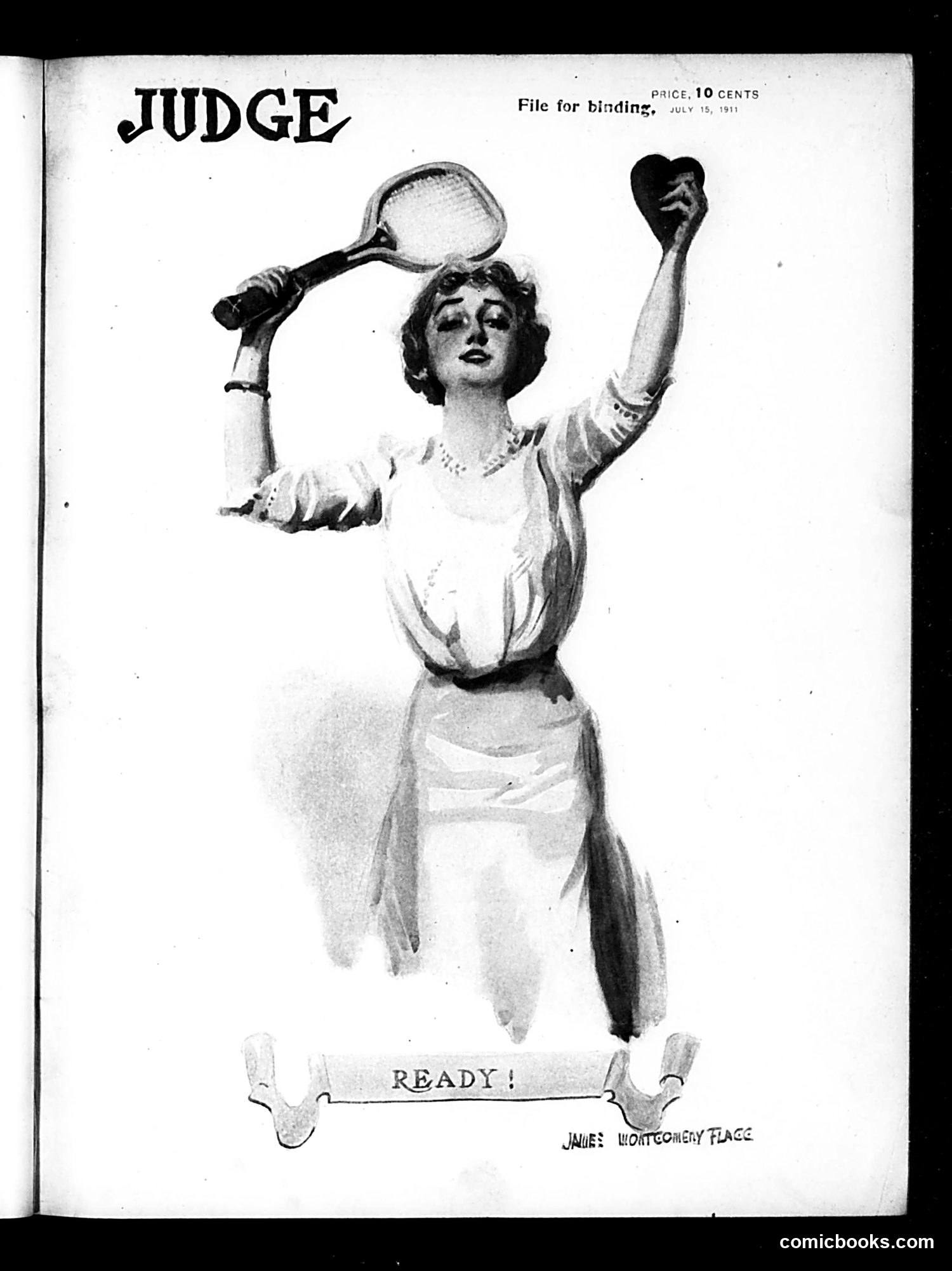
This July 15, 1911 Judge cover depicts a woman in classical allegorical style, holding a tennis racket in one hand and a heart in the other, poised in an athletic stance marked "READY!" The illustration, credited to James Montgomery Flagg, appears to satirize women's growing participation in sports during the early 1900s. The juxtaposition of athletic equipment (racket) with romantic symbolism (heart) suggests contemporary anxiety about changing gender roles—specifically, how women's increasing involvement in competitive athletics might affect traditional courtship and femininity. The "Ready!" caption emphasizes this tension between active, competitive athleticism and passive romantic availability, reflecting broader early-20th-century debates about women's proper social roles.
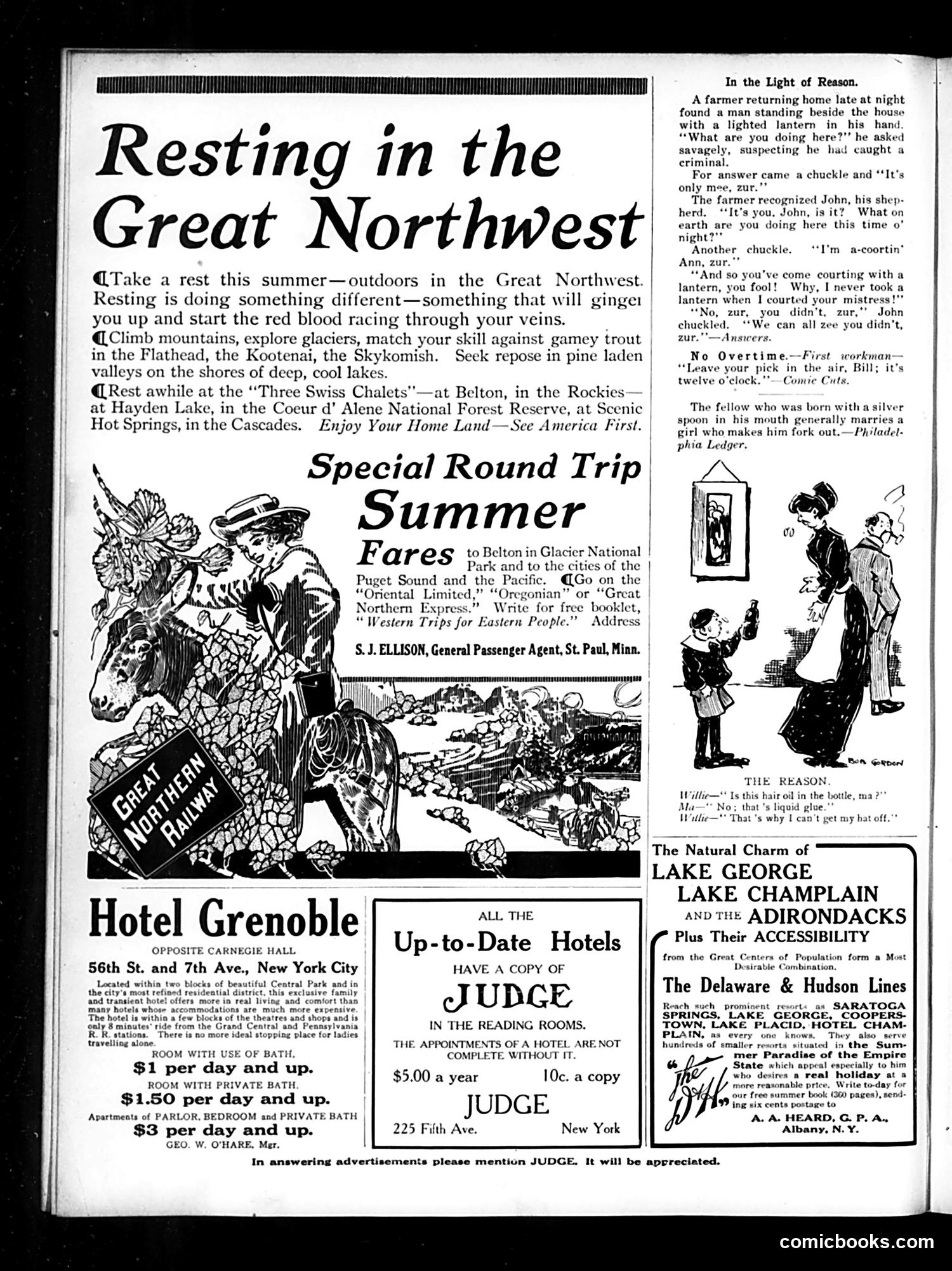
This page is **primarily advertisements** for summer travel and hotels, with minimal editorial content. The main visual is a Great Northern Railway advertisement featuring an illustrated cowboy and horse promoting summer trips to the Pacific Northwest—reflecting early 20th-century American tourism marketing. The small cartoon vignettes on the right ("In the Light of Reason" and the "Overheard" jokes) are generic domestic humor unrelated to politics or current events. They depict everyday social situations: a farmer questioning a suspicious visitor at night, and a child's confusion about grooming products. The page reflects Judge's mix of satirical commentary and commercial content typical of the era, though this particular page emphasizes travel advertising over political satire.
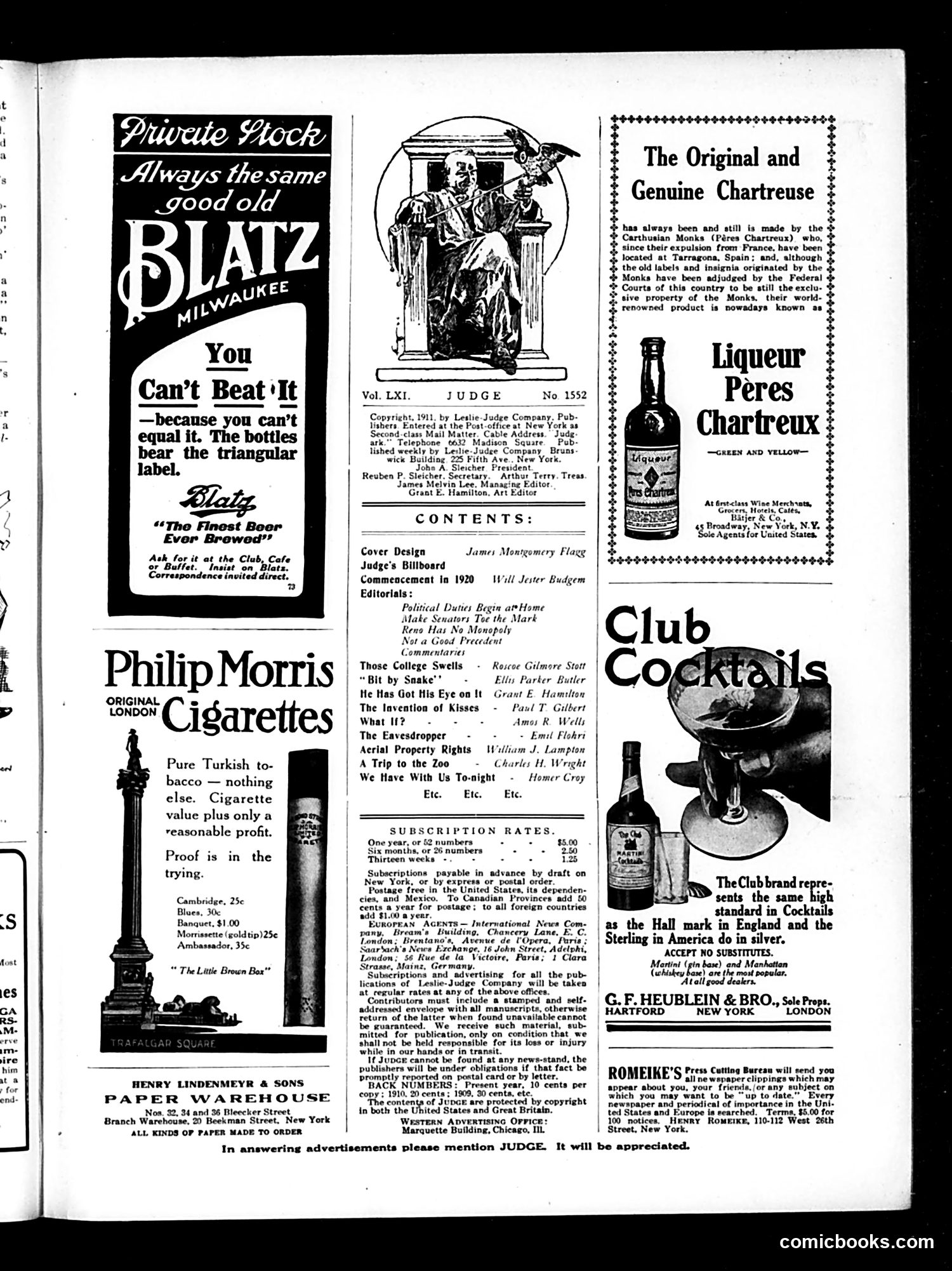
This page is primarily **advertising** rather than editorial content or political cartoons. The advertisements include: - **Blatz Beer** (Milwaukee): emphasizes the product's consistency and triangular label - **Philip Morris Cigarettes**: highlights "pure Turkish tobacco" - **Chartreuse Liqueur**: claims originality as "The Original and Genuine Chartreuse" - **Club Cocktails**: advertises a branded cocktail mixer - **Paper Warehouse and other services**: miscellaneous business ads The only editorial content visible is the **contents page** for this issue (Vol. LXI, No. 1552), listing articles and authors. **No political satire or recognizable caricatures appear on this page.** The "Judge" masthead and subscription information are present, but this is essentially a commercial advertisement page typical of early 20th-century magazines.
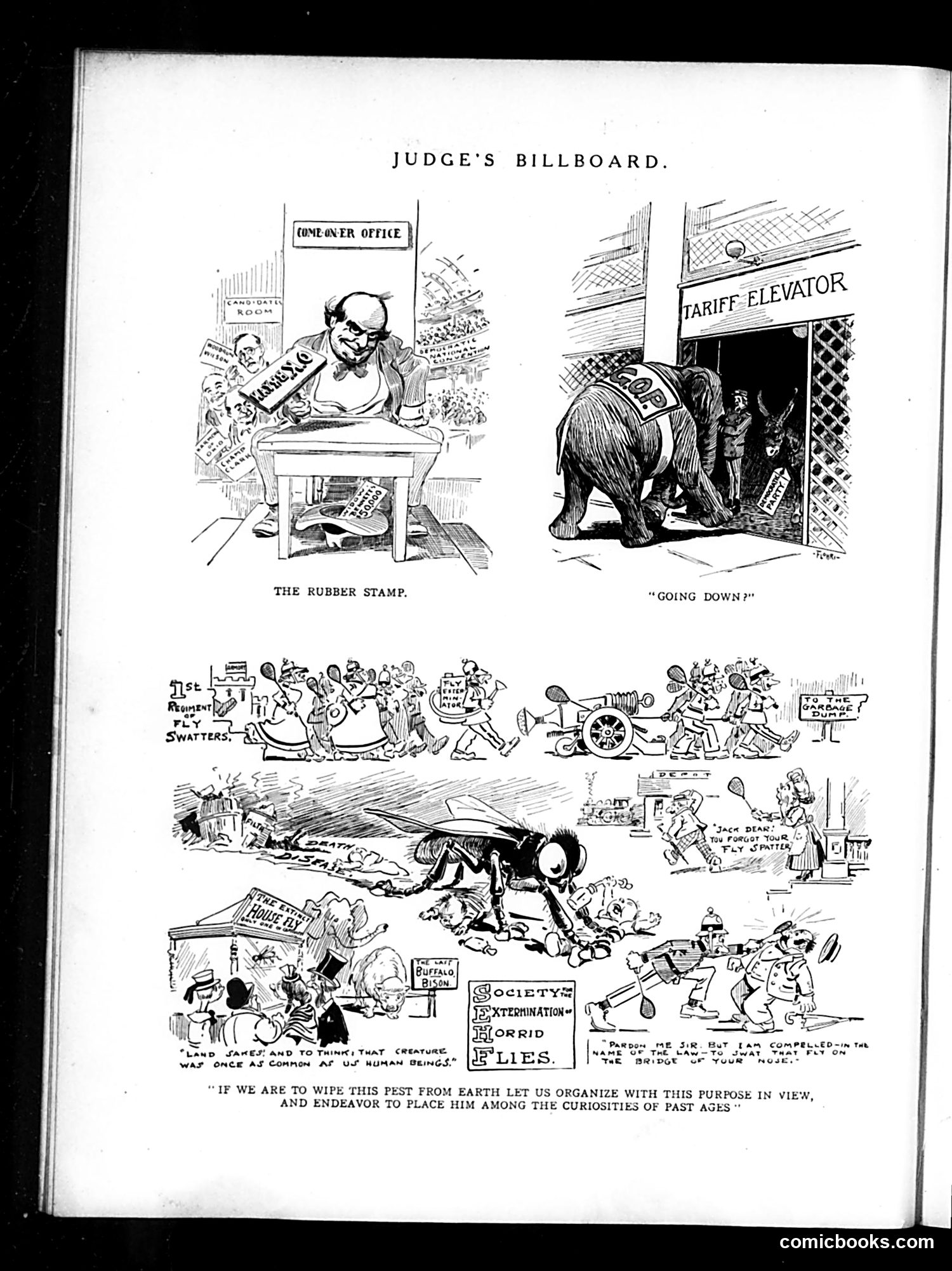
This page satirizes judicial corruption and tariff politics in early 20th-century America. **"The Rubber Stamp"** (top left) depicts a judge mechanically approving documents at the Coroner's Office, suggesting courts rubber-stamp verdicts without genuine examination. **"Going Down?"** (top right) shows a bear (likely representing tariff/economic concerns) entering a "Tariff Elevator," satirizing how protective tariffs operate. The lower panel presents chaotic vignettes about pest control and extermination, with text referencing organizing "to wipe this pest from earth" and placing it "among curiosities of past ages"—likely commentary on eliminating corruption through institutional reform. The overall message critiques judicial passivity and the need for systematic governmental housecleaning.
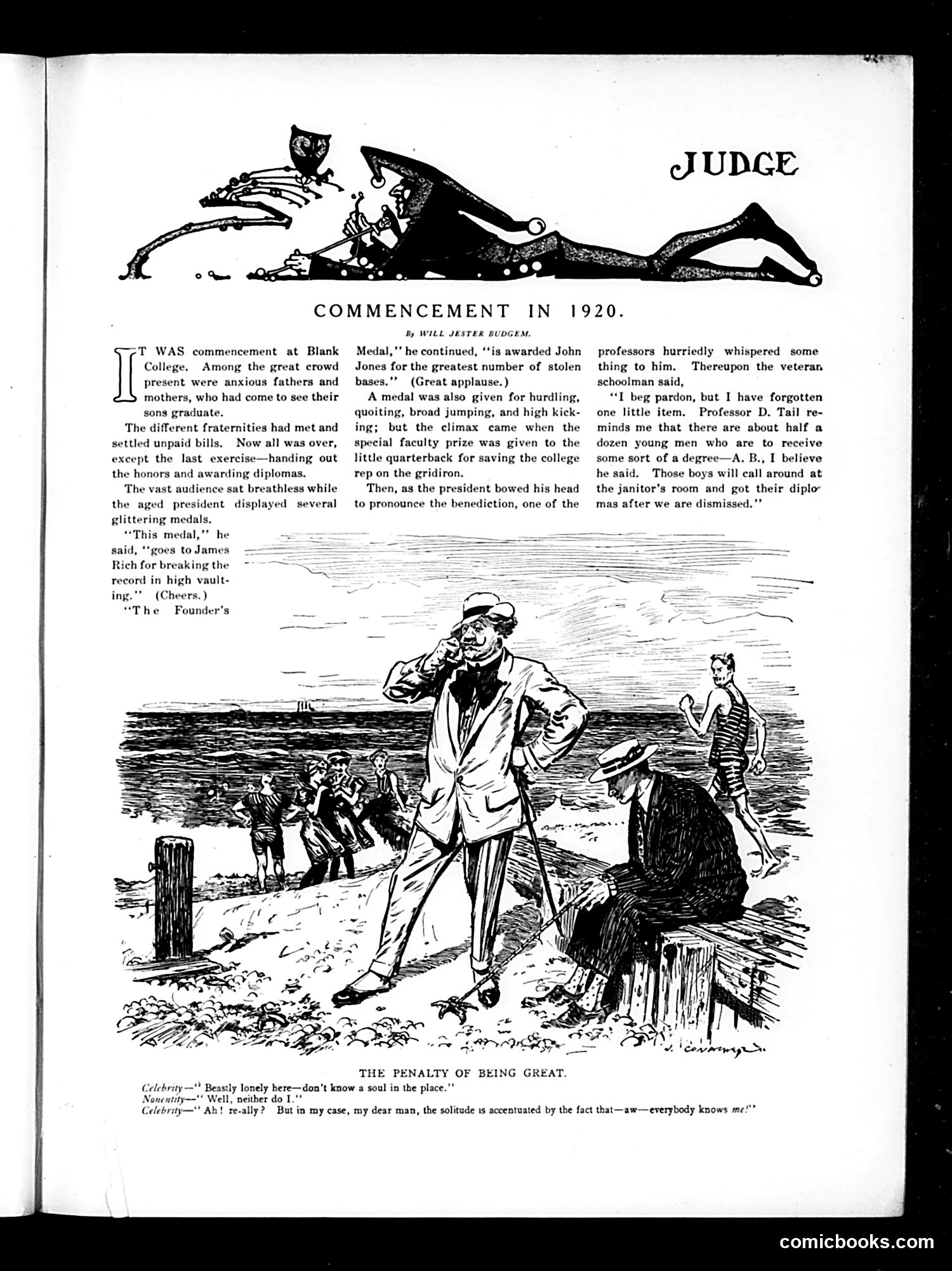
This page satirizes a college commencement ceremony at Blank College. The article mocks the awarding of medals for various athletic achievements (high vaulting, hurdling, broad jumping), culminating in a "special faculty prize" for a quarterback who saved the college's reputation on the gridiron. The cartoon below, titled "The Penalty of Being Great," depicts a distinguished elderly gentleman at a beach looking melancholy while others enjoy themselves. The caption plays on themes of isolation and fame—the celebrated figure's prominence paradoxically alienates him socially. The satire targets early 20th-century college culture's elevation of athletics over academics and the hollow loneliness accompanying public acclaim, likely critiquing American institutional values of that era.
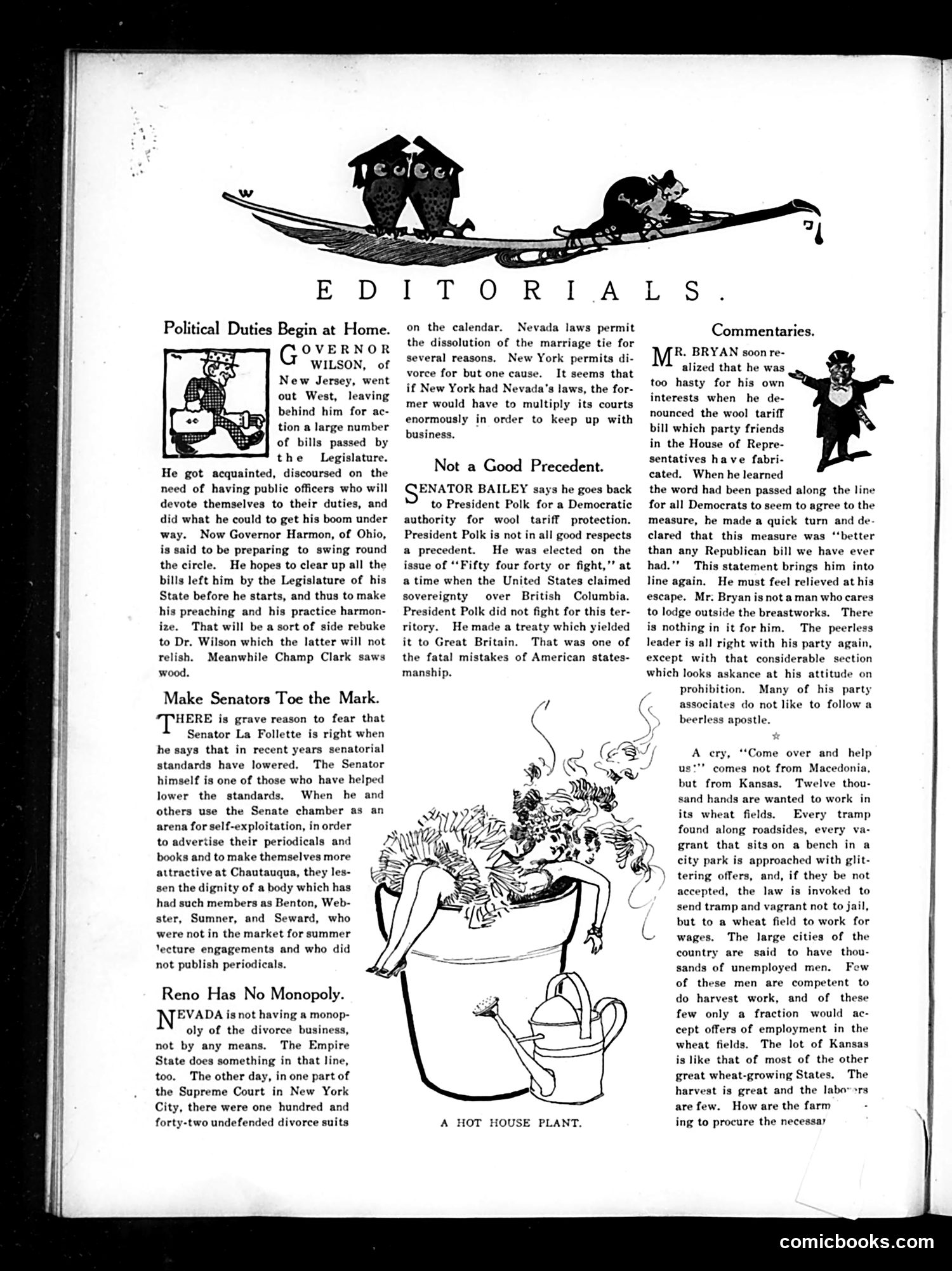
This page satirizes prominent American politicians circa 1912, mocking their hypocrisy and inconsistency: **"Political Duties Begin at Home"** criticizes Governor Wilson (later President Woodrow Wilson) for campaigning out West while leaving legislative work unfinished in New Jersey—contrasted favorably with Ohio's Governor Harmon, who completes his duties before political travel. **"Make Senators Toe the Mark"** attacks Senator La Follette for using the Senate chamber for self-promotion, lecturing at Chautauqua and publishing periodicals rather than serving with dignity like historical senators (Benton, Webster, Sumner, Seward). **"Reno Has No Monopoly"** sarcastically notes Nevada isn't alone in divorce business—New York has 142 pending cases despite stricter laws, suggesting hypocrisy about moral standards. **"Not a Good Precedent"** criticizes Senator Bailey citing President Polk's tariff policy, noting Polk failed to fight for disputed Oregon Territory, making him a poor model. **Commentaries** mocks William Jennings Bryan for flip-flopping on a wool tariff bill, reversing his criticism once party leadership pressured him—ridiculing his compromised independence.
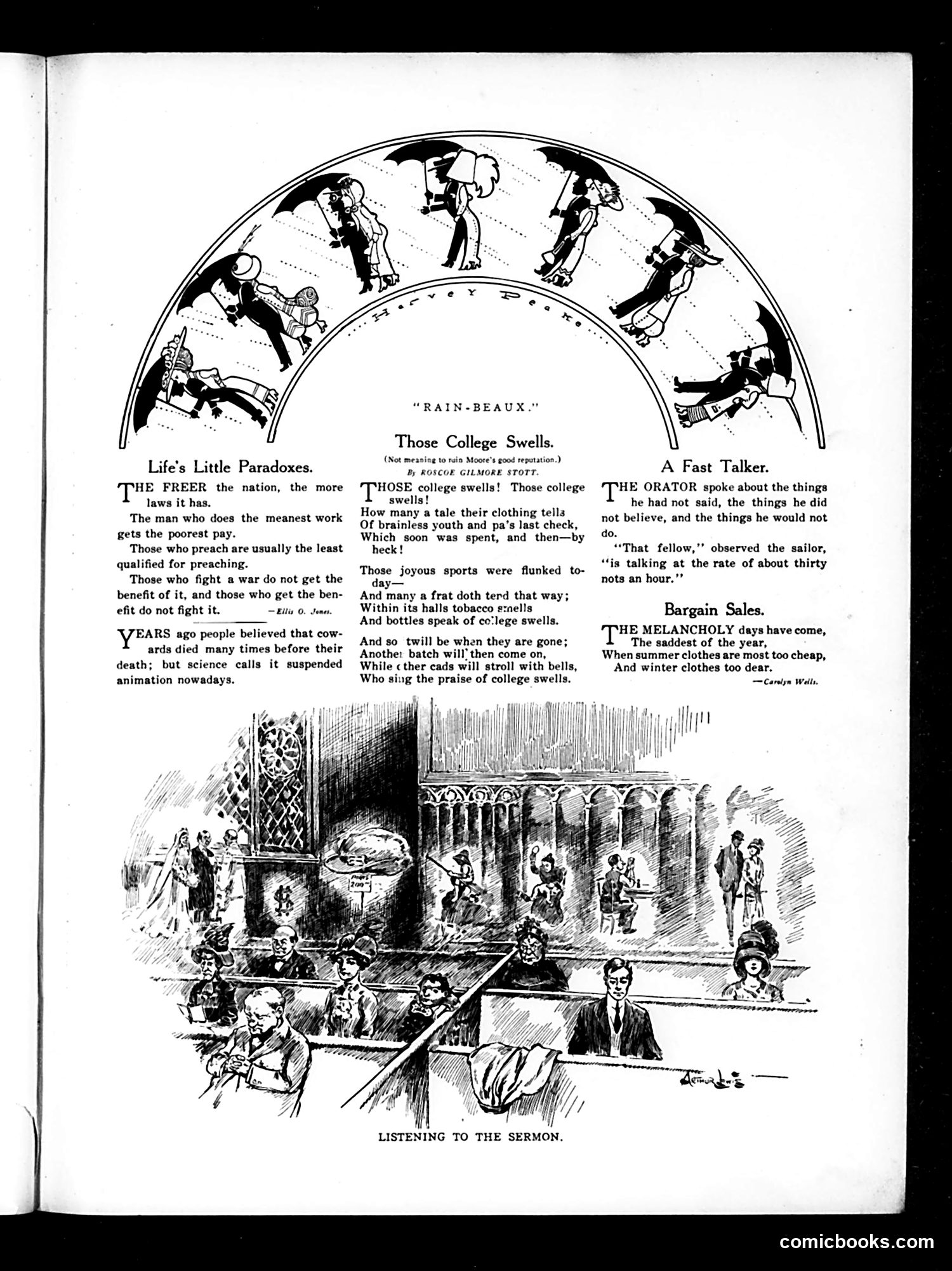
This page contains three separate satirical pieces targeting common social hypocrisies: **"Life's Little Paradoxes"** lists ironic contradictions: free nations create more laws; manual laborers earn least; preachers lack qualifications; soldiers don't benefit from wars they fight. The final item mocks outdated superstition by suggesting "suspended animation" (modern pseudoscience) explains why cowards supposedly died repeatedly before actual death. **"Those College Swells"** satirizes wealthy college students whose expensive clothing and spending reveal their emptiness—they flunk courses, smell of tobacco and alcohol, and waste their fathers' money on fraternity excess. **"A Fast Talker"** ridicules verbose orators who speak at length while saying nothing substantive—a sailor observes the speaker talks at "thirty nots an hour," parodying the speed of empty rhetoric. **"Bargain Sales"** presents a humorous seasonal complaint: summer clothes become absurdly cheap just as weather turns cold, while winter clothing grows expensive. The bottom illustration shows a church congregation listening to a sermon, connecting to the orator theme above.
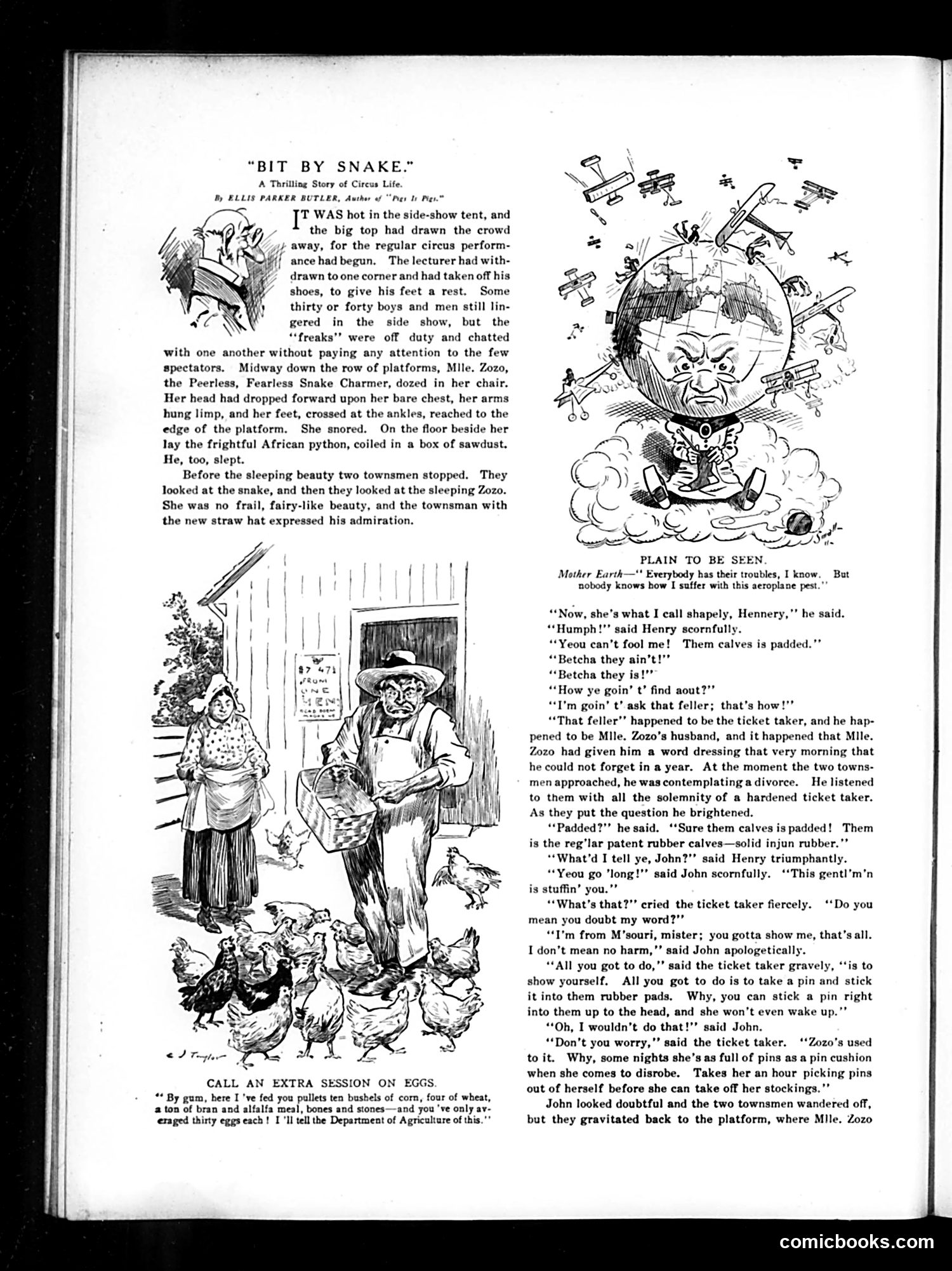
This page contains two distinct pieces by Ellis Parker Butler: **"Bit by Snake"** (main story): A humorous circus tale where two gullible townsmen encounter Mlle. Zozo, a snake charmer performer at a side show. The story satirizes rural credulity and carnival deception. The ticket taker (Zozo's husband, apparently unhappy in his marriage) deliberately cons the townsmen by claiming Zozo's shapely legs are actually padded rubber calves that can be pierced with pins without waking her—a patent absurdity he presents as fact. The joke mocks both the townsmen's gullibility and the carnival worker's cynical exploitation of it. **"Plain to Be Seen"** (bottom cartoon): A brief visual gag featuring "Mother Earth" complaining about "aeroplane pests"—likely referencing early 20th-century aviation anxieties, showing an exasperated earth figure surrounded by crude aircraft. The smaller cartoon about eggs shows a farmer's frustration with low egg production despite expensive feed. The humor relies on period-specific vernacular dialect and small-town naïveté.
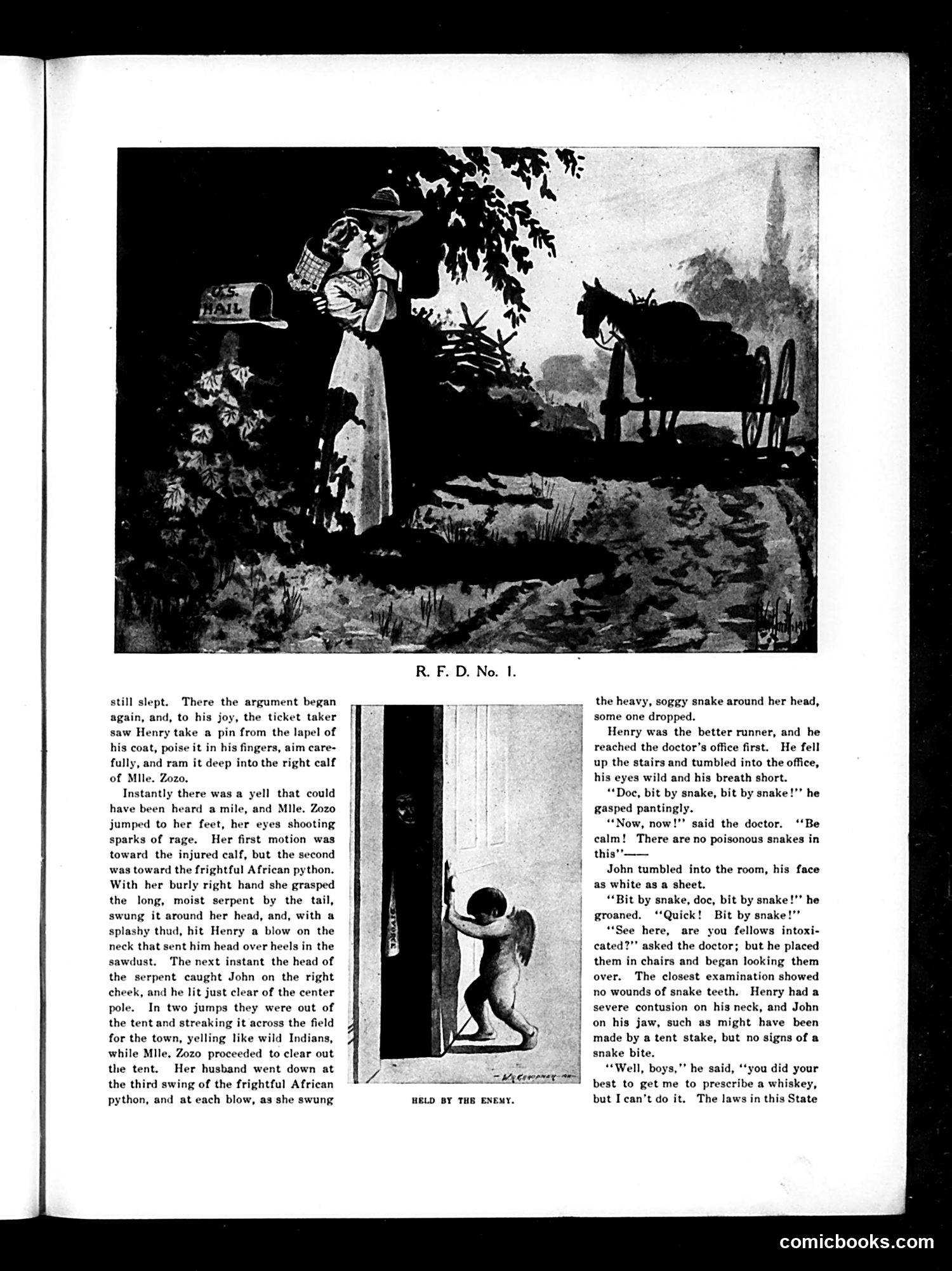
This appears to be a humorous short story from *Judge* magazine about two men who visit a circus tent featuring "Mlle. Zozo," a performer with a large African python. After one man (Henry) prods the woman with a pin from his lapel, she retaliates by swinging the snake at both men, sending them fleeing in panic to a doctor's office. The satire targets the men's deception: they arrive claiming to be "bitten by snake" to obtain a whiskey prescription (likely during Prohibition or a period of liquor restrictions). The doctor's final line reveals the joke—their actual injuries come from the woman and tent stake, not the snake, exposing their attempted fraud to circumvent local alcohol laws. The humor satirizes both foolish masculine behavior and attempts to evade legal restrictions through false medical claims.
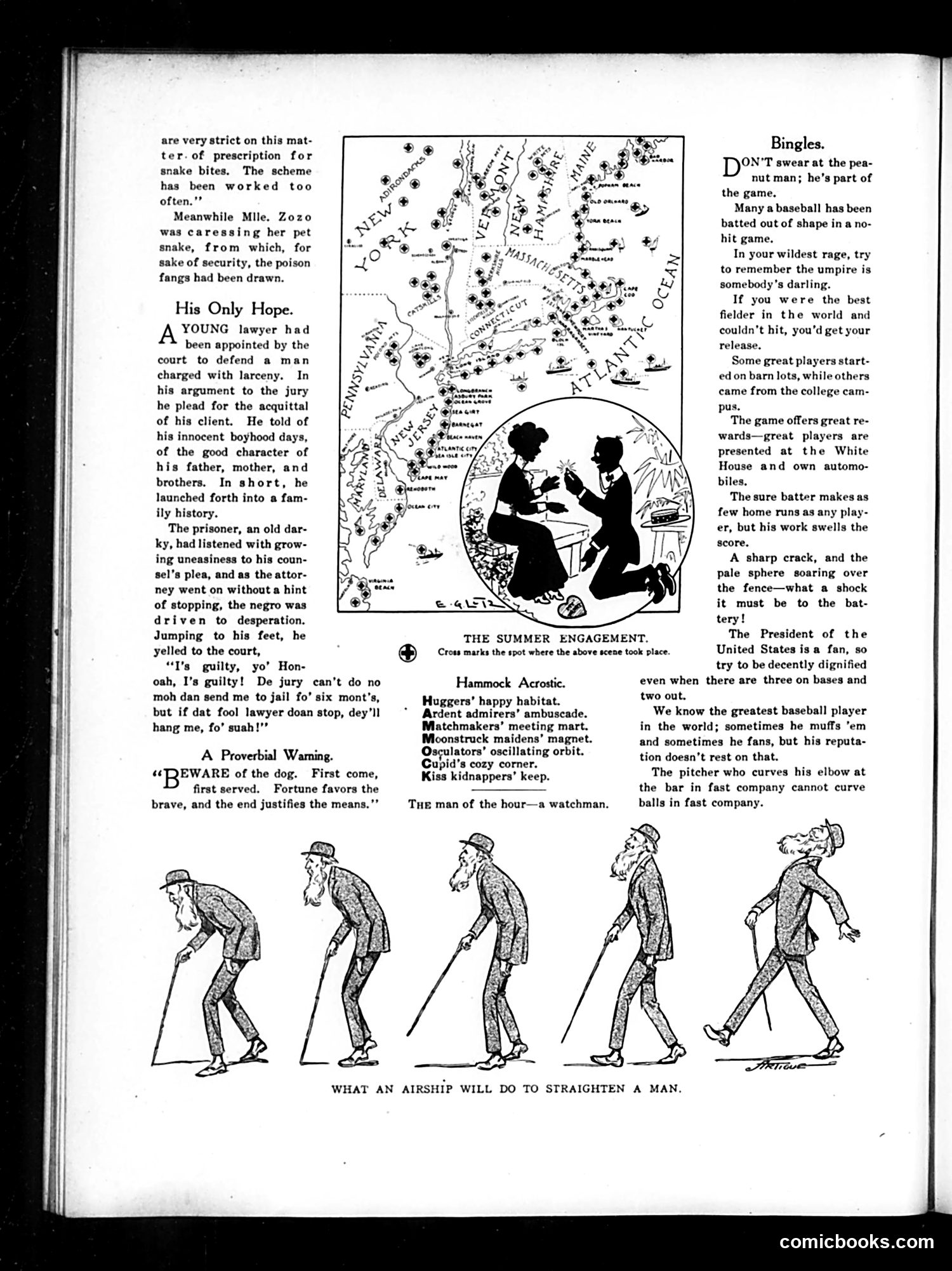
This page contains multiple satirical pieces typical of early 20th-century American humor: **"His Only Hope"** mocks both verbose lawyers and racial stereotypes. A Black defendant charged with larceny grows so frustrated with his court-appointed attorney's lengthy, irrelevant family history that he interrupts, claiming the lawyer's endless speech is worse punishment than jail itself. The satire targets excessive legal oratory. **"The Summer Engagement"** cartoon shows two figures in a hammock—likely representing young courting couples, a common Judge topic during this era. **"Bingles"** offers baseball aphorisms, reflecting baseball's enormous popularity around this period. References to "the White House" and "the President" as a fan suggest early 20th-century dating. **"What an Airship Will Do to Straighten a Man"** shows sequential cartoon panels of a hunched man progressively straightened by airship buffeting—satirizing both aviation novelty and physical posture concerns of the era. The page mixes social commentary with topical humor about technology, sports, and courtship conventions.
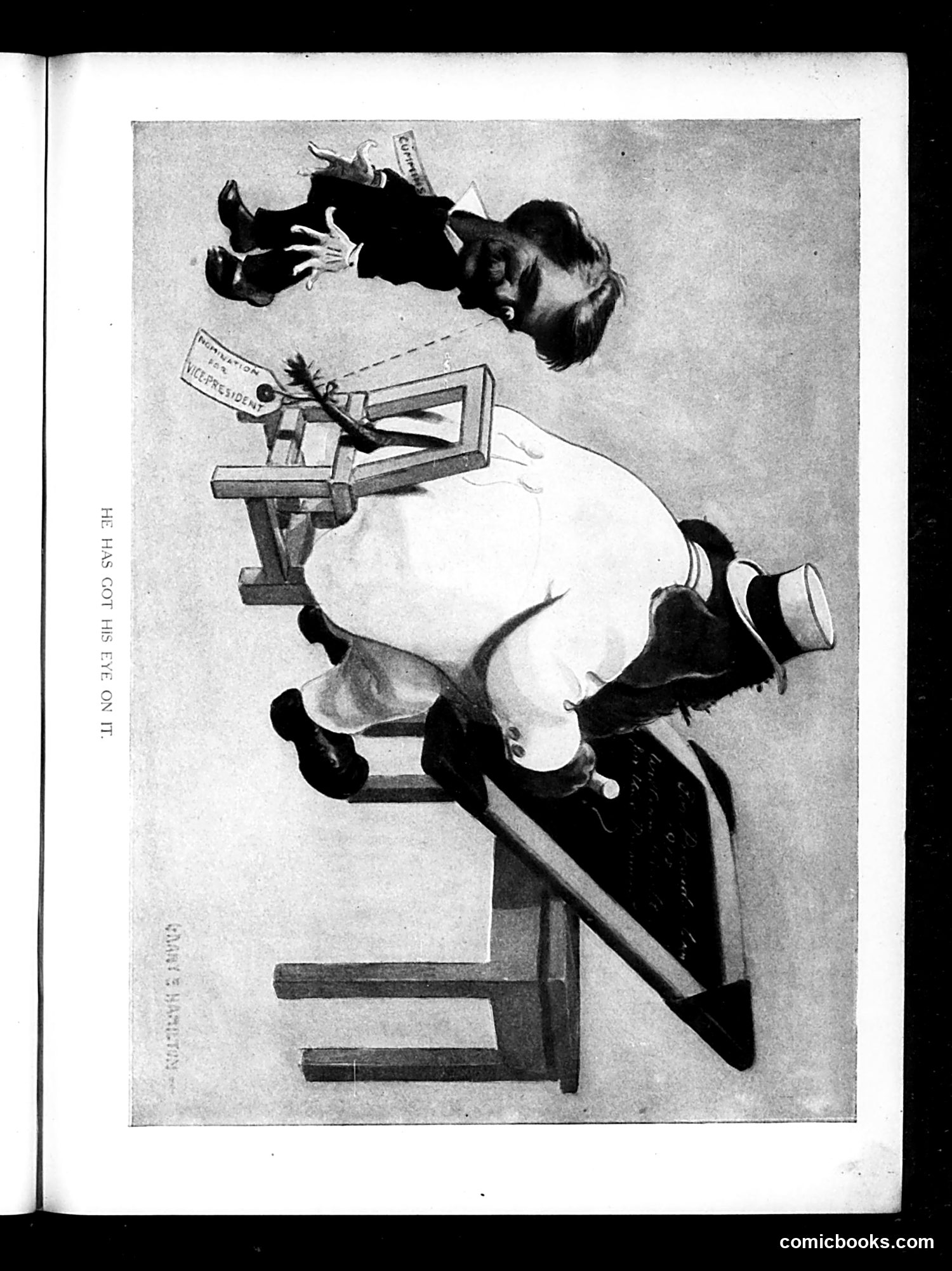
This appears to be a satirical cartoon from *Judge* magazine showing a man operating what looks like a mechanical device or contraption. The caption reads "HE HAS GOT THE EYE ON IT," suggesting he's focused intently on something. The figure appears to be a caricatured politician or public figure, though the OCR text is too garbled to identify him specifically. The mechanical apparatus likely represents either a political position, office, or opportunity he's pursuing. The cartoon satirizes the desperation or single-minded ambition of politicians competing for power or position. Without clearer text or additional context, I cannot identify the specific political event or figure being mocked, but the humor relies on depicting ambitious self-interest through the exaggerated mechanical imagery.
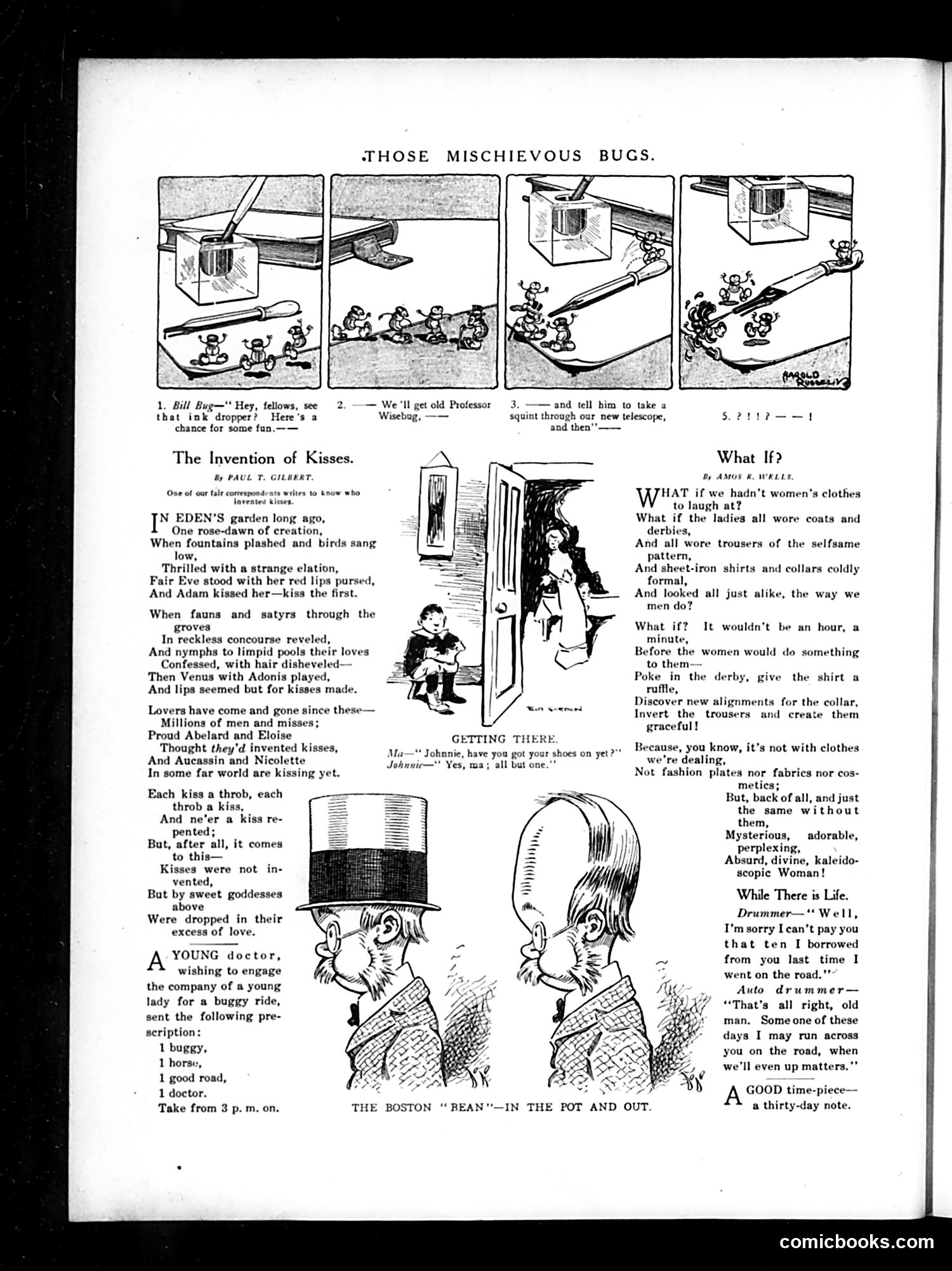
The page opens with a four-panel cartoon about anthropomorphic bugs causing laboratory mishaps—they steal an ink dropper to prank "Professor Wisebug" and sabotage a telescope. It's simple slapstick humor with no political content. Below are three unrelated pieces: a romantic poem by Paul T. Gilbert tracing the history of kissing from Adam and Eve through famous lovers; a humorous prescription where a young doctor prescribes himself, a buggy, horse, and good road as ingredients for courting a woman; and "What If?" by Amos R. Wells, a satirical commentary on women's fashion and femininity—arguing that even if women wore identical utilitarian clothing like men, they'd still innovate and differentiate themselves, celebrating women's mysterious nature and adaptability. The "Boston Bean" cartoon depicts a man asking if his son has shoes on—gentle domestic humor.
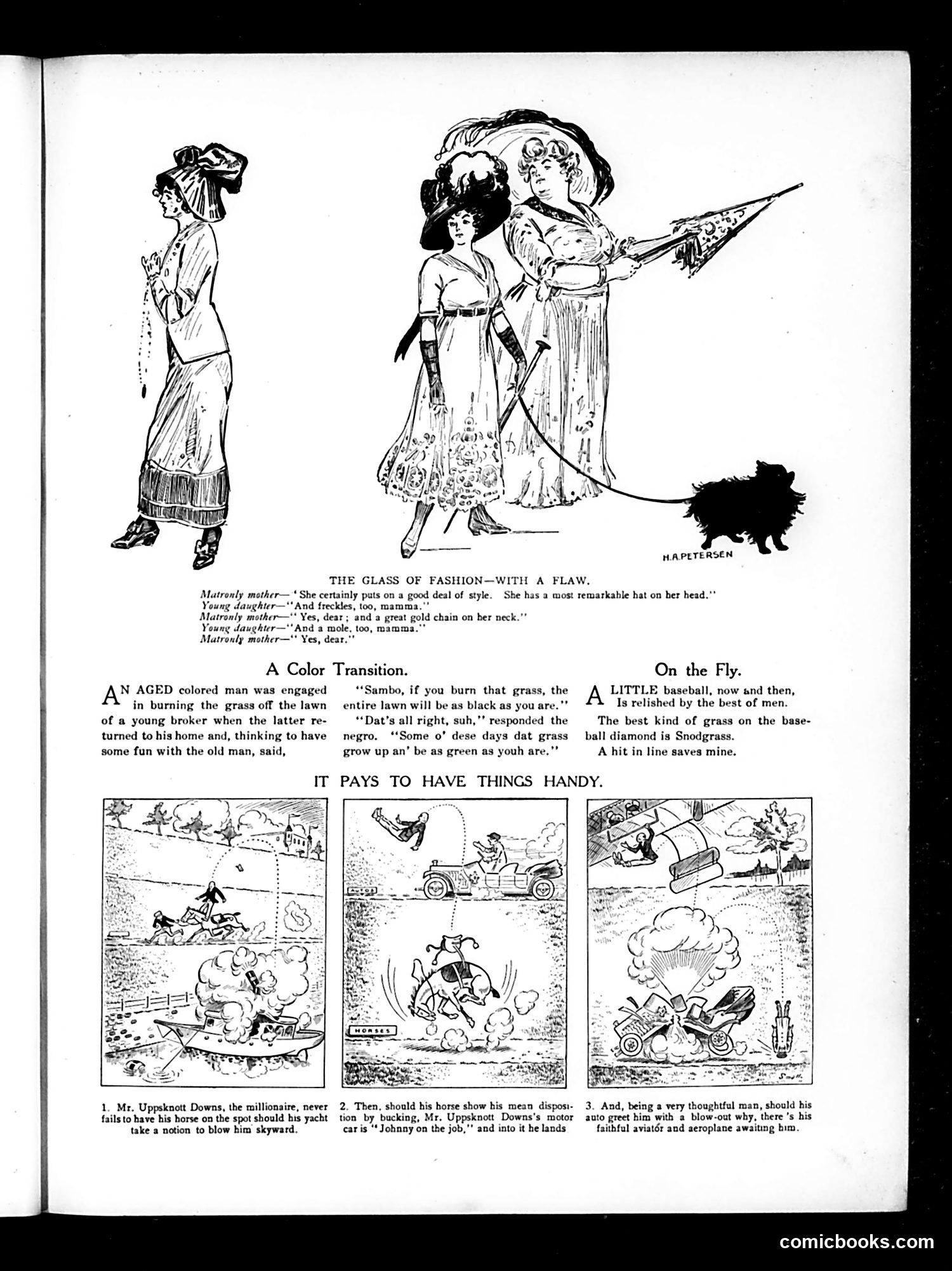
This page contains three separate satirical pieces typical of early 20th-century American humor: **"The Glass of Fashion—With a Flaw"** mocks fashionable women's vanity. A mother admires a woman's stylish hat and gold chain, while her daughter repeatedly points out unflattering flaws (freckles, a mole), suggesting that no amount of fashionable accessories can hide physical imperfections. **"A Color Transition"** is a racist joke playing on dialect humor. An elderly Black man burning lawn grass responds to the employer's jibe about the grass turning black by suggesting the employer's own skin will eventually turn green—crude humor based on stereotypes and vernacular speech. **"It Pays to Have Things Handy"** satirizes wealth and preparedness through Mr. Uppsknott Downs, a millionaire so equipped for misfortune that he has a motor car ready for when his horse bucks him, and an airplane waiting for yacht emergencies—absurdist humor mocking excessive wealth and paranoid over-preparation. The page reflects period attitudes toward class, race, and fashion that modern readers would find offensive or dated.
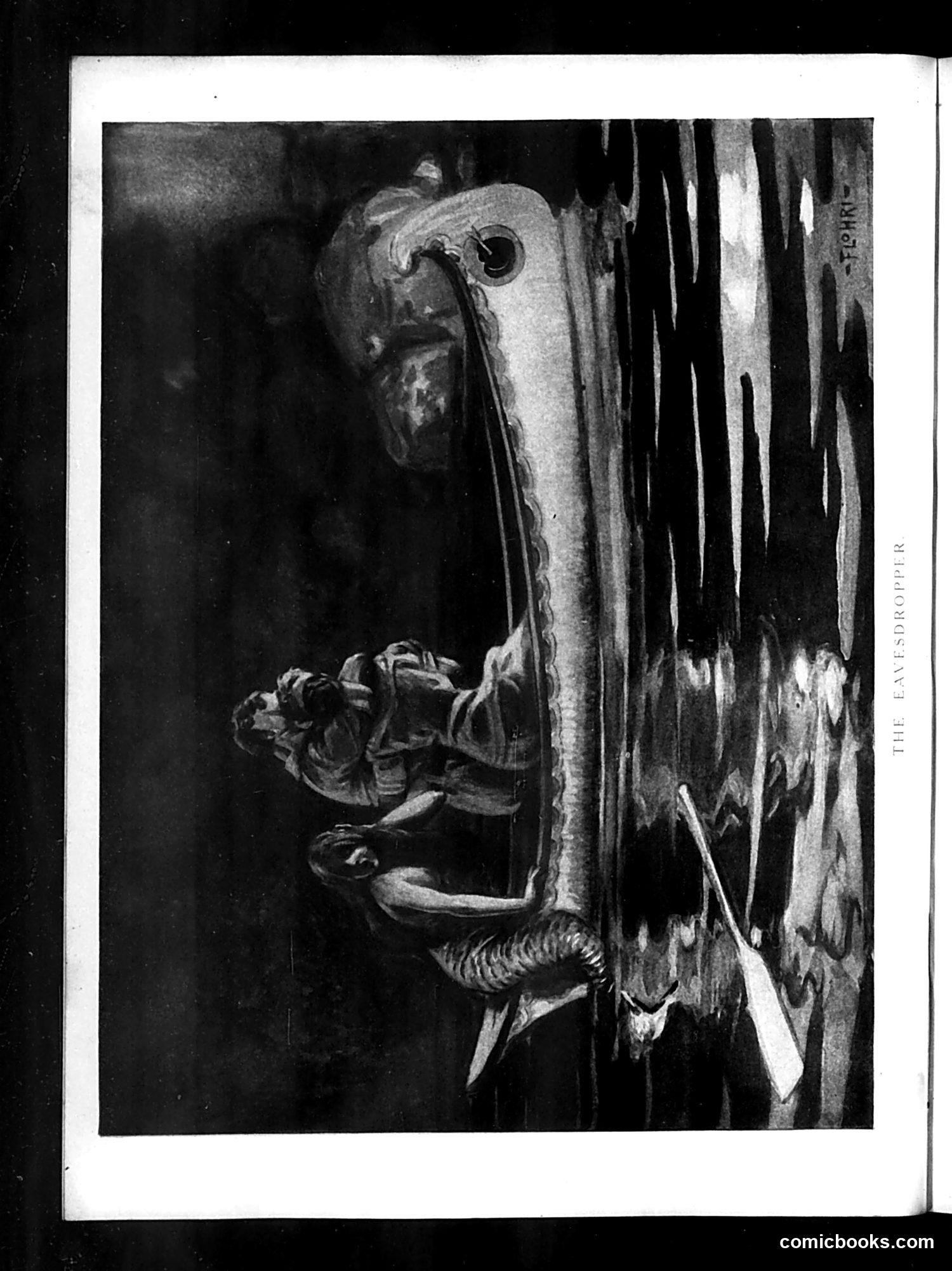
I can see this is a black and white illustration from Judge magazine showing a figure in classical or mythological style - appearing to be a tall, elongated face or mask with large circular eyes, beside a smaller human figure. The style suggests allegorical or symbolic representation typical of Judge's satirical approach. However, I cannot reliably identify the specific political or social references from the image alone. The OCR text provided only contains "comicbooks.com" and a source attribution, without the actual article title, caption, or explanatory text that would clarify what figures are depicted and what contemporary event or issue is being satirized. To accurately explain this cartoon's meaning to a modern reader, I would need the original caption and surrounding text from the Judge page.
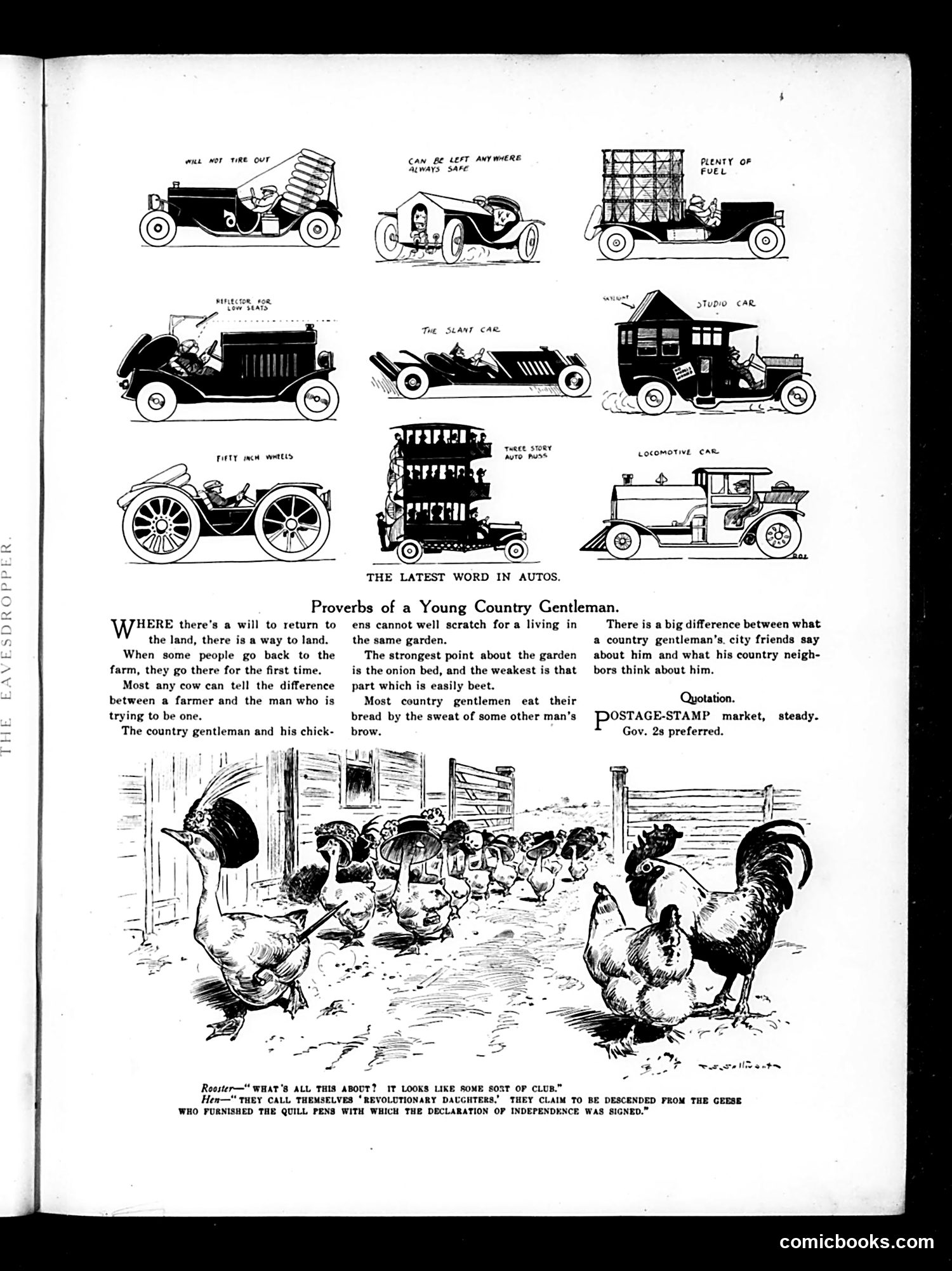
This page mixes automotive humor with rural satire and a political jab at women's organizations. **Top section:** Nine whimsical car designs satirize emerging automobile variety—from practical utility vehicles (dump truck, fuel carrier) to absurd concepts (a three-story auto-bus, a "slant car"). The caption "THE LATEST WORD IN AUTOS" suggests manufacturers were producing increasingly bizarre vehicles to capitalize on automobile mania. **Middle section:** "Proverbs of a Young Country Gentleman" mocks wealthy urbanites attempting rural life—they fail at farming basics and misunderstand agricultural work, relying instead on hired labor. **Bottom cartoon:** A rooster and hen represent the "Revolutionary Daughters," a women's patriotic organization. The joke ridicules their pretensions: they claim descent from geese that provided quill pens for the Declaration of Independence—an absurd genealogical claim. The rooster's dismissal ("some sort of club") suggests Judge found their patriotic posturing laughable and overstated. This appears to mock upper-class women's organizations of the era.
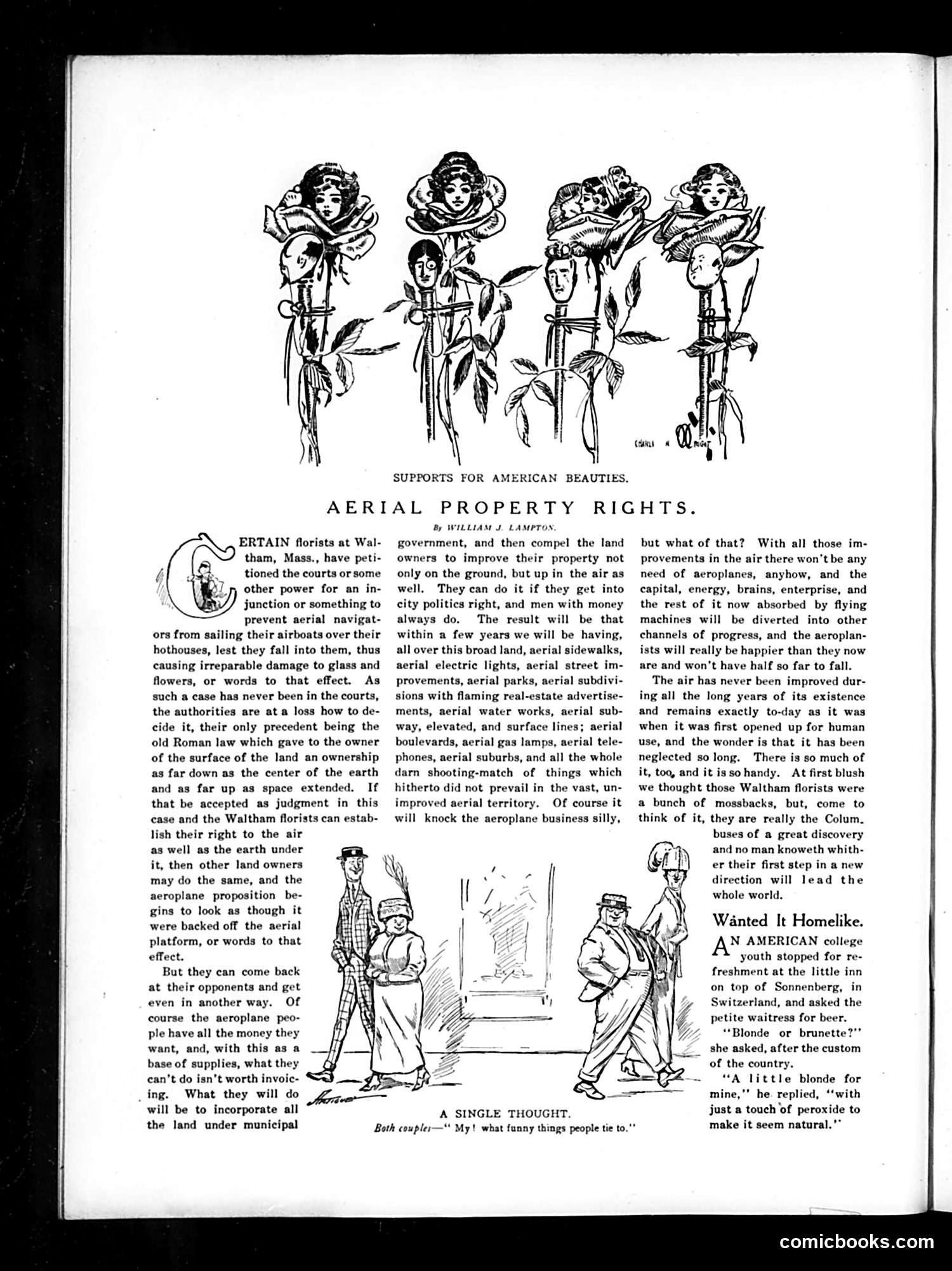
This page satirizes two emerging issues of the early aviation age: **"Aerial Property Rights"** (main article): Waltham, Massachusetts florists petitioned courts to prevent airplanes from flying over their hothouses, fearing damage. The author (William J. Lampton) humorously argues that if landowners own airspace above their property (per old Roman law), wealthy aviation interests will simply buy political influence to develop the sky—creating aerial sidewalks, electric lights, parks, and suburbs. This will ironically kill the airplane business itself, yet redirect capital into "progress." The satire mocks both small-business anxiety about new technology and the predictable corruption of urban development. **"Wanted It Homelike"**: A separate joke about an American college student in Switzerland asking a waitress for beer. She asks "blonde or brunette?" (the beer types). He requests blonde beer "with a touch of peroxide to make it seem natural"—mocking American vanity and the era's obsession with artificially bleached hair, presented as crude American tourist behavior. The top illustration shows elaborately decorated women's heads on flower stems—visual pun on "American beauties" (flowers and women).
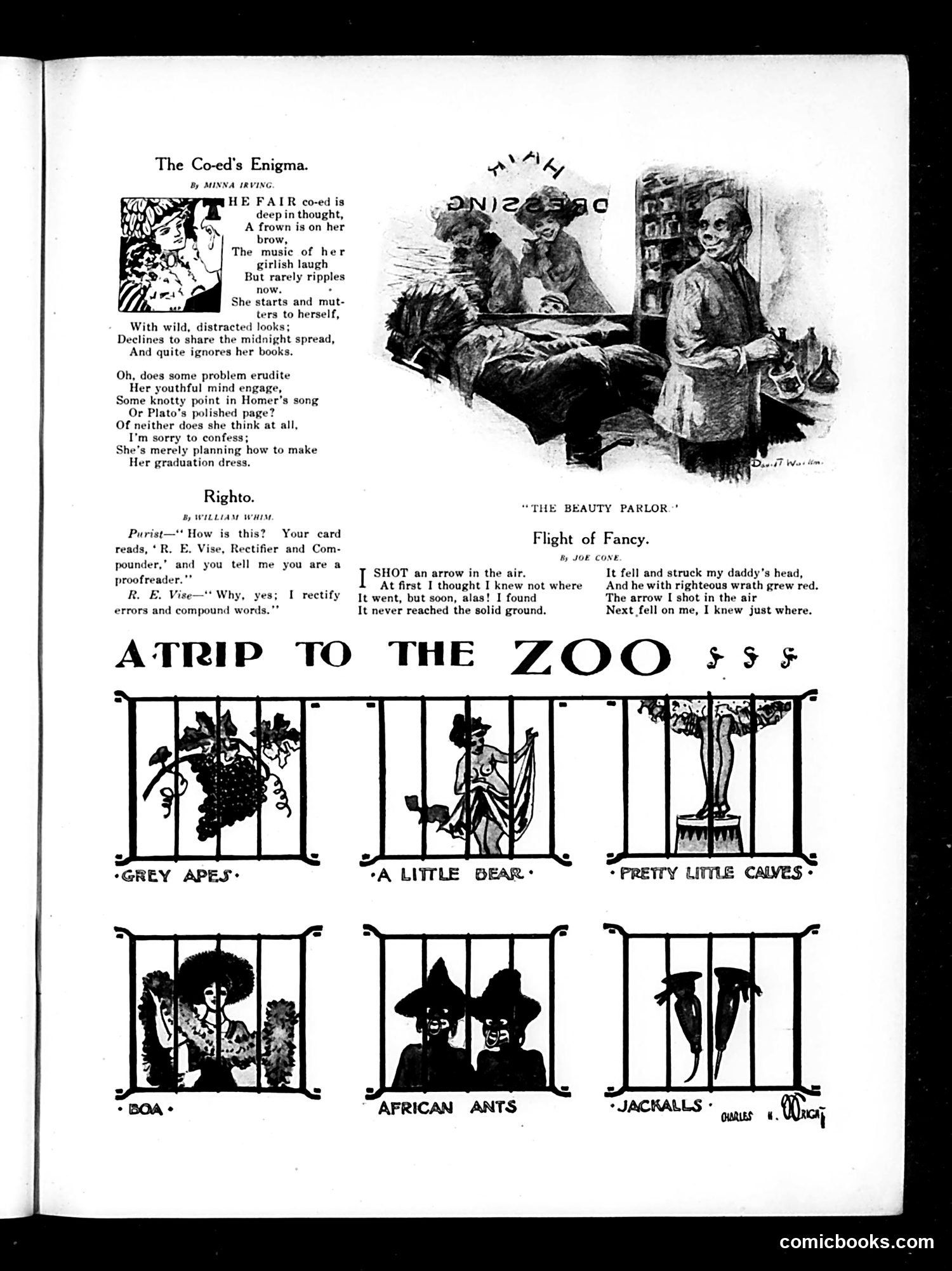
This page contains three separate humor pieces typical of early 20th-century satire: **"The Co-ed's Enigma"** mocks female college students, suggesting that despite having access to serious intellectual pursuits (Homer, Plato), young women are supposedly only concerned with frivolous matters—specifically, designing their graduation dress. The satire targets both the pretensions of higher education for women and contemporary assumptions about female priorities. **"Righto"** is a brief wordplay joke about a proofreader named "R. E. Vise" (sounds like "revise"), playing on homonyms and professional terminology. **"Flight of Fancy"** is a humorous poem about an arrow's unpredictable trajectory, ending with slapstick: it hits the father, angering him, then the child receives punishment—reflecting period attitudes toward parental discipline. **"A Trip to the Zoo"** presents animal cages with anthropomorphic humor, showing creatures labeled with human characteristics (Grey Apes, African Ants depicted as people in the cages), a common visual joke format of the era.
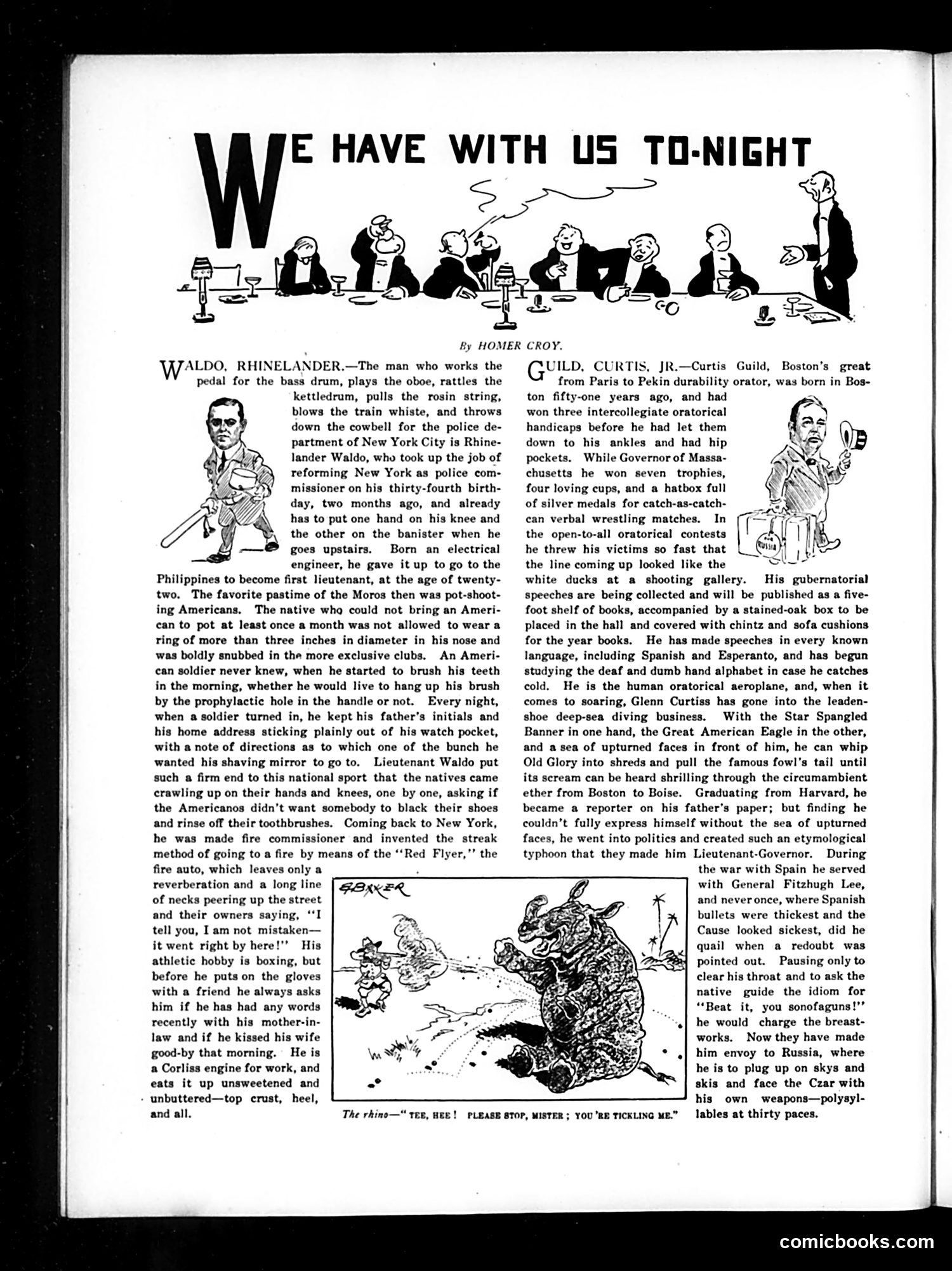
This page from Homer Croy's "We Have With Us To-Night" satirizes two prominent early 1900s figures through exaggerated biographical sketches. **Rhinelander Waldo** was New York City's Police Commissioner, mocked for his frantic, hyperactive reforms. The satire portrays him as exhaustingly energetic—someone who "already has to put one hand on his knee" climbing stairs despite his youth. References to his Philippine service and fire commissioner role are real, but presented as evidence of a man constantly rushing from job to job. **Curtis Guild Jr.**, a Boston orator and former Massachusetts Governor, is ridiculed for his verbose, theatrical speaking style. The satire exaggerates his medal-collecting and speech-making to absurd extremes, suggesting he's an airborne machine of endless oratory who drowns audiences in words. Both sketches mock the era's progressive reformers and professional politicians as exhausting, self-promotional figures whose constant activity masks questionable substance. The bottom cartoon (caption about "the rhino") likely reinforces these themes visually.
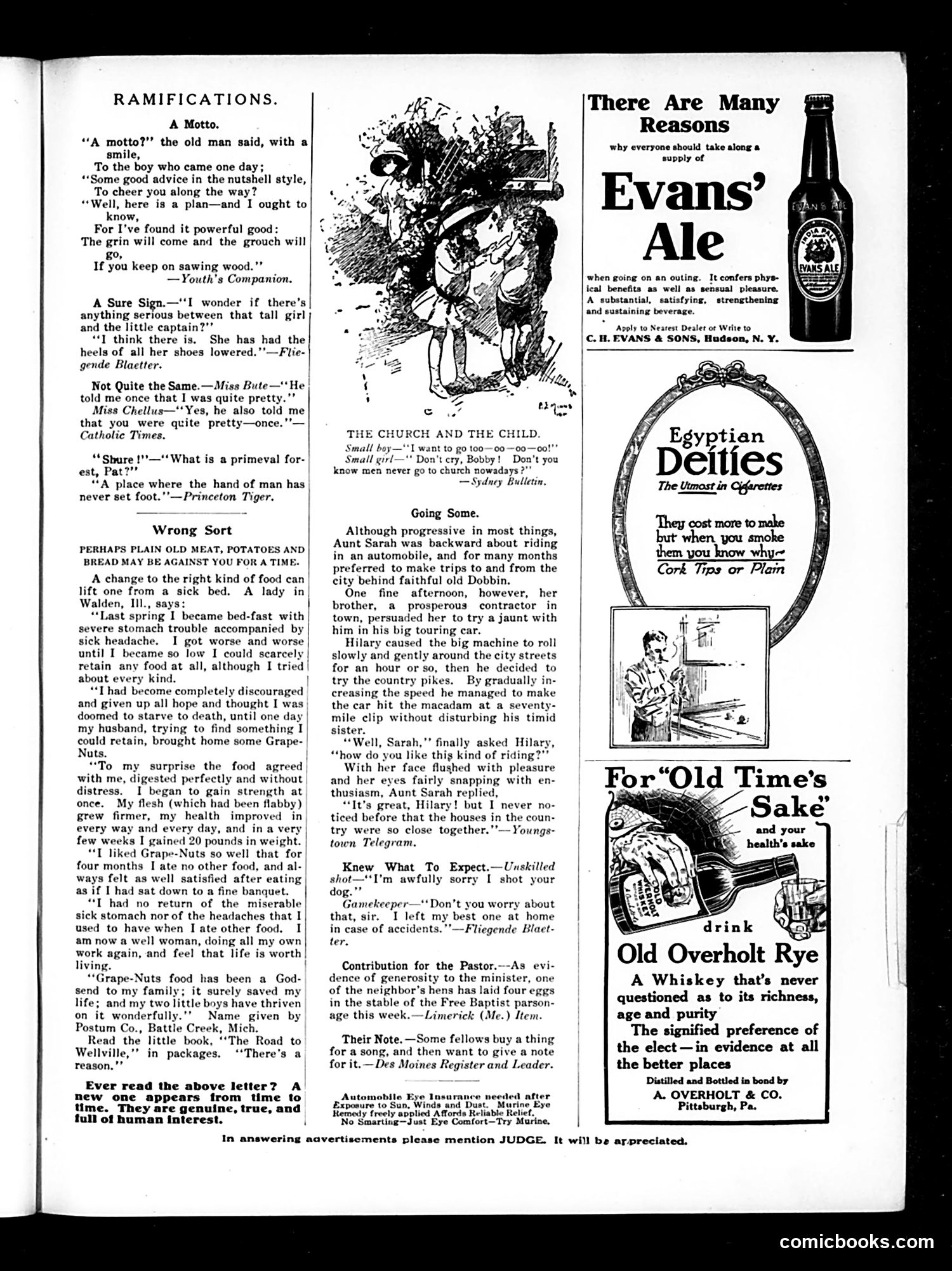
This page from *Judge* contains primarily **humorous anecdotes and advertisements** rather than political cartoons. The content includes: **Humor pieces** satirizing everyday social situations—a woman's vanity (lowering shoe heels to appear taller), gender stereotypes (a child noting men don't attend church), and rural ignorance (Aunt Sarah, traveling 70 mph in a car, thinks country houses are closer together than city ones). **A Grape-Nuts advertisement** disguised as a testimonial letter—a common advertising strategy of the era. It presents a woman's "recovery" from stomach troubles through diet change, implying poor nutrition causes illness. **Period advertisements** for Evans' Ale, Egyptian cigarettes, and Old Overholt Rye whiskey, with typical early-1900s marketing appeals to health and quality. The page reflects *Judge's* formula: light social mockery targeting middle-class pretension and provincial attitudes, combined with commercial sponsorship. There are no identifiable political figures or major social commentary—just genteel satire of daily life and consumer culture.
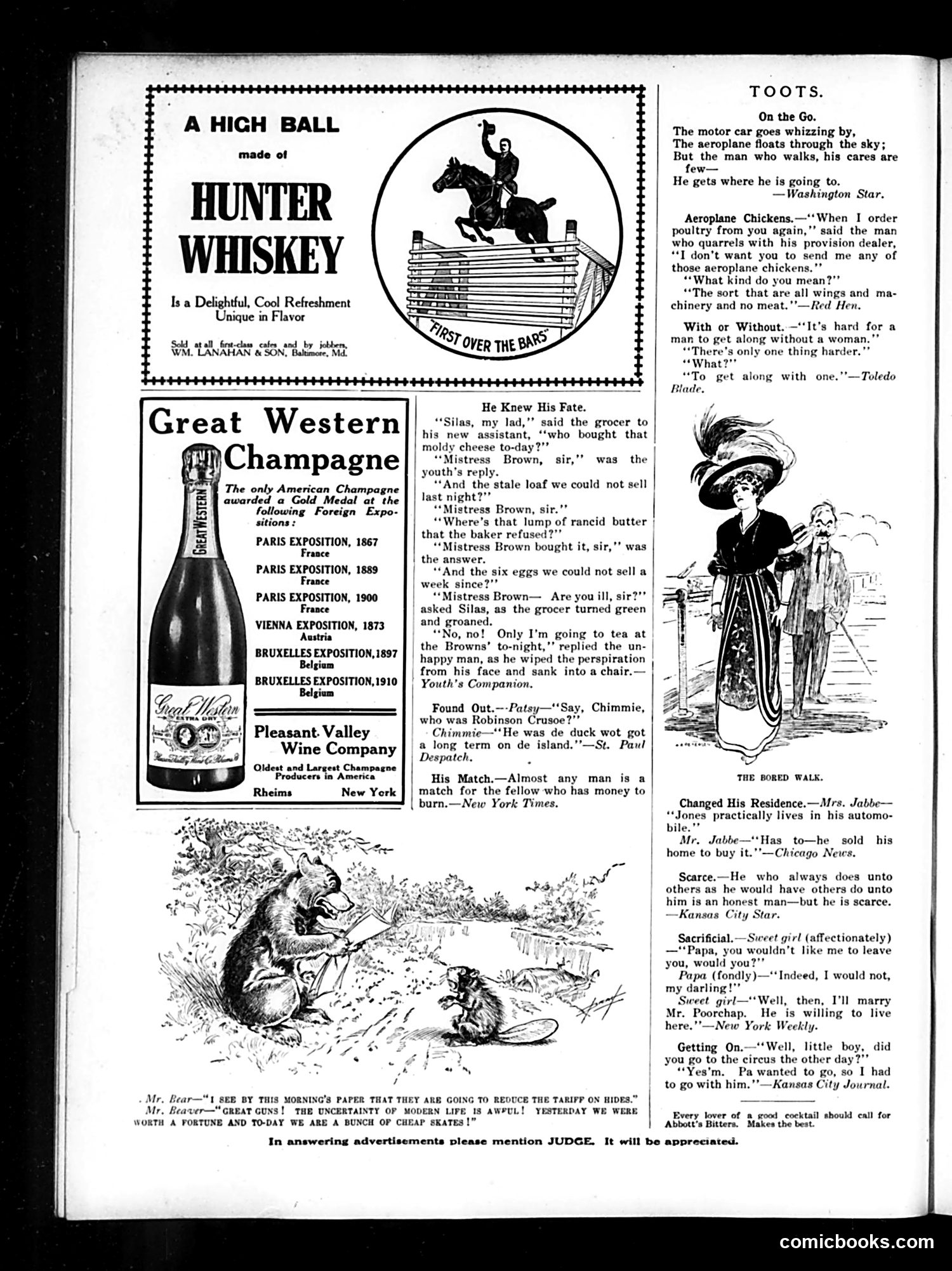
This page is primarily **advertisements and humor shorts**, typical of Judge magazine's format. The main cartoon features **Mr. Bear and Mr. Beaver** discussing tariff policy. Bear expresses anxiety that uncertainty about trade tariffs (specifically whether hides will be taxed) makes their economic status unpredictable—they were "worth a fortune" yesterday but are now "cheap skates." This satirizes how **business confidence fluctuates with political/economic policy**, and how tariff debates created genuine uncertainty for industries dependent on import/export goods. The beaver and bear appear to represent fur traders or related businesses vulnerable to tariff changes. The remaining content consists of short joke items labeled "TOOTS"—witty one-liners about modern life (automobiles, aeroplanes, bicycles), relationships, and human nature. These are filler humor typical of the era. Advertisements occupy significant space: Hunter Whiskey, Great Western Champagne, and Abbott's Bitters—all alcohol products, reflecting early 20th-century advertising norms.
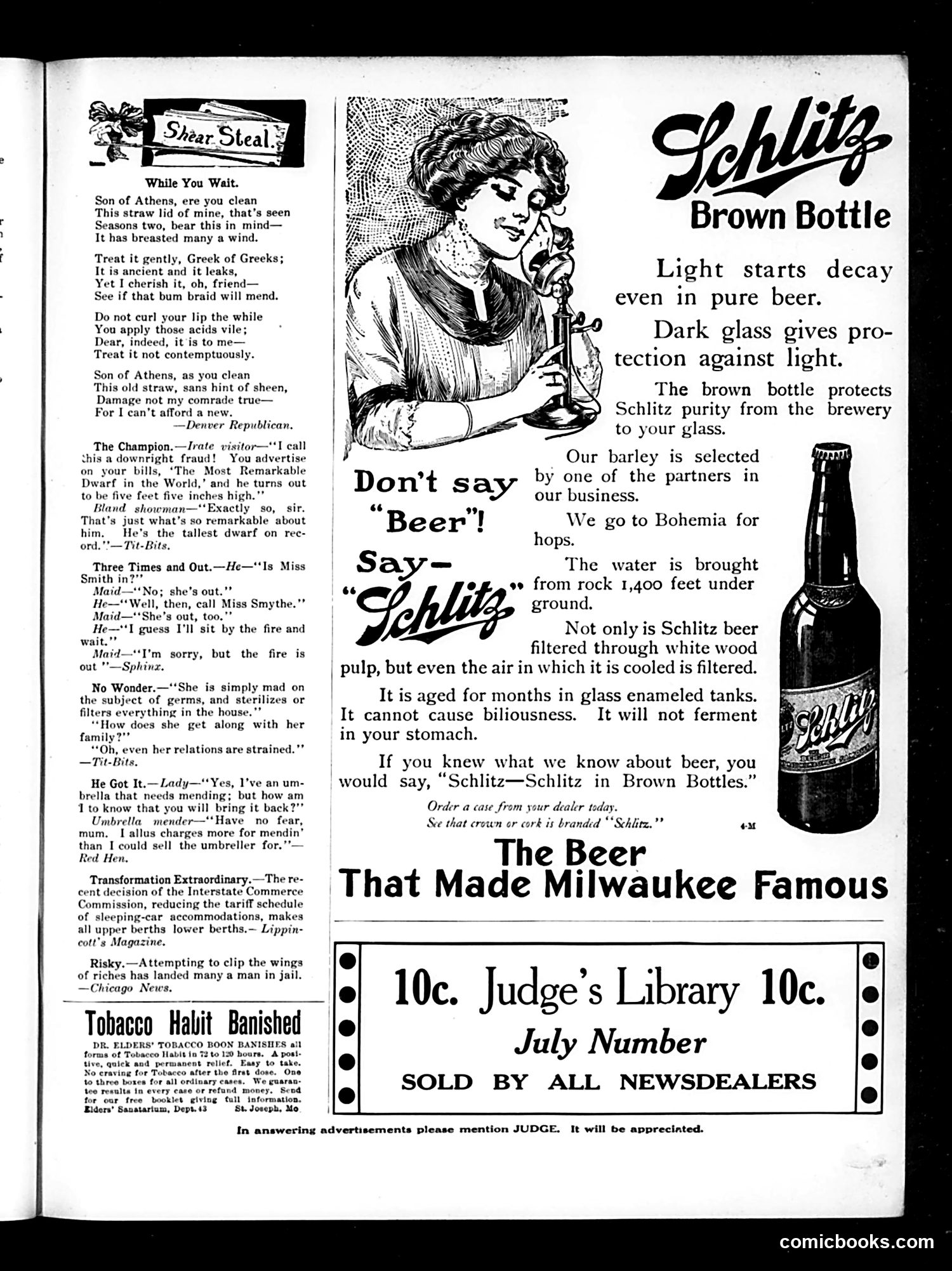
This page contains **short satirical jokes** on the left (typical of *Judge* magazine's humor section) and a **full-page Schlitz beer advertisement** dominating the right side. The jokes mock everyday situations: a customer worried about his old straw hat being damaged during cleaning; a "dwarf" who's actually five feet tall; a woman so obsessed with germs she sterilizes her family relationships; an umbrella repairman who charges more than the umbrella's worth. The **Schlitz ad** emphasizes product purity through brown bottles that "protect" beer from light decay. It claims superior ingredients (Bohemian hops, deep-well water, wood-pulp filtration, glass-tank aging) won't cause stomach upset—selling the beer as scientifically superior and healthier than competitors. This reflects early 20th-century marketing that positioned beer as a quality, safe product rather than a vice. The bottom promotes *Judge's* July issue at 10 cents—typical newsstand pricing of the era.
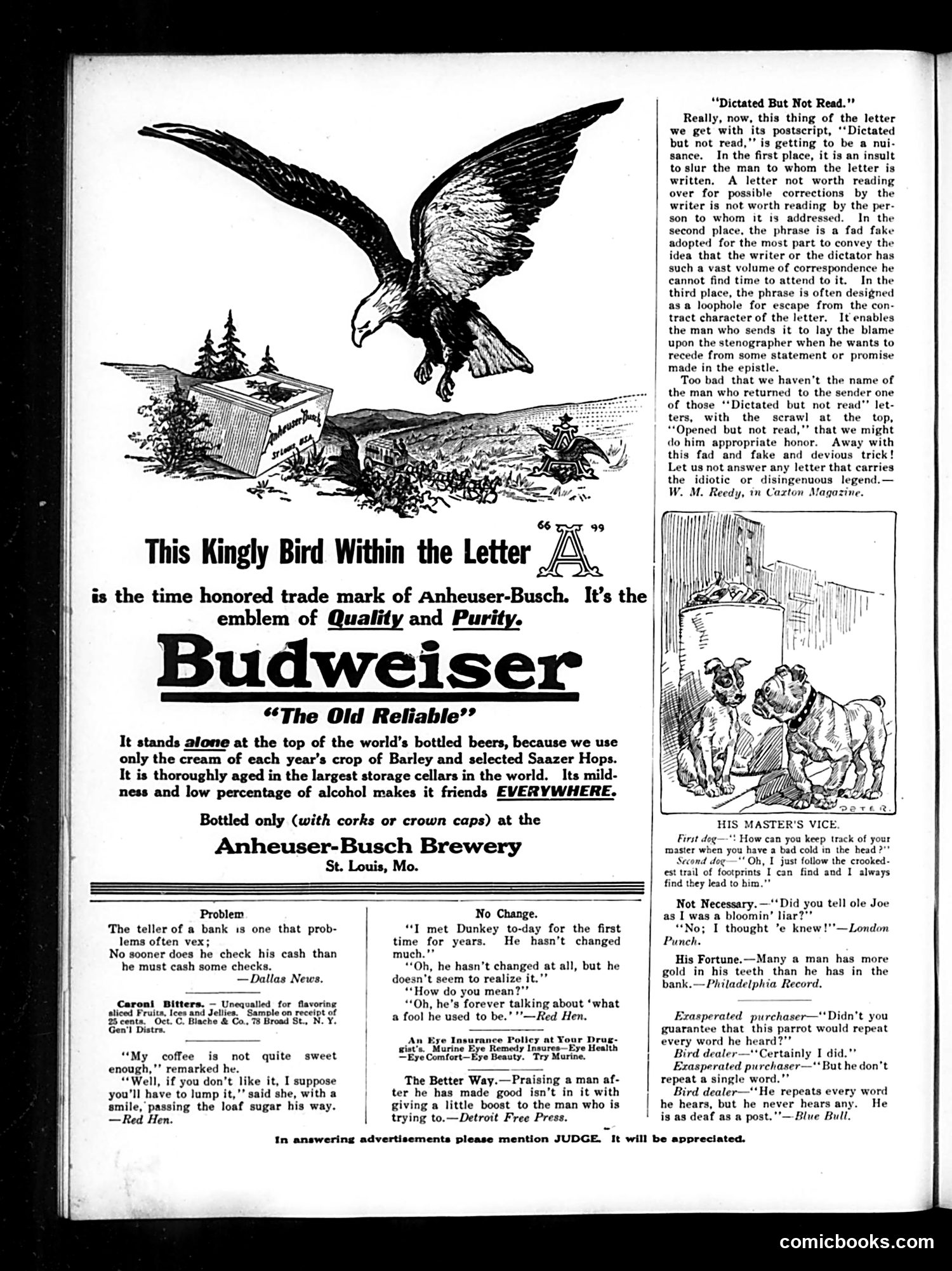
This page is primarily **advertising**, dominated by a large Budweiser beer advertisement featuring an eagle carrying a barrel—Anheuser-Busch's trademark. The ad emphasizes quality ingredients and aging processes. The page also contains **humorous short anecdotes** typical of Judge magazine's satirical format: - "Dictated But Not Read" critiques the then-common business practice of adding this phrase to typed letters, arguing it's insulting, pretentious, and used as an excuse for carelessness. - Several brief jokes about everyday life: a bank teller's dilemma, a coffee complaint, a dog following drunk footprints, and a deaf parrot. These satirize modern conveniences and social affectations becoming absurd. The eagle illustration and period styling date this to the early 20th century, when such workplace shortcuts and business formality were emerging social issues. The humor depends on recognizing these practices as contemporary annoyances.
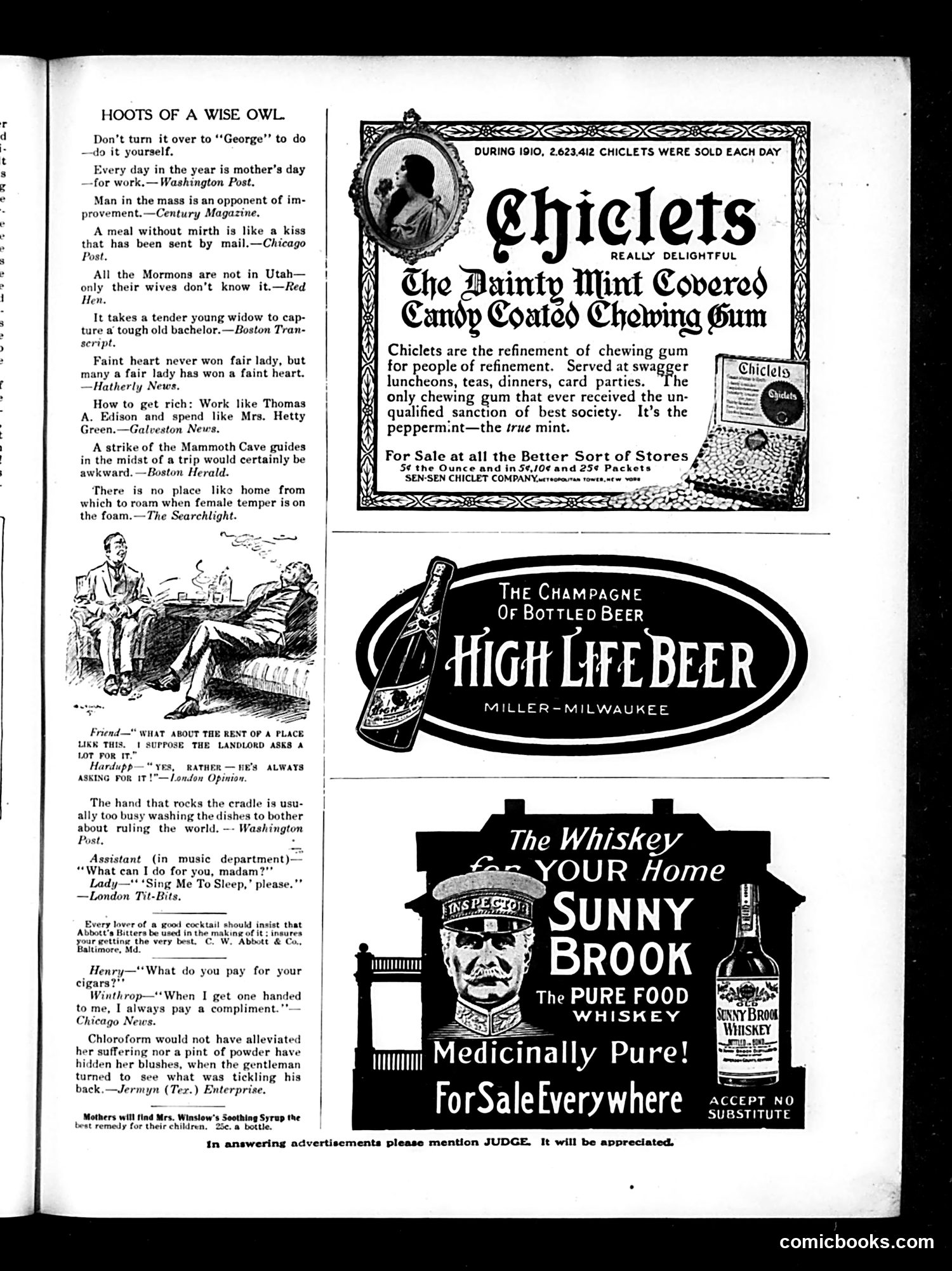
This page is primarily **advertising** with a small section of satirical humor at the top. The "Hoots of a Wise Owl" section presents brief, witty observations on gender relations and social behavior—typical Judge fare. Notable examples mock Mormon polygamy ("All the Mormons are not in Utah—only their wives don't know it") and gender dynamics ("Faint heart never won fair lady, but many a fair lady has won a faint heart"). One cartoon depicts a landlord-tenant exchange where the landlord repeatedly asks for rent payment; the tenant darkly jokes the landlord is "always asking for it"—implying the landlord deserves whatever consequences befall him. The page's bulk consists of period advertisements: Chiclets gum (marketed as refined, society-approved candy), High Life Beer (Milwaukee), and Sunny Brook whiskey (marketed as "medicinally pure" for home use—relevant given Prohibition-era restrictions on alcohol sales). These ads reflect early 20th-century marketing strategies emphasizing refinement, social status, and medicinal legitimacy.
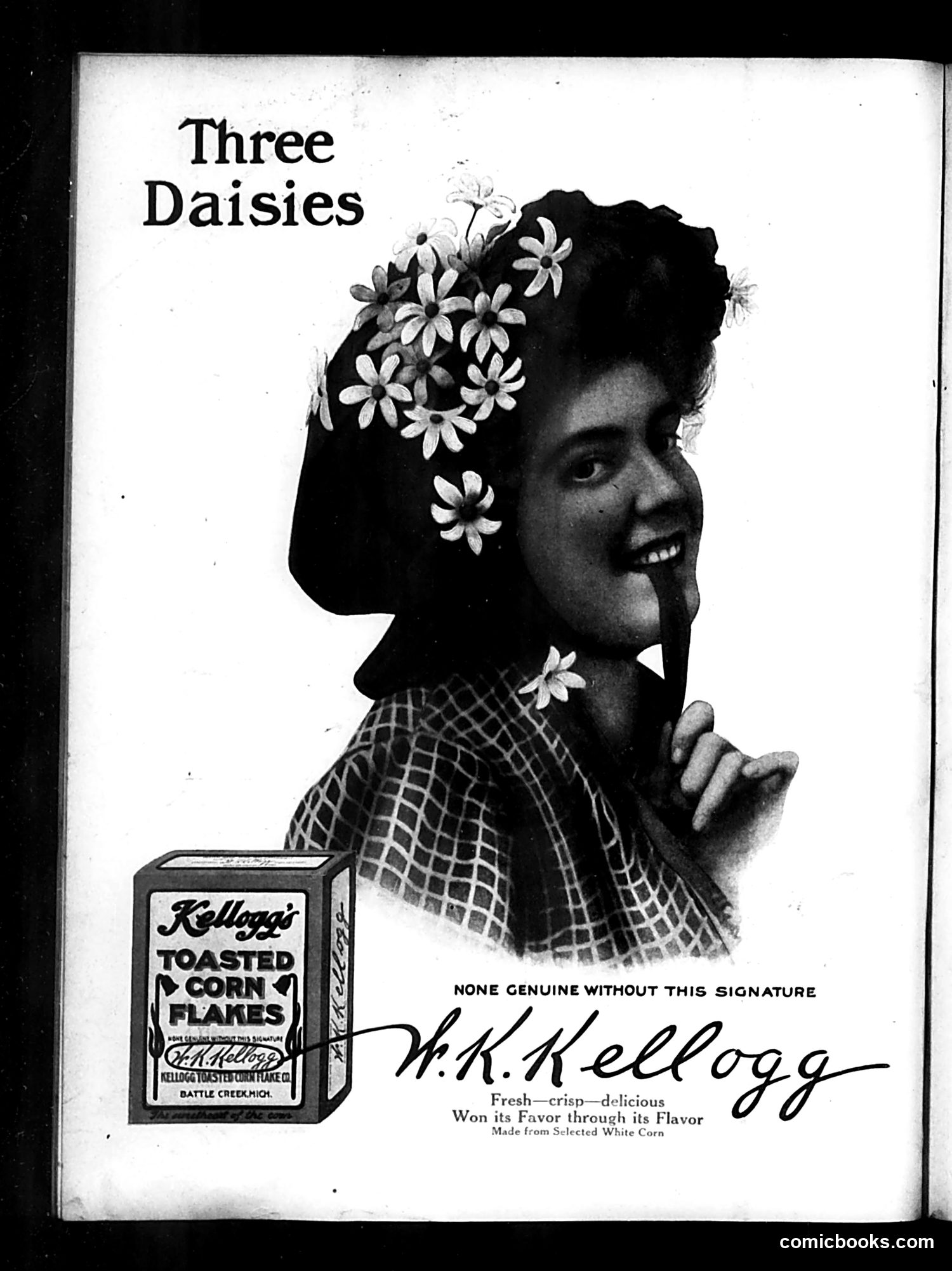
This is a **Kellogg's Toasted Corn Flakes advertisement**, not political satire. The page features a smiling woman wearing daisies in her hair and at her neck, positioned next to a cereal box. The text emphasizes authenticity through W.K. Kellogg's signature. The "Three Daisies" title likely refers to the decorative flowers adorning the woman, which serve as visual branding rather than commentary. The ad appeals to consumers by associating the product with freshness, wholesomeness, and feminine charm—standard marketing strategy of the era. While *Judge* was satirical, this particular page is straightforward commercial advertising, using nostalgic imagery to sell breakfast cereal to early 20th-century American households.