
Judge, 1911-07-15 · page 6 of 24
Judge — July 15, 1911 — page 6: what you’re looking at
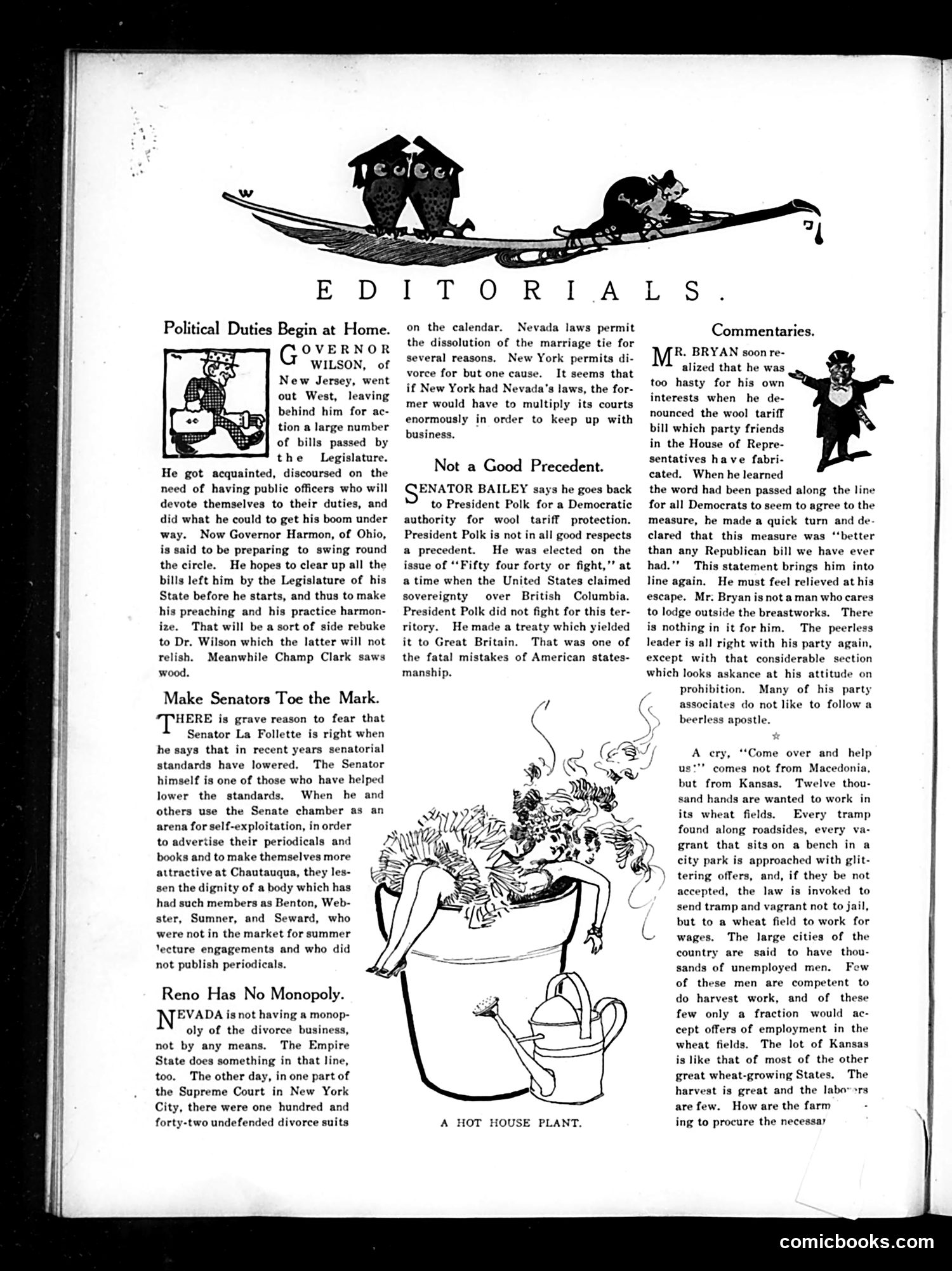
What you’re looking at
This page satirizes prominent American politicians circa 1912, mocking their hypocrisy and inconsistency: **"Political Duties Begin at Home"** criticizes Governor Wilson (later President Woodrow Wilson) for campaigning out West while leaving legislative work unfinished in New Jersey—contrasted favorably with Ohio's Governor Harmon, who completes his duties before political travel. **"Make Senators Toe the Mark"** attacks Senator La Follette for using the Senate chamber for self-promotion, lecturing at Chautauqua and publishing periodicals rather than serving with dignity like historical senators (Benton, Webster, Sumner, Seward). **"Reno Has No Monopoly"** sarcastically notes Nevada isn't alone in divorce business—New York has 142 pending cases despite stricter laws, suggesting hypocrisy about moral standards. **"Not a Good Precedent"** criticizes Senator Bailey citing President Polk's tariff policy, noting Polk failed to fight for disputed Oregon Territory, making him a poor model. **Commentaries** mocks William Jennings Bryan for flip-flopping on a wool tariff bill, reversing his criticism once party leadership pressured him—ridiculing his compromised independence.
📄 Transcribed text from this page (OCR, searchable)
Machine-transcribed from the original scan — historical spelling and the odd misread are preserved.
EDITORIALS Political Duties Begin at Home. OVERNOR WILSON, of New Jersey, went out West, leaving behind him for ac- tion a large number of bills passed by the Legislature. He got acquainted, discoursed on the need of having public officers who will devote themselves to their duties, and did what he could to get his boom under way. Now Governor Harmon, of Ohio, is said to be preparing to swing round the circle. He hopes to clear up all the bills left him by the Legislature of his State before he starts, and thus to make his preaching and his practice harmon- ize. That will be a sort of side rebuke to Dr. Wilson which the latter will not relish. Meanwhile Champ Clark saws wood. Make Senators Toe the Mark. HERE is grave reason to fear that Senator La Follette is right when he says that in recent years senatorial standards have lowered. The Senator himself is one of those who have helped lower the standards. When he and others use the Senate chamber as an arena for self-exploitation, in order to advertise their periodicals and books and to make themselves more attractive at Chautauqua, they les- sen the dignity of a body which has had such members as Benton, Web- ster, Sumner, and Seward, who were not in the market for summer lecture engagements and who did not publish periodicals. Reno Has No Monopoly. NEVADA isnot having a monop- oly of the divorce business, not by any means. The Empire State does something in that line, too. The other day, in one part of the Supreme Court in New York City, there were one hundred and forty-two undefended divorce suits on the calendar. Nevada laws permit the dissolution of the marriage tie for several reasons. New York permits di- vorce for but one cause. It seems that if New York had Nevada's laws, the for- mer would have to multiply its courts enormously in order to keep up with business. Not a Good Precedent. SENATOR BAILEY says he goes back to President Polk for a Democratic authority for wool tariff protection. President Polk is not in all good respects a precedent. He was elected on the issue of ‘Fifty four forty or fight,’’ at atime when the United States claimed sovereignty over British Columbia. President Polk did not fight for this ter- ritory. He made a treaty which yielded it to Great Britain. That was one of the fatal mistakes of American states- manship. A HOT HOUSE PLANT. Commentaries. R. BRYAN soon re- alized that he was too hasty for his own interests when he de- nounced the wool tariff bill which party friends in the House of Repre- sentatives have fabri- cated. When he learned the word had been passed along the line for all Democrats to seem to agree to the measure, he made a quick turn and de- clared that this measure was “‘better than any Republican bill we have ever had." This statement brings him into line again. He must feel relieved at his escape. Mr. Bryan is not aman who cares to lodge outside the breastworks. There is nothing in it for him. The peer! leader is all right with his party again, except with that considerable section which looks askance at his attitude on prohibition. Many of his party associates do not like to follow a beerless apostle. A cry, ‘Come over and help us‘’’ comes not from Macedonia, but from Kansas. Twelve thou- sand hands are wanted to work in its wheat fields. Every tramp found along roadsides, every va- grant that sitson a bench in a city park is approached with glit- tering offers, and, if they be not accepted, the law is invoked to send tramp and vagrant not to jail, but to a wheat field to work for The large cities of the country are said to have thou- sands of unemployed men. Few of these men are competent to do harvest work, and of these few only a fraction would ac- cept offers of employment in the wheat fields. The lot of Kansas is like that of most of the other great wheat-growing States. The harvest is great and the labovors are few. How are the farm ing to procure the necessa’ wages. comicbooks.com