
Judge, 1911-07-15 · page 18 of 24
Judge — July 15, 1911 — page 18: what you’re looking at
What you’re looking at
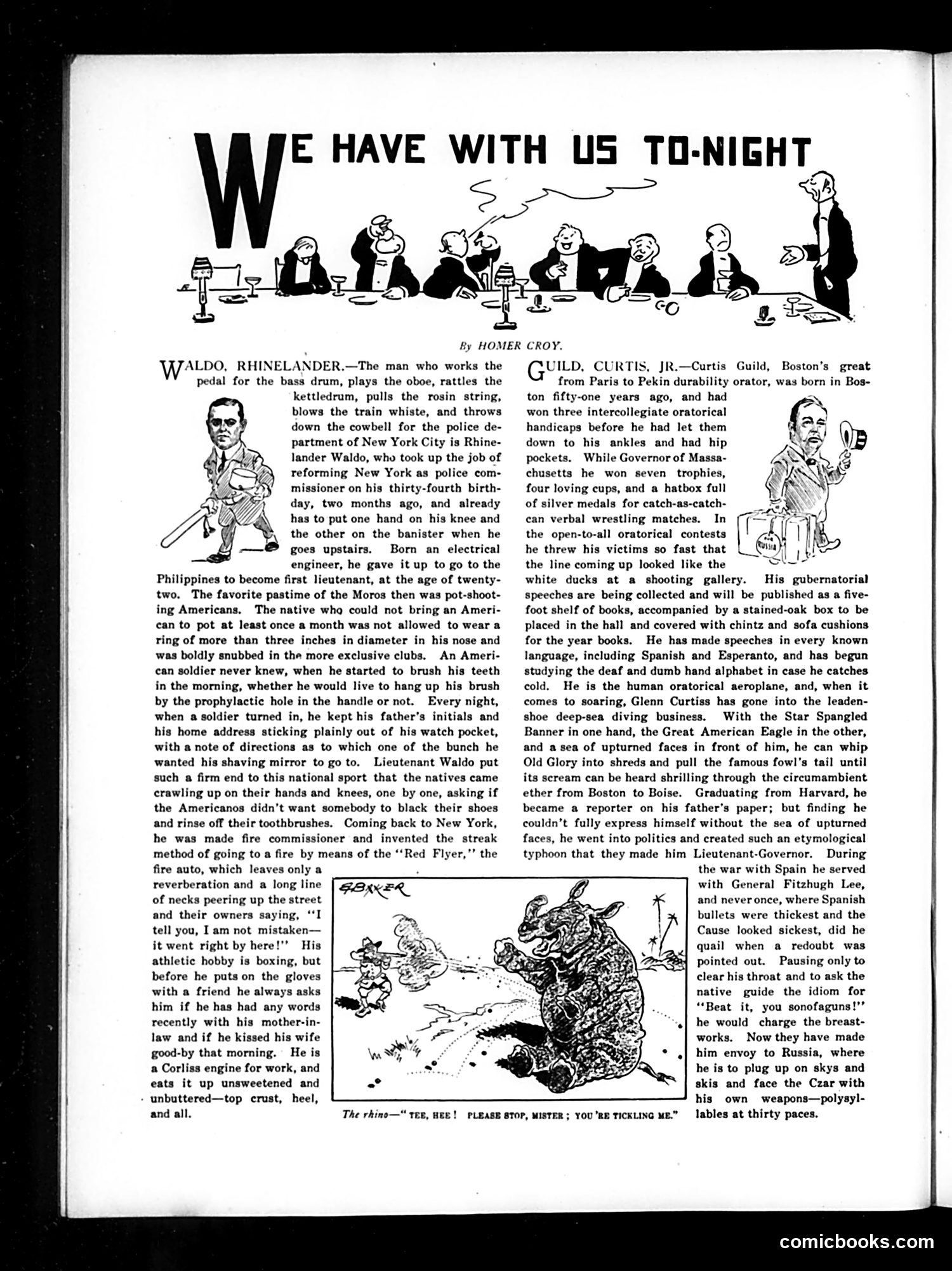
This page from Homer Croy's "We Have With Us To-Night" satirizes two prominent early 1900s figures through exaggerated biographical sketches. **Rhinelander Waldo** was New York City's Police Commissioner, mocked for his frantic, hyperactive reforms. The satire portrays him as exhaustingly energetic—someone who "already has to put one hand on his knee" climbing stairs despite his youth. References to his Philippine service and fire commissioner role are real, but presented as evidence of a man constantly rushing from job to job. **Curtis Guild Jr.**, a Boston orator and former Massachusetts Governor, is ridiculed for his verbose, theatrical speaking style. The satire exaggerates his medal-collecting and speech-making to absurd extremes, suggesting he's an airborne machine of endless oratory who drowns audiences in words. Both sketches mock the era's progressive reformers and professional politicians as exhausting, self-promotional figures whose constant activity masks questionable substance. The bottom cartoon (caption about "the rhino") likely reinforces these themes visually.
📄 Transcribed text from this page (OCR, searchable)
Machine-transcribed from the original scan — historical spelling and the odd misread are preserved.
E HAVE WITH US TO-NIGHT By HOMER CROY. ALDO, RHINELANDER.—The man who works the pedal for the bass drum, plays the oboe, rattles the kettledrum, pulls the rosin string, blows the train whiste, and throws down the cowbell for the police de- partment of New York City is Rhine- lander Waldo, who took up the job of reforming New York as police com- missioner on his thirty-fourth birth- day, two months ago, and already has to put one hand on his knee and the other on the banister when he goes upstairs. Born an electrical engineer, he gave it up to go to the Philippines to become first lieutenant, at the age of twenty- two. The favorite pastime of the Moros then was pot-shoot- ing Americans, The native who could not bring an Ameri- can to pot at least once a month was not allowed to wear a ring of more than three inches in diameter in his nose and was boldly snubbed in the more exclusive clubs. An Ameri- can soldier never knew, when he started to brush his teeth in the morning, whether he would live to hang up his brush by the prophylactic hole in the handle or not. Every night, when a soldier turned in, he kept his father’s initials and his home address sticking plainly out of his watch pocket, with a note of directions as to which one of the bunch he wanted his shaving mirror to go to. Lieutenant Waldo put such a firm end to this national sport that the natives came crawling up on their hands and knees, one by one, asking if the Americanos didn’t want somebody to black their shoes and rinse off their toothbrushes. Coming back to New York, he was made fire commissioner and invented the streak method of going to a fire by means of the ‘Red Flyer,’’ the fire auto, which leaves only a ; reverberation and a long line of necks peering up the street and their owners saying, ‘I tell you, Iam not mistaken— it went right by here!’ His athletic hobby is boxing, but before he puts on the gloves with a friend he always asks him if he has had any words recently with his mother-in- law and if he kissed his wife good-by that morning. H. a Corliss engine for work, and eats it up unsweetened and + unbuttered—top crust, heel, UILD, CURTIS, JR.—Curtis Guild, Boston’s great from Paris to Pekin durability orator, was born in Bos- ton fifty-one years ago, and had won three intercollegiate oratorical handicaps before he had let them down to his ankles and had hip pockets. While Governor of Massa- chusetts he won seven trophies, four loving cups, and a hatbox full of silver medals for catch-as-catch- can verbal wrestling matches. In the open-to-all oratorical contests he threw his victims so fast that the line coming up looked like the white ducks at a shooting gallery. His gubernatorial speeches are being collected and will be published as a five- foot shelf of books, accompanied by a stained-oak box to be placed in the hall and covered with chintz and sofa cushions for the year books. He has made speeches in every known language, including Spanish and Esperanto, and has begun studying the deaf and dumb hand alphabet in case he catches cold. He is the human oratorical aeroplane, and, when it comes to soaring, Glenn Curtiss has gone into the leaden- shoe deep-sea diving business. With the Star Spangled Banner in one hand, the Great American Eagle in the other, and a sea of upturned faces in front of him, he can whip Old Glory into shreds and pull the famous fowl's tail until its scream can be heard shrilling through the circumambient ether from Boston to Boise. Graduating from Harvard, he became a reporter on his father’s paper; but finding he couldn’t fully express himself without the sea of upturned faces, he went into politics and created such an etymological typhoon that they made him Lieutenant-Governor. During the war with Spain he served with General Fitzhugh Lee, and never once, where Spanish bullets were thickest and the Cause looked sickest, did he quail when a redoubt was pointed out. Pausing only to clear his throat and to ask the native guide the idiom for “Beat it, you sonofaguns!’’ he would charge the breast- works. Now they have made him envoy to Russia, where he is to plug up on skys and skis and face the Czar with his own weapons—polysyl- ['¢ St and all. The rhino—" tee, HEE! PLEASE STOP, MISTER ; YOU'RE TICKLING ME.” lables at thirty paces. comicbooks.com