
A complete issue · 24 pages · 1911
Judge — July 1, 1911
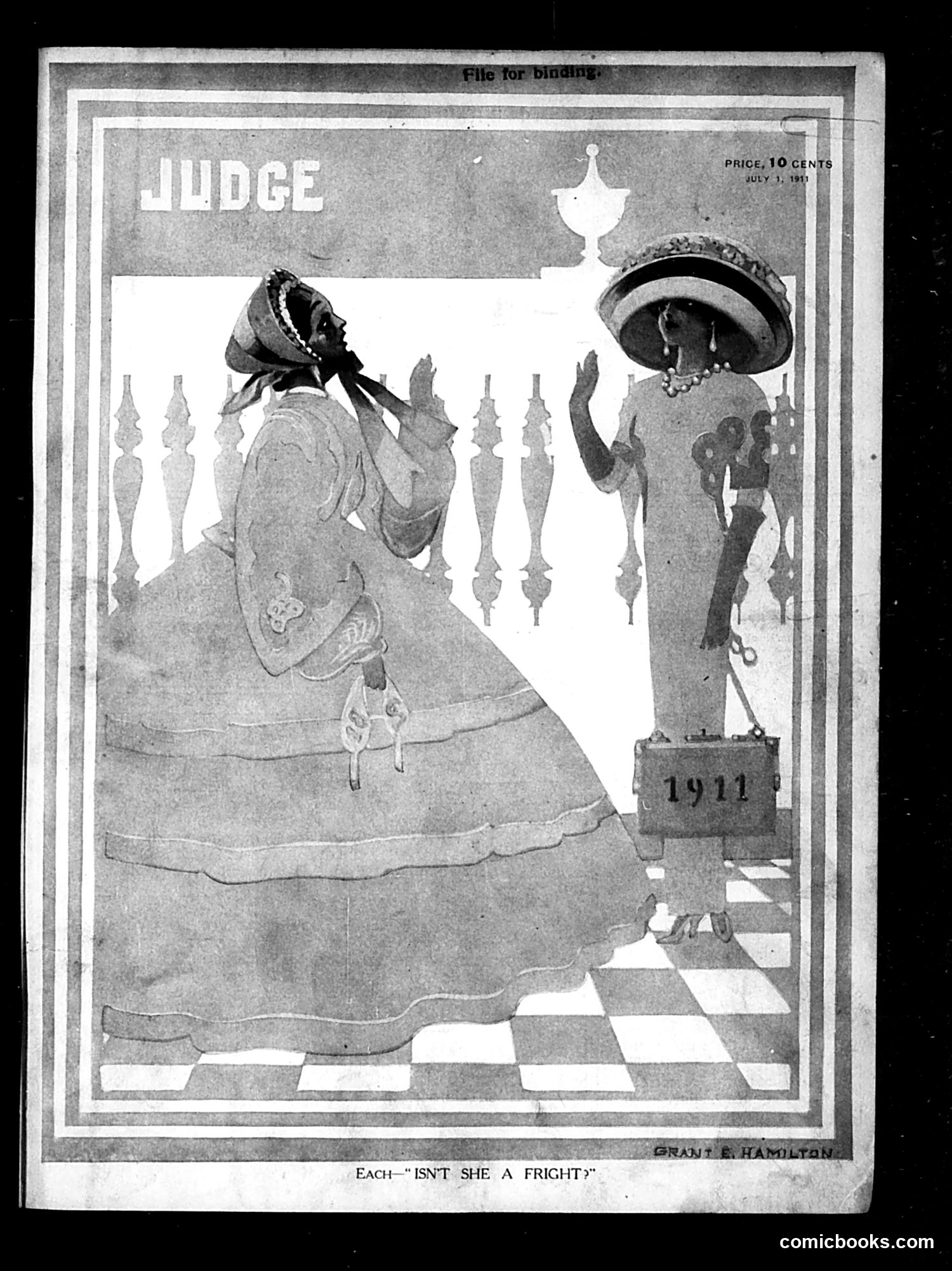
This cover illustration by Grant E. Hamilton depicts two fashionable women in an interior setting with decorative candlesticks. The caption reads "Isn't She a Fright?" The satire appears to mock women's fashion of 1911, specifically the elaborate hats and clothing styles of the period. The woman on the right wears an oversized, ornate hat characteristic of the "Gibson Girl" era's excessive millinery. The interior setting—with its formal furnishings and checkered floor—suggests upper-class society commentary. The joke likely critiques how wealthy women's extreme fashion choices, intended to display elegance and status, could actually appear ridiculous or unflattering. This was a recurring theme in early 20th-century satirical magazines, which frequently lampooned women's fashions and consumerism among the affluent classes.
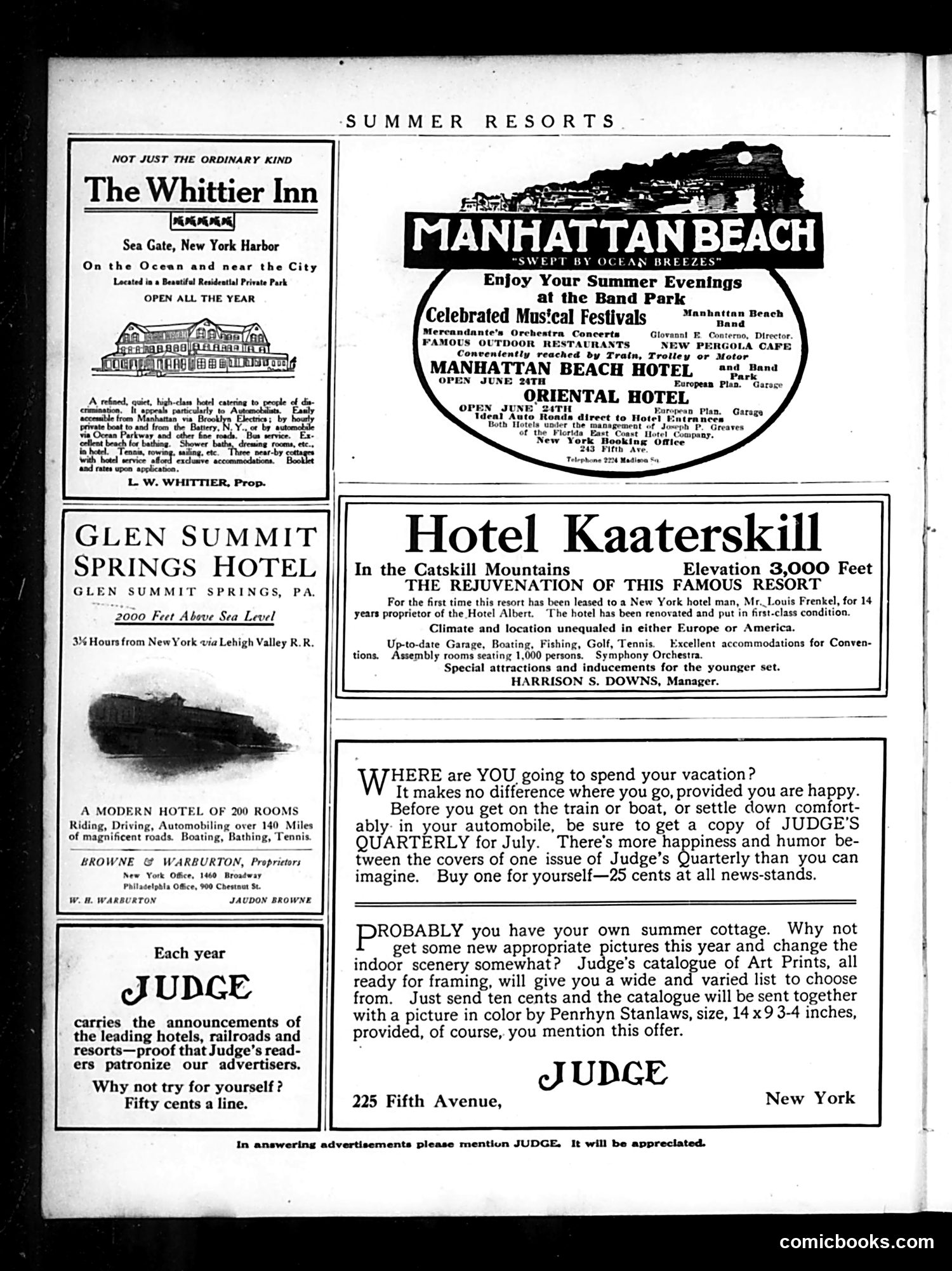
This page is **primarily advertising**, not satirical content. It features summer resort advertisements from the early 20th century, including: - The Whittier Inn (Sea Gate, New York Harbor) - Manhattan Beach Hotel and Oriental Hotel - Glen Summit Springs Hotel (Pennsylvania) - Hotel Katerskill (Catskill Mountains) The only editorial content is a **Judge magazine self-promotion** encouraging readers to purchase the July issue and to advertise in the publication. There's also a promotional piece for Judge's catalog of Art Prints. **No political cartoons or satirical commentary appears on this page.** It represents Judge's business model: the magazine subsidized its content through resort and hotel advertising aimed at affluent readers seeking summer leisure destinations.
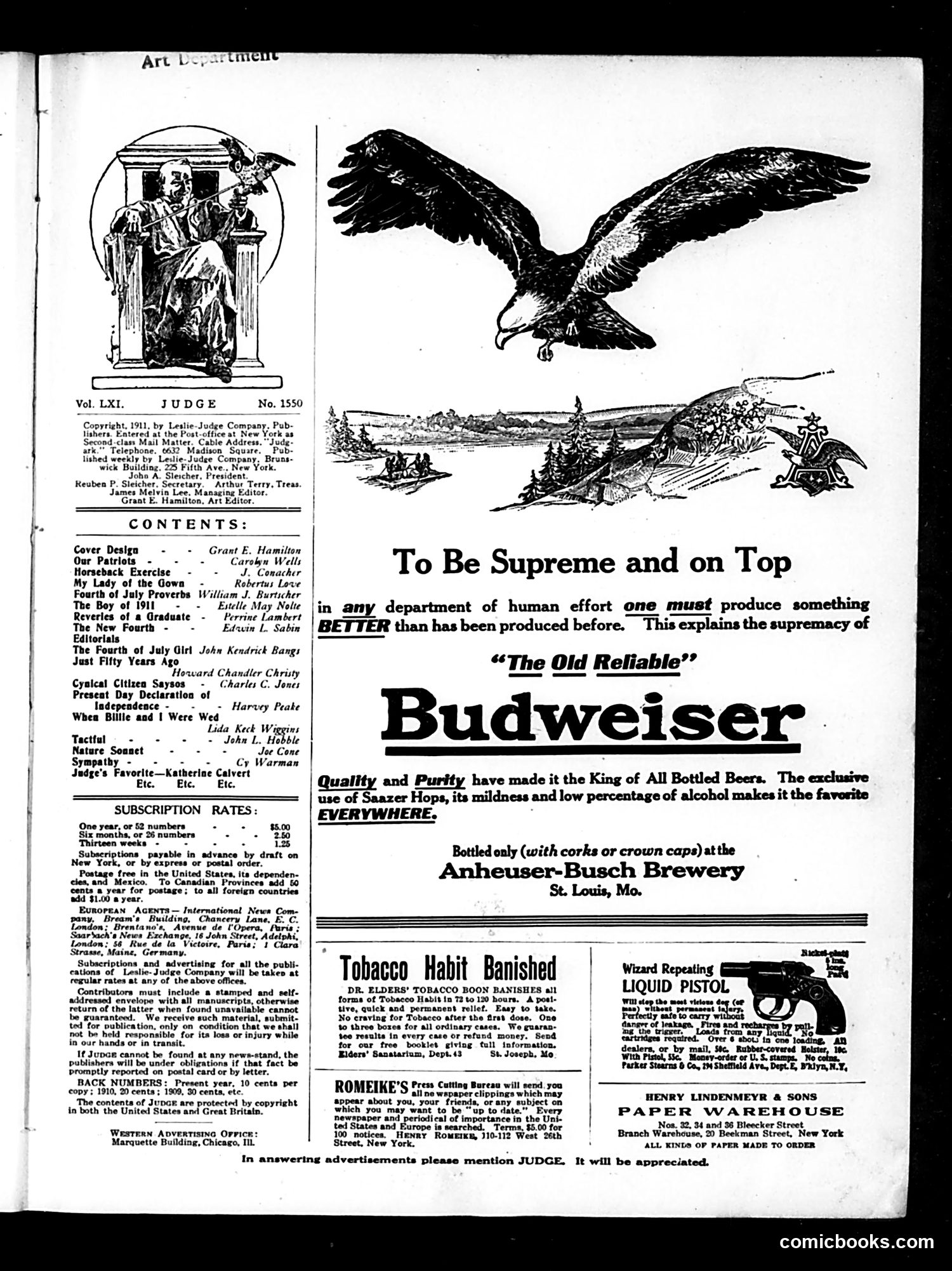
This page is primarily **advertising rather than satirical content**. The dominant feature is a large Budweiser beer advertisement claiming "The Old Reliable" beer achieves supremacy through superior quality and purity, produced by Anheuser-Busch in St. Louis. Below that are smaller ads for tobacco cessation ("Tobacco Habit Banished"), a "Liquid Pistol" weapon, and a paper warehouse. The page header shows it's from Judge magazine (Vol. LXI, No. 1550, 1911), with a table of contents listing various articles. The decorative header illustration includes an eagle and classical figures, but these appear purely ornamental rather than satirical. **No meaningful political or social satire is evident on this page**—it's a straightforward advertising vehicle typical of early 20th-century magazine publishing.
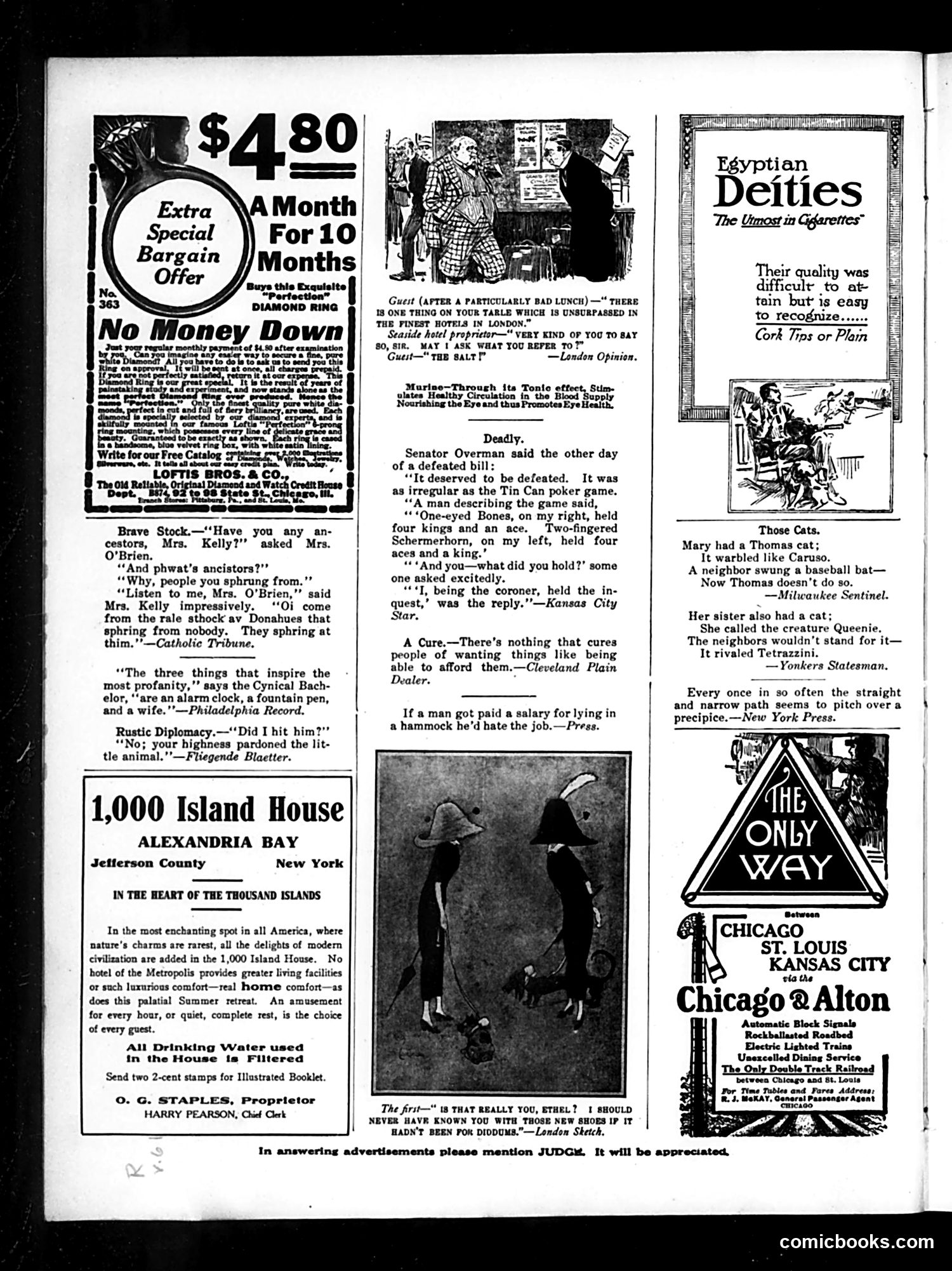
This page is primarily **advertising and humor content** rather than political satire. The main cartoon depicts two figures examining shoes, with the caption suggesting concern about shoe quality—"IS THAT REALLY TOO, ETHEL? I SHOULD NEVER HAVE KNOWN YOU WITH THOSE NEW SHOES IF IT HADN'T BEEN FOR DODGES."—London Sketch. The joke appears to be about poorly made or uncomfortable shoes that are obvious/noticeable to others. The page also contains various **period advertisements** (diamond rings, island houses, cigarettes, railroad services) and short **humor snippets** about marriage, cats, and social observations—typical filler content for Judge magazine. Without additional context about the specific publication date or the figures depicted, the exact satirical targets remain unclear, though the overall tone reflects early 20th-century domestic comedy and consumerism.
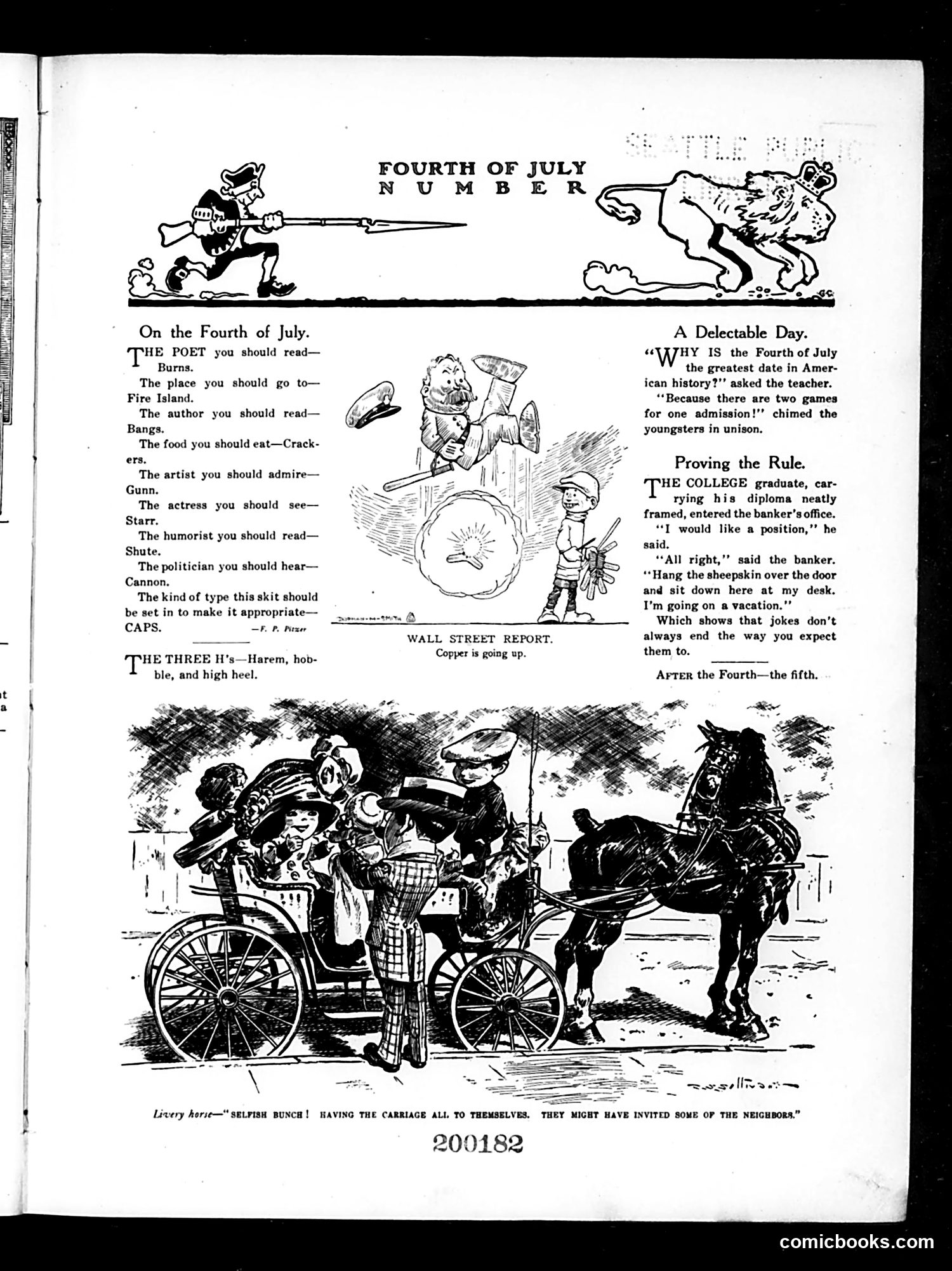
This page celebrates Independence Day with multiple jokes and illustrations. The top cartoon shows a figure with a bayonet chasing what appears to be Uncle Sam (represented as a donkey), likely satirizing political conflict or military aggression around the holiday. The middle section lists "Fourth of July" essentials: Burns (poetry), Fire Island (location), Bangs (fireworks), Crackers (food), and references to artists, actresses, and humorists—standard satirical commentary on what Americans actually enjoy versus patriotic ideals. "A Delectable Day" jokes that July 4th's importance stems from two games (baseball) uniting youngsters. "Proving the Rule" mocks a job-seeker whose banker employer makes him hang sheepskin (diploma) while taking vacation—suggesting credentials mean nothing. The bottom illustration shows a wealthy family in a carriage, captioned about "selfish bunch" excluding neighbors.
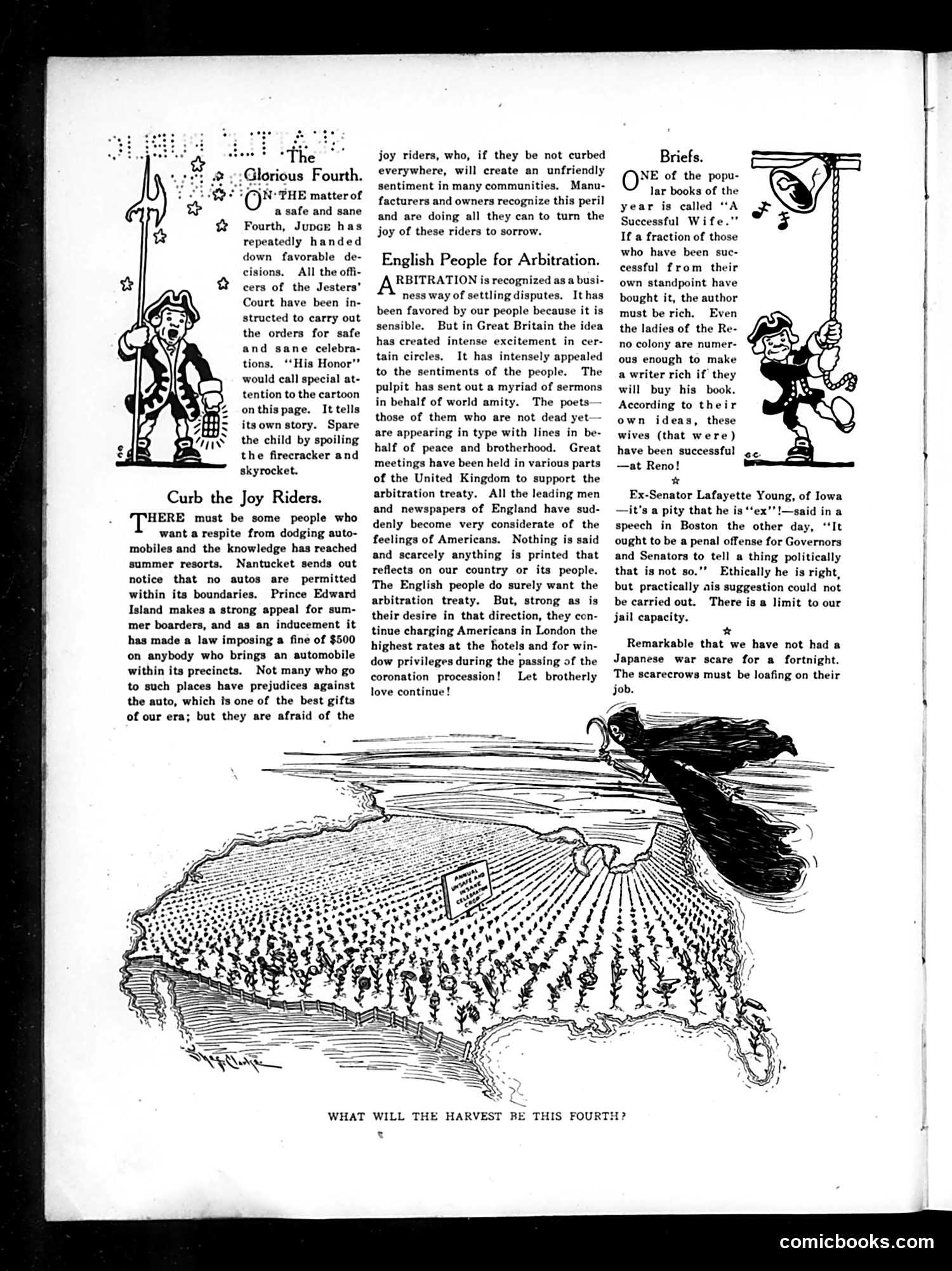
This 1910s-era page uses multiple satirical pieces to critique contemporary American issues: **"The Glorious Fourth"** cartoon warns about Fourth of July dangers—fireworks injuries to children and reckless "joy riders" (early automobile drivers) endangering communities. The skeletal figure reaping a harvest of tiny figures symbolizes death from holiday accidents. **"Curb the Joy Riders"** addresses automobile safety panic. Resort towns like Nantucket and Prince Edward Island are banning cars to protect tourists, recognizing that unregulated drivers create public backlash against the automobile industry itself. **"English People for Arbitration"** mocks British hypocrisy: while England publicly champions peace and arbitration treaties with America through sermons and rallies, British hotels simultaneously overcharge American visitors during coronation events—preaching brotherhood while practicing exploitation. The brief items mock a successful divorce-advice book ("A Successful Wife" selling well in Reno, Nevada's divorce colony) and satirize politician Lafayette Young's call for laws punishing political dishonesty as impractical.
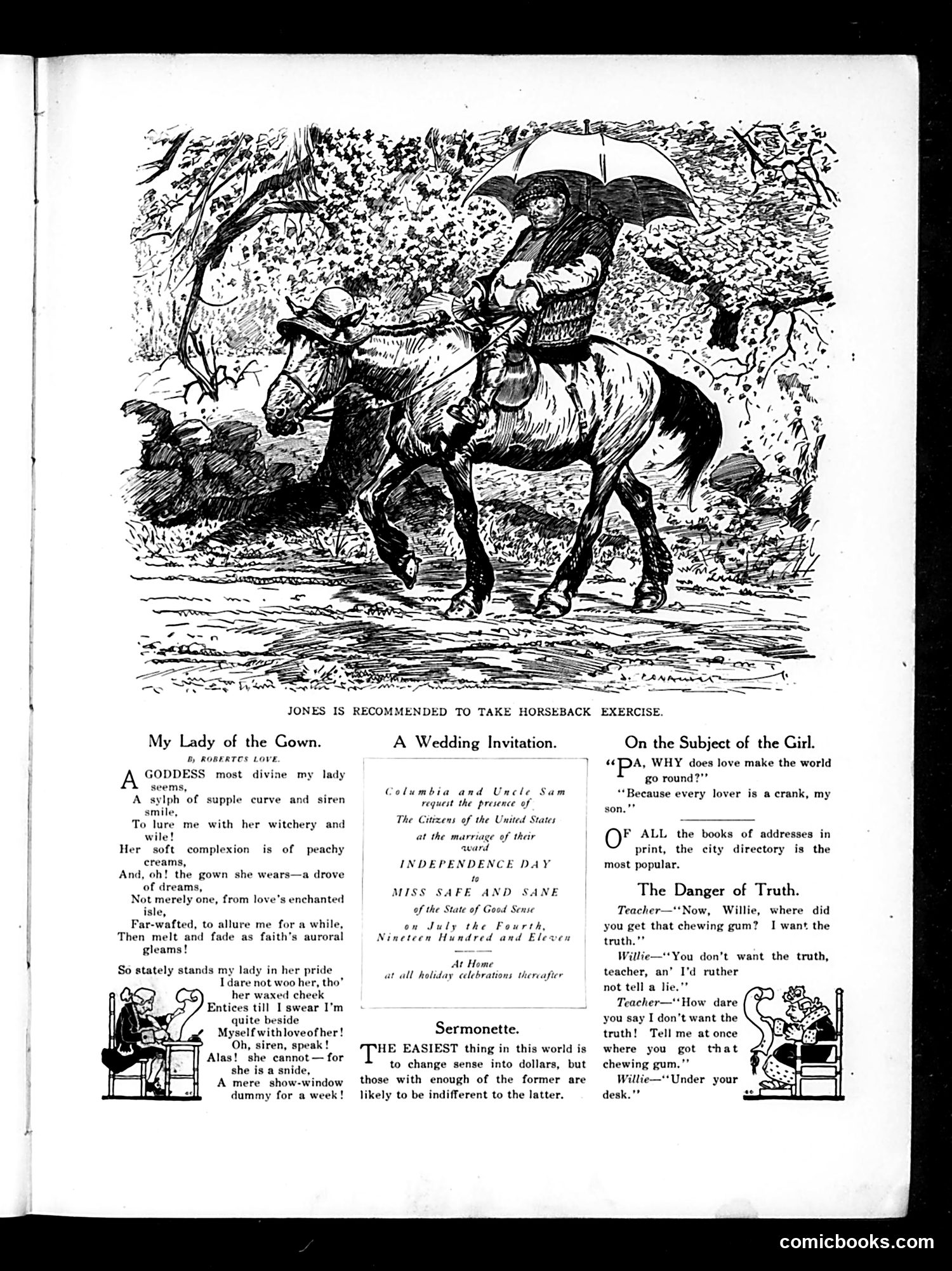
The page contains several satirical pieces typical of early 1900s American humor: **Top Cartoon**: "Jones is Recommended to Take Horseback Exercise" shows a man on horseback with an umbrella in the rain—likely satirizing someone given dubious health advice or mocking a pretentious figure forced into awkward circumstances. **Text Pieces**: The content includes light social satire: - "My Lady of the Gown" mocks fashion-obsessed women, comparing an elegantly-dressed lady to a store mannequin - "A Wedding Invitation" jokes about Independence Day and "Good Sense"—possibly satirizing frivolous Fourth of July celebrations - "The Danger of Truth" features a child's honest admission that adults don't actually want truth, undercutting adult hypocrisy - Various one-liners mock romance, love, and materialism **Overall Tone**: Gentle mockery of contemporary American social pretensions, gender relations, and human nature rather than hard political satire. The humor targets universal follies rather than specific events or politicians.
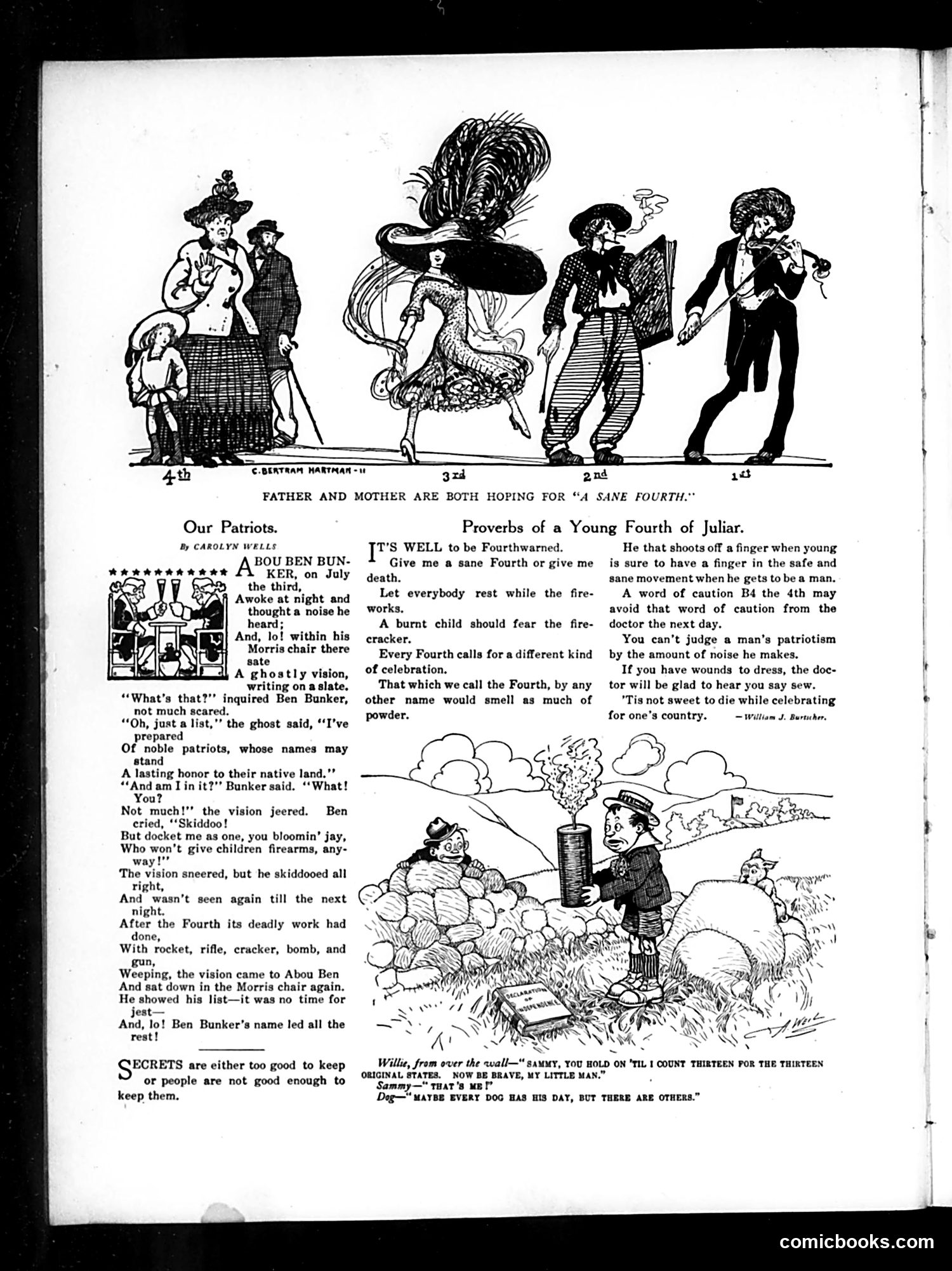
This Judge magazine page satirizes dangerous Fourth of July celebrations circa 1910s-1920s. The top cartoon shows fashionable families hoping for a "sane Fourth"—ironic given the era's rampant fireworks injuries. The story "Our Patriots" by Carolyn Wells uses a ghost-of-conscience framing device. Ben Bunker, an ordinary man who refuses to give children dangerous firearms, becomes the "greatest patriot" because he prioritizes safety over loud celebration. The satire inverts patriotism: true patriots protect children, not enable injury through fireworks. The "Proverbs" section mocks the holiday's carnage through dark wordplay ("A burnt child should fear the firecracker"). The bottom cartoon depicts children counting down before lighting explosives—a grim illustration of common Fourth of July accidents. The page advocates for "sane" celebrations over dangerous tradition, reflecting progressive-era safety reform efforts targeting fireworks-related injuries and child endangerment.
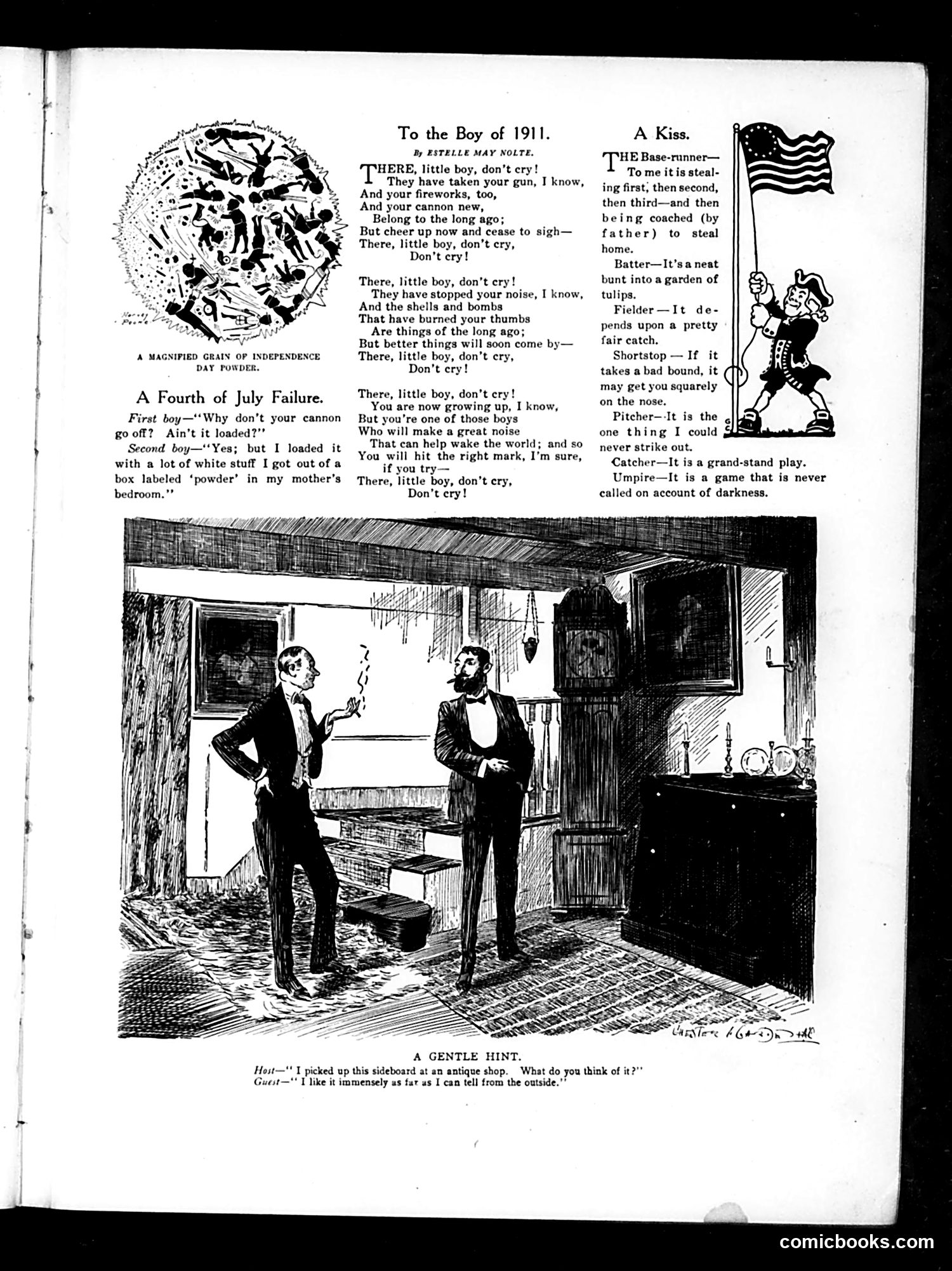
**"A Fourth of July Failure"** satirizes changing attitudes toward Independence Day celebrations. The joke depicts a child's failed cannon experiment using cosmetic powder instead of gunpowder—a humorous mishap reflecting actual safety hazards of fireworks. **"To the Boy of 1911"** is a sentimental poem by Estelle May Nolte addressing firecracker restrictions. Early 1900s America saw increasing regulations banning dangerous fireworks due to injuries. The poem consoles boys losing traditional July 4th explosives while suggesting they'll channel youthful energy toward productive adult accomplishments. **"A Kiss"** humorously defines a kiss through baseball metaphors, with different players offering sport-specific interpretations (stealing bases, bunting, catching, etc.). This is lighthearted wordplay with no deeper political meaning. **"A Gentle Hint"** is a brief comic dialogue about a sideboard's unseen interior condition—a conversational joke unrelated to current events. The page reflects Progressive Era safety reforms restricting fireworks while maintaining nostalgic, patriotic sentiment about American boyhood.
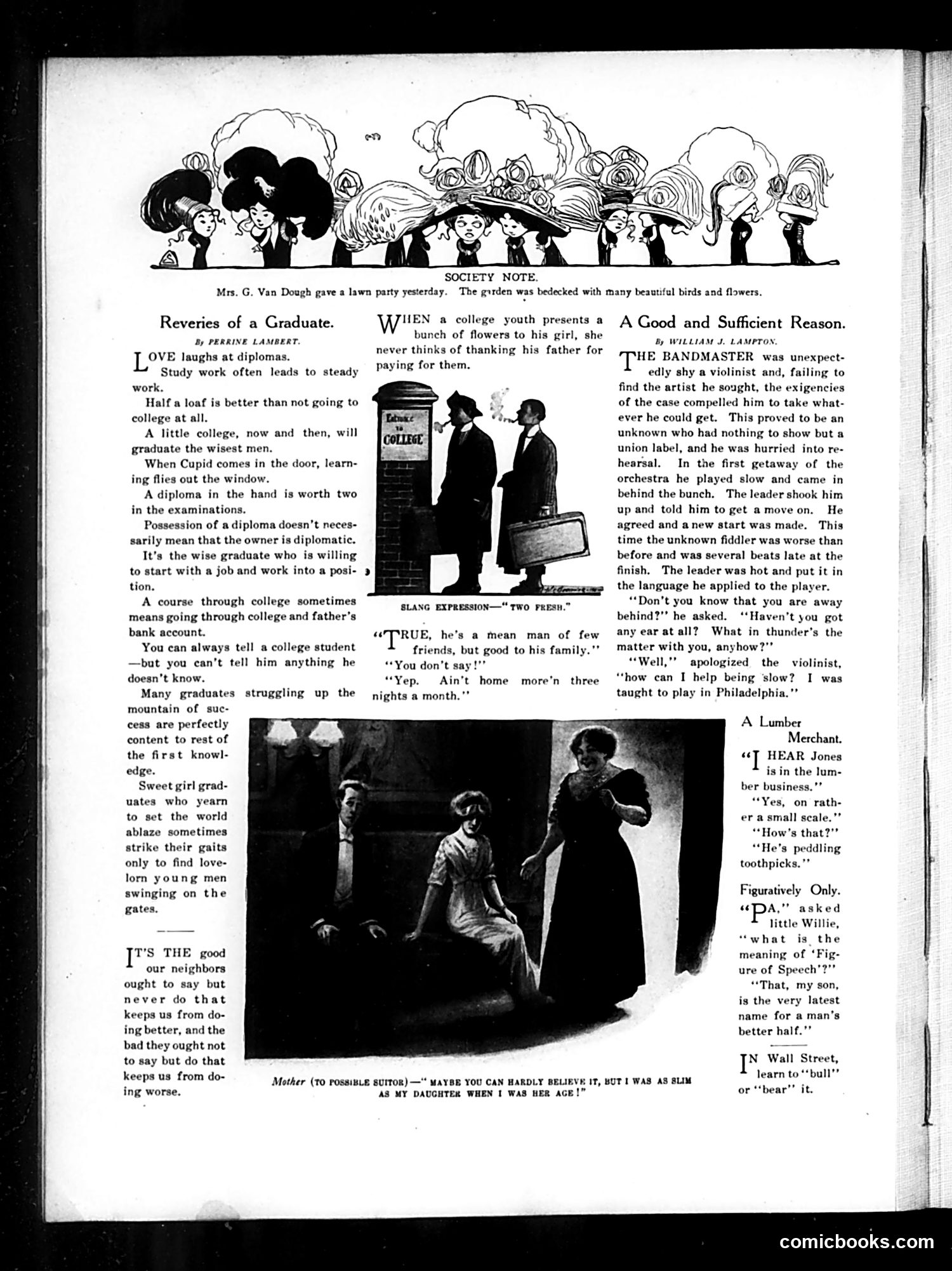
This page from the satirical magazine *Judge* contains several humor pieces mocking American social pretensions and gender dynamics circa early 20th century. **"Reveries of a Graduate"** presents cynical observations about college education—diplomas don't guarantee success or wisdom; graduates often deplete fathers' bank accounts; and college students are unteachably arrogant. The satire targets both the inflated value of degrees and young people's overconfidence. **The cartoon "Two Fresh"** depicts a suitor courting a young woman while her mother boasts she was equally slim at her daughter's age—a joke about aging women's vanity and denial. **"A Good and Sufficient Reason"** mocks an incompetent orchestra violinist who blames his poor playing on training received in Philadelphia, implying that city's musicians are inherently slow or inferior. The remaining brief pieces target similar targets: men's ignorance of courtship economics, Wall Street jargon, lumber industry small-timers, and marital humor ("figure of speech" = wife). The overall tone satirizes American pretension, youthful arrogance, and social climbing.
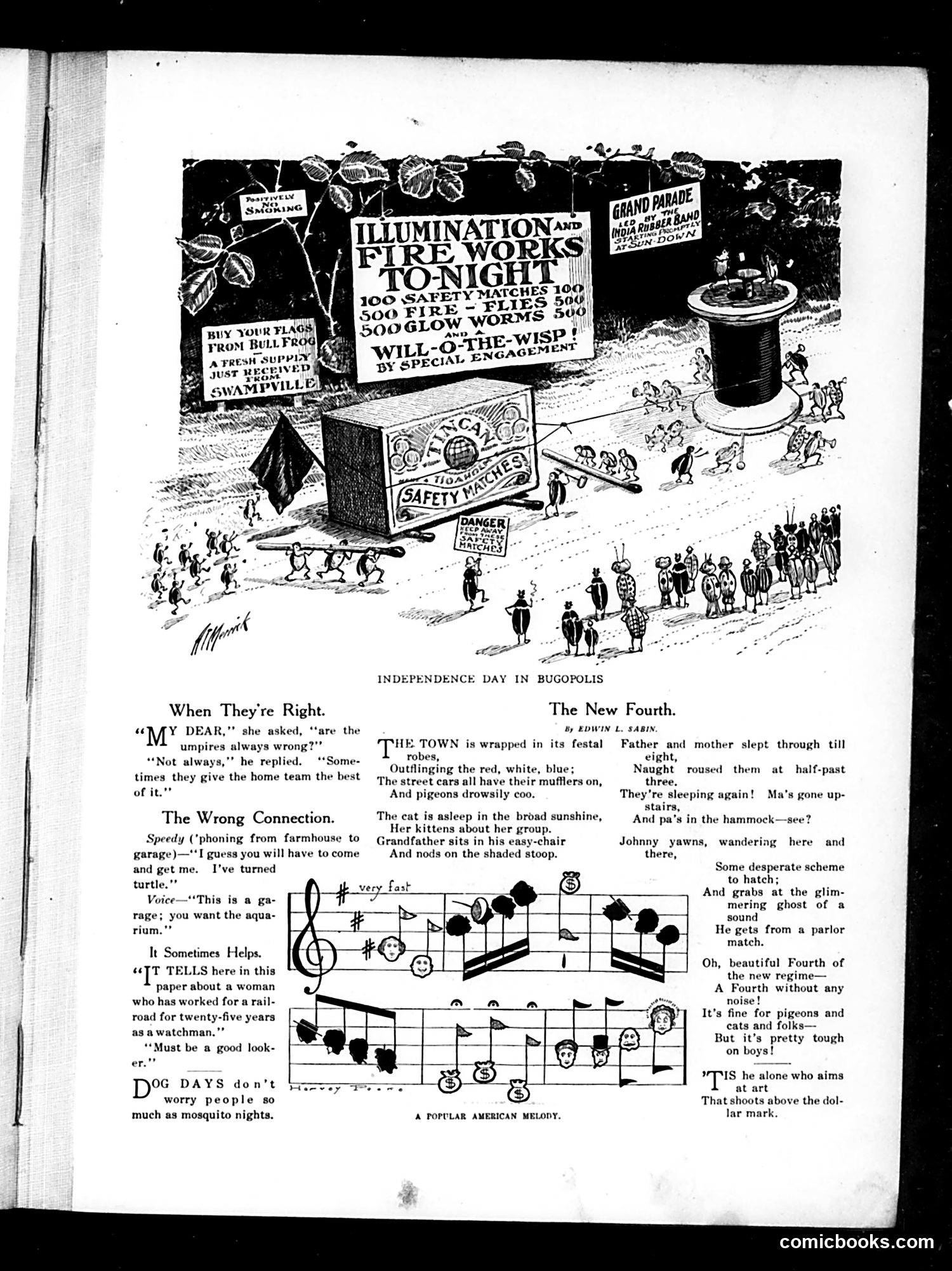
This page satirizes a muted Fourth of July celebration. The main cartoon depicts a town so quiet and peaceful that even animals sleep undisturbed—a stark contrast to typical raucous Independence Day festivities with fireworks and noise. The accompanying poem by Edwin L. Sabin celebrates this "New Fourth" ironically: families sleep through the holiday, children find it boring without traditional explosions and commotion. The satire's point appears critical of efforts to suppress Independence Day noise—perhaps referencing early 20th-century safety campaigns or municipal noise ordinances. The final couplet mocks this quietness as "pretty tough on boys," capturing nostalgia for rowdier celebrations. The shorter jokes on the page are unrelated filler—typical magazine content about miscommunications and observations. The irony is clear: removing noise from July 4th removes its essential character and appeal, especially for children.
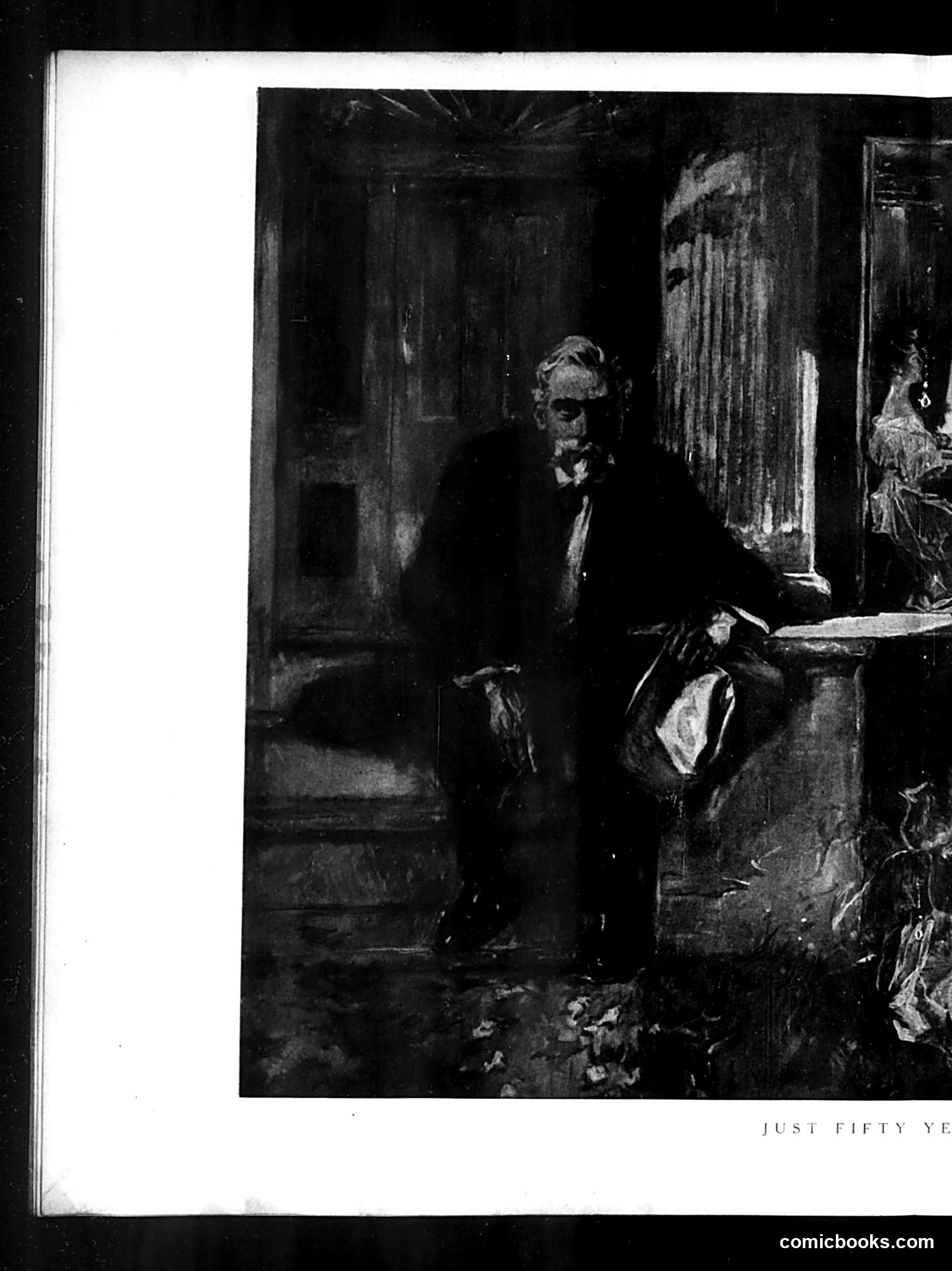
This appears to be a page from *Judge* magazine showing a black and white illustration of an elderly gentleman in formal attire (dark suit, bow tie) standing in what seems to be a domestic interior. The partial caption reads "JUST FIFTY YE[ARS]" (likely "JUST FIFTY YEARS"), suggesting this depicts a commemorative or anniversary theme. The figure appears dignified but the moody, dark artistic treatment and the fragment of text suggest satirical commentary—possibly about someone's long tenure in office, a long marriage, or enduring social institution. Without the complete caption or additional context, the specific target of satire remains unclear, though the formal setting and aging subject suggest commentary on established authority or tradition.
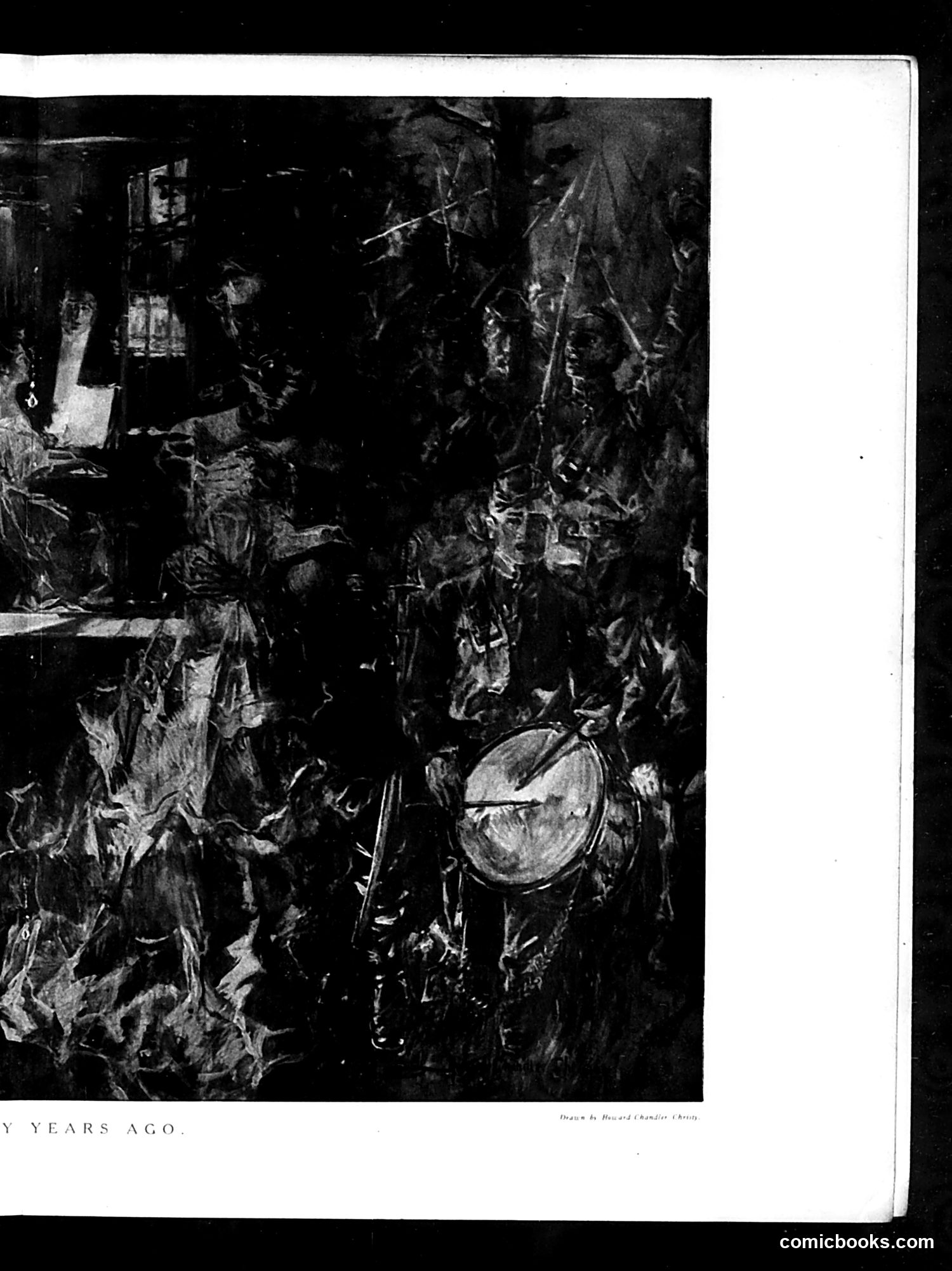
I can see this is a black and white illustration from Judge magazine showing what appears to be a crowded, chaotic scene with multiple figures in period clothing, musical instruments visible (including what looks like a drum), and considerable visual detail suggesting movement and activity. However, the OCR text provided only contains "comicbooks.com" and attribution information, offering no caption, title, or explanatory text for the cartoon itself. Without the actual text content that would identify the figures, the historical event or political situation being satirized, or the intended message, I cannot reliably explain what this specific cartoon means to a modern reader. To properly analyze this, I would need the original caption or article text that accompanied this illustration in Judge magazine.
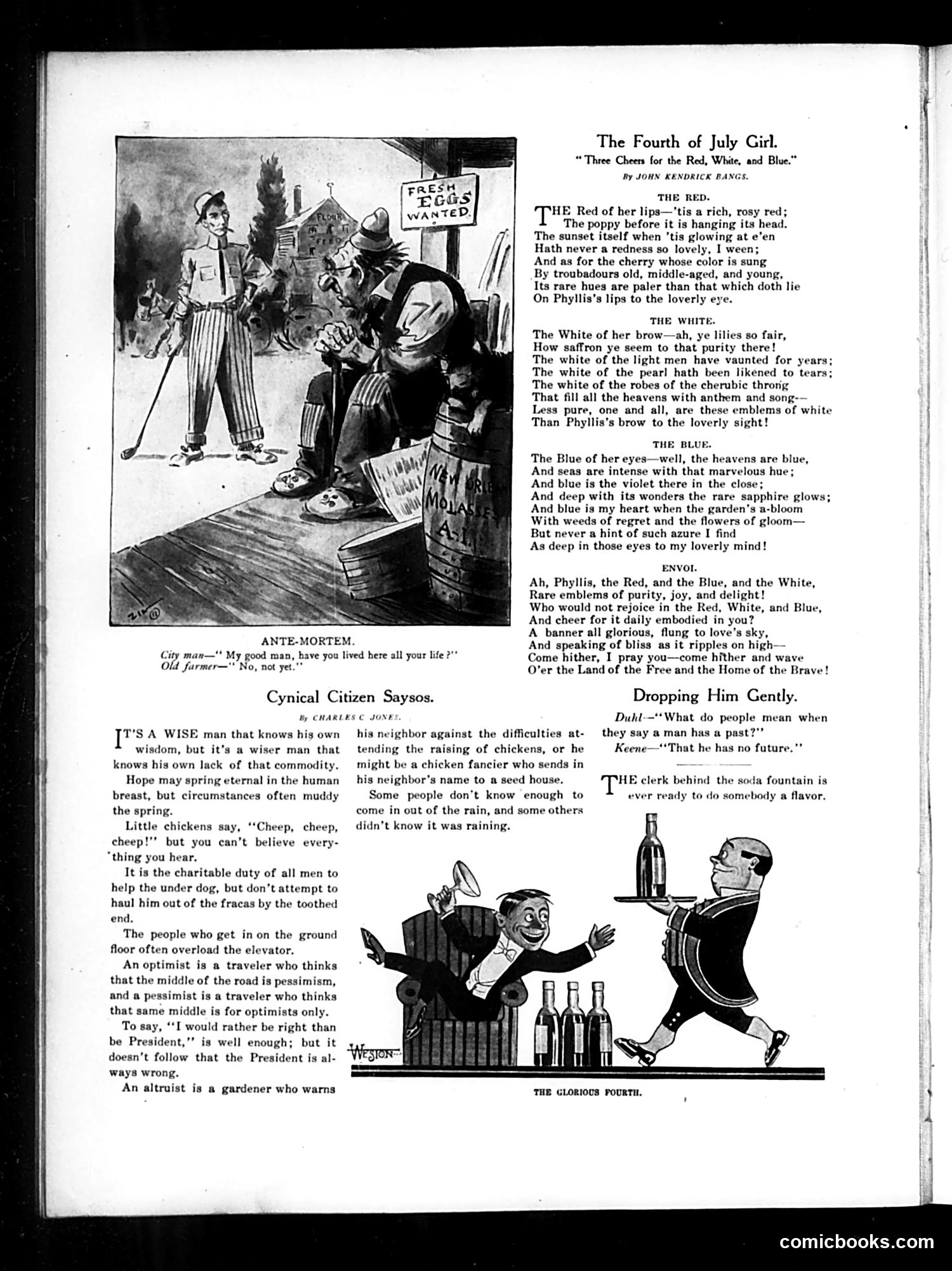
**"The Fourth of July Girl"** is a patriotic poem by John Kendrick Bangs that uses the American flag's colors as metaphors for a woman's beauty—her red lips, white brow, and blue eyes personify national virtues ("purity, joy, and delight"). The accompanying illustration shows a woman in patriotic dress, linking romantic idealization to nationalistic sentiment. **"Cynical Citizen Saysos"** by Charles C. Jones presents sardonic observations on human nature and social life—critiquing people's foolishness (not knowing when it rains), false charity, elevator etiquette, and the self-contradiction of those claiming principle while criticizing leaders. It's social commentary masquerading as aphorisms. **"Dropping Him Gently"** and **"The Glorious Fourth"** appear to be brief comic vignettes with minimal text visible. The **"Ante-Mortem"** dialogue jokes that a farmer hasn't yet finished living, suggesting rural life's endless hardship. Overall, this represents typical Judge magazine content: patriotic sentiment mixed with cynical social satire and light humor.
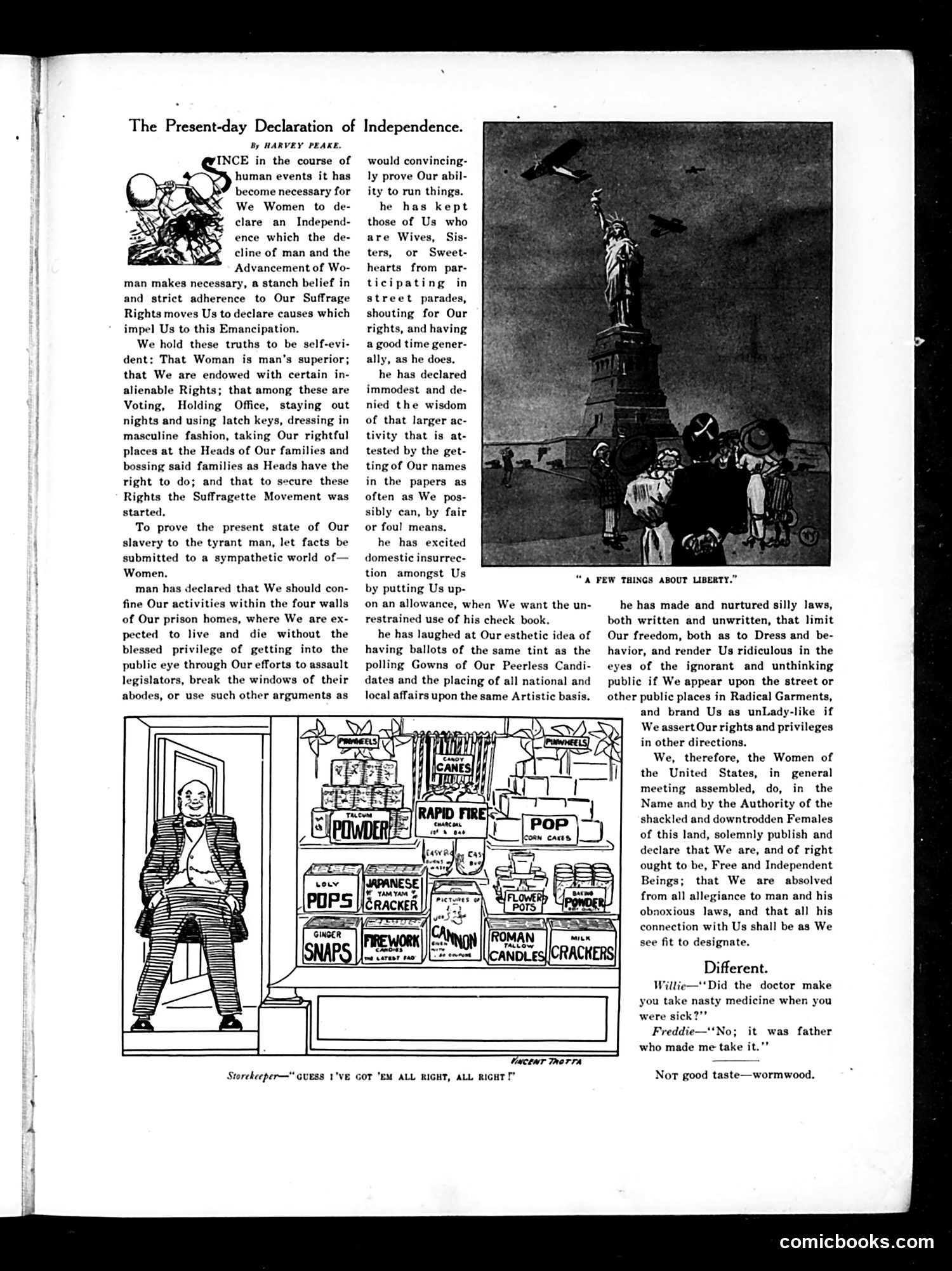
This Harvey Peake satire mocks the women's suffrage movement by parodying the Declaration of Independence. The piece presents exaggerated feminist demands—voting rights, holding office, staying out late, wearing masculine fashion, and controlling family finances—as absurd grievances against men's "tyranny." The satire ridicules suffragettes specifically: their street parades, window-breaking tactics, and desire for media attention. The accompanying illustrations mock women's independence claims through domestic imagery (a woman at a stove; consumer goods like "Jap Cracker" and "Pop"). The author frames women's rights activism as selfish entitlement rather than legitimate reform. The tone suggests suffragists are ridiculous rebels seeking unreasonable freedoms, not serious political actors. This reflects anti-suffrage sentiment common in early 20th-century satirical publications, treating the movement as comic overreach rather than civil rights advocacy.
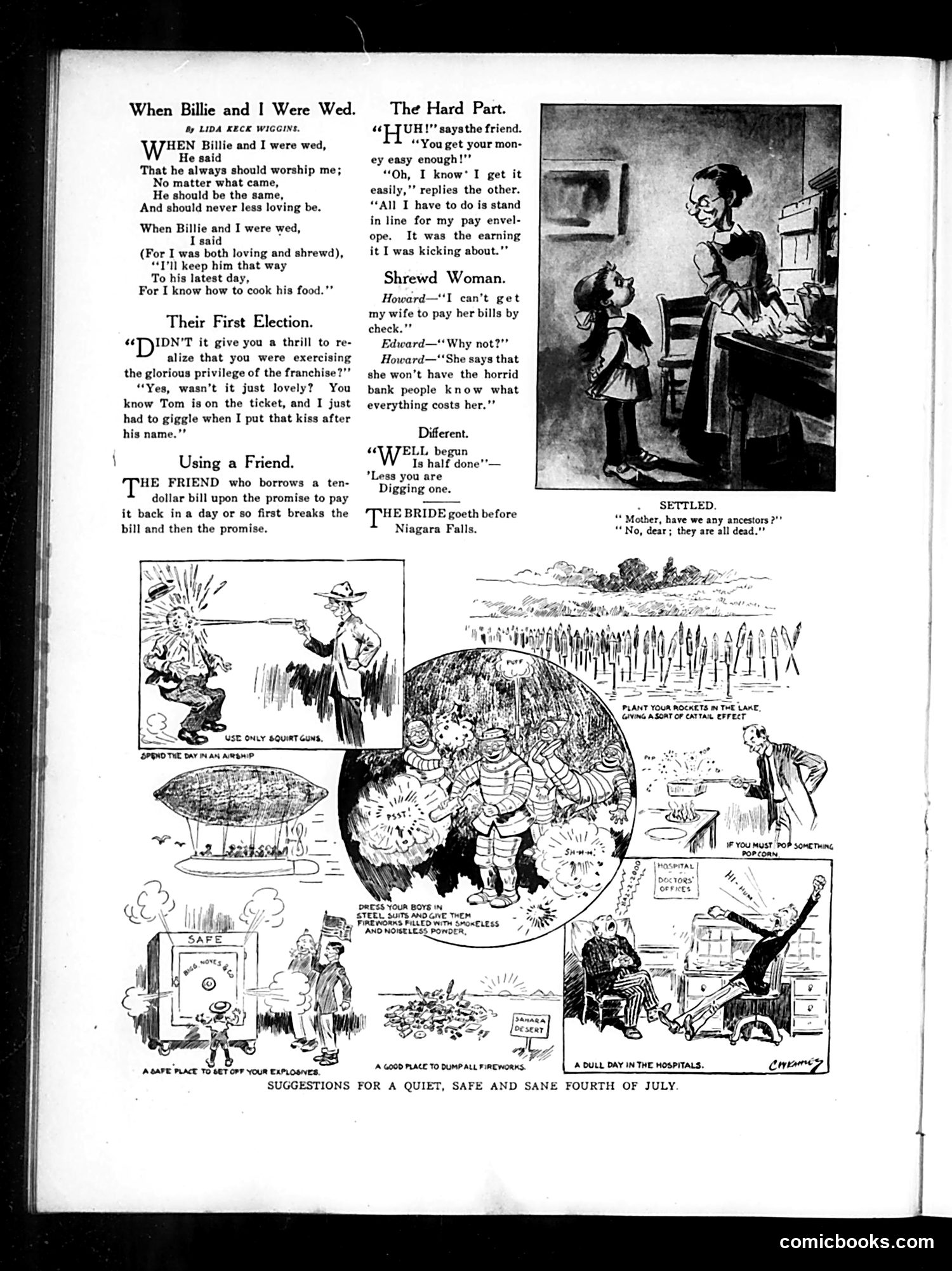
This page from *Judge* presents early 20th-century humor targeting domestic life and gender relations. The poems mock marital dynamics—wives securing husbands' devotion through cooking, a woman voting based on attraction to a candidate rather than policy. "Shrewd Woman" satirizes feminine vanity: a wife avoids checks because banks would see her spending habits. The central illustration humorously depicts Fourth of July safety, showing families enjoying fireworks indoors under umbrellas or in protective structures—absurdist visual satire of dangerous holiday explosives. "Settled" jokes darkly about American social mobility, suggesting ancestors are "dead" (socially irrelevant), reflecting period attitudes about erasing immigrant or working-class heritage. Throughout, the satire reflects Progressive Era anxieties: women's newly won suffrage treated as frivolous; conspicuous consumption concerns; class anxiety about ancestry and respectability.
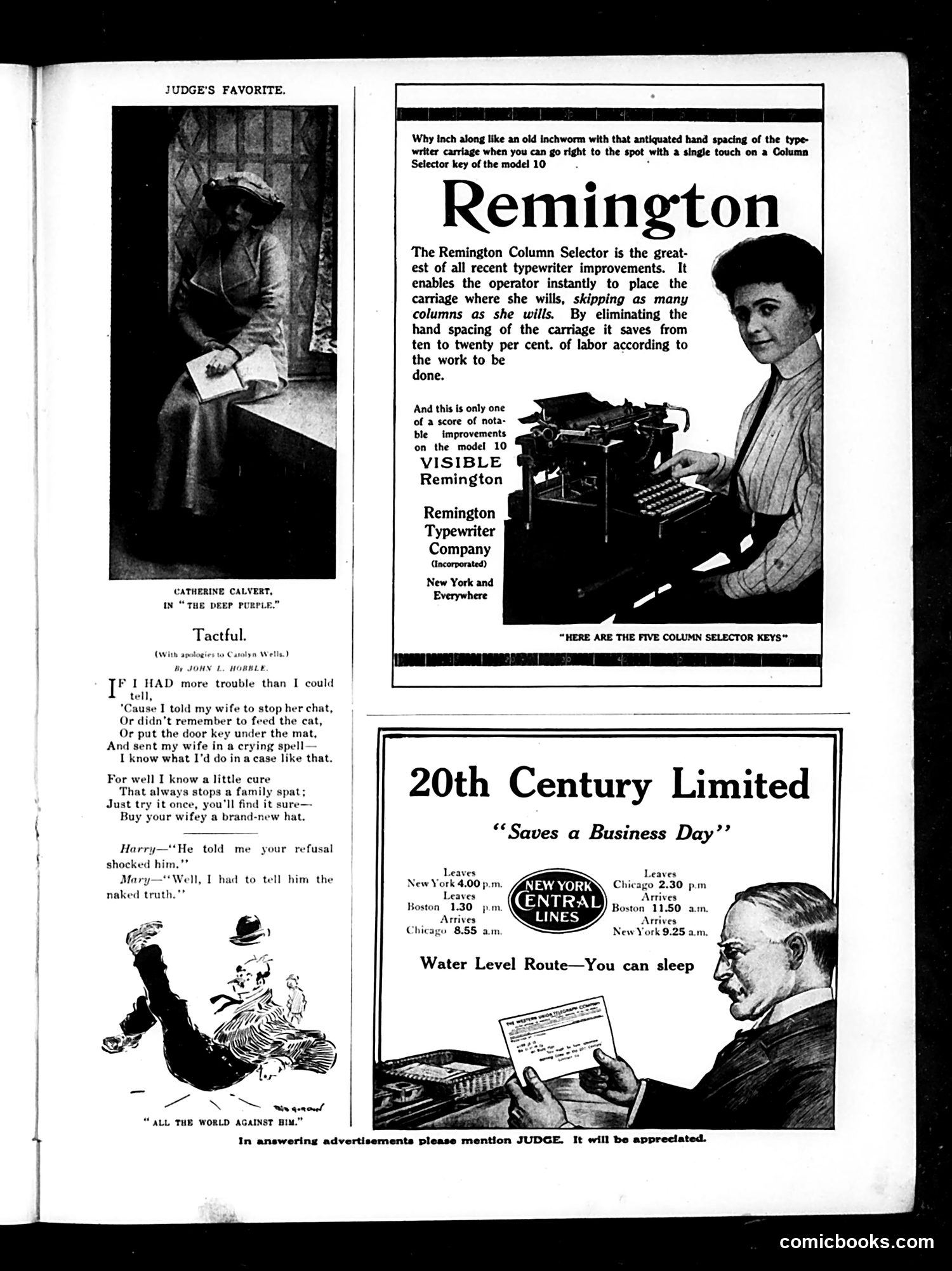
This page from *Judge* contains three distinct elements: **"Tactful" Comic Strip**: A humorous dialogue about marital dispute resolution. A husband describes causing domestic trouble (neglecting the cat, misplacing the door key, upsetting his wife), then reveals his solution: buy the wife a new hat. The satire mocks both male tactlessness and the era's assumption that women's discontent could be cheaply purchased with fashion—a commentary on shallow domestic relations and consumerism. **Remington Typewriter Advertisement**: Promotes the Model 10's "Column Selector" feature, targeting female typists by emphasizing labor-saving convenience. The ad reflects early-20th-century office work where women dominated typing positions. **20th Century Limited Railroad Advertisement**: Promotes fast rail service between New York and Chicago via the New York Central Lines, emphasizing time-saving for business travelers. The page demonstrates *Judge's* mix of social satire, targeted advertising to middle-class readers, and the era's gender assumptions about women, consumption, and work.
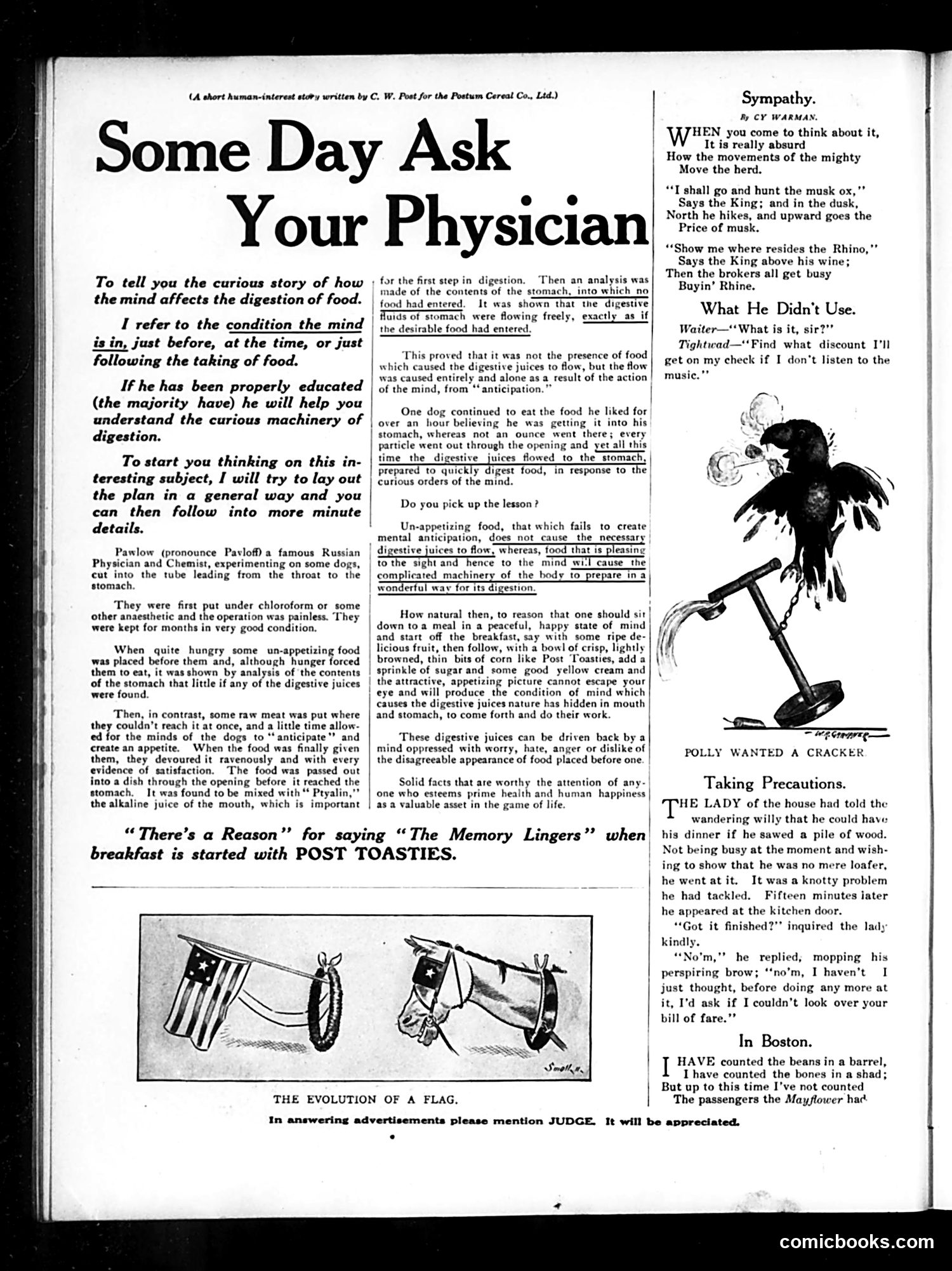
This page is primarily **paid advertising content** disguised as editorial material. It's written by C.W. Post, founder of Postum Cereal Company, promoting Post Toasties breakfast cereal. The "article" uses pseudo-scientific claims about Russian physiologist Pavlov's digestion experiments to argue that **mental anticipation—not actual food—triggers digestive juices**. The argument: unappealing food doesn't stimulate digestion; appetizing food does. The conclusion: start breakfast with visually appealing Post Toasties to create the mental state necessary for proper digestion. The accompanying cartoons are minor: one shows flag evolution (unrelated to the text), while another illustrates domestic scenes from the accompanying stories. **For modern readers**: This represents early 20th-century advertiser-friendly magazine content where corporations could essentially publish marketing as journalism, using contemporary scientific references (Pavlov) to legitimize product claims that wouldn't survive modern scrutiny.
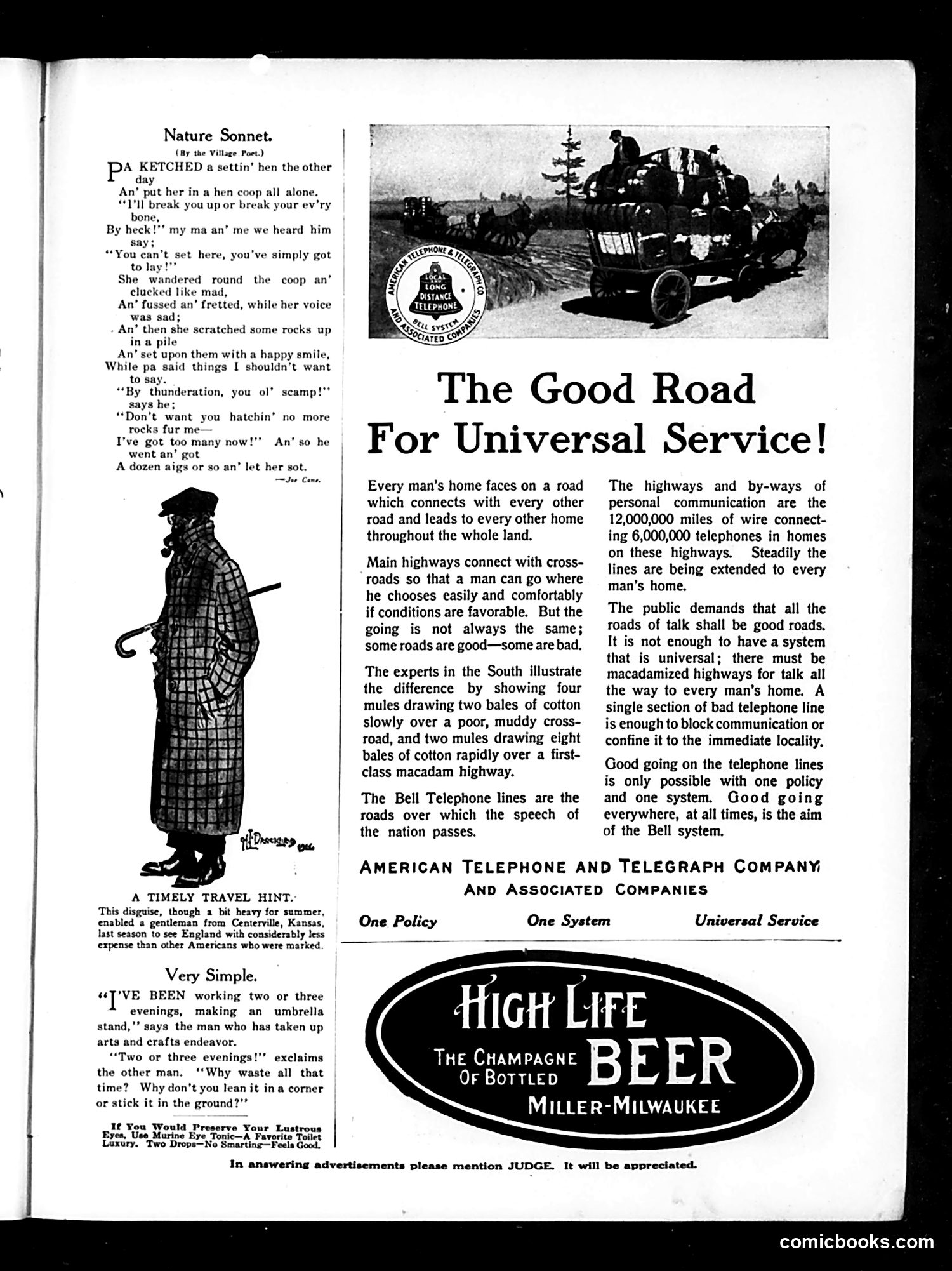
This page contains several humorous pieces typical of early 20th-century American satire: **"Nature Sonnet"** and **"A Timely Travel Hint"**: Light rural humor. The poem mocks amateur verse about a stubborn hen; the travel hint jokes about disguising oneself as a beggar to travel Europe cheaply and avoid being recognized as a wealthy American (suggesting Americans were targets for exploitation abroad). **"Very Simple"**: Gentle satire on the Arts and Crafts movement—a popular but sometimes pretentious hobby among middle-class Americans. The joke mocks the movement's inefficiency: why spend evenings crafting an umbrella stand when you could simply lean it against a wall? **The Bell Telephone Advertisement**: Using the metaphor of highways and roads, it argues for universal, standardized telephone infrastructure. This is corporate propaganda framed as public service—comparing good telephone lines to well-maintained macadam roads, promoting Bell's monopolistic "One Policy, One System, Universal Service" model. The page is primarily **advertising and light humor**—no overt political satire beyond gentle mockery of affectation and consumerism.
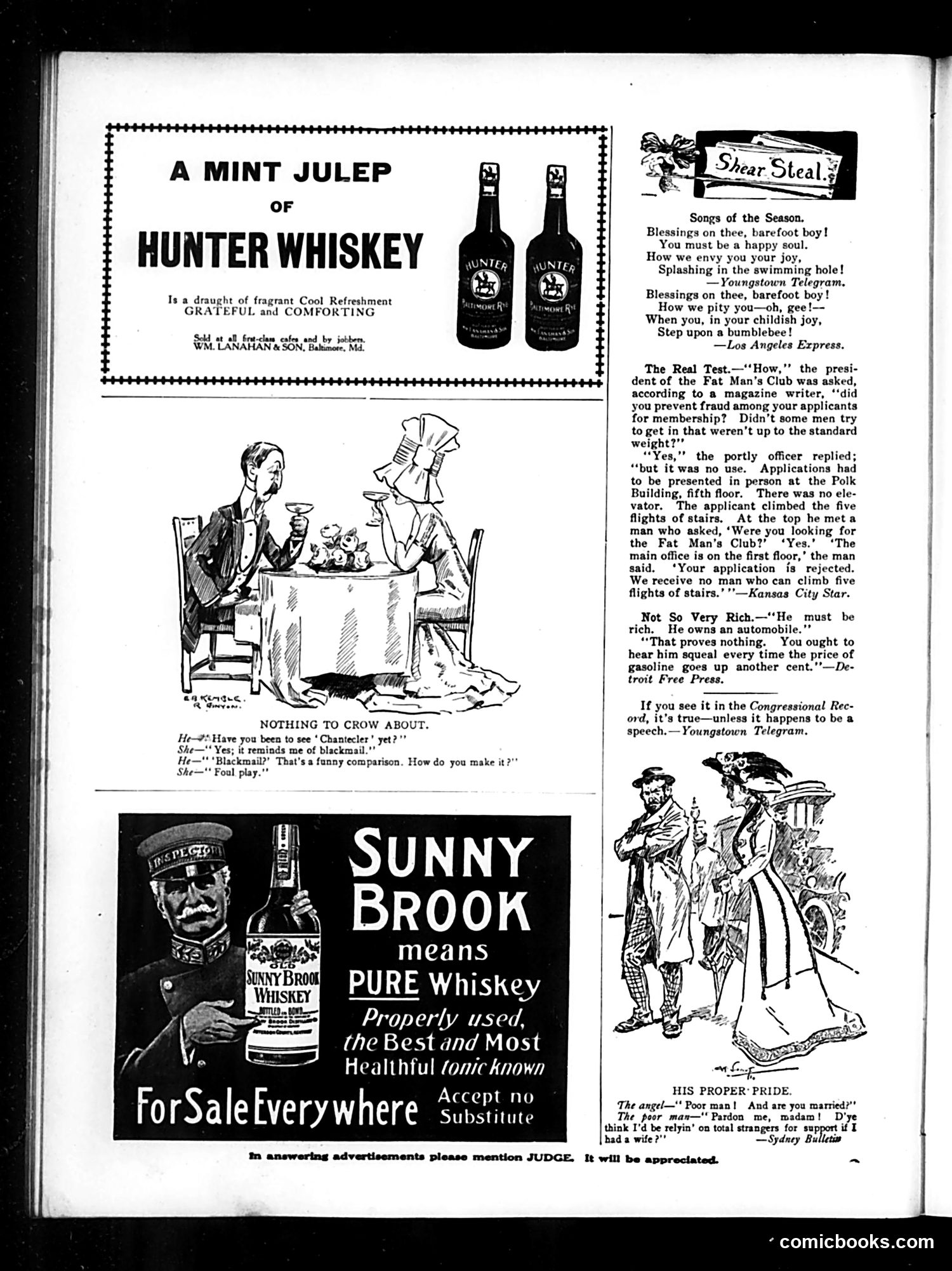
This page contains multiple satirical pieces typical of early 20th-century American humor. The main cartoon depicts a conversation between a man and woman at dinner, with the caption "NOTHING TO CROW ABOUT." The joke references the play *Chantecler* (a French work about a rooster), with the woman saying it "reminds me of blackmail"—the punchline being "foul play" (fowl/foul wordplay). The "Fat Man's Club" anecdote satirizes membership fraud-prevention: applicants must climb five flights of stairs to apply, ensuring only those physically fit enough qualify. The joke critiques both the club's absurd logic and the applicants' desperation. Other brief humorous pieces mock wealth (a man owning a car but complaining about gas prices), marriage (a poor man denying he relies on strangers, implying he'd accept his wife's support), and politicians (Congressional Record speeches being inherently false). The page also contains period whiskey advertisements, reflecting the magazine's commercial content during Prohibition-era America.
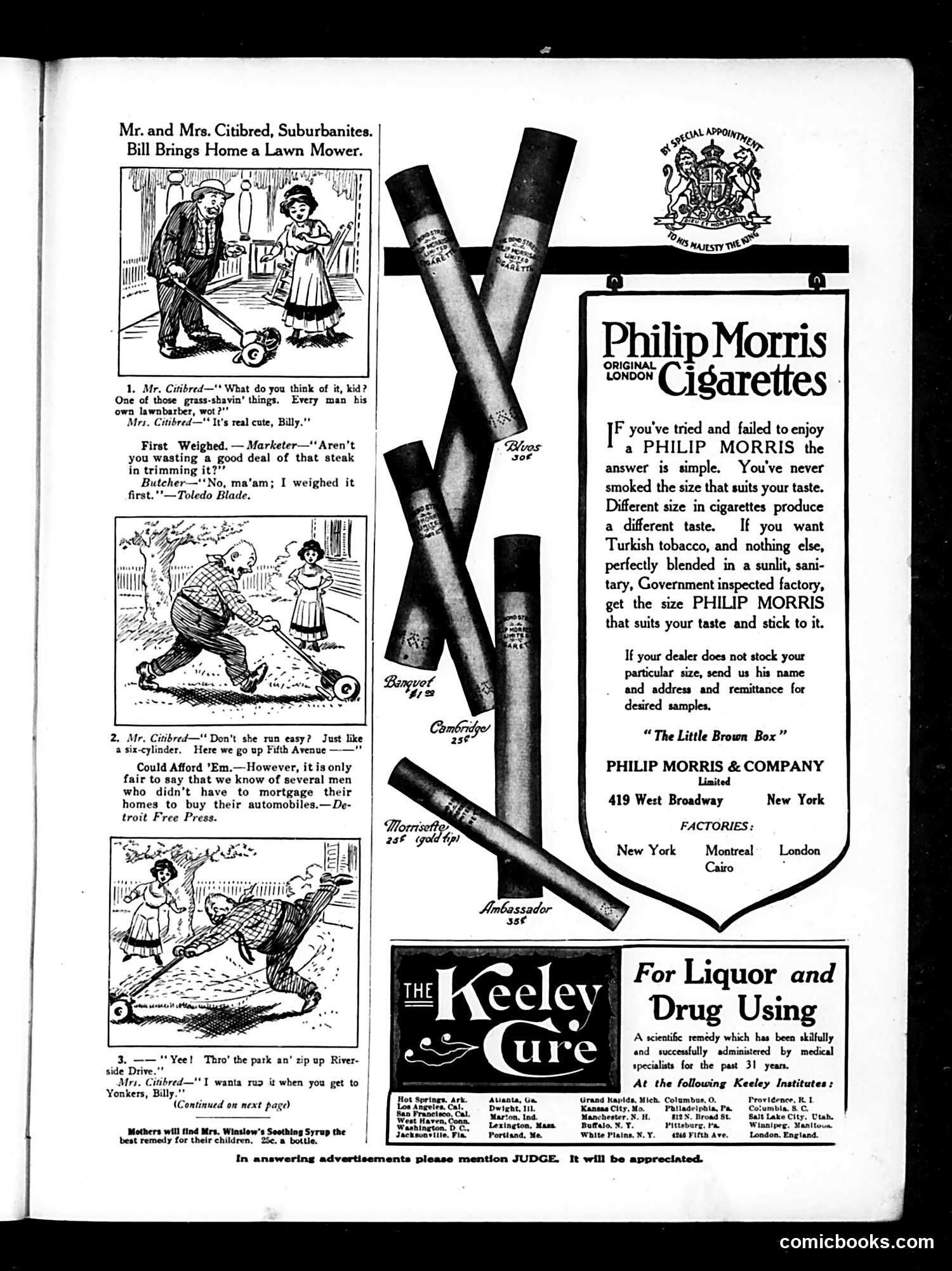
This Judge magazine page contains satirical comics about suburban life and period advertisements. **The "Mr. and Mrs. Citibred" Comics:** These mock newly wealthy suburbanites purchasing consumer goods they can barely afford. Panel 1 jokes about Mr. Citibred's pretentious language ("grass-shavin' things," "lawnbarber") regarding a new lawn mower. Panel 2 ridicules him comparing the mower's operation to a luxury automobile engine, while Mrs. Citibred wants to "race it" in Yonkers—the humor targeting suburban status-anxiety and conspicuous consumption. Reprinted jokes suggest financial strain: men "mortgaging their homes" for automobiles. **The Advertisements:** Philip Morris cigarettes (various sizes available), Mrs. Winslow's Soothing Syrup (a children's remedy), and the Keeley Cure (an addiction treatment facility network)—all period products reflecting early 20th-century consumer culture and medical practices now considered questionable or harmful. The satire reflects Judge's critique of suburban pretension and emerging consumer culture.
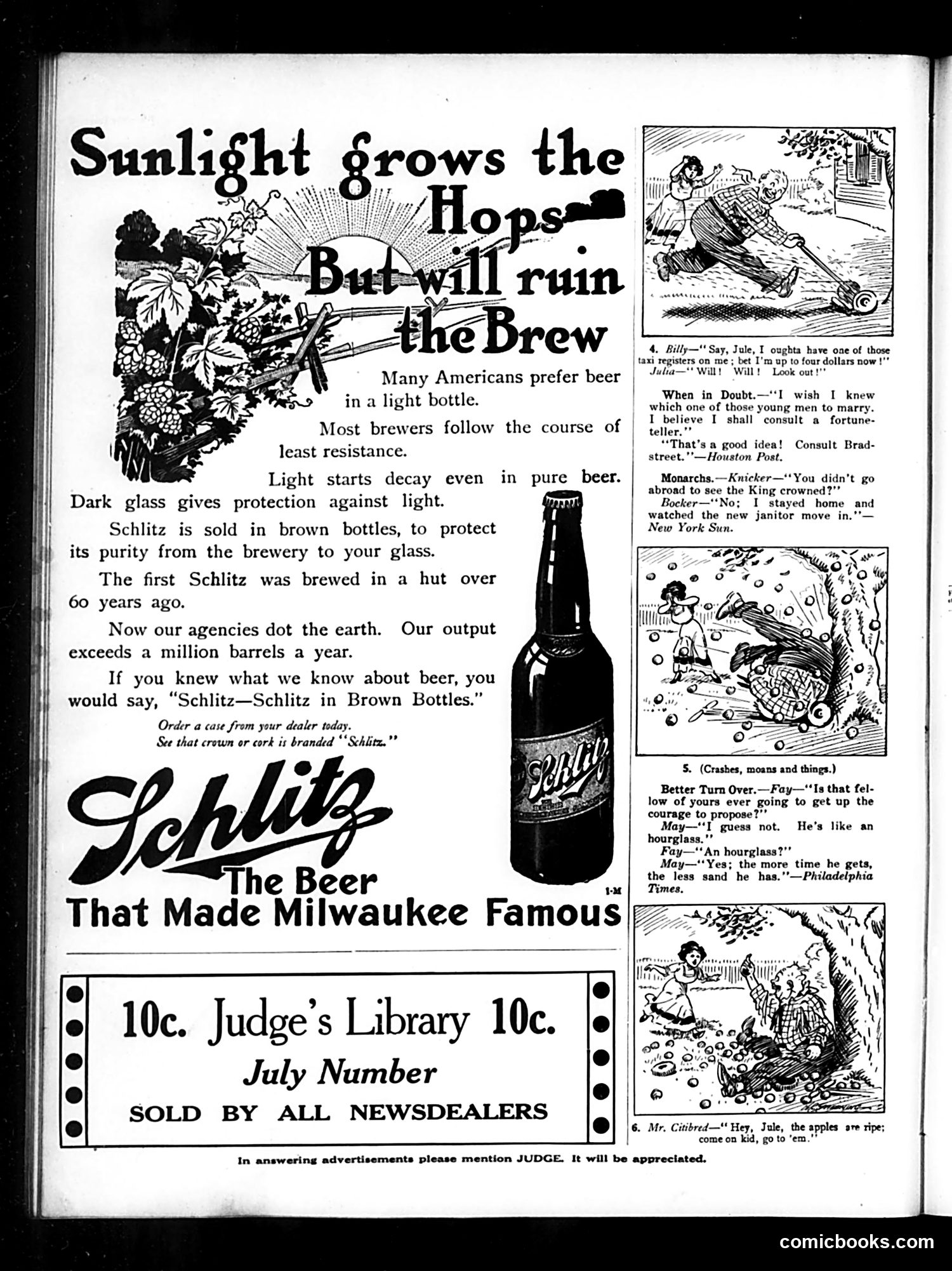
This page is primarily a **Schlitz beer advertisement** with accompanying humorous comic vignettes from *Judge* magazine. The main ad argues that Schlitz should be purchased in **brown bottles** to protect beer from light decay, which damages flavor. It emphasizes the brand's Milwaukee heritage and massive production scale ("a million barrels a year"). The surrounding **comic strips** are brief, unrelated jokes typical of the era: - Billy complains about taxi meter costs - A woman seeks fortune-telling advice on choosing a husband - "Better Turn Over" mocks a timid suitor lacking courage to propose - Rural characters discuss ripe apples These comics serve as filler content, standard in magazines of this period. The page reflects early-20th-century advertising practices: combining product promotion with light entertainment to engage readers. The Schlitz messaging focuses on practical product superiority (glass color = freshness) rather than lifestyle branding.
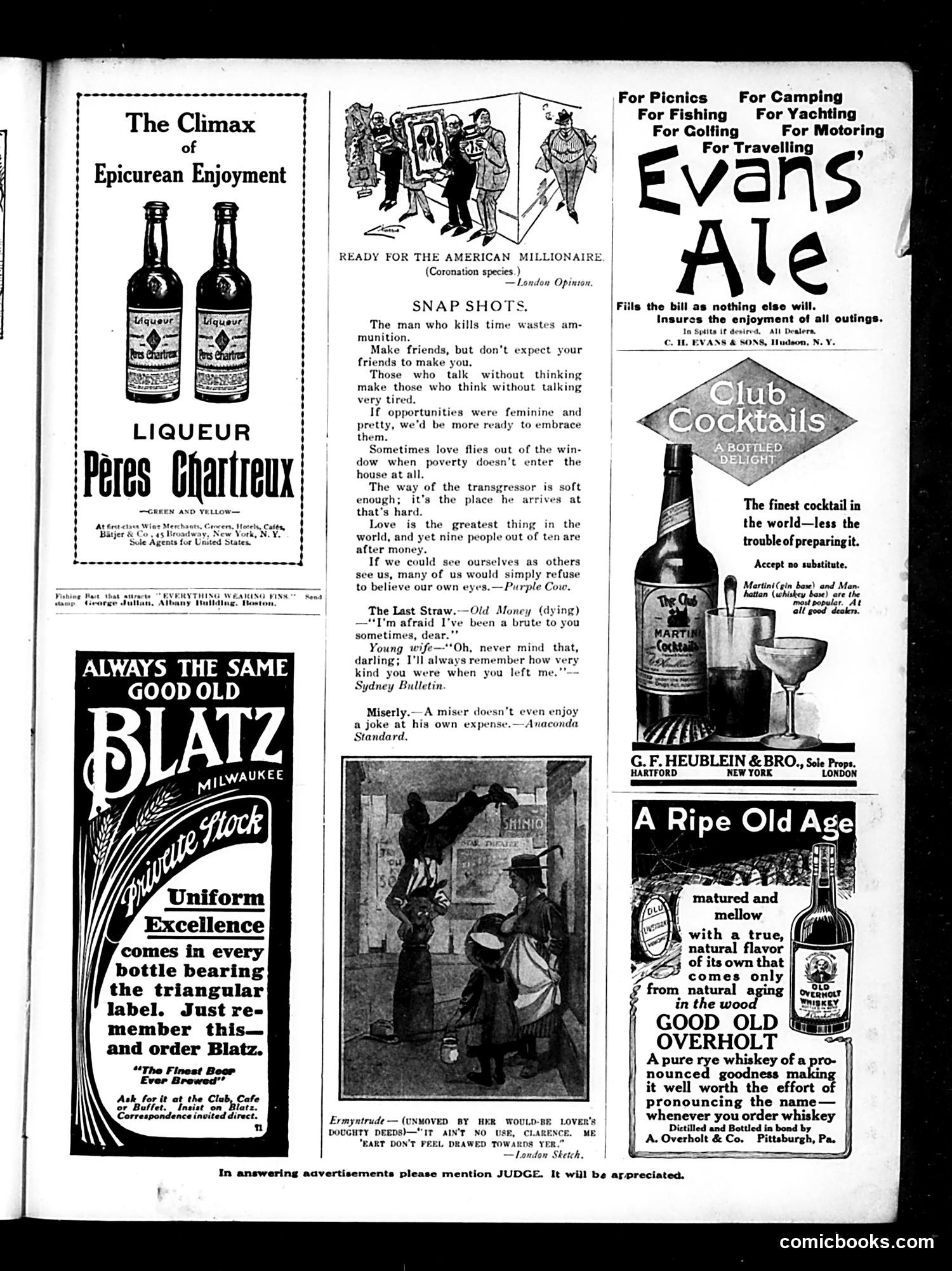
This is primarily an **advertising page** with minimal editorial content. The main cartoon appears to be a small illustration captioned "READY FOR THE AMERICAN MILLIONAIRE (Coronation species)" depicting figures in formal dress—likely satirizing wealthy Americans' eagerness to participate in British coronation celebrations. The "Snap Shots" section contains brief humorous aphorisms about human nature (ambition, friendship, love, money) rather than topical satire. The bulk of the page consists of liquor and beer advertisements—Peres Chartreux liqueur, Blatz beer, Evans Ale, Club Cocktails, and Good Old Overholt whiskey—typical of early 20th-century Judge magazine content. These ads reflect the pre-Prohibition era when such advertising was common in American periodicals. The overall point of the page is commercial rather than satirical.
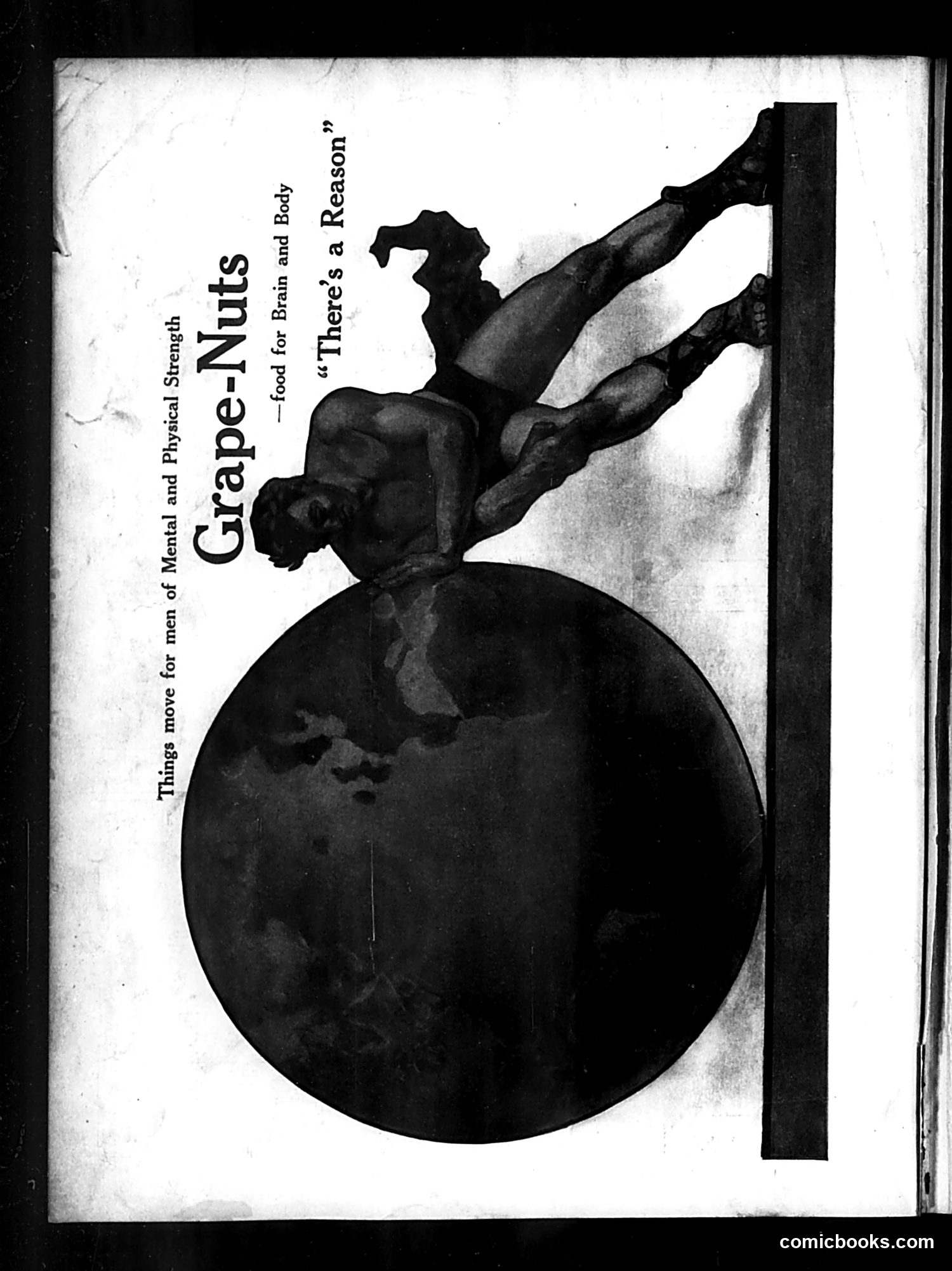
This appears to be a vintage advertisement or promotional page from *Judge* magazine rather than a political cartoon. The OCR text is severely corrupted and unreadable, making specific interpretation difficult. The visible image shows a silhouetted figure in an acrobatic or inverted position on a large dark sphere, grasping a vertical bar or post. The text fragment reads "Grape-Nuts" and mentions "food for Brain and Body" and "There's a Reason." This is clearly a **Grape-Nuts cereal advertisement** using dynamic imagery to suggest strength and physical vitality. The acrobat represents vigor and mental/physical capability supposedly derived from eating the product. Without legible OCR text, I cannot determine the specific historical context or any satirical commentary this page may have contained.