
Judge, 1911-07-01 · page 14 of 24
Judge — July 1, 1911 — page 14: what you’re looking at
What you’re looking at
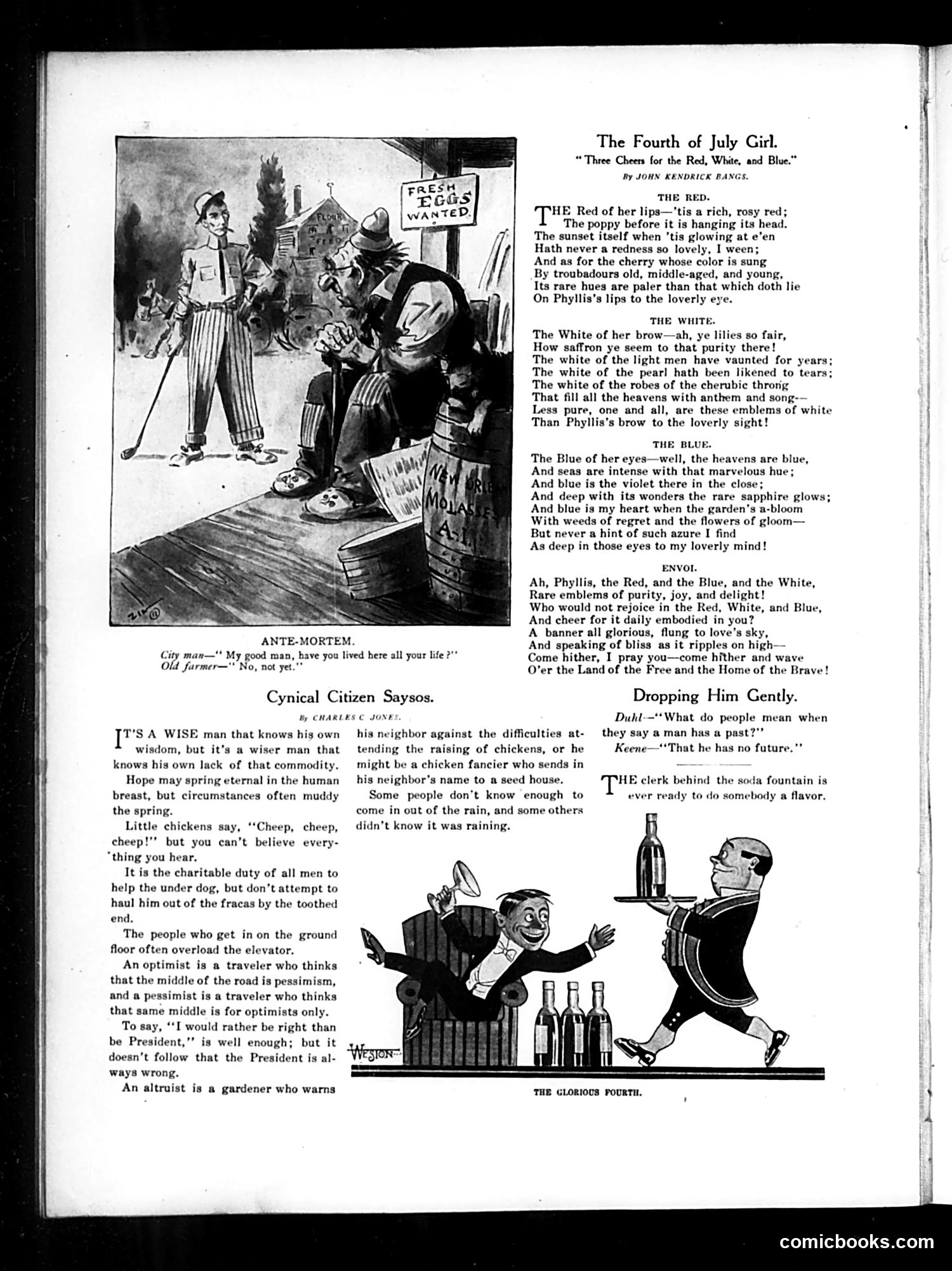
**"The Fourth of July Girl"** is a patriotic poem by John Kendrick Bangs that uses the American flag's colors as metaphors for a woman's beauty—her red lips, white brow, and blue eyes personify national virtues ("purity, joy, and delight"). The accompanying illustration shows a woman in patriotic dress, linking romantic idealization to nationalistic sentiment. **"Cynical Citizen Saysos"** by Charles C. Jones presents sardonic observations on human nature and social life—critiquing people's foolishness (not knowing when it rains), false charity, elevator etiquette, and the self-contradiction of those claiming principle while criticizing leaders. It's social commentary masquerading as aphorisms. **"Dropping Him Gently"** and **"The Glorious Fourth"** appear to be brief comic vignettes with minimal text visible. The **"Ante-Mortem"** dialogue jokes that a farmer hasn't yet finished living, suggesting rural life's endless hardship. Overall, this represents typical Judge magazine content: patriotic sentiment mixed with cynical social satire and light humor.
📄 Transcribed text from this page (OCR, searchable)
Machine-transcribed from the original scan — historical spelling and the odd misread are preserved.
The Fourth of July Girl. “Three Cheers for the Red, White, and Blue.” By JOHN KENDRICK BANGS. THE RED. HE Red of her lips—’tis a rich, rosy red; The poppy before it is hanging its head. The sunset itself when tis glowing at e’en Hath never a redness so lovely, I ween; And as for the cherry whose color is sung By troubadours old, middle-aged, and young, Its rare hues are paler than that which doth lie On Phyllis’s lips to the loverly eye. THE WHITE. The White of her brow—ah, ye lilies so fair, How saffron ye seem to that purity there! The white of the light men have vaunted for years; The white of the pearl hath been likened to tears The white of the robes of the cherubic throng That fill all the heavens with anthem and song-— Less pure, one and all, are these emblems of white i Than Phyllis’s brow to the loverly sight! THE BLUE. The Blue of her eyes—well, the heavens are blue, And seas are intense with that marvelous hue; And blue is the violet there in the close; And deep with its wonders the rare sapphire glows; And blue is my heart when the garden's a-bloom With weeds of regret and the flowers of gloom— But never a hint of such azure I find As deep in those eyes to my loverly mind! ENVOL. Ah, Phyllis, the Red, and the Blue, and the White, Rare emblems of purity, joy, and delight! Who would not rejoice in the Red, White, and Blue, i And cheer for it daily embodied in you? H A banner all glorious, flung to love’s sky, . ANTE-MORTEM. And speaking of bliss as it ripples on high— City man—"' My good man, have you lived here all your life ?"" Come hither, I pray you—come hither and wave Old farmer—"* No, not yet. O’er the Land of the Free and the Home of the Brave! Cynical Citizen Saysos. Dropping Him Gently. By CHARLES C JONES. Duhl-—“‘What do people mean when ‘T'S A WISE man that knows his own his neighbor against the difficulties at- they say a man has a past?” wisdom, but it’s a wiser man that tending the raising of chickens, or he Keene—‘That he has no future.” knows his own lack of that commodity. might be a chicken fancier who sends in clerk behind the soda fountain is Hope may spring eternal in the human _ his neighbor’s name to a seed house. HE breast, but circumstances often muddy Some people don’t know enough to ever ready to do somebody a flavor, the spring. come in out of the rain, and some others Little chickens say, ‘Cheep, cheep, didn’t know it was raining. cheep!"’ but you can’t believe every- “thing you hear. It is the charitable duty of all men to help the under dog, but don’t attempt to haul him out of the fracas by the toothed end, The people who get in on the ground floor often overload the elevator. An optimist is a traveler who thinks that the middle of the road is pessimism, and a pessimist is a traveler who thinks that same middle is for optimists only. To say, ‘‘I would rather be right than be President,’’ is well enough; but it doesn’t follow that the President is al- ways wrong. An altruist is a gardener who warns THE GLORIOUS FOURTH. comicbooks.com