
A complete issue · 24 pages · 1911
Judge — June 10, 1911
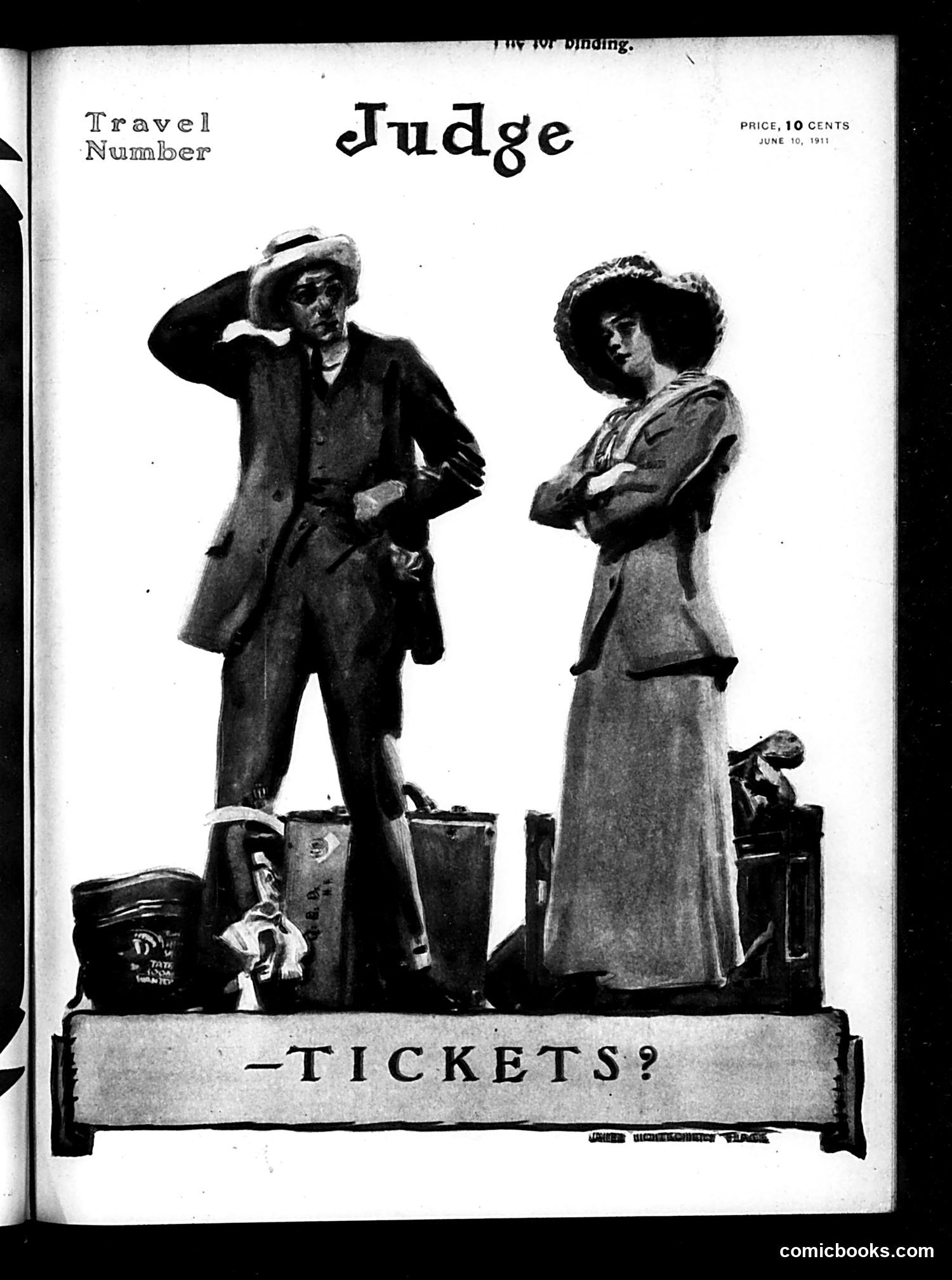
This is a satirical travel advertisement showing a man and woman with luggage, titled "—TICKETS?" The man appears agitated (hand to head), while the woman stands composed beside him. The satire targets the common frustration of travel planning in the early 1900s. The joke plays on the anxiety of obtaining travel tickets—the man's distressed posture suggests the hassle and complications involved in booking transportation during this era. The woman's calm demeanor contrasts humorously with his worry, possibly mocking how travelers (particularly men handling logistics) became flustered by the procedural demands of ticketing. This reflects early-20th-century humor about the inconveniences of travel before streamlined booking systems existed.
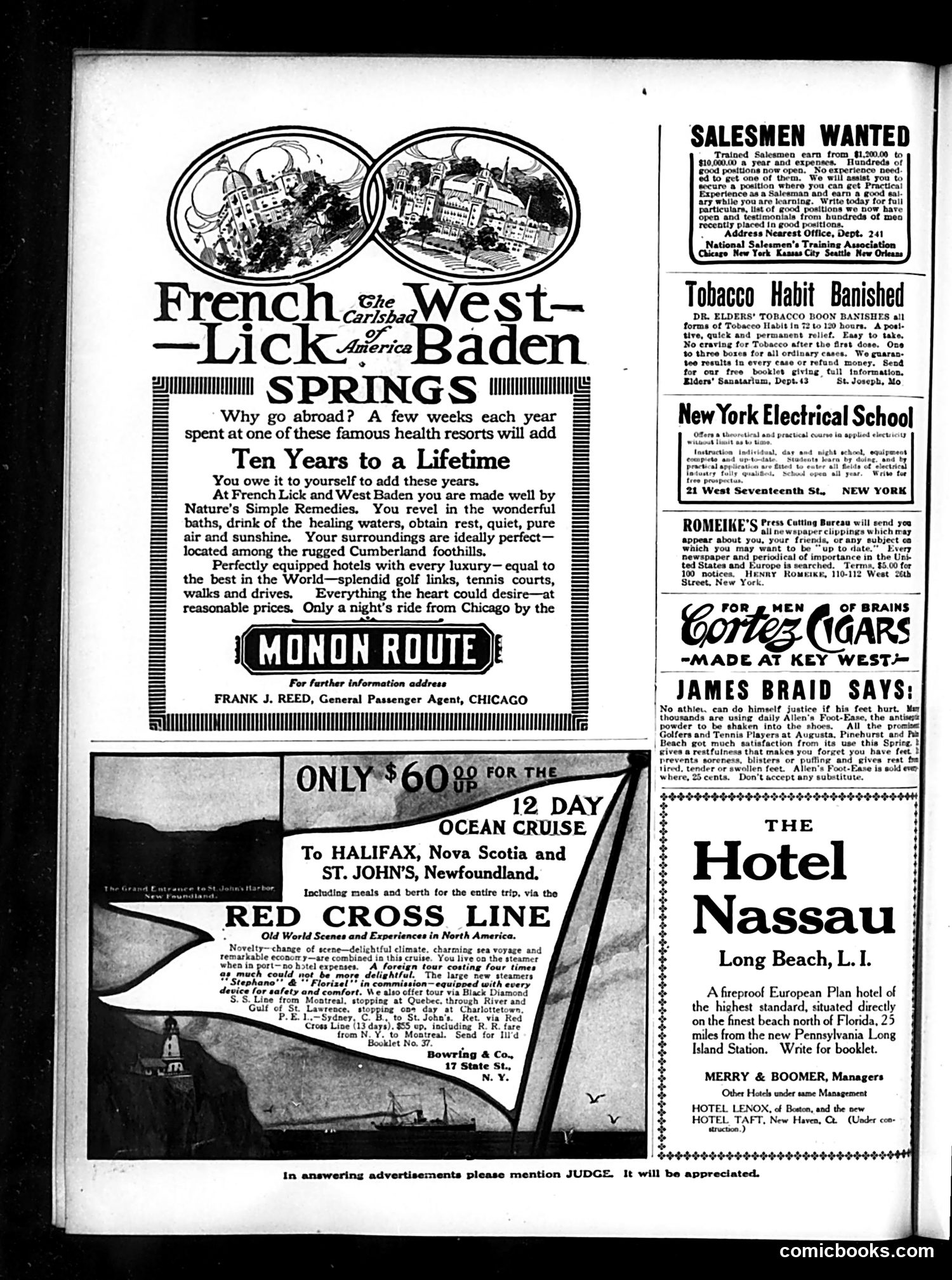
This page is primarily **advertising**, not satirical content. It contains four major advertisements: 1. **French Lick and Baden Springs** - promoting luxury health resorts accessible via the Monon Route railroad from Chicago 2. **Red Cross Line Ocean Cruise** - a $60 twelve-day cruise to Halifax and Newfoundland 3. **Hotel Nassau** - a beachfront resort in Long Beach, Long Island 4. Smaller ads for salesmen positions, tobacco cessation, electrical school, and cigars The page reflects early 20th-century American leisure culture, targeting affluent readers who could afford extended travel and resort stays. There is **no political satire or cartoon commentary visible**—the dual oval vignettes at top are decorative illustrations for the French Lick resort, not caricatures. This appears to be a standard advertising section from *Judge* magazine.
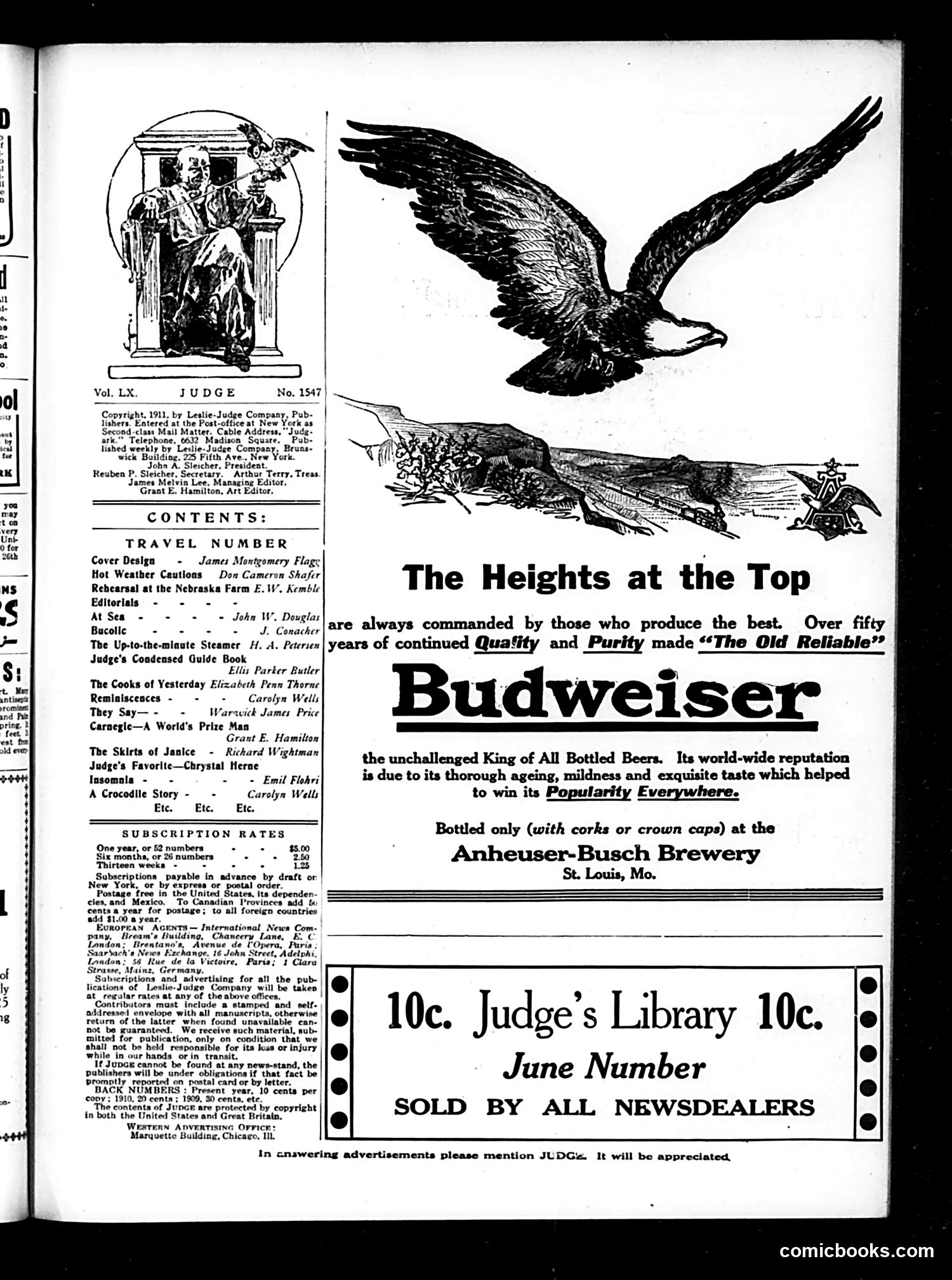
This page is primarily **advertising**, not satirical content. The dominant feature is a large Budweiser beer advertisement claiming the brand is "the unchallenged King of All Bottled Beers" and attributing its popularity to "over fifty years of continued Quality and Purity." The page header shows this is **Judge magazine, Vol. LX, No. 1547** (1911), with a table of contents listing travel-themed articles. Decorative illustrations at top—an eagle and a dead fish—appear to be generic design elements rather than political satire. The bottom advertises "Judge's Library," a 10-cent June Number "sold by all newsdealers." The content reflects early 20th-century magazine culture: a mix of editorial matter and full-page commercial advertisements targeting middle-class readers.
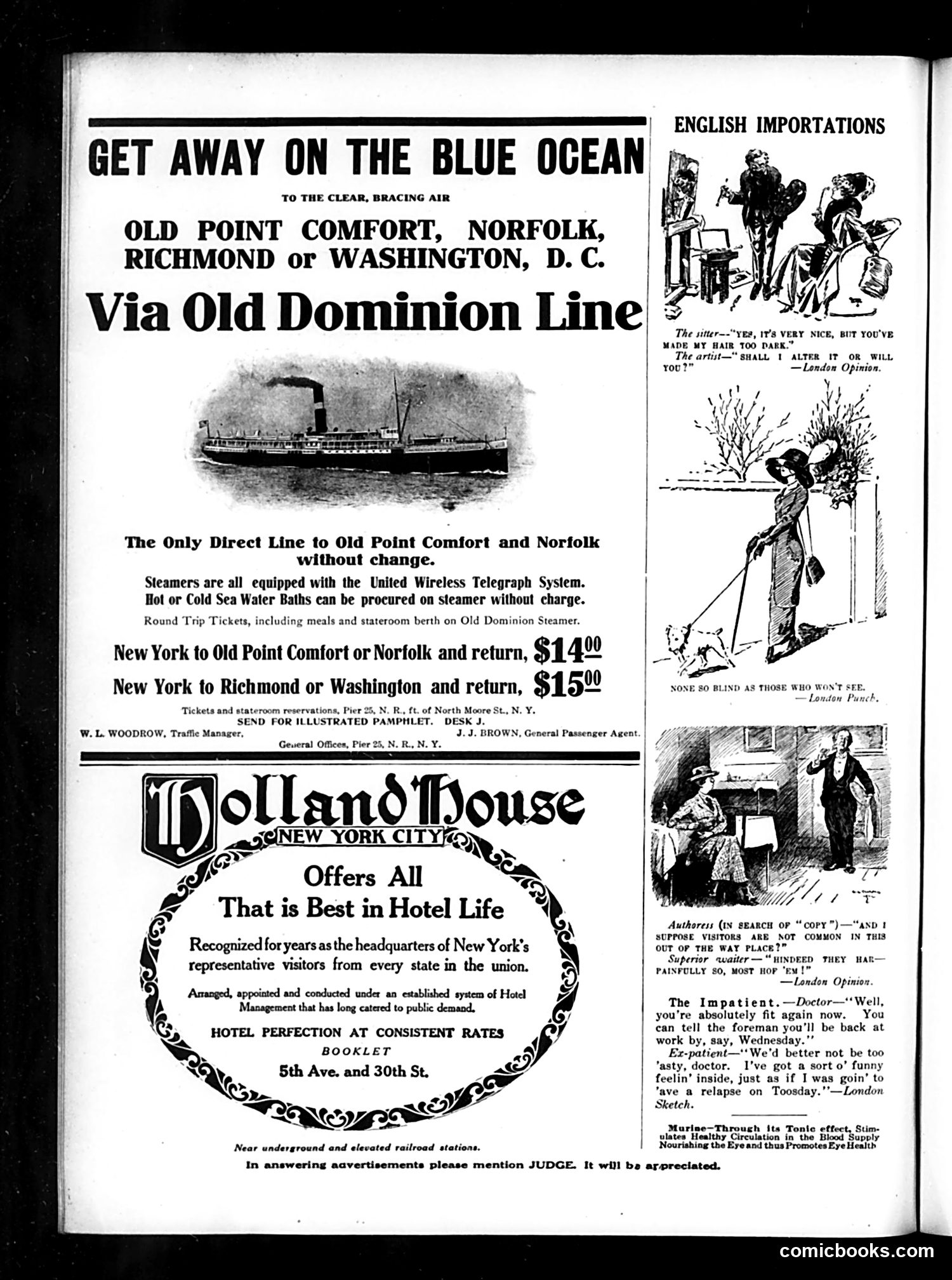
This page is primarily **advertisements** for steamship travel and hotel accommodations, with a small section of satirical cartoons on the right labeled "English Importations." The cartoons appear to be reprints from London publications (*London Opinion*, *London Punch*, *London Sketch*). They mock British social pretensions and mannerisms through humor about: 1. Hair styling/appearance concerns 2. Class-conscious visitor experiences in England 3. Medical advice-seeking behavior The cartoons use exaggerated character types to satirize British attitudes, likely appealing to American readers by portraying the English as snobbish or fussy. The specific identities of drawn figures are unclear, but they represent generic "types" rather than named individuals—a common Judge format for mocking national characteristics and social behavior.
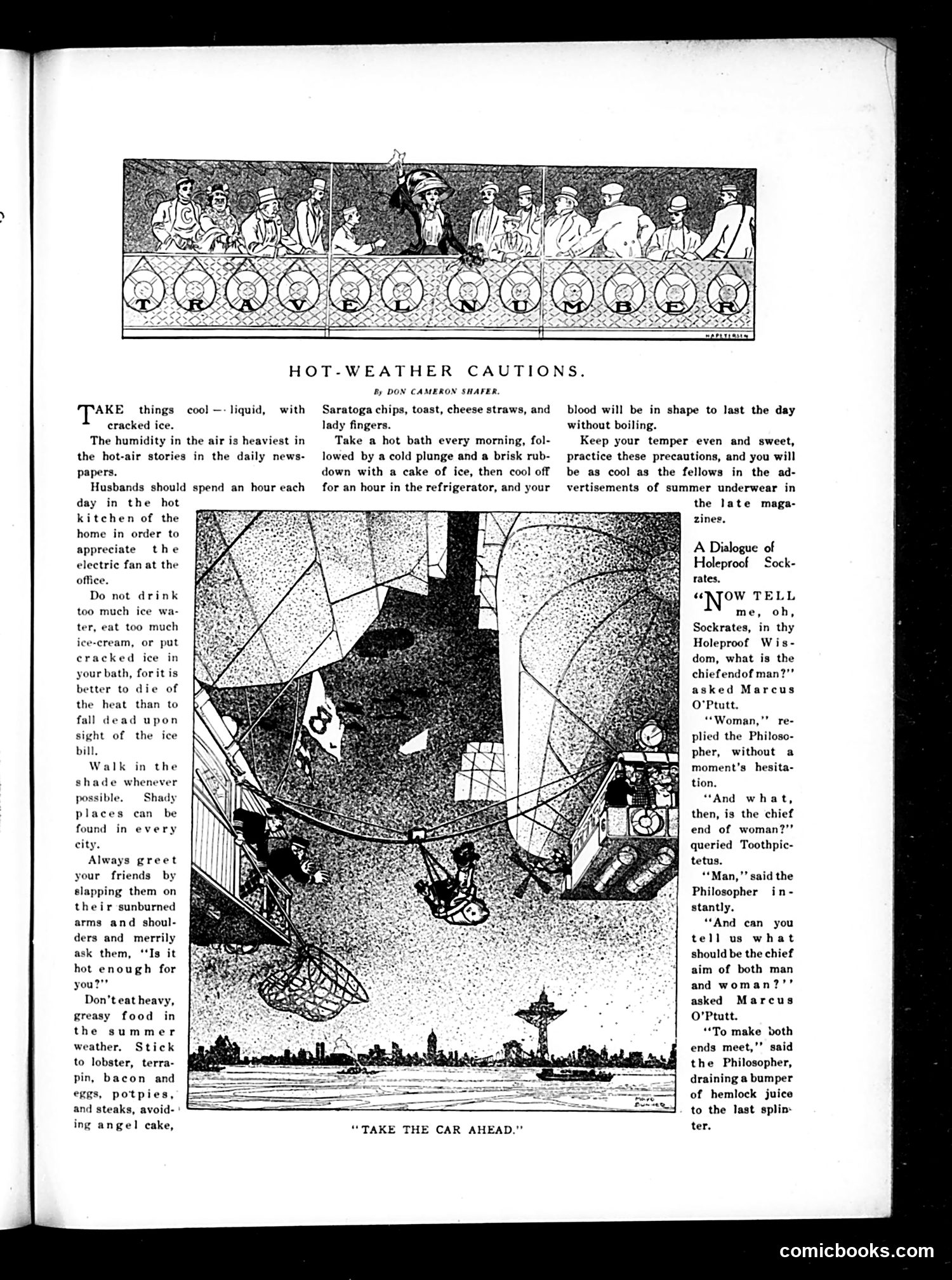
This page combines practical summer advice with satirical humor typical of Judge magazine's style. The top illustration shows people in various states of summer distress—appearing overheated and uncomfortable in urban conditions. The main cartoon "Take the Car Ahead" depicts someone fleeing the oppressive city heat by automobile, likely referencing early 1900s aspirations for car ownership as escape from crowded, sweltering urban environments. The accompanying text offers tongue-in-cheek advice about staying cool: avoiding heavy foods, frequent ice baths, walking in shade, and greeting friends by slapping their sunburned arms. The right column presents a philosophical dialogue between characters discussing what defines "chief end of man" versus "woman"—likely social satire about gender roles and expectations of the era. Overall, the page satirizes summer discomfort while gently mocking period concerns and social conventions.
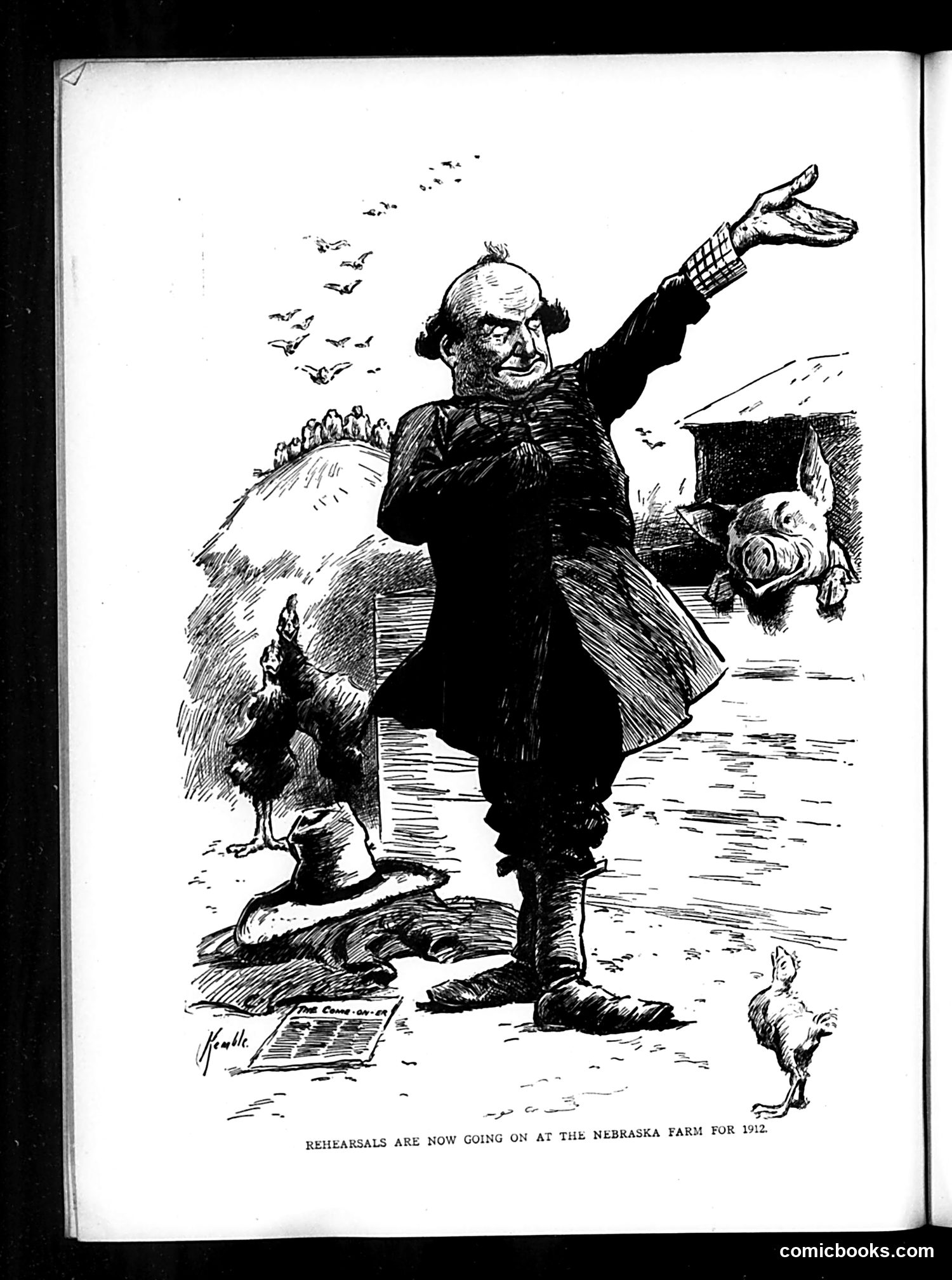
This 1912 *Judge* magazine cartoon satirizes what appears to be political "rehearsals" at a Nebraska farm. A large, portly figure (likely a politician or political boss) stands center stage, directing proceedings with an authoritative gesture. He's surrounded by smaller figures—including what appears to be political operatives or party members—suggesting he's orchestrating or manipulating political events. The caption "Rehearsals are now going on at the Nebraska Farm for 1912" implies this is staging for the 1912 presidential election or related political campaigns. The theatrical staging metaphor suggests the cartoonist viewed these political preparations as inauthentic or artificially choreographed performances rather than genuine democratic processes. The specific "Nebraska Farm" reference remains unclear without additional context, though it may reference a notable political figure or location associated with 1912 politics.
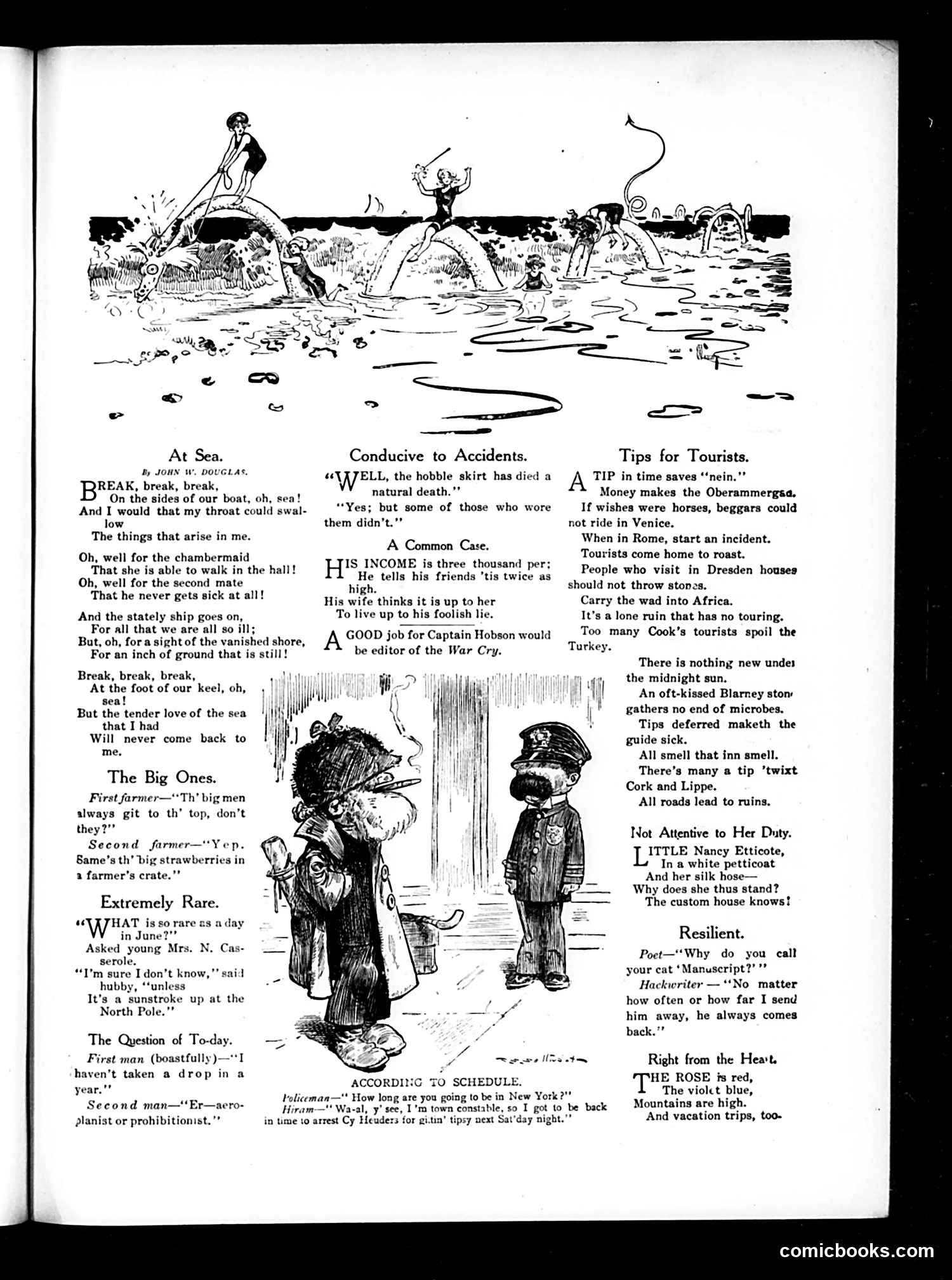
This page from the satirical magazine *Judge* contains multiple humorous sketches and poems targeting early 20th-century social conventions. **"At Sea"** parodies Tennyson's "Break, Break, Break," transforming romantic melancholy into seasickness complaints—mocking sentimental poetry by grounding it in mundane physical suffering. **"The Big Ones"** uses farmer dialect to joke that successful people rise to the top naturally, like large strawberries in a crate—satirizing both social mobility myths and rural simplicity. **"Conducive to Accidents"** mocks the hobble skirt (a restrictive women's fashion of the era) as a safety hazard, with dark humor about wearers dying. **"Tips for Tourists"** provides faux-travel advice parodying guidebooks, suggesting tourists are gullible, destructive, and encourage locals to fleece them. Other brief pieces mock prohibition debates, income inequality, and bureaucratic small-town life. The cartoons above show beach leisure and street scenes of period types. This is primarily **humor and satire** about contemporary fashion, travel culture, and social pretension rather than political commentary.
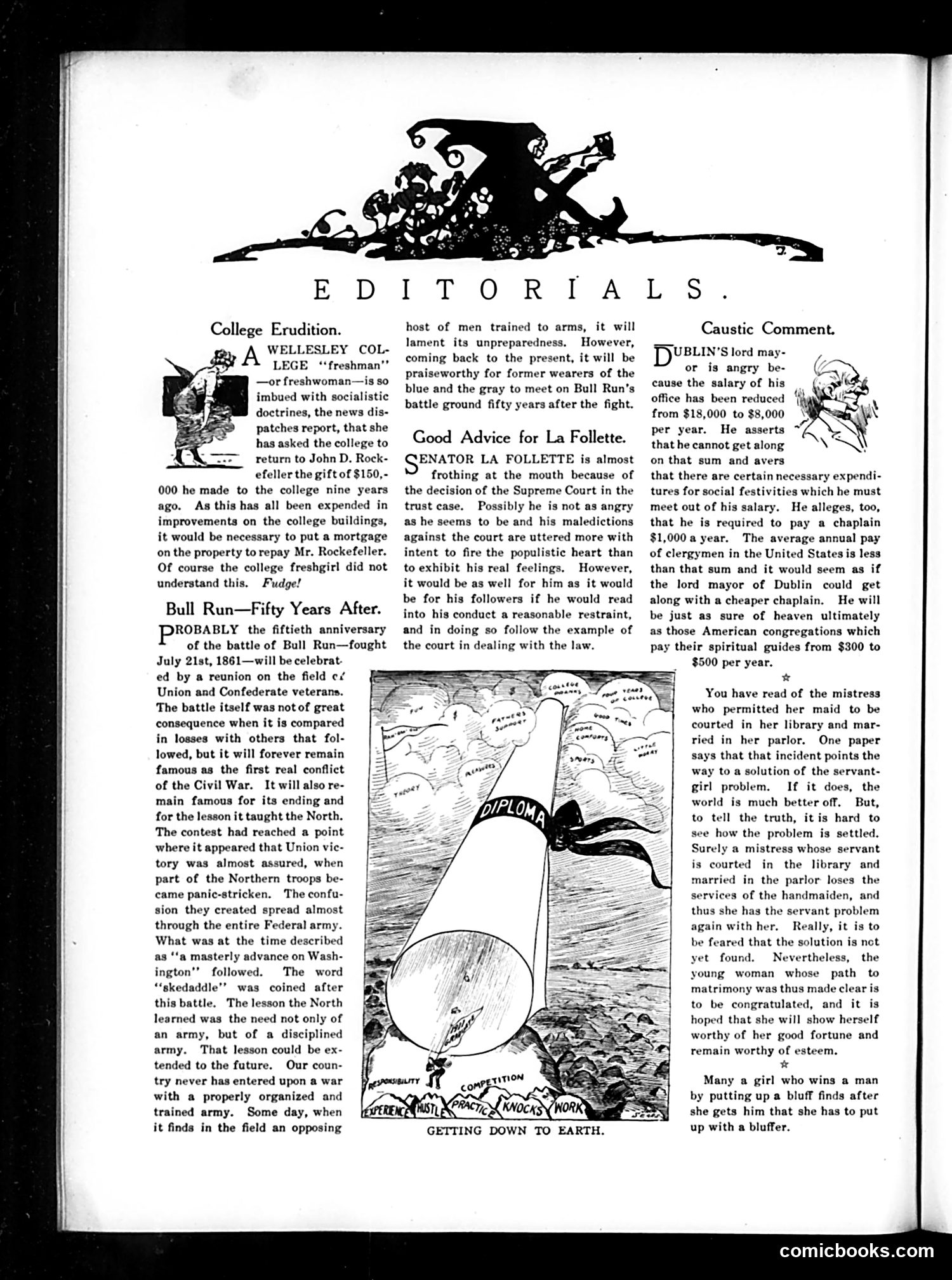
This is a Judge magazine editorials page featuring three satirical pieces: 1. **"College Erudition"**: Mocks Wellesley College's request for a $150,000 gift, arguing the funds should address campus infrastructure rather than indulge "scholastic doctrines." 2. **"Bull Run—Fifty Years After"**: Commemorates the Civil War battle's anniversary, using it to argue that the North learned the necessity of organized, trained military forces—a lesson America should retain. 3. **"Getting Down to Earth"** (central cartoon): Depicts a ballot or election issue descending like a balloon, labeled with competing forces ("Diplomacy," "Competition," "Knock," "Hook"). This appears to satirize political conflict or electoral competition weighing heavily on society. 4. **"Caustic Comment"**: Critiques Dublin's lord mayor's salary reduction and discusses servant-mistress social dynamics, suggesting societal hypocrisy about class relations. The page reflects early 20th-century American political and social preoccupations.
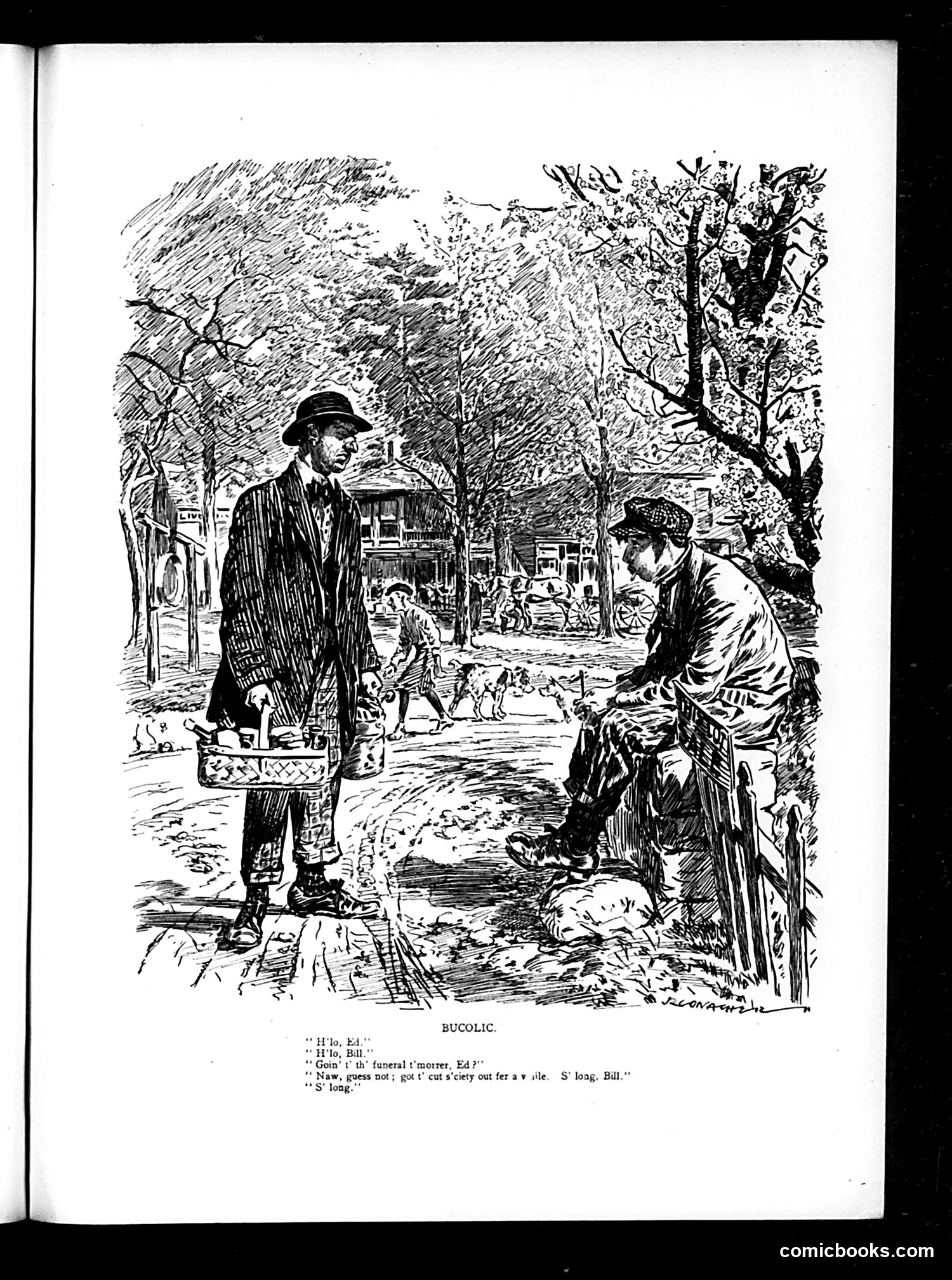
This cartoon depicts two working-class men in a park setting, titled "Bucolic" (meaning rural or pastoral). The dialogue shows them using dialect speech patterns typical of early 20th-century working-class caricature. One man declines attending a funeral tomorrow because he must "cut society out for a while"—meaning he's prioritizing leisure time or avoiding social obligations. The satire appears to mock working-class priorities and social manners, contrasting rustic informality with the expectations of "society." The park setting, with its trees and distant figures, emphasizes the rural or common-folk context. Judge magazine frequently lampooned class differences and social pretensions of various American groups during this era.
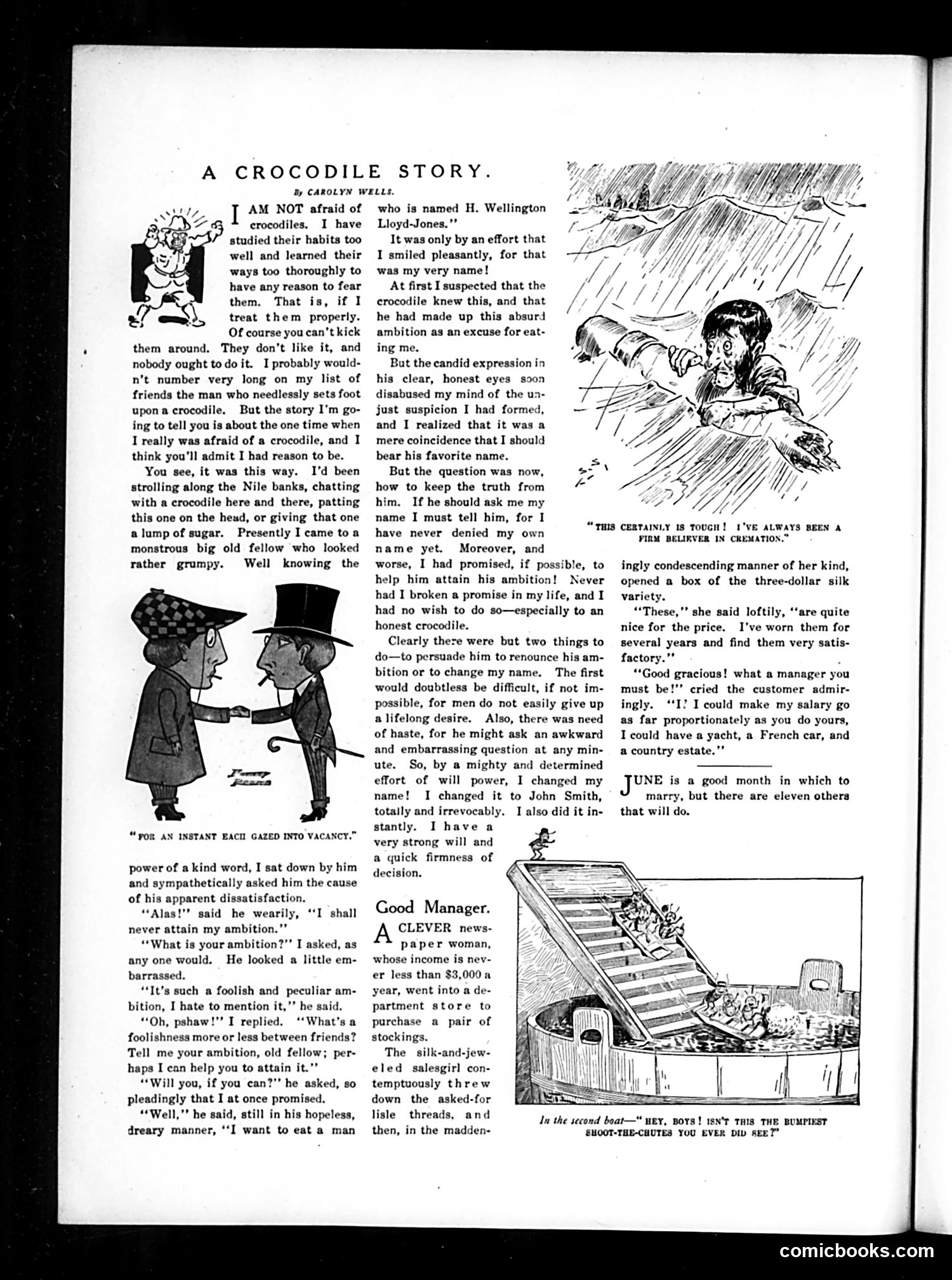
This page contains two separate satirical pieces: **"A Crocodile Story"** is a humorous tall tale by Carolyn Wells about the narrator meeting a crocodile on the Nile with an unusual ambition: to eat a man named H. Wellington Lloyd-Jones—which happens to be the narrator's own name. The joke plays on coincidence and the narrator's predicament of having promised to help the crocodile achieve its goal while bearing the very name desired. The resolution (changing his name to John Smith) satirizes the absurdity of the situation. **"Good Manager"** is a brief satirical anecdote about a wealthy newspaper woman ($3,000+ annual income—substantial for the era) shopping in a department store. A snobbish salesgirl condescendingly offers expensive silk stockings, claiming she herself has worn cheaper lisle ones for years. The customer's admiring response to this "good management" is ironic—the salesgirl's frugality contradicts her air of superiority, exposing class pretension and the gap between salespeople's wages and customer wealth. Both pieces mock human foibles and social pretension through comedic situations.
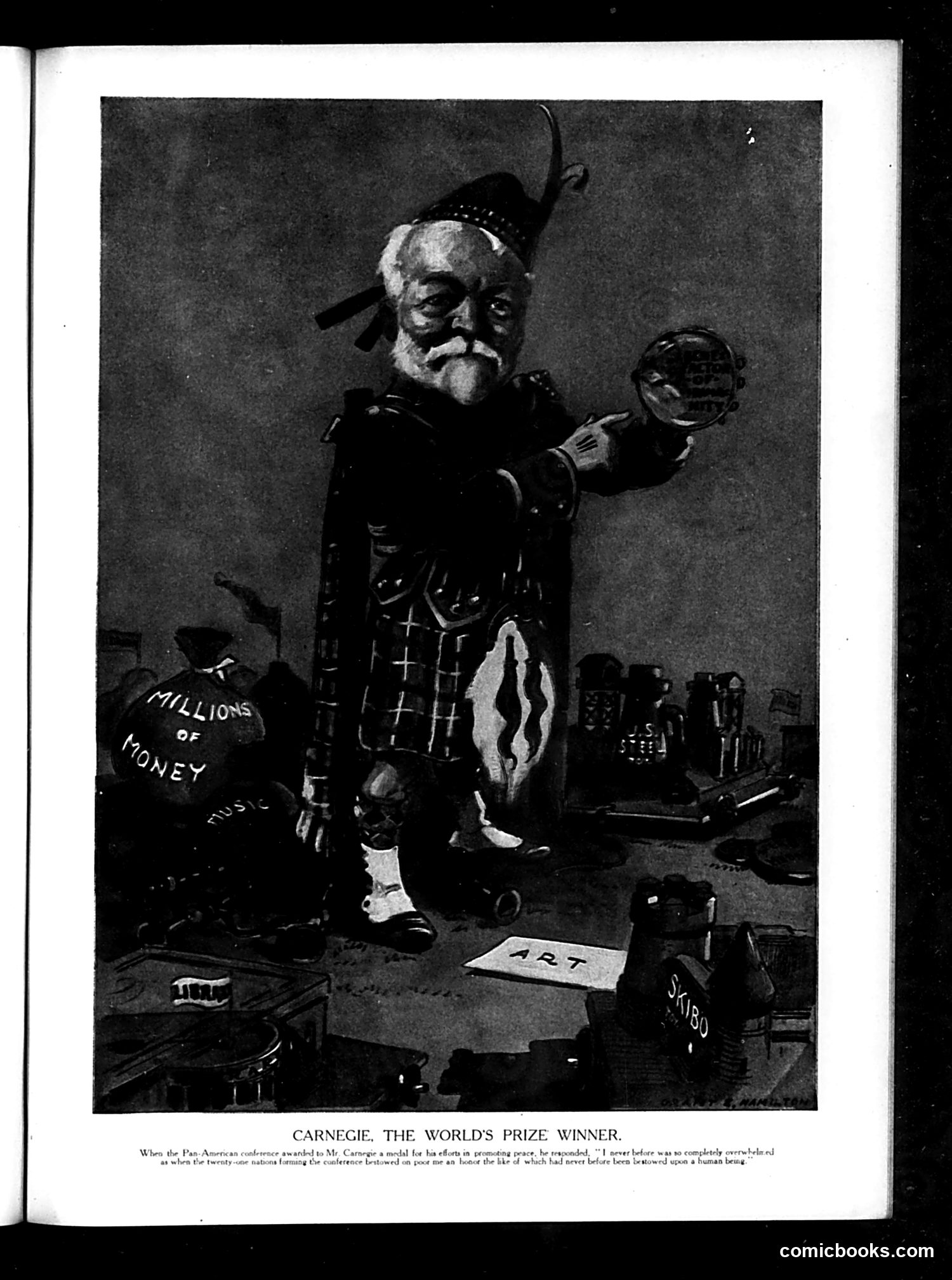
This is a satirical caricature of Andrew Carnegie, the Scottish-American industrialist and philanthropist. The caption indicates Carnegie received a medal from the Pan-American Conference for promoting peace. The satire is biting: Carnegie is depicted as a grotesque figure holding a globe, surrounded by symbols of wealth ("Millions of Money") and industrial power. The word "Art" appears on the ground, suggesting cultural pretensions. The imagery mocks the disconnect between Carnegie's public reputation as a peacemaker and philanthropist versus his actual fortune built on steel manufacturing—an industry associated with weapons and warfare. The cartoon suggests hypocrisy: that Carnegie's peace medal is contradicted by his wealth derived from industries that enable conflict. This reflects contemporary Progressive-era criticism of wealthy industrialists who sought moral legitimacy through charitable giving.
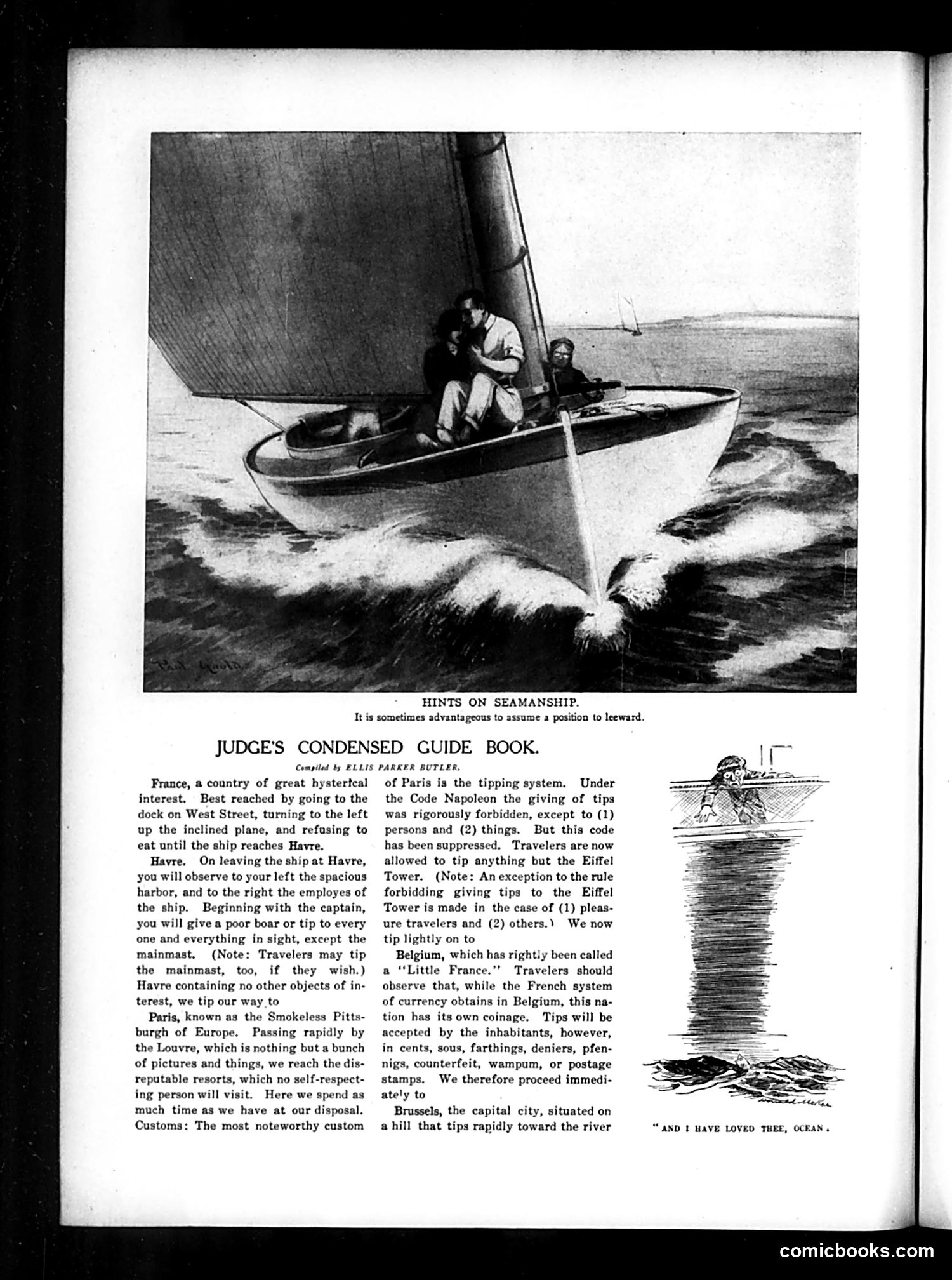
This page from Judge magazine satirizes American tourists abroad through Ellis Parker Butler's mock travel guide. The cartoon above depicts a small sailboat in rough seas with the caption "It is sometimes advantageous to assume a position to leeward"—a nautical joke about positioning oneself downwind, likely mocking tourists' ignorance of basic seamanship. The text parodies tourist guides and American travelers' stereotypical behaviors, particularly their obsession with tipping. Butler ridicules the widespread practice of American tourists tipping excessively everywhere in Europe—"you will give a poor boar or tip to every one and everything in sight, except the mainmast." The joke escalates absurdly, suggesting travelers can even tip the Eiffel Tower and pay in "counterfeit, wampum, or postage stamps." The satire targets American travelers' combination of ignorance, excessive spending, and general cluelessness abroad—portraying them as culturally blind (dismissing the Louvre as "pictures and things") yet financially reckless.
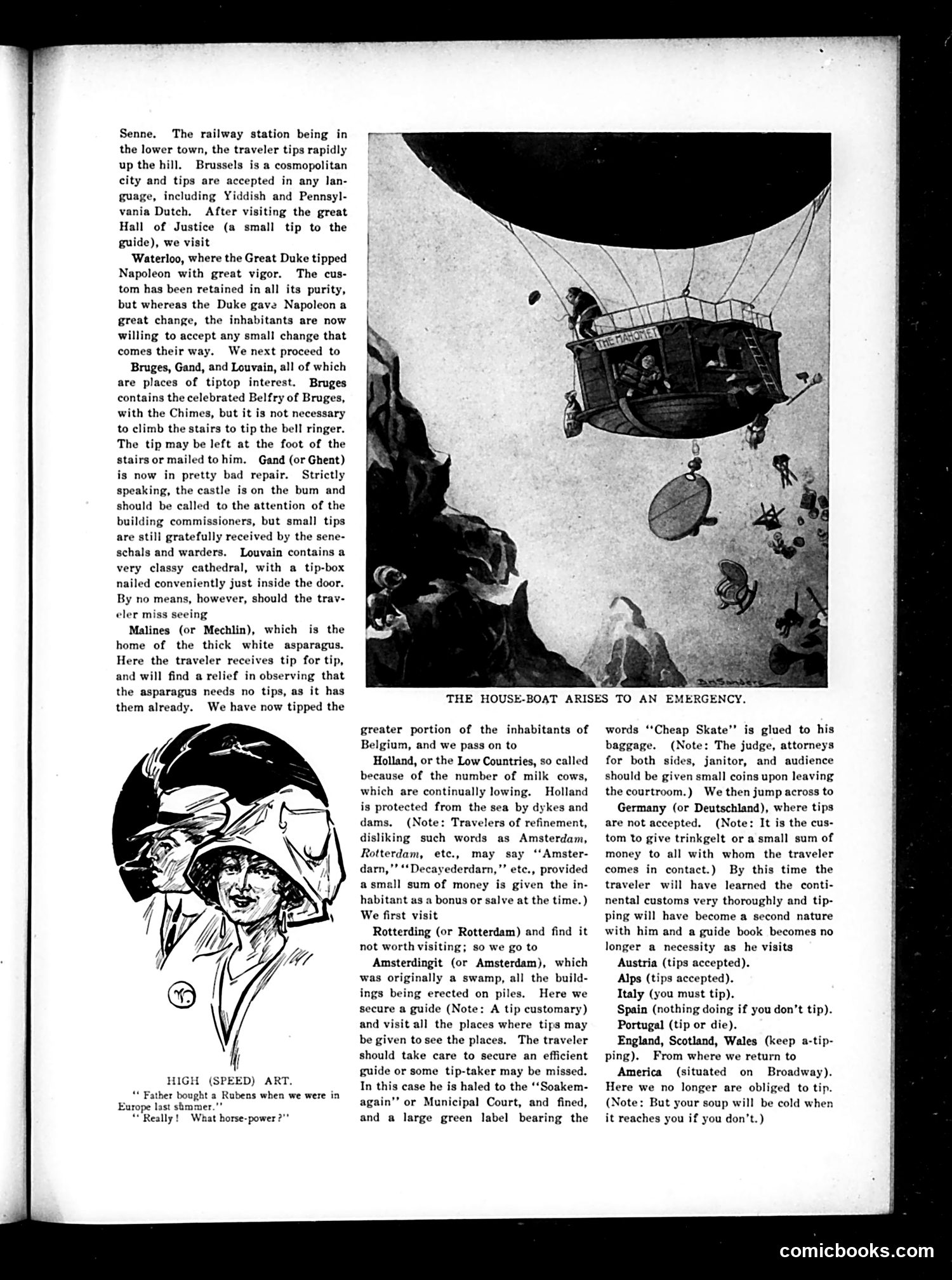
This is a humorous travel essay mocking the ubiquity of tipping throughout Europe. The text describes a traveler's journey through Belgium, Holland, and beyond, presenting every destination as an opportunity to tip someone—guides, bell-ringers, cathedral workers, even court officials. The satire exaggerates how pervasive the custom is, suggesting you must tip for nearly every interaction or face consequences (including being labeled a "Cheap Skate" in court). The accompanying cartoons reinforce the humor: "High (Speed) Art" jokes about a wealthy art collector's misplaced priorities, while "The House-Boat Arises to an Emergency" (caption visible) appears to show a hot-air balloon incident, representing unexpected travel mishaps. The piece satirizes both American tourist behavior and European expectations of gratuities, presenting tipping as an inescapable tax on travel itself.
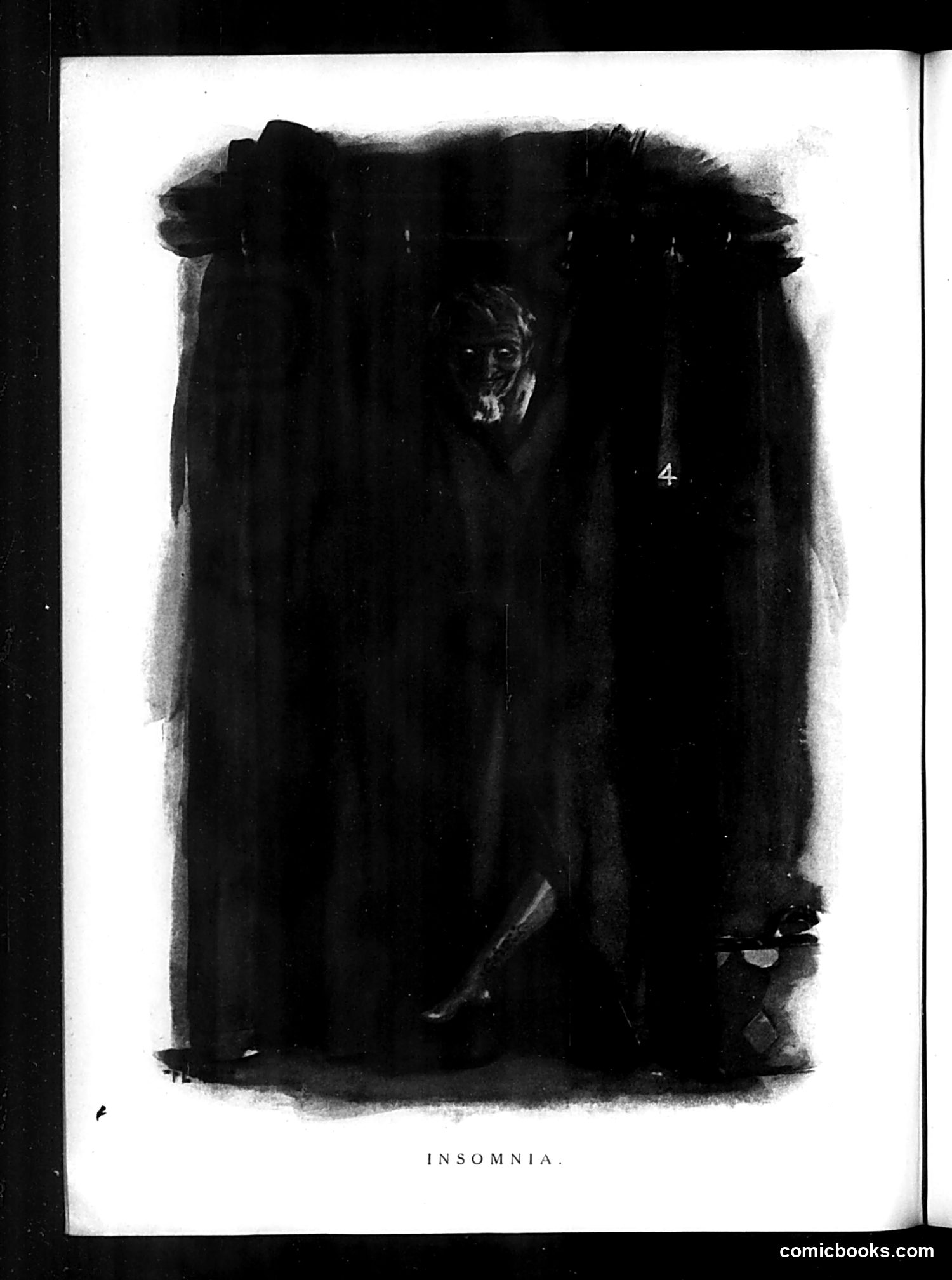
This is a dark, expressionistic illustration labeled "INSOMNIA" showing a figure shrouded in heavy black drapery or cloth, with only their face barely visible within the shadowy folds. The number "4" appears to mark this as part of a series. The cartoon uses insomnia as metaphor for anxiety or worry—the suffocating darkness and fabric suggest mental distress or being trapped by sleeplessness. The technique emphasizes psychological torment through visual heaviness and obscured features, rather than explicit political commentary. Without additional context or accompanying text, the specific social or political target remains unclear, though the style suggests commentary on a contemporary condition affecting the magazine's readership during its publication period.
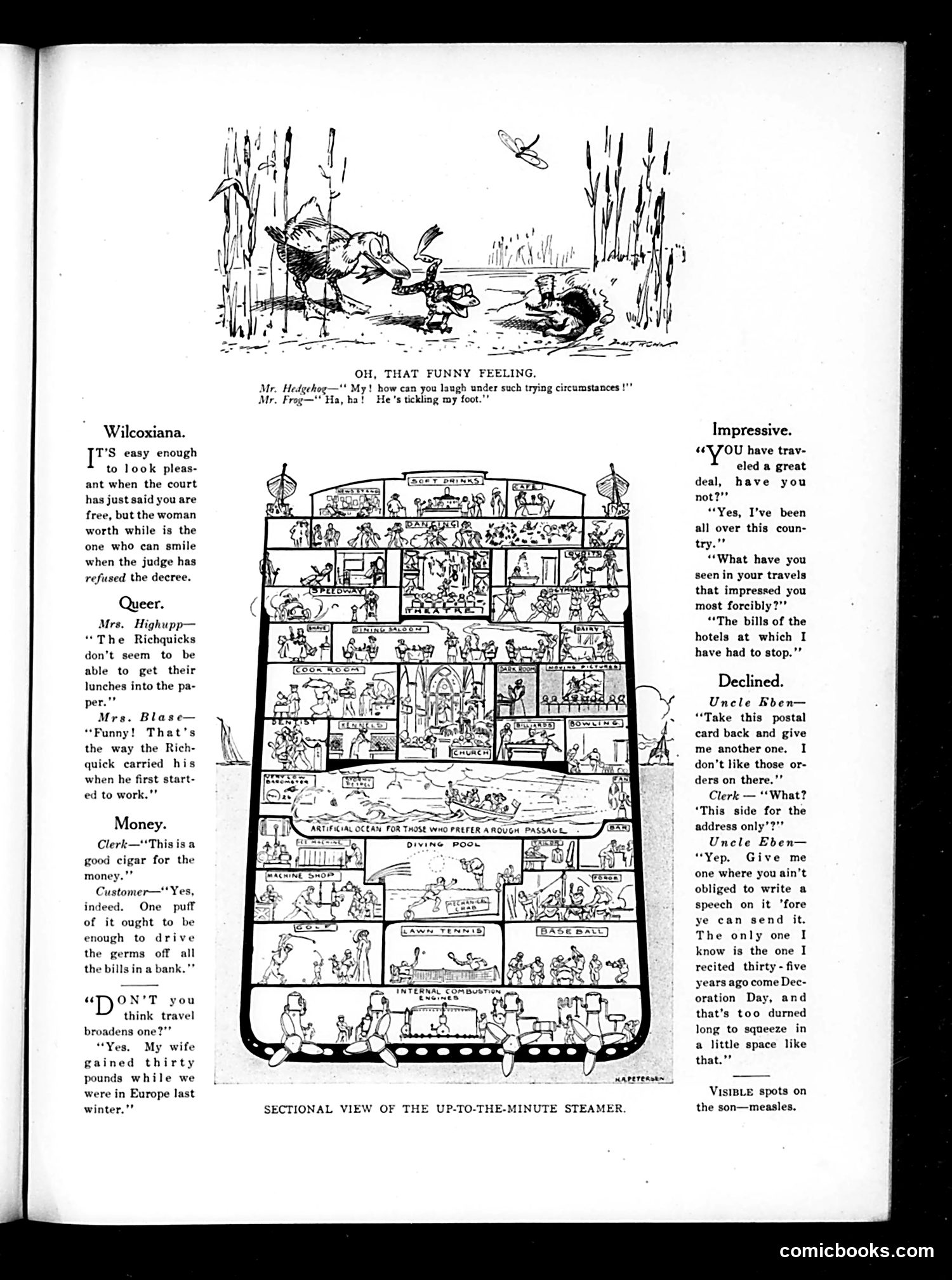
This page contains multiple short humorous pieces typical of early 20th-century satirical magazines: **Main Cartoon**: "Sectional View of the Up-to-the-Minute Steamer" is a detailed cross-section showing the absurdly crowded interior of a modern luxury steamship, satirizing the packed conditions and numerous activities crammed into ships despite claims of advancement. **Short Jokes** address contemporary concerns: - Divorce and stoicism among the wealthy - Social climbing and newspaper gossip columns - Poor-quality cigars and money-saving - Travel as status symbol masking excessive eating/spending - Bureaucratic absurdity (postal card regulations) - Race-based humor ("Uncle Eben," appearing to depict a Black character with dialect) The satire targets turn-of-the-century American materialism, pretension among the rich, modern inconveniences marketed as progress, and the gap between expectations and reality in leisure travel. The humor relies on class observation and period-specific anxieties about consumption and social status.
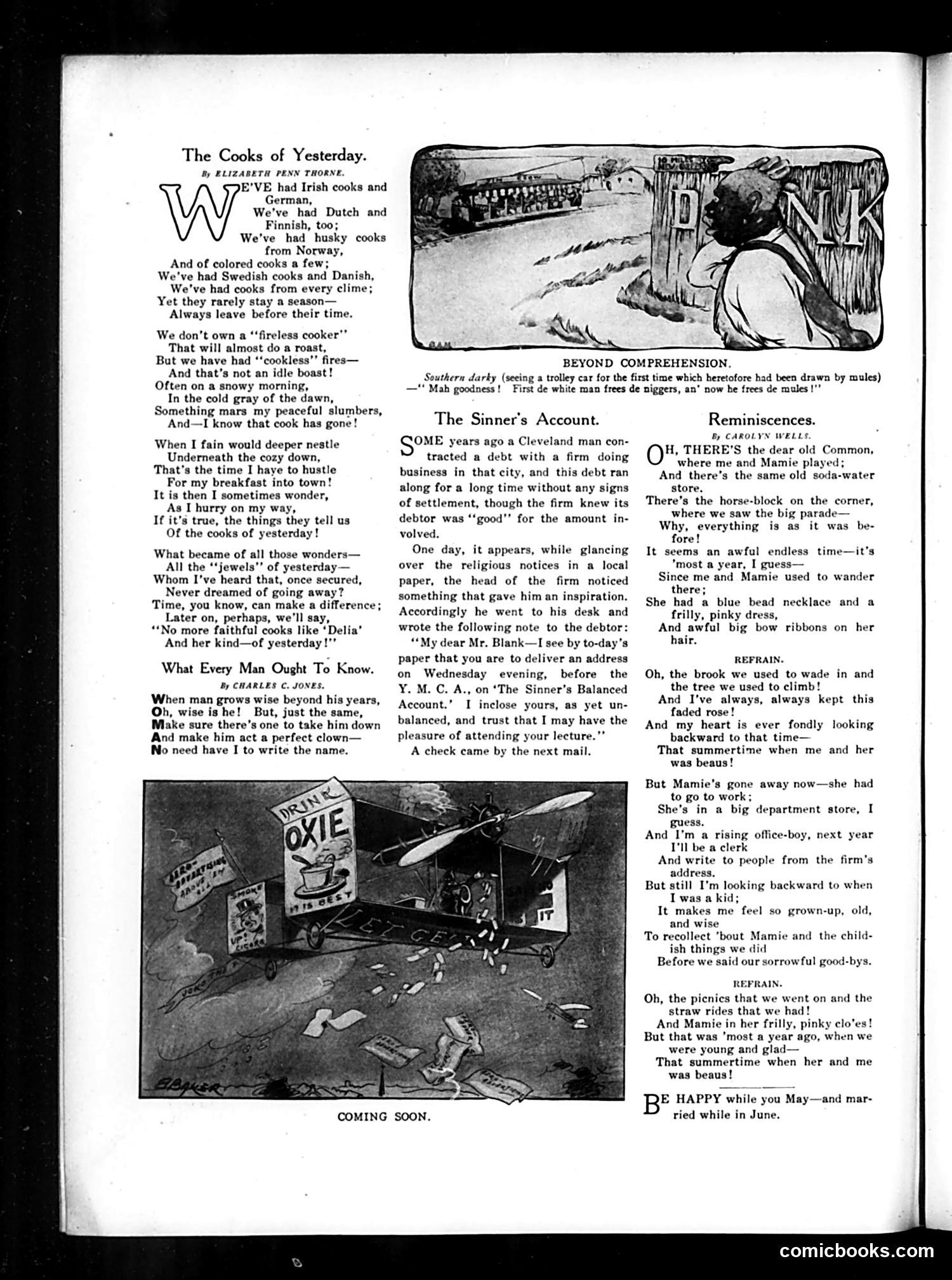
This page contains three distinct pieces of nostalgic Americana satire reflecting early 20th-century American anxieties: **"The Cooks of Yesterday"** laments the disappearance of long-term domestic servants. The poem complains that immigrant cooks (Irish, German, Dutch, Finnish, Norwegian, Swedish, Danish, and "colored") never stay long, forcing employers to scramble for breakfast. The satire mocks employers' romanticization of fictional loyal servants like "Delia"—suggesting such reliability never actually existed. **"Beyond Comprehension"** is a racial caricature joke: a Southern Black man seeing an electric trolley for the first time misunderstands its automation as the government "freeing" mules as it previously freed enslaved people. The "humor" depends on depicting the character as stupidly confused. **"Reminiscences"** is a sentimental poem about a young office boy nostalgic for childhood sweethearts and simpler times, now separated by economic necessity—Mamie works retail while he pursues clerical advancement. Together, these pieces reflect anxieties about social mobility, servant scarcity, and industrialization displacing traditional relationships.
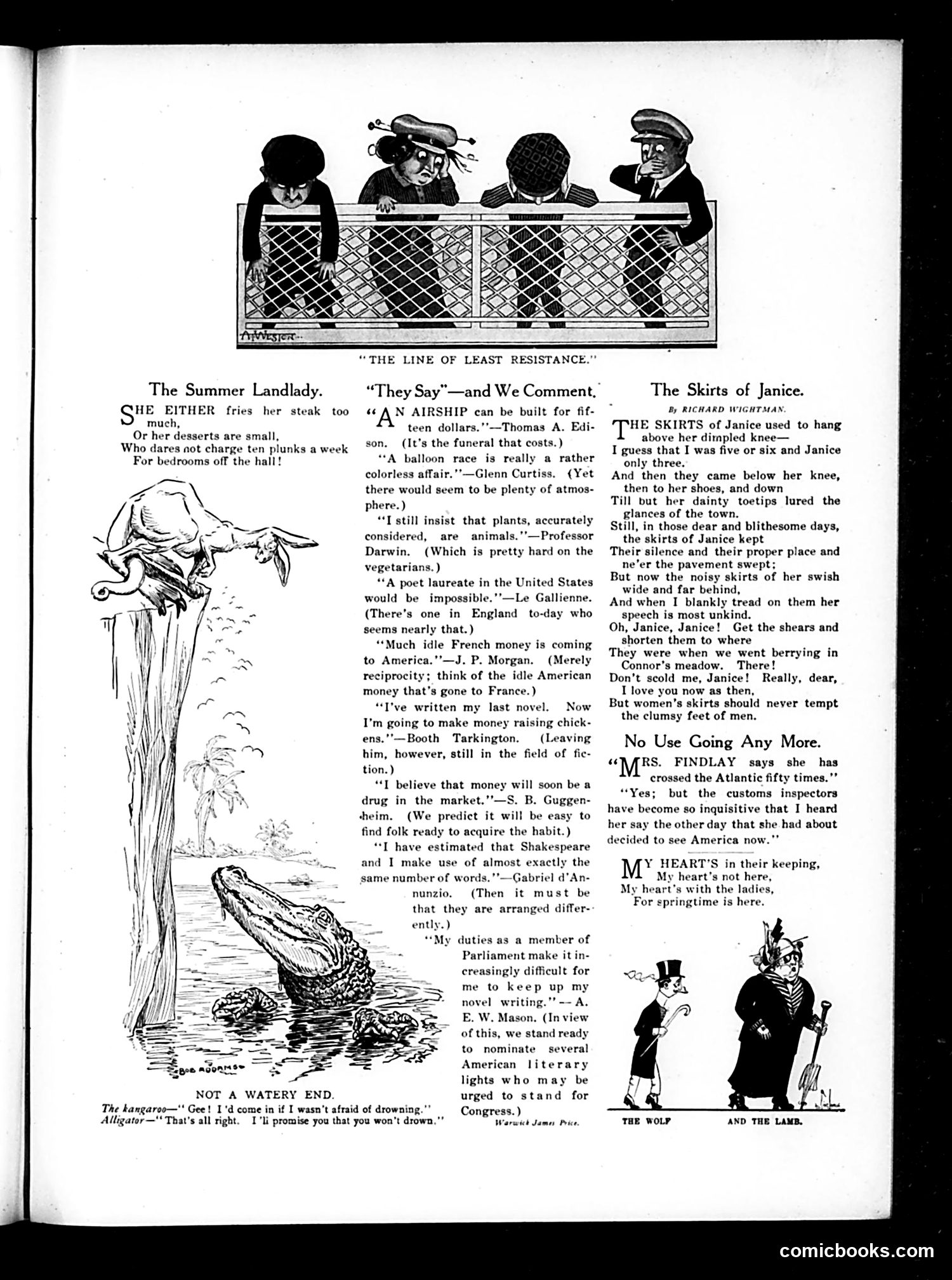
This page contains multiple satirical pieces typical of Judge's style: **"The Line of Least Resistance"** (top cartoon): Four figures peer over a fence, likely representing public figures responding to contemporary claims. The satire undercuts famous statements—Edison's cheap airship (implying hidden costs), Morgan's money coming to America (mocking reciprocal economic hypocrisy), and claims about plants being animals and Shakespeare's vocabulary (absurd declarations). **"The Summer Landlady"**: A humorous poem mocking landlords who charge premium rates despite serving poor meals or small portions. **"The Skirts of Janice"**: A nostalgic poem lamenting women's increasingly short skirts (likely 1910s fashion), with the speaker comically getting stepped on by the wider, noisier hems—satirizing changing women's fashion. **Minor pieces**: "The Wolf and the Lamb" (a fable adaptation) and "No Use Going Any More" (mocking a woman's repeated Atlantic crossings and customs inspectors). The page emphasizes Judge's formula: punching up at powerful figures, commenting on social/fashion trends, and pairing verse with quick satirical commentary.
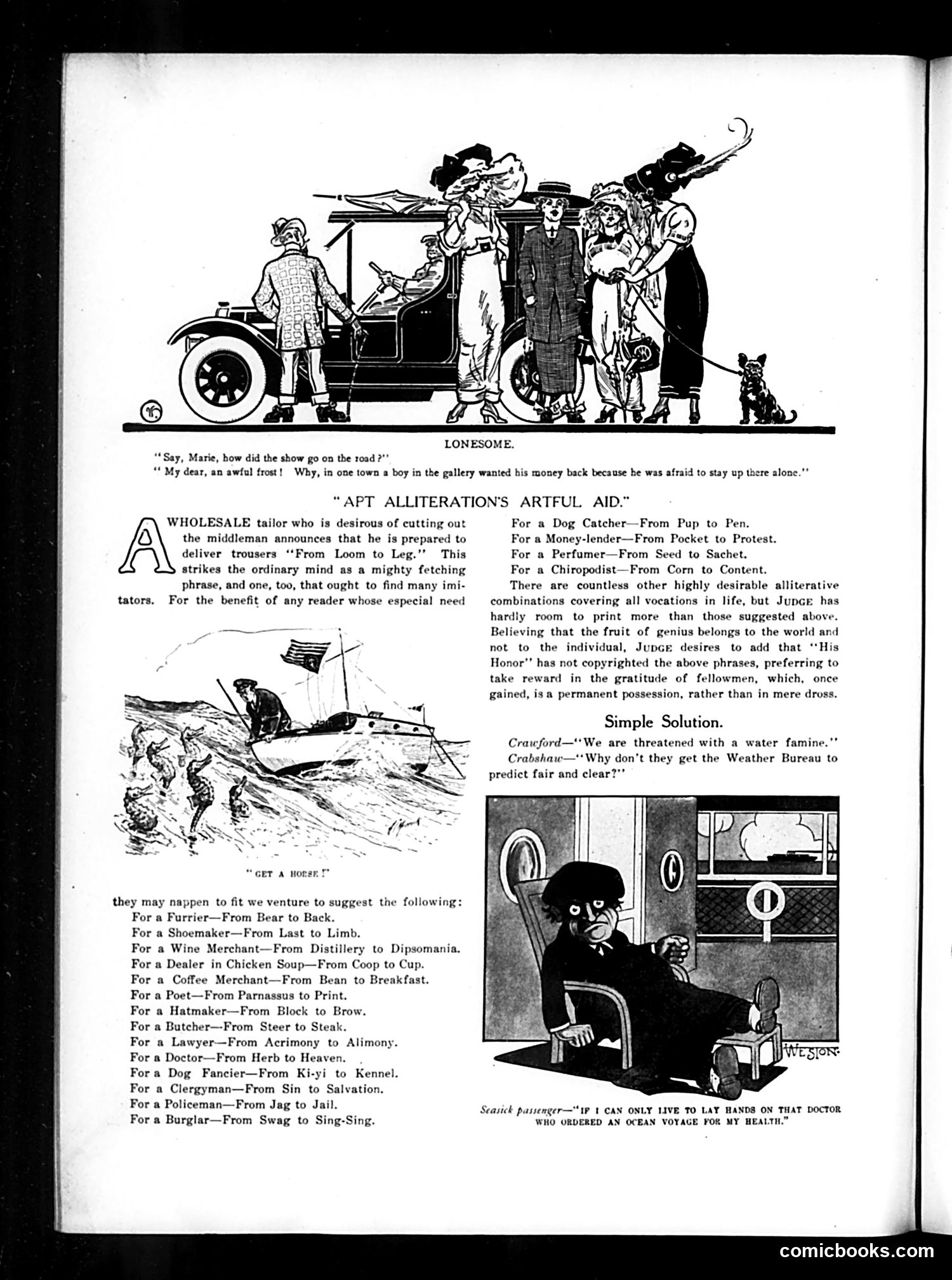
This page contains three separate satirical pieces: **"Lonesome"** (top): A theatrical joke about a failed traveling production so poorly attended that a boy in the gallery wanted a refund rather than sit alone—mocking theatrical flops. **"Apt Alliteration's Artful Aid"** (center): The main satire mocks a wholesale tailor's marketing slogan "From Loom to Leg." Judge humorously extends this alliterative formula to other professions, creating darkly comic wordplay: a lawyer goes "From Acrimony to Alimony," a doctor "From Herb to Heaven," a burglar "From Swag to Sing-Sing" (prison). The satire critiques both the tailor's gimmicky advertising and various professions themselves through exaggerated, ironic slogans. **"Simple Solution"** (bottom): A brief joke where "Crabshaw" sarcastically suggests solving a water shortage by having the Weather Bureau predict clear weather—absurdist humor about bureaucratic futility. The page exemplifies Judge's blend of theatrical, advertising, and social satire typical of early 20th-century American humor magazines.
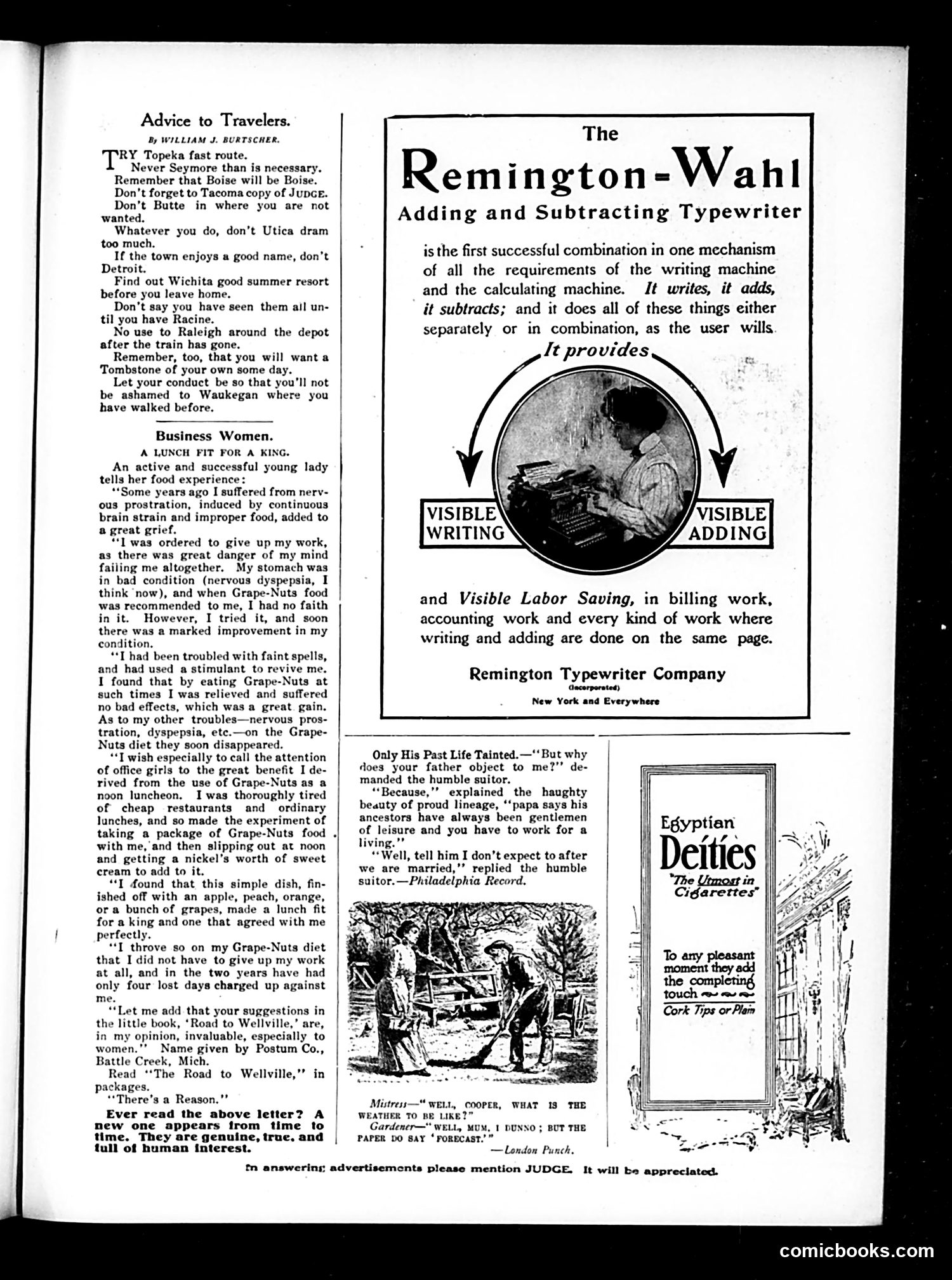
This page contains two distinct elements: **"Advice to Travelers"** is a punny piece playing on U.S. city names as verbs (Tacoma = "take a," Butte = "butt," Utica = "you take a," etc.). It's gentle wordplay humor typical of the era. **The main advertisement** promotes the Remington-Wahl typewriter, emphasizing it combines writing, adding, and subtracting functions—marketed as labor-saving for office work, particularly billing and accounting. The circular diagram shows "Visible Writing" and "Visible Adding" capabilities. **"Business Women"** features a Grape-Nuts cereal testimonial from an office worker who credits the food with curing nervous exhaustion and dyspepsia, allowing her to continue working. This reflects early 1900s concerns about women's workplace health. **The cartoon** (bottom) shows a dialogue about a suitor's humble background—the father objects because ancestors were "gentlemen of leisure" while the suitor must work. The joke critiques old-money snobbery: the father won't accept working-class marriage prospects regardless of character. The page reflects Progressive Era attitudes toward women's work, health, and commerce.
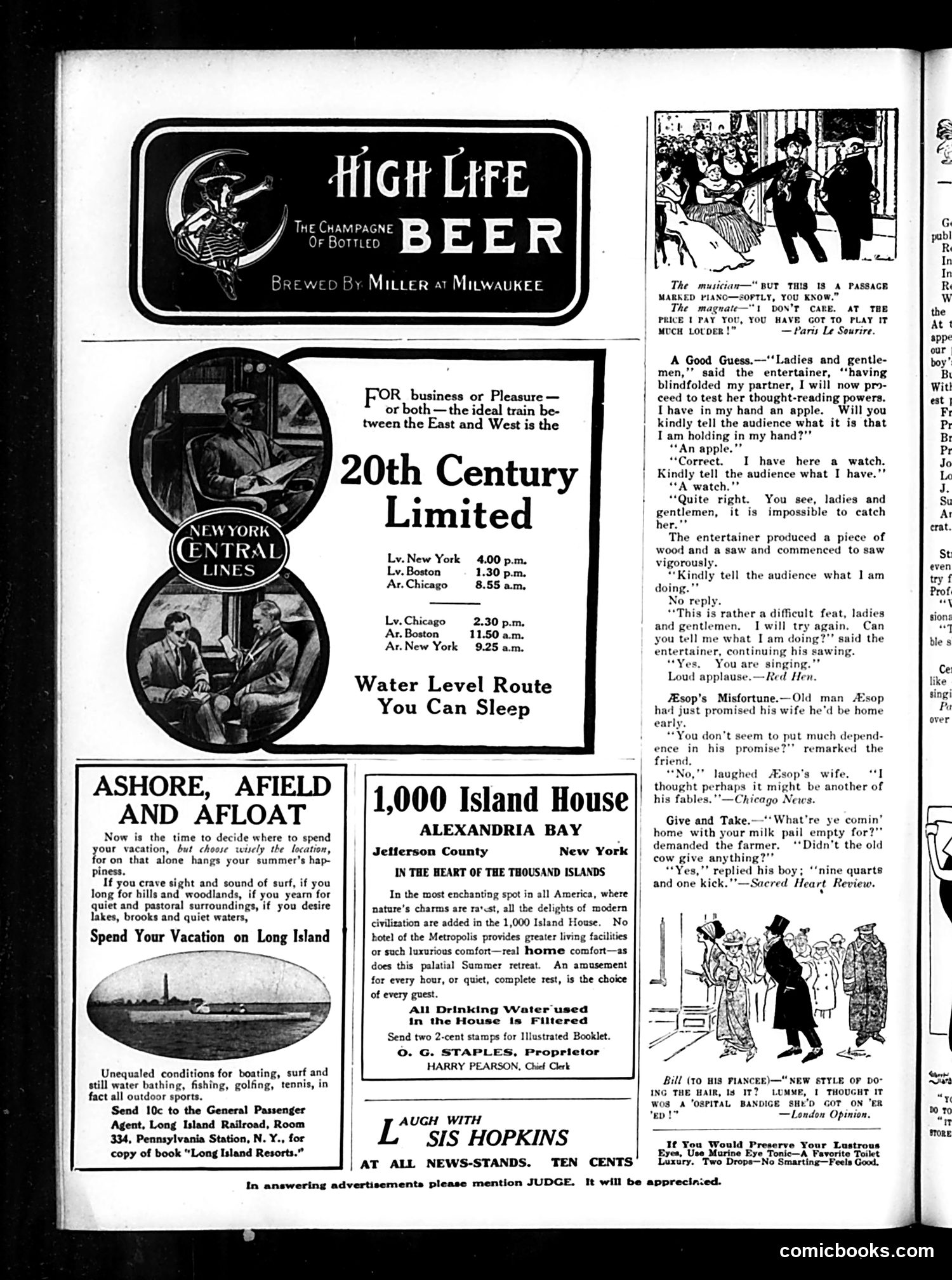
This is primarily an **advertising page** with several small humor comics interspersed. The ads promote vacation destinations (Long Island, the 20th Century Limited train, the 1,000 Island House resort) and High Life beer. The cartoons use simple joke formats typical of early 20th-century humor magazines: - **"The Musician"** satirizes wealthy magnates who throw money around demanding service regardless of artistic appropriateness—a wealthy patron insists a pianist play loudly despite sheet music marking "piano" (soft). - **"A Good Guess"** is a setup joke about a magician's mind-reading act that fails when asked to identify a piece of wood being sawed—the blindfolded assistant jokes he's "singing" instead. - **"Aesop's Misfortune"** and **"Give and Take"** are brief anecdotes about broken promises and farm life. - **"Bill"** contains dated British slang humor about a woman's new hairstyle resembling a hospital bandage. These represent Judge's typical format: light, domesticated humor targeting middle-class readers, mixed with luxury lifestyle advertising.
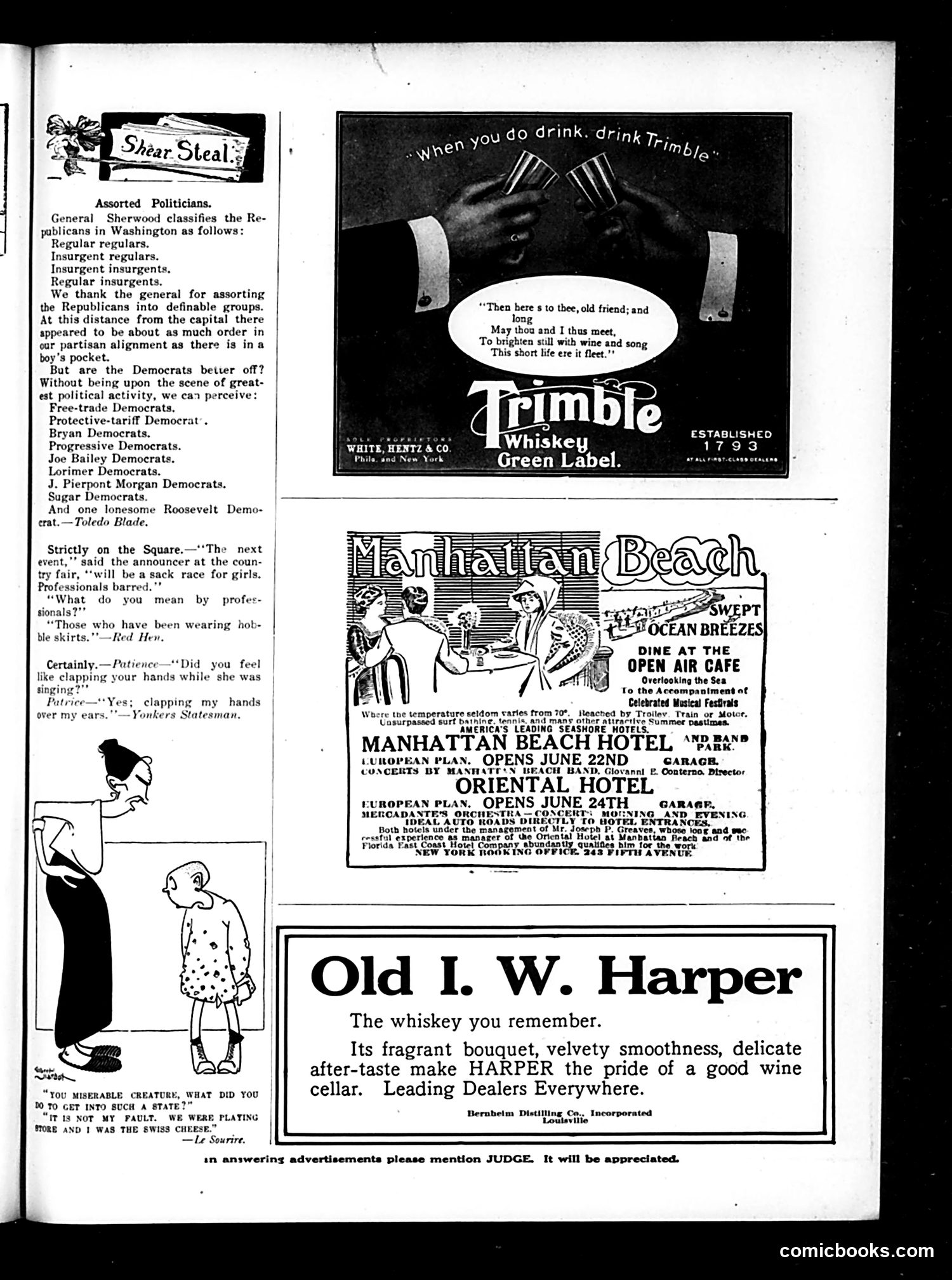
This page contains several satirical pieces typical of early 20th-century American humor: **"Assorted Politicians"** mocks the fragmentation of both major parties. General Sherwood's Republican classifications ("Regular regulars," "Insurgent insurgents") humorously suggest internal party chaos. The text extends this to Democrats, listing factions like "Joe Bailey Democrats" and "J. Pierpont Morgan Democrats"—references to actual political figures whose names became shorthand for competing ideologies within their party. **"Strictly on the Square"** jokes about women's fashion (the "hobble skirt" craze of the 1910s), with professionals being those accustomed to wearing restrictive skirts. **"Certainly"** is a mild double-entendre about hand-clapping. The **bottom cartoon** shows a woman scolding a drunken man who claims he was "playing more" and became the "Swiss cheese"—likely a non-sequitur joke about alcohol-impaired reasoning. The page is otherwise dominated by **period advertisements** for whiskey, hotels, and beach resorts—the commercial foundation of Judge's publication.
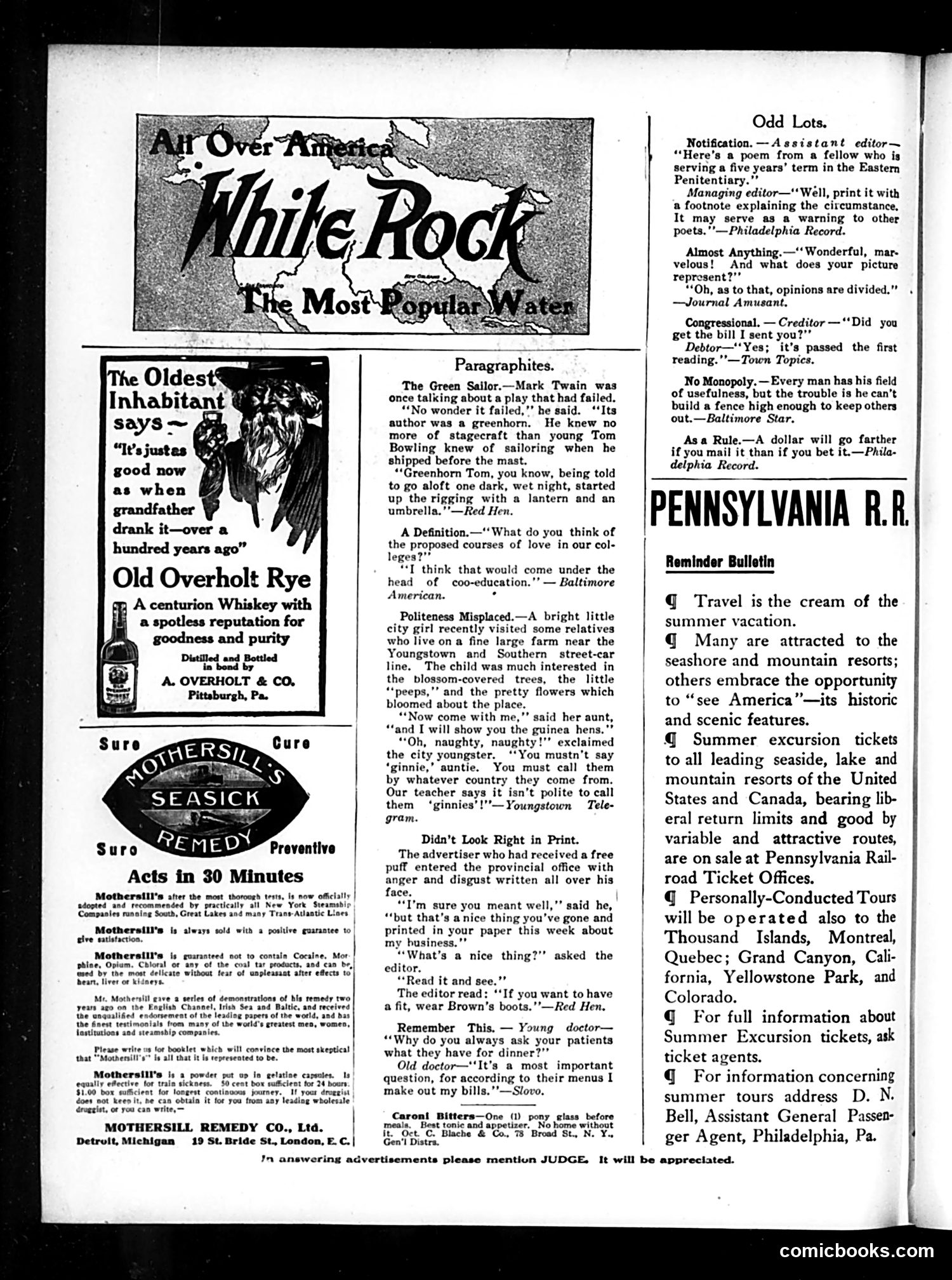
This page primarily contains **advertisements and short humor pieces** (typical of Judge magazine's format) rather than political cartoons requiring historical context. The notable advertisements are for: - **Old Overholt Rye whiskey**, emphasizing its "spotless reputation" - **Mothersill's seasickness remedy**, claiming rapid effectiveness and endorsement by steamship companies The "Odd Lots" section consists of brief jokes about contemporary life—a poem from a penitentiary inmate, misused etiquette (a city child correcting "guinea hens" to use proper country names), and a printing mistake advertising boots as a cure for fits. These are light, observational humor pieces typical of early 1900s American satire. They satirize human folly through everyday scenarios rather than targeting specific political figures or events. The humor relies on readers recognizing social conventions being violated or misapplied—no specialized historical knowledge is required beyond understanding early 20th-century social norms and advertisement culture.
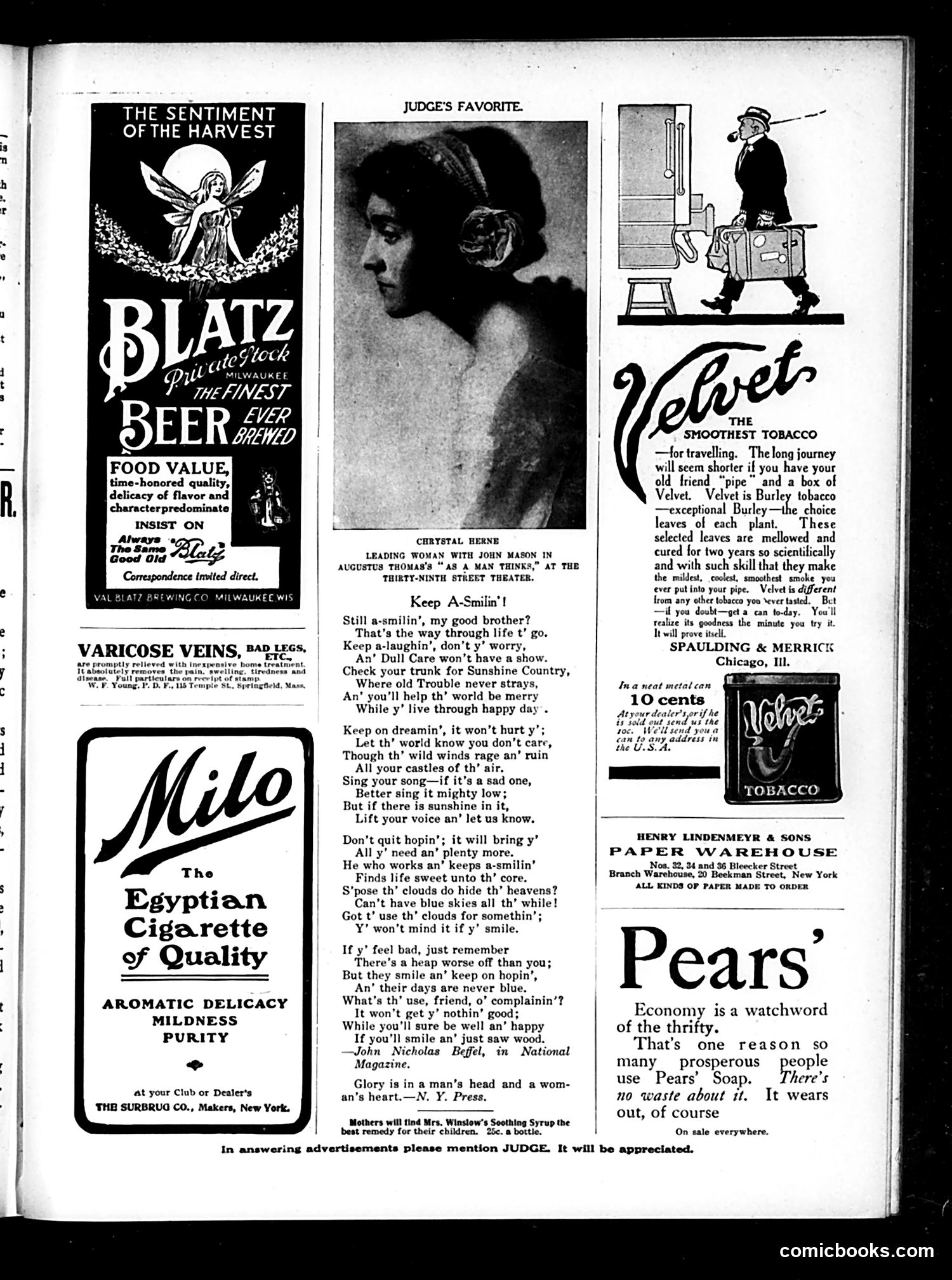
This page is primarily **advertising** with minimal editorial content. The advertisements showcase early 20th-century consumer products: Blatz beer (Milwaukee brewing), Milo Egyptian cigarettes, Velvet pipe tobacco, and Pears' soap. The only identifiable editorial content is a photograph labeled "Judge's Favorite" showing **Crystal Herne**, identified as the leading woman in Augustus Thomas's play *"As a Man Thinks"* at the Thirty-Ninth Street Theater. This appears to be a theater promotion. Below the photograph runs a poem titled "Keep A-Smilin'!" (attributed to John Nicholas Beffel in *National Magazine*) offering cheerful platitudes about optimism and perseverance—typical sentimental verse for the era. The page contains no political satire or recognizable social commentary. It functions as a straightforward commercial vehicle and entertainment promotion, reflecting Judge's reliance on advertising revenue and its role in promoting Broadway theater and consumer goods to affluent readers.
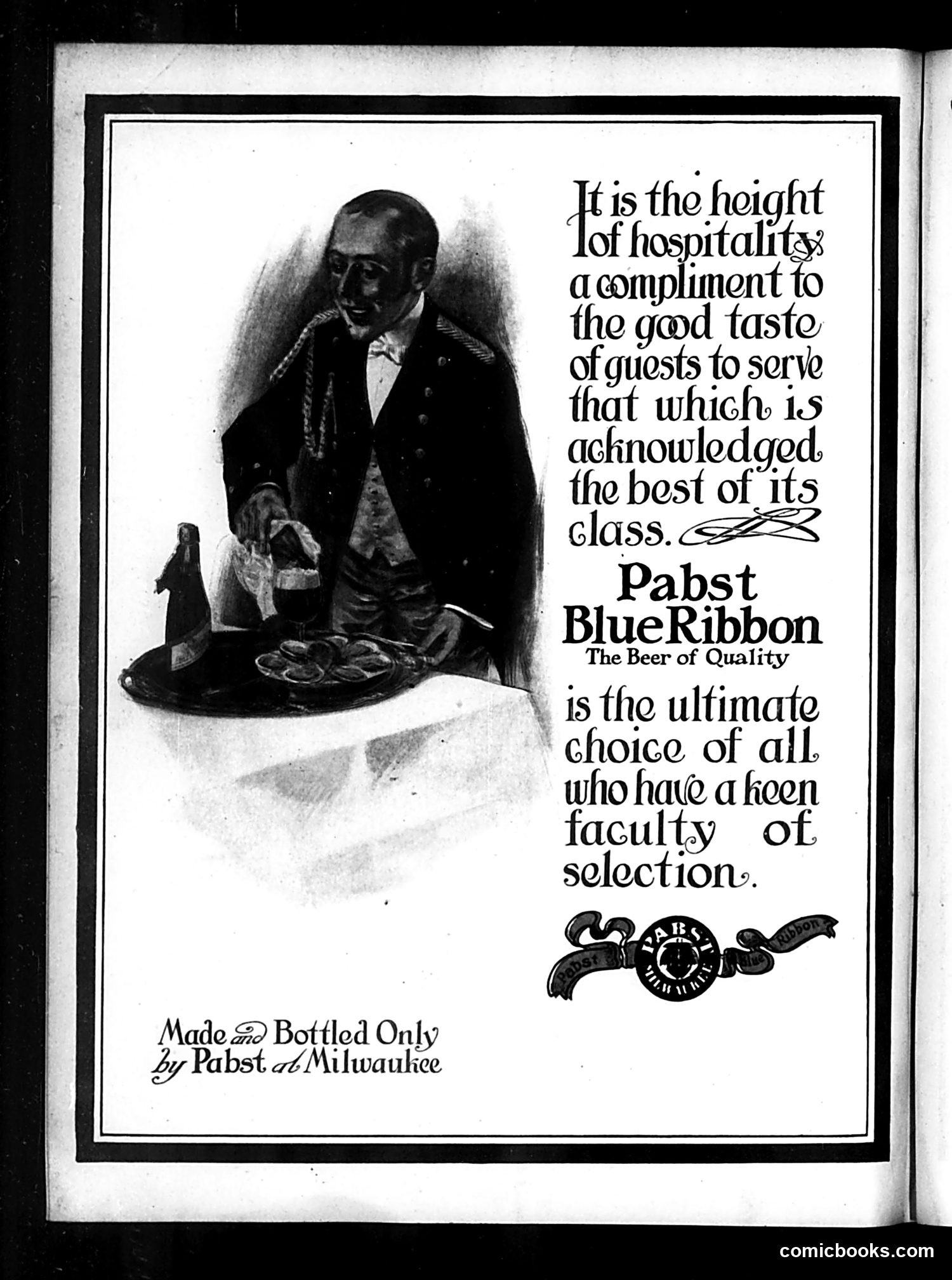
This is a **beer advertisement**, not satirical content. It features a formally-dressed waiter or server presenting a bottle of Pabst Blue Ribbon beer on a platter, positioning the product as a mark of refined hospitality and good taste. The ad argues that serving Pabst Blue Ribbon demonstrates both the host's discernment and respect for guests' refined palates. The tagline claims it's "the ultimate choice of all who have a keen faculty of selection"—flattering consumers by suggesting that choosing this beer signals sophistication and good judgment. The piece exemplifies early 20th-century advertising's appeal to aspirational middle-class values around social standing and etiquette. "Made and Bottled Only by Pabst at Milwaukee" emphasizes quality control and local manufacturing pride.