
Judge, 1911-06-10 · page 13 of 24
Judge — June 10, 1911 — page 13: what you’re looking at
What you’re looking at
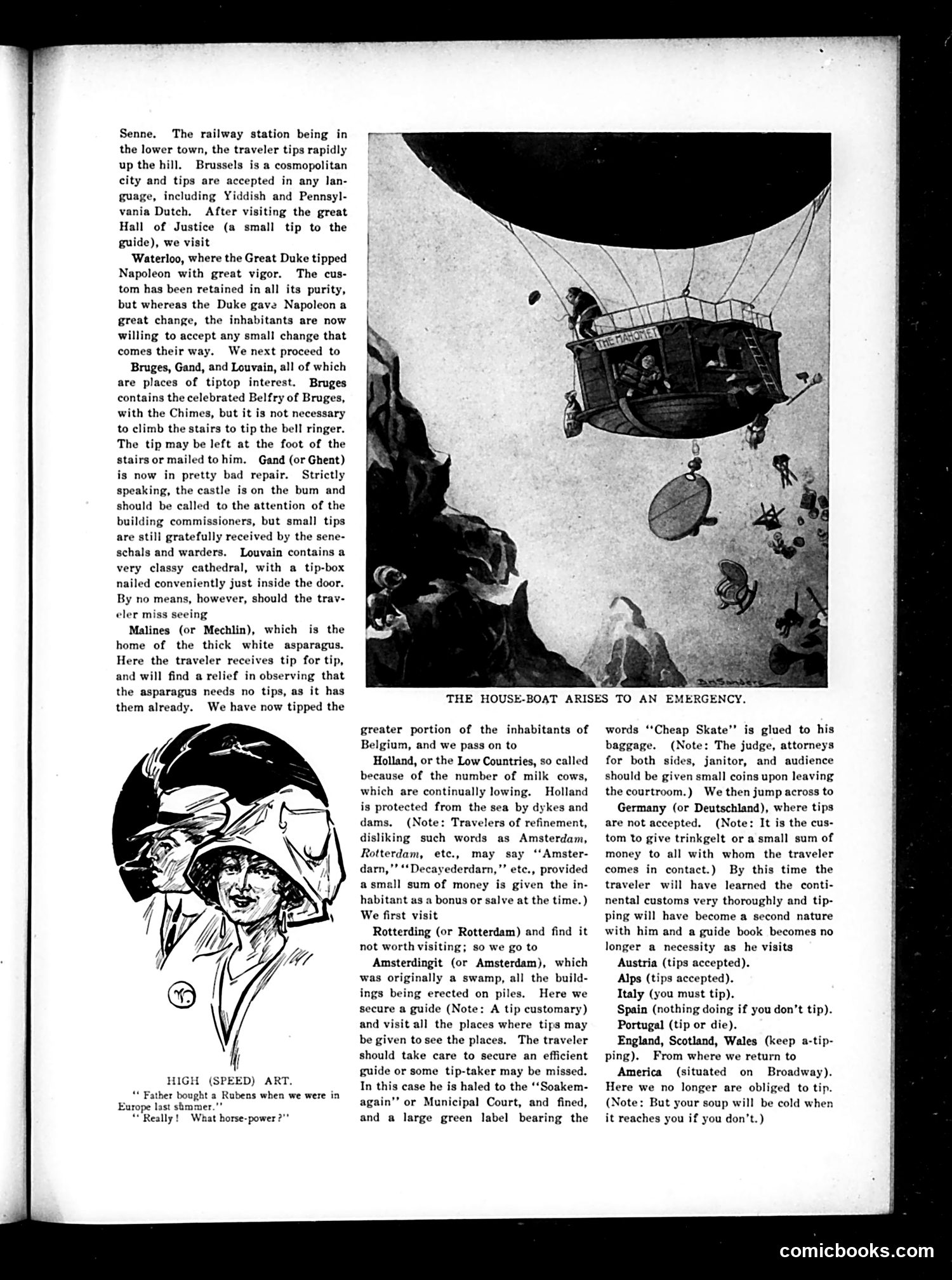
This is a humorous travel essay mocking the ubiquity of tipping throughout Europe. The text describes a traveler's journey through Belgium, Holland, and beyond, presenting every destination as an opportunity to tip someone—guides, bell-ringers, cathedral workers, even court officials. The satire exaggerates how pervasive the custom is, suggesting you must tip for nearly every interaction or face consequences (including being labeled a "Cheap Skate" in court). The accompanying cartoons reinforce the humor: "High (Speed) Art" jokes about a wealthy art collector's misplaced priorities, while "The House-Boat Arises to an Emergency" (caption visible) appears to show a hot-air balloon incident, representing unexpected travel mishaps. The piece satirizes both American tourist behavior and European expectations of gratuities, presenting tipping as an inescapable tax on travel itself.
📄 Transcribed text from this page (OCR, searchable)
Machine-transcribed from the original scan — historical spelling and the odd misread are preserved.
Senne. The railway station being in the lower town, the traveler tips rapidly up the hill. Brussels is a cosmopolitan city and tips are accepted in any lan- guage, including Yiddish and Pennsyl- vania Dutch, After visiting the great Hall of Justice (a small tip to the guide), we visit Waterloo, where the Great Duke tipped Napoleon with great vigor. The cus- tom has been retained in all its purity, but whereas the Duke gave Napoleon a great change, the inhabitants are now willing to accept any small change that comes their way. We next proceed to Bruges, Gand, and Louvain, all of which are places of tiptop interest. Bruges contains the celebrated Belfry of Bruges, with the Chimes, but it is not necessary to climb the stairs to tip the bell ringer. The tip may be left at the foot of the stairs or mailed tohim. Gand (or Ghent) is now in pretty bad repair. Strictly speaking, the castle ison the bum and should be called to the attention of the building commissioners, but small tips are still gratefully received by the sene- schals and warders. Louvain contains a very classy cathedral, with a tip-box nailed conveniently just inside the door. By no means, however, should the trav- eler miss seeing Malines (or Mechlin), which is the home of the thick white asparagus. Here the traveler receives tip for tip, and will find a relief in observing that the asparagus needs no tips, as it has them already. We have now tipped the HIGH (SP “ Father bought a Rubens when we were in Europe last smmer."” “Really! What horse-power ?”” THE HOUSE-BOAT ARISES TO AN EMERGENCY. greater portion of the inhabitants of Belgium, and we pass on to Holland, or the Low Countries, so called because of the number of milk cows, which are continually lowing. Holland is protected from the sea by dykes and dams. (Note: Travelers of refinement, disliking such words as Amsterdam, Rotterdam, ete., may say ‘‘Amster- darn,”’ ‘‘Decayederdarn,”’ etc., provided asmall sum of money is given the in- habitant as a bonus or salve at the time.) We first visit Rotterding (or Rotterdam) and find it not worth visiting; so we go to Amsterdingit (or Amsterdam), which was originally a swamp, all the build- ings being erected on piles. Here we secure a guide (Note: A tip customary) and visit all the places where tips may be given to see the places, The traveler should take care to secure an efficient guide or some tip-taker may be missed. In this case he is haled to the ‘‘Soakem- again’’ or Municipal Court, and fined, and a large green label bearing the words ‘Cheap Skate’ is glued to his baggage. (Note: The judge, attorneys for both sides, janitor, and audience should be given small coins upon leaving the courtroom.) We then jump across to Germany (or Deutschland), where tips are not accepted. (Note: It is the cus- tom to give trinkgelt or a small sum of money to all with whom the traveler comes in contact.) By this time the traveler will have learned the conti- nental customs very thoroughly and tip- ping will have become a second nature with him and a guide book becomes no longer a necessity as he visits Austria (tips accepted). Alps (tips accepted). Italy (you must tip). Spain (nothing doing if you don’t tip). Portugal (tip or die). England, Scotland, Wales (keep a-tip- ping). From where we return to America (situated on Broadway). Here we no longer are obliged to tip. (Note: But your soup will be cold when it reaches you if you don’t.) comicbooks.com