
Judge, 1911-06-10 · page 16 of 24
Judge — June 10, 1911 — page 16: what you’re looking at
What you’re looking at
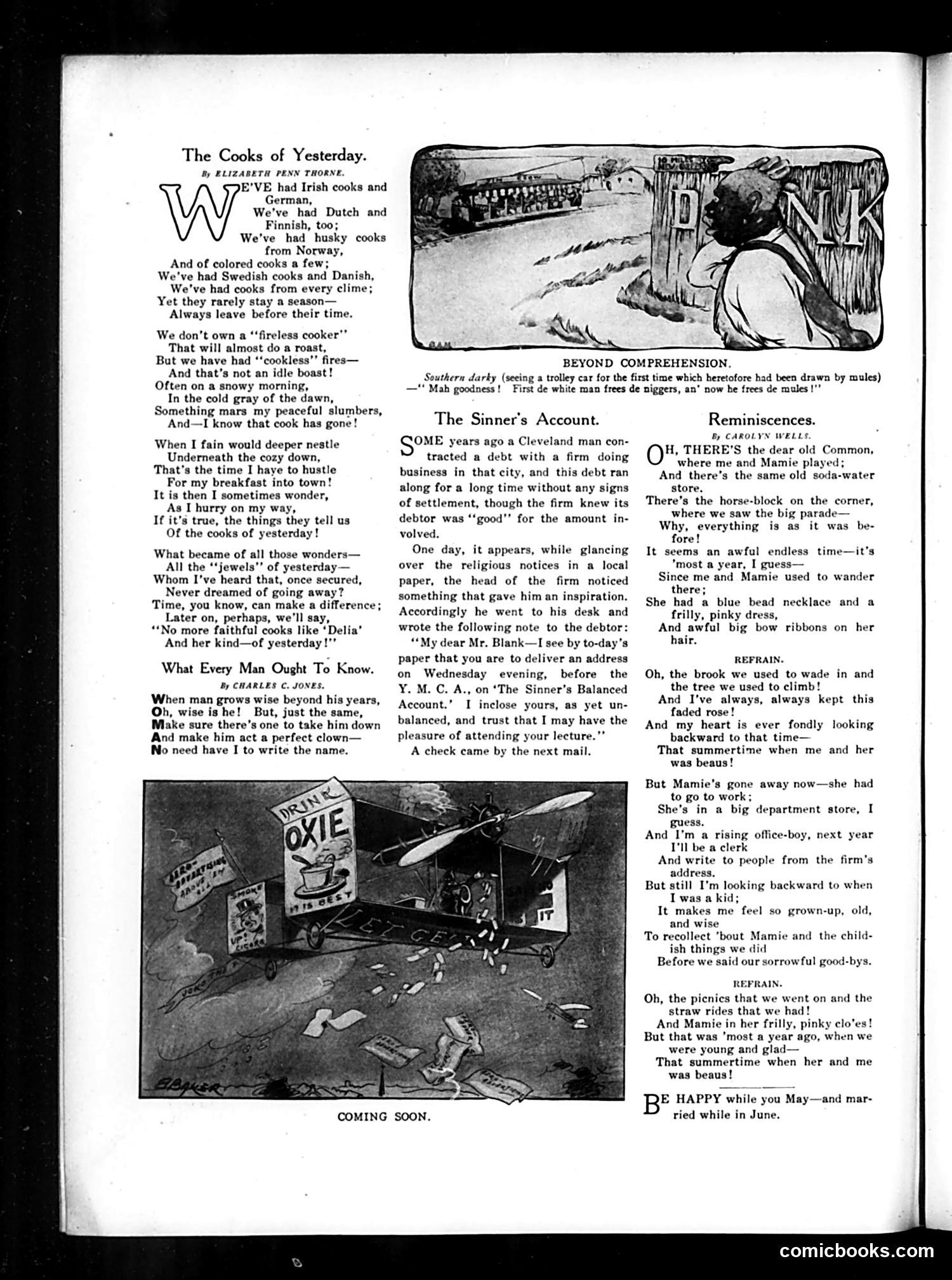
This page contains three distinct pieces of nostalgic Americana satire reflecting early 20th-century American anxieties: **"The Cooks of Yesterday"** laments the disappearance of long-term domestic servants. The poem complains that immigrant cooks (Irish, German, Dutch, Finnish, Norwegian, Swedish, Danish, and "colored") never stay long, forcing employers to scramble for breakfast. The satire mocks employers' romanticization of fictional loyal servants like "Delia"—suggesting such reliability never actually existed. **"Beyond Comprehension"** is a racial caricature joke: a Southern Black man seeing an electric trolley for the first time misunderstands its automation as the government "freeing" mules as it previously freed enslaved people. The "humor" depends on depicting the character as stupidly confused. **"Reminiscences"** is a sentimental poem about a young office boy nostalgic for childhood sweethearts and simpler times, now separated by economic necessity—Mamie works retail while he pursues clerical advancement. Together, these pieces reflect anxieties about social mobility, servant scarcity, and industrialization displacing traditional relationships.
📄 Transcribed text from this page (OCR, searchable)
Machine-transcribed from the original scan — historical spelling and the odd misread are preserved.
The Cooks of Yesterday. By ELIZABETH PENN THORNE. E’VE had Irish cooks and German, We've had Dutch and Finnish, too; We've had husky cooks from Norway, And of colored cooks a few; We've had Swedish cooks and Da We've had cooks from every clime Yet they rarely stay a season— Always leave before their time. We don’t own a “‘fireless cooker”’ That will almost do a roast, But we have had ‘‘cookless’’ fires— And that’s not an idle boast! Often on a snowy morning, In the cold gray of the dawn, Something mars my peaceful slumbers, And—I know that cook has gone! When I fain would deeper nestle Underneath the cozy down, That's the time I haye to hustle For my breakfast into town! It is then I sometimes wonder, As I hurry on my way, If it’s true, the things they tell us Of the cooks of yesterday! What became of all those wonders— All the ‘‘jewels’’ of yesterday — Whom I've heard that, once secured, Never dreamed of going away? Time, you know, can make a difference; Later on, perhaps, we'll say, “‘No more faithful cooks like ‘Delia’ And her kind—of yesterday !'’ What Every Man Ought To Know. By CHARLES C. JONES. When man grows wise beyond his years, Oh, wise is he! But, just the same, Make sure there’s one to take him down And make him act a perfect clown— No need have I to write the name. BEYOND COMPREHENSION. Southern darky (seeing a trolley car for the first time which heretofore had been drawn by mules) —'' Mah goodness ! The Sinner’s Account. Some years ago a Cleveland man con- tracted a debt with a firm doing business in that city, and this debt ran along for a long time without any signs of settlement, though the firm knew its debtor was ‘‘good"’’ for the amount in- volved. One day, it appears, while glancing over the religious notices in a local paper, the head of the firm noticed something that gave him an inspiration. Accordingly he went to his desk and wrote the following note to the debtor: “My dear Mr. Blank—I see by to-day’s paper that you are to deliver an address on Wednesday evening, before the Y. M. C. A., on ‘The Sinner’s Balanced Account.’ I inclose yours, as yet un- balanced, and trust that I may have the pleasure of attending your lecture.”’ A check came by the next mail. First de white man frees de niggers, an’ now he frees de mules !"” Reminiscences. By CAROLYN WELLS. H, THERE'S the dear old Common, where me and Mamie played; And there’s the same old soda-water store. There's the horse-block on the corner, where we saw the big parade— Why, everything is as it was be- fore! It seems an awful endless time—it’s ’most a year, I guess— Since me and Mamie used to wander there; She had a blue bead necklace frilly, pinky dress, And awful big bow ribbons on her hair. and a REFRAIN. Oh, the brook we used to wade in and the tree we used to climb! And I’ve always, always kept this faded rose! And my heart is ever fondly looking backward to that time— That summertime when me and her was beaus! But Mamie’s gone away now—she had to go to work; She’s in a big department store, I guess. And I'm a rising office-boy, next year I'll be a clerk And write to people from the firm's address. But still I’m looking backward to when Iwas a kid It makes me and wise To recollect bout Mamie and the child- ish things we did Before we said our sorrowful good-bys. feel so grown-up, old, REFRAIN. Oh, the picnics that we went on and the straw rides that we had! And Mamie in her frilly, pinky clo’es! But that was ‘most a year ago, when we were young and glad— That summertime when her and me was beaus! E HAPPY while you May—and mar- ried while in June. comicbooks.com