
A complete issue · 24 pages · 1911
Judge — June 3, 1911
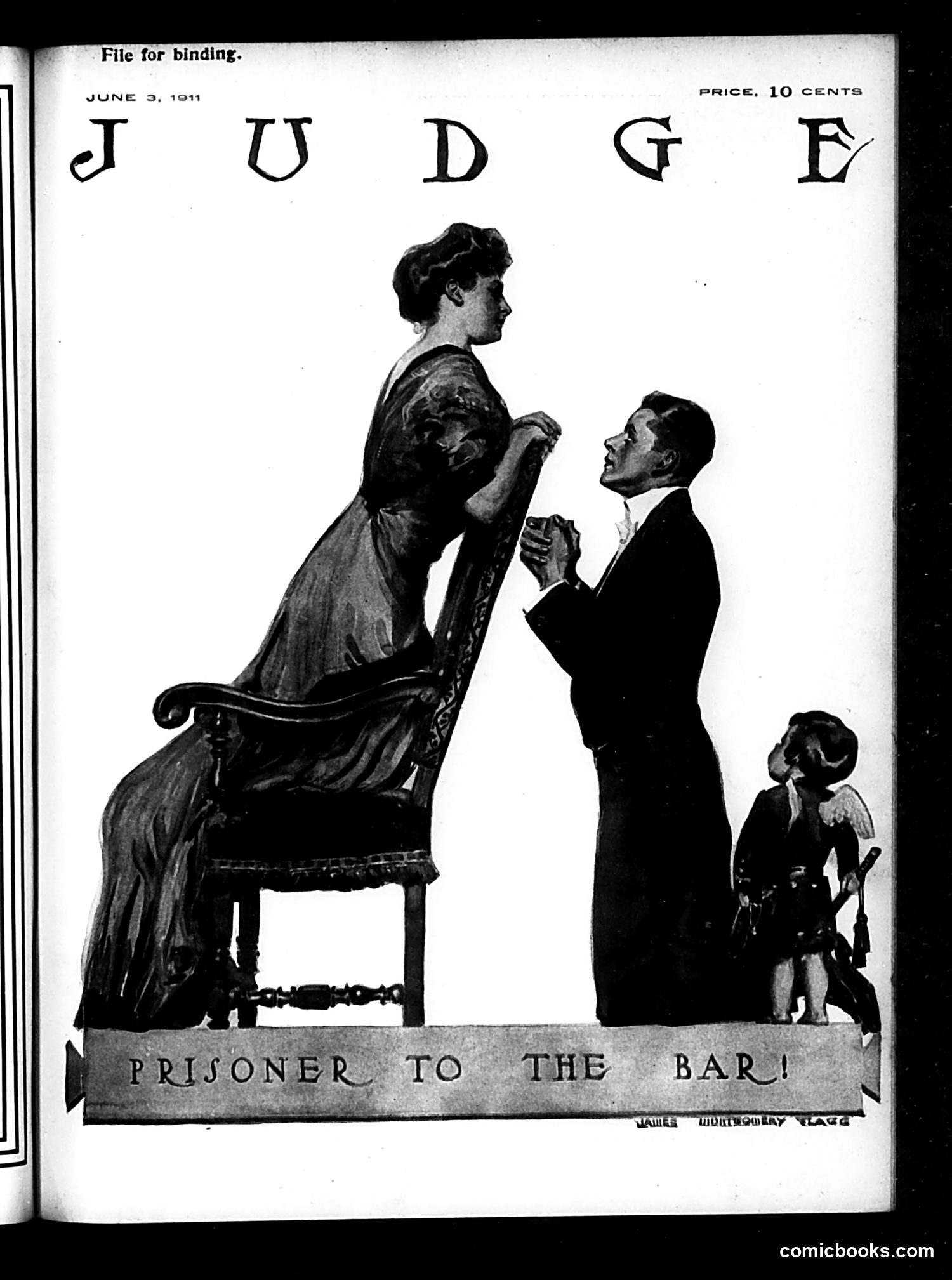
This June 3, 1911 Judge cartoon satirizes a woman's legal predicament. The image shows a well-dressed man presenting a woman (standing on a chair) to what appears to be a judge or court official, with a small child present. The caption "Prisoner to the Bar!" is a legal pun—"bar" refers both to the courthouse bar and a drinking establishment. The satire likely comments on contemporary debates about women's legal status, possibly regarding marriage, custody, or women's rights in court proceedings. The woman's elevated position on the chair and the formal presentation suggest she's being judged or tried for some domestic or social transgression. Without additional context, the specific legal or social issue remains unclear, though it reflects early-20th-century anxieties about women's changing social roles.
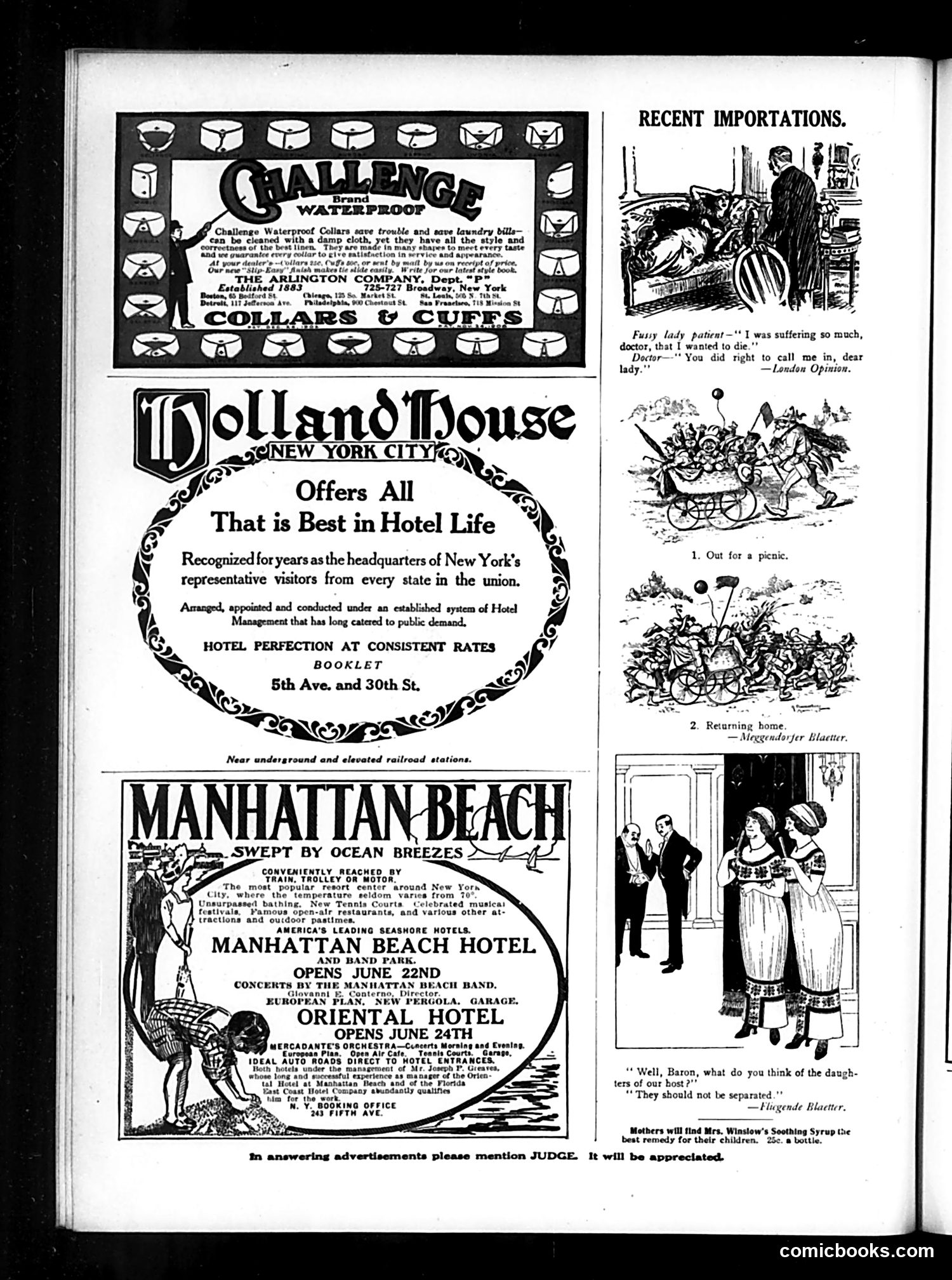
This page is primarily **advertisements** for New York City hotels and services (Challenge Waterproof Collars, Holland House hotel, Manhattan Beach Hotel and Oriental Hotel), interspersed with unrelated cartoon vignettes on the right side. The cartoons shown are brief humorous sketches: one depicts a doctor visit ("I was suffering so much, doctor, that I wanted to die"), another shows picnic and travel scenes, and a final domestic scene about child-rearing. These appear to be standard filler humor common to satirical magazines of the era—observational jokes about everyday life rather than political satire. The page's primary function is commercial rather than editorial commentary.
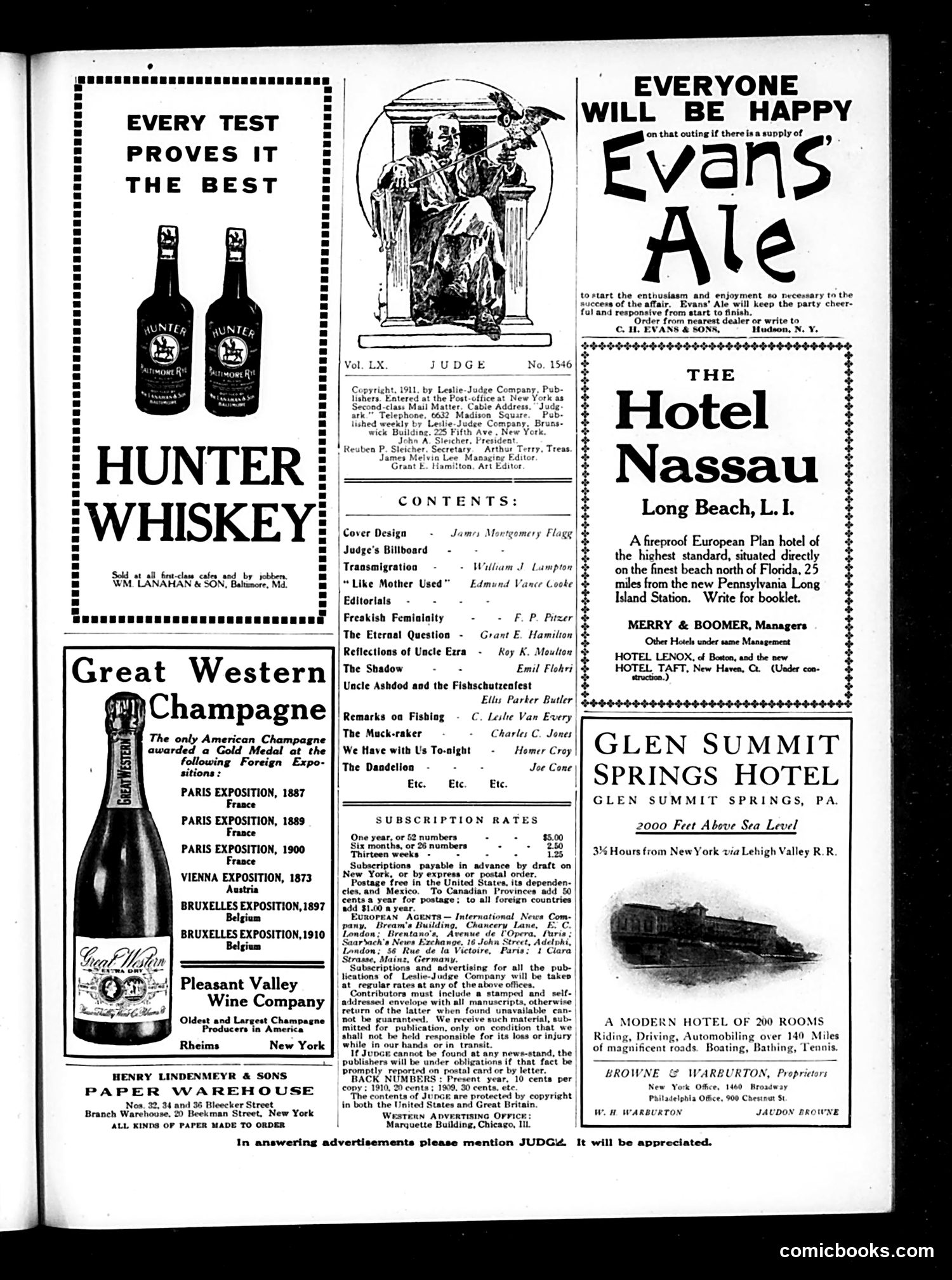
This page is primarily **advertisements** rather than political content. The ads feature: - **Hunter Whiskey** (left): A straightforward product advertisement - **Great Western Champagne** (lower left): Emphasizes American production, noting it won a Gold Medal at the 1887 Paris Exposition—likely responding to European champagne dominance - **Evans' Ale** (top right): Another beverage ad - **Hotel advertisements** (right side): Three hotels competing for tourist business The center contains a table of contents for the magazine issue, indicating this is a cover or contents page from *Judge* Vol. LX, No. 1546. There is **no apparent political cartoon or satire** visible on this page. The content reflects early 20th-century American commercial culture, with emphasis on luxury beverages and leisure travel—typical of *Judge's* affluent readership.
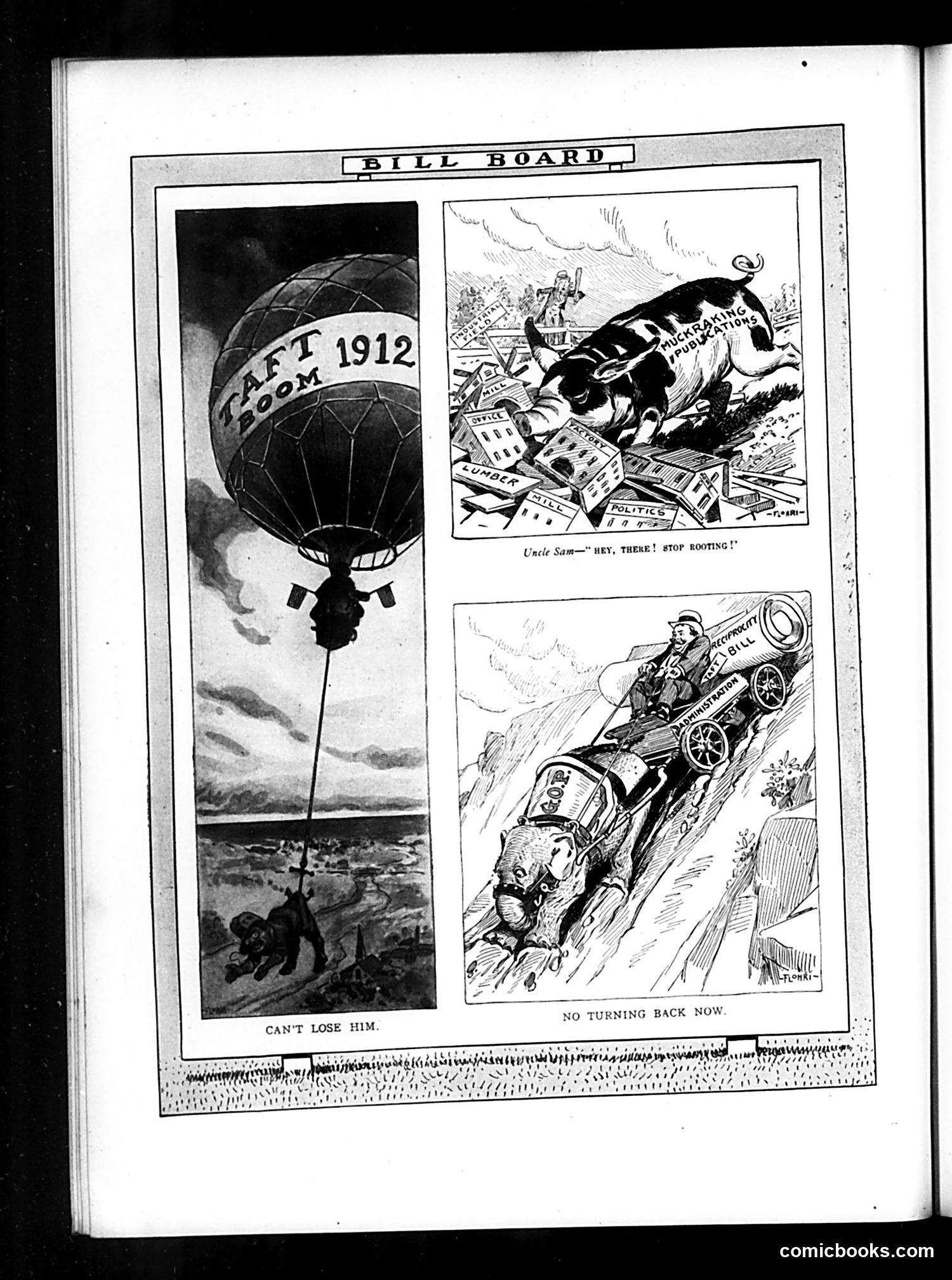
This 1912 *Judge* magazine page presents three political cartoons satirizing the 1912 presidential election: 1. **"Can't Lose Him"** (left): A balloon labeled "TAFT 1912" floats upward—likely depicting President William Howard Taft's struggling campaign, suggesting he was being "lost" or abandoned by his party. 2. **"Uncle Sam—Hey, There! Stop Booting!"** (top right): Shows a bull labeled "BULL MOOSE" (Theodore Roosevelt's Progressive Party) kicking figures representing politics and other institutions, satirizing the chaos Roosevelt's third-party candidacy created. 3. **"No Turning Back Now"** (bottom right): A runaway train with "BILL" (likely the Progressive or reform agenda) careening downhill uncontrollably, suggesting momentum toward radical change with no stopping point. These cartoons criticize the Republican Party's 1912 split between Taft and Roosevelt.
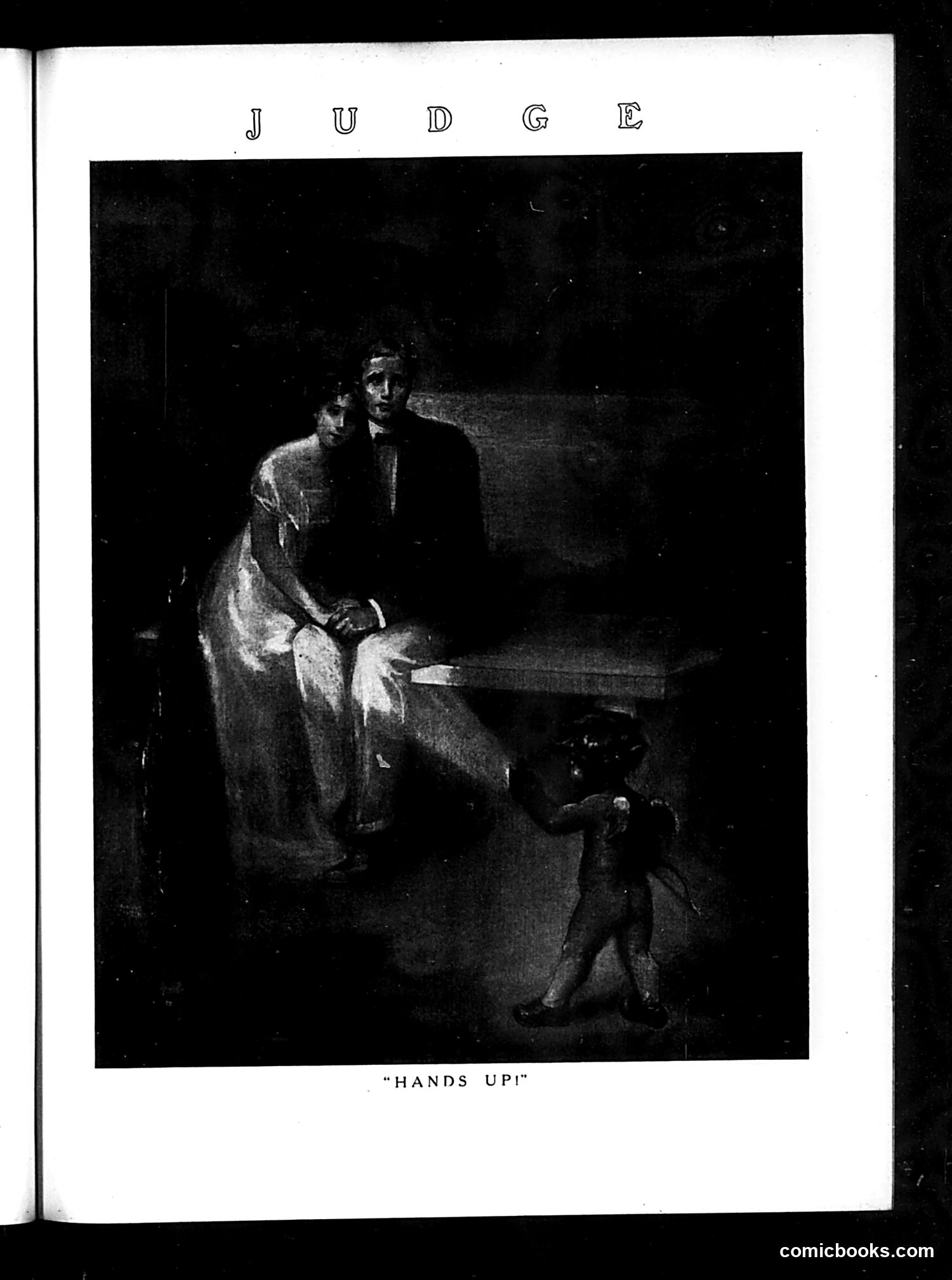
This appears to be a dramatic scene depicting a robbery or holdup, likely from the early 20th century when Judge magazine was active. The image shows a man and woman with their hands raised in surrender while confronted by what appears to be a smaller armed figure (possibly a child or diminutive criminal). The caption "Hands Up!" is the classic command issued during a robbery. Without additional context from surrounding text or other pages, the specific satirical target is unclear—this could be commentary on crime prevalence, social anxieties about lawlessness, or possibly a play on domestic situations. The dramatic lighting and composition suggest Judge intended this as either social commentary on contemporary crime concerns or domestic satire, though the precise reference point requires additional historical context.
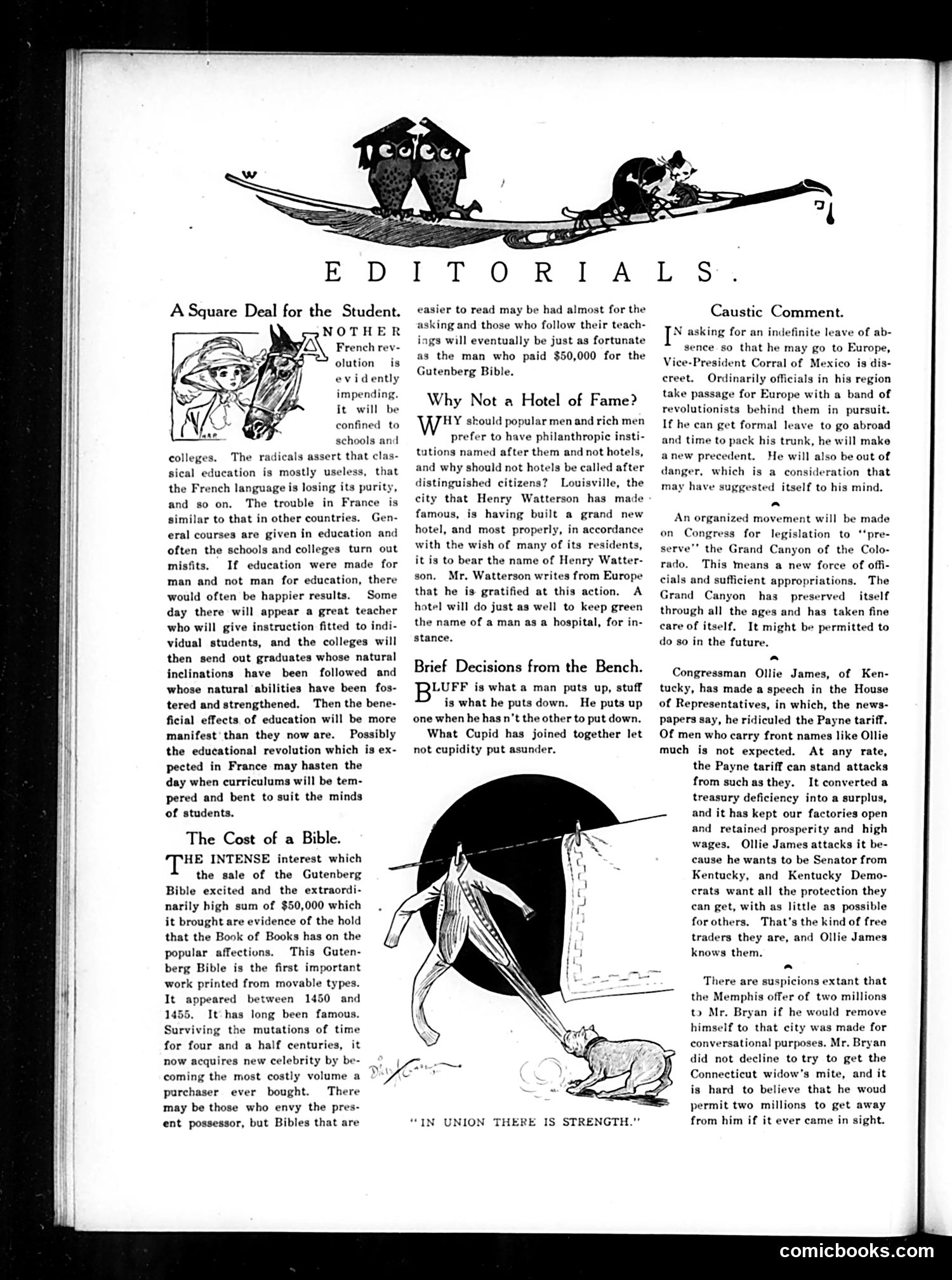
This page from the satirical magazine *Judge* contains several brief editorials commenting on contemporary issues: **"A Square Deal for the Student"** advocates educational reform in France, arguing schools should tailor instruction to individual students rather than forcing students to fit rigid curricula. **"The Cost of a Bible"** discusses the $50,000 sale of a Gutenberg Bible, noting that while historically significant, affordable modern Bibles serve equally well spiritually. **"Why Not a Hotel of Fame?"** praises Louisville's decision to name a new hotel after journalist Henry Watterson, arguing hotels deserve equal honor as hospitals for commemorating distinguished citizens. **"Brief Decisions from the Bench"** offers humorous legal wordplay about "bluff" and "stuff," and a quip about Cupid versus cupidity. **"Caustic Comment"** mocks Mexican President Corral for formally requesting leave to travel to Europe—suggesting revolutionists typically chase fleeing officials—and criticizes Congressman Ollie James's attacks on the Payne tariff. The page's decorative header features an owl (symbolizing wisdom/editorial authority) and an artist figure, standard *Judge* iconography.
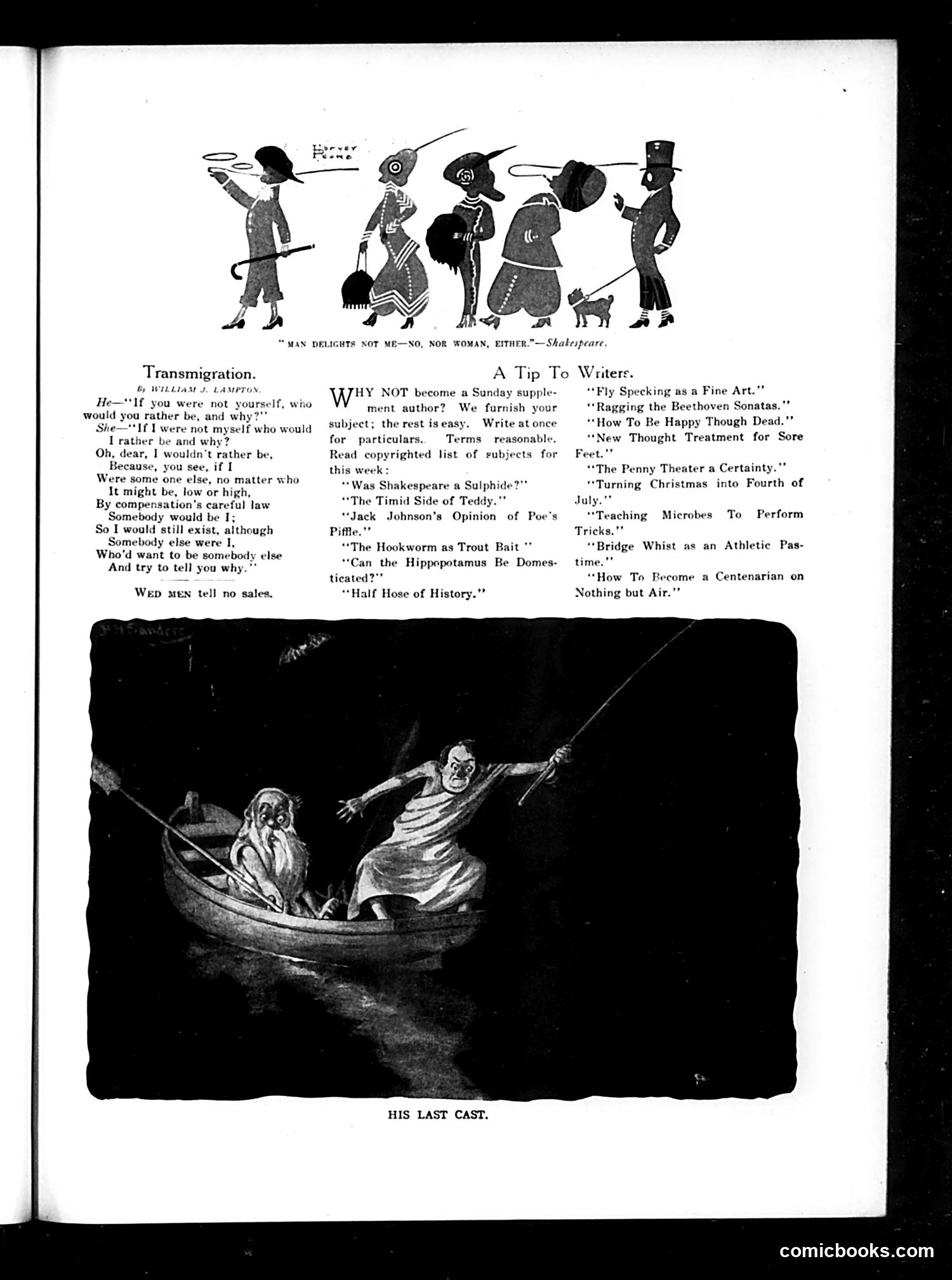
**Top Cartoon**: Five caricatured figures in exaggerated dress represent different social types—likely depicting various professions or social classes of the era. The Shakespeare quote ("Man delights not me—no, nor woman, either") frames them as unappealing representatives of society, suggesting satirical commentary on contemporary social pretension or foolishness. **"Transmigration" Poem**: A humorous meditation on personal identity and reincarnation, playing with the philosophical paradox that if you became someone else, someone else would become you—so nothing truly changes. The final line mocks married men's lack of agency ("Wed men tell no sales"). **"A Tip To Writers"**: This section satirizes Sunday newspaper supplement writers by offering ridiculous article titles—"Jack Johnson's Opinion of Poe's Piffle," "Hippopotamus Domestication," "Teaching Microbes to Perform Tricks." It mocks low-quality journalism and sensationalism of the period. **Bottom Image "His Last Cast"**: Depicts an old fisherman in a boat, likely illustrating a literary or allegorical scene, though the specific reference remains unclear without additional context.
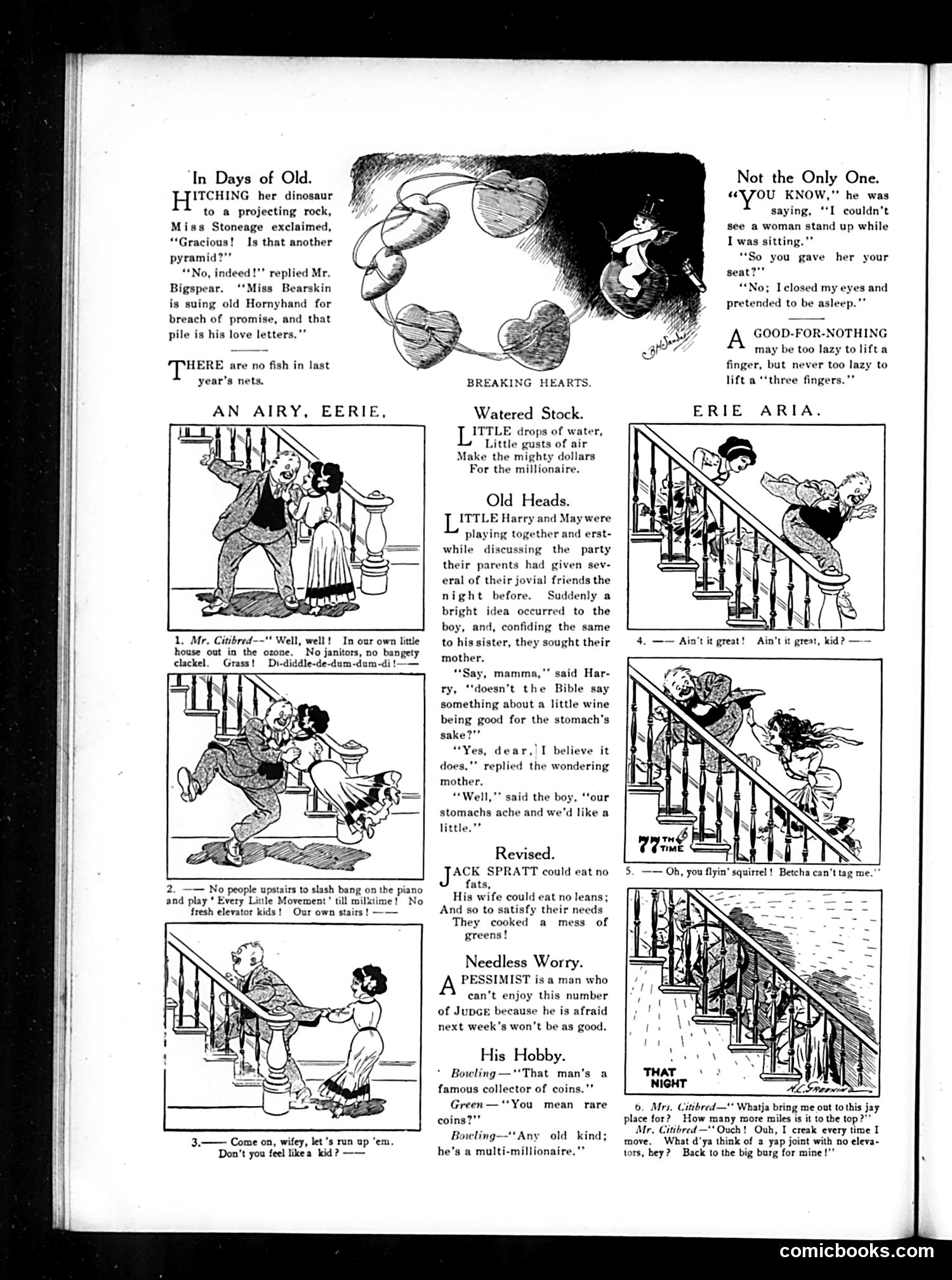
This is a collection of short humorous pieces satirizing early 20th-century American life and attitudes. **"In Days of Old"** parodies prehistoric romance through excessive love letters—mocking sentimental courtship customs. **"An Airy, Eerie"** satirizes wealthy urbanites ("Mr. Citibred") who affect superiority about living in apartments without servants or elevators, then immediately regret the physical exertion—poking fun at pretentious affectation and disconnect from reality. **"Old Heads"** shows children cleverly misusing Biblical reference about medicinal wine to get alcohol, satirizing both parental naivety and children's manipulation. **"Revised"** and other pieces mock various social types: overly cautious pessimists, wealthy coin collectors (implying wealth without taste or discrimination), and men feigning deafness to avoid giving up seats to women—all gentle satire of common character flaws and social hypocrisies of the era. The cartoons use simple, recurring scenarios to expose vanity and inconsistency in American society.
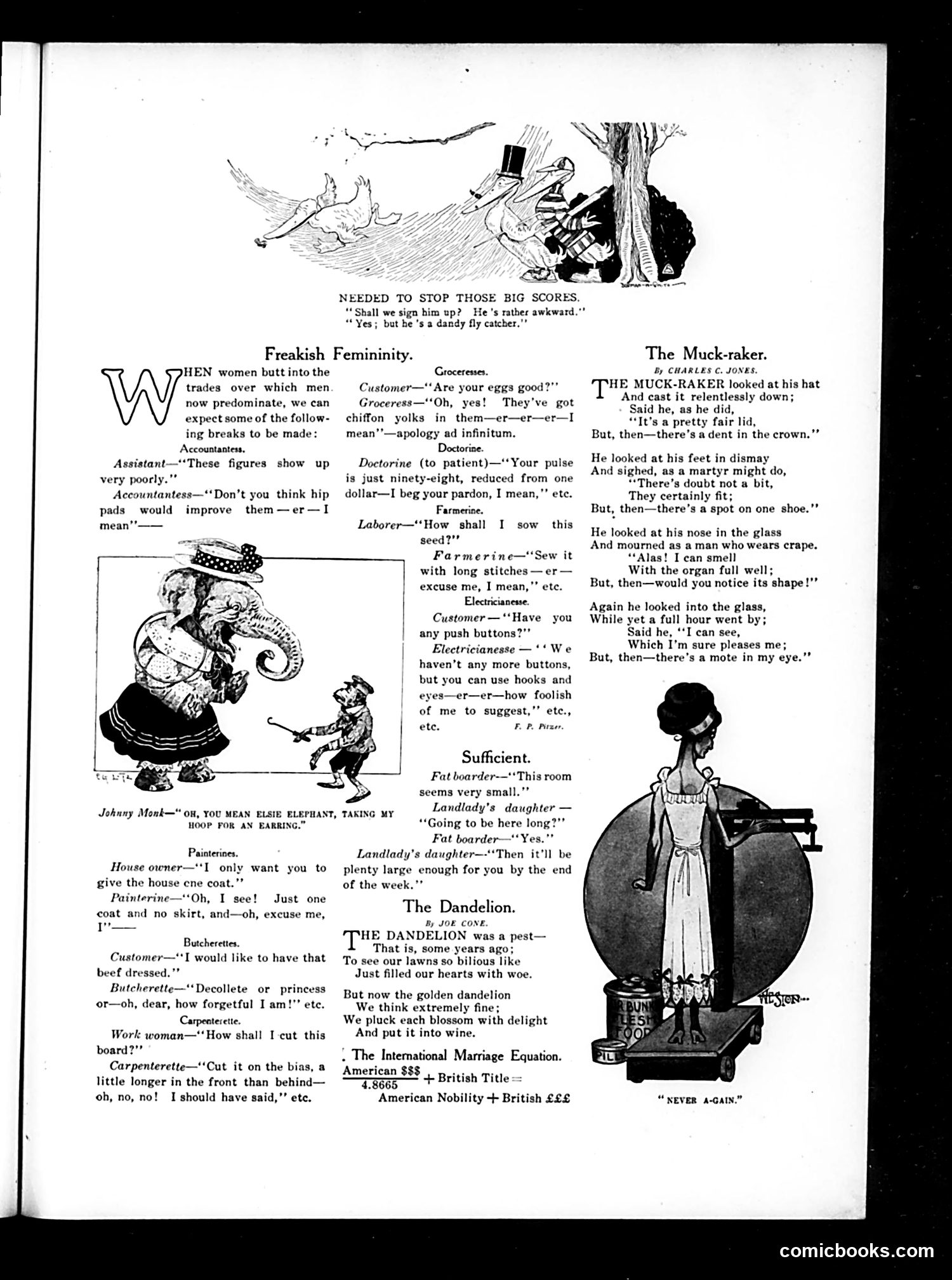
This Judge magazine page satirizes early-20th-century anxieties about women entering male-dominated professions. "Freakish Femininity" mocks female workers by inventing absurd job titles (Doctorine, Farmerine, Electricianesse) and imagining they'd confuse professional vocabulary with fashion terminology—mixing accountancy with "hip pads," medicine with fabric costs, and carpentry with dress tailoring. The humor relies on the stereotype that women are inherently unsuited for serious work. "The Muck-raker" (by Charles C. Jones) depicts a compulsive critic obsessing over trivial flaws—a dent in his hat, a spot on his shoe, his nose's shape—while ignoring what actually works. This likely targets contemporary "muckraking" journalists who exposed corruption but, the cartoonist suggests, fixated obsessively on minor scandals. Other brief items include puns about women in trades ("dandy fly catcher") and a joke equating international marriages as commercial transactions: American wealth exchanged for British titles.
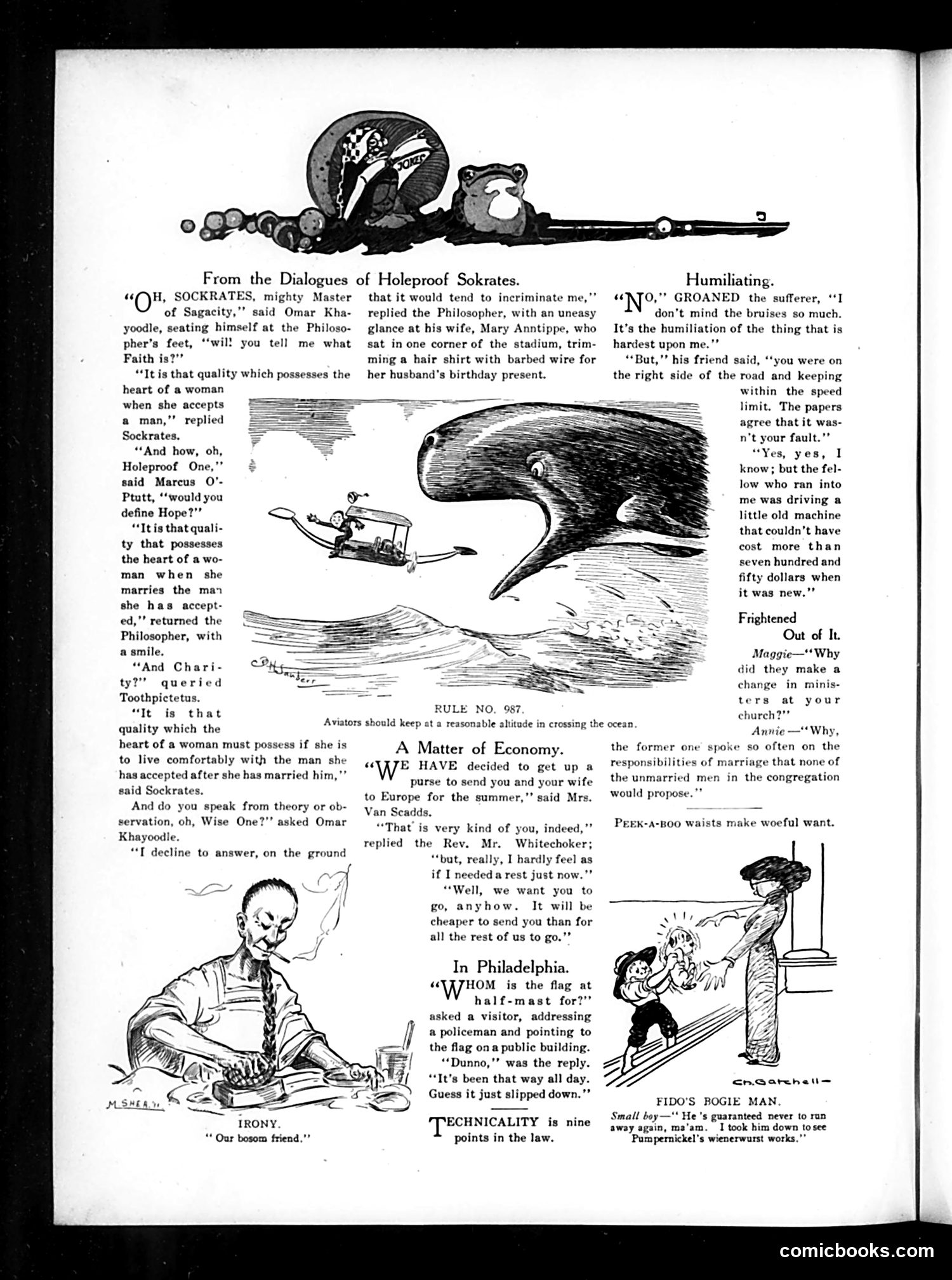
This page satirizes early-1900s attitudes toward marriage and gender, using mock-Socratic dialogue. The main cartoon presents philosophy in cynical terms: **Faith** is a woman accepting a man; **Hope** is her marrying him; **Charity** is her tolerating married life afterward. The joke's bite comes from the Philosopher refusing to answer whether he speaks from "theory or observation"—his wife sits nearby trimming a "hair shirt with barbed wire" for his birthday, suggesting his own marriage validates this bleak view. Secondary items mock social hypocrisy: a clergyman is sent to Europe because his congregation finds him *too honest* about marriage responsibilities (discouraging proposals); a traffic accident victim is humiliated not by injuries but by being hit by a cheap car worth only $750. The overall theme: **marriage is a trap for women, who sacrifice happiness for duty**—a common satirical position in this era's humor magazines, reflecting contemporary anxieties about matrimony and gender roles.
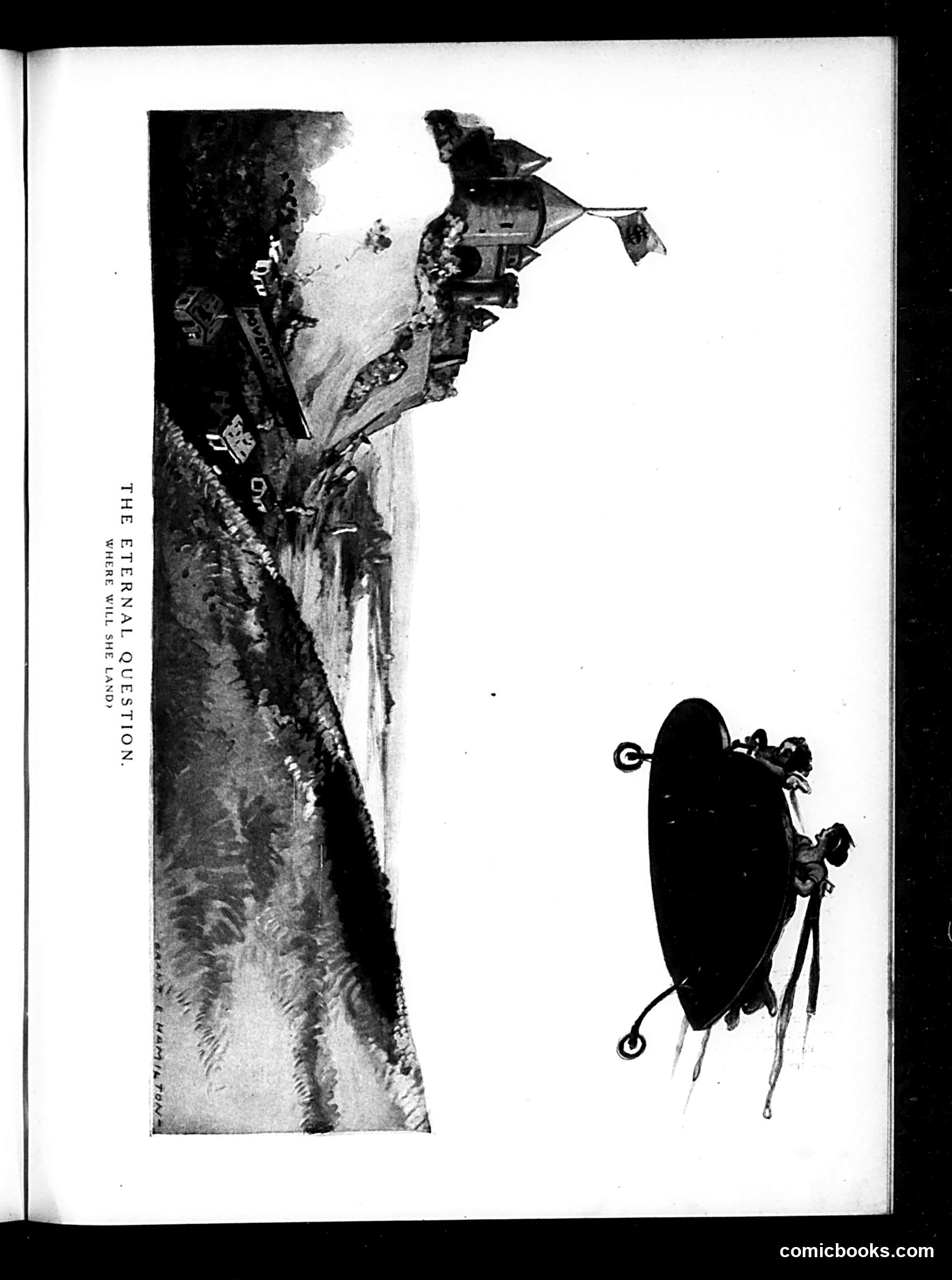
This Judge cartoon depicts two images: a landscape on the left showing what appears to be mountainous or rocky terrain, and on the right, a silhouetted figure of a woman descending by parachute. The caption "The Eternal Question—Where Will She Land?" suggests satirical commentary on women's uncertain social or economic position, likely reflecting late 19th or early 20th-century anxieties about women's roles. The parachuting woman may represent either a woman entering the workforce, marriage market, or political sphere—all "uncertain landings" in a society debating women's place. Without clearer context or date, the specific reference remains unclear, but the image uses the precariousness of descent to mock uncertainty about women's social trajectory during this era of changing gender roles.
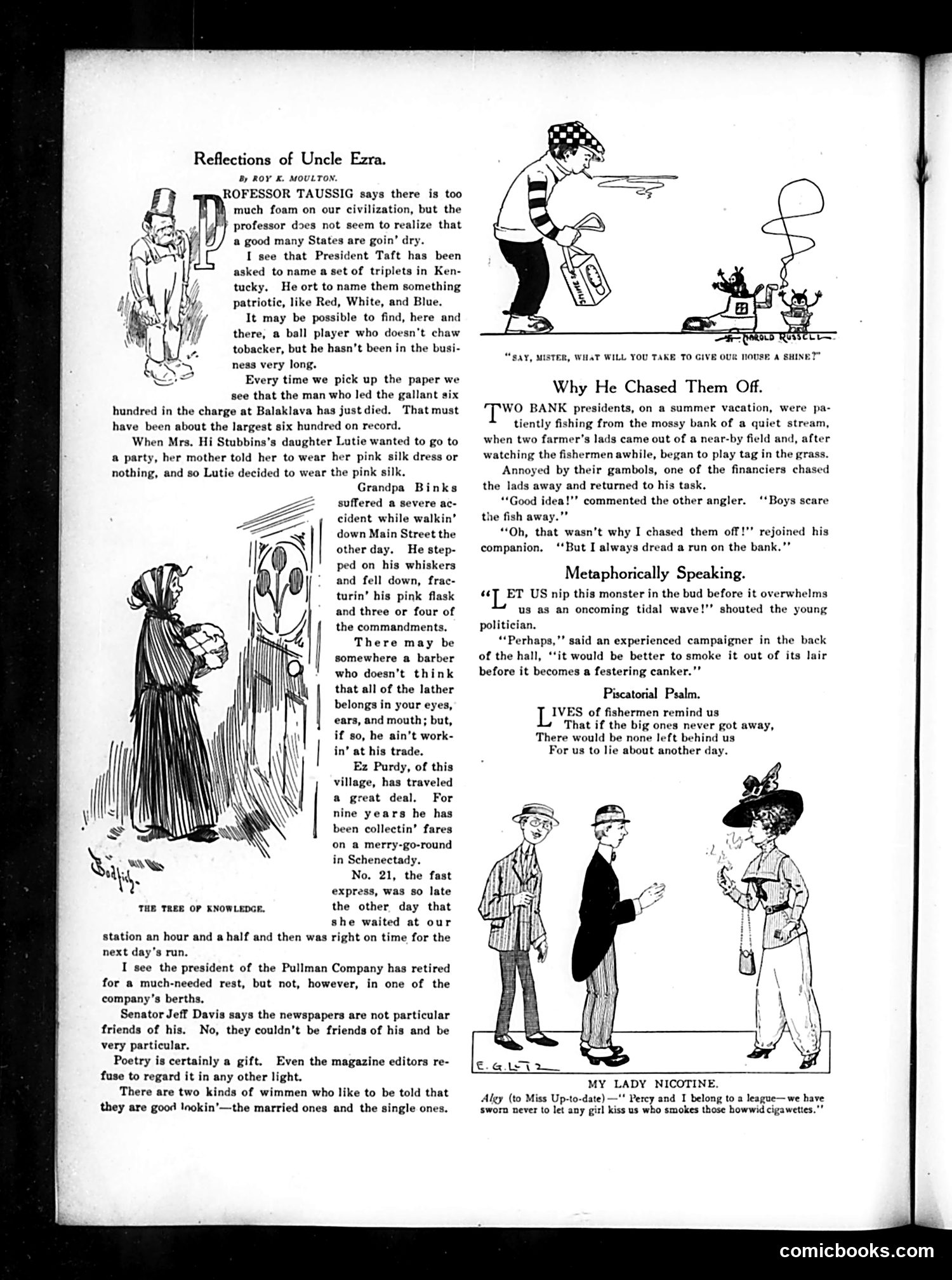
This page from the satirical magazine **Judge** contains several distinct pieces of social commentary typical of early 20th-century American humor: **Main Content**: "Uncle Ezra" offers folksy observations mocking contemporary society—Professor Taussig's concerns about "foam" on civilization, President Taft naming triplets, and various small-town absurdities. The humor relies on rural wisdom puncturing pretension. **"Why He Chased Them Off"**: A banker's joke about "runs on the bank"—the punchline plays on financial panic (literal bank runs during economic crises) by confusing it with boys running through a field. **The Cartoons**: Include social satire on barber culture, feminine fashion choices, and "My Lady Nicotine"—mocking young men's affectations about rejecting girls who smoke cigarettes. The overall tone reflects Progressive-era sensibilities: poking fun at both rural simplicity and urban pretension while touching on contemporary concerns like banking stability and changing social mores around women and smoking.
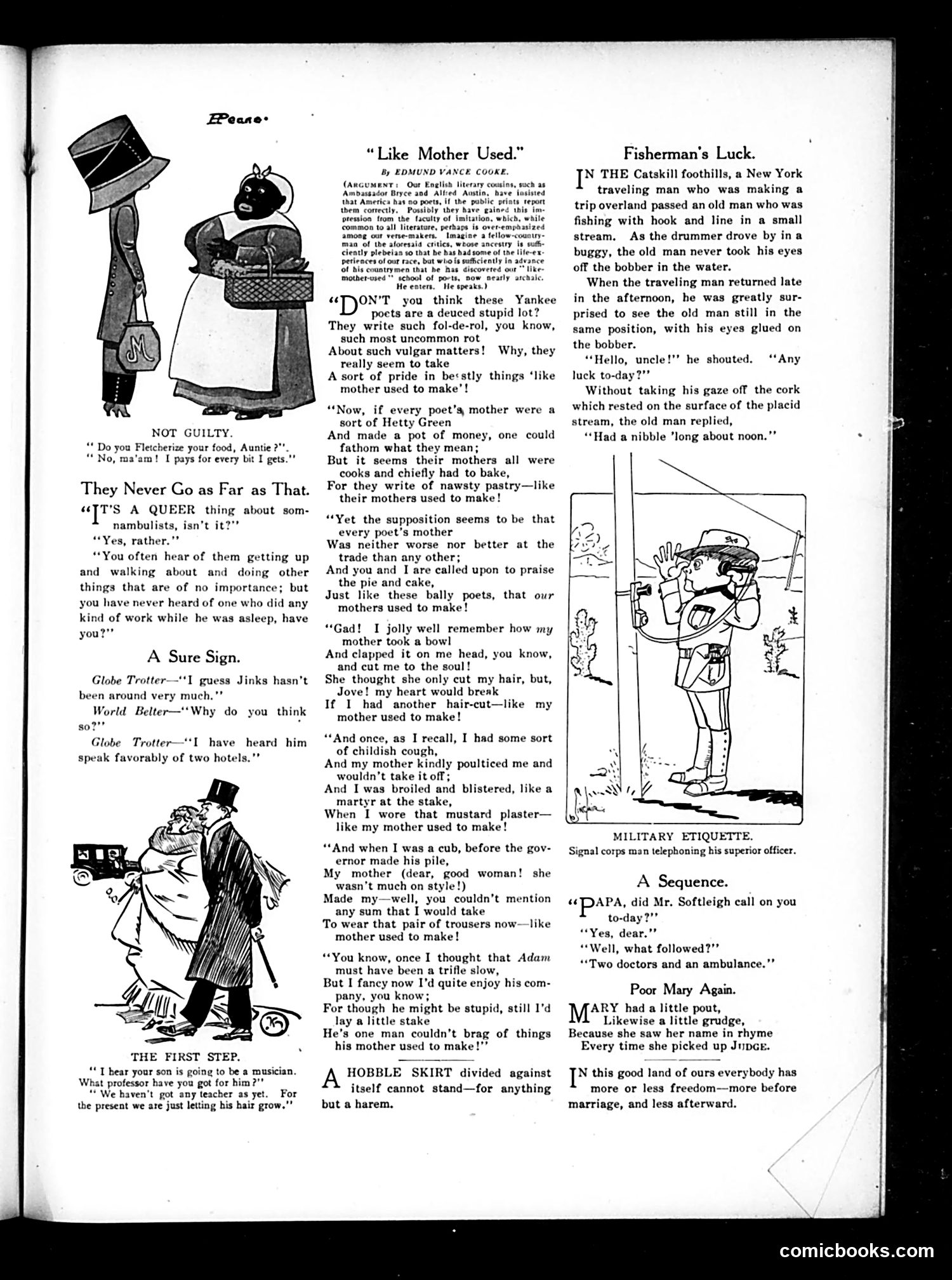
This page satirizes literary pretension and American culture circa early 1900s. **"Like Mother Used"** (main feature): A pompous British critic mocks American poets for celebrating ordinary domestic subjects—cooking, childhood punishments, homemade clothes. The satire cuts both ways: the critic is ridiculous for his snobbery, yet the poem acknowledges American poets' obsession with nostalgic domesticity. The piece parodies both affected British superiority and sentimental American populism. **Other cartoons mock:** - "Fletcherize" (chew food excessively per Horace Fletcher's fad diet) - Sleepwalkers never doing productive work - People who only praise mediocre hotels as worldly travelers - Parents growing children's hair long hoping they'll become musicians - Women's hobble skirts as impractical The humor targets contemporary fads, pretension, and the gap between aspiration and reality. These are gentle, observational jokes about American middle-class affectations and European condescension.
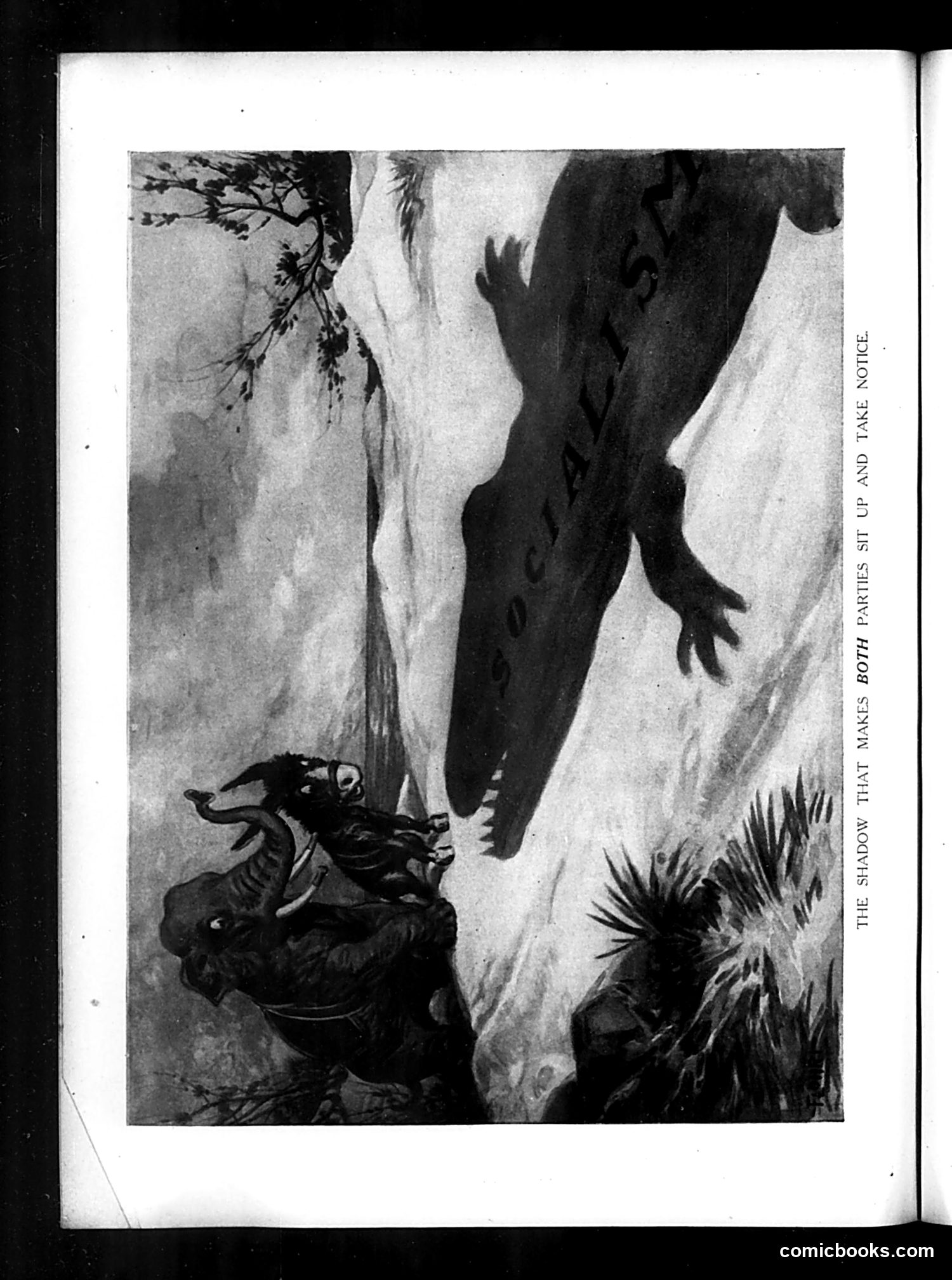
I can see this is a black and white illustration from Judge magazine showing what appears to be two figures in shadow—one larger figure looming over a smaller one in a dramatic pose. The caption reads "THE SHADOW THAT MARS BOTH PARTIES SIT UP AND TAKE NOTE." However, the OCR text is severely corrupted and illegible, making it impossible to determine the specific political or social references intended. Without readable accompanying text, I cannot reliably identify which historical figures or events are being satirized, or what the cartoon's particular point was meant to be. To properly explain this cartoon's meaning to a modern reader, I would need clearer source material or additional context about the publication date and issue.
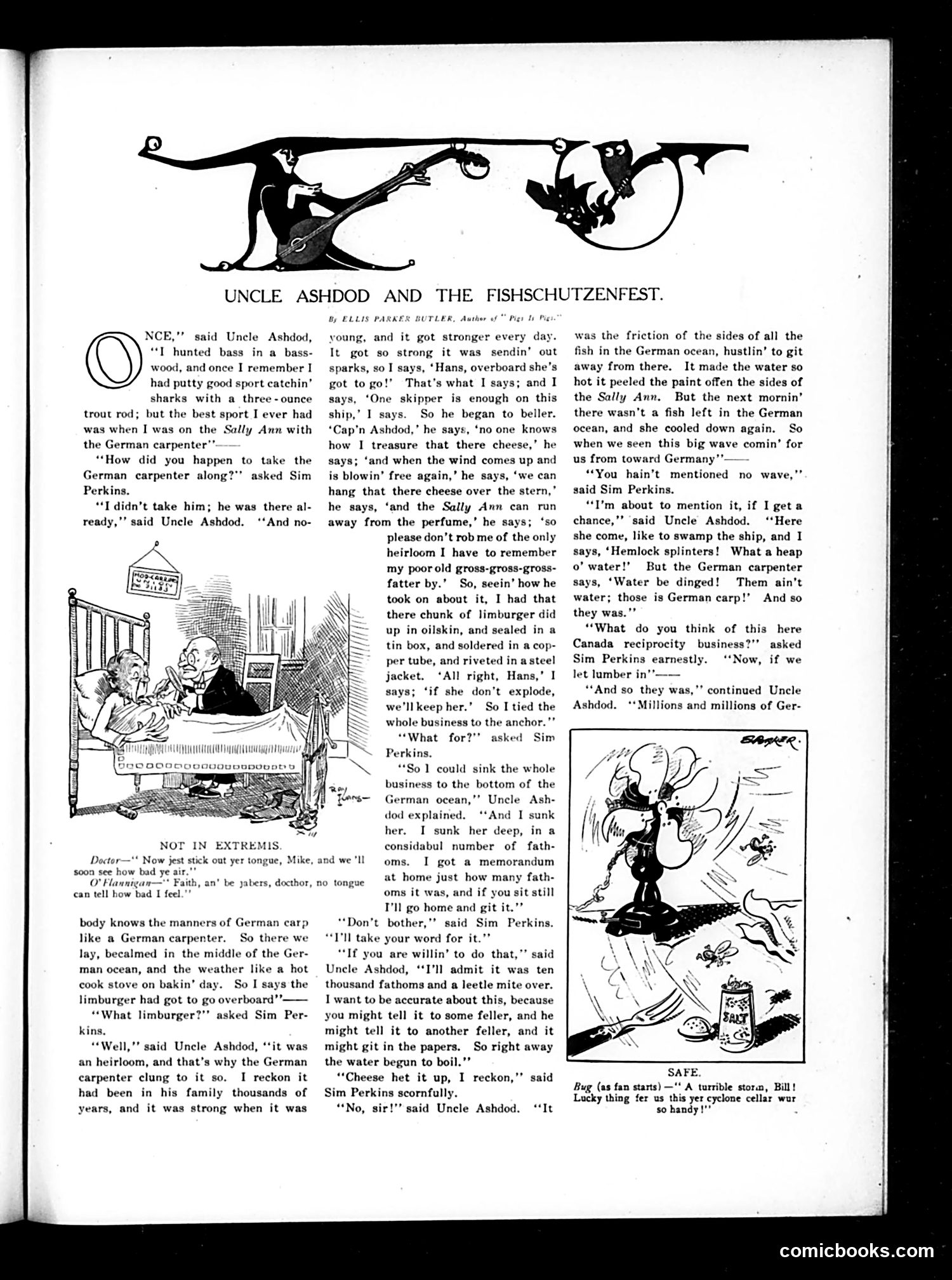
This is a tall tale by Ellis Parkes Butler featuring Uncle Ashdod, a recurring character known for absurd maritime stories. The main narrative recounts a voyage on the *Sally Ann* with a German carpenter obsessed with his family heirloom: limburger cheese so pungent it becomes weaponized. Uncle Ashdod sinks it sealed in steel to the ocean floor, where friction from fleeing fish boils the water and kills all German ocean fish. The "wave" that follows is actually German carp. The satire targets German immigrants and stereotypes: the German carpenter's excessive attachment to his heritage, the association with strong-smelling foods, and the absurd notion that German fish would respond differently to crisis. The title's reference to "Fishschutzenfest" (a shooting festival, a real German tradition) reinforces ethnic mockery. The closing question about "Canada reciprocity" suggests contemporary trade politics, though the connection remains unclear from this excerpt alone.
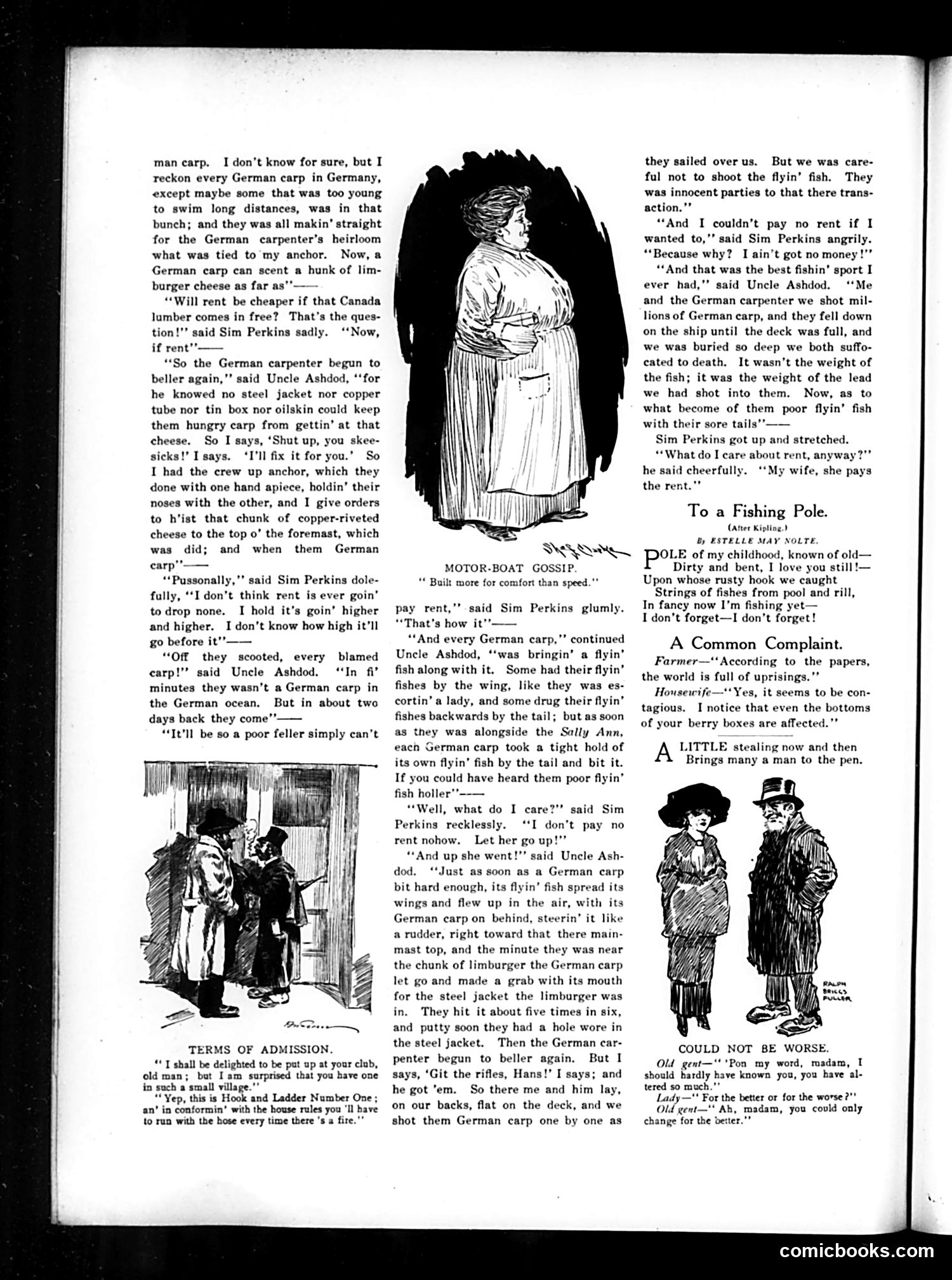
This page from *Judge* contains interconnected satirical commentary on early 20th-century American concerns: **Main narrative (Uncle Ashdod's tall tale):** A fantastical fishing story featuring German carp, flying fish, and limburger cheese appears designed as absurdist humor, though the repeated German references suggest post-WWI anti-German sentiment common in American satirical magazines. **"Terms of Admission" cartoon:** Shows urban/rural class humor—a city visitor shocked that a small village has a club, only to learn it's a fire brigade requiring members to respond to emergencies. The joke mocks provincial pretension. **"Motor-Boat Gossip"** and **"Could Not Be Worse"**: Light domestic humor about relative comfort and marriage complaint. The overall page reflects *Judge's* typical mix of absurdist storytelling, gentle class mockery, and marital comedy—entertainment for educated, urban middle-class readers. The German references likely resonated with contemporary anxieties about foreign "otherness."
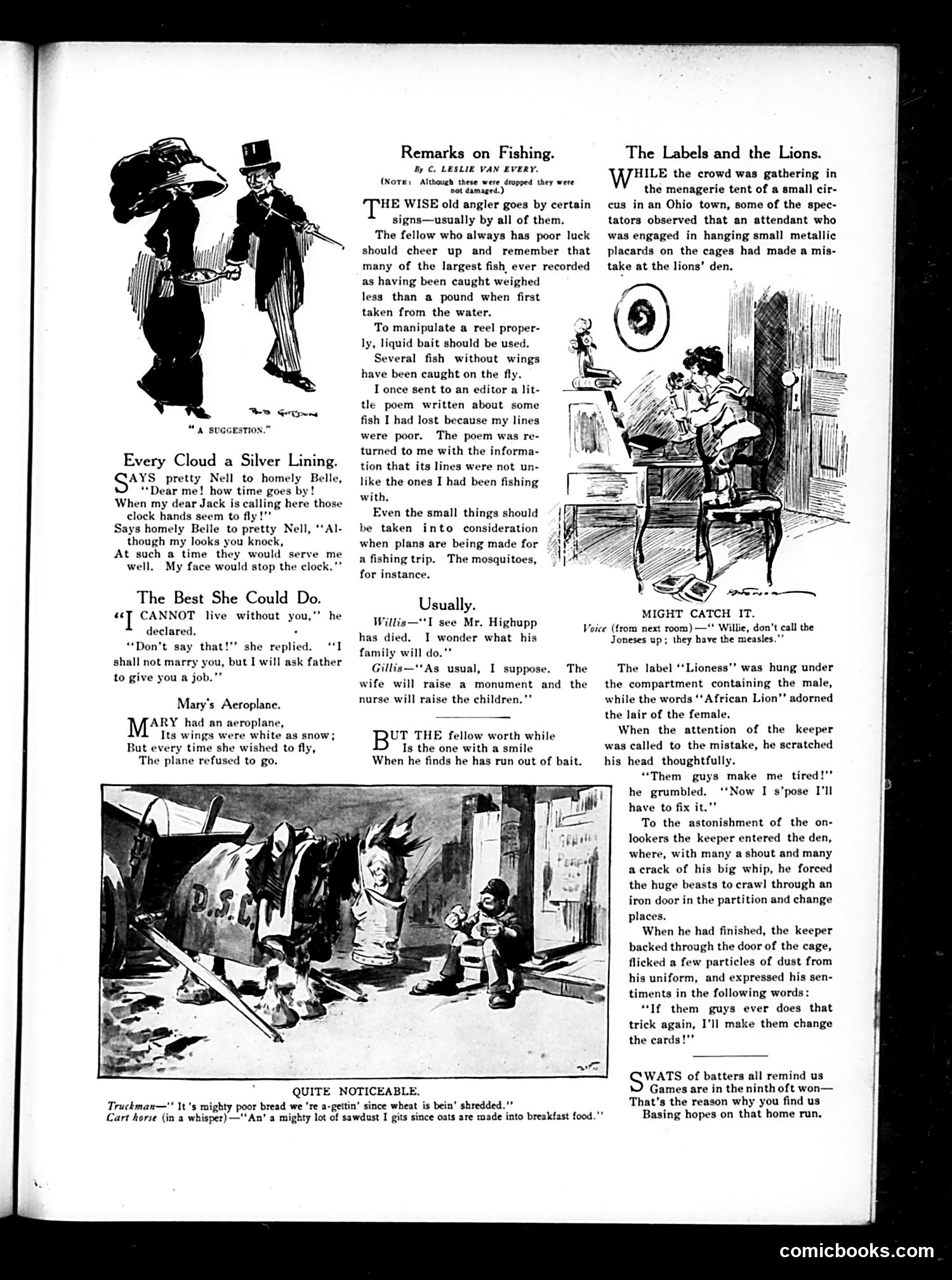
This page contains several brief humorous pieces typical of early 20th-century American satire: **"The Labels and the Lions"** (main cartoon): A circus keeper mistakenly labels the male lion "Lioness" and the female "African Lion." When corrected, he forces the lions to physically swap cages rather than simply switching the labels—illustrating the absurdity of prioritizing literal correctness over practical common sense. The joke mocks bureaucratic rigidity. **"Remarks on Fishing"** (text column): Satirical observations about fishing, including a dry joke about a poor fisherman's lines being as "poor" as his poetry about lost fish—wordplay on "lines" as both fishing equipment and verse. **Other brief jokes** include commentary on class and work ("The Best She Could Do," where a woman offers marriage refusal but a job instead) and wartime food substitutions ("Quite Noticeable," where sawdust replaces oats in horse feed). The overall tone is gentle social satire aimed at everyday follies rather than sharp political commentary.
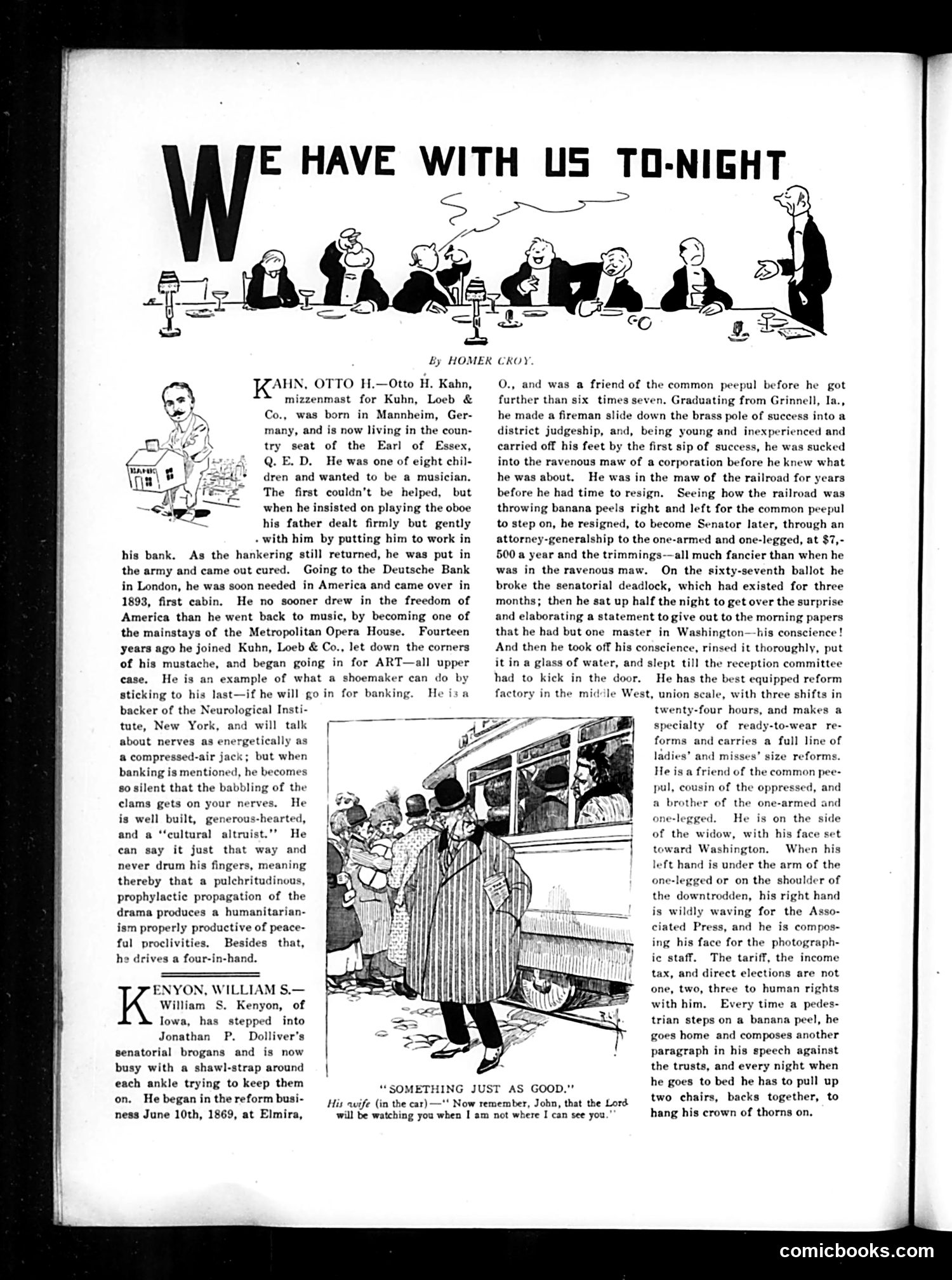
This page satirizes two prominent figures through mock biographical sketches, a Judge magazine specialty. **Otto H. Kahn** (banker/financier) is mocked for abandoning musical aspirations to enter banking, then contradicting himself by becoming a major Metropolitan Opera patron and "cultural altruist." The satire ridicules wealthy financiers who pose as arts patrons while remaining fundamentally devoted to profit. **William S. Kenyon** (Iowa Senator) is portrayed as an opportunistic hypocrite who rose through reform politics, then abandoned principles upon gaining power. The cartoon caption shows his wife reminding him "the Lord will be watching" while he's away—suggesting his claimed conscience is performative. The text sarcastically catalogs his ready-made "reforms" and self-serving rhetoric about serving common people. Both sketches employ Judge's characteristic acidic humor: praising subjects' stated values while documenting their contradictions, exposing wealthy elites' and politicians' hypocrisy through exaggerated flattery.
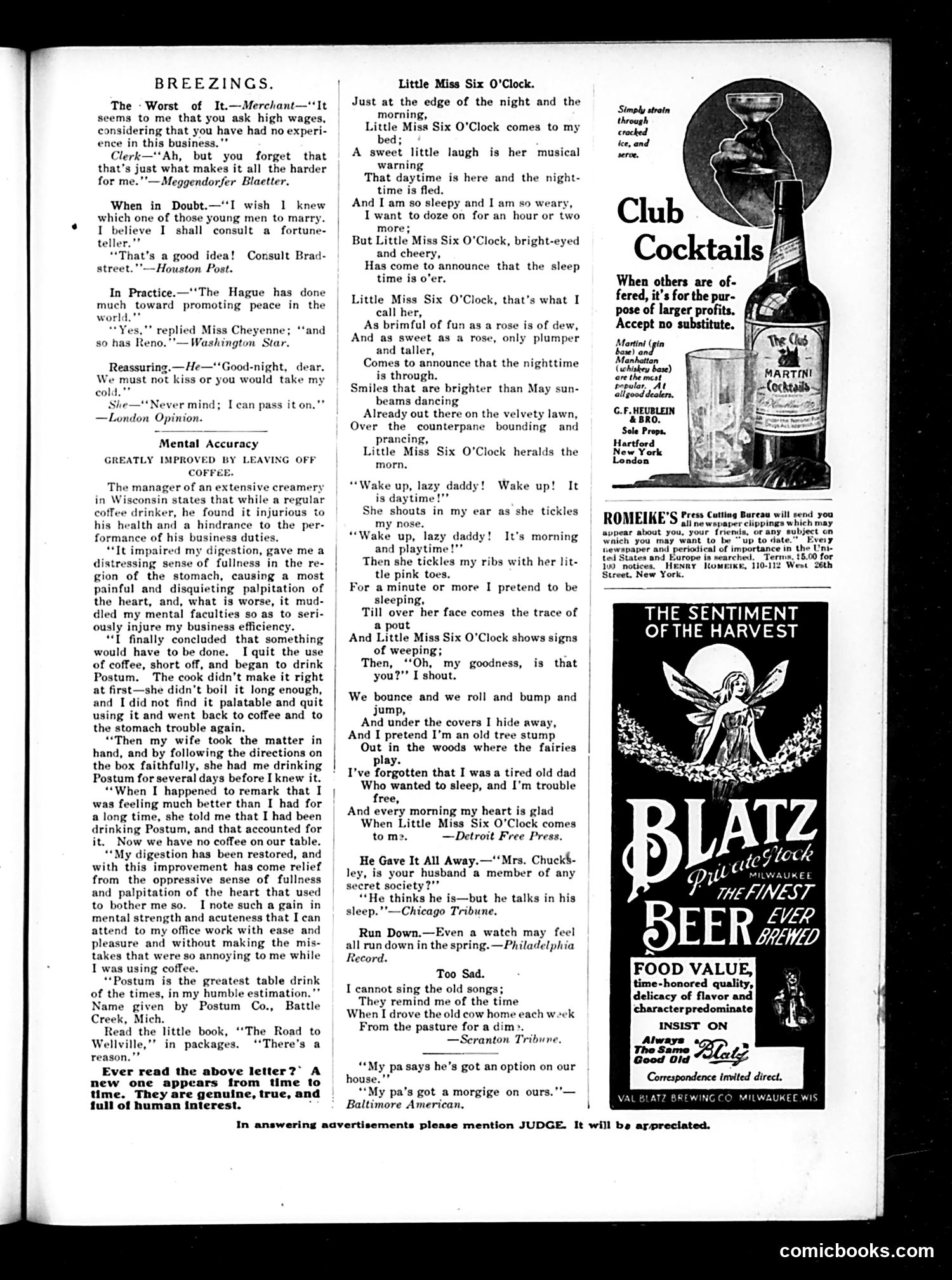
This page contains **short humorous anecdotes** (the "Breezings" section) and **advertising**, rather than political cartoons. The anecdotes are brief jokes about everyday situations: a clerk arguing that inexperience justifies high wages; a woman consulting a fortune-teller about marriage; observations about The Hague and peace efforts. These are gentle, domestic humor typical of early 20th-century magazines. The dominant content is a **Postum coffee substitute advertisement** disguised as testimonial—a "creamery manager" claims coffee damaged his health and business efficiency until switching to Postum, which restored his digestion and mental acuity. This was a common marketing tactic: fabricated endorsements presented as genuine letters. The poem "Little Miss Six O'Clock" celebrates a young daughter waking her father at dawn—sentimental Victorian-era family content. There's also a **Blatz Beer advertisement** for Milwaukee beer emphasizing "food value" and quality. The page reflects early 1900s preoccupations: nostalgic family sentiment, health-conscious consumerism, and aggressive product advertising embedded within editorial content.
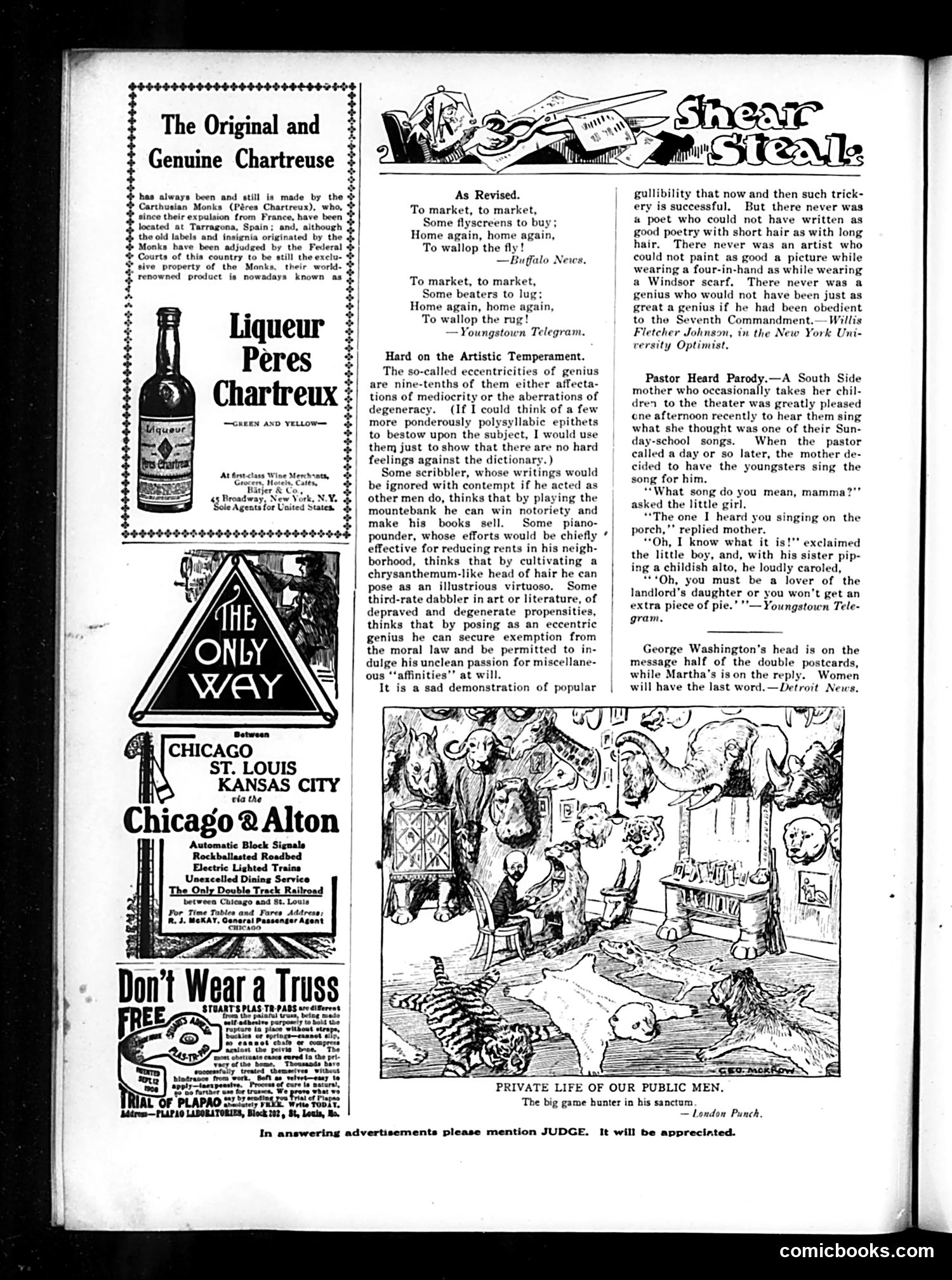
This page from the satirical magazine *Judge* contains several distinct elements: **Main Cartoon:** "Private Life of Our Public Men" depicts a chaotic hunting scene, likely mocking a prominent public figure's obsession with big-game hunting. The crude, crowded composition suggests satirizing the gap between a politician's public image and private pursuits. **Articles:** Several brief satirical pieces mock affectation in the arts—criticizing artists and musicians who adopt eccentric appearance (long hair, unusual dress) to gain fame rather than relying on genuine talent. The pieces argue that true genius needs no theatrical posturing. **Anecdotes:** Humorous short stories about a mother mishearing children sing a parody (replacing hymns with comic lyrics) and a joke about George Washington's and Martha's heads on postcards, with the quip that "women will have the last word." **Advertisements:** The page also contains period ads for Chartreuse liqueur, railroads, and medical devices. The overall tone is satirical, targeting pretense and humbug across society.
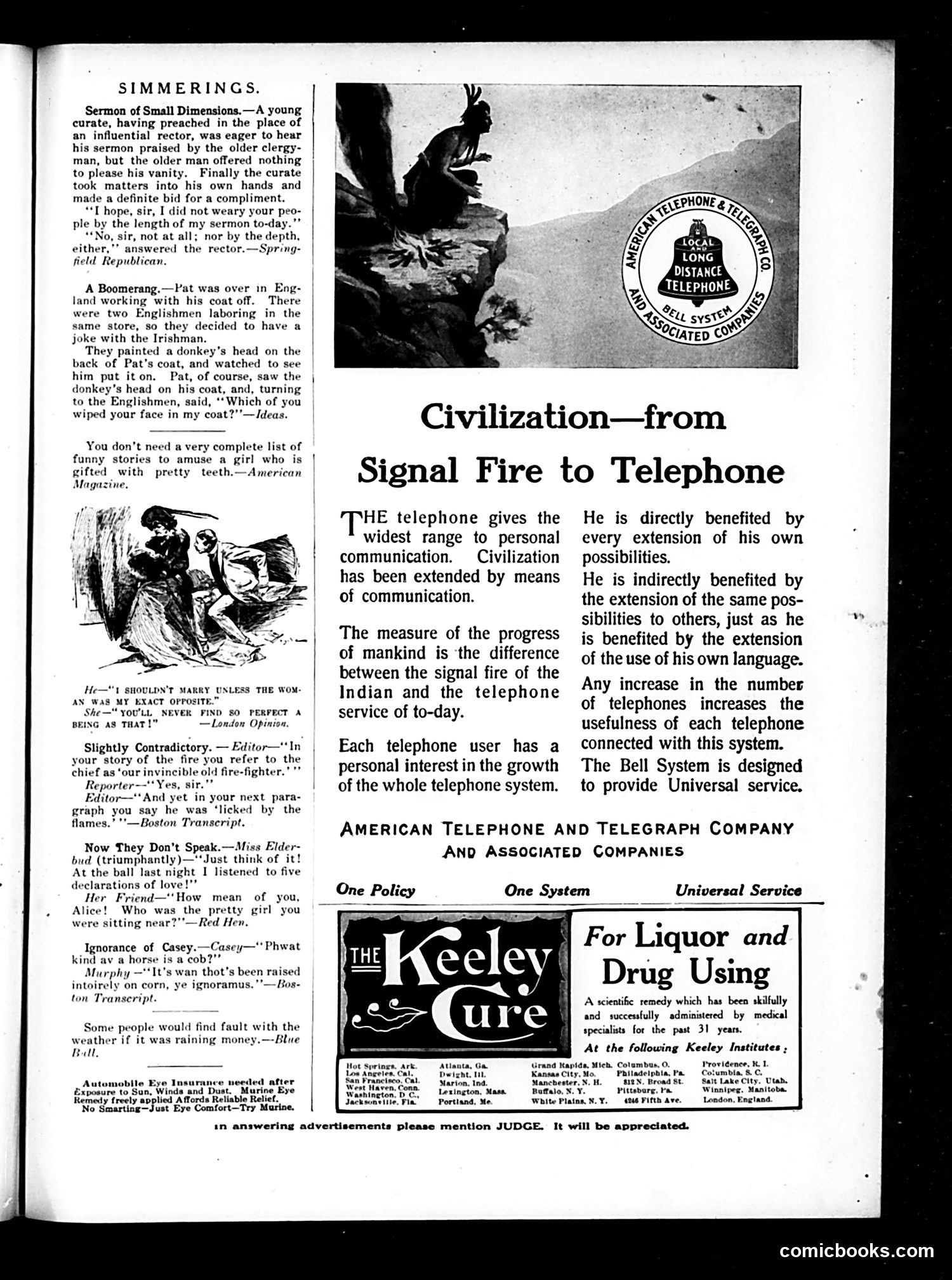
This page contains several short humorous anecdotes typical of Judge's "Simmerings" humor column, plus two major advertisements. **The cartoons/jokes** are brief social comedies: a young clergyman fished for compliments about his short sermon, only to be insulted about its shallowness; an Irishman ("Pat") turned the tables on English coworkers who played a prank on him; and various one-liners about courtship, ignorance, and weather. **The main content** is a full-page advertisement for the Bell Telephone System, presented as institutional propaganda. It argues that telephone communication represents civilization's progress—comparing it to "signal fires of the Indian"—and claims each user benefits both directly and indirectly from network expansion. This reflects early-20th-century monopoly marketing. **Below that** is an advertisement for the Keeley Institute, promoting a "scientific remedy" for alcohol and drug addiction, with locations listed across America and England. The page reflects Judge's mix of social satire and commercial messaging characteristic of early 1900s American magazines.
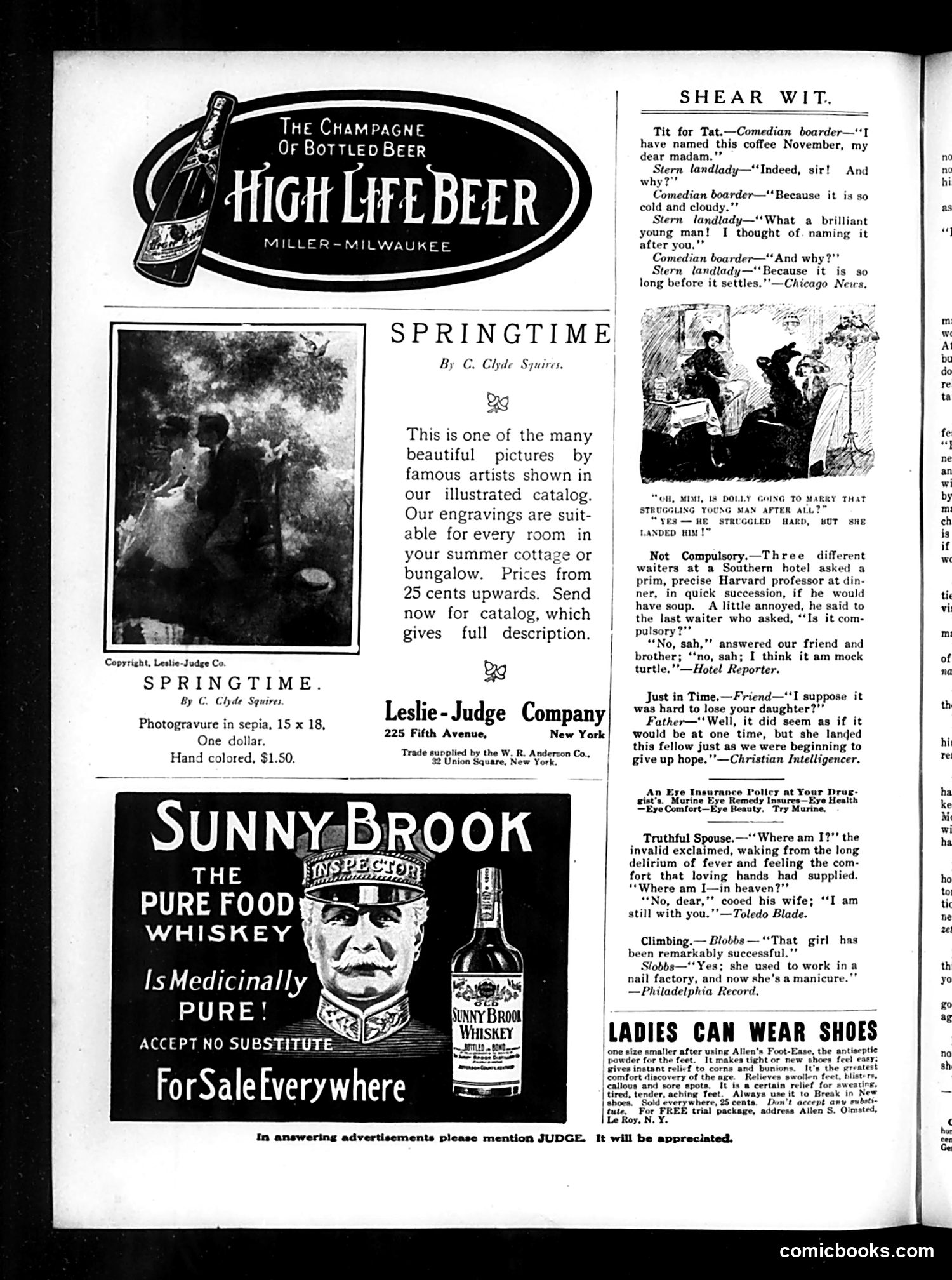
This page is primarily **advertising with humorous filler content**, typical of Judge magazine's format. The main advertisements promote consumer products: High Life Beer (Miller-Milwaukee), Sunny Brook Whiskey ("medicinally pure"), and Allen's Foot-Ease shoe product. A C. Clyde Squires artwork titled "Springtime" is offered for sale through Leslie-Judge Company. The "SHEAR WIT" section contains brief jokes with social commentary. Notable examples mock gender dynamics: a comedian borders lodging by naming coffee "November" (cold/cloudy); a joke plays on fathers being relieved to "lose" daughters through marriage; a Harvard professor is ribbed for his precise diction; and a manicure joke tracks upward mobility from factory work. The humor relies on **contemporary class assumptions, marriage market anxieties, and mild misogyny**—common in early 20th-century American satire. These brief jokes reflect period attitudes toward courtship, servants, and labor rather than targeting specific political figures or events.
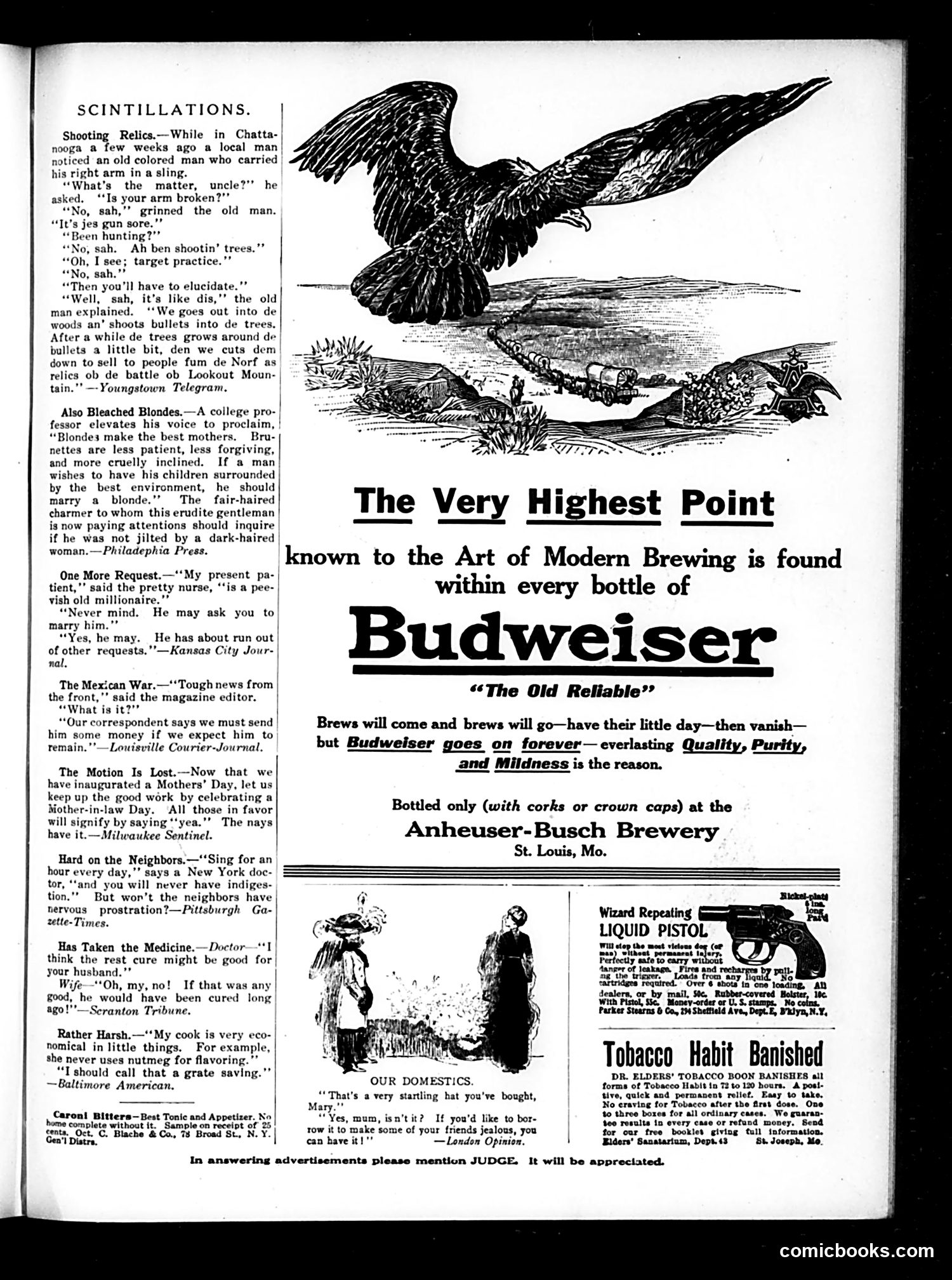
This page from *Judge* magazine contains brief satirical anecdotes and advertisements rather than political cartoons. The humor targets social pretension and regional stereotypes: **"Shooting Relics"** mocks Northern tourists and Southern entrepreneurship—a Black man describes fraudulently selling bullets embedded in trees as Civil War relics from the Battle of Lookout Mountain to Northern visitors. **"Bleached Blondes"** satirizes a college professor's claim that blonde women make better mothers, suggesting he should question whether he was jilted by a dark-haired woman—ironic commentary on his apparent bias. Other brief items joke about millionaires' endless requests, war correspondence, and a wife's skepticism about her husband needing a "rest cure." The prominent **Budweiser advertisement** features an eagle and claims the beer maintains "everlasting Quality, Purity, and Mildness." Other ads promote a "Liquid Pistol," tobacco cessation treatment, and Capon Bitters.
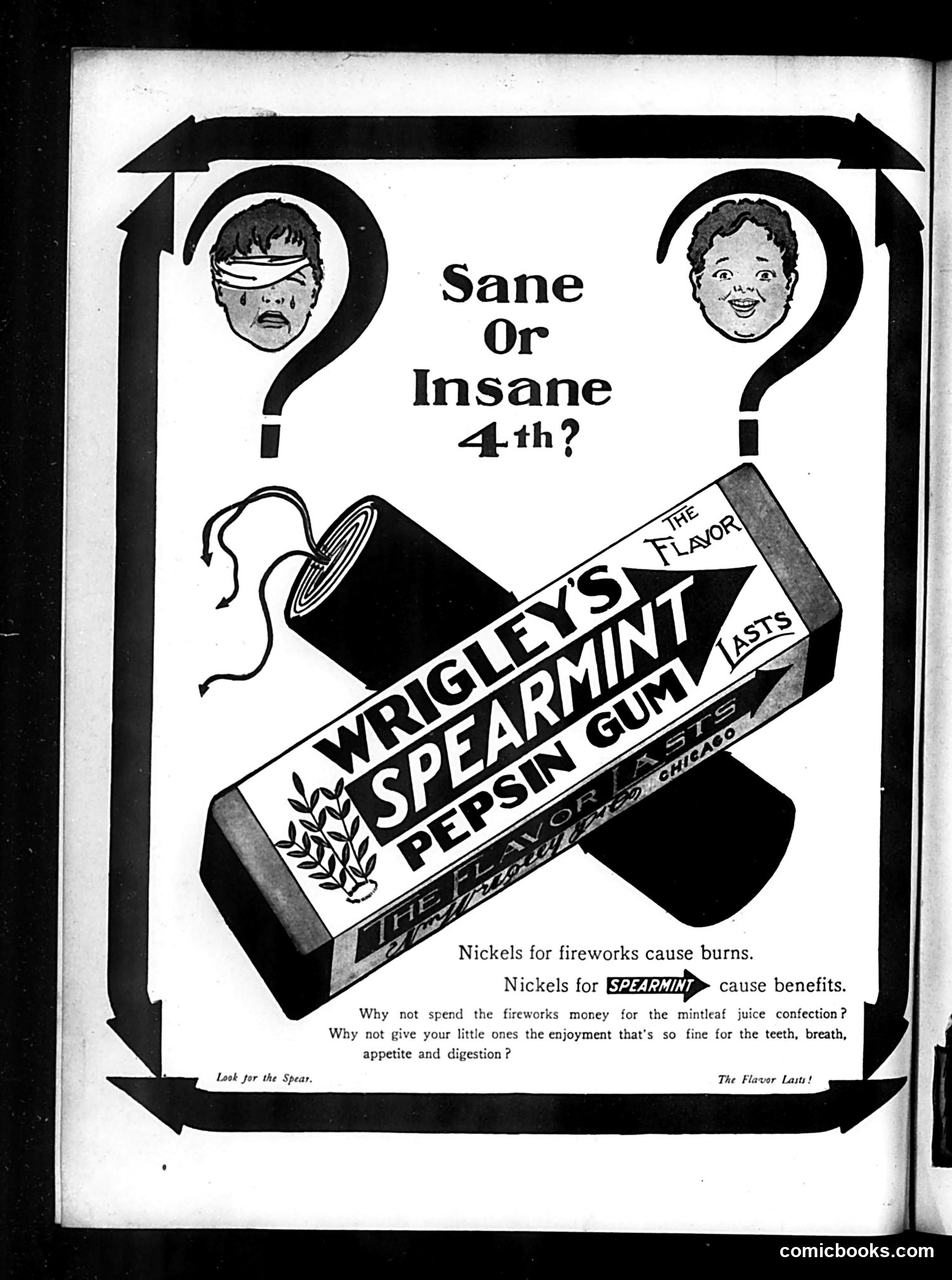
This is a **Wrigley's Spearmint gum advertisement**, not political satire. The "Same or Insane 4th?" headline uses a playful rhetorical device comparing two faces—one stern (associated with fireworks), one happy (associated with gum)—to argue parents should redirect Fourth of July spending. The ad contrasts dangerous fireworks (which cause burns) with Spearmint gum as a safer, healthier alternative for children's holiday enjoyment. It emphasizes gum's alleged benefits: improving teeth, breath, appetite, and digestion. The satire is gentle commercial persuasion rather than political commentary—using the "sane versus insane" framing to position gum consumption as the responsible parental choice. This reflects early 20th-century advertising's focus on promoting consumer products as solutions to everyday decisions.