
Judge, 1911-06-03 · page 13 of 24
Judge — June 3, 1911 — page 13: what you’re looking at
What you’re looking at
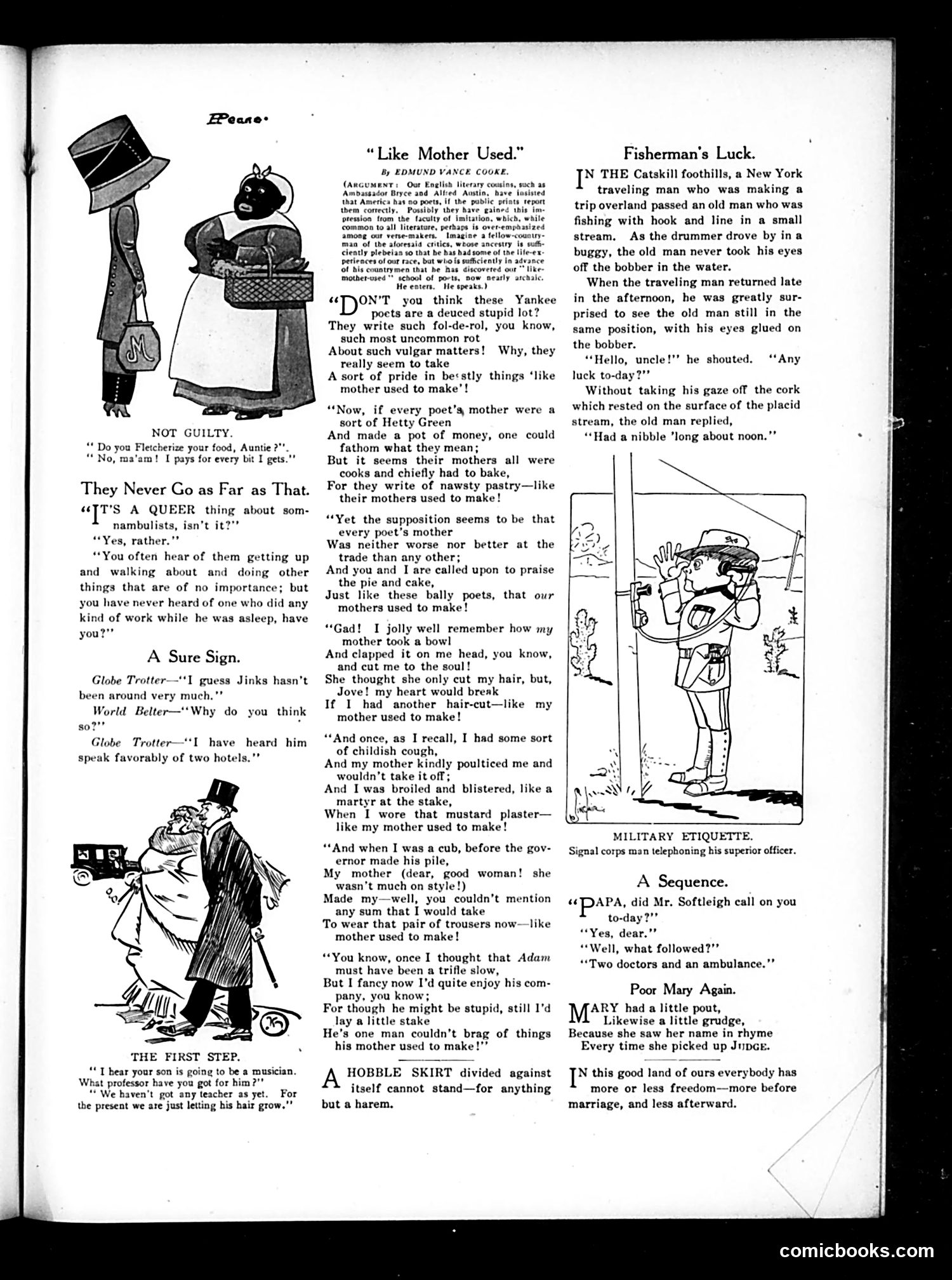
This page satirizes literary pretension and American culture circa early 1900s. **"Like Mother Used"** (main feature): A pompous British critic mocks American poets for celebrating ordinary domestic subjects—cooking, childhood punishments, homemade clothes. The satire cuts both ways: the critic is ridiculous for his snobbery, yet the poem acknowledges American poets' obsession with nostalgic domesticity. The piece parodies both affected British superiority and sentimental American populism. **Other cartoons mock:** - "Fletcherize" (chew food excessively per Horace Fletcher's fad diet) - Sleepwalkers never doing productive work - People who only praise mediocre hotels as worldly travelers - Parents growing children's hair long hoping they'll become musicians - Women's hobble skirts as impractical The humor targets contemporary fads, pretension, and the gap between aspiration and reality. These are gentle, observational jokes about American middle-class affectations and European condescension.
📄 Transcribed text from this page (OCR, searchable)
Machine-transcribed from the original scan — historical spelling and the odd misread are preserved.
NOT GUILTY. “ Do you Fletcherize your food, Auntie 2” “No, ma'am! I pays for every bit I gets. They Never Go as Far as That. “TT'S A QUEER thing about som- nambulists, isn’t it?’’ “Yes, rather."" “You often hear of them getting up and walking about and things that are of no importance; but you have never heard of one who did any kind of work while he was asleep, have you?” doing other A Sure Sign. Globe Trotter—‘'1 guess Jinks hasn't been around very much.”* World Belter—‘*Why do you think Globe Trotter—‘*I have heard him speak favorably of two hotels."” so THE FIRST STEP. “T bear your son is going to be a musician. What professor have you got for him?"* “We haven't got any teacher as yet. For the present we ate just letting his hair grow."’ “Like Mother Used.” By EDMUND VANCE COOKE. ENT: Our English literary cous dor Bryce and Alfted Austin, hav has 00 poets, if the public pri tly. Possibly they bave &: ptession from the faculty of imitation, which, whil common to all literature, perhaps is 0% amoog our verse-makers. Imagine a fel man of the aforesaid critics, weose ancestry ciently plebeian so that he bas had some of the | perieaces of our race, bat wi is sufhciently in advance Of his countrymen that he has discovered out mother-used school of ports, Bow neatly atchaic. He enters. He speaks.) “séT)ON’T you think these Yankee poets are a deuced stupid lot? They write such fol-de-rol, you know, such most uncommon rot About such vulgar matters! really seem to take A sort of pride in besstly things ‘like mother used to make’! Why, they “Now, if every poet’s, mother were a sort of Hetty Green And made a pot of money, one could fathom what they mean; But it seems their mothers all were cooks and chiefly had to bake, For they write of nawsty pastry—like their mothers used to make! “Yet the supposition seems to be that every poet’s mother Was neither worse nor better at the trade than any other; And you and I are called upon to praise the pie and cake, Just like these bally poets, that our mothers used to make! “Gad! I jolly well remember how my mother took a bowl And clapped it on me head, you know, and cut me to the soul! She thought she only cut my hair, but, Jove! my heart would break If 1 had another hair-cut—like my mother used to make! “And once, as I recall, I had some sort of childish cough, And my mother kindly poulticed me and wouldn’t take it off ; And I was broiled and blistered, like a martyr at the stake, When I wore that mustard plaster— like my mother used to make! “*And when I was a cub, before the gov- ernor made his pile, My mother (dear, good woman! wasn’t much on style!) Made my—well, you couldn't mention any sum that I would take To wear that pair of trousers now—like mother used to make! she “*You know, once I thought that Adam must have been a trifle slow, But I fancy now I'd quite enjoy his com- pany, you know; For though he might be stupid, still I'd lay a little stake He’s one man couldn’t brag of things his mother used to make!”’ A HOBBLE SKIRT divided against itself cannot stand—for anything but a harem, Fisherman's Luck. N THE Catskill foothills, a New York traveling man who was making a trip overland passed an old man who was fishing with hook and line in a small stream. As the drummer drove by ina buggy, the old man never took his eyes off the bobber in the water. When the traveling man returned late in the afternoon, he was greatly sur- prised to see the old man still in the same position, with his eyes glued on the bobber. “Hello, uncle!'’ he shouted. luck to-day?” Without taking his gaze off the cork which rested on the surface of the placid stream, the old man replied, ‘Had a nibble ‘long about noon,”” “Any MILITARY ETIQUETTE. Signal corps man telephoning his superior officer. A Sequence. “Para, did Mr. Softleigh call on you to-day?” “Yes, dear.’” “Well, what followed?”” ‘‘Two doctors and an ambulance. Poor Mary Again. M*ky had a little pout, Likewise a little grudge, Because she saw her name in rhyme Every time she picked up JupcE. i this good land of ours everybody has more or less freedom—more before age, and less afterward. ma comicbooks.com