
Judge, 1911-06-03 · page 18 of 24
Judge — June 3, 1911 — page 18: what you’re looking at
What you’re looking at
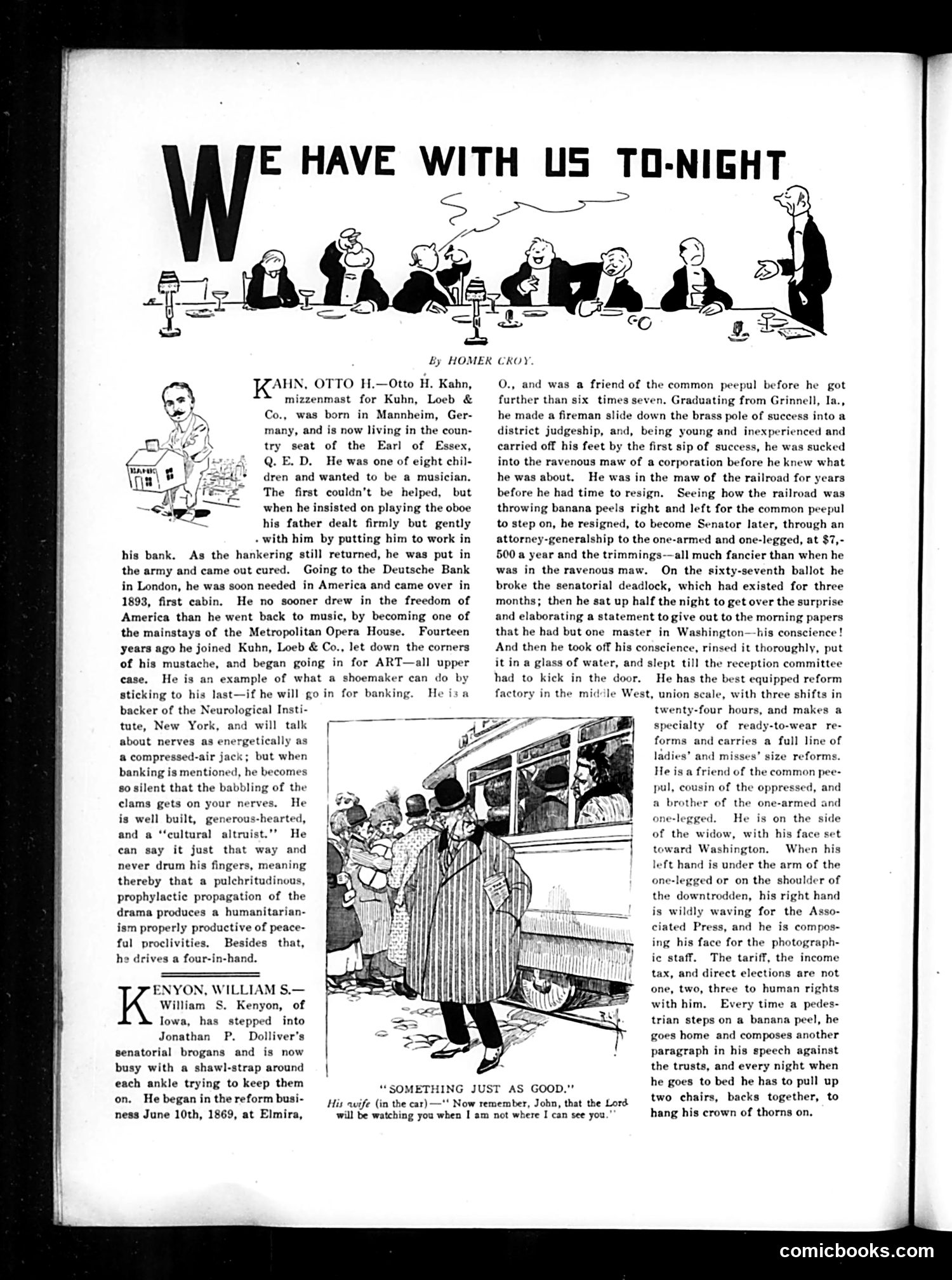
This page satirizes two prominent figures through mock biographical sketches, a Judge magazine specialty. **Otto H. Kahn** (banker/financier) is mocked for abandoning musical aspirations to enter banking, then contradicting himself by becoming a major Metropolitan Opera patron and "cultural altruist." The satire ridicules wealthy financiers who pose as arts patrons while remaining fundamentally devoted to profit. **William S. Kenyon** (Iowa Senator) is portrayed as an opportunistic hypocrite who rose through reform politics, then abandoned principles upon gaining power. The cartoon caption shows his wife reminding him "the Lord will be watching" while he's away—suggesting his claimed conscience is performative. The text sarcastically catalogs his ready-made "reforms" and self-serving rhetoric about serving common people. Both sketches employ Judge's characteristic acidic humor: praising subjects' stated values while documenting their contradictions, exposing wealthy elites' and politicians' hypocrisy through exaggerated flattery.
📄 Transcribed text from this page (OCR, searchable)
Machine-transcribed from the original scan — historical spelling and the odd misread are preserved.
By HOMER CRO} Kan, OTTO H.—Otto H. Kahn, mizzenmast for Kuhn, Loeb & Co., was born in Mannheim, Ger- many, and is now living in the coun- try seat of the Earl of Essex, Q. E. D. He was one of eight chil- dren and wanted to be a musician. The first couldn’t be helped, but when he insisted on playing the oboe his father dealt firmly but gently + with him by putting him to work in his bank. As the hankering still returned, he was put in the army and came out cured. Going to the Deutsche Bank in London, he was soon needed in America and came over in 1893, first cabin. He no sooner drew in the freedom of America than he went back to music, by becoming one of the mainstays of the Metropolitan Opera House. Fourteen years ago he joined Kuhn, Loeb & Co., let down the corners of his mustache, and began going in for ART—all upper case. He is an example of what a shoemaker can do by sticking to his last—if he will go in for banking. He isa backer of the Neurological Insti- tute, New York, and will talk about nerves as energetically as a compressed-air jack; but when banking is mentioned, he becomes so silent that the babbling of the clams gets on your nerves. is well built, generous-hearte and a “‘cultural altruist."” He can say it just that way and never drum his fingers, meaning thereby that a pulchritudinous, prophylactic propagation of the drama produces a humanitarian- ism properly productive of peace- ful proclivities, Besides that, he drives a four-in-hand. YON, WILLIAM S.— William S. Kenyon, of Iowa, has stepped into Jonathan P. Dolliver’s senatorial brogans and is now busy with a shawl-strap around each ankle trying to keep them on. He began in the reform busi- ness June 10th, 1869, at Elmira, “SOMETHING JUST AS GOOD." His wife (in the car) —"' Now remember, Jobn, that the Lord will be watching you when I am not where I can see you.’ O., and was a friend of the common peepul before he got further than six times seven. Graduating from Grinnell, Ia., he made a fireman slide down the brass pole of success into a district judgeship, and, being young and inexperienced and carried off his feet by the first sip of success, he was sucked into the ravenous maw of a corporation before he knew what he was about. He was in the maw of the railroad for years before he had time to resign. Seeing how the railroad was throwing banana peels right and left for the common peepul to step on, he resigned, to become Senator later, through an attorney-generalship to the one-armed and one-legged, at $7,- 500 a year and the trimmings-—all much fancier than when he was in the ravenous maw. On the sixty-seventh ballot he broke the senatorial deadlock, which had existed for three months; then he sat up half the night to get over the surprise and elaborating a statement to give out to the morning papers that he had but one master in Washington—his conscience! And then he took off his conscience, rinsed it thoroughly, put it in a glass of water, and slept till the reception committee had to kick in the door. He has the best equipped reform factory in the middle West, union scale, with three shifts in twenty-four hours, and makes a specialty of ready-to-wear re- forms and carries a full line of ladies’ and misses’ size reforms. He isa friend of the common pee- pul, cousin of the oppressed, and a brother of the one-armed and one-legged. He is on the side of the widow, with his face set toward Washington. When his left hand is under the arm of the one-legged or on the shoulder of the downtrodden, his right is wildly waving for the Asso- ciated Press, and he is compos- ing his face for the photograph- ic staff. The tariff, the income tax, and direct elections are not one, two, three to human rights with him. Every time a pedes- trian steps on a banana peel, he goes home and composes another paragraph in his speech against the trusts, and every night when he goes to bed he has to pull up two chairs, backs together, to hang his crown of thorns on. comicbooks.com