
A complete issue · 26 pages · 1911
Judge — April 29, 1911
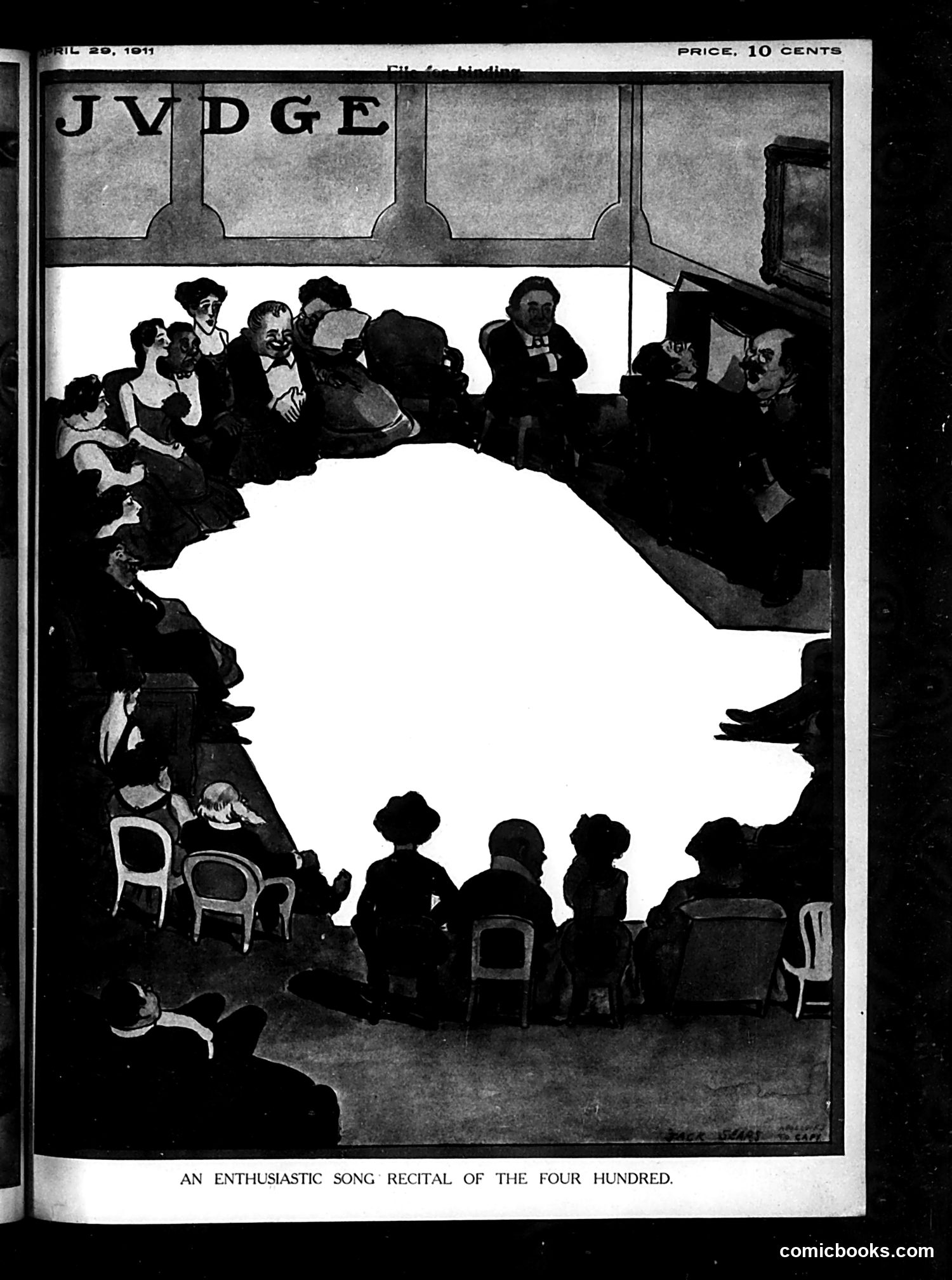
This Judge magazine page from April 23, 1911 depicts "An Enthusiastic Song Recital of the Four Hundred"—a satirical reference to New York's wealthy elite social class (the "Four Hundred" was the term for the city's most exclusive high-society families). The cartoon shows fashionable guests seated around a large, empty white space—likely representing a music recital or performance. The silhouettes suggest formal evening dress typical of Gilded Age society gatherings. The satire appears to mock the pretentiousness of these wealthy socialites attending cultural events. The empty white space where content should be suggests either an underwhelming performance or perhaps mockery of the participants' own emptiness beneath their refined appearances. Judge frequently lampooned wealthy New York society's affectations and self-importance.
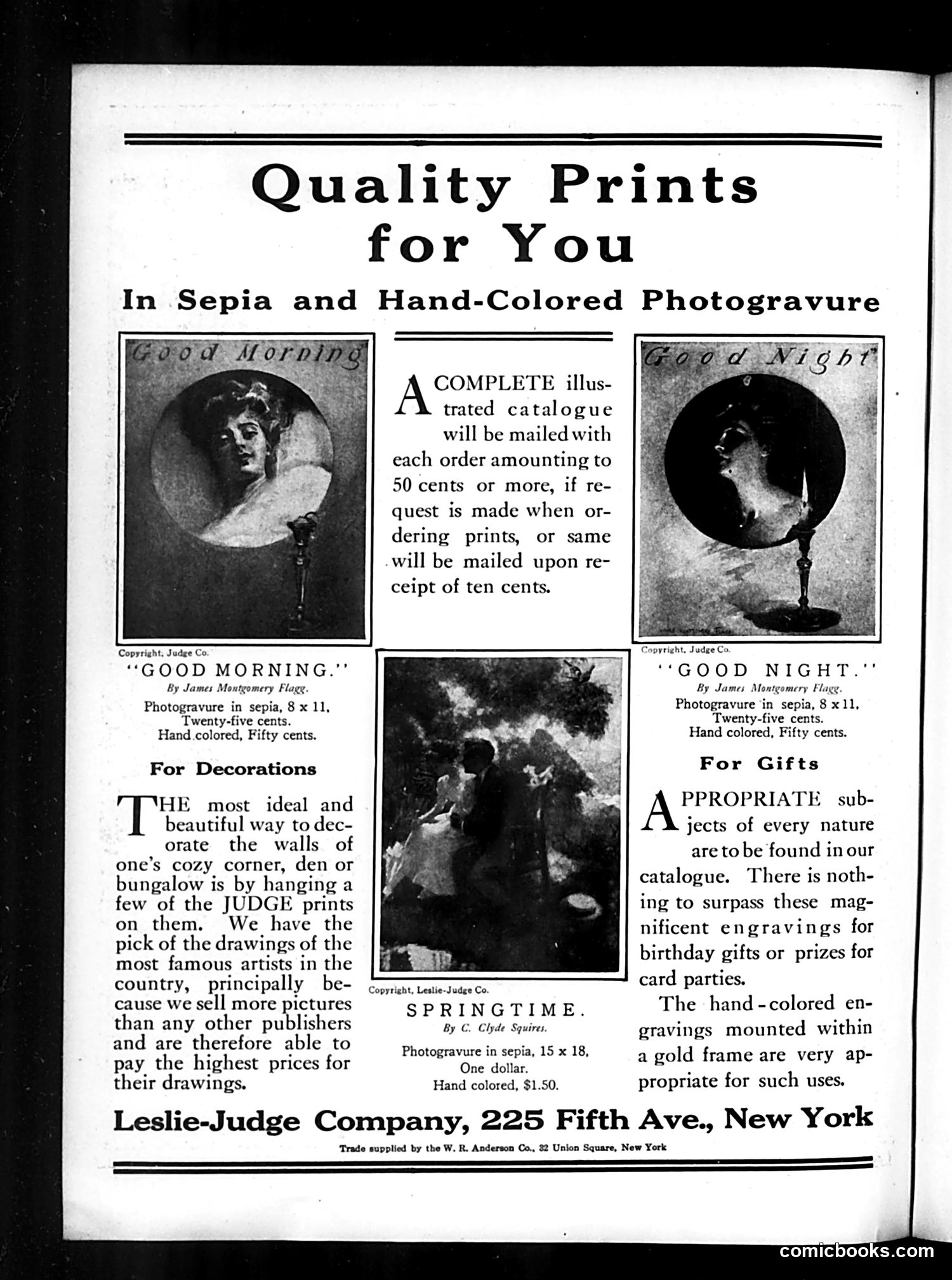
This page is primarily **advertising, not satire or political content**. It's a catalog advertisement from the Leslie-Judge Company promoting quality prints and photogravures available in sepia tone and hand-colored versions. The page features three sample artworks: - "Good Morning" by James Montgomery Flagg (top left) - "Good Night" by James Montgomery Flagg (top right) - "Springtime" by C. Clyde Squires (center) The text emphasizes these prints' suitability for home decoration and gifts, highlighting that Judge publishes more pictures than competitors and can therefore afford the "highest prices for their drawings." **No political satire or caricature is present.** This is straightforward commercial content appearing in Judge magazine's pages.
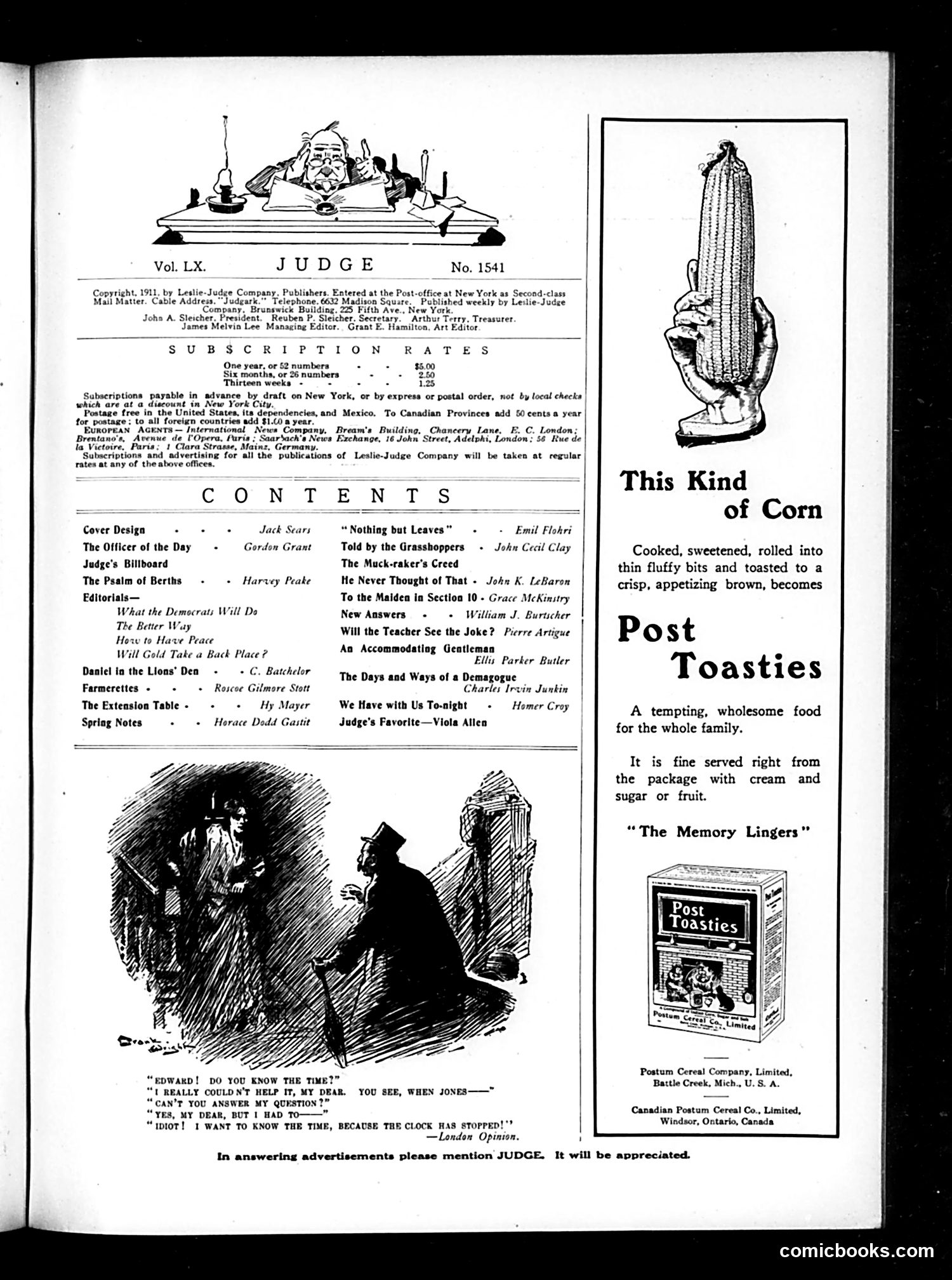
This page is primarily **advertising and editorial content** rather than political satire. The main cartoon depicts two figures in what appears to be a theatrical or social scene, with dialogue about Edward not knowing the time—a domestic humor joke rather than political commentary. The page's substantive content is a **Post Toasties cereal advertisement** featuring illustrated corn and product packaging. The "Memory Lingers" slogan emphasizes the product's appeal. The editorial section lists article titles addressing contemporary social issues (extending tables, spring notes, democratization), but specific political figures or events aren't identifiable from this excerpt alone. Without additional context about Judge's 1911 publication date and specific references, precise satirical targets remain unclear.
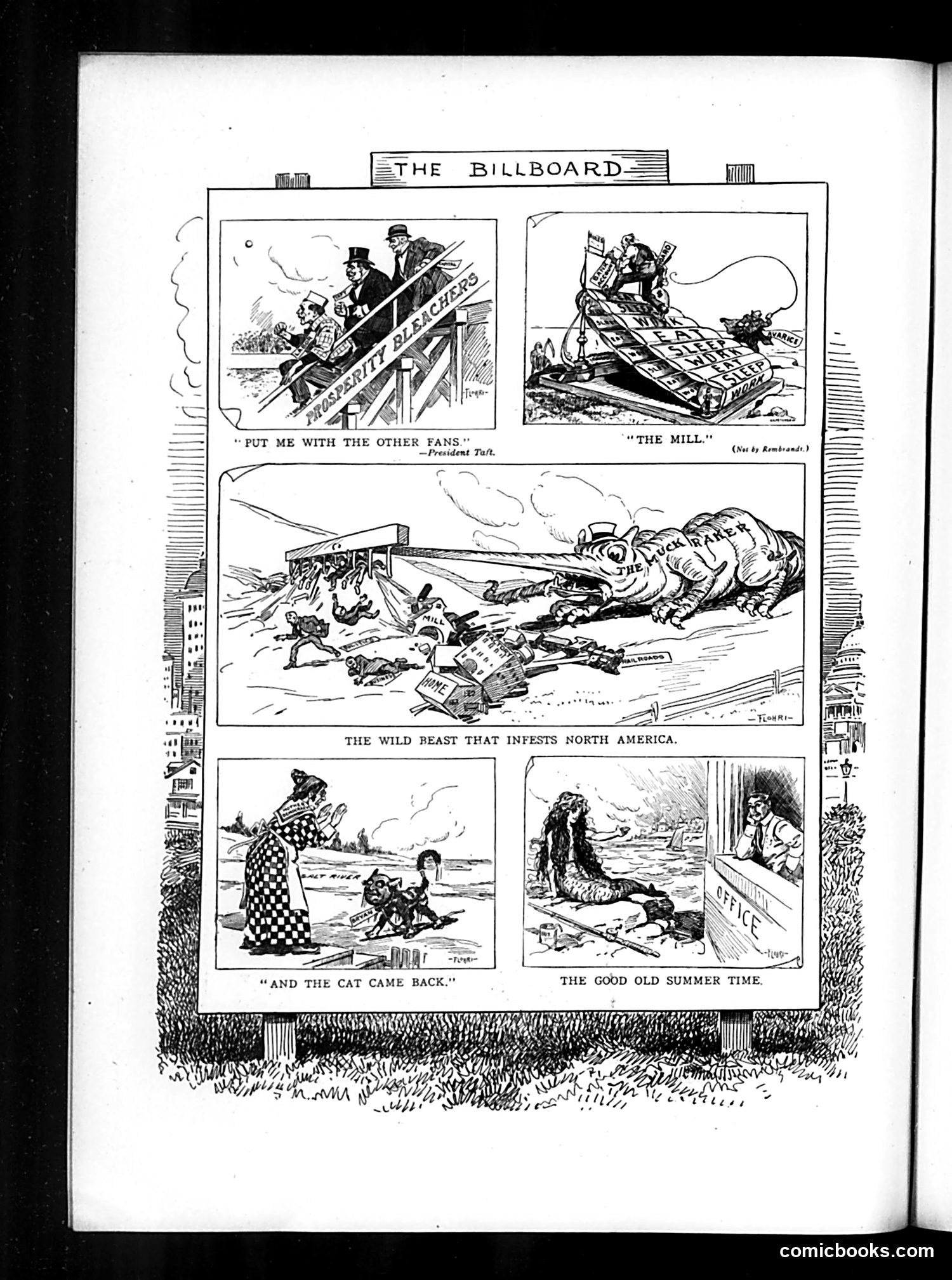
This page presents political satire from *Judge* magazine using the metaphor of a "wild beast that infests North America"—likely referring to a political figure or movement of the era. **Top panels**: "Put Me with the Other Fans" (attributed to President Taft) and "The Mill" show crowds being processed, suggesting political machinery or popularity. **Central panel**: A large beast labeled "The Wild Beast" lies surrounded by destruction, with figures appearing to combat or contain it. **Bottom panels**: "And the Cat Came Back" and "The Good Old Summer Time" show domestic scenes, possibly contrasting peaceful normalcy with the political turmoil above. The overall message appears critical of a political force threatening America, though without the original publication date, identifying the specific figure or event referenced remains uncertain.
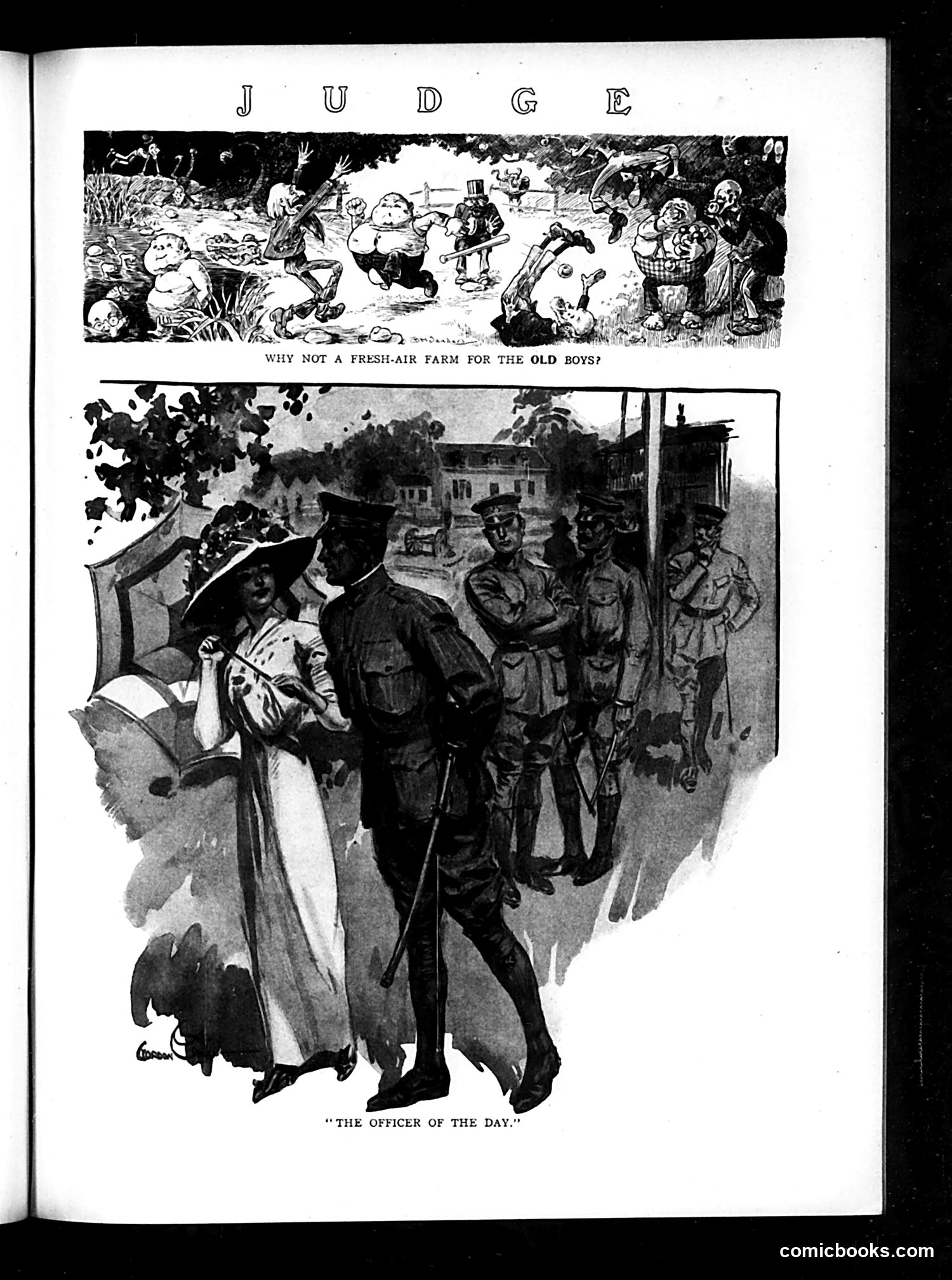
The page contains two satirical cartoons addressing elderly men's welfare. **Top cartoon:** "Why Not a Fresh-Air Farm for the Old Boys?" depicts a chaotic seaside scene with elderly men engaged in various undignified activities—falling, tumbling, playing roughly. The satire mocks the "fresh-air farm" concept (a Progressive-era charity initiative), suggesting such programs for elderly men would result in comic disaster rather than genuine benefit. **Bottom cartoon:** "The Officer of the Day" shows a military officer surrounded by soldiers in what appears to be a barracks or garrison setting. The satire likely critiques military discipline or officer conduct, though the specific reference is unclear without additional context. Both cartoons employ exaggeration and physical comedy typical of Judge's satirical style, targeting social welfare programs and military authority as worthy subjects for ridicule.
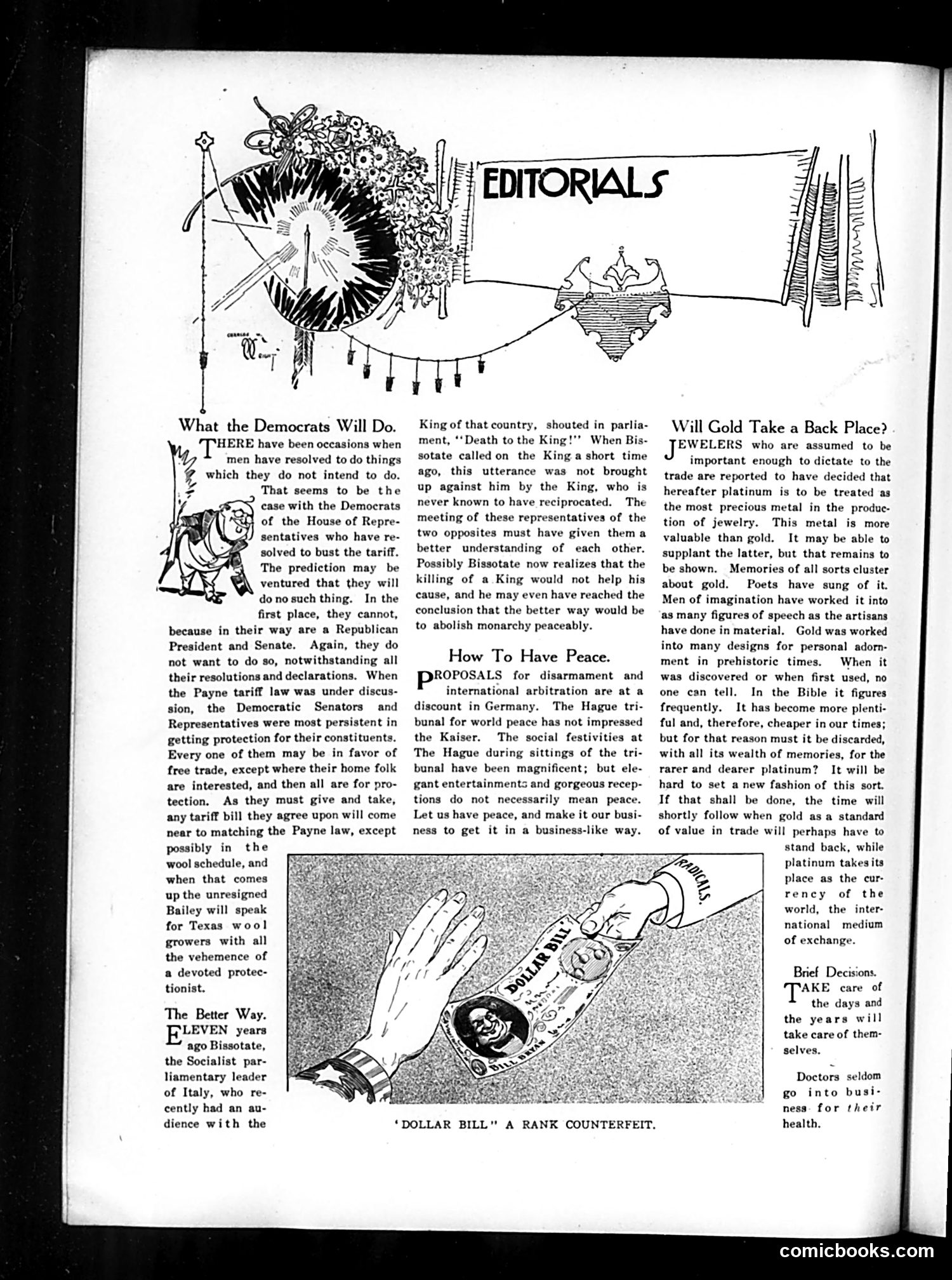
This page contains three political editorials satirizing early 20th-century American politics: **"What the Democrats Will Do"** mocks Democratic promises to reduce tariffs. The satire suggests Democrats cannot deliver because Republicans control the Presidency and Senate, and Democrats themselves protect their home industries—using Texas wool as an example. **"The Better Way"** references an apparent recent visit between Italy's Socialist parliamentary leader Bissolati and the Italian King. The piece ironically suggests that since the King didn't hold Bissolati's past call for regicide against him, perhaps Bissolati now understands monarchy "peaceably"—satirizing both socialist revolutionaries and monarchies for their apparent rapprochement. **"How To Have Peace"** criticizes Germany's dismissal of disarmament proposals and The Hague peace tribunal, suggesting flowery diplomatic ceremonies don't create genuine peace. The central cartoon depicts a hand holding a counterfeit dollar bill, criticizing economic deception. The editorial on platinum questions whether this metal can truly replace gold's cultural significance in human civilization and commerce.
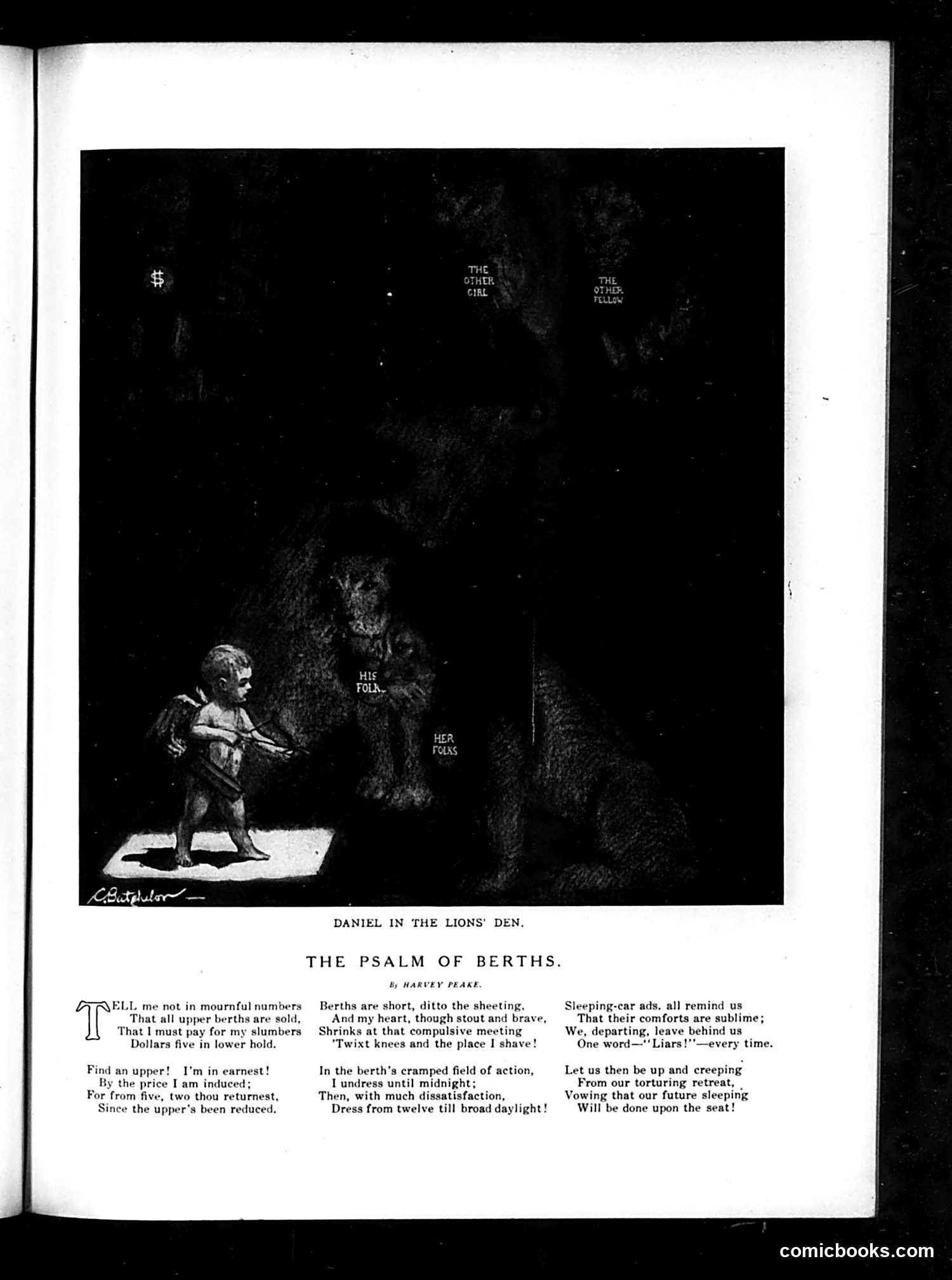
This page satirizes the cramped, uncomfortable conditions of railroad sleeping cars (berths) in the late 19th/early 20th century. The cartoon "Daniel in the Lions' Den" pairs biblical imagery with the complaint: a small man faces enormous lions labeled "THE OTHER GIRL," "THE OTHER FELLOW," "HIS FOLD," and "HER FOAM"—representing the crowded, intimate indignities of shared sleeping quarters. Harvey Peake's poem parodies Longfellow's "A Psalm of Life," mocking railroad advertising claims about "sublime comforts." The humor targets the gap between marketing promises and reality: upper berths sold out, cramped spaces forcing awkward physical proximity, inadequate bedding, and sleeping arrangements so terrible passengers joke they'd prefer sitting up. This reflects genuine public frustration with railroad travel conditions before modern comfort standards.
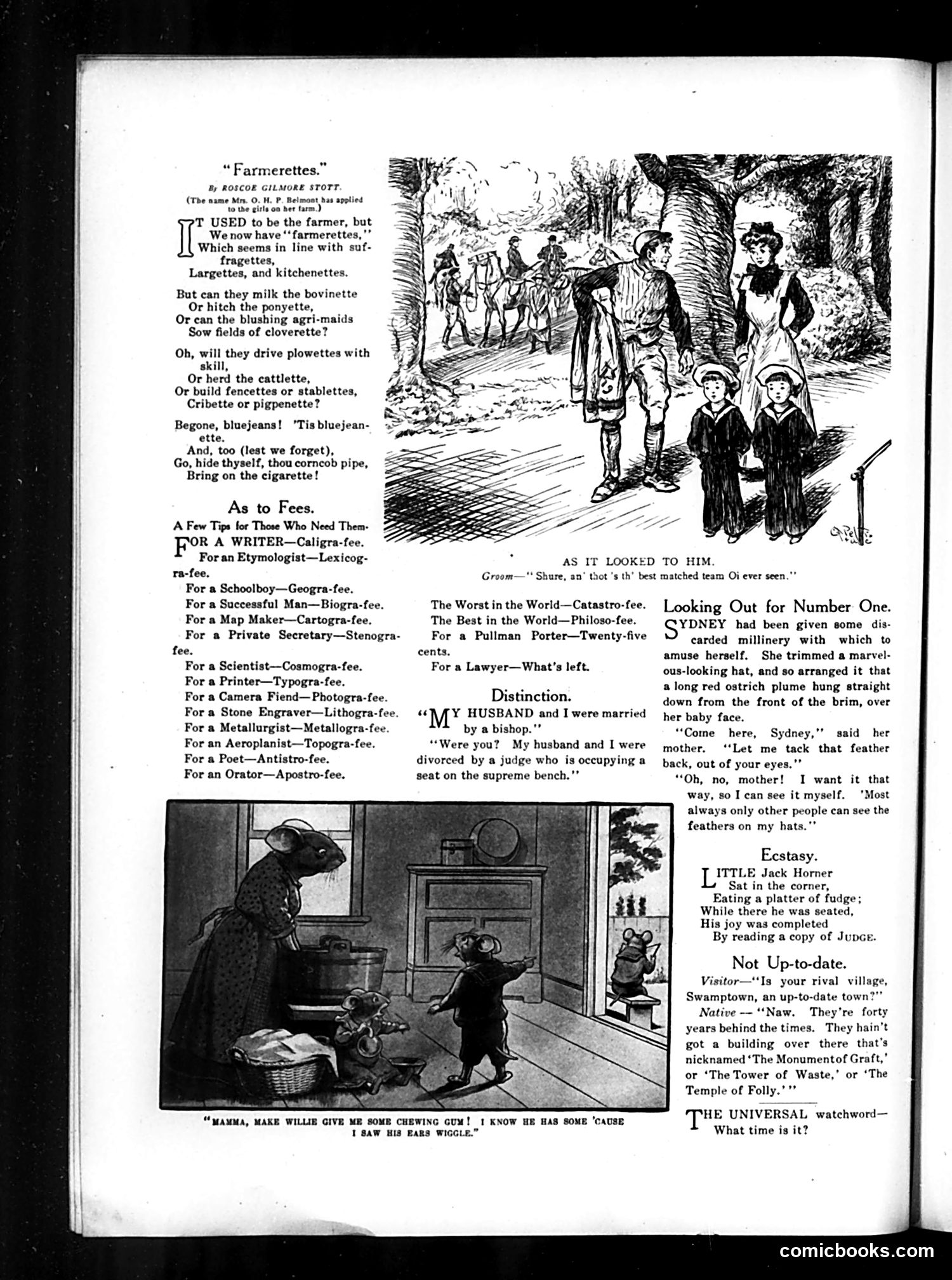
This Judge page satirizes early 20th-century social changes, particularly women's expanding roles. The main poem, "Farmerettes," mocks the practice of women (associated with suffragettes) taking agricultural jobs by mockingly adding "-ette" suffixes to farming terms ("bovinette," "plowettes," "cattlette"). The satire suggests this feminization of language makes serious work sound trivial. Other content includes wordplay on professional fees (lawyer gets "what's left"), jokes about marriage/divorce, and a cartoon showing a child demanding gum while his mother is distracted—illustrating parental indulgence. A separate anecdote depicts a girl positioning her hat feather so she alone can admire it, mocking vanity. The page reflects anxieties about women's suffrage and labor participation, using humor to dismiss these developments as fashionable nonsense rather than serious social progress.
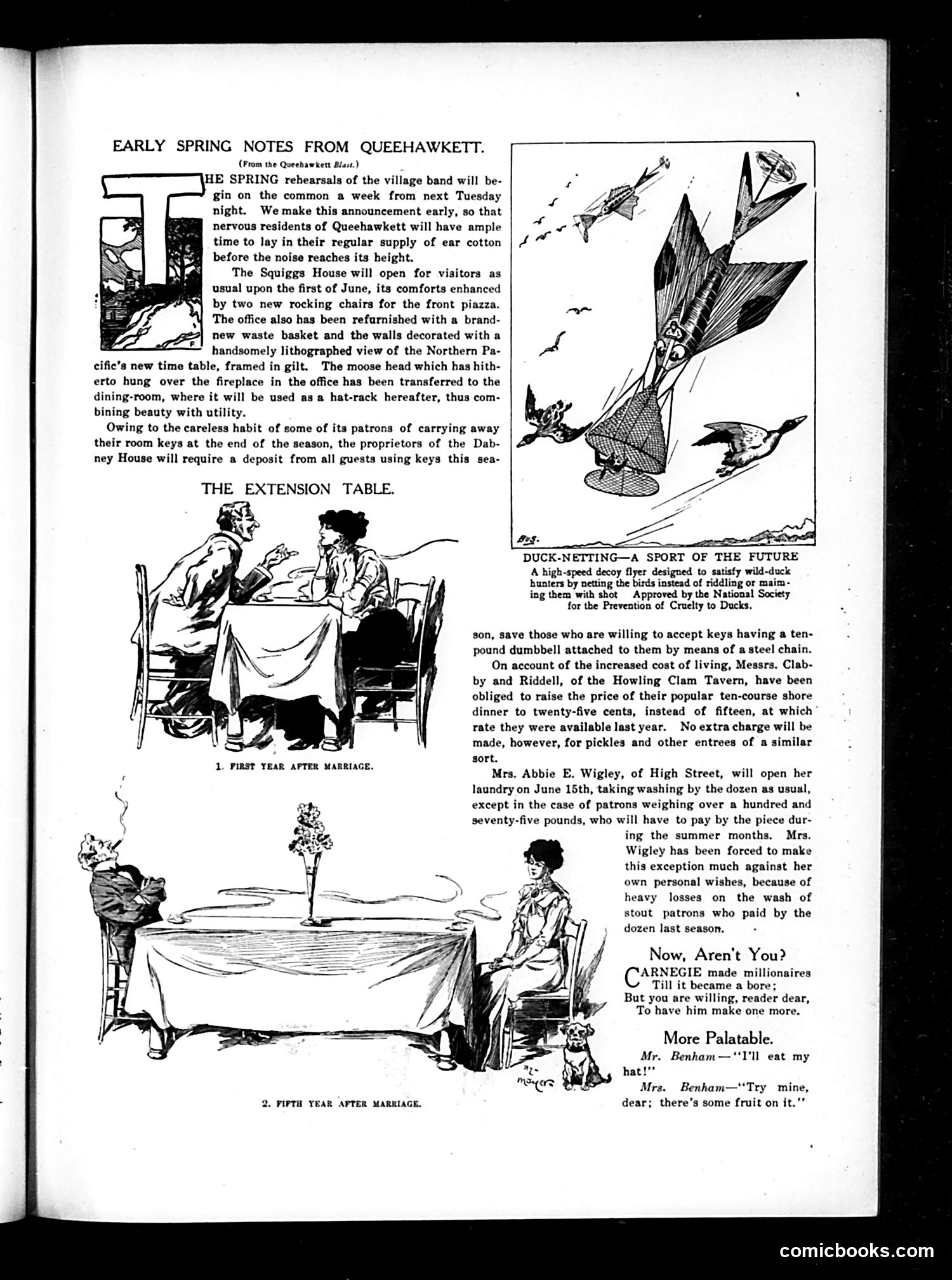
This Judge magazine page contains small-town American humor from the early 1900s. "Early Spring Notes from Queehawkett" satirizes rural village life through exaggerated local announcements: a band so loud residents need ear cotton; a tourist house offering minimal upgrades (two rocking chairs); a hotel demanding key deposits because guests steal them; restaurants raising prices due to inflation; and a laundry charging overweight customers per-item instead of by the dozen because heavier patrons' washing cost more. The cartoons illustrate social themes: "The Extension Table" shows marital stages (newlyweds and fifth-year couples), while the duck-netting device mocks animal-cruelty prevention societies. A final joke depicts a wife suggesting her hat is more palatable to eat than his—implying it contains actual fruit, mocking feminine "domestic improvement." The humor relies on period-specific economic concerns, class anxieties, and gender dynamics rather than timeless comedy.
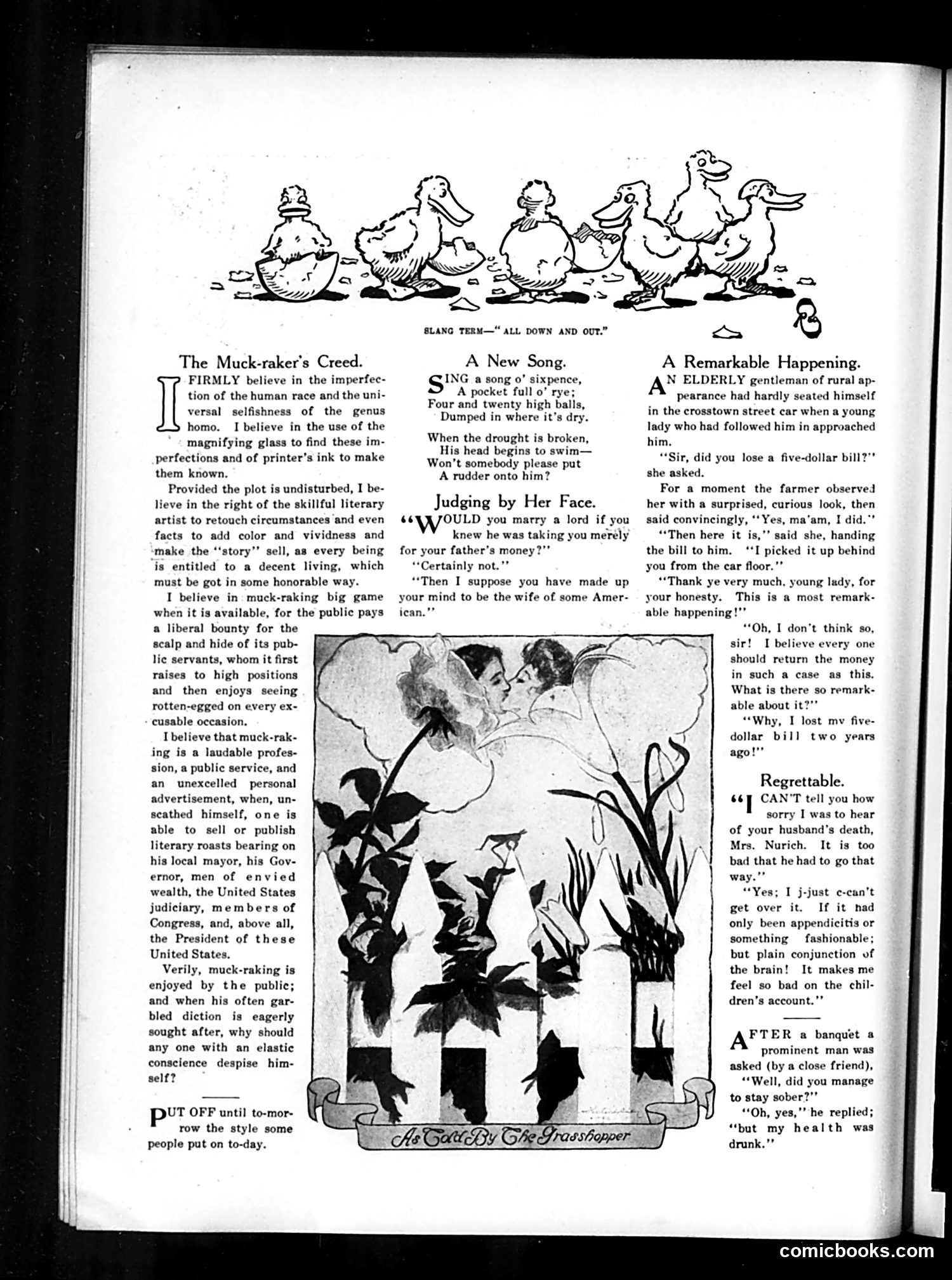
This page satirizes early 20th-century American journalism and social attitudes. **"The Muck-raker's Creed"** mocks investigative journalists ("muck-rakers") who exposed corruption in government and business. The text sarcastically presents their stated noble mission—revealing truth—while exposing the real motivation: profit and self-promotion. The author suggests these journalists exaggerate or fabricate facts to sell papers, targeting politicians, judges, and the wealthy for public entertainment. **The other short pieces** offer social commentary: "A New Song" jokes about Prohibition-era drinking; "Judging by Her Face" contrasts American and European courtship by suggesting American men marry for money; "A Remarkable Happening" uses a rural farmer's amazement at basic honesty to satirize urban society's low moral standards; "Regrettable" mocks wealthy society's priorities (fashionable diseases preferred to common ones); and the final anecdote plays on drinking culture. The cartoon illustration (credited "Cale By The Grasshopper") appears decorative rather than narrative. Overall, the page reflects Judge's skeptical, cynical worldview about journalism, wealth, and modern American values.
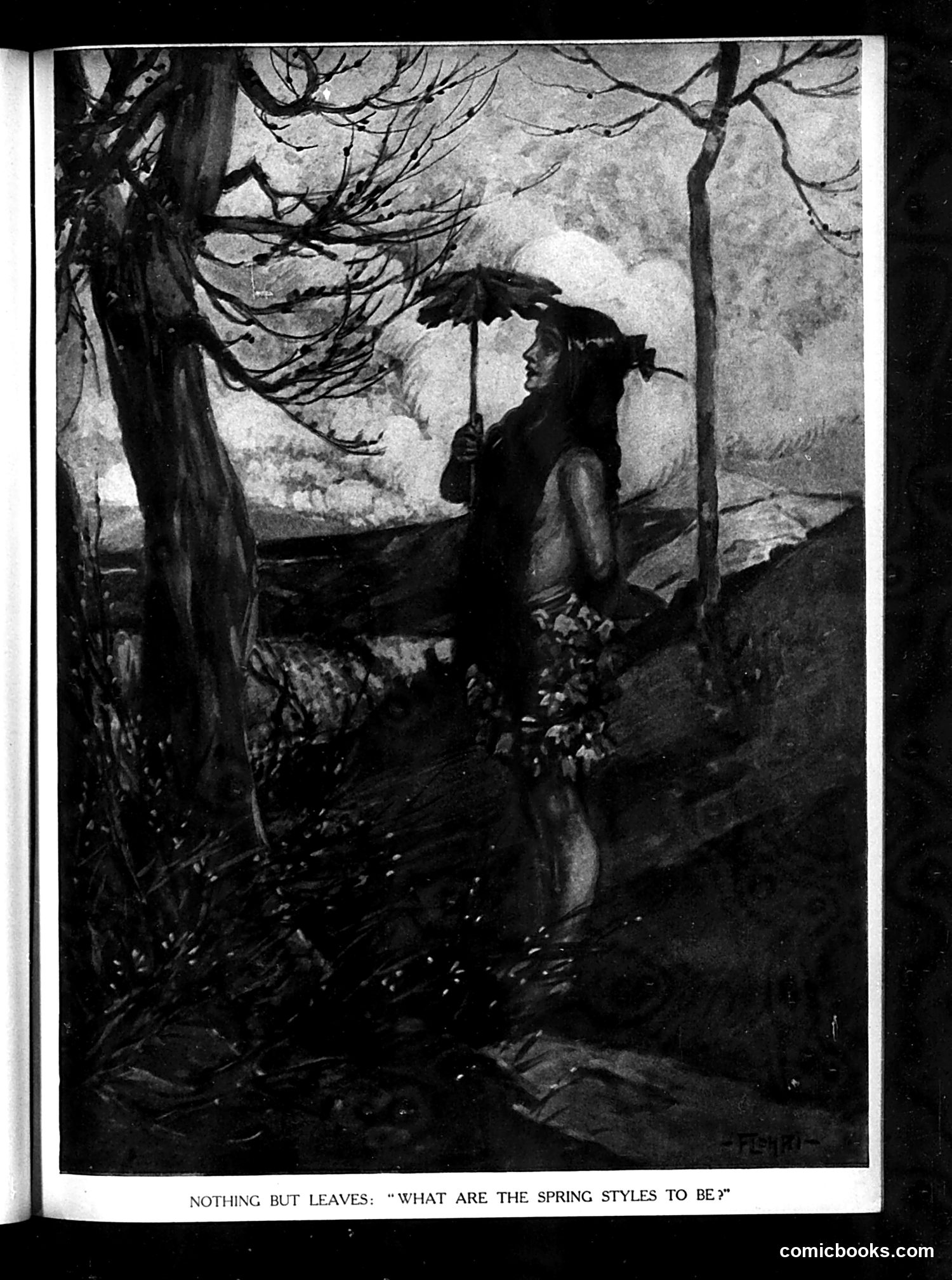
This illustration depicts a figure in silhouette standing in a bare, late-winter woodland, holding an umbrella. The caption reads: "NOTHING BUT LEAVES: 'WHAT ARE THE SPRING STYLES TO BE?'" The satire appears to be social commentary about women's fashion. The figure—likely representing a fashionable woman or fashion industry—asks what spring styles will be, yet is surrounded by leafless trees with bare branches. The joke seems to be that despite nature offering "nothing but leaves" (i.e., minimal covering), the fashion industry still seeks elaborate new styles. This likely critiques either the absurdity of constantly changing fashion trends, or possibly satirizes revealing/minimal women's clothing styles being promoted as "fashionable" during this period. The exact date and specific fashion trend being mocked remain unclear without additional context.
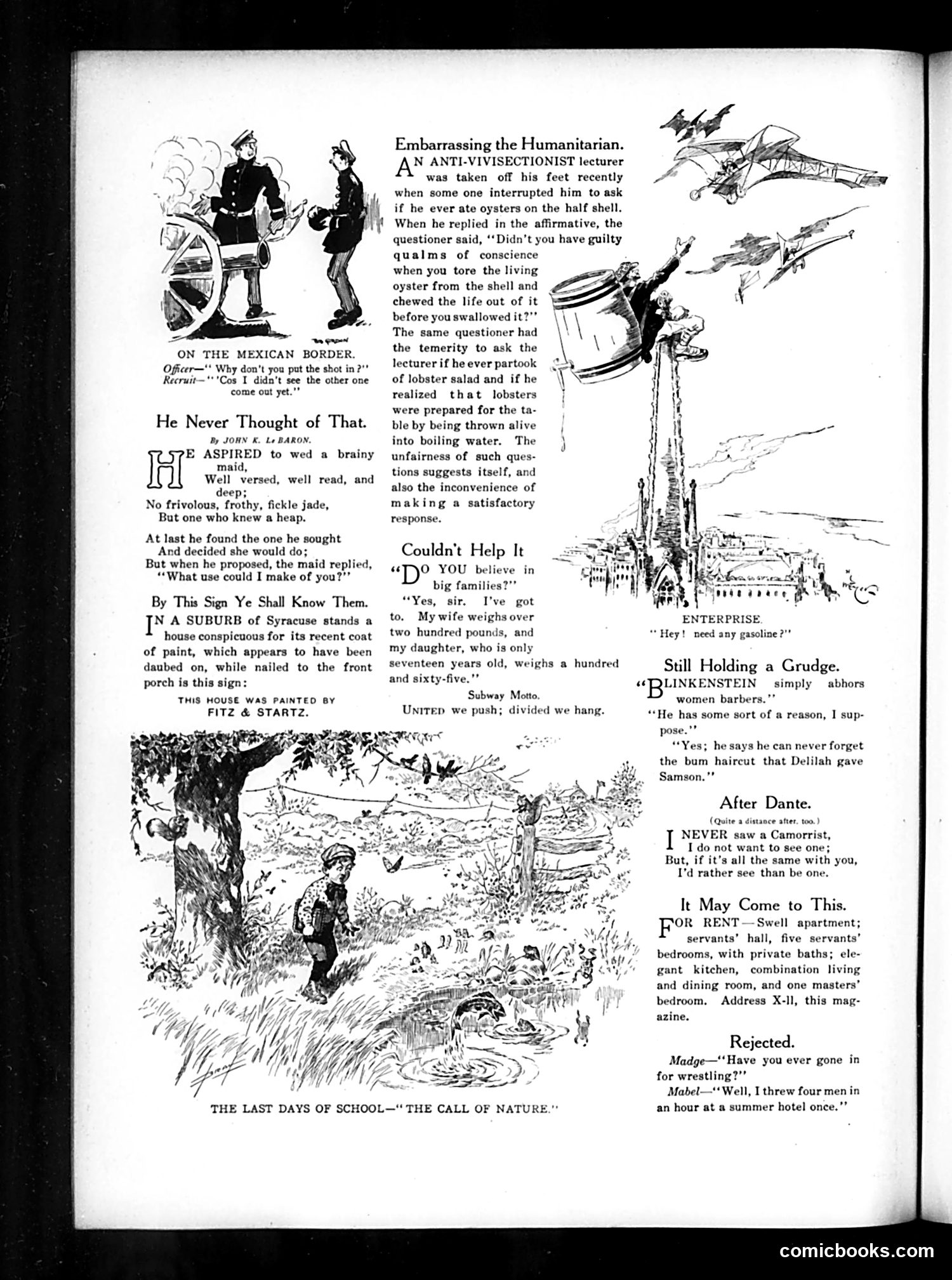
This page contains multiple unrelated humor pieces typical of early 20th-century satirical magazines: **"On the Mexican Border"** mocks military incompetence—a recruit doesn't load his rifle because he didn't see the previous shot exit. **"He Never Thought of That"** plays on gender role assumptions: a man seeks an intellectual wife, but she rejects him as useless. **"Embarrassing the Humanitarian"** satirizes anti-vivisection activists by catching a lecturer in hypocrisy—he opposes animal experimentation but eats oysters and lobster, which also involve killing living creatures painfully. **"Couldn't Help It"** is a weight joke about a man with an obese wife and daughter. **"Still Holding a Grudge"** references the Biblical story of Samson and Delilah, joking that a man dislikes female barbers because of Delilah's treachery. The remaining pieces are brief one-liners and advertisements. The humor relies on wordplay, moral hypocrisy, and stereotypes typical of the era.
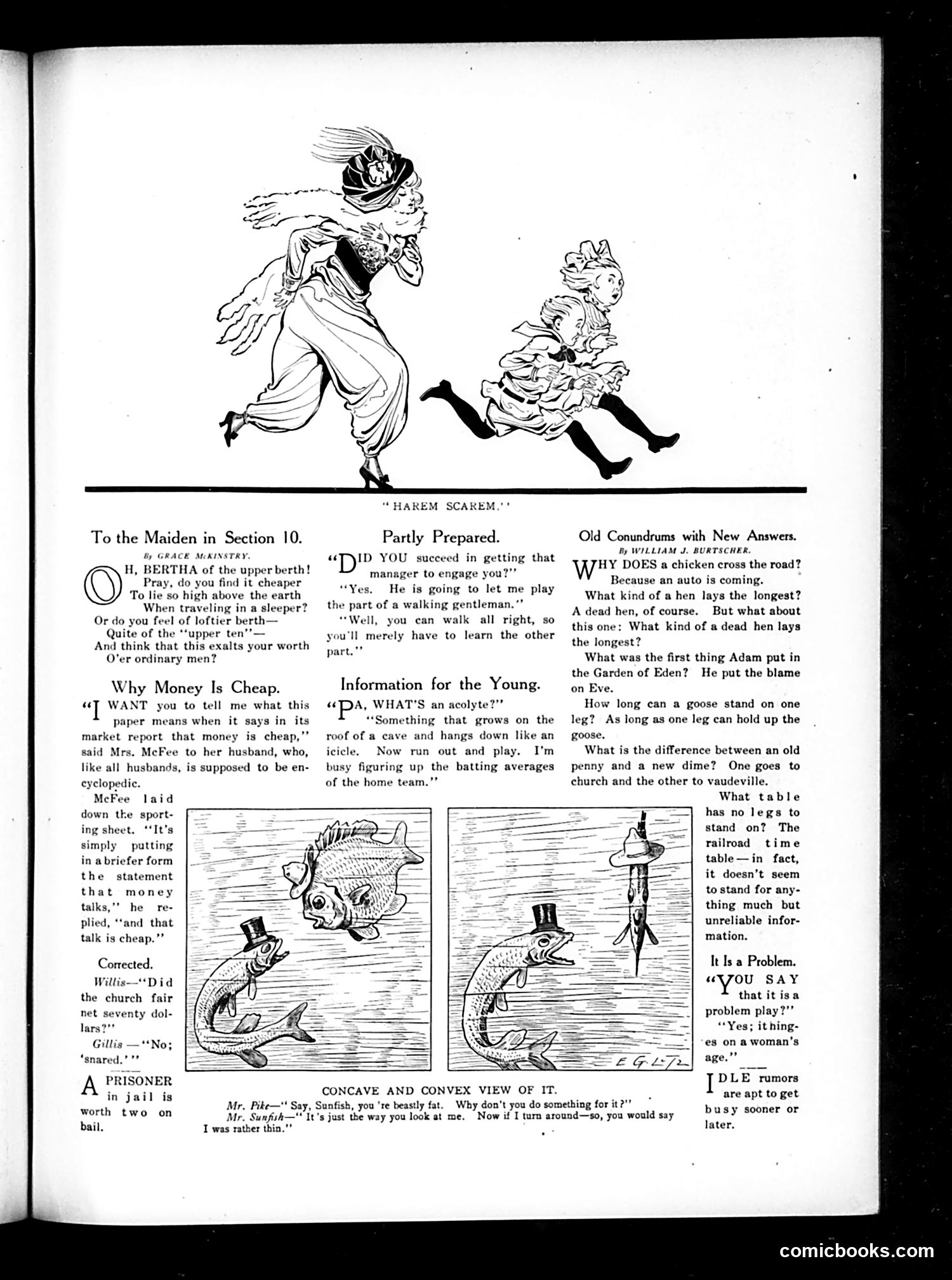
This page collects light satirical pieces and jokes typical of early 20th-century American humor magazines. The illustrated "Harem Scarem" cartoon shows a woman fleeing with children, likely satirizing contemporary anxieties about "harem" culture or immigrant populations—a common nativist trope of the era. The text pieces mock everyday situations: a wife questioning her husband about financial jargon ("money is cheap"), an aspiring actor's thin role, a father dismissing his wife by citing baseball stats instead of explaining economics, and corrected jokes ("Why does a chicken cross the road?"). The "Concave and Convex View" illustration shows fish with top hats making jokes about perspective and appearance—a visual pun on how viewpoint changes perception. Overall, this represents Judge's formula: gentle domestic satire, wordplay, and visual gags aimed at middle-class readers, with no overt political content on this particular page.
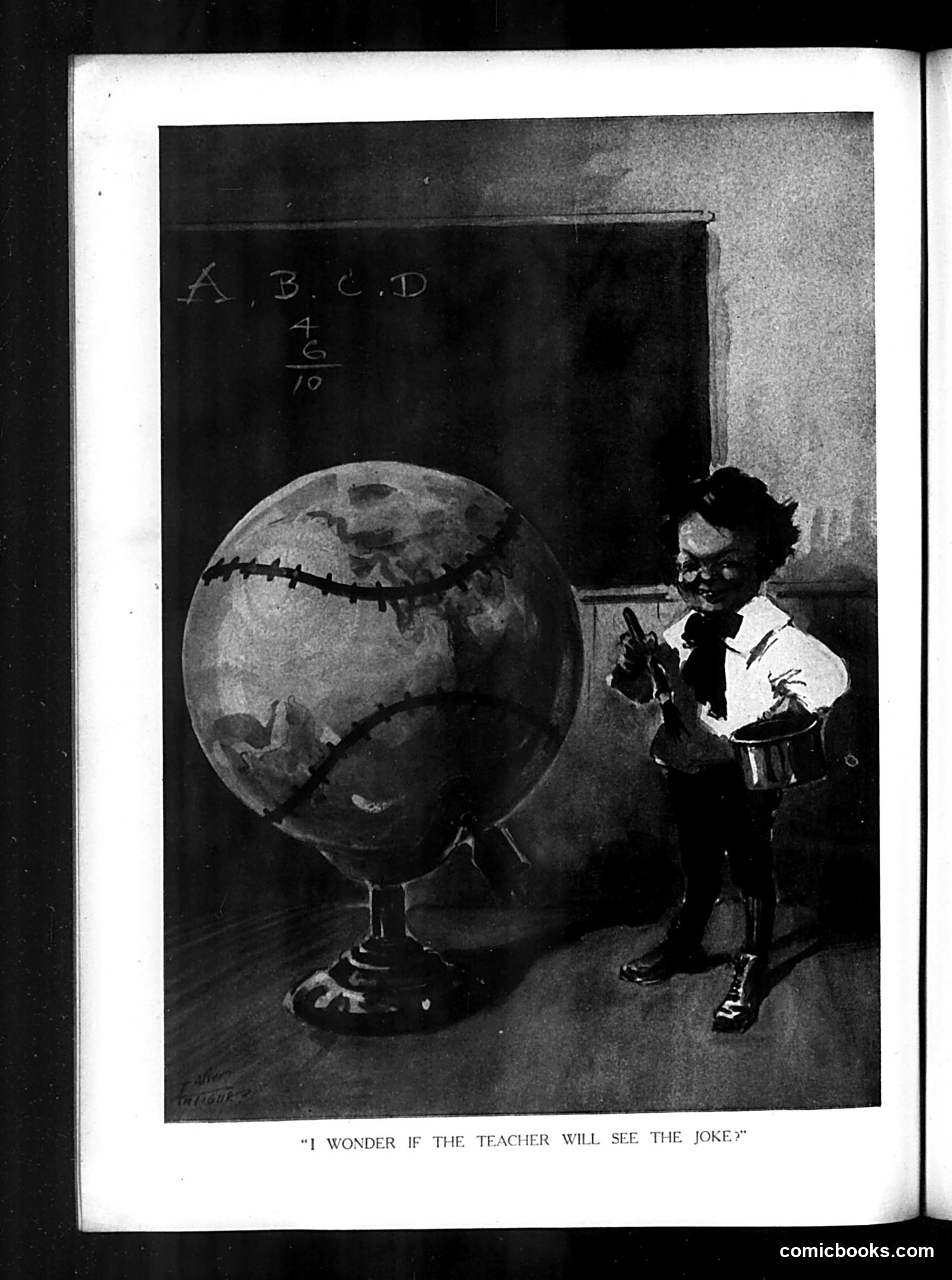
This cartoon depicts a mischievous student who has drawn a face on a large globe—specifically stitching lines across it like a grotesque or skull-like visage. The student stands before the globe in a classroom setting, with a blackboard behind showing "A, B, C, D" and what appears to be lesson notes. The joke's humor relies on the student's prank: defacing educational equipment by giving the Earth an absurd, menacing appearance. The caption "I Wonder if the Teacher Will See the Joke?" suggests the student doubts whether the authority figure will appreciate this act of vandalism or merely punish it. This reflects common early 20th-century school humor—the tension between student mischief and institutional discipline. The cartoon satirizes both youthful irreverence and the rigid classroom environment, likely resonating with *Judge* magazine's adult readership who remembered such pranks.
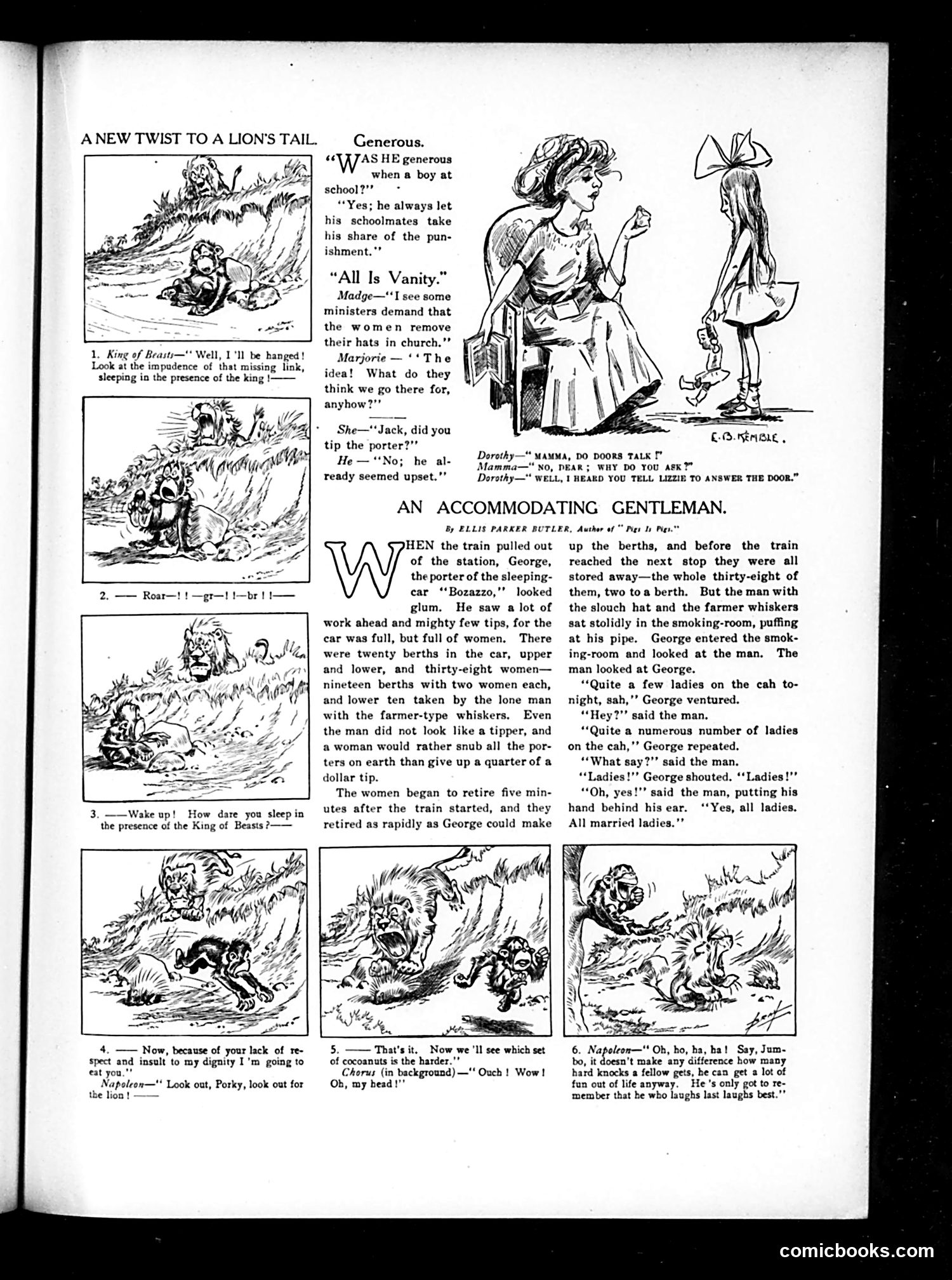
This page contains two distinct pieces of content: **"A New Twist to a Lion's Tail"** (left side) is a comic strip where a lion confronts a sleeping man, demanding respect. The man is identified as "Napoleon," and the narrative suggests a humorous reversal—the supposedly dignified "King of Beasts" is insulted by this human. The lion threatens to eat him, but Napoleon philosophizes that hardship teaches resilience and laughter. "Twist to a lion's tail" was a common phrase meaning to provoke or mock British authority; here it appears to mock Napoleon's pretensions instead. **"An Accommodating Gentleman"** (right side) is a short story illustrated by E.D. Kemble. It depicts a train porter named George attempting to make conversation with a taciturn farmer-passenger to secure a tip. The farmer is nearly deaf and misunderstands George's comments about the female passengers. The humor derives from the communication breakdown and the farmer's apparent indifference to George's social efforts—a satire on failed attempts at flattery and tipping culture. The page also includes brief joke snippets on social topics: women's hats in church, children's misunderstandings, and generosity.
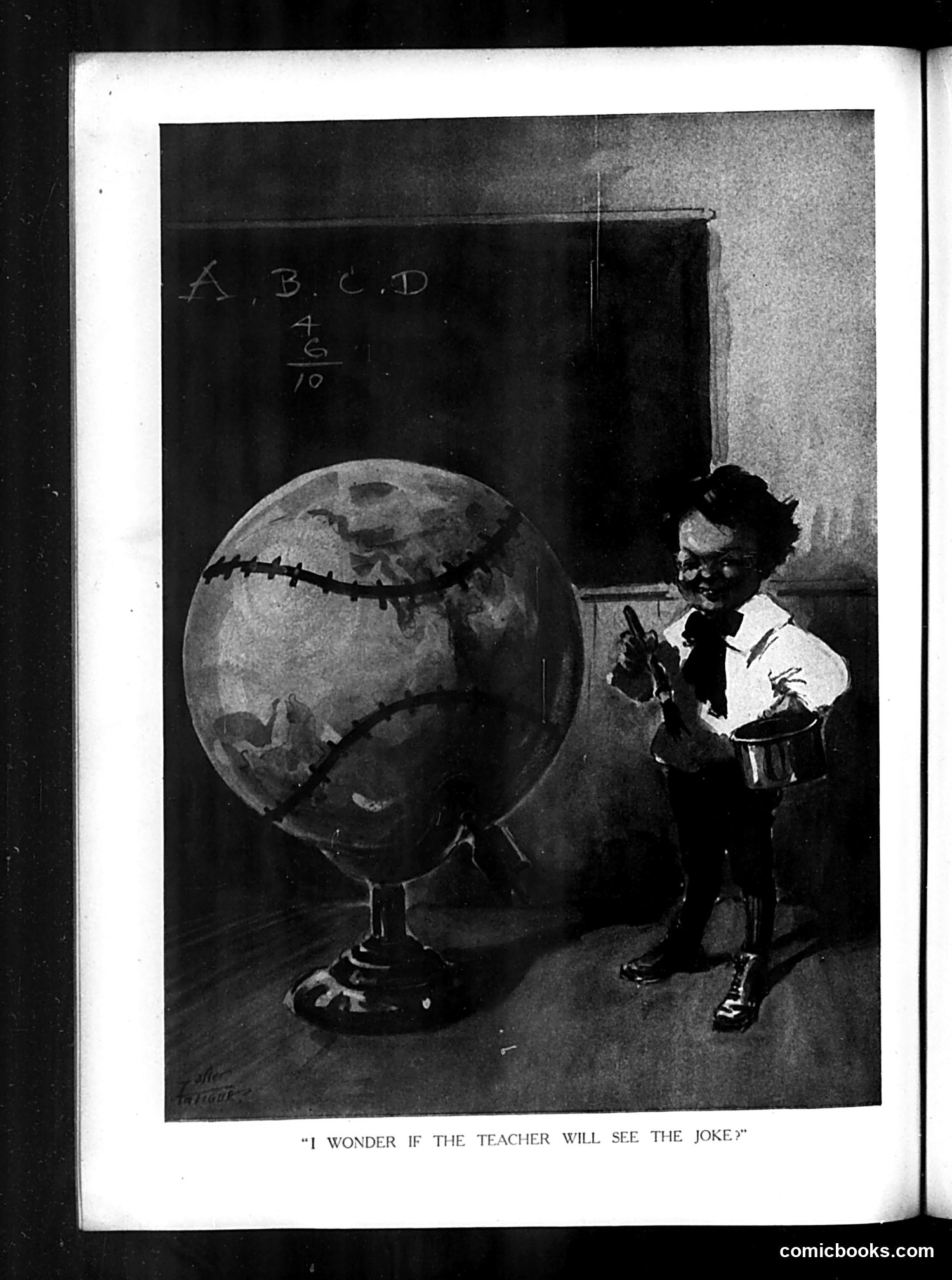
This cartoon shows a child who has drawn a crude face on a globe with a line of stitches across it, creating a grotesque appearance. The caption reads "I WONDER IF THE TEACHER WILL SEE THE JOKE?" The humor appears to target either the child's crude prank or, more likely, the teacher's intelligence—suggesting the teacher might miss or fail to understand the "joke" of defacing the educational globe. The visible letters "A, B, C, D" on the blackboard reinforce this is a classroom setting. The satire likely mocks either schoolchildren's mischief or, alternatively, teachers' lack of perception. The stitched mouth particularly suggests the globe has been deliberately mutilated to look monstrous—a prank the child hopes will go unnoticed or appreciated by authority figures.
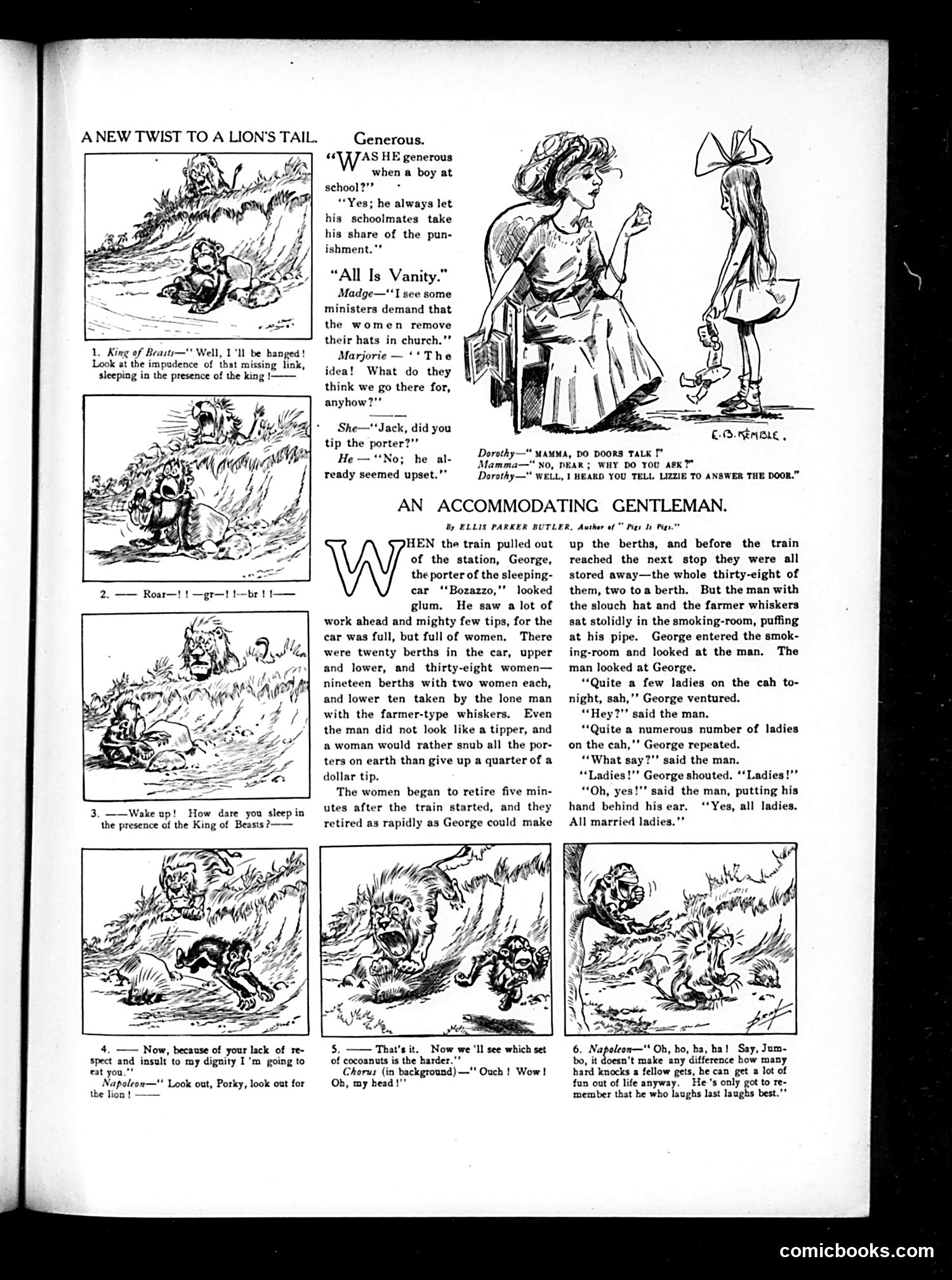
This Judge magazine page contains three distinct pieces: **"A New Twist to a Lion's Tail"** (comic strip): A lion encounters a sleeping man and demands respect, threatening to eat him for his insolence. The title's reference to "twisting a lion's tail" was a common phrase for mocking British authority—here applied to a man who refuses to be intimidated by the beast's threats. The humor lies in the man's indifference to the king of beasts' posturing. **Three brief joke items** ("Generous," "All Is Vanity," "Mamma, Do Doors Talk?"): These are simple gag items satirizing social hypocrisy and children's literalism—ministers objecting to women's hats in church while women attend primarily for fashion display; a child misinterpreting the phrase "answer the door." **"An Accommodating Gentleman"** (short story by Ellis Parker Butler): A porter attempts to engage a deaf, rural passenger about the numerous female travelers on a sleeping car, hoping for conversation. The passenger's hearing difficulty and the porter's frustrated attempts at communication provide comedic irony rather than sharp social satire.
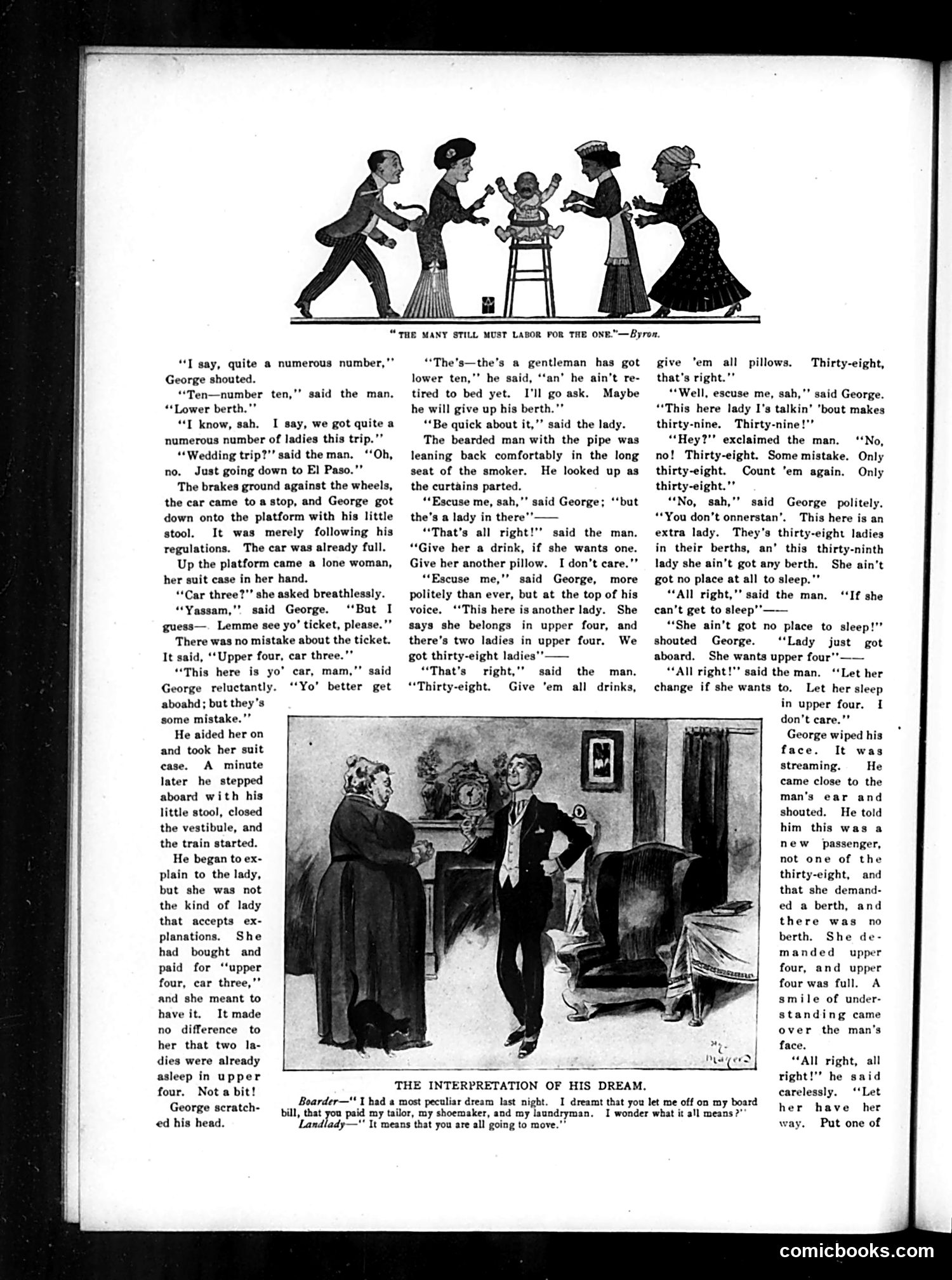
This page satirizes railroad passenger accommodation problems, likely from the early 1900s. The main cartoon depicts a porter (George) struggling to explain to a drunk or indifferent male passenger that a newly-boarded woman needs a berth, but the car is completely full with thirty-eight ladies already. The man keeps miscounting or dismissing the problem until George finally gets through to him. The satire targets **casual male obliviousness** to women's practical needs and the absurdity of overcrowded rail travel. The secondary joke at bottom mocks a deadbeat boarder who dreams his landlady has forgiven his debts—she responds it means he's about to be evicted. The cartoons together reflect turn-of-century concerns: transportation logistics and the social friction between genders in shared public spaces.
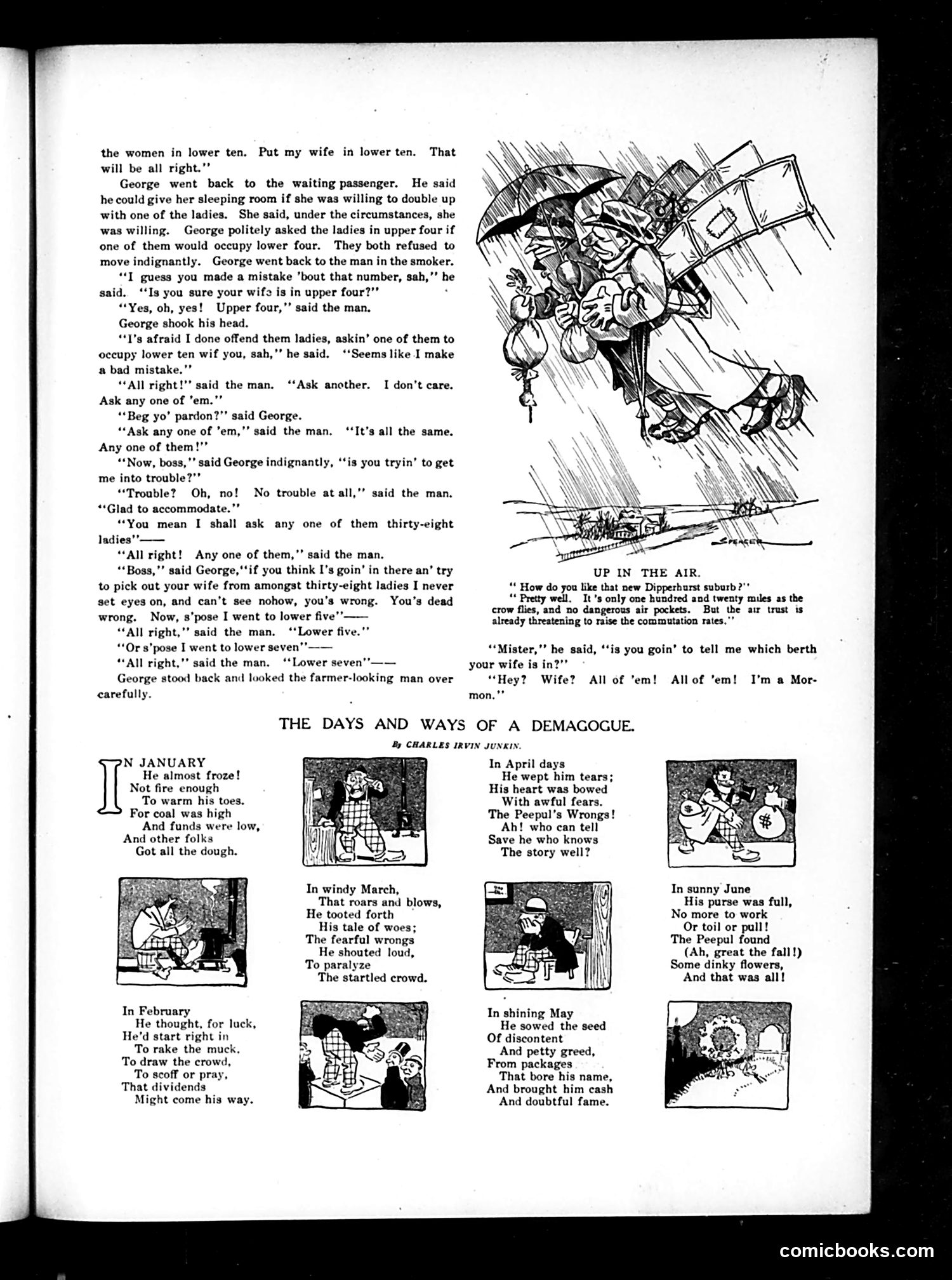
**Upper Story ("Up in the Air"):** A porter named George navigates an absurd encounter with a farmer-like man who claims to have put his wife in an upper berth but then insists any of thirty-eight ladies will do—suggesting he's either lying about having a wife or doesn't care which woman he's assigned to. The joke satirizes either marital indifference or outright deception. A sidebar mocks a new suburb "Dipperhurst," joking that despite being 120 miles away, residents already face an "air trust" threatening to raise commutation rates—early satire of emerging air travel monopolies and suburban sprawl. **Lower Section ("The Days and Ways of a Demagogue"):** This illustrated poem by Charles Irvin Junkin traces a cynical political operator's yearly cycle: freezing in January (poor), ranting about injustices in March, faking reform in February, weeping crocodile tears in April, sowing discontent in May, and by June—having collected donations and gained fame—abandoning his causes for leisure. It's a biting critique of demagogues who exploit public grievances for personal profit.
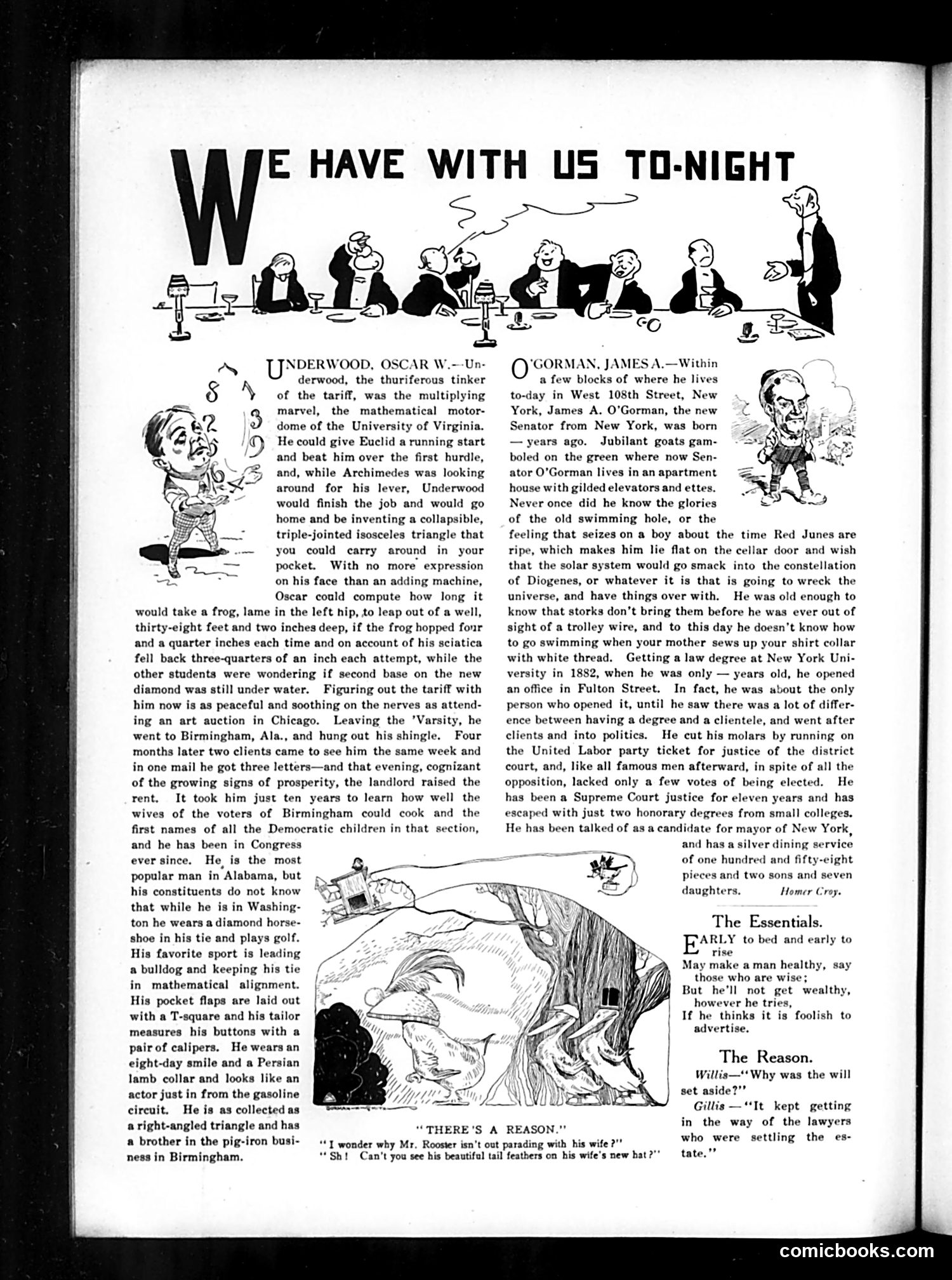
This Judge magazine page ridicules two newly elected senators through mock biographical sketches: **Oscar W. Underwood** (Alabama) is caricatured as a mathematical prodigy obsessed with tariff calculations and personal fastidiousness — his tie kept in "mathematical alignment," buttons measured with calipers. The satire mocks his rise from poverty to Congress by emphasizing his obsessive, emotionless demeanor and the disconnect between his public persona (popular in Alabama) and his elite pretensions (wearing diamond horseshoes, playing golf). **James A. O'Gorman** (New York) is portrayed as a social climber who escaped poverty to become a lawyer and senator, yet remains socially naive — not knowing how to swim or understand childhood rural experiences. The satire implies his political success came through ambition rather than genuine accomplishment. The cartoon's title promises entertaining "guests," suggesting Judge's audience enjoyed seeing prominent politicians publicly deflated through exaggerated character sketches emphasizing their flaws, pretensions, and humble origins.
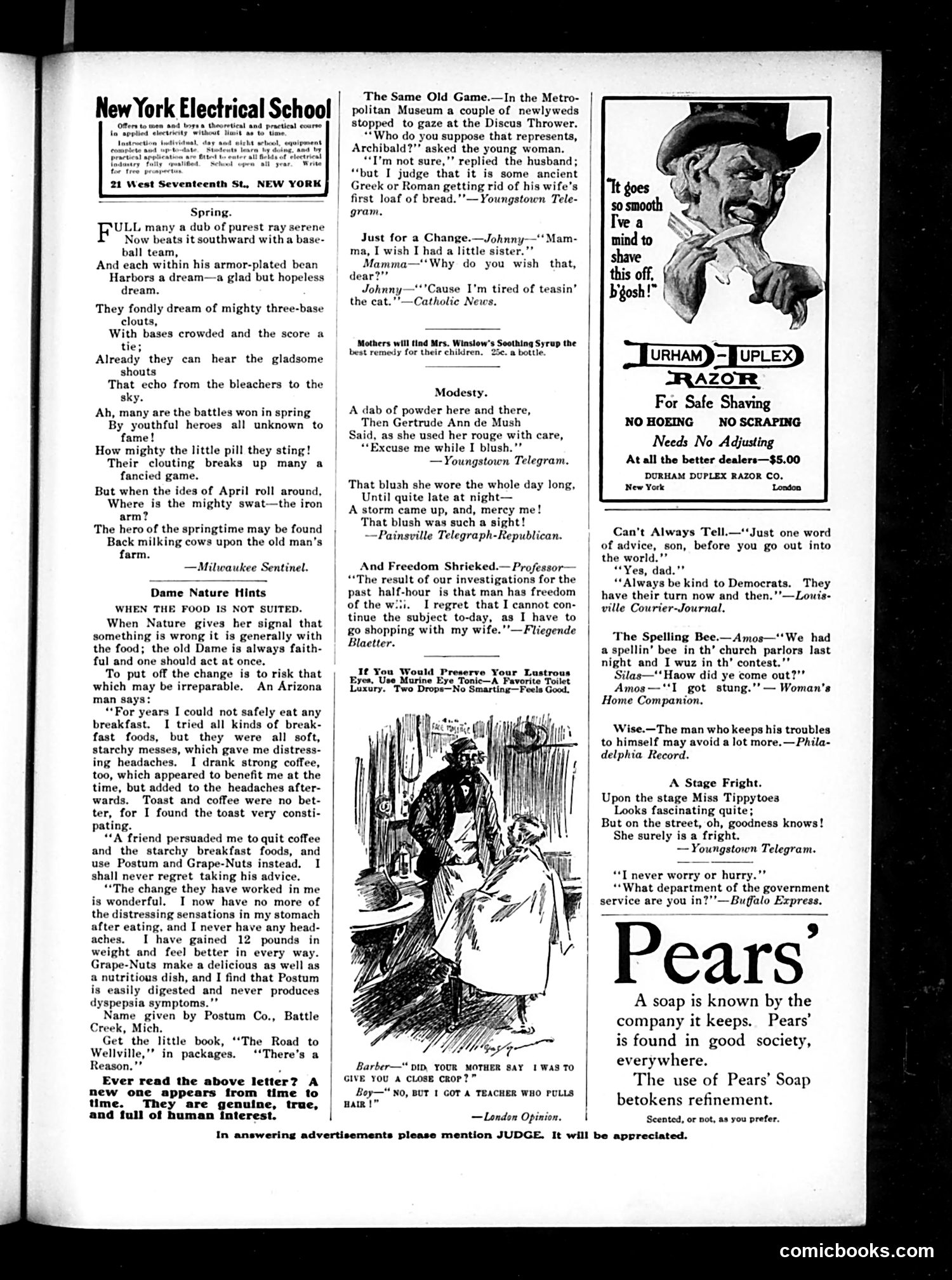
This page from *Judge* magazine contains primarily **humorous short jokes and advertisements** rather than political cartoons requiring historical context. The content includes: 1. **"Spring"** poem mocking amateur baseball players whose springtime dreams of glory fade when they return to farm life by April—a gentle satire on youthful illusions. 2. **"Dame Nature Hints"** — a testimonial (likely paid advertising disguised as editorial) promoting Postum cereal and Grape-Nuts as digestive aids, claiming they cured headaches and constipation. 3. **Various short jokes** about newlyweds, children, and social pretense (a woman's artificial blush washing away in rain). 4. **Advertisement for Durham-Duplex Razors** and **Pears' Soap**. The page reflects early 1900s concerns: digestive health anxiety, amateur athletics, and product advertising. The humor is gentle domestic comedy rather than sharp political satire—typical of *Judge*'s lighter content mixed with advertising revenue.
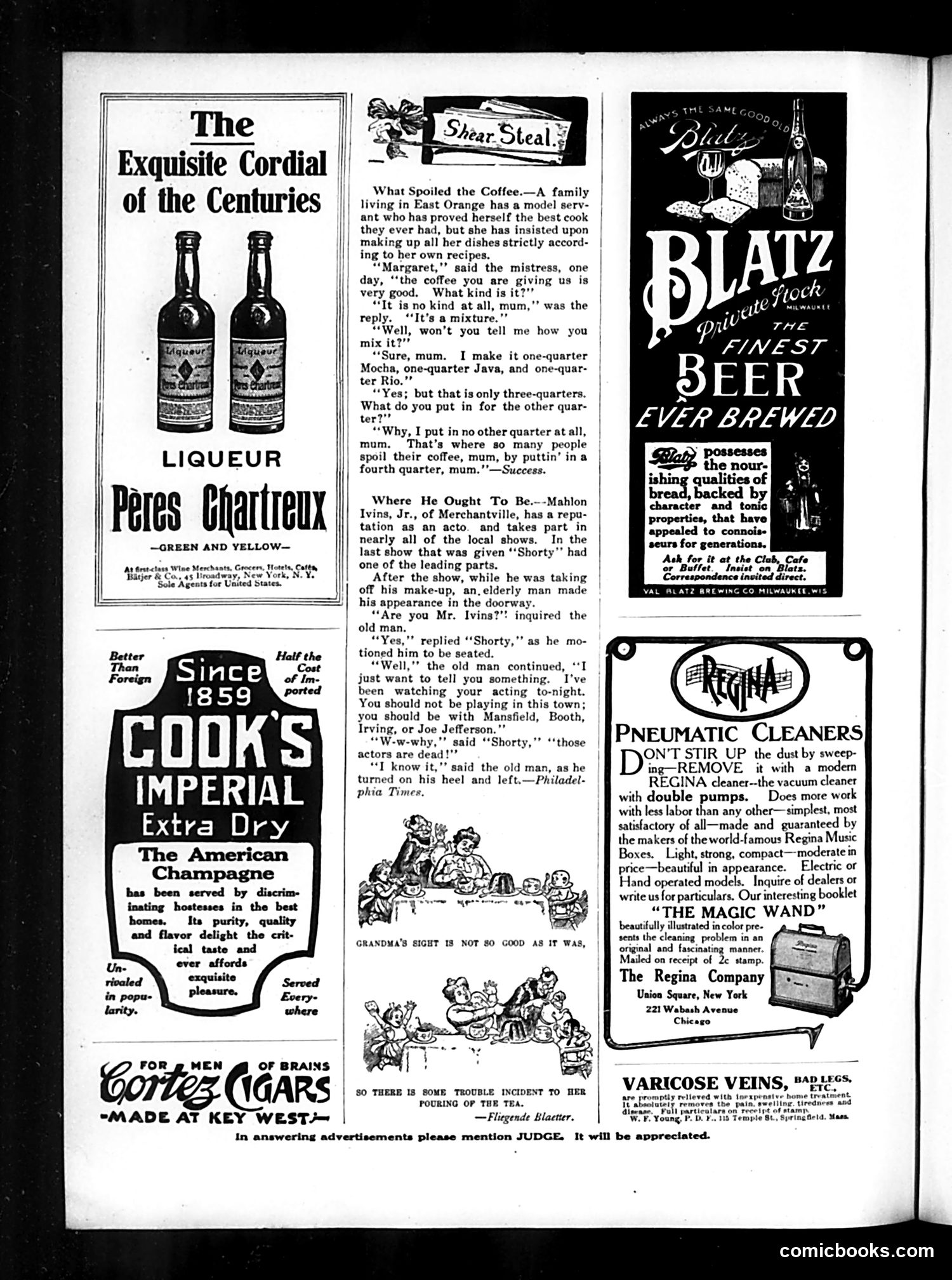
This is primarily a **advertisements page** from Judge magazine, with two brief humorous anecdotes interspersed. **The humor pieces:** 1. "What Spoiled the Coffee" — A servant's illogical explanation: she mixes coffee from three varieties (Mocha, Java, Rio) but refuses to add a fourth ingredient, claiming *that's* where people spoil coffee. The joke is her backwards reasoning. 2. "Where He Ought To Be" — An elderly man compliments an amateur actor (Mahlon Ivins Jr.), saying he should perform alongside famous actors Mansfield, Booth, and Irving. When "Shorty" protests those actors are dead, the old man replies he knows it and leaves. The joke: the compliment is actually an insult—he belongs with the dead. **The advertisements** promote luxury goods (Chartreaux liqueur, Cook's champagne, Blatz beer, Regina vacuum cleaners with "double pumps"), and Cortez cigars "for men of brains." These reflect early 20th-century consumer products targeting affluent readers. No political satire is present on this page.
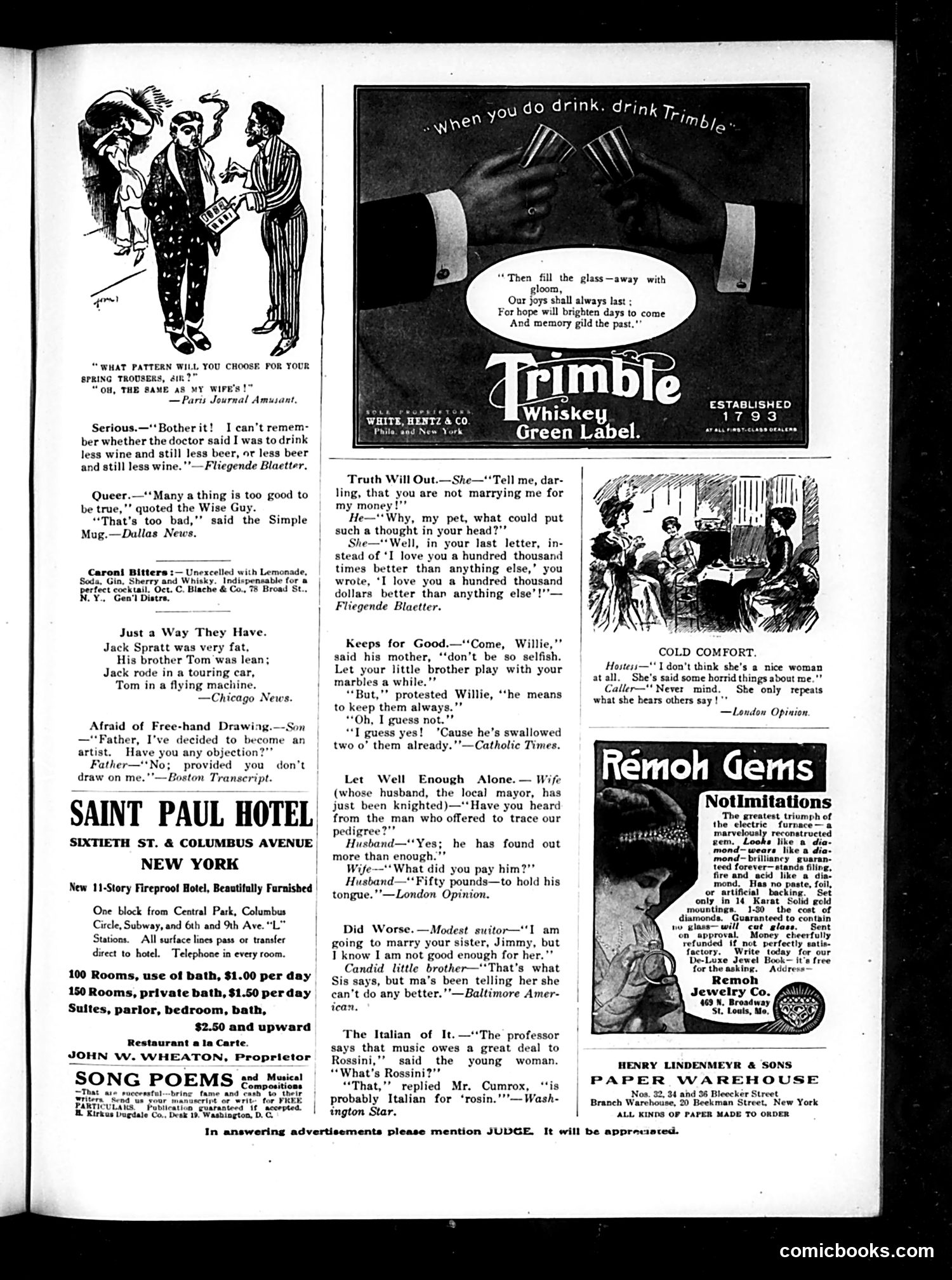
This page is primarily **advertising and humor snippets** rather than political cartoons. The top-left cartoon shows a man asking about trouser patterns, with the punchline referencing his wife's clothing choices—a mild domestic joke about marital conformity. The page consists mostly of **short humorous anecdotes** (called "quips") on everyday topics: drinking advice, relationships, sibling rivalry, marriage deceptions, and social pretensions. These reflect early 20th-century middle-class concerns and stereotypes. Notable examples: a wife catches her husband claiming to love her "a hundred thousand dollars" better rather than "times"; a child swallows marbles; a woman pays a genealogist to stop tracing her pedigree. The advertisements include a hotel, whiskey, jewelry, and sheet music—typical of Judge's commercial content. **The satire targets** petty domestic absurdities, social climbing, marital dishonesty, and class anxieties rather than political figures or events. This represents Judge's lighter content pages.
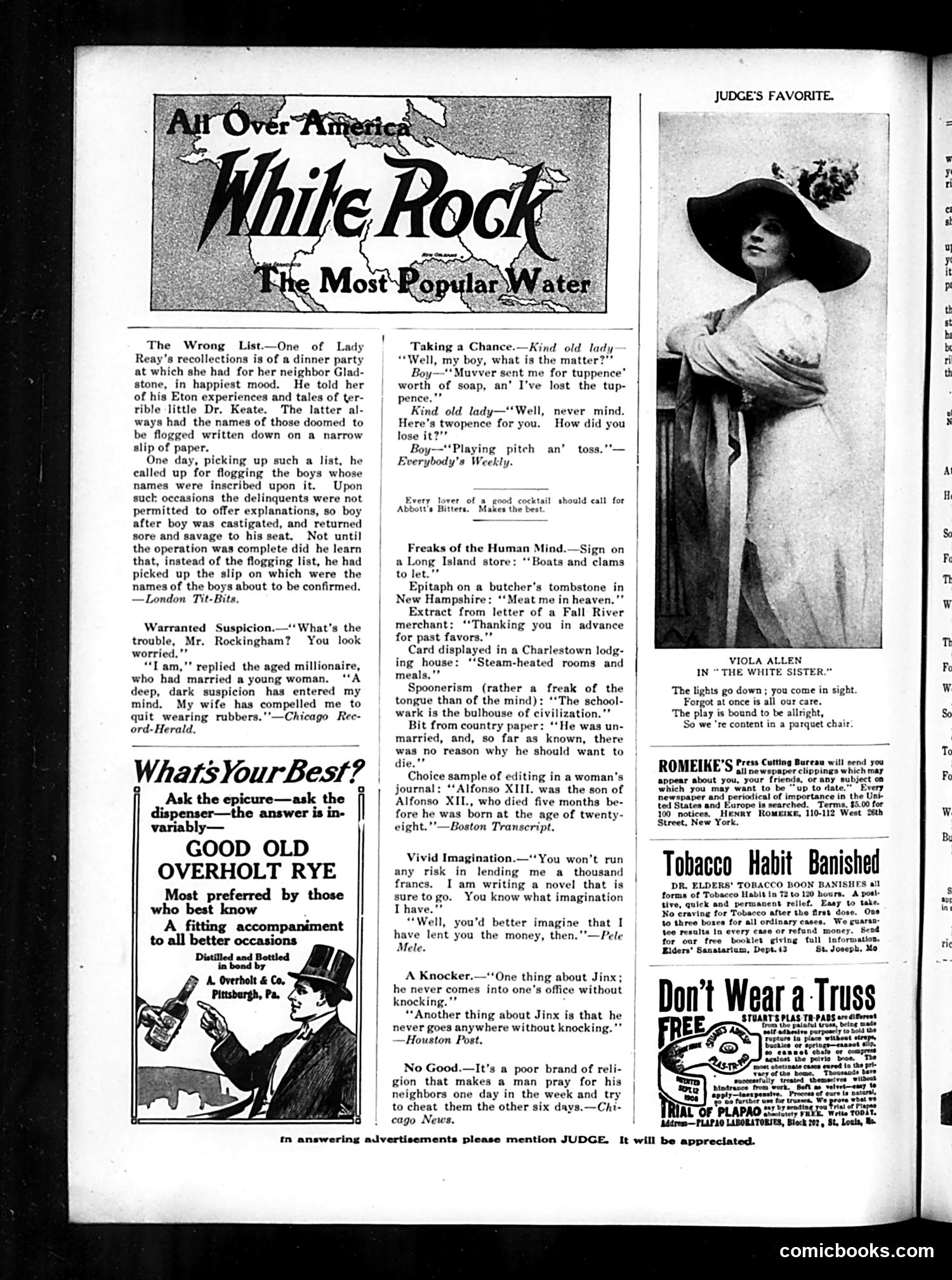
This page from *Judge* magazine contains primarily **humor pieces and advertisements** rather than political cartoons. The content includes several brief anecdotes and jokes typical of early 20th-century satirical magazines: - "The Wrong List" recounts a story about William Gladstone's schooldays, when a headmaster mistakenly flogged boys on a confirmation list instead of a flogging list - "Warranted Suspicion" jokes about a wealthy older man suspicious his young wife married him for money - "Taking a Chance" features a boy losing soap money - "Freaks of the Human Mind" collects amusing typos and malapropisms from various sources The page also includes **advertisements** for Overholt Rye whiskey, Abbott's Bitters, and various services. **The right side features** a photograph and praise for actress Viola Allen in "The White Sister," along with ads for a press-clipping bureau and tobacco cessation remedies—typical commercial content of the era. The humor relies on wordplay, Irish bulls, and gentle social observation rather than pointed satire.
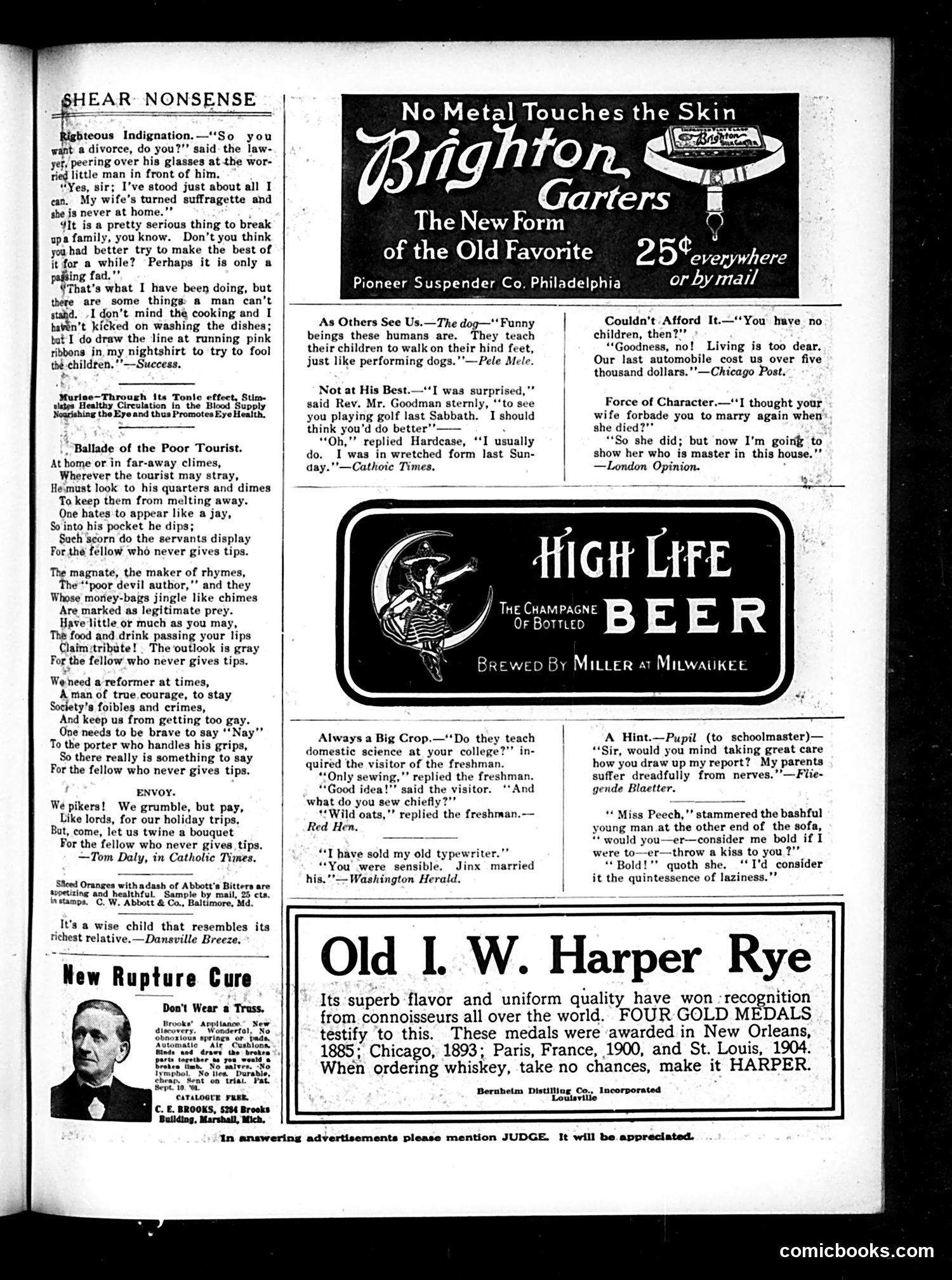
This page contains satirical humor and advertisements typical of early 1900s Judge magazine. The main content consists of short comic anecdotes mocking contemporary social issues: **Key Satire Topics:** - **Women's suffrage**: A husband seeks divorce because his wife became a suffragette and won't stay home, noting she decorates his nightshirt with pink ribbons (suffragette colors) - **Tipping culture**: A poem criticizing the expectation to tip servants generously while traveling - **Class anxiety**: Jokes about the wealthy being "marked as legitimate prey" by service workers **Notable Anecdotes:** - A clergyman criticizing golf on Sunday; the golfer replies he "was in wretched form" - A couple without children claiming they can't afford them due to expensive automobiles - A freshman claiming to sew "wild oats" in domestic science class The advertisements—for garters, beer, whiskey, and a rupture cure—are period-typical. The humor targets middle-class anxieties about social change, particularly women's independence and economic pressures.
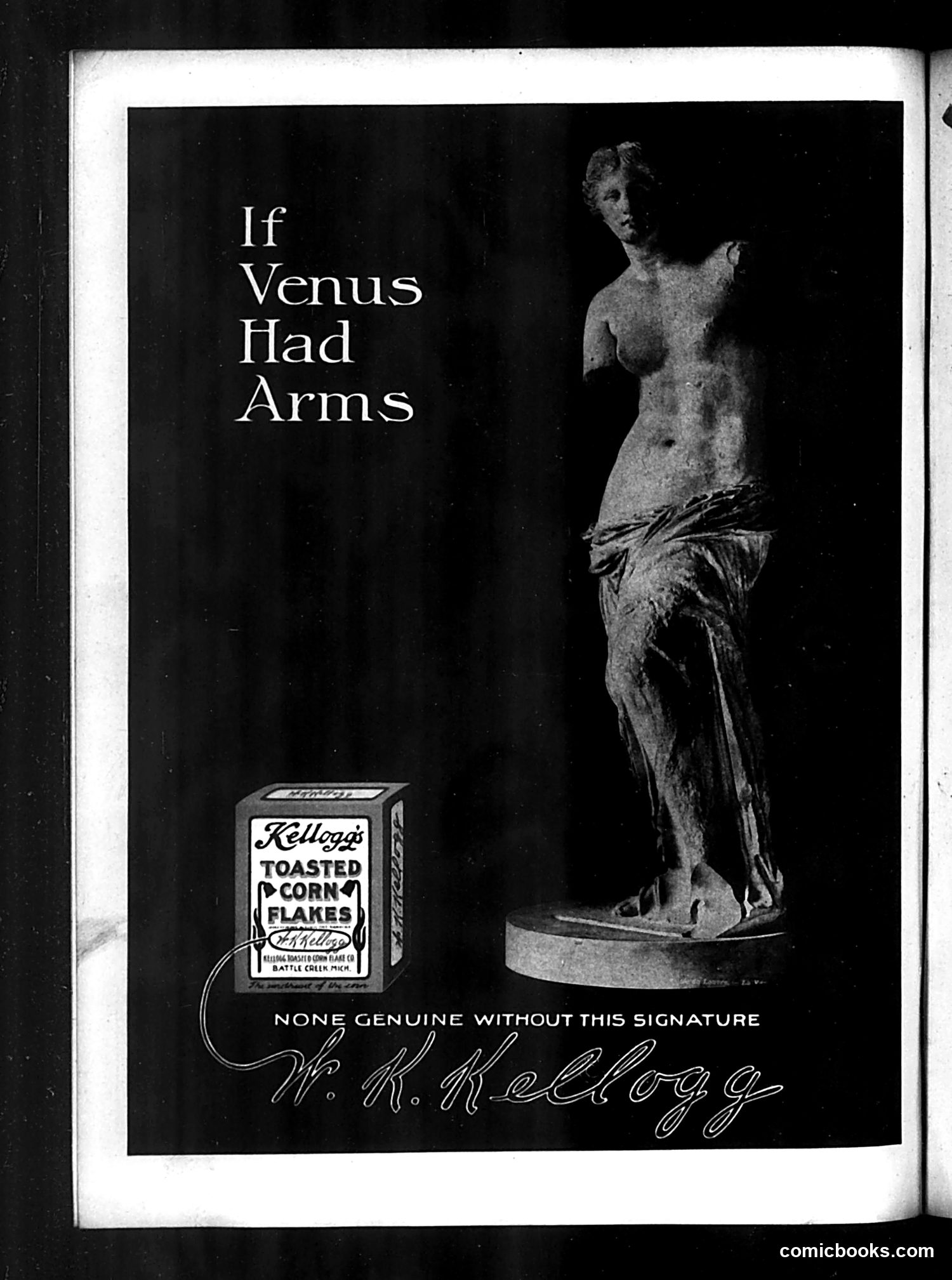
This is a **Kellogg's Toasted Corn Flakes advertisement**, not a political cartoon. The image presents a classical statue of Venus de Milo (the famous armless Greek sculpture) alongside a cereal box. The advertisement's headline—"If Venus Had Arms"—is a playful visual joke suggesting that if the iconic statue possessed arms, they might hold a box of Kellogg's cereal. This is straightforward product advertising using classical art as a humorous reference point. The signature line "None Genuine Without This Signature" emphasizes brand authenticity and was a common advertising practice of the era to combat counterfeit products. There is no political or social satire present—this is purely commercial advertising leveraging art history for consumer appeal.