
A complete issue · 24 pages · 1911
Judge — March 18, 1911
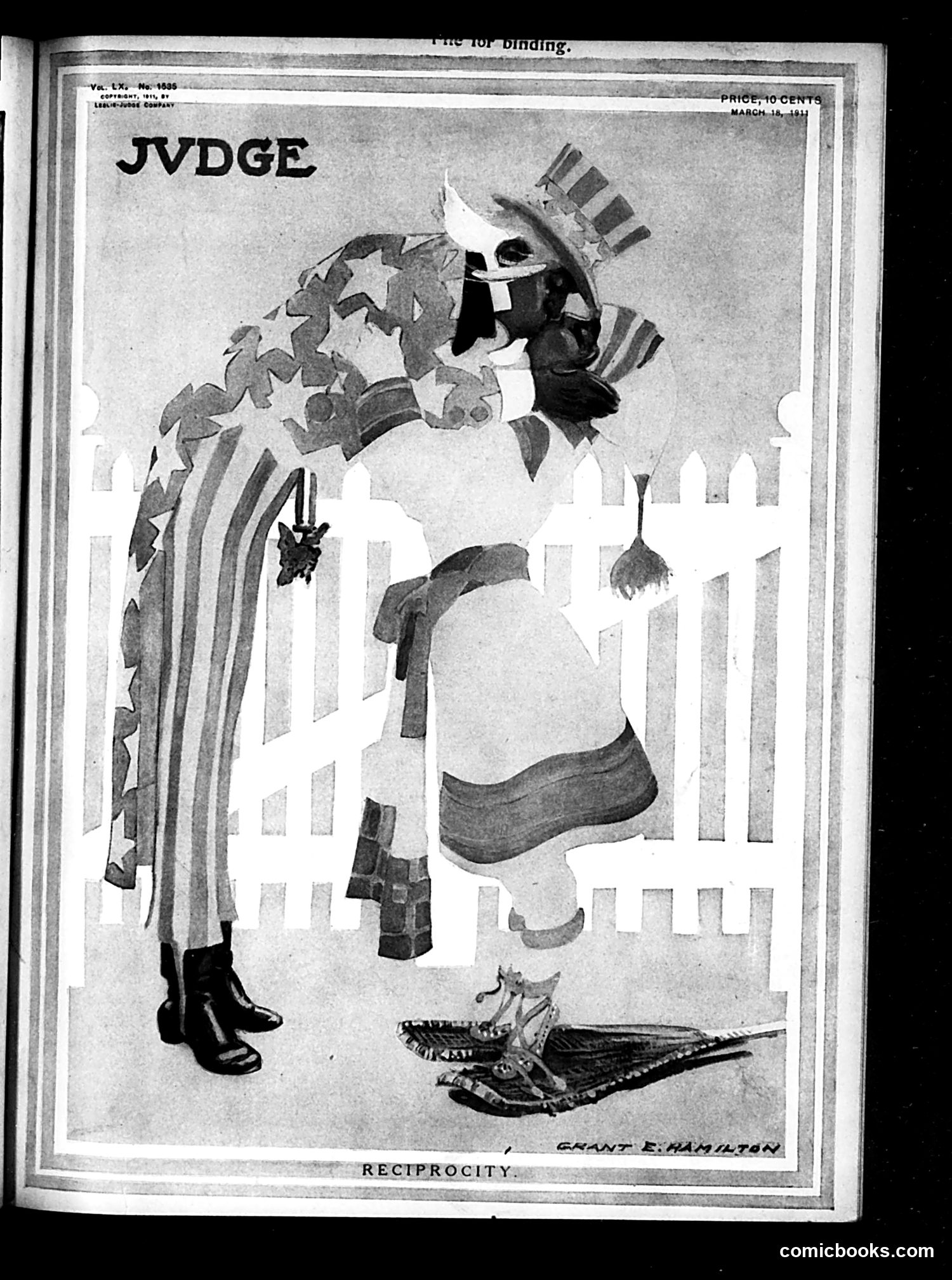
This cover cartoon titled "Reciprocity" depicts a woman in patriotic American dress (Uncle Sam-style clothing with stars and stripes) standing at a white fence, appearing to flirt with or beckon to a rooster wearing a top hat and Union Jack-patterned clothing (representing Britain). At her feet lies a dead fish. The satire critiques American-British trade reciprocity negotiations occurring around 1911. The cartoon suggests America is foolishly courting British interests through trade agreements. The dead fish likely symbolizes the "catch" or loss resulting from such dealings. The rooster's anthropomorphic presentation adds mockery to British pretensions, while America's feminine personification emphasizes perceived weakness in accepting unfavorable terms.
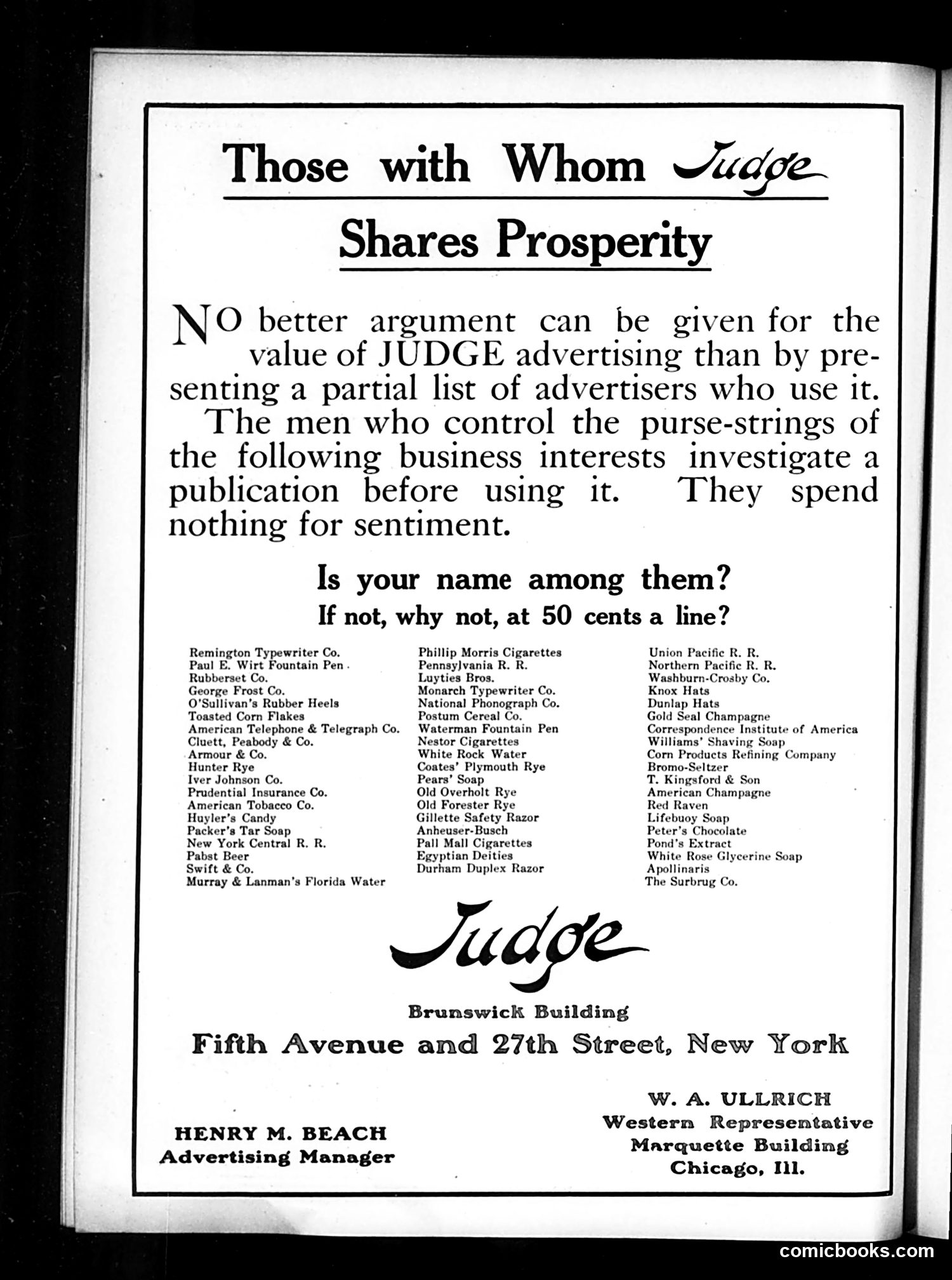
This page is **primarily advertising**, not editorial content or satire. The headline "Those with Whom Judge Shares Prosperity" is a marketing pitch for Judge magazine's advertising rates (50 cents per line). The advertisement lists prominent companies—Remington Typewriter, Phillip Morris Cigarettes, Gillette Safety Razor, and others—as advertisers in Judge. The implicit sales argument: if these respected, successful businesses trust Judge with their advertising, potential advertisers should too. The phrase "investigate a publication before using it" suggests Judge's credibility with major commercial interests. The contact information lists the advertising manager (Henry M. Beach) and western representative (W.A. Ullrich), confirming this is a straightforward business solicitation rather than political or social satire.
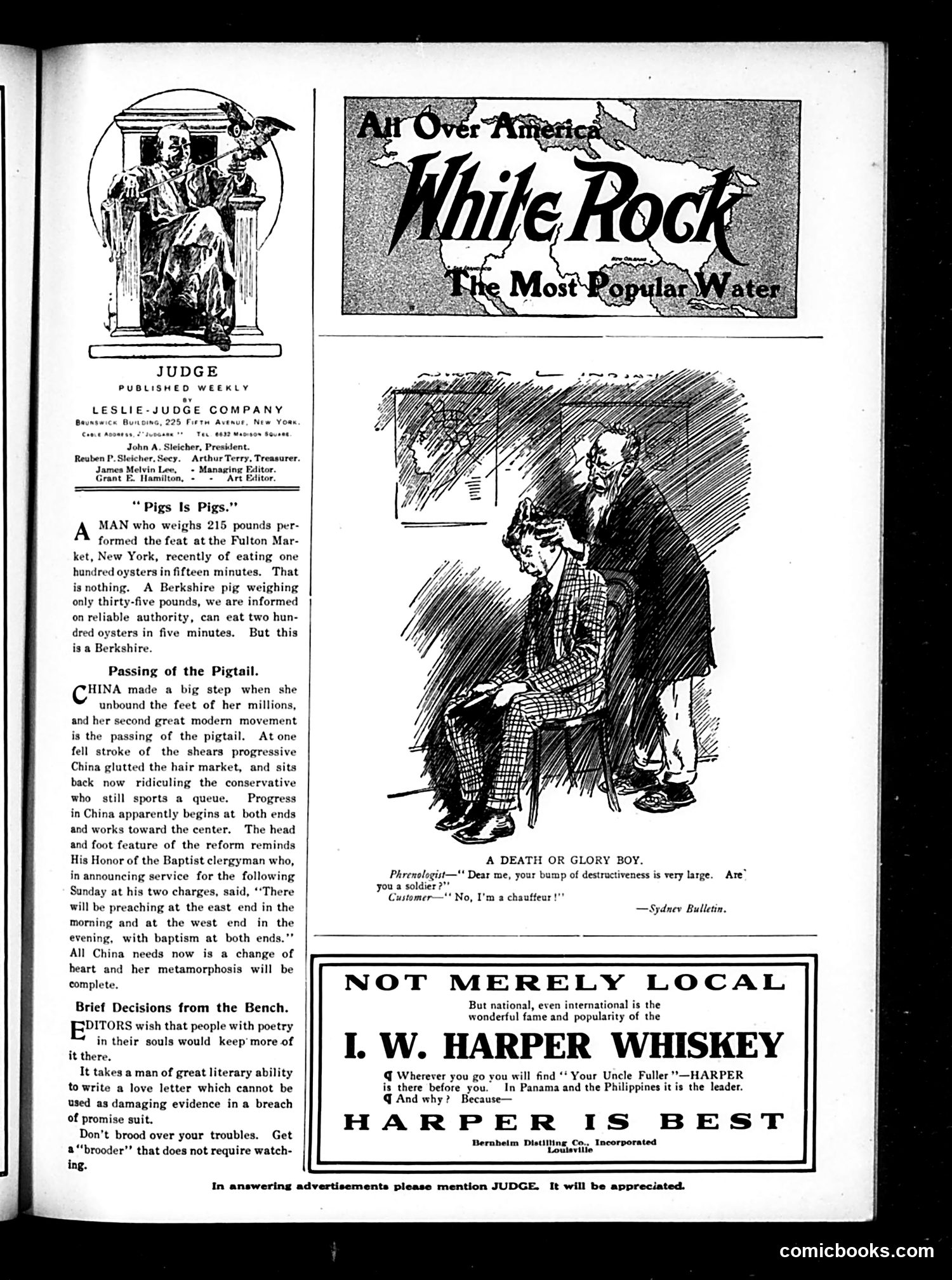
This page is primarily **advertising and filler content** rather than political commentary. The main cartoon, titled "A Death or Glory Boy," depicts two figures in conversation—one seated in tattered clothing, the other standing. The caption presents a brief dialogue where one character claims to be a "chasteur" (likely "chasseur"—a soldier). This appears to be **generic humor about military life** rather than specific political satire. The page includes advertisements for **White Rock water** and **I.W. Harper whiskey**, plus brief editorial items about pigs, Chinese pigtails, and literary ability—typical Judge filler material. Without clear identification of specific political figures or dated events, the cartoon's precise satirical intent remains unclear to modern readers.
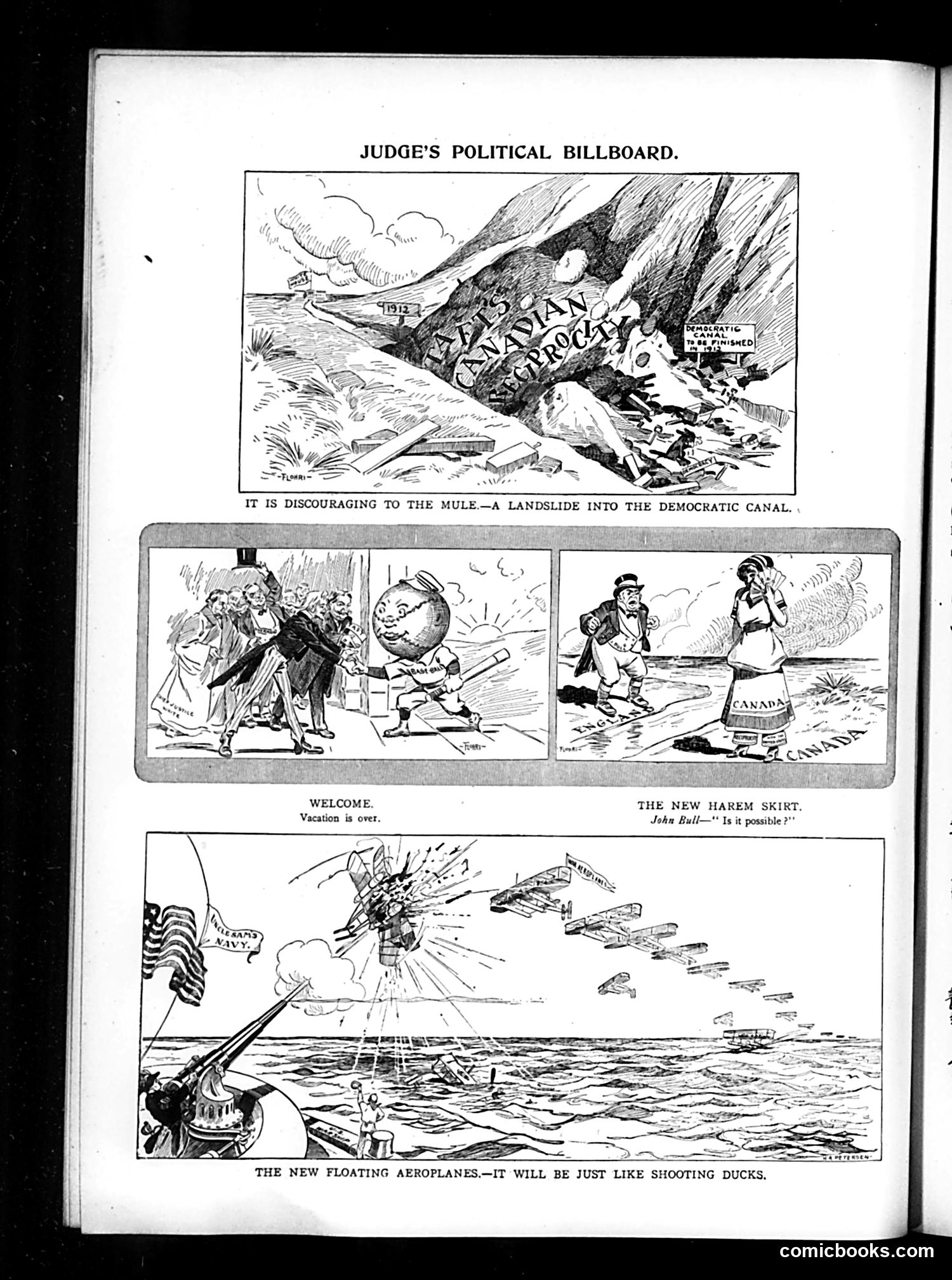
This page presents three political cartoons satirizing early 20th-century events: 1. **"Judge's Political Billboard"** (top): Shows a landslide labeled "Canadian Reciprocity" burying a mule into the "Democratic Canal," mocking Democratic support for Canadian trade reciprocity as politically damaging. 2. **"Welcome/New Harem Skirt"** (middle): Two panels depicting vacation's end and John Bull (Britain) questioning if a "new harem skirt" is feasible, likely satirizing fashion trends or British imperial concerns. 3. **"Floating Aeroplanes"** (bottom): Military aircraft dropping bombs into water, with the caption comparing this to "shooting ducks"—appearing to mock the practicality of early naval aviation warfare. The cartoons employ caricature and visual metaphor to comment on trade policy, fashion, and military technology circa 1910s.
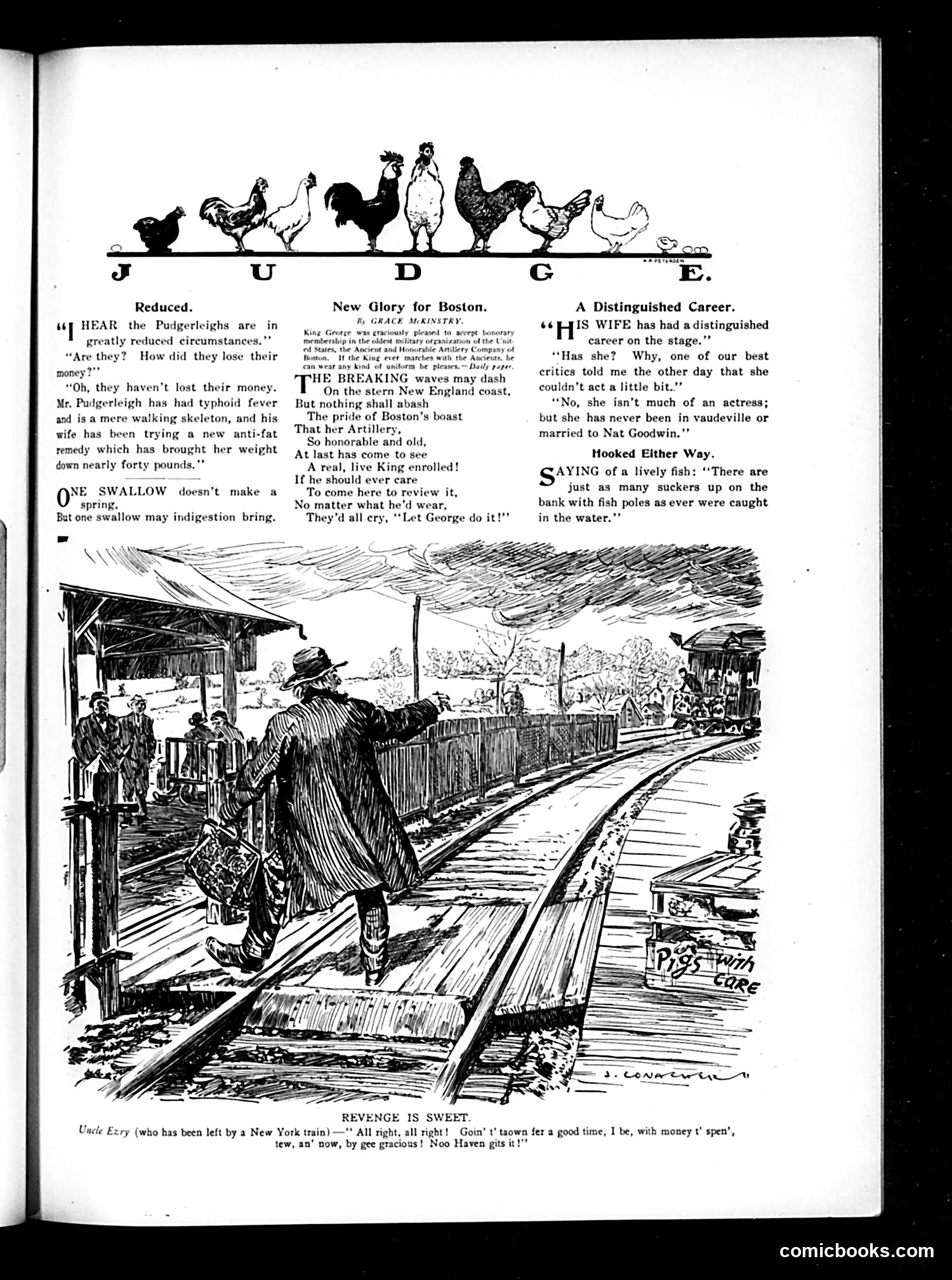
This page contains three satirical pieces: **"Reduced"** mocks the Pouderleighs' financial decline—the husband has typhoid fever and lost weight; they've lost their money. The joke plays on social pretension: they once had status but now lack resources. **"New Glory for Boston"** appears to be verse celebrating someone named King (possibly a theatrical performer) coming to Boston for review, with military/patriotic references suggesting civic pride about a visiting performer. **"A Distinguished Career"** jokes about an actress's credibility—critics say she's talented but has never performed in vaudeville or legitimate theater, questioning her theatrical legitimacy. The bottom illustration shows a railroad scene with "Uncle Ery" (left by a New York train) joking about having money to spend in town—satirizing small-town economic hopes tied to visiting wealth.
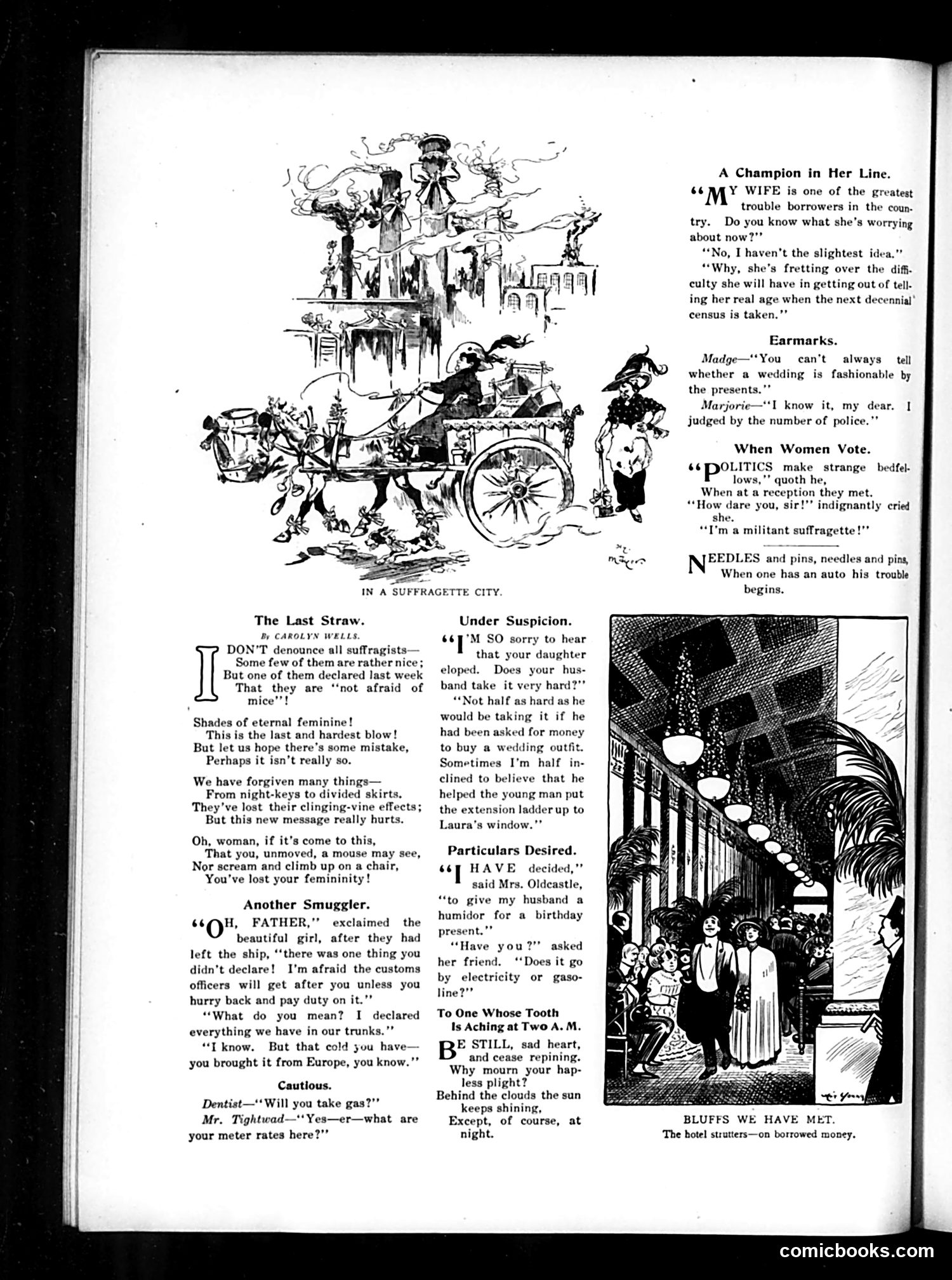
This page satirizes early 20th-century women's suffrage and social changes. The main cartoon "In a Suffragette City" depicts the chaos of women's activism, mocking suffragettes as disruptive and unfeminine. The text pieces reinforce anti-suffrage sentiment. "The Last Straw" jokes that suffragettes claiming fearlessness of mice represent femininity's death—suggesting women's rights advocacy destroys traditional womanhood. "When Women Vote" implies militant suffragettes are hostile and unreasonable. Other jokes mock women's perceived incompetence with modern technology (the humidor "gasoline" joke) and exaggerate their irrationality. The humor relies on portraying suffragettes as simultaneously threatening to male authority and ridiculous. The cartoonist and writers treat women's political organizing as absurd rather than legitimate, a common rhetorical strategy opponents used against the suffrage movement. The overall tone dismisses women's activism as both dangerous and laughable.
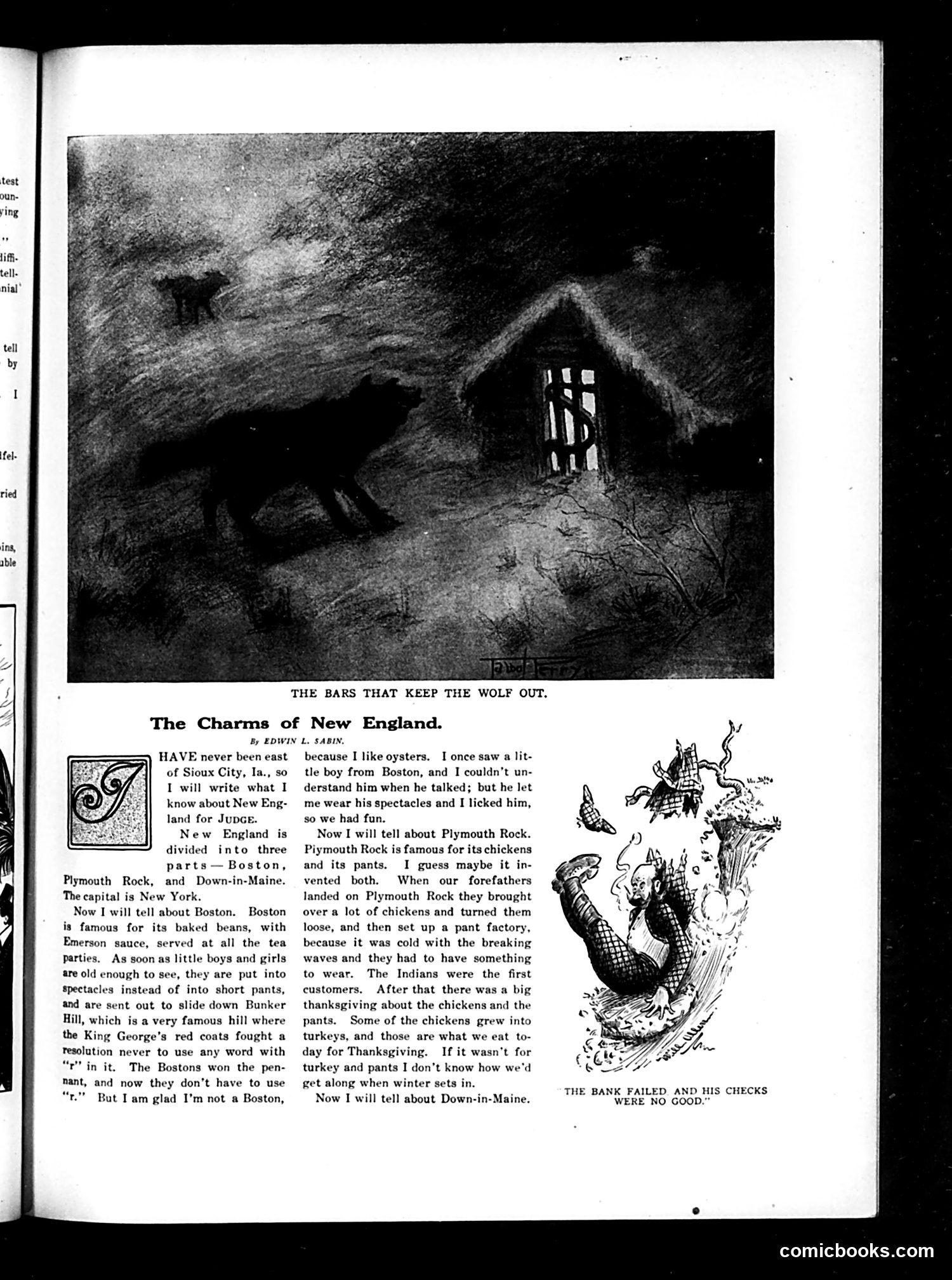
This is a humorous essay by Edwin L. Sabin mocking New England regional stereotypes. The author adopts a deliberately ignorant persona (admitting he's never been east of Iowa) to satirize: **Boston**: Famous for baked beans and tea parties; Bostonians wear spectacles constantly and famously cannot pronounce the letter "r" (a well-known Boston accent joke). **Plymouth Rock**: Associated with the Pilgrims' chickens and pants manufacture; thanksgiving origins. **Maine**: ("Down-in-Maine") Referenced but not yet explained. The top illustration, "The Bars That Keep the Wolf Out," shows a wolf at a cottage door—likely illustrating frontier/rural New England dangers. The sidebar illustration depicts a failed banker, referencing financial scandals common to the era. The satire works through exaggeration of regional characteristics and the narrator's mock-earnest misunderstandings, a common Judge magazine technique for poking fun at American regional pride and peculiarities.
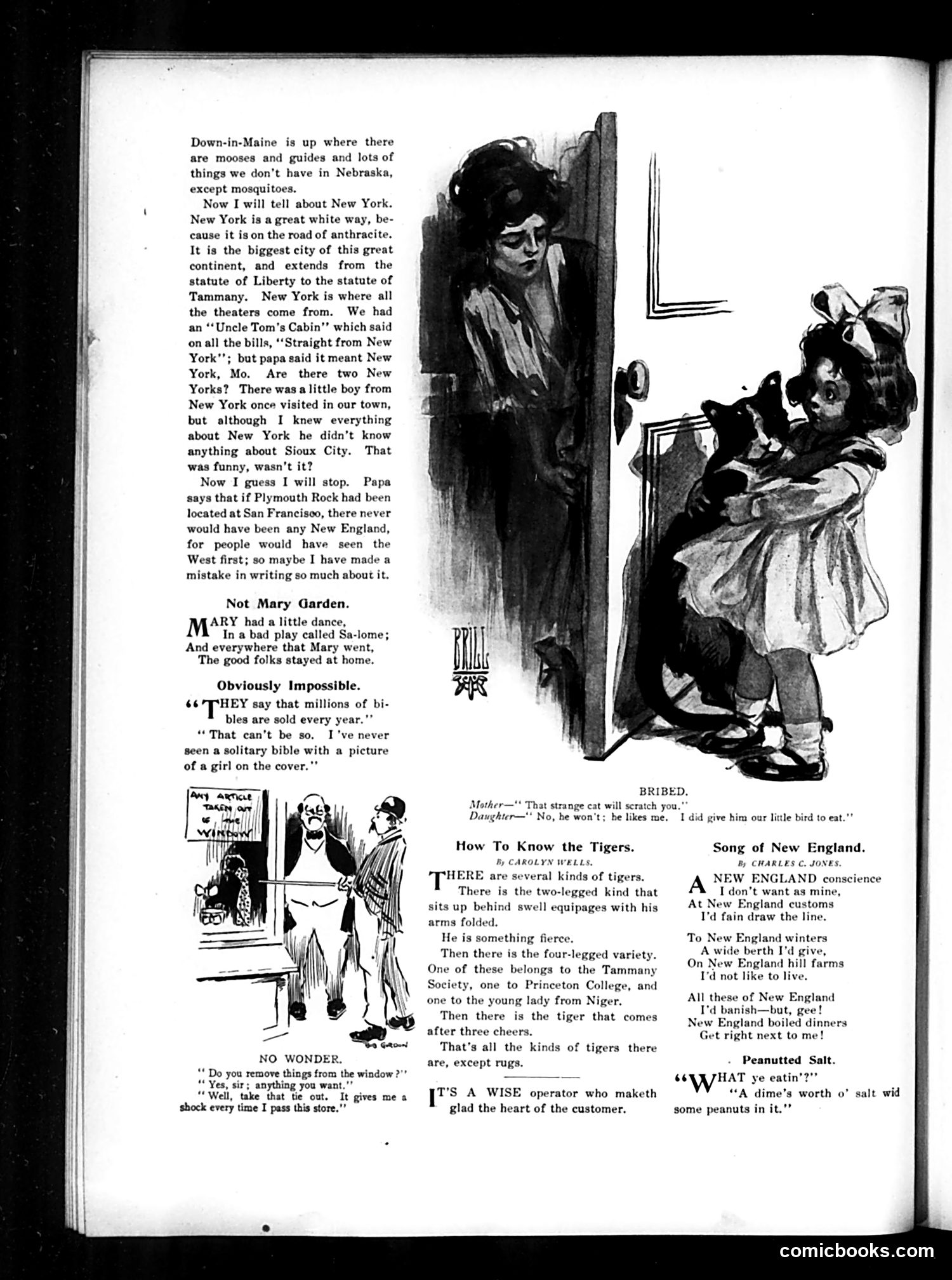
This page contains multiple satirical pieces typical of early 20th-century Judge magazine: **Main narrative** mocks a naive rural narrator describing travels to "New York" and Maine, confusing geographic and cultural references (mixing New York City with New York, Missouri; referencing Tammany Hall as a "statue"). **"Not Mary Garden"** parodies the famous opera singer Mary Garden, suggesting her scandalous role in Salomé drove respectable people away from theaters. **"How To Know the Tigers"** cleverly uses "tigers" as slang for wealthy, fashionable men (the "two-legged kind" in carriages), while referencing Princeton and Tammany Society mascots. **Minor jokes** include a store clerk removing an ugly tie from the window, and a New England resident praising boiled dinners while rejecting other regional traits—mocking both rural simplicity and New England's reputation for austere culture. The humor targets social pretension, regional stereotypes, and contemporary entertainment scandals.
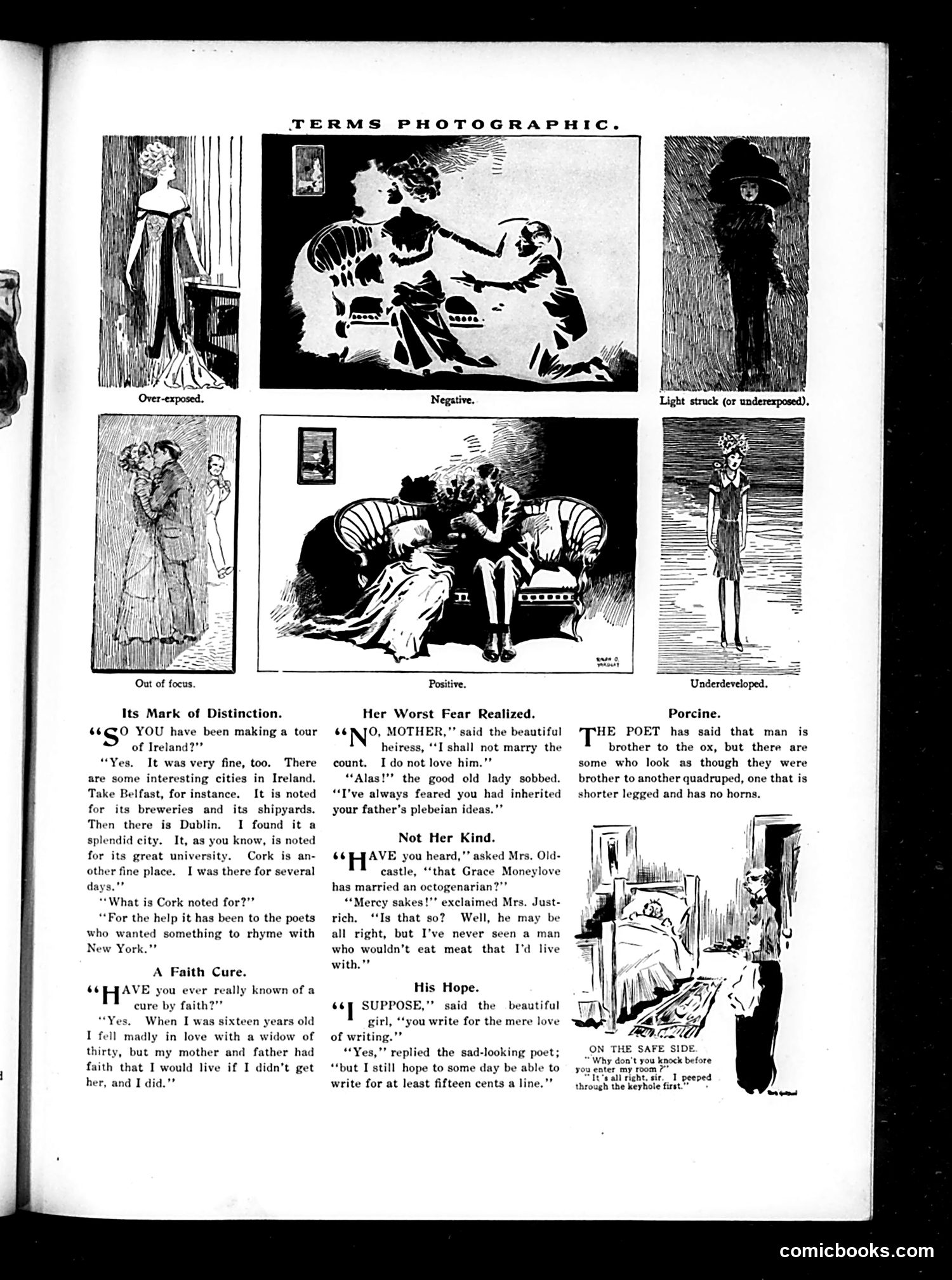
This page features six short humor pieces typical of late 19th/early 20th-century American satire: **The photographic terms section** (top) uses darkroom terminology as metaphors for social types—overexposed people, underdeveloped intellects, etc. **The Irish tourism joke** mocks Cork's association with poets needing rhymes for "New York." **"A Faith Cure"** jokes about parental intervention preventing an unwise romantic match through sheer willpower. **"Her Worst Fear Realized"** satirizes class anxiety: a wealthy heiress's mother fears her daughter has inherited democratic/egalitarian values rather than proper aristocratic snobbery about marrying a count. **"Not Her Kind"** and **"His Hope"** are marriage/courtship jokes mocking materialism and aspiration. **"Porcine"** compares certain men unfavorably to pigs. The page exemplifies Judge's style: brief, genteel humor targeting middle-class concerns about class, romance, poetry, and social pretension. The jokes rely on wordplay and mild social commentary rather than political content.
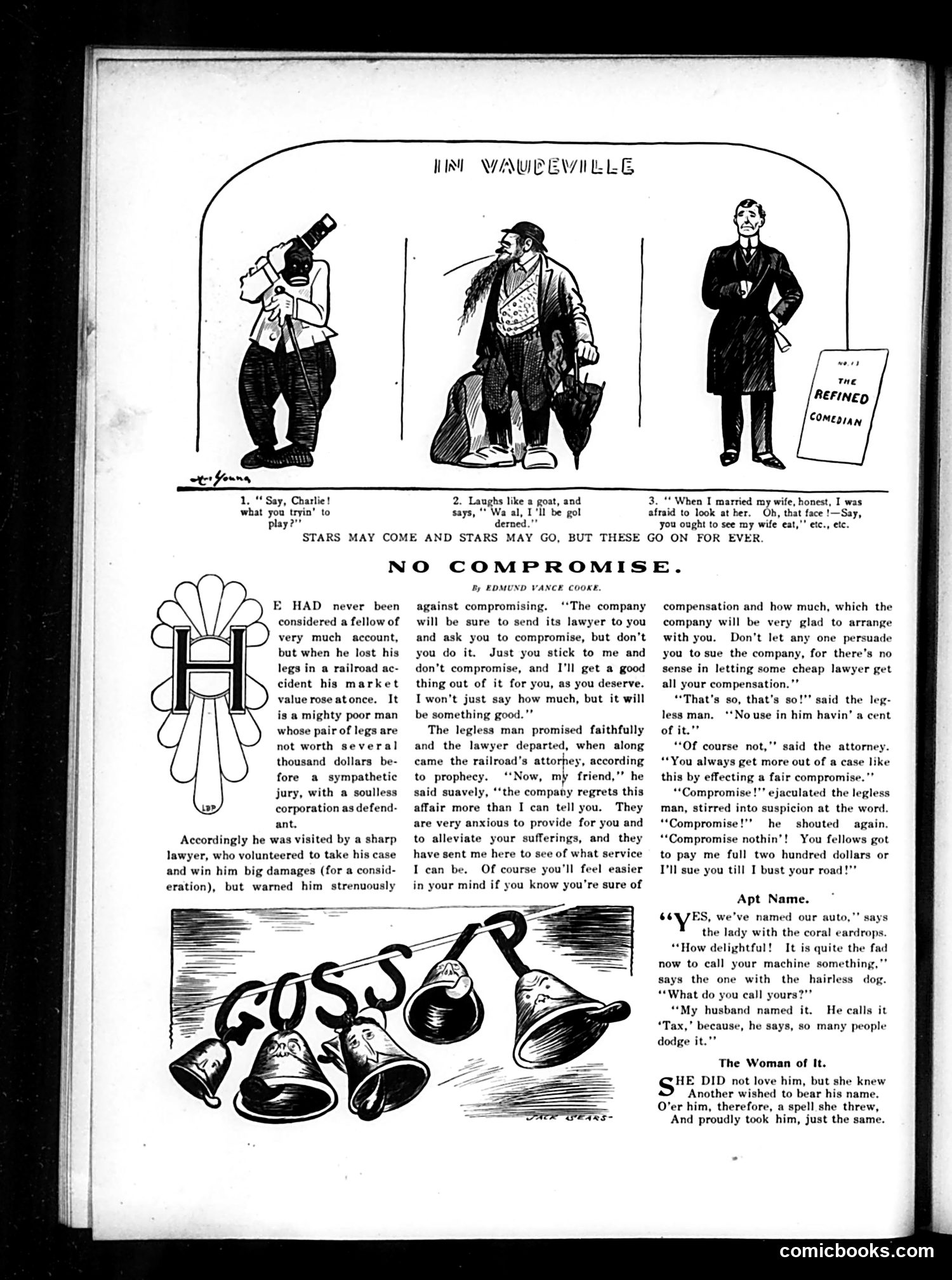
**Top Cartoon ("In Vaudeville"):** Three stock vaudeville character types are shown—a man with a telescope, a ragged tramp, and a refined gentleman—with the caption noting these recurring comedic personas "go on for ever." This satirizes vaudeville's reliance on tired, repetitive character archetypes and worn-out joke formulas that persist regardless of changing entertainment trends. **Main Story ("No Compromise"):** A legless railroad accident victim is warned by his lawyer never to settle with the company. However, the railroad's attorney uses reverse psychology, advising him that compromise is wisest—causing the legless man to become suspicious and demand full payment instead. The satire targets both ambulance-chasing lawyers and corporate attorneys who manipulate injured workers, while mocking how easily the victim is manipulated by transparent rhetoric, despite his initial instructions. The page also includes humorous short pieces about automobile naming and romantic irony.
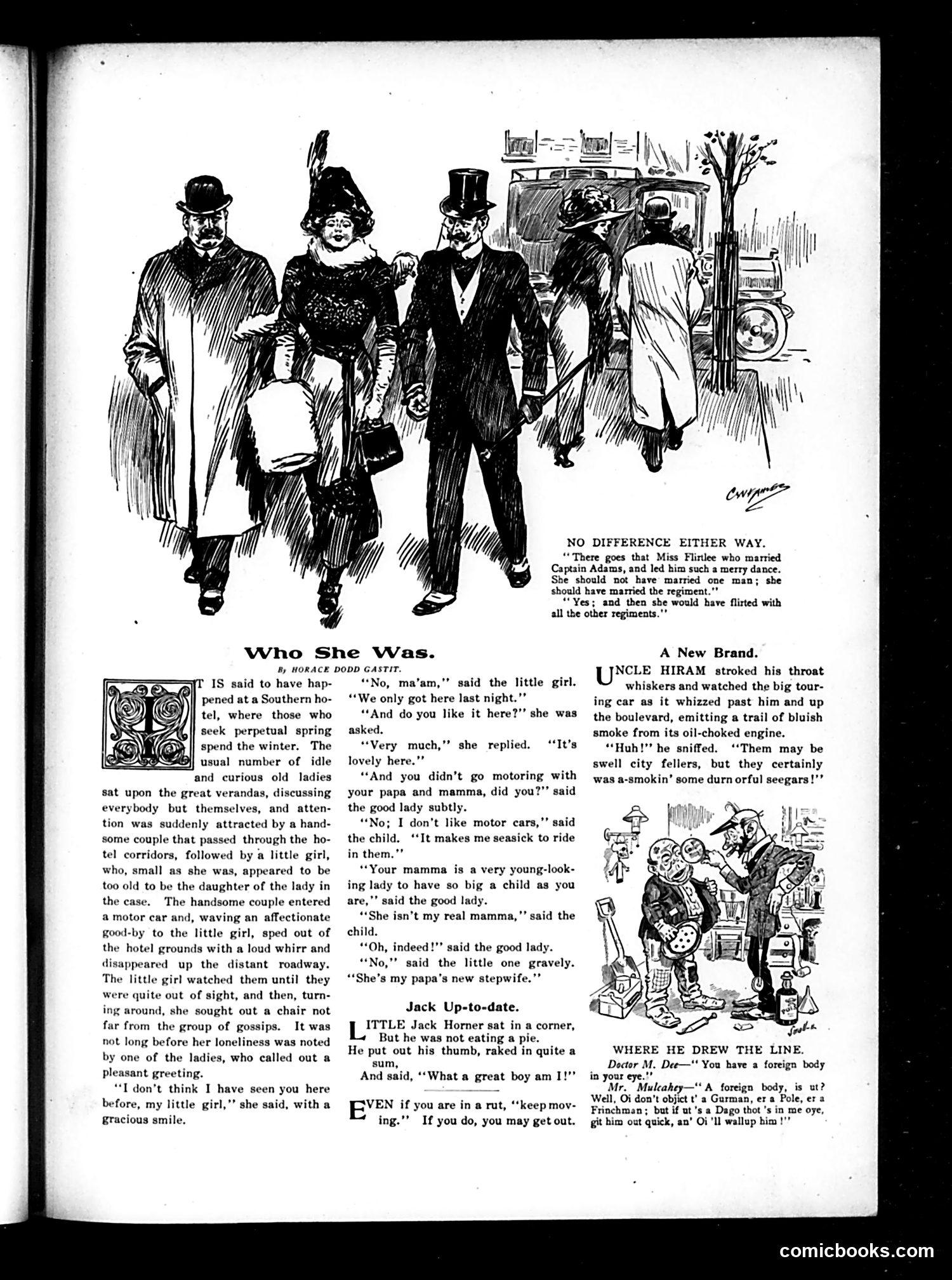
This page contains three separate satirical pieces typical of early-20th-century American humor: **"No Difference Either Way"** mocks a woman (Miss Flirtlee) who flirted excessively before marriage. The joke: whether she married one officer or the whole regiment, her behavior would remain unchanged—she'd flirt with everyone regardless. **"Who She Was"** is a short story about gossiping ladies at a Southern hotel who assume a young woman with an older man is his mistress. The punchline reveals the "scandalous" truth: she's actually his new *stepwife*—making the gossips' assumptions about impropriety humorous by contrast. **"A New Brand"** depicts Uncle Hiram, a rural character, complaining that the oil smoke from a passing car smells like cheap cigars—satirizing both automobile pollution and rural/urban cultural gaps. **"Where He Drew the Line"** features an Irish-dialect character (Mulcahey) who accepts foreign-born doctors but explicitly refuses if the "foreign body" in his eye is Italian ("Dago")—crude ethnic stereotyping and prejudice played for laughs, reflecting period xenophobia.
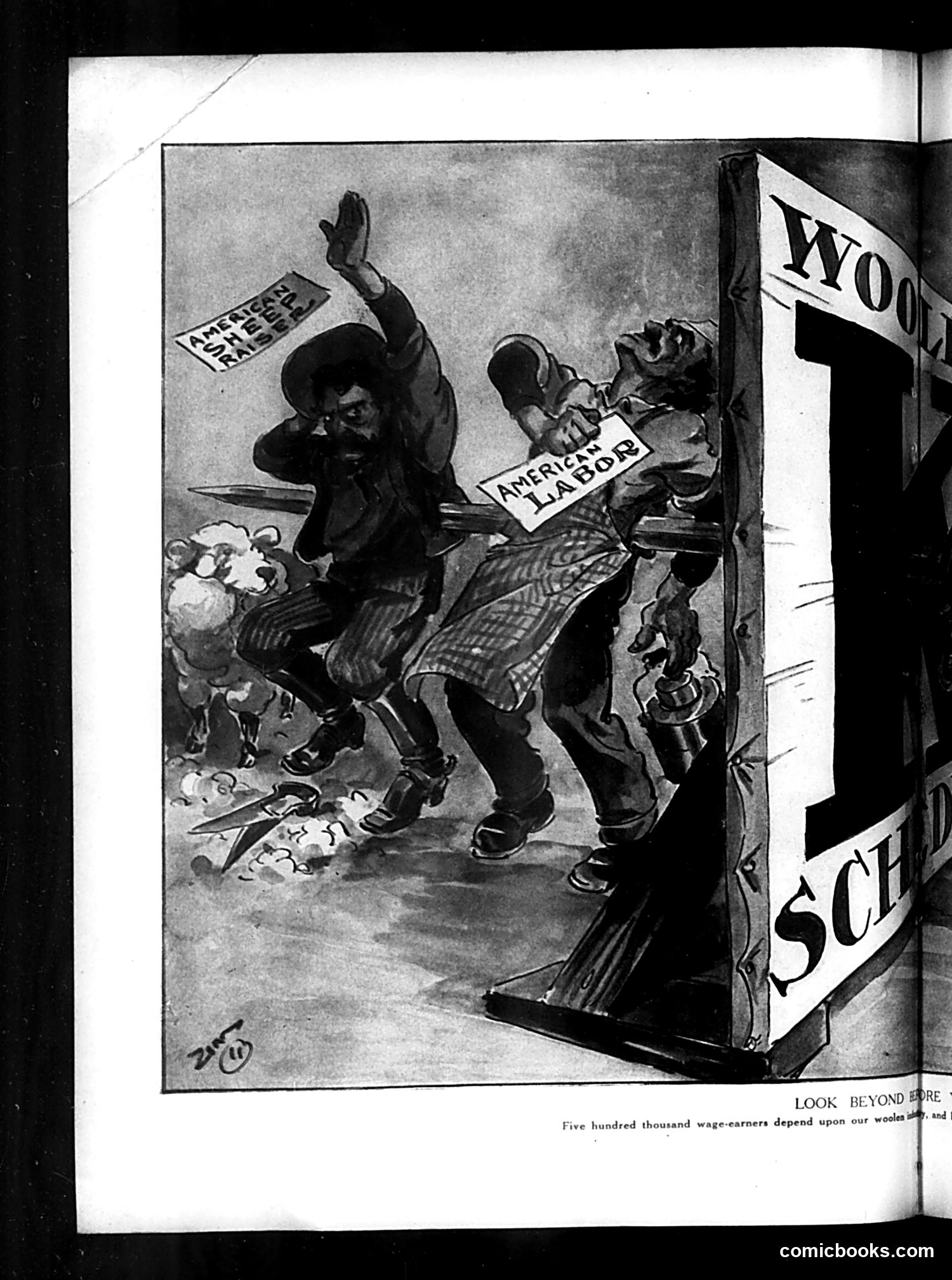
This appears to be an early labor-related political cartoon from *Judge* magazine. The image depicts figures engaged in conflict near a "Wool Scheme" building, with one figure holding an "American Labor" sign being thrown or pushed away. The caption references "five hundred thousand wage-earners" depending on wool production, suggesting this satirizes labor disputes or protectionist policies around the American wool industry. The caricatured figures and aggressive posturing indicate the cartoon criticizes how labor interests were being treated or excluded from economic decisions affecting workers. The exact historical moment is unclear without a date, but the style and subject matter suggest this addresses early-to-mid 20th century labor conflicts and industrial policy debates.
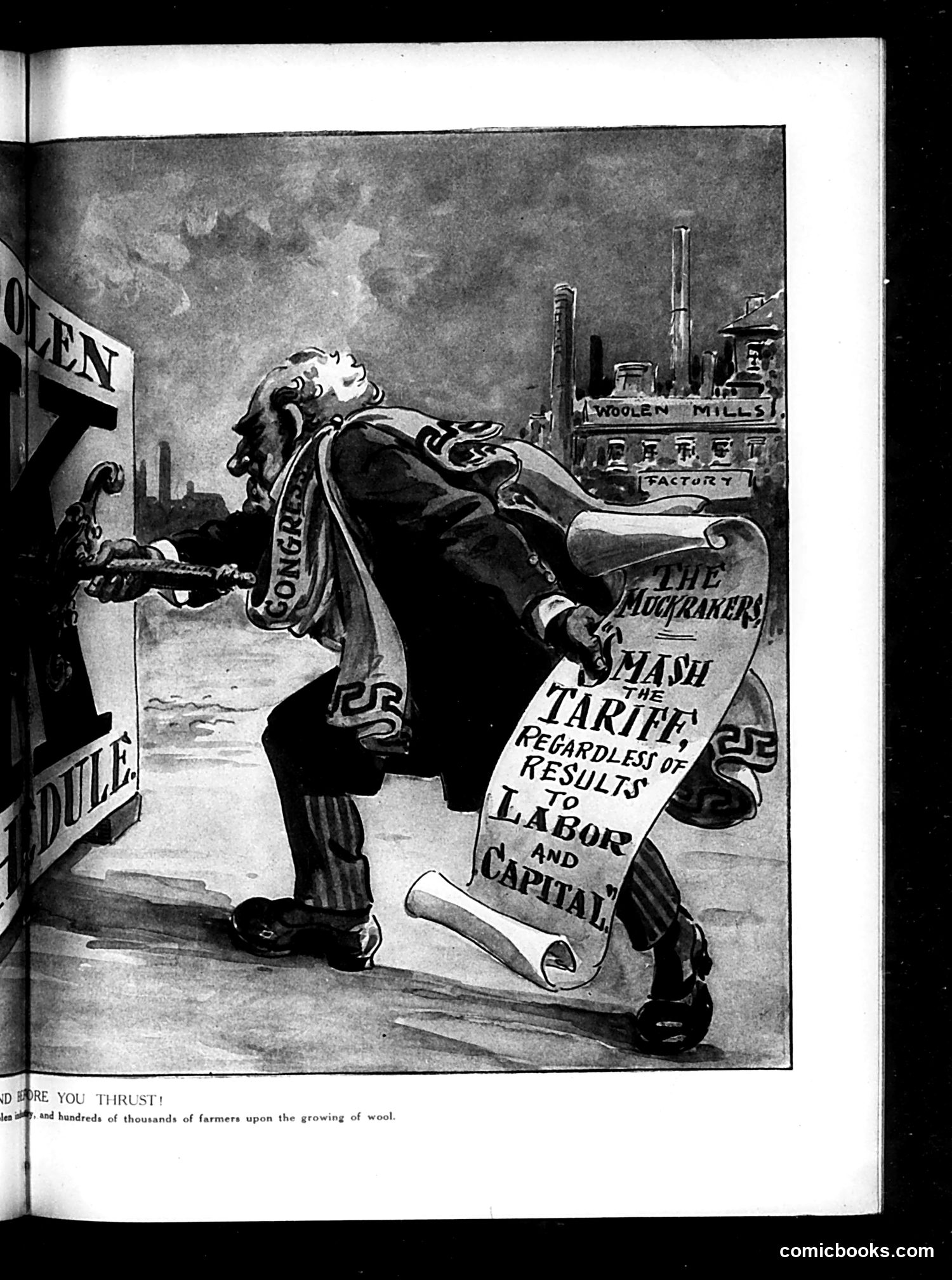
This Judge magazine cartoon depicts a caricatured figure (appears to be a politician or labor advocate) wielding a scroll labeled "SMASH THE TARIFF REGARDLESS OF RESULTS TO LABOR AND CAPITAL." The figure holds "DONCHICAGO" (possibly a labor leader or publication) and stands before an industrial landscape with "WOOLEN MILLS" and a "FACTORY." The satire mocks those advocating for tariff elimination without considering economic consequences. The dramatic pose and heading "BEFORE YOU THRUST!" warn against reckless action that would harm both workers and capitalists. The reference to farmers suggests this addresses agricultural trade policy debates of the early 20th century—likely the protectionist vs. free-trade debate affecting American wool and textile industries. The cartoon criticizes tariff opponents as ideologically blind to real economic damage.
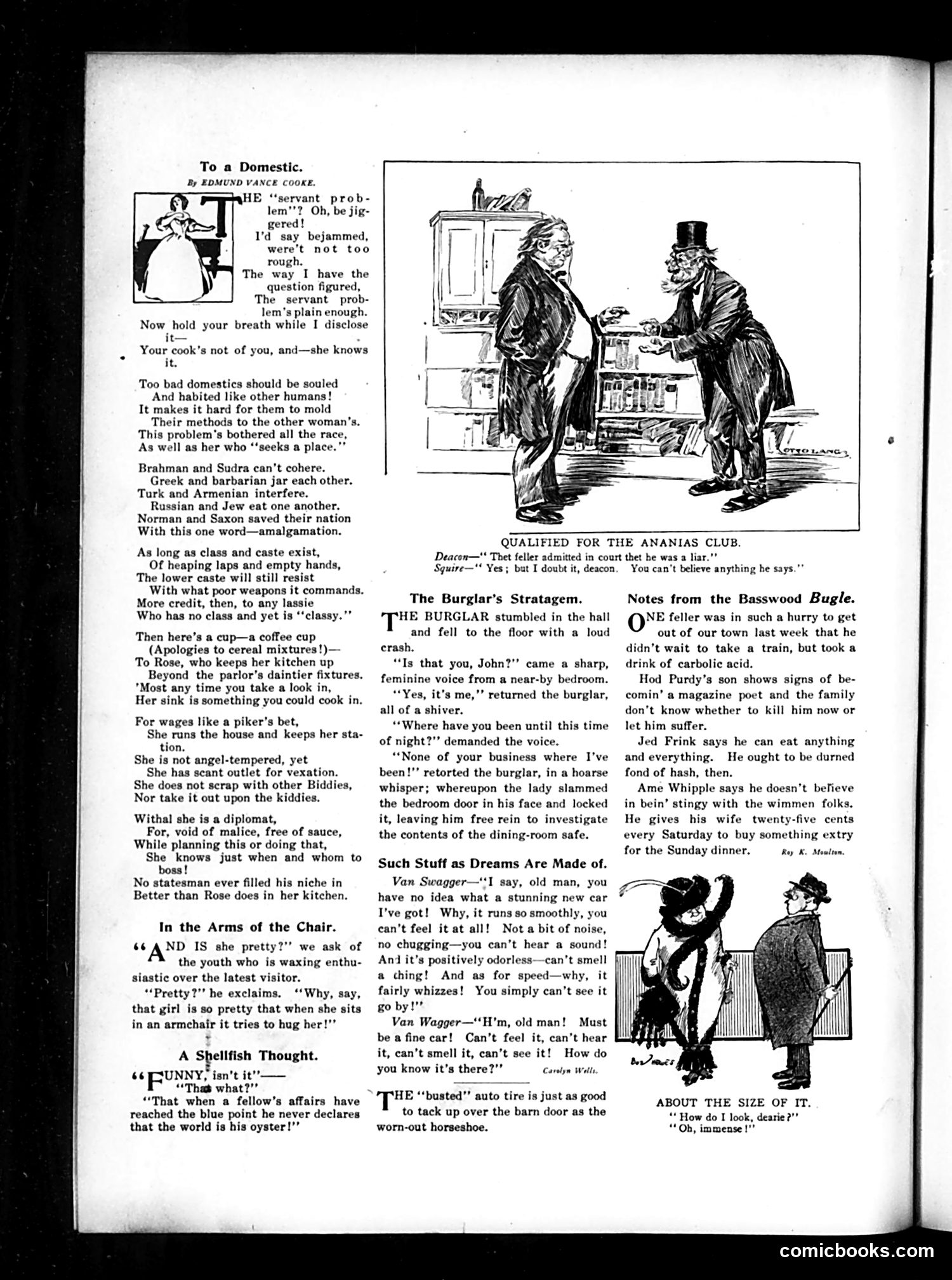
This page contains several separate humorous pieces satirizing early 20th-century social issues: **"To a Domestic"** (poem): Critiques the "servant problem"—the difficulty wealthy households faced hiring domestic help. The satire argues servants resist poor treatment because class divisions persist; it praises "Rose," a hardworking cook who maintains professionalism despite low wages and difficult conditions. The poem uses caste system comparisons (Brahman/Sudra, Greek/barbarian) to suggest social hierarchies are artificial. **"The Burglar's Stratagem"** (cartoon): A burglar pretends to be the homeowner to avoid suspicion from his wife, who mistakes him for her husband. She scolds him and locks herself in, unwittingly giving him free access to the safe—humor derived from marital discord enabling crime. **"Such Stuff as Dreams Are Made Of"** (dialogue): Van Swagger boasts about a car so perfect it's imperceptible—can't hear, feel, see, or smell it. Van Wagger's punchline questions whether it actually exists, mocking exaggerated advertising claims of the automobile age. Other brief jokes target gullible rural folks and magazine poets.
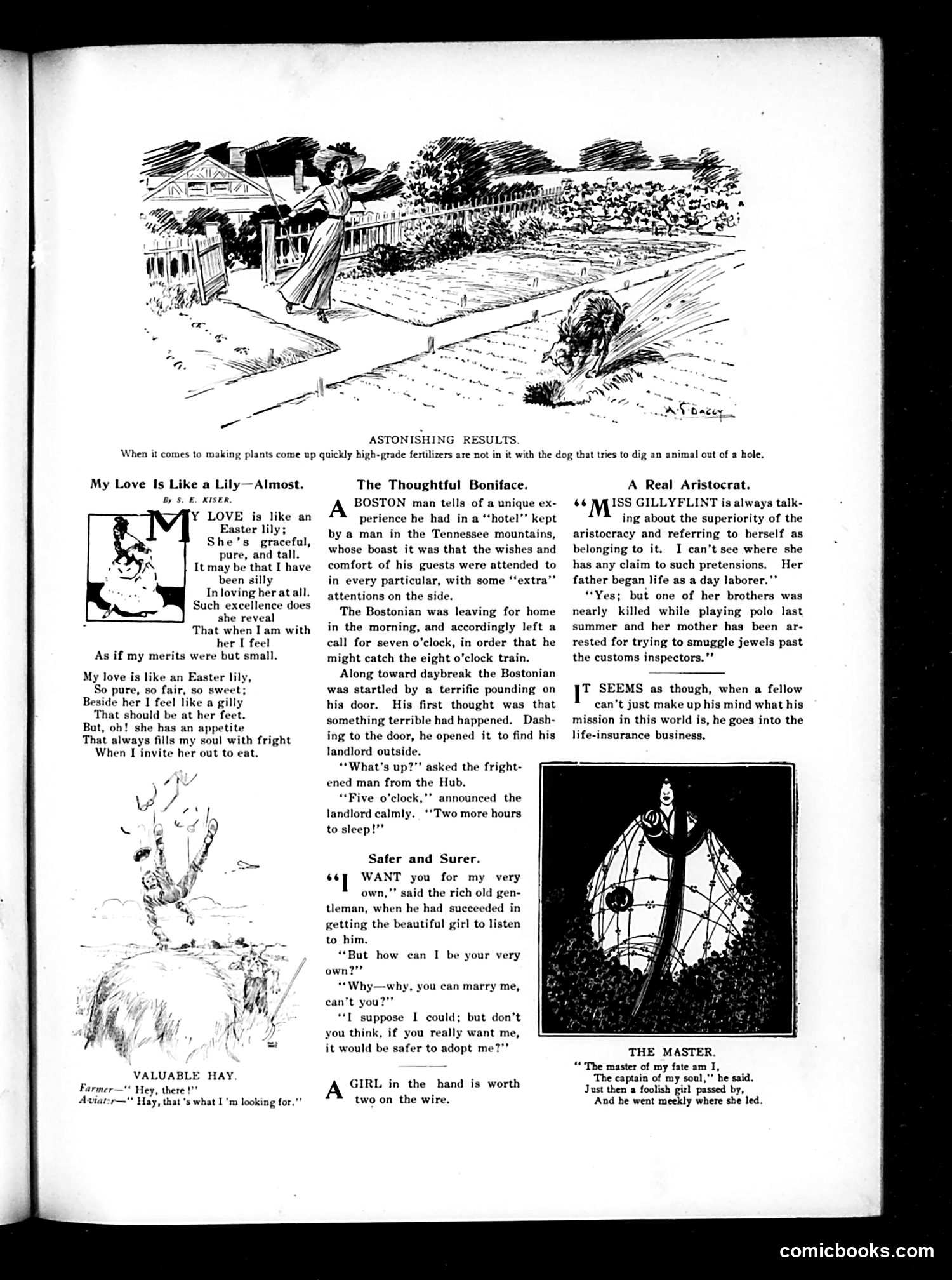
This page contains several humorous anecdotes satirizing American social attitudes circa early 1900s. **Top cartoon**: A dog digging frantically illustrates the caption's joke that dogs are more effective than fertilizer at making things "come up quickly"—a visual pun on agricultural productivity. **"My Love Is Like a Lily"**: A poem mocking romantic idealization. The speaker elevates his beloved while diminishing himself, yet reveals her glaring flaw: she has a voracious appetite ("appe-tite"), undercutting his poetic pretense. **"The Thoughtful Boniface"**: A mountain innkeeper's "extra attentions" are ironically unhelpful—he wakes a guest at 5 a.m. to announce the 7 a.m. call time, forcing unnecessary wakefulness. The joke satirizes rustic hospitality as well-intentioned but foolish. **"A Real Aristocrat"**: Miss Gillyflint claims aristocratic superiority despite her father's working-class origins. Her family's "credentials"—a brother's polo accident and mother's jewel smuggling—inadvertently prove the opposite, mocking false pretensions to aristocracy. Other brief jokes mock romantic foolishness and the life-insurance industry.
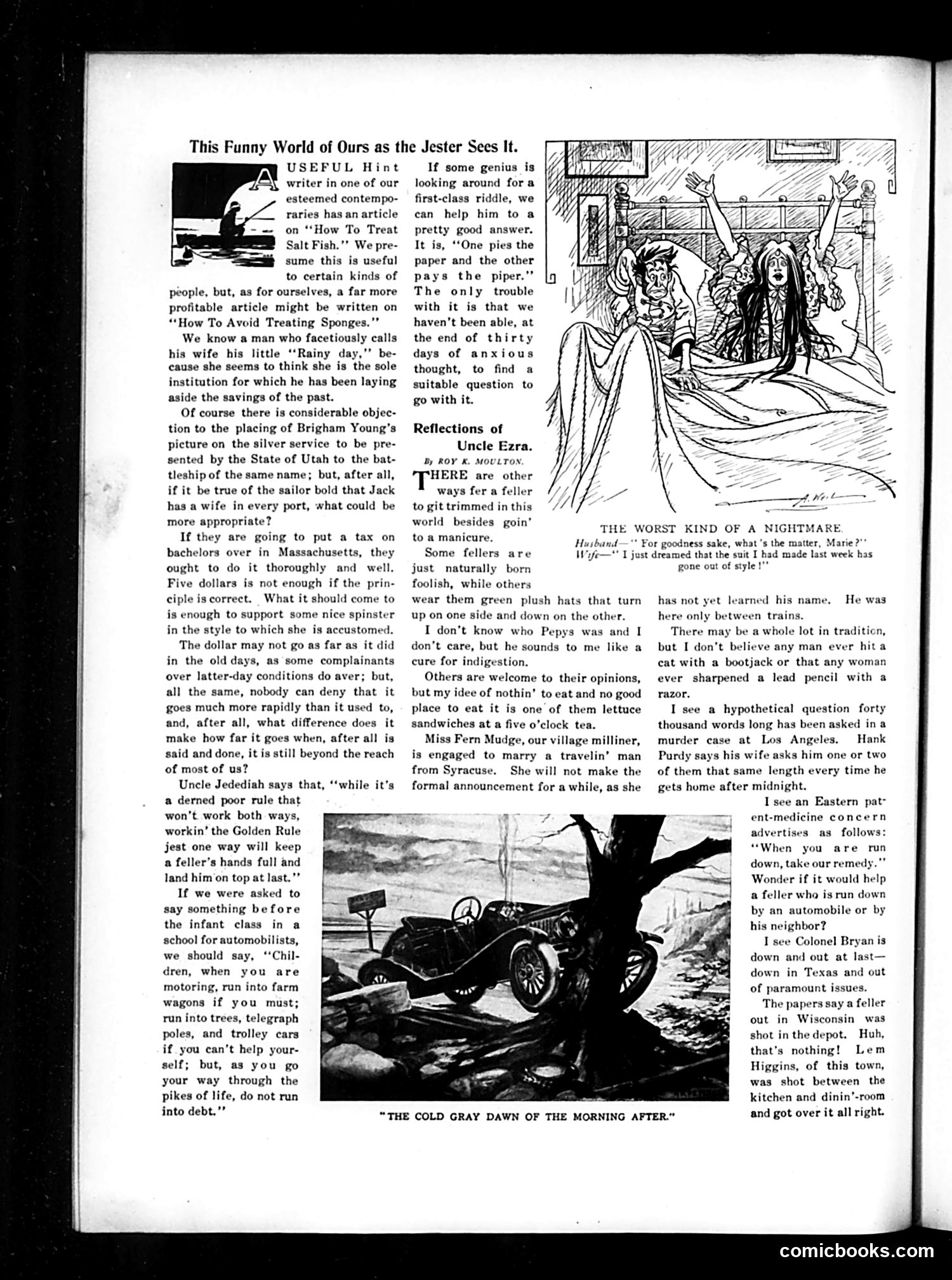
This page from Judge presents humorous social commentary typical of early-20th-century American satire. The main content consists of three sections: **"This Funny World of Ours as the Jester Sees It"** offers satirical "hints" on contemporary issues: mocking advice columns, poking fun at wives as financial drains ("Rainy day"), and critiquing automobile safety (advising new drivers to crash into farm wagons but avoid debt). **"Reflections of Uncle Ezra"** uses a rural character's folksy observations to comment on fashion absurdities (green plush hats) and courtship customs, including a milliner's engagement to a traveling salesman. **Two cartoons** illustrate domestic life: "The Worst Kind of a Nightmare" depicts a wife's anxiety over fashion obsolescence, while "The Cold Gray Dawn of the Morning After" (lower image) shows an automobile accident's aftermath. The satire targets materialism, automotive dangers, fashion obsession, and marital dynamics—concerns resonating with early-automobile-era America.
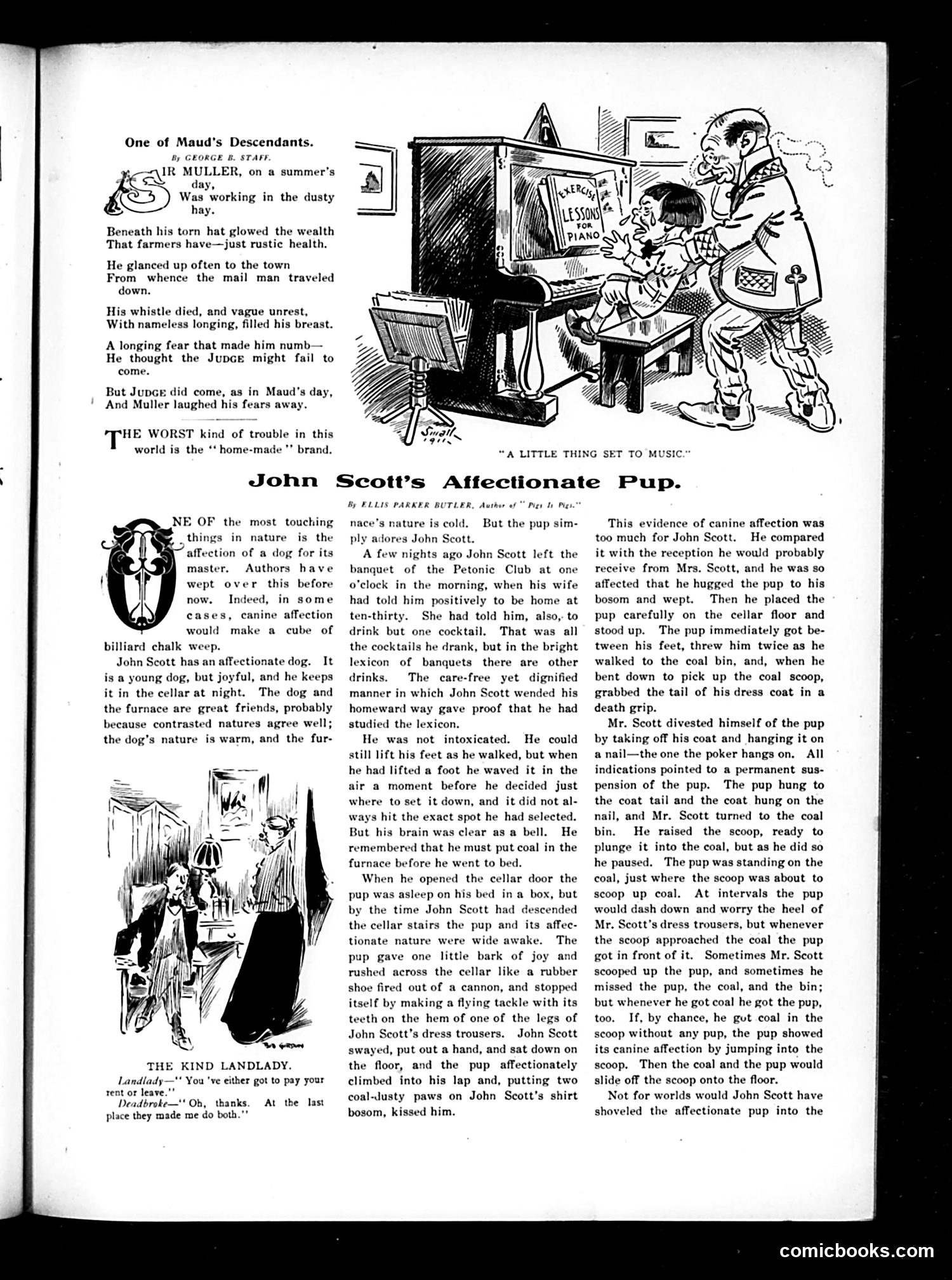
This page contains three separate pieces of humor, typical of Judge's satirical format: **"One of Maud's Descendants"** (top left): A poem satirizing rural mail obsession. "Maud's Descendants" likely references Tennyson's poem "Maud." The farmer anxiously awaits the mailman's arrival—suggesting even rural people were becoming dependent on correspondence and connection to town life, a social observation about modernization's reach. **"A Little Thing Set to Music"** (top right): A cartoon showing a piano lesson, with the caption suggesting that teaching music to children is comically chaotic—a gentle domestic satire about parental efforts at "cultured" child-rearing. **"John Scott's Affectionate Pup"** (main story): A humorous narrative by Ellis Parker Butler about a drunk man returning home late after violating his wife's curfew. The pup's innocent affection contrasts sharply with the wife's expected anger, highlighting marital tension. The dog's loyalty becomes a comedic mirror reflecting the husband's domestic troubles.
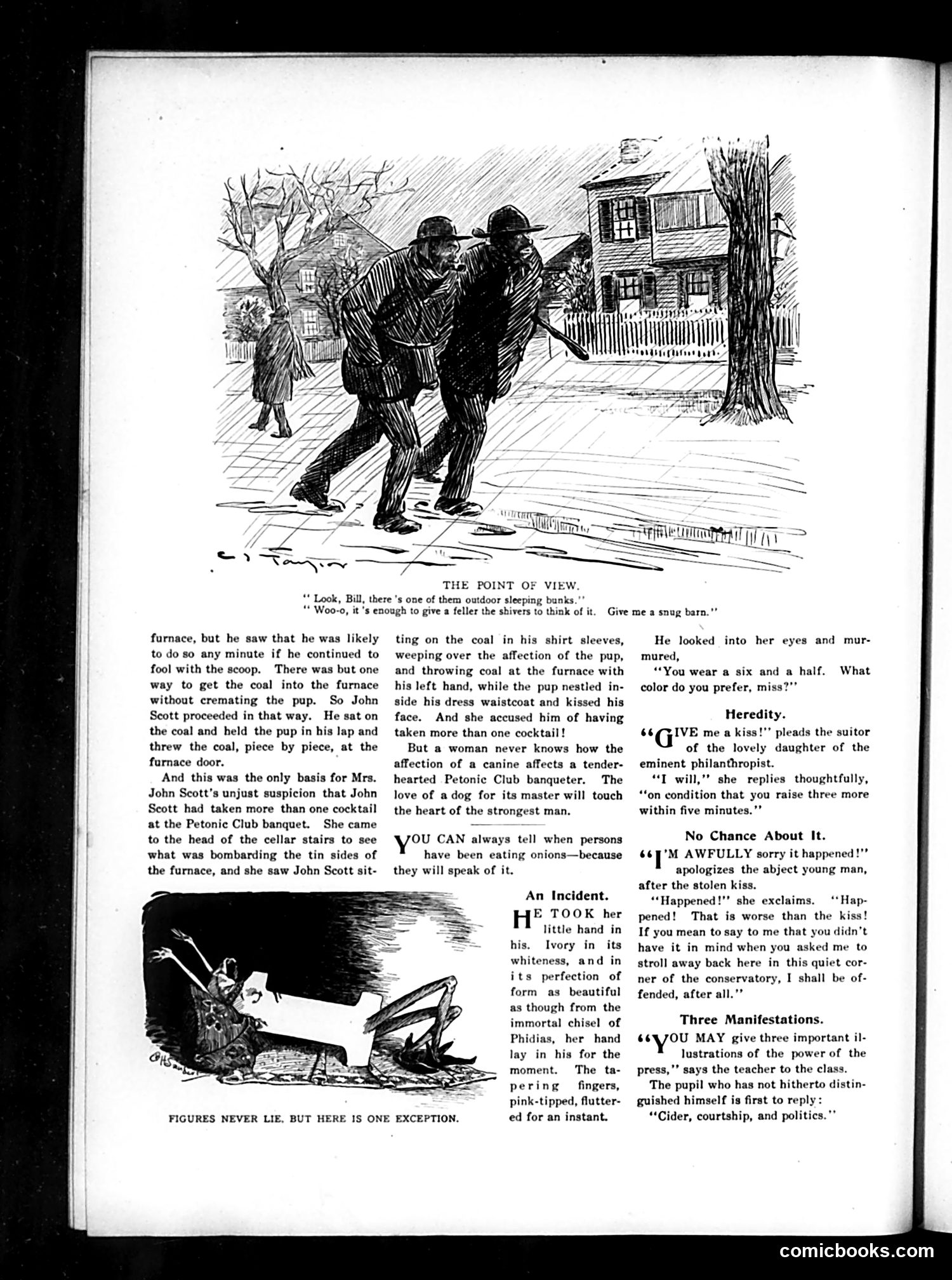
This page contains three unrelated humorous sketches typical of Judge magazine's social satire: **Top cartoon**: Two men observe an "outdoor sleeping bunk" (likely a homeless shelter or tramp lodging). The joke appears to mock either the poor conditions of such facilities or the discomfort middle-class observers feel contemplating poverty. **Middle story**: A domestic comedy about a man named John Scott who sits on coal while holding a puppy to his chest, throwing coal pieces at a furnace. His wife discovers him covered in coal dust and weeping, and suspiciously assumes he's been drinking at his Petonic Club banquet. The satire mocks both sentimental male sentimentality over dogs and wives' skepticism of their husbands' excuses. **Bottom vignettes**: Three short romantic/social jokes playing on misunderstandings: a suitor's shoe-size comment mistaken for romance; a woman's cynical response to a kiss request; and a student's answer about "the power of the press" being "cider, courtship, and politics" (suggesting these topics dominate newspapers). The overall tone is gentle domestic mockery of middle-class life.
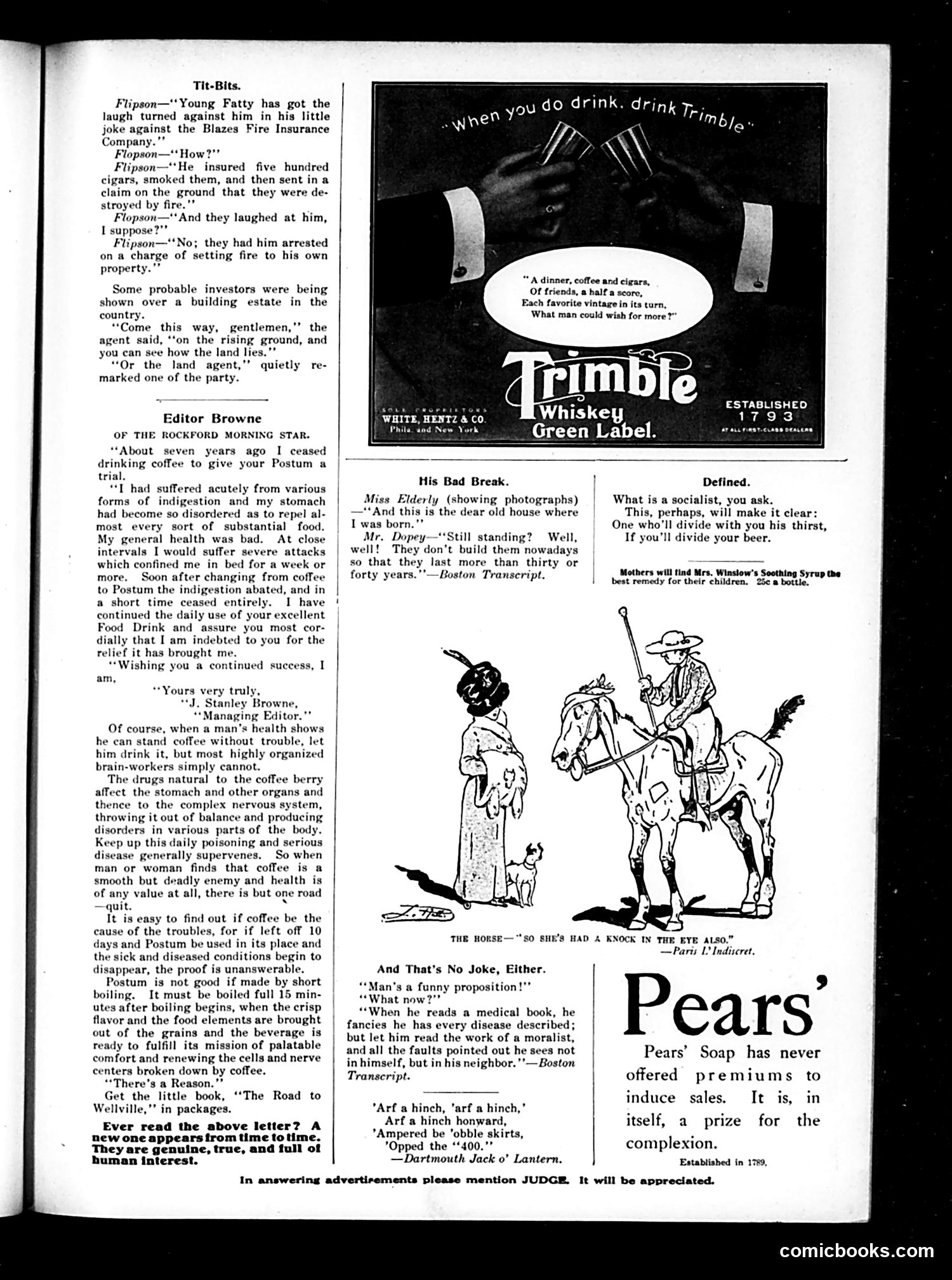
This page contains satirical humor pieces and advertisements typical of early 1900s American magazines. **Top cartoon**: A joke about insurance fraud. A man named "Fatty" insures cigars, smokes them, then claims fire damage. Rather than laughing at the insurance company, he's arrested for arson—the joke being his scheme backfired spectacularly. **Middle section**: Editor J. Stanley Browne's testimonial letter praising Postum (a coffee substitute), claiming it cured his indigestion. This is advertisement disguised as editorial content—common practice then. **"His Bad Break"**: A short joke where an elderly woman shows a man old family photographs. He tactlessly suggests the house shouldn't still be standing after 30-40 years, implying poor construction. **Bottom cartoon**: A visual pun on "The Horse"—shows a woman on a horse; the caption references she's "had a knock in the eye also," playing on colloquial expressions. **Right side**: Advertisements for Trimble Whiskey and Pears' Soap, emphasizing gentlemanly sophistication and complexion benefits respectively. The page reflects early advertising methods blending editorial content with commercial promotion.
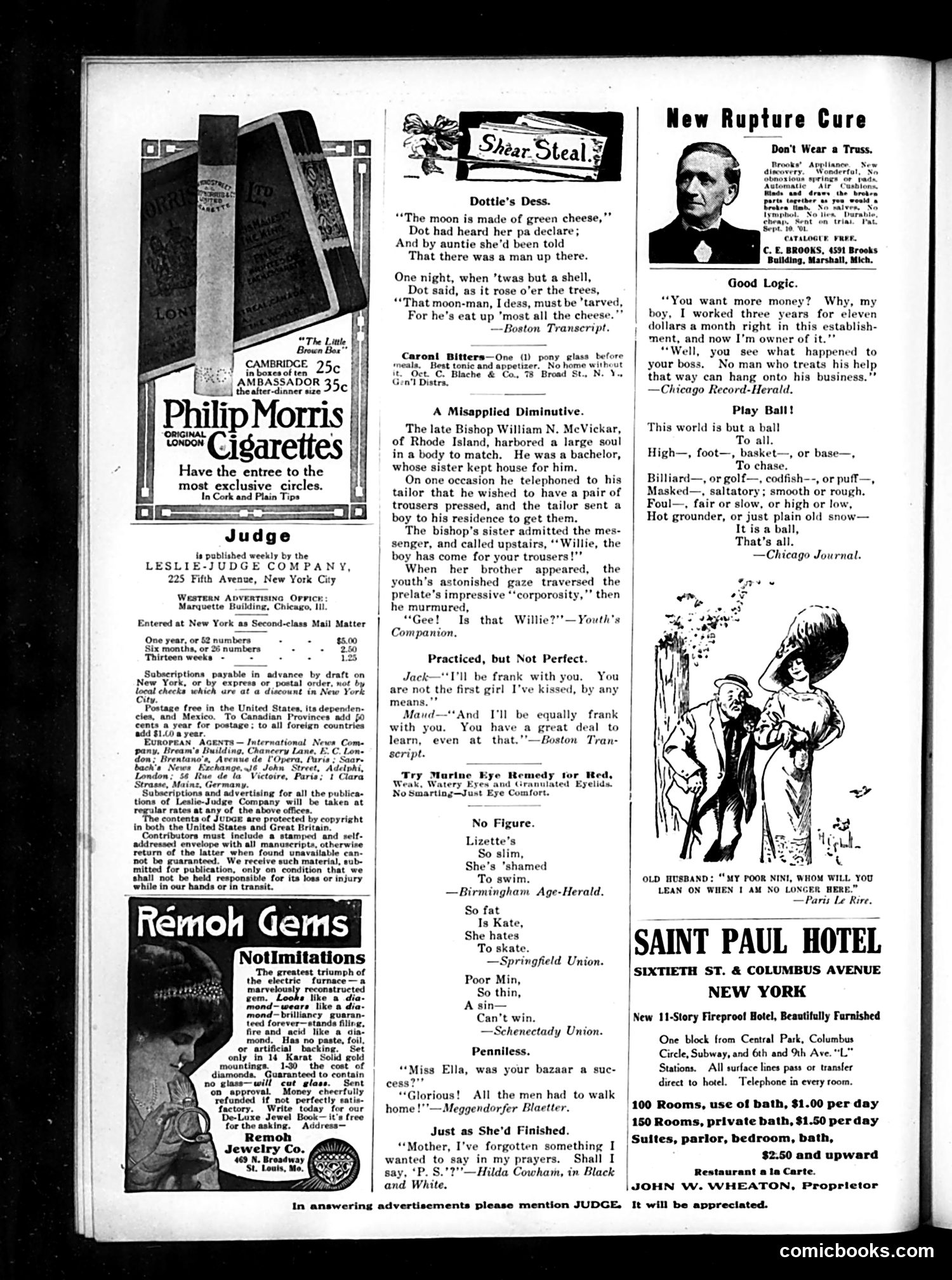
This page is primarily **advertising and filler content** with several short humorous anecdotes typical of early 20th-century satirical magazines. The main items of note: **"A Misapplied Diminutive"** presents a joke about Bishop William N. McVickar of Rhode Island. His sister calls upstairs to "Willie" about a tailor's boy arriving for trousers. When the corpulent bishop appears, the boy exclaims "Gee! Is that Willie?"—the humor being that the nickname "Willie" seems absurdly inadequate for such a large man. This relies on physical comedy and the era's acceptance of mocking someone's body size. The remaining content consists of short, light jokes about romance ("Practiced, but Not Perfect"), weight ("So fat / Is Kate"), and domestic life ("Just as She'd Finished"). **The advertisements** promote Philip Morris cigarettes, Judge magazine subscriptions, and various patent medicines and jewelry—typical commercial content of the period. There is no apparent political satire on this particular page.
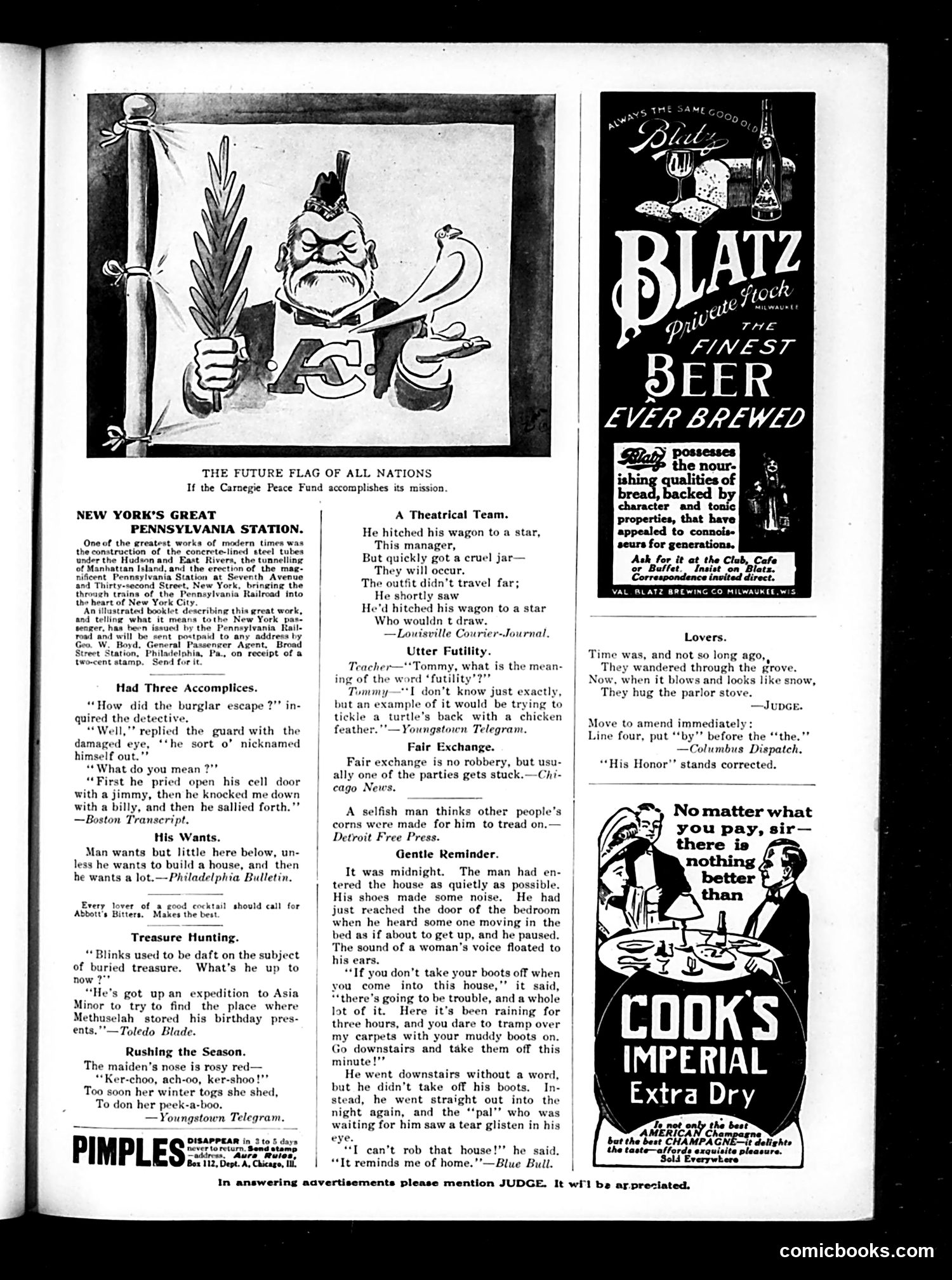
The page is primarily **advertisements and humorous short anecdotes** rather than political satire. The main cartoon at top shows a caricatured Asian figure (likely representing anti-Chinese sentiment common in early 1900s America) labeled "The Future Flag of All Nations," sarcastically commenting on Andrew Carnegie's peace initiatives—suggesting that Carnegie's Peace Fund won't actually achieve universal peace. The rest consists of joke items: a Pennsylvania Railroad advertisement, brief humorous stories about burglars and domestic disputes, and two beer advertisements (Blatz and Cook's Imperial). The "Gentle Reminder" anecdote involves a man planning a robbery who abandons it after hearing his wife's voice—he finds home too unpleasant to rob. The page reflects **early 20th-century sensibilities**: casual ethnic stereotyping, domestic humor centered on nagging wives, and commercial advertising mixed freely with editorial content. The satire is gentle and largely non-political, focusing on universal human foibles rather than contemporary events or figures.
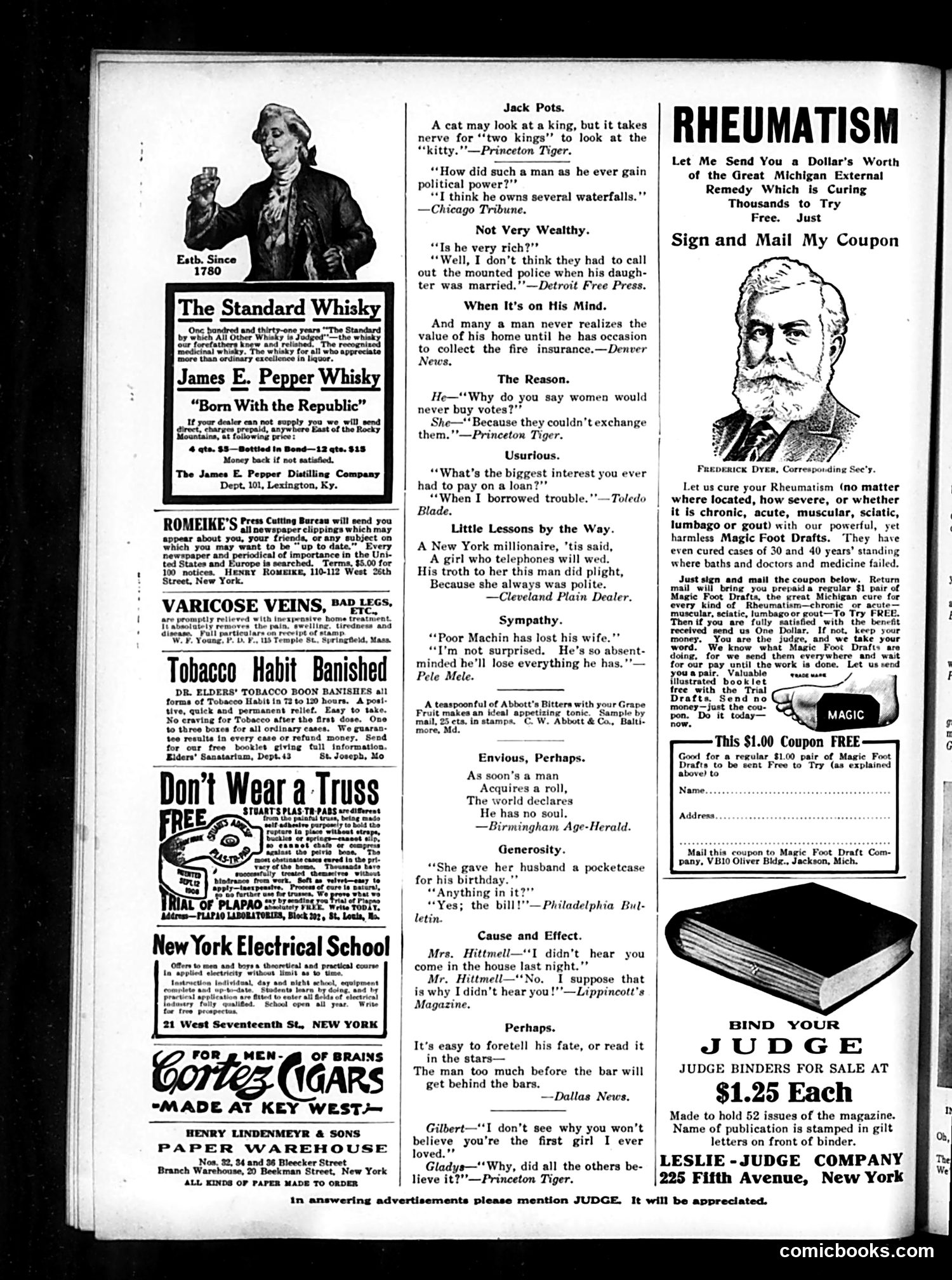
This page is primarily **advertising with scattered short jokes** rather than political cartoons. The humor consists of brief, punny one-liners about romance, wealth, and human nature—typical of early 20th-century magazine filler. **Key content:** The top-left features a historical figure (labeled "Estd. Since 1780") advertising James E. Pepper Whisky, likely the brand's founder or a colonial-era persona meant to suggest tradition and legitimacy. **The jokes** cover stock topics: a wealthy man's waterfalls as "political power," a bride's modest wedding suggesting limited wealth, wives losing husbands' possessions through absentmindedness, and a woman who won't believe she's a man's first love because "the others" believed it. **The advertisements** peddle patent medicines (tobacco cessation, varicose veins), medical devices (trusses), and trade schools—typical turn-of-the-century marketing to working-class readers. **No significant political satire** is evident on this particular page.
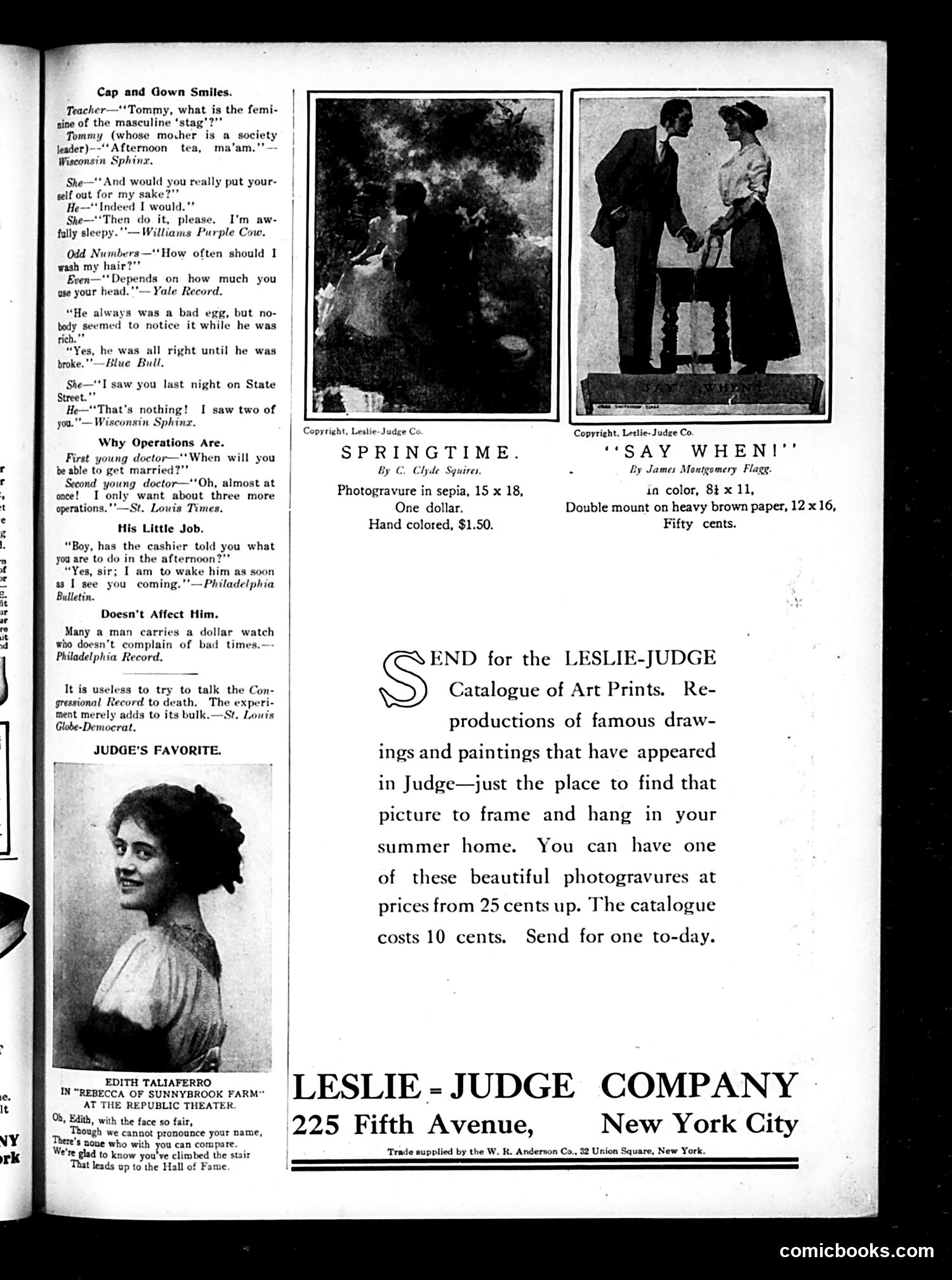
This page consists primarily of **short humorous anecdotes** and **advertising** rather than political cartoons. The jokes target educated, upper-class audiences with references to college life (Yale, Wisconsin) and contemporary professions. Humor relies on wordplay and gentle social observation—a young doctor needing "three more operations" before affording marriage satirizes medical professionals' financial struggles; a cashier sleeping on the job pokes fun at workplace laziness. The page includes **two theatrical photographs** ("Springtime" and "Say When!") and prominently features actress **Edith Taliaferro** in *Rebecca of Sunnybrook Farm*, with an accompanying tribute poem celebrating her as among the finest performers. The lower half advertises the **Leslie-Judge Company's art print catalog**, offering reproductions of famous drawings and paintings for home decoration, priced from 25 cents upward. This represents typical early-20th-century magazine monetization through cultural merchandise sales. The satire is mild and apolitical—focused on social customs and professional life rather than political commentary.
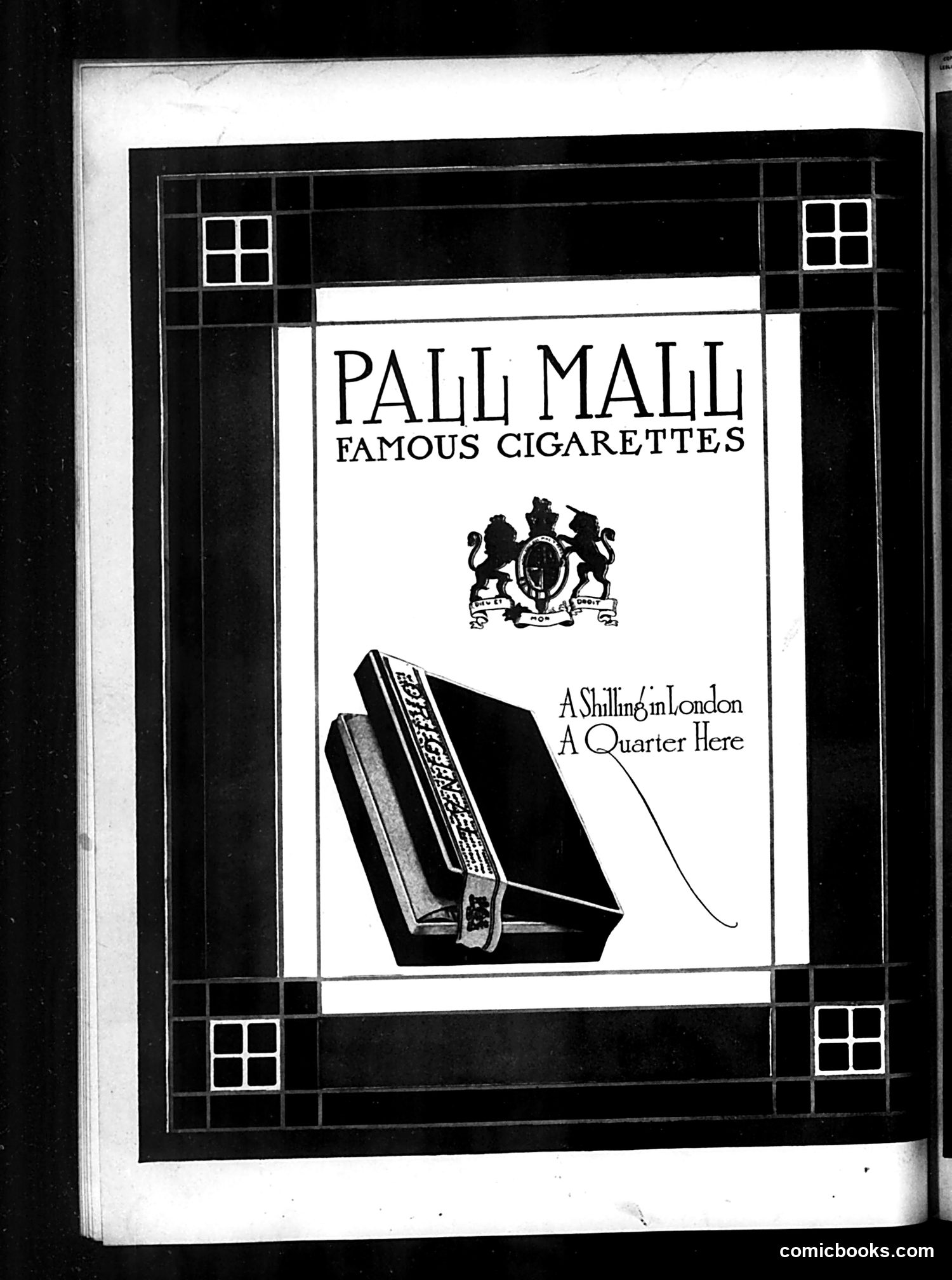
This is a full-page advertisement for Pall Mall Famous Cigarettes, a British brand. The ad shows a cigarette package and lists the price as "A Shilling & London, A Quarter Here" — indicating pricing for British and American markets. The design features a heraldic coat of arms at the top, suggesting prestige and tradition. The ornate border with small window-like elements creates a framed, formal presentation typical of early 20th-century luxury goods advertising. This appears to be a straightforward commercial advertisement rather than satirical content, though it ran in *Judge*, a humor magazine. The emphasis on British pricing and heritage reflects the brand's positioning as an upscale imported product for American consumers during an era when British goods carried aspirational cachet.