
Judge, 1911-03-18 · page 17 of 24
Judge — March 18, 1911 — page 17: what you’re looking at
What you’re looking at
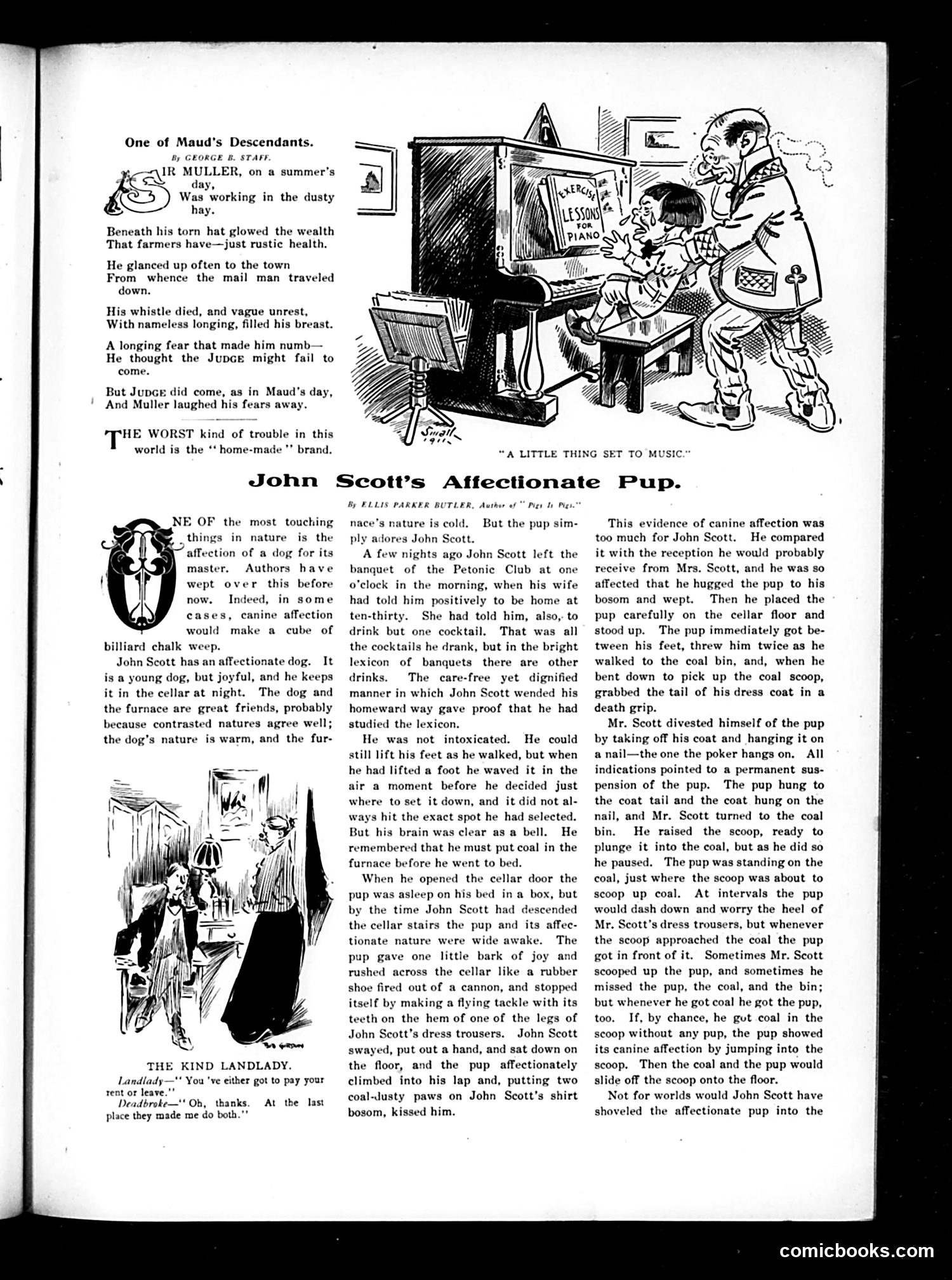
This page contains three separate pieces of humor, typical of Judge's satirical format: **"One of Maud's Descendants"** (top left): A poem satirizing rural mail obsession. "Maud's Descendants" likely references Tennyson's poem "Maud." The farmer anxiously awaits the mailman's arrival—suggesting even rural people were becoming dependent on correspondence and connection to town life, a social observation about modernization's reach. **"A Little Thing Set to Music"** (top right): A cartoon showing a piano lesson, with the caption suggesting that teaching music to children is comically chaotic—a gentle domestic satire about parental efforts at "cultured" child-rearing. **"John Scott's Affectionate Pup"** (main story): A humorous narrative by Ellis Parker Butler about a drunk man returning home late after violating his wife's curfew. The pup's innocent affection contrasts sharply with the wife's expected anger, highlighting marital tension. The dog's loyalty becomes a comedic mirror reflecting the husband's domestic troubles.
📄 Transcribed text from this page (OCR, searchable)
Machine-transcribed from the original scan — historical spelling and the odd misread are preserved.
One of Maud’s Descendants. by GEORGE B. STAFF IR MULLER, on a summer's A aay, Was working in the dusty hay. Beneath his torn hat glowed the wealth That farmers have—just rustic health. He glanced up often to the town From whence the mail man traveled down. His whistle died, and vague unrest, With nameless longing, filled his breast. A longing fear that made him numb— He thought the Jupce might fail to come. But Jupce did come, as in Maud’s day, And Muller laughed his fears away, HE WORST kind of trouble in this world is the ‘* home-made "’ brand. “A LITTLE THING SET TO MUSIC.” John Scott’s Affectionate Pup. NE OF the most touching things in nature is the affection of a dog for its master. Authors have wept over Indeed, this before now. in some cases, canine affection would make a cube of billiard chalk weep. John Scott has an affectionate dog. It is a young dog, but joyful, and he keeps it in the cellar at night. The dog and the furnace are great friends, probably because contrasted natures agree well; the dog’s nature is warm, and the fur- "hr ex THE KIND LANDLADY. Landlady—"* You 've either got to pay your rent or leave.” Deadbroke—"* Ob, thanks. place they made me do both."" At the last By ELLIS PARKER BUTLER, Author of “ Pigs ty Pies nace’s nature is cold. But the pup sim- ply adores John Scott. A few nights ago John Scott left the banquet of the Petonic Club at one o'clock in the morning, when his wife had told him positively to be home at ten-thirty. She had told him, also,- to drink but one cocktail. That was all the cocktails he drank, but in the bright lexicon of banquets there are other drinks. The care-free yet dignified manner in which John Scott wended his homeward way gave proof that he had studied the lexicon. He was not intoxicated. He could still lift his feet as he walked, but when he had lifted a foot he waved it in the air a moment before he decided just where to set it down, and it did not al- ways hit the exact spot he had selected. But his brain was clear as a bell. He remembered that he must put coal in the furnace before he went to bed. When he opened the cellar door the pup was asleep on his bed ina box, but by the time John Scott had descended the cellar stairs the pup and its affec- tionate nature were wide awake. The pup gave one little bark of joy and rushed across the cellar like a rubber shoe fired out of a cannon, and stopped itself by making a flying tackle with its teeth on the hem of one of the legs of John Scott’s dress trousers. John Scott swayed, put out a hand, and sat down on the floor, and the pup affectionately climbed into his lap and, putting two coal-dusty paws on John Scott's shirt bosom, kissed him. This evidence of canine affection was too much for John Scott. He compared it with the reception he would probably receive from Mrs. Scott, and he was so affected that he hugged the pup to his bosom and wept. Then he placed the pup carefully on the cellar floor and stood up. The pup immediately got be- tween his feet, threw him twice as he walked to the coal bin, and, when he bent down to pick up the coal scoop, grabbed the tail of his dress coat in a death grip. Mr. Scott divested himself of the pup by taking off his coat and hanging it on a nail—the one the poker hangs on. All indications pointed to a permanent sus- pension of the pup. The pup hung to the coat tail and the coat hung on the nail, and Mr. Scott turned to the coal bin. He raised the scoop, ready to plunge it into the coal, but as he did so he paused. The pup was standing on the coal, just where the scoop was about to scoop up coal. At intervals the pup would dash down and worry the heel of Mr. Scott's dress trousers, but whenever the scoop approached the coal the pup got in front of it. Sometimes Mr. Scott scooped up the pup, and sometimes he missed the pup, the coal, and the bin; but whenever he got coal he got the pup, too. If, by chance, he gut coal in the scoop without any pup, the pup showed its canine affection by jumping into the scoop. Then the coal and the pup would slide off the scoop onto the floor. Not for worlds would John Scott have shoveled the affectionate pup into the comicbooks.com