
Judge, 1911-03-18 · page 8 of 24
Judge — March 18, 1911 — page 8: what you’re looking at
What you’re looking at
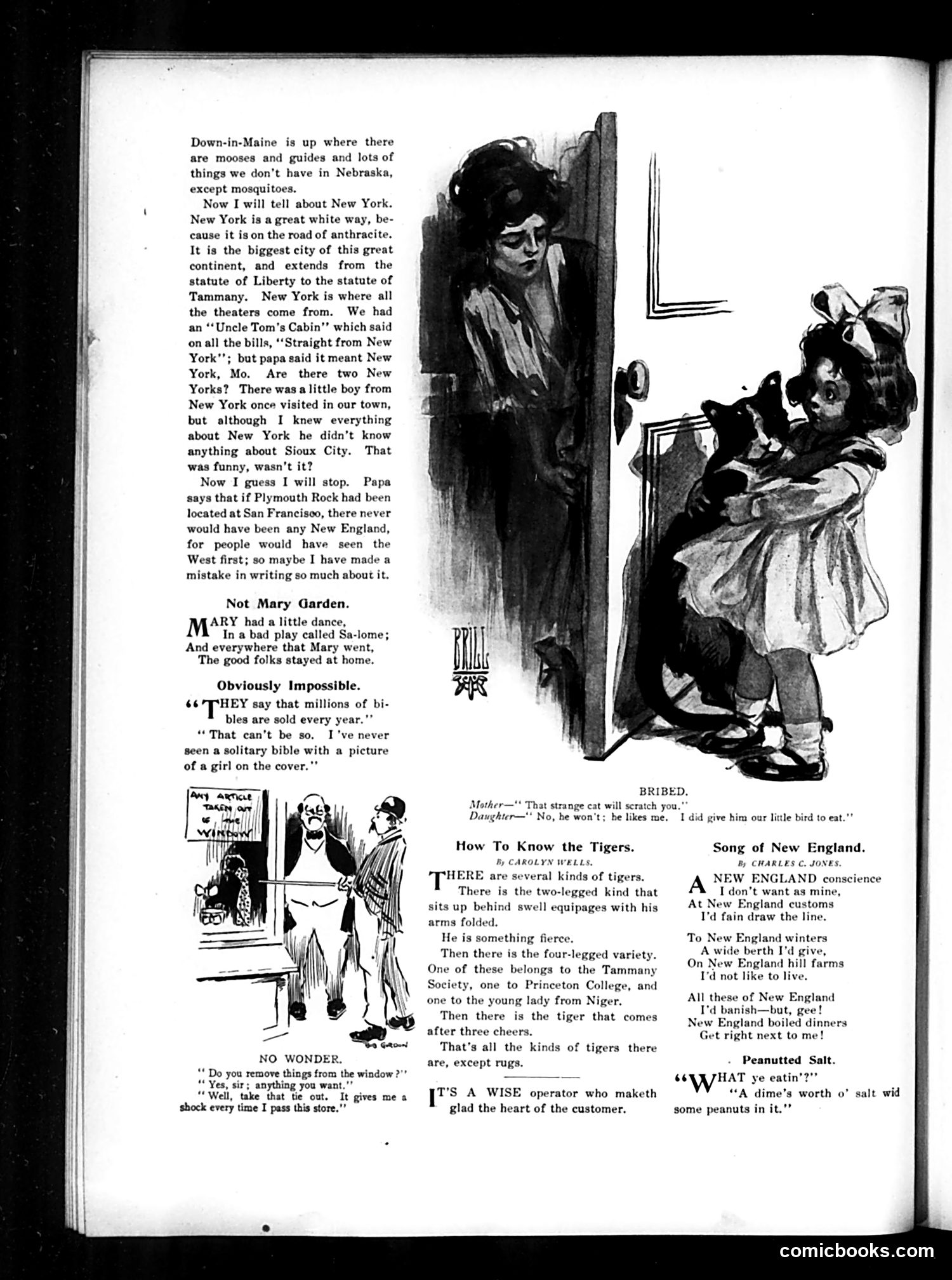
This page contains multiple satirical pieces typical of early 20th-century Judge magazine: **Main narrative** mocks a naive rural narrator describing travels to "New York" and Maine, confusing geographic and cultural references (mixing New York City with New York, Missouri; referencing Tammany Hall as a "statue"). **"Not Mary Garden"** parodies the famous opera singer Mary Garden, suggesting her scandalous role in Salomé drove respectable people away from theaters. **"How To Know the Tigers"** cleverly uses "tigers" as slang for wealthy, fashionable men (the "two-legged kind" in carriages), while referencing Princeton and Tammany Society mascots. **Minor jokes** include a store clerk removing an ugly tie from the window, and a New England resident praising boiled dinners while rejecting other regional traits—mocking both rural simplicity and New England's reputation for austere culture. The humor targets social pretension, regional stereotypes, and contemporary entertainment scandals.
📄 Transcribed text from this page (OCR, searchable)
Machine-transcribed from the original scan — historical spelling and the odd misread are preserved.
Down-in-Maine is up where there are mooses and guides and lots of things we don’t have in Nebraska, except mosquitoes. Now I will tell about New York. New York is a great white way, be- cause it is on the road of anthracite. It is the biggest city of this great continent, and extends from the statute of Liberty to the statute of Tammany. New York is where all the theaters come from. We had an ‘‘Uncle Tom's Cabin’? which said on all the bills, ‘‘Straight from New York'’; but papa said it meant New York, Mo. Are there two New Yorks? There was alittle boy from New York once visited in our town, but although I knew everything about New York he didn’t know anything about Sioux City. That was funny, wasn’t it? Now I guess I will stop. Papa says that if Plymouth Rock had been located at San Francisoo, there never would have been any New England, for people would have seen the West first; so maybe I have made a mistake in writing so much about it. Not Mary Garden. ARY had a little dance, In a bad play called Sa-lome; And everywhere that Mary went, The good folks stayed at home. Obviously Impossible. Ty HEY. say that millions of bi- bles are sold every year.”” “That can't be so. I've never seen a solitary bible with a picture of a girl on the cover."’ a NO WONDER. “Do you remove things from the window ?"’ “Yes, sir; anything you want."” “Well, take that tie out. It gives me a shock every time I pass this store."” BRIBED. Mother—* That strange cat will scratch you." Daughter—" No, he won't; he likes me. How To Know the Tigers. By CAROLYN WELLS. HERE are several kinds of tigers. There is the two-legged kind that sits up behind swell equipages with his arms folded. He is something fierce. Then there is the four-legged variety. One of these belongs to the Tammany Society, one to Princeton College, and one to the young lady from Niger. Then there is the tiger that comes after three cheers. That’s all the kinds of tigers there are, except rugs. rs A WISE operator who maketh glad the heart of the customer. I did give him our little bird to eat.” Song of New England. By CHARLES C. JONES. NEW ENGLAND conscience I don’t want as mine, At New England customs I'd fain draw the li To New England winters A wide berth I'd give, On New England hill farms I'd not like to live. All these of New England I'd banish—but, ! New England boiled dinners Get right next to me! Peanutted Salt. 66XXJHAT ye eatin'?” “(A dime’s worth o° salt wid some peanuts in it.’” comicbooks.com