
A complete issue · 24 pages · 1911
Judge — March 11, 1911
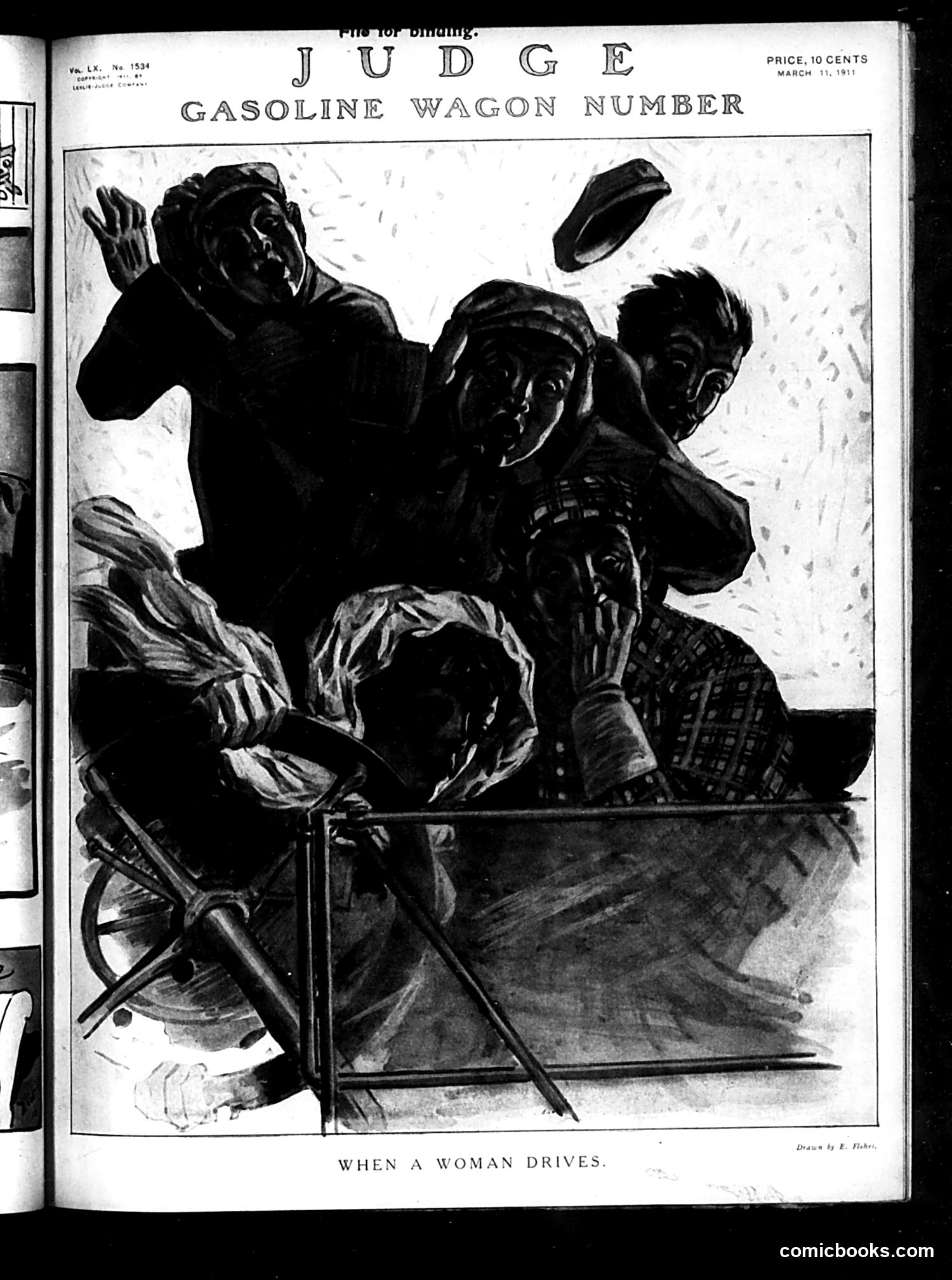
This satirical illustration depicts the anxieties of early 20th-century Americans about women operating automobiles. The cartoon shows a woman at the wheel of a "gasoline wagon" while male passengers appear terrified—one man's hat flies off, and their expressions convey panic and distress. The satire mocks contemporary assumptions that women were incompetent or reckless drivers. This reflects a period when women's increasing independence, including driving automobiles, challenged traditional gender roles and provoked masculine anxiety. The exaggerated terror of the male passengers satirizes the overblown fears men expressed about female motorists. The 10-cent cover price and "Judge" branding identify this as mainstream satirical commentary on contemporary social change.
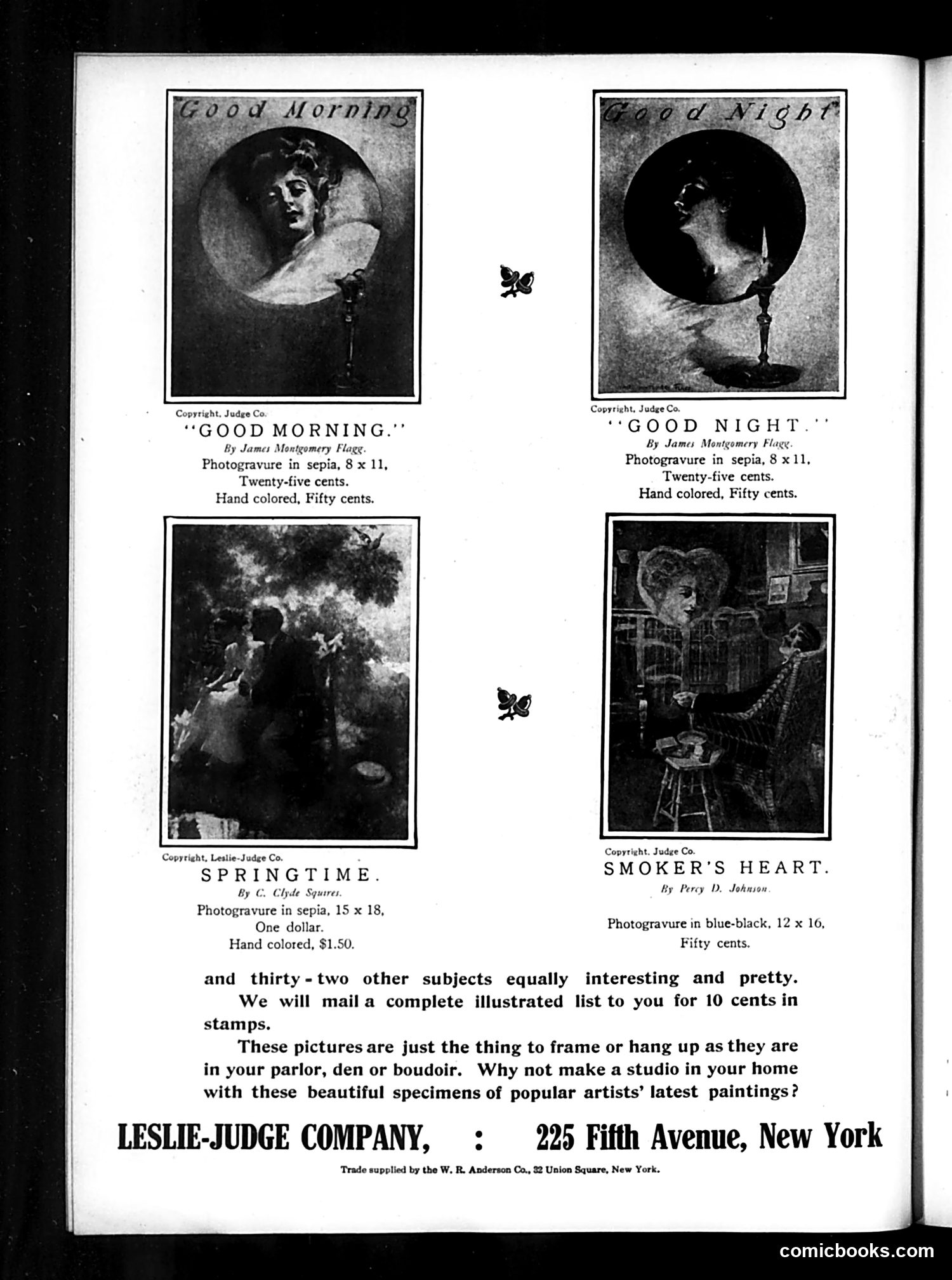
This page is primarily **advertising, not political satire**. It showcases photogravure reproductions sold by Leslie-Judge Company, a New York art publisher. Four artworks are displayed: - "Good Morning" and "Good Night" by James Montgomery Flagg (portrait studies) - "Springtime" by C. Clyde Squires (outdoor scene) - "Smoker's Heart" by Percy D. Johnson (interior domestic scene) The ad pitches these as affordable home décor ("frame or hang up as they are in your parlor, den or boudoir"), marketed as reproductions of "popular artists' latest paintings." Prices range from 25 cents to $1.50, with hand-coloring available at higher cost. The page promises 32 additional subjects available through mail order. This represents early 20th-century mass-market art reproduction advertising rather than editorial cartoon content.
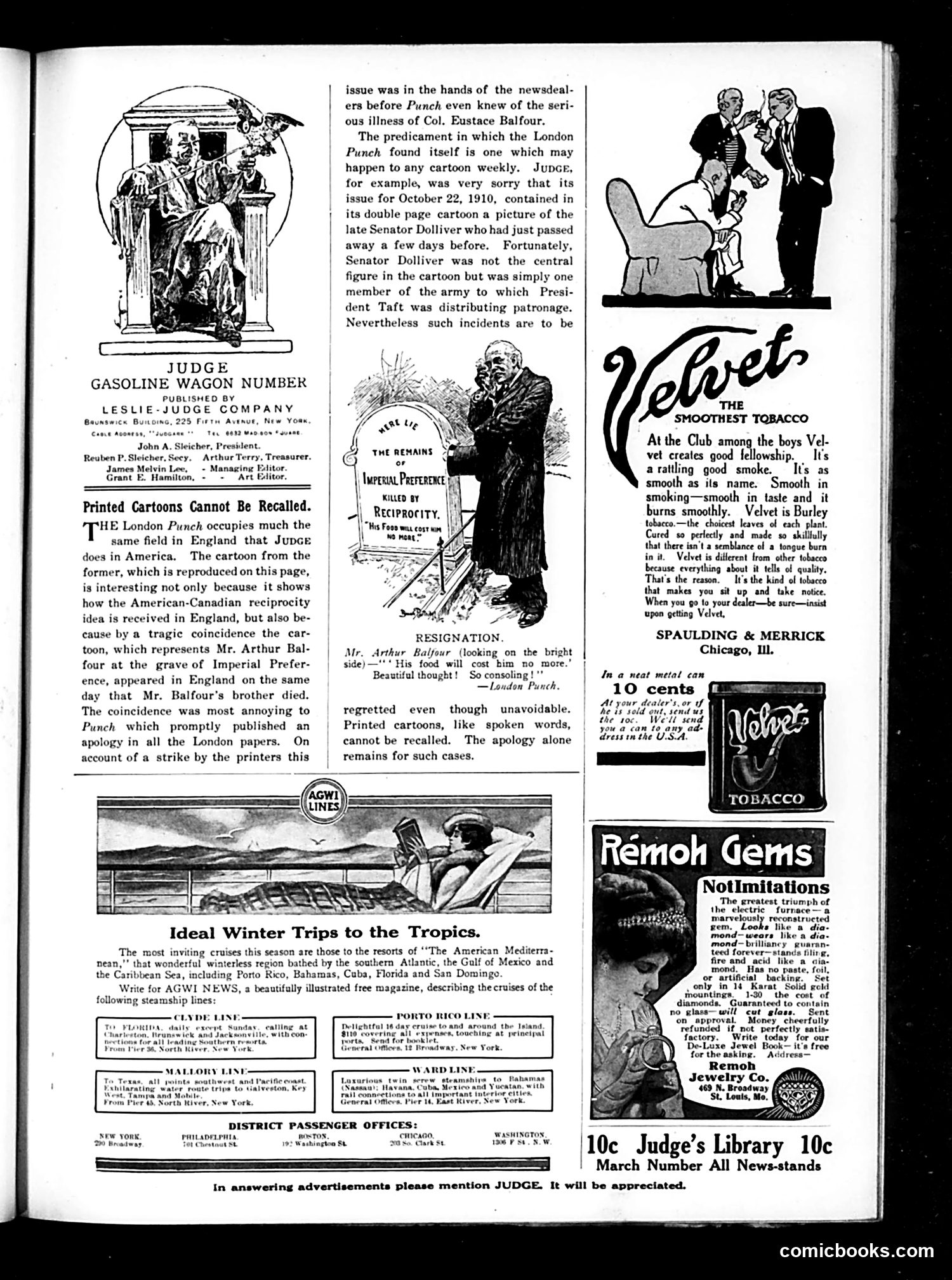
This page primarily contains **advertisements and travel promotions** rather than political cartoons. The main content discusses "Printed Cartoons Cannot Be Recalled"—explaining how a London *Punch* magazine accidentally published a cartoon depicting the death of Senator Dolliver, who died shortly after. The article notes this coincidence was "most annoying" and discusses how printed satire, unlike spoken apologies, cannot be withdrawn. The cartoons shown illustrate this point: one depicts a figure at a grave, another shows what appears to be a resignation scene. The advertisements for Velvet Tobacco, Remoh Gems jewelry, and various cruise lines dominate the lower portion, reflecting typical early 1910s commercial content in such magazines.
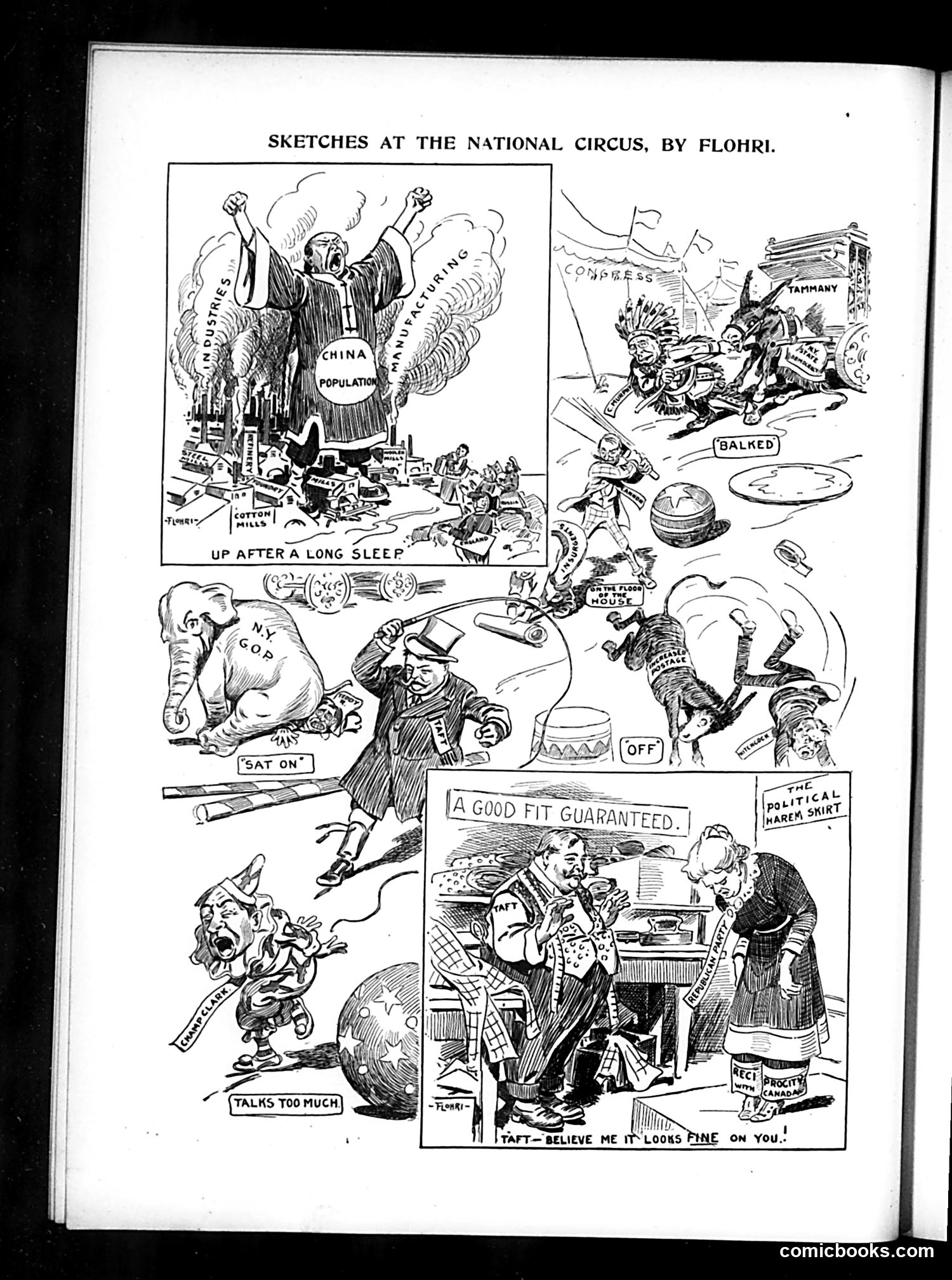
This satirical page uses circus metaphors to mock American politics and public figures. The top panel, "Up After a Long Sleep," depicts China's population as a giant awakening figure—likely referencing China's emergence as a geopolitical force. Other panels employ sideshow imagery: "Sat On" shows an elephant (Republican symbol) being crushed; acrobats perform dangerous stunts labeled "Balked"; and a character "Talks Too Much" with a ball-and-chain. The bottom panel, "A Good Fit Guaranteed," depicts tailors fitting someone (possibly President Taft, based on the visible label) with clothing labeled "The Political Harm Shirt," satirizing how political accommodations constrain leaders. The overall conceit treats politics as circus entertainment—chaotic, artificial, and absurd.
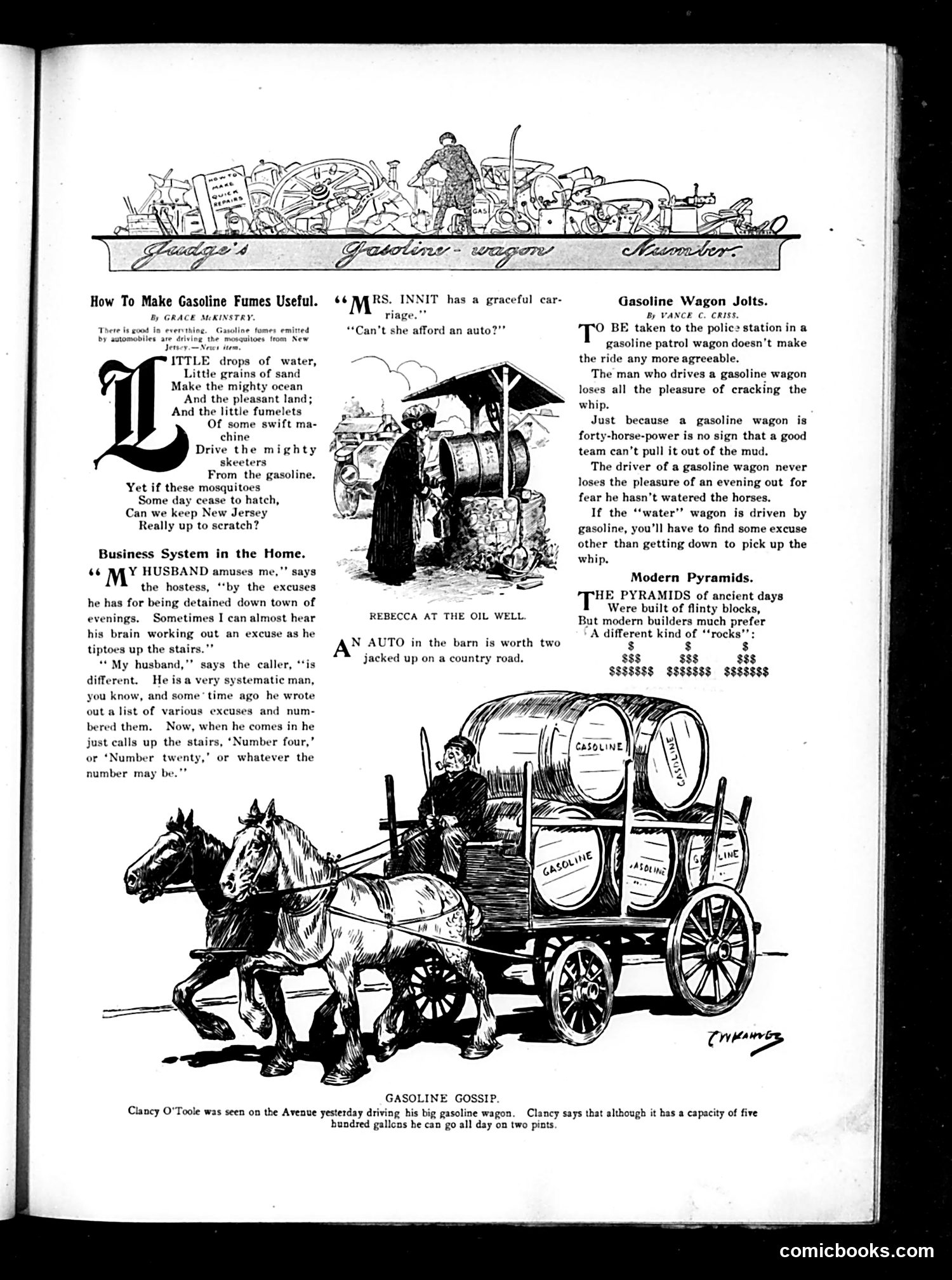
This page contains three separate humorous articles about gasoline and automobiles in the early automotive era: 1. **"How To Make Gasoline Fumes Useful"** - A poem satirizing the noxious fumes from gasoline engines, suggesting they might serve some purpose given how unpleasant they are. 2. **"Gasoline Wagon Jolts"** - Brief jokes contrasting gasoline-powered wagons with horse-drawn ones, noting that gasoline wagons eliminate the pleasure of cracking a whip and require constant maintenance. 3. **"Modern Pyramids"** - A visual joke showing dollar signs stacked like pyramids, likely satirizing the wealth generated by the gasoline industry. The large illustration depicts a horse-drawn wagon loaded with gasoline barrels, captioned as belonging to "Clancy O'Toole," suggesting early gasoline distribution. The satire reflects early 20th-century skepticism about automobiles and their practical advantages over horses.
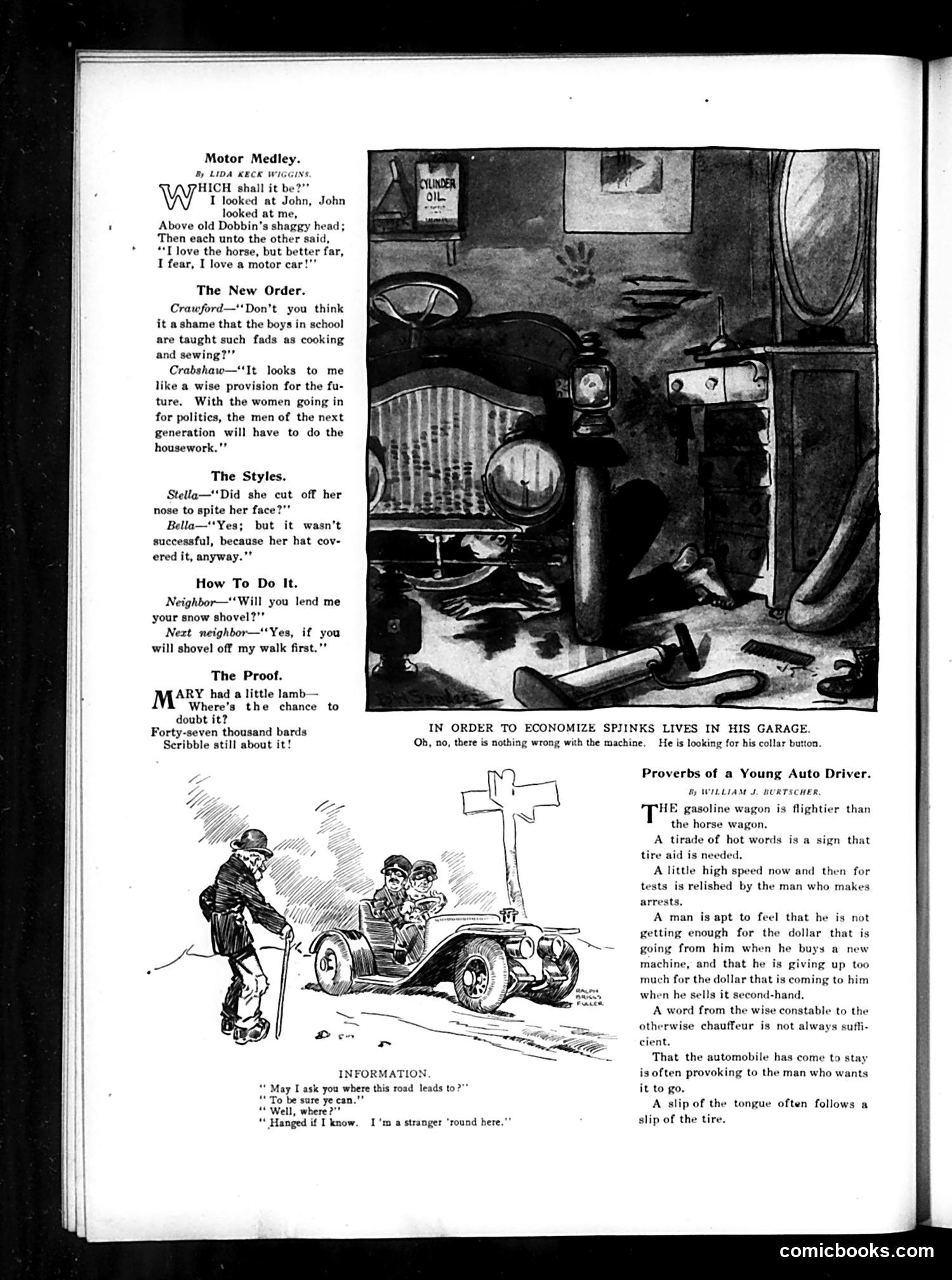
This page satirizes early-20th-century anxieties about **automobiles and changing gender roles**. The main cartoon shows a priest blessing an automobile, captioned "Information" — humorously depicting cars as new objects of reverence, replacing horses in American life. The prose sections mock **women's liberation**. "The New Order" jokes that as women enter politics, men will need to learn housework. "Motor Medley" shows couples preferring cars to horses — reflecting cultural worry about automobiles as symbols of modern independence threatening traditional domesticity. The **"Proverbs of a Young Auto Driver"** satirizes reckless motorists and their conflicts with law enforcement ("A tirade of hot words is a sign that tire aid is needed"). The final section mocks strangers getting lost on unfamiliar roads — suggesting automobiles' disorienting effect on established social geography. Overall: the page presents automobiles as socially disruptive, undermining both traditional transportation hierarchies and gender expectations.
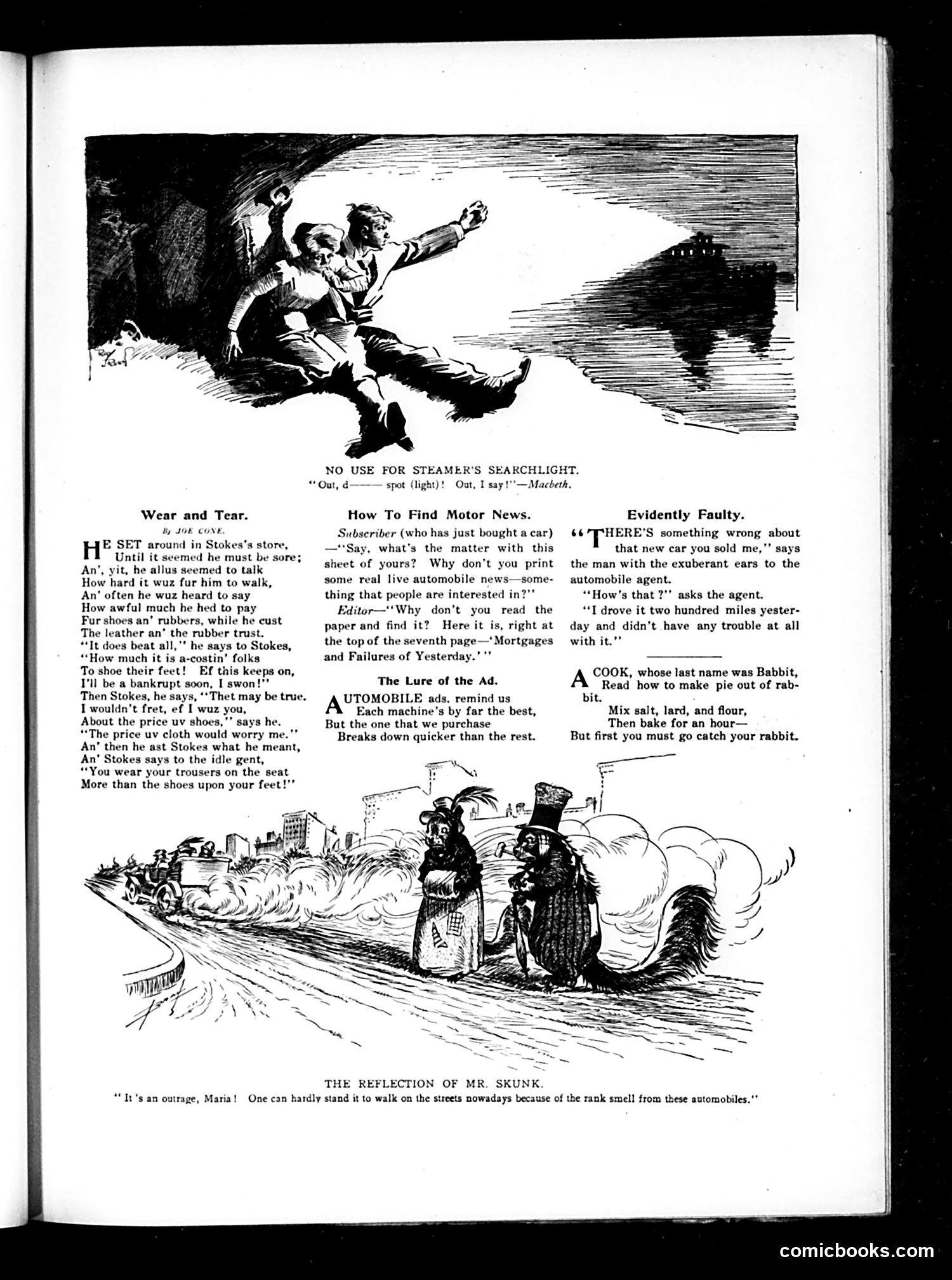
This page from *Judge* satirizes early automobile culture and consumer complaints circa 1900s-1910s. **Top cartoon**: "Wear and Tear" mocks a chronic complainer who gripes about shoe costs while wearing out his trousers sitting idle—Stokes deflates his grievance by pointing out he wears his pants through *sitting*, not walking. **"No Use for Steamer's Searchlight"**: References Shakespeare's *Macbeth* ("Out, damned spot") to mock automobile exhaust—the searchlight cannot penetrate the pollution. **"How to Find Motor News"**: A new car owner demands automobile news but the editor points out cars only appear in the financial section under "Mortgages and Failures," suggesting early vehicles were unreliable investments. **"The Lure of the Ad"**: Advertising claims each automobile is "best," yet purchasers' cars fail fastest—exposing false advertising. **"The Reflection of Mr. Skunk"**: Complains about automobile smell polluting streets, comparing fumes to skunk odor. Overall, the page satirizes both consumer gullibility and automobiles' real problems: unreliability, pollution, and financial risk.
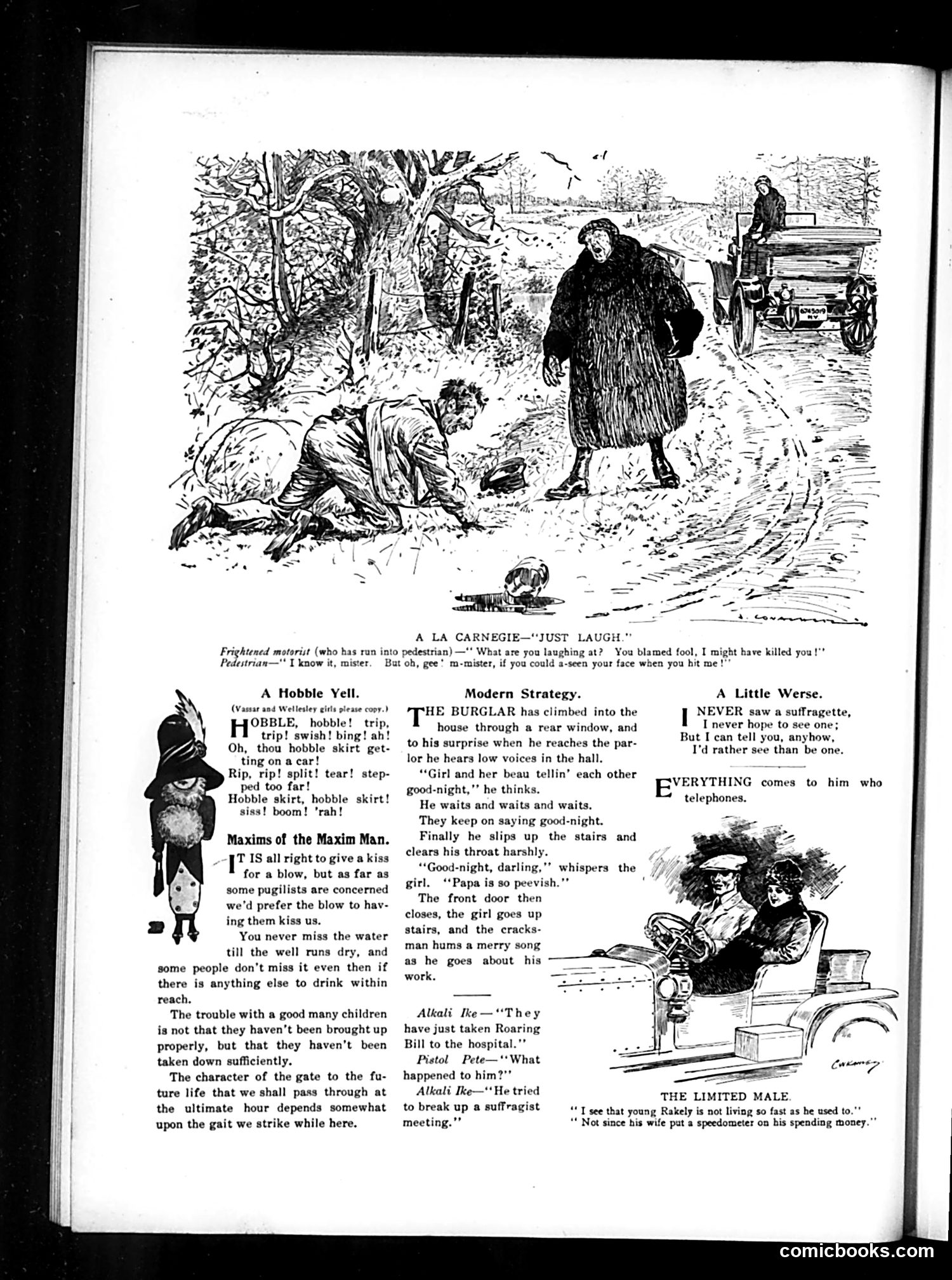
This page contains multiple satirical pieces targeting early 1900s social trends: **Top cartoon ("Just Laugh")**: Mocks a motorist hitting a pedestrian who finds humor in the accident—satirizing both reckless driving (a new phenomenon) and lower-class stoicism. **"Hobble Yell"**: Parodies college cheers while ridiculing the "hobble skirt," a restrictive women's fashion that made walking difficult. The mockery targets both the absurd garment and educated women who wore it. **"Modern Strategy"**: A burglar abandons his robbery because a couple won't stop saying goodnight—satirizing prolonged romantic farewells as comically obstructive. **"A Little Verse"**: Anti-suffragist doggerel expressing preference for women's invisibility over their voting rights activism. **Other pieces**: Mock various social types (overly affectionate men, frivolous spending husbands, suffragists). The page reflects Judge's conservative stance on women's expanding social roles—fashion, education, and especially suffrage—presenting these developments as ridiculous threats to normalcy.
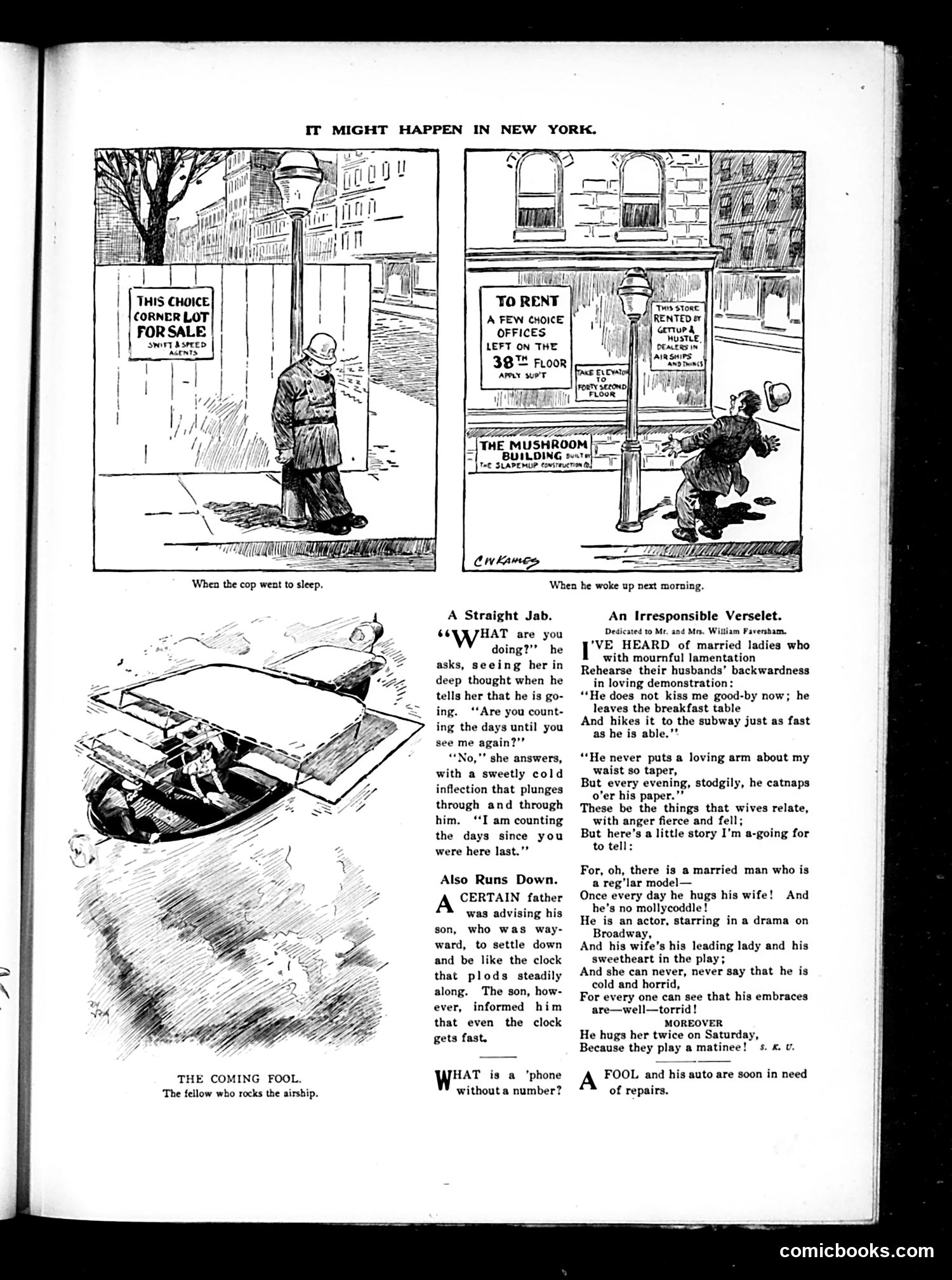
This page contains multiple satirical pieces typical of early 20th-century Judge magazine humor: **Top comics**: A two-panel sequence showing a policeman discovering a corner lot for rent, then discovering someone has stolen the sign overnight—satirizing New York's rapid commercialism and petty theft. **Text pieces below**: Several short humorous anecdotes mocking marital discord and foolish behavior: - "A Straight Jab" ridicules a husband by having his wife reveal she's counting days *since* he arrived, not until he leaves - "Also Runs Down" jokes that even clocks (symbols of reliability) malfunction - "An Irresponsible Verselet" dedicates a poem to actor William Faversham and his wife, sardonically praising a theater couple who embrace regularly—because their kisses are literally performed onstage, not genuine affection - "The Coming Fool" mocks someone rocking an airship The humor targets marital coldness, urban chaos, and human foolishness—typical concerns of this genteel satirical magazine.
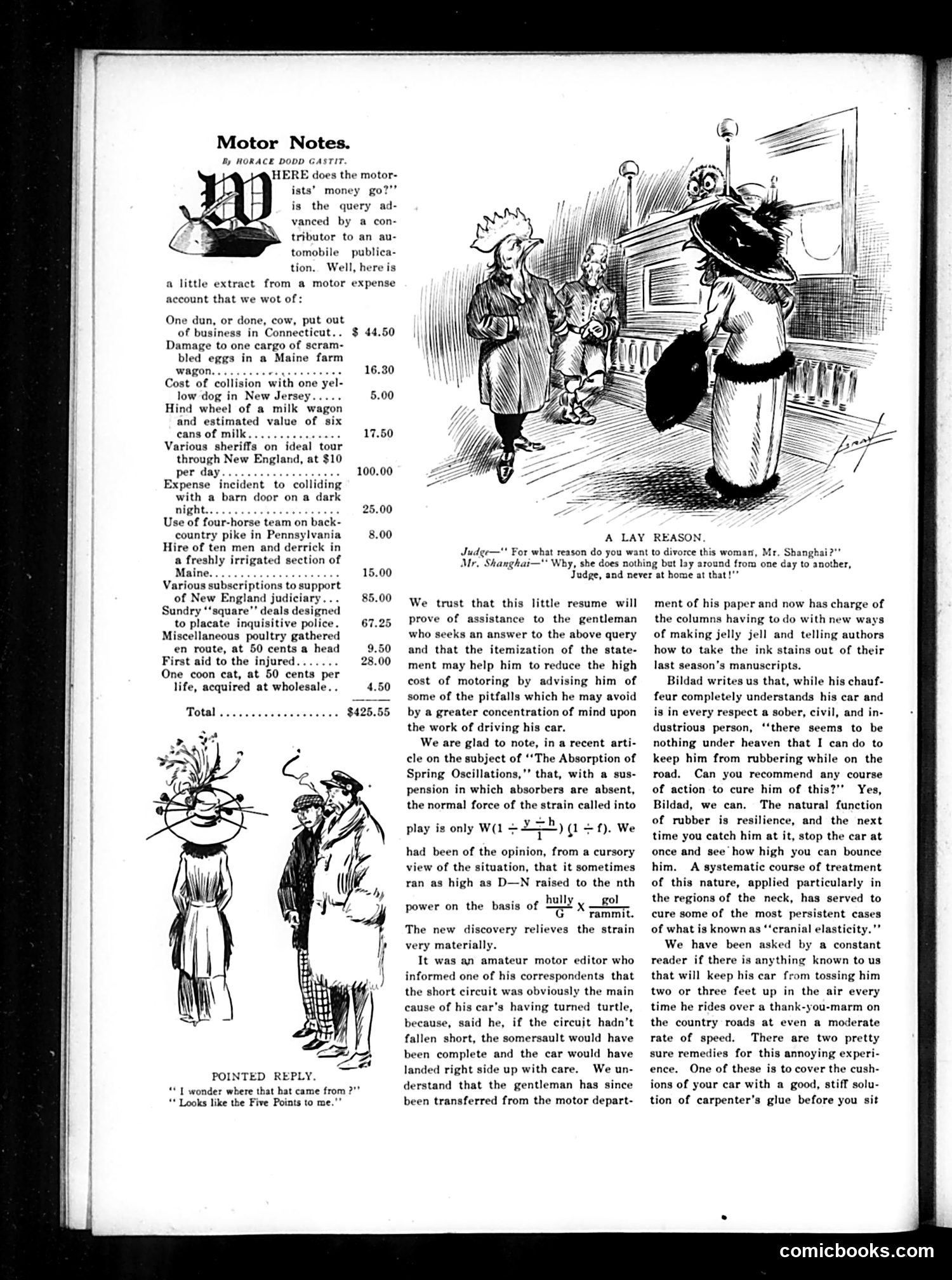
This page satirizes the high costs and accidents of early automobile ownership. The main "Motor Notes" column by Horace Dodd Gastit lists comically exaggerated motoring expenses—hitting a cow ($44.50), damaging farm produce, colliding with dogs and wagons, bribing sheriffs and judges to avoid prosecution ($67.25), and paying for livestock damage. The total: $425.55. The humor targets reckless early drivers who damage property and must pay off local authorities. The cartoons and jokes reinforce this: one depicts a woman's infidelity (the "lay reason" for divorce—a pun on a chicken's egg-laying); another jokes about worn clothing ("Five Points"—a poor neighborhood). The column mocks both careless drivers and the pretentious technical jargon of amateur automotive journalists, suggesting early motoring culture was chaotic and accident-prone.
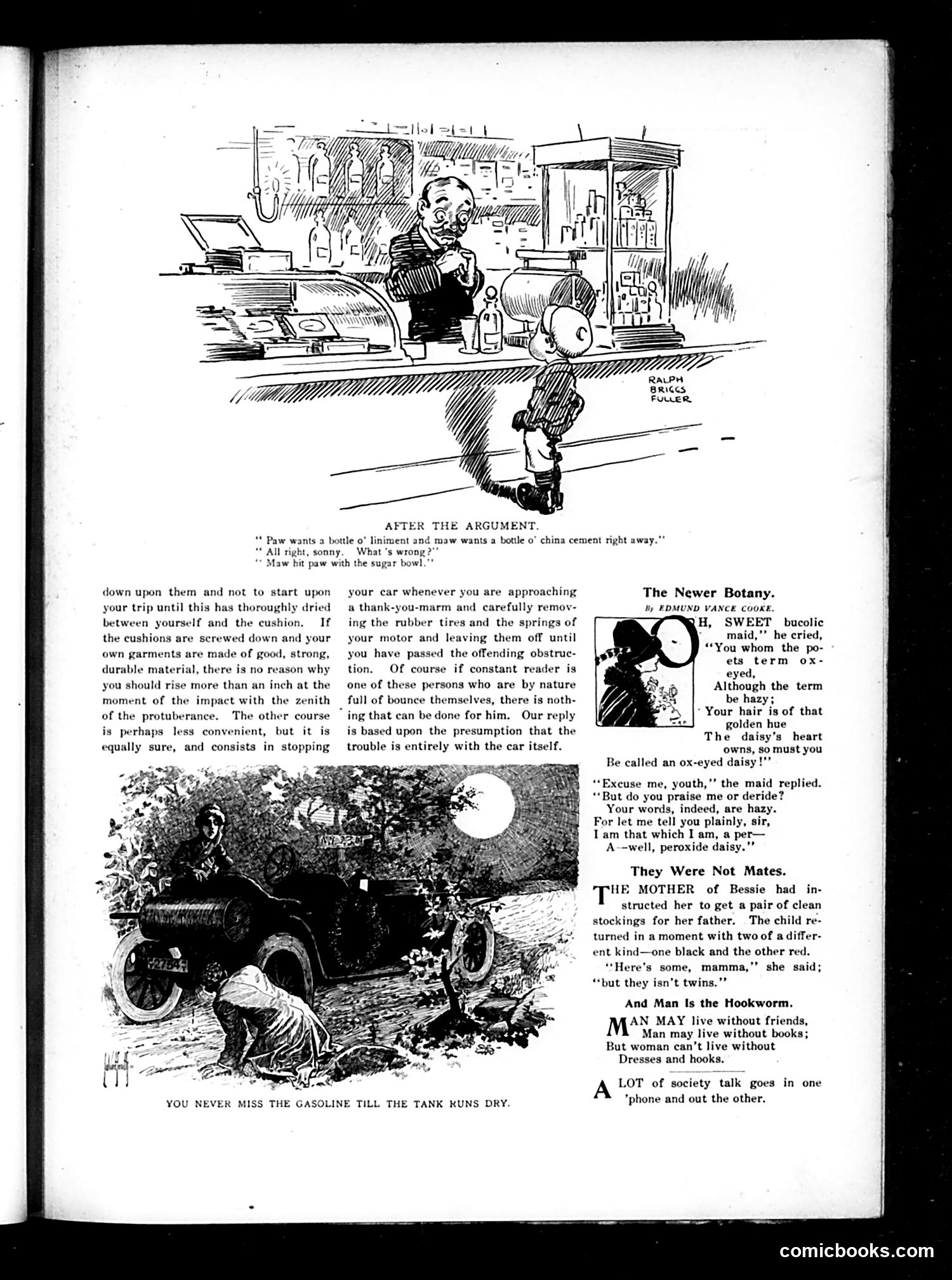
This page contains several satirical pieces typical of early 20th-century American humor: **Top Cartoon:** "After the Argument" depicts a domestic dispute where a wife hit her husband with a sugar bowl. Their child matter-of-factly requests liniment for "paw" and "china cement" for "maw"—satirizing working-class family violence as commonplace and requiring practical remedies. **Middle Section:** Technical advice about automobile suspension, humorously addressing the problem of "thank-you-ma'ams" (road bumps that jolted vehicles), reflecting early automotive culture's frustrations. **Poetry & Humor Pieces:** - "The Newer Botany" mocks poetic clichés about feminine beauty, with a woman rejecting romantic flattery by admitting her blonde hair is actually peroxide-dyed - "They Were Not Mates" jokes about a child mismatching stockings (one black, one red), punning on "twins" - Final quips about women needing dresses/hooks and gossip The page reflects Edwardian-era attitudes: domestic discord treated as comedy, early car culture anxieties, and cynicism toward romantic idealization.
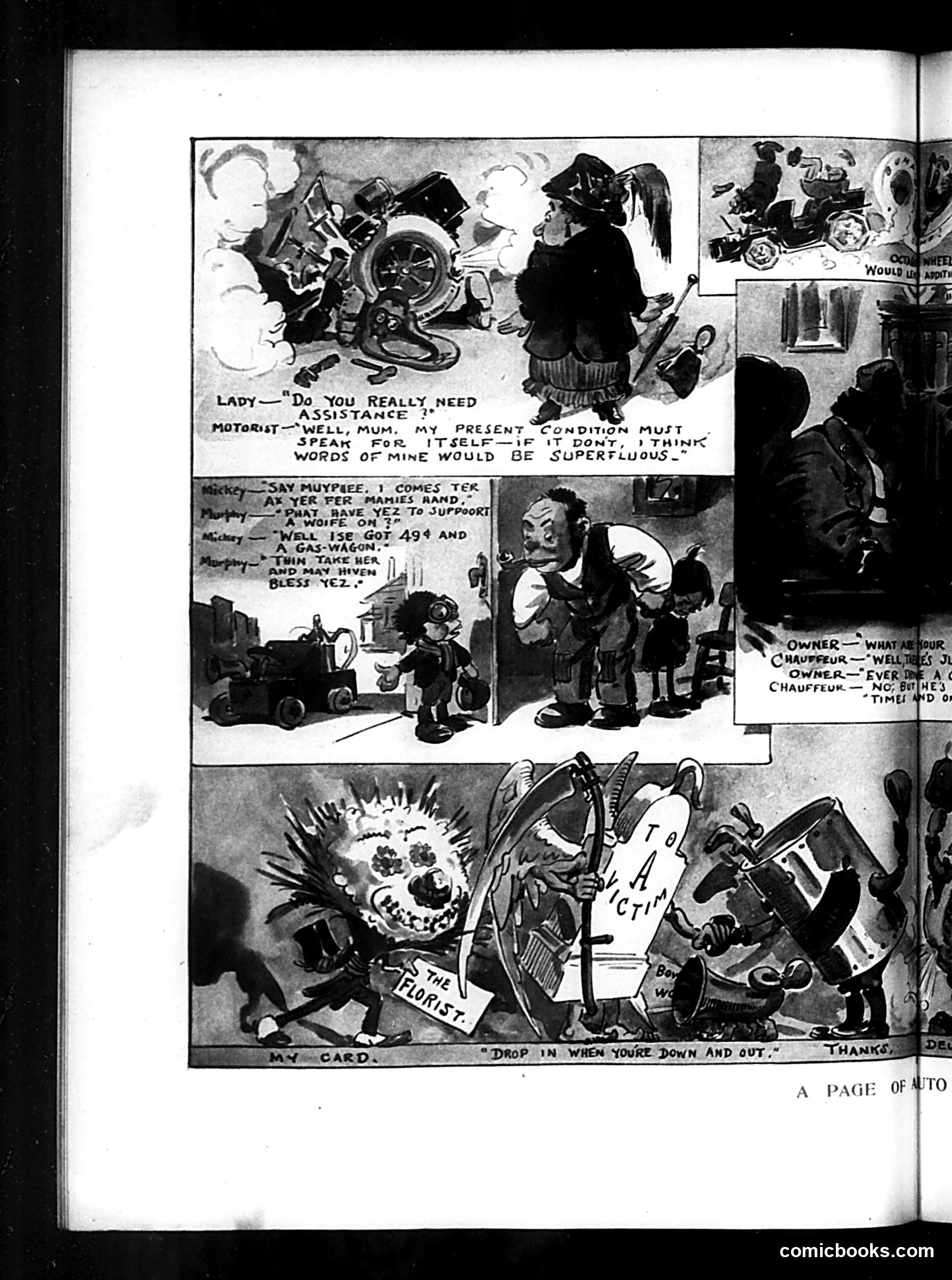
This is a multi-panel comic from *Judge* magazine satirizing early automobile culture and the dependency it created. **Top panel:** A well-dressed motorist has broken down and seeks help from a lady. His pompous response—that his wrecked condition "speaks for itself"—mocks the pretentiousness of early car owners. **Middle panel:** A character named Mickey discusses supporting a wife on minimal wages (49¢ and a gas-wagon), suggesting automobiles were becoming financial burdens for working-class families aspiring to middle-class status. **Bottom panel:** Shows an automobile explosion or disaster, labeled "The Florist" and "To a Victim," sardonically suggesting one should "drop in when you're down and out"—dark humor about car accidents. The cartoons collectively mock how automobiles, marketed as status symbols and conveniences, actually created financial strain and safety hazards for ordinary people. The satire targets both pretentious car owners and the false promises of automotive progress.
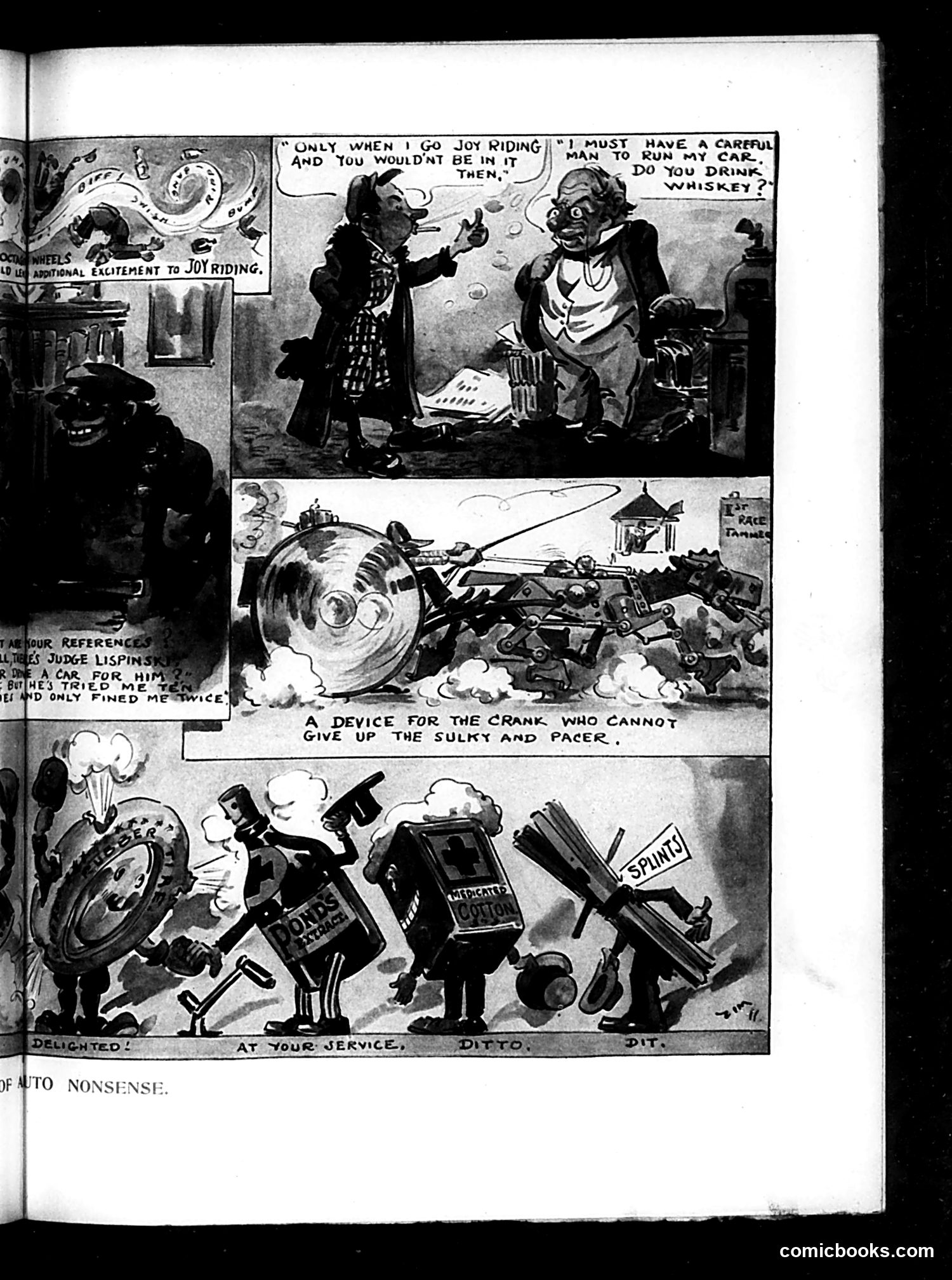
This appears to be an early 20th-century satirical cartoon about automobiles and driving culture. The top panel shows two caricatured men discussing joy riding—one claims he only does it safely, while the other questions his drinking habits ("Do you drink whiskey?"), suggesting reckless behavior among motorists. The middle panel depicts "a device for the crank who cannot give up the sulky and pacer"—apparently mocking drivers addicted to fast driving, comparing them to those obsessed with horse-drawn vehicles. The bottom panel shows various automotive devices and equipment personified as if "delighted" to be "at your service," satirizing the proliferation of car accessories and gadgets of the era. The overall joke targets early automobile culture's association with recklessness, drinking, and excessive speed, positioning cars as a frivolous luxury that encourages bad behavior.
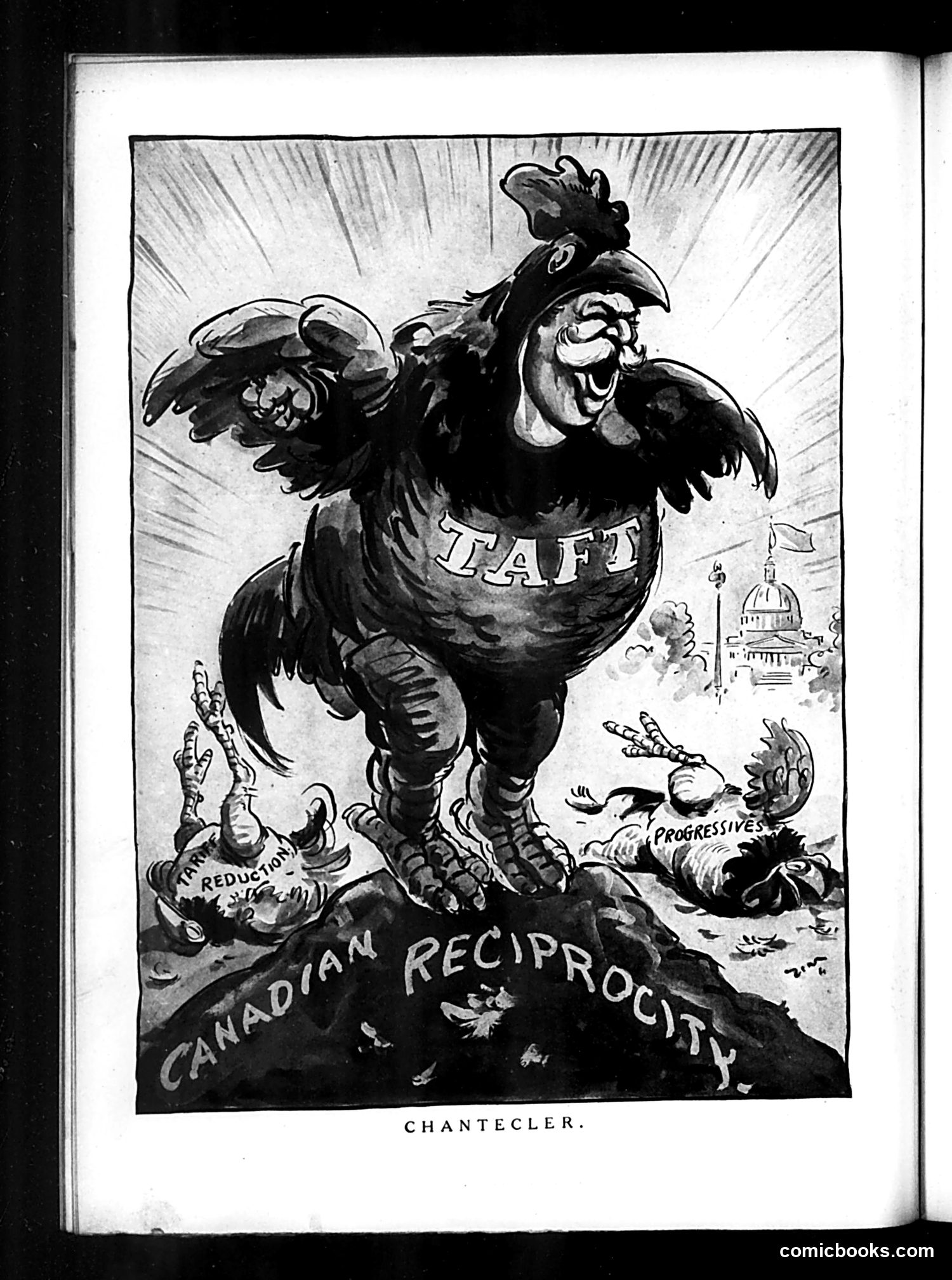
This satirical cartoon depicts a large rooster wearing a "TAFT" sash, standing atop a rock labeled "CANADIAN RECIPROCITY." The rooster appears to be crowing triumphantly while trampling figures labeled "REDUCTIONISTS" and "PROGRESSIVES" below. The cartoon critiques President William Howard Taft's support for Canadian reciprocity (free trade agreement), mocking him as a boastful rooster. The title "Chantecler" references Edmond Rostand's famous play about a vain rooster, suggesting Taft is similarly self-important or deluded. The "Progressives" and "Reductionists" underfoot represent political factions opposing the reciprocity deal—likely protectionists who feared economic harm and progressives skeptical of corporate interests. The Capitol visible in the background emphasizes this is a national political matter. The satire suggests Taft's reciprocity policy was arrogant overreach that harmed key political constituencies.
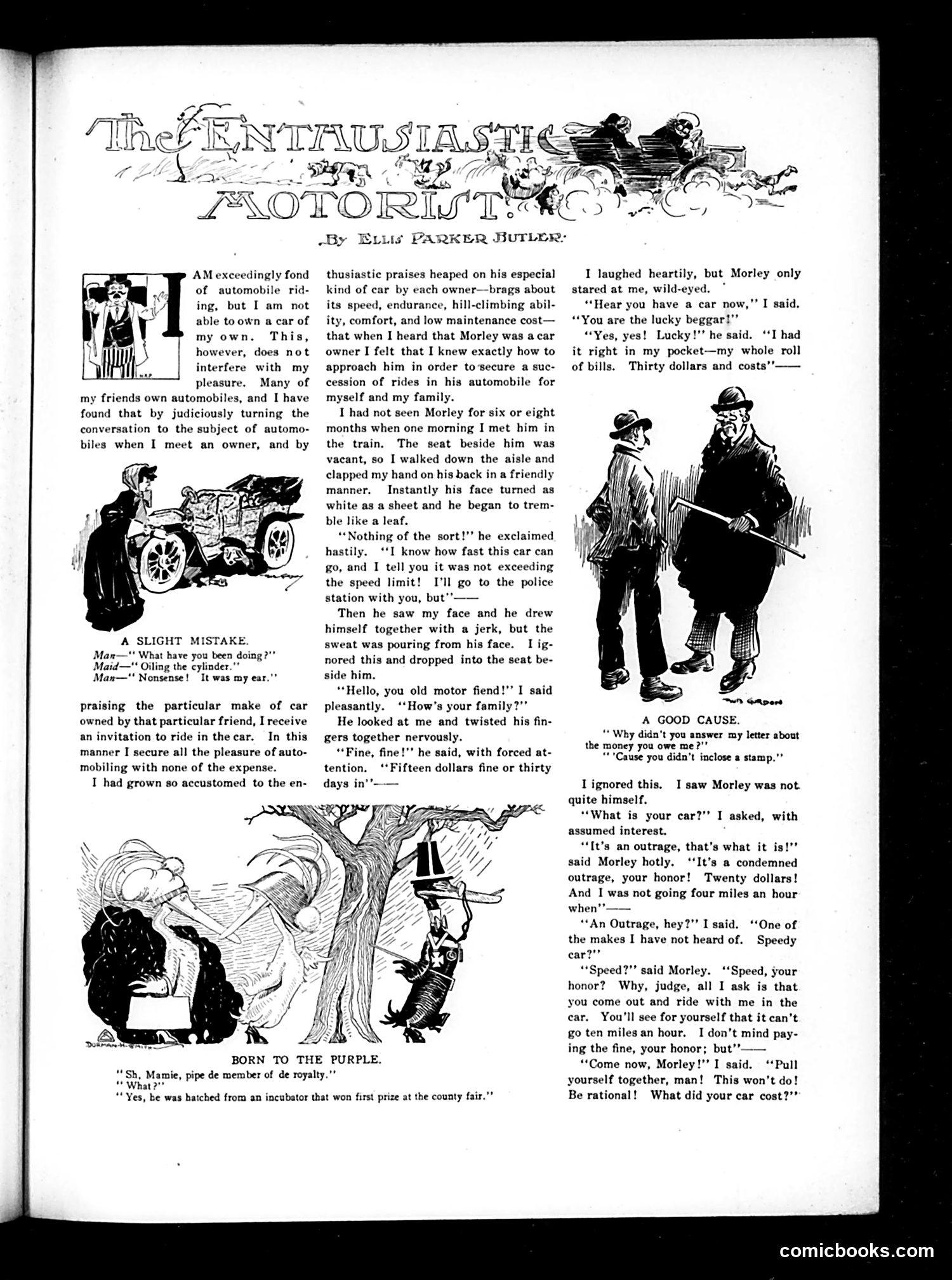
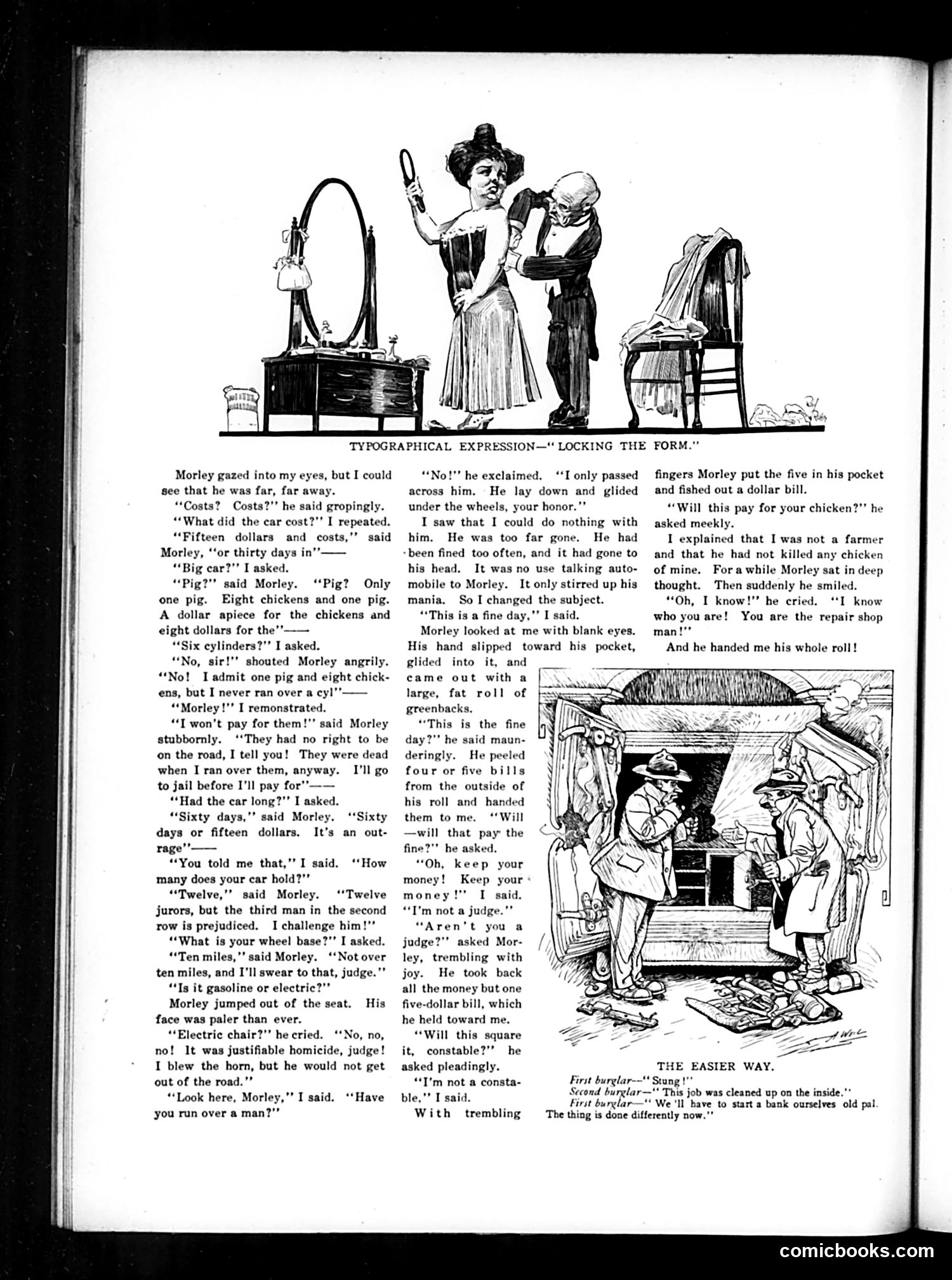
This page contains two satirical pieces about crime and legal corruption in early 20th-century America. **Top cartoon and story**: A man named Morley, apparently a chronic lawbreaker, speaks in confused non-sequiturs to a judge (likely the narrator). Morley conflates automobile terminology with legal jargon—mixing "cylinders" with chickens he's hit, "wheel base" with jail sentences, and "electric" with "electric chair." The satire mocks how habitual criminals become so desensitized by repeated fines and arrests that legal proceedings lose meaning to them. He reflexively offers bribes to anyone in authority, unable to distinguish judges from repair men. **Bottom cartoon, "The Easier Way"**: Two burglars discuss a completed heist. One notes it was "cleaned up on the inside," implying inside corruption made the robbery easy. The punchline suggests they'll "start a bank ourselves"—satirizing that legitimate banks operate through the same corrupt methods as burglars, just legally sanctioned. The joke critiques financial institutions as institutionalized theft. Both pieces express cynicism about urban crime, legal corruption, and the ineffectiveness of law enforcement.
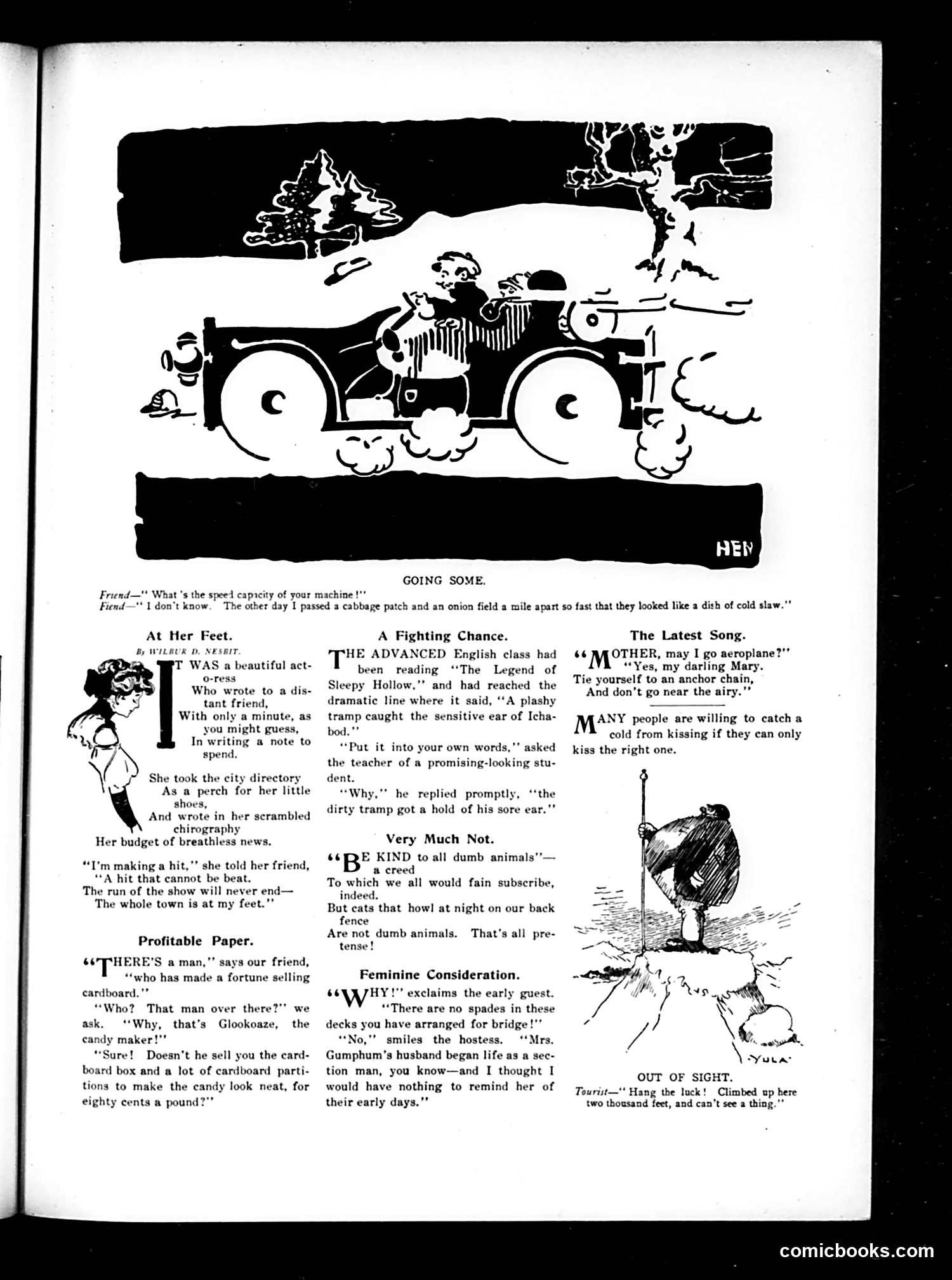
This page from the satirical magazine *Judge* contains multiple brief humorous pieces typical of early 20th-century American humor: **"Going Some"** (top cartoon): A joke about an automobile's speed—the driver claims he passed vegetables so fast they appeared as a dish of cold slaw, exaggerating the car's velocity for comedic effect. **"At Her Feet"**: Satirizes an actress's self-aggrandizing letter, where she claims the "whole town is at my feet"—a common theatrical cliché mocked here. **"Profitable Paper"**: Mocks a candy manufacturer who profits by selling expensive cardboard boxes and partitions to make candy appear more substantial than it is—commentary on commercial deception. **"A Fighting Chance"**: A schoolroom joke where a student misinterprets literary language, replacing "plashy tramp" with crude modern phrasing. The remaining pieces are brief social jokes about animals, bridge etiquette, aeroplanes, kissing, and tourism—reflecting contemporary concerns and class attitudes. The humor is gentle, domestic satire rather than political commentary.
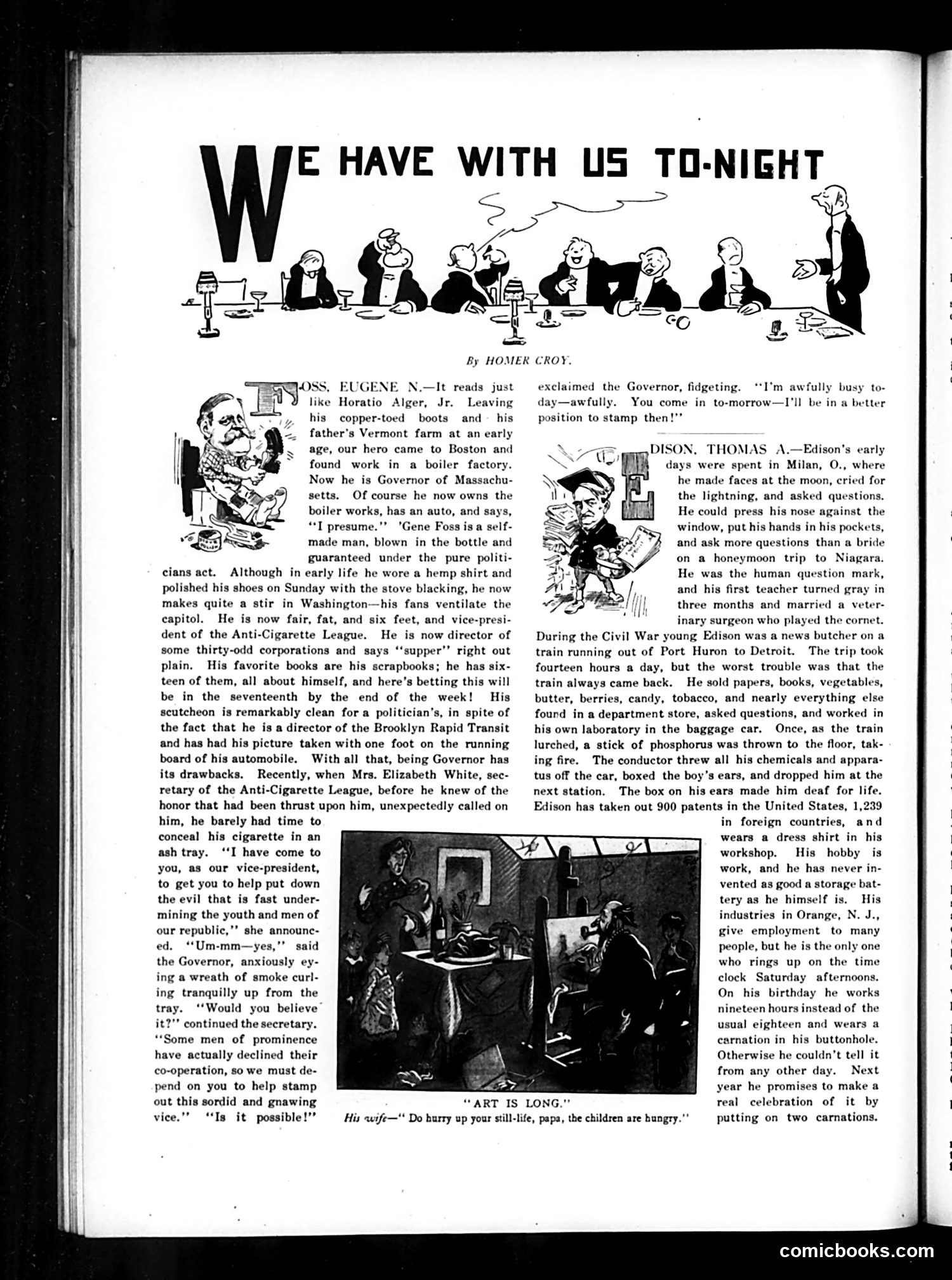
This Judge magazine page satirizes two prominent early-20th-century figures through biographical sketches with humor: **Top cartoon**: Eugene Foss, Governor of Massachusetts, is mocked as a self-made man (Horatio Alger-style rags-to-riches narrative) who has become a hypocrite. Despite his polished image and leadership of the Anti-Cigarette League, he's caught smoking. The joke: when the League's secretary visits asking him to "stamp out" cigarettes, he nervously hides his cigarette and delays, saying he'll be "in a better position to stamp then"—exposing his moral inconsistency. **Lower section**: Thomas Edison receives fawning biographical treatment contrasting his humble origins with his prolific achievements (900+ U.S. patents), though with gentle jabs at his work obsession and the irony that he's invented nothing better than himself as a "storage battery" of energy. Both pieces use satire to puncture pretension—Foss's moral posturing and the general American tendency to lionize self-made industrialists.
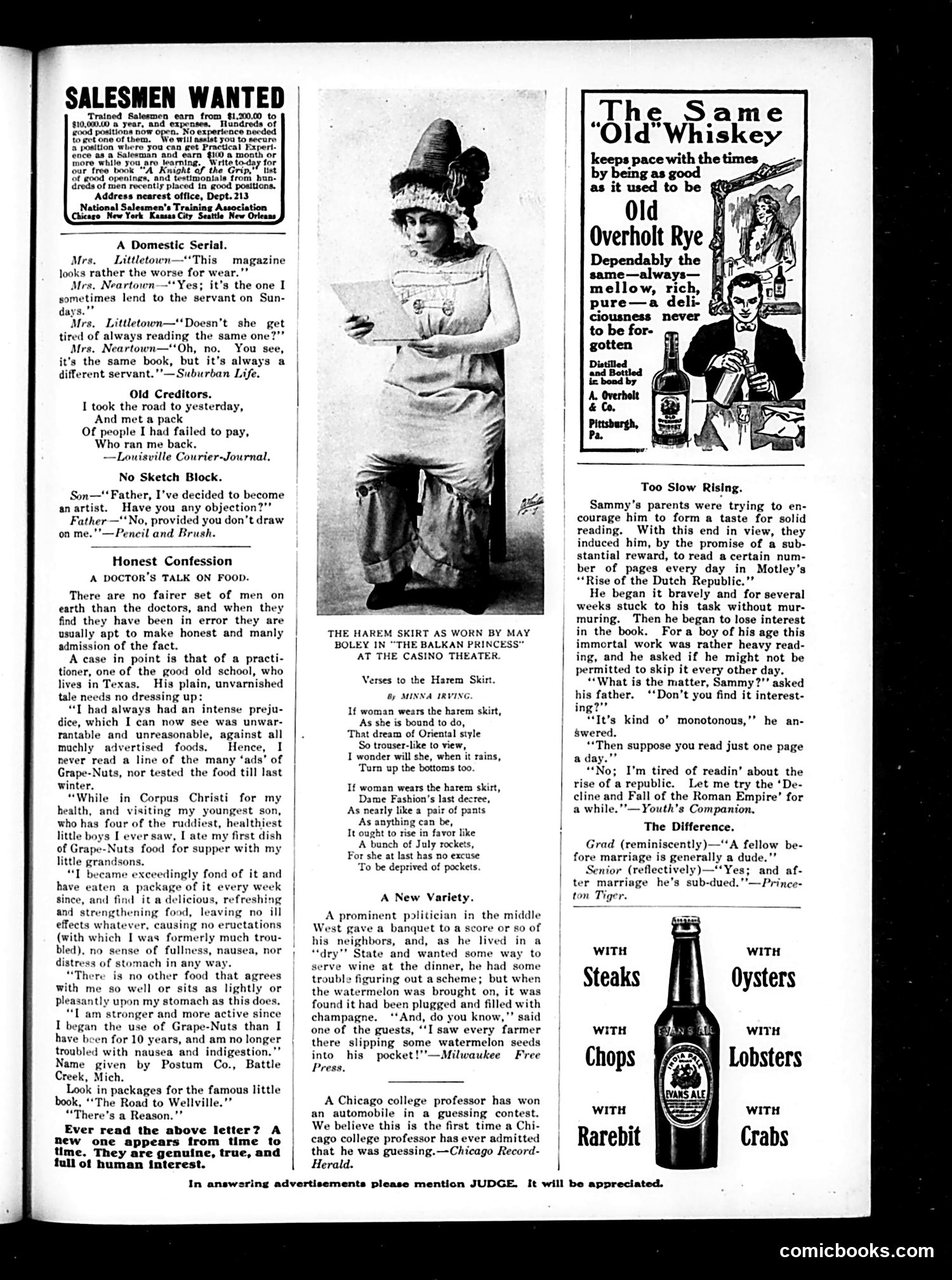
This page mixes advertisements, humor columns, and editorial content typical of early 1900s satirical magazines. **Main Content:** The centerpiece is a photograph of actress May Boley in a "harem skirt" from the theatrical production "The Balkan Princess" at the Casino Theater. This fashion sparked public debate—the poem by Minna Irving mocks the garment's resemblance to trousers, joking that women finally have "no excuse" to avoid having pockets. **The Humor:** The page's jokes target contemporary concerns: servant-class literacy (servants borrowing magazines), artist children (financial burdens), and doctors' resistance to advertised food products (Grape-Nuts receives a testimonial from a converted Texas physician). **Context for Modern Readers:** The "harem skirt" controversy reflects anxieties about women's clothing becoming less restrictive and more masculine-coded. The Grape-Nuts ad represents early mass-marketing skepticism among professionals. The servant joke reflects class attitudes of the era. The page is primarily advertising-driven, with humor filling space between commercial pitches—typical Judge magazine format.
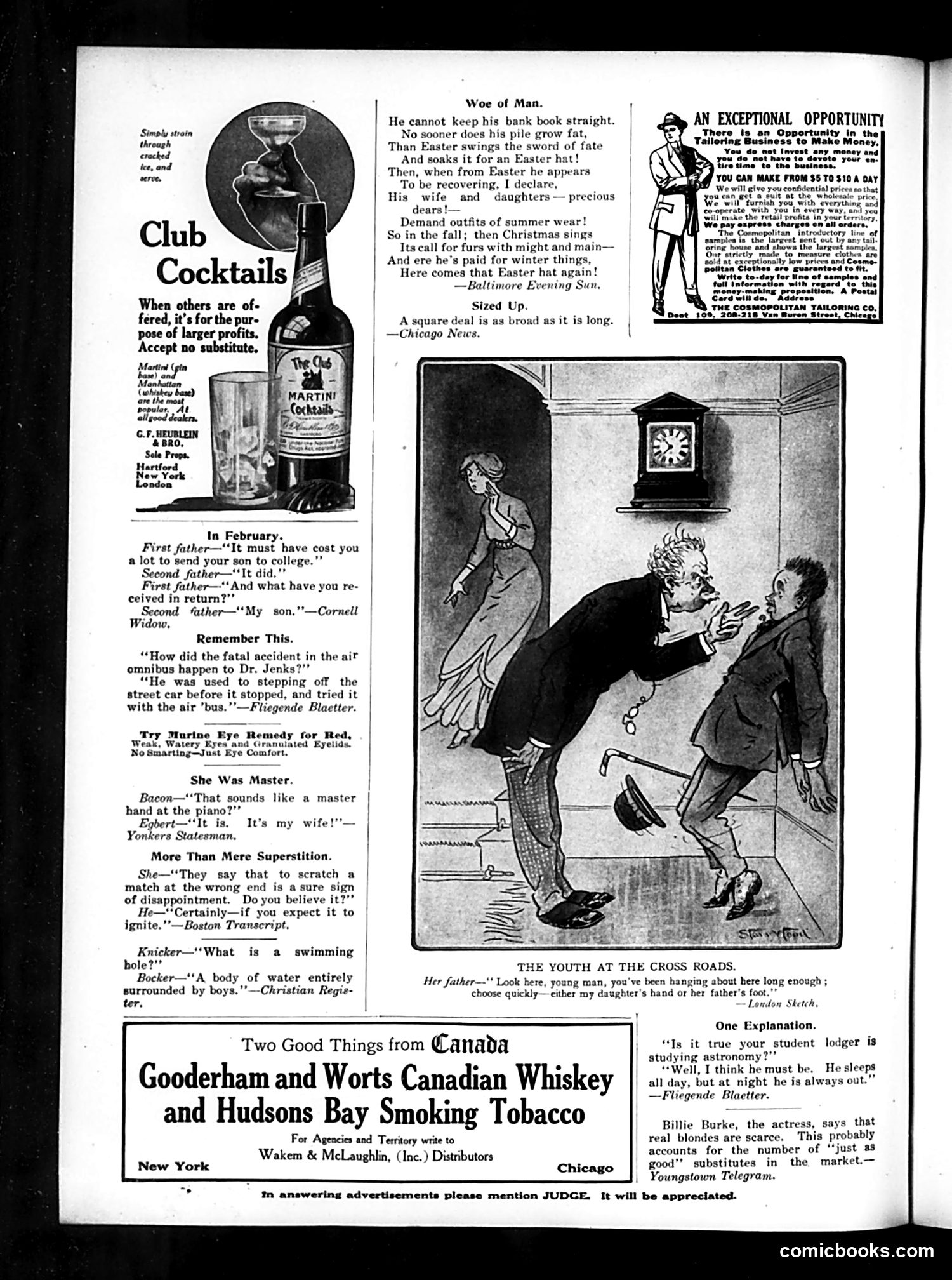
This page contains several short humor pieces typical of Judge magazine's satirical style. **"Woe of Man"** (top left) is a verse satire about male financial struggles. It depicts a man perpetually broke despite earning enough, as his wife and daughters constantly demand new clothes for each season—Easter hats, summer wear, winter furs—creating an endless cycle of spending. The joke critiques both consumerism and women's fashion demands, presenting the husband as a hapless victim of female shopping habits, a common theme in early 20th-century humor. **"The Youth at the Cross Roads"** (main cartoon, right) shows a young man threatened by an angry father wielding a shoe, forced to choose between marrying the daughter or facing violence. It satirizes shotgun marriages and paternal authority over courtship. The remaining items are brief jokes about college costs, aviation mishaps, piano playing, superstition, and swimming holes—typical filler humor. The page also includes advertisements for Canadian whiskey and tailoring services, and a note about an actress's comments on blonde hair.
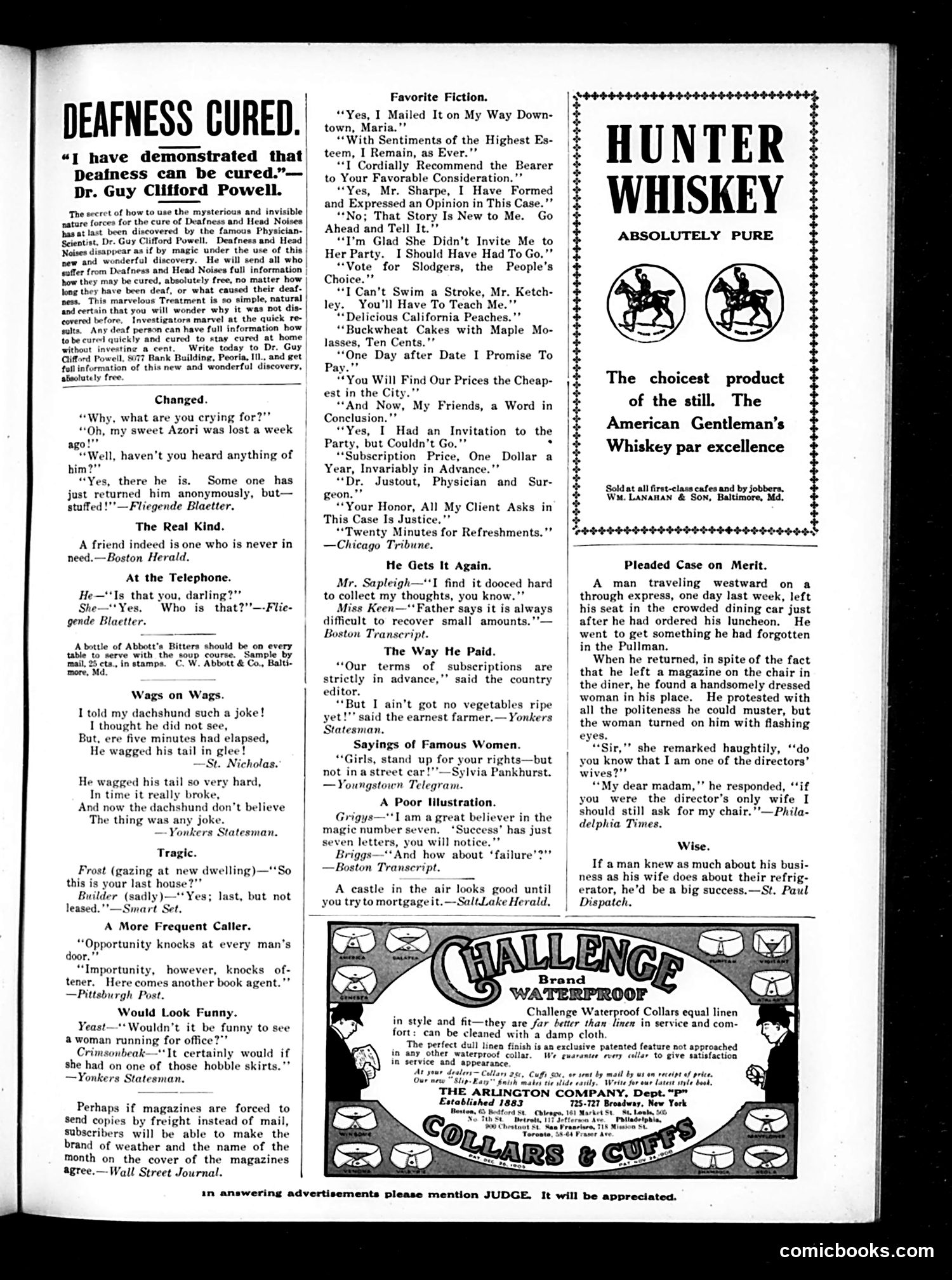
This page from *Judge* (a prominent American satirical magazine) combines various humorous short pieces with period advertisements. **Content Overview:** The page features multiple brief comedic items—mostly one-liners and short jokes—typical of satirical magazines of this era. Topics include wordplay ("At the Telephone"), observational humor about human nature ("A More Frequent Caller"), and gentle domestic comedy. **Key Satirical Element:** The section titled "Favorite Fiction" mocks common platitudes and insincere social formulas people routinely use—phrases like "I cordially recommend," "the people's choice," and "your honor, all my client asks is justice." The satire suggests these expressions are hollow utterances devoid of genuine meaning. **Advertisements:** The page includes period product ads (Abbott's Bitters, Hunter Whiskey, Challenge Brand Waterproof Collars) and a medical ad for "deafness cure" by Dr. Guy Clifford Powell—likely a quack remedy typical of the era. **Context:** This reflects early 20th-century magazine humor: light, observational, focused on social manners and domestic life rather than political satire.
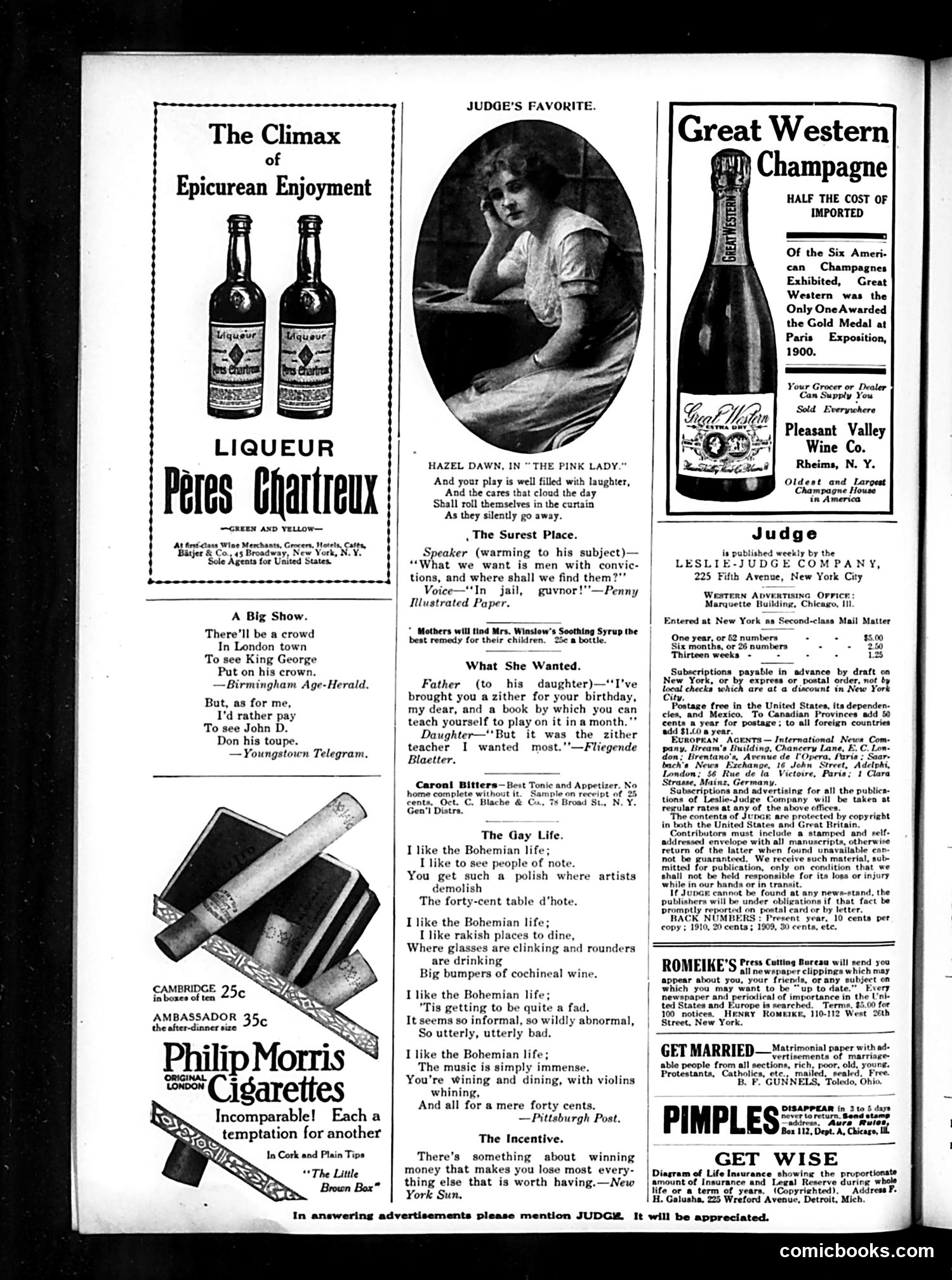
This page is primarily **advertisements and light humor**, not political satire. The main content includes: **Advertisements:** Liqueur, cigarettes, wine, and patent medicines dominate the page—typical of early 1900s magazine monetization. **Humor pieces:** Brief jokes about everyday topics: a father buying his daughter a zither (she wanted the zither *teacher*); a speaker asking where to find men with convictions (heckler shouts "jail!"); commentary on the "Bohemian life" of artists living cheaply. **Notable reference:** A joke compares King George's London coronation to John D. Rockefeller donning a toupee—mocking American fascination with wealth over royal pageantry. This appears to reference King George V's 1911 coronation. **The "Hazel Dawn" photo** illustrates a theatrical production called "The Pink Lady," suggesting entertainment coverage. The page reflects Judge's mix of satirical commentary (mostly anti-establishment, pro-common sense) alongside commercial content typical of early 20th-century magazines.
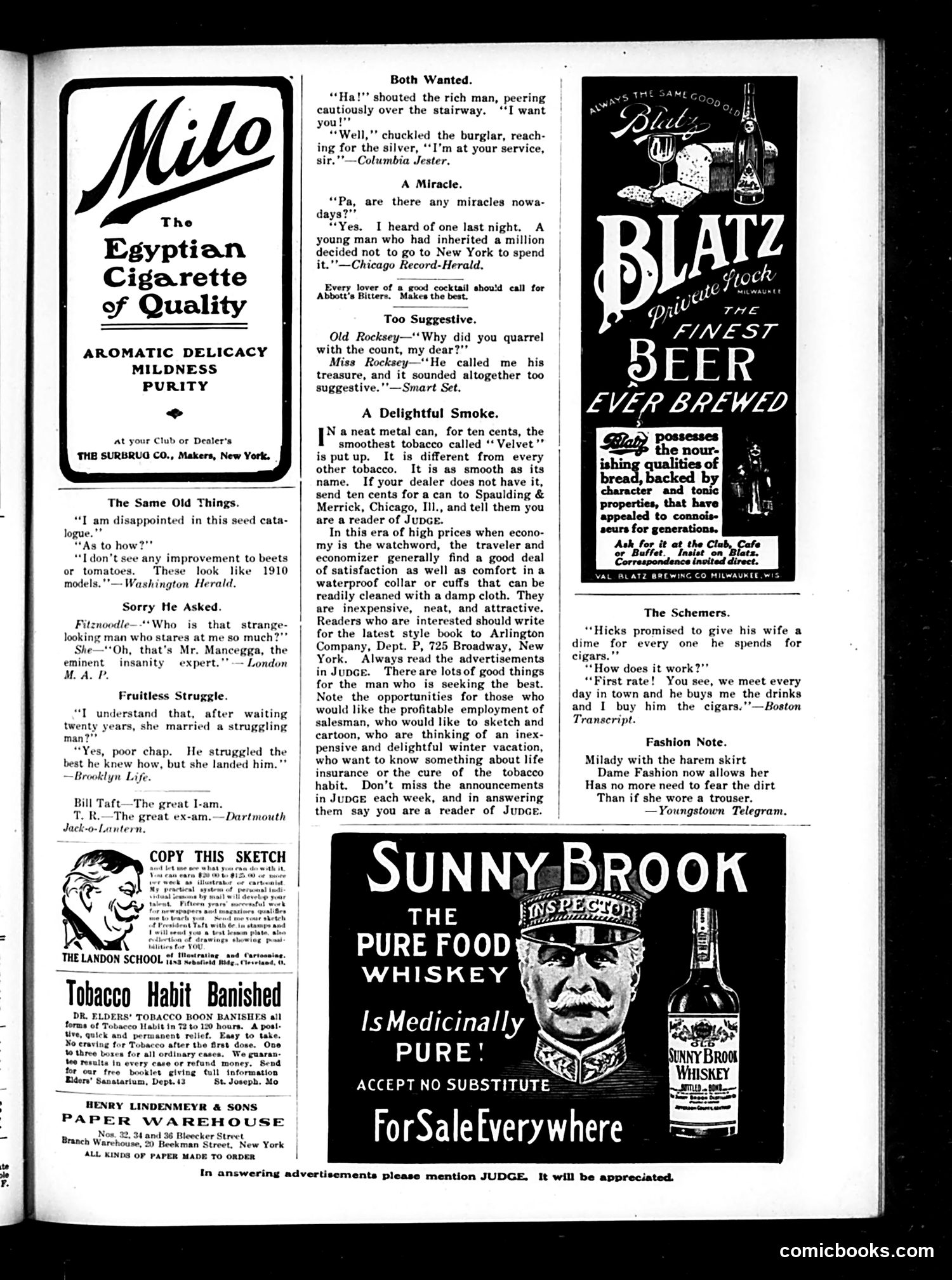
This page is primarily **advertising with brief humor pieces**, typical of Judge magazine's format. The humor sketches are short jokes about everyday life: a burglar politely agreeing to rob a rich man; a millionaire inheriting money but not wasting it in New York (presented as miraculous); marital schemes involving cigars and drinks; and observations about outdated seed catalogs. The **advertisements** promote period products: Milo Egyptian cigarettes, Blatz Beer (claiming medicinal purity), Sunny Brook whiskey (labeled "The Pure Food Whiskey" and claiming medical purity), tobacco-cessation treatments, waterproof collars, and paper supplies. A notable feature is the recurring claim that whiskey and tobacco products were "pure" or "medicinal"—reflecting pre-FDA regulation standards when such claims were unregulated. The humor and ads together capture early 20th-century consumer culture and marketing before modern consumer protection laws.
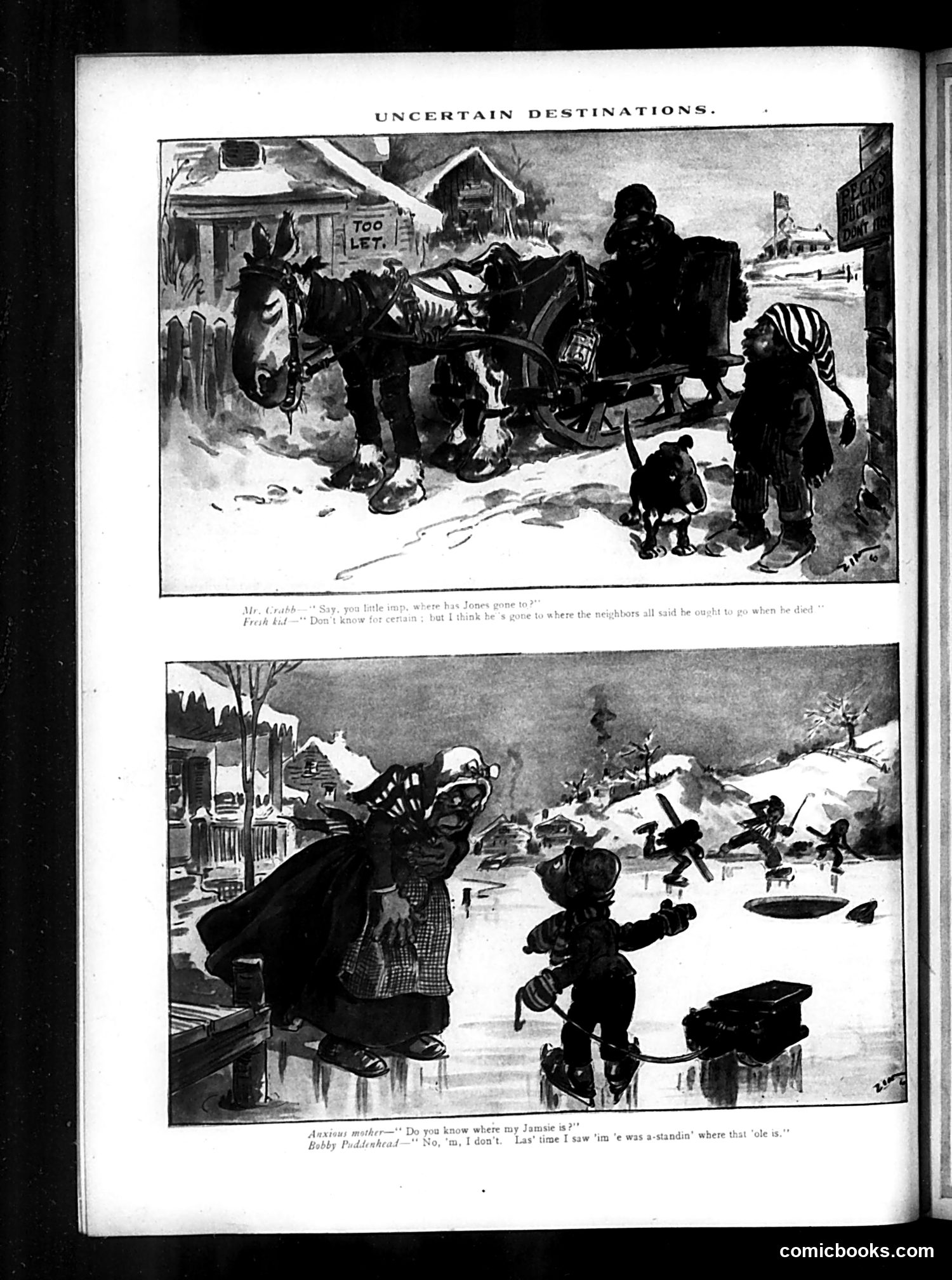
This page contains two winter-themed comic strips. The **top panel** shows a horse-drawn sleigh where Mr. Clark asks Fresh kid about "where has Jones gone to?" Fresh kid replies he doesn't know for certain, but thinks Jones went "where the neighbors all said he ought to go when he died"—implying Jones went to Hell. The **bottom panel** depicts an anxious mother asking Bobby Puddinghead if he knows where her son Jimmie is. Bobby responds he last saw him "standin' where that 'ole is," referring to what appears to be a dangerous hole in frozen ice. Both strips use dark humor about uncertain, potentially fatal destinations—one theological (Hell), one physical (through thin ice)—playing on winter peril and childhood mischief.