
Judge, 1911-03-11 · page 18 of 24
Judge — March 11, 1911 — page 18: what you’re looking at
What you’re looking at
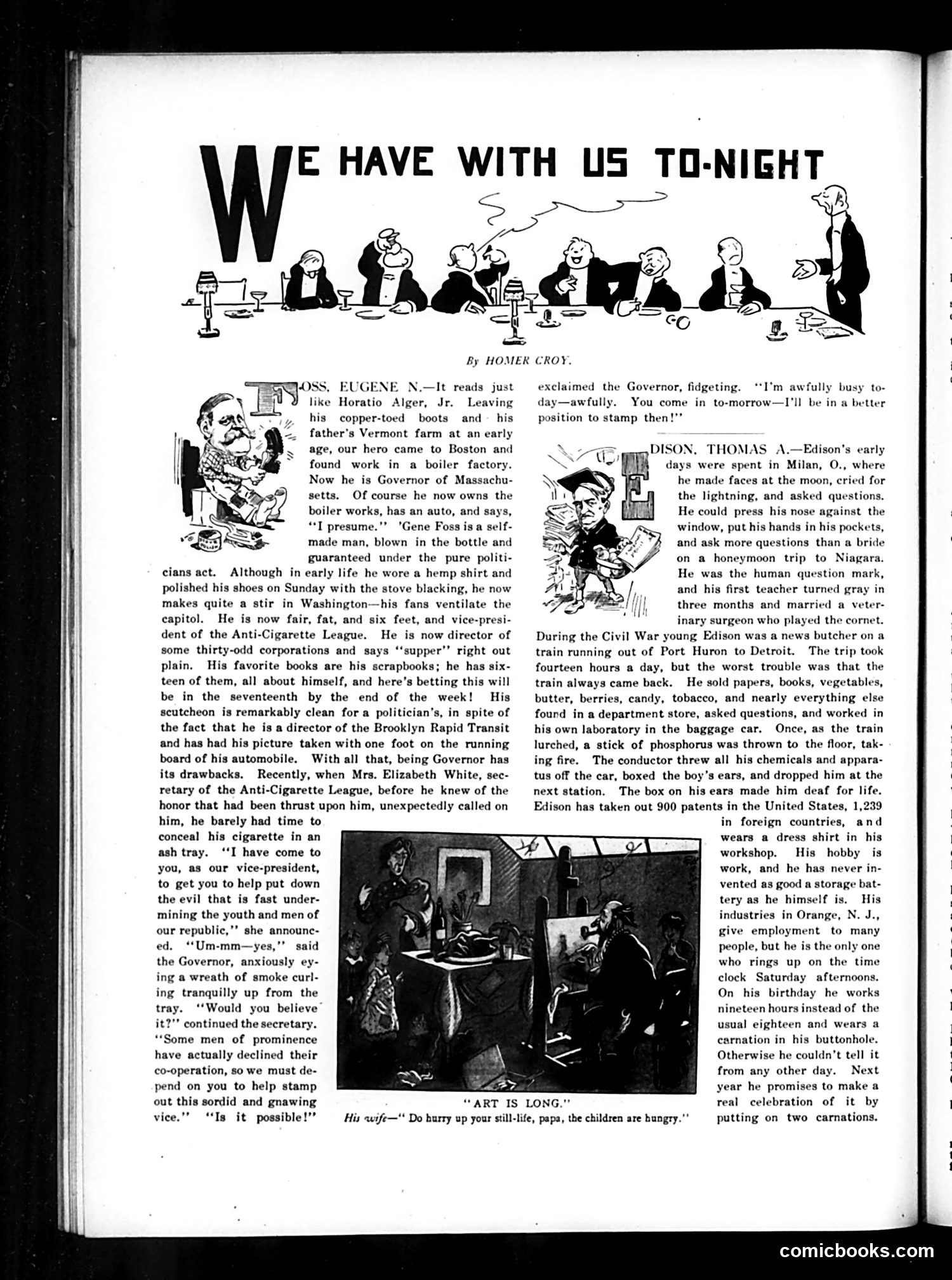
This Judge magazine page satirizes two prominent early-20th-century figures through biographical sketches with humor: **Top cartoon**: Eugene Foss, Governor of Massachusetts, is mocked as a self-made man (Horatio Alger-style rags-to-riches narrative) who has become a hypocrite. Despite his polished image and leadership of the Anti-Cigarette League, he's caught smoking. The joke: when the League's secretary visits asking him to "stamp out" cigarettes, he nervously hides his cigarette and delays, saying he'll be "in a better position to stamp then"—exposing his moral inconsistency. **Lower section**: Thomas Edison receives fawning biographical treatment contrasting his humble origins with his prolific achievements (900+ U.S. patents), though with gentle jabs at his work obsession and the irony that he's invented nothing better than himself as a "storage battery" of energy. Both pieces use satire to puncture pretension—Foss's moral posturing and the general American tendency to lionize self-made industrialists.
📄 Transcribed text from this page (OCR, searchable)
Machine-transcribed from the original scan — historical spelling and the odd misread are preserved.
By HOMER CROY. “Ess: EUC E N.—It reads just ike like Horatio Alger, Jr. Leaving ==, his copper-toed boots and~ his =, father’s Vermont farm at an early age, our hero came to Boston and found work in a boiler factory. Now he is Governor of Massachu- setts. Of course he now owns the boiler works, has an auto, and says, “T presume.’’ 'Gene Foss isa self- made man, blown in the bottle and guaranteed under the pure politi- cians act. Although in early life he wore a hemp shirt and polished his shoes on Sunday with the stove blacking, he now makes quite a stir in Washington—his fans ventilate the capitol. He is now fair, fat, and six feet, and vice-presi- dent of the Anti-Cigarette League. He is now ector of some thirty-odd corporations and says ‘supper’ right out plain. His favorite books are his scrapbooks; he has six- teen of them, all about himself, and here’s betting this will be in the seventeenth by the end of the week! His scutcheon is remarkably clean for a politician’s, in spite of the fact that he is a director of the Brooklyn Rapid Transit and has had his picture taken with one foot on the running board of his automobile. With all that, being Governor has its drawbacks. Recently, when Mrs. Elizabeth White, sec- retary of the Anti-Cigarette League, before he knew of the honor that had been thrust upon him, unexpectedly called on him, he barely had time to conceal his cigarette in an ash tray. ‘‘I have come to you, as our vice-president, to get you to help put down the evil that is fast under- mining the youth and men of our republic,"’ she announc- ed. ‘Um-mm—yes,"" said the Governor, anxiously ey- ing a wreath of smoke curl- ing tranquilly up from the tray. ‘‘Would you believe it?’’ continued the secretary. “Some men of prominence have actually declined their co-operation, so we must de- pend on you to help stamp out this sordid and gnawing vice." “Is it possible!’ “ART IS “ Do hurry up your still-life, papa, the children are bungry."* exclaimed the Governor, fidgeting. ‘‘I’m awfully busy to- day—awfully. You come in to-morrow—I'll be in a better position to stamp then!’" DISON, THOMAS A.—Edison's early days were spent in Milan, O., where he made faces at the moon, cried for the lightning, and asked questions. He could press his nose against the window, put his hands in his pockets, and ask more questions than a bride on a honeymoon trip to Niagara. He was the human question mark, and his first teacher turned gray in three months and married a veter- inary surgeon who played the cornet. During the Civil War young Edison was a news butcher on a train running out of Port Huron to Detroit. The trip took fourteen hours a day, but the worst trouble was that the train always came back. He sold papers, books, vegetab butter, berries, candy, tobacco, and nearly everything els found in a department store, asked questions, and worked in his own laboratory in the baggage car. Once, as the train lurched, a stick of phosphorus was thrown to the floor, tak- ing fire. The conductor threw all his chemicals and appara- tus off the car, boxed the boy's ears, and dropped him at the next station, The box on his ears made him deaf for life. Edison has taken out 900 patents in the United States, 1,239 in foreign countries, and wears a dress shirt in his workshop. His hobby is work, and he has never in- vented as good a storage bat- tery as he himself is. His industries in Orange, N. J., give employment to many people, but he is the only one who rings up on the time clock Saturday afternoons. On his birthday he works nineteen hours instead of the usual eighteen and wears a carnation in his buttonhole. Otherwise he couldn't tell it from any other day. Next year he promises to make a real celebration of it by putting on two carnations. comicbooks.com