
A complete issue · 24 pages · 1911
Judge — February 11, 1911
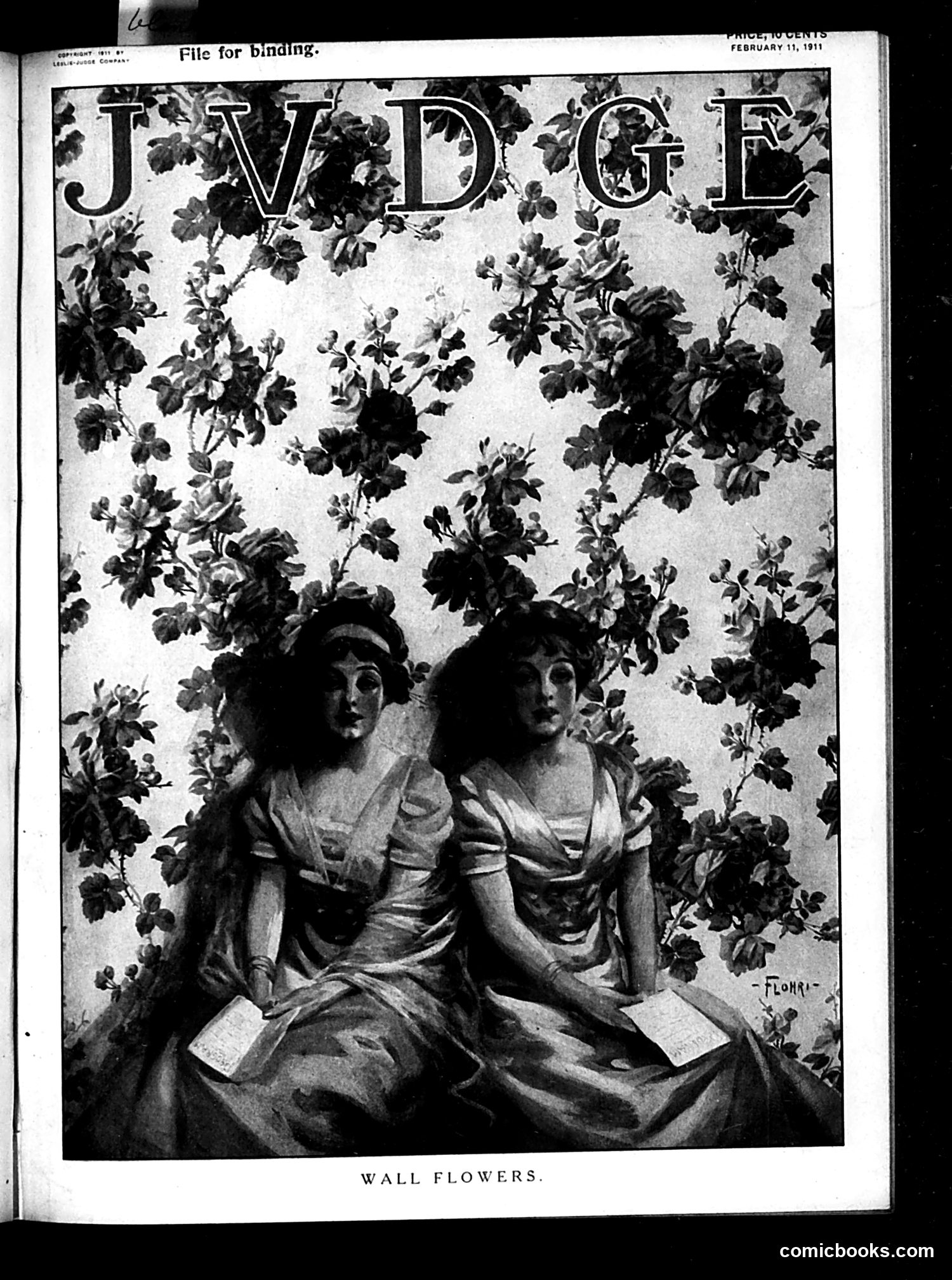
This appears to be a satirical illustration rather than a political cartoon. The image shows two elegantly dressed women seated against a floral wallpaper backdrop, both holding what appear to be dance cards or programs. The caption "Wall Flowers" refers to young women who remain unasked to dance at social events—a social embarrassment in the era when this was published. The satire likely mocks the irony of these fashionably dressed, apparently attractive women being overlooked by potential dance partners. The elaborate floral wallpaper suggests an upscale social setting, perhaps emphasizing the contrast between their fine appearance and their social failure. This reflects period anxieties about courtship and unmarried women's social status.
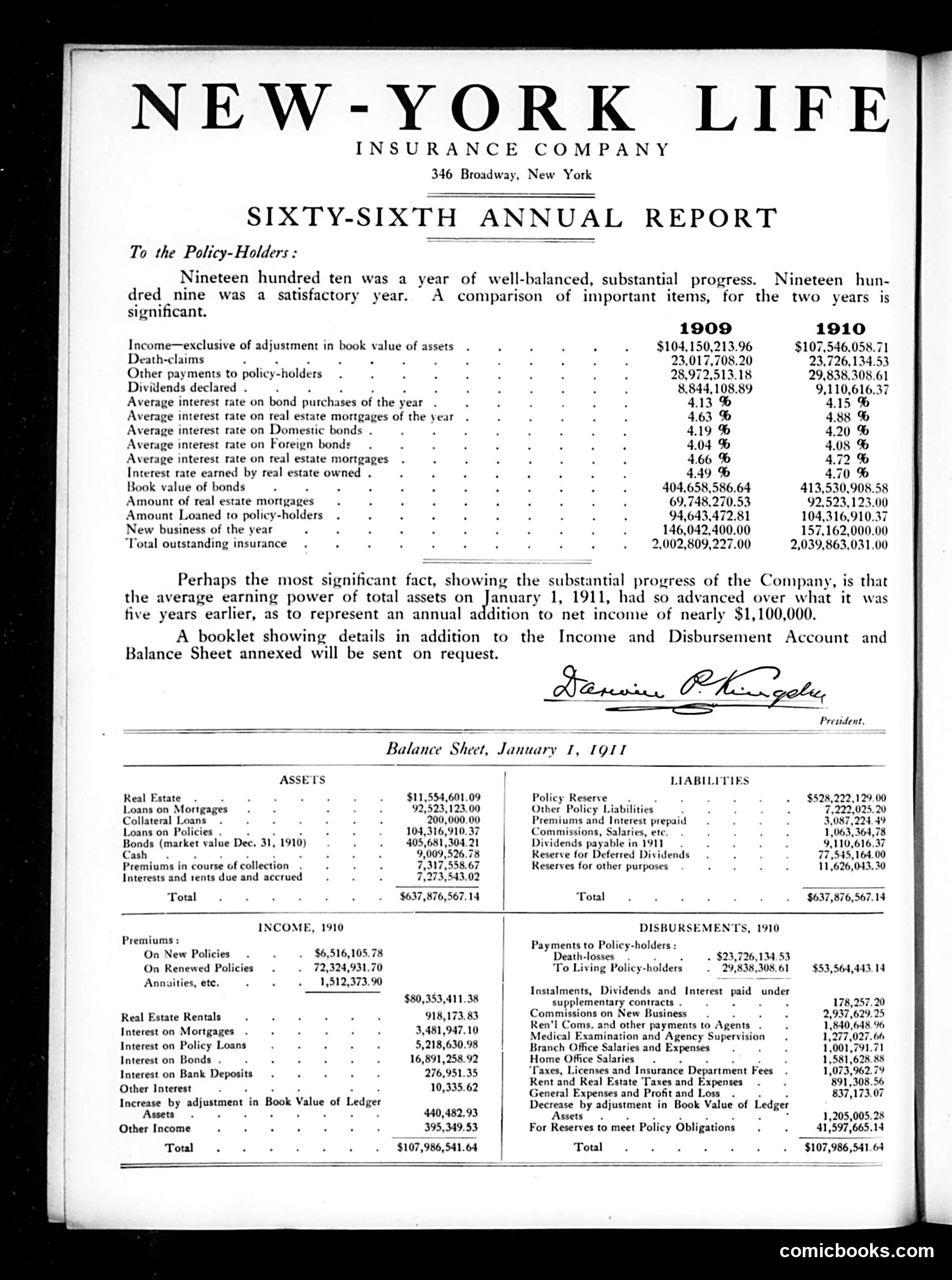
This page contains **no cartoon or satirical content**. It is entirely a financial document: the Sixty-Sixth Annual Report of the New York Life Insurance Company, dated 1911, addressed to policyholders. The page presents: - A letter from the President (signature appears to be "Harriman Phillipotts") - Financial comparisons between 1909 and 1910 - A Balance Sheet for January 1, 1911 - Income and disbursement tables This is a legitimate corporate financial statement, not satirical material. Judge magazine likely included this as paid advertising or a business insert, a common practice in periodicals of that era.
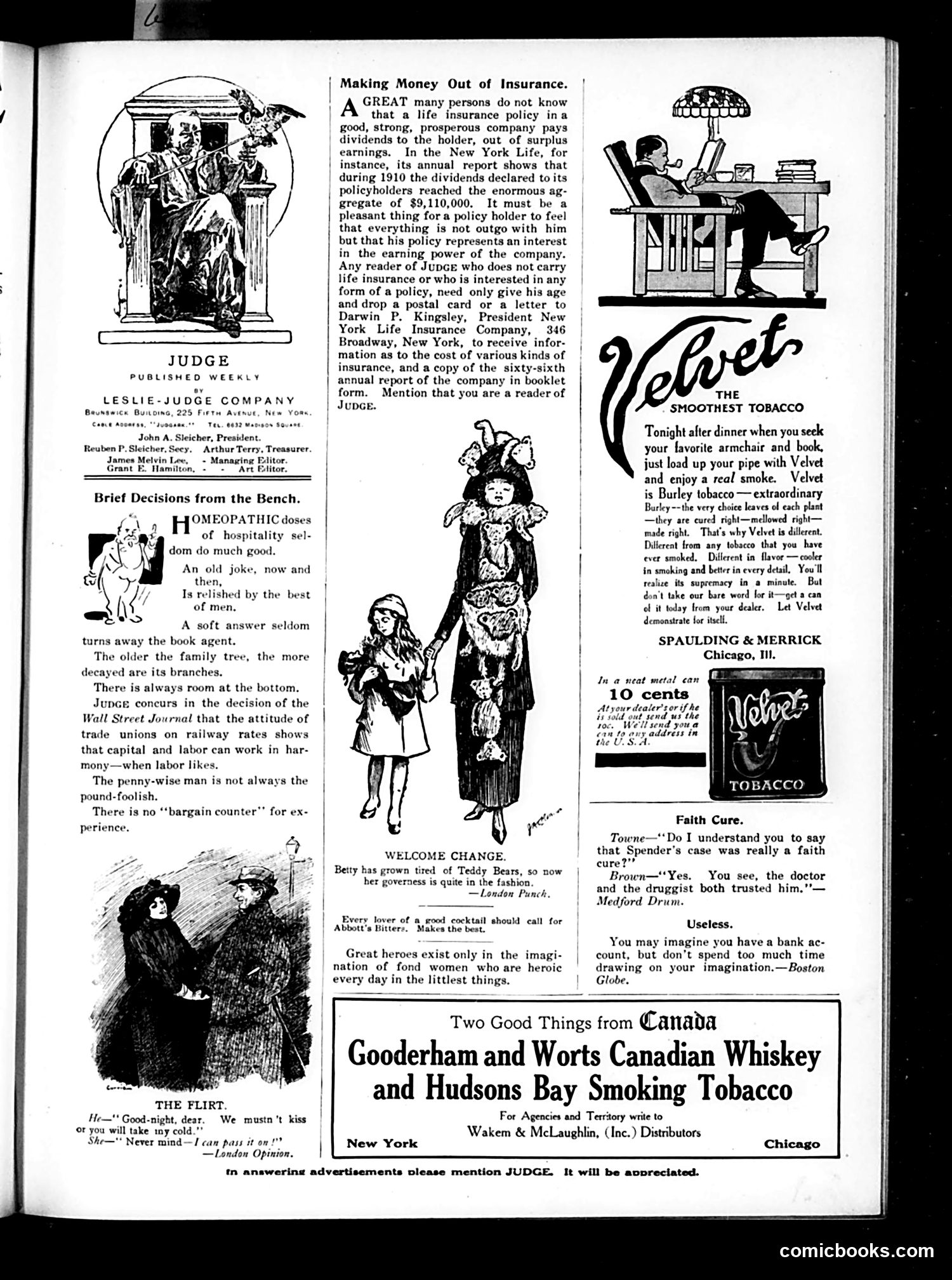
This page is primarily **advertising and humor content** rather than political satire. The left side features "Brief Decisions from the Bench"—short humorous quips about life, presented with generic illustrations of judges and everyday figures. These are lighthearted observations ("An old joke, now and then, / Is relished by the best of men") with no specific political targets. The cartoons titled "Welcome Change" and "The Flirt" appear to be gentle social humor about changing fashions (Teddy Bears replacing something) and romantic interactions, using stock characters rather than identified political figures. The page is dominated by **period advertisements** for Velvet tobacco, Gooderham and Worts whiskey, and other products—typical of Judge's revenue model. No specific political commentary or satire is evident.
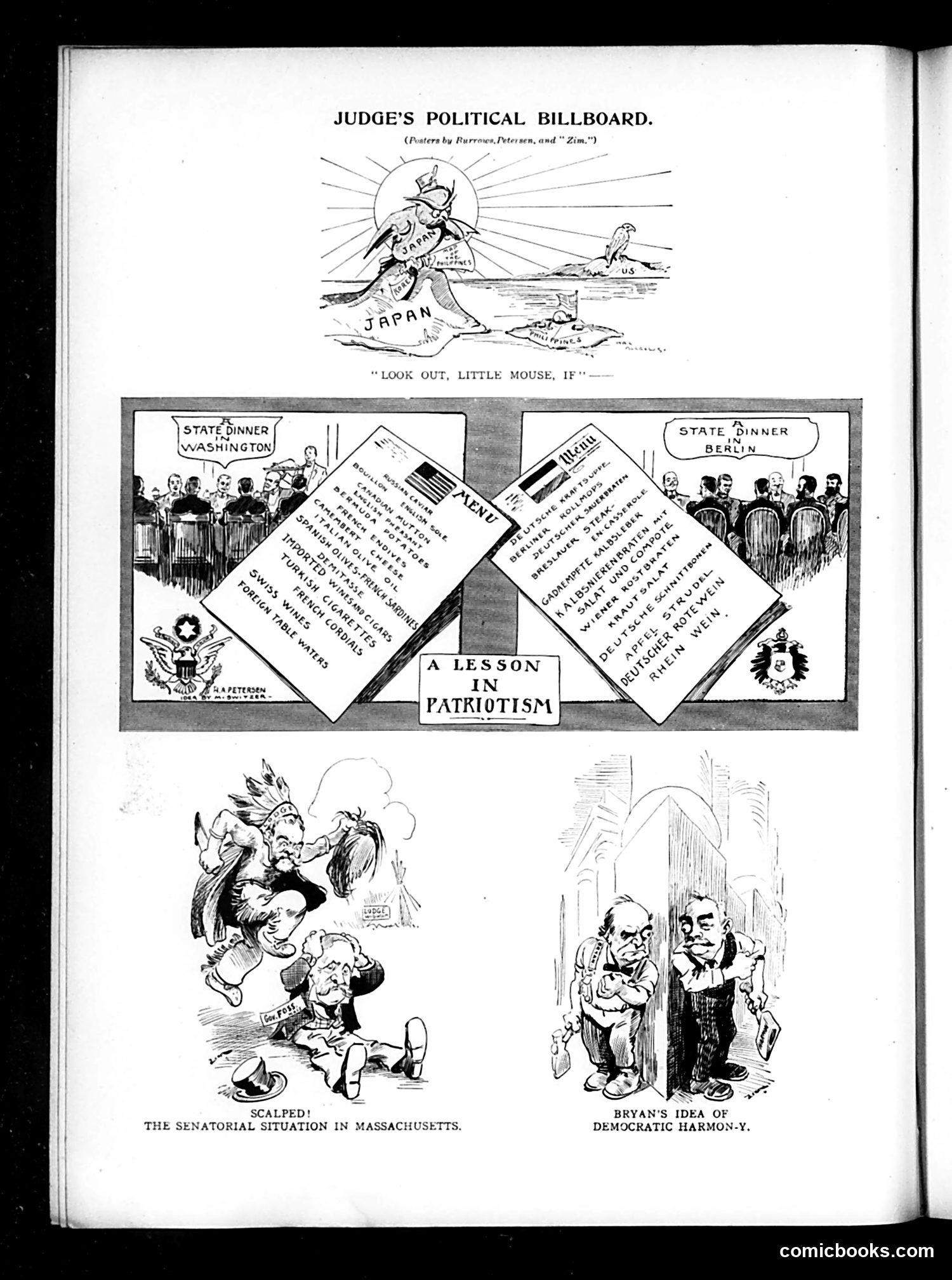
This page satirizes American political figures and international relations, likely from the early 1900s. The top cartoon shows a caricatured figure (possibly representing American interests or a political figure) threatening Japan, labeled "Look Out, Little Mouse, If—" The middle section, "A Lesson in Patriotism," compares state dinners in Washington and Berlin, implying hypocrisy in American political virtue-signaling. The bottom cartoons mock Democratic politics: one depicts "Scaled! The Senatorial Situation in Massachusetts," showing political infighting, while "Bryan's Idea of Democratic Harmony-Y" portrays William Jennings Bryan's vision of party unity as forced and artificial, with figures appearing coerced together. The overall message criticizes American political pretension and Democratic disunity.
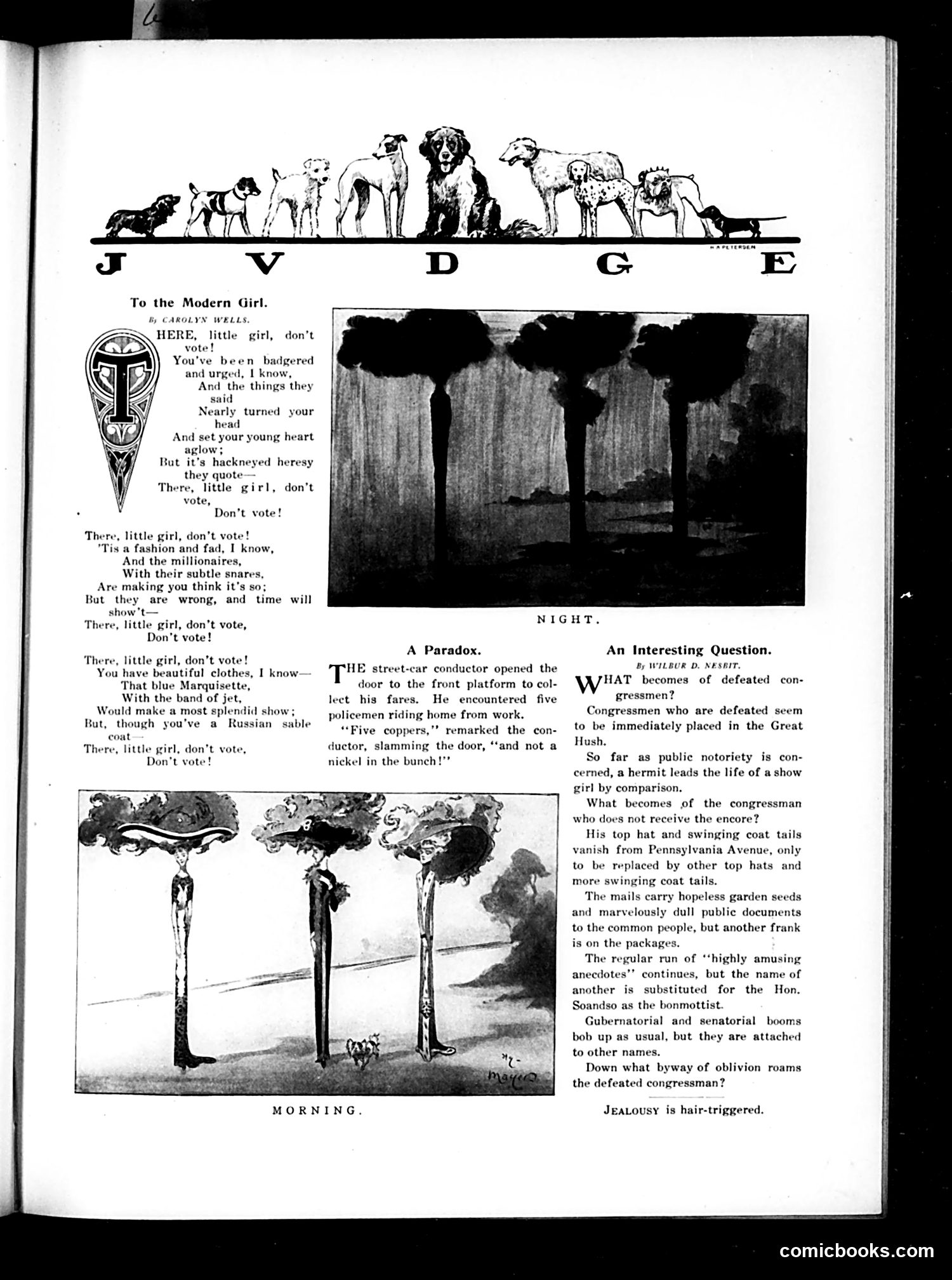
**"To the Modern Girl"** is a poem by Carolyn Wells mocking women's suffrage. It urges young women not to vote, claiming voting is a "fashion and fad" promoted by "millionaires" and their "subtle snares." The poem suggests women should focus instead on fashion and appearance ("beautiful clothes," a "Russian sable coat"). **"A Paradox"** and **"An Interesting Question"** are brief satirical pieces about defeated congressmen—mocking their fate and questioning what becomes of them after electoral loss, with joking references to their hats and coats disappearing. The illustrations labeled "NIGHT" and "MORNING" appear to depict everyday scenes, though details are unclear. This page reflects anti-suffrage sentiment common in early 20th-century American humor publications, dismissing women's political participation as frivolous.
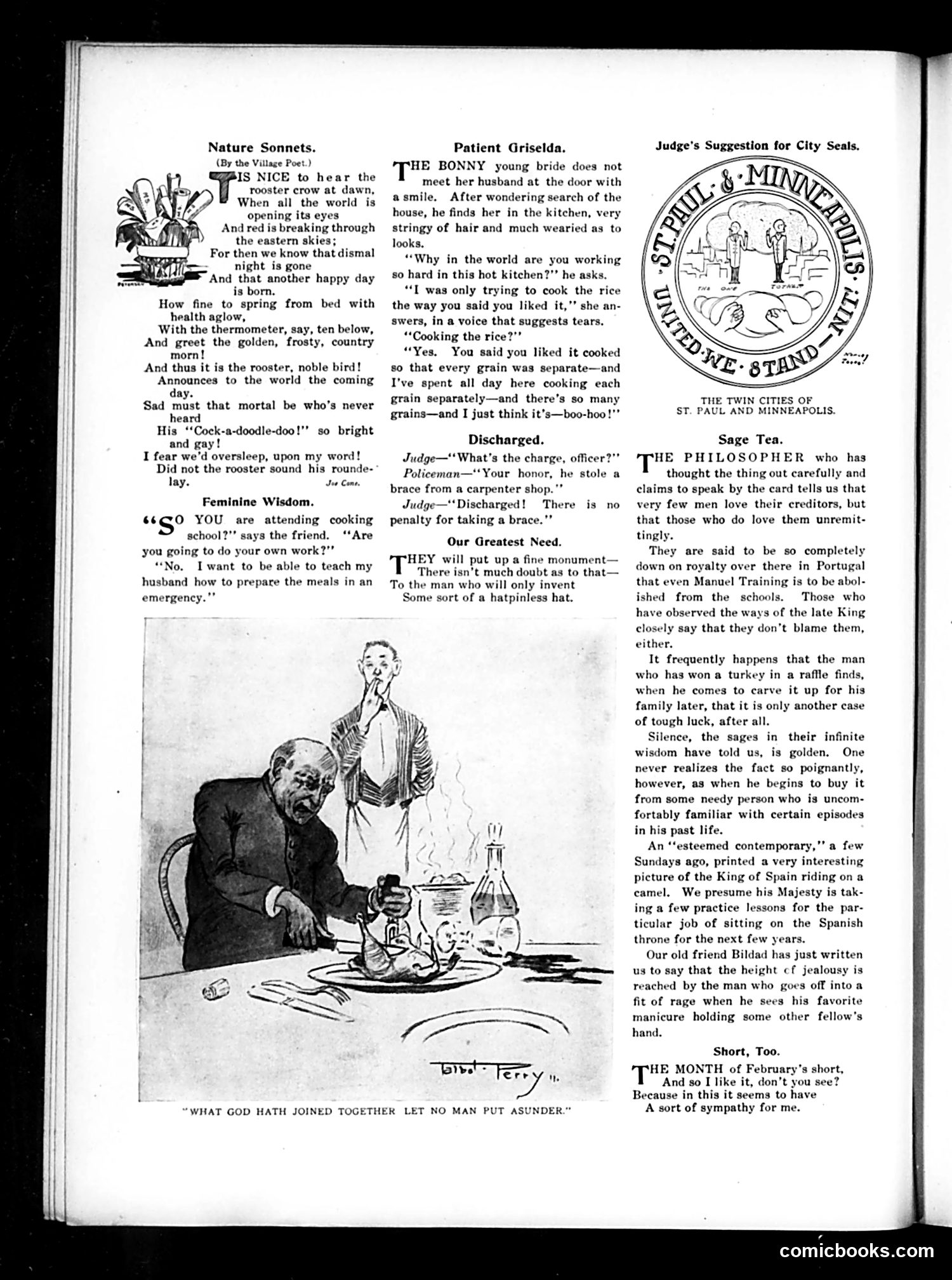
This page from Judge magazine contains several short humorous pieces typical of early 20th-century American satirical humor: **"Nature Sonnets"** mocks overwrought romantic poetry about rural life, specifically praising roosters—likely satirizing sentimental nature writing popular at the time. **"Patient Griselda"** jokes about newlywed expectations: a bride literally interprets her husband's request for rice with "separate grains," spending all day cooking each grain individually, illustrating the gap between marital communication and reality. **"Feminine Wisdom"** satirizes women's cooking education—the wife wants to learn cooking not to do housework herself, but to teach her husband, suggesting class anxieties about domestic labor. **The central cartoon** (captioned "What God Hath Joined Together Let No Man Put Asunder") depicts a man and woman at a table with chemical equipment, likely satirizing divorce or marital discord as a chemical problem requiring dissolution. **Other brief items** mock Philippine politics, Spanish royalty, and February's shortness. The content reflects early 1900s anxieties about gender roles, marriage, and international affairs.
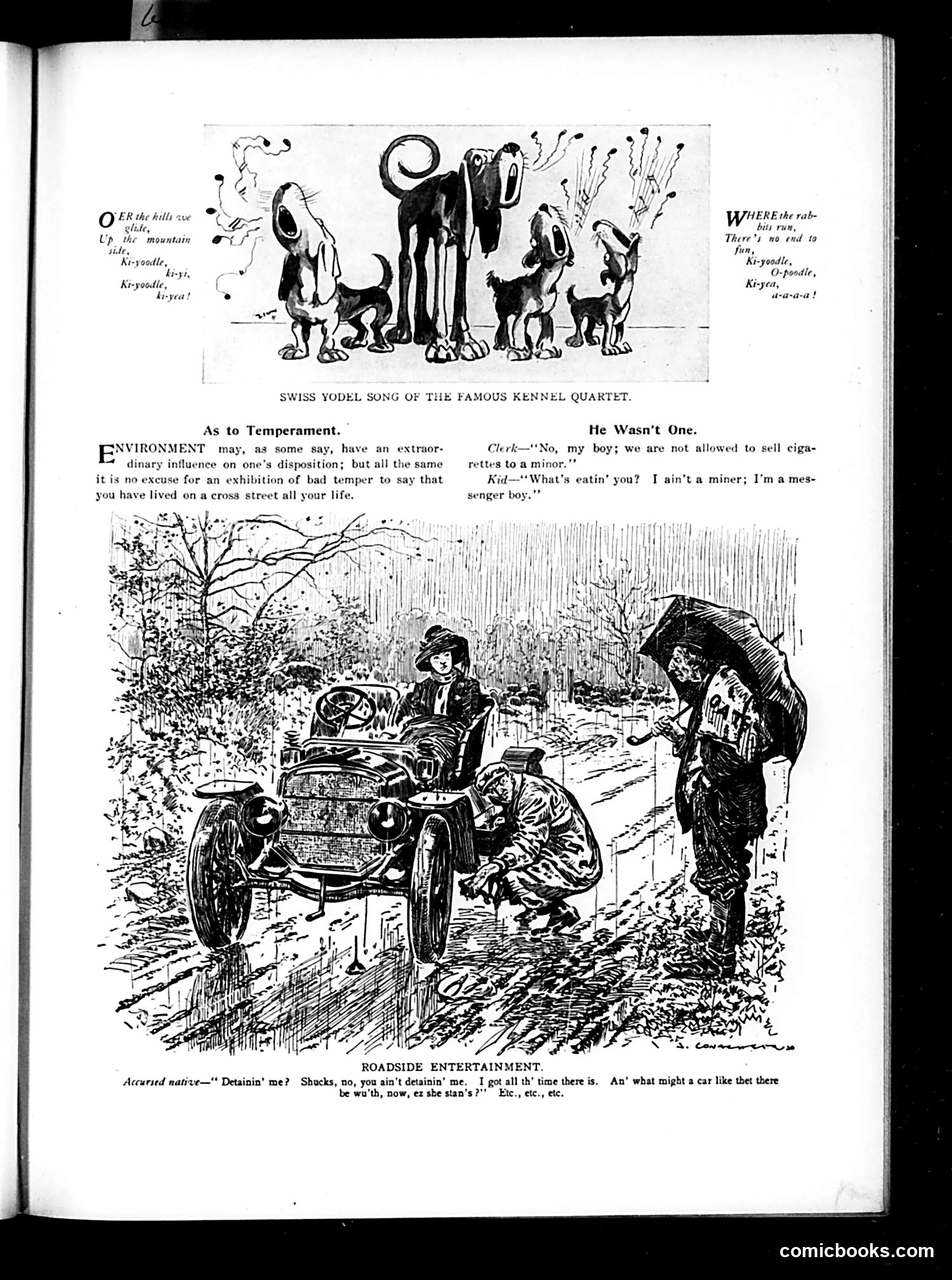
This page contains three separate humor pieces: 1. **"Swiss Yodel Song"**: A lighthearted illustration of dogs yodeling, with onomatopoetic Swiss-style lyrics. This is whimsical entertainment, not satirical. 2. **"As to Temperament"**: A brief joke about environment's influence on behavior, followed by "He Wasn't One"—a pun where a clerk refuses to sell cigarettes to a "minor," but the boy clarifies he's a "messenger boy," not a miner. The humor relies on the homophone. 3. **"Roadside Entertainment"**: A sketch depicting what appears to be a rural American being shown an automobile. The rural figure uses dialect ("wu'th," "ez she stan's") and seems interested in the car's value, suggesting satire of rural/urban cultural divides or the novelty of automobiles to rural populations unfamiliar with them. The page mixes light puns with gentle social observation rather than sharp political satire, typical of Judge's varied content approach.
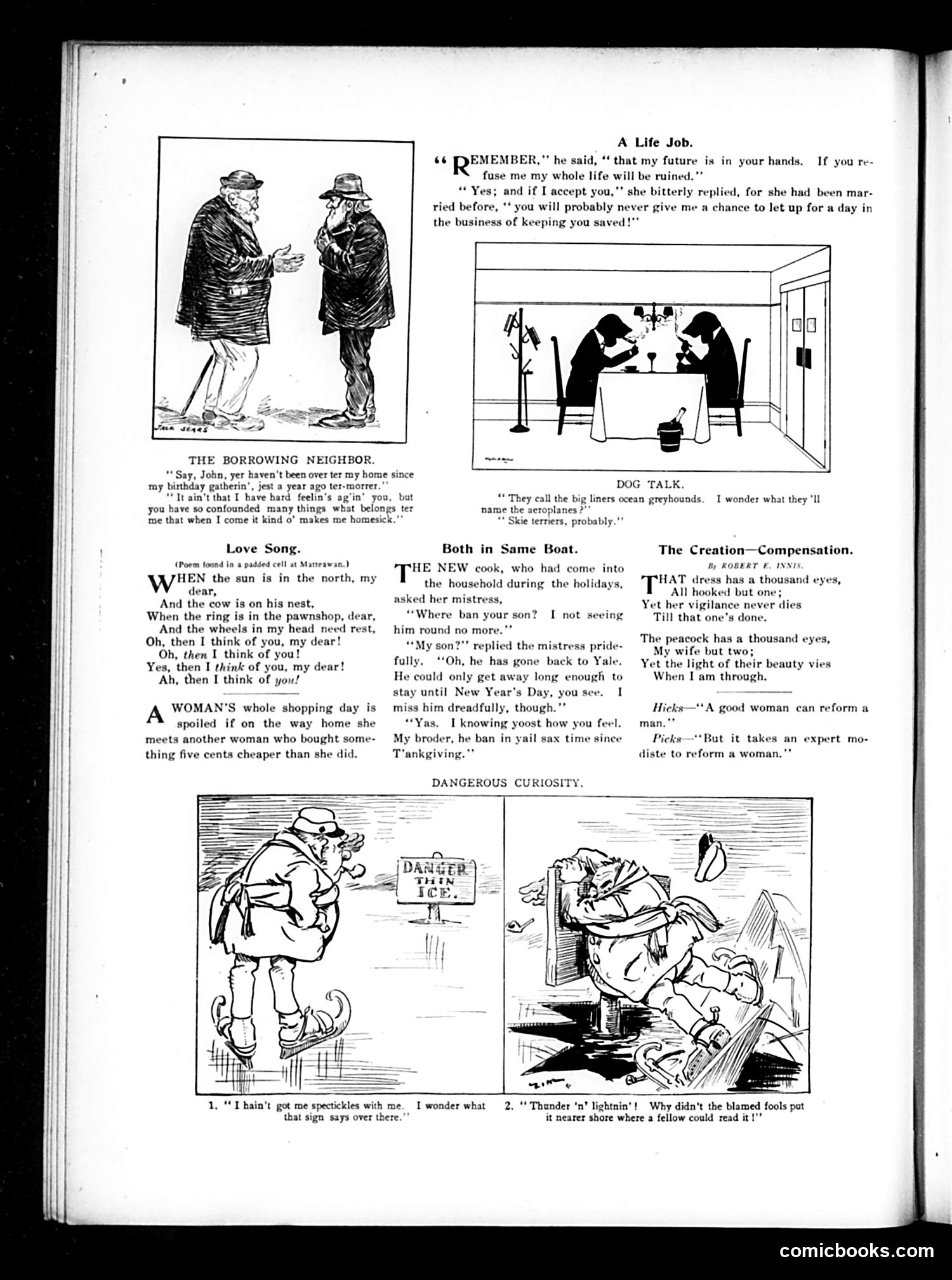
This page collects several humor pieces satirizing domestic life and social pretension in early 20th-century America. **"A Life Job"** depicts a marriage negotiation where a woman, previously married, warns her suitor that accepting his proposal means endless domestic labor—"keeping you saved" becomes a lifetime job with no days off. The satire mocks both male helplessness and the exhausting, thankless nature of wives' domestic duties. **"The Borrowing Neighbor"** jokes about a man who avoids visiting because the neighbor has borrowed so many of his possessions that returning home reminds him of what he's lost. **"Dangerous Curiosity"** shows a nearsighted man unable to read a warning sign, leading to comedic disaster—satirizing human foolishness and the consequences of curiosity without caution. Other pieces include light verse about romantic sentimentality and observations about women's competitive shopping habits. The humor targets domestic friction, marital power dynamics, and middle-class anxieties—typical Judge magazine fare mocking everyday life absurdities.
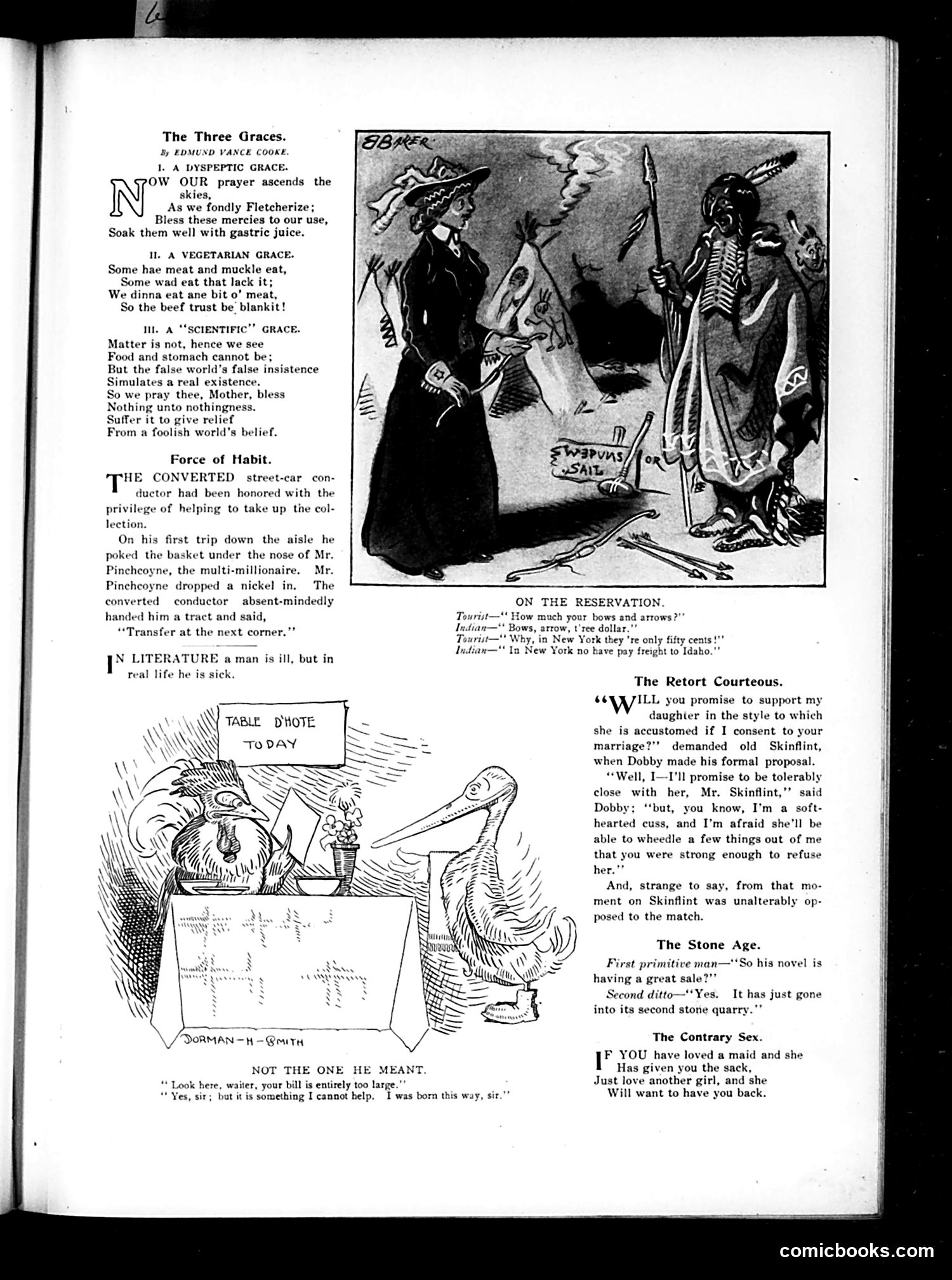
This page contains multiple satirical pieces targeting early 1900s American social trends: **"The Three Graces"** mocks contemporary diet fads: "Fletcherizing" (extreme chewing), vegetarianism, and Christian Science (which denied material reality). The prayers parody how devotees rationalize these practices religiously. **"Force of Habit"** jokes about a street-car conductor converted to Christianity who reflexively hands a wealthy donor a religious tract instead of a transfer ticket—suggesting conversion hasn't changed his unconscious habits. **"On the Reservation"** cartoon depicts a Native American vendor complaining that New York prices undercut his tourist trade, satirizing commercialization and the tourist exploitation of Indigenous people. The remaining brief jokes address courtship (a father's objection to his daughter's suitor backfires) and publishing (a terrible novel finds an audience in prisons—"stone quarry"). The page exemplifies *Judge*'s satirical approach: mocking fads, religious earnestness, class pretension, and contemporary social absurdities through humor targeting educated readers.
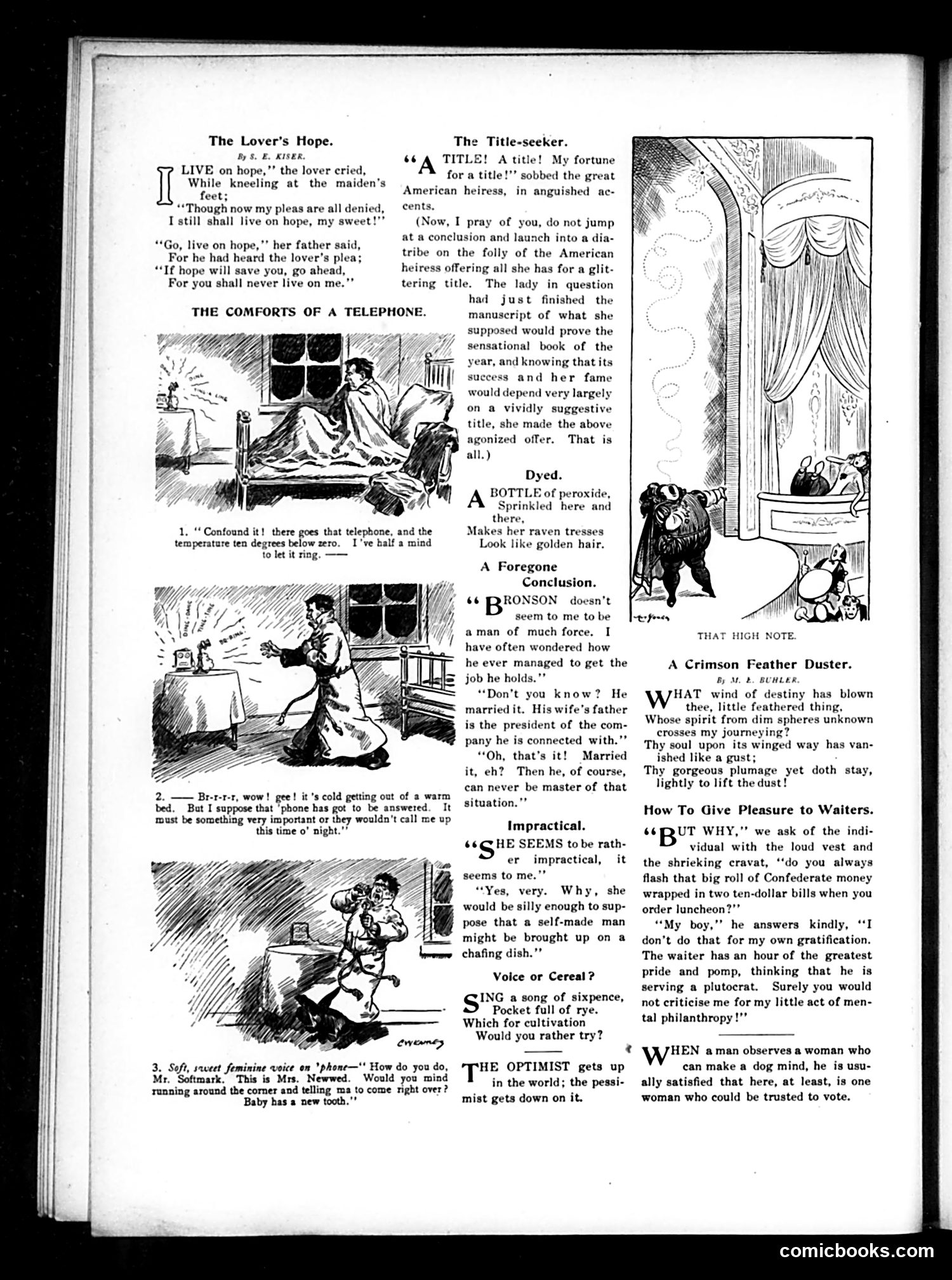
This page contains light satirical humor typical of early 20th-century American magazines. The cartoons mock social pretensions and gender dynamics of the era: **"The Lover's Hope"** satirizes a poor suitor—his would-be father-in-law dismisses him, telling him to "live on hope" since he won't support him financially. **"The Comforts of a Telephone"** jokes about the annoyance of early telephone technology, showing someone reluctant to answer late-night calls from demanding callers (notably, a newlywed woman expecting her neighbor to help with her baby). **"The Title-seeker"** mocks wealthy American heiresses' desperation for aristocratic titles and their commercial desperation—here one needs a catchy book title for her manuscript. **"A Foregone Conclusion"** satirizes how a man secured employment through marriage rather than merit, making him permanently subordinate to his wife's father. Other brief pieces joke about peroxide hair dye, impractical women, and the pretense of flashing "Confederate money" to impress waiters. A final quip suggests women capable of controlling dogs deserve voting rights—gentle suffrage commentary.
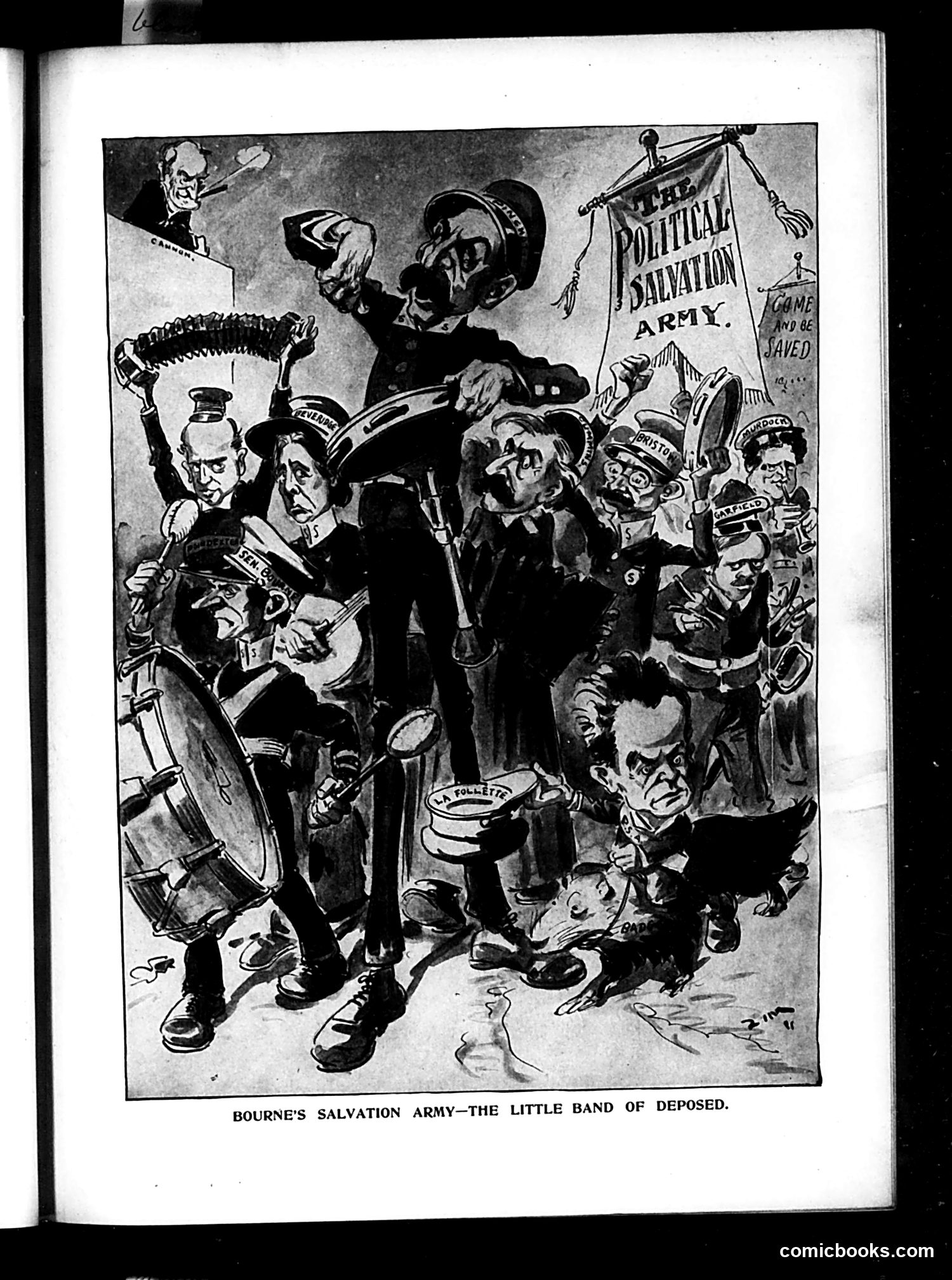
This political cartoon satirizes **Bourne's "Salvation Army,"** apparently a political faction or group of deposed politicians. The central tall figure conducting like a bandleader appears to be **Bourne** himself, leading a motley group of caricatured politicians playing instruments in disharmony. The banner reads "The Political Salvation Army" with "Game and Saved" visible, suggesting ironic commentary on their claims to rescue the nation. The exaggerated, grotesque features and chaotic composition mock these politicians as incompetent or discredited figures pretending to lead, while the "band" metaphor emphasizes their disorganization and cacophony. The overall message: these are failed politicians attempting a comeback through false claims of virtue or reform.
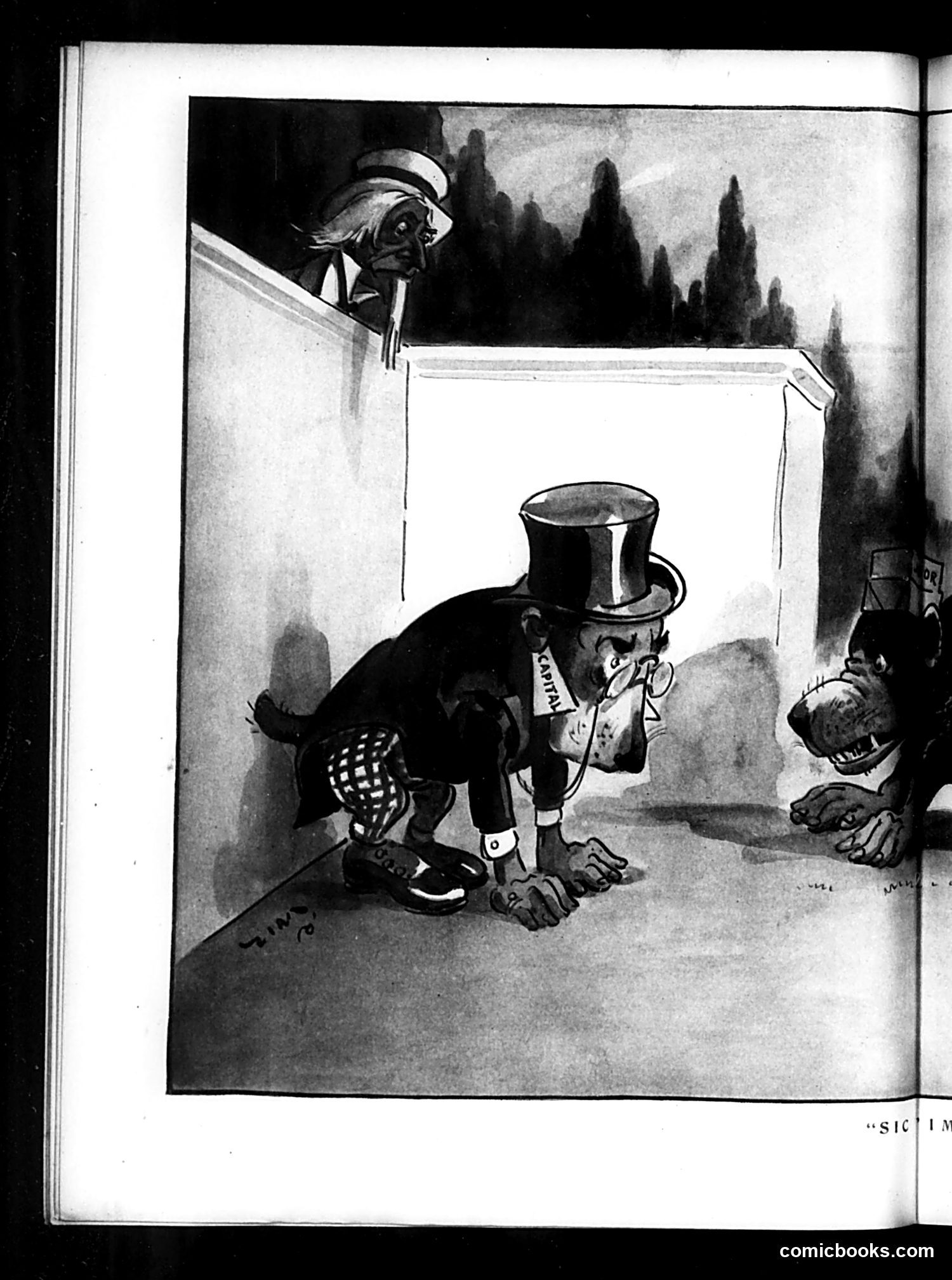
This appears to be a satirical cartoon from *Judge* magazine featuring caricatured figures with exaggerated features typical of early 20th-century political commentary. The central figure wears a top hat and formal attire, suggesting wealth or political authority. The caricatures display stereotypical ethnic or racial features common to the period's problematic satirical style. The setting appears claustrophobic—figures are confined within rectangular frames or spaces—which likely represents constraint or entrapment. Without clear text visible in the image and with OCR errors making the accompanying text illegible, the specific political reference remains unclear. However, the composition suggests commentary on wealth disparity, political restriction, or social hierarchy typical of *Judge*'s satire during this era. The exact message cannot be reliably determined from the image alone.
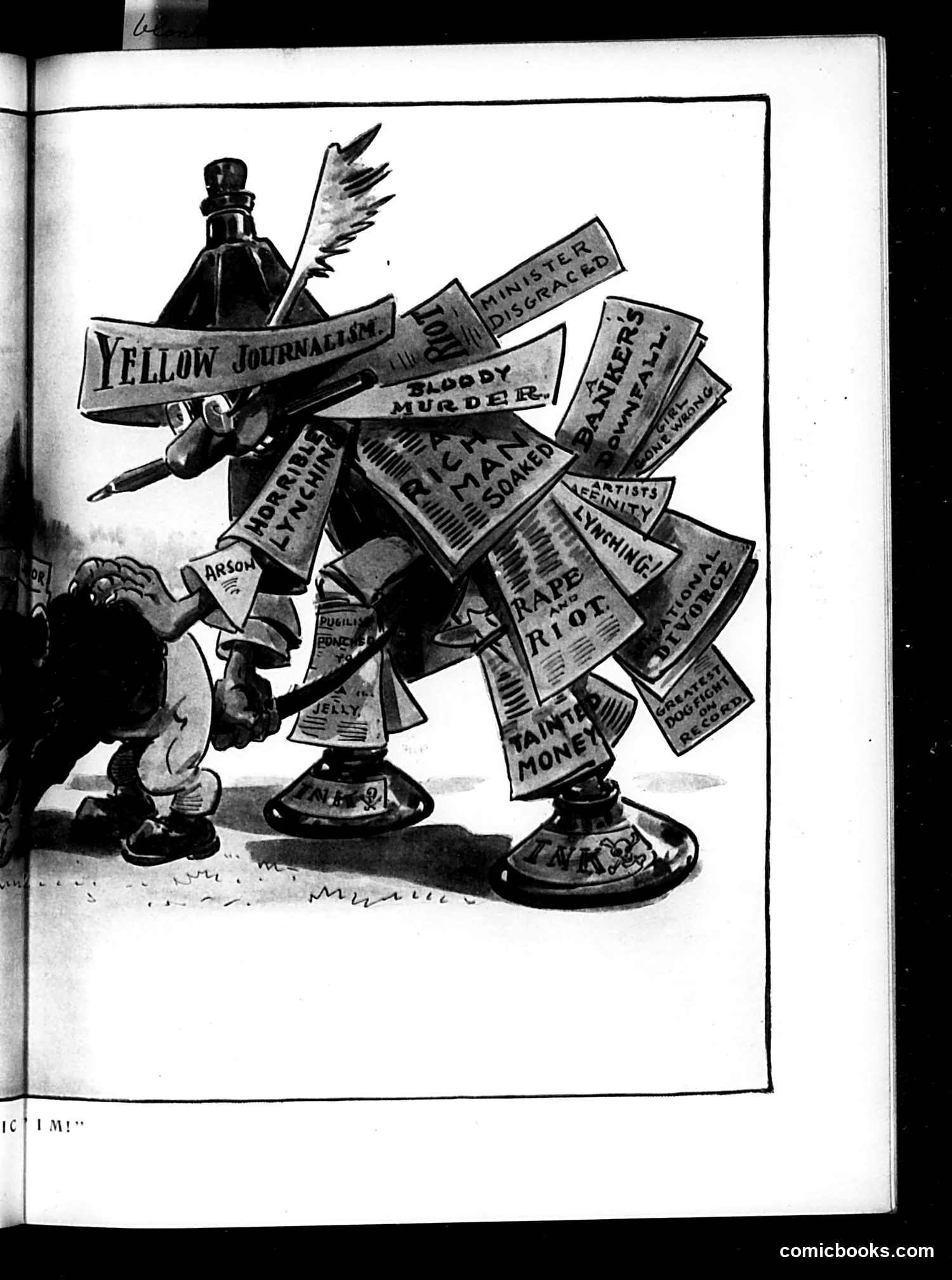
This satirical cartoon depicts a grotesque figure labeled "Yellow Journalism" wielding a pen/quill like a weapon, spraying ink or poison. The figure is covered with labels representing various sensational crimes and scandals: "Murder," "Bloody," "Rape," "Riot," "Arson," "Minister Disgraced," "Bribery," "Scandal," and similar inflammatory topics. A small caricatured figure (possibly representing the public or a reader) appears to be recoiling or defending against this onslaught. The satire criticizes how yellow journalism—sensationalist newspaper reporting—exploited crime, corruption, and scandal for profit and readership, drowning the public in lurid, exaggerated stories rather than responsible reporting. This reflects late 19th/early 20th-century concerns about press ethics and media manipulation.
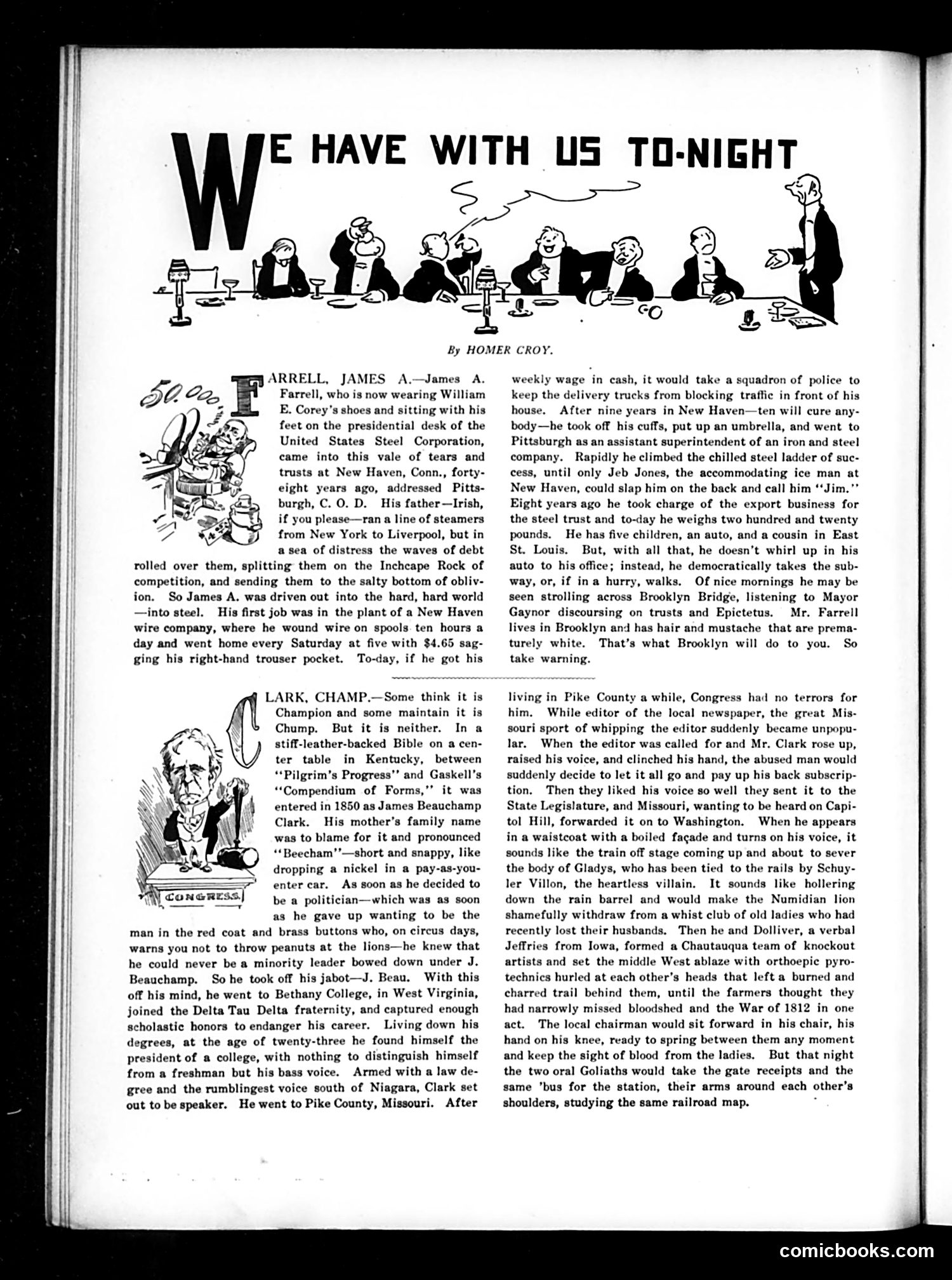
This satirical article profiles two prominent American figures of the early 1900s through biographical sketches paired with caricatures: **James A. Farrell** (left): Now president of U.S. Steel, having replaced William E. Corey. The satire traces his rise from poverty—his Irish father lost shipping business to debt—through hard labor winding wire spools at $4.65/week, to his current wealth and influence in Pittsburgh's steel industry. The joke: his success is so complete that police would be needed to manage delivery trucks blocking his street. **Champ Clark** (right): A Missouri congressman whose full name was James Beauchamp Clark. The satire humorously explains how he dropped "Beauchamp" (pronounced "Beecham") from his identity to pursue politics, fearing it sounded too refined. Armed only with a law degree and a booming voice, he rose from college president to political power through intimidation and rhetoric. Both profiles mock the self-made American success narrative while celebrating these men's unconventional paths to power.
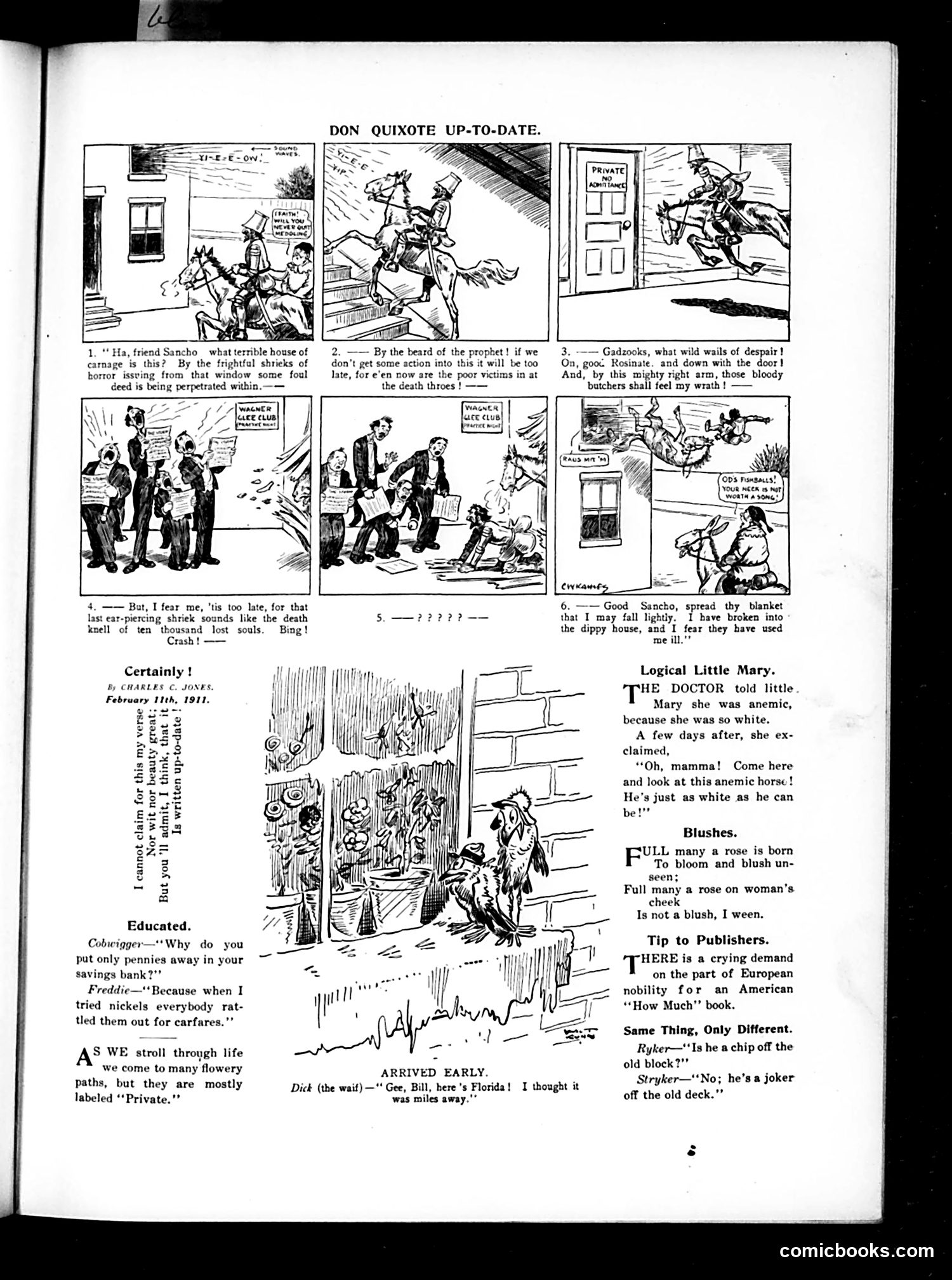
This page parodies Cervantes' *Don Quixote* by transplanting the 17th-century knight-errant into modern 1911 America. The top comic strip shows Don Quixote and Sancho Panza responding to screams from a building, imagining villainous conspiracies requiring heroic intervention—a classic setup where the delusional knight mistakes ordinary situations for dramatic emergencies. The satire mocks outdated romanticism and chivalric ideals when confronted with modern urban realities. By setting Quixote "up-to-date," Judge suggests that such antiquated notions of honor and heroism are comically mismatched to contemporary life. The surrounding humor items (about penny savings, private property, anemia) are typical filler content of the era, offering lighthearted social observations rather than connected satire.
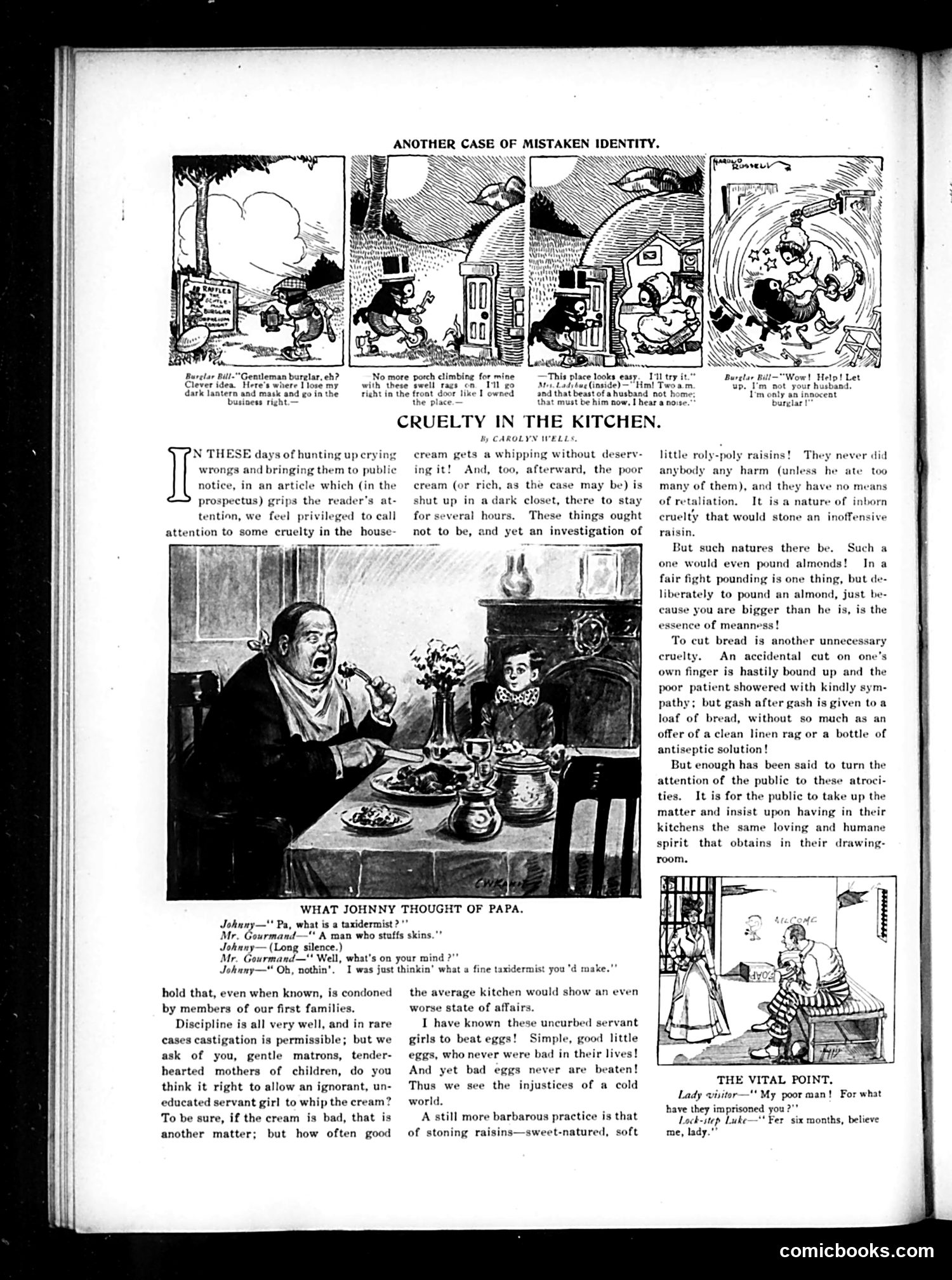
This page satirizes the pretentious moral sensibilities of wealthy households. The main article by Carolyn Wells mocks society women who claim to care about cruelty while treating kitchen servants brutally. The satire works through **absurdist inversion**: the author solemnly catalogs the "cruelties" servants inflict on *inanimate food items*—beating cream and eggs, stoning raisins, cutting bread—while implying the servants themselves receive harsh treatment without sympathy. When a servant gets a cut finger, they receive only "gashes of bread" in return. The accompanying cartoon "What Johnny Thought of Papa" presents a related joke: a child innocently suggests his father would make an excellent "taxidermist" (one who stuffs animal skins), implying the father is cold, lifeless, or emotionally dead—likely a commentary on patriarchal indifference. The top strip shows burglars mistaking each other for homeowners, unrelated social commentary. The piece critiques upper-class hypocrisy: drawing-room refinement masking kitchen cruelty toward working-class domestic help.
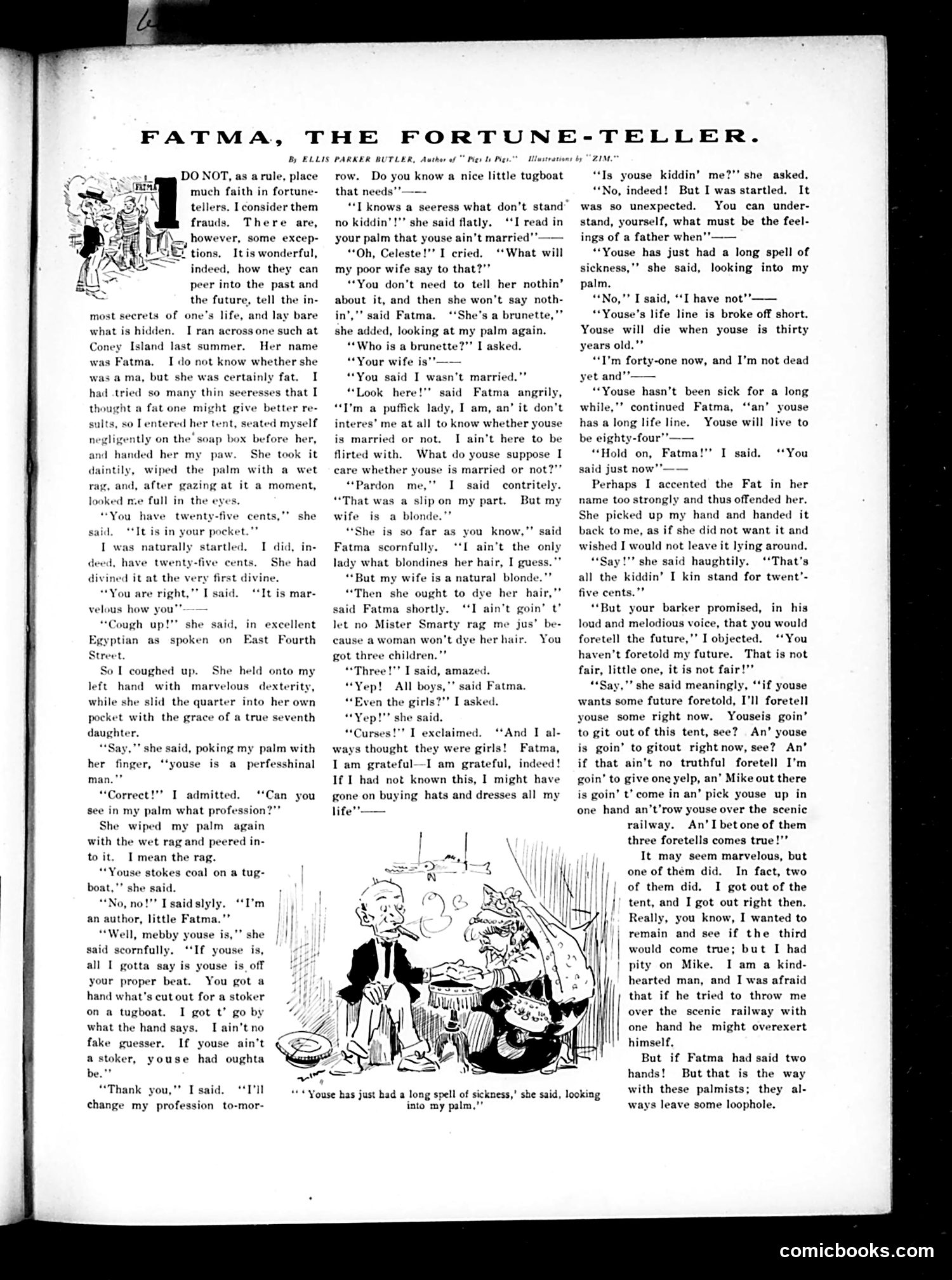
This is a humorous short story by Ellis Parker Butler (author of "Pigs is Pigs") illustrated with comic panels. The narrative satirizes fortune-tellers as obvious frauds. The protagonist visits "Fatma," a fortune-teller at Coney Island who reads his palm. The joke relies on her comically transparent fakery: she correctly guesses he has twenty-five cents (visible in his pocket), claims he's a coal-stoker (based on his "worker's hands"), then contradicts herself claiming his wife is brunette after saying he's unmarried. She invents details about his children, then declares his life-line shows imminent death. The satire targets credulous customers who believe such obviously fraudulent practitioners. Fatma's heavy dialect humor and transparent contradictions underscore how fortune-tellers exploit people through vague statements and cold-reading tactics. The story mocks both the charlatan and her willing victim—the author himself, who pays despite recognizing the obvious deceptions.
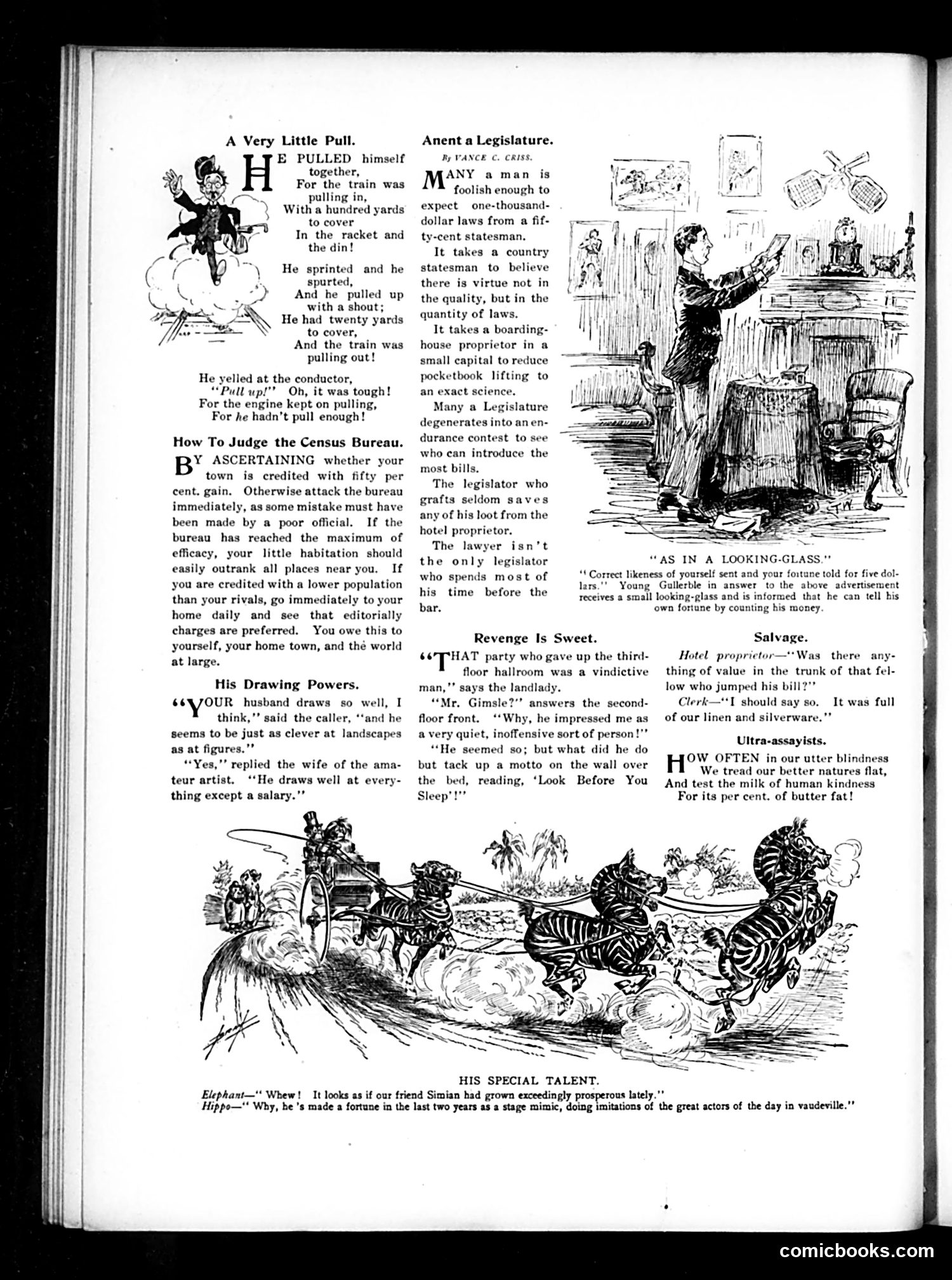
This page contains several standalone comic pieces lampooning American institutions and social types circa early 1900s: **"A Very Little Pull"** mocks a man's frantic attempt to catch a departing train—the "pull" he needs is merely effort, but the train's mechanical pull proves stronger. **"How to Judge the Census Bureau"** satirizes civic boosterism and corruption: towns should immediately attack census officials if population gains seem insufficient, suggesting dishonesty in both bureaucracy and local pride. **"His Drawing Powers"** is a brief joke: an amateur artist draws well at everything except earning a salary—a common complaint about talented but unsuccessful artists. **"Anent a Legislature"** critiques state lawmakers as cheap (fifty-cent quality) yet expected to produce expensive laws, producing endless trivial legislation while engaged in petty graft and hotel-keeper bribery. The smaller pieces mock vengeful landlords, fortune-telling scams, and calculating "ultra-assayists" who reduce human kindness to percentages. The vaudeville joke references a stage mimic named Simian who'd apparently prospered through imitation.
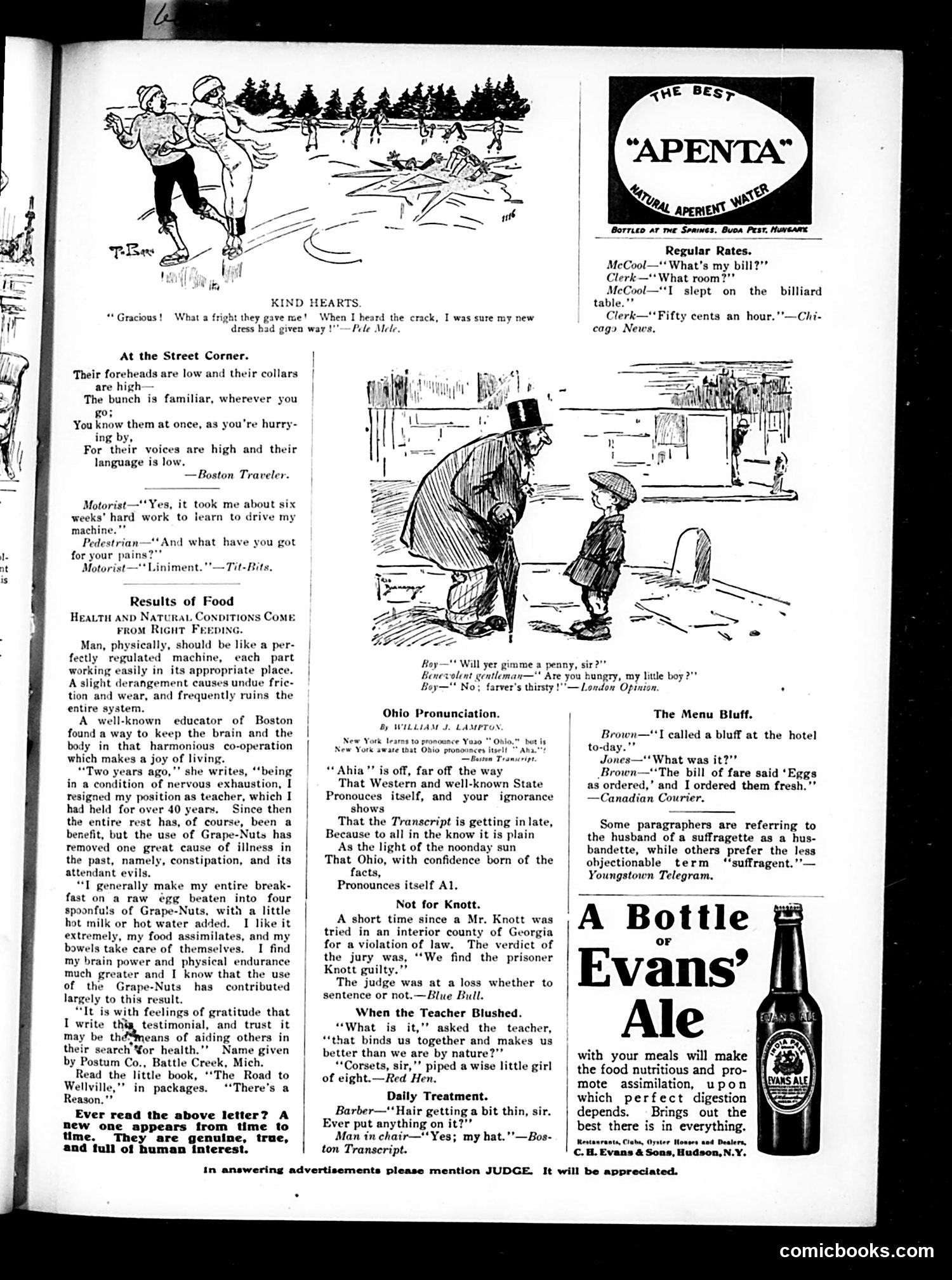
This page contains multiple short humorous pieces typical of early 20th-century satirical magazines: **"Kind Hearts"** depicts working-class pedestrians at a street corner, characterized by "low foreheads" and "high collars"—crude visual stereotypes suggesting poor education and status. **"At the Street Corner"** presents a motorist-pedestrian exchange mocking both parties: the motorist's six-week learning curve and the pedestrian's sarcastic suggestion of liniment for his "pain." **Ohio Pronunciation** satirizes regional dialect differences, joking that Ohioans pronounce their state's name distinctively ("Ahia"). **"Not for Knott"** is a pun-based joke about a man named Knott tried in Georgia, with the judge confused about sentencing. **"When the Teacher Blushed"** presents a child's cheeky answer about corsets binding people together—risqué humor for the era. The page also contains testimonials (Grape-Nuts cereal) and advertisements (Apenta water, Evans' Ale), reflecting how magazines monetized editorial content.
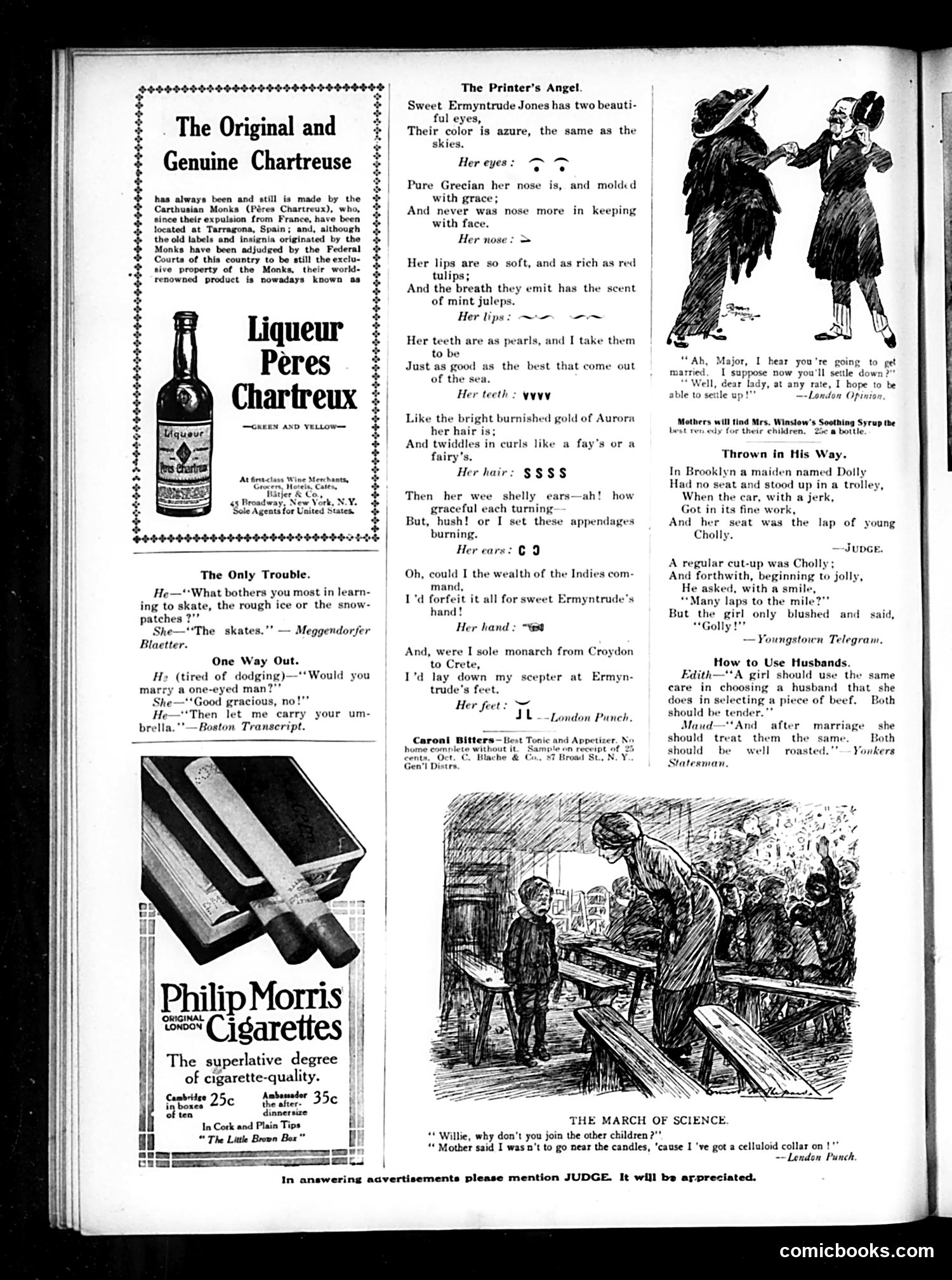
This page contains primarily **advertisements and light humor**, not political satire. The main content includes: - **Chartreuse liqueur ad** (left): A trademark dispute note—the Carthusian monks' product, expelled from France and relocated to Spain, still owns the brand despite U.S. court rulings. - **Philip Morris cigarettes ad** (lower left) - **"The Printer's Angel"** (center-right): A florid, mock-romantic poem about "Sweet Ermyntrude Jones" with phonetic descriptions of her features—gentle wordplay humor typical of era magazine content. - **Short jokes** about skating, dodging rain, marriage, and trolley etiquette—domestic comedy with no political content. - **"The March of Science"** (bottom): A child's safety joke about celluloid collars near candles, reflecting period anxieties about flammable materials. The humor is entirely **social and domestic**—no identifiable political figures or events appear. This is a typical turn-of-century Judge magazine page mixing advertising with gentle, family-friendly comic verse and jokes.
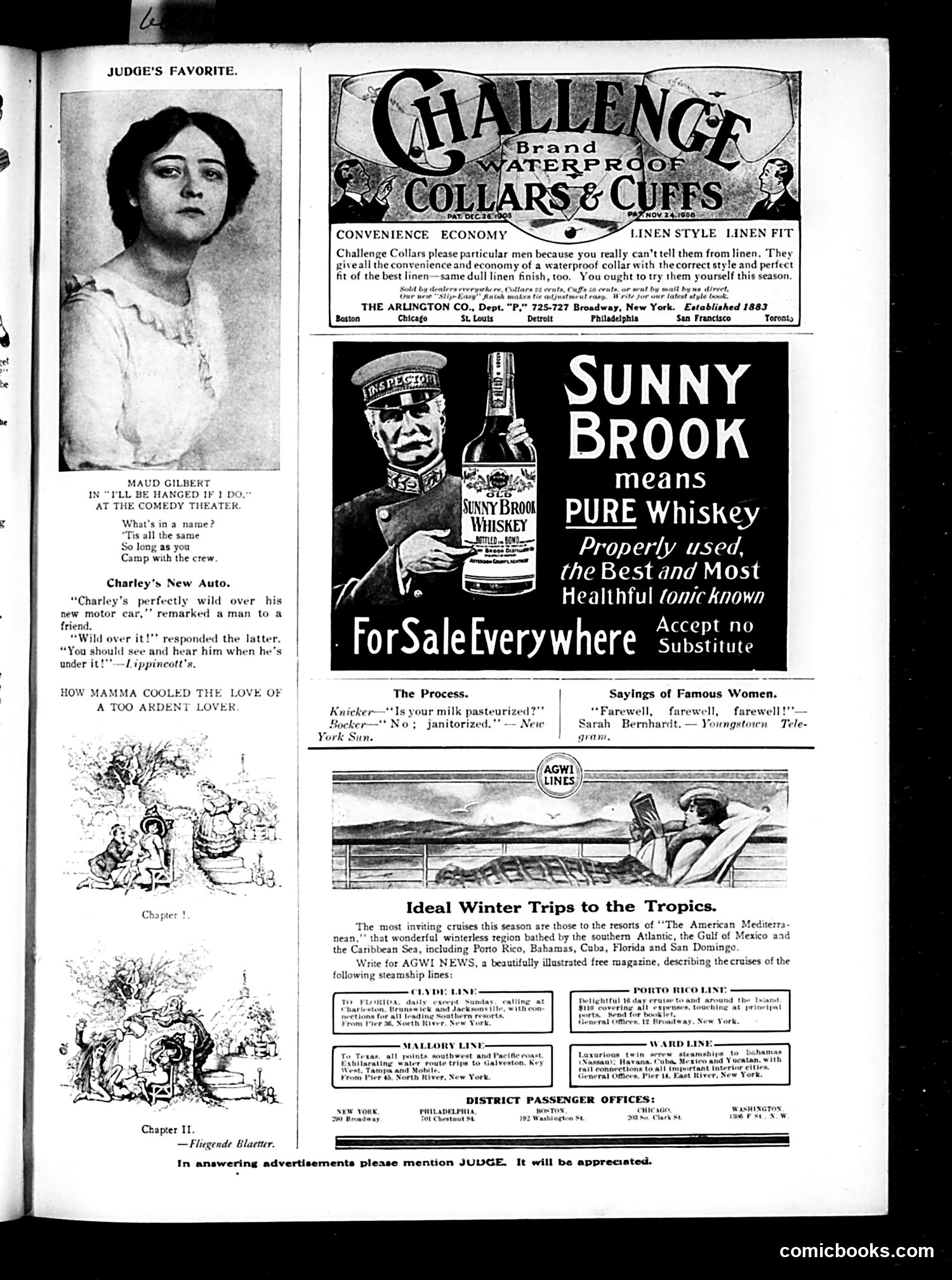
This page is primarily **advertising**, not editorial content or satire. The dominant features are commercial advertisements for: 1. **Challenge Brand Collars & Cuffs** — promoting waterproof collars that mimicked linen's appearance while offering convenience 2. **Sunny Brook Whiskey** — marketed as a "pure" tonic for health when "properly used" 3. **AGWI Steamship Lines** — advertising winter Caribbean cruises The page includes a photograph of **Maud Gilbert**, an actress in the play "I'll Be Hanged If I Do" at the Comedy Theater, presented as "Judge's Favorite." Below are comic vignettes titled "How Mamma Cooled the Love of a Too Ardent Lover" and story chapters, with brief humor pieces about names and automobiles. The whiskey ad is notably candid about alcohol's medicinal claims—standard early 20th-century marketing that would become illegal post-Prohibition. The collar advertisement emphasizes labor-saving convenience, reflecting middle-class consumer culture of the era.
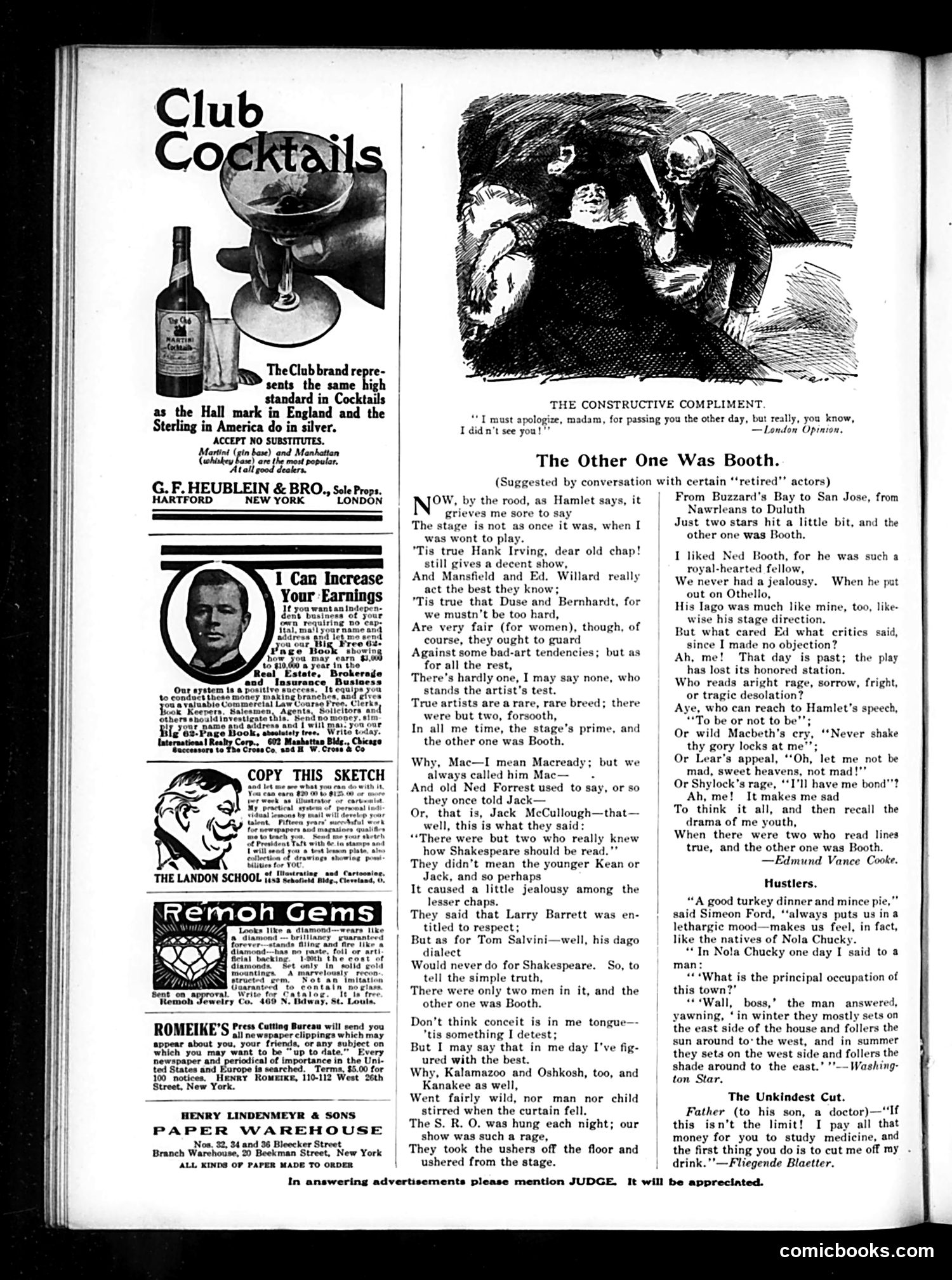
This satirical piece mocks aging actors reminiscing about theatrical glory days. The unnamed speaker—a retired performer—repeatedly claims only two truly great Shakespearean actors existed: himself and "the other one was Booth" (likely Edwin Booth, the renowned 19th-century American actor). The satire targets vanity and selective memory. The speaker name-drops famous performers (Irving, Mansfield, Duse, Bernhardt, Macready, Forrest) only to dismiss them, while boasting of his own provincial success (packed houses in Kalamazoo, Oshkosh, Duluth). His pretentious comparisons—claiming his Iago matched Booth's—ring hollow against his braggadocio about ushers working overtime. The repetitive refrain "the other one was Booth" emphasizes the absurdity: this mediocre actor genuinely believes he belongs in company with actual theatrical legends. The piece gently ridicules nostalgic ego and the tendency of minor performers to inflate their significance.
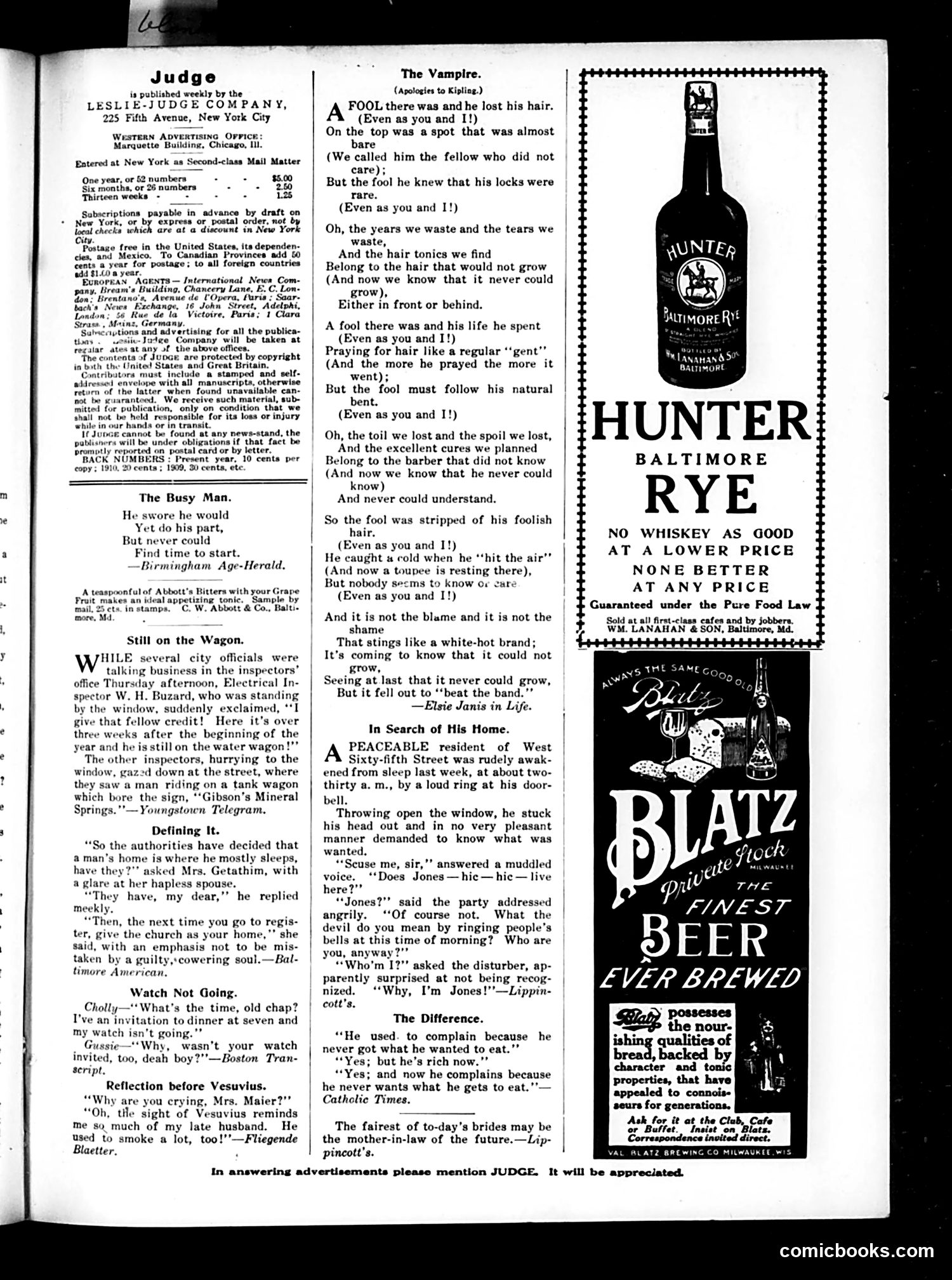
This page is primarily **advertisements and short satirical pieces** typical of Judge magazine's format. The main visual content is a **Hunter Baltimore Rye whiskey advertisement** featuring a bottle and marketing copy about price and quality. The text pieces are brief humorous items: - **"The Vampire"** parodies Kipling's poem structure, mocking men's futile obsession with hair tonics and remedies for baldness. The satire suggests that no product can restore lost hair—a recurring concern for turn-of-the-century men. - **"Still on the Wagon"** jokes about a city official's sobriety; he's spotted riding a water/mineral spring delivery wagon, creating a pun on "staying on the wagon" (abstaining from alcohol). - Other short pieces include predictable period humor about marriage, punctuality, and domestic life. The **Blatz beer advertisement** at bottom-right uses period typography emphasizing "finest beer ever brewed." Overall, this reflects early 1900s consumer culture—heavy advertising mixed with mild social satire about male vanity and behavior.
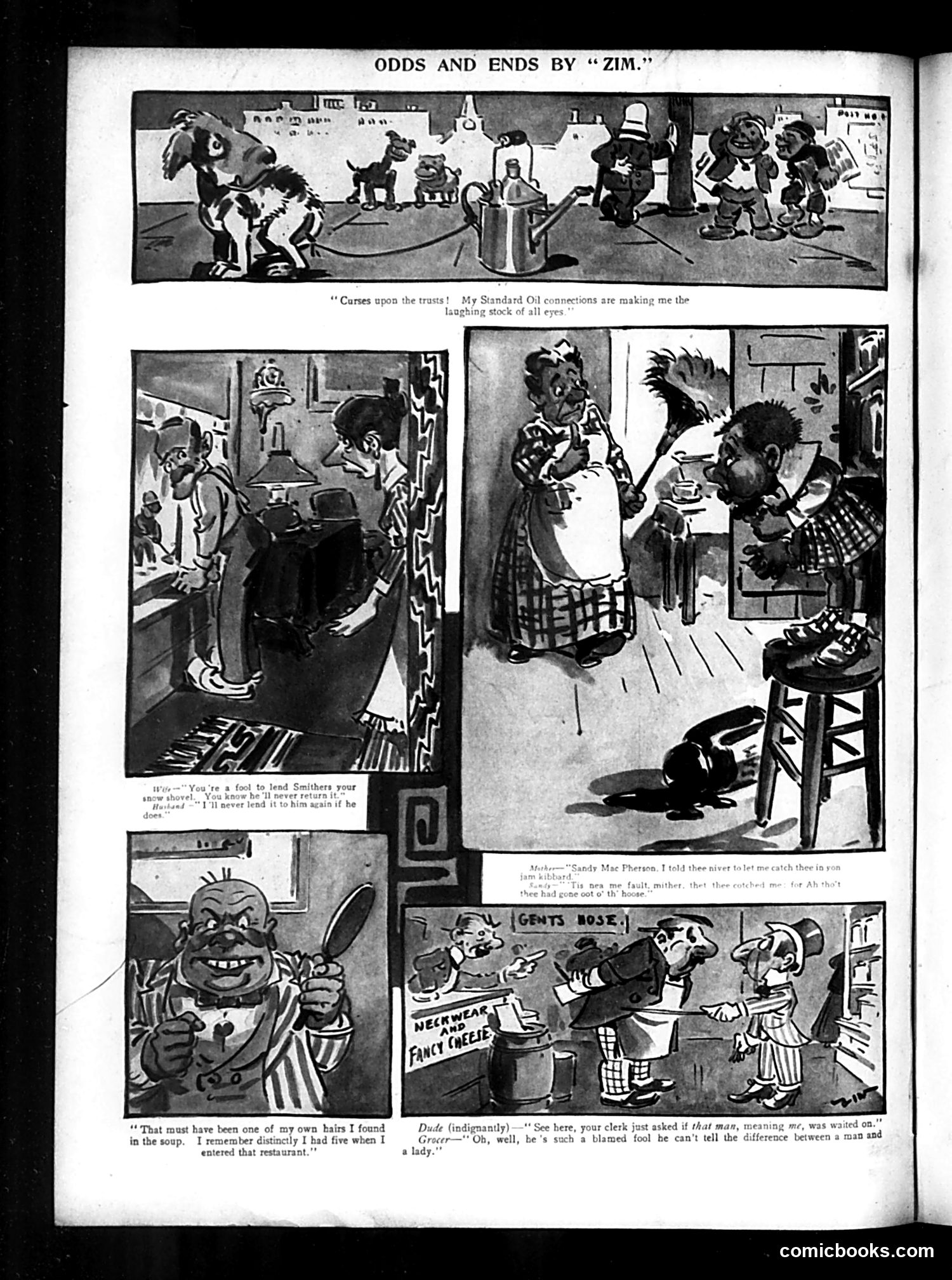
This comic strip by "Zim" satirizes early 20th-century restaurant hygiene and class attitudes. The top panel shows a man complaining to a grocer about finding a hair in soup, claiming it must be his own since he only had five hairs when entering the restaurant. The grocer dismisses the complaint, suggesting the hair belongs to "a lady"—implying female customers or staff are responsible. The humor targets both poor sanitation standards in restaurants and the era's casual sexism. The joke also plays on the diner's vanity: he's embarrassed about his baldness, yet uses it as an excuse. The strip mocks how restaurant owners deflected blame for unsanitary conditions onto female patrons or workers rather than acknowledging their own failures. This reflects genuine concerns about restaurant safety in that period, when food hygiene regulations were minimal.