
Judge, 1911-02-11 · page 14 of 24
Judge — February 11, 1911 — page 14: what you’re looking at
What you’re looking at
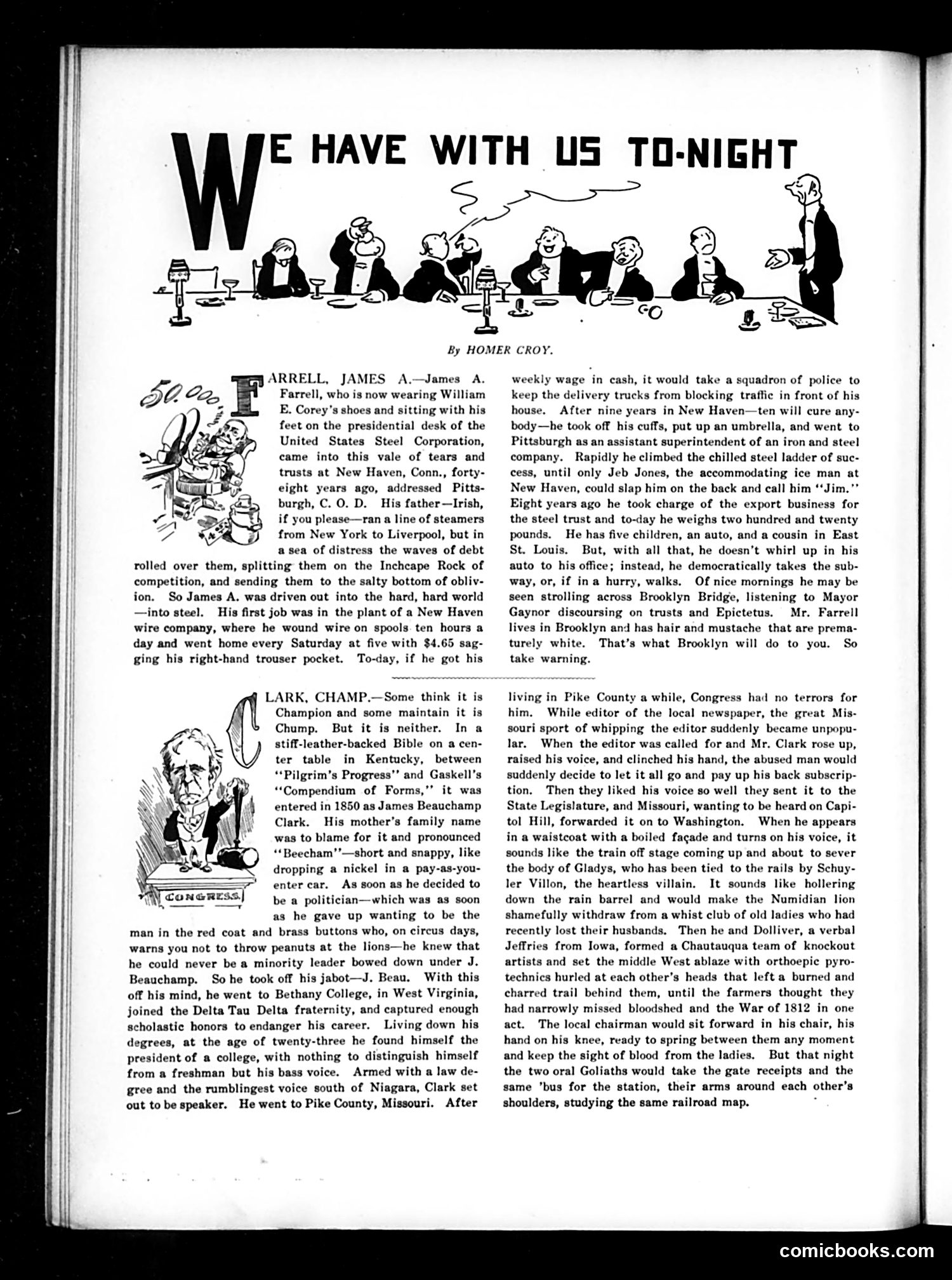
This satirical article profiles two prominent American figures of the early 1900s through biographical sketches paired with caricatures: **James A. Farrell** (left): Now president of U.S. Steel, having replaced William E. Corey. The satire traces his rise from poverty—his Irish father lost shipping business to debt—through hard labor winding wire spools at $4.65/week, to his current wealth and influence in Pittsburgh's steel industry. The joke: his success is so complete that police would be needed to manage delivery trucks blocking his street. **Champ Clark** (right): A Missouri congressman whose full name was James Beauchamp Clark. The satire humorously explains how he dropped "Beauchamp" (pronounced "Beecham") from his identity to pursue politics, fearing it sounded too refined. Armed only with a law degree and a booming voice, he rose from college president to political power through intimidation and rhetoric. Both profiles mock the self-made American success narrative while celebrating these men's unconventional paths to power.
📄 Transcribed text from this page (OCR, searchable)
Machine-transcribed from the original scan — historical spelling and the odd misread are preserved.
By HOMER CROY. ARRELL, JAMES A.—James A. Farrell, who is now wearing William E. Corey's shoes and sitting with his feet on the presidential desk of the United States Steel Corporation, came into this vale of tears and trusts at New Haven, Conn., forty- eight years ago, addressed Pitts- burgh, C. 0. D. His father—Irish, if you please—ran a line of steamers from New York to Liverpool, but in a sea of distress the waves of debt rolled over them, splitting them on the Inchcape Rock of competition, and sending them to the salty bottom of obliv- ion. So James A. was driven out into the hard, hard world —into steel. His first job was in the plant of a New Haven wire company, where he wound wire on spools. ten hours a day and went home every Saturday at five with $4.65 sag- ging his right-hand trouser pocket. To-day, if he got his 9 LARK, CHAMP.—Some think it is Champion and some maintain it is Chump. But it is neither. In a stiff-leather-backed Bible on a cen- ter table in Kentucky, between “*Pilgrim’s Progress’’ and Gaskell’s “Compendium of Forms,’’ it was entered in 1850 as James Beauchamp Clark. His mother’s family name was to blame for it and pronounced “‘Beecham’’—short and snappy, like dropping a nickel in a pay-as-you- ——— = enter car. As soon as he decided to CONGRESS] be @ politician—which was as soon as he gave up wanting to be the man in the red coat and brass buttons who, on circus days, warns you not to throw peanuts at the lions—he knew that he could never be a minority leader bowed down under J. Beauchamp. So he took off his jabot—J. Beau. With this off his mind, he went to Bethany College, in West Virginia, joined the Delta Tau Delta fraternity, and captured enough scholastic honors to endanger his career. Living down his degrees, at the age of twenty-three he found himself the president of a college, with nothing to distinguish himself from a freshman but his bass voice. Armed with a law de- gree and the rumblingest voice south of Niagara, Clark set out to be speaker. He went to Pike County, Missouri. After weekly wage in cash, it would take a squadron of police to keep the delivery trucks from blocking traffic in front of his house. After nine years in New Haven—ten will cure any- body—he took off his cuffs, put up an umbrella, and went to Pittsburgh as an assistant superintendent of an iron and steel company. Rapidly he climbed the chilled steel ladder of suc- cess, until only Jeb Jones, the accommodating ice man at New Haven, could slap him on the back and call him ‘‘Jim."’ Eight years ago he took charge of the export business for the steel trust and to-day he weighs two hundred and twenty pounds. He has five children, an auto, and a cousin in East St. Louis. But, with all that, he doesn’t whirl up in his auto to his office; instead, he democratically takes the sub- way, or, if ina hurry, walks, Of nice mornings he may be seen strolling across Brooklyn Bridge, listening to Mayor Gaynor discoursing on trusts and Epictetus. Mr. Farrell lives in Brooklyn and has hair and mustache that are prema- turely white. That’s what Brooklyn will do to you. So take warning. living in Pike County a while, Congress had no terrors for him. While editor of the local newspaper, the great Mis- souri sport of whipping the editor suddenly became unpopu- lar. When the editor was called for and Mr. Clark rose up, raised his voice, and clinched his hand, the abused man would suddenly decide to let it all go and pay up his back subscrip- tion. Then they liked his voice so well they sent it to the State Legislature, and Missouri, wanting to be heard on Capi- tol Hill, forwarded it on to Washington. When he appears in a waistcoat with a boiled facade and turns on his voice, it sounds like the train off stage coming up and about to sever the body of Gladys, who has been tied to the rails by Schuy- ler Villon, the heartless villain. It sounds like hollering down the rain barrel and would make the Numidian lion shamefully withdraw from a whist club of old ladies who had recently lost their husbands. Then he and Dolliver, a verbal Jeffries from Iowa, formed a Chautauqua team of knockout artists and set the middle West ablaze with orthoepic pyro- technics hurled at each other’s heads that left a burned and charred trail behind them, until the farmers thought they had narrowly missed bloodshed and the War of 1812 in one act. The local chairman would sit forward in his chair, his hand on his knee, ready to spring between them any moment and keep the sight of blood from the ladies, But that night the two oral Goliaths would take the gate receipts and the same ‘bus for the station, their arms around each other's shoulders, studying the same railroad map. . comicbooks.com