
Judge, 1911-02-11 · page 9 of 24
Judge — February 11, 1911 — page 9: what you’re looking at
What you’re looking at
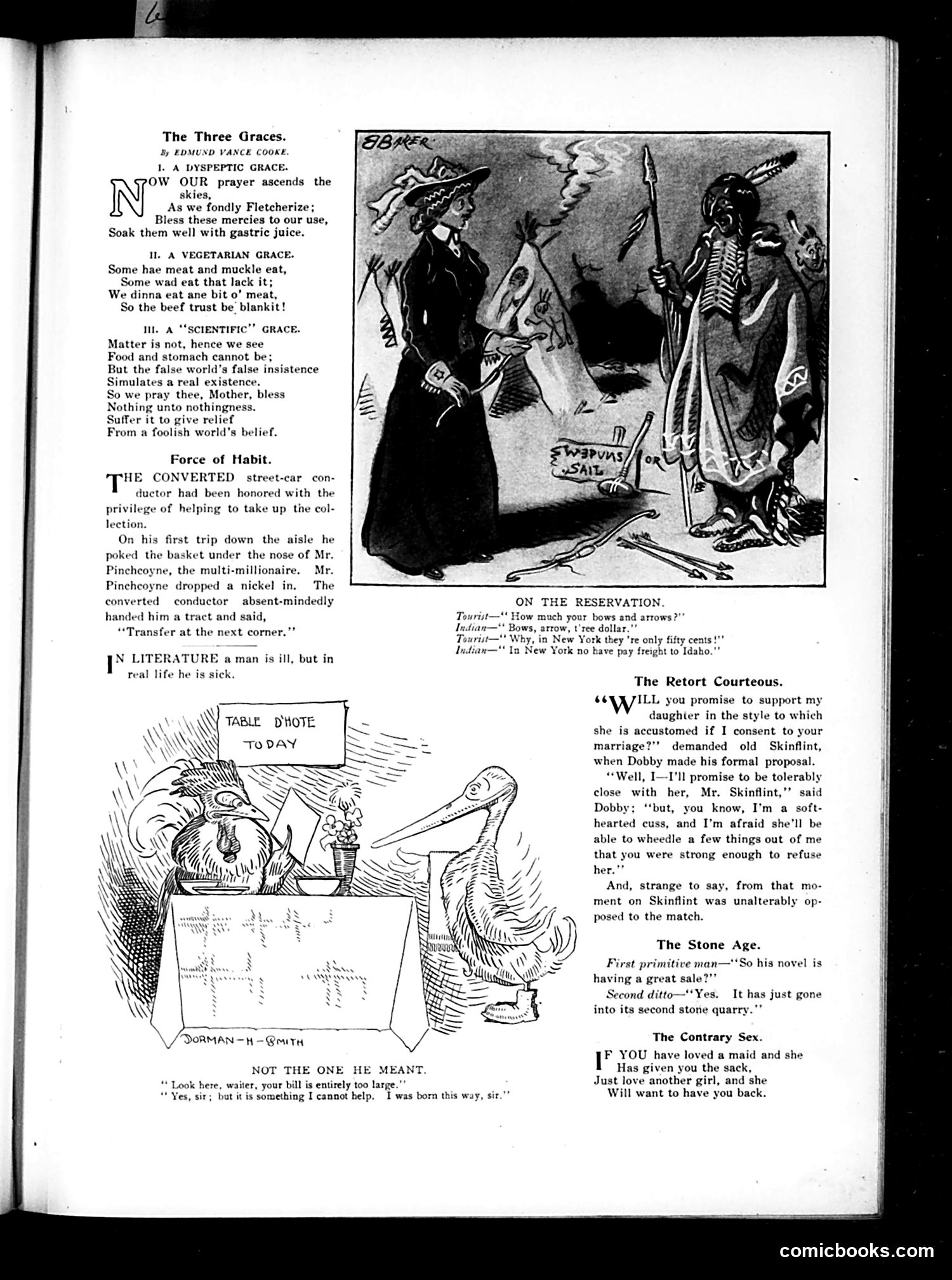
This page contains multiple satirical pieces targeting early 1900s American social trends: **"The Three Graces"** mocks contemporary diet fads: "Fletcherizing" (extreme chewing), vegetarianism, and Christian Science (which denied material reality). The prayers parody how devotees rationalize these practices religiously. **"Force of Habit"** jokes about a street-car conductor converted to Christianity who reflexively hands a wealthy donor a religious tract instead of a transfer ticket—suggesting conversion hasn't changed his unconscious habits. **"On the Reservation"** cartoon depicts a Native American vendor complaining that New York prices undercut his tourist trade, satirizing commercialization and the tourist exploitation of Indigenous people. The remaining brief jokes address courtship (a father's objection to his daughter's suitor backfires) and publishing (a terrible novel finds an audience in prisons—"stone quarry"). The page exemplifies *Judge*'s satirical approach: mocking fads, religious earnestness, class pretension, and contemporary social absurdities through humor targeting educated readers.
📄 Transcribed text from this page (OCR, searchable)
Machine-transcribed from the original scan — historical spelling and the odd misread are preserved.
The Three Graces. By EDMUND VANCE COOKE. I. A DYSPEPTIC GRACE. OW OUR prayer ascends the skies, As we fondly Fletcherize; Bless these mercies to our use, Soak them well with gastric juice. Il. A VEGETARIAN GRACE. Some hae meat and muckle eat, Some wad eat that lack it; We dinna eat ane bit 0’ meat, So the beef trust be blankit! Il. A ‘SCIENTIFIC’ GRACE. Matter is not, hence we see Food and stomach cannot be; But the false world’s false insistence Simulates a real existence. So we pray thee, Mother, bless Nothing unto nothingness. Suffer it to give relief From a foolish world’s belief. Force of Habit. HE CONVERTED §sstreet-car_ con- ductor had been honored with the privilege of helping to take up the col- lection. On his first trip down the aisle he poked the basket under the nose of Mr. Pinchcoyne, the multi-millionaire. Mr. Pinchcoyne dropped a nickel in. The converted conductor absent-mindedly ON THE RESERVATION. handed him a tract and said, p “« How much your bows and arrows ?"" “Transfer at the next corner.” : Bows; arrow \'ree dollar. ee ene Tourist—'* Why, in New York they 're only fifty cents !"" LITERATURE a man is ill, but in real Ife he:iaislek. The Retort Courteous. seyyILL you promise to support my daughier in the style to which she is accustomed if I consent to your marriage?’’ demanded old Skinflint, when Dobby made his formal proposal. “Well, I—I'll promise to be tolerably close with her, Mr. Skinflint,’’ said Dobby; ‘but, you know, I'm a soft- hearted cuss, and I'm afraid she'll be able to wheedle a few things out of me that you were strong enough to refuse her.”” And, strange to say, from that mo- ment on Skinflint was unalterably op- posed to the match. Indian—" In New York no have pay freight to Idaho.’ The Stone Age. First primitive man—‘So his novel is having a great sale?” Second ditto—‘‘Yes. It has just gone into its second stone quarry.”’ JORMAN—H-@mutn : The Contrary Sex. [F XOU have toved a maid and she NOT THE ONE HE MEANT. Has given you the sack, * Look here, waiter, your bill is entirely too large.”’ Just love another girl, and she “Yes, sir; but it is something I cannot help. I was born this way, sir."” Will want to have you back. comicbooks.com