
A complete issue · 24 pages · 1911
Judge — January 28, 1911
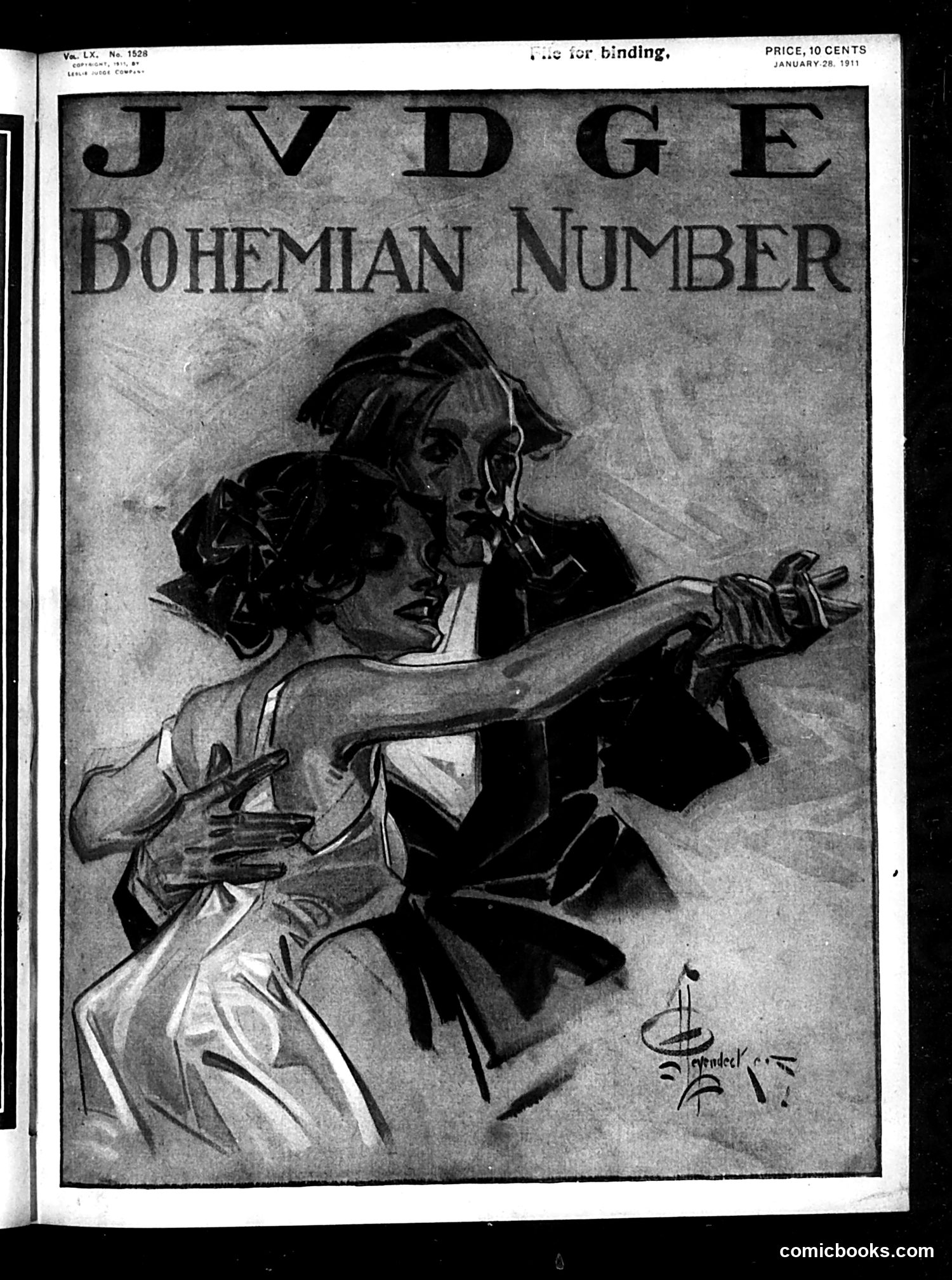
This cover depicts two figures in what appears to be a theatrical or dramatic scene labeled "Bohemian Number." The artwork shows a man and woman in period costume engaged in an animated interaction—the woman's arm extended dramatically while the man gestures expressively behind her. "Bohemian" refers to artistic, unconventional lifestyles associated with bohemian culture. The cover likely satirizes bohemian artistic circles or theatrical life of the era. The dramatic posing and theatrical styling suggest this issue focused on satirizing bohemian society's affectations and pretensions—a common target for Judge magazine's satirical humor. The specific identities of the figures remain unclear without additional context from the magazine's contents.
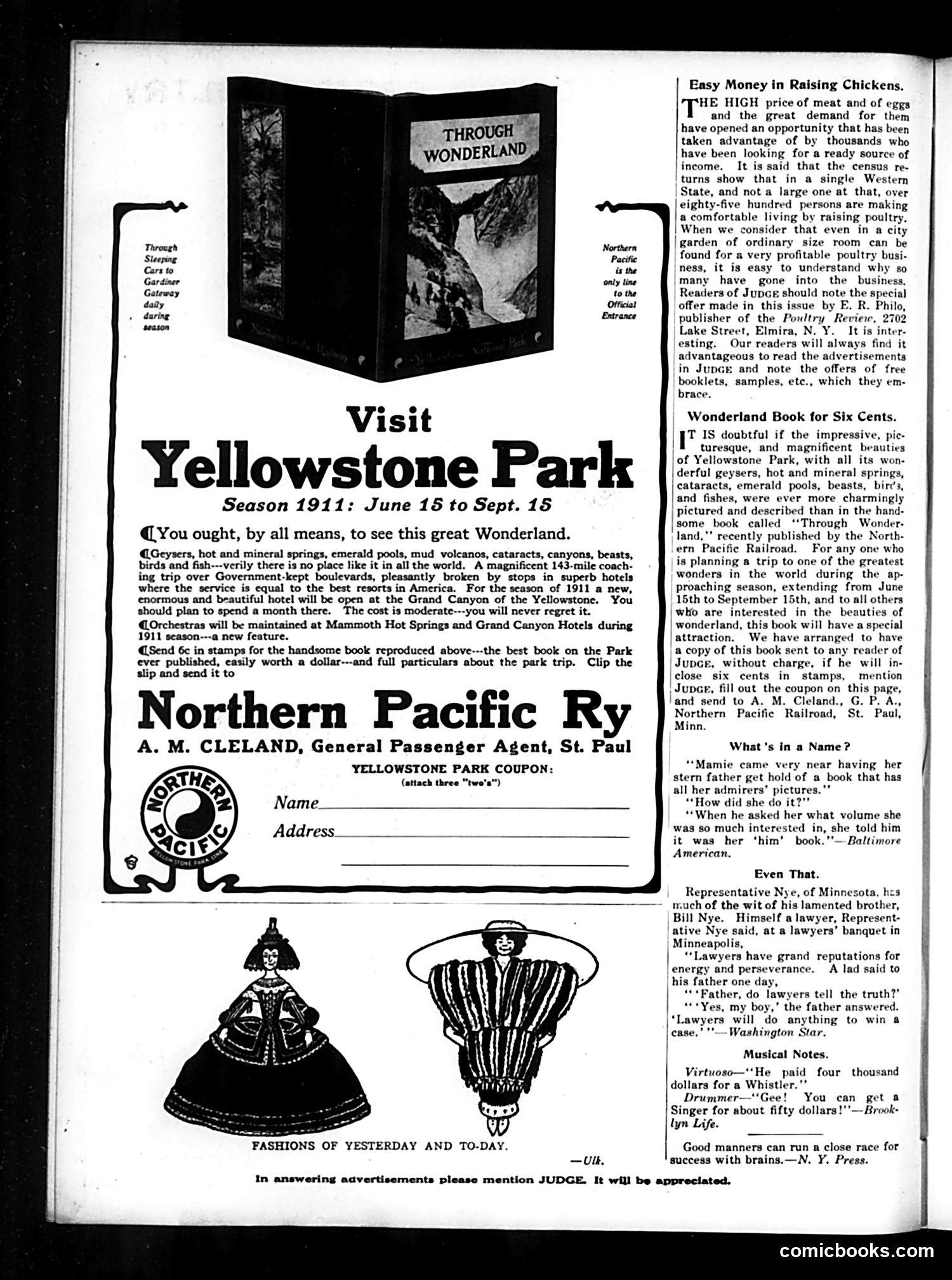
This page is primarily **advertising and filler content** rather than political satire. The main feature is a **Northern Pacific Railway advertisement** promoting Yellowstone Park visits for the 1911 season (June 16–September 15). It includes a coupon and describes the park's natural attractions. The bottom section, titled **"Fashions of Yesterday and To-Day,"** shows two fashion illustrations comparing historical dress (left: elaborate Victorian-era gown) with contemporary fashion (right: a more streamlined 1910s silhouette). This appears to be light social commentary on changing fashion rather than political satire. The right column contains miscellaneous **humor items and anecdotes**—brief jokes about names, lawyers, and musical talent—typical of Judge magazine's filler content. Overall, this represents **routine magazine padding** interspersed with commercial advertisements.
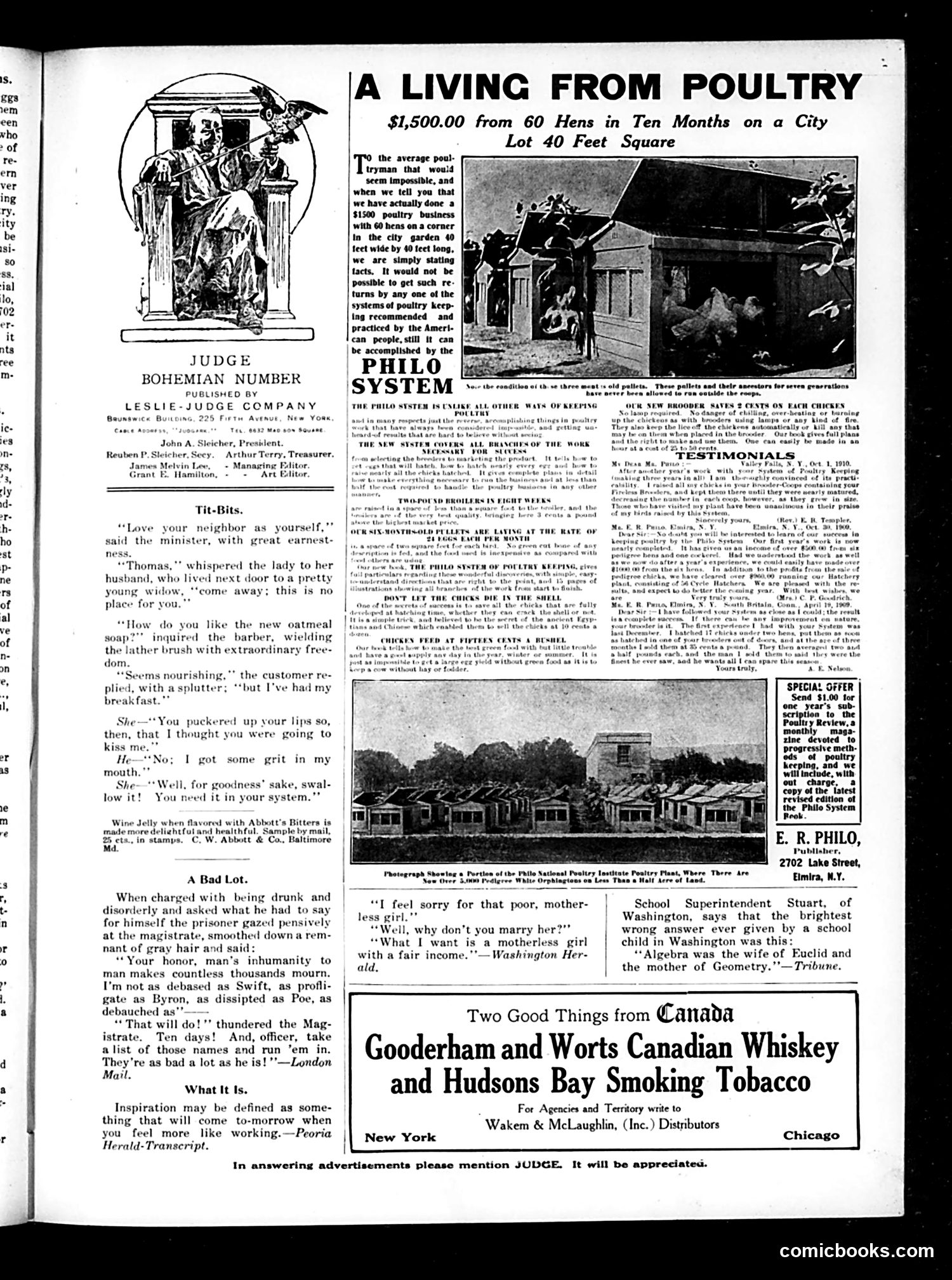
This page is primarily **advertising and commercial content** rather than political satire. The main feature is "A Living from Poultry," promoting the Philo System of chicken-keeping—a commercial venture claiming $1,500 profit from 60 hens on a city lot. The testimonials and detailed descriptions suggest this was a mail-order business opportunity popular in early 20th-century America. The decorative header shows "Judge Bohemian Number," published by Leslie-Judge Company, but contains no apparent political cartoon or satirical commentary. The page includes unrelated humor snippets ("Tit-Bits," "A Bad Lot") and advertisements for Canadian whiskey and tobacco, typical of Judge's mixed-content format. The overall emphasis is **commercial promotion** rather than social or political satire.
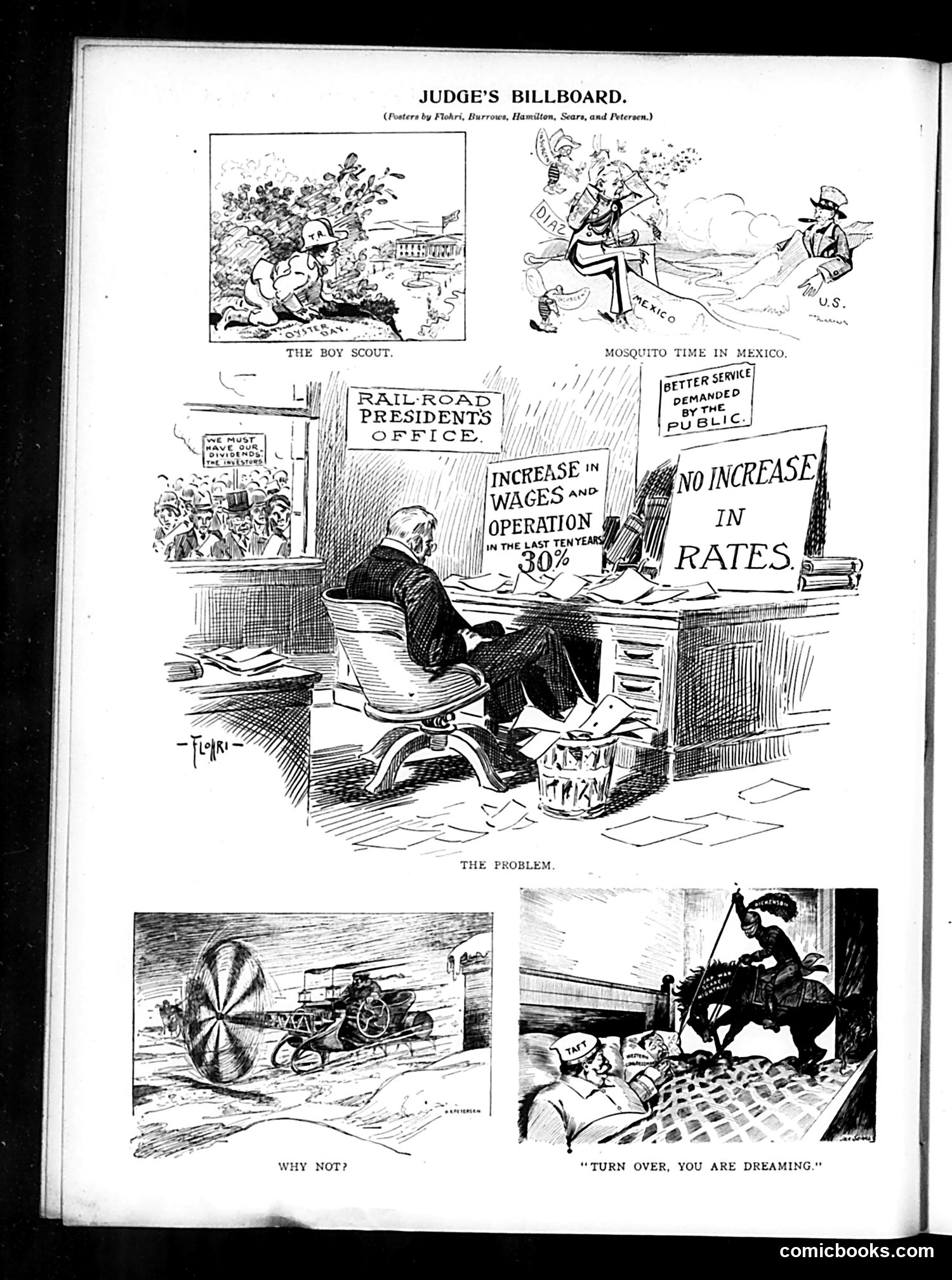
This page satirizes early 20th-century railroad industry problems. "The Problem" cartoon depicts a railroad president facing an impossible contradiction: public demands for "Better Service" while also demanding "No Increase in Rates." The executive sits surrounded by papers, caught between these irreconcilable demands. The accompanying cartoons mock proposed solutions—"Why Not?" shows a absurd mechanical wheel supposedly solving efficiency, while "Turn Over, You Are Dreaming" depicts a fantastical solution as pure fantasy. Top panels appear unrelated political commentary (Boy Scout, Mexico references), but the central focus critiques the regulatory tension between consumer interests and railroad profitability—a major Progressive Era debate over whether public services could maintain quality without rate increases.
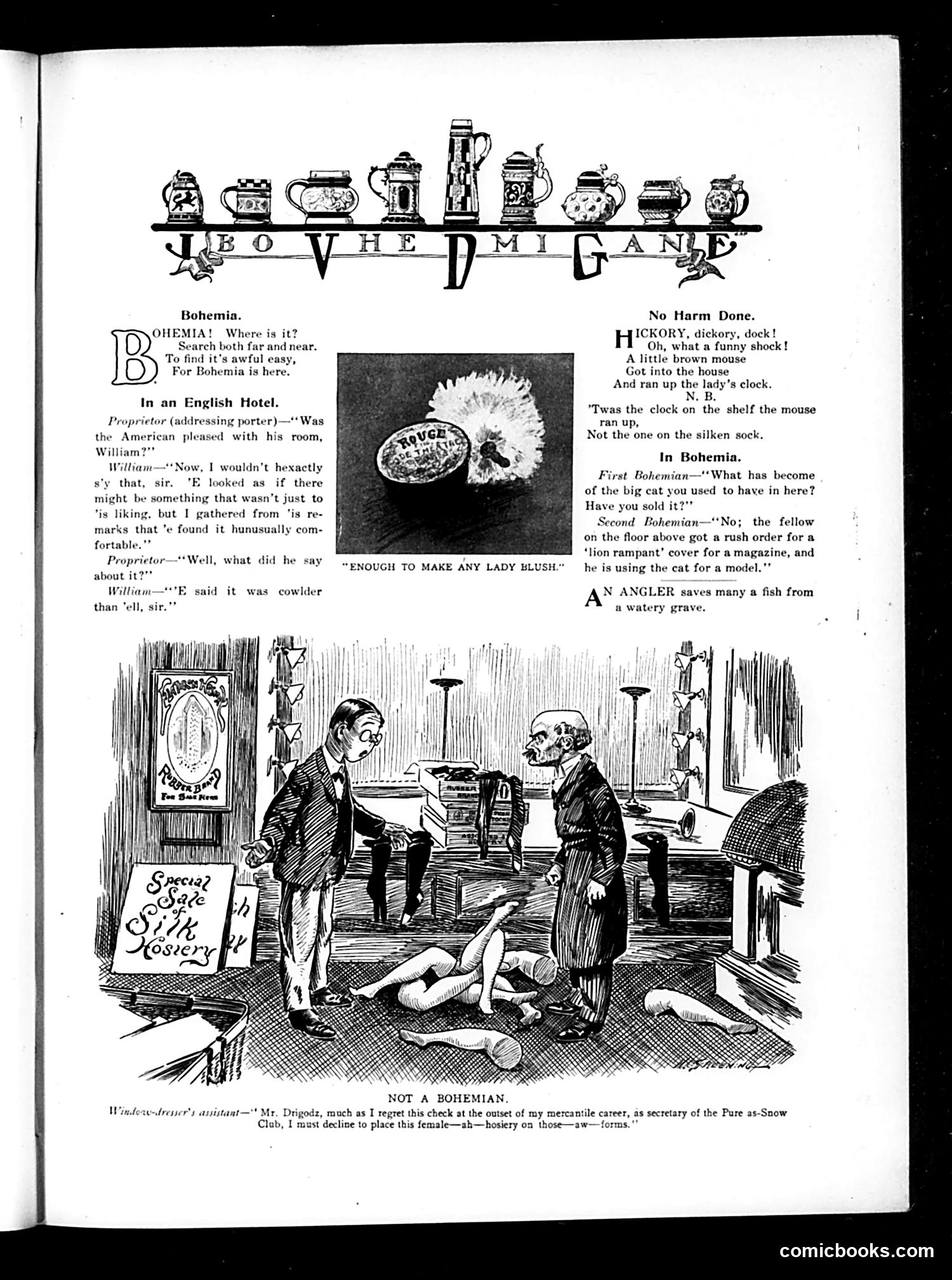
This page contains multiple brief humorous sketches rather than a single cartoon. The "Bohemia" sections mock bohemian life and affectations common in artistic circles. "In an English Hotel" presents a dialogue where an American guest complains about the accommodations, calling them "cowdier than 'ell"—satirizing both American tourists and their complaints abroad. The central cartoon titled "NOT A BOHEMIAN" depicts what appears to be a shop or establishment scene where a window-dresser's assistant declines to classify someone as "bohemian," suggesting social pretensions and class anxieties about artistic identity in urban settings. The miscellaneous jokes target contemporary social types—mouse-chasers, fishermen—reflecting Judge's typical satirical approach to everyday American life and manners.
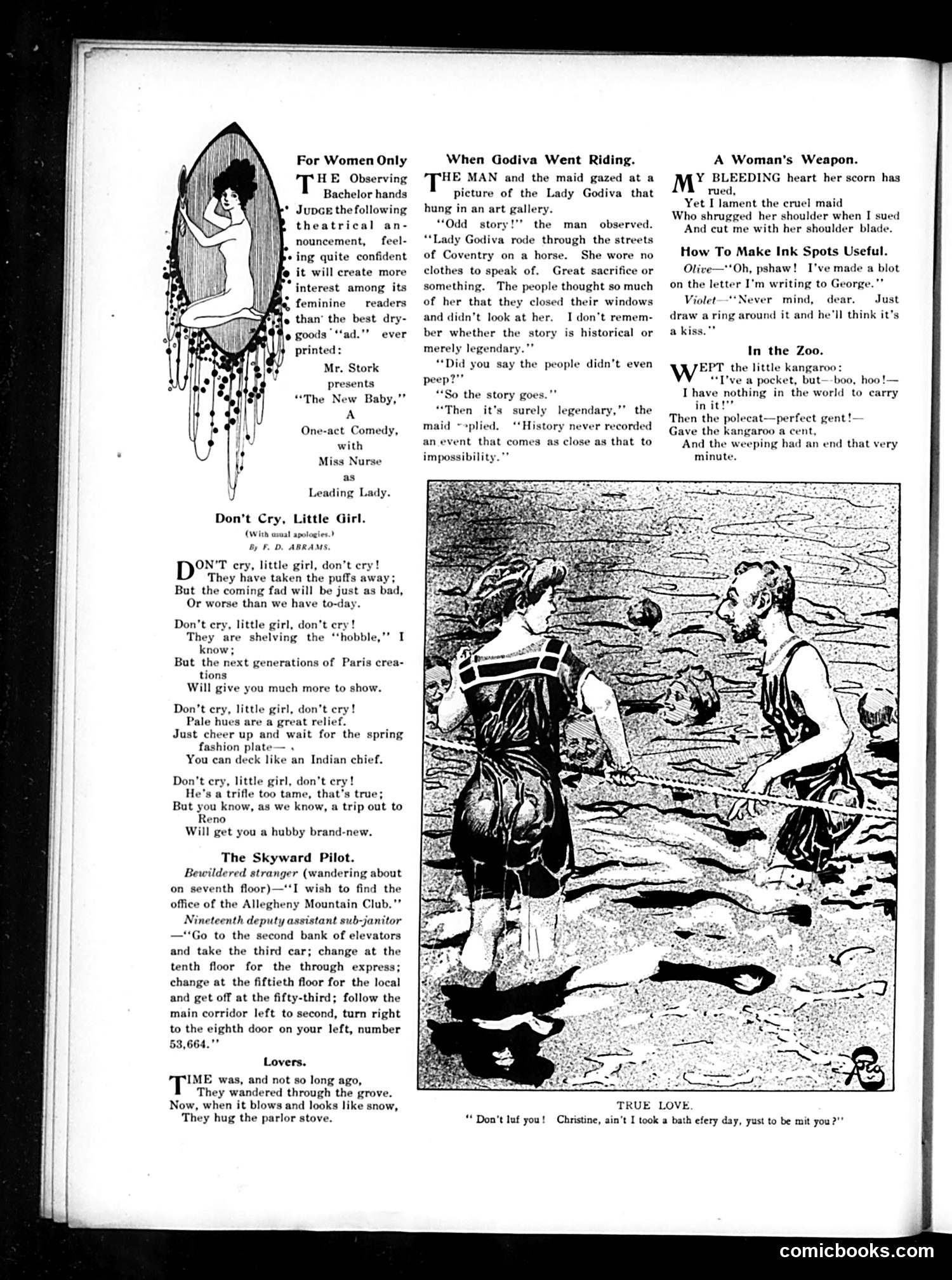
This page contains several short humorous pieces targeting early 20th-century social trends and gender dynamics: **"For Women Only"** satirizes theatrical announcements, with "The New Baby" presented as a comedy—poking fun at how society treated childbirth as entertainment for women readers. **"Don't Cry, Little Girl"** mocks women's fashion anxieties, referencing the "hobble skirt" (a restrictive garment) and alluding to Reno divorces—contemporary shorthand for easy divorces, suggesting women shouldn't worry about fashion or relationships. **"When Godiva Went Riding"** jokes that the famous nude rider's modesty-respecting audience seems impossible—implying modern people are voyeuristic by nature. **"A Woman's Weapon"** presents a romantic complaint: being rejected via a woman's "shoulder blade"—treating feminine rejection as aggressive. The cartoon illustration shows a bathing scene with the caption "True Love," ironically depicting intimate domestic life. Overall, the page reflects early 1900s attitudes toward women's fashion anxieties, divorce, and romantic power dynamics.
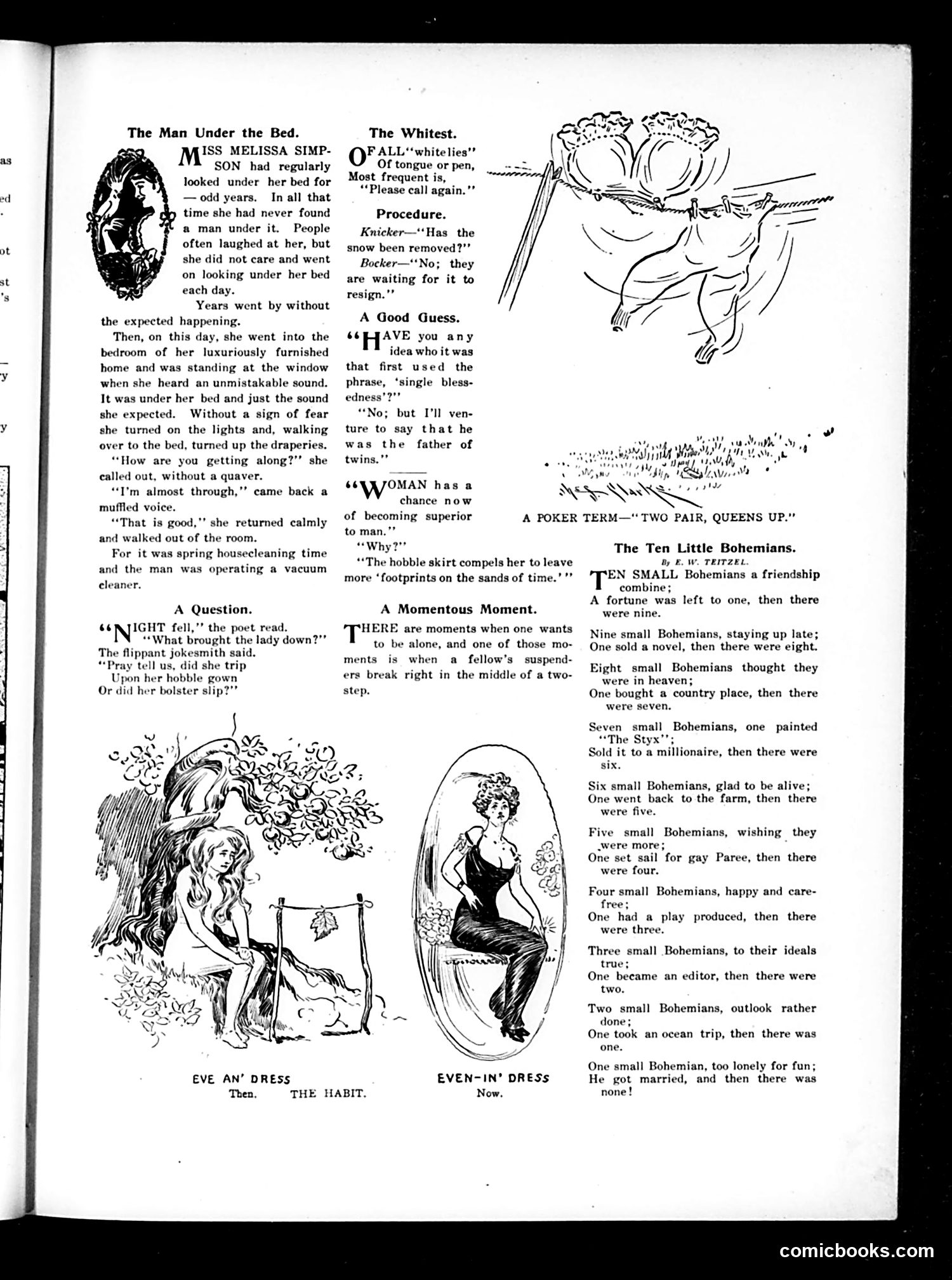
This page contains several short satirical pieces typical of early 20th-century humor: **"The Man Under the Bed"** plays on the common Victorian anxiety about intruders—Miss Simpson routinely checks under her bed. The punchline: it's just a vacuum cleaner operator doing spring cleaning, deflating both romantic and sinister expectations. **"The Whitest"** mocks the common social lie "Please call again," suggesting it's the most frequent dishonesty. **Fashion cartoons** ("Eve an' Dress Then / Even-in' Dress Now") contrast natural, loose clothing with the restrictive "hobble skirt" trend of the era—a fashionable but impractical garment that severely limited women's movement. **"The Ten Little Bohemians"** is a parody of "Ten Little Indians," tracking bohemian artists/writers who abandon their artistic community when they achieve success (selling work, getting wealthy, moving away). The final marriage destroys the group entirely—a satirical jab at bohemian lifestyle instability and conventionality's inevitability. The humor relies on topical references (hobble skirts, bohemian culture) now requiring historical context.
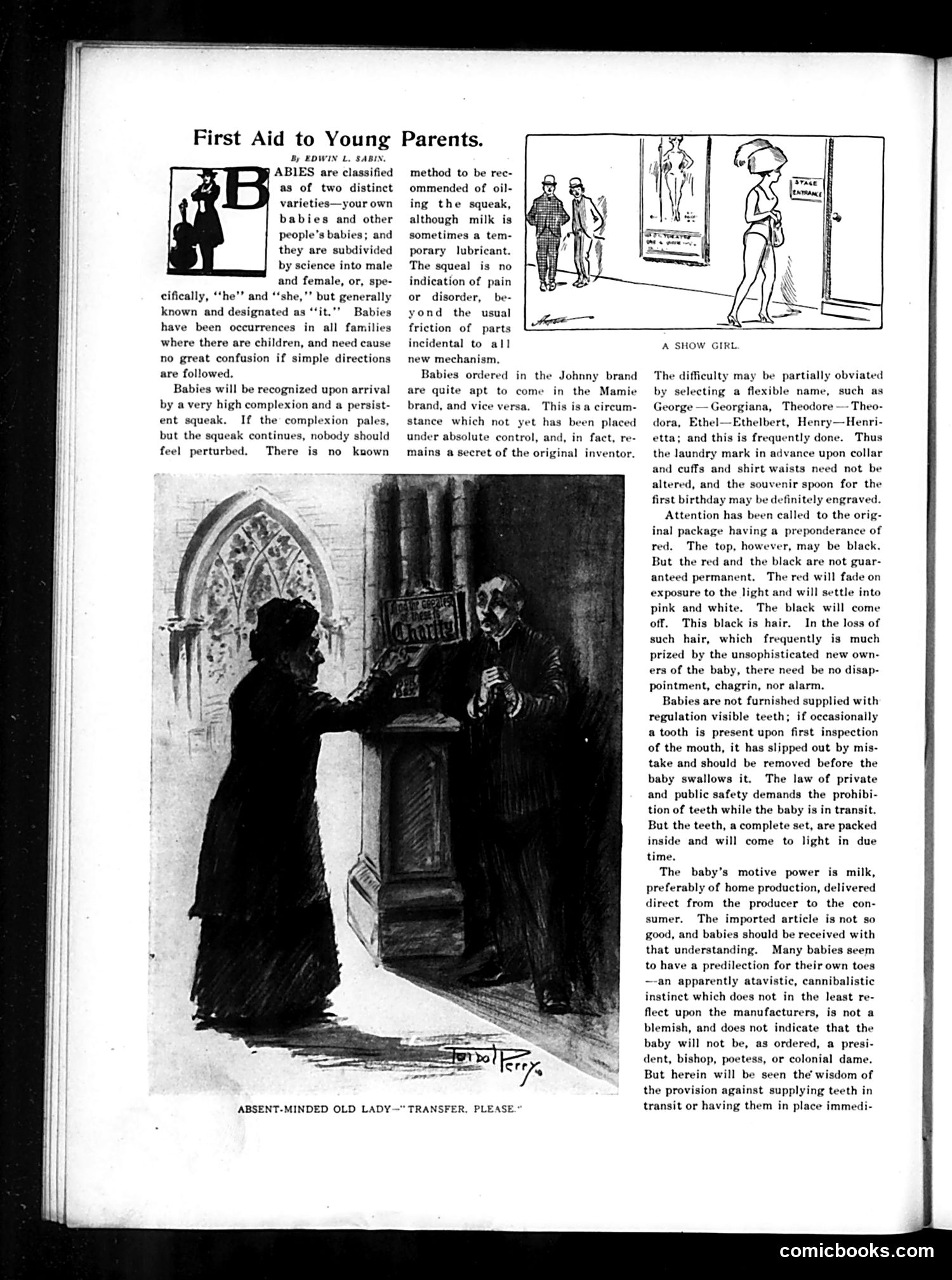
This is a humorous advice article by Edwin L. Sabin offering tongue-in-cheek guidance to new parents. The satirical tone mocks overly scientific and formal parenting instruction popular in the early 20th century. The article playfully classifies babies as either "your own" or "other people's babies" and uses mock-technical language to describe newborn characteristics—the "persistent squeak," the unpredictable coloring (red fades to pink; black hair falls out), and the surprising appearance of teeth in transit. **The cartoon** shows an absent-minded elderly woman on a train asking for a "transfer"—likely confusing train terminology with baby delivery, a visual pun supporting the article's theme of parental confusion. **The "Show Girl" illustration** appears unrelated to the main text, typical of magazine layout conventions. The satire targets anxious new parents seeking overly elaborate guidance for simple biological realities, suggesting that babies are straightforward mechanisms requiring basic care rather than scientific expertise.
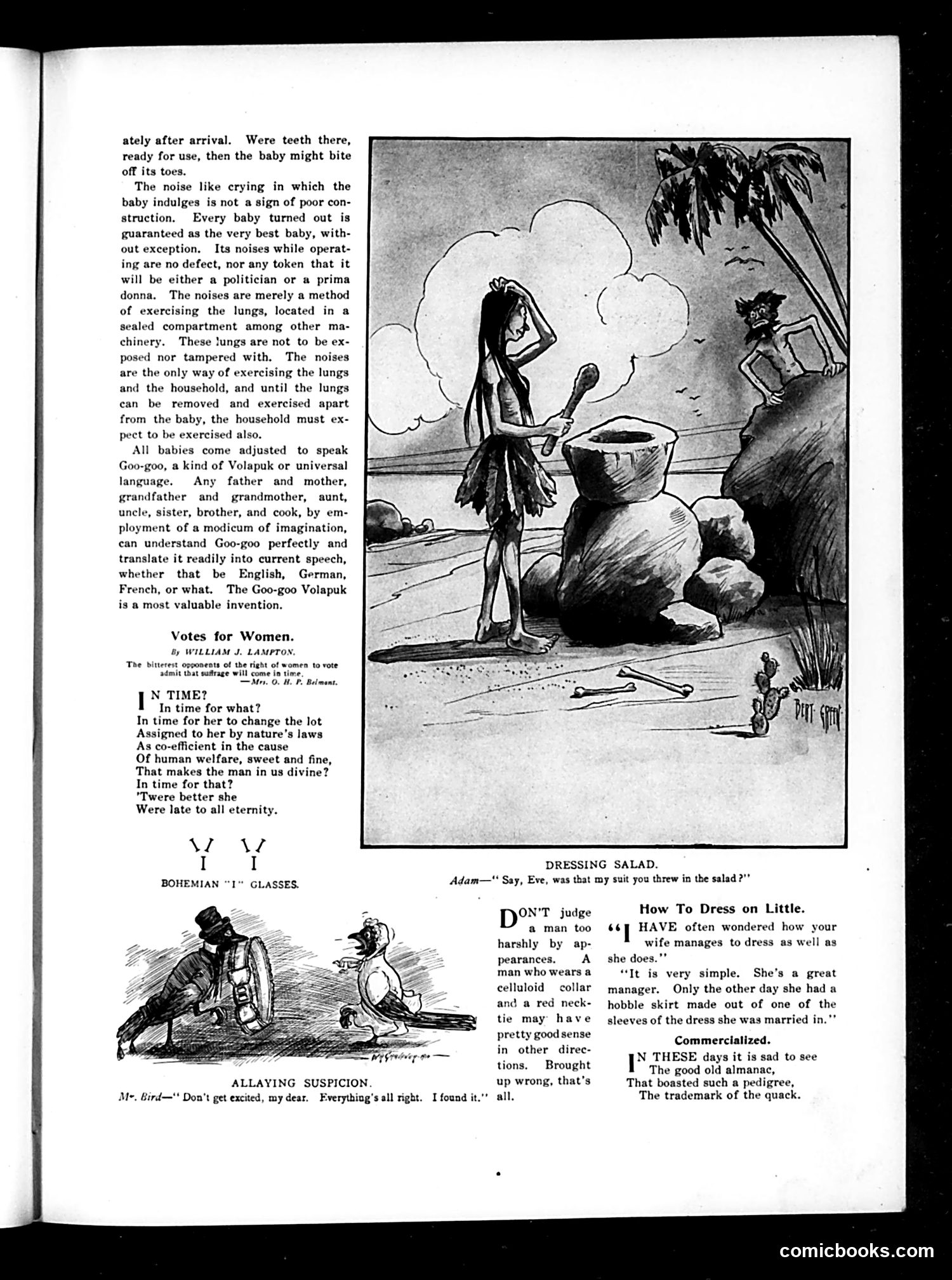
This Judge magazine page contains three distinct satirical pieces: **"Votes for Women"** (Lampton poem): Satirizes women's suffrage advocates by questioning whether voting rights will truly improve women's lives or disrupt "nature's laws." The poem suggests women's traditional domestic role is divinely ordained, mocking suffrage as futile social disruption. **"Dressing Salad" cartoon**: A biblical Adam-and-Eve joke playing on marital domestic discord—Eve has apparently ruined Adam's suit by throwing it in food, a visual pun on "dressing" salad. **"How to Dress on Little"**: Satirizes economical housewives who repurpose old clothing (converting a dress sleeve into a hobble skirt). It gently mocks domestic thrift culture while praising efficient household management. **"Allaying Suspicion"**: Shows a man reassuring his anxious wife that he "found" something suspicious, implying marital distrust and potential infidelity humor. The page reflects early 1900s attitudes: skepticism toward women's suffrage, jokes about marriage tensions, and commentary on working-class/middle-class domestic economies.
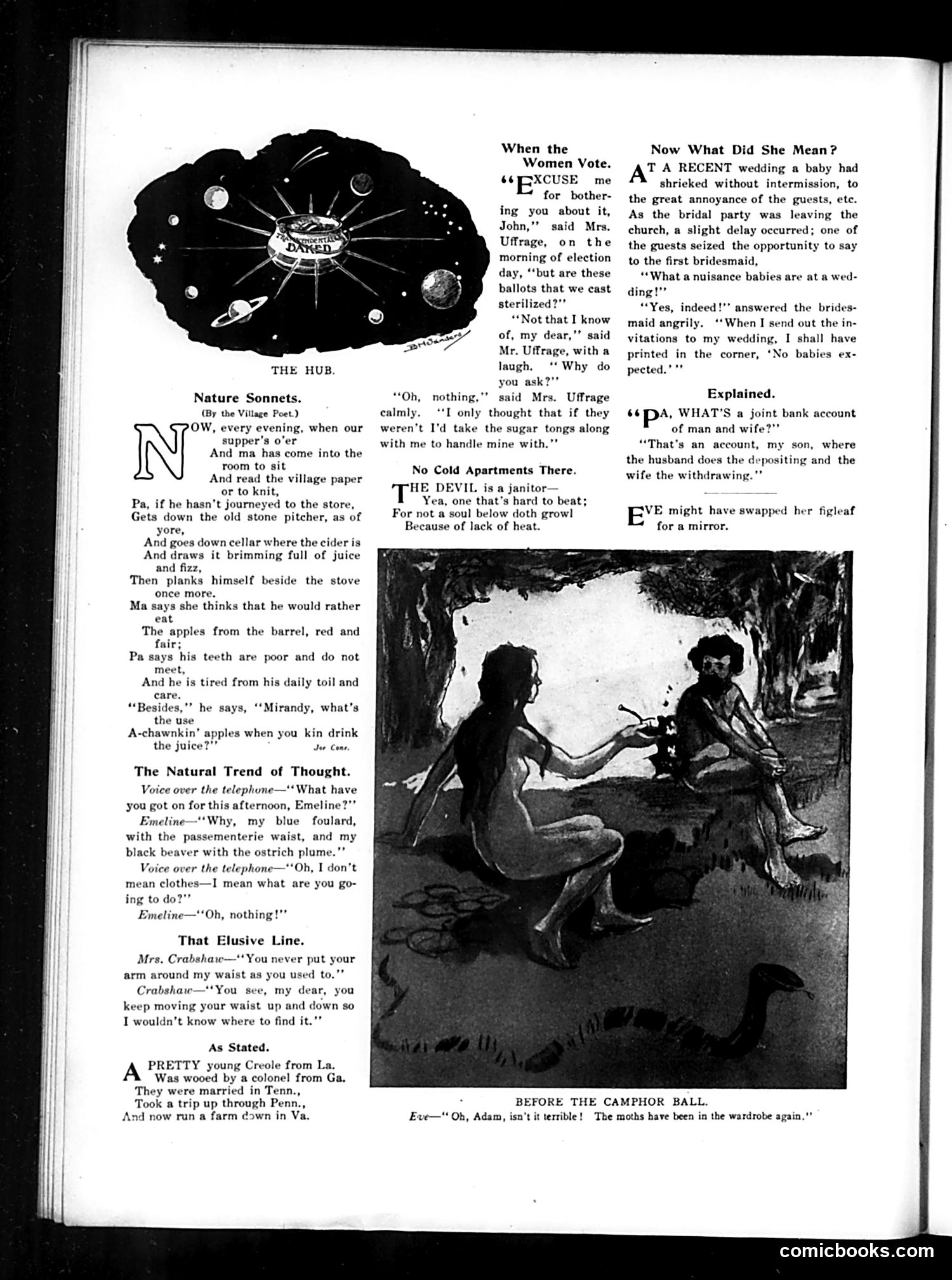
This page from the satirical magazine *Judge* contains several jokes mocking women's suffrage and gender roles circa the early 1900s. **"When the Women Vote"** depicts Mrs. Uffrage (a pun on "suffrage") asking whether election ballots are "sterilized"—implying women voters are obsessed with cleanliness and domestic concerns rather than serious politics. The joke ridicules female suffragists as intellectually unsuited for voting. **Other satirical items** include: - A bride promising "No babies expected" at her wedding—mocking maternal concerns - A joint bank account joke where the husband "deposits" and wife "withdraws"—suggesting women only care about spending money - "No Cold Apartments There" about the Devil as janitor—a non-political poem The overall message reflects anti-suffrage sentiment: that women entering the political sphere would bring trivial domestic preoccupations to serious governance. The humor relies on gender stereotypes common to the era's opposition to women's voting rights.
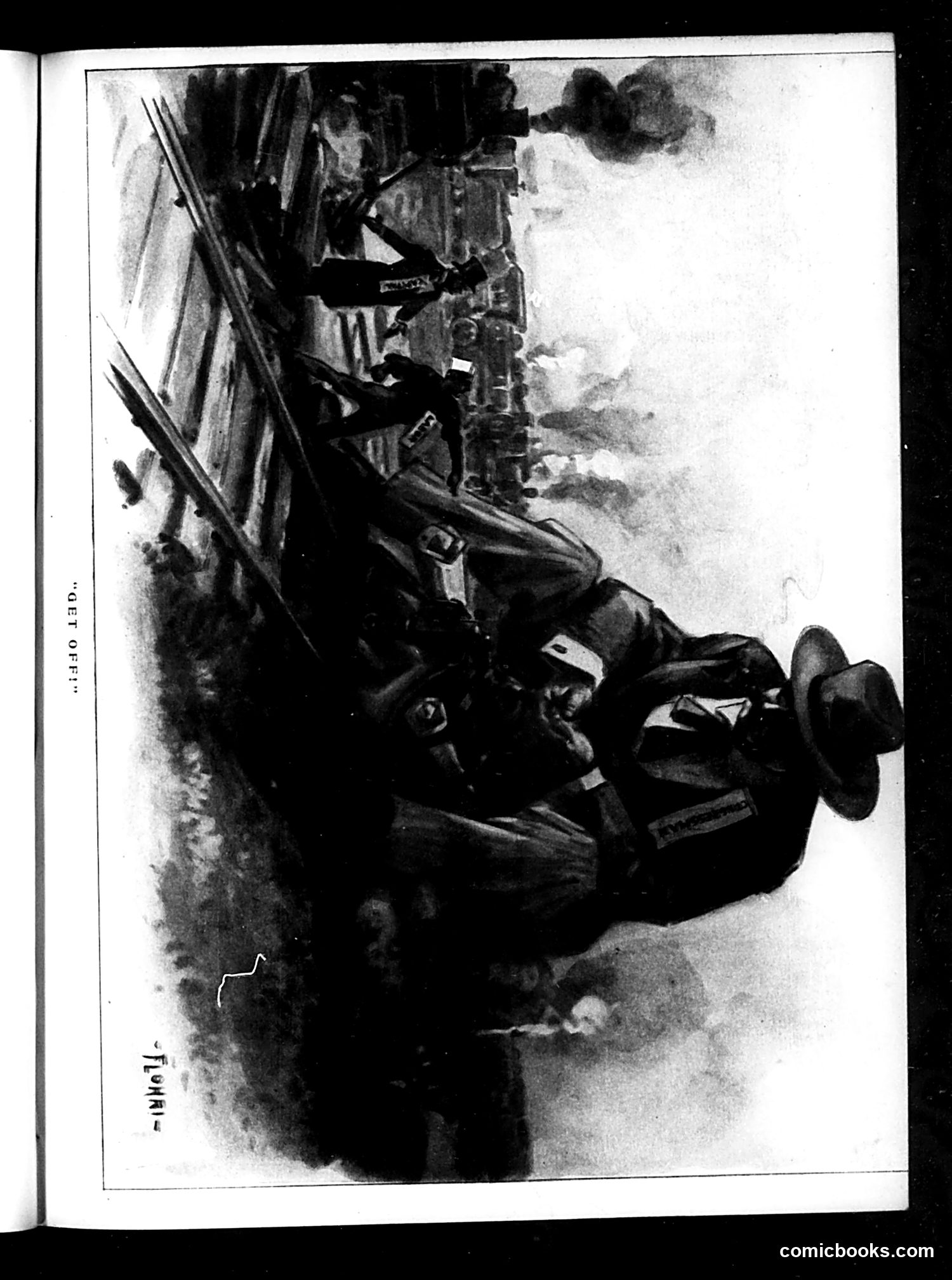
This appears to be a political cartoon from *Judge* magazine, shown sideways/rotated. The image depicts what seems to be a confrontational scene with two figures—one appears to be a uniformed official or authority figure (possibly military or police, suggested by the hat and formal dress) confronting another person. The caption "GET OFF!" suggests an eviction or removal scenario. Without being able to identify the specific figures clearly or see additional context clues, the cartoon likely satirizes a contemporary political or social conflict involving abuse of authority or forcible removal of someone from property or position. The quality and styling suggest early-to-mid 20th century. More specific identification of the figures and historical event would require additional source documentation beyond what's visible here.
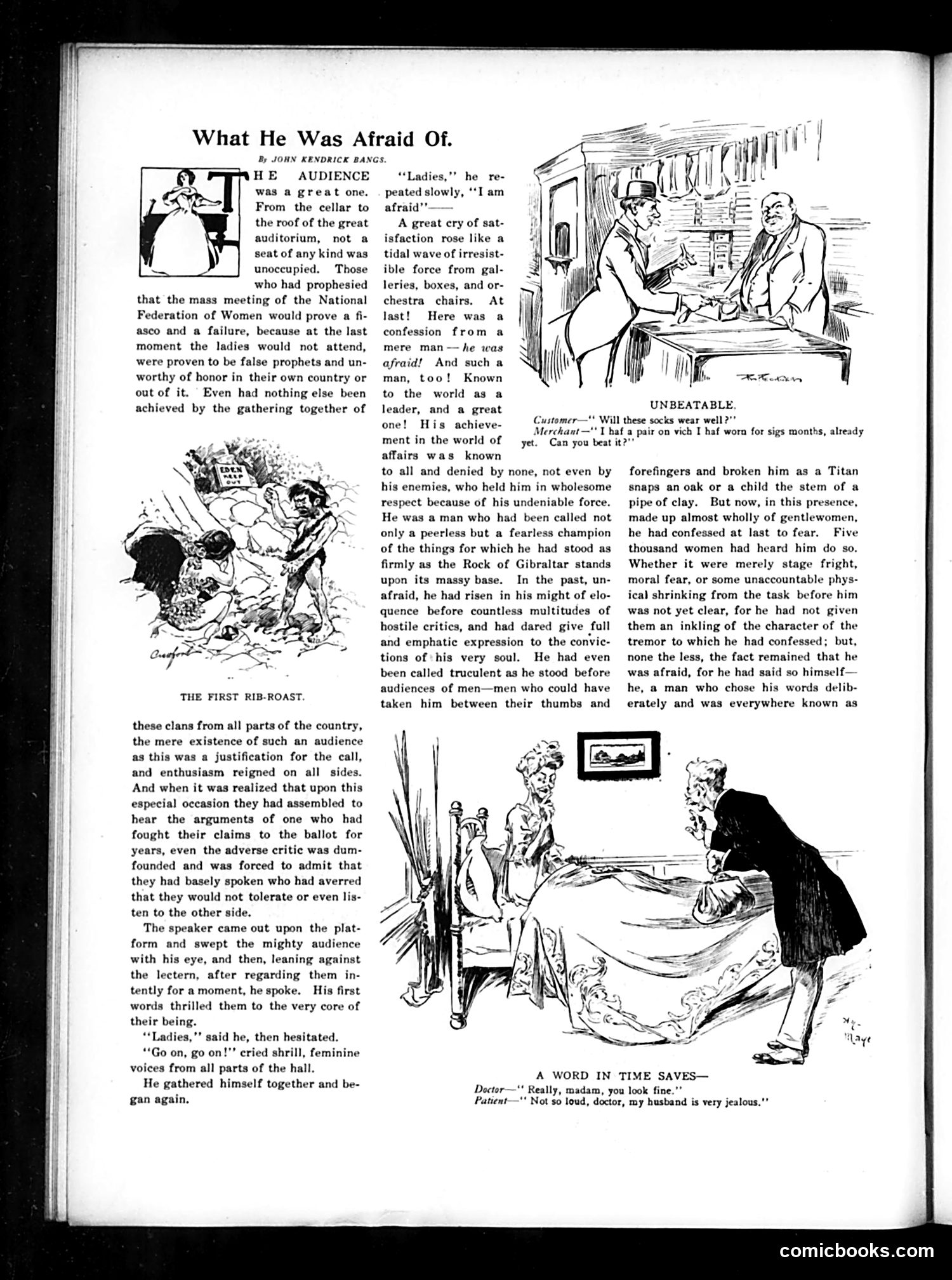
This story by John Kendrick Bangs satirizes the women's suffrage debate. A prominent male speaker—described as a fearless champion who has intimidated hostile male audiences—addresses a massive gathering of the National Federation of Women. When he begins by confessing "I am afraid," the female audience erupts in triumph, interpreting his admission as proof that even great men fear women's power. The satire works on multiple levels: it mocks both anti-suffrage men (who feared women's political participation) and suggests that women's collective presence itself intimidates traditionally confident male leaders. The cartoon's title, "The First Rib-Roast," references the biblical Genesis account where woman was created from man's rib—implying women are now "roasting" or mocking their male counterpart. The secondary cartoons about marital jealousy and merchant disputes provide lighter comic relief on gender dynamics.
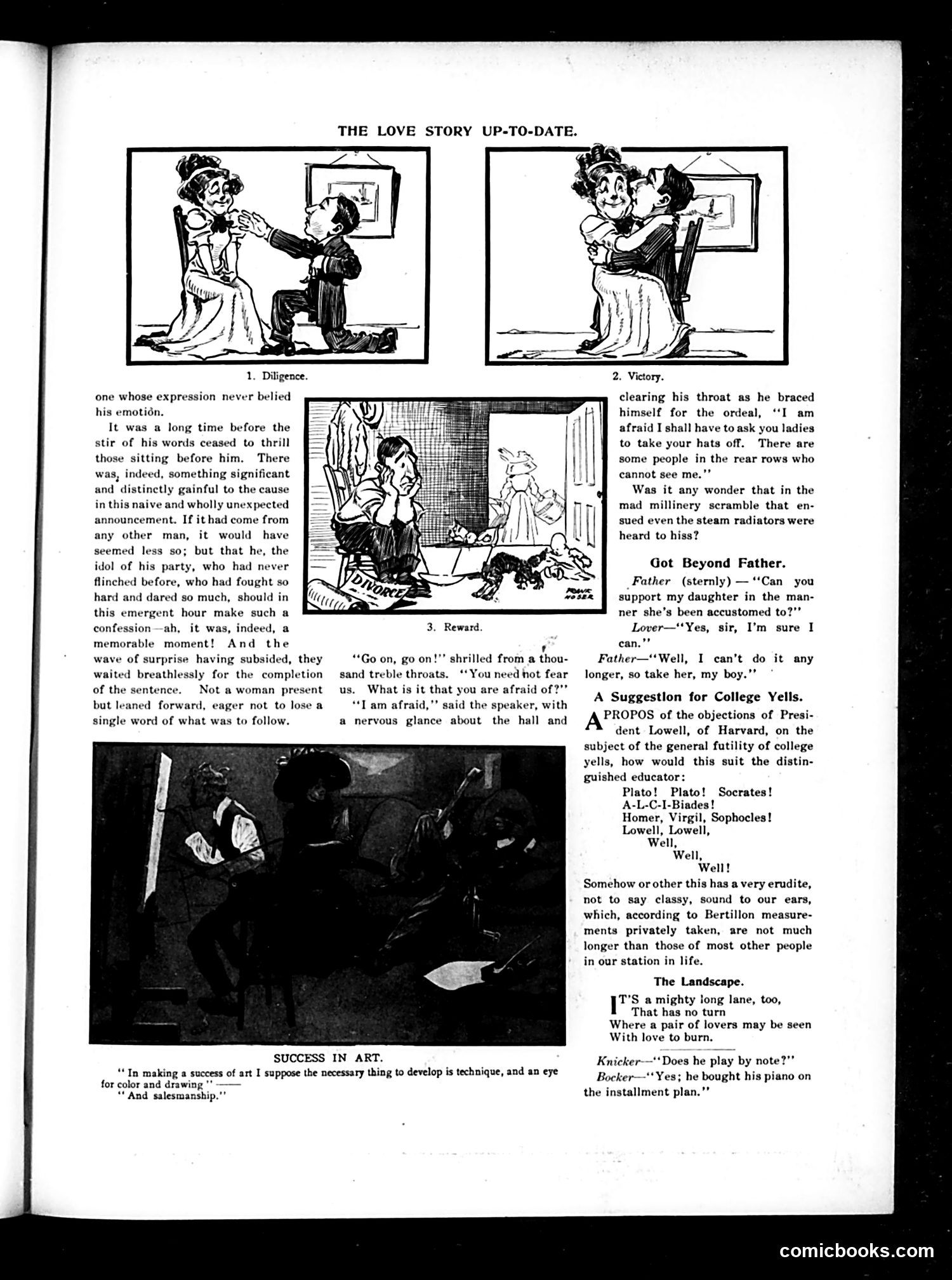
This page presents three satirical cartoon panels mocking romantic courtship customs: **Panel 1 ("Diligence")**: A man kneels before a woman in formal dress, depicting traditional proposal etiquette. **Panel 2 ("Victory")**: The woman lifts the man triumphantly, reversing gender roles in a humorous inversion of expected romantic dynamics. **Panel 3 ("Reward")**: The couple embraces, completing the romantic arc. The accompanying text humorously documents the man's nervous public proposal at a theater, emphasizing social embarrassment and the audience's reaction. Below, "Success in Art" discusses developing artistic technique. The satire targets early-20th-century courtship formality and public spectacle, while the gender-role reversal in Panel 2 jokes about women's increasing social assertiveness during this era. The joke's comedy relies on audiences' familiarity with rigid Victorian romantic conventions.
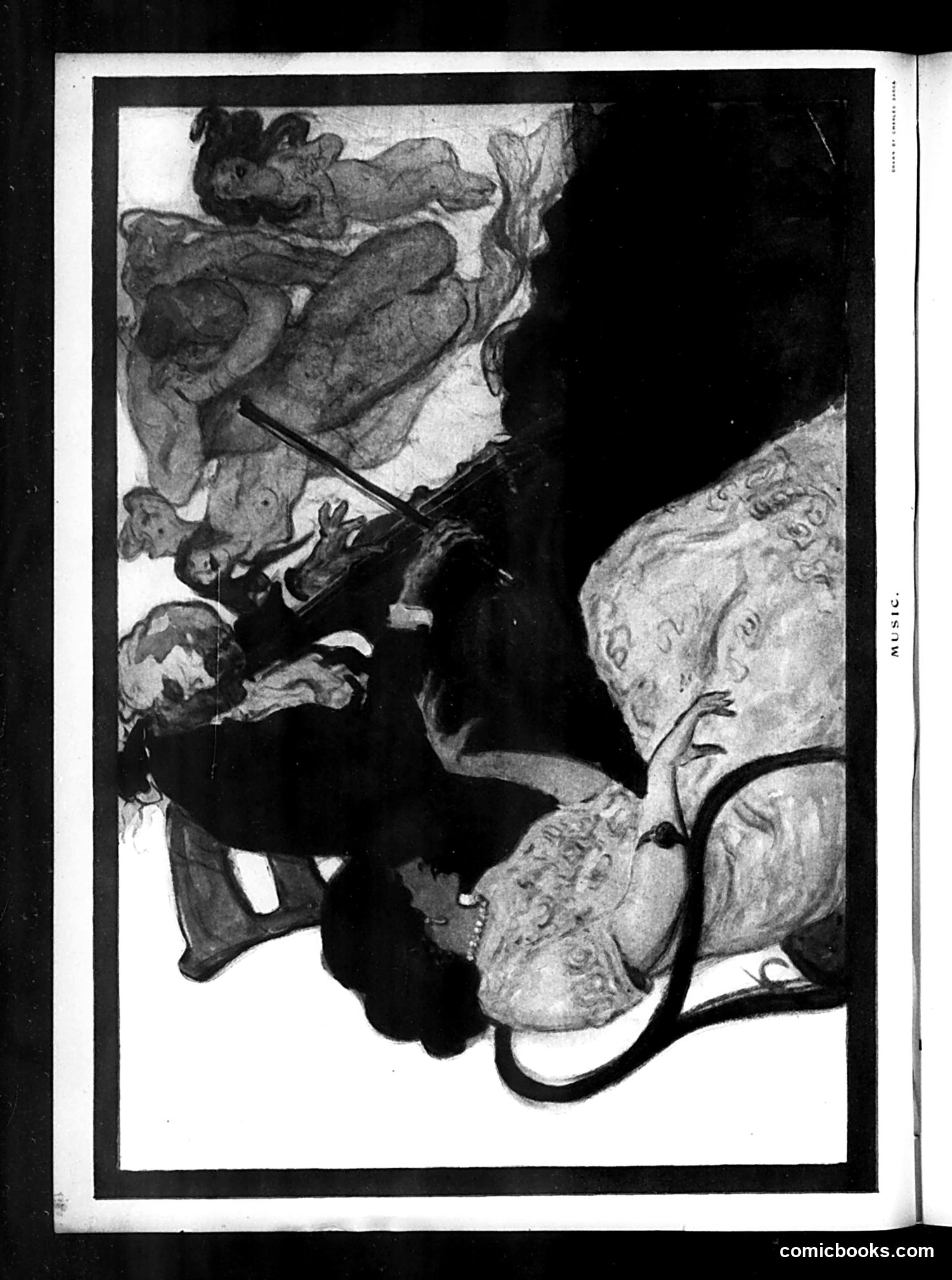
This page appears to be from **Judge magazine**, a satirical publication. The image shows what appears to be a classical or allegorical scene, rotated 90 degrees, depicting multiple figures in period dress with ornate details. One figure holds what looks like a musical instrument or staff. The word "MUSIC" appears on the right margin, suggesting this cartoon comments on music or musicians. However, without clearer visibility of faces, specific captions, or publication date information, I cannot confidently identify which particular figures, musicians, or musical controversies this satirizes. The classical style and allegorical composition suggest commentary on a cultural or artistic topic relevant to Judge's readership, but the specific satirical point remains unclear from the available text and image quality.
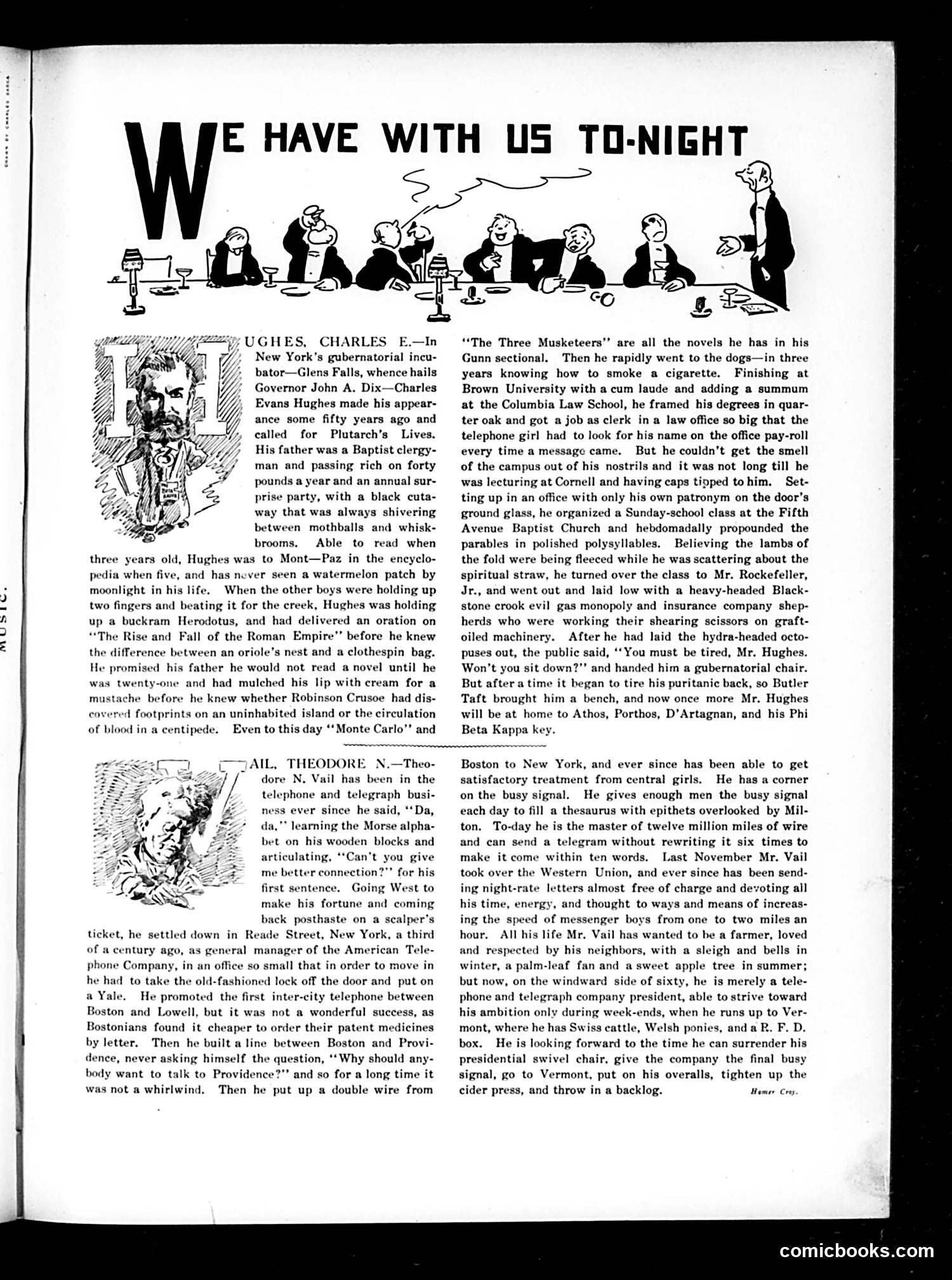
This page features satirical biographical sketches of prominent figures, likely from the early 1900s. The top cartoon shows men in formal dress at what appears to be a dinner or gathering. The text profiles **Charles Evans Hughes** (gubernatorial candidate from Glens Falls, New York) and **Theodore N. Vail** (telephone/telegraph executive). The satire mocks their stuffiness and moral superiority through exaggeration: Hughes is portrayed as an impossibly precocious, bookish prude who never read novels until adulthood; Vail is depicted as an earnest, relentless telephone pioneer whose early ventures nobody wanted. The humor lies in contrasting their rigid, self-righteous personas with subtle hints of hypocrisy—Hughes eventually becomes a politician, Vail's monopolistic practices are obliquely referenced. This is characteristic *Judge* satire: affectionate mockery of America's elite, poking fun at their pretensions while acknowledging their prominence.
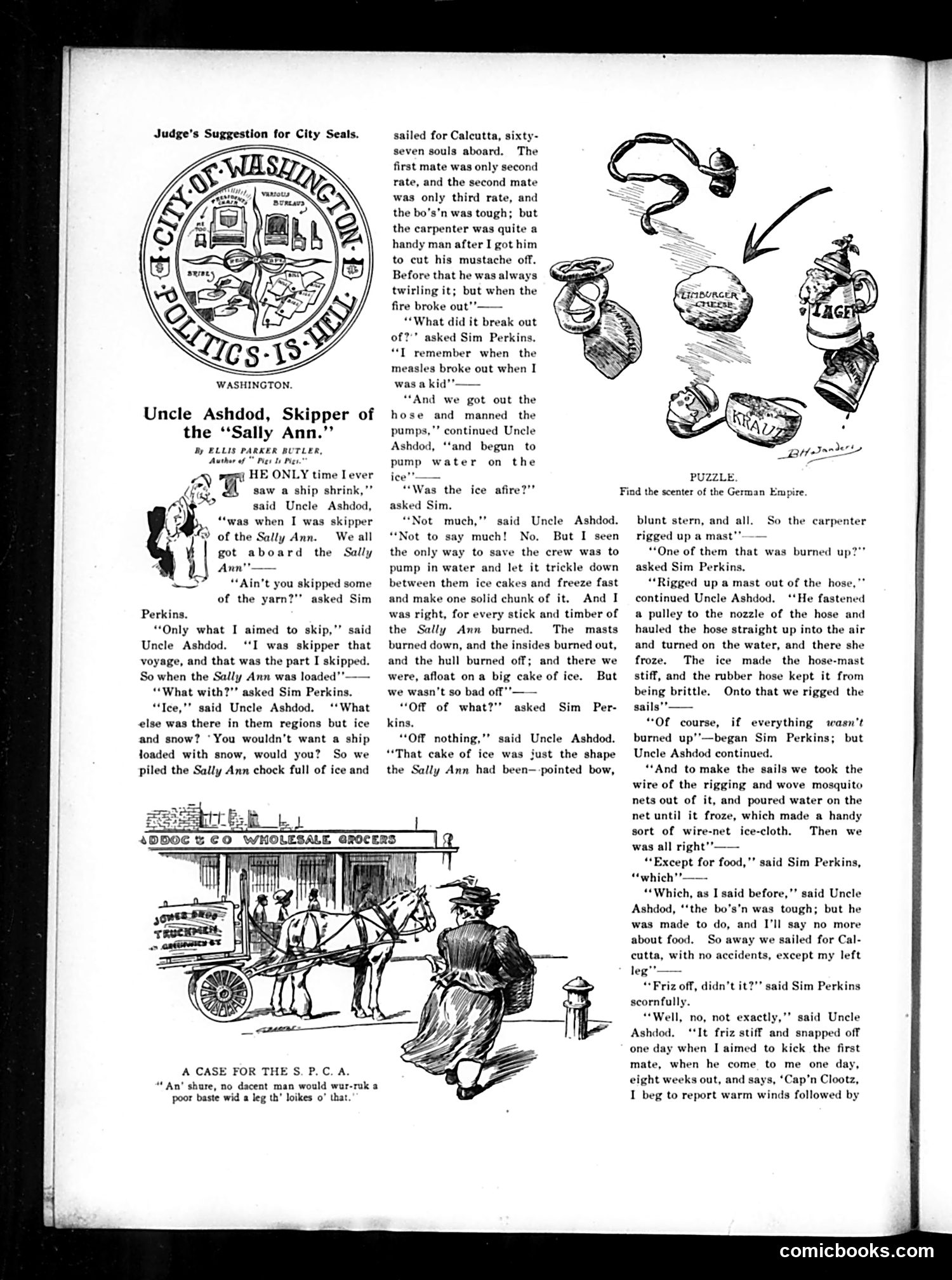
This is a humorous tall tale by Ellis Parker Butler about Uncle Ashdod, a ship captain, recounting an absurd voyage of the *Sally Ann* to a skeptical listener named Sim Perkins. The joke is that Uncle Ashdod tells increasingly implausible stories—a ship that shrinks, loading it with ice instead of snow, a fire that burns everything yet leaves the ship floating on a giant ice cake shaped exactly like the ship, a mast made from a frozen fire hose, sails woven from frozen mosquito netting—and Sim Perkins keeps catching him in logical contradictions, which Uncle Ashdod dismisses with folksy charm. The humor relies on the classic "yarn-spinning" tradition: an old sailor who tells wildly impossible stories with complete confidence, undeterred by obvious holes in the narrative. It's gentle satire of tall-tale telling itself rather than political commentary. The sidebar cartoon about a donkey appears unrelated to the main story.
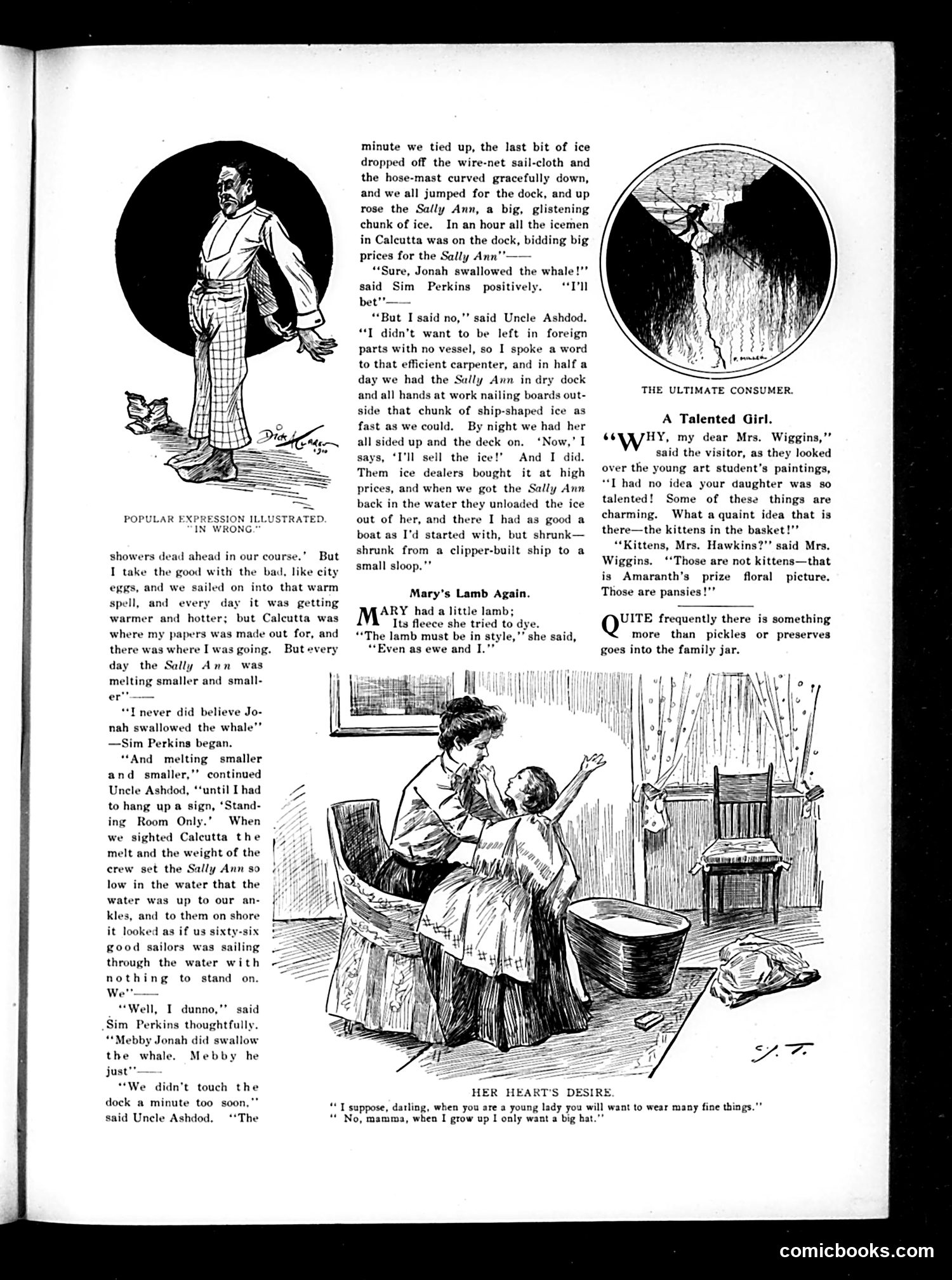
This page contains three distinct pieces of satirical content: **"Popular Expression Illustrated in Wrong"**: A tall sailor figure represents the idiom "swallowing the whale"—meant to mean believing something absurd. Uncle Ashdod's tall tale demonstrates this: his ship *Sally Ann* became so covered in ice during a voyage to Calcutta that it shrank to a tiny sloop after melting. The satire mocks tall tales and gullible listeners who accept obvious fabrications. **"A Talented Girl"**: A visitor praises a young art student's painting of "kittens in a basket," only to learn they're actually a "floral picture" of pansies. The joke satirizes either the student's poor artistic skill or the pretentiousness of calling crude work "talented"—a common criticism of amateur artists and their indulgent parents. **"Her Heart's Desire"**: A brief dialogue satirizing women's materialism. When a mother asks her daughter about wanting fine things as an adult, the girl replies she only wants "a big hat"—implying that fashion/vanity, not substance, motivates women.
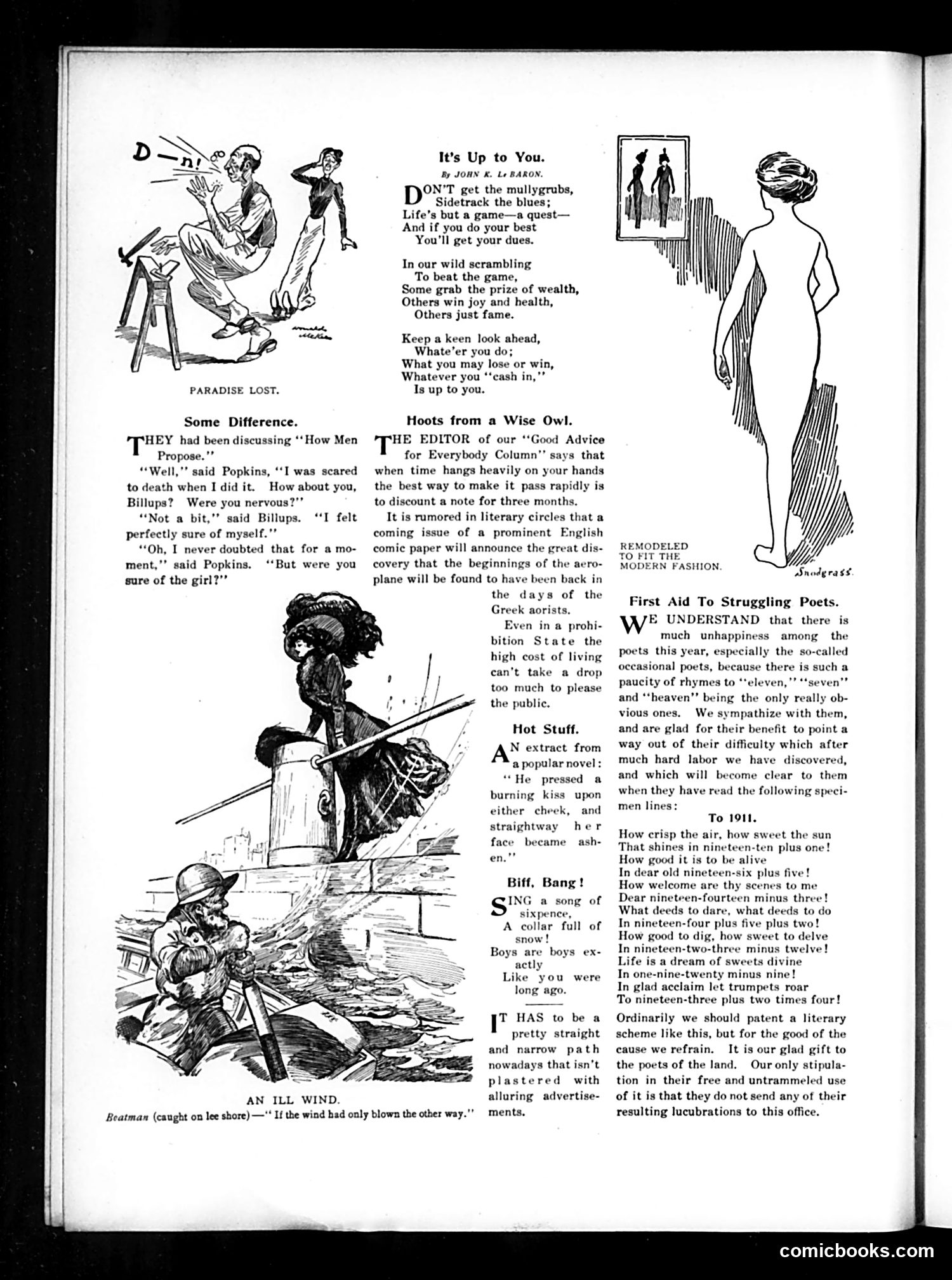
This page from the satirical magazine *Judge* contains several humor pieces targeting turn-of-the-century American life: **"Some Difference"** jokes about male nervousness during marriage proposals—Popkins was terrified proposing, but Billups claims confidence. Popkins's punchline exposes the absurdity: Billups was sure of *himself*, but what about the woman's feelings? The satire mocks male self-absorption in romance. **"An Ill Wind"** shows a boatman regretting circumstances beyond his control—simple wordplay humor. **"Hoots from a Wise Owl"** consists of dry social commentary: mocking people who discount notes to pass time, satirizing literary pretension about airplane history, and critiquing the ubiquity of advertisements. **"First Aid to Struggling Poets"** ridicules poets struggling to rhyme with "eleven" and "heaven." Judge offers deliberately absurd mathematical rhyme-schemes (like "nineteen-four plus five plus two") to mock overwrought verse-making, ending with a tongue-in-cheek refusal to accept submissions using this method. The overall tone is lighthearted social satire of contemporary manners and cultural pretensions.
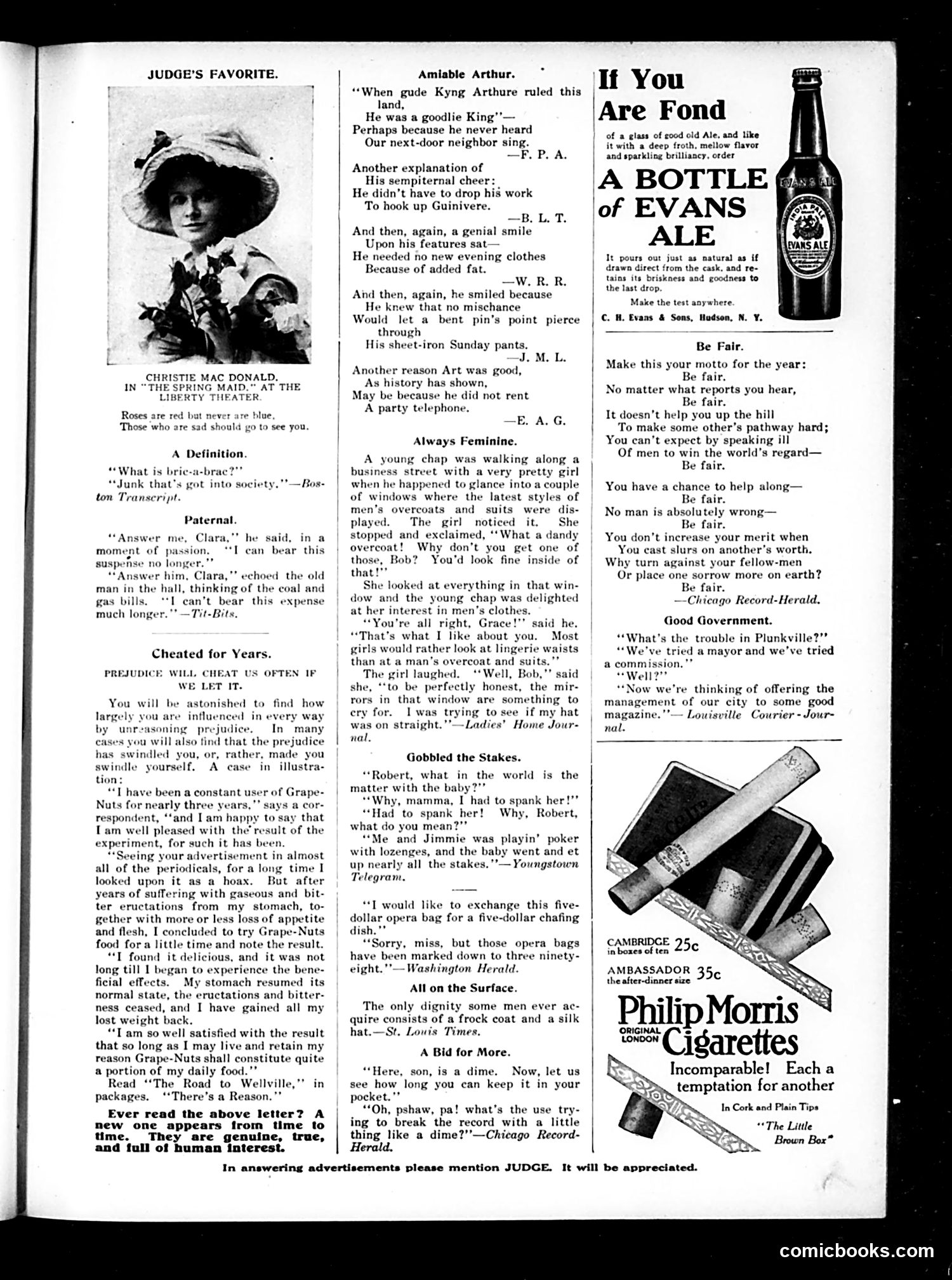
This page from the satirical magazine **Judge** contains mostly **humorous vignettes and advertising** rather than political cartoons. The content includes: **"Judge's Favorite"**: A photo of Christie Mac Donald, a theater actress, with reader-submitted jokes about King Arthur—poking fun at his contentment by suggesting he never heard his neighbor sing, didn't rent a party telephone, and wore sheet-iron pants. **Humor pieces**: Short jokes on everyday topics (definitions, marriage, prejudice) and advertising testimonials for Grape-Nuts cereal claiming health benefits. **Social satire**: "Always Feminine" mocks women's priorities, suggesting a girl cares more about checking her reflection than admiring her boyfriend's clothing. "Gobbled the Stakes" jokes about a baby eating poker chips (lozenges). **Advertisements** dominate the right side: Evans Ale, Philip Morris Cigarettes. The overall tone is light domestic humor targeting middle-class concerns—modern inconveniences (party phones), consumer goods, and gender stereotypes. No significant political content is evident.
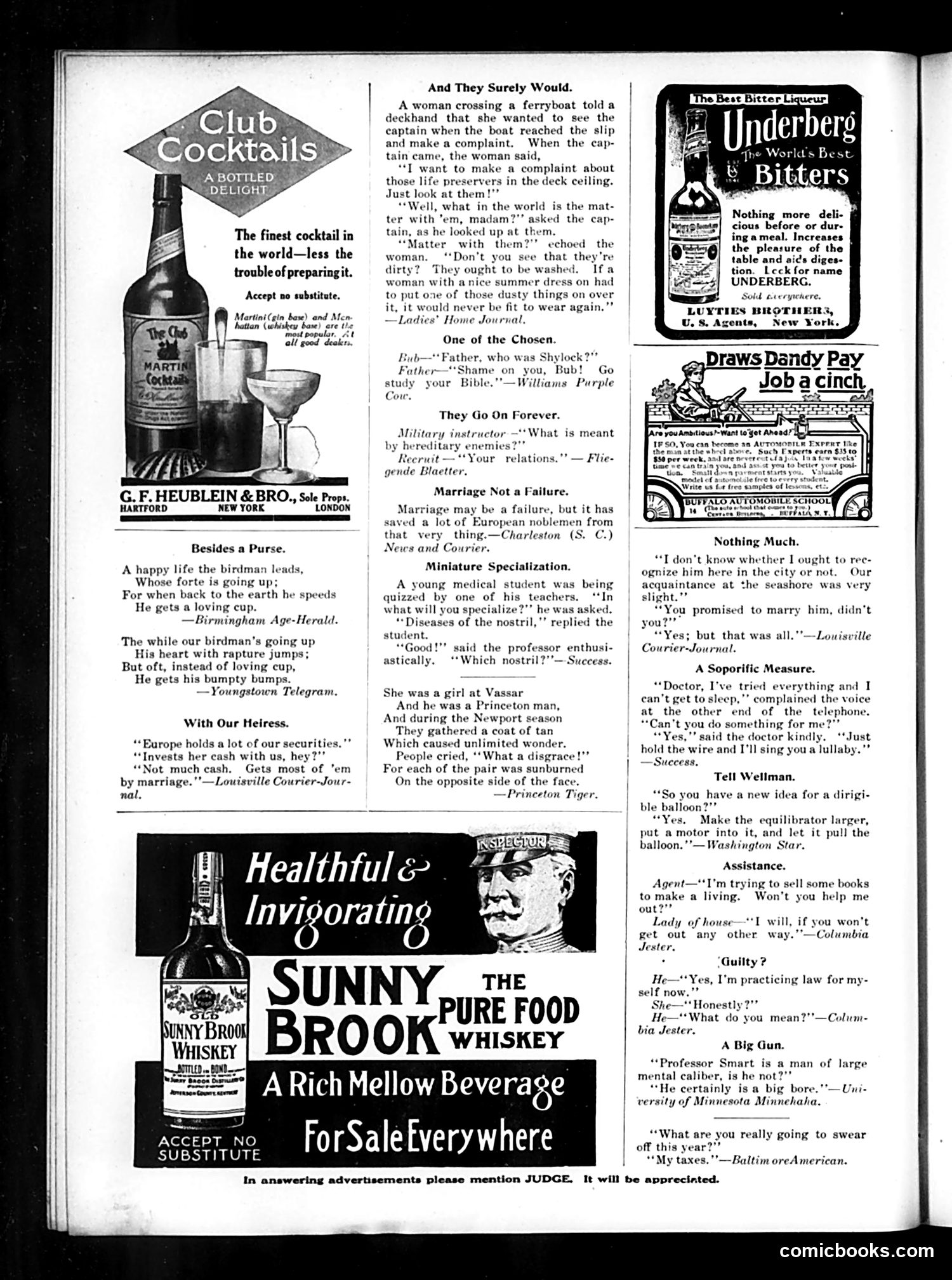
This page comprises primarily **short humorous anecdotes and advertisements** rather than political cartoons. The content reflects early 20th-century American humor. **Notable content:** The jokes target contemporary social situations: a woman complaining about dirty life preservers (prioritizing fashion over safety), a student specializing absurdly in "diseases of one nostril," and mismatched sunburns from a Newport season romance. **"With Our Heiress"** references the period's anxiety about wealthy American heiresses marrying European nobility—a genuine social phenomenon where cash-poor European aristocrats sought American fortunes through matrimonial alliances. **"They Go On Forever"** jokes about hereditary enemies (military context suggests European rivalries), likely alluding to ongoing tensions between European powers before WWI. The advertisements dominate, hawking **Club Cocktails, Underberg bitters, and Sunny Brook whiskey**—products marketed with health claims typical of the pre-Prohibition era when alcohol was openly promoted as medicinal and invigorating. The page reflects a pre-WWI American magazine culture mixing light satire with commercial interests.
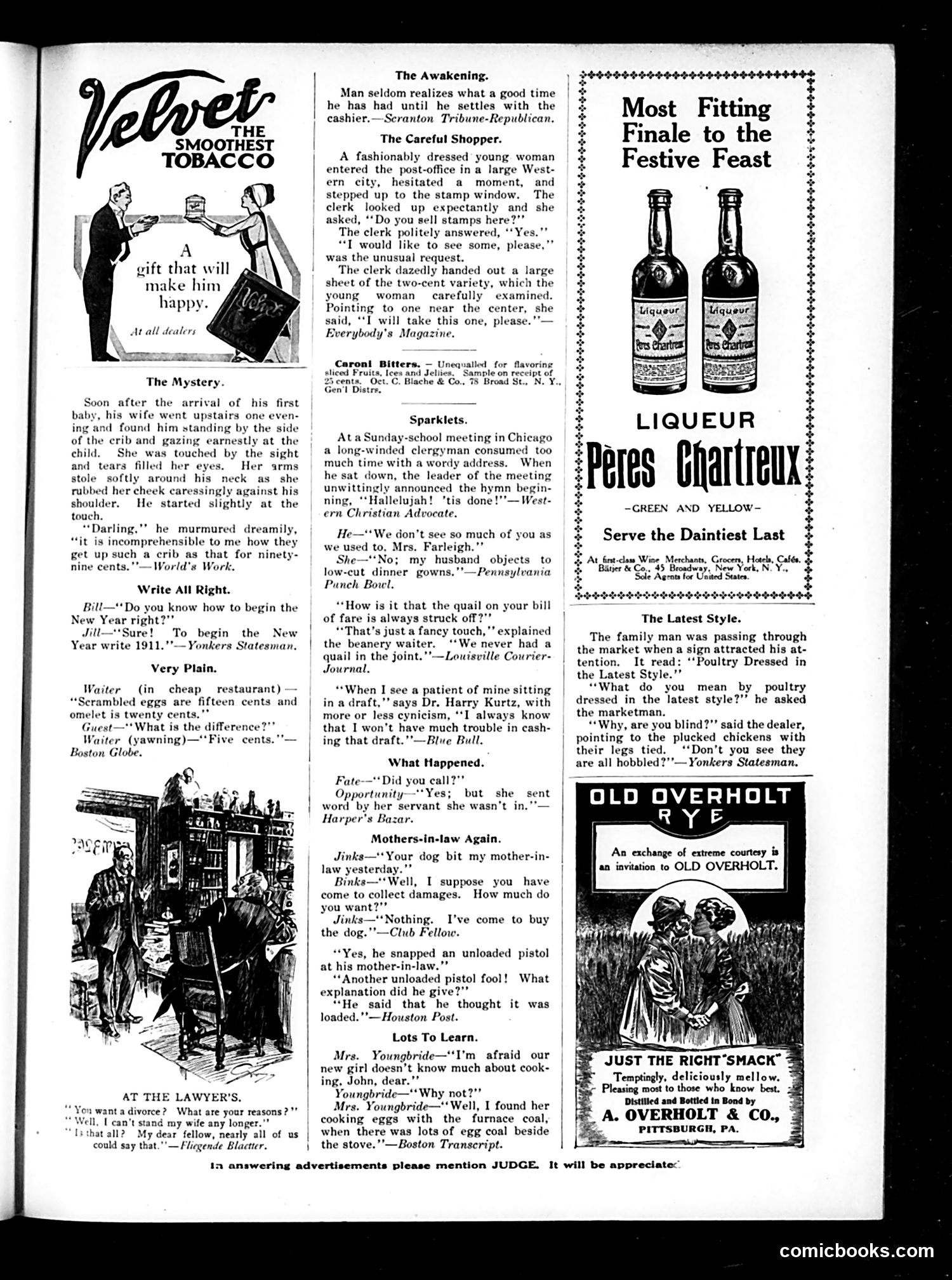
This page from *Judge* magazine comprises mostly **humorous short anecdotes and advertisements** rather than political cartoons. The content reflects early 1910s American humor—domestic comedy and mild social satire. **Key humor pieces:** - "The Mystery": A new father obsesses over the low cost (99 cents) of a baby crib rather than the baby itself—satirizing American consumerism and distracted husbands. - "The Careful Shopper": A woman asks to *see* postage stamps before buying one, implying female vanity or impracticality in shopping. - "Mothers-in-law Again": Running joke about mother-in-law mishaps (a dog biting one; someone shooting at one with an unloaded pistol), reflecting contemporary hostility toward the relationship. - "The Awakening": A man only appreciates good times when paying the bill—satirizing obliviousness. The cartoons depict domestic scenes (men at lawyers' offices, at home) illustrating these relatable scenarios. The advertisements (Velvet Tobacco, Peres Chartreaux liqueur, Old Overholt Rye) occupy significant space, typical for the era's magazines.
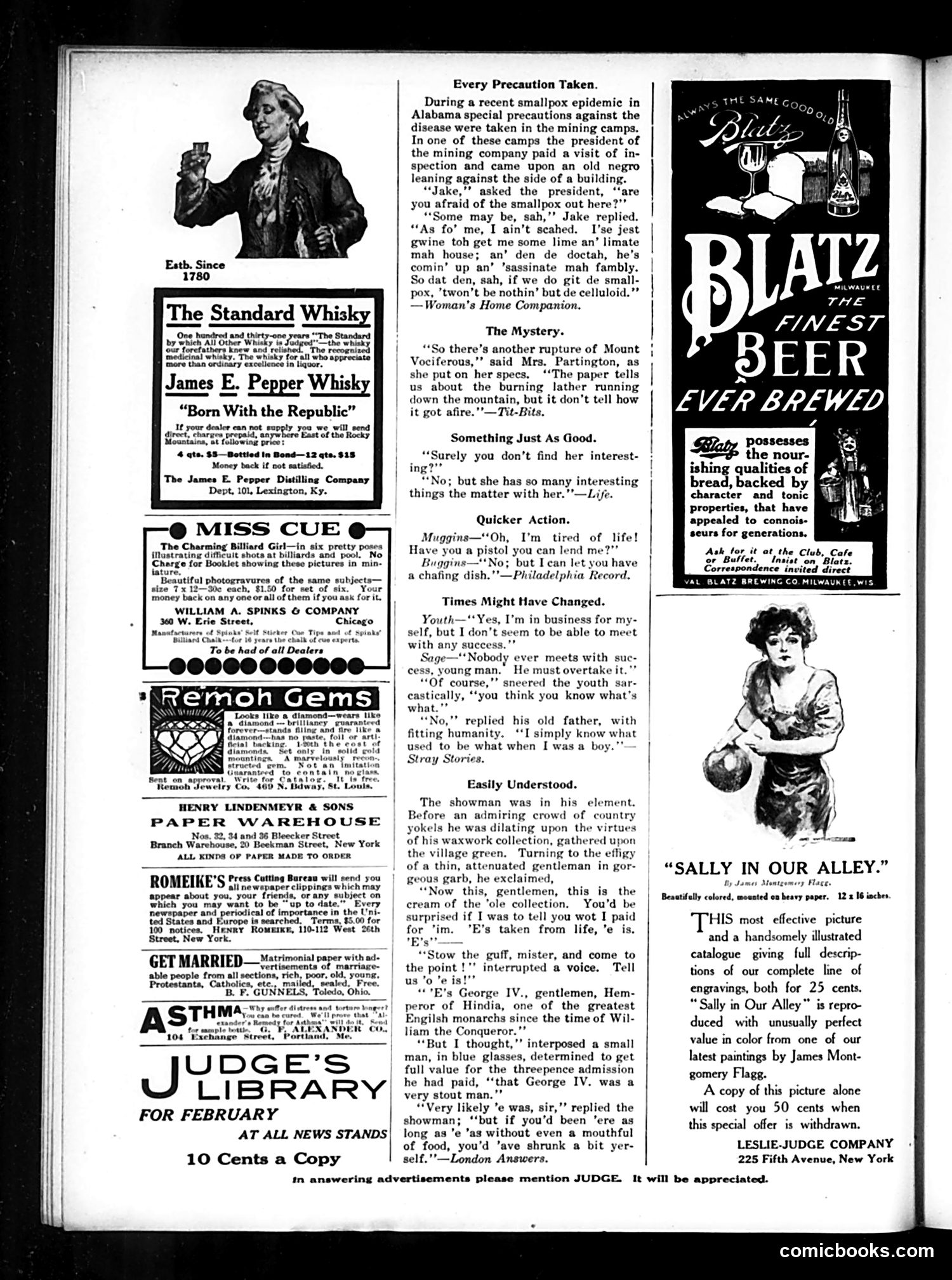
This page is primarily **advertising with humor content**, not political satire. The page contains: **Main Content:** - Short humorous anecdotes/jokes scattered throughout - The most prominent item: "Every Precaution Taken," a dialect humor piece depicting an African American man's malapropistic take on smallpox prevention (using "lime" and "limate" phonetically, misunderstanding medical terminology as "assassinate") - Other brief jokes about romance, business advice, and a waxwork museum showman **Historical Context:** This reflects early 20th-century *Judge* magazine's reliance on racial stereotype humor, particularly "plantation dialect" comedy featuring African American characters speaking in exaggerated vernacular. This was mainstream entertainment at the time, though deeply offensive by modern standards. **The Satire:** There's minimal political satire here. The humor derives from misunderstandings and character types rather than social commentary. The "aged wisdom vs. youth" joke represents gentle generational humor common to the era. The page is overwhelmingly devoted to **product advertisements** (whisky, jewelry, paper warehouse services, matrimonial services).
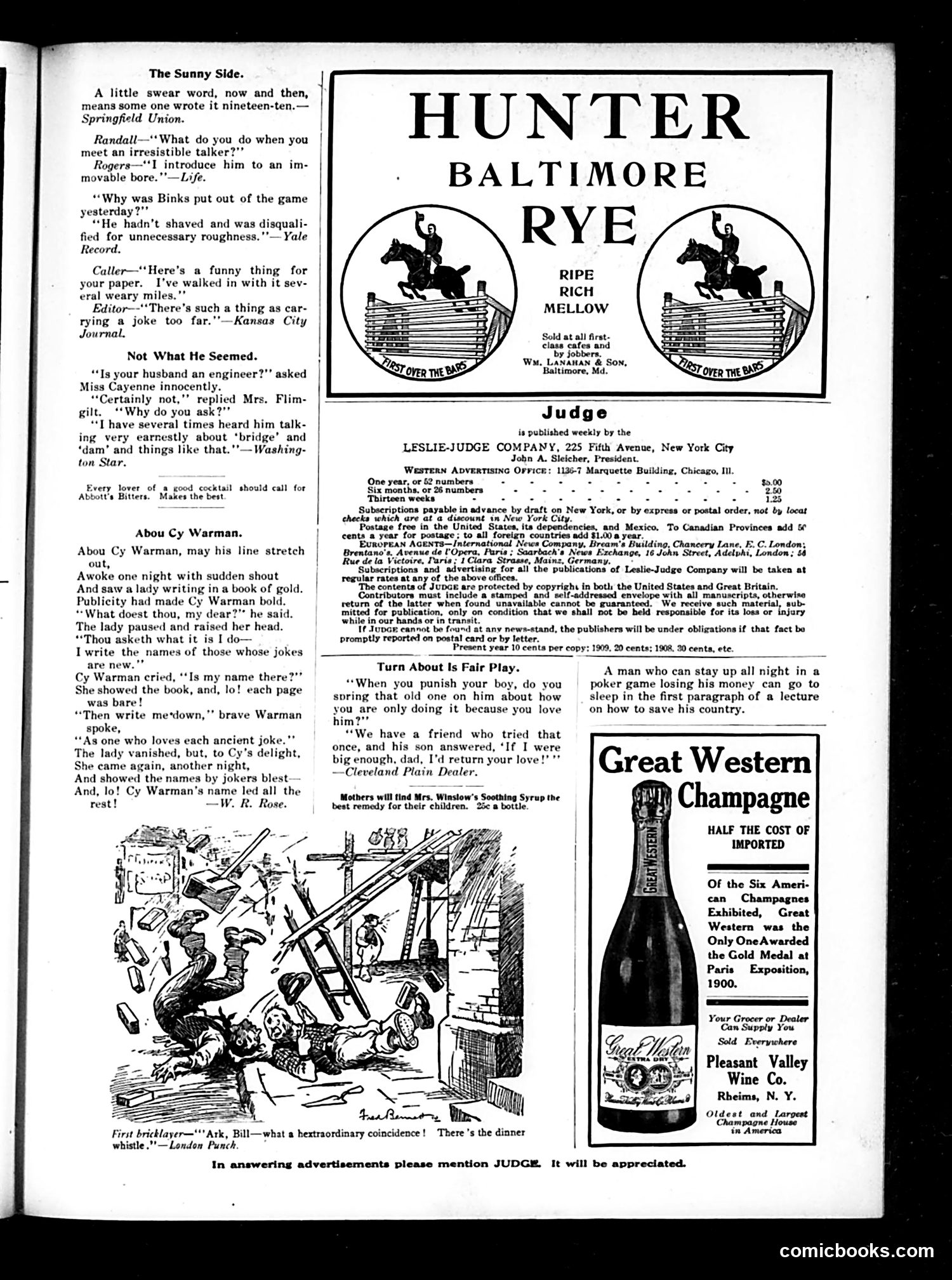
This page contains **short satirical jokes and advertisements** rather than political cartoons. **Key content:** The "Abou Cy Warman" poem parodies classic literature (echoing "Abou Ben Adhem") to mock Cy Warman, apparently a journalist or humorist known for recycling old jokes rather than creating original material. The lady's book shows his name leads the list—but of those who love *ancient* jokes, not new ones. It's gentle professional ridicule about plagiarism or unoriginality in journalism. The other jokes mock domestic life, conversation tactics, and baseball—typical early-1900s humor fodder. **Advertisements:** - Hunter Baltimore Rye whiskey - Great Western Champagne (claiming cost advantage over imported brands) The page reflects *Judge* magazine's mix of satirical commentary on contemporary figures and products, targeting educated, affluent readers familiar with literary references and urban social commentary.
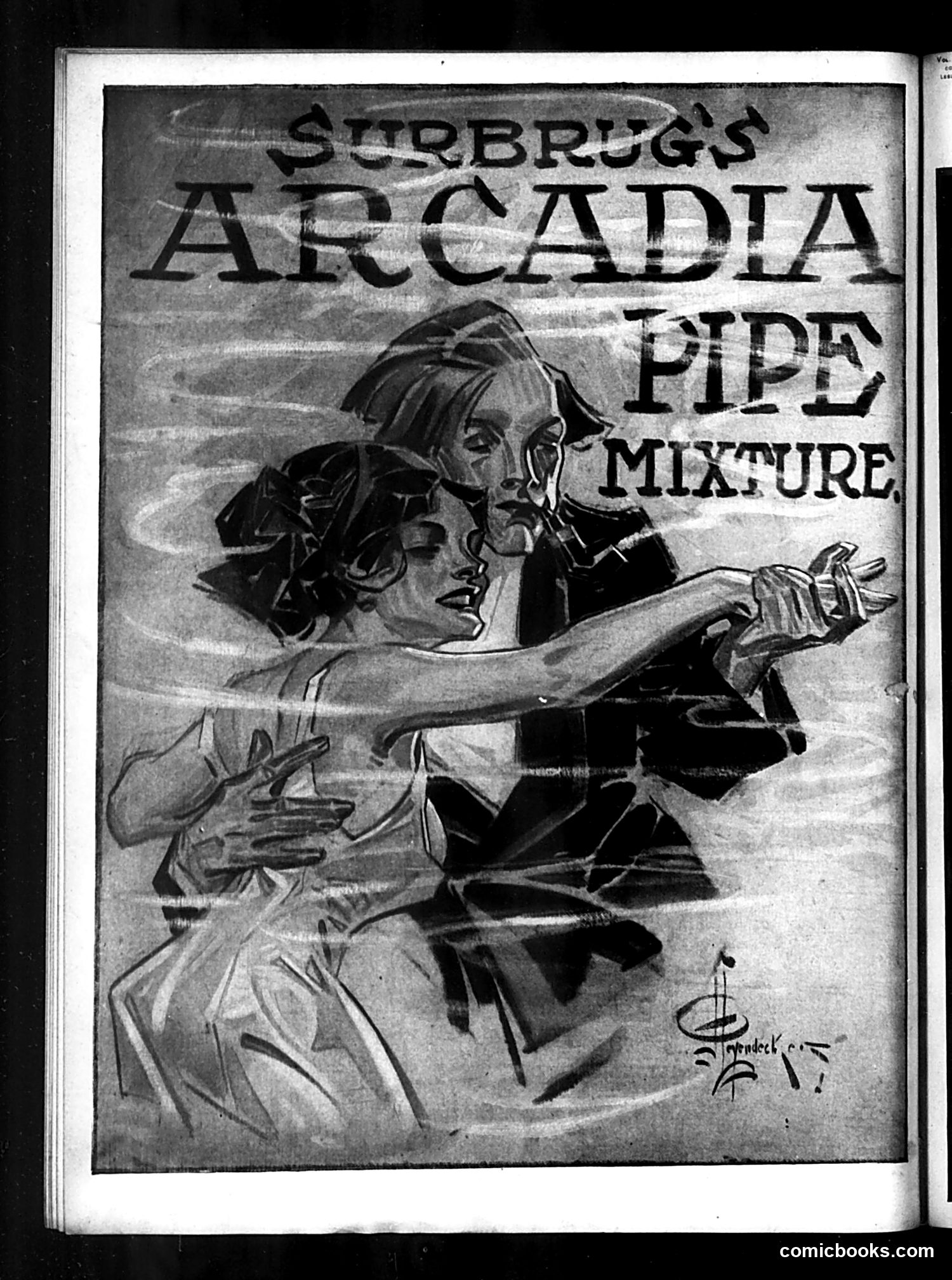
This appears to be a **tobacco product advertisement** rather than political satire. The header reads "SURBRUGG'S ARCADIA PIPE MIXTURE," promoting a brand of smoking tobacco. The illustration depicts two figures in an idyllic, romantic setting—likely referencing "Arcadia," the classical pastoral ideal of simple, peaceful countryside life. The artistic style and composition suggest leisurely contentment associated with pipe smoking. The signature appears to read "Spendeck" or similar. **For modern readers:** This is essentially vintage advertising that equated pipe smoking with refined leisure and romantic ideals. The classical "Arcadia" reference positioned the product as sophisticated and cultured—a common marketing tactic in early 20th-century tobacco advertising before health warnings became standard.