
Judge, 1911-01-28 · page 15 of 24
Judge — January 28, 1911 — page 15: what you’re looking at
What you’re looking at
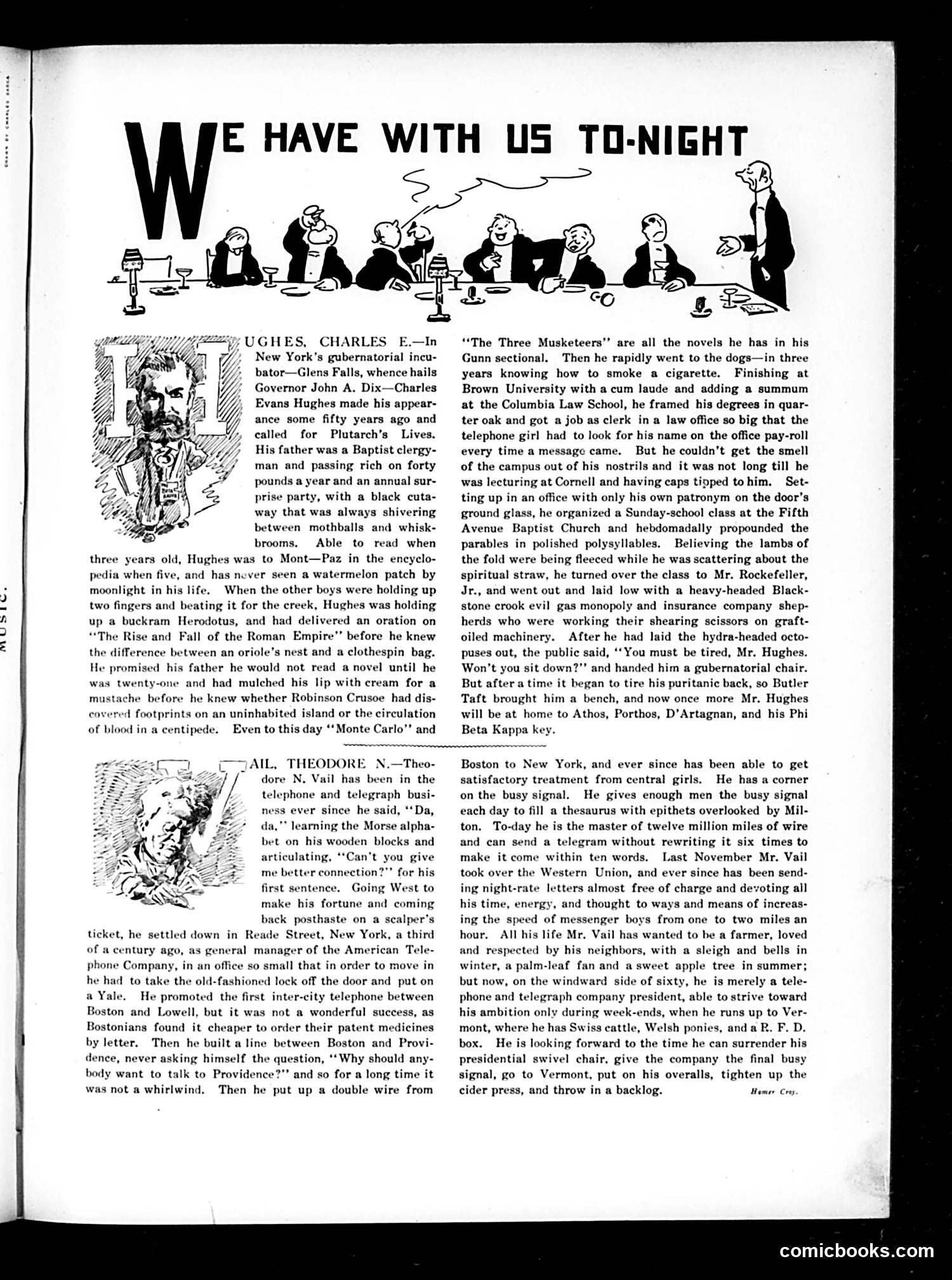
This page features satirical biographical sketches of prominent figures, likely from the early 1900s. The top cartoon shows men in formal dress at what appears to be a dinner or gathering. The text profiles **Charles Evans Hughes** (gubernatorial candidate from Glens Falls, New York) and **Theodore N. Vail** (telephone/telegraph executive). The satire mocks their stuffiness and moral superiority through exaggeration: Hughes is portrayed as an impossibly precocious, bookish prude who never read novels until adulthood; Vail is depicted as an earnest, relentless telephone pioneer whose early ventures nobody wanted. The humor lies in contrasting their rigid, self-righteous personas with subtle hints of hypocrisy—Hughes eventually becomes a politician, Vail's monopolistic practices are obliquely referenced. This is characteristic *Judge* satire: affectionate mockery of America's elite, poking fun at their pretensions while acknowledging their prominence.
📄 Transcribed text from this page (OCR, searchable)
Machine-transcribed from the original scan — historical spelling and the odd misread are preserved.
E HAVE WITH US TO-NIGHT S New York's gubernatorial incu- bator—Glens Falls, whence hails Governor John A. Dix—Charles Evans Hughes made his appear- ance some fifty years ago and called for Plutarch’s Lives. His father was a Baptist clergy- man and passing rich on forty pounds a year and an annual sur- prise party, with a black cuta- way that was always shivering between mothballs and whisk- brooms. Able to read when three years old, Hughes was to Mont—Paz in the encyclo- pedia when five, and has never seen a watermelon patch by moonlight in his life. When the other boys were holding up two fingers and beating it for the creek, Hughes was holding up a buckram Herodotus, and had delivered an oration on “The Rise and Fall of the Roman Empire’’ before he knew the difference between an oriole’s nest and a clothespin bag. He promised his father he would not read a novel until he was twenty-one and had mulched his lip with cream for a mustache before he knew whether Robinson Crusoe had dis- covered footprints on an uninhabited island or the circulation Even to this day ‘‘Monte Carlo’’ and Ress SSN of blood in a centipede. (JAIL, THEODORE N.—Theo- dore N, Vail has been in the telephone and telegraph busi- n ever since he said, ‘‘Da, * learning the Morse alpha- bet on his wooden blocks and articulating, ** iv me better connection?” for his first sentence. Going West to make his fortune and coming back posthaste on a sealper’s ticket, he settled down in Reade Street, New York, a third of a century ago, as general manager of the American Tele- phone Company, in an office so small that in order to move in he to take the old-fashioned lock off the door and put on a Ya He promoted the first inter-city telephone between Boston and Lowell, but it was not a wonderful success, as Bostonians found it cheaper to order their patent medicines by letter, Then he built a line between Boston and Provi- dence, never asking himself the question, ‘Why should any- body want to talk to Providence?" and so for a long time it was not a whirlwind. Then he put up a double wire from BES “The Three Musketeers’’ are all the novels he has in his Gunn sectional. Then he rapidly went to the dogs—in three years knowing how to smoke a cigarette. Finishing at Brown University with a cum laude and adding a summum at the Columbia Law School, he framed his degrees in quar- ter oak and got a job as clerk in a law office so big that the telephone girl had to look for his name on the office pay-roll every time a message came. But he couldn't get the smell of the campus out of his nostrils and it was not long till he was lecturing at Cornell and having caps tipped tohim. Set- ting up in an office with only his own patronym on the door’s ground glass, he organized a Sunday-school class at the Fifth Avenue Baptist Church and hebdomadally propounded the parables in polished polysyllables. Believing the lambs of the fold were being fleeced while he was scattering about the spiritual straw, he turned over the class to Mr. Rockefeller, Jr., and went out and laid low with a heavy-headed Black- stone crook evil gas monopoly and insurance company shep- herds who were working their shearing scissors on graft- oiled machinery. After he had laid the hydra-headed octo- puses out, the public said, ‘‘You must be tired, Mr. Hughes. Won't you sit down?” and handed him a gubernatorial chair. But after a time it began to tire his puritanic back, so Butler Taft brought him a bench, and now once more Mr. Hughes will be at home to Athos, Porthos, D’Artagnan, and his Phi Beta Kappa key. Boston to New York, and ever since has been able to get satisfactory treatment from central girls. He has a corner on the busy signal. He gives enough men the busy signal each day to fill a thesaurus with epithets overlooked by Mil- ton. To-day he is the master of twelve million miles of wire and can send a telegram without rewriting it six times to make it come within ten words. Last November Mr. Vail took over the Western Union, and ever since has been send- ing night-rate letters almost free of charge and devoting all his time, energy, and thought to ways and means of increas- ing the speed of messenger boys from one to two miles an hour. All his life Mr. Vail has wanted to be a farmer, loved and respected by his neighbors, with a sleigh and bells in winter, a palm-leaf fan and a sweet apple tree in summer; but now, on the windward side of sixty, he is merely a tele- phone and telegraph company president, able to strive toward his ambition only during week-ends, when he runs up to Ver- mont, where he has Swiss cattle, Welsh ponies, anda R. F. D. box. Hi looking forward to the time he can surrender his presidential swivel chair, give the company the final busy signal, go to Vermont, put on his overalls, tighten up the cider press, and throw in a backlog. Homer Cry comicbooks.com