
A complete issue · 24 pages · 1911
Judge — January 14, 1911
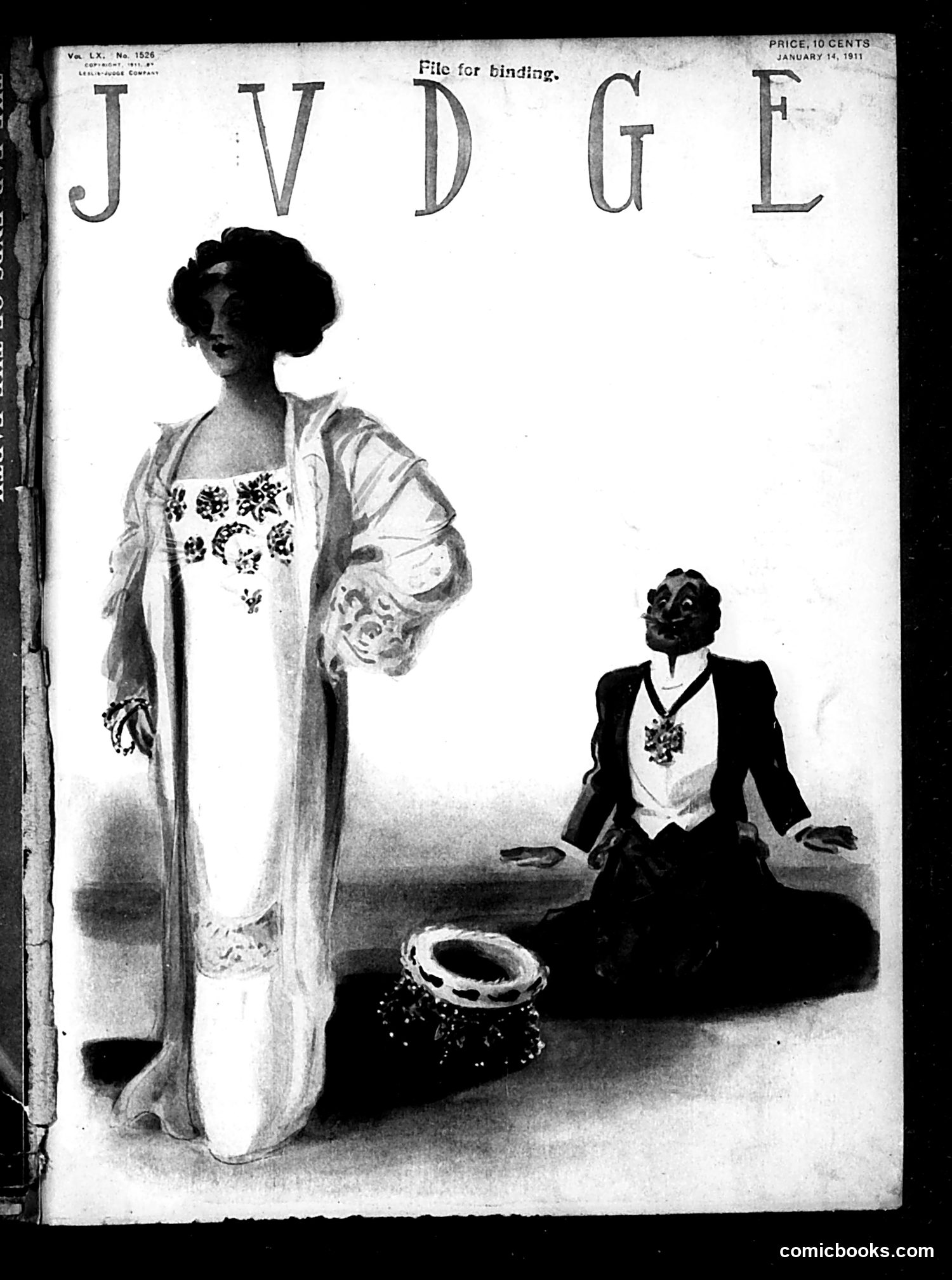
This *Judge* magazine cover from January 14, 1911 depicts two women examining jewelry or ornaments. The standing figure wears an elaborate, flowing white gown with decorative embroidery; the seated figure wears a dark formal dress with a jeweled brooch. The exact satirical target remains unclear without additional context. The title "JVDGE" and note "File for binding" suggest this is a cover page. The composition—one woman displaying finery while another observes—may satirize social climbing, fashion competition, or wealth display among wealthy women of the Edwardian era. However, without identifying the specific figures or accompanying article text, the precise joke or social commentary cannot be definitively determined. The image appears to mock women's preoccupation with luxury goods or social status.
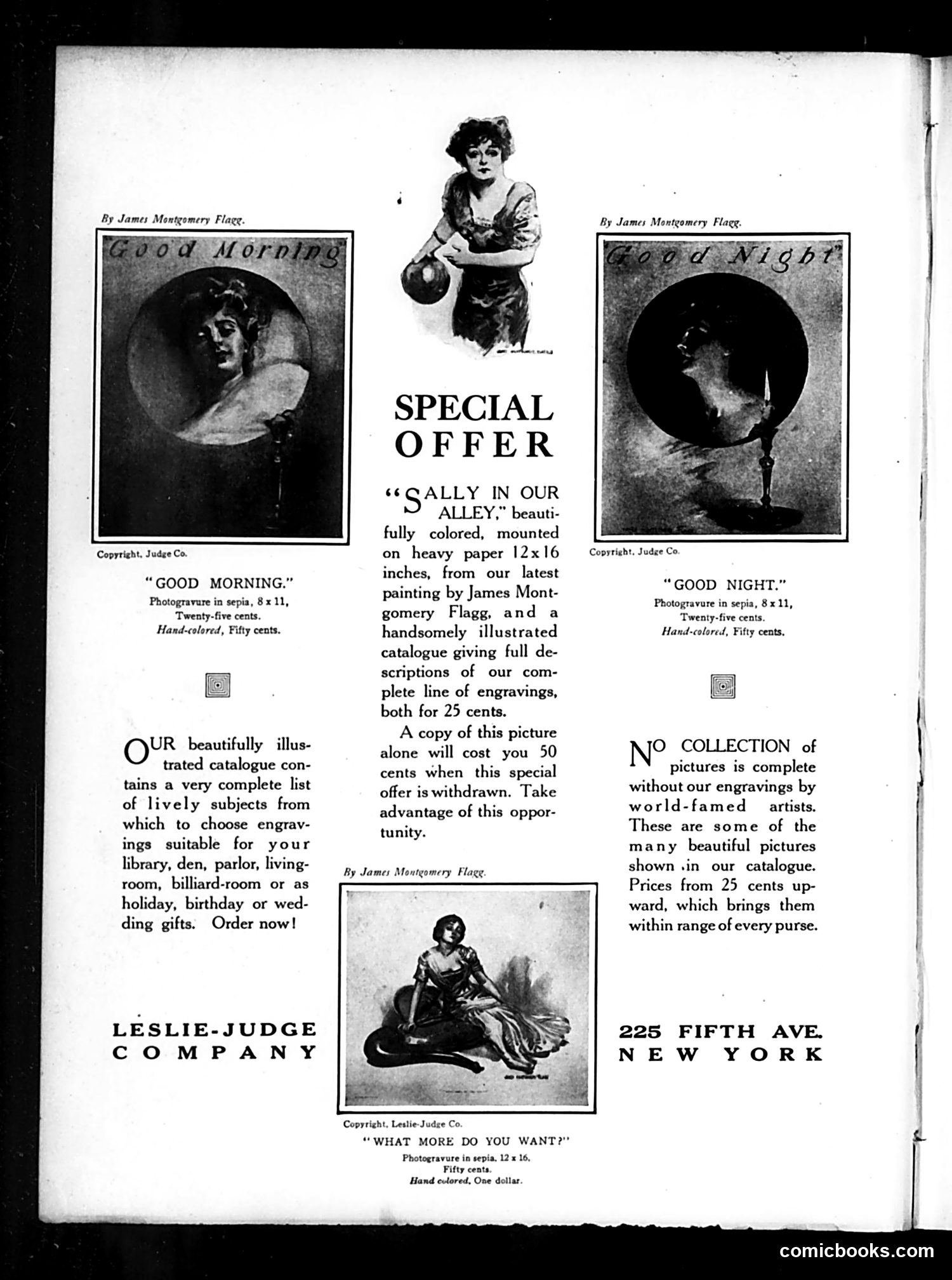
This page is **primarily an advertisement**, not political satire. The Leslie-Judge Company uses Judge magazine's platform to market engravings and photogravures by artist James Montgomery Flagg. The content features three female figures presented as decorative art subjects: "Good Morning," "Good Night," and "What More Do You Want?" These appear to be romantic or sentimental images typical of early 20th-century popular art—the kind marketed for home decoration. The "special offer" promotes a colored reproduction of "Sally in Our Alley" alongside a catalog of engravings, priced affordably (25-50 cents) to reach middle-class buyers furnishing homes. No political commentary is evident; this is straightforward commercial promotion leveraging Judge's readership for art sales.
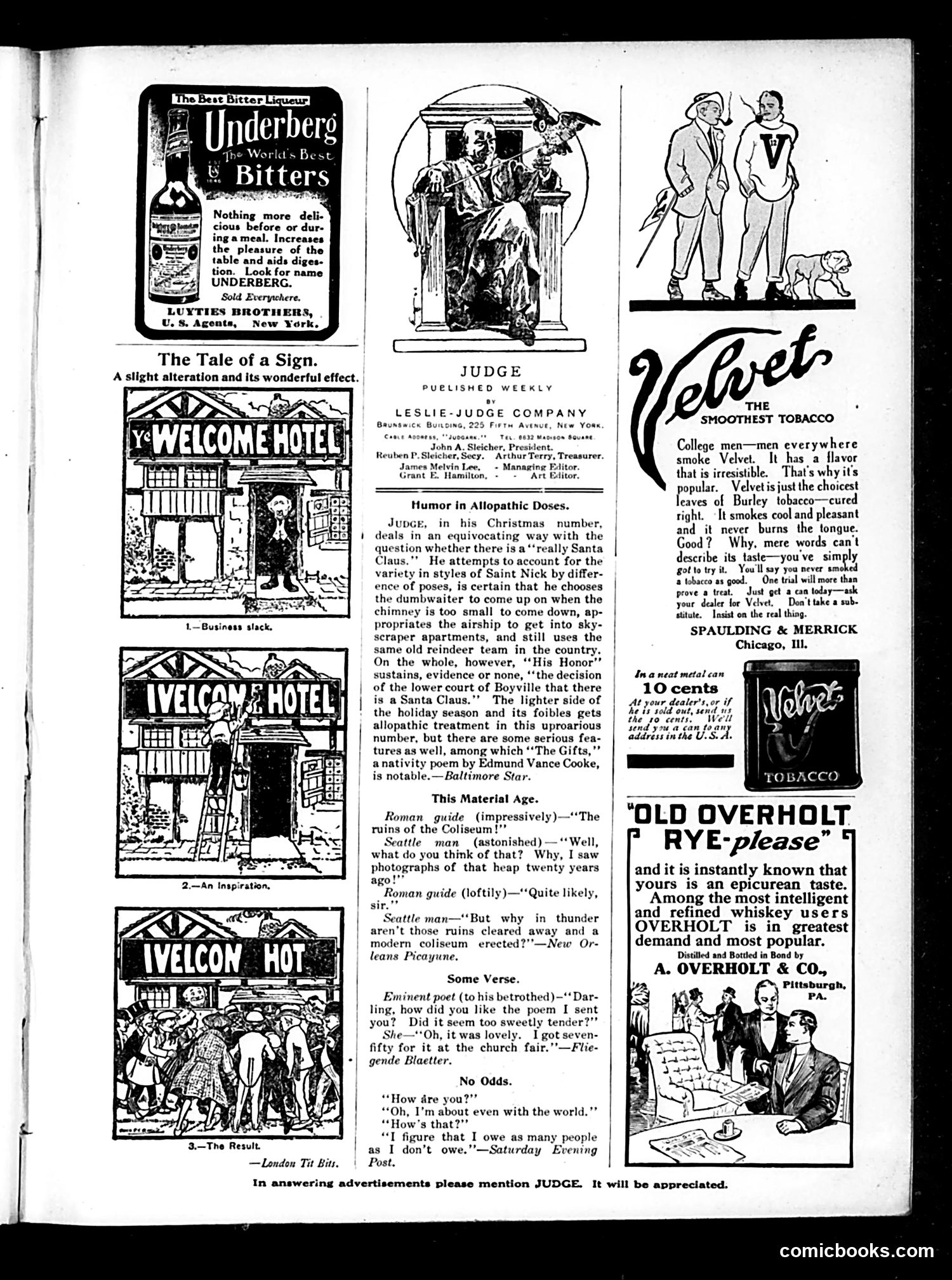
This page is primarily **advertisements and humor content** rather than political satire. The main elements include: **Advertisements:** Underberg Bitters, Velvet tobacco, Nohes tobacco, and Overholt Rye whiskey dominate the page—typical of early 20th-century Judge magazine monetization. **"The Tale of a Sign":** A three-panel cartoon about the Welcome Hotel, depicting a sign's transformation. The humor appears to center on how the sign deteriorates or changes appearance over time, with panels labeled "Business slack," "An inspiration," and "The result." **Humor Columns:** "Humor in Allopathic Doses," "This Material Age," "Some Verse," and "No Odds" contain light jokes and witticisms typical of the era—no specific political references are evident. The page reflects Judge's primary function: entertainment and advertising for an educated male audience.
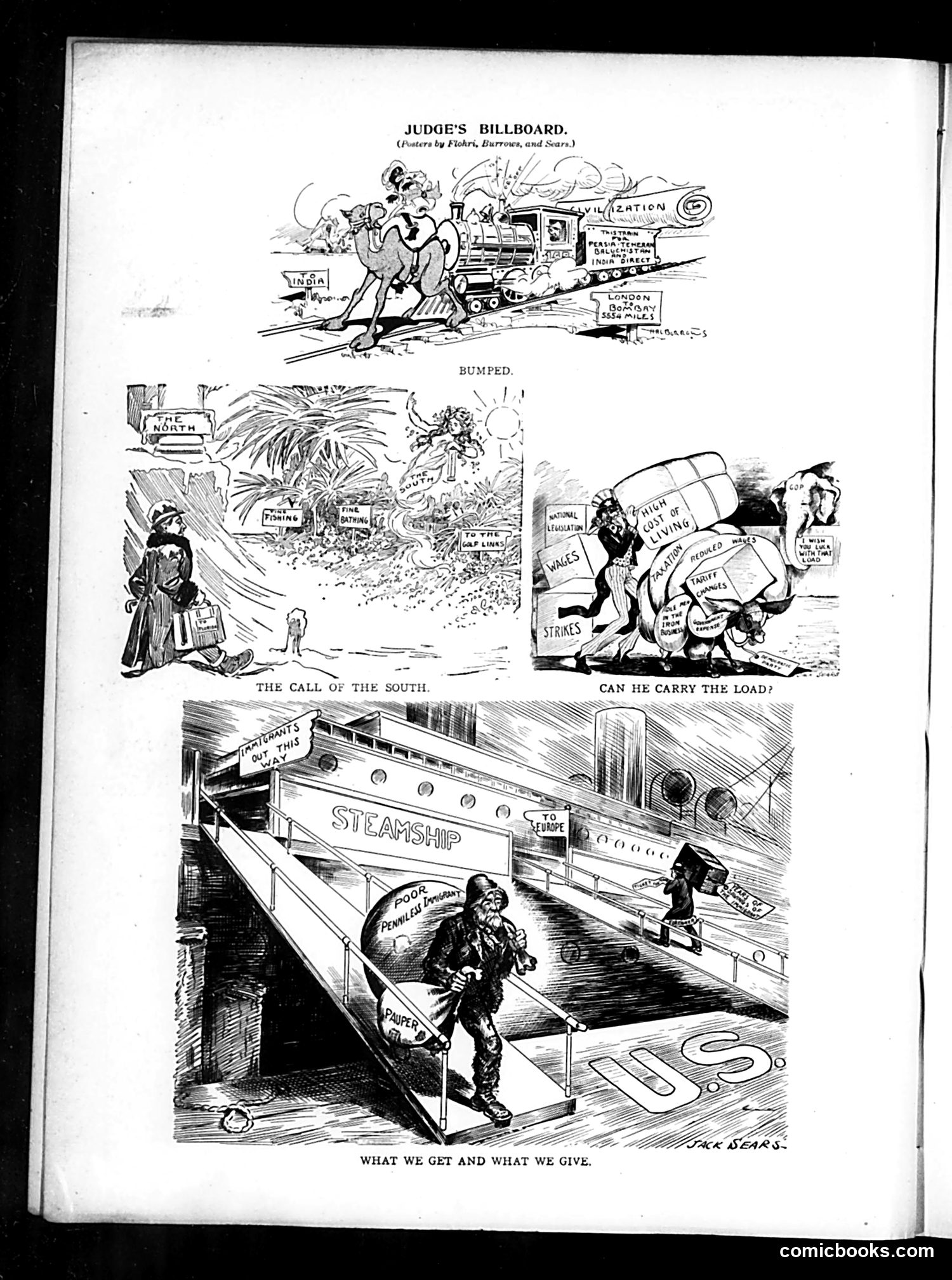
This page presents four political cartoons critical of American imperial expansion, likely from the early 1900s. **"Civilization"** depicts a train labeled with colonial destinations (India, Egypt, London) crushing indigenous peoples—satirizing claims that imperialism brings "progress." **"Bumped"** shows a figure struggling under burdens labeled "Strikes," "Wages," and other domestic problems, suggesting America cannot handle both colonial ambitions and internal issues. **"The Call of the South"** appears to reference Southern U.S. economic struggles or colonial interests. **"Can He Carry the Load?"** depicts an overburdened figure carrying multiple labeled weights, questioning whether America can sustain its imperial commitments. **"What We Get and What We Give"** shows unequal exchange between America and colonial territories on a steamship—critiquing the exploitative nature of imperialism.
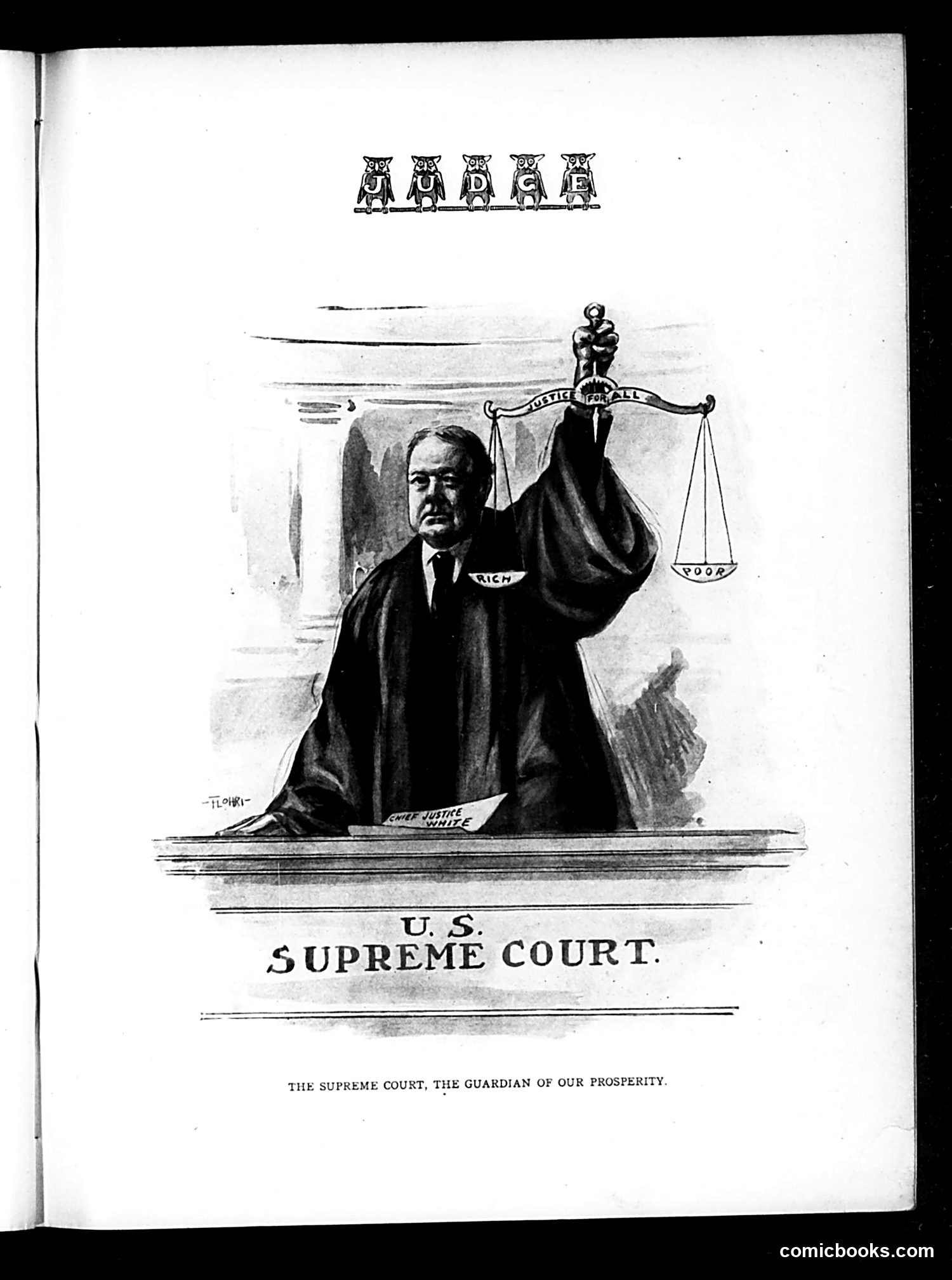
This Judge magazine page features an illustration titled "The Supreme Court, the Guardian of Our Prosperity." It depicts a judge in robes holding the scales of justice, with one side labeled "RICH" and the other "POOR"—clearly unbalanced toward the wealthy side. The scales themselves appear tilted, emphasizing judicial bias favoring the rich. The "JUDGE" header at top suggests this is the magazine's masthead or section marker. The satire criticizes the Supreme Court for failing to protect ordinary citizens' interests, instead appearing to serve wealthy interests. The cartoon implies the Court's supposed role as "guardian of our prosperity" is compromised—it protects only the wealthy while neglecting the poor. This likely reflects early 20th-century progressive-era criticism of judicial decisions favoring corporate and wealthy interests over workers and the working class.
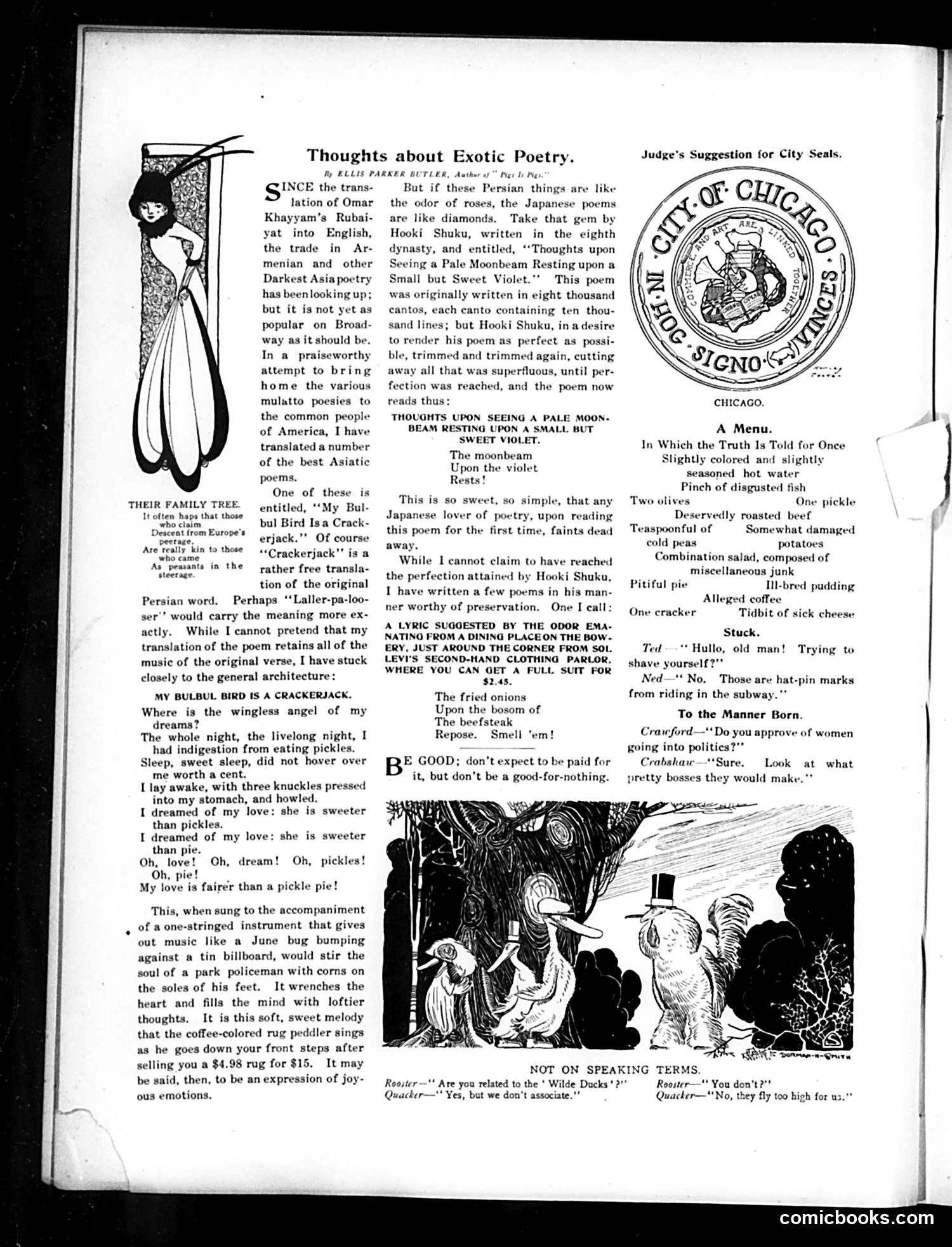
This page satirizes the early 20th-century American fascination with "exotic" Asian poetry—a trend sparked by translations of Persian and Japanese verse. Ellis Parker Butler, a humor writer, mocks this pretension through parody. **The Main Satire:** Butler ridicules Americans' reverent adoption of foreign poetry by creating deliberately absurd "translations." His fake Japanese poem reduces an 8,000-canto work to one line: "The moonbeam / Upon the violet / Rests!" His mock-Persian verse about indigestion from pickles further deflates the genre's perceived profundity. **The Joke:** The piece suggests these exotic poems aren't actually profound—they're just simple observations that Western audiences treat as mysteriously deep because they're foreign. The "Menu" section at right drives this home, listing deliberately terrible restaurant food with the same pretentious language. **Social Context:** This reflects American anxiety about foreign cultural imports and immigrant populations. The reference to a Bowery clothing parlor and dismissive treatment of Asian culture reflects period attitudes. The cartoons (including one about family trees/ancestry) appear to support similar themes about class and cultural pretension, though OCR errors make the exact meaning unclear.
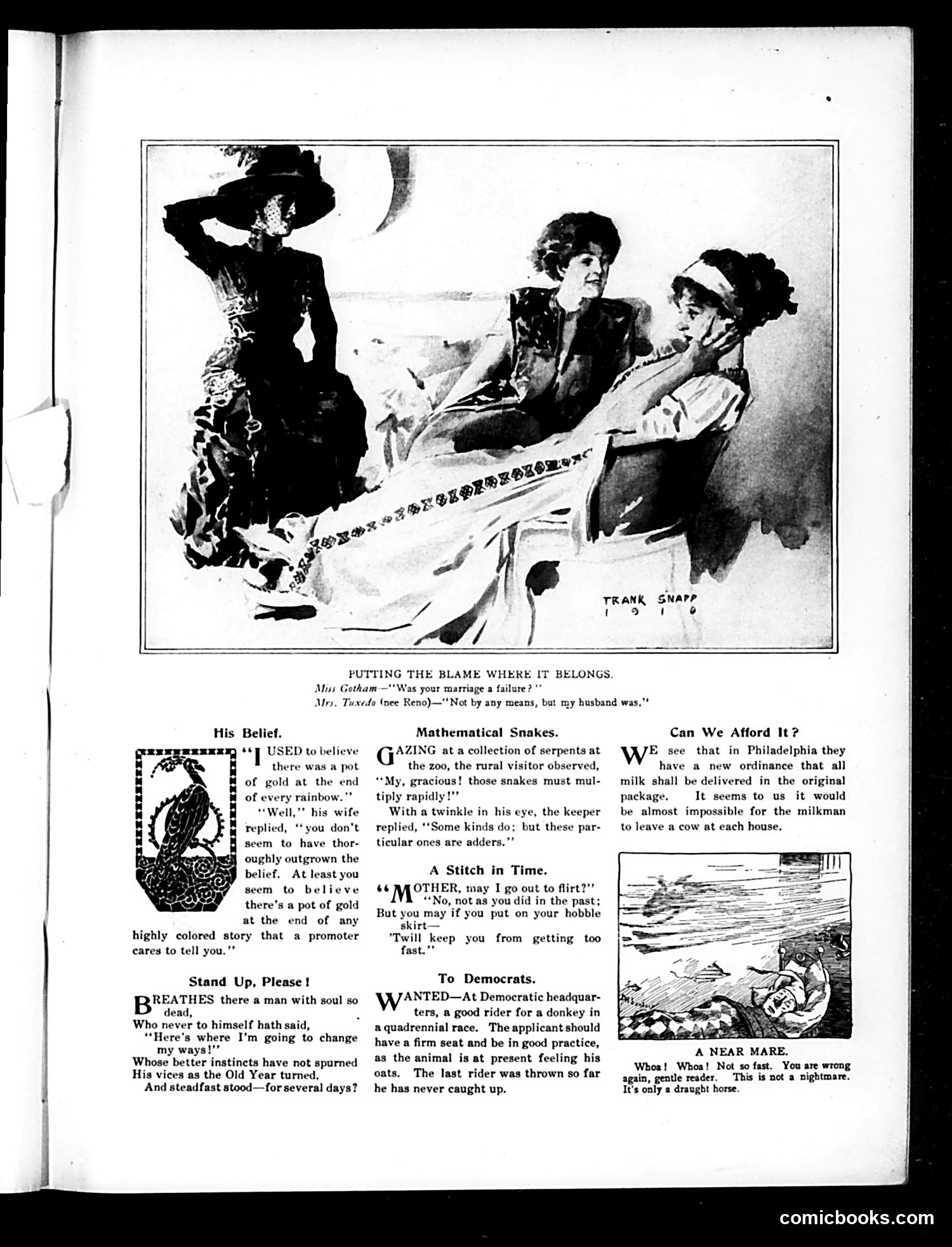
This page contains multiple satirical pieces typical of early 20th-century humor: **Top cartoon**: "Putting the Blame Where It Belongs" depicts a woman (Mrs. Tuxedo, from Reno—Nevada, known for divorce) telling a society woman her marriage failed because of her husband, not the institution itself. The joke satirizes wealthy women obtaining divorces in Reno, which had lenient divorce laws. **Various short humor pieces**: - "His Belief" mocks gullible men believing promoters' exaggerated stories - "Mathematical Snakes" is a simple pun (adders multiply) - "A Stitch in Time" jokes about hobble skirts (fashionable restrictive skirts) as chaperones against flirtation - "To Democrats" political satire comparing the Democratic Party to a bucking donkey, suggesting recent electoral losses **Bottom illustration** appears to be a visual pun clarifying that a "mare" (horse) is not a "nightmare." The page reflects early 1900s concerns: divorce stigma, fashion trends, and partisan politics.
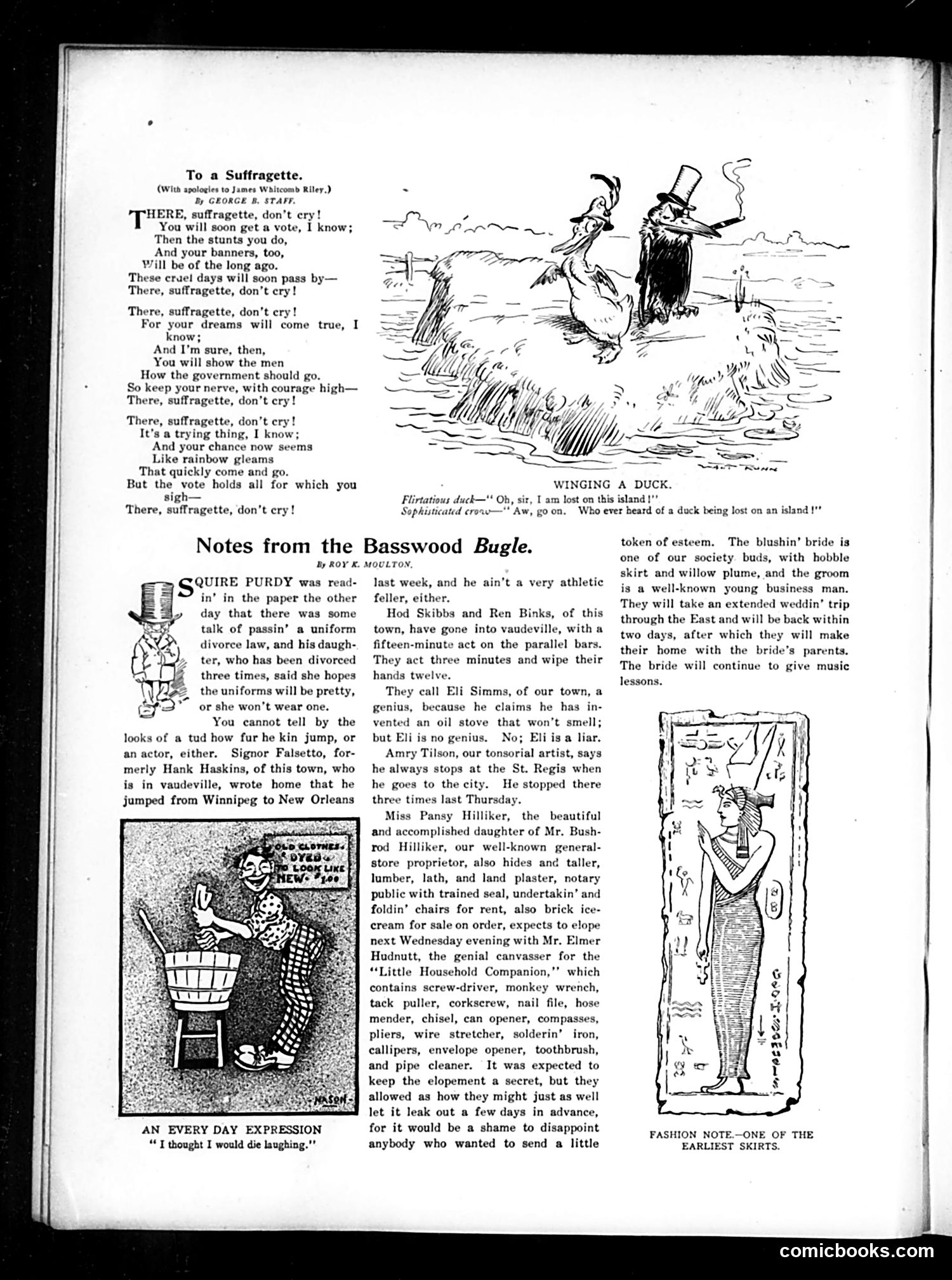
**"To a Suffragette"** is a patronizing poem mocking women's suffrage activists. The speaker condescends to assure a suffragette that she'll eventually get the vote, suggesting her current activism ("stunts," "banners") will soon be obsolete. The satire lies in its false comfort—implying women's demands are both inevitable yet currently futile, while dismissing their urgent struggle as emotional ("don't cry"). This reflects Judge magazine's skeptical, anti-suffrage editorial stance during the women's voting rights movement. **"Notes from the Basswood Bugle"** consists of humorous small-town gossip anecdotes mocking rural Americana through exaggerated lies and absurdities (a man claiming to have jumped from Winnipeg to New Orleans, a barber who "stops" at fancy hotels during three-minute visits). The humor targets provincial pretense and boasting. The cartoon "Winging a Duck" shows a duck and crow in a flirtation scenario—the joke being the crow's cynical response that ducks don't get lost on islands, mocking the duck's transparent pickup line.
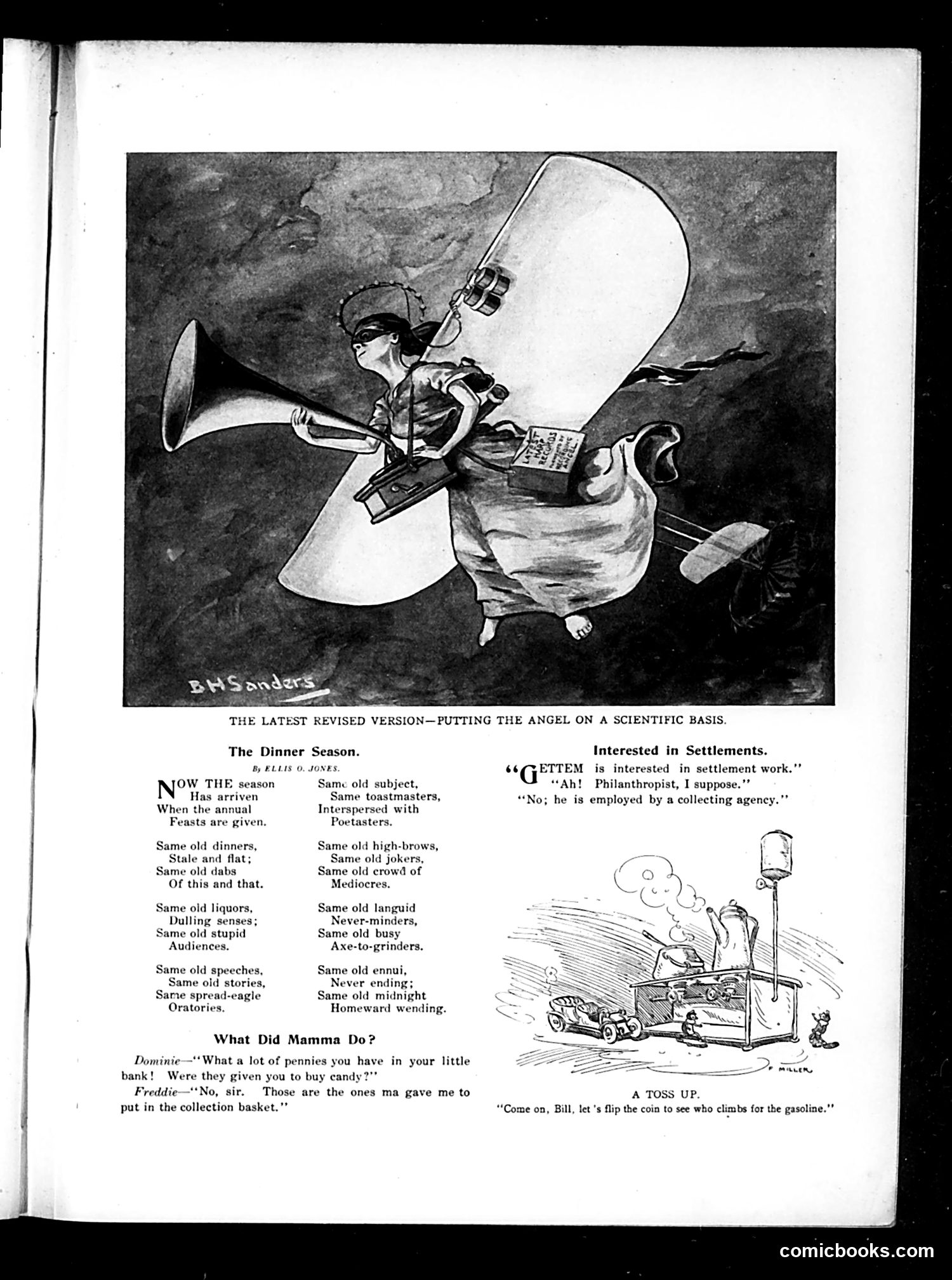
**Top Cartoon:** "Putting the Angel on a Scientific Basis" satirizes modern efficiency and rationalization. An angel—traditionally a spiritual, ethereal being—is depicted as an industrial/mechanical contraption with propellers, megaphones, and technical apparatus. The joke is that even celestial figures are being subjected to contemporary mania for "scientific" modernization and mechanization, reducing something sacred to industrial components. **"The Dinner Season":** Ellis O. Jones's poem mocks the tedium of formal dinner season—the repetitive nature of identical events with identical attendees, speeches, and tired socializing. It captures the era's social obligation fatigue. **Bottom Comics:** Two brief gags—one about charitable collection (children unknowingly donating coins their mother gave them), and another about workers flipping a coin to determine who climbs for gasoline, suggesting dangerous or undesirable labor assignments. The page overall reflects early 20th-century satirical humor about social conventions, modern anxieties, and working-class life.
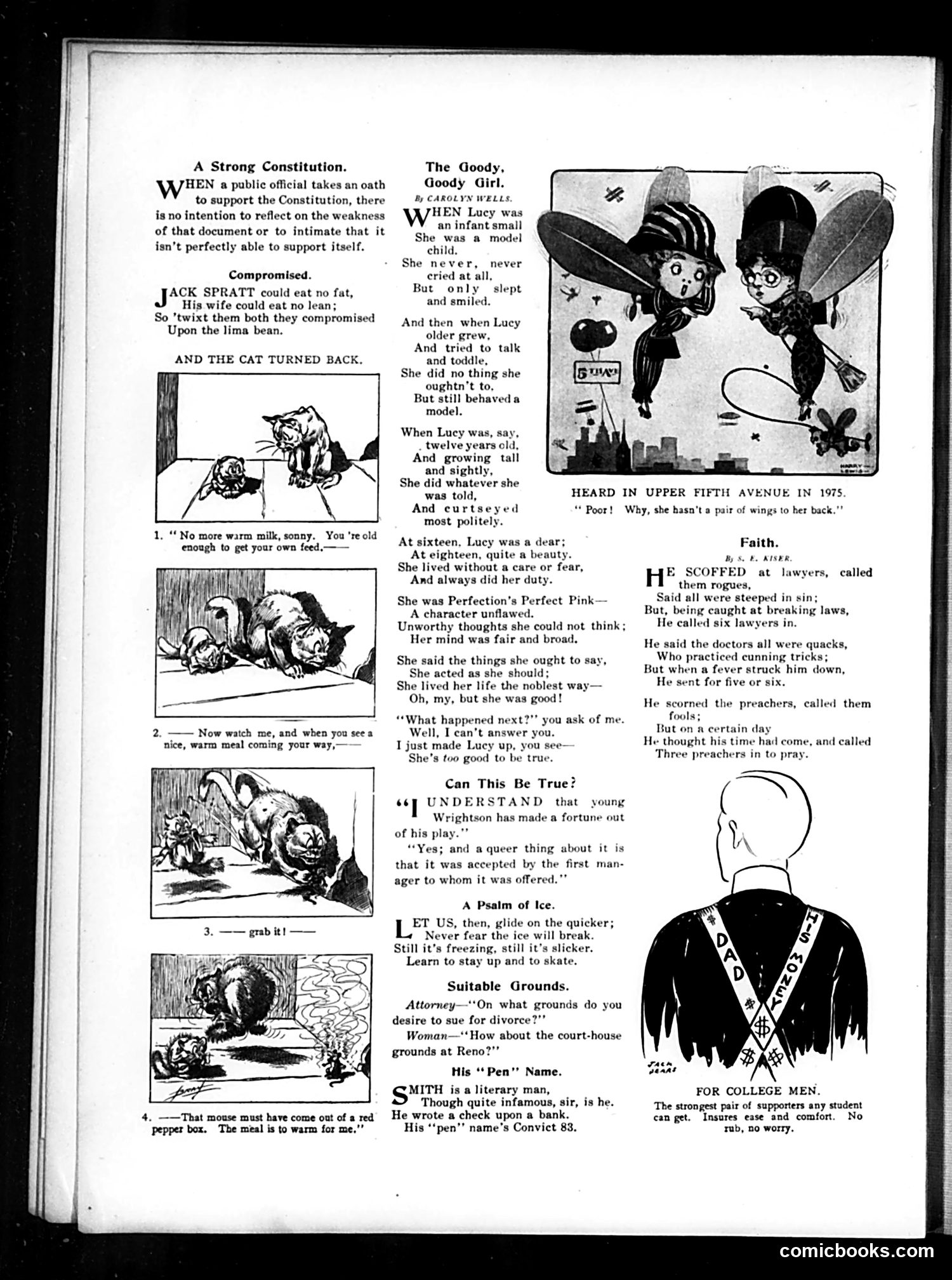
This page from *Judge* contains several short satirical pieces typical of early-20th-century American humor magazines: **"The Goody, Goody Girl"** (by Carolyn Wells) satirizes unrealistic moral perfection. Lucy is portrayed as an impossibly well-behaved child who never misbehaves—the joke's punchline reveals she's entirely fictional, mocking sentimental literature that depicts implausibly virtuous heroines. **"And the Cat Turned Back"** uses a cat's logic to mock human behavior. The cat observes a warm meal but refuses it because it's "too warm," playing on contradictory human excuses and rationalizations. **"His 'Pen' Name"** is a pun: Smith, a literary man, wrote a bad check and now goes by "Convict 83"—his actual prison identification becomes his "pen name." **"Faith"** ironically describes a man who publicly scorns lawyers, doctors, and preachers as frauds, yet desperately employs all of them when he needs help. It mocks hypocrisy and fair-weather faith. The page also includes brief joke items about compromise, constitutional weakness, and divorce proceedings at Reno (then famous for lenient divorce laws).
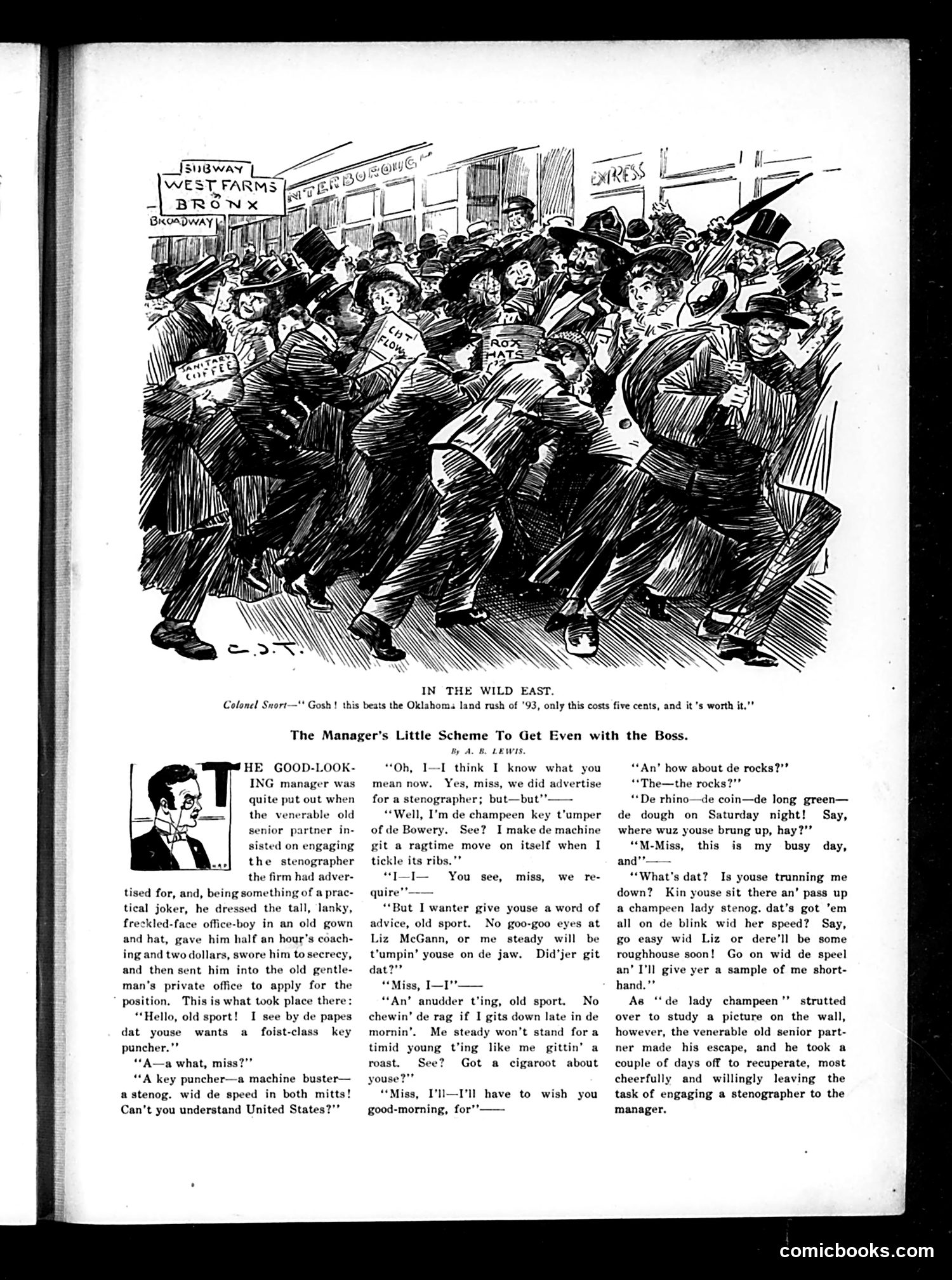
This is a workplace prank story, not political satire. A good-looking office manager, annoyed that his elderly senior partner has hired a stenographer without consulting him, retaliates by disguising the office boy in women's clothing and coaching him to impersonate the applicant. The boy, dressed as "de lady champeen" stenographer, speaks in exaggerated Bowery slang and Brooklyn dialect, threatening the old man with jealous-boyfriend violence, demanding high wages ("de rhino—de coin"), and boasting about his typing speed. The humor derives from the absurdity of the deception and the crude impersonation breaking the boss's composure. The top cartoon references the 1893 Oklahoma Land Rush, comparing the crowded subway station to that chaotic historical event. The satire targets urban congestion and the spectacle of mass transit rather than any specific political figure.
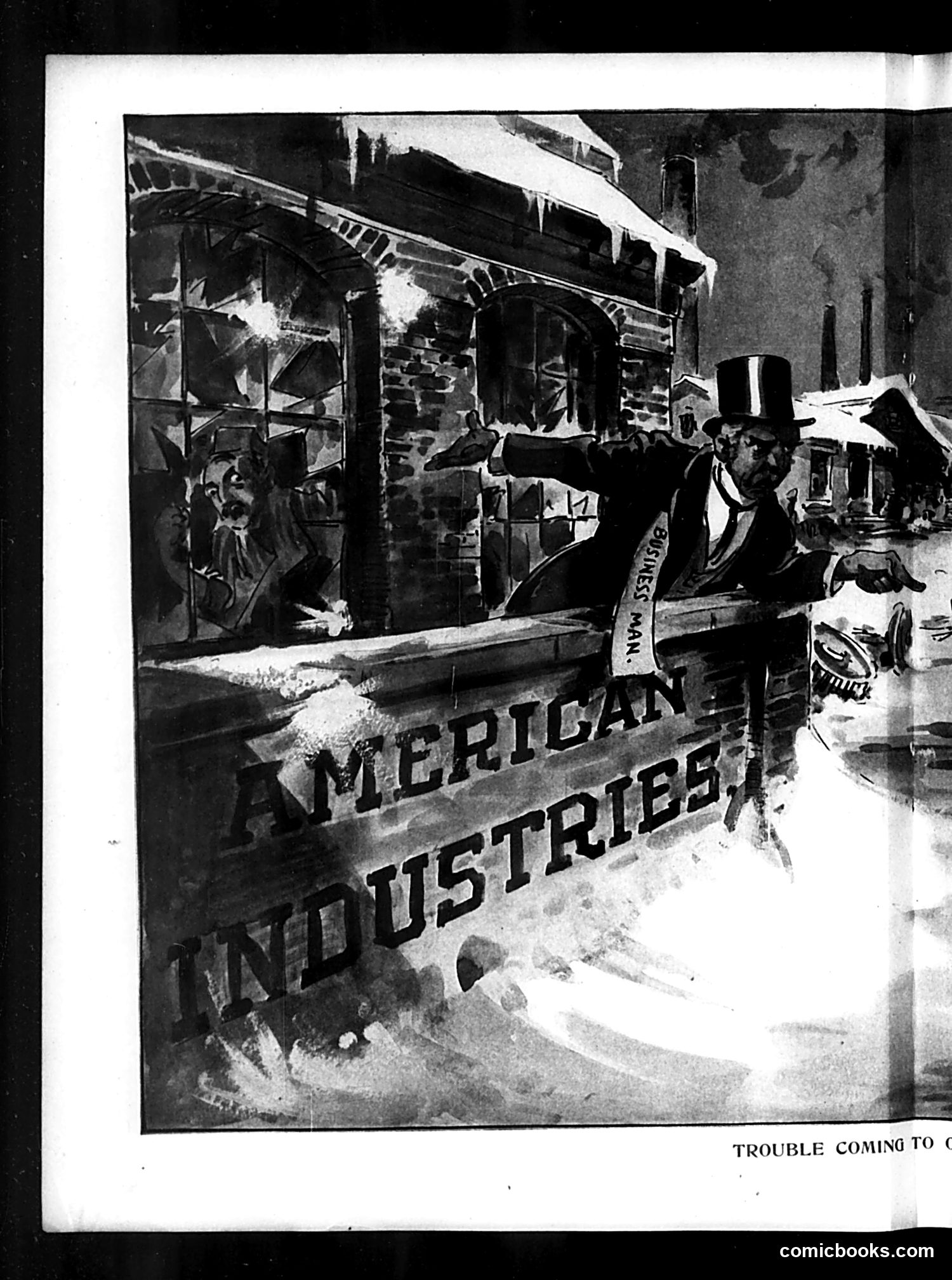
This appears to be a page from *Judge* magazine showing a satirical scene titled "Trouble Coming to..." (the complete title is cut off). The image depicts a man in formal attire wearing a top hat and a sash labeled "American Industries" pointing toward a storefront marked "American Industries." Snow covers the ground and building, suggesting winter hardship. The satire appears to target American industrial practices or labor conditions during an economically troubled period. The well-dressed figure representing "American Industries" gestures toward his own establishment, seemingly warning of impending problems. The visual juxtaposition between the formal, prosperous-looking gentleman and the snow-covered, struggling storefront suggests irony about industrial wealth versus worker welfare or economic inequality—common *Judge* satirical themes from the early 20th century.
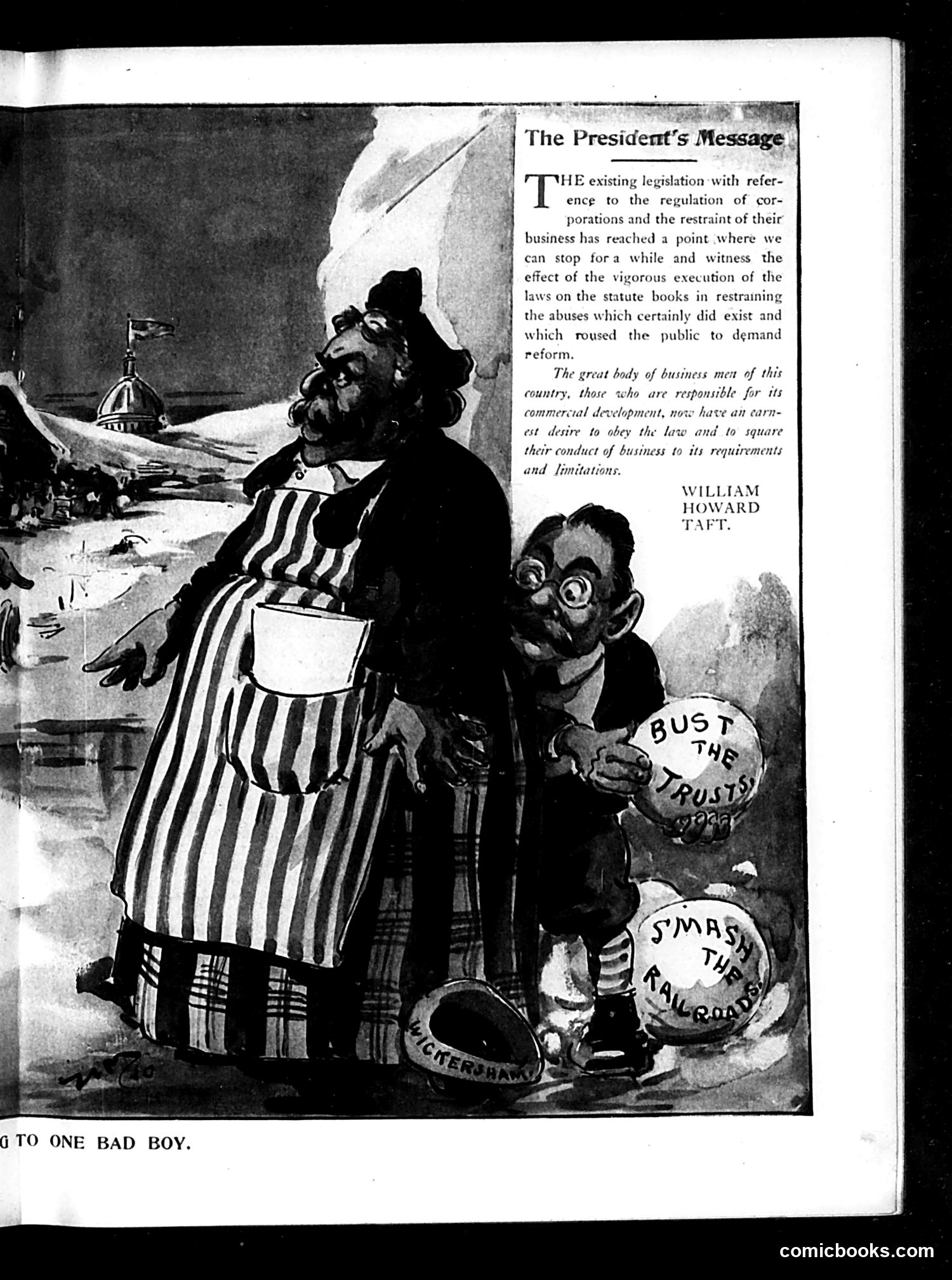
This page features a political cartoon accompanying President William Howard Taft's message on corporate regulation. The cartoon depicts Uncle Sam as a stern father figure confronting a caricatured "bad boy" (representing big business or trusts). The child holds spheres labeled "BUST THE TRUSTS" and "SMASH THE RAILROADS"—referencing Taft's anti-trust enforcement agenda. The satire contrasts Taft's optimistic message (that businesses now voluntarily obey the law) with the visual reality: Uncle Sam must still discipline the wayward "boy," suggesting corporations require continued firm government action rather than voluntary compliance. The caption "TO ONE BAD BOY" reinforces this paternalistic stance. This reflects the Progressive Era's trust-busting debates and satirizes whether Taft's enforcement was achieving genuine reform or merely symbolic gestures.
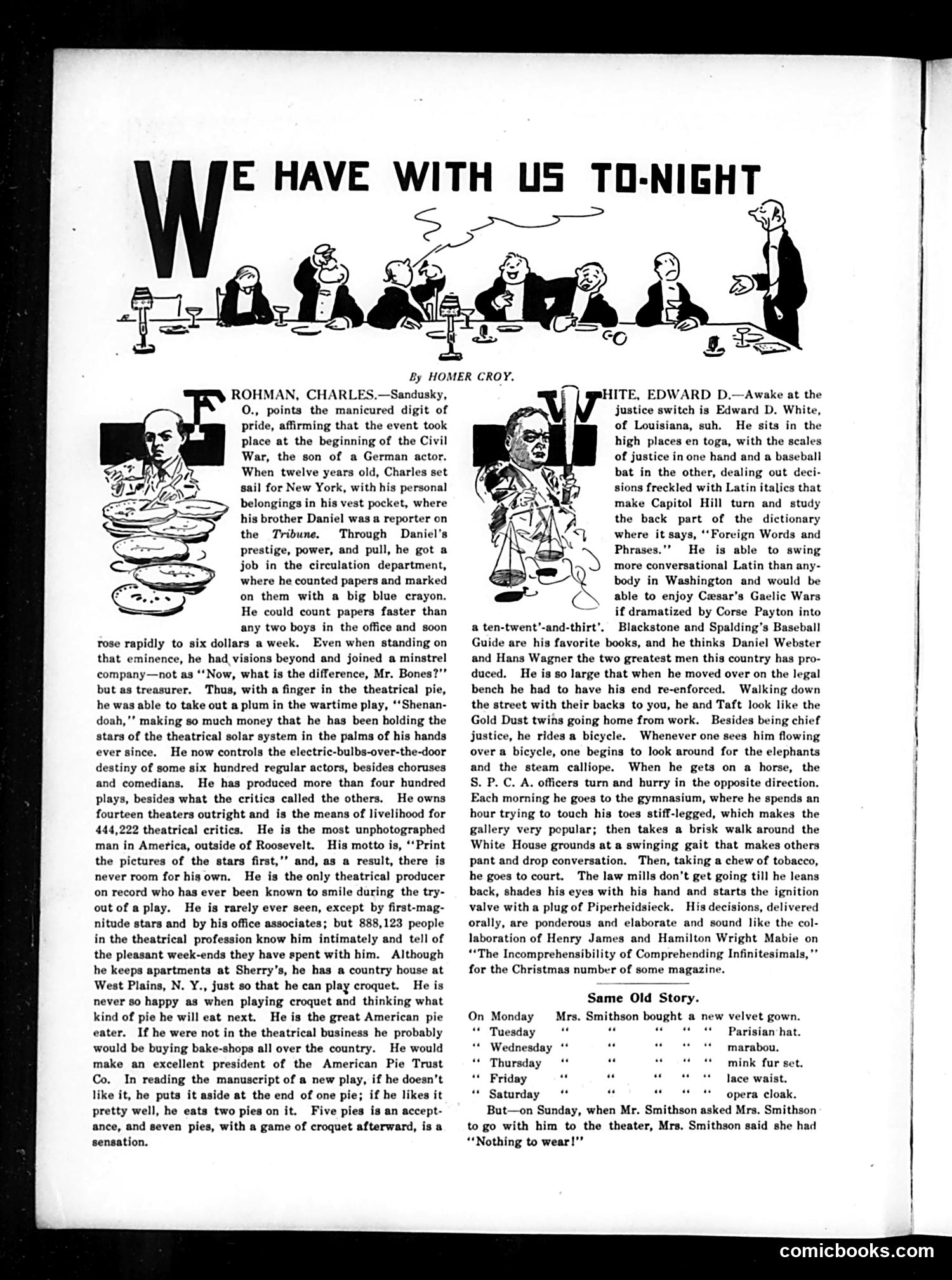
This page from Judge presents humorous biographical sketches of prominent figures by Homer Croy. The header cartoon shows a dinner party scene with caricatured guests. The two main profiles mock: **Charles Frohman** (theater producer): Satirized as an obsessive pie-eater who judges new plays by how many pies he consumes during reading—one pie means rejection, five means acceptance. The joke highlights his legendary reclusivenessand focus on star publicity over his own prominence, while exaggerating his control over theatrical production (claiming he supports 444,222 "theatrical critics"). **Edward D. White** (Chief Justice of the U.S.): Mocked for his massive size, excessive use of Latin phrases in legal opinions, and peculiar hobby of riding a bicycle despite his girth. The "Gold Dust twins" comparison refers to a popular cleaning product advertisement featuring identical figures—suggesting White and President Taft look comically similar from behind. Both sketches use absurdist exaggeration and specific behavioral quirks to create affectionate ridicule of these public figures.
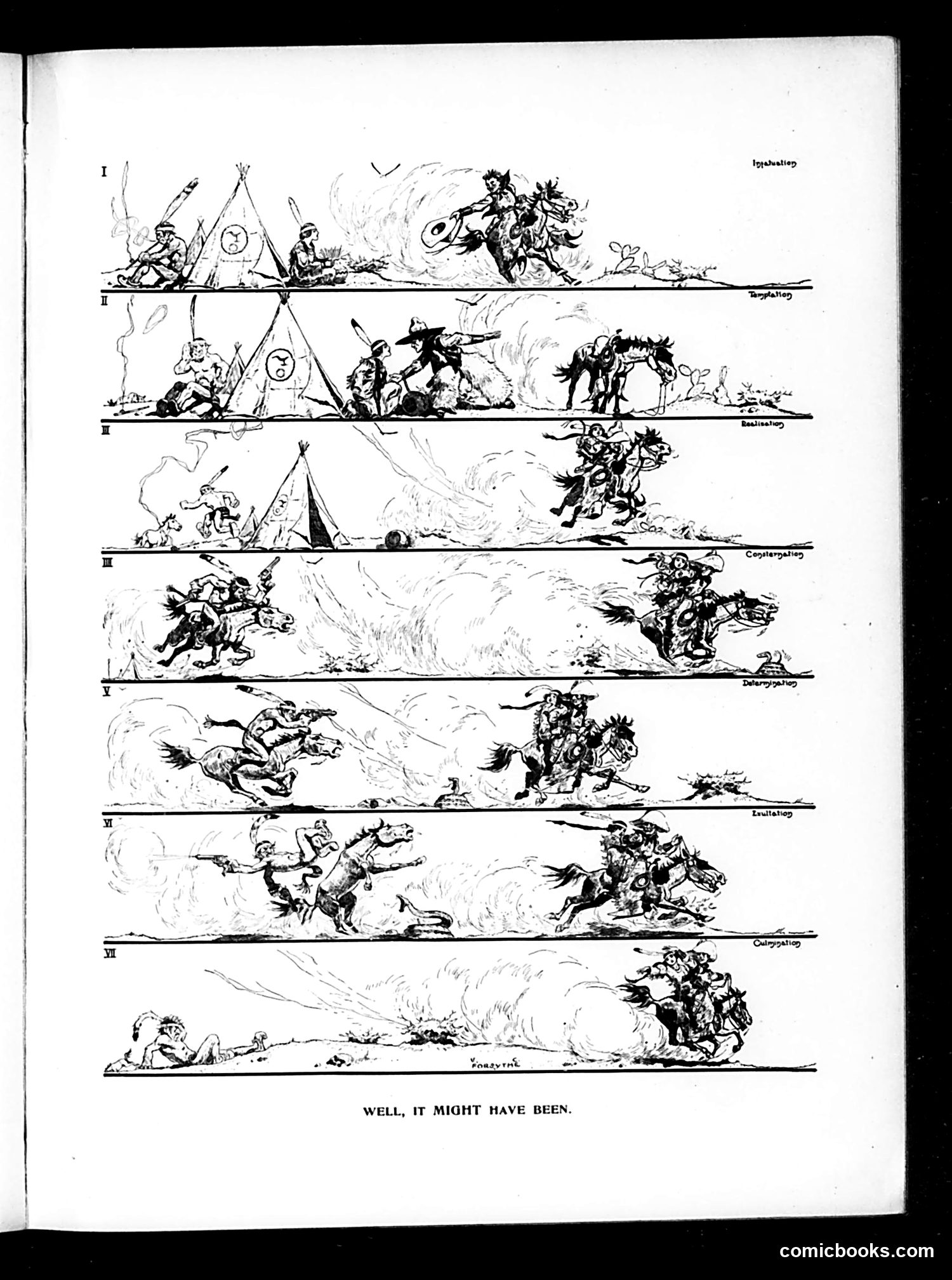
This multi-panel satirical cartoon depicts an escalating series of violent encounters between what appears to be Native Americans (shown on the right in each panel) and settlers or soldiers (on the left). The sequence progresses through eight scenes labeled with different terms, showing increasingly dramatic confrontations—fires, raids, and combat. The title "Well, It Might Have Been" suggests a counterfactual or hypothetical scenario. This appears to be commentary on Indian Wars or frontier conflict, likely satirizing either the inevitability of such violence or perhaps the justifications given for it. The progression implies either a warning about what could occur or ironic commentary on how conflicts escalated. Without the specific date or publication context, the exact political point remains unclear, though it engages with late-19th-century American anxieties about frontier conflict.
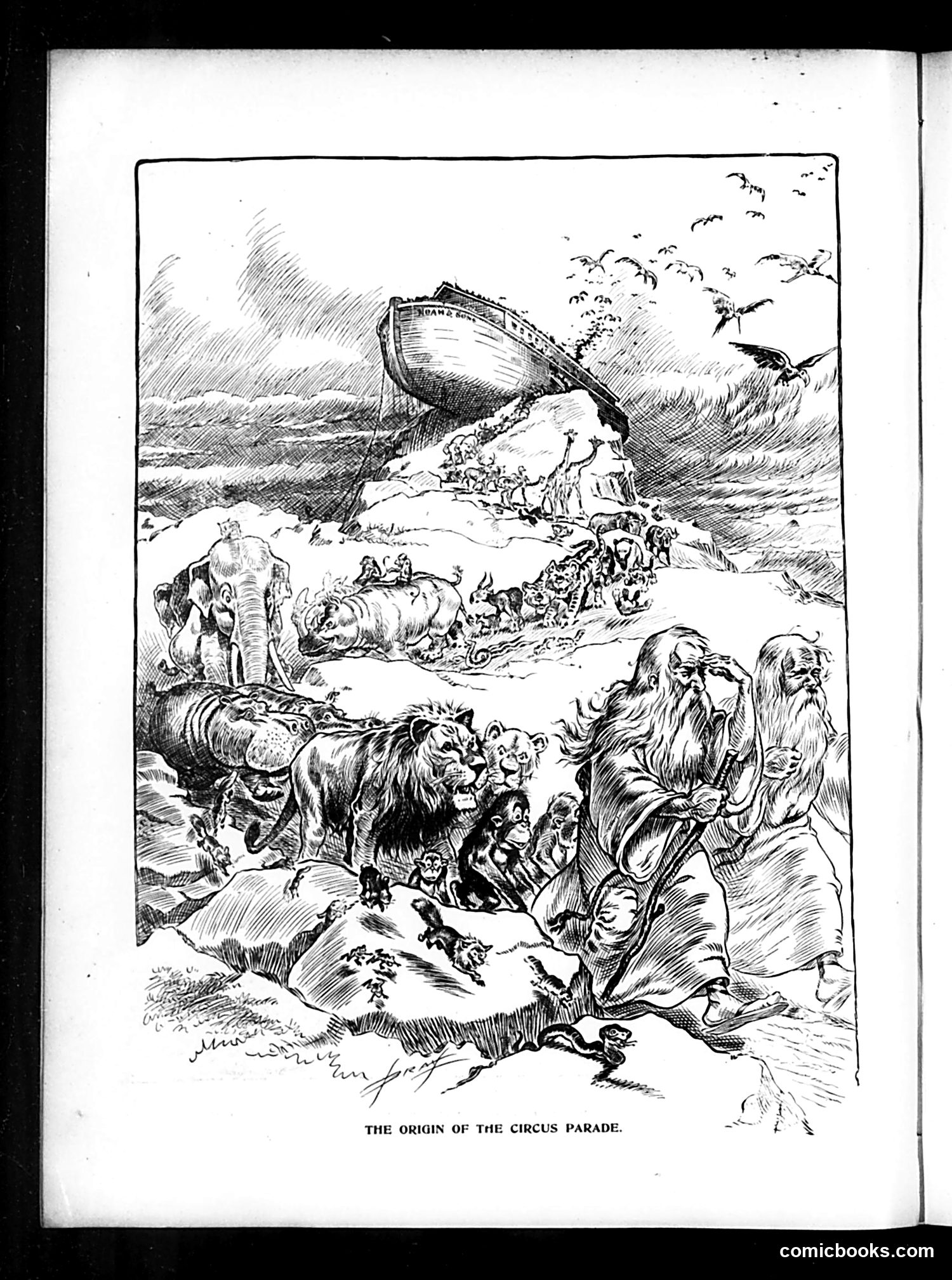
This satirical illustration presents a humorous, fantastical origin story for circus parades. The scene depicts various creatures and characters—including elephants, lions, bearded men (appearing to be wizards or ancient figures), and smaller animals—gathered around a large beached or capsized boat. The joke appears to be that circus parades originated from some mythical or prehistoric event: perhaps shipwrecked exotic animals and eccentric people gathering together, with their chaotic procession becoming the template for modern circus parades. The exaggerated, fantastical nature of the assembled group—combining real animals, fantastical creatures, and oddly-costumed humans—satirizes both the circus itself and the absurdity of tracing its "origins" to impossible circumstances. The cartoon uses visual humor and imaginative storytelling typical of Judge magazine's satirical approach.
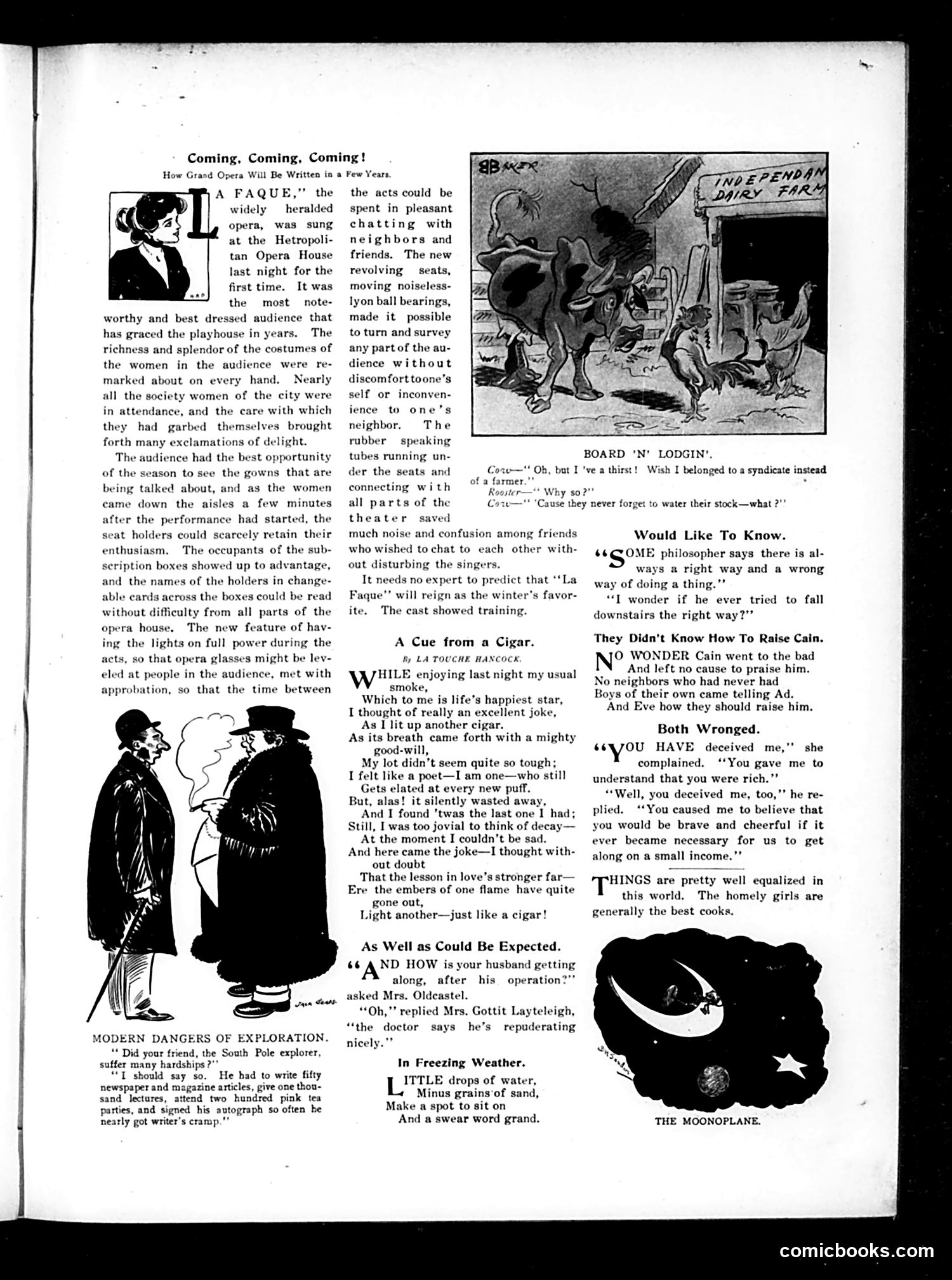
This page from Judge magazine contains several satirical pieces mocking contemporary society (early 1900s): **"Coming, Coming, Coming!"** mocks the pretentiousness of Metropolitan Opera audiences. The satire focuses on how attendees care more about displaying their fashionable costumes and socializing than experiencing the actual opera. The new technological features (revolving seats, speaking tubes, full lighting) are presented ironically as designed for spectacle rather than artistic appreciation. **"Modern Dangers of Exploration"** jokes that a South Pole explorer suffered not from polar hardships but from the exhausting social demands of fame afterward—writing articles, giving lectures, attending tea parties, and signing autographs. **"A Cue from a Cigar"** contains romantic advice: light a new romantic flame before the old one dies completely, comparing romance to cigars. The remaining pieces are brief humor items about marital life, exploration philosophy, and weather. The overall tone reflects Judge's typical satirical critique of upper-class pretension and modern social absurdities.
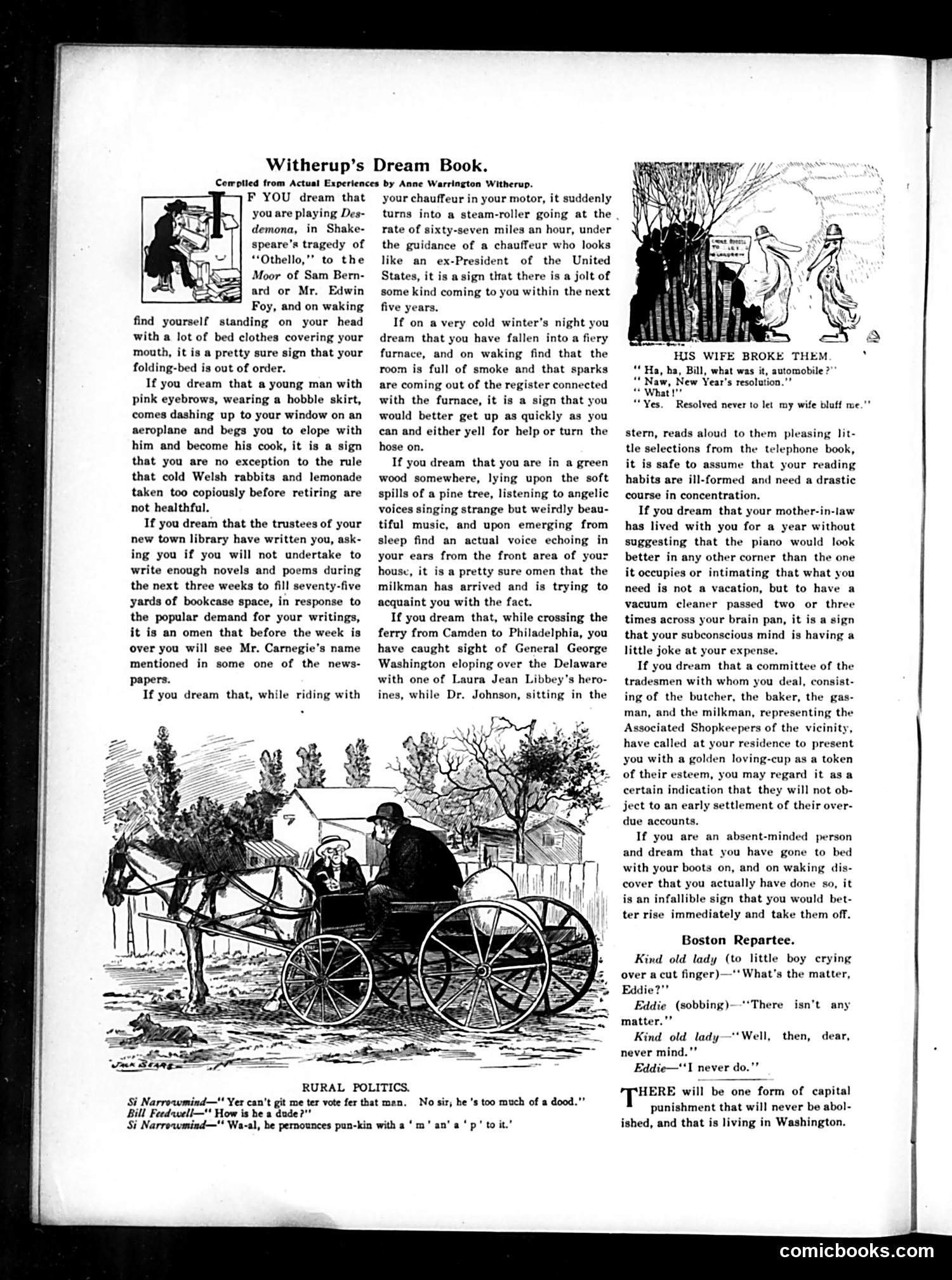
This is a humorous satirical piece from *Judge* magazine parodying dream interpretation books—popular self-help publications of the era. "Anne Warrington Witherup's" dream interpretations mock both the genre's pretensions and contemporary anxieties. The jokes target early-20th-century concerns: motorcar dangers (a chauffeur resembling an "ex-President" suggests Theodore Roosevelt's reckless driving reputation); women's fashion absurdities (hobble skirts, aeroplanes as romance); and domestic frustrations (mothers-in-law, folding beds, piano placement). The "Rural Politics" cartoon below satirizes rural voters' provincial attitudes—Si Narrowmind objects to a candidate for mispronouncing "pumpkin," equating dialect with unsuitability. This reflects *Judge's* urban, educated readership mocking rural simplicity. The page blends domestic comedy with class satire, portraying modern anxieties and social tensions through exaggeration.
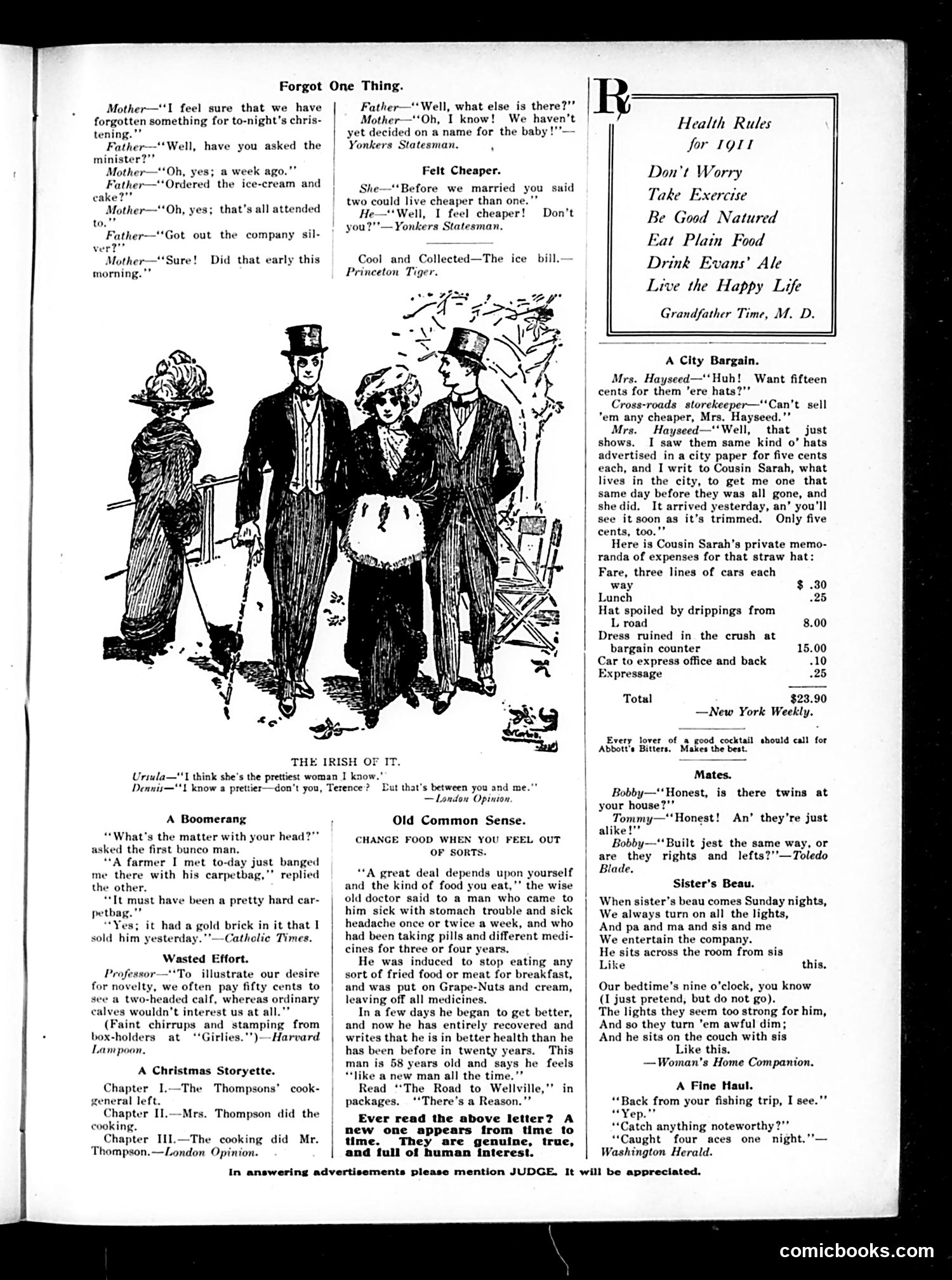
This page from *Judge* contains several short humorous pieces typical of early 1900s American satirical magazines: **"Forgot One Thing"** jokes about middle-class christening preparations—the parents have arranged everything (ice cream, cake, silver) but forgotten to name the baby, satirizing absent-minded parental priorities. **"The Irish of It"** features ethnic stereotyping (Dennis and Terence), common to the era's humor, playing on Irish-American caricatures about romantic competition. **Other sketches** mock working-class figures (a farmer's violence in "A Boomerang"), domestic comedy ("A Christmas Storyette" where cooking mishaps injure Mr. Thompson), and rural naiveté ("A City Bargain," where a farmer's wife discovers urban shopping's hidden costs outweigh bargain prices). The page is primarily **advertising and filler content**—including a Grape-Nuts cereal testimonial and "Health Rules for 1911"—alongside brief, disconnected comic vignettes. The humor relies on class and ethnic stereotypes, domestic mishaps, and rural-versus-urban contrasts typical of 1910s popular magazines.
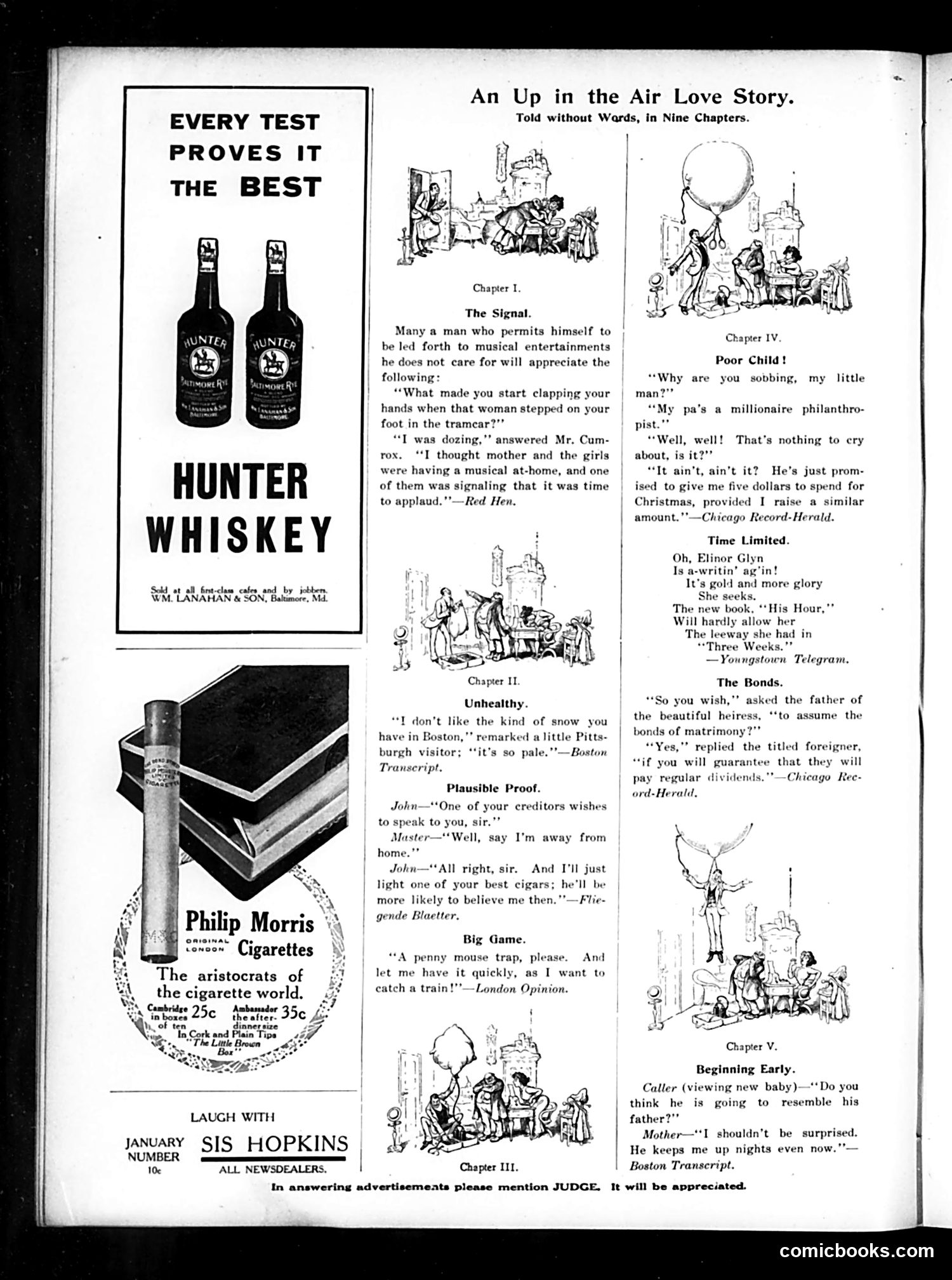
This page contains advertisements and a serialized wordless comic strip titled "An Up in the Air Love Story." **The Advertisements:** Hunter Whiskey and Philip Morris Cigarettes use period marketing language ("Every Test Proves It the Best"; "aristocrats of the cigarette world") typical of early 20th-century product promotion. These ads make unsubstantiated quality claims common before modern advertising regulations. **The Comic Strip:** "An Up in the Air Love Story" is a nine-chapter visual narrative about romance and courtship. The installments shown focus on humorous domestic and social situations—a man pretending to sleep at a concert, Boston snow quality, a creditor encounter, and parental concerns about a daughter's wealthy suitor. The humor derives from mundane relationship awkwardness and class anxieties. The strip's title "Up in the Air" likely suggests the romantic plot remains unresolved/uncertain. **Overall Context:** This is a January issue of *Judge*, a satirical weekly. The page mixes consumer advertising with light domestic humor targeting middle-class readers concerned with propriety, courtship protocols, and social standing.
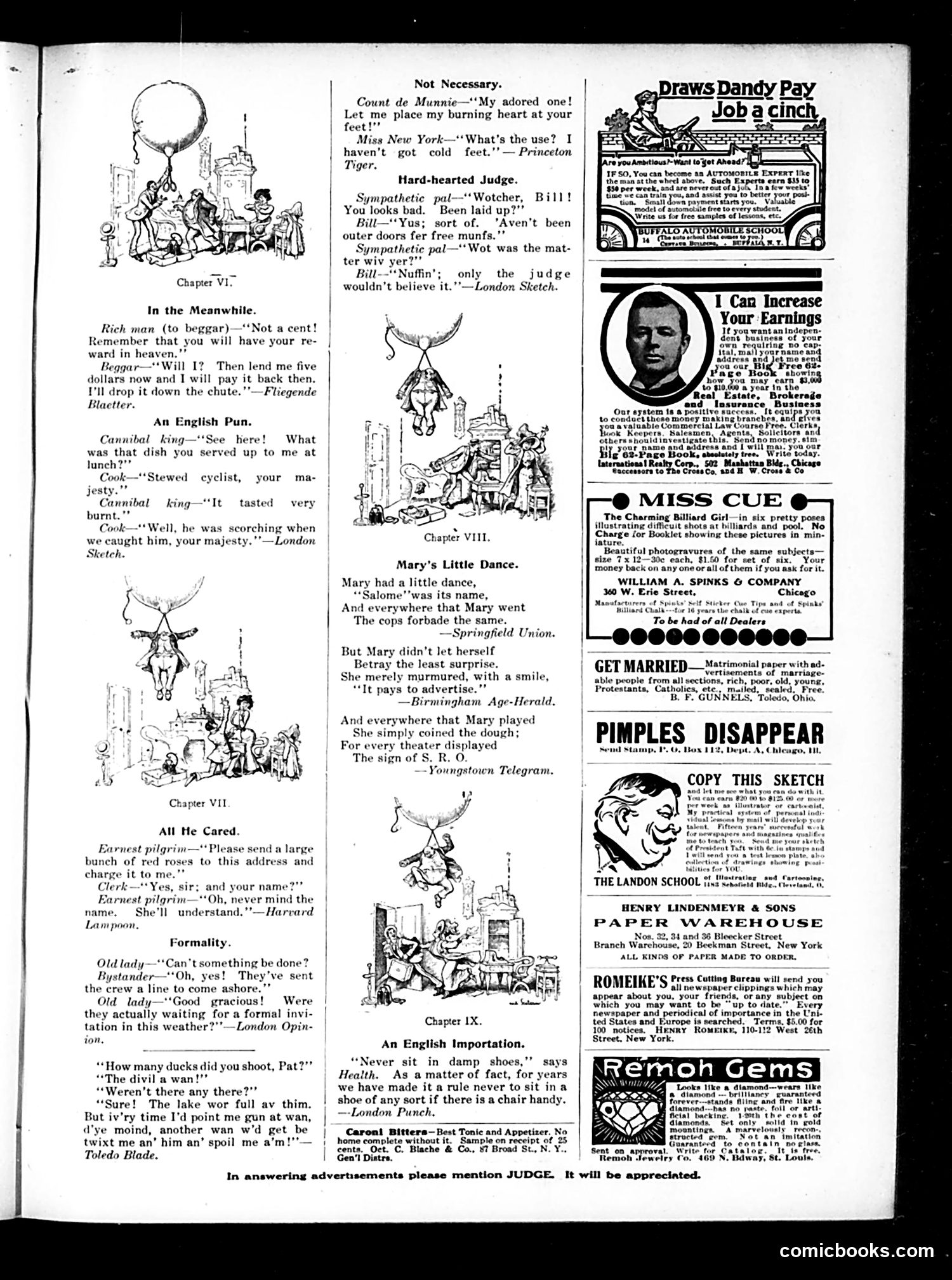
This page from Judge (likely early 1900s) contains humorous short jokes and advertisements rather than political cartoons. **The Jokes:** The content satirizes social conventions and human foibles through brief anecdotes. "Not Necessary" mocks romantic excess—a nobleman's flowery declaration is rejected because the woman lacks feet to place his heart upon. "Hard-hearted Judge" shows a man imprisoned who claims only the judge wouldn't believe his innocence. "Mary's Little Dance" is a parody of "Mary Had a Little Lamb" making fun of the Salome dance craze (exotic dances considered scandalous) and how theaters exploited it by claiming "standing room only." **Social Context:** The repeated references to Salome dances reflect genuine 1900s-1910s moral panic over sexually suggestive performances. The beggar-to-rich-man joke satirizes hypocrisy about charity and the afterlife. **The Page Structure:** Predominantly advertisements (automobile school, billiard photos, marriage bureau, pimple cream) with scattered comic relief—typical Judge layout mixing entertainment with revenue.
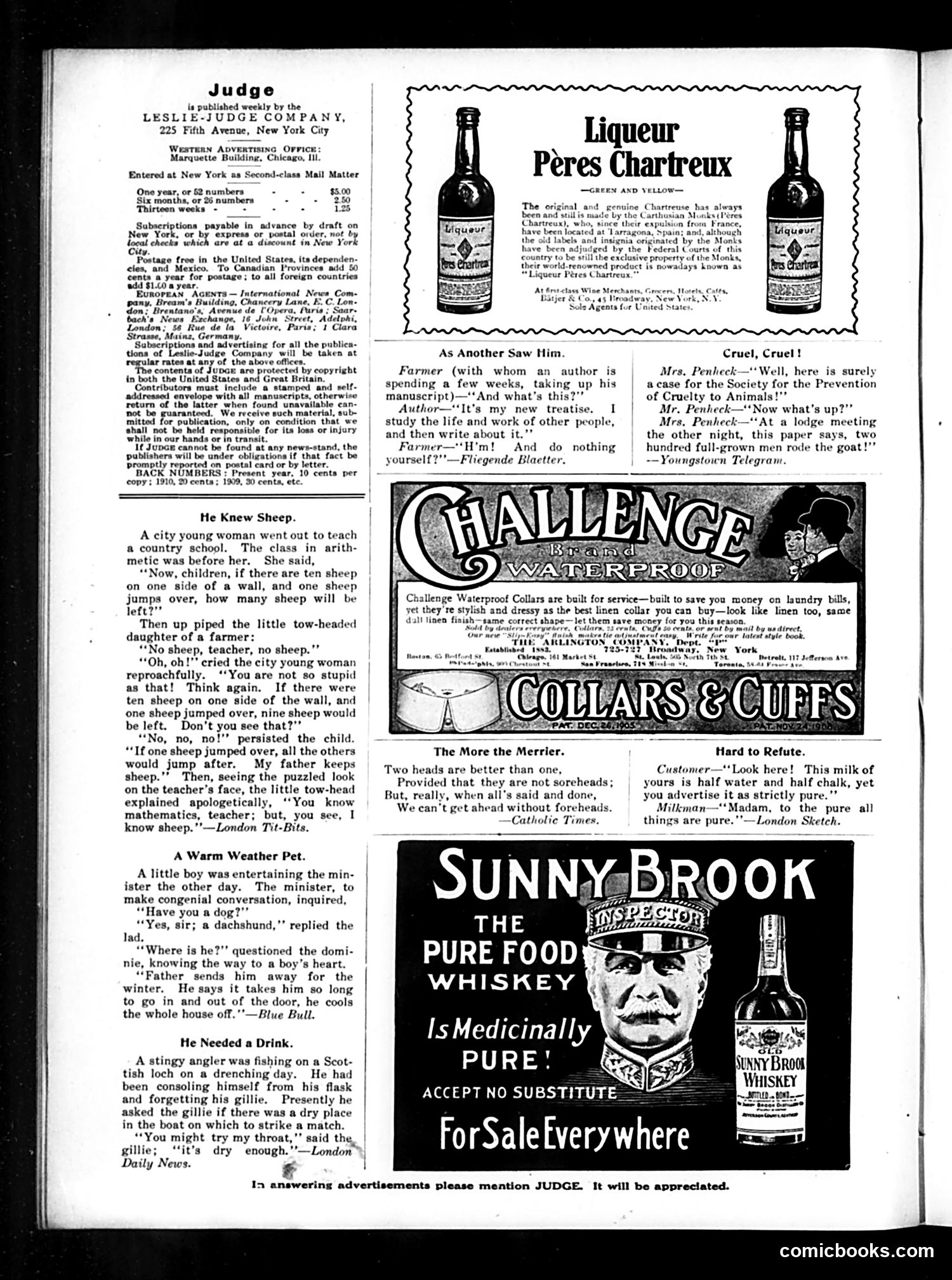
This page is primarily **advertising and filler content** rather than editorial cartoons. The layout includes: **Advertisements:** Large ads for Liqueur Péres Chartreux (a French chartreuse liqueur), Challenge Waterproof Collars, and Sunny Brook Whiskey dominate the page. **Humorous Anecdotes:** Several brief, lighthearted stories occupy the text columns: - "He Knew Sheep" — a city schoolteacher learns rural children have practical rather than academic knowledge - "A Warm Weather Pet" — a boy's dachshund is sent away because it cools the house - "He Needed a Drink" — a dry joke about a Scottish angler's thirst These aren't political satire but rather gentle social humor typical of early 1900s magazines. The page reflects Judge's mixed content model: combining satirical commentary (elsewhere in the issue) with advertising revenue and light entertainment for general audiences.
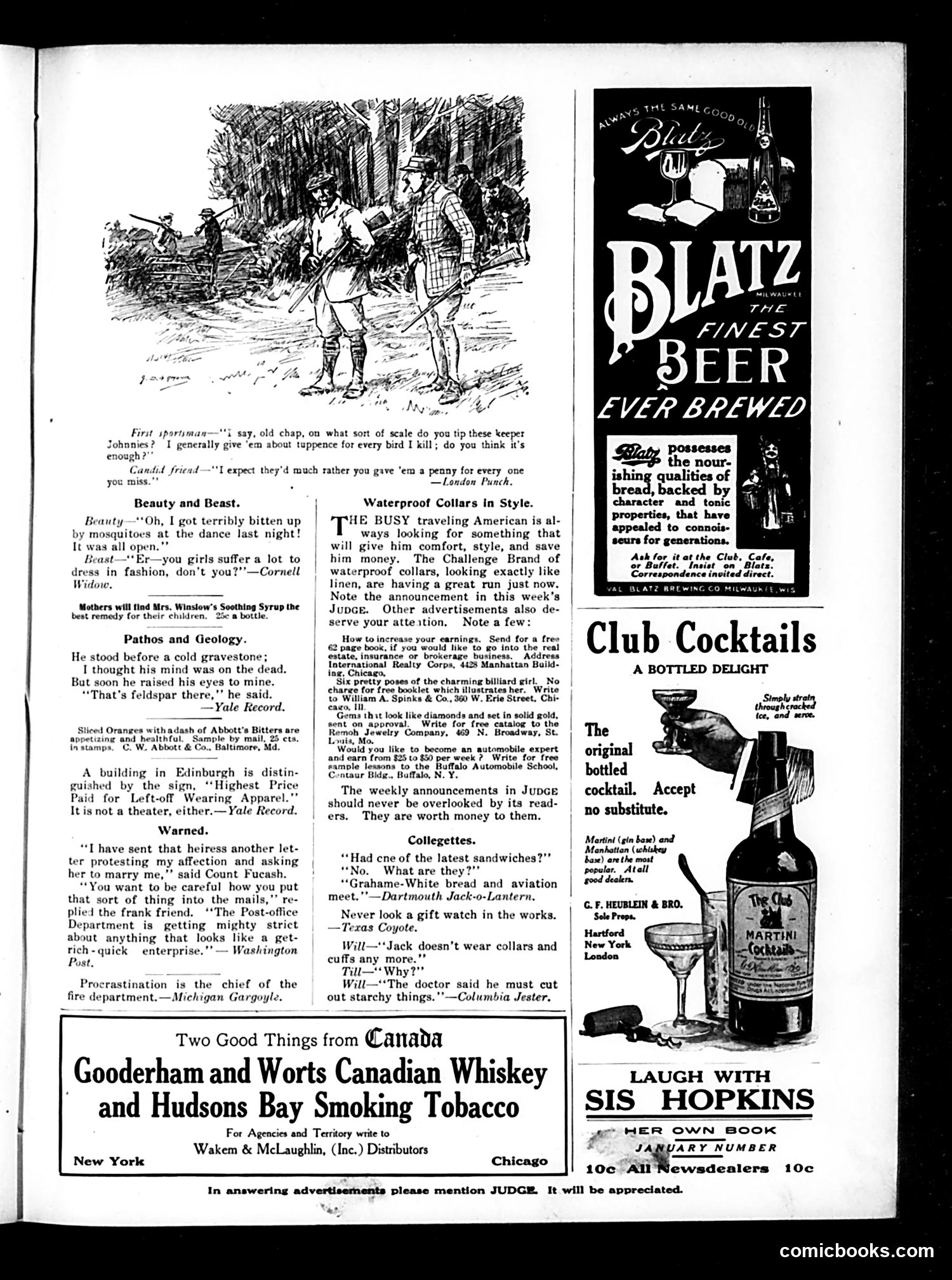
This page from *Judge* contains multiple short humorous pieces typical of early 20th-century satirical magazines, plus advertisements. The visible cartoon/joke at top-left depicts two hunters discussing tipping "keepers" (hunting guides). The humor derives from class distinctions: the first sportsman tips "tuppence" (two pence) per bird killed, while his companion suggests tipping a penny per *missed* bird instead—implying the keeper would prefer easier work. Other jokes address contemporary concerns: women's fashion ("Beauty and Beast" mocks exposed shoulders at dances attracting mosquitoes); geology humor; and warnings about mail fraud. One piece jokes about a building sign advertising "Highest Price Paid for Left-off Wearing Apparel"—implying it might be mistaken for a theater (a euphemism for brothels). The remainder is advertising: waterproof collars, correspondence courses, jewelry, automobiles, and notably Canadian whiskey and beer—products prominently featured. The "Club Cocktails" ad emphasizes accepting "no substitute" for the original bottled drink.
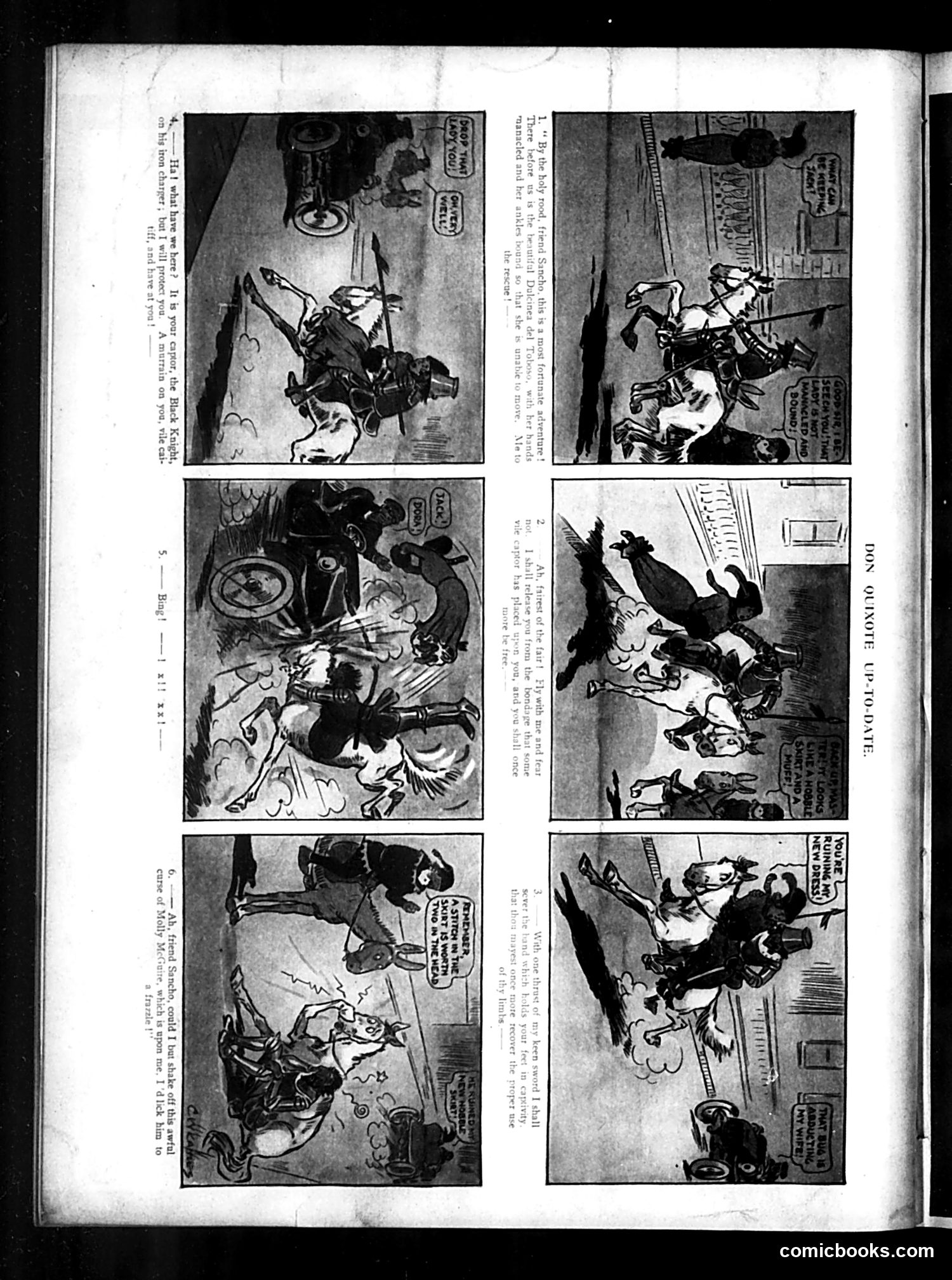
The OCR text is too corrupted to read reliably, making it difficult to identify the specific figures or political references with certainty. However, the page appears to contain multiple comic panels arranged vertically on both left and right sides, rendered in black and white with speech bubbles—typical of Judge magazine's satirical format. The imagery suggests domestic or social comedy scenarios, though without legible captions, I cannot confidently identify which politicians, celebrities, or social figures are being caricatured or what specific events or controversies are being satirized. To accurately explain the satire's target and point to a modern reader would require clearer text or additional contextual information.