
Judge, 1911-01-14 · page 14 of 24
Judge — January 14, 1911 — page 14: what you’re looking at
What you’re looking at
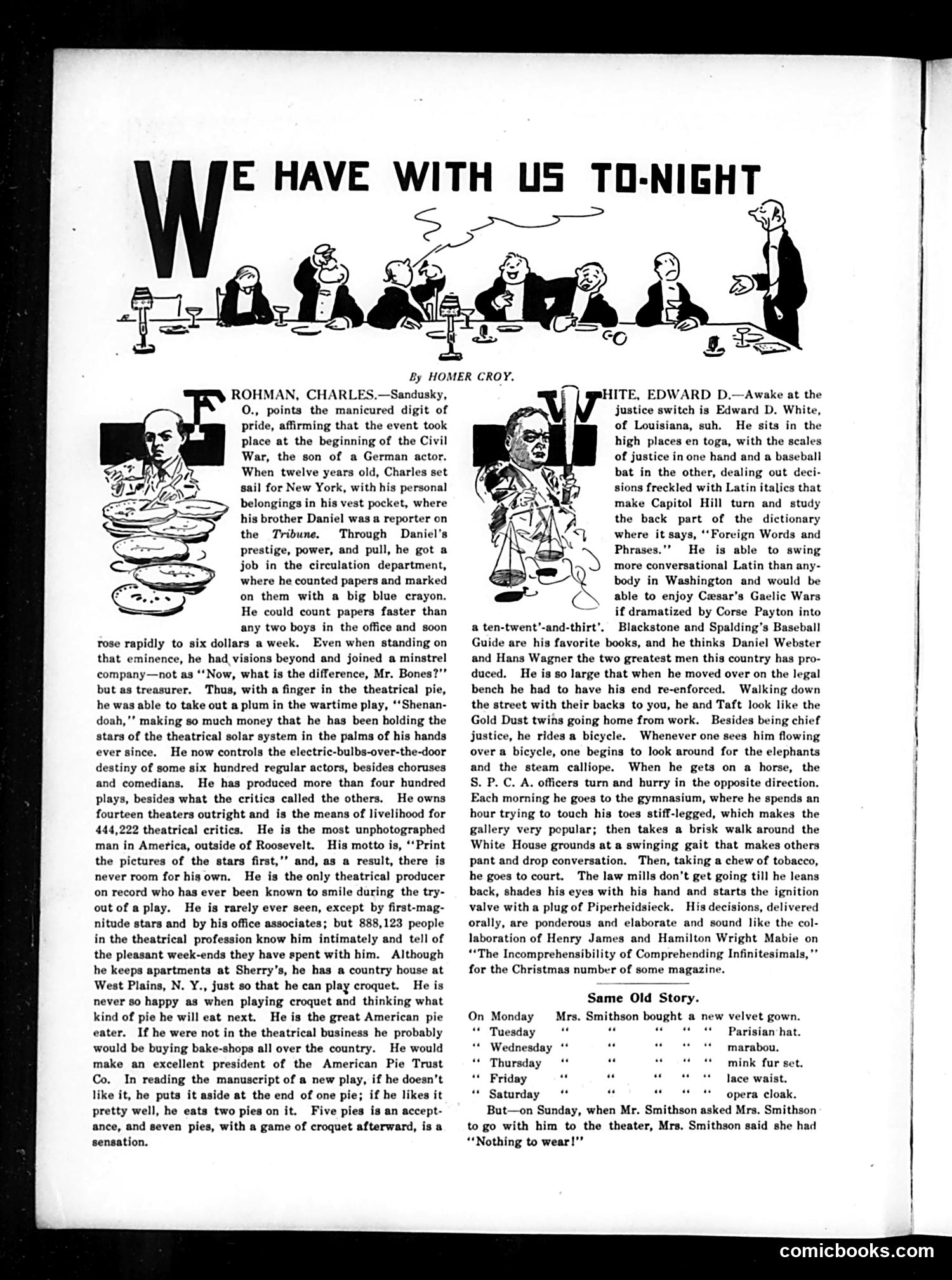
This page from Judge presents humorous biographical sketches of prominent figures by Homer Croy. The header cartoon shows a dinner party scene with caricatured guests. The two main profiles mock: **Charles Frohman** (theater producer): Satirized as an obsessive pie-eater who judges new plays by how many pies he consumes during reading—one pie means rejection, five means acceptance. The joke highlights his legendary reclusivenessand focus on star publicity over his own prominence, while exaggerating his control over theatrical production (claiming he supports 444,222 "theatrical critics"). **Edward D. White** (Chief Justice of the U.S.): Mocked for his massive size, excessive use of Latin phrases in legal opinions, and peculiar hobby of riding a bicycle despite his girth. The "Gold Dust twins" comparison refers to a popular cleaning product advertisement featuring identical figures—suggesting White and President Taft look comically similar from behind. Both sketches use absurdist exaggeration and specific behavioral quirks to create affectionate ridicule of these public figures.
📄 Transcribed text from this page (OCR, searchable)
Machine-transcribed from the original scan — historical spelling and the odd misread are preserved.
ROHMAN, CHARLES.—Sandusky, O., points the manicured digit of pride, affirming that the event took place at the beginning of the Civil War, the son of a German actor. When twelve years old, Charles set sail for New York, with his personal belongings in his vest pocket, where his brother Daniel was a reporter on the Tribune. Through Daniel's prestige, power, and pull, he got a job in the circulation department, where he counted papers and marked on them with a big blue crayon. He could count papers faster than any two boys in the office and soon rose rapidly to six dollars a week. Even when standing on that eminence, he had visions beyond and joined a minstrel company—not as ‘‘Now, what is the difference, Mr. Bones?’’ but as treasurer. Thus, with a finger in the theatrical pie, he was able to take out a plum in the wartime play, ‘‘Shenan- doah,'’ making so much money that he has been holding the stars of the theatrical solar system in the palms of his hands ever since. He now controls the electric-bulbs-over-the-door destiny of some six hundred regular actors, besides choruses and comedians. He has produced more than four hundred plays, besides what the critics called the others. He owns fourteen theaters outright and is the means of livelihood for 444,222 theatrical critics. He is the most unphotographed man in America, outside of Roosevelt. His motto is, ‘‘Print the pictures of the stars first,’’ and, as a result, there is never room for his own. He is the only theatrical producer on record who has ever been known to smile during the try- outofaplay. He is rarely ever seen, except by first-mag- nitude stars and by his office associates; but 888,123 people in the theatrical profession know him intimately and tell of the pleasant week-ends they have spent with him. Although he keeps apartments at Sherry’s, he has a country house at West Plains, N. Y., just so that he can play croquet. He is never so happy as when playing croquet and thinking what kind of pie he will eat next. He is the great American pie eater. If he were not in the theatrical business he probably would be buying bake-shops all over the country. He would make an excellent president of the American Pie Trust Co. In reading the manuscript of a new play, if he doesn’t like it, he puts it aside at the end of one pie; if he likes it pretty well, he eats two pies on it. Five pies is an accept- ance, and seven pies, with a game of croquet afterward, is a E HAVE WITH US TO-NIGHT By HOMER CROY. HITE, EDWARD D.—Awake at the justice switch is Edward D. White, of Louisiana, suh. He sits in the high places en toga, with the scales of justice in one hand and a baseball bat in the other, dealing out deci- sions freckled with Latin italics that make Capitol Hill turn and study the back part of the dictionary where it says, ‘‘Foreign Words and Phrases.” He is able to swing more conversational Latin than any- body in Washington and would be able to enjoy Cwesar’s Gaelic Wars if dramatized by Corse Payton into a ten-twent’-and-thirt’. Blackstone and Spalding’s Baseball Guide are his favorite books, and he thinks Daniel Webster and Hans Wagner the two greatest men this country has pro- duced. He is so large that when he moved over on the legal bench he had to have his end re-enforced. Walking down the street with their backs to you, he and Taft look like the Gold Dust twins going home from work. Besides being chief justice, he rides a bicycle. Whenever one sees him flowing over a bicycle, one begins to look around for the elephants and the steam calliope. When he gets on a horse, the S. P. C. A. officers turn and hurry in the opposite direction. Each morning he goes to the gymnasium, where he spends an hour trying to touch his toes stiff-legged, which makes the gallery very popular; then takes a brisk walk around the White House grounds at a swinging gait that makes others pant and drop conversation. Then, taking a chew of tobacco, he goes to court. The law mills don’t get going till he leans back, shades his eyes with his hand and starts the ignition valve with a plug of Piperheidsieck. His decisions, delivered orally, are ponderous and elaborate and sound like the col- laboration of Henry James and Hamilton Wright Mabie on “The Incomprehensibility of Comprehending Infinitesimals,"’ for the Christmas number of some magazine. Same Old Story. On Monday Mrs. Smithson bought a new velvet gown. “Tuesday =“ “ “4 Parisian hat. “Wednesday ‘ “ “4 marabou. “Thursday “* “ “4 4 mink fur set. “ Friday“ “ “8 tace waist. “Saturday “ “ “© opera cloak. But—on Sunday, when Mr. Smithson asked Mrs. Smithson to go with him to the theater, Mrs. Smithson said she had “Nothing to wear!”” comicbooks.com