
Judge, 1911-01-14 · page 6 of 24
Judge — January 14, 1911 — page 6: what you’re looking at
What you’re looking at
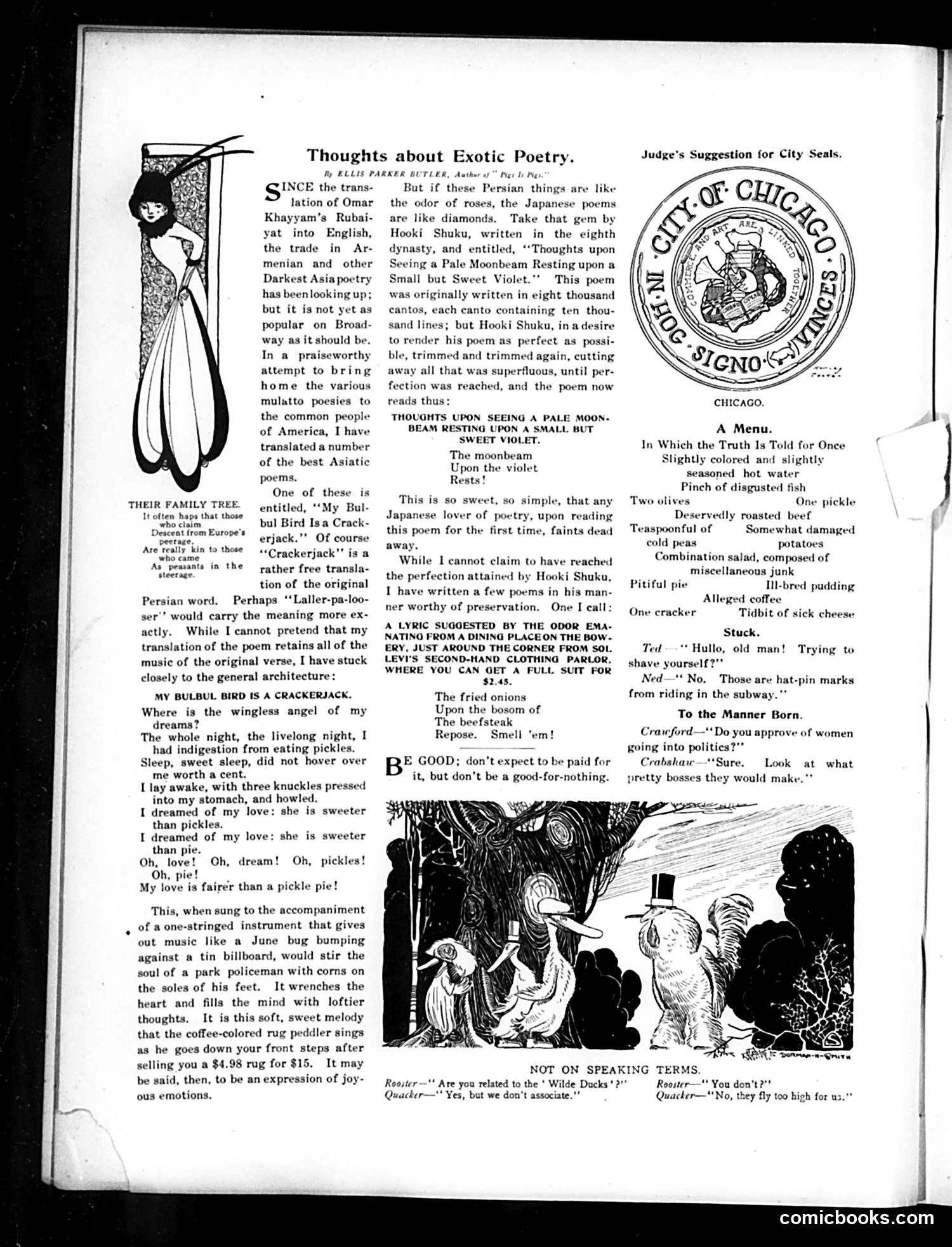
This page satirizes the early 20th-century American fascination with "exotic" Asian poetry—a trend sparked by translations of Persian and Japanese verse. Ellis Parker Butler, a humor writer, mocks this pretension through parody. **The Main Satire:** Butler ridicules Americans' reverent adoption of foreign poetry by creating deliberately absurd "translations." His fake Japanese poem reduces an 8,000-canto work to one line: "The moonbeam / Upon the violet / Rests!" His mock-Persian verse about indigestion from pickles further deflates the genre's perceived profundity. **The Joke:** The piece suggests these exotic poems aren't actually profound—they're just simple observations that Western audiences treat as mysteriously deep because they're foreign. The "Menu" section at right drives this home, listing deliberately terrible restaurant food with the same pretentious language. **Social Context:** This reflects American anxiety about foreign cultural imports and immigrant populations. The reference to a Bowery clothing parlor and dismissive treatment of Asian culture reflects period attitudes. The cartoons (including one about family trees/ancestry) appear to support similar themes about class and cultural pretension, though OCR errors make the exact meaning unclear.
📄 Transcribed text from this page (OCR, searchable)
Machine-transcribed from the original scan — historical spelling and the odd misread are preserved.
SINCE the trans- lation of Omar Khayyam’s Rubai- yat into the trade in Ar- menian and other Darkest Asia poetry has beenlooking up; but it is not yet as popular on Broad- way as it should be. In a_ praiseworthy attempt to bring home the various mulatto poesies to the common people of America, I have translated a number of the best Asiatic poems. One of these is entitled, ‘‘My Bul- bul Bird Isa Crack- erjack.’’ Of course “Crackerjack’’ is a rather free transla- tion of the original Persian word. Perhaps ‘‘Laller-pa-loo- ser’ would carry the meaning more ex- actly. While I cannot pretend that my translation of the poem retains all of the music of the original verse, I have stuck closely to the general architecture: MY BULBUL BIRD IS A CRACKERJACK. Where is the wingless angel of my dreams? The whole night, the livelong night, I had indigestion from eating pickles. Sleep, sweet sleep, did not hover over me worth a cent. I lay awake, with three knuckles pressed into my stomach, and howled. I dreamed of my love: she is sweeter than pickles. THEIR FAMILY TREE. It often haps that those who claim Descent from Europe's peerage. Are really kin to those who came As peasants in the steerage. I dreamed of my love: she is sweeter than pi Oh, love! Oh, dream! Oh, pickles! Oh, | My love is fairer than a pickle pie! This, when sung to the accompaniment of a one-stringed instrument that gives out music like a June bug bumping against a tin billboard, would stir the soul of a park policeman with corns on the soles of his feet. It wrenches the heart and fills the mind with loftier thoughts. It is this soft, sweet melody that the coffee-colored rug peddler sings as he goes down your front steps after selling you a $4.98 rug for $15. It may be said, then, to be an expression of joy- ous emotions. Thoughts about Exotic Poetry. By ELLIS PARKER BUTLER, Authe Desh Pes But if these P the odor of roses, the Japanese poems are like diamonds, Take that gem by Hooki Shuku, written in the eighth dynasty, and entitled, ‘‘Thoughts upon Seeing a Pale Moonbeam Resting upon a Small but Sweet Violet."’ This poem was originally written in eight thousand cantos, each canto containing ten thou- but Hooki Shuku, in a desire to render his poem as perfect as pos ble, trimmed and trimmed again, cutting away all that was superfluous, until per- sian things are like sand line: fection was reached, and the poem now reads thus: THOUGHTS UPON SEEING A PALE MOON. BEAM RESTING UPON A SMALL BUT SWEET VIOLET. The moonbeam Upon the violet Rests! This is so sweet, so simple, that any Japanese lover of poetry, upon reading this poem for the first time, faints dead awa: While I cannot claim to have reached the perfection attained by Hooki Shuku, I have written a few poems in his man- ner worthy of preservation. One I call: A LYRIC SUGGESTED BY THE ODOR EMA- NATING FROM A DINING PLACE ON THE BOW- ERY, JUST AROUND THE CORNER FROM SOL. LEVI'S SECOND-HAND CLOTHING PARLOR, WHERE YOU CAN GET A FULL SUIT FOR $2.48. The fried onions Upon the bosom of The beefsteak Repose. Smell ’ mi! E GOOD; don't expect to be paid for it, but don’t be a good-for-nothing. Judge's Suggestion for City Seals. CHICAGO. A Menu. In Which the Truth Is Told for Once Slightly colored and slightly seasoned hot water Pinch of disgusted fish Two olives One pickle Deservedly roasted beef Teaspoonful of Somewhat damaged cold peas potatoes Combination salad, composed of miscellaneous junk Ill-bred pudding Alleged coff. Tidbit of sick cheese Stuck. Ted -** Hullo, old man! Trying to shave yourself?" ved—‘* No. Those are hat-pin marks from riding in the subway.”* Pitiful pie One cracker To the Manner Born. Crawford—"Do you approve of women going into politics? Crabshaw—*Sure. Look at what pretty bosses they would ma NA I Detman-n-Grer en, NOT ON SPEAKING TERMS. Yes, but we don’t associate.’’ Are you related to the ‘ Wilde Ducks’ ?"’ Rooster—"* You don't?” Quacker—"*No, they fly too high for u comicbooks.com