
A complete issue · 16 pages · 1910
Judge — June 4, 1910
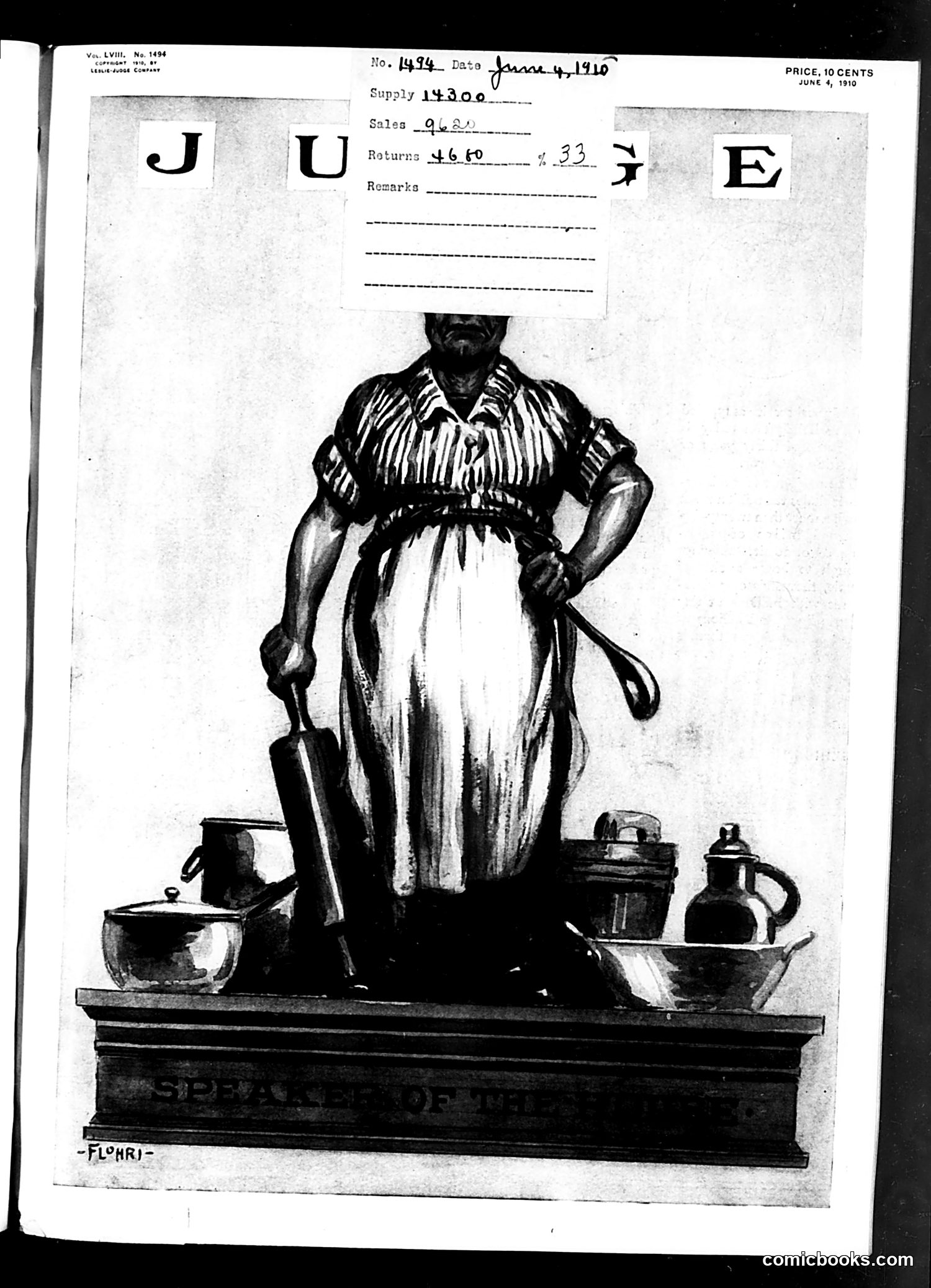
This appears to be a Judge magazine cover from June 4, 1910. The illustration depicts a woman in classical allegorical style—standing on a pedestal in domestic servant attire, surrounded by cooking implements and household items. The letters "JUDE" are visible at top, likely incomplete text. The figure represents "Justice" or a similar virtue, rendered as a domestic worker rather than the traditional blindfolded classical goddess. This likely satirizes contemporary debates about labor, domestic service, or women's roles in early 20th-century America. The contrast between noble allegorical tradition and mundane domestic labor serves as social commentary, though the specific political target remains unclear without additional context about June 1910 events.
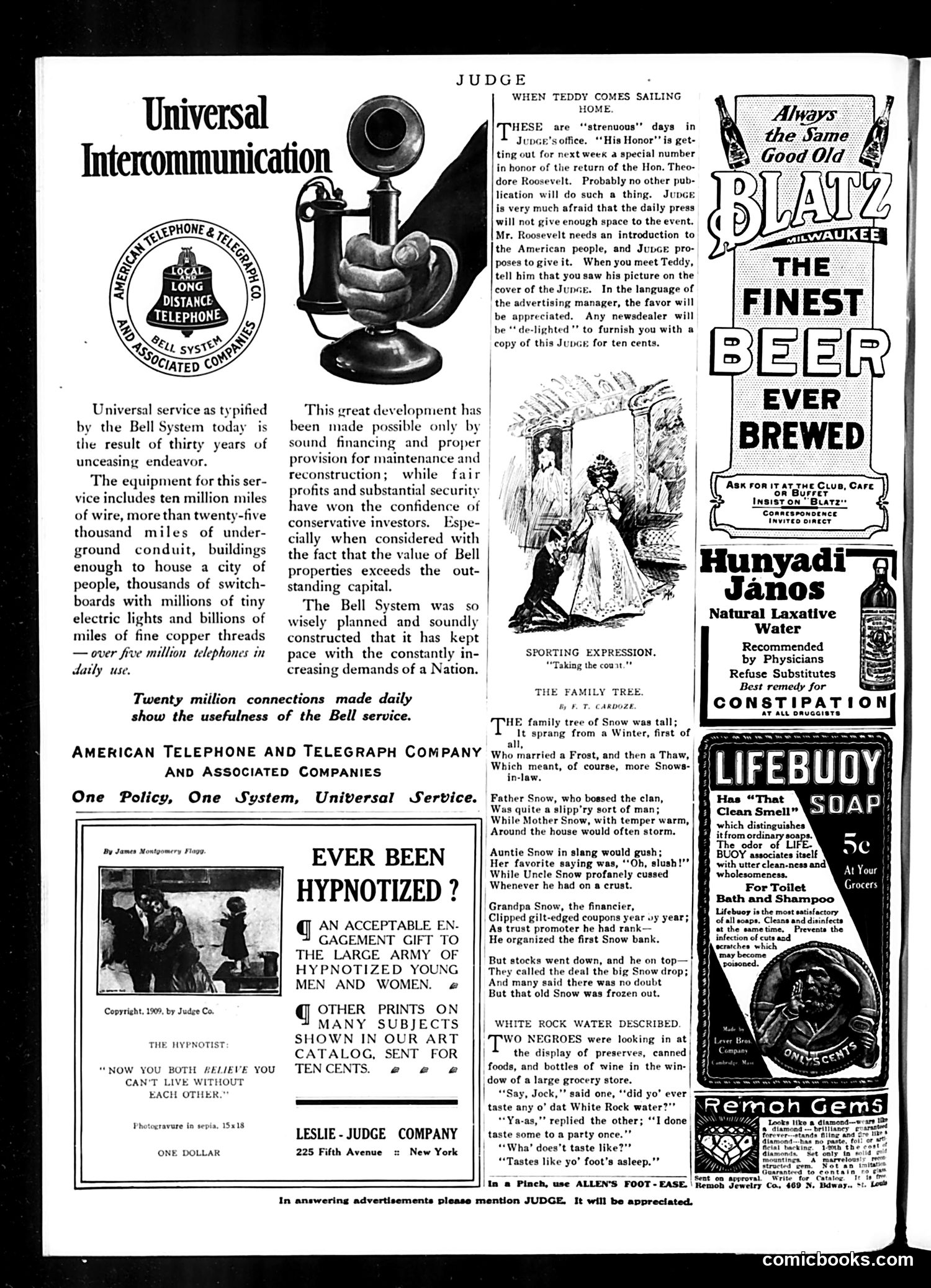
This page is primarily **advertising and editorial content** rather than political satire. The main cartoon titled "EVER BEEN HYPNOTIZED?" depicts a hypnotist performing for an audience, with the caption explaining it's an "acceptable engagement gift to the large army of hypnotized young men and women." This appears to be **social satire about romance and courtship**—suggesting young people are so entranced by romance they're effectively "hypnotized." The remainder of the page consists of various advertisements (Blatz Beer, Lifebuoy Soap, Hunyadi János laxative water) and a poem called "The Family Tree" by F.T. Cardige about various relatives nicknamed after snow. The hypnotism reference likely plays on early-1900s fascination with mesmerism as both scientific novelty and popular entertainment, humorously applied to matters of the heart.
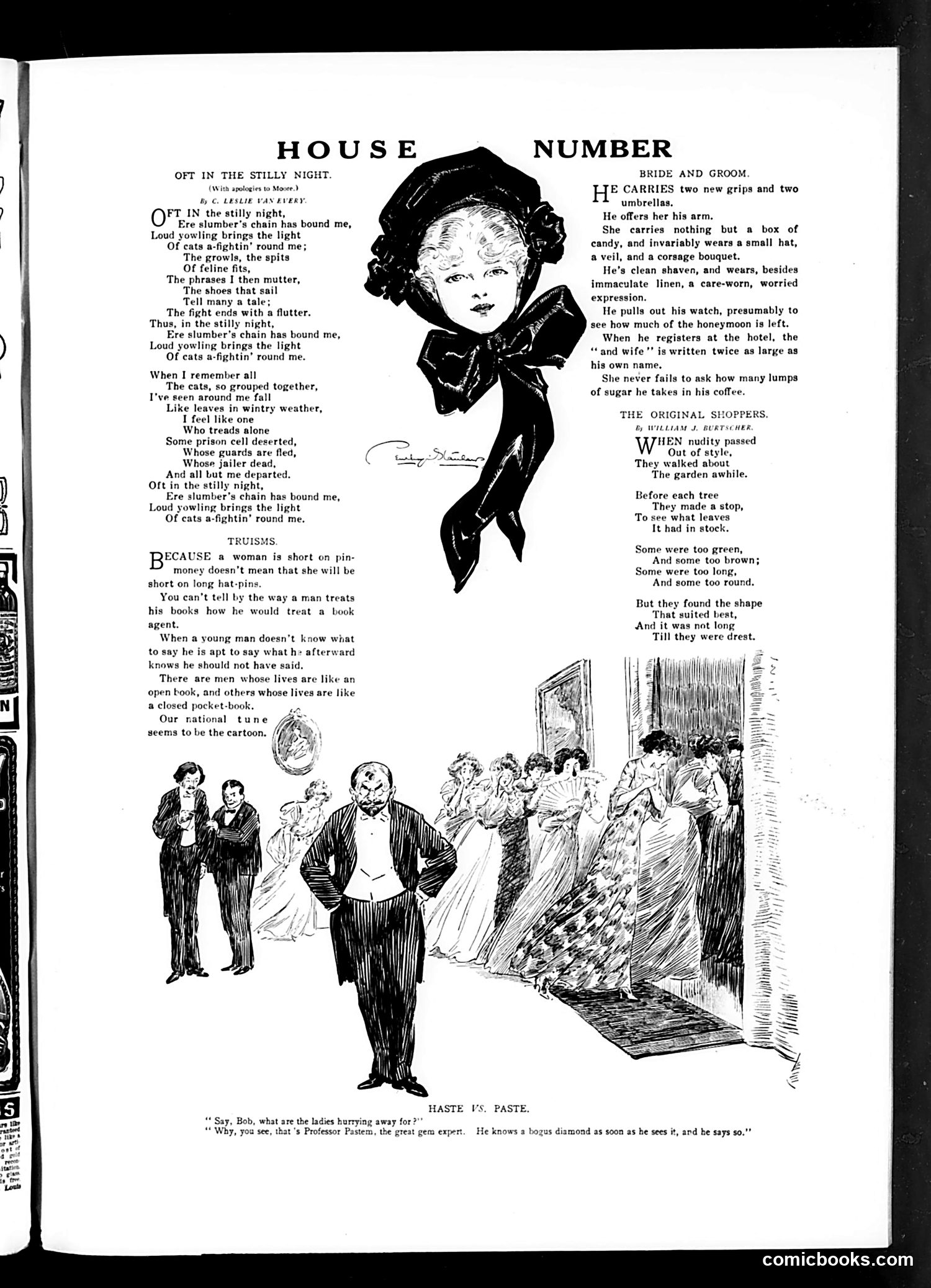
This page contains three literary pieces and illustrations unrelated to politics. **"Off in the Stilly Night"** is a melancholic poem about memories and loss, accompanied by an illustration of a woman's face in profile. **"Truisms"** offers philosophical observations about human nature, money, and character—general social commentary rather than political satire. **"Bride and Groom"** humorously describes a newlywed couple and their modest circumstances. **"The Original Shoppers"** is a whimsical poem about window shoppers, illustrated with a sketch of people examining store displays. The bottom illustration, "Haste Is Paste," appears to be a social scene with a caption referencing Professor Padern and a "boxed diamond"—likely a humorous anecdote about deception or hasty judgment. This page focuses on light humor and verse rather than political commentary.
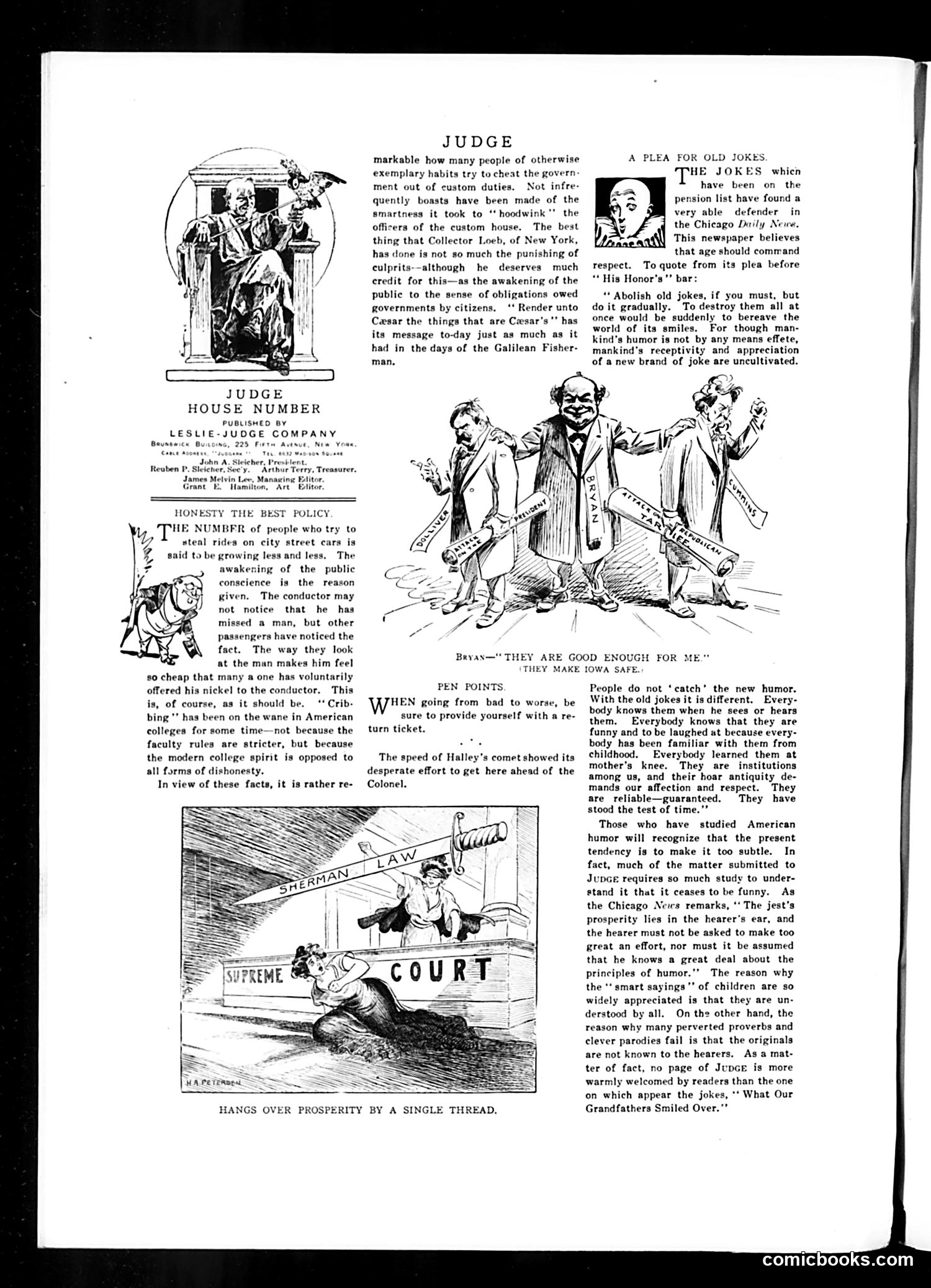
This page satirizes American judicial and political figures circa early 1900s. The main cartoon "Hangs Over Prosperity by a Single Thread" depicts the Supreme Court as precarious—a figure representing the court system stands on one leg while "Law" and "Sherman" (likely referencing the Sherman Antitrust Act) dangle above like a sword. This suggests anxieties about legal frameworks' fragility regarding monopolies and corporate power. The accompanying article "A Plea for Old Jokes" argues that established humor—particularly judicial anecdotes—deserves respect as cultural institutions. The three caricatured figures above appear to represent political/judicial personalities of the era, though specific identities are unclear from the image alone. The overall theme critiques both legal uncertainty and attempts to modernize humor.
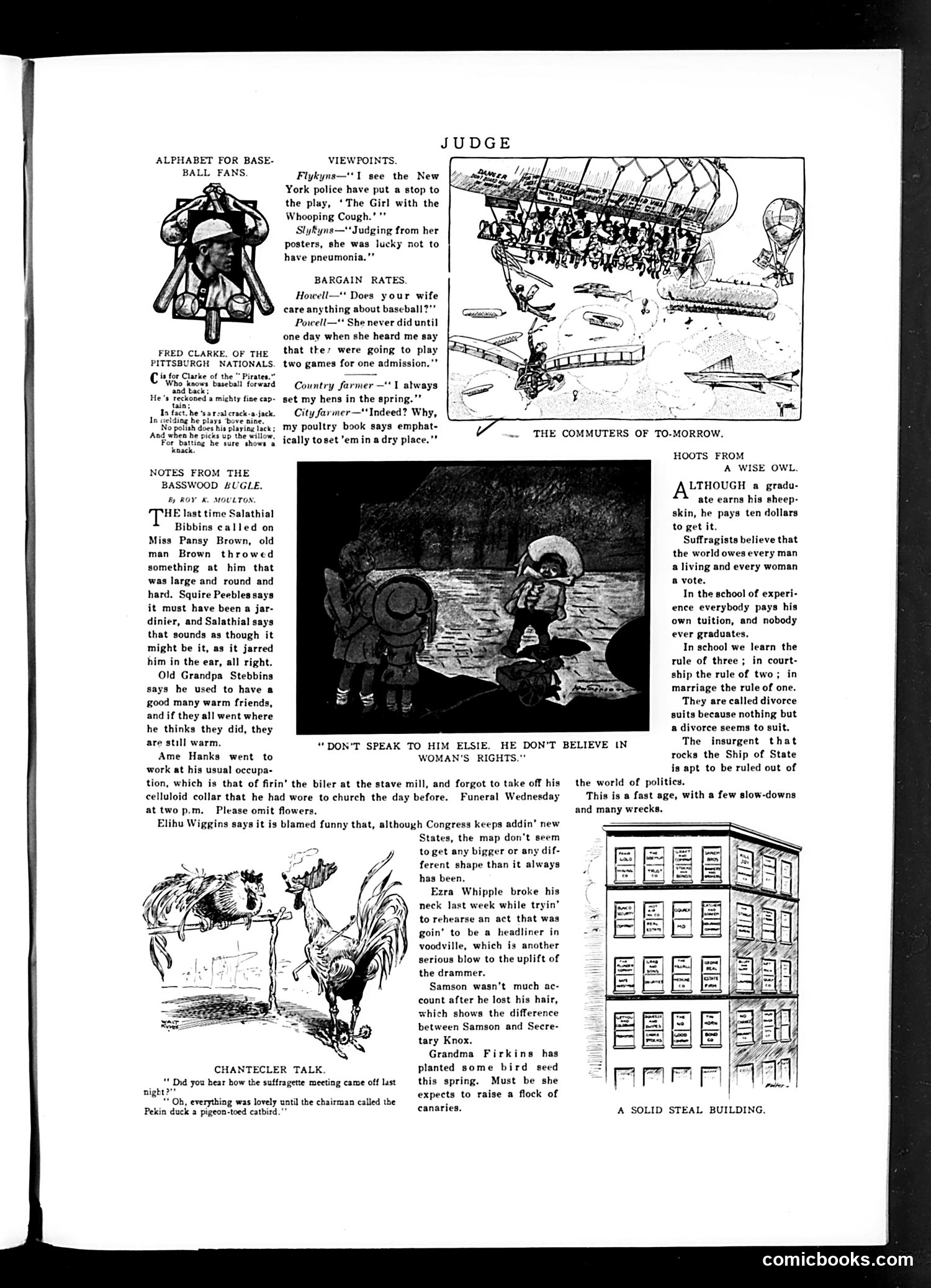
This page combines humor columns with satirical cartoons. The main cartoon shows two figures in what appears to be a domestic scene, captioned "DON'T SPEAK TO HIM ELSIE. HE DON'T BELIEVE IN WOMAN'S RIGHTS." The satire targets anti-suffrage attitudes—mocking men who oppose women's voting rights by depicting a man so committed to the position that he won't even speak to someone who disagrees. The humor lies in the absurdity of his rigid stance affecting his own household. The page also includes period anecdotes ("Notes from the Basswood Bugle," "Chanticleer Talk") poking fun at rural life and politics, plus an illustration labeled "A Solid Steel Building" promoting modern architecture. The overall content reflects early 20th-century debates over women's suffrage and modernization.
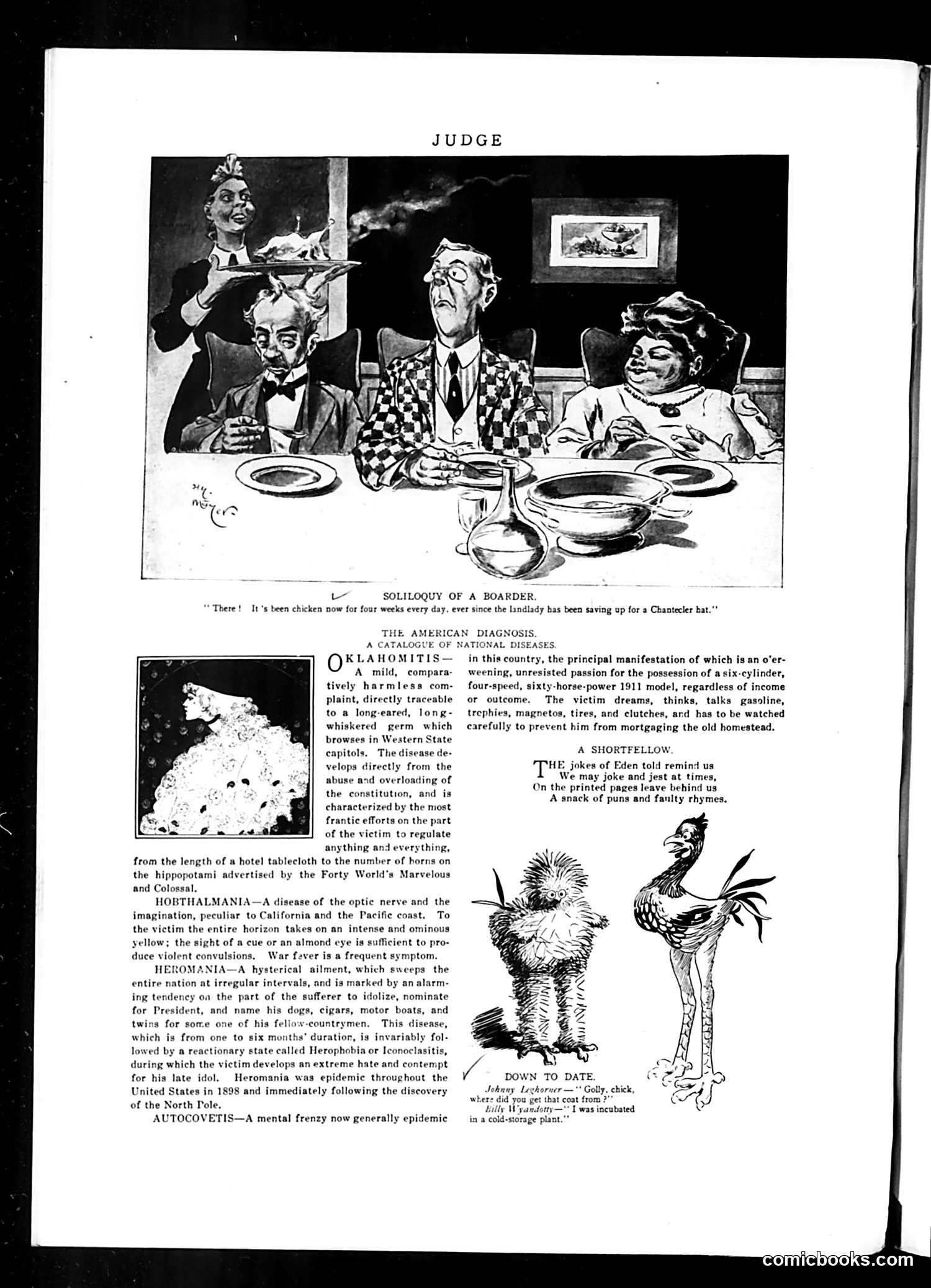
The top cartoon mocks a boarding house landlady's penny-pinching: she's served chicken daily for four weeks to save money for a fashionable "Chanticleer hat" (referencing the rooster, playing on the chicken theme). The joke satirizes working-class aspirations to high fashion at the expense of boarders' quality of life. The lower section, "The American Diagnosis," is satirical pseudo-medical commentary on national foibles. "Klahomitis" mocks Oklahoma politics and constitutional overreach; "Xanthalmia" appears to reference anti-Asian sentiment on the Pacific Coast; "Heromania" satirizes Americans' tendency to obsessively idolize public figures (citing 1898 and North Pole discovery), followed by swift disillusionment; "Autocovetis" ridicules the 1911 automobile craze's hold over Americans regardless of financial capacity. The bottom illustrations joke about artificial food production ("cold-storage" chicken), reflecting early 20th-century anxieties about industrial food manufacturing and its separation from natural processes.
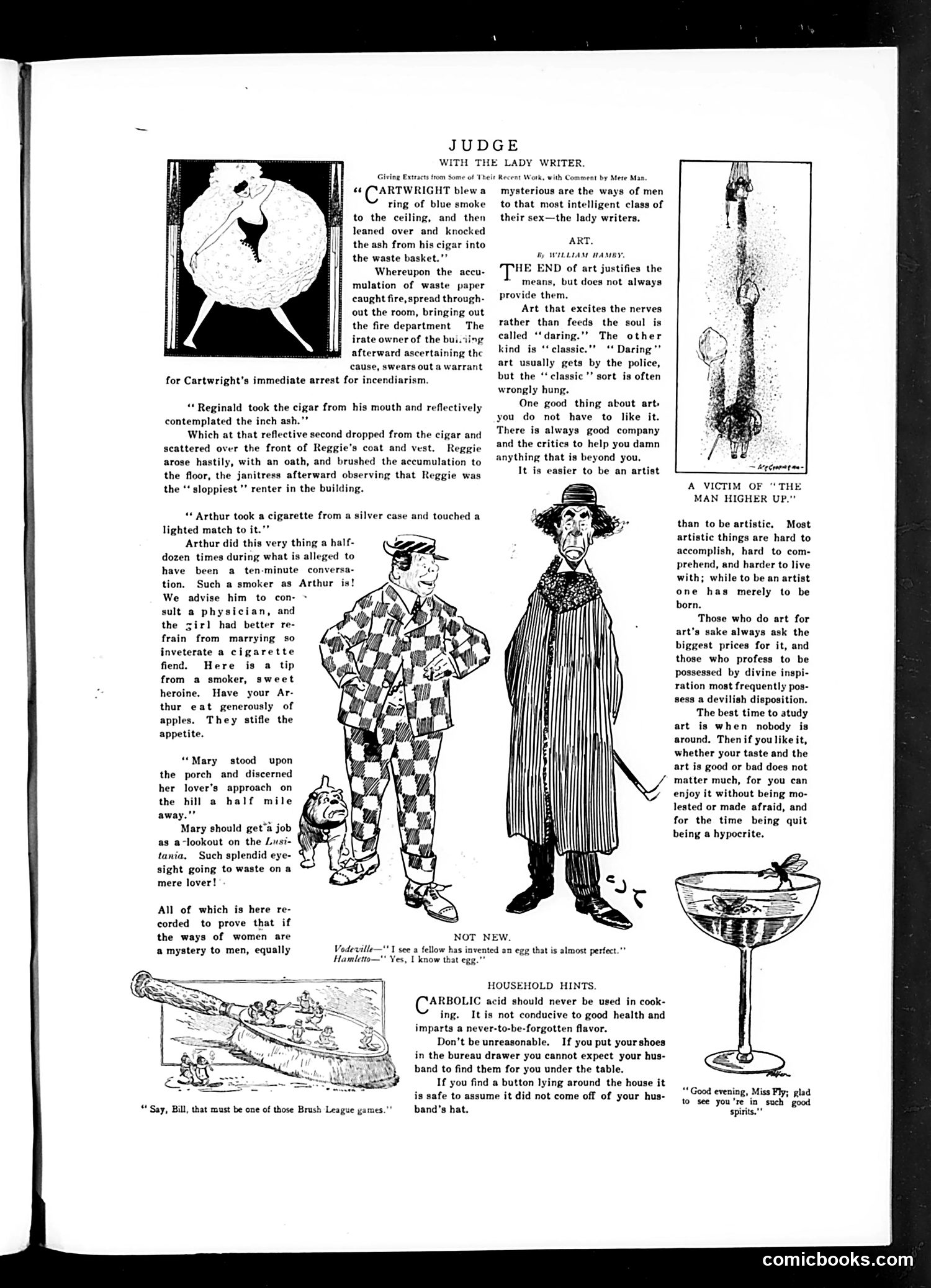
This page satirizes female writers' implausible fictional details. The main article mocks women authors for creating absurd scenarios—characters carelessly dropping cigar ash that starts fires, smoking constantly during conversations, or possessing implausibly keen eyesight. The satire suggests these writers lack realism and practical knowledge of how the world actually works. The accompanying essay on "Art" by William Hamby discusses artistic pretension more broadly, distinguishing between genuine art and mere "artistic" posturing. It critiques those who claim divine inspiration while displaying difficult temperaments, and those who affect taste they don't genuinely possess. The "Household Hints" section continues the gentle mockery of domestic life, offering common-sense advice presented as if addressing foolish assumptions. Overall, this represents early 20th-century *Judge* magazine's typical satirical approach: poking fun at contemporary social affectations, particularly targeting women's literary aspirations and artistic pretension through humor based on observed human foibles.
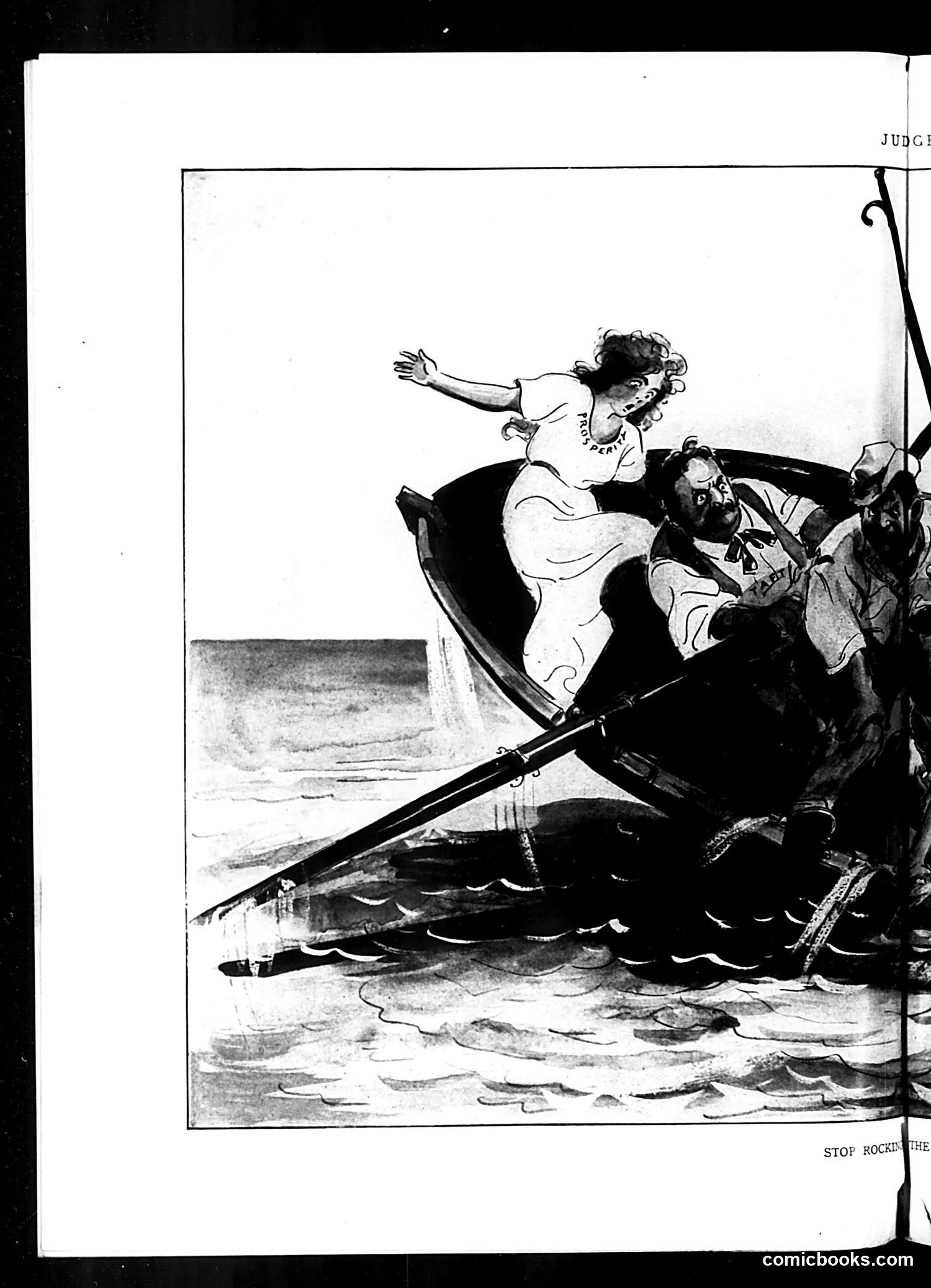
This appears to be a satirical illustration from *Judge* magazine featuring a woman in a boat with several men. The woman is gesturing dramatically while seated in what looks like a gondola or small vessel on water. The partial text "STOP ROCKI[NG]" at the bottom suggests the cartoon's joke concerns someone (likely the woman) asking the men to stop rocking the boat—a common idiom meaning "don't cause trouble" or "don't disrupt the status quo." Without a clear date or full caption, the specific political or social target is unclear. However, the image likely satirizes either a woman attempting to maintain control in a male-dominated situation, or commentary on gender dynamics and authority. The dramatic gesture and theatrical composition suggest mockery of someone's attempt to assert control or demand compliance.
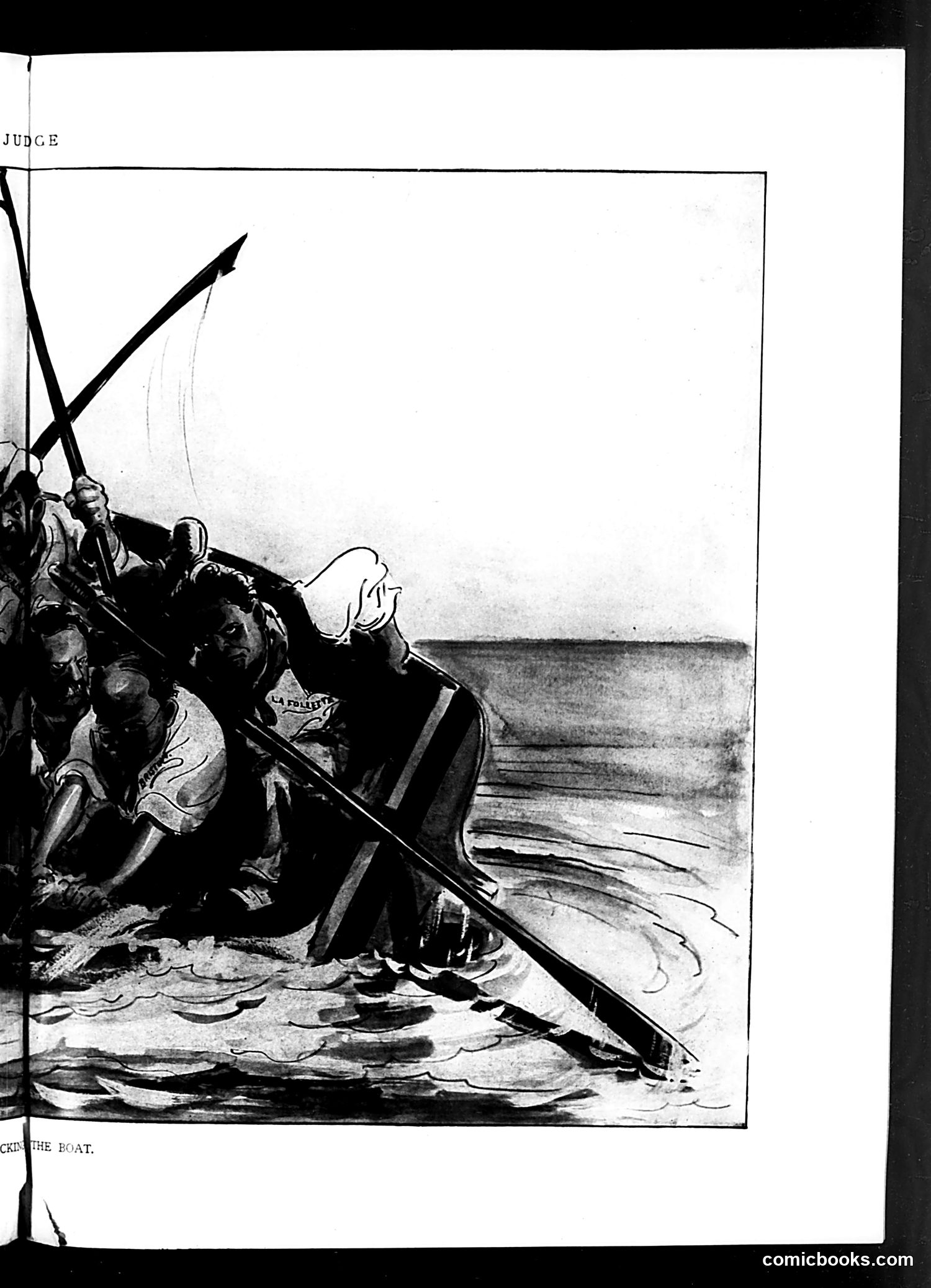
This political cartoon from *Judge* magazine depicts figures in a boat on water, with one figure appearing to rock or destabilize it—literally and figuratively. The title "Rock the Boat" is a common idiom meaning to create trouble or disruption. The cartoon likely satirizes political or social agitation during a period of instability. The figures' military or formal dress and the dramatic gesturing suggest this concerns leadership or authority figures causing upheaval. The boat metaphor represents the state or social order being threatened by reckless action. Without the publication date visible, the specific political event remains unclear, but the imagery suggests criticism of disruptive political behavior or revolutionary activity that endangered the established system.
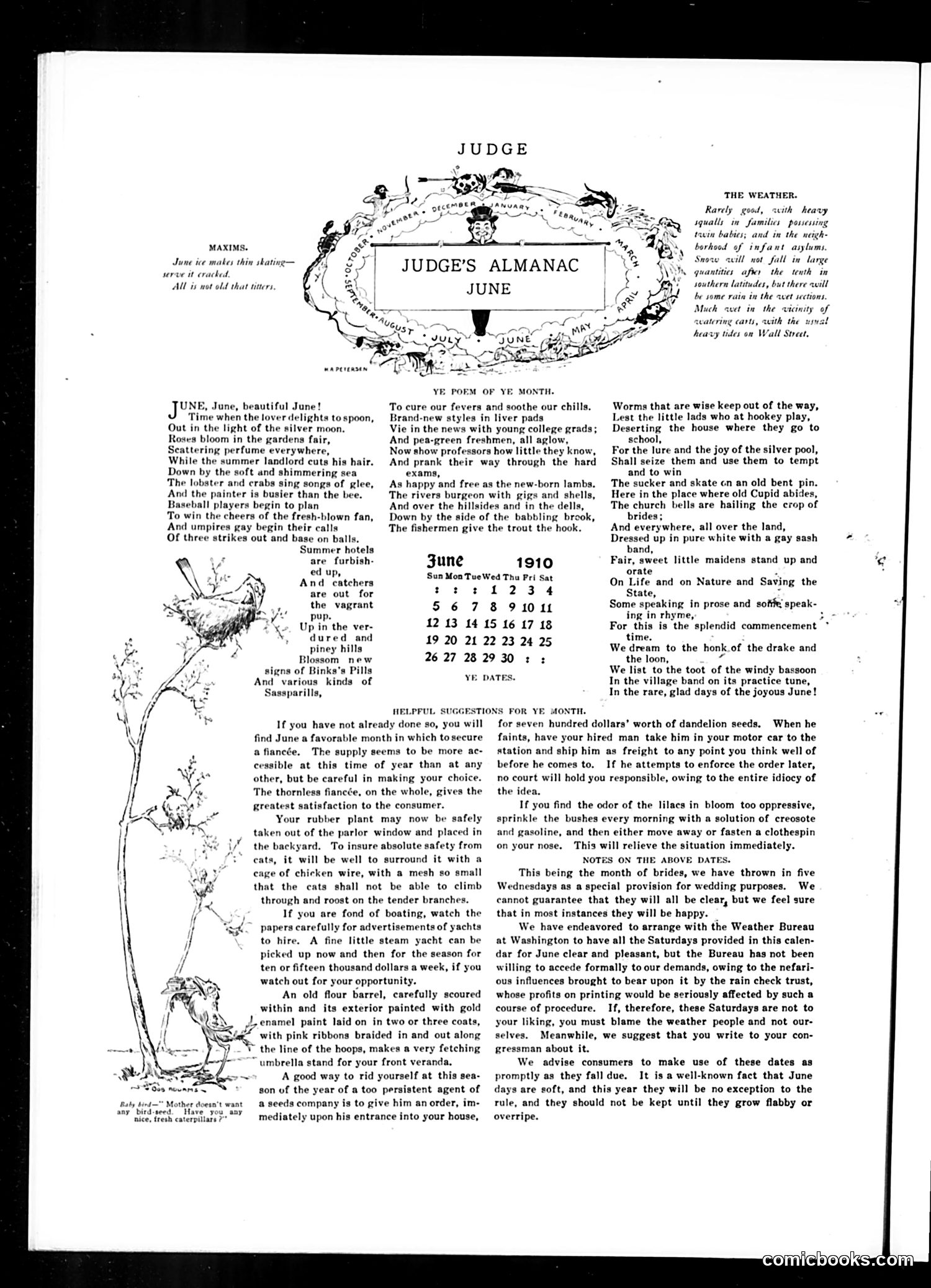
This is primarily a **calendar and lifestyle advice page** rather than political satire. The page centers on June 1910, featuring: **Main Content:** - Decorative calendar header with illustrated border - "Maxims" (humorous aphorisms) - Poem celebrating June's pleasures (romance, baseball, fishing) - "Helpful Suggestions for Ye Month" — satirical domestic advice **The Satire:** The humor targets **upper-middle-class consumer culture** and courtship rituals. Jokes include: - Finding a fiancée as a "consumer good" (preferring "thornless" varieties) - Absurd home décor tips (gold-painted flour barrels as umbrella stands) - Yacht rentals at "$15,000 a week" - Protecting rubber plants from cats with chicken wire **Weather forecast** mockingly references Wall Street's "heavy tides." The page reflects **Edwardian-era attitudes**: leisured summer activities, marriage as commerce, and genteel anxieties about servants and pests. It's lighthearted social commentary on affluent American leisure, not political critique.
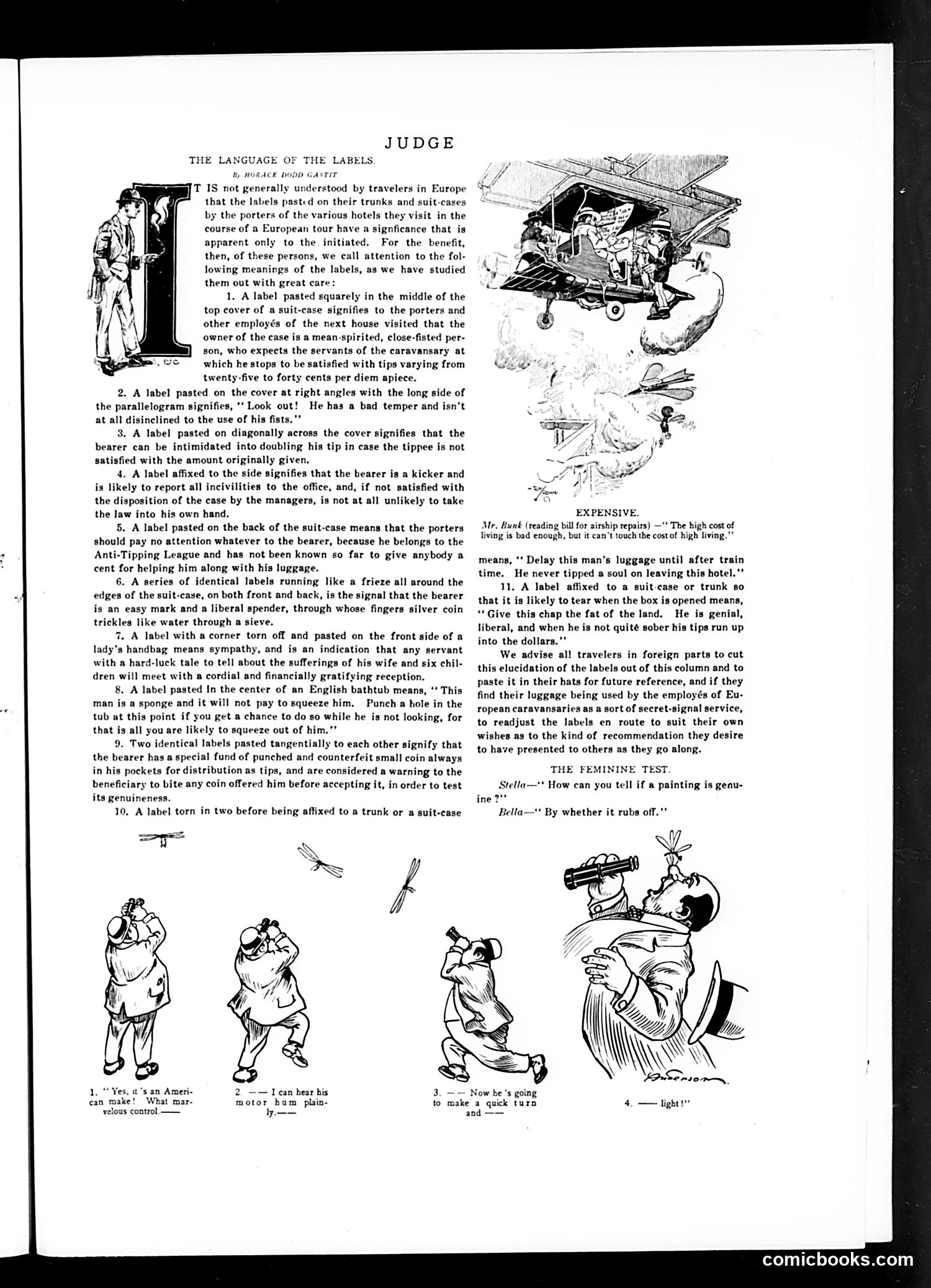
This article satirizes the supposedly sophisticated codes that European hotel porters allegedly used to read luggage labels and determine how to treat guests. By Horace Dodd Gaunt, it humorously decodes ten label placements as signals indicating each traveler's generosity (or stinginess), temperament, and trustworthiness. The joke targets American tourists abroad, mocking their assumption that porters operated by mysterious "continental" rules. Each label position allegedly broadcasts the guest's character—a centered label means cheap; a diagonal one means easily intimidated; multiple labels mean lavish spending. The accompanying cartoons show travelers with various luggage mishaps, reinforcing the satire's implicit message: American travelers are comically naive about European customs and easily exploited. The "Expensive" cartoon panel adds commentary on wasteful spending among the wealthy. The satire playfully suggests that what tourists interpret as sophisticated European hotel culture is actually just porters reading transparent signals about who to bilk.
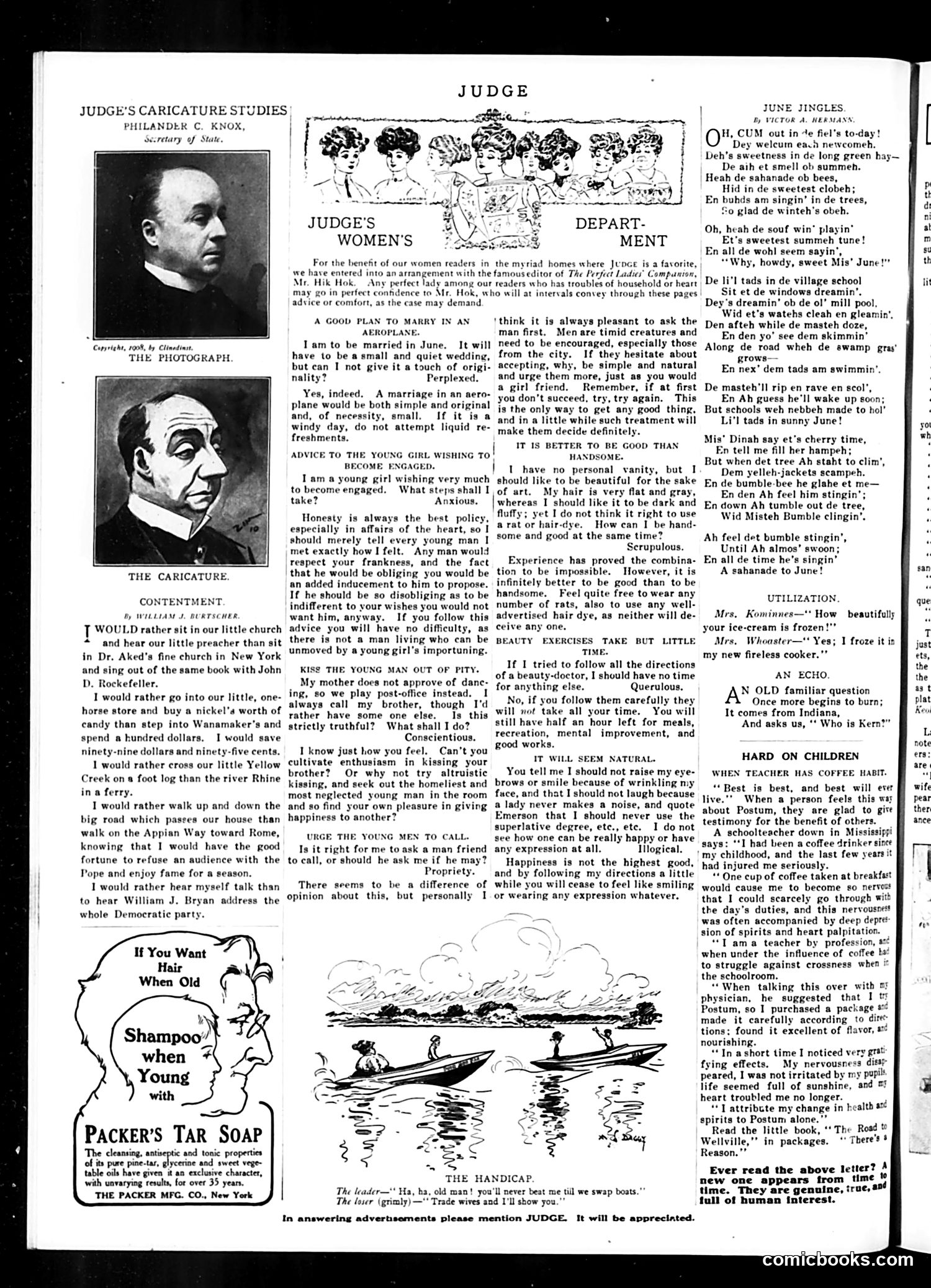
This page from Judge (circa 1908) contains several elements: **Main Content:** "Judge's Women's Department" advice column, supposedly written by "Mr. Hik Hok," editor of *The Perfect Ladies' Companion*. The satire is straightforward—the advice given is deliberately terrible, mocking both advice columns and the pretensions of women's magazines. For example, girls are told to pursue men aggressively, kiss reluctant brothers enthusiastically, and marry in aeroplanes. **Caricature Studies:** At top left are sketch studies of Philander C. Knox, Secretary of State, contrasting his photograph with a caricature. **"Contentment" Poem:** Celebrates small-town American simplicity over urban wealth—rejecting Rockefeller's church, Wanamaker's stores, and even meeting the Pope. **Advertising:** Packer's Tar Soap ad (bottom). **The Joke:** The entire women's department parodies the era's earnest ladies' magazines by offering hilariously bad guidance, mocking both the format and contemporary attitudes toward courtship and female behavior.
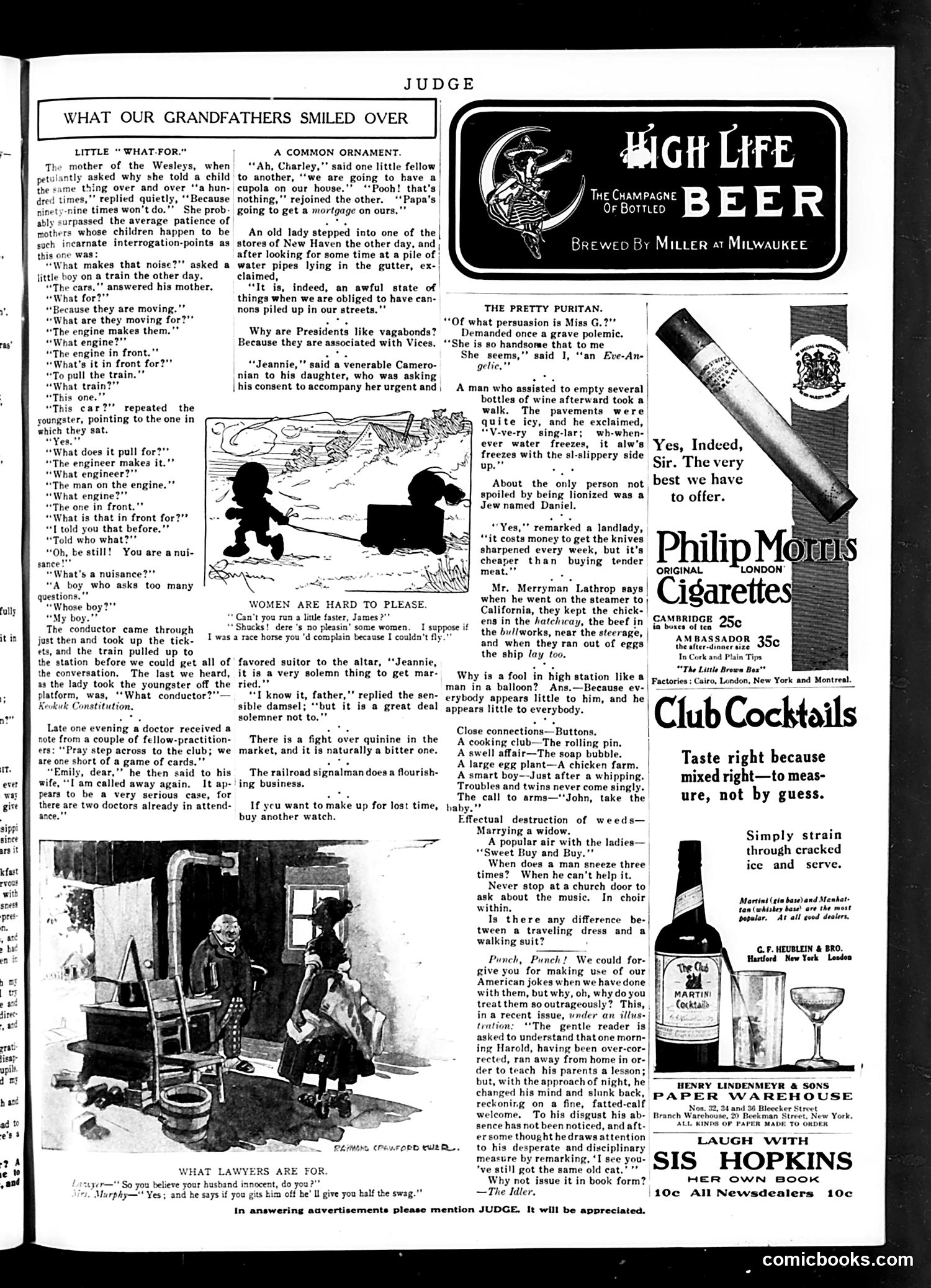
This page from the satirical magazine **Judge** contains several humorous anecdotes and advertisements typical of early 20th-century American humor. ## Main Cartoons/Content: **"Little 'What-For'"** depicts a relentless child pestering his mother with endless "why" questions during a train ride—a timeless joke about parental patience that satirizes both childhood curiosity and adult exasperation. **"Women Are Hard to Please"** features a carriage driver frustrated with a female passenger's constant complaints, mocking women as perpetually dissatisfied—reflecting period stereotypes about women as unreasonable. **"What Lawyers Are For"** presents a dark joke: a woman believes her husband innocent but expects he'll share stolen goods ("swag") if acquitted, suggesting lawyers defend criminals for profit. The page also includes scattered one-liners mocking Presidents as vagabonds, mortgages as "common ornaments," and ethnic stereotypes (the Cameronian father, the Jewish man named Daniel). **The advertisements** (High Life Beer, Philip Morris cigarettes, Club Cocktails) are period appropriate but unremarkable. The humor relies on class consciousness, gender stereotypes, and casual ethnic mockery typical of the era.
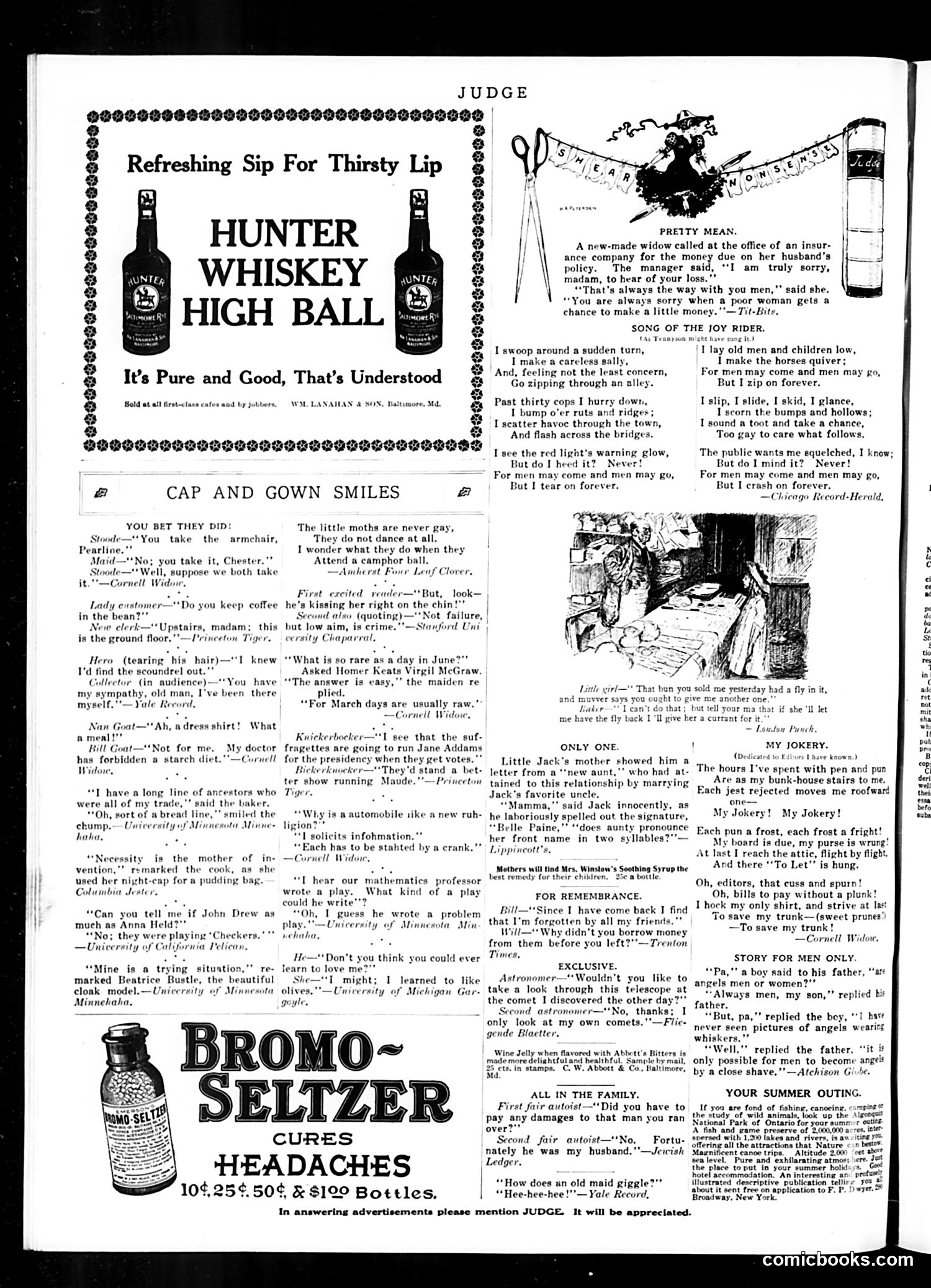
This page is primarily **advertising and humor content** rather than political satire. The main elements are: **Advertisements:** - Hunter Whiskey dominates the upper left with a standard product pitch - Bromo-Seltzer ad at bottom promotes headache relief **Humor Sections:** "Cap and Gown Smiles" collects college newspaper jokes from universities like Princeton, Cornell, and Michigan. These are light campus humor—puns about coffee "in the bean," romantic misunderstandings, and wordplay. **Satirical Content:** The "Song of the Joy Rider" parodies Tennyson to mock reckless automobile drivers who endanger pedestrians and ignore police, presenting dangerous driving as a cavalier trend. "Pretty Mean" briefly satirizes a widow exploiting insurance claims. The page reflects early 1900s concerns: dangerous new automobiles and their operators, college culture, and insurance fraud—but these are light social commentary rather than serious political critique.
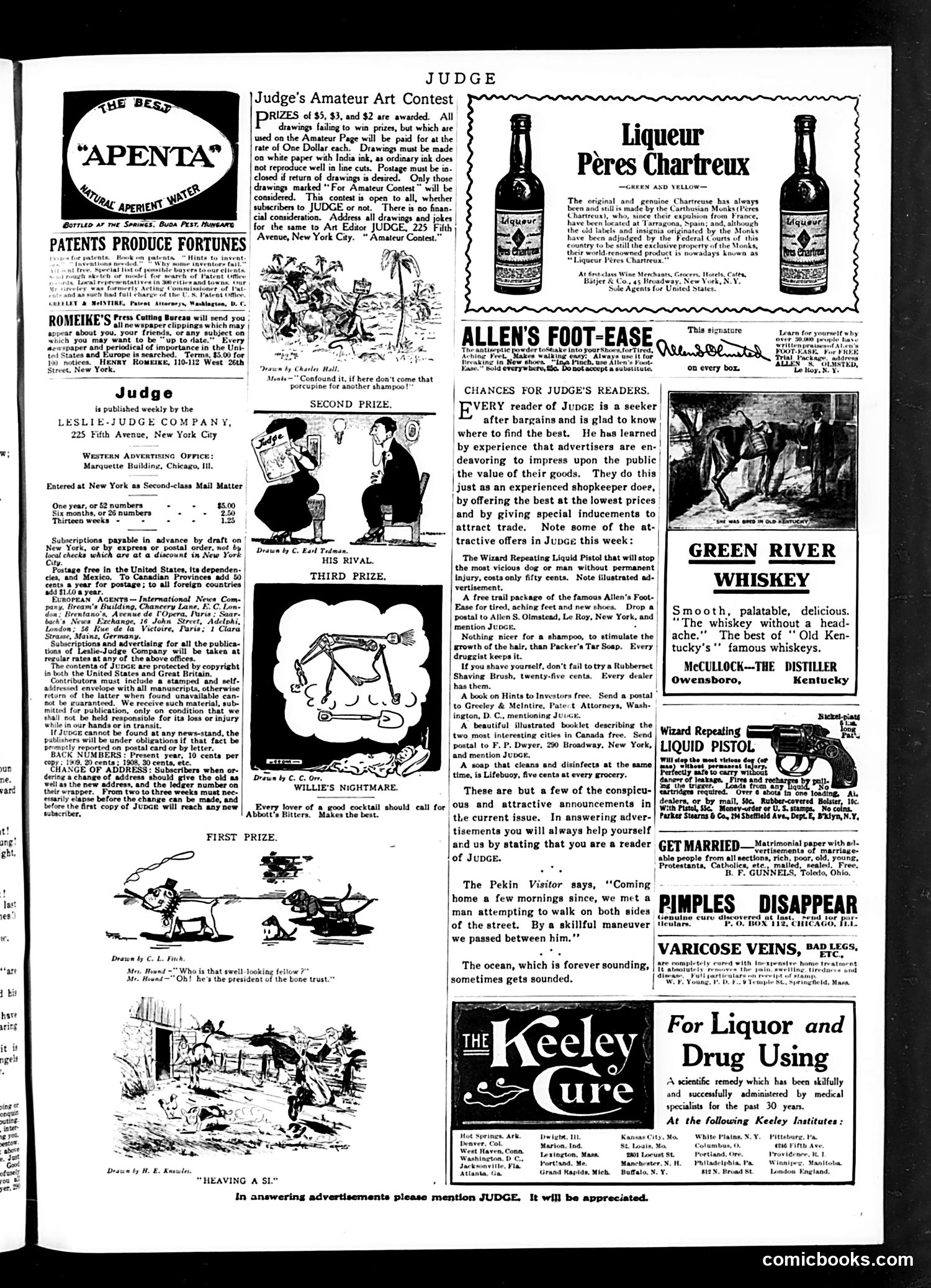
This page is primarily an **amateur art contest announcement** with accompanying cartoons and advertisements—typical editorial content for Judge, a satirical weekly magazine. ## The Contest Cartoons Three amateur-submitted drawings illustrate various jokes: one depicts a man attempting to walk on both sides of a street simultaneously (captioned about "the bone trust president"); another shows a figure's nightmare involving what appears to be household objects or animals in surreal juxtaposition; a third presents a domestic scene with rival figures. The humor is gentle, domestic satire typical of early-20th-century American magazines—relying on visual absurdity and wordplay rather than sharp political commentary. ## The Advertisements The page features liqueur, whiskey, foot-ease products, and a matrimonial service—standard commercial fare for the era. Notably, "The Keeley Cure" advertises treatment for "liquor and drug using" at various institutes, reflecting Progressive-era concern with addiction and institutional remedies. ## Context for Modern Readers This reflects Judge's dual nature: a platform for amateur comic artists alongside commercial advertising. The gentle domestic humor and remedial product ads reveal early-1900s American anxieties about health, marriage, and substance abuse.
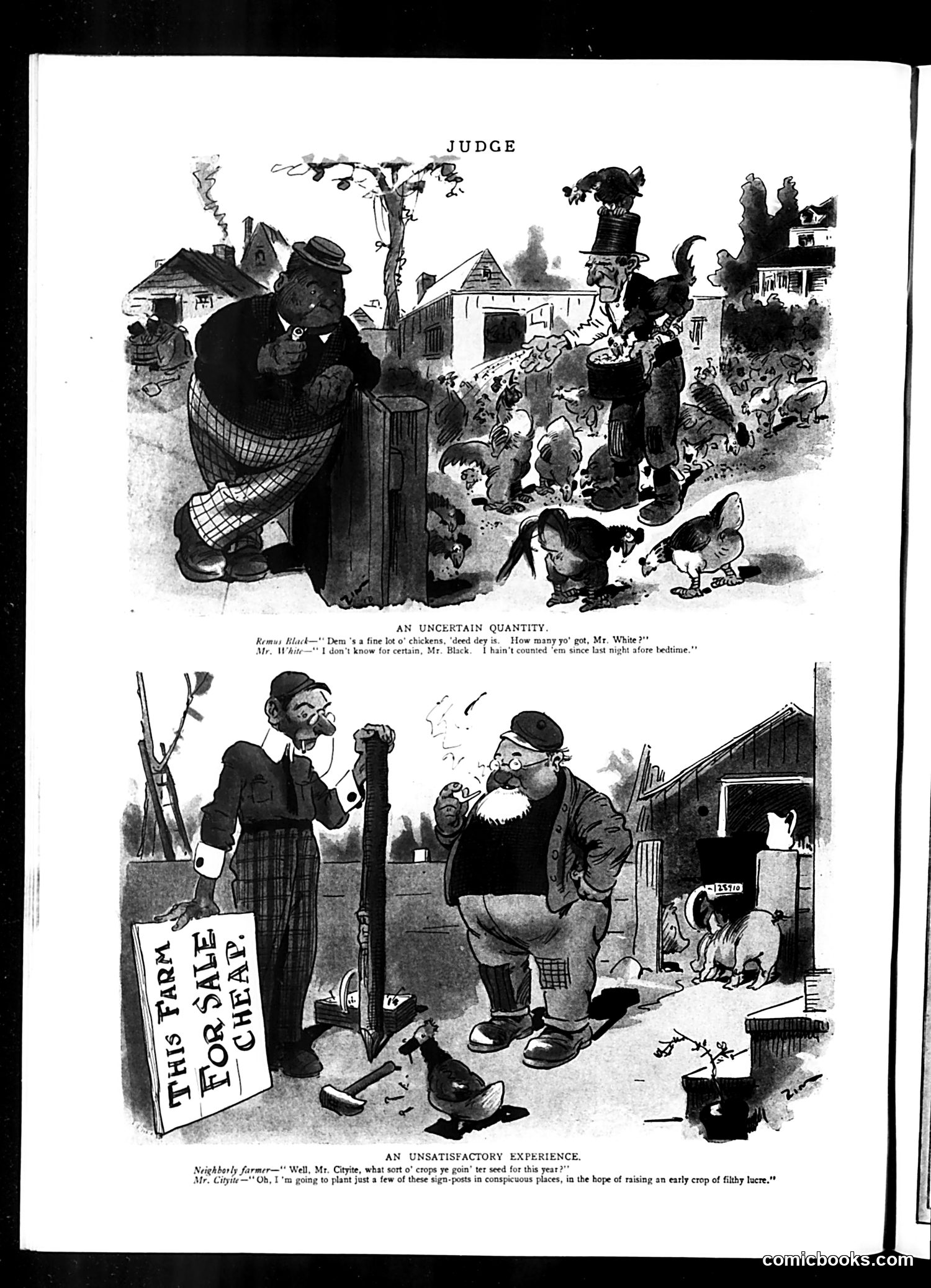
This page contains two separate cartoons mocking rural and urban figures through racial and class stereotypes typical of late 19th/early 20th-century American humor. **Top cartoon** ("An Uncertain Quantity"): Features a Black farmer (Remus Black) asking a white farmer (Mr. White) about his chicken count. The joke plays on the stereotype of rural incompetence—Mr. White hasn't counted his chickens since bedtime, suggesting carelessness or dim-wittedness. **Bottom cartoon** ("An Unsatisfactory Experience"): A city dweller ("Mr. Cityite") tells a rural farmer he plans to plant "sign-posts" to harvest "filthy lucre" (money). The satire mocks urban greed and get-rich-quick schemes, portraying the city man as dishonest and the farmer as bewildered by such schemes. Both cartoons trade in period stereotypes—rural ignorance and urban corruption—typical of Judge's social commentary.