
Judge, 1910-06-04 · page 4 of 16
Judge — June 4, 1910 — page 4: what you’re looking at
What you’re looking at
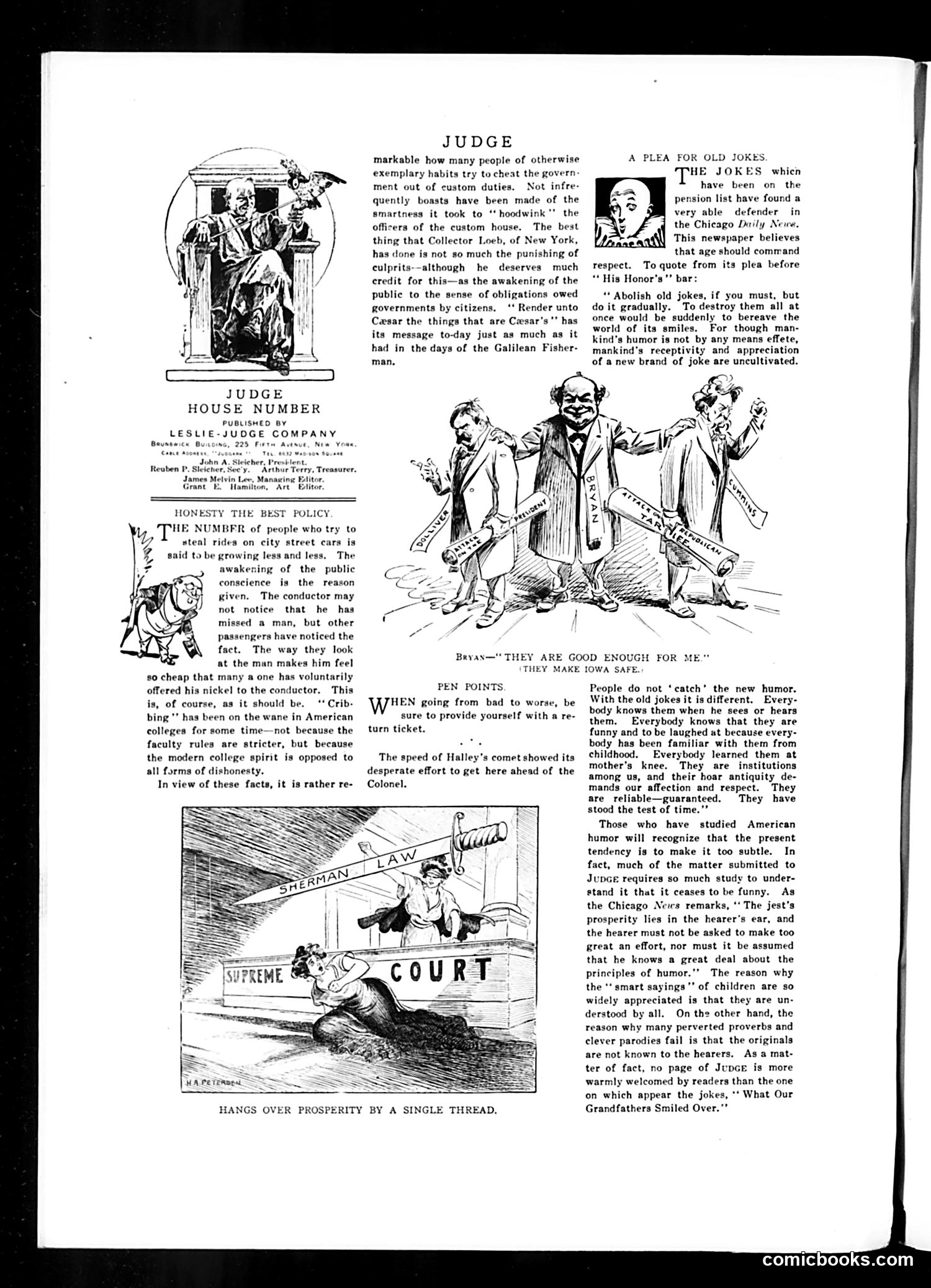
This page satirizes American judicial and political figures circa early 1900s. The main cartoon "Hangs Over Prosperity by a Single Thread" depicts the Supreme Court as precarious—a figure representing the court system stands on one leg while "Law" and "Sherman" (likely referencing the Sherman Antitrust Act) dangle above like a sword. This suggests anxieties about legal frameworks' fragility regarding monopolies and corporate power. The accompanying article "A Plea for Old Jokes" argues that established humor—particularly judicial anecdotes—deserves respect as cultural institutions. The three caricatured figures above appear to represent political/judicial personalities of the era, though specific identities are unclear from the image alone. The overall theme critiques both legal uncertainty and attempts to modernize humor.
📄 Transcribed text from this page (OCR, searchable)
Machine-transcribed from the original scan — historical spelling and the odd misread are preserved.
HOUSE NUMBER PUBLISHED BY LESLIE-JUDGE COMPANY HONESTY THE BEST POLICY ly HE NUMBFR of people who try to 7 steal rides on city street cars is % said to be growing less and less, The awakening of the public conscience is the reason given, The conductor may not notice that he has ed a man, but other sengers have noticed the The way they look at the man makes him feel 80 cheap that many a one has voluntarily offered his nickel to the conductor. This is, of course, as it should be, ‘* Crib: bing "’ has been on the wane in American colleges for some time—not because the faculty rules are stricter, but because the modern college spirit is opposed to all forms of dishonesty. In view of these facts, it is rather re- WA PeTrMace JUDGE markable how many people of otherwise exemplary habits try to cheat the govern ment out of custom duties. Not infre- quently boasts have been made of the smartness it took to ‘ hoodwink ‘’ the officers of the custom house. The best thing that Collector Loeb, of New York, has done is not so much the punishing of culprits--although he deserves much credit for this—as the awakening of the public to the sense of obligations owed governments by citizens. ‘* Render unto Cesar the things that are Caesar's '’ has its message to-day just as much as it had in the days of the Galilean Fishe: man. Bryax— THEY ARE GOOD ENOU PLEA FOR OLD JOKES. HE JOKES which have been on the pension list have found a very able defender in the Chicago Daily News. This newspaper believes that age should command respect. To quote from its plea before “His Honor’s"” bar: “Abolish old jokes, if you must, but do it gradually. To destroy them all at once would be suddenly to bereave the world of its smiles. For though man- kind’s humor is not by any means effete, mankind's receptivity and appreciation of a new brand of joke are uncultivated. iH FOR ME." THEY MAKE IOWA SAFE. PEN POINTS. HEN going from bad to worse, be sure to provide yourself with a re- turn ticket. The speed of Halley's comet showed its desperate effort to get here ahead of the Colonel. HANGS OVER PROSPERITY BY A SINGLE THREAD. People do not ‘catch’ the new humor. With the old jokes it is different. Every- body knows them when he sees or hears them. Everybody knows that they are funny and to be laughed at because every- body has been familiar them from i Everybody learned them at mother’s knee. They are institutions among us, and their hoar antiquity de- mands our affection and respect. They are reliable—guaranteed. They have stood the test of time.’” Those who have studied American humor will recognize that the present tendency is to make it too subtle. In fact, much of the matter submitted to JupGeE requires so much study to under- stand it that it ceases to be funny. As the Chicago News remarks, ‘‘ The jest’s prosperity lies in the hearer’s ear, and the hearer must not be asked to make too great an effort, nor must it be assumed that he knows a great deal about the principles of humor.’’ The reason why the ‘‘ smart sayings" of children are so widely appreciated is that they are un- derstood by all. On the other hand, the reason why many perverted proverbs and clever parodies fail is that the originals are not known to the hearers. As a mat- ter of fact, no page of Jupce is more warmly welcomed by readers than the one on which appear the jokes, “* What Our Grandfathers Smiled Over. comicbooks.com