
Judge, 1910-06-04 · page 11 of 16
Judge — June 4, 1910 — page 11: what you’re looking at
What you’re looking at
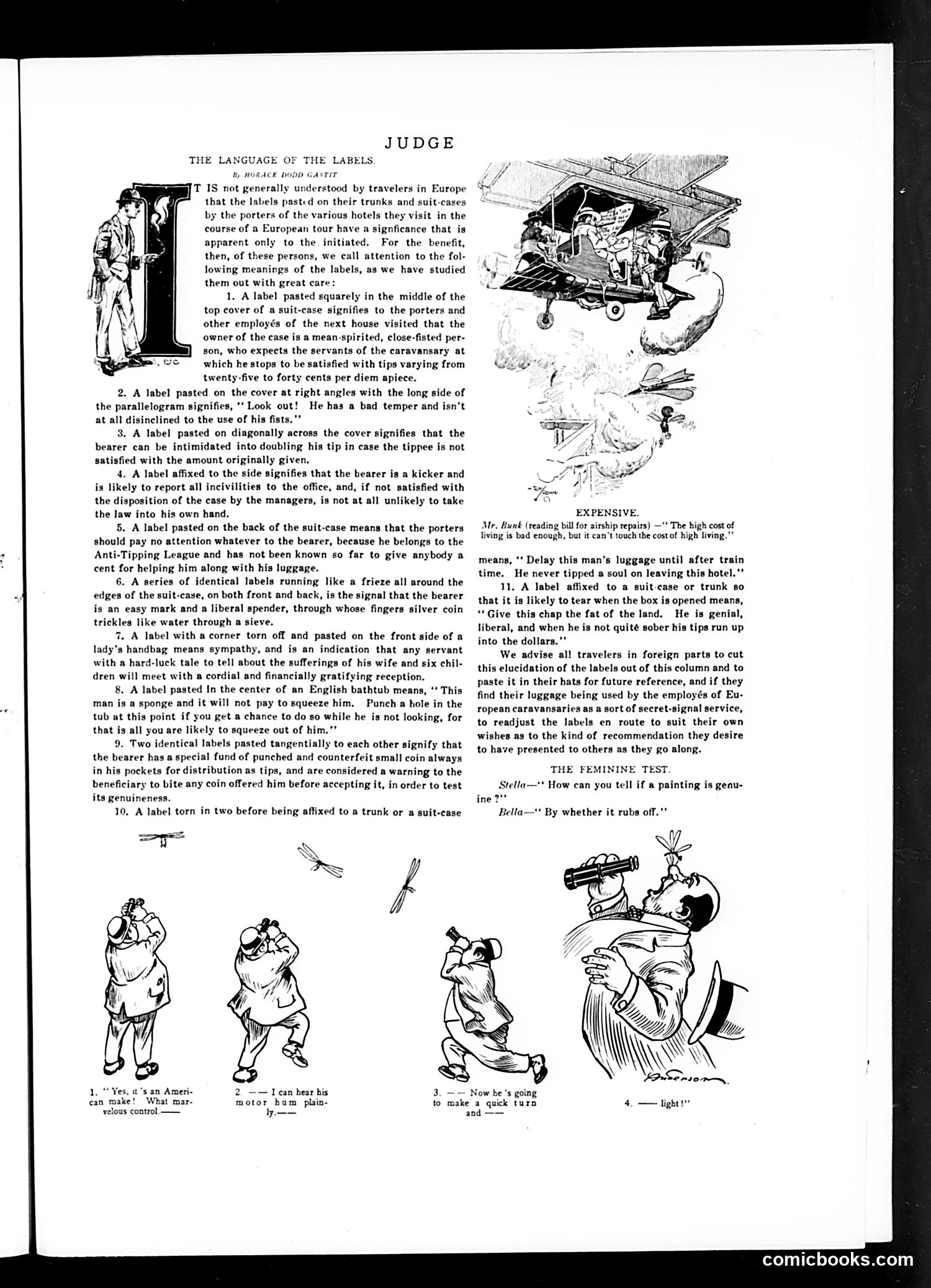
This article satirizes the supposedly sophisticated codes that European hotel porters allegedly used to read luggage labels and determine how to treat guests. By Horace Dodd Gaunt, it humorously decodes ten label placements as signals indicating each traveler's generosity (or stinginess), temperament, and trustworthiness. The joke targets American tourists abroad, mocking their assumption that porters operated by mysterious "continental" rules. Each label position allegedly broadcasts the guest's character—a centered label means cheap; a diagonal one means easily intimidated; multiple labels mean lavish spending. The accompanying cartoons show travelers with various luggage mishaps, reinforcing the satire's implicit message: American travelers are comically naive about European customs and easily exploited. The "Expensive" cartoon panel adds commentary on wasteful spending among the wealthy. The satire playfully suggests that what tourists interpret as sophisticated European hotel culture is actually just porters reading transparent signals about who to bilk.
📄 Transcribed text from this page (OCR, searchable)
Machine-transcribed from the original scan — historical spelling and the odd misread are preserved.
JUDGE THE LANGUAGE OF THE LABELS. B, HORACE DODD GASTIT T IS not generally understood by travelers in Europe that the labels pasted on their trunks and s by the porters of the various hotels they visit in the course of a European tour have a signficance that is apparent only to the ated. For the benefit, then, of these persons, we call attention to the fol- lowing meanings of the labels, as we have studied them out with great care: 1, A label pasted squarely in the middle of the top cover of a suit-case signifies to the porters and other employés of the next house visited that the owner of the case is a mean-spirited, close-fisted per- son, who expects the servants of the caravansary at which he stops to be satisfied with tips varying from twenty-five to forty cents per diem apiece. 2. A label pasted on the cover at right angles with the long side of the parallelogram signifies, ‘‘ Look out! He has a bad temper and isn't at all disinclined to the use of his fists.”” 3. A label pasted on diagonally across the cover signifies that the bearer can be intimidated into doubling his tip in case the tippee is not satisfied with the amount originally given. 4. A label affixed to the side signifies that the bearer is a kicker and is likely to report all incivilities to the office, and, if not satisfied with the disposition of the case by the managers, is not at all unlikely to take the law into his own hand. 5. A label pasted on the back of the suit-case means that the porters should pay no attention whatever to the bearer, because he belongs to the Anti-Tipping League and has not been known so far to give anybody a cent for helping him along with his luggage. 6. A series of identical labels running like a frieze all around the edges of the suit-case, on both front and back, is the signal that the bearer is an easy mark and a liberal spender, through whose fingers silver coin trickles like water through a sieve. 7. A label with a corner torn off and pasted on the front side of a lady's handbag means sympathy, and is an indication that any servant with a hard-luck tale to tell about the sufferings of his wife and six chil- dren will meet with a cordial and financially gratifying reception. 8. A label pasted in the center of an English bathtub means, “* This man is a sponge and it will not pay to squeeze him. Punch a hole in the tub at this point if you get a chance to do so while he is not looking, for that is all you are likely to squeeze out of him."" 9. Two identical labels pasted tangentially to each other signify that the bearer has a special fund of punched and counterfeit small coin always in his pockets for distribution as tips, and are considered a warning to the beneficiary to bite any coin offered him before accepting it, in order to test its genuineness. 10, A label torn in two before being affixed to a trunk or a suit-case == it-cases BS = 1, “Yes, it’s an Ameri- 2. —— I can hear his 3. -- can make! What mar- motor bum plain- velous control — y— to make a quick turn EXPENSIVE. Mr. Bunk (reading bill for airship repairs) —"‘ The high cost of living is bad enough, but it can't touch the cost of high living.”* means, ‘‘ Delay this man’s luggage until after train time. He never tipped a soul on leaving this hotel.”* 11. A label affixed to a suit-case or trunk so that it is likely to tear when the box is opened mean: “Give this chap the fat of the land. He is genial, liberal, and when he is not quite sober his tips run up into the dollars.’” We advise al! travelers in foreign parts to cut this elucidation of the labels out of this column and to paste it in their hats for future reference, and if they find their luggage being used by the employés of Eu- ropean caravansaries as a sort of secret-signal service, to readjust the labels en route to suit their own wishes as to the kind of recommendation they desire to have presented to others as they go along. THE FEMININE TEST. Stella—* How can you tell if a painting is geau- Bella—** By whether it rubs off.’ Now be 's going 4. — light" and —— comicbooks.com