
A complete issue · 16 pages · 1910
Judge — May 14, 1910
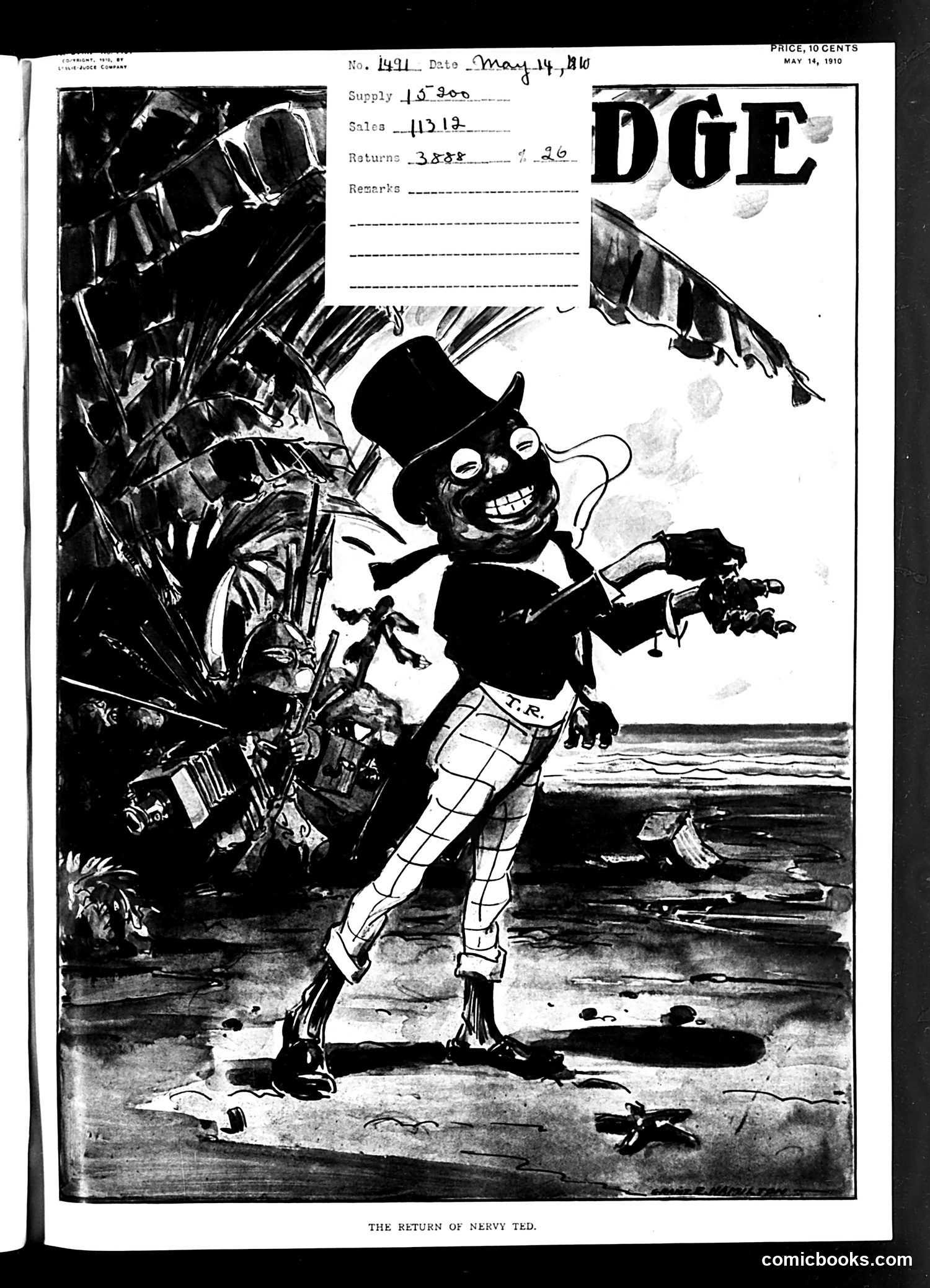
This Judge magazine cover from May 14, 1910 depicts a cartoon character labeled "Nervy Ted"—likely Theodore Roosevelt, known for his bold, aggressive personality. The caricature shows an exaggerated grinning figure in a top hat and checkered pants, wielding guns in a tropical or beach setting with palm fronds and what appears to be African wildlife or jungle imagery. The "return" reference likely alludes to Roosevelt's planned African safari (1909-1910) following his presidency. The satirical point appears to mock Roosevelt's reputation for aggressive imperialism and his famous hunting expeditions, presenting him as a boisterous, gun-slinging adventurer. The elaborate tropical setting emphasizes the exotic nature of his travels and his association with colonial expansion.
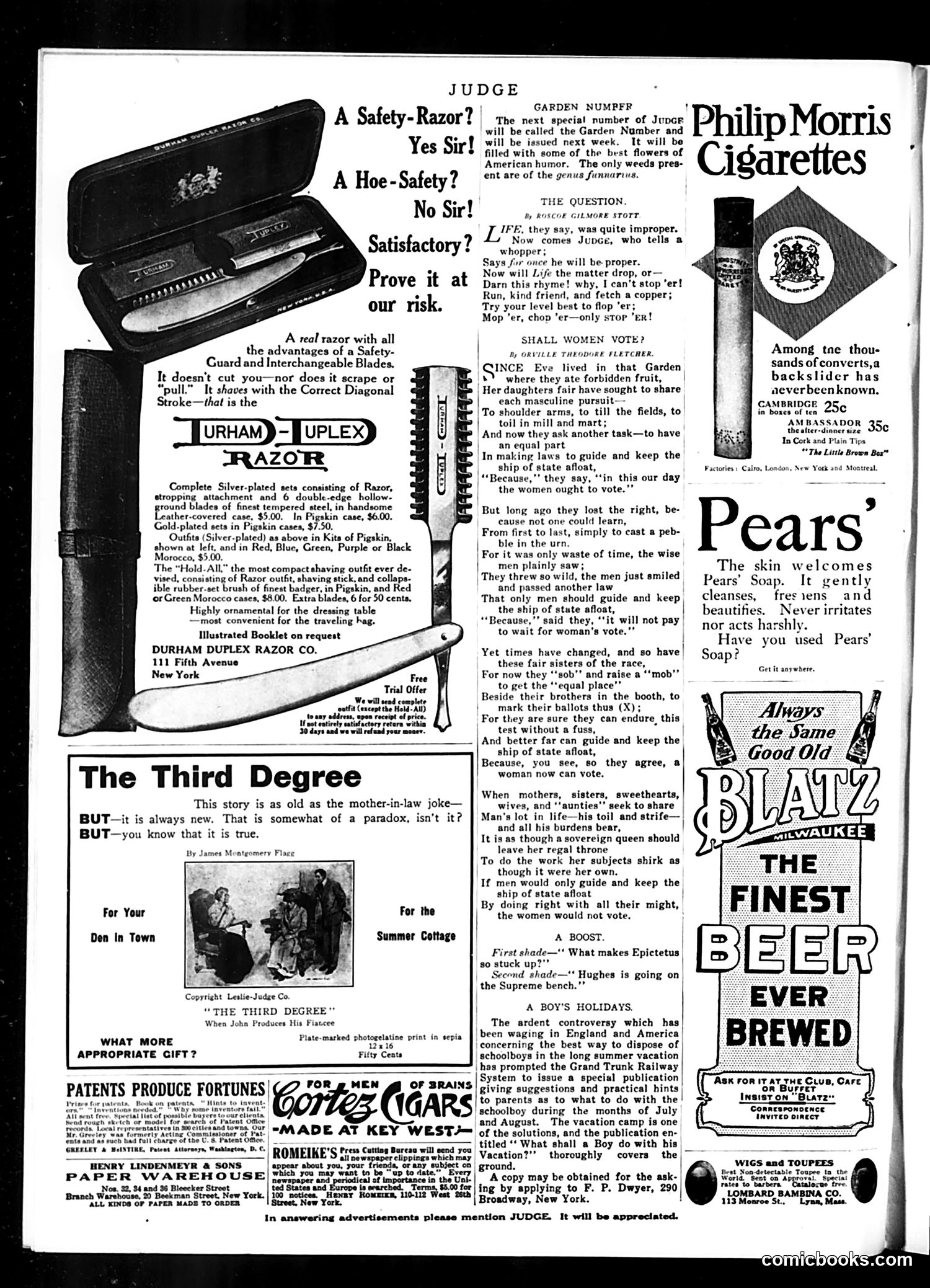
This page is **primarily advertisements** interspersed with light editorial content. The main satirical piece is "The Third Degree," a short story about a mother-in-law joke scenario, which Judge notes is "as old as the mother-in-law joke—BUT it is always new." The editorial poem "The Question" debates **women's suffrage**, arguing that women deserve voting rights equal to men's. It counters the anti-suffrage argument that women shouldn't vote because they lack political understanding—pointing out women already participate in civic life and social responsibility. The page reflects early 20th-century debates over women's voting rights, likely from before the 19th Amendment (1920). The poem advocates for expanding democratic participation to women, positioning suffrage as a logical extension of women's existing social contributions.
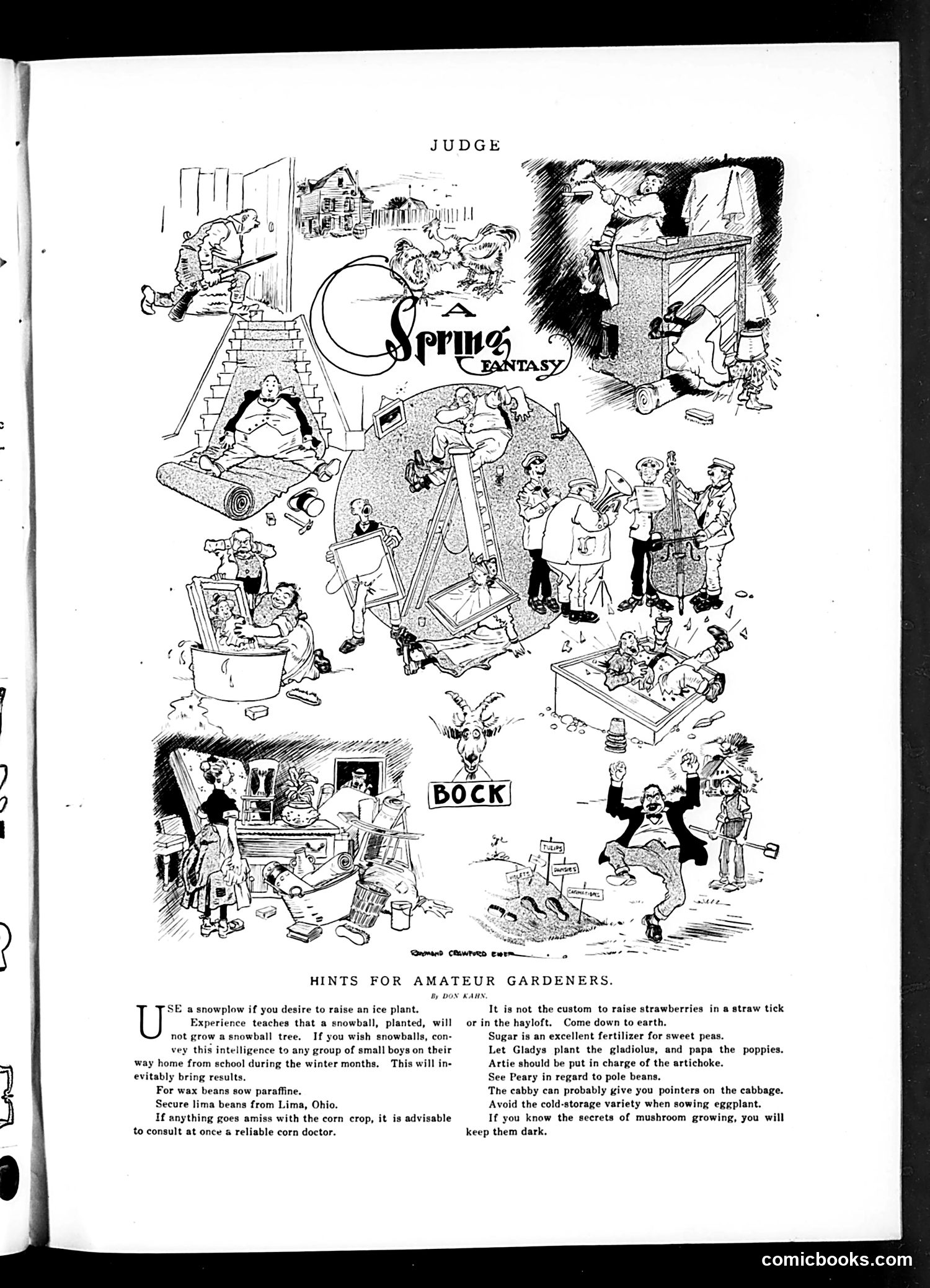
This page presents spring-themed humorous illustrations with practical gardening advice titled "Hints for Amateur Gardeners" by Don Lark. The cartoons depict comical domestic scenes of amateur gardeners attempting spring projects with predictably chaotic results. The illustrations show people engaged in various gardening mishaps—planting, composting, and other seasonal activities rendered absurdly. The text offers genuine gardening tips (snowplow for ice plants, lima beans from Lima, Ohio, straw for berries, sugar as fertilizer) mixed with lighthearted observations about common gardening failures. The "Judge" and "Bock" labels appear to be section headers. Rather than political satire, this page targets the universal comedic subject of amateur gardeners' incompetence during spring—a relatable theme for Judge's readership.
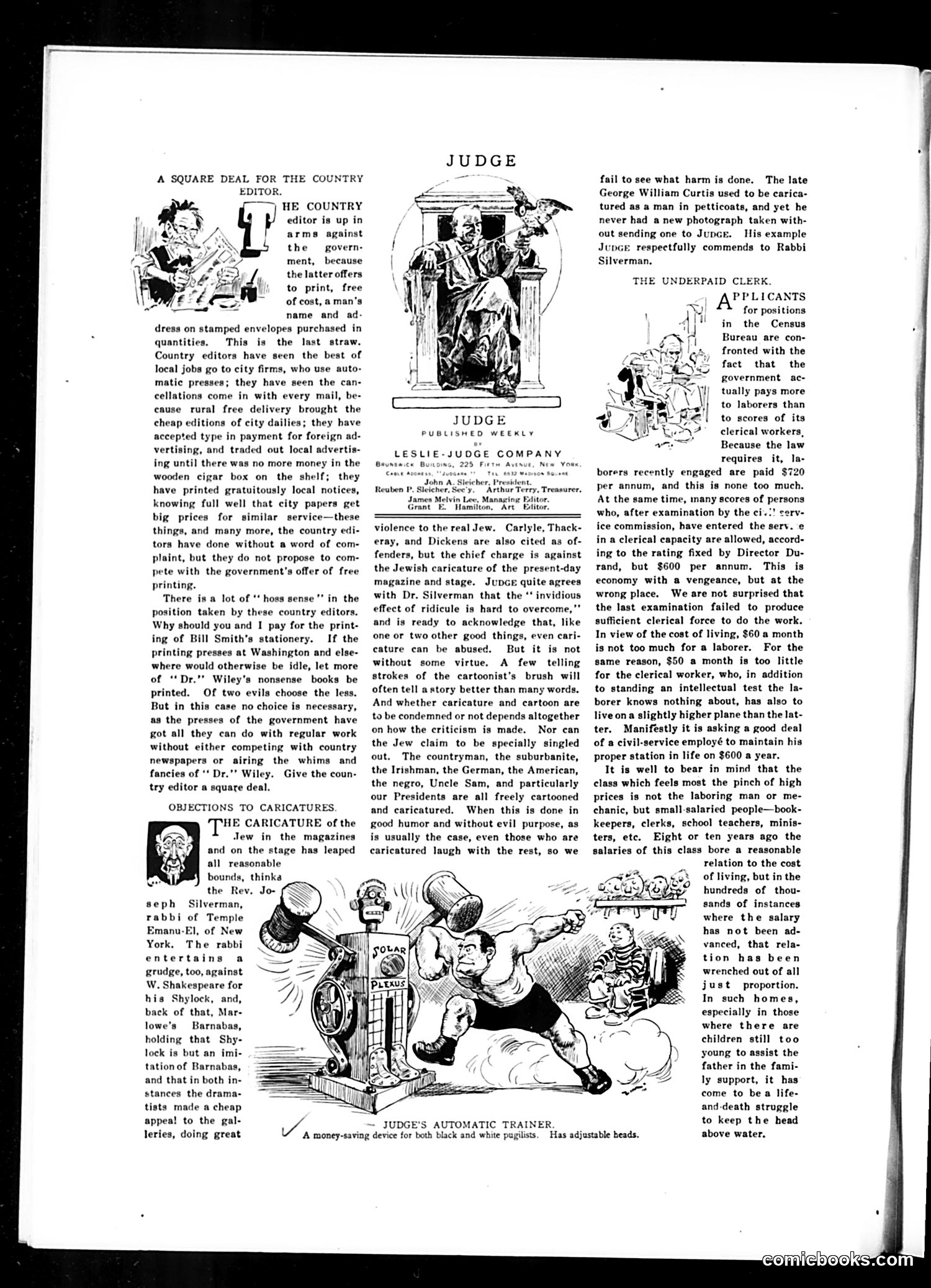
This page contains satirical commentary about caricature in journalism and Jewish representation in media. The main text criticizes cartoonist Joseph Keppler (referenced as "Dr. Wiley") and defends Rabbi Silverman against caricatures that employ antisemitic stereotypes. The central cartoon, "Judge's Automatic Trainer," depicts a mechanical device for training both "black and white pigeons"—likely satirizing how media stereotypes reduce people to simplistic, trainable types. The editorial argues that while caricature can be a legitimate artistic tool, targeting Jewish people specifically with dehumanizing imagery crosses ethical lines. It acknowledges other groups face cartoons but asserts the Jewish caricature problem is particularly acute and unjustifiable, defending the rabbi's right to complain without being dismissed.
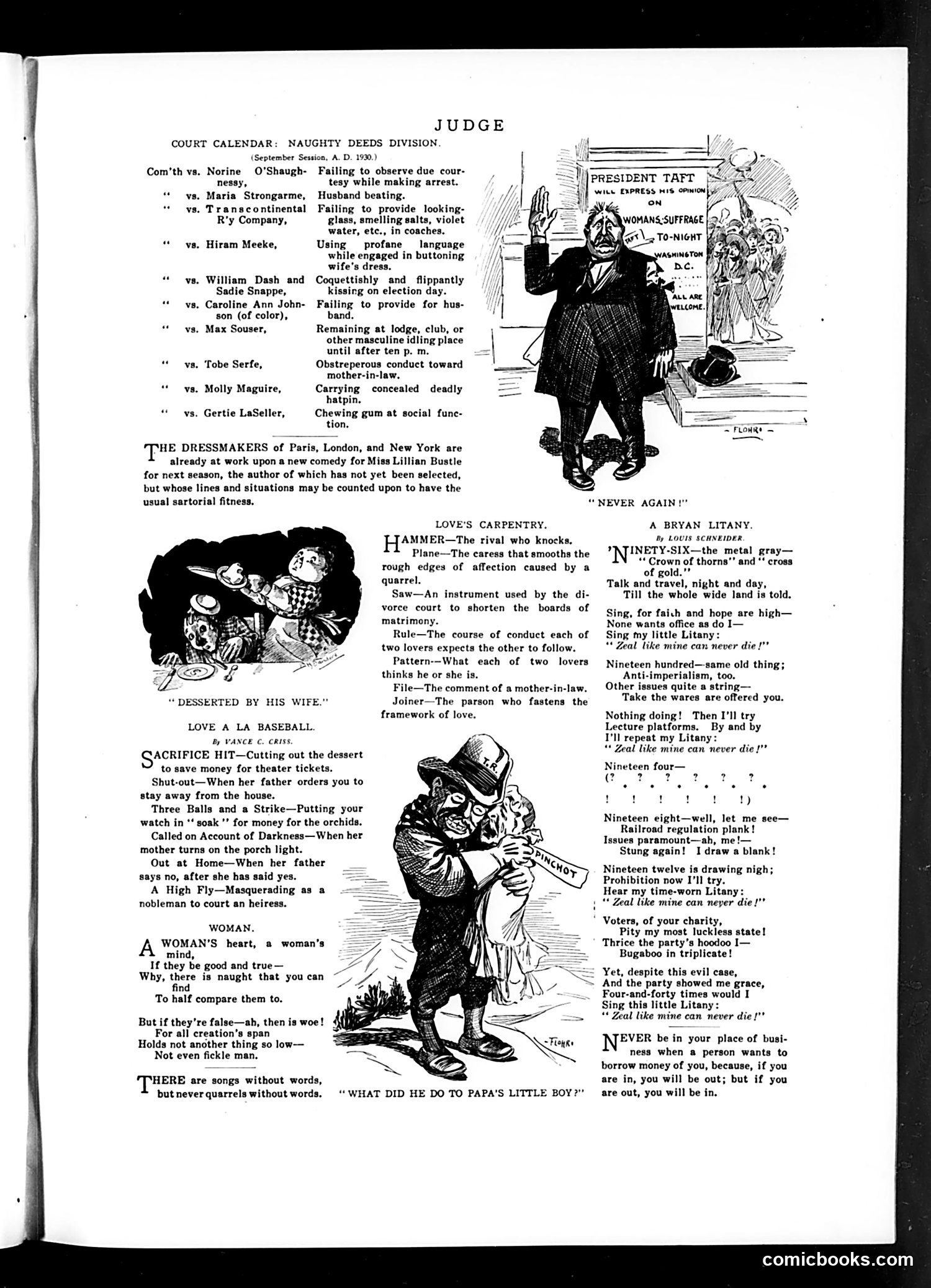
The top cartoon depicts **President Taft** addressing women's suffrage advocates in Washington, D.C. The caption "Never Again!" suggests Taft is retreating from or opposing the suffrage movement, which was a major political issue of the early 1910s. Below are humorous definitions in "Love's Carpentry" and poems/observations about relationships and social conduct. The other illustrations appear to be generic satirical sketches on romance and courtship rather than political commentary. The "Naughty Deeds Division" court calendar at the top lists various moral infractions treated as legal cases—a common Judge format for social satire, mocking both legal proceedings and contemporary behavioral standards. The page primarily targets **President Taft's political stance on women's suffrage** while using romance and domestic life as secondary satirical subjects.
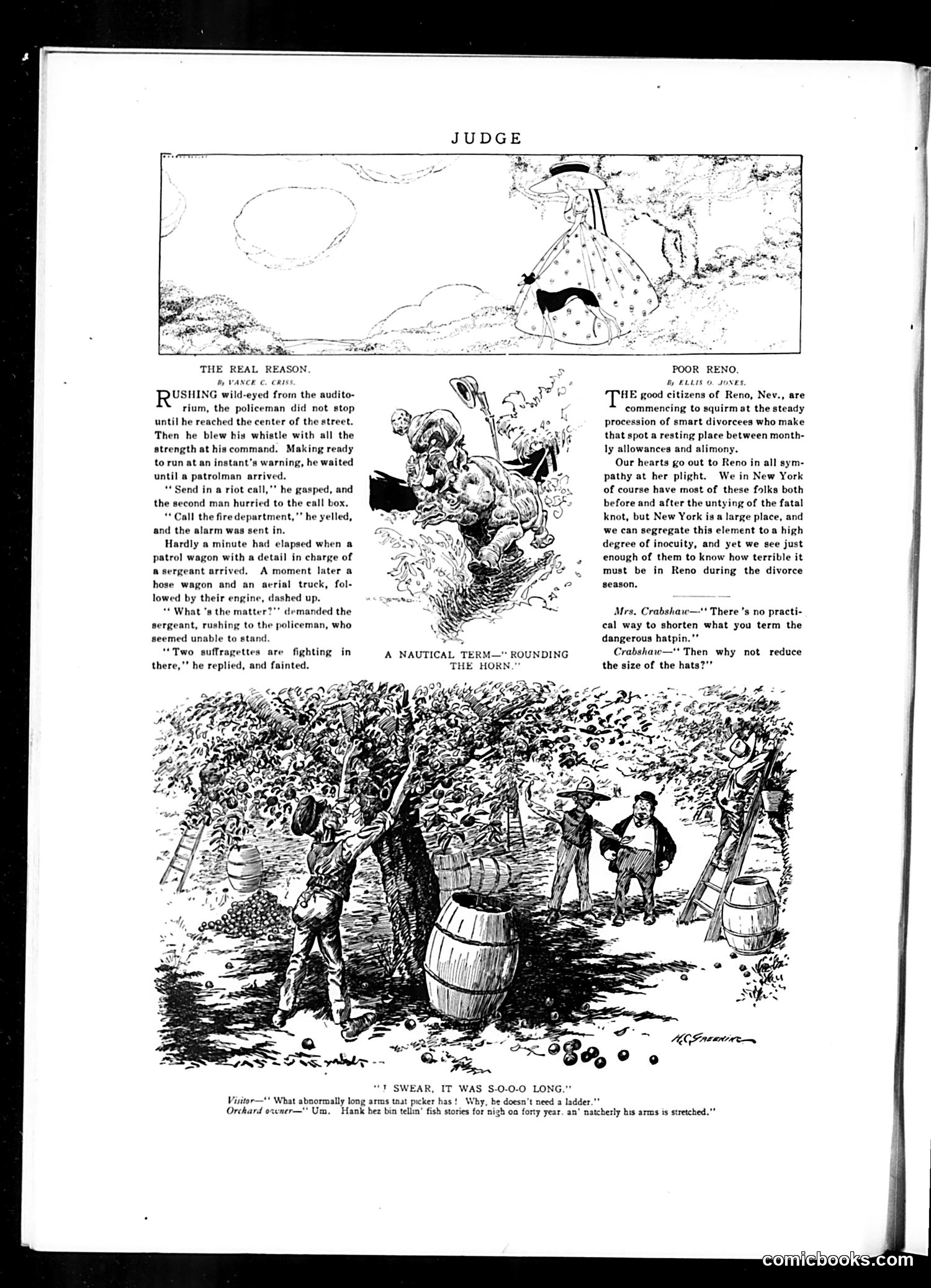
This *Judge* page contains three separate satirical pieces mocking contemporary anxieties: **"The Real Reason"** ridicules the social panic around suffragettes (women's voting rights activists). A policeman calls in riot police, fire department, and emergency services in terror—not for an actual emergency, but because two women are arguing inside. The joke targets both the perceived threat suffragettes posed to society and police overreaction. **"Poor Reno"** comments on Reno, Nevada's reputation as a divorce destination. The piece sarcastically sympathizes with Reno being flooded with wealthy divorced women collecting alimony between marriages, treating this as a social scourge. It's social commentary on women's independence and leisure. **The bottom cartoons** use visual puns: one about a fruit picker's unusually long arms (explained as exaggeration from "fish stories"), and dialogue about shortening hatpins versus reducing hat sizes—trivial domestic humor. The page reflects early-20th-century anxieties about women's changing social roles, independence, and autonomy.
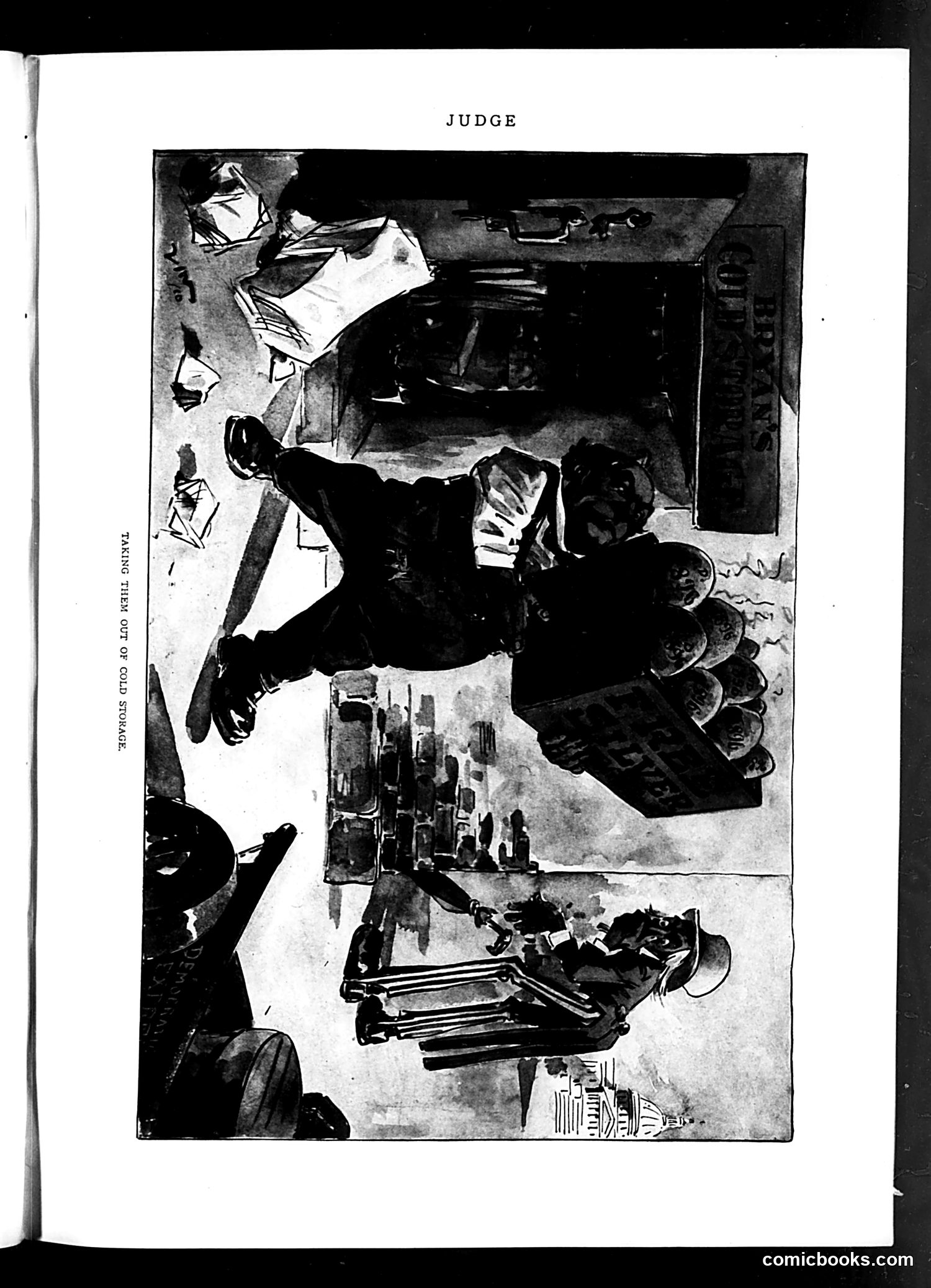
The OCR text is largely illegible, consisting mainly of formatting characters and symbols rather than readable content. The image itself, viewed upside-down as presented, appears to show a figure in formal attire (possibly judicial robes, given the page header "JUDGE") positioned above a cityscape, with what looks like another figure below. However, without clear OCR text identifying the specific figures, political figures, or historical event being referenced, I cannot reliably determine the cartoon's satirical target or message. To accurately explain this Judge magazine cartoon's meaning to a modern reader, I would need either legible text or additional context identifying the figures and the historical moment being satirized. **I cannot responsibly speculate about the identity of the caricatures or political references depicted.**
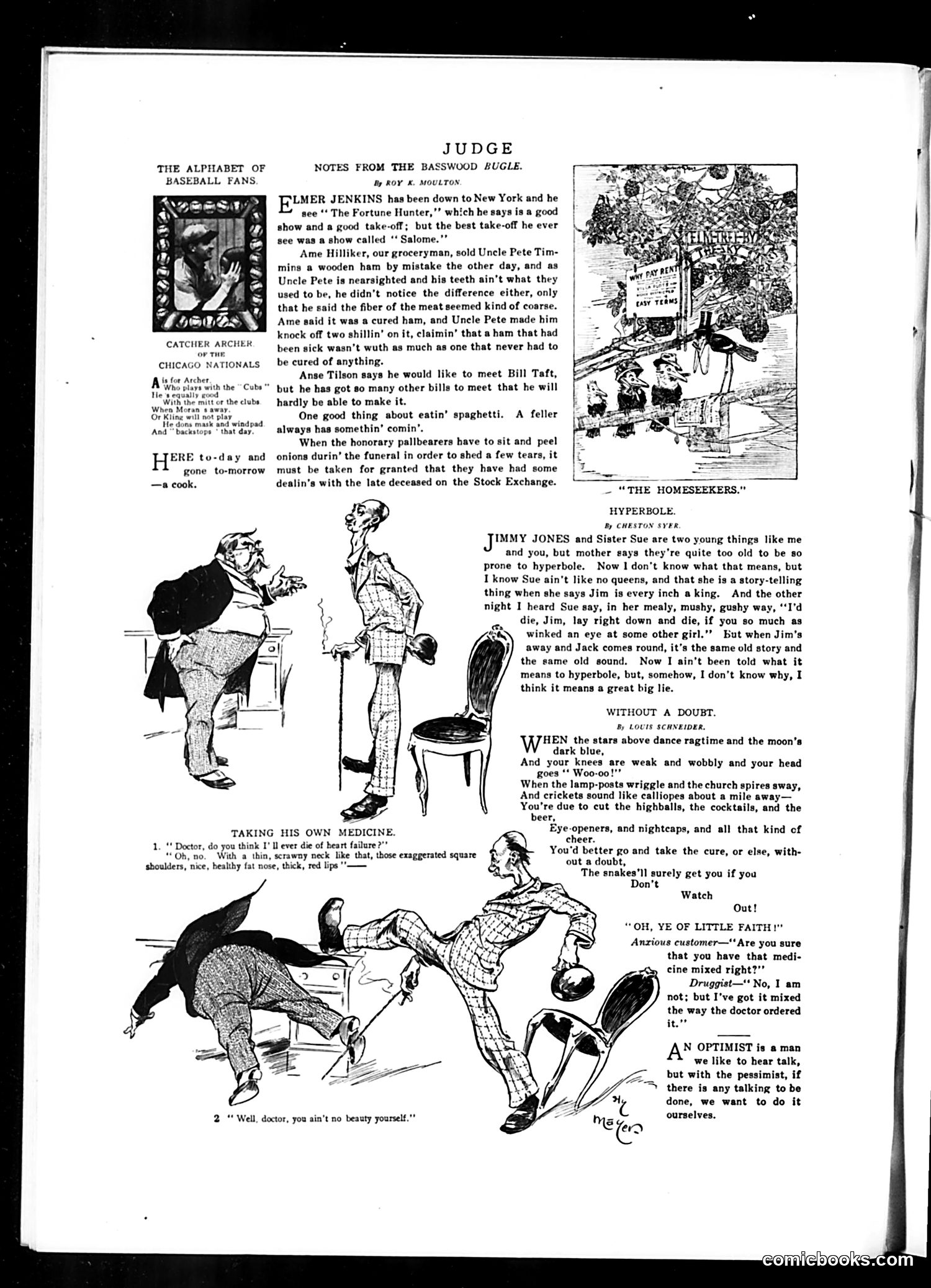
This page contains several satirical pieces targeting early 1900s American life: **"The Alphabet of Basswood Bugle"** mocks rural small-town gossip and naiveté through baseball fan anecdotes—including a grocer selling a wooden ham and references to political/financial figures like "Bill Taft" (likely President William Howard Taft). **"Taking His Own Medicine"** cartoons show a doctor insulting a patient's appearance, then the patient retaliating—satirizing the arrogance of physicians of the era. **"The Homeseekers"** illustration depicts domestic life humorously. **"Hyperbole," "Without a Doubt," and "Oh, Ye of Little Faith"** are humorous verses about exaggeration in courtship, excessive drinking, and pharmacy mishaps—poking fun at common social behaviors and romantic affectation. The cartoons use slapstick and caricature to mock vanity, incompetence, and human pretension. The overall tone is light social satire aimed at middle-class readers.
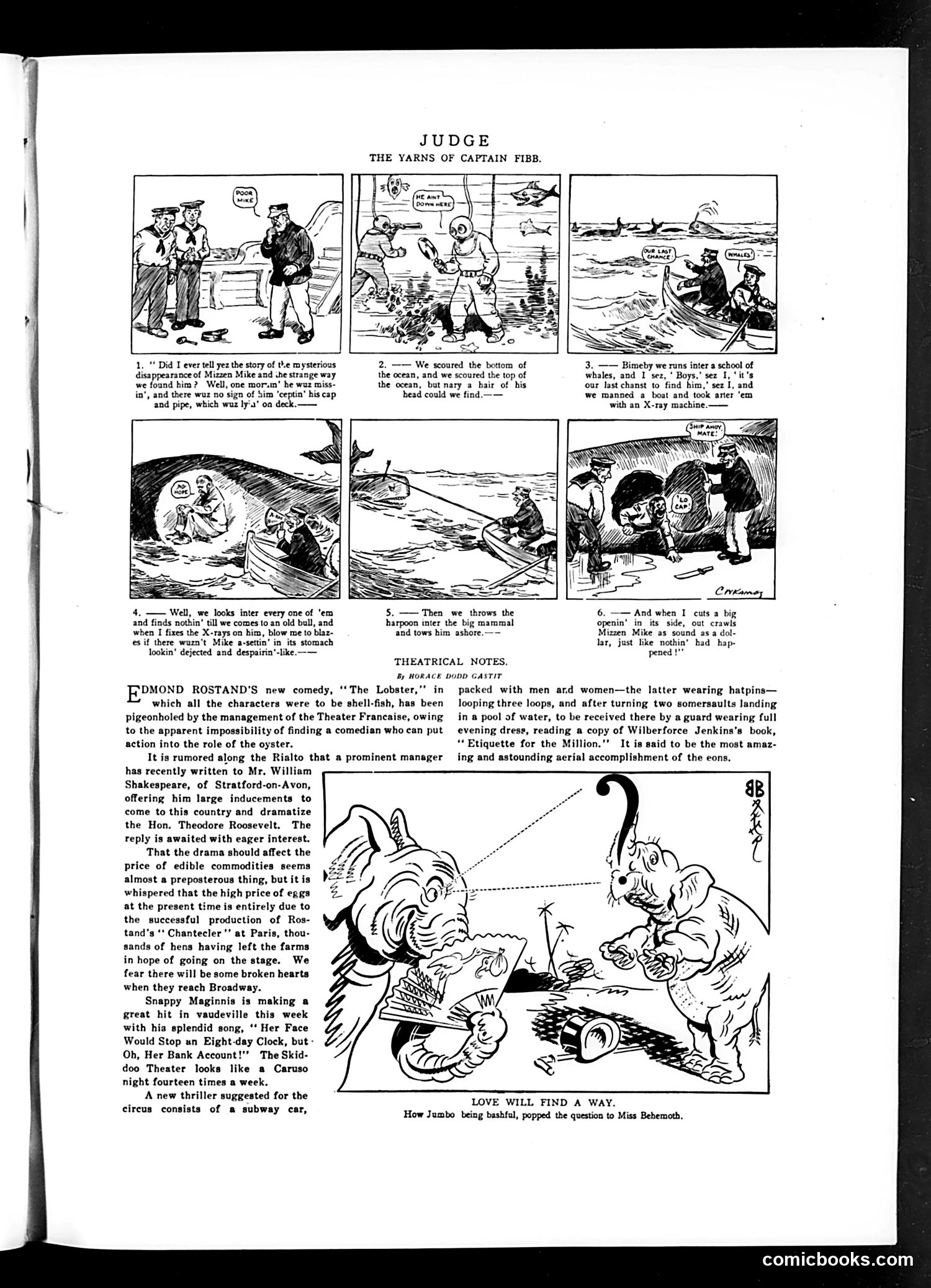
This is a humorous six-panel comic strip featuring an unnamed sea captain telling increasingly absurd stories. The running joke is the captain's use of an "X-ray machine" aboard his ship—a contemporary technology (X-rays were discovered in 1895) that appears anachronistic and fantastical for nautical adventure. The plot: a crew member named Mizzen Mike disappears; the captain uses X-ray technology to search inside whales and a bull, eventually finding Mike alive inside the whale's stomach, completely unharmed. The humor derives from the tall-tale tradition of maritime exaggeration combined with the comic incongruity of applying cutting-edge science to impossible situations. The accompanying theatrical notes discuss contemporary Broadway productions, including a reference to Rostand's "Chantecler" (a 1910 play about a rooster), which was actually performed successfully—making the satire about hens abandoning farms to pursue stage careers a joke about art's romantic appeal.
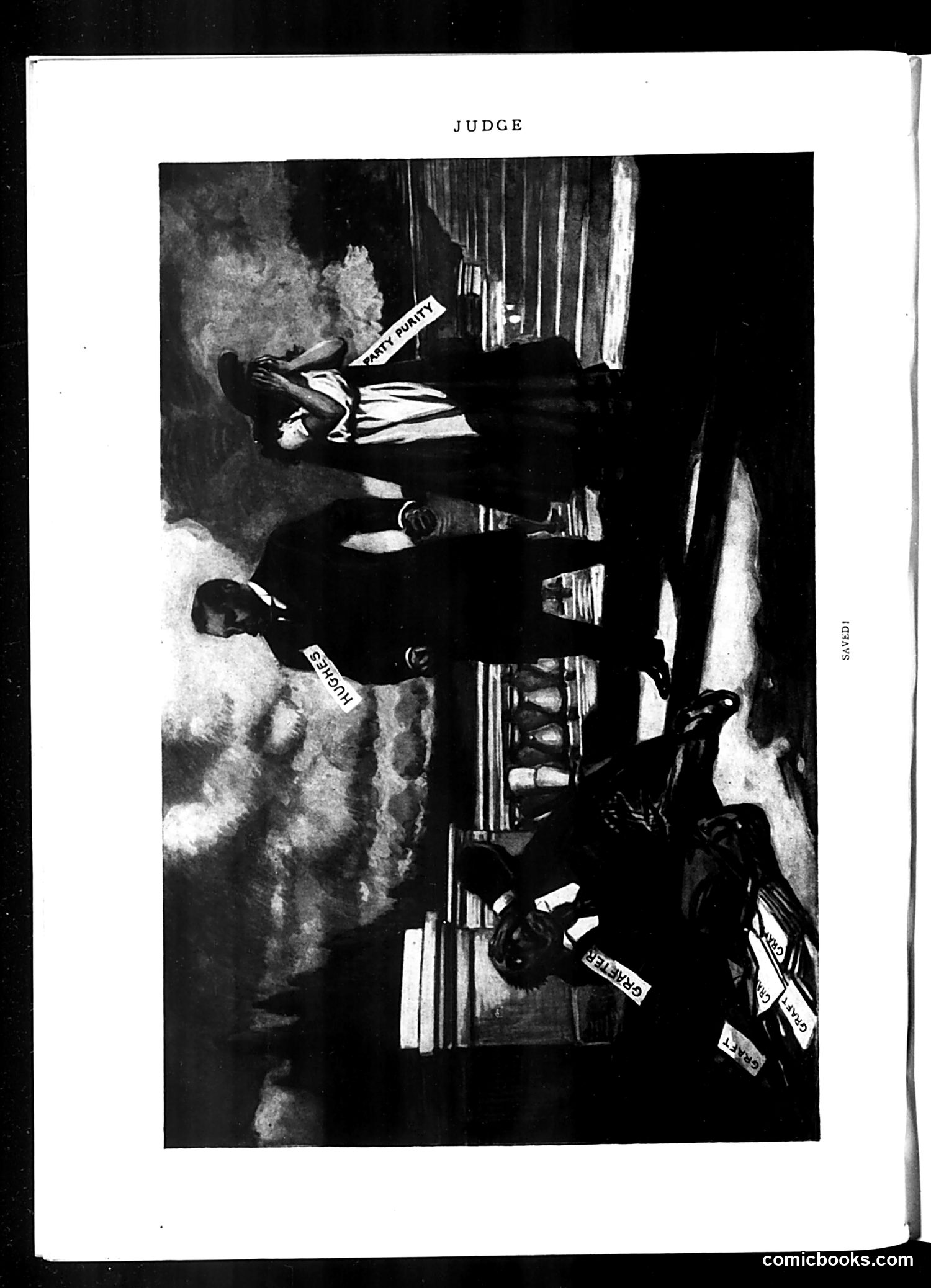
The image appears to be a theatrical or courtroom scene photographed from a play or performance, rotated 90 degrees. The page header reads "JUDGE," confirming this is from the satirical magazine. Three figures are visible with labels that appear to read "EQUITY," "SHERIFF," and possibly other institutional roles, suggesting this depicts a legal or social conflict. The formal dress and indoor setting support a courtroom or official proceeding interpretation. However, without legible OCR text and given the image's rotation and theatrical quality, I cannot confidently identify the specific figures, political references, or the satire's intended point. The cartoon likely commented on a contemporary legal case or institutional conflict, but determining which requires clearer source text or additional context about Judge magazine's publication date.
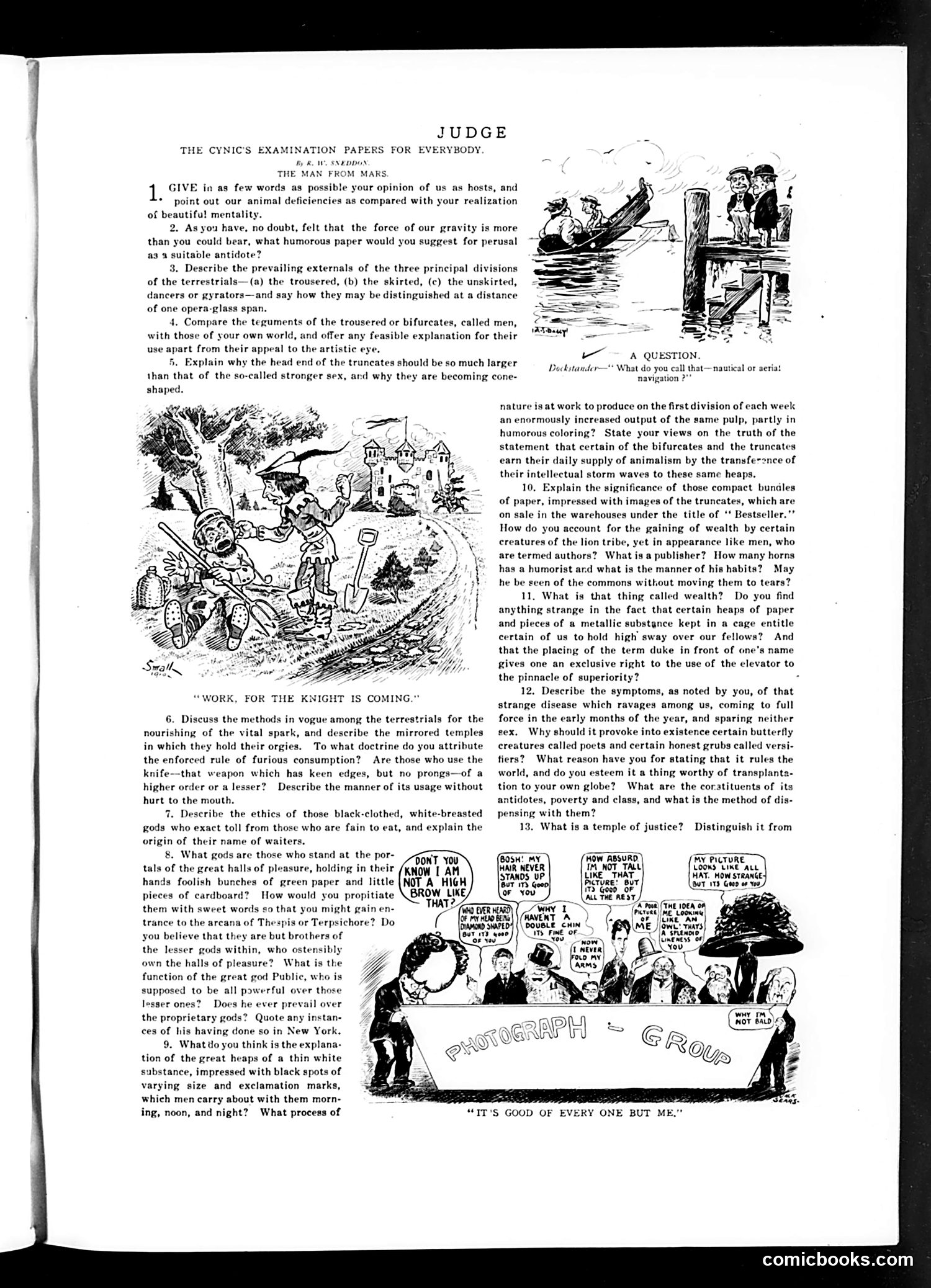
This page presents a satirical examination as if written by a Martian visitor observing human society. The premise uses an alien perspective to mock contemporary American institutions and customs. The "Cynic's Examination Papers" ridicule: - **Class and gender distinctions** (references to "trousered," "skirted," and "unskirted" people) - **Dining customs and waiters** ("black-clothed, white-breasted gods") - **Theater doormen** (gatekeepers to "halls of pleasure") - **Publishers and authors** (wealth disparity in literature) - **Newspapers and pulp magazines** (the "bundles of paper" and "humorous coloring") - **Wealth itself** (money's arbitrary power to grant social status) - **Spring fever** (the "strange disease" affecting society) The cartoons below illustrate a "Photograph Group" and a dinner scene, reinforcing the satirical examination of social hierarchies. The satire's effectiveness depends on recognizing that 1920s-era readers would find familiar absurdities in treating everyday social institutions as if explaining bizarre alien customs.
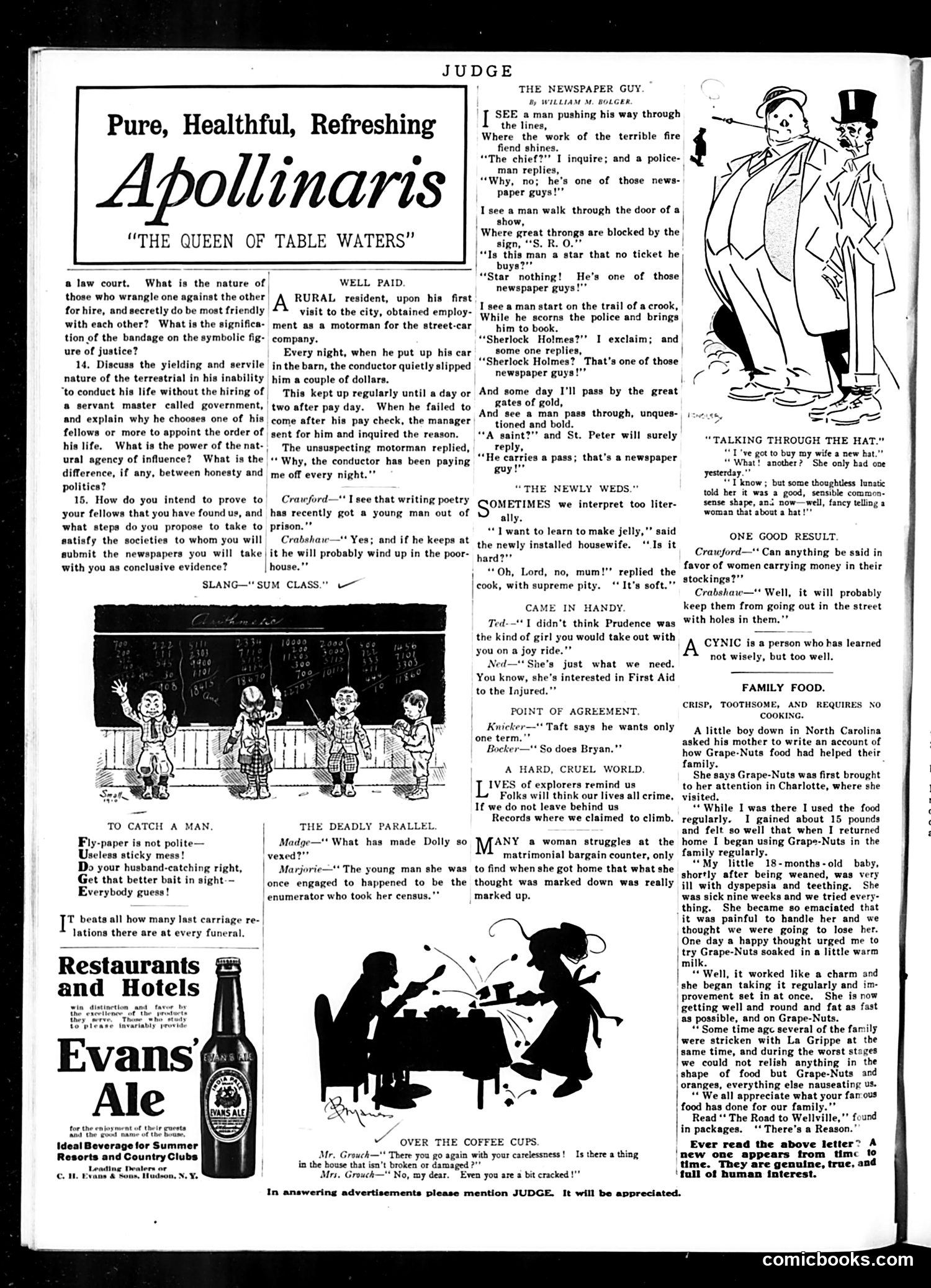
This page from Judge presents multiple satirical pieces typical of early 20th-century American humor. The central feature, "The Newspaper Guy" by William M. Bolger, celebrates newspaper reporters as heroic figures—comparing them favorably to Sherlock Holmes and even suggesting they deserve sainthood. The satire appears to mock either the inflated self-importance of journalists or society's actual reverence for them (the text's tone is ambiguous). The surrounding content includes typical magazine humor: brief comedic vignettes about newlyweds, domestic life, and social observations. A prominent Apollinaris water advertisement emphasizes "pure, healthful, refreshing" qualities—standard marketing language of the era. The cartoons and jokes reflect Edwardian-era preoccupations: gender roles, courtship, class distinctions, and emerging urban professions like motormen and journalists. Without clearer dating visible on this page, the exact year and specific topical references remain uncertain.
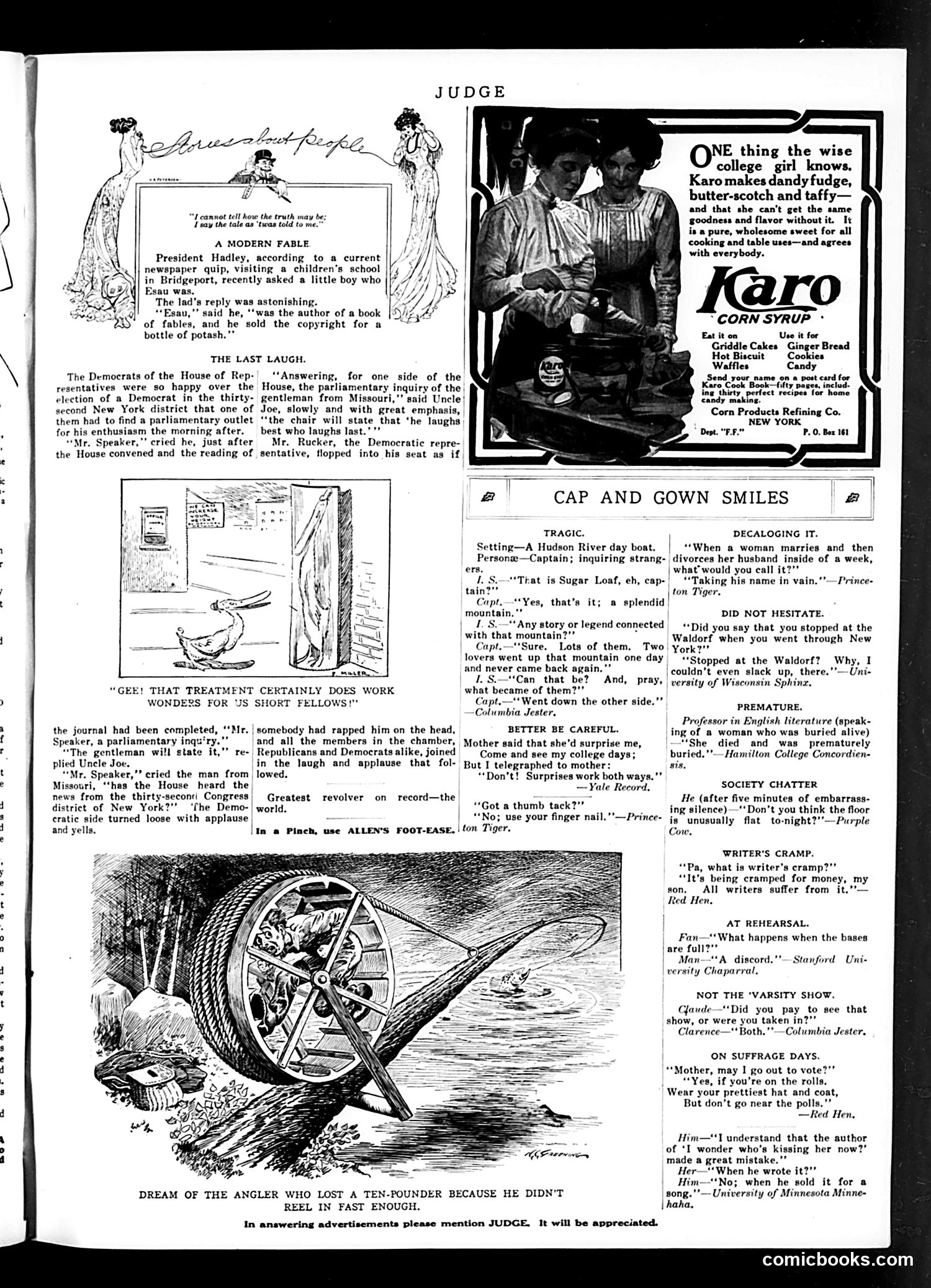
This page contains several distinct elements: **Main Political Cartoon ("A Modern Fable"):** Satirizes President Hadley's visit to a Bridgeport school, where he asked a boy about Esau. The boy's reply—that Esau wrote fables and sold the copyright for "a bottle of potash"—is nonsensical, mocking the absurdity of the interaction or perhaps the boy's education. **"The Last Laugh":** A brief political anecdote about House Democrats celebrating a district victory. A Democratic representative makes a parliamentary inquiry, prompting Uncle Joe (likely Joseph G. Cannon, Speaker) to deliver a quip about "he who laughs last, laughs best," earning applause from both parties. **Lower Cartoon:** A surreal illustration of a fishing reel, captioned as the "dream of the angler who lost a ten-pounder because he didn't reel in fast enough"—a humorous take on fishing failure. **Remaining Content:** College humor pieces ("Cap and Gown Smiles"), vintage advertisements (Karo corn syrup, Allen's Foot-Ease), and miscellaneous jokes typical of early 1900s college magazines. The page mixes political satire with light collegiate humor and advertising.
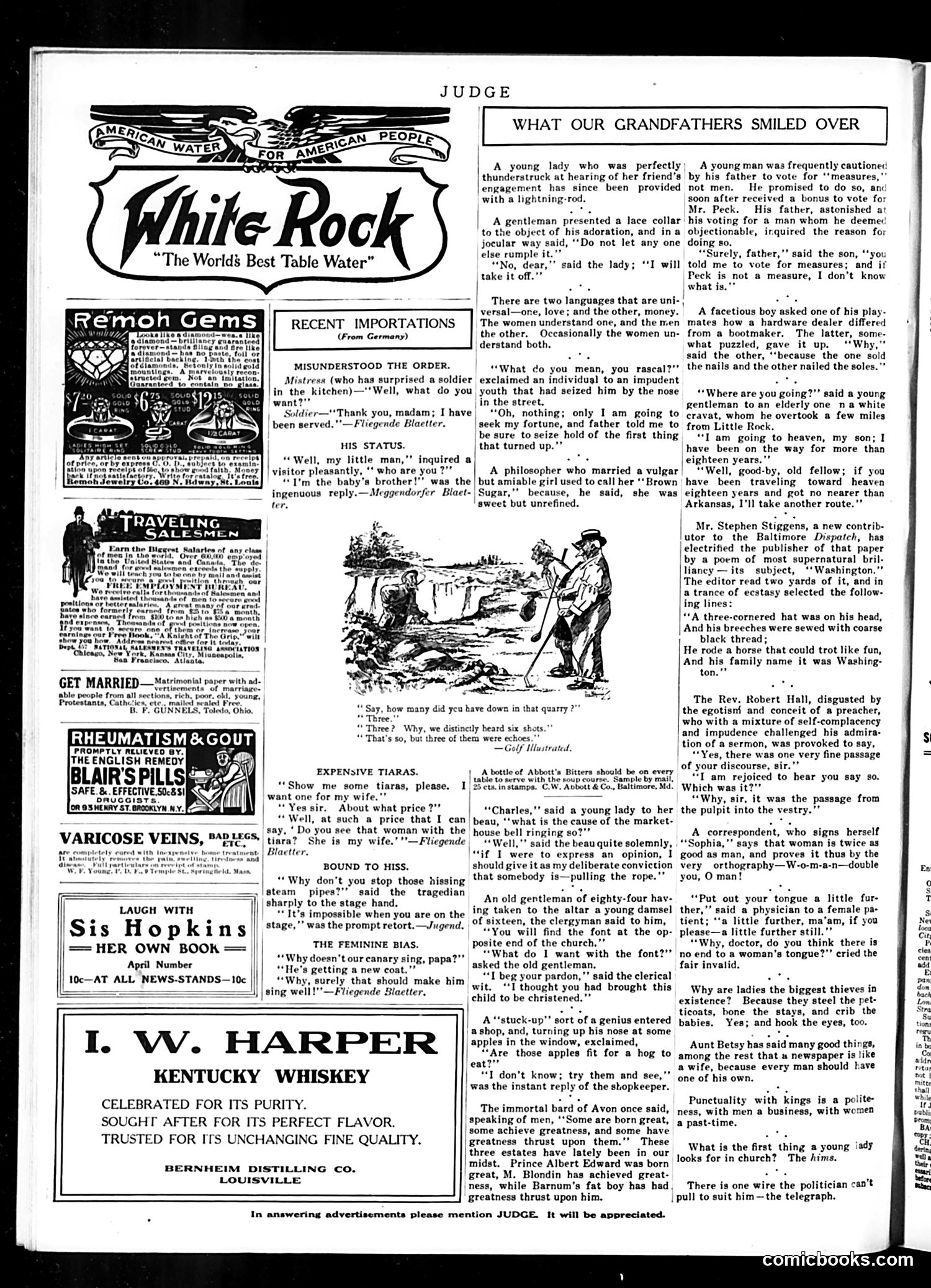
This page from *Judge* contains mostly humorous anecdotes and advertisements rather than political cartoons. The content consists of brief jokes and witty observations typical of late 19th-century American humor magazines. The humor relies on wordplay and social commentary: one anecdote mocks a son who votes for "Mr. Peck" because his father told him to vote for "measures" (policies), not men—treating a person as if he were a policy measure. Another jokes about the difference between a hardware dealer and bootmaker: one "nails" things, the other "nails the soles." The cartoonist's satirical point in the illustrated quarry scene (captioned "Say, how many did you bag down in that quarry?") appears to be social commentary on hunting or perhaps labor practices, though the specific reference is unclear without additional context. The page is primarily filled with period advertisements for patent medicines, whiskey, and matrimonial services—typical *Judge* content aimed at middle-class readers seeking both humor and consumer goods.
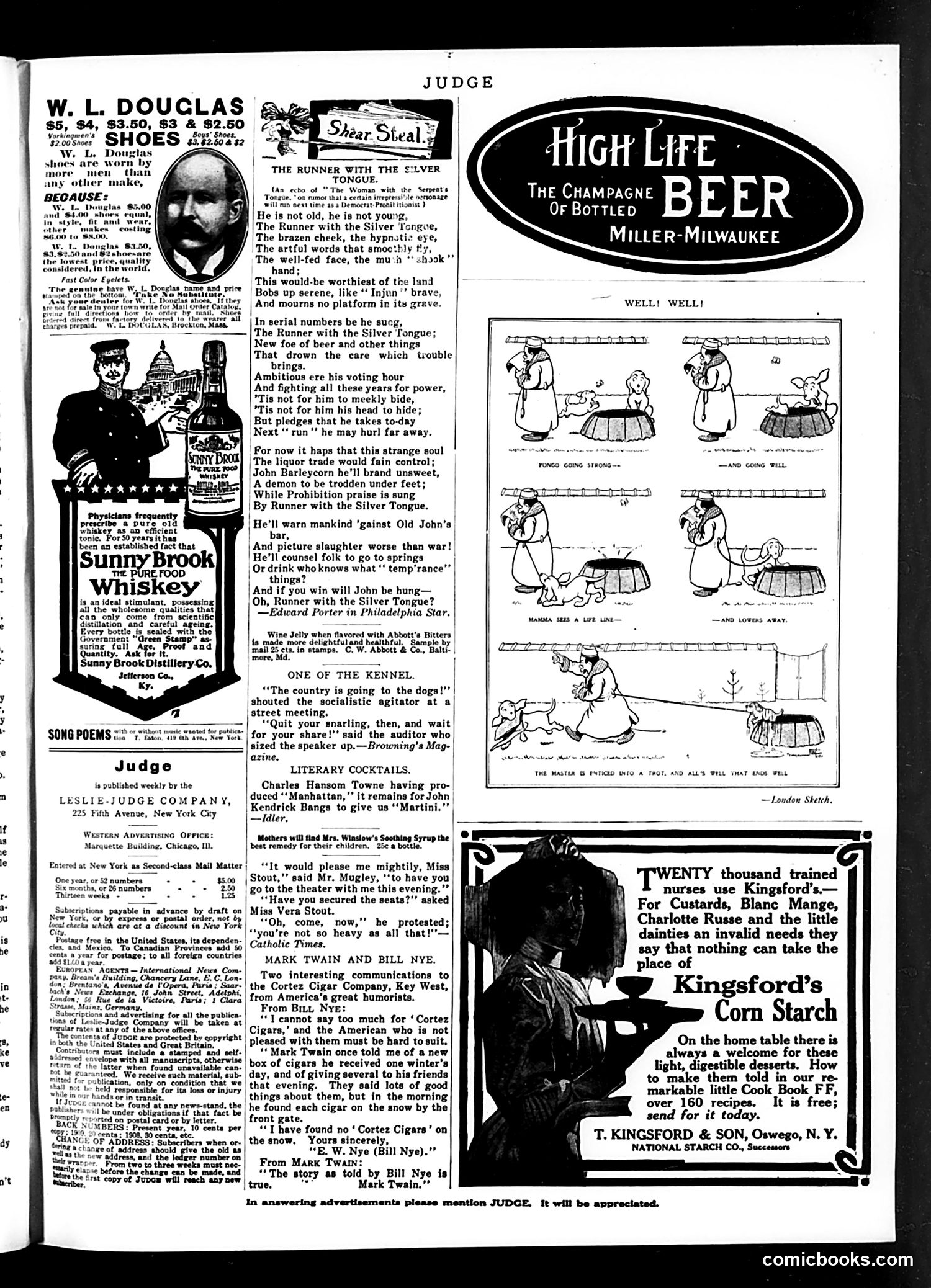
This page's central poem satirizes a political figure—identified only as "the Runner"—who opportunistically shifts positions to gain power. The caricature depicts a hypocritical politician who previously opposed temperance but now champions Prohibition to court voters, treating it as merely another expedient campaign platform. The satire mocks his insincerity: he takes pledges he'll later abandon ("Next 'run' he may hurl far away"), weaponizes moral causes for political gain, and speaks eloquently but dishonestly. The title "Silver Tongue" emphasizes his rhetorical manipulation. The poem likely references a real contemporary politician embracing Prohibition-era politics, though the specific identity remains unclear from the text alone. The broader critique targets politicians who cynically adopt popular causes without genuine conviction—a timeless complaint about opportunistic campaigning.
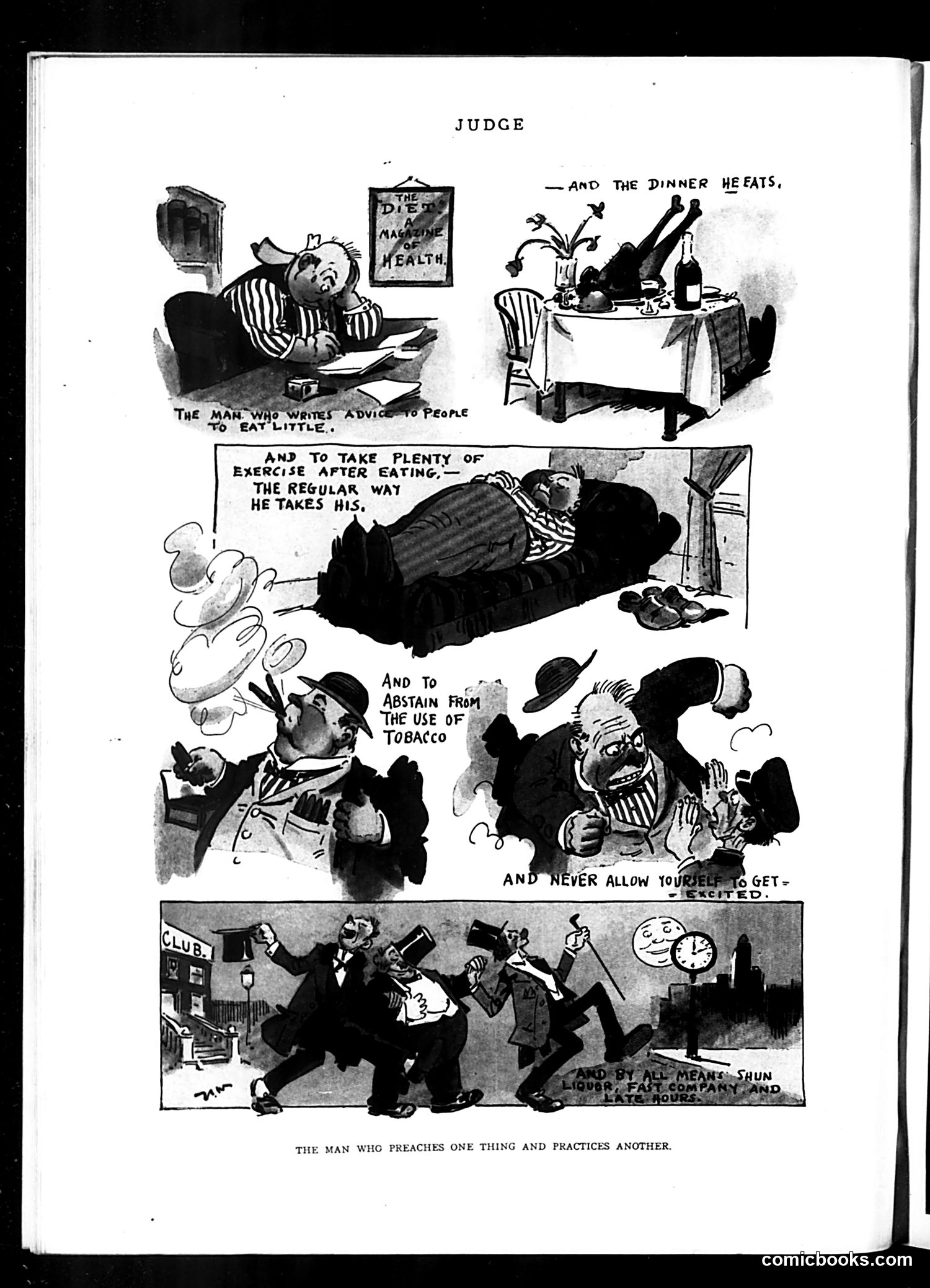
This satirical cartoon targets a public health advocate—likely a doctor or temperance/health reformer—who preaches nutritional and moral virtue while practicing the opposite. The left panel shows him as "the man who writes advice to people to eat little," while the right depicts him eating lavishly at a well-stocked dinner table. The middle sections mock his further hypocrisy: he recommends exercise after meals but takes naps instead; he advises abstaining from tobacco while smoking heavily. The bottom panel shows him at a nightclub drinking and carousing—violating all his stated principles about restraint and late hours. The caption concludes: "The man who preaches one thing and practices another." The satire exposes the gap between public morality lectures and private indulgence, a timeless critique of sanctimonious reformers.